
Spider Identification Guide for Northwest Indiana Homes
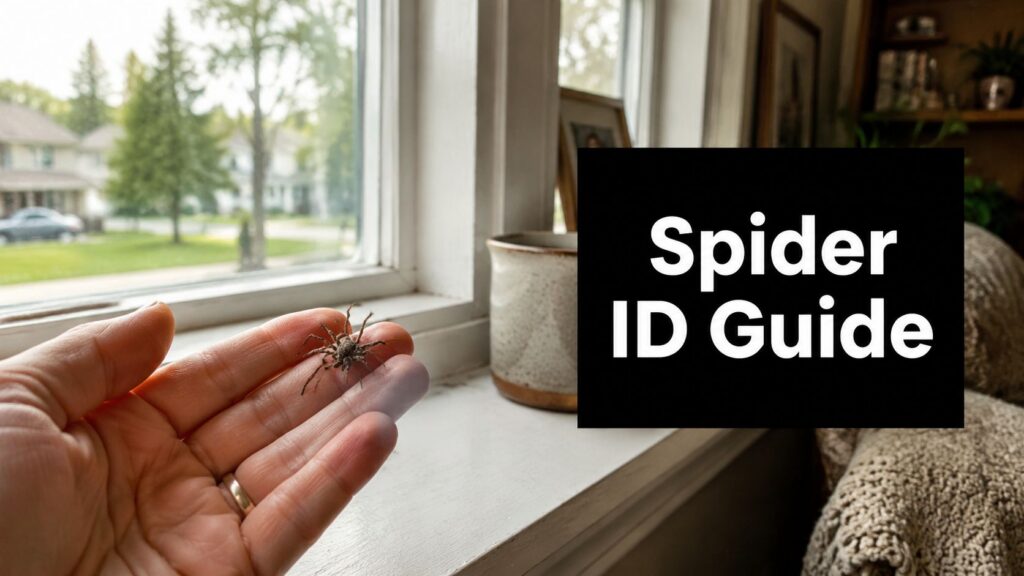
You're probably here because you just saw a spider on a basement wall, tucked behind storage in the garage, or hanging near a window and thought, “Do I need to worry about this?” That's a normal reaction. In Crown Point and across Northwest Indiana, spiders show up often enough to unsettle homeowners, especially when the spider is larger than expected or turns up in a bedroom, bathroom, or utility area.
A good spider identification guide helps, but most online advice is either too generic or too technical. Homeowners don't need a biology lecture. They need clear ways to tell what they're looking at, whether it's likely harmless, and when it makes sense to call for pest control near me or an exterminator in Crown Point, IN.
Answering Spider Concerns for Crown Point Homeowners
A common local scenario goes like this. A homeowner heads into the basement to grab holiday decorations, sees a fast-moving spider dart under a shelf, and suddenly every corner looks suspicious. That reaction isn't overblown. Spiders trigger concern because they're quiet, hard to track, and easy to misidentify from a quick glance.
Part of the confusion is simple scale. Over 37,000 distinct species of spiders have been scientifically described worldwide, and nearly 1,000 have been documented in the continental U.S. and Canada, which is why even a basic understanding matters for homeowners in places like Northwest Indiana, as noted in the IPM Institute spider guide. Contacting pest control in Crown Point, IN after spotting one spider is usually not an overreaction. They're responding to uncertainty.
What usually worries homeowners most
Most callers aren't asking for a formal species label. They want answers to practical questions:
- Is it dangerous: They want to know whether the spider poses a health concern.
- Is it alone: They want to know if one sighting means more are hidden nearby.
- Why is it inside: They want to know what's drawing spiders into the house.
- Will sprays from the store work: They want to know if DIY treatment will solve it or just scatter the problem.
Those are the right questions. In many homes, the spider itself is only part of the story. Indoor spider activity can point to cluttered harborages, moisture issues, gaps around doors, or a steady food source from other insects.
Practical rule: If you keep seeing spiders in the same rooms, don't focus only on the spider. Look at entry points, lighting, moisture, storage habits, and the insects those spiders may be feeding on.
Why local context matters in Northwest Indiana
Homes in Crown Point deal with changing seasons, attached garages, basements, crawl spaces, and landscaping that puts insects close to the structure. That mix creates regular opportunities for spider sightings. Some are wandering hunters. Others stay near webs in quiet corners, window frames, or utility spaces.
That's why a Northwest Indiana spider identification guide should do more than show photos. It should help you sort nuisance spiders from medically significant ones and decide when residential pest control or even commercial pest control makes sense for a larger property, rental, or business site.
A Homeowners Guide to Spider Identification Clues
If you want to identify a spider without getting too deep into technical jargon, start with what you can safely observe from a distance. The most useful clues are the web, the body shape, the markings, and the place where you found it.
Start with the web
One of the fastest field clues is the web itself. Spider family and genus identification can be efficiently achieved by analyzing web architecture and location, including whether the web is spiral, cobweb, funnel, or sheet-shaped, according to this spider web identification reference from TERRO.
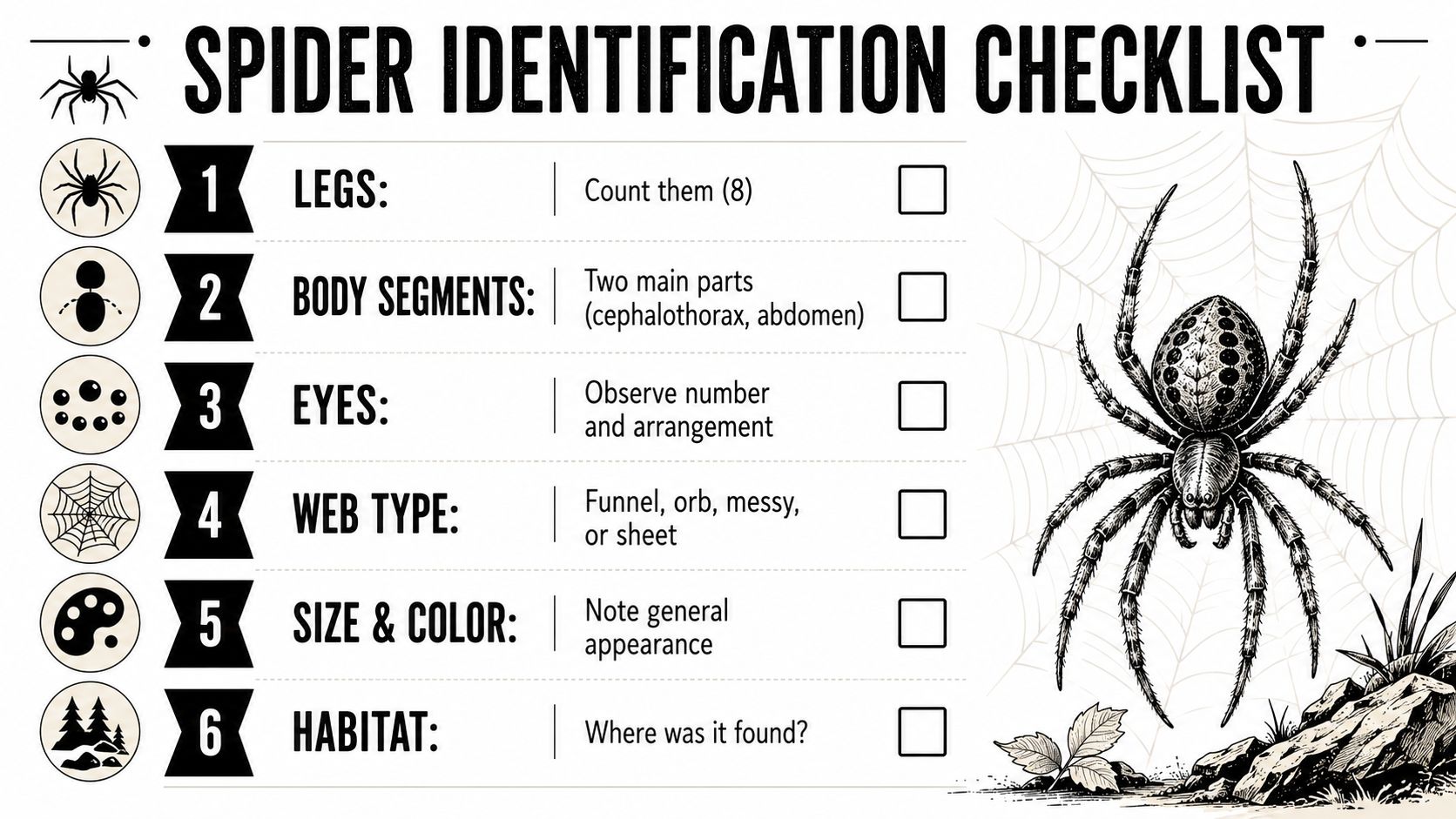
That matters because homeowners often notice the web before they notice the spider.
- Orb-style web: A more organized circular web usually points to a web-building spider outdoors or near exterior lighting.
- Messy cobweb: Irregular, tangled silk often shows up in corners, ceiling lines, garages, and storage areas.
- Funnel web: A flat web that narrows into a retreat often appears in grass, landscaping, or along edges.
- Sheet web: A blanket-like web can appear low to the ground or in sheltered exterior areas.
Then check the spider's look
You won't identify every spider to species level by sight alone, but a few visible traits help a lot.
- Body build matters. A stockier spider with a sturdy appearance often behaves differently than a long-legged, delicate spider.
- Leg length helps. Some common house spiders have very thin, long legs, while hunting spiders look heavier and more athletic.
- Color and markings can narrow things down, especially if you notice striping, banding, a violin-like marking, or a dark glossy abdomen.
- Movement is useful. Fast runners usually aren't the same type as spiders that sit at the center of a web.
Pay attention to where it was found
Location tells you almost as much as appearance.
A spider in a damp basement corner suggests a different pattern than one found in a shrub, a window well, or a garage ceiling.
Ask yourself:
- Inside or outside: Was it in a finished room, utility area, attic, garage, or landscaping bed?
- Hidden or exposed: Was it tucked behind stored items or sitting openly in a web?
- Dry or damp: Moisture can influence where insects gather, and spiders follow food.
What doesn't work well
Many homeowners try to identify spiders from memory after the spider disappears. That usually leads to bad guesses. Cell phone photos help more than memory does, especially if you can capture the web and the location without getting close.
Eye arrangement can matter in expert identification, but for homeowners it's not usually practical to rely on. Focus first on the clues you can observe safely. That's what makes a spider identification guide useful in real homes, not just in a lab or textbook.
Common Spiders You Might Find in Northwest Indiana
Most spiders found in Crown Point homes aren't the spiders people fear most. They're nuisance pests, occasional indoor wanderers, or outdoor species that end up inside by accident. The useful question isn't “Is every spider bad?” It's “What pattern does this spider fit?”
The spiders homeowners usually notice first
Wolf spiders get attention because they're large enough to startle people. They don't build the classic corner web often expected, and they often show up running across floors, especially in basements, garages, and ground-level areas. They look intimidating, but in most homes they're more alarming than dangerous.
Cellar spiders are the long-legged spiders many people call daddy long-legs. They're often found hanging upside down in quiet ceiling corners, basements, and less-disturbed rooms. They tend to stay put, build loose webs, and become a nuisance when webs collect in multiple spots.
Grass spiders are common around the outside of homes in Northwest Indiana. If they move indoors, they usually appear near entry points, garages, or lower-level areas. Their funnel-style web is often easier to notice outside than the spider itself.
Common house spiders also show up around windows, corners, storage areas, and attached garages. They usually build irregular webs and stay near them. Homeowners often notice the web long before they notice the spider.
Common Spiders in Northwest Indiana at a Glance
| Spider Name | Appearance | Web Type | Common Habitat | Risk Level |
|---|---|---|---|---|
| Wolf Spider | Stocky body, sturdy legs, fast-moving | No typical capture web for hunting | Basements, garages, lower levels | Low |
| Cellar Spider | Very long thin legs, delicate body | Loose, irregular web | Basements, corners, utility rooms | Low |
| Grass Spider | Brownish body, quick movement | Funnel web | Landscaping edges, garages, near foundations | Low |
| Common House Spider | Small to medium, variable color | Messy cobweb | Windows, corners, storage spaces | Low |
How to tell nuisance spiders from a bigger concern
A lot of mistaken identification comes from size. Homeowners often assume the bigger spider is the dangerous one. In practice, that isn't a reliable rule. A large wolf spider on the basement floor is more likely to frighten you than harm you.
What matters more is behavior and setting.
- Running across open floors: Often points to a hunting spider.
- Staying in a web corner: Often points to a web-building nuisance species.
- Appearing near insects: Suggests prey activity nearby.
- Showing up repeatedly in one part of the home: Suggests a habitat issue that needs correction.
If the spider is active, common, and tied to clutter, storage, or insect activity, the better fix is usually a broader spider control plan, not just removing the one spider you saw.
For homeowners searching exterminator near me, professional judgment offers significant assistance. A technician doesn't just identify the spider. They read the pattern around it, including entry points, prey pressure, moisture, and where treatment will be most effective.
Identifying Medically Significant Spiders in Indiana
When people ask whether a spider is dangerous, they usually have two spiders in mind. That's reasonable. In the United States, the only two spider species that pose a serious health threat requiring immediate medical attention if bitten are the Black Widow and the Brown Recluse, as explained by the PestWorld spider safety guide.
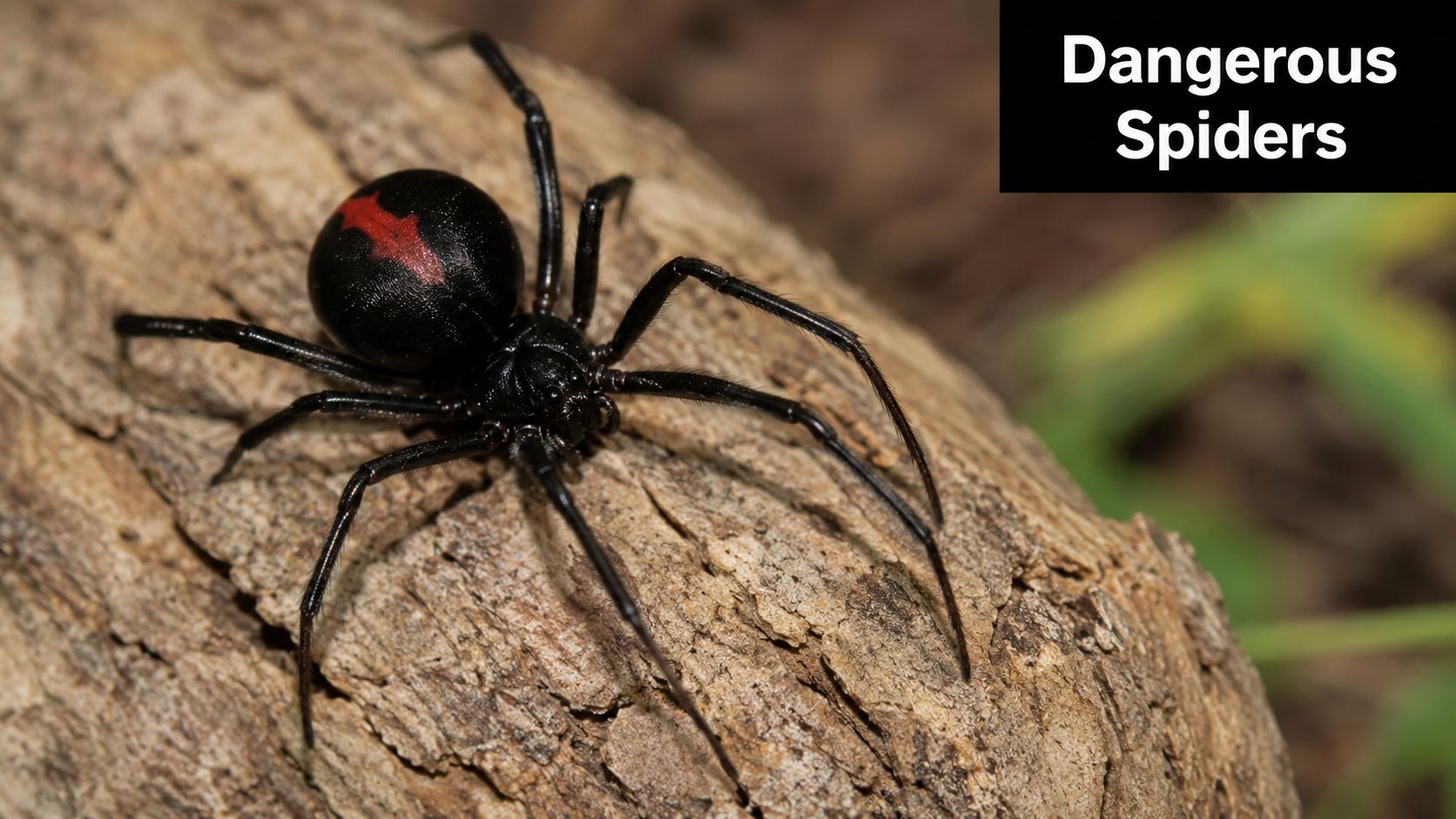
Black Widow
The Black Widow is best known for a distinct red hourglass on the abdomen. It has a glossy dark body and tends to stay in more protected areas rather than out in the open. If a homeowner sees a shiny dark spider in a secluded spot, that hourglass marking is the detail that matters most.
These spiders are associated with sheltered locations such as undisturbed storage, wood piles, sheds, and protected structural voids. That means quick sightings in living spaces are often misidentified. Plenty of harmless dark spiders get mistaken for widows.
Brown Recluse
The Brown Recluse is associated with a dark violin marking on its back. It prefers concealed, quiet spaces and is more likely to be encountered where boxes, storage, clothing, or undisturbed materials create cover.
In real homes, caution is essential. People often overidentify recluse spiders based on any brown spider they find. That's a mistake. A plain brown spider is not automatically a Brown Recluse, and poor identification causes unnecessary panic.
If you suspect either of these spiders and someone may have been bitten, prioritize medical care first. Identification can come second.
For homeowners trying to compare skin irritation, swelling, or a mystery mark, this guide on mosquito bites versus spider bites can help you think more clearly about what you're seeing.
When to stop guessing
Bite symptoms can be confusing, and skin reactions have many causes. The right response is simple. If a bite is suspected from a medically significant spider, seek medical attention right away. Don't wait for an internet image search to settle it.
This short video gives a useful visual reference point before you decide your next step.
For Indiana homeowners, the safest approach is cautious, not panicked. Most spider sightings are not emergencies. But if markings match, the setting fits, or a bite is involved, treat it seriously and bring in professional help.
Why Professional Spider Control Is Your Best Solution
Seeing one spider doesn't always mean you have an infestation. Seeing them repeatedly is different. Recurring spider activity usually points to a home condition that keeps supporting them, such as insect prey, cluttered storage, gaps around the exterior, or quiet undisturbed spaces that rarely get cleaned or sealed.
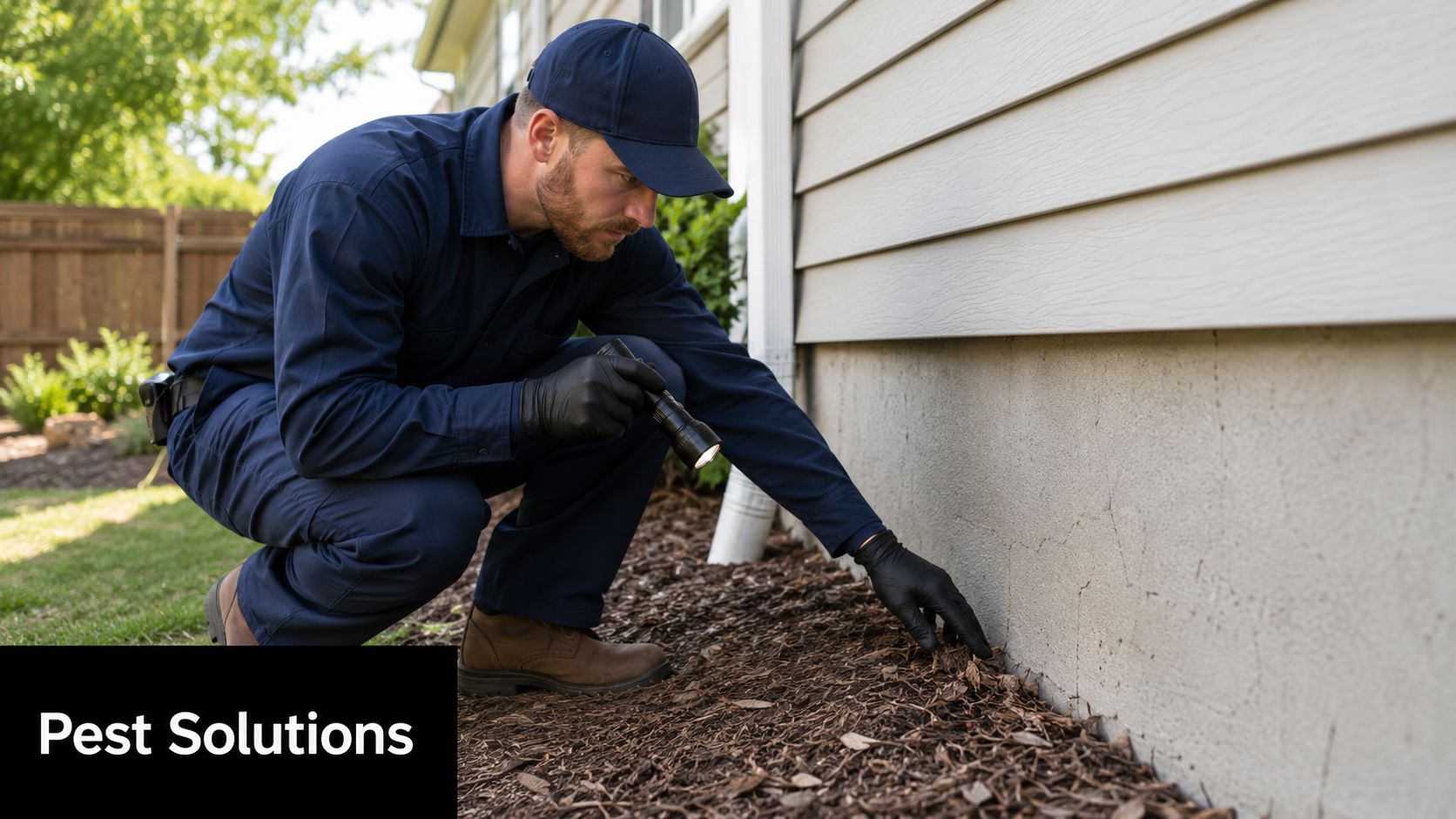
Why DIY usually falls short
Store sprays can knock down a spider you can see. They rarely solve the reason spiders keep showing up. That's the trade-off. DIY products feel immediate, but they often treat the symptom and miss the pattern.
A real spider control plan usually involves several pieces working together:
- Exterior inspection: Finding gaps, thresholds, vents, and foundation areas where pests move in.
- Harborage reduction: Addressing storage clutter, web build-up, and sheltered areas spiders favor.
- Prey reduction: Managing the insects that attract spiders in the first place.
- Targeted treatment: Applying products where spiders travel, rest, or build webs, not just where they're noticed.
Accurate identification changes the treatment
This part matters more than many homeowners realize. Spider identification often requires precise morphological detail, and experts may use a stereoscopic microscope at 20x to 50x magnification, which is one reason professionals emphasize getting identification right before treatment, as described in this arachnology overview of spider identification methods.
That doesn't mean every home visit turns into microscope work. It means visual guessing has limits. A professional doesn't need to overpromise species-level certainty to make smart treatment decisions. They know when the spider type, web pattern, location, and activity level are enough to act, and when a closer look matters.
What professional service solves better
Homeowners who search residential pest control or exterminator near me are usually dealing with one of three situations:
- Spiders keep returning after cleanup.
- The home has multiple pest issues, not just spiders.
- Someone in the household is anxious enough that reassurance alone isn't enough.
That's where broader pest service helps. Spider control often overlaps with ant control, wasp removal around entry points, rodent control in garages or crawl spaces, and seasonal insect pressure around foundations and landscaping.
For a practical look at treatment and prevention, this guide on how to get rid of spiders covers what helps and what tends to waste time.
What to Expect from Our Pest Control Service in Crown Point IN
When homeowners call for pest control in Crown Point, IN, they usually want two things right away. They want the issue taken seriously, and they want the process to be simple. A strong service visit should do both.
The inspection comes first
The first step is a property inspection. That means looking at where spiders were seen, what kind of activity is happening, and what conditions are supporting it. In a Northwest Indiana home, that often includes basements, garages, window areas, door thresholds, utility penetrations, attic access points, and exterior foundation lines.
This part matters because spider control isn't just about applying product. If the technician doesn't identify the pressure points, the result is often temporary.
You should get a plan that fits the property
Not every home needs the same approach. A house with occasional cellar spiders in the basement needs a different solution than a property with recurring web build-up around exterior lighting and garage corners. A commercial pest control plan for a local facility also differs from residential pest control because the traffic patterns, sanitation practices, and structural conditions are different.
A useful service plan should address:
- Where treatment belongs: Interior, exterior, or both.
- What conditions need correction: Clutter, gaps, moisture, lighting, or prey insects.
- What follow-up is realistic: One-time relief, ongoing monitoring, or seasonal preventative pest treatments.
Good service should feel clear. You should know where the issue is, what's being done about it, and what changes at home will help keep spiders from returning.
The treatment should be targeted, not random
A professional visit should focus on likely travel routes, entry points, web sites, and harborage areas. In many homes, that includes exterior perimeter work, removal of active webbing, and treatment in areas where spiders rest instead of broad, unnecessary application everywhere.
Homeowners should also expect practical advice after service. That may include reducing insects around the home with better exterior lighting choices, sealing gaps, improving storage practices, or addressing related issues through mosquito control, termite control, or rodent exclusion if those conditions are contributing to overall pest pressure.
In Crown Point, IN, the best pest service is straightforward. It respects your home, explains the reasoning, and gives you a clear path forward instead of a vague promise.
Protect Your Home and Family with The Green Advantage
Spiders create stress out of proportion to their size. One sighting can make a bedroom feel unsettled, a basement feel off-limits, or a garage feel like a problem you've been putting off too long. The right response isn't panic. It's a clear plan.
For many homes in Northwest Indiana, spider issues are tied to broader pest conditions. A good service approach protects more than one room or one moment. It helps protect your property, reduce indoor pest pressure, and restore confidence in the places your family uses every day.
Why homeowners act sooner rather than later
Waiting rarely makes pest issues simpler. If spiders are showing up regularly, there's usually a reason. It may be prey insects. It may be entry points around the home. It may be storage, moisture, or seasonal movement from the exterior inward.
That's why professional help often becomes the smarter option when:
- Sightings are recurring: You're seeing spiders in the same areas again and again.
- DIY hasn't held up: Sprays and traps gave short-term relief or no relief.
- You want certainty: You'd rather have a trained eye assess the situation than keep guessing.
- Other pests are involved: Ants, wasps, rodents, or mosquitoes are part of the bigger picture.
A calm, informed inspection usually solves more worry than another round of guessing from across the room.
If you've been searching pest control near me, exterminator in Crown Point, IN, or eco-friendly pest control for your home or business, the next step is simple. Get the property inspected, identify pressure points, and deal with the problem before it becomes a bigger headache.
If spiders, ants, rodents, wasps, mosquitoes, or other pests are making your Crown Point home feel less comfortable, contact The Green Advantage to schedule an inspection or request a quote. Their team serves Crown Point and nearby Northwest Indiana communities with thoughtful residential pest control and commercial pest control built around clear answers, targeted treatment, and long-term prevention.
Mosquito Misting System Cost: 2026 Guide for Crown Point

A professional mosquito misting system usually costs $2,000 to $5,000 to install. For many Crown Point homeowners, that means this is not an impulse buy. It's a real home improvement decision that deserves a clear look at both the upfront price and the long-term cost.
If you're reading this, you're probably tired of planning a cookout, opening the patio door, and then retreating inside because the mosquitoes won. That's common in Northwest Indiana. Warm evenings, damp spots, landscaping beds, shaded fence lines, and nearby standing water can turn a nice yard into a place nobody wants to use.
A lot of people start by searching for mosquito control, then end up comparing everything from candles and traps to full automatic systems. That's the right instinct. The sticker price only tells part of the story. A key question is whether a misting system is the right fit for your yard, your budget, and how much convenience you want.
If you've also been looking for pest control near me, exterminator near me, or pest control in Crown Point, IN, you're likely trying to solve a bigger outdoor comfort problem, not just kill a few mosquitoes. The best decision usually comes from understanding total ownership cost, not just the first invoice.
Reclaiming Your Yard from Mosquitoes in Northwest Indiana
A Crown Point family doesn't buy a mosquito misting system because it sounds fancy. They buy one because they're fed up. They want to sit outside after dinner, let the kids play in the yard, or host friends without everybody swatting their legs and rushing back indoors.
That frustration is what pushes many homeowners from DIY mosquito control to a more permanent setup. The appeal is simple. A misting system automates coverage around the parts of the yard you use. It's a premium option for people who want less hassle and more consistent protection.
What most homeowners should expect to spend
The national installed price for a professional system typically lands between $2,000 and $5,000, and that final number depends heavily on yard size, installation complexity, and system features, according to this mosquito misting system cost overview.
That range matters because it resets expectations. This isn't in the same category as buying a few bug zappers or a stack of citronella candles. It's closer to deciding whether to add a permanent outdoor upgrade that affects how you use your property.
A misting system makes the most sense when mosquitoes are stopping you from using your yard the way you want.
Why this hits differently in Crown Point
In Northwest Indiana, mosquito pressure can feel especially annoying because outdoor living is seasonal. You wait all winter for usable evenings, then lose them to biting insects. That changes the value equation. Homeowners here aren't just buying mosquito control. They're trying to get their patio, deck, pool area, and backyard routines back.
For some homes, a misting system is the right answer. For others, recurring professional mosquito treatments are the better value. If you're also comparing broader residential pest control, commercial pest control, or services like ant control, rodent control, spider control, wasp removal, or termite control, this decision fits into the same basic rule. Buy the level of protection that matches the problem.
Here's the straight opinion. If you want convenience and daily automation, a misting system can be worth it. If you want the lowest commitment, it probably won't be.
Deconstructing the Upfront Installation Cost
The initial price scares people because they don't know what's inside it. Fair enough. You're not just paying for a box on the side of the house. You're paying for a complete system that has to be designed around your property.
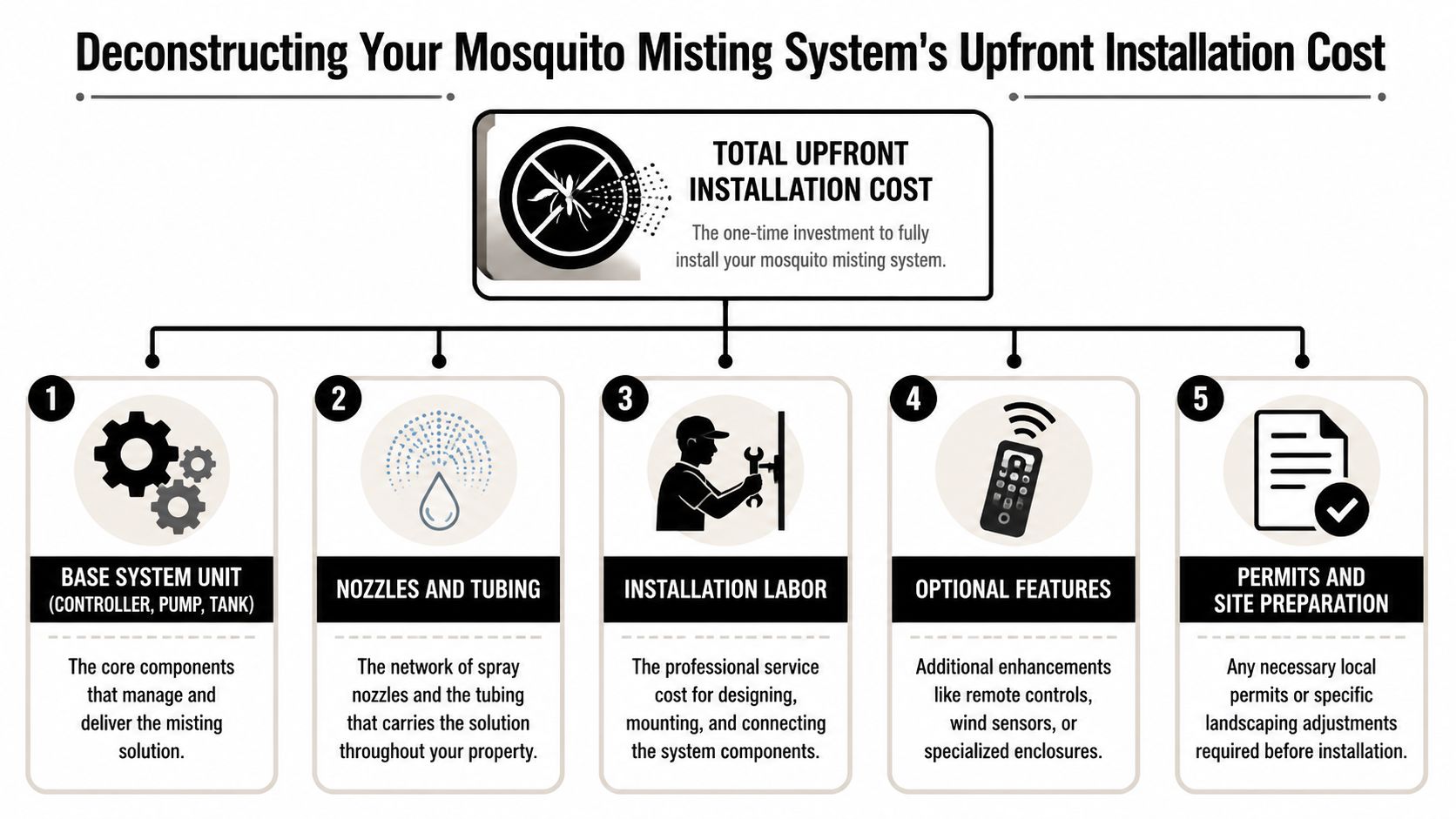
What the upfront price includes
For standard residential properties with up to 30 nozzles, professional installation fees typically range from $400 to $700, while the average total system cost is $2,747. Insecticide refills usually cost $0.50 to $1 per ounce, based on HomeAdvisor's outdoor misting system cost guide.
Those numbers make more sense when you break the system apart:
- Base unit: This is the controller, pump, and either a tank or tankless setup. It's the mechanical heart of the system.
- Tubing and nozzles: These run around the perimeter and target the areas where mosquitoes rest and move.
- Labor: Placement matters. A system only works well when the layout matches the yard.
- Optional upgrades: Remote controls and convenience features can raise the total.
- Site prep: Some homes need more planning because of landscaping, fences, patios, or access issues.
Why labor is not the place to cut corners
The labor line isn't filler. A poor layout creates weak coverage, overspray, maintenance headaches, and wasted refill costs. A good layout hides tubing cleanly, places nozzles where they'll perform best, and avoids obvious problem areas around outdoor living spaces.
Here's a practical approach:
| Cost element | What affects it most |
|---|---|
| Base system | Type of controller, pump, and reservoir setup |
| Nozzles and tubing | Perimeter length, spray zones, yard layout |
| Labor | Access, mounting points, complexity of installation |
| Features | Remote operation and add-on controls |
| Prep work | Obstacles, landscaping, and install conditions |
Practical rule: If a quote seems unusually cheap, ask what's being left out. Usually it's design quality, cleaner installation, or future service planning.
The real reason quotes vary so much
Two Crown Point homes can sit on the same street and still need very different systems. One might have a small open yard. The other might have heavy shrubs, a deck, a fence line, and multiple seating areas. That changes nozzle count, tubing runs, labor time, and how difficult the system is to install cleanly.
That's also why broad online averages only get you so far. They're useful for ballpark planning. They aren't enough to tell you what your house will cost.
Budgeting for Long Term Maintenance and Refills
Homeowners often get blindsided. A lot of articles talk about mosquito misting system cost like it ends after installation. It doesn't. The long-term expense is what decides whether you'll still feel good about the purchase a year or two from now.
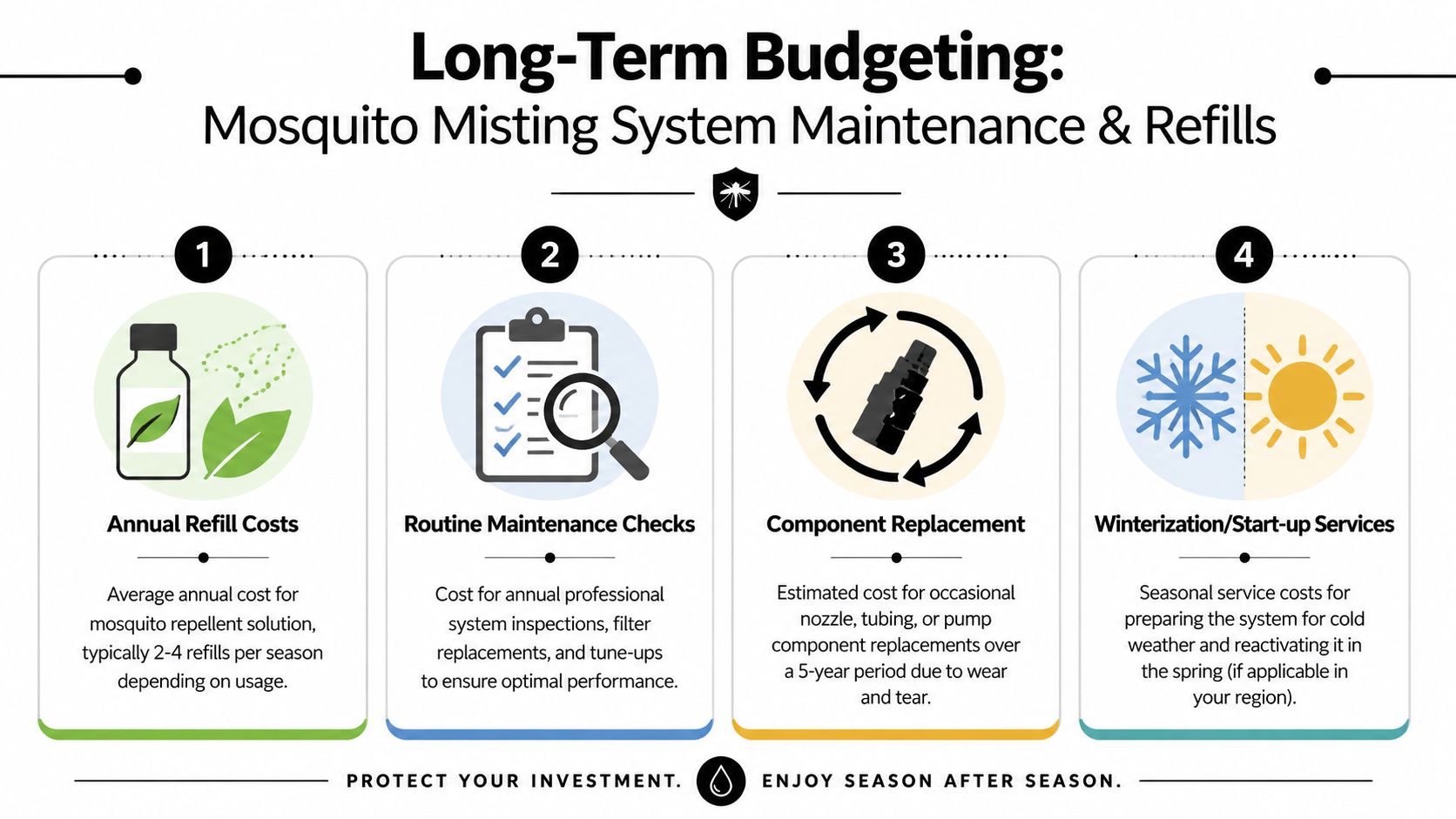
The set it and forget it idea is wrong
Maintenance is not a flat fee. It's a property-specific expense that can exceed $1,500 annually for larger lots, and many homeowners underestimate it because costs rise with property size, according to this analysis of mosquito misting system maintenance.
That's the hidden burden. Small monthly numbers sound manageable until you realize they don't stay small on more demanding properties.
What you keep paying for
Long-term ownership usually includes a mix of routine and unpredictable costs:
- Refill solution: The more often the system runs, the more product you buy.
- Nozzle cleaning: Dirty or partially blocked nozzles hurt performance.
- Seasonal service: In Indiana, outdoor systems need attention when weather changes.
- Repairs: Wear shows up in tubing, pumps, and fittings over time.
Some owners budget well for the initial purchase and then get annoyed by the maintenance rhythm. That's avoidable if you go in with your eyes open.
Why the five-year view matters
One verified estimate puts the five-year investment above $5,000, combining initial installation of $2,000 to $4,500, annual chemical refills of $300 to $600, and possible repair costs tied to issues like clogged nozzles or pump failures, according to this breakdown of mosquito misting system pros and cons.
That same source points out why maintenance keeps showing up. These systems only kill mosquitoes present during a 30 to 45 second spray cycle, so new mosquitoes can return within hours. Wind also matters because coverage depends on proper conditions, and nozzle clogs can reduce effectiveness by 40 to 60 percent.
Maintenance isn't a side note. On a misting system, maintenance is part of the product.
If you hate recurring upkeep, skip the system and choose scheduled professional mosquito treatments instead. If you want automation and accept the ongoing service needs, a misting system can still be a smart fit.
Key Factors That Influence Your Final Price
No honest estimator should hand you one flat number without looking at the yard. Final pricing changes for reasons that are easy to understand once you know what drives the work.
Property layout matters more than most people think
The first variable is simple. Bigger perimeter usually means more tubing and more nozzles. But square footage alone doesn't tell the whole story. A straightforward yard is cheaper to design than one with tight corners, dense planting beds, separate structures, or multiple outdoor zones.
A few local examples that push cost upward:
- Dense landscaping: Shrubs, trees, and layered beds can require more careful nozzle placement.
- Outdoor living areas: Patios, pergolas, decks, and seating zones need coverage without obvious overspray.
- Access challenges: Fences, hardscapes, and elevation changes make installation slower.
Features and system style change the budget
Some homeowners want a basic automated setup. Others want a cleaner look, easier controls, or specific placement preferences. Those choices affect the final quote because the system has to match the way the property is used.
This is also where people underestimate the cost of doing it wrong. Poor design doesn't just reduce convenience. It can create safety problems.
Drift risk is a real cost issue
The EPA warns that pesticide drift from improperly installed or operated mosquito misting systems can harm neighbors, pets, and the local environment, creating a liability risk that can cost more than the initial system price, as explained in the EPA guidance on mosquito misting systems.
That matters in neighborhoods around Crown Point where homes sit close enough for drift concerns to become disputes. If nozzle placement is sloppy or the system is operated poorly, the problem is no longer just mosquito control. It becomes a neighbor issue, a pet safety issue, and potentially a legal issue.
Good installation protects more than your yard. It protects your budget from avoidable mistakes.
That's why the lowest quote isn't always the cheapest option. A system that's carefully designed around your property is often the safer purchase in the long run.
ROI and Alternatives Offered in Crown Point
A misting system isn't the only way to control mosquitoes. It's just one option, and it's usually the premium option. The right comparison is not “Does it work?” The better question is “What do I get for the money, effort, and upkeep?”
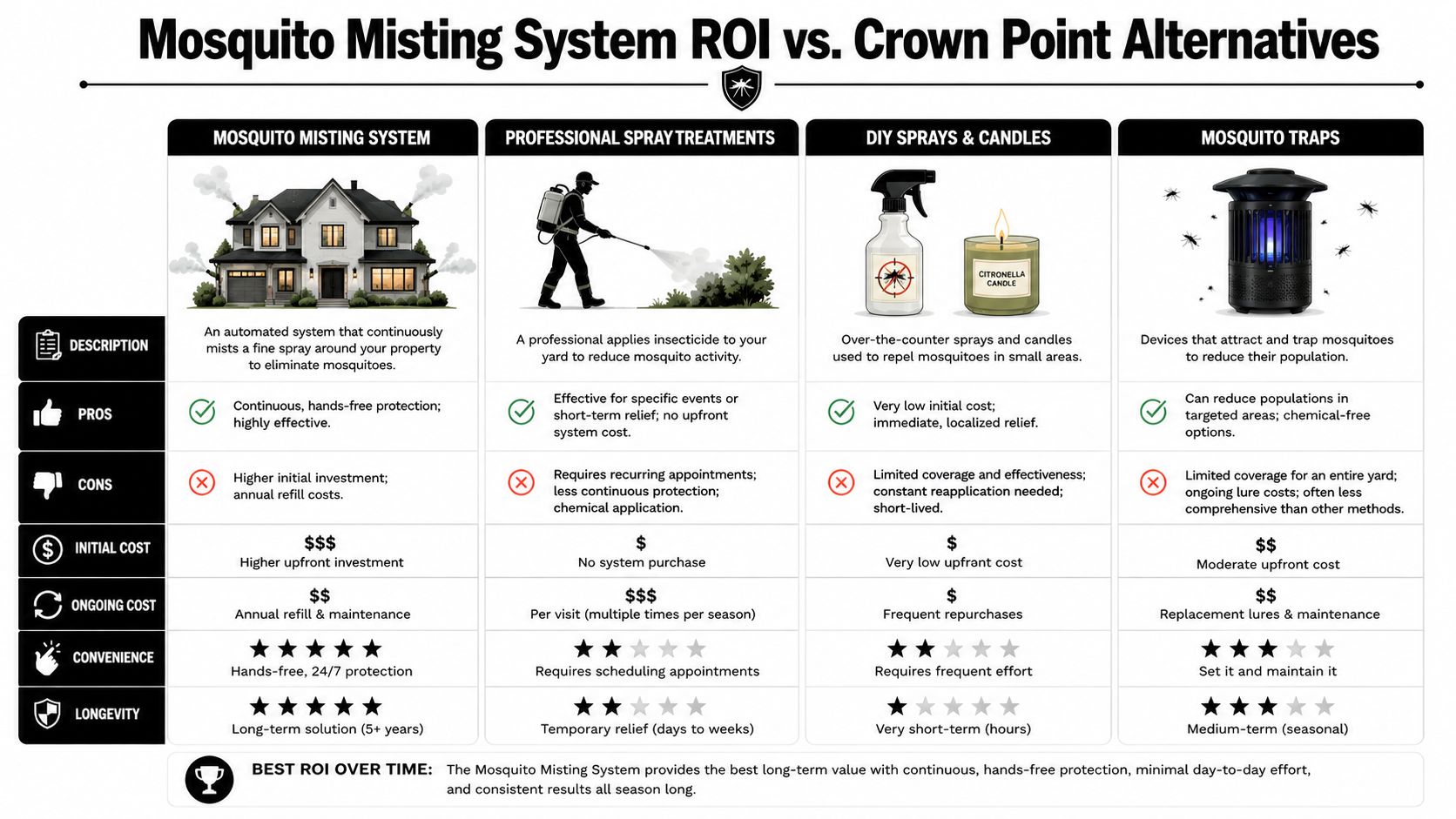
How a misting system compares
When properly installed, mosquito misting systems often achieve an 80% reduction in mosquito populations, and installation is often priced by nozzle at about $100 per nozzle, according to this discussion of misting system effectiveness and nozzle pricing.
That's strong performance, but cost and effort still matter. Here's the practical comparison:
| Option | Upfront cost | Ongoing cost | Homeowner effort | Coverage style | Best fit |
|---|---|---|---|---|---|
| Mosquito misting system | Higher | Ongoing refills and maintenance | Low day to day | Automated, continuous | Homeowners who want convenience |
| Professional spray treatments | Lower upfront | Recurring service | Low | Scheduled protection | Homeowners who want results without owning equipment |
| DIY sprays and candles | Low | Repeated purchases | High | Short-term, limited | Occasional use |
| Mosquito traps | Moderate | Ongoing lure or service needs | Moderate | Targeted areas | Supplemental control |
My recommendation for most homeowners
If you host often, spend a lot of time outside, and want hands-free mosquito control, the misting system has a good case. If you just want dependable seasonal relief without owning and maintaining a system, recurring professional treatment is usually the better value.
For a broader breakdown of service pricing, this page on mosquito control service cost in Northwest Indiana is worth reviewing before you decide.
Homeowners upgrading their outdoor spaces should also think about the yard as a whole. If you're building a more usable patio or screened area, these Lucas Furniture & Mattress ideas can help you think through layout and enclosure options that work well alongside mosquito control planning.
Where DIY usually falls short
DIY has one advantage. It's cheap to start. The problem is consistency. Sprays wear off, candles only help in a narrow zone, and traps rarely solve an entire yard by themselves.
For Crown Point homeowners searching exterminator in Crown Point, IN, residential pest control, or eco-friendly pest control, the core choice usually comes down to this:
- Choose a misting system if convenience is your top priority.
- Choose recurring professional service if you want lower commitment and less ownership responsibility.
- Use DIY only if your expectations are modest.
That's the honest ranking.
The Green Advantage Mosquito Control Process
Big purchases feel easier when you know exactly what happens next. A mosquito project should feel organized, not confusing.
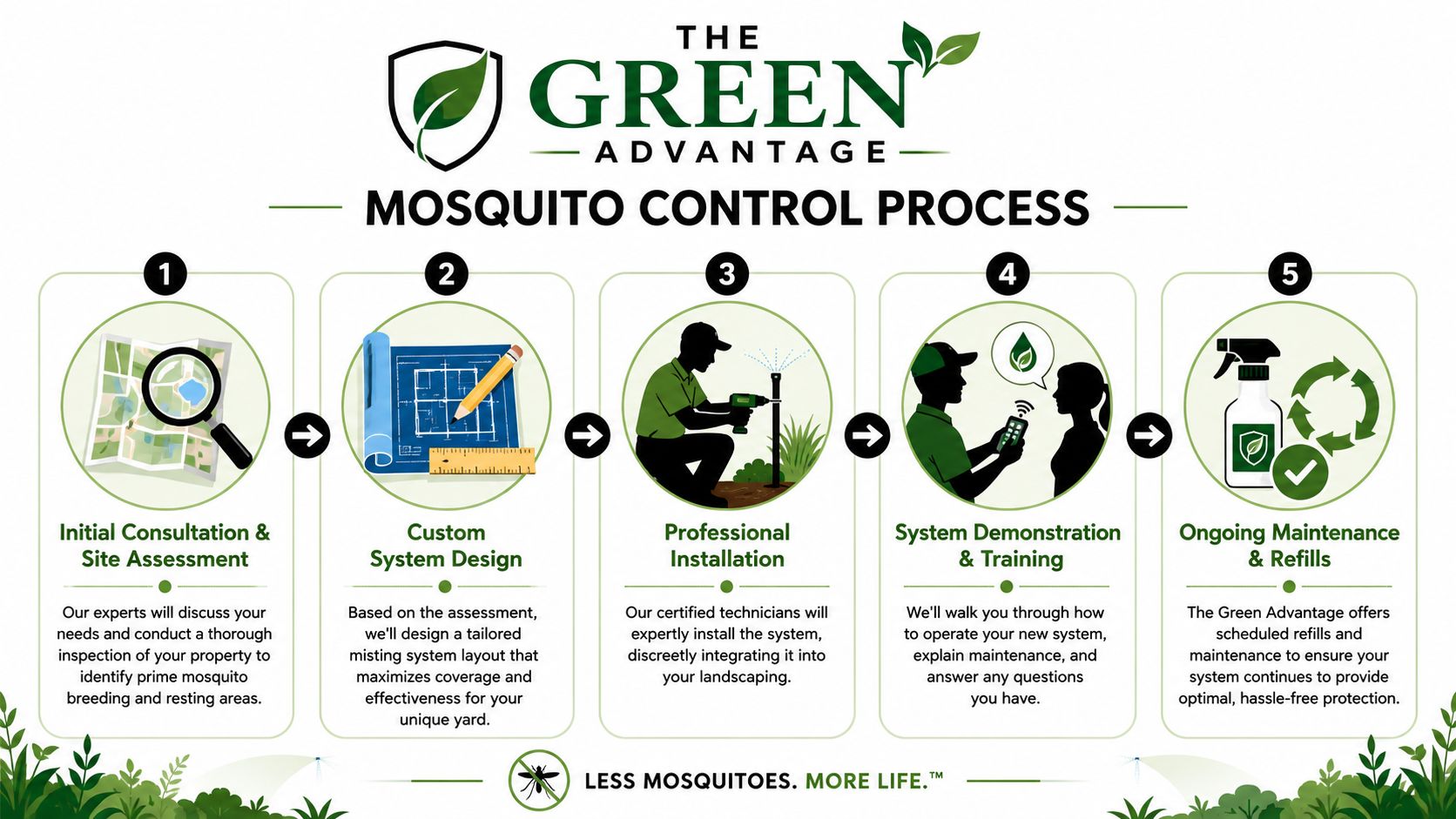
The process starts with a conversation about the property and how the yard is used. That matters because a family that wants quiet patio evenings has different priorities than a property manager trying to improve shared outdoor areas. Good planning begins with those details.
What the experience should look like
A professional mosquito control process should feel straightforward:
Consultation and site review
The yard gets evaluated for mosquito pressure, resting areas, and practical installation routes.Custom layout
The system is planned around the specific property instead of forcing a generic setup onto the home.Clean installation
Equipment, tubing, and nozzles should be installed with attention to appearance and performance.
A good provider also explains how the system runs, what maintenance looks like, and when service is likely to be needed.
Here's a quick visual overview of what that kind of process looks like in practice.
Why process matters in pest control
This isn't just about mosquitoes. It reflects how a company handles service overall. If you're also comparing commercial pest control, rodent control, spider control, termite control, or preventative pest treatments in Northwest Indiana, the same rule applies. The process should be clear, local, and responsive.
The best pest control experience is the one where you always know what's being done, why it's being done, and what it will cost.
That's what builds trust. Not flashy promises. Clear communication, careful work, and support after installation.
Is a Misting System Right for Your Indiana Home
A misting system is right for the homeowner who wants steady, automated mosquito control and is comfortable treating it like a real property system, not a one-time gadget purchase. If that sounds like you, it can be a strong investment.
If you're still unsure, that's normal. The best decision usually comes down to three things:
- How often you use the yard
- How much convenience matters to you
- How willing you are to pay ongoing ownership costs
For many homes in Crown Point and nearby Northwest Indiana communities, recurring mosquito treatments will be the simpler answer. For others, especially households that spend a lot of time outside, a misting system earns its keep by making the yard usable again with less day-to-day effort.
If you want to compare the ownership route against a dedicated service plan, this page on mosquito misting systems in Northwest Indiana is a helpful next step.
My advice is simple. Don't buy based on the lowest advertised number. Buy based on what you'll still feel good about after the install, after the refill bills, and after a full season of use.
If you want clear answers from a local team that understands mosquito pressure, seasonal pest issues, and outdoor living in Crown Point, IN, contact The Green Advantage. They can help you compare a misting system against other mosquito control options, explain the actual long-term costs, and provide a quote that fits your property without the guesswork.
Indoor Mosquito Repellent Spray: Crown Point Guide
You hear it first as a faint buzz near the lamp. Then one lands on your arm while you're watching TV, and another shows up in the bedroom right after you turn out the light. If you're dealing with mosquitoes inside your house in Crown Point, grabbing an indoor mosquito repellent spray feels like the obvious move.
Sometimes it is the right first move.
It just isn't the whole answer. Indoor sprays can knock down the mosquitoes you see. They usually don't fix why mosquitoes are getting inside in the first place, why they keep showing up, or why the problem returns after a few days. That's where homeowners lose time, money, and patience.
If you've been searching for pest control near me, exterminator near me, or pest control in Crown Point, IN, you're probably past the point of wanting another generic product roundup. You want a straight answer. Here it is. Use indoor mosquito spray for short-term relief, but don't mistake it for a complete mosquito control plan.
Battling Indoor Mosquitoes in Your Crown Point Home
A lot of indoor mosquito problems start the same way. A door opens after sunset. A torn screen goes unnoticed. Moisture builds up around the home, and mosquitoes stay active around entry points. Then they end up in the kitchen, the bathroom, or circling the living room window when you're trying to relax.
For Northwest Indiana homeowners, this gets frustrating fast because indoor mosquitoes feel personal. They're in your safe space. They're near your kids' rooms, your pets' bedding, your food prep area, and the places where you should be comfortable. So you spray the room, swat what you can, and hope that handles it.
Why the quick fix keeps disappointing
Indoor mosquito sprays can help, but they don't erase the conditions that let mosquitoes enter and linger. If entry points stay open, if resting spots remain untouched, or if mosquitoes are breeding outside and moving in, the problem keeps resetting.
Local reality: If you're spraying the same room over and over, the spray isn't your main problem. Your house is telling you mosquitoes still have access.
That matters in Crown Point because mosquito activity around homes often overlaps with broader pest issues. The same house that needs mosquito control may also benefit from residential pest control, screen inspection, moisture correction, and seasonal prevention around the exterior.
What homeowners should do next
Start by treating the indoor sightings seriously, especially if they keep happening. If mosquitoes are surviving long enough to bother you indoors, there is usually a reason.
A useful place to begin is learning how long mosquitoes can live inside a home. That helps you understand why one mosquito tonight can turn into several nights of frustration if the conditions are right.
If you're looking for an exterminator in Crown Point, IN, the smarter goal isn't just killing the mosquitoes you can see. It's stopping the cycle so your home feels normal again.
Understanding Indoor Mosquito Sprays and How They Work
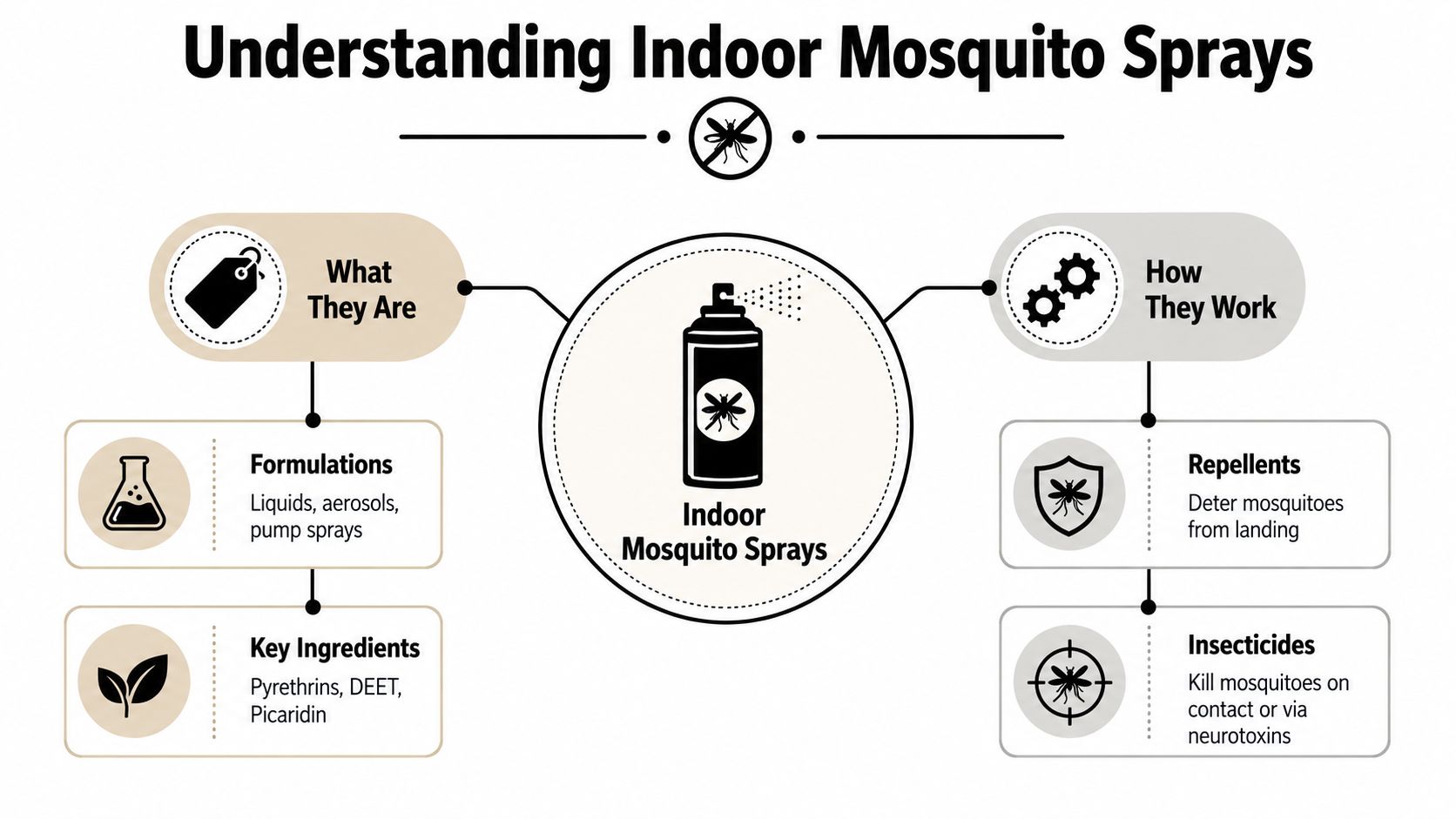
Most homeowners use the phrase indoor mosquito repellent spray to describe any product they spray inside the house. That's too broad. Some products repel. Some kill. Some do both poorly if they're used for the wrong job.
The two indoor spray categories that matter
The CDC separates indoor mosquito products into foggers or aerosols and surface sprays. Foggers and aerosols kill mosquitoes in the air. Surface sprays kill when mosquitoes land on treated indoor resting sites like under sinks, in closets, and behind furniture, according to CDC guidance on indoor spraying.
That distinction matters because mosquitoes indoors don't just fly around randomly. They rest. They hide in protected areas. If you only spray open air, you may knock down a few adults and miss the places where others settle.
Repellent versus insecticide
Homeowners also mix up repellents and insecticides, and that leads to bad expectations. Public health guidance treats those as different tools. A repellent is meant to keep mosquitoes away from you. An insecticide is meant to kill mosquitoes.
If you spray a personal repellent around a room and expect the product to eliminate the infestation, you're using the wrong tool for the job. If you use an indoor insect spray but ignore re-entry points, you're still leaving the door open to the next round.
Sprays work better when you match the product to the problem. Air knockdown for active flyers. Targeted treatment for indoor resting areas. Prevention at the entry points and around the home.
What this means in real homes
If you're standing in a store aisle comparing cans, keep this simple:
| Product type | Primary job | Typical use case |
|---|---|---|
| Fogger or aerosol | Kill mosquitoes in the air | Fast knockdown when mosquitoes are actively flying indoors |
| Surface spray | Kill on contact after landing | Treat indoor resting spots where mosquitoes settle |
| Personal repellent spray | Keep mosquitoes off skin | Bite prevention for people, not room-wide elimination |
The mistake I see most often is using one category and expecting results from another. That's why brand comparisons alone don't solve much. The issue isn't just what product you bought. It's whether the product matches the behavior of the mosquitoes in your house.
Safe and Effective Use of Mosquito Sprays Indoors
If you're going to use an indoor mosquito repellent spray, use it with discipline. A lot of DIY frustration comes from two bad assumptions. First, that more product means better protection. Second, that if a product is sold on a shelf, it must be safe to use however you want.
Neither is true.
Higher concentration doesn't automatically mean better results
For personal mosquito repellent sprays, the active ingredient concentration matters, but higher isn't always better. The Mississippi State Department of Health reports that DEET products are sold from about 5% to 100%, but 10% to 35% DEET provides adequate protection under most circumstances, and concentrations above about 50% don't provide significantly greater protection. It gives a practical example. 50% DEET provides about 4 hours of protection, while 100% DEET gives only about 1 extra hour according to the department's mosquito repellent guidance.
That should change how you shop. Stop chasing the strongest label just because it sounds tougher. For many homeowners, that's wasted exposure without a meaningful gain.
Indoor use needs a safety-first routine
The CDC's indoor spraying guidance says foggers or aerosols require occupants and pets to leave the home until the spray has dried. That's not a minor detail. It's the difference between proper use and careless use.
Use this checklist before you spray indoors:
- Read the label all the way through: Don't assume two products work the same way.
- Remove people and pets when required: If the label or product category requires vacancy, follow it.
- Keep sprays away from food areas: Kitchens, counters, utensils, and food storage need extra caution.
- Treat the right spots: Random spraying wastes product and increases exposure.
- Reapply only as directed: Overapplication doesn't create bonus protection.
If you're also trying to reduce residue concerns in a house with animals, this guide on what to use for pet-safe cleaning is a useful companion resource for handling the surfaces around your living space more carefully.
The label is not optional
Homeowners get into trouble when they improvise. They spray bedding, overuse products in closed rooms, treat the wrong surfaces, or mix products that were never meant to be combined.
Practical rule: Use mosquito products exactly where the label allows, exactly how the label allows, and no more often than the label allows.
If you need a broader primer on indoor application habits, this article on how to spray pest control in your home is worth reviewing before you start. Indoor spraying can be useful, but once you need to think this hard about location, drying time, people, pets, and surfaces, you can see the limit of DIY pretty quickly.
DIY Sprays vs Professional Mosquito Control Strategies
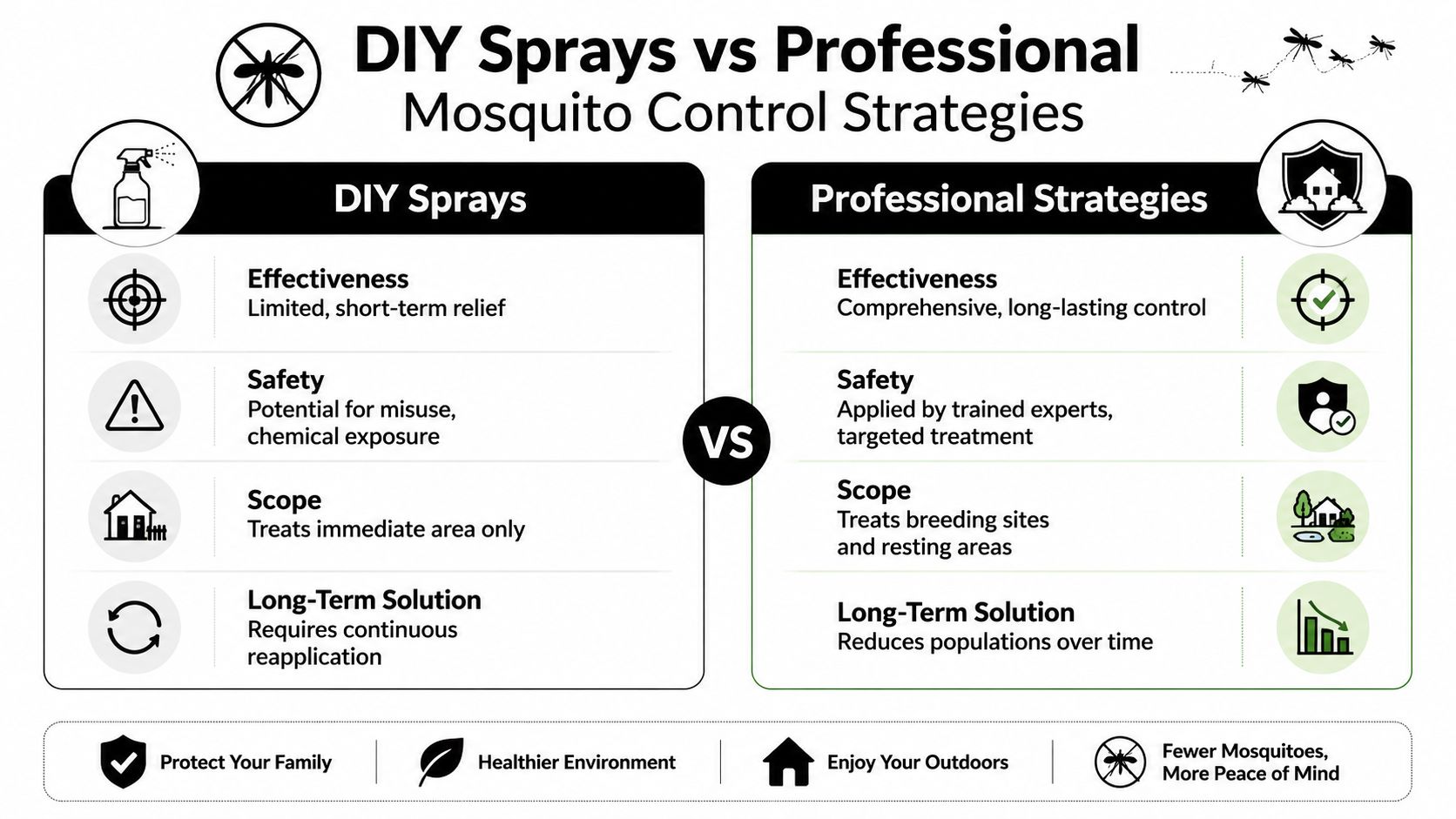
DIY indoor sprays have a role. They just have a narrow one. They help when you need immediate relief from mosquitoes already inside. They don't give most Crown Point homeowners what they want, which is fewer mosquitoes around the property and fewer mosquitoes getting indoors in the first place.
What DIY does well and where it stops
A can of spray is reactive. You see mosquitoes, so you spray mosquitoes. That can make the room better tonight.
Public-health guidance is clear that indoor spraying belongs inside a broader system. The American Mosquito Control Association says indoor use works best when combined with screened windows, air conditioning, and removal of standing water in its mosquito control guidance. That's the part too many homeowners skip.
Side-by-side comparison
| Issue | DIY indoor spray | Professional mosquito strategy |
|---|---|---|
| Immediate knockdown | Good for visible mosquitoes indoors | Good, plus evaluation of where mosquitoes are coming from |
| Root cause control | Weak | Stronger because the plan includes entry points, resting areas, and breeding pressure around the property |
| Consistency | Depends on homeowner timing and technique | Depends on inspection, targeted treatment, and follow-up |
| Safety burden | Falls on the homeowner | Managed through trained application and site-specific decisions |
| Long-term peace of mind | Limited | Better when the whole property is part of the plan |
A more complete strategy can include indoor assessment, exterior reduction, standing-water inspection, and recommendations on screens, doors, and moisture-prone areas. One available option in Crown Point is The Green Advantage, which provides mosquito reduction as part of broader pest management for local properties.
Here's a useful video if you want a quick visual overview before deciding how far to take DIY.
My recommendation
If you get the occasional mosquito indoors, use the right spray correctly and move on. If you're repeatedly buying products, reapplying, and still getting bit inside, stop treating this as a spray-shopping problem.
It's a control-plan problem.
When to Call a Pest Control Exterminator in Crown Point IN
A lot of homeowners wait too long to call. They keep testing one more aerosol, one more room spray, one more weekend cleanup. Meanwhile, the mosquitoes keep showing up.
The trigger point is straightforward. The CDC recommends hiring a pest control professional if mosquitoes persist after you've taken steps like using indoor sprays, fixing screens, and removing standing water, according to its guidance on mosquito control at home. That's the line between a manageable nuisance and a problem that needs diagnosis.
Clear signs it's time to stop experimenting
Call a professional if any of these sound familiar:
- Mosquitoes keep returning indoors: You knock them down, but new ones show up anyway.
- You already fixed the obvious issues: Screens, doors, and standing water have been addressed, but the activity continues.
- You're seeing them in multiple rooms: That usually points to a broader access or resting pattern.
- You want a whole-property solution: Indoor relief isn't enough if the source pressure outside remains high.
- You need confidence around family spaces: Bedrooms, bathrooms, kitchens, and pet areas require smarter treatment choices.
Why persistence matters
Persistent mosquitoes usually mean one of two things. Either they're continuing to enter the house, or they're surviving in overlooked areas connected to a larger property issue. Both problems call for inspection, not guesswork.
If you've already done the obvious work and mosquitoes are still winning, the next step isn't another can. It's a professional diagnosis.
For homeowners comparing service approaches, this overview of Effective mosquito management is a helpful example of what a broader mosquito-control mindset looks like. The key takeaway is simple. Serious mosquito problems don't respond well to isolated indoor spraying.
This is the moment that warrants a search for an exterminator in Crown Point, IN or pest control near me. Not at the first mosquito. At the point where repeated DIY effort isn't solving the problem.
Your Solution for a Mosquito-Free Home in Northwest Indiana
Indoor mosquito repellent spray has a place. It's useful for fast relief. It is not a complete defense for your home, and it shouldn't carry that burden by itself.
What protects your family better is a layered approach. Control the mosquitoes you find indoors. Reduce the reasons they get inside. Address conditions around the home that support them. Then keep pressure on the problem before it rebuilds. That's how homeowners move from constant swatting to real peace of mind.

If you're in Crown Point or nearby Northwest Indiana communities, don't treat mosquitoes as a one-room issue when they're clearly a property issue. The same home may also benefit from broader residential pest control, seasonal exterior treatments, spider control, rodent control, wasp removal, or prevention for other recurring pest pressures.
For homeowners budgeting and comparing service categories, Home Project Services' pest control guide can help you think through the bigger picture. Then take the next practical step and talk to a local team that can inspect the situation directly.
You don't need another summer of spraying the same corners and hoping for a different outcome. If mosquitoes are getting inside your home, fix the cause and take control of the whole problem.
If you're ready for a practical plan instead of another temporary fix, contact The Green Advantage to schedule a pest inspection or request a quote in Crown Point, IN and Northwest Indiana. Whether you need mosquito control, residential pest control, or help tracking down a recurring indoor pest issue, the goal is simple. Protect your home, reduce the stress, and make your space comfortable again.
Indiana Pest Control: A Homeowner’s Guide for Crown Point
You hear scratching in a wall after dark. The next morning, you find a line of ants cutting across the kitchen counter. By the weekend, you're checking the basement, the pantry, and the window frames, wondering if you've got one small nuisance or a real infestation starting.
That's a common moment for homeowners in Crown Point and across Northwest Indiana. Our seasons shift hard, moisture levels change fast, and pests respond to every bit of it. Some stay outside until weather or food pressure pushes them in. Others settle in undetected long before you notice them.
A lot of people start by searching for pest control near me, hoping for a quick answer. The better answer is a clear one. You need to know what's active in this area, what you can handle on your own, and when it's time to bring in a licensed exterminator in Crown Point, IN.
Your Guide to Pest Control in Crown Point Indiana
One of the most common calls starts with something simple. A homeowner spots a few ants near the sink and assumes it's a cleaning issue. Then they wipe the counter, put food away, and the ants still come back. By then, the problem isn't the crumb on the counter. It's the route into the house, the moisture source, and the colony pressure behind it.
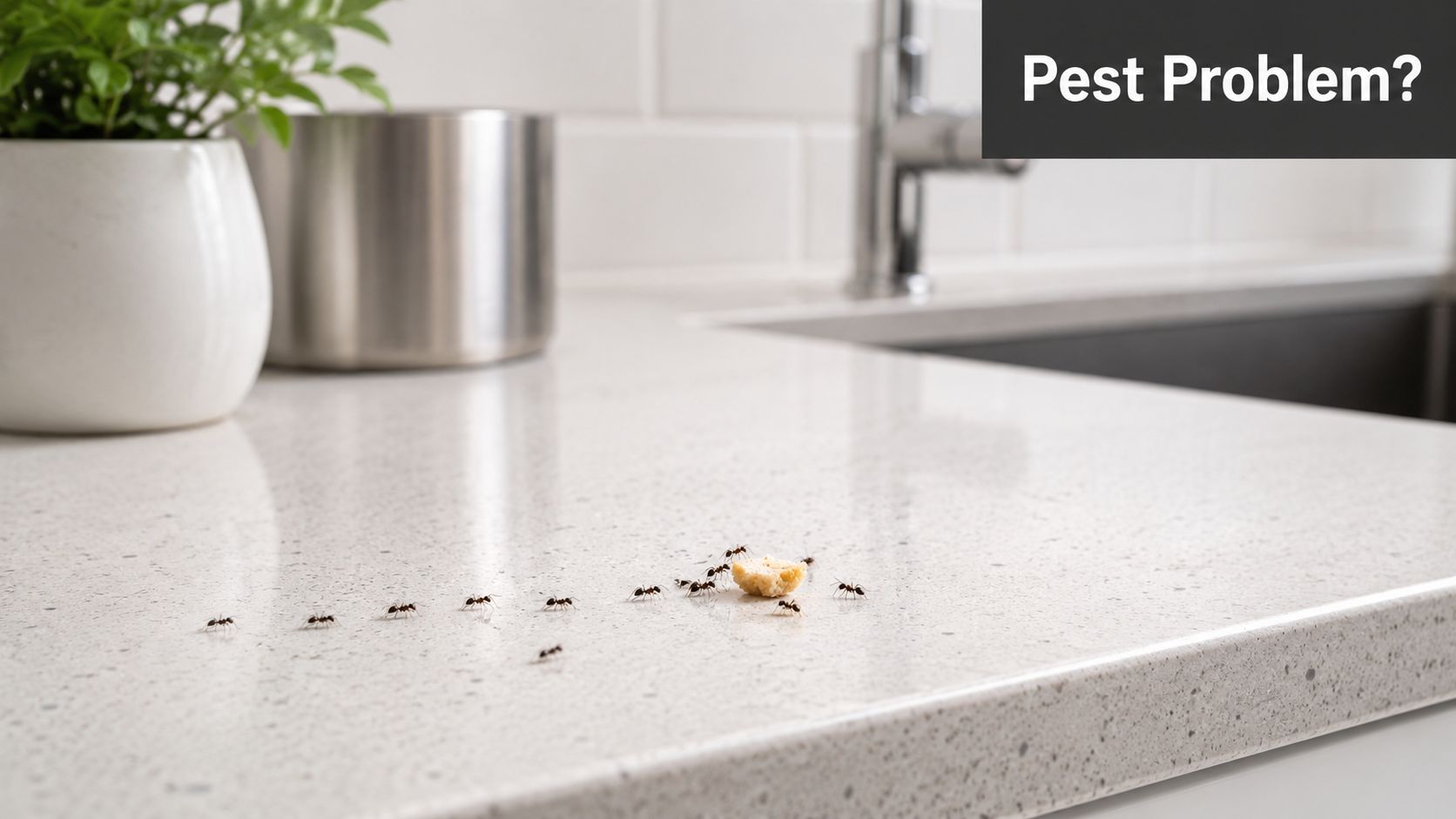
That's how a lot of pest issues work in Northwest Indiana. You don't just have “bugs.” You have a local pattern. Ants in spring, mosquitoes around standing water in summer, spiders and rodents pressing inward as temperatures drop, and overwintering pests that take advantage of quiet corners indoors. A house in Crown Point can look sealed and well-kept and still have enough gaps, moisture, or food access to attract pests.
Why local context matters
Indiana pest control isn't a niche service. IBISWorld projects Indiana's pest control industry will reach 597 businesses and $417.1 million in market size in 2026, with average annual growth of 6.0% from 2021 to 2026. That scale tells you something practical. Homeowners here deal with pest pressure often enough that the work has become more structured and specialized.
If you want a broader look at how service demand varies by area, this Transactional LLC pest control mapping resource gives useful geographic context.
Practical rule: If the same pest keeps showing up after you clean, remove clutter, or spray a store product, the pest usually isn't the main issue. The access point is.
What homeowners usually need
What's needed isn't more noise, stronger odors, or random treatments. Rather, it's a process that answers a few direct questions:
- What's active on the property right now
- Why it's there, including entry points and attractants
- What treatment fits, instead of using the same method everywhere
- Whether follow-up is needed to confirm the problem is under control
That's the difference between a one-time reaction and a real residential pest control plan. For homes in Crown Point, IN, that difference matters.
Common Pests in Northwest Indiana and Their Seasons
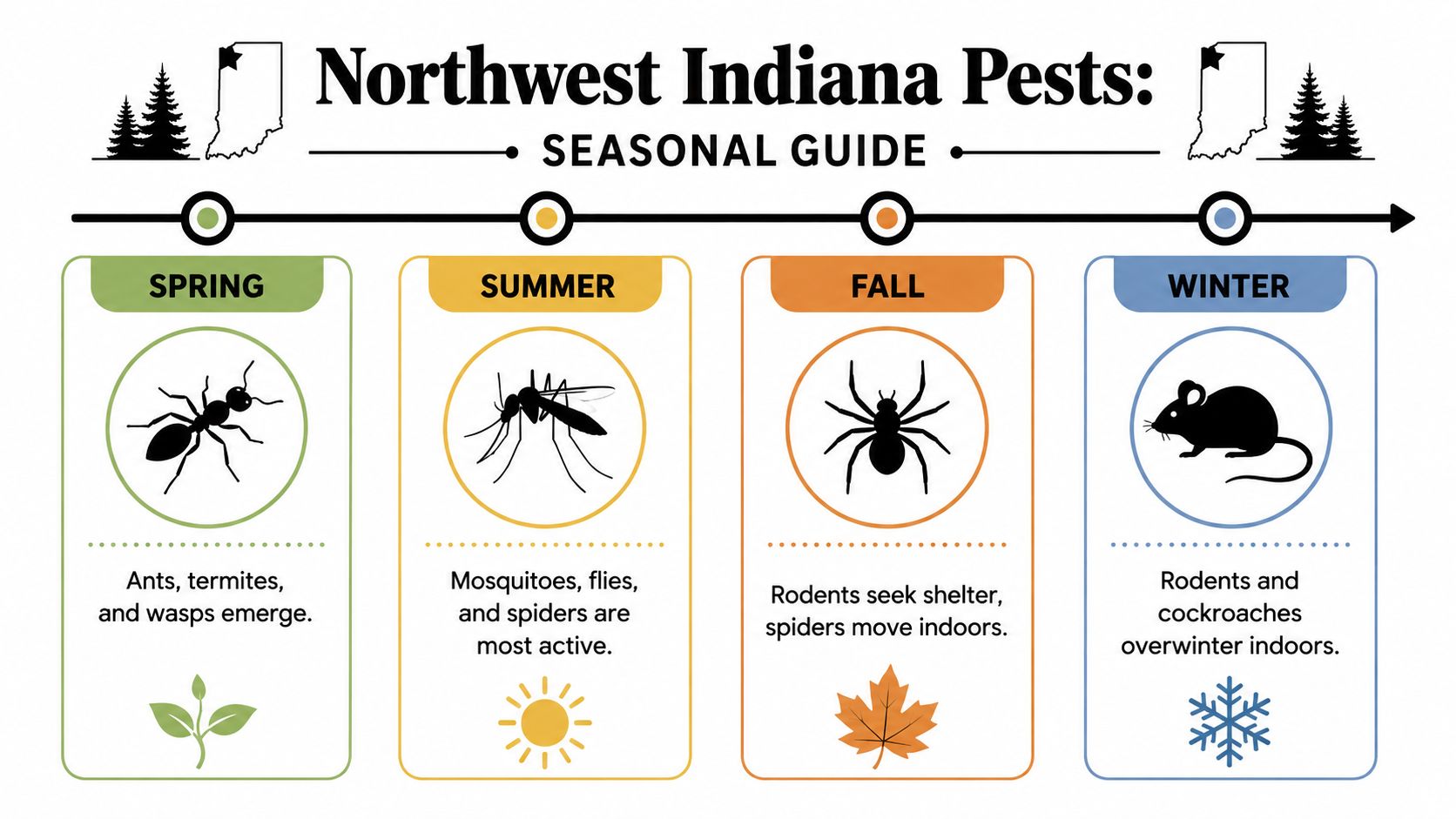
Pest activity in Northwest Indiana follows a pretty familiar rhythm. Not every home sees the same pressure, but the timing matters. If you know what usually shows up each season, you can catch problems earlier and avoid treating every issue like an emergency.
Spring activity around Crown Point
Spring usually starts the visible push. Soil warms, moisture shifts, and insects that stayed hidden become active around foundations, mulch beds, window lines, and kitchens.
You'll often want to watch for:
- Ants indoors as colonies expand and foragers start moving
- Termite concerns when conditions support swarming activity
- Early wasp activity around eaves, sheds, and porch areas
A few insects in spring can turn into a regular pattern fast. This is when people often realize the problem didn't begin today. It started outside and worked inward.
Summer pressure on yards and living spaces
Summer is when outdoor activity and indoor annoyance collide. Windows open more, people spend time in the yard, pets move in and out, and pests have more places to feed and breed.
The most common summer complaints include mosquitoes, flies, spiders, and stinging insects. Mosquito control matters most where there's standing water, dense shade, clogged areas that stay damp, or containers collecting rain. Wasps also become more noticeable as nests develop around rooflines, play areas, and entry points.
Warm weather doesn't create pest problems by itself. It speeds up feeding, nesting, and movement that was already building.
For many homes, this is also the season when outdoor treatment and yard-focused prevention make the biggest difference in daily comfort.
Fall movement indoors
Fall changes the job. Pests that stayed mostly outside start looking for stable shelter. Homes in Crown Point with attached garages, basements, crawl spaces, or utility penetrations often show activity first.
Common fall invaders include:
| Season shift | What homeowners notice |
|---|---|
| Cooler nights | Rodents testing gaps near doors, siding, and utility lines |
| Less outdoor prey | Spiders showing up in corners, basements, and garages |
| Dry indoor shelter | Other nuisance pests settling into wall voids and storage areas |
This is usually when a homeowner searches for an exterminator near me after hearing movement, spotting droppings, or finding webs in rooms that were quiet all summer.
Winter doesn't mean pest-free
Winter feels calmer, but it doesn't mean the property is clear. It usually means the activity is less visible and more concentrated indoors. Rodents and cockroaches are the main concerns people tend to ignore too long because they assume cold weather solved the problem.
That assumption rarely helps. If pests found warmth, food, and shelter before winter settled in, they're already where they want to be.
Proactive Prevention and When to Call an Exterminator
Most pest control starts before any product comes out. Good prevention lowers pressure, helps treatments work better, and sometimes stops a small issue from becoming a recurring one. Indiana's public guidance reflects that approach. The Indiana Department of Environmental Management recommends integrated pest management, including sealing openings with 16-gauge mesh, using sealant around pipes and cracks, keeping food and water sources dry, and requesting targeted strategies from providers. It also points residents toward practical tools like bait stations for cockroaches, snap traps for mice, and outdoor water management to reduce mosquito breeding sites, as outlined in Indiana's pests and pesticides guidance.
Prevention that actually helps
A few basic habits do more than is commonly thought:
- Seal entry points around utility lines, pipe gaps, sill plates, and foundation cracks
- Dry problem areas under sinks, near sump spaces, around hoses, and beside HVAC lines
- Store food properly in containers, not loosely in pantries or garages
- Reduce exterior harborage by trimming back contact points and keeping clutter off the house
- Manage standing water in buckets, toys, planters, and low spots in the yard
The point isn't to make your home sterile. It's to make it harder for pests to feed, breed, and settle in.
What usually doesn't work
Homeowners often lose time with the same three moves. They buy a spray for the insects they can see, put traps in one room only, or treat inside while ignoring the exterior source. That can knock down activity for a few days, but it usually doesn't solve the cause.
Recurring ants, persistent rodent noise, repeated wasp nesting, and ongoing roach sightings all point to a problem that needs more than surface treatment.
If pest activity keeps returning to the same room, the pest is using that room for access or resources. It's not there by accident.
When it's time to call an exterminator in Crown Point, IN
Call for professional help when any of the following shows up:
- Repeat sightings after cleaning and store-bought treatment
- Evidence of nesting such as droppings, gnawing, void activity, or concentrated webs
- Higher-risk pests like termites or stinging insects near family activity areas
- Property-related concerns tied to rental units, real estate transactions, or commercial use
That's the point where professional residential pest control or commercial pest control becomes less about convenience and more about protecting the property.
What to Expect from Professional Pest Control Services
Most homeowners feel better once they know what a service visit looks like. Good pest control isn't guessing, and it shouldn't feel rushed. It follows a sequence that makes sense for the pest, the property, and the level of activity.
Here's the service flow typically expected from a structured Indiana pest control program.
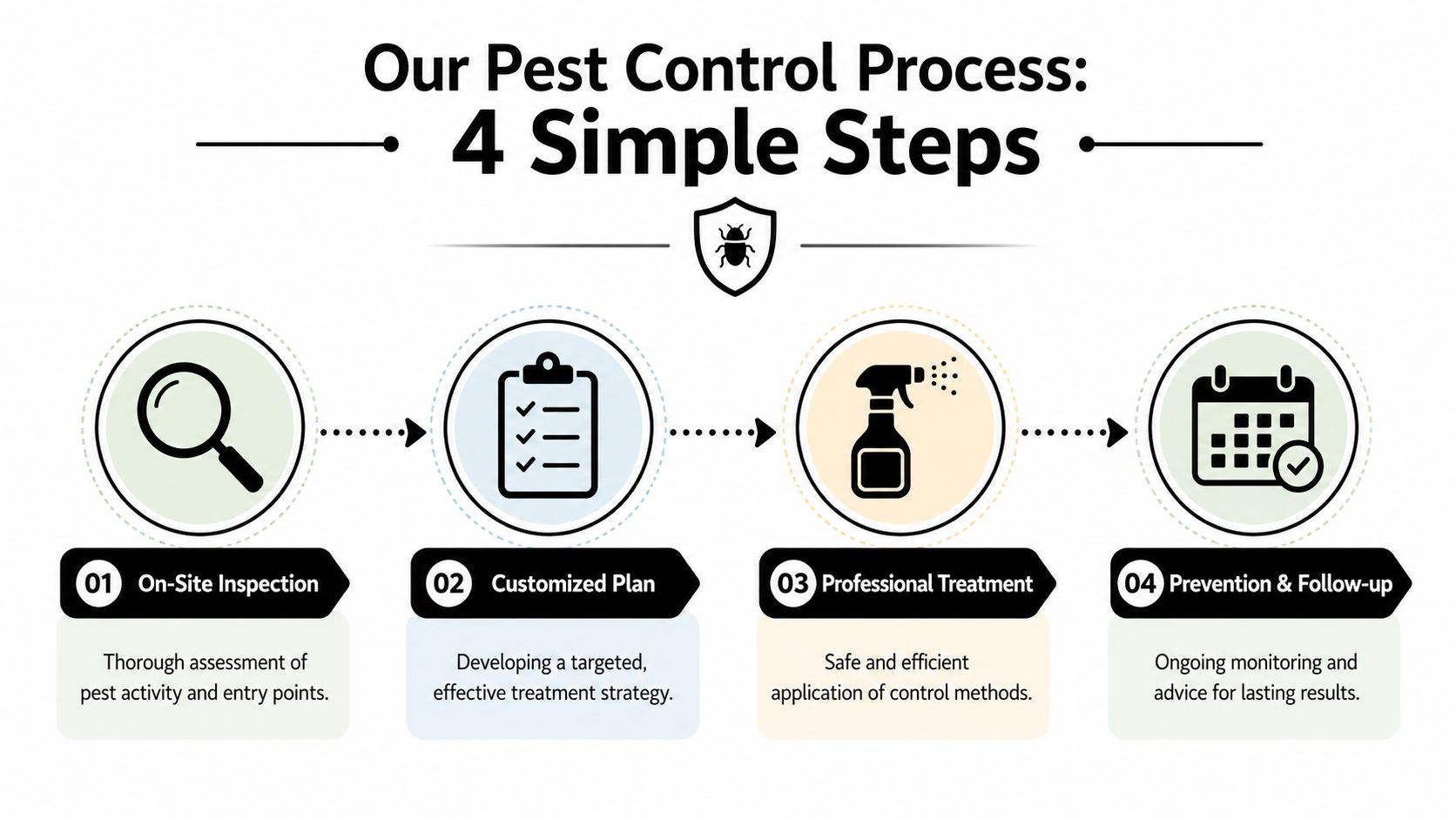
Inspection comes first
A real inspection looks beyond the obvious complaint. If someone says they're seeing ants in a bathroom, the technician should also be checking moisture, exterior access, sill conditions, plumbing penetrations, and nearby rooms.
That first visit usually answers three practical questions:
- What pest are we dealing with
- Where is it entering or nesting
- What conditions are helping it stay active
That's why inspection matters more than quick spraying. If identification is wrong, treatment is usually weak or temporary.
Treatment should match the problem
A good treatment plan isn't one-size-fits-all. Ant control, rodent control, mosquito reduction, termite work, and wasp removal all require different methods and follow-up expectations. A family home with pets also needs a different treatment discussion than a warehouse, office, or multi-unit property.
Indiana residential service commonly follows a process of inspection, identification, treatment selection, and follow-up verification, often 14 to 30 days after the first application, in line with the practical framework described in Indiana pesticide regulation guidance and service standards.
Indiana law also matters here. Commercial applicators must hold the right IDOA license or certification for the category they're working in, and restricted-use products can only be applied by certified applicators or people under their direct supervision. The same guidance notes record retention requirements for at least 2 years for those regulated uses, which is part of what makes licensing more than paperwork.
For homeowners comparing providers, it also helps to understand bonded and insured pros so you know what protections and accountability to look for.
If you want a plain-language look at service scope, this page on what pest control companies do is useful.
Follow-up is where the job gets confirmed
One visit can solve some problems. Other issues need verification after the initial work. Rodents may require monitoring and exclusion updates. Roach jobs often need rechecks. Exterior invaders may change with weather or sanitation conditions.
This short video gives a quick visual overview of how homeowners often think about the process:
A professional service should leave you with fewer surprises. You should know what was found, what was done, and what happens next.
The Green Advantage Our Eco-Friendly Approach
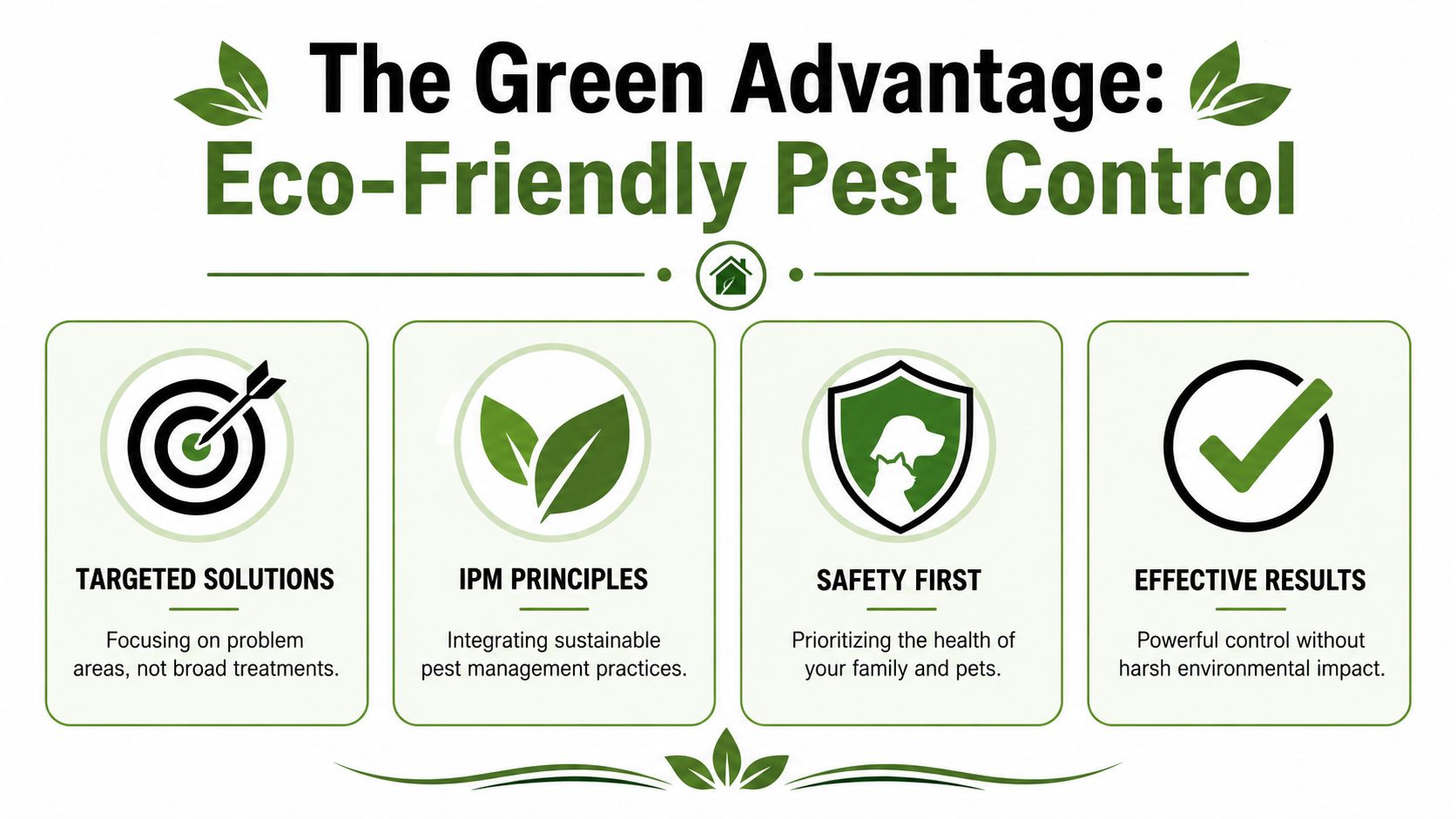
A lot of homeowners hear “eco-friendly pest control” and assume it means lighter treatment that won't hold up. That's not how effective work is done. The better definition is targeted treatment with less unnecessary exposure.
What eco-friendly means in practice
For a homeowner, the practical version looks like this:
- Focused placement instead of broad, indiscriminate treatment
- Exclusion and sanitation to reduce the need for repeat chemical use
- Product selection based on pest behavior rather than using the same material everywhere
- Attention to family and pet routines before treatment decisions are made
That approach usually works better because it lines up with how pests use a property. Roaches need harborage and food access addressed. Rodents require entry-point correction. Mosquito relief depends heavily on habitat pressure outdoors. Spiders often improve when the insects they feed on are reduced and access routes are cut off.
Why effective and careful can go together
The strongest-looking treatment isn't always the most useful one. Overapplying products to the wrong places can waste time and leave the actual issue in place. Smart pest control uses the least disruptive method that still solves the problem.
That's where integrated methods matter. They connect inspection, habitat correction, targeted applications, and follow-up. For homeowners who want to read more about that philosophy, this overview of environmentally friendly pest control methods gives a clear explanation.
The Green Advantage applies that kind of approach in Northwest Indiana with licensed service for homes and businesses, including common household pests, rodents, mosquitoes, termites, and stinging insects.
Good eco-friendly pest control isn't passive. It's precise.
Understanding Pest Control Costs in Northwest Indiana
Clients inquiring about price typically want to know two things. What affects the quote, and what are they paying for beyond a single visit. That's a fair question, because pest control in Crown Point, IN isn't priced as a flat commodity. The cost depends on the problem you have.
What changes the price
Several factors shape service recommendations and pricing:
- Property size and layout because larger homes, multi-unit sites, and complex structures take more inspection and treatment time
- Type of pest since ants, mosquitoes, rodents, termites, and cockroaches each require different materials, labor, and follow-up
- Severity of activity because a light seasonal issue is different from an established infestation
- Service frequency including one-time work versus a recurring preventive plan
- Access and exclusion needs if sealing, trapping, monitoring, or specialized placement is part of the solution
A termite concern, for example, is a different level of job than a minor ant trail at one sink. A rodent issue in a finished basement with utility gaps is different from occasional spider activity in a garage.
Cost versus value
The cheapest option often looks better only at the start. If the treatment doesn't identify the pest correctly, misses the entry route, or skips follow-up, you may end up paying again while the infestation keeps going.
Here's the better way to consider it:
| What you're paying for | Why it matters |
|---|---|
| Accurate inspection | Wrong identification leads to weak treatment |
| Targeted control | Better fit for the pest and the site |
| Licensed application | Important for compliance, safety, and accountability |
| Prevention guidance | Helps reduce repeat activity |
For homeowners and property managers, pest control is usually an investment in structure protection, livability, and peace of mind, not just a one-day fix.
Indiana Pest Control Frequently Asked Questions
Are pest control treatments safe around kids and pets
That depends on the pest, the product, where it's applied, and whether the treatment plan is built carefully. A responsible provider should explain where materials will be placed, what to avoid touching, and whether any temporary restrictions apply. Safety improves when treatment is targeted instead of broadly applied and when exclusion and sanitation do part of the work.
If you have children, pets, or specific sensitivities in the home, say that up front. That information should shape the plan.
Is one visit enough or do I need ongoing service
Some problems respond well to a one-time visit. Others don't. Wasp removal at a single nest may be straightforward. Recurring ant activity, rodent pressure, mosquitoes, and general household pest issues often benefit from ongoing monitoring and seasonal prevention.
The question isn't whether repeat service sounds appealing. It's whether the property has conditions that keep attracting pests. If it does, a maintenance plan is usually more practical than treating the same issue from scratch over and over.
What's the difference between residential and commercial pest control
Residential pest control focuses on living spaces, family routines, pets, garages, yards, and the comfort of the home. Commercial pest control has a different pressure. It often includes sanitation oversight, traffic patterns, storage areas, staff coordination, documentation needs, and protection of business operations.
A restaurant, office, warehouse, or multi-tenant property can't be treated exactly like a single-family house. The inspection and service plan need to match how the building is used.
When should I schedule an inspection
Schedule one as soon as activity becomes repeatable. If you see the same pest more than once, hear movement in walls or ceilings, notice droppings, find fresh nesting signs, or keep getting bitten outdoors, waiting rarely makes the job easier.
People often call later than they should because they hope a change in weather will solve it. Usually, pests are already responding to the weather faster than the homeowner is.
If you're looking for pest control in Crown Point, IN, want a local exterminator near me, or need help with residential pest control, commercial pest control, mosquito control, rodent control, termite concerns, spider issues, ant control, or wasp removal in Northwest Indiana, the next step is simple. Get the property inspected and get a plan based on what's happening.
If you're dealing with pest activity in Crown Point or nearby Northwest Indiana communities, contact The Green Advantage to schedule a pest inspection, request a quote, or talk through what you're seeing. A clear inspection and a targeted plan can save a lot of frustration, especially when the problem keeps coming back.
Diatomaceous Earth Pest Control: A Crown Point Guide
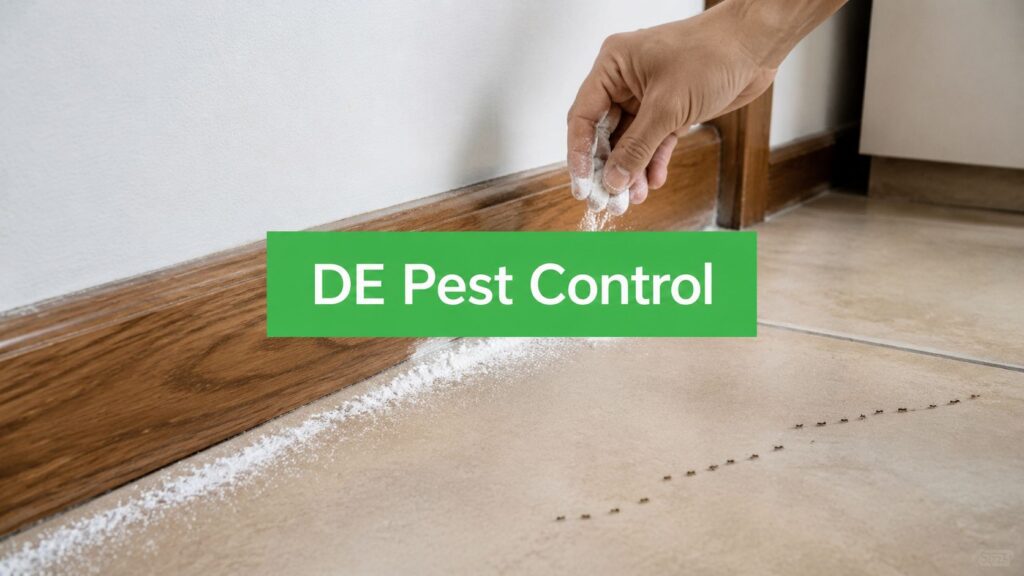
You find a line of ants under the kitchen window, or a few spiders showing up in the basement corners, and the search usually starts the same way. You want something quick, affordable, and safe to use around the house. Before long, diatomaceous earth pest control pops up in your search results as the popular DIY answer.
That appeal makes sense in Crown Point and across Northwest Indiana. Homeowners want practical solutions, not harsh guesswork. Landlords and property managers often want something they can try before calling in service, especially when they're already juggling maintenance, turnover, and tenant communication. If you manage rentals, this overview on solving pest issues for landlords gives good context on why pest problems tend to become bigger operational headaches when they're handled too late.
The issue is that diatomaceous earth, often called DE, isn't a magic powder. It can work in specific situations, but it also has limits that many DIY articles skip over. If you use it in the wrong place, in the wrong amount, or for the wrong pest, you can end up with dusty rooms, lingering activity, and no real answer to the source of the infestation.
Your Local Guide to Pest Control in Crown Point IN
Why homeowners keep trying DE first
A lot of pest problems begin with a small sighting and a simple hope. Maybe it's ants near the dishwasher, crickets in the garage, or a spider problem that seems to get worse whenever the weather changes. For many, a complicated process is undesirable. They want the pests gone without turning the house upside down.
DE sounds like that kind of solution. It's commonly described as a more natural option, and that alone makes many homeowners feel more comfortable trying it than a conventional over-the-counter spray. That's especially true in family homes where kids, pets, or sensitive indoor spaces are part of the decision.
Local reality: In Crown Point, a pest problem usually isn't just about the insects you can see. It's about where they're nesting, how they're getting in, and what conditions are letting them stay.
What usually gets missed
The part that DIY advice often leaves out is that pests don't live where you notice them. Ants may trail through the kitchen while the colony sits deeper in a wall void or outside near the foundation. Spiders may collect in a basement because other insects are already active there. Fleas may still be developing in overlooked areas even after an owner dusts a few visible spots.
That's why a one-product approach often falls short. A dust can only do so much if the infestation source stays active, moisture conditions keep helping pests survive, or entry points are still open around doors, utility lines, and foundation gaps.
Why a broader pest control plan matters
Residential pest control works best when the treatment matches the pest and the location. Commercial pest control needs that same logic, just with more attention to traffic patterns, sanitation pressures, storage areas, and ongoing monitoring. Whether someone searches for pest control near me, exterminator near me, or pest control in Crown Point, IN, what they usually need isn't just a product recommendation. They need a reliable diagnosis.
That matters for common Northwest Indiana issues beyond crawling insects too. The same property may also need rodent control, wasp removal, spider control, mosquito control, termite control, or seasonal preventative pest treatments. DE can be one small tool in the conversation, but it isn't a complete pest management strategy.
What Is Diatomaceous Earth and How Does It Work
The basic idea
Diatomaceous earth is a fine powder made from fossilized microscopic aquatic organisms. In pest control, it isn't used as a chemical poison. It works as a contact insecticide. Formal pesticide use in the modern United States began in 1960, and there are now over 150 registered products for indoor and outdoor use. Regulatory guidance also identifies it as most useful on hard-bodied arthropods such as bed bugs, fleas, cockroaches, ticks, spiders, and crickets because it works by absorbing oils from the insect cuticle and abrading the exoskeleton, as explained by the National Pesticide Information Center fact sheet on diatomaceous earth.

A simple way to think about it is this. DE doesn't poison pests after they eat it. It has to get on their bodies.
How the powder affects insects
When a crawling pest moves through a thin layer of DE, the particles damage the protective outer layer and pull away oils that help the insect retain moisture. Over time, that pest loses water and dries out. The action is physical.
That matters because it explains several things homeowners often find confusing:
- It isn't instant. Pests usually don't drop dead on the spot.
- It requires contact. If insects avoid the dust, nothing happens.
- It favors certain pests. Hard-bodied crawling pests are better targets than insects that don't spend much time moving through treated zones.
- It depends on placement. A light, well-placed application works better than dumping visible piles around the room.
A more detailed explanation of that physical action is available in this overview of how diatomaceous earth works in pest control.
Why light application matters more than heavy application
Many DIY users make the same mistake. They assume more powder means more control. In practice, insects may avoid thick piles, and heavy application creates more mess than benefit.
Controlled research on Tribolium castaneum found that DE's insecticidal effect is dose- and exposure-time dependent, with 2 days of exposure significantly increasing insect mass loss. The study also showed higher water emission and signs of increased cuticle permeability and lipid absorption, supporting the idea that DE works through sustained dehydration rather than immediate knockdown, as reported in the PubMed study on DE exposure and water loss.
A short visual helps if you've never seen DE discussed in practical terms:
A thin dust in the right harborage beats a thick white line in the middle of the floor.
The True Effectiveness of DE on Household Pests
Where DE can help
DE has a place in pest control, but it has a narrow one. It can help when the target is a crawling pest, the powder stays dry, and the insects keep crossing the treated area. In real homes, that usually means protected cracks, voids, and harborage paths rather than open room surfaces.
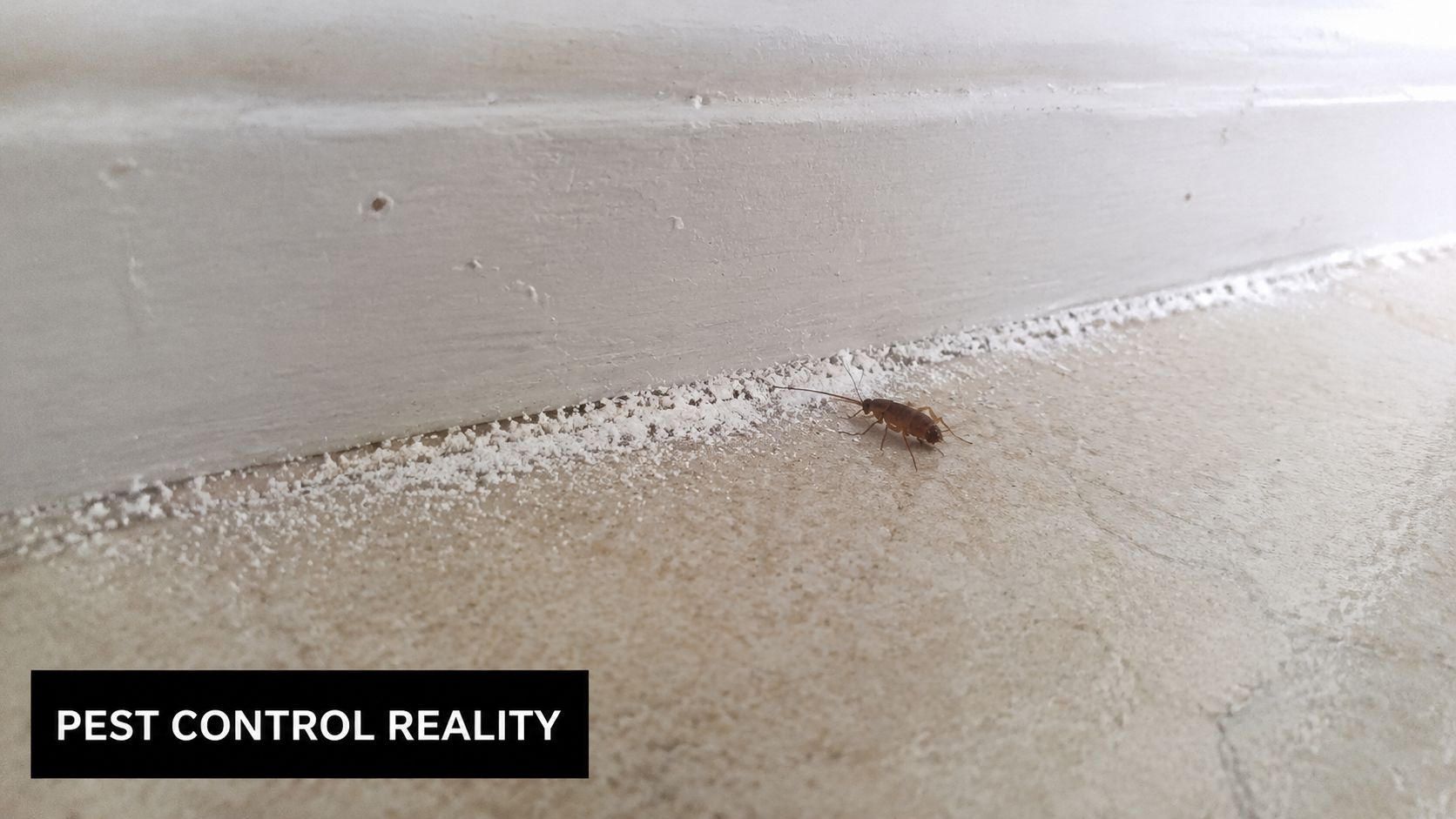
For example, some homeowners try it for:
- Cockroaches in protected edges behind appliances or inside wall voids
- Spiders in less-disturbed basement or crawl space edges
- Fleas in limited dry-contact areas as part of a broader cleanup effort
- Crickets and similar crawling pests where travel routes are predictable
It can also fit into a broader low-impact strategy when used carefully. If you're exploring non-broadcast options, this page on natural pest control for home is a useful starting point for understanding where selective methods make sense.
Where it commonly disappoints
The biggest weakness of DE is that the environment controls the outcome. It is less effective when humidity is high because moisture weakens the desiccation process, and it works best as a dry, residual dust in cracks and voids, not on damp or exposed surfaces, according to this explanation of environmental limits of diatomaceous earth.
That becomes a real problem in lived-in homes. People mop floors. Air moves through rooms. Pets track through treatment areas. Basements get damp. Bathrooms hold moisture. Indiana weather doesn't always cooperate with products that need dry, undisturbed conditions.
Bed bugs are the clearest warning sign
Bed bugs are a good example of why internet claims about DE can be misleading. In a 2019 peer-reviewed synthesis, diatomaceous-earth-based bed bug treatments produced results over a 4-week period ranging from 29.1% to 97.5%, depending on the product and application conditions, according to the peer-reviewed review on arthropod control and DE performance.
That range is huge. It tells you the material itself isn't the whole story. Conditions and application quality drive the result.
Practical rule: If a treatment only works well when it stays dry, thin, undisturbed, and exactly in the pest's travel path, many households won't get the result they expect.
Why flea control often needs more than dust
Fleas are another area where people overestimate what DE can do. Even when it plays a role, the bigger job is sanitation, pet treatment guidance, and repeated attention to the places fleas develop and hide. Homeowners looking for broader housekeeping support can review this guide on preventing flea infestations at home, which helps explain why vacuuming, fabrics, pet bedding, and follow-through matter so much.
The short version is simple. DE isn't useless. It's just highly conditional, and pest problems in Crown Point homes rarely stay inside ideal conditions for long.
DIY Risks vs The Green Advantage Professional Pest Control
The part DIY guides soften
A lot of articles say food-grade DE is safe, then stop there. That's incomplete. Food-grade DE is considered low-toxicity, but it should not be inhaled, and guidance emphasizes masks, gloves, sparing application in protected areas, and avoiding airborne dust, especially in homes with children, pets, or people with respiratory sensitivities, as noted in this consumer safety guidance on using diatomaceous earth at home.
That doesn't mean every DE application is dangerous. It means homeowners should stop thinking of it as harmless dust they can spread freely across carpet, baseboards, mattresses, or open floors.
Common DIY mistakes include:
- Overapplying it: Heavy visible piles create more airborne dust and are easier for pests to avoid.
- Using it in active living spaces: Disturbance from walking, sweeping, or pets breaks up the deposit.
- Treating symptoms instead of the source: Seeing ants by the sink doesn't mean the nest is there.
- Repeating the same failed approach: More dust rarely fixes a placement or moisture problem.
DIY dust vs a complete service plan
Professional pest control starts with identification and inspection. That's the main difference. Instead of asking, "What powder should I buy?" the better question is, "Why are these pests active here in the first place?"
For some homes, the answer is moisture. For others, it is food access, hidden entry points, cluttered harborage, an exterior condition near the foundation, or a seasonal pattern that calls for preventative treatment rather than repeated spot reactions.
If you want a fuller picture of low-impact methods beyond one DIY product, this guide to environmentally friendly pest control methods shows how targeted, environmentally mindful approaches work best when they're part of a real plan.
A surprisingly helpful comparison comes from outside pest control. This London House Cleaners' expert guide reflects the same principle seen in many home services. Surface-level cleaning or treatment often looks easier at first, but hidden buildup and missed areas are what keep problems coming back.
Diatomaceous Earth vs. Professional Pest Control
| Factor | DIY Diatomaceous Earth | The Green Advantage Professional Service |
|---|---|---|
| Pest identification | Homeowner has to guess the pest and choose placement | Service begins with identifying the pest and activity pattern |
| Safety handling | Dust exposure is easy to underestimate | Application decisions account for occupied spaces, children, pets, and sensitivities |
| Moisture and environment | Product performance drops when conditions aren't right | Treatment plan is adjusted to the environment and infestation pressure |
| Coverage | Usually limited to visible areas | Inspection includes hidden harborage, entry points, and contributing conditions |
| Long-term control | Often symptom-focused | Strategy addresses source, pressure points, and prevention |
| Time and cleanup | Reapplication and dust management often fall on the homeowner | Service is structured, targeted, and easier to maintain over time |
The hidden cost of DIY isn't just the product. It's the time spent treating the wrong place while the infestation keeps going.
Why professional help is usually more reliable
A seasoned exterminator in Crown Point, IN doesn't rely on one trick. Real pest control combines inspection, targeted treatment, monitoring, exclusion advice, and prevention. That's what gives homeowners better peace of mind than trial-and-error dusting.
The same logic applies whether you're dealing with ant control, spider control, rodent control, wasp removal, or recurring seasonal pests. A reliable plan protects the house, reduces indoor stress, and keeps a small problem from turning into a stubborn one.
What to Expect from Your Local Crown Point Exterminator
When homeowners search for exterminator in Crown Point, IN or residential pest control, they're often unsure what the visit will look like. A good service call should feel straightforward, not confusing.
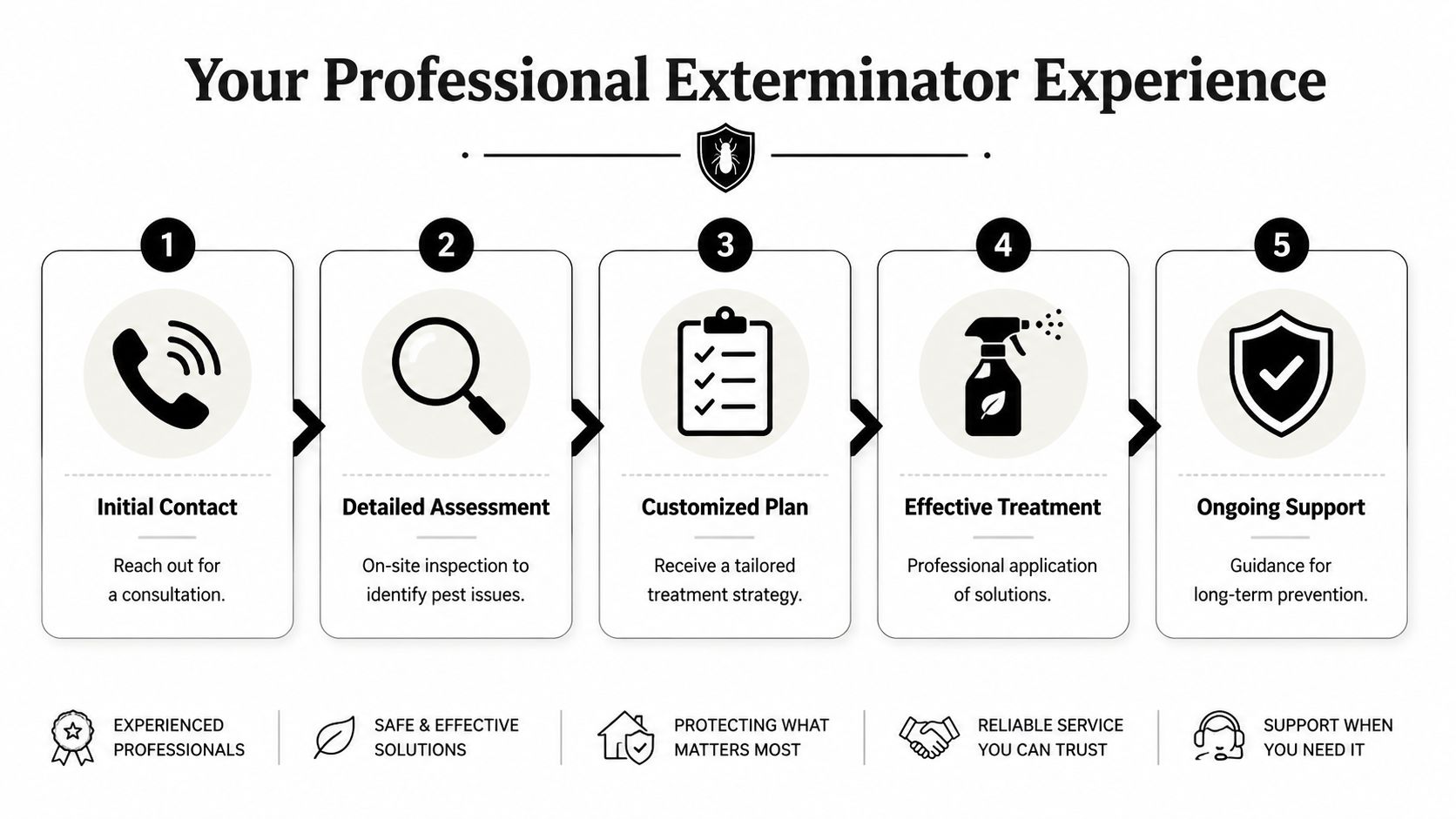
The visit starts with diagnosis
A professional inspection looks at more than the insects you noticed first. The technician checks where pests are active, where they may be entering, what conditions are helping them survive, and whether there are signs of broader pressure elsewhere on the property.
That could include:
- Interior clues: Baseboards, utility penetrations, under-sink areas, basements, garages, crawl spaces, and storage zones
- Exterior contributors: Foundation gaps, mulch lines, door sweeps, moisture areas, and nearby harborage
- Pattern recognition: Whether the problem points to ants, spiders, roaches, fleas, rodents, or a different pest entirely
Treatment is tailored, not generic
A good exterminator near me should never force every problem into the same treatment style. Different pests need different tactics, and the same pest may require a different plan in two different homes.
That often means using an integrated approach rather than a one-product approach. A technician may combine targeted materials, exclusion recommendations, sanitation guidance, habitat corrections, and follow-up support based on what the property needs.
Some infestations need dust in a protected void. Others need exterior treatment, entry-point correction, or a full prevention plan. The right tool depends on the pest and the site.
Ongoing support matters
Professional service offers a distinct advantage over DIY trial and error. If you're dealing with recurring ant activity, spider pressure around the home, seasonal mosquito issues in the yard, termite concerns, or rodent activity around a structure, consistency is the primary value.
Homeowners and businesses in Northwest Indiana often benefit from services such as:
- Preventative pest treatments for seasonal pressure before it grows
- Mosquito control for outdoor areas where family time matters
- Termite control when property protection is the priority
- Commercial pest control for offices, retail spaces, storage areas, and facilities that need routine oversight
Communication should be clear
You shouldn't have to guess what was found or what happens next. A reliable pest professional explains the issue in plain language, outlines the treatment plan, and gives practical advice for what you can do between visits. That's especially important for families, landlords, and business owners who want confidence that the problem is being handled responsibly.
Frequently Asked Questions About Pest Control
Can diatomaceous earth get rid of bed bugs by itself
It might help in limited circumstances, but it isn't something to count on as a standalone bed bug solution. Peer-reviewed studies on bed bug control with DE showed 4-week results ranging from 29.1% to 97.5%, which shows how heavily success depends on ideal application conditions in a problem that's already difficult to control.
Is food-grade DE safe around kids and pets
Low-toxicity doesn't mean risk-free in daily use. The main concern is dust inhalation and overapplication in occupied areas. If a home includes children, pets, or anyone with respiratory sensitivity, broad DIY dusting is a poor choice.
Why didn't DE work when I used it for ants
Usually because ants were not forced through the right deposit, the treated area got disturbed, or the visible trail wasn't the true source of the infestation. Ant control often fails when people focus on the countertop or floor activity but miss the colony location and entry pattern.
Does DE work better indoors or outdoors
It tends to make more sense in protected, dry spaces where it can stay undisturbed. Open, damp, or frequently cleaned areas usually work against it. That's one reason homeowners who search for pest control near me often move on from DIY products after trying them.
When should I call a professional exterminator
Call when the activity keeps returning, when you're seeing pests in multiple rooms, when the problem involves bites or health concerns, or when you've already tried store-bought products without a clear result. That applies to ants, spiders, fleas, roaches, rodents, wasps, and many seasonal pests common in Crown Point, IN.
Is professional pest control only for severe infestations
No. Many calls are preventative, especially for homeowners who want to avoid repeat issues. Early service is often simpler, cleaner, and easier than chasing a more established infestation later.
If you're tired of guessing with DIY dusts and want a safer, more dependable answer, contact The Green Advantage for help in Crown Point, IN and nearby Northwest Indiana communities. Whether you need a pest inspection, recurring residential pest control, commercial pest control, mosquito control, rodent control, spider control, or a full prevention plan, their team can help you solve the problem at the source and restore peace of mind.
How to Get Rid of Pests Naturally: A Crown Point Guide
You walk into the kitchen in Crown Point first thing in the morning and spot a line of ants running along the counter. Or you hear scratching in the wall after dark and start wondering if mice found a way in before the weather changed. Most homeowners have the same first thought. They want the problem gone, but they don't want to make their home feel less safe in the process.
That's a reasonable instinct. If you have kids, pets, or just don't like the idea of spraying harsh products around food prep areas, searching for how to get rid of pests naturally makes sense. The trouble is that a lot of advice online skips the hard part. It tells you what to spray, but not whether that method is meant to repel pests, kill a few on contact, or solve the hidden source of the problem.
In Northwest Indiana, pest pressure usually comes from a mix of weather, moisture, shelter, and easy food access. That means the most useful natural approach isn't a magic recipe. It's a practical system. Some DIY steps help. Some don't do much at all. And once pests are established inside walls, attics, crawl spaces, or around foundations, a more complete plan is usually the safer route.
A Homeowner's Guide to Natural Pest Control in Crown Point
A lot of natural pest control starts with the same moment. Someone sees one problem and realizes it might be a larger one. Ants by the sink. Spiders in basement corners. Wasps under the eaves. Mice sounds at night. The first reaction usually isn't panic. It's caution. People want an answer that protects the house without turning the house into a chemistry project.
That concern is especially common in family homes around Crown Point. People want a clean kitchen, a usable yard, and a home where pets and children can move around normally. They also want honest advice. Not every natural remedy belongs indoors, and not every infestation can be handled with ingredients from a pantry shelf.
Why homeowners start with natural options
Natural pest control appeals to homeowners for good reasons:
- Less indoor exposure: People want to avoid unnecessary residue on counters, floors, and pet areas.
- Simple first steps: Sealing food, reducing moisture, and cleaning up attractants often helps right away.
- A prevention mindset: Many pest issues start outside, then move in when conditions are right.
In practice, the strongest natural programs start before pests take over. If you also pay attention to the surroundings around your property, that helps. Problems in the yard often feed problems at the house. Homeowners dealing with roots, moisture, and plant stress sometimes find value in broader property maintenance topics such as addressing liquid amber root problems, because outdoor conditions can affect drainage, shelter, and pest activity near the foundation.
Practical rule: If a natural method doesn't change the conditions attracting pests, it usually won't hold for long.
What local experience changes
A technician who works in Crown Point sees patterns that generic articles miss. Northwest Indiana homes deal with seasonal moisture, changing temperatures, garage access, mulch beds, low spots near foundations, and outdoor clutter that becomes pest harborage. Those details matter more than trendy DIY hacks.
That's why the best natural approach is usually measured and specific. Start with prevention. Use low-impact steps where they make sense. Watch for signs that the issue is growing. If you only focus on what you can spray, you miss where pests are feeding, nesting, or entering in the first place.
Prevention Your First and Best Natural Defense
The most effective natural pest control starts before you see pests indoors. The Royal Horticultural Society notes that a foundational principle of natural pest control is prevention through habitat management, with practices such as removing diseased plant sections, using mulch as a barrier, encouraging beneficial insects, and monitoring populations before they boom in order to suppress pests and diseases without chemicals (RHS guidance on controlling pests and diseases without chemicals).
That principle applies just as much to homes in Crown Point as it does to gardens. Pests stay where food, water, shelter, and access line up. Break those conditions early and you make the property far less inviting.
Start outside the house
Walk the exterior slowly. Look at the foundation line, door sweeps, utility penetrations, window frames, garage corners, and siding transitions. You're looking for gaps, not dramatic holes. Tiny openings are enough for crawling insects, and larger cracks or worn seals can invite rodents.
Focus on these areas first:
- Entry points: Seal gaps around pipes, wires, and doors where light or air passes through.
- Vegetation contact: Trim branches and shrubs so they don't rest against siding or roofs.
- Stored materials: Keep firewood, cardboard, and clutter away from the house so pests don't settle nearby.
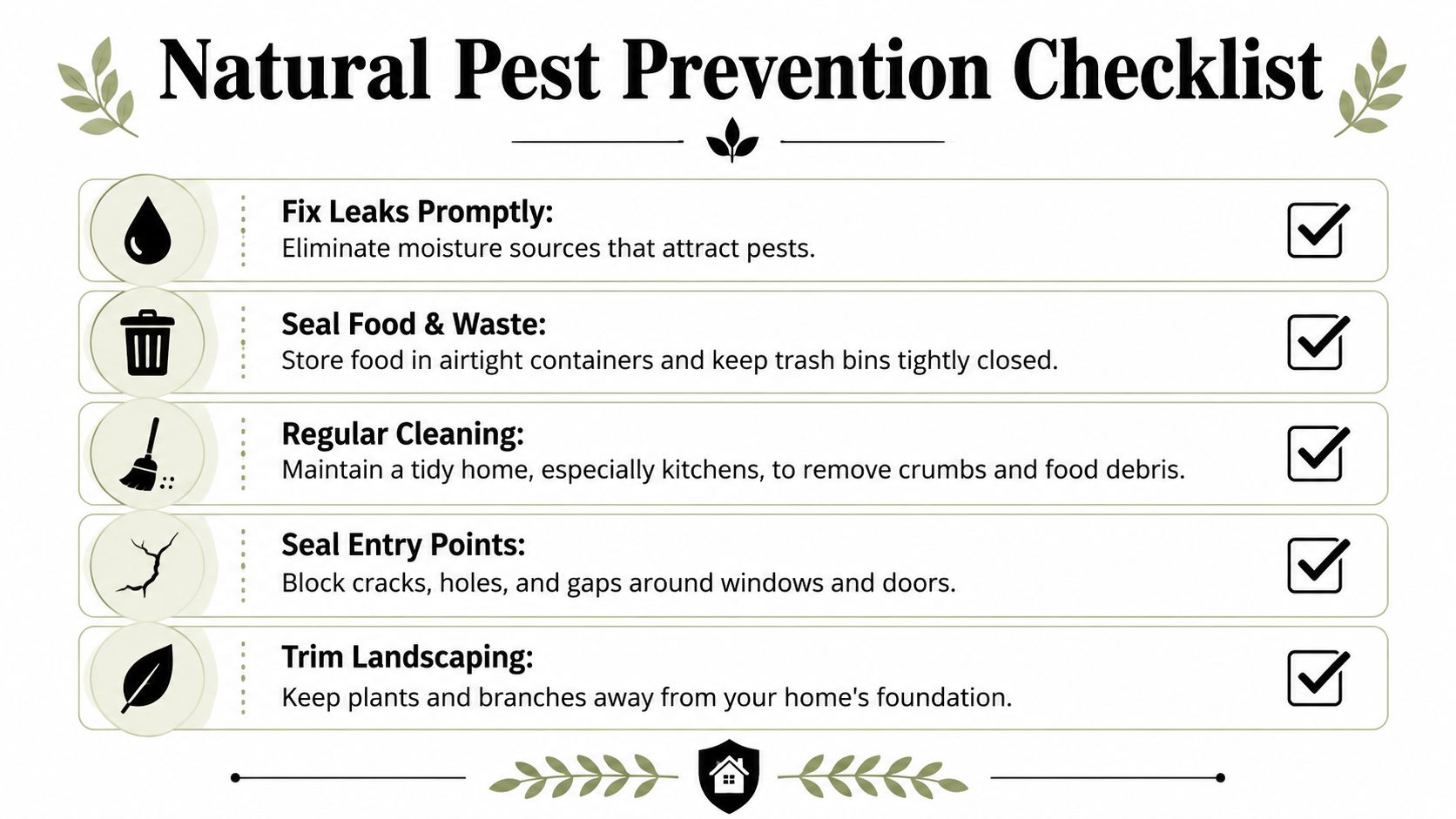
Control moisture before pests do
Moisture is one of the biggest hidden drivers of pest activity. Leaky spigots, clogged gutters, downspouts that dump too close to the foundation, wet crawl spaces, and dense mulch against the home all create more favorable conditions. Ants, mosquitoes, flies, and many occasional invaders show up more often when damp areas are left alone.
If you suspect roof runoff is contributing to wet soil or pest pressure around the foundation, it helps to understand the basics in this guide for Utah homeowners on gutter issues. The climate is different, but the lesson carries over. Poor drainage invites larger home maintenance problems, and pests take advantage of them.
Good prevention isn't glamorous. It usually looks like fixing leaks, improving drainage, reducing clutter, and keeping pests from getting comfortable in the first place.
Clean with pest behavior in mind
General tidiness helps, but targeted sanitation works better. In kitchens, that means wiping up grease and sugar residue, not just visible crumbs. In garages and basements, it means reducing cardboard storage and checking pet food, birdseed, and bulk pantry items. Outdoors, keep trash lids shut and avoid letting bins sit right next to entry doors.
A simple home checklist works well:
| Area | What to check | Why it matters |
|---|---|---|
| Kitchen | Crumbs, spills, food containers | Food residue supports ants and flies |
| Bathroom | Leaks, damp mats, slow drains | Moisture supports pest activity |
| Basement | Cardboard, clutter, humidity | Shelter makes monitoring harder |
| Yard edge | Leaf litter, stacked wood, dense cover | Harborage increases near the structure |
Prevention is still the most natural move you can make. It doesn't rely on a strong smell, a viral recipe, or repeated guessing. It changes the environment so pests have fewer reasons to stay.
DIY Natural Remedies for Common Indiana Pests
Once prevention is in place, some DIY remedies can help with light pest activity. The key is to match the method to the problem. A repellent may interrupt movement. A contact spray may affect exposed insects. Neither one automatically fixes a nest in a wall void or a breeding issue in the yard.
For homemade sprays, consistency is more critical than commonly understood. The Peace Corps standard for botanical sprays recommends drying neem leaf material in shade, then steeping a generous handful of powder in 10 liters of water for 12 to 24 hours, applied in the evening. For soap spray, the listed mix is 2 tablespoons of grated soap per 1.5 liters of water, and the guidance stresses complete surface coverage rather than spot spraying for effectiveness (Peace Corps natural pest control recipes).
Ants and crawling insects
For ants, start with trail disruption and food removal. Clean the trail thoroughly, store sweets and dry goods in sealed containers, and watch where the ants are entering. If you use a soap spray on exposed ants, remember that spraying a few workers on the counter doesn't mean the colony is gone.
What often helps more than a spray:
- Wipe trails fully: Ants follow scent cues, so partial cleanup doesn't do much.
- Check moisture: Sink areas, dishwasher edges, and pet bowls often keep ant traffic going.
- Follow the line: If they're emerging from trim, outlets, or wall gaps, the source is deeper than the visible trail.
Mosquitoes around the yard
Mosquito control is where many natural plans fall short because the problem usually isn't one spot. It's the whole environment. Standing water, shaded resting areas, dense vegetation, and neighboring conditions all play a role. Empty water-holding items regularly, improve drainage where you can, and trim heavy growth around seating areas.
Homeowners who want a few low-chemical ideas for outdoor use can review these home remedies to keep mosquitoes away. The most useful takeaway is that yard comfort usually improves when you combine habitat reduction with targeted action, not when you rely on one scent alone.
A mosquito problem is rarely solved by fragrance. It improves when you remove resting areas and water sources and keep pressure down over time.
Spiders and rodents
Spiders often show up because other insects are present. If you knock down webs but leave the insect food supply untouched, more spiders usually return. Vacuum webs, reduce clutter, limit exterior lighting that attracts insects near doors, and seal gaps around utility lines and basement entries.
For mice, natural deterrents are usually the weakest category of DIY advice. Scent-based methods may discourage activity in a limited area, but they don't replace exclusion. If mice can still get inside and find food, nesting material, or warmth, odor alone won't carry the job.
A better pest-by-pest way to think about DIY methods is this:
| Pest | Natural step that may help | Main limitation |
|---|---|---|
| Ants | Sanitation and trail cleanup | Doesn't remove hidden colony |
| Mosquitoes | Standing water reduction | Doesn't address broader yard pressure |
| Spiders | Web removal and insect reduction | Returns if food source remains |
| Mice | Sealing entry points | Repellents alone are unreliable |
DIY can work best when the problem is small, visible, and recent. It works worst when the pests are nesting out of sight.
Safety First When Natural Isn't Necessarily Harmless
A lot of homeowners hear "natural" and assume "safe everywhere." That isn't always true. A common gap in DIY advice is the safety and effectiveness tradeoff for indoor use, especially with essential oils, vinegar, and borax-like mixtures that are often recommended without enough guidance on exposure risks, residue, or airway irritation. What works in a garden setting may be a poor fit for a kitchen, bedroom, or home with pets (overview of natural garden pest control methods and indoor-use concerns).
That matters because homes aren't all the same. A remedy used on a patio planter isn't judged by the same standard as something sprayed near food prep surfaces, around cat dishes, or in a child's room. Setting changes the risk.
Common mistakes with indoor natural remedies
Some DIY problems come from overapplication. People spray too much, use strong scents in poorly ventilated rooms, or leave powders where they can be kicked up into the air. Others use food-based mixtures that end up feeding the wrong pests or leaving sticky residue behind.
Watch for these trade-offs:
- Essential oils: Strong odors may bother people or pets, especially in closed rooms.
- Powders and dusts: Fine materials can become an inhalation issue if applied carelessly.
- Food-based baits or mixes: Sweet or greasy ingredients can create secondary pest attention if spilled or misplaced.
Match the method to the room
A kitchen ant issue should be handled differently than a mosquito issue outdoors. A child's bedroom should be approached differently than a detached shed. One of the biggest reasons homeowners call for help is that online advice treats all natural options as interchangeable when they aren't.
If you're weighing treatment choices for indoor spaces, this page on home pest control chemicals is useful because it frames the larger safety question homeowners are already asking. The goal isn't just getting rid of pests. It's doing it without creating a new problem for the people living there.
Natural products still need judgment. The safest approach is the one that fits the pest, the room, and the people in the home.
When DIY Natural Pest Control Isn't Enough
The main reason DIY natural pest control disappoints people is simple. It often addresses what they can see, not what's sustaining the infestation. The University of Florida's entomology guidance raises that exact issue by separating deterrence, direct kill, and population control, and noting that practical guidance is shifting toward integrated methods such as sanitation, habitat reduction, and professional help rather than one-off remedies that don't solve the root cause (University of Florida guidance on natural pest control methods that really work).
That distinction matters in real homes.
Deterrence versus elimination
If you spray ants on a countertop and they disappear for a few hours, you may have achieved direct kill on the ants you hit. You have not necessarily changed the colony. If you scatter a scent mice don't like in one room, you may create short-term avoidance, but you haven't closed the entry route.
Those are different outcomes:
- Deterrence: Makes an area less appealing for a while
- Direct kill: Affects exposed pests on contact
- Population control: Reduces the source, access, or reproduction driving the problem
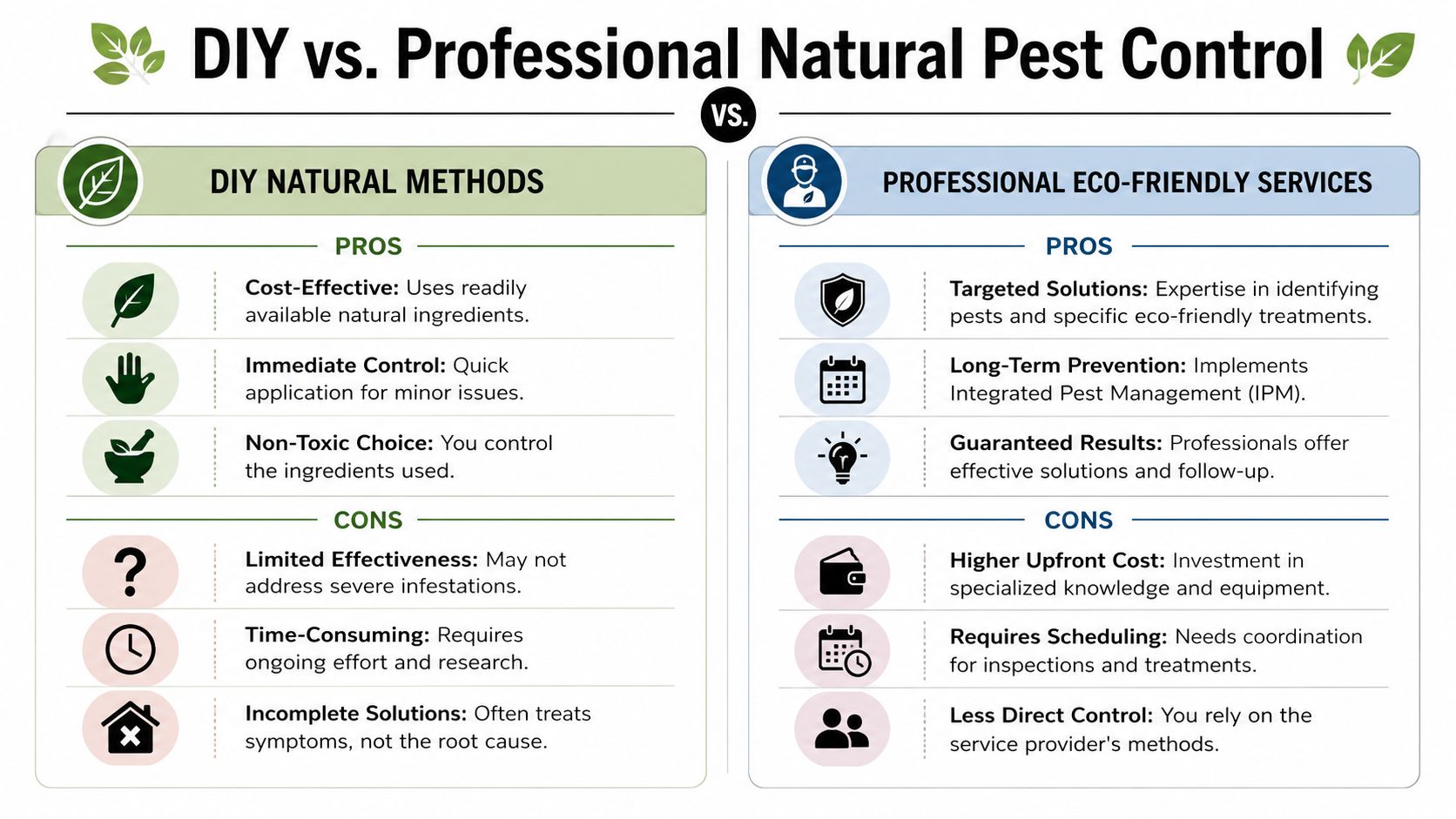
Signs the problem has moved beyond home remedies
A few situations usually signal that DIY is no longer enough:
- Repeat sightings: You clean, spray, or repel, and the pests keep returning to the same area.
- Hidden activity: You hear movement in walls, find droppings, or notice pests around plumbing voids, attics, or crawl spaces.
- Outdoor pressure: Mosquitoes, wasps, or other pests are affecting the whole yard or structure, not one isolated spot.
For serious infestations, the issue isn't effort. It's reach. A homeowner can do a good job on visible surfaces and still miss nesting areas, breeding sites, structural gaps, and moisture conditions that keep the cycle going.
Why integrated work lasts longer
The most reliable solutions combine inspection, sanitation, exclusion, habitat reduction, monitoring, and, when needed, targeted treatment. That's why professional eco-friendly service often feels different from DIY. It isn't based on one trick. It's based on identifying the pest, finding the access point, correcting conditions, and following up when needed.
If your goal is lasting peace of mind, that bigger system usually matters more than whether a remedy smells pleasant or came from a natural ingredients list.
The Green Advantage A Professional Eco-Friendly Solution
When homeowners search for pest control near me, exterminator near me, or pest control in Crown Point, IN, they're usually past the point of wanting random tips. They want a clear answer. What's in the house, why is it there, and what's the safest practical way to stop it from coming back?
That's where a professional eco-friendly approach fits. In Crown Point and across Northwest Indiana, the right service doesn't start with over-treating. It starts with inspection, identification, and a plan built around the site.

What a professional process looks like
A sound residential pest control plan usually includes:
- Inspection first: Identify the pest correctly and look for the conditions supporting it.
- Exclusion and correction: Seal likely entry points and address moisture, clutter, and harborage.
- Targeted treatment when needed: Use the lightest effective approach for the actual problem and setting.
- Follow-up: Check whether the pressure dropped and whether additional corrections are needed.
This is also where commercial pest control differs from casual DIY. Restaurants, offices, multifamily buildings, and retail spaces need consistency, documentation, and prevention habits that hold up under daily use.
A lot of property owners also benefit from improving the surrounding outdoor areas. Reducing dense cover, fixing drainage, and making the yard less hospitable to pests supports any treatment plan. For broader property upkeep, these eco-friendly landscaping tips are worth a look because the outside environment often determines how much pest pressure reaches the structure.
What local homeowners can expect
The Green Advantage offers pest inspections and service plans for homes and businesses in Crown Point and nearby Northwest Indiana communities. That includes support for common concerns such as ant control, mosquito control, rodent control, spider control, wasp removal, and preventative pest treatments. The point of that kind of service isn't to replace common sense steps like cleaning and sealing. It's to build on them with trained inspection and problem-solving.
A homeowner dealing with an active infestation usually needs answers to practical questions:
| Question | Why it matters |
|---|---|
| What pest is this? | Correct identification changes the treatment plan |
| Where is it coming from? | Entry points and nesting areas determine recurrence |
| Is this safe for my home setup? | Kitchens, pets, and children change the approach |
| What keeps it from returning? | Lasting control depends on prevention, not just treatment |
If you want to see the kind of approach that supports long-term prevention, this overview is helpful:
For many homeowners, that combination of inspection, eco-conscious planning, and follow-through is the answer to how to get rid of pests naturally. Use low-impact methods where they make sense. Be realistic about their limits. And when the issue is inside walls, across the yard, or recurring no matter what you try, bring in a trained local team that can solve the whole problem instead of the visible part of it.
If pests are disrupting your home or business in Crown Point, the next step is simple. Contact The Green Advantage to schedule an inspection, request a quote, and get a practical pest control plan built for your property, your family, and the realities of Northwest Indiana.
Flea and Tick Control in Crown Point, in: A Homeowner Guide
You let the dog out, the kids run through the grass, and later that evening someone finds a tick crawling on a sock or attached near a pet's ear. That's usually the moment flea and tick control stops feeling like a minor nuisance and starts feeling personal.
In Crown Point and across Northwest Indiana, that reaction is completely reasonable. Fleas and ticks aren't just annoying. They create stress inside the home, put pets at risk, and turn your yard into a place you stop trusting. What makes these problems harder is that they rarely stay in one place. A pet brings something in from the yard. Eggs end up in carpet and furniture. Wildlife activity along fence lines keeps pressure on the property.
The good news is that this problem is manageable when you treat it as a system instead of a single product purchase. That means looking at the pet, the home, and the yard together. It also means knowing when a do-it-yourself plan is enough and when it's time to bring in professional help.
Flea and tick prevention has also become a major part of routine pet care, not an occasional add-on. The flea and tick control medication market is estimated at USD 7.7 billion in 2025 and projected to reach USD 15.3 billion by 2035, with 7.1% CAGR over that period, while chewable products account for 38.0% of the 2025 segment and over-the-counter products are projected to hold 61.0% of revenue in 2025, according to Future Market Insights flea and tick market projections. That scale reflects how many households now treat prevention as part of normal care.
Your Guide to Flea and Tick Control in Northwest Indiana
A lot of homeowners start in the same place. The pet scratches more than usual. You notice small black specks on bedding. Or you find a tick after a walk around the yard and suddenly every room in the house feels suspect.
That concern makes sense in Northwest Indiana because our mix of lawns, tree lines, shaded beds, pet traffic, and changing weather creates steady opportunities for fleas and ticks to move between outdoor and indoor spaces. In Crown Point, the issue often builds gradually. Pets rest in the same sunny patch near the patio. Rabbits or other wildlife pass through the edges of the yard. Then the problem shows up all at once inside the home.
What local homeowners usually miss
The issue isn't ignored, but efforts often tackle the wrong part first. This means buying a treatment for the dog, spraying a room, or mowing the grass lower. Each step can help, but none of them solves the whole problem by itself.
Practical rule: If you only treat the pet, the house and yard can keep feeding the infestation. If you only treat the house, the pet can bring it right back in.
For dog owners who want a grooming-focused perspective on early warning signs and basic prevention habits, this roundup of expert dog parasite control advice is a useful companion to the property side of the problem.
What a calm response looks like
Start by assuming there are three possible zones of activity:
- On the pet where fleas feed and ticks attach
- Inside the home where eggs, larvae, and hiding adults can persist
- Outside in the yard especially in shaded, protected areas
That framework keeps you from wasting time on one-off fixes. It also makes your next steps clearer. First, confirm what you're seeing. Then choose a treatment plan that matches the actual scale of the problem. If the activity is light and recent, some homeowners can get ahead of it. If it's established, recurring, or spread across multiple rooms and animals, the smart move is often faster professional intervention.
How to Identify a Flea or Tick Problem
The fastest way to lose time is guessing. Flea and tick control works better when you confirm what pest you're dealing with, where it's active, and whether it's limited to one animal or already established in the home.
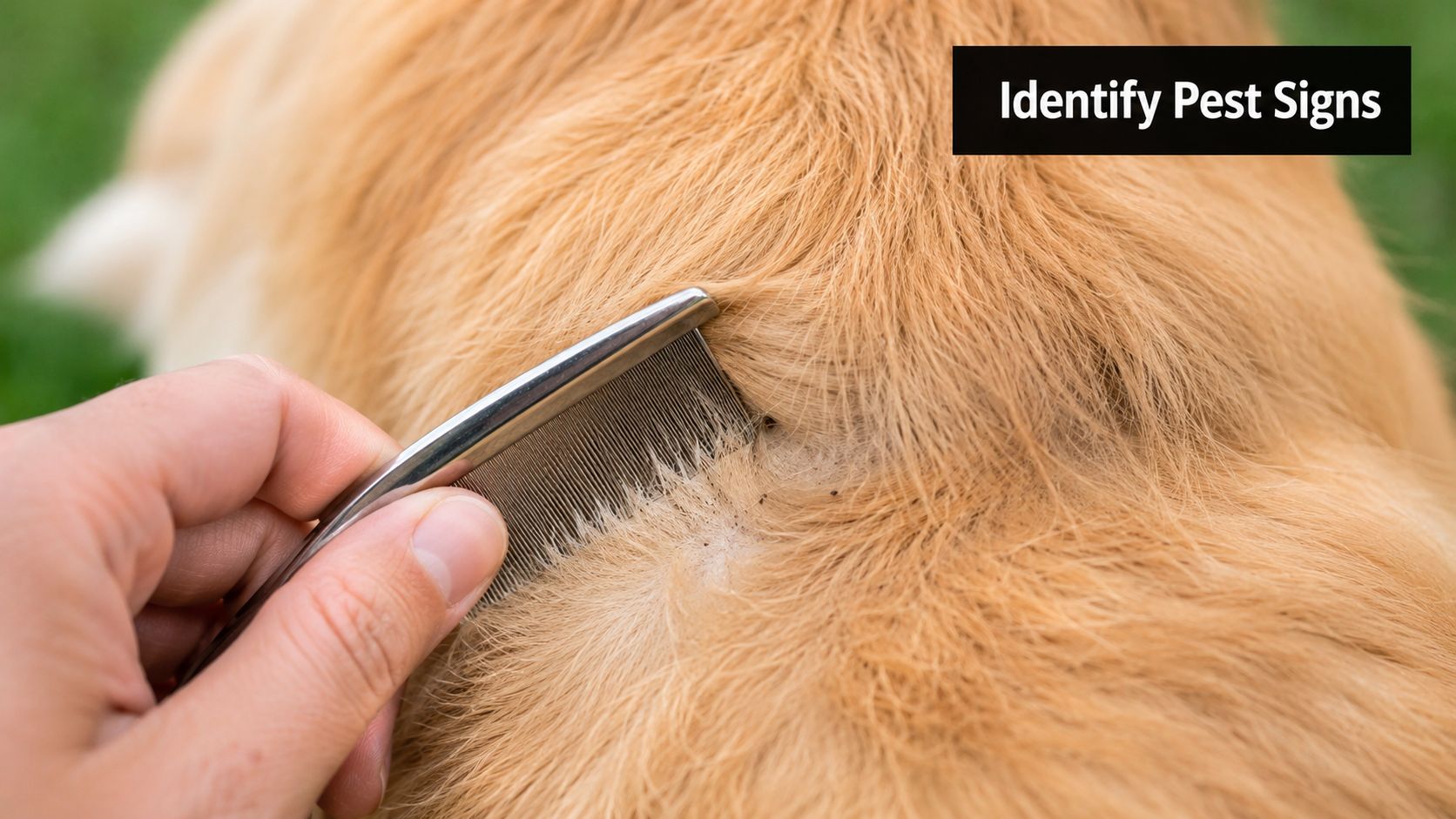
How to check for fleas
Fleas are small, fast, and easy to miss when you're only doing a quick visual scan. A fine-toothed flea comb is more reliable than your eyes alone. Comb slowly around the base of the tail, lower back, belly, and neck. After each pass, tap the comb onto a damp white paper towel or tissue.
If you see pepper-like black specks that smear reddish-brown when wet, that's often flea dirt. Check pet bedding too. Flea dirt on bedding, along with scratching and restlessness, is a strong sign that fleas are active somewhere in the home environment.
A simple home check can also help. Put on white socks and walk slowly through carpeted rooms and areas where pets spend time. Then inspect the socks closely. Fleas are easier to spot against a light background.
For a deeper look at why a few visible fleas can turn into a much larger indoor issue, review the flea reproduction cycle. Understanding that life cycle helps explain why surface-level treatment often disappoints.
How to check for ticks
Ticks create a different kind of problem. They may be crawling on a pet or person, or they may already be attached. On pets, check behind the ears, around the collar line, under the front legs, between the toes, around the eyelids, and near the groin and tail base. On people, pay attention to warm, hidden areas such as the scalp, armpits, waistband, and behind the knees.
An attached tick usually feels like a small bump fixed in place. A crawling tick moves across the coat or skin and hasn't embedded yet. Both matter, because if you find one tick, there may be more in the yard or along the route the pet uses most often.
Signs the problem is larger than it first appears
A mild problem often stays close to pet resting spots. A larger one starts showing up in multiple places.
Look for patterns like these:
- Repeated scratching after a recent walk or yard time
- Specks on bedding that return soon after washing
- Ticks in more than one area of the yard or on more than one family member
- Activity in rooms without carpet which can signal a broader indoor spread
This short visual can help homeowners understand where fleas hide and how pet checks should be done:
If you're seeing activity on pets and in the house at the same time, don't treat those as separate problems. They're connected.
A Coordinated Plan for Your Pets Home and Yard
Flea and tick control breaks down when homeowners treat one area and ignore the others. Veterinary and EPA guidance emphasizes that fleas and ticks can be controlled with a mix of oral, topical, and collar products on pets, while home control may also require vacuuming and laundering bedding, as described by VCA's flea and tick prevention guidance. The key is coordination.
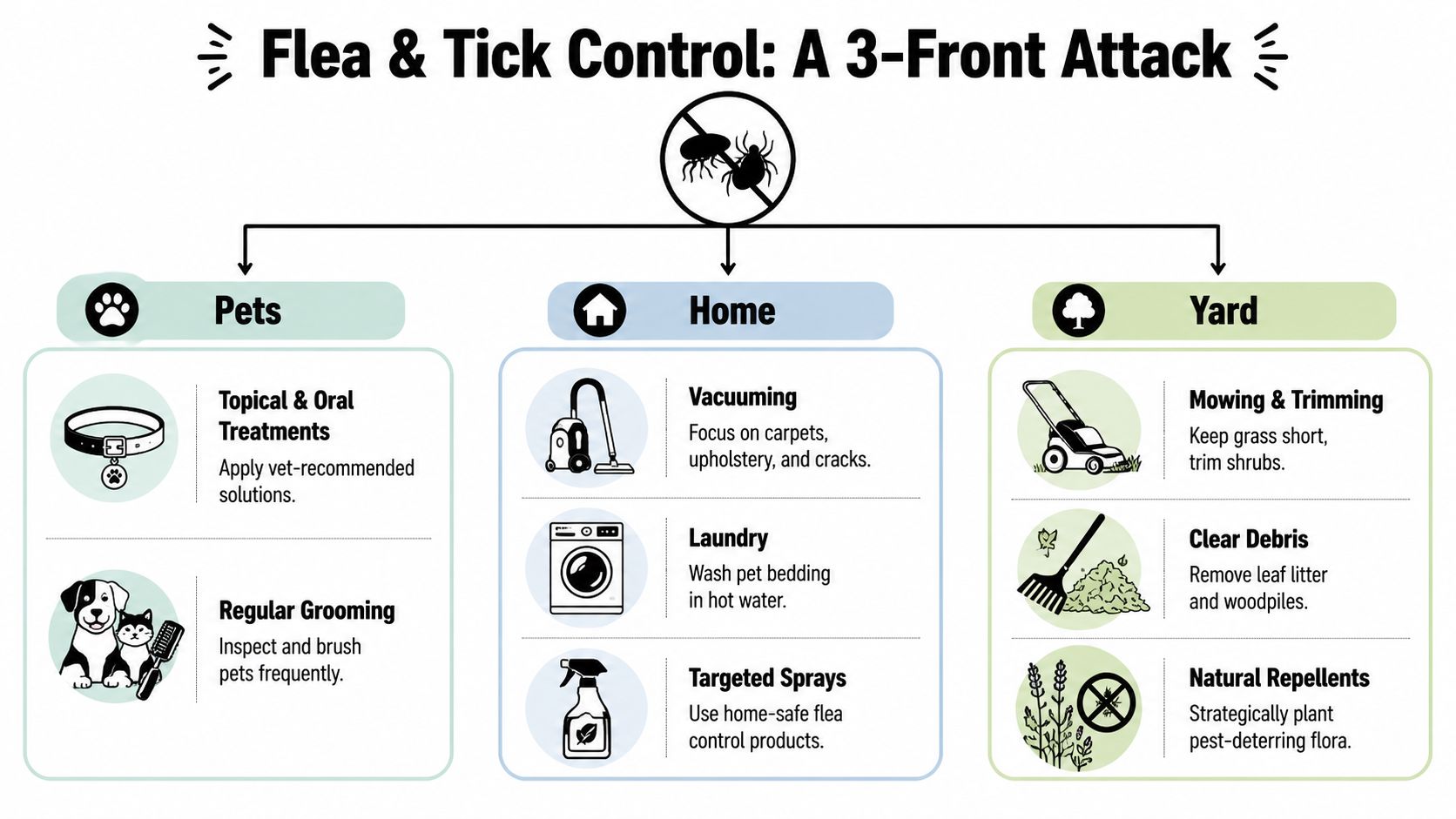
Start with the pets
If even one pet remains untreated, the rest of your work can unravel quickly. Every dog and cat in the home needs to be part of the plan, even if only one seems affected.
Product type matters. Some households do well with topicals. Others prefer collars or chewables because they're easier to keep consistent. The right choice depends on the pet's age, size, health history, and habits. Cornell notes that pet owners should follow species and weight labels carefully, avoid using dog products on cats, and pay attention to special situations such as seizure-prone dogs, puppies, kittens, and pregnant or nursing pets in its flea and tick prevention guidance from Cornell.
Safety matters as much as effectiveness. A product that works well for one pet may be the wrong choice for another.
If your dog swims often, gets frequent baths, or spends long periods outdoors, that should shape the product decision too. Convenience affects follow-through, and follow-through is a large part of success.
Clean the home like you mean it
For indoor flea work, half-measures usually just stir things up. You need repeated, thorough cleaning targeted to the places where pets rest and where vibrations trigger flea activity.
Focus on:
- Vacuuming floors and edges especially along baseboards, under furniture, and where carpet meets wall
- Washing pet bedding and washable fabrics including throw blankets and removable covers
- Checking upholstered furniture where pets nap or climb
- Reducing clutter in rooms where pests have more places to hide
Homeowners often ask whether one deep cleaning is enough. It usually isn't. Vacuuming and laundering need to continue alongside pet treatment, not as a one-day project.
Make the yard less inviting
Outside, fleas and ticks prefer protection. They build up in shade, under shrubs, along fence lines, around wood piles, and in pet resting zones where moisture and host activity overlap.
A practical yard checklist looks like this:
| Area | What to do | Why it helps |
|---|---|---|
| Shaded lawn edges | Mow and trim regularly | Reduces cover and humidity |
| Landscape beds | Remove leaf litter and debris | Limits protected harborage |
| Pet hangout areas | Keep surfaces cleaner and drier | Lowers repeated exposure |
| Fence lines and brushy spots | Open them up where possible | Makes the area less tick-friendly |
If you're evaluating outdoor surfaces and pet-use zones, even design choices can support long-term management. Homeowners comparing low-maintenance options sometimes look at Modern Yard Landscapes' Austin turf solutions for ideas on creating cleaner pet areas that are easier to inspect and maintain.
For a property-focused look at outdoor treatment options, review this guide to yard flea and tick control.
Timing is what ties it together
Treating pets on Saturday, vacuuming once on Wednesday, and thinking about the yard next weekend is how infestations linger. The pet, home, and yard have to be addressed as one coordinated effort. That's the missing piece in most DIY attempts.
One practical option for homeowners in Crown Point, IN who need property-level help is The Green Advantage, which provides pest inspection and treatment support for residential and commercial sites in Northwest Indiana.
Proactive Prevention for Year-Round Peace of Mind
Reactive flea and tick control feels expensive because it always starts when you're already behind. Prevention is different. It turns the property into a less friendly place for pests and reduces the odds that one hitchhiking flea or one tick from the yard becomes a household problem.
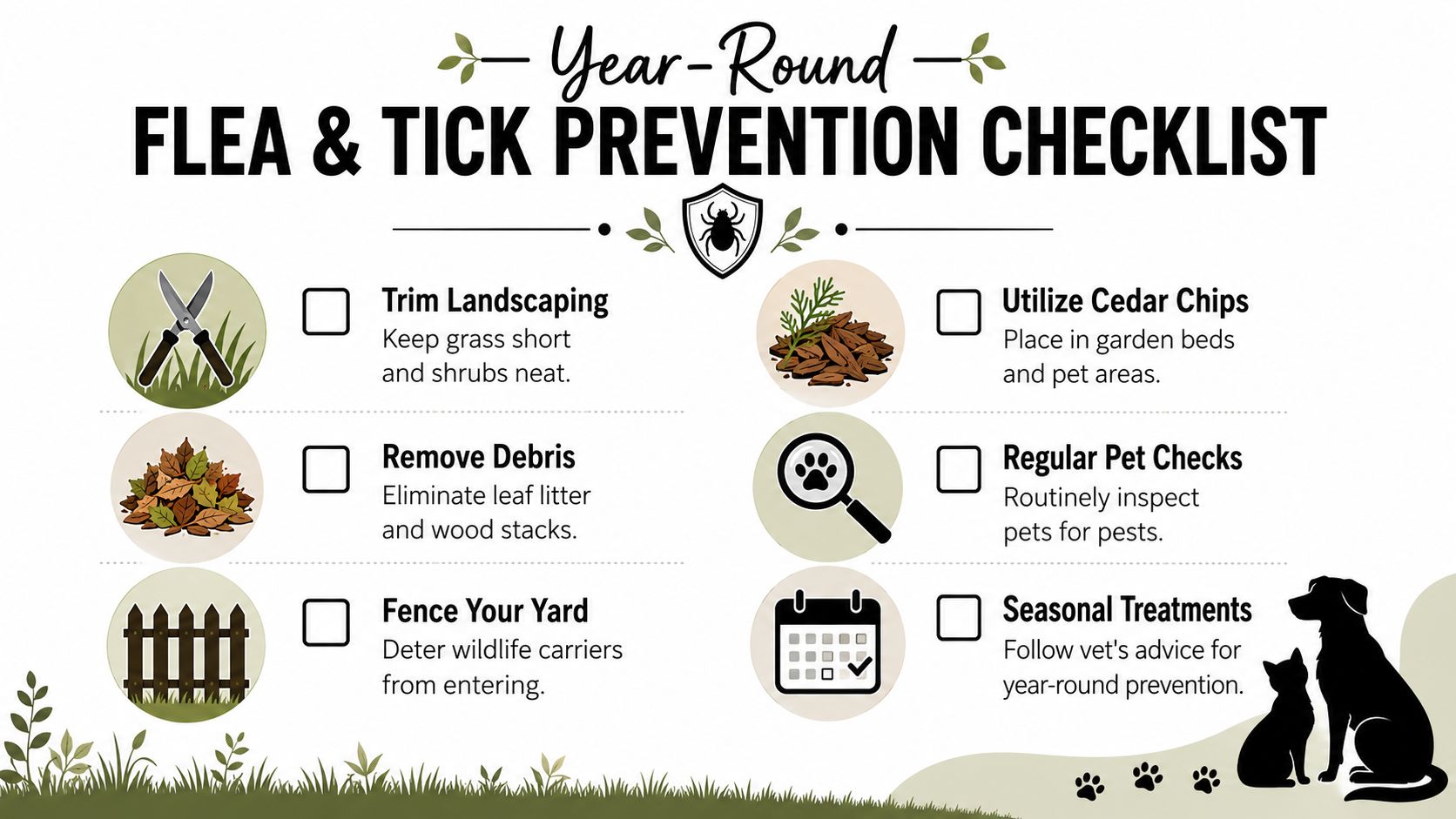
Why consistency beats catch-up treatment
A major reason prevention works better is simple. People are more consistent with protection that's easier to maintain. In a study of over 30,000 dogs, those prescribed 12-week fluralaner were more likely to achieve 7 to 12 months of protection, with 15.7% reaching that range compared with shorter-acting monthly products, according to this real-world adherence study on canine flea and tick protection.
That doesn't mean every pet needs the same format. It means regimen design matters. If a product schedule is hard for the household to maintain, gaps happen. Gaps are where reinfestation starts.
CAPC also notes in the same source that residual insecticides such as selamectin, fipronil, and imidacloprid can kill many newly acquired fleas within 24 hours, but that short window still matters because fleas may feed and transmit pathogens before they die. That's one more reason year-round coverage makes more sense than sporadic treatment.
Property habits that lower pressure
You can't seal your yard off from every pest, but you can make it less comfortable for them.
Use habits like these:
- Trim grass and shrubs so shaded, damp hiding areas don't build up near walking paths
- Remove leaf litter and stacked debris especially where pets cut through the yard
- Discourage wildlife traffic by reducing sheltered edge zones and food attractants
- Check pets after outdoor time with extra attention to ears, paws, legs, and collar line
- Keep screens and entry points in good repair so hitchhiking pests are easier to catch before they spread indoors
The households that struggle most are usually not the ones who missed one step. They're the ones who stop prevention as soon as the immediate problem seems gone.
For cat owners sorting through prevention options, this overview of effective cat flea products is a helpful supplement to your veterinarian's guidance, especially when product form and tolerance are part of the decision.
Think of prevention as home maintenance
In Northwest Indiana, homeowners already plan for weeds, mosquitoes, rodents, and seasonal ants. Fleas and ticks belong in that same category. Not because every property has a major issue, but because waiting until you see activity usually means the pests have had time to settle in.
A good prevention mindset also pairs well with other services homeowners often need, including mosquito control, rodent control, and general residential pest control. The common thread is reducing conditions that let pests stay established around the home.
Why DIY Flea Control Fails and When to Call an Exterminator
DIY flea and tick control often fails for a frustrating reason. The product may do something, but the homeowner expects it to do everything.
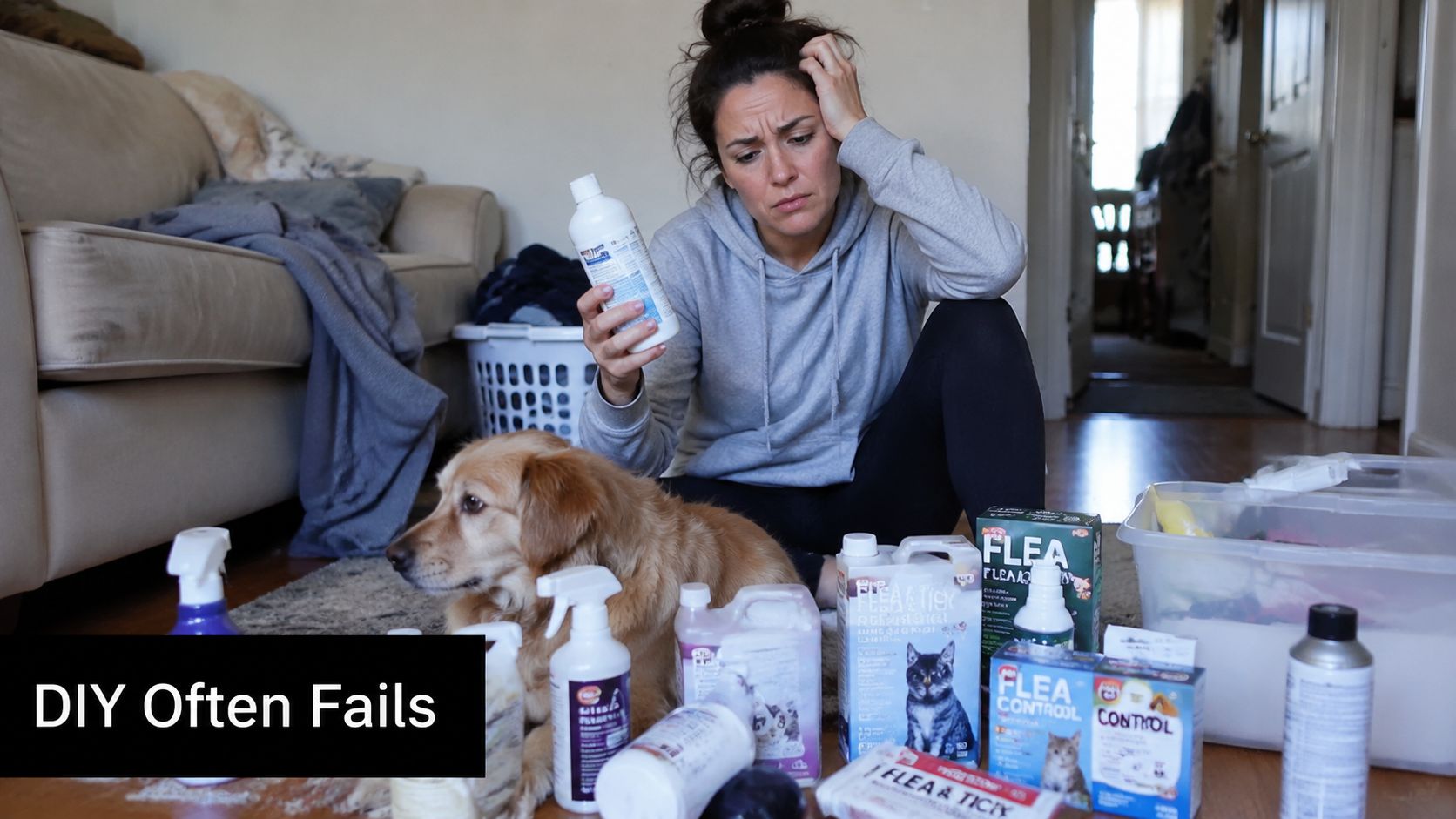
The timeline is longer than most people expect
The CDC lays out a four-step IPM sequence for flea control: sanitize by washing bedding and vacuuming floors, walls, and carpet edges; treat every pet in the home; start home treatment at the same time as pet treatment with outdoor applications focused on shaded and pet-resting areas; and schedule two or more follow-up treatments within 5 to 10 days because some flea life stages are insecticide-resistant. The CDC also states that moderate to severe infestations can take months to control, as explained in the agency's guidance for getting rid of fleas.
That's the point many people miss. They treat once, see fewer bites, and assume they're done. Then hidden life stages keep developing, and the home gets repopulated.
Common DIY failure points
The pattern is usually one of these:
- Pet-only treatment while carpets, bedding, and furniture still support the life cycle
- Indoor-only treatment while pets continue picking up pests outside
- One-time application with no follow-up on the interval the infestation requires
- Inconsistent dosing because the household forgets, delays, or changes products midstream
- Unsafe product use such as applying the wrong species-specific product to the wrong animal
Professional help isn't about giving up. It's about recognizing when biology and logistics are working against the do-it-yourself plan.
When it's time to bring in a professional
Some trigger points are clear. Call for help when:
| Situation | Why it matters |
|---|---|
| You still see fleas or ticks after repeated treatment attempts | The problem may be larger or more widespread than expected |
| Multiple pets or multiple rooms are involved | Control becomes harder to coordinate without a full plan |
| The infestation keeps returning | There may be an untreated outdoor or structural source |
| You have high-risk pets or young children in the home | Product selection and application need tighter safety control |
| You're preparing a rental, sale, or turnover | Fast, property-wide resolution matters more than trial and error |
In Crown Point, IN, this is especially relevant for busy families, landlords, and homeowners dealing with repeat yard pressure. Professional pest control near me searches usually happen after people have already spent time and money on partial fixes. In many cases, an earlier inspection would have shortened the whole process.
The Green Advantage Solution in Crown Point
When homeowners call for flea and tick control in Crown Point, they usually want three things. They want the problem identified correctly, they want a treatment plan that makes sense for their property, and they want to know the process will be handled safely.
That professional process should feel straightforward. It starts with an inspection that looks at where the activity is happening. On the pet side, that often means confirming whether the issue appears limited to hitchhiking exposure or whether there are signs of active indoor establishment. On the property side, it means checking shaded yard zones, pet paths, bedding areas, floor transitions, and furniture where fleas tend to build up.
What homeowners should expect from service
A useful service visit should give you clear answers, not vague reassurance.
You should expect:
- A property-specific assessment based on indoor and outdoor conditions
- A treatment recommendation that matches the scale of the issue
- Straightforward safety instructions for people and pets
- A follow-up plan when the infestation level calls for one
- Clear communication about what you should do between visits
That matters because flea and tick problems aren't solved by product alone. They're solved by matching the right treatment to the right places on the right schedule.
Why local experience matters in Northwest Indiana
Homes in Crown Point and nearby Northwest Indiana communities don't all face the same pest pressure. Some properties back up to wooded edges. Some have heavy pet traffic and shaded landscaping. Some are dealing with recurring issues after trying to manage it alone.
A local exterminator in Crown Point, IN should understand those patterns and be able to tell the difference between a light, recent issue and a more established infestation that needs broader action. That same practical approach usually helps with related concerns too, whether a homeowner is also dealing with mosquitoes in the yard, rodents around the structure, or general residential pest control needs.
If you're tired of second-guessing what's crawling in the house or what's hiding in the yard, it's time to get a real plan in place.
If you need flea and tick control, residential pest control, or an experienced exterminator in Crown Point, IN, contact The Green Advantage to schedule an inspection or request a quote. They'll help you sort out whether the issue is on the pet, in the home, in the yard, or all three, so you can get back to feeling comfortable in your home again.
Expert Lawn Care and Pest Control Services Near Me

A lot of people start searching for lawn care and pest control services near me after the same kind of day. The grass is finally looking decent. The kids or grandkids want to be outside. Then mosquitoes push everyone back indoors, wasps start circling the deck, or ants show up in the kitchen and make it obvious that the problem isn't just “out there.”
In Crown Point and across Northwest Indiana, that pattern is common. Outdoor pest pressure and indoor pest problems often connect more than homeowners realize. What happens in the turf, mulch beds, around the foundation, and near standing water can shape what ends up around your doors, windows, and living spaces.
That's why the smartest solution usually isn't to treat lawn care and pest control as two unrelated chores. A property does better when someone understands the whole exterior environment and knows how to reduce pest pressure before it turns into a bigger problem inside the home.
Your Trusted Local Exterminator in Crown Point IN
A Crown Point homeowner might notice the first warning signs in small ways. Ants start appearing near the sink after a warm stretch. Spiders show up in corners of the garage. By evening, mosquitoes make the backyard hard to enjoy. Soon the search begins for pest control near me, exterminator near me, or a company that can handle both the yard and the pests around it.
That search makes sense because individuals typically prefer not to juggle separate providers, separate schedules, and separate explanations. They want one reliable local team that understands Northwest Indiana conditions and can tell the difference between a one-time nuisance and a pattern that will keep coming back.
What local homeowners are usually trying to solve
In my experience, homeowners aren't just asking for a spray. They're asking for relief from a chain reaction:
- Outdoor irritation: Mosquitoes, wasps, and turf-related pest activity make the yard less usable.
- Indoor frustration: Ants, spiders, rodents, and crawling insects turn a comfortable home into a place where people keep checking corners and baseboards.
- Uncertainty: DIY products might knock down visible activity, but they often miss nesting sites, entry points, and moisture issues that keep feeding the problem.
Most pest issues don't start with the bug you saw. They start with the conditions that allowed that bug to stay.
That's where local experience matters. A family-owned company serving Crown Point, IN and nearby Northwest Indiana communities sees recurring patterns in neighborhoods, lot layouts, drainage, seasonal shifts, and the way pests move from lawn edges to structures.
Why trust matters before treatment starts
Homeowners also want clear communication. They want to know what's happening, what treatment makes sense, and what they should expect afterward. That's one reason the broader industry pays so much attention to communication and service presentation. If you're curious how companies think about connecting with homeowners before the first appointment, this overview of Pest control marketing strategies is a useful look at what builds trust and what feels generic.
When you call for pest control in Crown Point, IN, you shouldn't feel like just another stop on a route. You should feel like you're talking with people who know the area, respect your home, and can solve the actual cause of the problem.
The Advantage of an Integrated Lawn and Pest Program
A common Crown Point call goes like this. The grass is thinning near the fence, mosquitoes are bad by the patio, and ants keep showing up near the back door. If those problems get handled by separate providers who never compare notes, the symptoms may improve for a while, but the cause often stays in place.
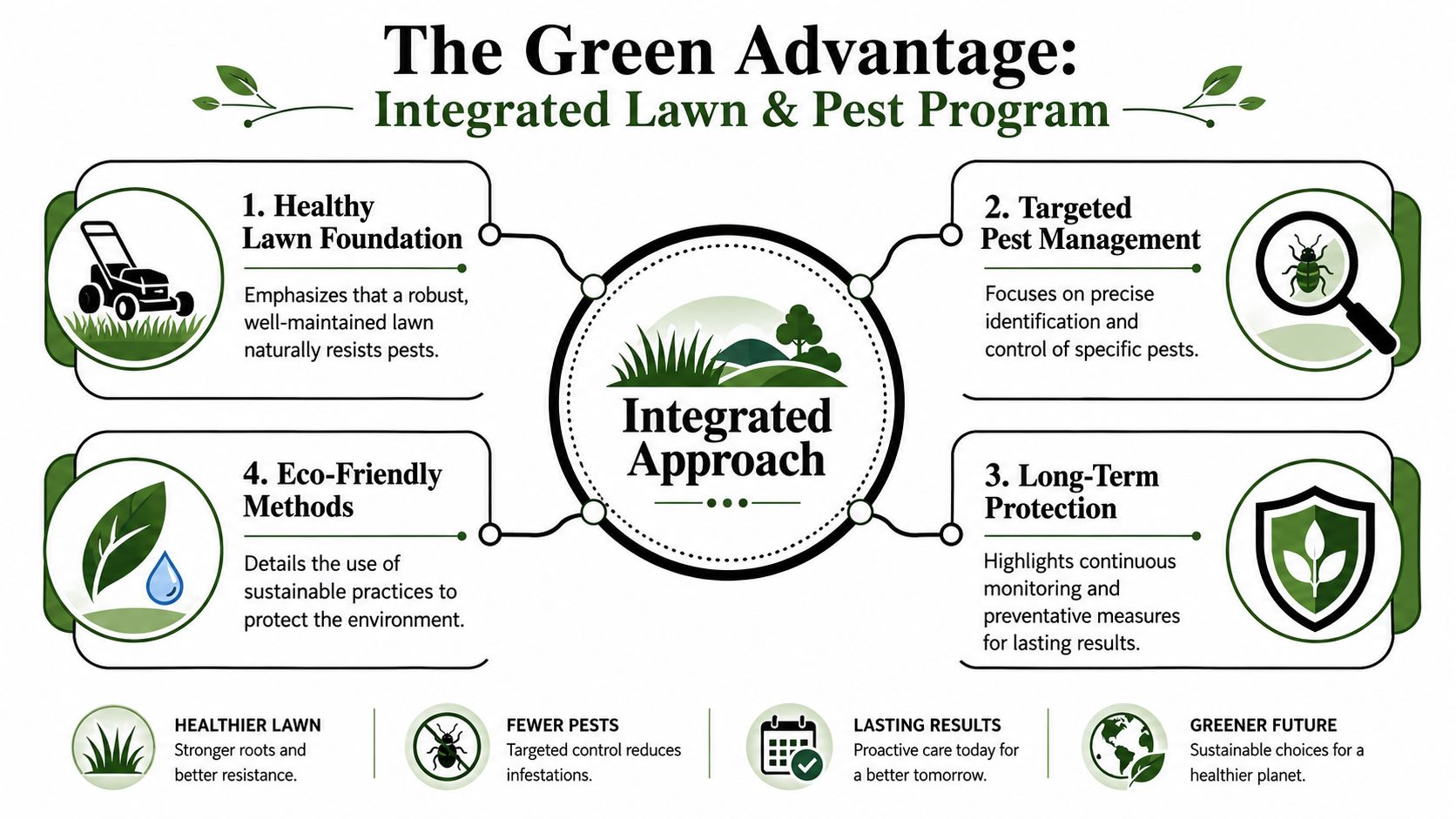
An integrated lawn and pest program works better because the yard, the foundation edge, drainage, shade, turf stress, and insect activity all affect each other. That perspective matters here in Northwest Indiana, where spring moisture, summer heat, and heavy clay soils can create pest pressure fast. A company that started in lawn care and grew into pest control brings a different set of eyes to the property. It sees how outdoor conditions feed indoor problems.
Why the lawn matters to pest pressure
Pests respond to conditions first.
Thin turf, excess thatch, standing water, compacted soil, overwatered areas, and overgrown edges create cover, moisture, and breeding space. Those conditions can support mosquitoes, ants, stinging insects, and other pests before they ever reach the house. Treat the pest without correcting the site conditions, and the problem often comes back sooner than homeowners expect.
Healthy turf helps, but it is not a cure by itself. Dense grass can reduce exposed soil and cut down on some harborage. Better drainage can make a yard less attractive to mosquitoes. Cleaner edges along patios, walkways, and foundations make inspections more accurate and treatments more targeted.
Why combining services can be smarter, and when it is not
A combined plan makes the most sense when the same outdoor conditions are driving both lawn stress and recurring pest activity. That is often the case on properties with damp low spots, shaded fence lines, heavy insect pressure around outdoor living areas, or repeated activity near entry points.
Separate service can still be the right choice in some situations. If the lawn is in good shape and the problem is a one-time interior issue, a standalone pest visit may be enough. If a homeowner already has a lawn specialist they trust, the better move may be coordination instead of replacement.
| Property situation | Integrated plan usually makes sense when | Separate service may make sense when |
|---|---|---|
| Yard and house both show recurring activity | exterior conditions are clearly driving repeat pest issues | pest issue is isolated and not tied to outdoor conditions |
| Family uses the yard often | mosquito reduction and perimeter prevention need to work together | lawn health is fine and only one interior pest issue needs attention |
| Turf problems and insect pressure overlap | technician needs to judge both site conditions and pest timing | homeowner already has a separate lawn specialist they want to keep |
The key trade-off is simple. One coordinated plan usually gives a clearer diagnosis and better timing. Separate services can work, but only if both sides are paying attention to the same conditions on the property.
What integrated management looks like in practice
Good integrated work does not mean applying more product. It means inspecting first, fixing favorable conditions where possible, and treating the right areas at the right time. That is the foundation of integrated pest management, and it fits homes in Crown Point especially well because no two lots hold moisture, shade, and pest pressure the same way.
For homeowners who want practical upkeep tips between service visits, SkipCalls' Lawn Care Advice offers a useful general reference on routine yard care.
A key advantage is coordination. When one team understands turf health, drainage patterns, pest harborage, and how insects move from the yard toward the structure, it can solve problems with fewer blind spots and a safer, more deliberate plan.
Common Seasonal Pest Threats in Northwest Indiana
Northwest Indiana doesn't have one pest season. It has several. Pest pressure shifts with temperature, rainfall, mowing patterns, moisture around foundations, and when insects and rodents start looking for food, water, or shelter.
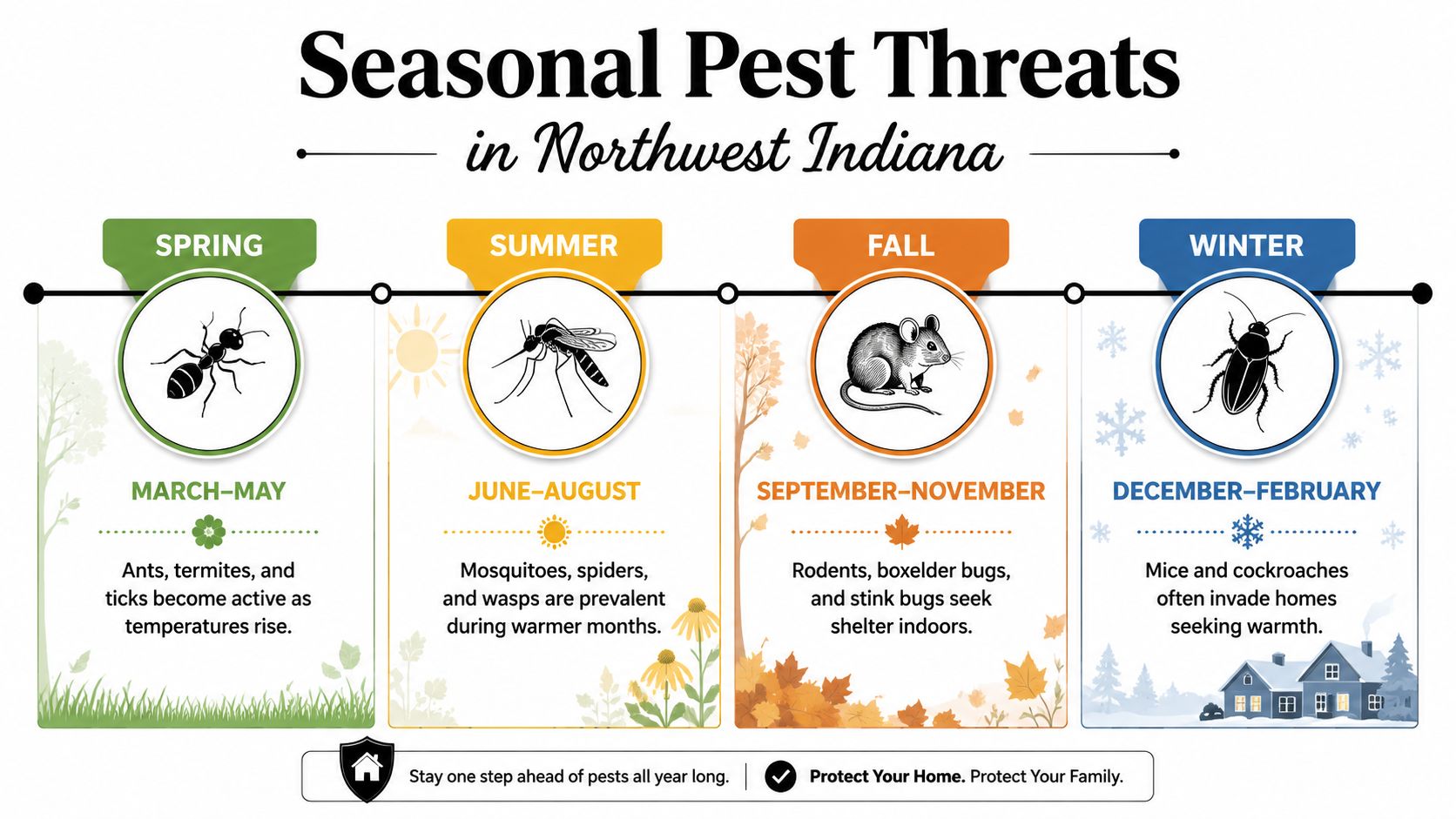
Spring and summer pressure around the yard
As the weather breaks, ants start foraging more aggressively. Spiders become more noticeable as insect activity builds around lights, soffits, and garages. Mosquitoes take advantage of standing water in gutters, low spots, toys, planters, and shaded zones that stay damp.
Wasps also become more active as nesting sites develop under eaves, around play sets, in sheds, and near entry points. The mistake many homeowners make is waiting until activity feels severe. By then, nests are established and mosquito breeding has already been underway.
For lawn-related insects, timing matters just as much as product choice. The Massachusetts homeowner IPM guide notes that grub action thresholds are typically around 8 to 10 grubs per square foot and that some insecticide timing works best 2 to 3 weeks after peak moth flight activity, which shows why measured density and lifecycle timing beat guesswork (homeowner IPM timing and thresholds).
Fall and winter invaders
When temperatures cool, the pest story changes. Rodents start exploring garages, utility penetrations, crawl spaces, and foundation gaps. Boxelder bugs, stink bugs, and other overwintering pests collect on sunny exterior walls and look for sheltered entry points.
Once they're inside, the issue stops being seasonal annoyance and starts becoming a household problem. That's why fall exclusion work matters so much. The best rodent control often starts before you ever hear scratching in a wall.
What to watch for by season
- Early warm weather: Ant trails, spider web buildup, and pest activity around mulch beds and foundation lines.
- Peak outdoor months: Mosquito pressure near shade and standing water, plus wasp activity near rooflines and outdoor gathering spaces.
- Cooling weather: Mice seeking shelter, insects gathering on siding, and more pest movement into garages and storage areas.
If a pest shows up in the same season every year, that's usually a prevention problem, not a surprise problem.
What doesn't work well
A one-size-fits-all schedule rarely works in Northwest Indiana. The pests aren't the same in April, July, and November, so the response shouldn't be either. Good service adjusts with the season, the property, and what the inspection shows.
Our Professional Residential and Commercial Pest Services
A good service plan starts with how the property functions. A single-family home in Crown Point has different pressure points than a restaurant, office, warehouse, or multi-unit building. The work should reflect that from day one.
Our background in both lawn care and pest control matters here. Outdoor pest pressure rarely starts at the door. It usually builds in turf, planting beds, moisture zones, shaded edges, trash areas, and along the foundation. Teams that understand those outdoor conditions can usually solve problems faster because they are treating the source, not just the symptom showing up indoors.
Residential pest control that addresses the source
In homes, the first job is finding out why the pest activity keeps returning. That means identifying the pest correctly, checking likely entry points, and looking at the conditions that support it. I look for gaps at doors and windows, garage transitions, mulch piled too high at the foundation, damp areas, cluttered storage, and signs that insects are feeding other pests.
Common residential concerns in Crown Point and nearby Northwest Indiana neighborhoods include:
- Ant control: Tracing where the colony is feeding and entering, then treating the source of activity.
- Spider control: Reducing web buildup, harborage areas, and the insect activity that keeps spiders around.
- Rodent control: Using traps, exclusion, and practical sanitation corrections together.
- Wasp removal: Removing active nests and reducing repeat activity near doors, patios, soffits, and play areas.
- Mosquito control: Treating resting areas outdoors and cutting down breeding sites where possible.
- Termite and inspection work: Checking for hidden risk factors before damage becomes obvious.
The trade-off is straightforward. Quick spray-only service may knock activity down for a short time, but recurring issues usually call for exclusion, habitat correction, and follow-up.
Commercial pest control requires consistency and documentation
Commercial work has less room for guesswork. Property managers, business owners, and facility teams need clear records, reliable scheduling, and service that fits how the building is used. A retail storefront, professional office, food service space, and multi-tenant property each create different risks.
Consistency matters more than one heavy treatment. If staff keeps seeing pest activity, there is usually an unresolved access point, sanitation issue, or exterior condition feeding the problem. The right plan accounts for traffic patterns, storage practices, delivery areas, dumpsters, utility penetrations, and seasonal changes around the building.
Why IPM fits both home and business service
Integrated Pest Management works because it combines inspection, monitoring, targeted treatment, and correction of the conditions pests need to thrive. For a company that grew from lawn care into pest control, that approach is a natural fit. The same property conditions that affect turf and plant health often affect insect and rodent pressure too.
That shows up in day-to-day service:
- Correct identification first: The plan changes depending on the pest, the season, and where activity is starting.
- Monitoring before over-application: Some problems need ongoing observation, not automatic over-treatment.
- Targeted product use: Materials should be applied where they will do the job, and only where they are warranted.
- Habitat correction: Moisture, food sources, entry points, and shelter usually need attention along with treatment.
The Green Advantage provides residential and commercial pest services in Northwest Indiana with that integrated approach. That gives homeowners and businesses a clearer answer to a common question. Lawn care and pest control work better together when the same team understands the whole outdoor environment around the property.
Protect Your Health Property and Peace of Mind
People sometimes treat pest control like an optional add-on until they've had a real infestation. Then the value becomes obvious very quickly. Professional service protects more than comfort. It helps protect the way a property functions day to day.
Health concerns aren't just about visible pests
Mosquitoes can make yards hard to use. Rodents can contaminate areas you don't check every day. Cockroaches and other indoor pests can spread through hidden spaces before activity becomes obvious. Even when the immediate issue seems minor, the stress it creates for a household is real.
Parents, pet owners, older adults, and anyone caring for guests usually want two things at once. They want the problem handled effectively, and they want a treatment approach that is thoughtful and site-specific.
A home feels different when you stop wondering what's crawling behind the wall, under the sink, or around the back door at night.
Property protection is part of routine maintenance
Exterior pest management belongs in the same conversation as lawn upkeep, drainage correction, and seasonal property care. The market itself reflects that scale. The U.S. landscaping services industry generated $188.8 billion in revenue in 2025, with about 1.32 million workers across roughly 635,000 firms, according to LawnStarter's landscaping industry statistics. That scale shows this isn't a niche service category. It's a normal part of maintaining residential and commercial property.
For homeowners, that means prevention usually costs less stress than repair. It's easier to keep rodents out than to clean up after them. It's easier to reduce mosquito habitat than to give up the yard all summer. It's easier to catch a developing issue at inspection time than after damage or repeated infestations.
Peace of mind has practical value
A pest-free home changes how people live in it. You use the patio. You stop checking the pantry every morning. You don't worry about hearing movement in the attic when the weather turns cold.
That peace of mind is why recurring service plans exist. They aren't just about treatment. They're about keeping small issues from turning into disruptive ones.
The Green Advantage Process from Start to Finish
Homeowners usually feel better once they know exactly what happens after they call. A clear process removes a lot of the uncertainty.
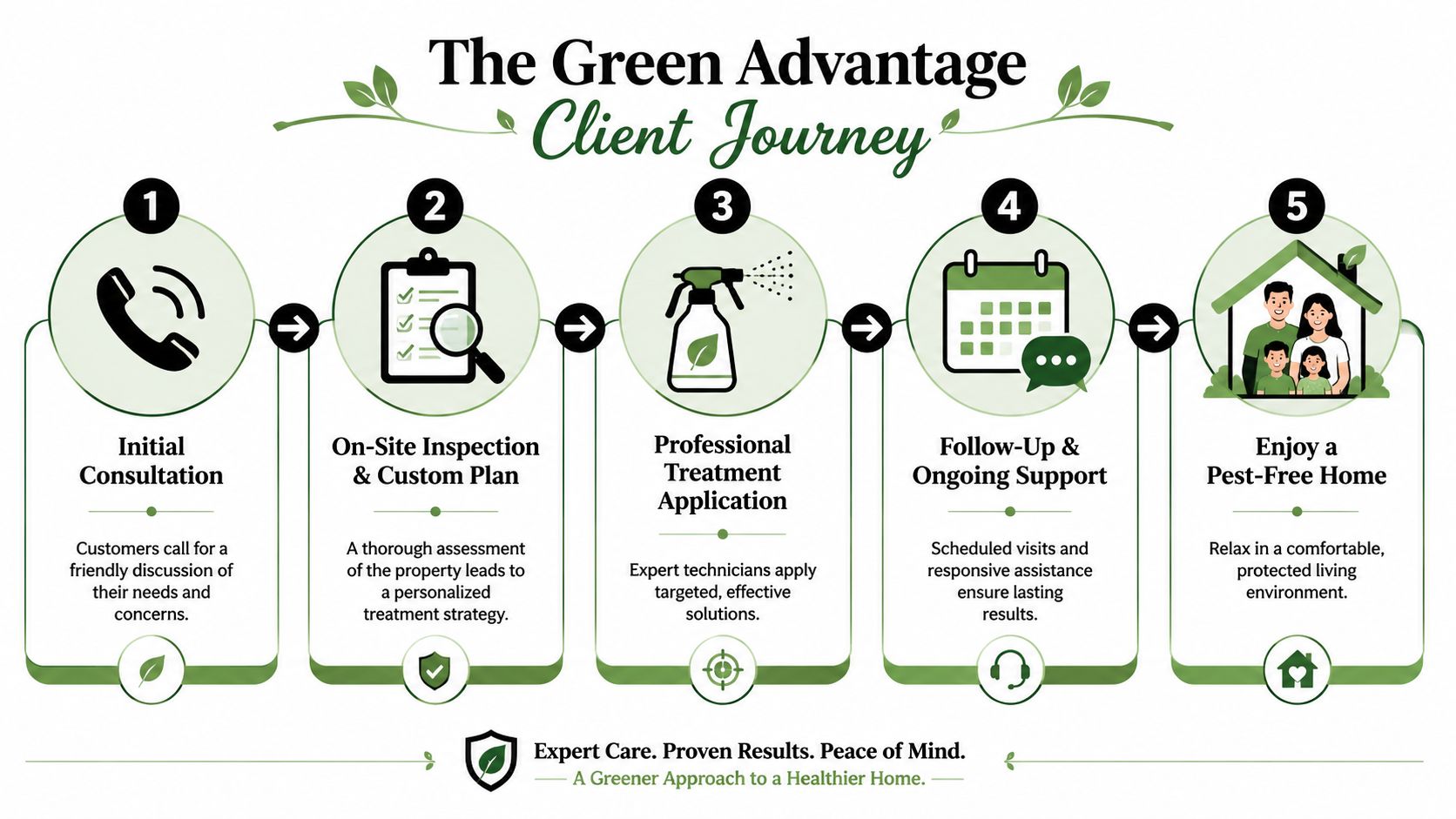
Step one through step three
The process starts with a real conversation. Office staff gathers the basics, including what pests you're seeing, where activity is happening, how long it's been going on, and whether there are outdoor conditions that may be contributing.
Then comes the on-site inspection. That's where a technician checks the structure, the exterior zones that matter, and the signs that separate a surface-level nuisance from a recurring pattern. After that, the property gets a customized treatment plan rather than a generic script.
A typical early flow looks like this:
- Initial consultation: Discuss the pest issue, timing, and property concerns.
- Inspection: Identify the pest, contributing conditions, and likely access points.
- Treatment plan: Match service to the property instead of forcing the property into a preset package.
Treatment and follow-up
Once the plan is in place, treatment focuses on the right areas and the right methods. Depending on the issue, that may involve exterior applications, nest treatment, rodent control measures, monitoring devices, exclusion recommendations, or adjustments to outdoor conditions that are helping the infestation.
After service, good follow-up matters. Homeowners should know what was done, what activity may continue briefly, and what changes they can make to support longer-term control. For properties that also need guidance on keeping turf, ornamentals, and beds looking clean after outdoor service, this page on post-care perfection for turf trees and landscape beds is a helpful companion.
A pest plan should never feel mysterious. You should know what the technician found, why the treatment fits, and what happens next.
Why recurring service keeps growing
More property owners are choosing preventive plans because they want convenience and fewer surprises. The combined global lawn maintenance and pest control service market was valued at $97.3 billion in 2024 and is projected to reach $150 billion by 2035, with about 4.0% CAGR from 2025 to 2035, according to Wise Guy Reports' lawn maintenance and pest control service market overview. That projected growth points to steady demand for ongoing, preventive service rather than waiting for problems to escalate.
That trend makes sense. Many individuals don't want to keep starting from zero every season.
Schedule Your Pest Inspection in Crown Point Today
If you're searching for lawn care and pest control services near me, you're probably not looking for theory. You want a clear answer, a reliable appointment, and a plan that fits your home or business in Crown Point and nearby Northwest Indiana communities.

An integrated approach gives you that. Instead of looking at the lawn, the perimeter, and the pest issue as separate headaches, it treats them as connected parts of the same property. That leads to smarter inspections, more targeted service, and fewer blind spots.
What to do before you book
Before scheduling, it helps to make a short list of what you've seen and where you've seen it. Note whether activity is worse after rain, during evening hours, or in certain rooms or sections of the yard. If you're coordinating with family members, tenants, or staff, consistent reminders can also make appointments easier to keep. This article on Call Loop for better appointment reminders has practical ideas for reducing missed visits.
When homeowners are ready to act, they usually want three things:
- A prompt inspection
- An explanation in plain language
- A treatment plan that respects the property and the people living on it
For a closer look at the kind of service homeowners are often looking for, this short video gives helpful context.
If pests are interrupting your yard, creeping into your home, or making you second-guess your property maintenance, now's the right time to get it checked.
Contact The Green Advantage to schedule a pest inspection, request a quote, and get a practical plan for your Crown Point home or Northwest Indiana property.
Natural Pest Control for Home: Safe & Effective Methods
You hear it at the worst time. Scratching in the wall after dark. A line of ants near the sink before coffee. A wasp circling the porch when the kids want to go outside. Most homeowners in Crown Point don't panic because they saw one bug. They panic because they don't know what happens next.
That concern is reasonable. You want the problem handled, but you also want to be careful about what goes into your home, around your pets, and near the places your family uses every day. Natural pest control for home makes sense for that reason. It focuses on reducing what pests need to survive, then using lower-toxicity options carefully instead of reaching for broad sprays first.
Your Guide to Natural Pest Control in Crown Point
In Crown Point and across Northwest Indiana, pest issues usually start with ordinary conditions. A little moisture under a sink. Gaps around a door sweep. Pet food left out overnight. A woodpile close to the siding. Most infestations don't begin because a house is dirty. They begin because a house gives pests food, water, shelter, or access.
That prevention-first mindset matters because pest treatment at home happens at a huge scale. Approximately 4.4 billion pesticide applications are made each year to American homes, gardens, and yards, which shows how common household pest management is and why smarter, prevention-based methods matter for everyday homeowners, according to healthy housing guidance on pesticides and pest prevention.
A homeowner looking for pest control in Crown Point, IN or an exterminator near me usually wants two things at once. They want relief now, and they want confidence that the fix won't create a new problem. That's where natural methods can help, if they're used with a clear plan.
What homeowners usually mean by natural control
For most homes, natural control doesn't mean ignoring the issue or trying random internet remedies. It usually means:
- Stopping access by sealing cracks, gaps, and utility openings
- Removing attractants like standing water, open trash, crumbs, grease, and clutter
- Making the yard less inviting by moving woodpiles, trimming back growth, and reducing harborage
- Using targeted products carefully when a pest has been correctly identified
Practical rule: If a method doesn't address food, water, shelter, or entry, it usually won't hold up for long.
Why local conditions matter in Crown Point
Homes in Northwest Indiana deal with shifting seasons, wet periods, freeze-thaw cycles, and pest pressure that changes through the year. Ants may trail indoors when outdoor conditions change. Spiders show up where they find insect activity. Rodents look for warmth and shelter as temperatures drop. Mosquitoes take advantage of standing water in yards and containers.
That means residential pest control isn't just about killing what you can see. It's about understanding why a pest chose your property in the first place and fixing that reason before the problem grows.
First Line of Defense Preventing Pests Naturally
The strongest form of natural pest control for home is prevention. That's not a slogan. It's how professionals keep low-toxicity strategies effective over time.
Extension guidance describes the most technically sound approach as an integrated pest management, or IPM, workflow: identify the pest, monitor activity, set a damage threshold, choose a control method, and evaluate results. It also notes that low-toxicity control works best when it starts with exclusion and sanitation, as explained in South Dakota State University Extension's guidance on organic pest control methods.
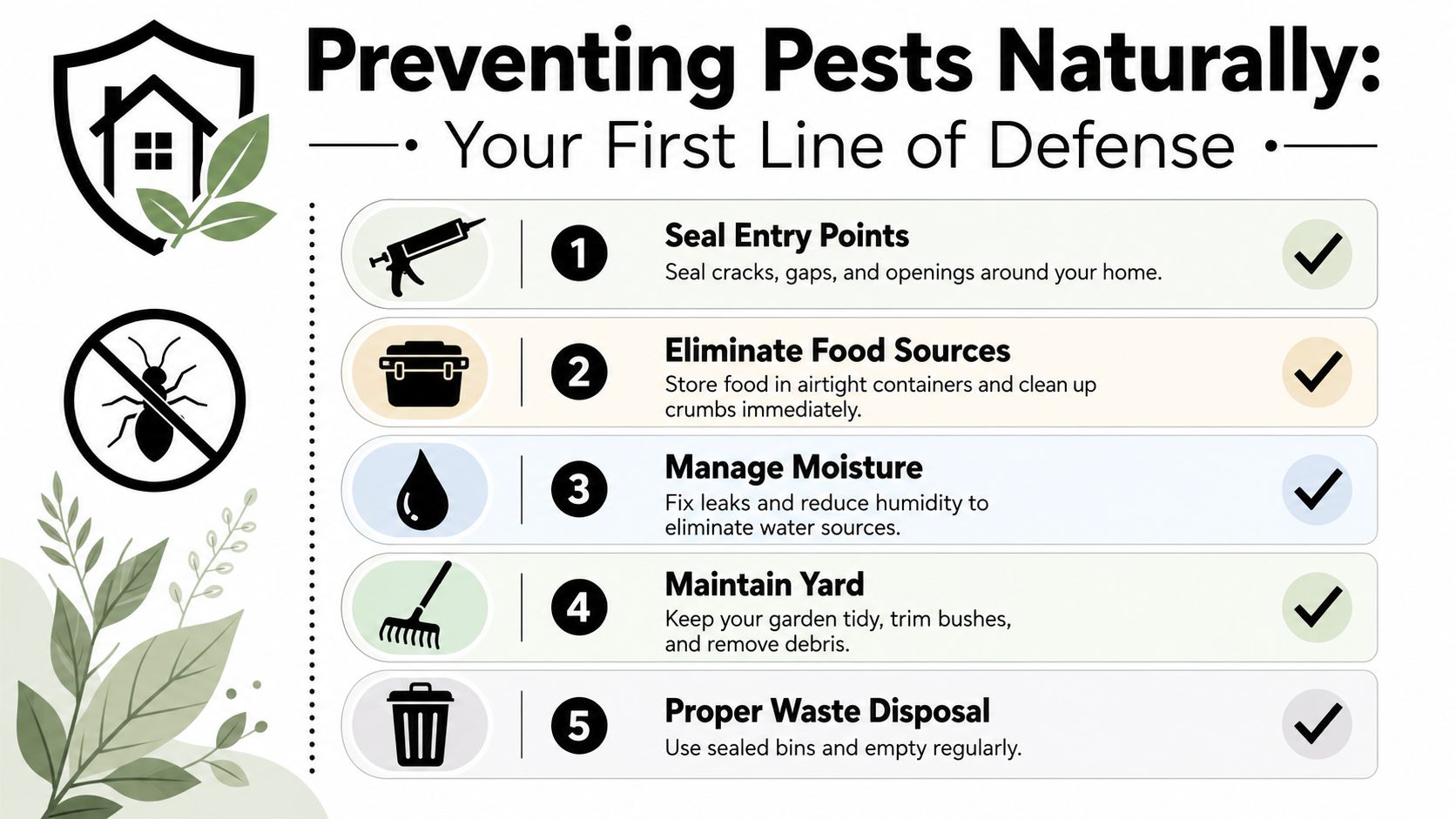
Think like a pest before you treat like a homeowner
Pests don't enter at random. They follow conditions.
Ants follow food residue and moisture. Spiders stay where insects are already present. Rodents look for small openings, protected nesting spots, and a dependable food source. Mosquitoes need breeding water. Wasps prefer sheltered areas where a nest can stay undisturbed.
If you solve those conditions first, you often shrink the problem before any product comes out of the garage.
A practical prevention checklist
Start outside and work in. That's the fastest way to spot the reasons pests keep returning.
- Seal entry points: Check door sweeps, window frames, utility penetrations, vents, siding gaps, and foundation cracks. Even a small gap can turn into a regular access route.
- Manage moisture: Repair plumbing leaks, improve drainage, clean gutters, and reduce damp areas in crawlspaces, basements, and under sinks.
- Control food sources: Store pantry goods in sealed containers, wipe up grease, vacuum crumbs, and don't leave pet food out overnight.
- Reduce yard shelter: Move mulch and woodpiles away from the structure, trim vegetation back from the house, and remove debris that gives pests cover.
- Handle waste correctly: Use sealed trash cans and don't let garbage or recycling sit open near entry doors.
Where homeowners often miss the real issue
A lot of people focus on the room where they saw the pest. The underlying issue is often nearby, but not visible. A dripping hose bib can support ants outside the wall. A clogged gutter can support mosquitoes in the yard. Dense shrubs against the home can create a shaded highway for insects.
Screens matter too. If you're comparing screen options for keeping flying insects out of outdoor living spaces, it's worth reviewing this guide on find the best Florida bug screens from Rescreen Rescue. The climate is different, but the basic screening principles are useful anywhere bugs exploit openings.
Prevention works best when you make the home harder to enter and less rewarding to stay in.
When prevention needs monitoring
IPM isn't a one-time cleanup. It works because you keep checking the result. If ants disappear from one corner and reappear at another window, that tells you access changed, not that the problem is solved. If spiders come back, look for the insect activity feeding them. If rodents stop making noise but droppings remain fresh, the entry point is still open.
For homeowners searching for pest control near me in Crown Point, this is often the biggest difference between a short-term fix and real control. Natural methods work better when they're part of a repeatable system.
Safe and Simple DIY Natural Pest Treatments
A homeowner in Crown Point often reaches this stage after doing the right early work. The crumbs are cleaned up, the trash is under control, the obvious gaps are sealed, but ants still show up at the sink or flies keep gathering by the back door. That is usually the point where natural DIY treatment makes sense. Used carefully, it can lower pest activity enough to tell you whether the problem is small and accessible or larger and hidden.
Soap sprays for the right pests
Soap and oil sprays are contact tools. They work on exposed, soft-bodied insects. They do not perform the same way on harder-bodied pests or insects sheltering in cracks, wall voids, or nests. A common mix is 1 tablespoon of soap per quart of water, and this University of Florida natural pest control overview explains why results depend so much on the insect type and the way the spray is applied.
That matters in a home setting. If the issue is small insects on patio plants or a limited cluster of pests you can see and hit directly, soap spray may help. If you are dealing with roaches under appliances, ants entering through hidden exterior gaps, or wasps working from a protected nest site, a contact spray usually falls short.
Use it with a little discipline:
- Mix with suitable water: Hard water can reduce performance. Distilled water is often a better choice.
- Apply where insects are active: Spraying baseboards, air, or large room surfaces rarely solves much.
- Test surfaces first: Plants, finished wood, and delicate materials can react.
- Expect reapplication: Soap sprays do not leave much residual protection.
Repellents are support tools
Peppermint, citronella, eucalyptus, and similar oils can make an area less attractive for some pests. Basil, lavender, rosemary, and marigolds can also help around patios and entry points. Those methods are useful for reducing pressure in a specific area, especially outdoors, but they do not remove the reason pests are there.
If ants have a moisture source under the siding, or flies are breeding near trash, drains, or pet waste, the scent changes the traffic pattern more than the infestation. Homeowners notice this all the time. One corner gets quieter and another starts up.
For outdoor fly pressure, how to use neem oil for flies is a practical example of how plant-based products are commonly used. Neem can have a place in a lower-toxicity plan. It still works best as one piece of the job, not the whole job.
Use a simple decision rule before you treat
The safest DIY approach is to match the treatment to the pest and to stop once the risk changes.
Use natural DIY methods when:
- You can identify the pest with reasonable confidence
- Activity is light and limited to one area
- You can reach the source without climbing, opening walls, or handling a nest
- No one in the home is at risk from stings, bites, or allergen exposure
Stop DIY and call for help when:
- Activity keeps returning after two or three focused attempts
- You see droppings, grease marks, gnawing, or damage
- The pest is stinging, wood-damaging, or hard to identify
- The source appears to be in a wall, attic, crawl space, roofline, or underground
That decision point saves homeowners a lot of frustration. It also avoids the common mistake of applying one natural product after another while the underlying source keeps growing.
Where DIY fits best
DIY natural pest control works best in a narrow range of problems. It can reduce pressure and buy time. It rarely solves a hidden infestation.
| Situation | DIY may help | DIY probably won't be enough |
|---|---|---|
| Ants | Wiping trails, storing food tightly, spot-treating visible activity | Repeated trails from the same entry area or hidden colony activity |
| Spiders | Removing webs, vacuuming, cutting down the insects they feed on | Frequent return tied to ongoing insect activity in garages, basements, or eaves |
| Mosquitoes | Emptying standing water, trimming damp shaded areas | Ongoing yard-wide pressure with multiple breeding spots nearby |
| Wasps | Monitoring early paper wasp activity from a safe distance | Active nests near doors, soffits, decks, or play areas |
| Rodents | Cleaning up food spills, reducing clutter, securing stored goods | Noises in walls, fresh droppings, chewing, or repeat entry signs |
Homeowners who want a broader low-toxicity plan can review these environmentally friendly pest control methods to see how targeted products, inspection, and follow-up work together.
A short visual walkthrough can help if you're sorting through options before taking the next step.
When DIY Is Not Enough The Professional Advantage
DIY usually fails for one simple reason. It targets the pest you saw, not the system supporting it.
A few ants at the sink may be the visible edge of a larger access pattern outside. A wasp on the porch may mean a nest tucked into a roofline. Rodent droppings in a utility room may point to multiple entry routes plus nesting activity you can't safely inspect on your own. By the time homeowners search for an exterminator in Crown Point, IN, they often aren't dealing with a single bug problem. They're dealing with a recurring property problem.
Signs you've crossed the DIY line
Some situations call for professional help quickly, even if you prefer natural methods.
- Recurring activity: You clean, seal, spray, and the pests keep returning to the same area or spread to new ones.
- Hidden pests: You hear movement in walls, see droppings, notice grease marks, or find damage without seeing the source.
- Stinging insects near people: Wasp nests near entries, patios, play spaces, or work areas create a direct safety issue.
- Wood-damaging concerns: Suspected termite activity isn't a trial-and-error project.
- Multi-point infestations: When the kitchen, basement, garage, and yard all show signs at once, the issue needs a coordinated plan.
What a professional actually adds
Professional pest control isn't just stronger products. Its primary value is diagnosis.
A trained technician identifies the pest correctly, looks at life cycle and pressure points, maps likely entry routes, and matches treatment to the actual problem. That's a very different process from buying a general spray and hoping it covers everything.
For homeowners comparing natural methods with professional service, the most useful model is still IPM. This overview of integrated pest management benefits explains how inspection, exclusion, monitoring, and targeted treatment work together instead of relying on blanket applications.
The right treatment applied to the wrong pest is still the wrong treatment.
Why professional service brings peace of mind
With persistent pests, confidence matters almost as much as control. You want to know someone checked the crawlspace entry, the sill plate gap, the damp area under the bathroom, the nest location under the eave, and the conditions outside that keep drawing pests back.
For commercial pest control, that need is even sharper because businesses also have to protect staff, customers, inventory, and reputation. But it's just as important in a family home. A good service plan should reduce uncertainty, not add to it.
The Green Advantage provides residential and commercial pest management in Crown Point and nearby Northwest Indiana communities, with service built around inspection, identification, and site-specific treatment rather than one-size-fits-all guessing.
What to Expect from Your Local Pest Control Partner
Most homeowners feel better once they know what the process looks like. A good pest service visit shouldn't feel mysterious or rushed. It should feel methodical.
When you call for pest control near me in Crown Point, you're usually trying to answer three questions. What is it. How bad is it. What needs to happen now versus later. A local pest partner should help you sort those out clearly.
The process from first call to follow-up

A straightforward service experience usually follows a sequence like this:
Initial conversation
You describe what you've seen, where you've seen it, and how long it's been happening. That helps prioritize urgency and identify likely pest patterns before the visit.On-site inspection
The technician checks active areas, likely entry points, moisture sources, exterior conditions, and any signs of nesting or structural access. Good inspections look beyond the obvious room.Treatment plan
You get a clear explanation of what the pest is, what conditions are supporting it, which steps you can handle, and which steps need professional treatment.Follow-up and prevention
Ongoing pests require reinspection, adjustment, and confirmation that the plan is working.
What you should ask during the visit
Homeowners sometimes focus only on the product. That's understandable, but better questions usually get better results.
Ask things like:
- Where is the pest likely entering
- What conditions are keeping it active
- What can I change right away
- What should improve after treatment, and how soon should I monitor
- What would tell us the problem is not fully resolved
Those questions keep the conversation practical. They also help separate a temporary knockdown from a lasting solution.
A good local partner should be clear, not vague
You shouldn't leave a service visit wondering what happened. A reliable pest company explains the likely cause, the treatment choice, the safety considerations, and the next steps in plain language.
A calm explanation is part of the service. Homeowners make better decisions when they know why a pest problem started.
That matters for common household issues such as ant control, spider control, rodent exclusion, mosquito reduction, and wasp removal. It also matters for landlords, property managers, and homebuyers who need an inspection process they can understand and document.
In Crown Point and nearby Northwest Indiana communities, local knowledge makes a difference. Seasonal pressure, yard conditions, drainage patterns, and building style all affect how pests behave around a property.
Protect Your Home and Peace of Mind Today
You notice ants along the kitchen trim again after wiping them up all week. Then you hear scratching in the wall at night, or spot wasps starting to build near the front entry. That is usually the point where a few natural fixes stop feeling reassuring and start feeling like guesswork.
Natural pest control for home works best as a clear decision process. Start with prevention that makes your house less inviting. Use low-risk DIY options for small, visible problems. If activity keeps coming back, spreads, or points to a hidden nest, it is time to bring in a professional who can identify the cause and fix the conditions allowing it to continue.
Homeowners in Crown Point often want the same thing. They want sensible treatment choices, less unnecessary product use, and a home that feels normal again. That goal matters more than chasing one quick fix after another.
Fewer pests are only part of the outcome. What homeowners want is confidence. You should be able to use your kitchen, sleep through the night, and let the kids or dog into the yard without second-guessing what is hiding nearby.
Natural methods have a place. I recommend them for prevention, light activity, and early intervention. But there is a trade-off. Some pests respond well to sanitation, exclusion, and targeted natural products. Others, especially rodents, carpenter ants, stinging insects, and moisture-driven infestations, often keep advancing until someone finds the entry point, nesting area, or structural condition behind the problem.
That is usually the line. If you are seeing repeat activity, droppings, new damage, strong outdoor pressure, or signs that pests are inside walls, attics, crawl spaces, or voids, schedule service. Early action usually means a smaller problem, a safer treatment plan, and less disruption to your home.
For homeowners and businesses searching for pest control in Crown Point, IN, residential pest control, commercial pest control, or an exterminator near me, a property-wide inspection is the smart next step. It should cover the pest you are seeing, where it is coming from, what is sustaining it, and what needs to change for lasting control.
If you want a clear plan for safer, more reliable pest control in Crown Point and Northwest Indiana, contact The Green Advantage. A professional inspection can identify the pest, locate the conditions causing the problem, and outline the most practical next steps for lasting control.
Crown Point Termite Treatment Options: Find Your Solution

You walk into the basement, press on a baseboard, and it feels softer than it should. Or you notice a thin mud line climbing the foundation near the mulch bed. That's usually the moment termite worries stop being abstract.
Around Crown Point and the rest of Northwest Indiana, most homeowners don't need more alarm. They need a calm explanation of what's happening, what the available termite treatment options are, and which one fits their house, family routine, and budget. Some treatments work fast but involve more drilling or trenching. Others are less disruptive but take more patience and follow-up.
If you're searching for pest control in Crown Point, IN, termite control, or an exterminator near me, the useful question isn't “Which treatment is best?” It's “Which treatment makes sense for this structure, this infestation, and this household?”
Protecting Your Crown Point Home from Termite Damage
A lot of termite calls start the same way. A homeowner finds something small that doesn't seem urgent at first. A blister in paint. A door frame that sounds hollow. Winged insects near a window after the weather shifts. Then the second thought hits. If I can see this now, how long has it been happening behind the wall?
That stress is understandable. Termites are unsettling because they work out of sight. You usually don't catch them in the act the way you would ants in a kitchen or wasps under an eave. By the time the evidence shows up, homeowners are already thinking about repair bills, resale value, and whether the problem has spread.
What most people need first
Before choosing among termite treatment options, it helps to slow the situation down and separate three issues:
- Active termites: Are termites feeding in or around the structure right now?
- Entry conditions: Is the house giving them easy access through soil contact, moisture, cracks, or hidden foundation gaps?
- Protection plan: Does the property need a barrier, a bait system, a localized wood treatment, or a combination?
Those answers matter more than internet shortcuts.
Practical rule: The right termite treatment is the one that matches the way termites are entering your home, not the one with the most dramatic marketing.
In Northwest Indiana, house design plays a big role in treatment choice. Slab sections, crawl spaces, additions, patios, landscaping, and finished basements all affect access. So does the homeowner's situation. A family with pets, a landlord managing occupied units, and a business trying to avoid downtime won't all make the same decision.
Why a local inspection matters
A local technician looks at more than bug activity. We look at grade lines, wood-to-soil contact, moisture patterns, expansion joints, attached concrete, and the spots where a textbook treatment gets harder in practice. That's why a treatment plan for one Crown Point home may not fit the next one down the street.
If you're trying to compare residential pest control, commercial pest control, and specialized termite treatment options, the goal is simple. Stop active activity, reduce re-entry risk, and choose a method your household can realistically maintain over time.
The Silent Threat to Northwest Indiana Homes
Subterranean termites are the main concern for homes in this region. They live in the soil and travel back and forth to a structure, using moisture and cover to stay protected while they feed. That's why you often don't see open, obvious termite activity in the middle of a room. They prefer hidden routes.
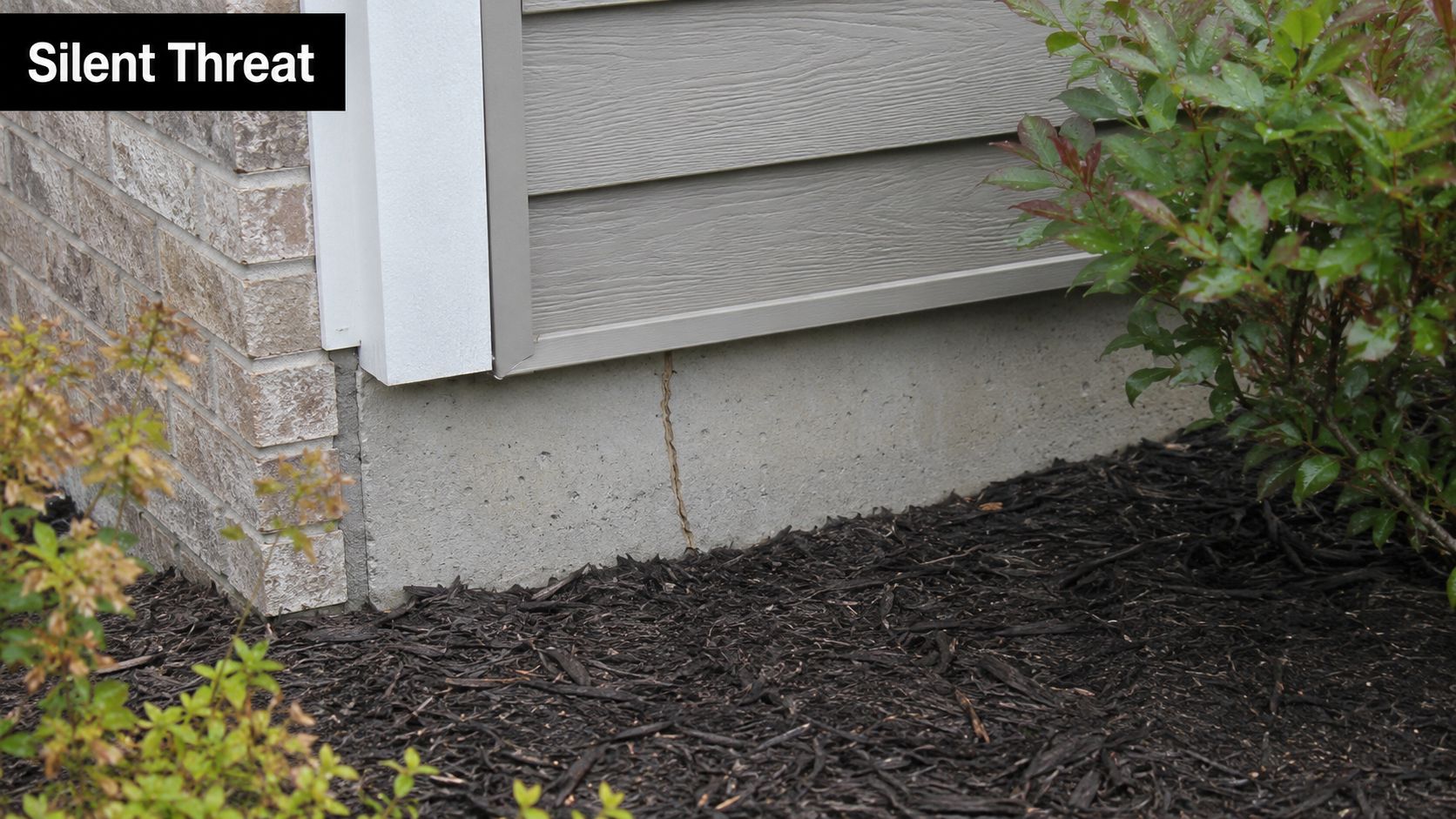
The scale of the problem is one reason termite control remains such a large pest-management category. A North America market report projects the regional termite control market will reach USD 4.31 billion by 2033, with the United States accounting for 80.2% of demand, and says chemical control methods held 55.3% of the market in 2024, while baiting systems and biological termiticides continue gaining attention for their targeted approach and lower environmental footprint, according to North America termite control market projections.
How subterranean termites get inside
These termites don't need a wide-open hole. They use tiny construction gaps, foundation cracks, utility penetrations, and concealed pathways. Once they reach wood, they can keep feeding from the inside out.
Homeowners in Crown Point should pay attention to a few common warning signs:
- Mud tubes: Pencil-width shelter tubes on foundation walls, piers, or masonry.
- Soft or hollow wood: Trim, sill plates, joists, or window frames that don't sound solid.
- Swarming activity: Winged termites appearing indoors or around windows.
- Discarded wings: Small piles near sills, doors, or light sources.
- Paint changes: Bubbling or rippling surfaces that can mimic a moisture problem.
Not every one of those signs confirms the same level of infestation, but they all deserve a professional look.
Why damage often stays hidden
Termites don't usually eat a board cleanly across the outside where you'd spot it quickly. They follow the grain and stay protected. That means a floor can still look normal while support members underneath have already been weakened.
This short visual overview helps homeowners understand how those hidden routes form and why foundation details matter.
When a homeowner says, “I've never actually seen termites, only the signs,” that's often exactly how subterranean activity presents.
If you're also dealing with seasonal pest pressure such as ants, spiders, rodents, or wasps, that doesn't make termite evidence less important. It just means your property may need a broader pest review alongside termite-specific work.
A Clear Comparison of Termite Treatment Methods
A homeowner in Crown Point usually asks one fair question first: “Which treatment gives me the best protection without turning my house upside down?” The honest answer depends on the house, the construction details, how active the termites are, and how much disruption your family can tolerate.
For subterranean termites, professional treatment usually falls into two main categories. Liquid soil barrier treatments and termite bait systems. The EPA lists both conventional barrier treatments and termite baits as recognized control methods, and explains that termite protection requires inspection and maintenance over time in its guide to identifying and controlling termites.
Here is the side-by-side comparison most homeowners need before they decide.
| Method | How it works | Main strength | Main trade-off | Good fit for |
|---|---|---|---|---|
| Liquid soil barrier | Applied in soil around the structure to create a treated zone termites can't cross | Faster structural protection | May require trenching, drilling, and periodic re-treatment | Homes where fast perimeter defense matters |
| Termite bait system | Stations are placed around the property and termites feed on bait that is shared back to the colony | Lower disruption and colony-focused control | Slower process and ongoing monitoring | Homes where minimal disruption is a top priority |
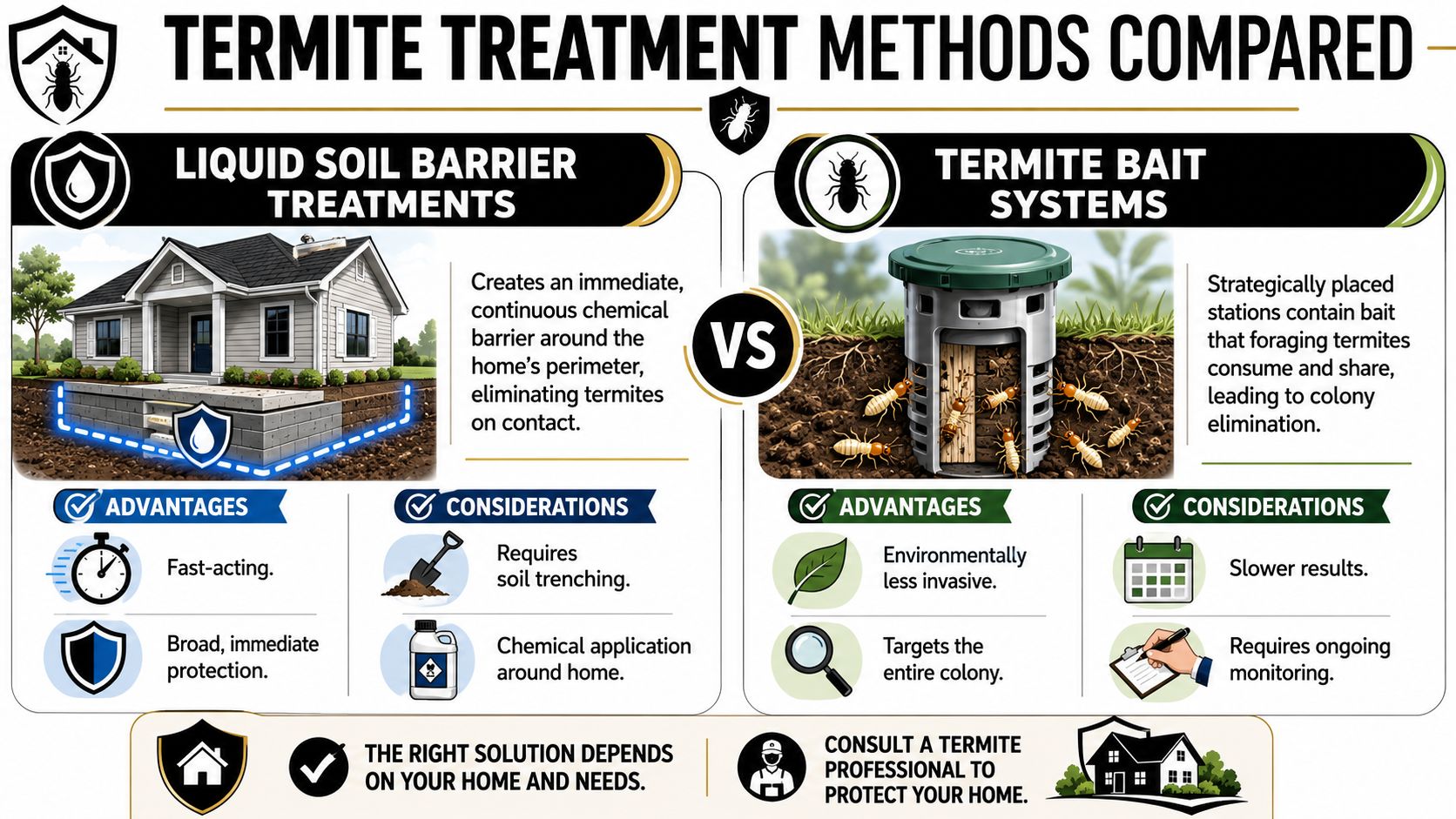
Liquid soil barrier treatments
Liquid barriers are still the method many technicians reach for when a home needs fast protection around the foundation. The treatment is applied to the soil along likely termite entry points so termites pass through a treated zone before they reach structural wood. The University of Kentucky Entomology program explains that liquid termiticides are commonly used for subterranean termite control and that treatment quality depends heavily on creating continuous coverage around the structure, as described in its guidance on termite control options for buildings.
In practice, this method often makes the most sense for homes with active termites near the foundation, crawl spaces with clear access, or situations where the homeowner wants a strong perimeter approach right away.
What homeowners usually like about liquid barriers
- Quicker structural defense: Protection starts at the soil around the home, where subterranean termites travel.
- Good fit for widespread risk: If termites could be entering from multiple sides, a properly applied barrier covers more of the perimeter at once.
- Proven approach for many Northwest Indiana homes: It works well on houses where the foundation layout allows thorough treatment.
Where liquid barriers get complicated
- Concrete changes the job: Attached garages, stoops, patios, and finished basements can require drilling to reach the soil beside the footing.
- Access matters: Tight crawl spaces, additions, and buried foundation sections can make full coverage harder.
- Retreatment may be needed: Termite control is not a one-visit decision for the life of the house. It needs follow-up and periodic inspection.
I usually tell homeowners to think about their tolerance for disruption here. If a day of trenching and some drilling is acceptable, a liquid treatment may offer the quickest peace of mind. If the idea of disturbing finished areas is a problem, baiting may be the better fit.
Termite bait systems
Bait systems work from the outside in. Stations are installed in the soil around the property, then checked on a schedule. Foraging termites feed on the bait and carry it back into the colony.
This approach appeals to homeowners who want less drilling, less trenching, and a treatment plan that doubles as an ongoing monitoring system. Penn State Extension notes that bait systems can be effective for subterranean termite management, but they depend on termite feeding activity and regular service visits to stay effective, as explained in its overview of termite prevention and control methods.
Where baiting shines
- Lower disruption around the structure: Installation is usually less invasive than a full liquid barrier treatment.
- Useful on difficult layouts: Homes with extensive concrete, decorative hardscaping, or areas that are hard to trench can be good candidates.
- Built-in monitoring: Stations give your technician repeat inspection points around the property.
What homeowners need to understand
Baiting takes time. Termites have to find the stations and feed consistently enough for the system to do its job. It also only works well if the stations are monitored and maintained on schedule.
That makes baiting a strong choice for some families and a frustrating one for others. If you want the fastest perimeter response, a liquid barrier often feels more direct. If you want lower disruption and are comfortable with ongoing service, baiting can be a very practical long-term option.
Homeowner takeaway: The right treatment depends on how your home is built, how quickly protection is needed, what level of disruption your family can handle, and whether you want a faster barrier approach or a monitored long-term system.
If you want help matching visible damage to the treatment approach, this guide on how to identify termite damage can help you understand what technicians look for during an inspection.
Specialized Solutions for Severe or Localized Infestations
Some termite problems don't fit neatly into the barrier-versus-bait conversation. A technician may recommend a more specialized treatment when the activity is limited to a known area, when wood is exposed during construction or renovation, or when the infestation is severe enough that whole-structure work has to be considered.
Direct wood treatments
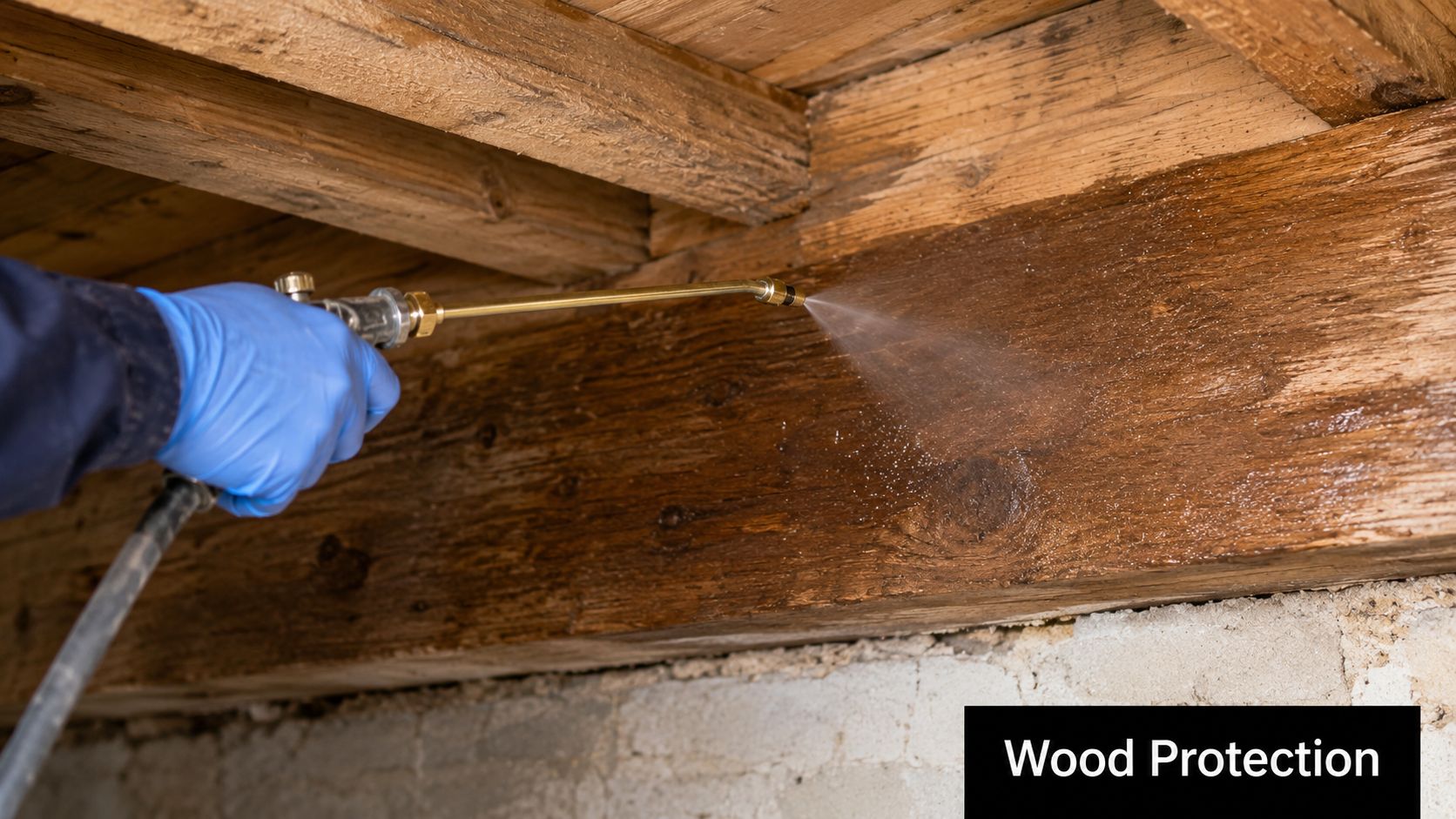
Wood treatments are exactly what they sound like. Instead of focusing first on soil or exterior stations, the treatment is applied directly to vulnerable or infested wood. This can make sense for exposed framing, sill areas, joists, or other accessible structural members.
These treatments are especially useful in two situations:
- During construction or renovation: Exposed wood is easier to treat thoroughly before it's covered up.
- For localized activity: When a known section of wood needs direct protection or direct knockdown.
Wood treatment alone usually isn't the whole answer for a subterranean termite problem if the colony still has soil access to the building. It's often part of a broader site plan.
When fumigation enters the conversation
Fumigation gets a lot of attention because it appears to be a complete solution, but for many suburban homes with subterranean termite issues, it isn't the first conversation. It's a specialized tool with major logistical demands.
Public guidance from Los Angeles County notes that fumigation uses sulfuryl fluoride and requires removal or securing of people, pets, plants, food, and medicines, along with exterior preparation such as cutting back plants and, in some cases, removing fence boards or fixtures, as outlined in the county's guidance on termite treatments and fumigations.
That disruption matters.
The real trade-off homeowners overlook
A treatment's inconvenience can decide whether it's practical for your family, tenants, or business operations.
- Occupied homes: Families with children, pets, or medical routines often prefer options with less relocation pressure.
- Rental properties: Landlords need to think about access, notice, and tenant cooperation.
- Commercial spaces: Downtime and prep work can be more costly than the treatment itself.
If a termite issue is localized, direct wood treatment may be enough as part of a broader plan. If the issue is extensive or involves termite behavior that isn't well addressed by localized work alone, a more intensive treatment may be necessary. The right answer comes from inspection findings, not from assuming the most aggressive method is automatically the most effective.
Why Professional Termite Control Is a Non-Negotiable Investment
A Crown Point homeowner usually sees termites after they have already been active for a while. Maybe a baseboard feels soft, a spring swarm shows up near a window, or paint starts to look bubbled along a wall. By that point, the key question is not whether a store product can kill a few insects. The question is whether anyone has found the entry points, the active areas, and the conditions letting the colony stay established.
That is where professional termite control earns its cost.
DIY products can knock down visible activity, but they rarely solve the full problem in a Northwest Indiana home with a basement, crawl space, attached garage, or multiple foundation transitions. Termite work depends on coverage, access, and correct identification. Miss one section along the structure, or treat the wrong pest entirely, and the colony can keep feeding out of sight.
I have seen homeowners spend money twice. First on sprays, foams, or bait stakes from the hardware store, then again on a full treatment after hidden activity continued behind finished walls or below flooring. The first expense felt cheaper. The total cost was not.
What a professional approach changes
Professional termite control starts with diagnosis, not product selection. The technician needs to confirm the termite species, map likely entry routes, inspect where soil meets structure, and decide whether the property calls for liquid treatment, baiting, localized work, or a combination.
The materials available to licensed pest professionals also matter, but the bigger difference is how they are applied. A good treatment is built around the structure so there are no easy gaps at stoops, utility penetrations, expansion joints, crawl space supports, or other problem areas that homeowners often miss.
That level of detail affects real outcomes.
Where DIY usually falls short
- Coverage is incomplete: One untreated section can leave termites an open path back into the home.
- The wrong method gets used: A localized product may be applied where the property really needs perimeter protection or ongoing monitoring.
- Damage can stay hidden: Surface activity may slow down while termites continue feeding in less visible structural wood.
- Follow-up is inconsistent: Without rechecks, homeowners may assume the problem is solved too early.
Professional service also gives homeowners something many families need. A plan they can live with. That means clear prep instructions, realistic expectations about disruption, and a treatment choice that fits the home, the household routine, and the budget instead of forcing the same answer on every property.
For companies trying to improve service coordination and homeowner communication around visits, tools such as Rosie for pest control can help streamline appointment flow and customer communication. Field skill still matters most, but clear scheduling and follow-up make termite work easier for homeowners to manage.
A termite treatment plan should protect structural wood, close off likely re-entry paths, and include follow-up so the home is not relying on guesswork.
One local option homeowners in Crown Point may consider is The Green Advantage, which emphasizes IPM-oriented service and uses baiting systems and low-toxicity treatment strategies where they fit the site conditions.
Your Termite Treatment Process with The Green Advantage
When homeowners call for pest control near me or an exterminator in Crown Point, IN, they usually want clarity as much as treatment. They want to know what happens first, what the technician is looking for, and whether the process is going to turn into a drawn-out mystery.

Step one starts with the inspection
The first visit should focus on evidence, access points, and conditions that support termite activity. That means more than checking one damaged board. A proper inspection looks at the foundation line, crawl spaces if accessible, basement framing, utility penetrations, moisture patterns, and any places where soil and wood come too close together.
A good inspection also separates termite issues from other wood-destroying or nuisance pest concerns. In Northwest Indiana, homeowners often ask about ant control, rodent control, spider control, mosquito control, or wasp removal during the same call. That broader context helps if the property needs a larger preventive pest strategy.
Then comes a treatment plan you can actually use
After the inspection, the next step is a site-specific recommendation. That recommendation should explain:
- What was found: Active signs, damage indicators, or risk factors.
- What method fits: Soil treatment, baiting, localized wood treatment, or a combined approach.
- What the household should expect: Access needs, prep, timing, and follow-up.
Practical details are important considerations. A homeowner with a busy family schedule may prioritize lower disruption. A seller preparing for a transaction may prioritize documentation and quick scheduling. A commercial property may care most about access windows and operational continuity.
Treatment and follow-up
Licensed technicians then perform the approved treatment based on the property's layout and needs. Depending on the method, that may include perimeter work, bait station installation, targeted treatment of specific structural areas, or monitoring visits.
The follow-up matters as much as the first treatment. Termite work shouldn't end with “we sprayed, call us if you see something.” Monitoring, re-checks, and clear communication are part of what makes professional termite control worth paying for.
The most reassuring termite appointment is the one where the homeowner knows what was found, why a certain method was chosen, and what happens next.
That kind of process is also what people expect from dependable residential pest control and commercial pest control in Crown Point and nearby Northwest Indiana communities.
Schedule Your Crown Point Termite Inspection Today
Good termite prevention starts with simple habits. Fix moisture issues. Keep wood debris and stored lumber away from the foundation. Avoid letting mulch, siding, and soil create hidden contact points. Watch for mud tubes, winged swarmers, and changes in wood or paint that don't look right.
But prevention at home has limits. Termites are hidden pests, and they often show themselves late. The most reliable next step is a professional inspection that looks at the whole property, not just the symptom you happened to notice first.
When it makes sense to call now
- You've seen a warning sign: Mud tubes, wings, soft trim, or suspicious blistering.
- You're buying or selling: Documentation matters during a real estate transaction. A termite inspection for real estate can help clarify conditions before closing.
- You want prevention, not repairs: Annual review is often easier than waiting for visible damage.
If you're in Crown Point or nearby Northwest Indiana and searching for pest control in Crown Point, IN, exterminator near me, or practical termite treatment options, don't wait for a small sign to become a structural problem. A clear inspection gives you real answers, a treatment path that fits your home, and a better chance to protect the property before damage spreads.
If you're ready to take the next step, contact The Green Advantage to schedule a termite inspection or request a quote for your Crown Point home or commercial property in Northwest Indiana.