
A lot of people start searching for lawn care and pest control services near me after the same kind of day. The grass is finally looking decent. The kids or grandkids want to be outside. Then mosquitoes push everyone back indoors, wasps start circling the deck, or ants show up in the kitchen and make it obvious that the problem isn't just “out there.”
In Crown Point and across Northwest Indiana, that pattern is common. Outdoor pest pressure and indoor pest problems often connect more than homeowners realize. What happens in the turf, mulch beds, around the foundation, and near standing water can shape what ends up around your doors, windows, and living spaces.
That's why the smartest solution usually isn't to treat lawn care and pest control as two unrelated chores. A property does better when someone understands the whole exterior environment and knows how to reduce pest pressure before it turns into a bigger problem inside the home.
Your Trusted Local Exterminator in Crown Point IN
A Crown Point homeowner might notice the first warning signs in small ways. Ants start appearing near the sink after a warm stretch. Spiders show up in corners of the garage. By evening, mosquitoes make the backyard hard to enjoy. Soon the search begins for pest control near me, exterminator near me, or a company that can handle both the yard and the pests around it.
That search makes sense because individuals typically prefer not to juggle separate providers, separate schedules, and separate explanations. They want one reliable local team that understands Northwest Indiana conditions and can tell the difference between a one-time nuisance and a pattern that will keep coming back.
What local homeowners are usually trying to solve
In my experience, homeowners aren't just asking for a spray. They're asking for relief from a chain reaction:
- Outdoor irritation: Mosquitoes, wasps, and turf-related pest activity make the yard less usable.
- Indoor frustration: Ants, spiders, rodents, and crawling insects turn a comfortable home into a place where people keep checking corners and baseboards.
- Uncertainty: DIY products might knock down visible activity, but they often miss nesting sites, entry points, and moisture issues that keep feeding the problem.
Most pest issues don't start with the bug you saw. They start with the conditions that allowed that bug to stay.
That's where local experience matters. A family-owned company serving Crown Point, IN and nearby Northwest Indiana communities sees recurring patterns in neighborhoods, lot layouts, drainage, seasonal shifts, and the way pests move from lawn edges to structures.
Why trust matters before treatment starts
Homeowners also want clear communication. They want to know what's happening, what treatment makes sense, and what they should expect afterward. That's one reason the broader industry pays so much attention to communication and service presentation. If you're curious how companies think about connecting with homeowners before the first appointment, this overview of Pest control marketing strategies is a useful look at what builds trust and what feels generic.
When you call for pest control in Crown Point, IN, you shouldn't feel like just another stop on a route. You should feel like you're talking with people who know the area, respect your home, and can solve the actual cause of the problem.
The Advantage of an Integrated Lawn and Pest Program
A common Crown Point call goes like this. The grass is thinning near the fence, mosquitoes are bad by the patio, and ants keep showing up near the back door. If those problems get handled by separate providers who never compare notes, the symptoms may improve for a while, but the cause often stays in place.
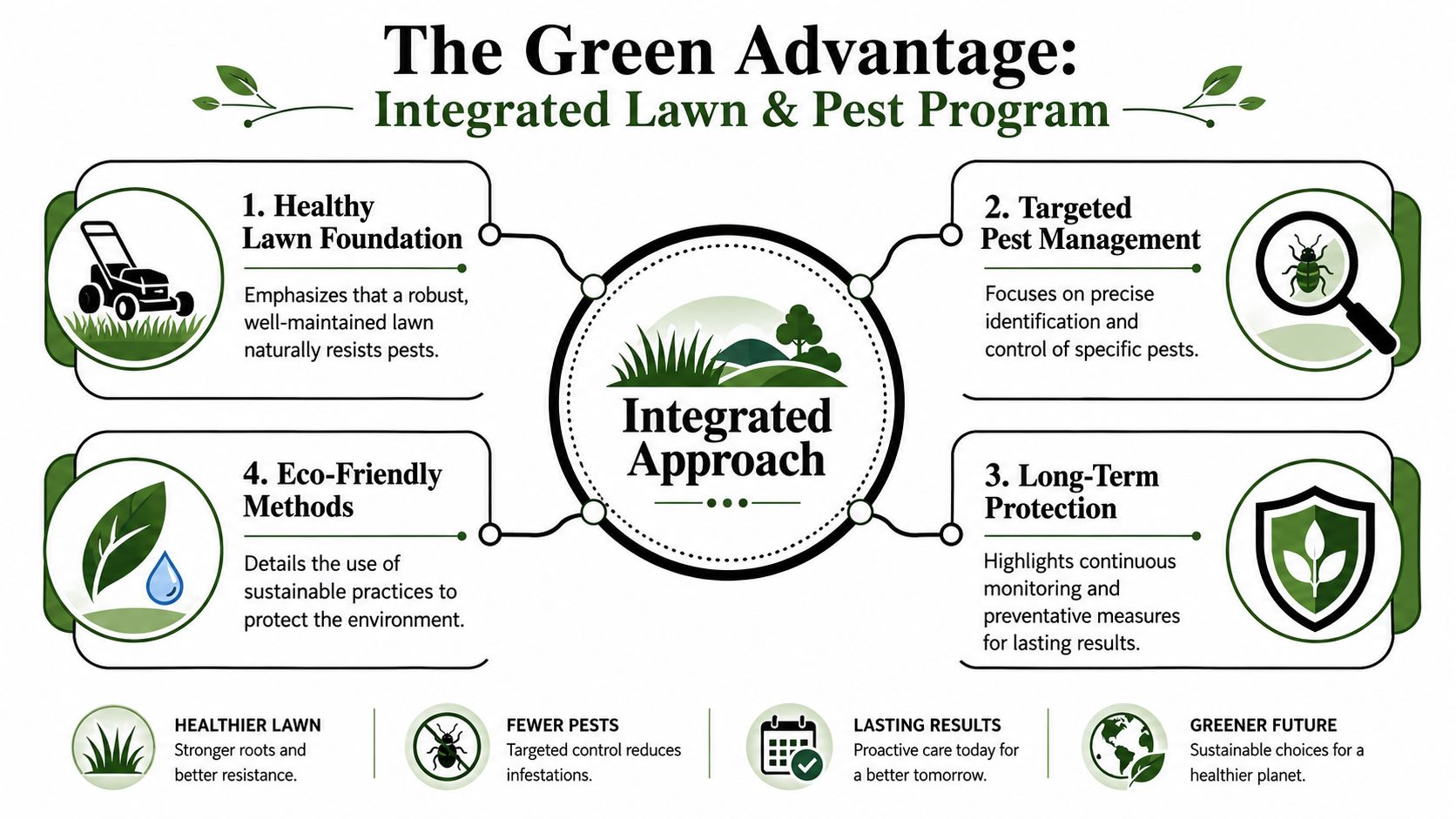
An integrated lawn and pest program works better because the yard, the foundation edge, drainage, shade, turf stress, and insect activity all affect each other. That perspective matters here in Northwest Indiana, where spring moisture, summer heat, and heavy clay soils can create pest pressure fast. A company that started in lawn care and grew into pest control brings a different set of eyes to the property. It sees how outdoor conditions feed indoor problems.
Why the lawn matters to pest pressure
Pests respond to conditions first.
Thin turf, excess thatch, standing water, compacted soil, overwatered areas, and overgrown edges create cover, moisture, and breeding space. Those conditions can support mosquitoes, ants, stinging insects, and other pests before they ever reach the house. Treat the pest without correcting the site conditions, and the problem often comes back sooner than homeowners expect.
Healthy turf helps, but it is not a cure by itself. Dense grass can reduce exposed soil and cut down on some harborage. Better drainage can make a yard less attractive to mosquitoes. Cleaner edges along patios, walkways, and foundations make inspections more accurate and treatments more targeted.
Why combining services can be smarter, and when it is not
A combined plan makes the most sense when the same outdoor conditions are driving both lawn stress and recurring pest activity. That is often the case on properties with damp low spots, shaded fence lines, heavy insect pressure around outdoor living areas, or repeated activity near entry points.
Separate service can still be the right choice in some situations. If the lawn is in good shape and the problem is a one-time interior issue, a standalone pest visit may be enough. If a homeowner already has a lawn specialist they trust, the better move may be coordination instead of replacement.
| Property situation | Integrated plan usually makes sense when | Separate service may make sense when |
|---|---|---|
| Yard and house both show recurring activity | exterior conditions are clearly driving repeat pest issues | pest issue is isolated and not tied to outdoor conditions |
| Family uses the yard often | mosquito reduction and perimeter prevention need to work together | lawn health is fine and only one interior pest issue needs attention |
| Turf problems and insect pressure overlap | technician needs to judge both site conditions and pest timing | homeowner already has a separate lawn specialist they want to keep |
The key trade-off is simple. One coordinated plan usually gives a clearer diagnosis and better timing. Separate services can work, but only if both sides are paying attention to the same conditions on the property.
What integrated management looks like in practice
Good integrated work does not mean applying more product. It means inspecting first, fixing favorable conditions where possible, and treating the right areas at the right time. That is the foundation of integrated pest management, and it fits homes in Crown Point especially well because no two lots hold moisture, shade, and pest pressure the same way.
For homeowners who want practical upkeep tips between service visits, SkipCalls' Lawn Care Advice offers a useful general reference on routine yard care.
A key advantage is coordination. When one team understands turf health, drainage patterns, pest harborage, and how insects move from the yard toward the structure, it can solve problems with fewer blind spots and a safer, more deliberate plan.
Common Seasonal Pest Threats in Northwest Indiana
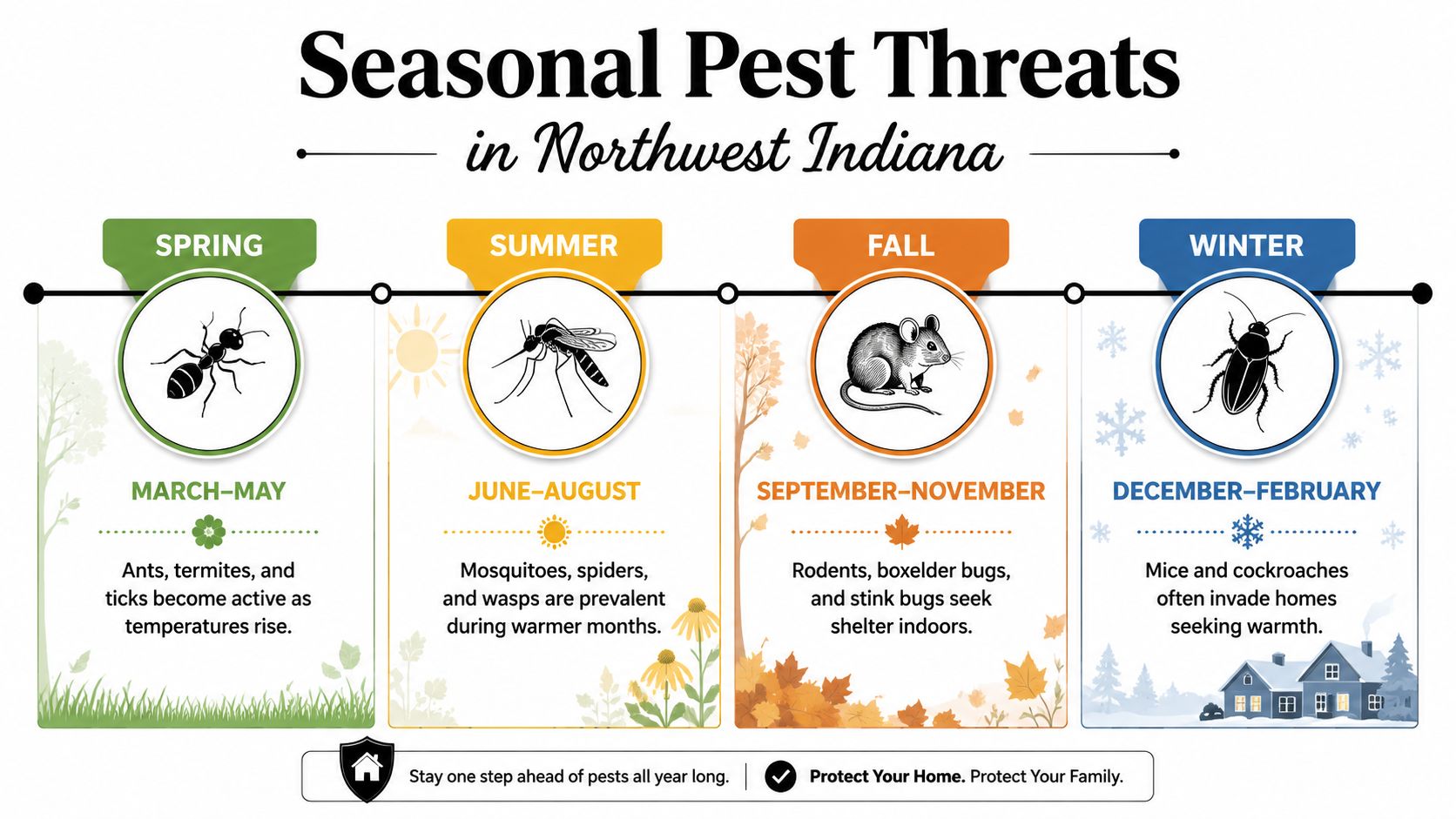
Northwest Indiana doesn't have one pest season. It has several. Pest pressure shifts with temperature, rainfall, mowing patterns, moisture around foundations, and when insects and rodents start looking for food, water, or shelter.
Spring and summer pressure around the yard
As the weather breaks, ants start foraging more aggressively. Spiders become more noticeable as insect activity builds around lights, soffits, and garages. Mosquitoes take advantage of standing water in gutters, low spots, toys, planters, and shaded zones that stay damp.
Wasps also become more active as nesting sites develop under eaves, around play sets, in sheds, and near entry points. The mistake many homeowners make is waiting until activity feels severe. By then, nests are established and mosquito breeding has already been underway.
For lawn-related insects, timing matters just as much as product choice. The Massachusetts homeowner IPM guide notes that grub action thresholds are typically around 8 to 10 grubs per square foot and that some insecticide timing works best 2 to 3 weeks after peak moth flight activity, which shows why measured density and lifecycle timing beat guesswork (homeowner IPM timing and thresholds).
Fall and winter invaders
When temperatures cool, the pest story changes. Rodents start exploring garages, utility penetrations, crawl spaces, and foundation gaps. Boxelder bugs, stink bugs, and other overwintering pests collect on sunny exterior walls and look for sheltered entry points.
Once they're inside, the issue stops being seasonal annoyance and starts becoming a household problem. That's why fall exclusion work matters so much. The best rodent control often starts before you ever hear scratching in a wall.
What to watch for by season
- Early warm weather: Ant trails, spider web buildup, and pest activity around mulch beds and foundation lines.
- Peak outdoor months: Mosquito pressure near shade and standing water, plus wasp activity near rooflines and outdoor gathering spaces.
- Cooling weather: Mice seeking shelter, insects gathering on siding, and more pest movement into garages and storage areas.
If a pest shows up in the same season every year, that's usually a prevention problem, not a surprise problem.
What doesn't work well
A one-size-fits-all schedule rarely works in Northwest Indiana. The pests aren't the same in April, July, and November, so the response shouldn't be either. Good service adjusts with the season, the property, and what the inspection shows.
Our Professional Residential and Commercial Pest Services
A good service plan starts with how the property functions. A single-family home in Crown Point has different pressure points than a restaurant, office, warehouse, or multi-unit building. The work should reflect that from day one.
Our background in both lawn care and pest control matters here. Outdoor pest pressure rarely starts at the door. It usually builds in turf, planting beds, moisture zones, shaded edges, trash areas, and along the foundation. Teams that understand those outdoor conditions can usually solve problems faster because they are treating the source, not just the symptom showing up indoors.
Residential pest control that addresses the source
In homes, the first job is finding out why the pest activity keeps returning. That means identifying the pest correctly, checking likely entry points, and looking at the conditions that support it. I look for gaps at doors and windows, garage transitions, mulch piled too high at the foundation, damp areas, cluttered storage, and signs that insects are feeding other pests.
Common residential concerns in Crown Point and nearby Northwest Indiana neighborhoods include:
- Ant control: Tracing where the colony is feeding and entering, then treating the source of activity.
- Spider control: Reducing web buildup, harborage areas, and the insect activity that keeps spiders around.
- Rodent control: Using traps, exclusion, and practical sanitation corrections together.
- Wasp removal: Removing active nests and reducing repeat activity near doors, patios, soffits, and play areas.
- Mosquito control: Treating resting areas outdoors and cutting down breeding sites where possible.
- Termite and inspection work: Checking for hidden risk factors before damage becomes obvious.
The trade-off is straightforward. Quick spray-only service may knock activity down for a short time, but recurring issues usually call for exclusion, habitat correction, and follow-up.
Commercial pest control requires consistency and documentation
Commercial work has less room for guesswork. Property managers, business owners, and facility teams need clear records, reliable scheduling, and service that fits how the building is used. A retail storefront, professional office, food service space, and multi-tenant property each create different risks.
Consistency matters more than one heavy treatment. If staff keeps seeing pest activity, there is usually an unresolved access point, sanitation issue, or exterior condition feeding the problem. The right plan accounts for traffic patterns, storage practices, delivery areas, dumpsters, utility penetrations, and seasonal changes around the building.
Why IPM fits both home and business service
Integrated Pest Management works because it combines inspection, monitoring, targeted treatment, and correction of the conditions pests need to thrive. For a company that grew from lawn care into pest control, that approach is a natural fit. The same property conditions that affect turf and plant health often affect insect and rodent pressure too.
That shows up in day-to-day service:
- Correct identification first: The plan changes depending on the pest, the season, and where activity is starting.
- Monitoring before over-application: Some problems need ongoing observation, not automatic over-treatment.
- Targeted product use: Materials should be applied where they will do the job, and only where they are warranted.
- Habitat correction: Moisture, food sources, entry points, and shelter usually need attention along with treatment.
The Green Advantage provides residential and commercial pest services in Northwest Indiana with that integrated approach. That gives homeowners and businesses a clearer answer to a common question. Lawn care and pest control work better together when the same team understands the whole outdoor environment around the property.
Protect Your Health Property and Peace of Mind
People sometimes treat pest control like an optional add-on until they've had a real infestation. Then the value becomes obvious very quickly. Professional service protects more than comfort. It helps protect the way a property functions day to day.
Health concerns aren't just about visible pests
Mosquitoes can make yards hard to use. Rodents can contaminate areas you don't check every day. Cockroaches and other indoor pests can spread through hidden spaces before activity becomes obvious. Even when the immediate issue seems minor, the stress it creates for a household is real.
Parents, pet owners, older adults, and anyone caring for guests usually want two things at once. They want the problem handled effectively, and they want a treatment approach that is thoughtful and site-specific.
A home feels different when you stop wondering what's crawling behind the wall, under the sink, or around the back door at night.
Property protection is part of routine maintenance
Exterior pest management belongs in the same conversation as lawn upkeep, drainage correction, and seasonal property care. The market itself reflects that scale. The U.S. landscaping services industry generated $188.8 billion in revenue in 2025, with about 1.32 million workers across roughly 635,000 firms, according to LawnStarter's landscaping industry statistics. That scale shows this isn't a niche service category. It's a normal part of maintaining residential and commercial property.
For homeowners, that means prevention usually costs less stress than repair. It's easier to keep rodents out than to clean up after them. It's easier to reduce mosquito habitat than to give up the yard all summer. It's easier to catch a developing issue at inspection time than after damage or repeated infestations.
Peace of mind has practical value
A pest-free home changes how people live in it. You use the patio. You stop checking the pantry every morning. You don't worry about hearing movement in the attic when the weather turns cold.
That peace of mind is why recurring service plans exist. They aren't just about treatment. They're about keeping small issues from turning into disruptive ones.
The Green Advantage Process from Start to Finish
Homeowners usually feel better once they know exactly what happens after they call. A clear process removes a lot of the uncertainty.
Step one through step three
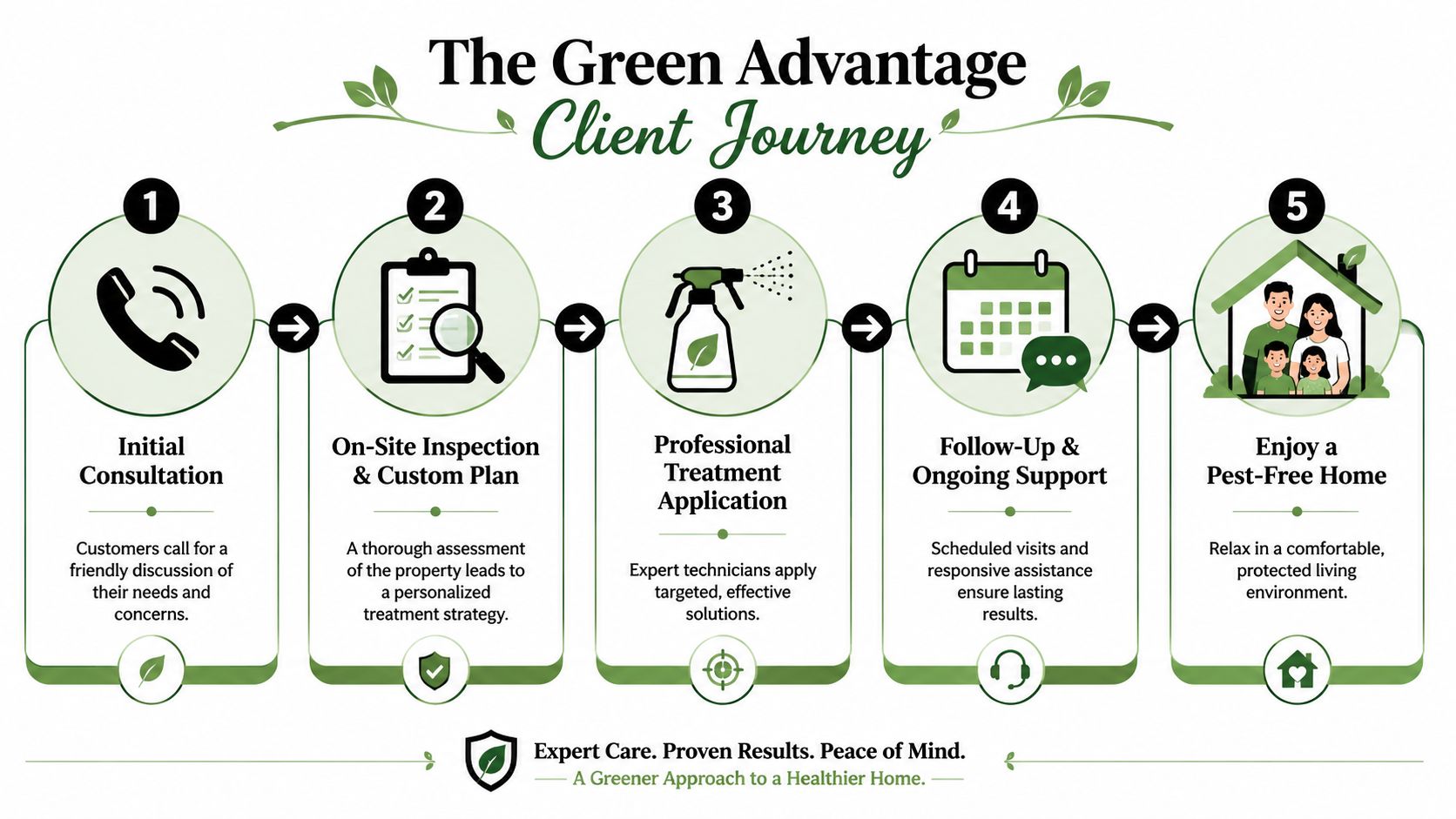
The process starts with a real conversation. Office staff gathers the basics, including what pests you're seeing, where activity is happening, how long it's been going on, and whether there are outdoor conditions that may be contributing.
Then comes the on-site inspection. That's where a technician checks the structure, the exterior zones that matter, and the signs that separate a surface-level nuisance from a recurring pattern. After that, the property gets a customized treatment plan rather than a generic script.
A typical early flow looks like this:
- Initial consultation: Discuss the pest issue, timing, and property concerns.
- Inspection: Identify the pest, contributing conditions, and likely access points.
- Treatment plan: Match service to the property instead of forcing the property into a preset package.
Treatment and follow-up
Once the plan is in place, treatment focuses on the right areas and the right methods. Depending on the issue, that may involve exterior applications, nest treatment, rodent control measures, monitoring devices, exclusion recommendations, or adjustments to outdoor conditions that are helping the infestation.
After service, good follow-up matters. Homeowners should know what was done, what activity may continue briefly, and what changes they can make to support longer-term control. For properties that also need guidance on keeping turf, ornamentals, and beds looking clean after outdoor service, this page on post-care perfection for turf trees and landscape beds is a helpful companion.
A pest plan should never feel mysterious. You should know what the technician found, why the treatment fits, and what happens next.
Why recurring service keeps growing
More property owners are choosing preventive plans because they want convenience and fewer surprises. The combined global lawn maintenance and pest control service market was valued at $97.3 billion in 2024 and is projected to reach $150 billion by 2035, with about 4.0% CAGR from 2025 to 2035, according to Wise Guy Reports' lawn maintenance and pest control service market overview. That projected growth points to steady demand for ongoing, preventive service rather than waiting for problems to escalate.
That trend makes sense. Many individuals don't want to keep starting from zero every season.
Schedule Your Pest Inspection in Crown Point Today
If you're searching for lawn care and pest control services near me, you're probably not looking for theory. You want a clear answer, a reliable appointment, and a plan that fits your home or business in Crown Point and nearby Northwest Indiana communities.

An integrated approach gives you that. Instead of looking at the lawn, the perimeter, and the pest issue as separate headaches, it treats them as connected parts of the same property. That leads to smarter inspections, more targeted service, and fewer blind spots.
What to do before you book
Before scheduling, it helps to make a short list of what you've seen and where you've seen it. Note whether activity is worse after rain, during evening hours, or in certain rooms or sections of the yard. If you're coordinating with family members, tenants, or staff, consistent reminders can also make appointments easier to keep. This article on Call Loop for better appointment reminders has practical ideas for reducing missed visits.
When homeowners are ready to act, they usually want three things:
- A prompt inspection
- An explanation in plain language
- A treatment plan that respects the property and the people living on it
For a closer look at the kind of service homeowners are often looking for, this short video gives helpful context.
If pests are interrupting your yard, creeping into your home, or making you second-guess your property maintenance, now's the right time to get it checked.
Contact The Green Advantage to schedule a pest inspection, request a quote, and get a practical plan for your Crown Point home or Northwest Indiana property.