
Think of a termite inspection for real estate as a specialized health check-up for a property’s skeleton—its wooden frame. This professional assessment, which results in a Wood-Destroying Insect (WDI) report, is designed to spot any evidence of current or past termite activity. Just as importantly, it points out conditions that could invite them in later. When you're considering a property in Crown Point, IN, this step is crucial for protecting your investment.
Why a Termite Inspection Is Essential for Crown Point Homebuyers

Buying a home in Crown Point, IN, is easily one of the biggest investments you'll ever make. While you're busy falling in love with the kitchen or picturing your furniture in the living room, a silent threat could be eating away at the very structure of your dream house. This is why a professional termite inspection for real estate isn't just a good idea; it's an absolute must for local homebuyers.
It’s like getting an x-ray for the house. Your standard home inspection gives you a fantastic overview, but a dedicated WDI inspection from a licensed specialist like The Green Advantage goes a level deeper. Our entire focus is on finding the hidden signs of termites and other wood-destroying insects that can cause thousands in damage before you even get the keys. As your local exterminator in Crown Point, we understand the specific risks our community faces.
Protecting Your Financial Future
Here in Northwest Indiana, subterranean termites are a constant menace. They thrive in our soil and can silently chew through support beams, floor joists, and wall studs for years without anyone knowing. A detailed inspection is your best line of defense, bringing to light issues that are simply impossible to see during a typical walkthrough.
Skipping this step means you could be unknowingly buying a massive, expensive problem. What's worse is that most homeowner's insurance policies do not cover termite damage. That leaves you holding the bag for any and all repairs. Finding these problems before closing protects you from a huge financial hit down the road.
Gaining Critical Negotiation Power
A WDI report isn't just a simple pass/fail grade; it's a powerful tool for negotiation. If our inspector finds an active infestation or old damage, that report gives you the professional proof you need to have a serious conversation with the seller. This can lead to a few different positive outcomes:
- The seller might agree to pay for professional termite control.
- You could negotiate the cost of any necessary structural repairs.
- The final sale price could be adjusted to reflect the cost of fixing the issue.
By uncovering potential issues early, a termite inspection for real estate empowers you to make informed decisions. It transforms uncertainty into clarity, ensuring you can proceed with confidence or negotiate terms that protect your investment.
As your trusted pest control company in Crown Point, The Green Advantage is here to give you the thorough, trustworthy inspection you need. We provide the peace of mind that comes from knowing the true condition of the home, paving the way for a secure and successful purchase.
Understanding the Silent Threat to Northwest Indiana Homes
Here in Crown Point and across the rest of Northwest Indiana, the most significant danger to your home’s structure isn't a tornado or a blizzard—it's an insect. The main offender is the Eastern Subterranean Termite, a silent destroyer that absolutely loves our local soil and climate. These pests work completely behind the scenes, chewing away 24/7 at the wooden bones of your house.
Imagine a hidden, underground city whose entire purpose is to find and eat wood. That’s a subterranean termite colony. Your home's foundation, support beams, and floor joists are the ultimate prize. To get there, they build intricate mud tubes—thin, pencil-sized tunnels made of dirt and wood—that act as protected highways from their nest in the ground right into your home, letting them avoid the open air completely. It's this stealthy approach that allows a full-blown infestation to go undetected for years, making professional termite control essential.
And the damage they inflict is far from superficial; it's genuinely destructive. A single colony can house hundreds of thousands of individual termites, and working together, they can chew through a 2×4 stud in just a few months. Over the long haul, this relentless consumption weakens the very framework holding your home up, which can lead to sagging floors, warped walls, and a severely compromised structure.
Recognizing the Subtle Warning Signs
Because termites are so secretive, you really need a trained eye to spot an active infestation. That said, there are definitely subtle clues homeowners in Crown Point can watch for. Catching any of these signs early can make a world of difference in preventing serious damage and protecting your investment.
Keep an eye out for these key indicators:
- Mud Tubes: Check for narrow, dirt-like tunnels running up your foundation walls, support posts, or along pipes in your crawl space. These are the superhighways termites build to travel safely.
- Hollow-Sounding Wood: Tap on baseboards, door frames, or any exposed wood beams. If it sounds papery or hollow, it's a red flag that termites might have already eaten out the inside.
- Discarded Wings: In the spring, termites often "swarm" to start new colonies, and afterward, they shed their wings. Finding little piles of these tiny, see-through wings on windowsills or near doorways is a sure sign a colony is nearby.
- Bubbling or Peeling Paint: Sometimes, paint that's blistering for no obvious reason can indicate moisture issues just under the surface, which is often linked to termite activity.
The sheer cost of untreated termite damage has created a massive global market for professional control services. In the United States alone, subterranean termites are responsible for an estimated $5 billion in property damage every single year. You can dig deeper into this data and its real estate implications at Mordor Intelligence.
Why Northwest Indiana Homes Are Vulnerable
Our local climate and typical construction methods can, unfortunately, create a perfect storm for termites. The dampness from our spring rains and humid summers, paired with common home features like basements, crawl spaces, and areas where wood touches the ground, gives termites a five-star resort.
This is exactly why a professional termite inspection is non-negotiable for real estate transactions in our area. An inspector from The Green Advantage isn’t just looking for live bugs. We’re trained to spot the specific risk factors and "conducive conditions" unique to homes in Crown Point. We know how local building codes and environmental factors can make a house more attractive to termites, giving you the expert insight you need for true peace of mind.
Have a closing date? Call The Green Advantage at (219) 779-9815 — we provide the NPMA-33 form lenders require for Northwest Indiana properties.
What to Expect During a Professional Termite Inspection in Crown Point
So, you’ve scheduled a termite inspection for a property you're buying or selling in Crown Point. It can feel like a bit of a black box, but the whole process is really just a methodical deep dive into the home’s condition, designed to protect everyone involved. When one of our licensed technicians at The Green Advantage shows up, we have one job: to give you a crystal-clear picture of what’s going on with any wood-destroying pests.
We're not there to tear down walls or cause a mess. A proper WDI inspection is a visual and physical assessment of all the accessible parts of the property. Think of us as detectives, armed with training and specialized tools, looking for the tiny, specific clues that termites and other pests leave behind.
The Inspection Process Step-by-Step
A real termite inspection isn't a quick walk-around. It’s a systematic sweep of the property, from the foundation right up to the attic, focusing on the spots where termites are most likely to show up.
We always start on the outside. Our technician will walk the entire perimeter, paying very close attention to the foundation. We’re on the hunt for the classic tell-tale signs: mud tubes. These are the highways subterranean termites build to get from the soil into your home's structure. We also flag any spots where wood touches soil—like siding that’s too low or a wooden porch stoop sitting on dirt—because that’s like rolling out the welcome mat for an infestation.
From there, we head inside, usually starting in the basement or crawl space. These areas are ground zero for termite activity in Northwest Indiana homes. Using bright flashlights and probing tools, we carefully check support beams, floor joists, and sill plates. If we tap on a beam and it sounds hollow, or if a probing tool sinks into soft, damaged wood, that’s a major red flag we investigate further.
Key Areas We Check During a WDI Inspection
Our inspection is all about being thorough. We have a mental (and physical) checklist of critical zones that are magnets for wood-destroying insects. The table below gives you a good idea of what our technicians are zeroed in on during a residential pest control inspection.
| Inspection Zone | What We Look For | Common Red Flags |
|---|---|---|
| Exterior & Foundation | Mud tubes, damaged wood, foundation cracks, wood-to-soil contact | Pencil-thin mud tunnels on foundation walls, rotting deck posts, siding buried in mulch |
| Basement/Crawl Space | Damaged floor joists, support beams, sill plates, excessive moisture | Hollow-sounding wood, sagging floors, standing water or leaks |
| Interior Living Areas | Baseboards, window/door frames, floors, walls | Swarms of winged insects, discarded wings on sills, bubbling or peeling paint |
| Kitchens & Bathrooms | Under sinks, behind toilets, areas around plumbing penetrations | Damp or discolored wood, active leaks, soft spots in the flooring |
| Garage | Walls adjoining the main house, wooden shelving, expansion joints | Mud tubes coming up from concrete slab joints, damaged drywall |
| Attic | Rafters, trusses, roof sheathing, vents | Damaged wood (especially from drywood termites), signs of leaks |
By methodically examining each of these zones, we build a comprehensive picture of the property's health, ensuring no potential issues are overlooked.
Comprehensive Coverage Inside and Out
After clearing the lower levels, our inspection moves through the main living areas of the home. We’ll check baseboards, door and window frames, and any other exposed wood. We pay extra attention to high-moisture zones like kitchens, bathrooms, and laundry rooms, since termites need water to survive and thrive.
The final stop is often the attic. Up here, we’re checking rafters, trusses, and roof supports for any damage that might point to a drywood termite problem (less common here, but still possible) or other wood-boring insects. This top-to-bottom approach guarantees we don't miss a thing. To keep everything organized and ensure nothing gets missed, many modern inspectors rely on specialized Pest Inspection Software to log findings and generate detailed reports right from the field.
This flow chart gives you a simple visual of how subterranean termites operate—making their way from the soil right into your home's structure.
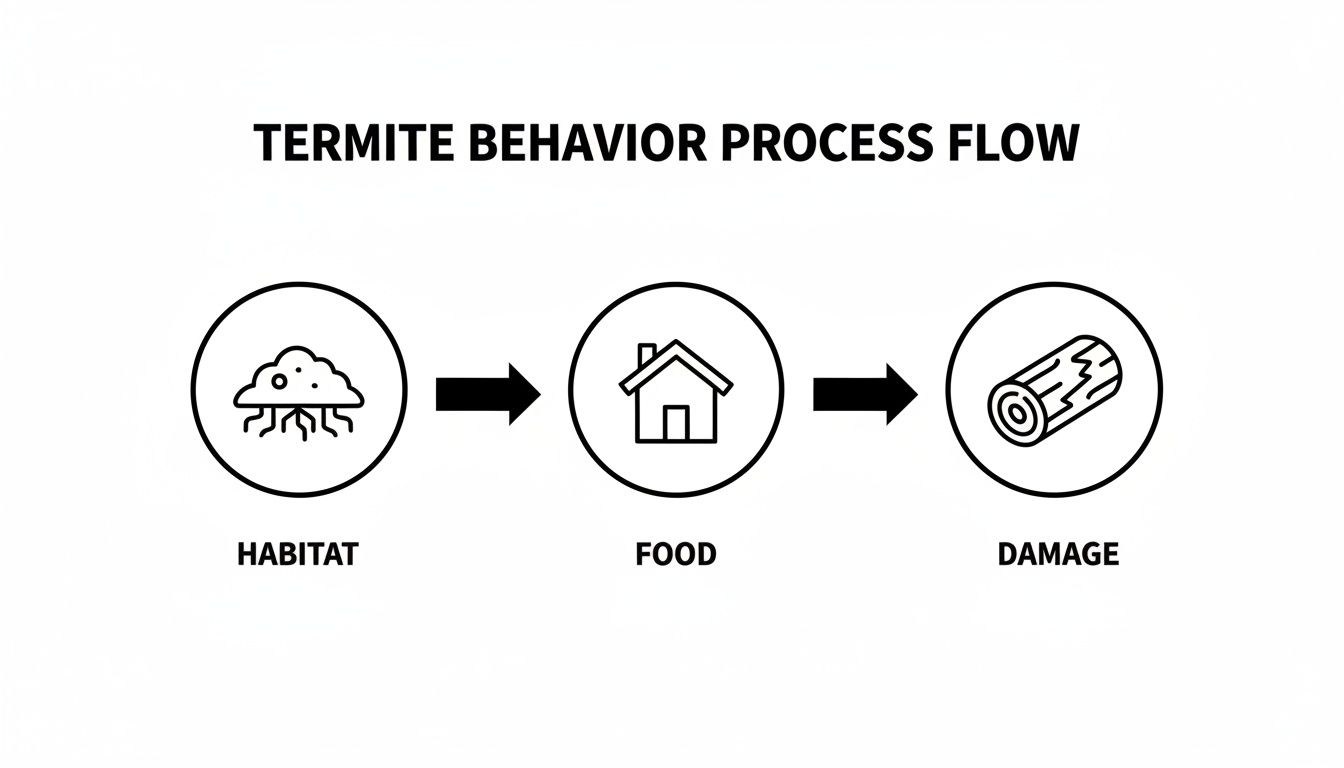
You can see why checking that foundation and lower level is so critical—it’s the bridge between their colony and the wood they want to eat.
Throughout the inspection, our technicians aren't just looking; we're also listening and probing. We might use a moisture meter to find hidden water sources or even an infrared camera to spot temperature anomalies behind walls that could indicate an active colony. You can find out more about how advanced equipment improves pest inspection accuracy in our detailed article.
Once the inspection is done—it usually takes about one to two hours for an average-sized home—our technician will walk you through their initial findings on-site. This conversation is followed up with a formal Wood-Destroying Insect (WDI) report, the official document you'll need to move forward with your real estate deal with total confidence.
How to Read Your Wood-Destroying Insect Report
Getting your official Wood-Destroying Insect (WDI) report can feel a little overwhelming. It’s a formal document, packed with diagrams, checkboxes, and industry jargon that can look like a foreign language at first glance.
But this report is your key to making a smart, confident decision on a property. Think of it less like a scary test result and more like a detailed health chart for the home. At The Green Advantage, we don't just find problems—we make sure you understand them, inside and out. Let's walk through the key sections so you know exactly what the findings mean for your family and your investment.
Unpacking the Key Findings
Every WDI report is designed to give a clear, standardized snapshot of the property's condition. While the layout might differ slightly between inspectors, they all answer the same critical questions. You'll usually find a main section that gets right to the point.
Look for these three crucial findings:
- Active Infestation: This is the big one. It means our inspector found live termites or other wood-destroying pests on the property. An active problem requires immediate professional attention.
- Evidence of Previous Infestation/Treatment: This tells you the home has a history with termites. We might find old, dried-out mud tubes, repaired wood damage, or signs of a past chemical treatment. It’s not necessarily a red flag, but it's a heads-up that the home is on the termite radar and needs to be watched closely.
- Conducive Conditions: This is maybe the most important part of the report for a future homeowner. It flags things that make the house an easy target for termites, even if none are present now. Fixing these is your best defense against future invasions.
Think of it this way: "Active" is a problem you need to solve now. "Evidence of previous" is a note in the home's history file. And "Conducive conditions" are your to-do list for preventative maintenance.
Translating Technical Terms into Plain English
As you dig deeper into the report, you'll come across specific terms that describe exactly what our inspector saw. Getting a handle on this language gives you a much clearer picture of what's going on.
Here are a few common ones you'll see:
- Mud Tubes: These look like little dirt tunnels running up a foundation wall or along a beam. They're the highways subterranean termites build to get from the soil into the wood of your home. Finding them is a classic sign of an infestation, whether it's happening now or happened years ago.
- Damaged Wood: The report might note wood that feels "soft," sounds "hollow" when tapped, or has visible "galleries" (the internal channels termites chew out). We'll pinpoint the location and extent of any damage we find.
- Frass: This is just a technical term for insect droppings. For termites, it often looks like tiny wood-colored pellets or a pile of sawdust, and its appearance can help us identify the specific pest.
- Wood-to-Ground Contact: This flags any spot where the home's wooden structure—like siding, a deck post, or a door frame—is touching the soil. It's a major red flag because it’s basically an open invitation for termites to walk right in.
- Excessive Moisture: Termites need water to survive, so any leaks, poor drainage, or standing water create a five-star resort for them. The report will note any dampness, especially in crawl spaces and basements.
These formal inspections aren't just a good idea; they've become a critical part of the real estate process, often required for mortgages in high-risk areas. This shift has made termite control a major part of the pest control industry, accounting for about 24.6 percent of all revenue. You can learn more about how this market impacts homeowners and property sales in this industry report.
When you get your WDI report from us, we want you to call us. We’ll go over the diagram of the house with you, explain every checkmark and comment, and make sure you feel totally clear on what it all means. Our goal is to replace that initial anxiety with actionable information, so you can move forward with confidence in your Crown Point real estate journey.
Navigating Your Next Steps After the Inspection

The termite inspection is done, and you’re holding the official Wood-Destroying Insect (WDI) report. This is where things get real. Whether you're buying or selling a home in Crown Point, IN, this single document dictates what happens next in the transaction.
Your report is going to land in one of three piles, each pointing you down a different path. Here at The Green Advantage, we don't just drop a report in your lap and walk away. We're your local partner, and our job is to help you make sense of it all with clear advice to keep your deal on track.
When the Report Comes Back Clean
Getting a clean report is the best news you can hope for. It means our inspector found no evidence of an active termite infestation, no signs of old damage, and no major red flags that put the home at immediate risk. For a buyer, this is a huge weight off your shoulders and gives you the green light to move forward.
But a clean report isn't a get-out-of-jail-free card for good. Think of it as a snapshot in time. We always recommend taking care of any minor "conducive conditions" noted in the report, like trimming back bushes or fixing a leaky gutter. These little preventative fixes are the key to keeping the home protected for the long haul.
Addressing Conducive Conditions
It's very common for a WDI report to find no active termites but list several "conducive conditions." These are simply the risk factors we talked about earlier—the things that make a home look like an easy meal for pests.
Some of the most common issues we see in Northwest Indiana homes include:
- Wood-to-Soil Contact: Think mulch piled high against the siding or deck posts buried directly in the ground.
- Excessive Moisture: Clogged gutters, leaky faucets, or poor drainage that create damp zones around the foundation.
- Firewood Stacks: A pile of wood sitting right next to the house is like leaving out a welcome mat for termites.
- Dense Vegetation: Overgrown shrubs or tree branches touching the house create a hidden bridge for pests to cross.
Dealing with these problems becomes a key part of the negotiation. A buyer might ask the seller to fix these issues before closing, or they might decide to handle it themselves after they move in. Either way, it’s a smart move for the future health of the property.
Responding to an Active Termite Infestation
If the report confirms live termites, take a deep breath. Don't panic. This is a common hurdle in real estate, and it absolutely does not have to kill the deal. It just means it's time to make a plan for treatment and repairs.
This is where negotiations get serious. Typically, the seller is responsible for treatment, as they’re expected to hand over a home that isn't actively being eaten. As the buyer, you can request that the seller cover the full cost of professional termite treatment from a licensed company like ours.
The presence of termites on a property report often becomes a central point of negotiation. Having a clear, professional treatment plan and a detailed estimate provides both parties with the concrete information needed to reach a fair agreement and move the transaction forward.
Our team will put together a comprehensive treatment proposal that spells out the exact methods and costs to get rid of the colony and protect the home. We also offer warranties that provide ongoing peace of mind—a huge plus for any new homeowner. If the report also noted structural damage, the cost of those repairs can also be negotiated.
As you plan your next move, it's also a good time to find out if your homeowner's policy will even cover termite damage, since in many cases, the answer to "does home insurance cover termites" is no.
Because so many homes in North America are built with wood, homeowners have come to see professional pest control as a non-negotiable part of protecting their investment. This is why a termite inspection for real estate has become such a standard part of the process—it’s critical for protecting a home's structural integrity and value. If you’re a homeowner in the area, you can learn more about what to expect in our guide on the cost of residential termite control in Crown Point.
The Green Advantage: Your Local Expert on Call
Choosing the right company for your termite inspection is just as crucial as the inspection itself. For anyone buying or selling a home in Crown Point, IN, this decision is about protecting your financial future and ensuring a smooth transaction.
The Green Advantage isn't some faceless national chain. We're your neighbors. We know the specific building styles, the soil conditions, and the common pest pressures that are unique to Northwest Indiana properties, because we live and work here too.
Our job isn't just about spotting termites. It's about giving you clear, honest answers so you can understand the findings and know exactly what your options are. From ant control to mosquito treatments, we are the exterminator near you that homeowners trust.
We Know Crown Point Homes
We bring decades of real-world experience to every inspection, and we’re genuinely committed to protecting our community. When you call us, you're not just hiring an inspector; you're getting a dedicated partner with a long history of safeguarding local homes and investments. We’ve built our reputation on trust, one straightforward report at a time.
Real peace of mind during a real estate deal comes from having a true expert in your corner. We see our role as providing the detailed insights and no-nonsense solutions you need to move forward with confidence, treating your investment with the same care we’d give our own.
How We Make It Easy
Working with us is refreshingly simple. We're easy to reach, quick to respond, and always ready to walk you through your questions. Our licensed inspectors provide the official WDI reports that lenders require, so you can keep your closing on track without any frustrating delays.
From the first phone call to the final walkthrough of the report, we’re here to make sure you feel supported and informed.
Don't leave one of the biggest investments of your life to guesswork. Whether you’re buying your dream home or getting ready to sell, let our local expertise provide the clarity and protection you need.
Ready to get your real estate deal locked in? Contact The Green Advantage today to schedule your professional termite inspection in Crown Point, IN. Get a trusted expert on your team and close with confidence.
Frequently Asked Questions About Termite Inspections
When you're buying or selling a home, the termite inspection can bring up a lot of questions. Here are the answers to a few we hear all the time from folks right here in Crown Point, aimed at giving you the clarity you need to move forward.
How Long Is a Termite Report Valid For in Indiana?
In Indiana, most lenders will only accept a Wood-Destroying Insect (WDI) report that's been completed within the last 90 days. It’s all about making sure the information is fresh and accurate right up to your closing date.
If your closing gets pushed back for some reason and that 90-day window closes, you'll likely need a new inspection. We get it—timelines shift. That’s why we work closely with real estate agents to schedule your inspection at just the right moment in your transaction.
Is the Seller Required to Pay for Termite Treatment?
This is one of the most common questions, and the answer is: it’s negotiable. There's no law that says the seller has to pay, but it’s often in their best interest to do so if an active infestation is found. Taking care of the problem is a common way to keep the deal on track.
Sometimes, the buyer and seller decide to split the cost. Whatever the situation, our team provides a clear, detailed estimate for treatment, which makes those negotiations much simpler for everyone involved.
What Are Conducive Conditions and Should I Worry?
"Conducive conditions" are just things that make a house look like a great meal to termites. Think of things like firewood stacked against the foundation, leaky gutters creating damp soil, or wood siding that makes direct contact with the ground.
While these aren't signs of an active infestation, you should definitely pay attention to them. Our WDI report will point out any of these risk factors and give you straightforward, practical steps to fix them. Taking care of these issues is one of the smartest preventative measures you can take to protect the home.
Think of conducive conditions as a preventative to-do list for the property. Addressing them now is a small investment that helps safeguard the home against a much larger, more expensive problem down the road.
Can I Do My Own Termite Inspection for a Home Purchase?
While the DIY spirit is great, it won't work for a real estate transaction. Lenders, especially those handling FHA and VA loans, need to see an official WDI report signed by a licensed pest control professional. They won't accept an amateur inspection.
Our inspectors at The Green Advantage are trained to spot the subtle, hard-to-see signs of termite activity that an untrained eye would almost certainly miss. Having that professional expertise is crucial for truly understanding the condition of the home and protecting your investment.
Your peace of mind is our priority. For a thorough, professional termite inspection for real estate in Crown Point, IN, trust the local experts who know Northwest Indiana homes inside and out.
Contact The Green Advantage today to schedule your inspection and ensure your transaction proceeds with confidence. Visit us at https://thegreenadvantage.biz.
Need a Termite Inspection for a Closing?
If your lender needs an NPMA-33, or you simply want to know what you are buying before you sign, we inspect and report fast. We are licensed to inspect and to treat whatever we find — so if there is a problem, you get answers the same day rather than a second appointment with someone else.
Serving Crown Point, Cedar Lake, Lowell, St. John, Valparaiso, Schererville, Merrillville and nearby Northwest Indiana communities.
Call (219) 779-9815 Request an Inspection
Monday–Friday, 8:00 AM – 4:00 PM · Family-owned since 1994