
You walk into the basement, press on a baseboard, and it feels softer than it should. Or you notice a thin mud line climbing the foundation near the mulch bed. That's usually the moment termite worries stop being abstract.
Around Crown Point and the rest of Northwest Indiana, most homeowners don't need more alarm. They need a calm explanation of what's happening, what the available termite treatment options are, and which one fits their house, family routine, and budget. Some treatments work fast but involve more drilling or trenching. Others are less disruptive but take more patience and follow-up.
If you're searching for pest control in Crown Point, IN, termite control, or an exterminator near me, the useful question isn't “Which treatment is best?” It's “Which treatment makes sense for this structure, this infestation, and this household?”
Protecting Your Crown Point Home from Termite Damage
A lot of termite calls start the same way. A homeowner finds something small that doesn't seem urgent at first. A blister in paint. A door frame that sounds hollow. Winged insects near a window after the weather shifts. Then the second thought hits. If I can see this now, how long has it been happening behind the wall?
That stress is understandable. Termites are unsettling because they work out of sight. You usually don't catch them in the act the way you would ants in a kitchen or wasps under an eave. By the time the evidence shows up, homeowners are already thinking about repair bills, resale value, and whether the problem has spread.
What most people need first
Before choosing among termite treatment options, it helps to slow the situation down and separate three issues:
- Active termites: Are termites feeding in or around the structure right now?
- Entry conditions: Is the house giving them easy access through soil contact, moisture, cracks, or hidden foundation gaps?
- Protection plan: Does the property need a barrier, a bait system, a localized wood treatment, or a combination?
Those answers matter more than internet shortcuts.
Practical rule: The right termite treatment is the one that matches the way termites are entering your home, not the one with the most dramatic marketing.
In Northwest Indiana, house design plays a big role in treatment choice. Slab sections, crawl spaces, additions, patios, landscaping, and finished basements all affect access. So does the homeowner's situation. A family with pets, a landlord managing occupied units, and a business trying to avoid downtime won't all make the same decision.
Why a local inspection matters
A local technician looks at more than bug activity. We look at grade lines, wood-to-soil contact, moisture patterns, expansion joints, attached concrete, and the spots where a textbook treatment gets harder in practice. That's why a treatment plan for one Crown Point home may not fit the next one down the street.
If you're trying to compare residential pest control, commercial pest control, and specialized termite treatment options, the goal is simple. Stop active activity, reduce re-entry risk, and choose a method your household can realistically maintain over time.
The Silent Threat to Northwest Indiana Homes
Subterranean termites are the main concern for homes in this region. They live in the soil and travel back and forth to a structure, using moisture and cover to stay protected while they feed. That's why you often don't see open, obvious termite activity in the middle of a room. They prefer hidden routes.
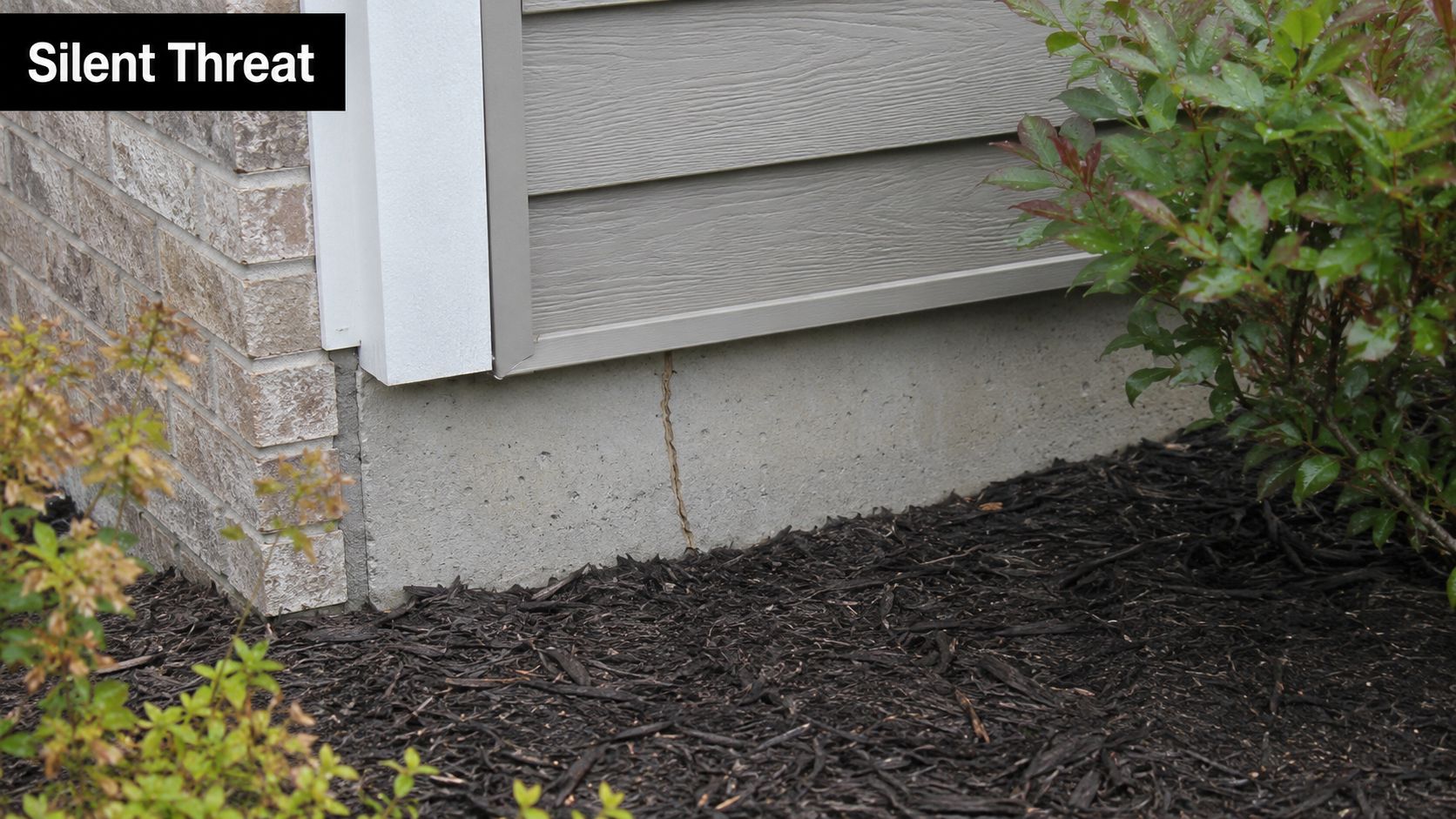
The scale of the problem is one reason termite control remains such a large pest-management category. A North America market report projects the regional termite control market will reach USD 4.31 billion by 2033, with the United States accounting for 80.2% of demand, and says chemical control methods held 55.3% of the market in 2024, while baiting systems and biological termiticides continue gaining attention for their targeted approach and lower environmental footprint, according to North America termite control market projections.
How subterranean termites get inside
These termites don't need a wide-open hole. They use tiny construction gaps, foundation cracks, utility penetrations, and concealed pathways. Once they reach wood, they can keep feeding from the inside out.
Homeowners in Crown Point should pay attention to a few common warning signs:
- Mud tubes: Pencil-width shelter tubes on foundation walls, piers, or masonry.
- Soft or hollow wood: Trim, sill plates, joists, or window frames that don't sound solid.
- Swarming activity: Winged termites appearing indoors or around windows.
- Discarded wings: Small piles near sills, doors, or light sources.
- Paint changes: Bubbling or rippling surfaces that can mimic a moisture problem.
Not every one of those signs confirms the same level of infestation, but they all deserve a professional look.
Why damage often stays hidden
Termites don't usually eat a board cleanly across the outside where you'd spot it quickly. They follow the grain and stay protected. That means a floor can still look normal while support members underneath have already been weakened.
This short visual overview helps homeowners understand how those hidden routes form and why foundation details matter.
When a homeowner says, “I've never actually seen termites, only the signs,” that's often exactly how subterranean activity presents.
If you're also dealing with seasonal pest pressure such as ants, spiders, rodents, or wasps, that doesn't make termite evidence less important. It just means your property may need a broader pest review alongside termite-specific work.
A Clear Comparison of Termite Treatment Methods
A homeowner in Crown Point usually asks one fair question first: “Which treatment gives me the best protection without turning my house upside down?” The honest answer depends on the house, the construction details, how active the termites are, and how much disruption your family can tolerate.
For subterranean termites, professional treatment usually falls into two main categories. Liquid soil barrier treatments and termite bait systems. The EPA lists both conventional barrier treatments and termite baits as recognized control methods, and explains that termite protection requires inspection and maintenance over time in its guide to identifying and controlling termites.
Here is the side-by-side comparison most homeowners need before they decide.
| Method | How it works | Main strength | Main trade-off | Good fit for |
|---|---|---|---|---|
| Liquid soil barrier | Applied in soil around the structure to create a treated zone termites can't cross | Faster structural protection | May require trenching, drilling, and periodic re-treatment | Homes where fast perimeter defense matters |
| Termite bait system | Stations are placed around the property and termites feed on bait that is shared back to the colony | Lower disruption and colony-focused control | Slower process and ongoing monitoring | Homes where minimal disruption is a top priority |
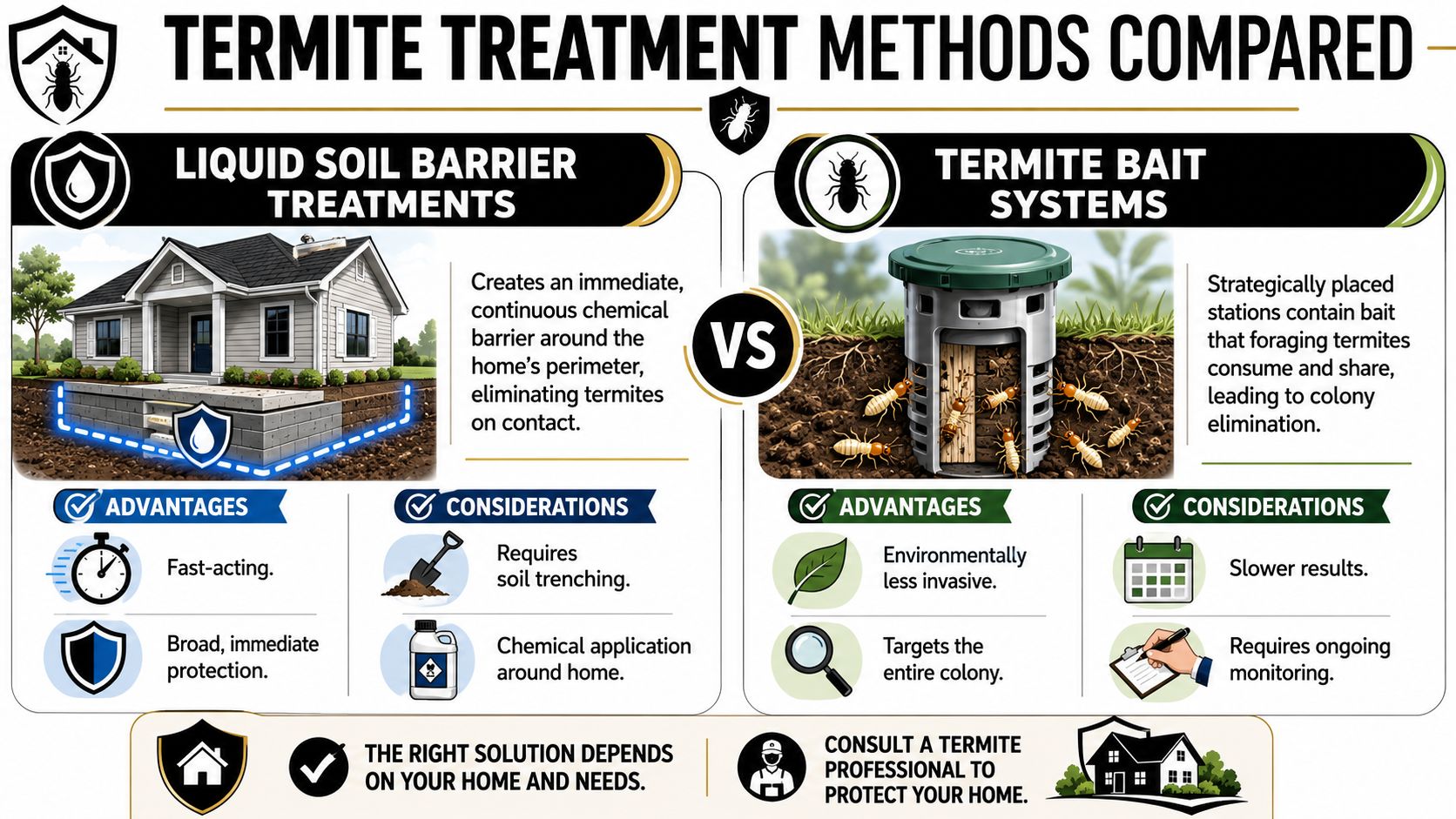
Liquid soil barrier treatments
Liquid barriers are still the method many technicians reach for when a home needs fast protection around the foundation. The treatment is applied to the soil along likely termite entry points so termites pass through a treated zone before they reach structural wood. The University of Kentucky Entomology program explains that liquid termiticides are commonly used for subterranean termite control and that treatment quality depends heavily on creating continuous coverage around the structure, as described in its guidance on termite control options for buildings.
In practice, this method often makes the most sense for homes with active termites near the foundation, crawl spaces with clear access, or situations where the homeowner wants a strong perimeter approach right away.
What homeowners usually like about liquid barriers
- Quicker structural defense: Protection starts at the soil around the home, where subterranean termites travel.
- Good fit for widespread risk: If termites could be entering from multiple sides, a properly applied barrier covers more of the perimeter at once.
- Proven approach for many Northwest Indiana homes: It works well on houses where the foundation layout allows thorough treatment.
Where liquid barriers get complicated
- Concrete changes the job: Attached garages, stoops, patios, and finished basements can require drilling to reach the soil beside the footing.
- Access matters: Tight crawl spaces, additions, and buried foundation sections can make full coverage harder.
- Retreatment may be needed: Termite control is not a one-visit decision for the life of the house. It needs follow-up and periodic inspection.
I usually tell homeowners to think about their tolerance for disruption here. If a day of trenching and some drilling is acceptable, a liquid treatment may offer the quickest peace of mind. If the idea of disturbing finished areas is a problem, baiting may be the better fit.
Termite bait systems
Bait systems work from the outside in. Stations are installed in the soil around the property, then checked on a schedule. Foraging termites feed on the bait and carry it back into the colony.
This approach appeals to homeowners who want less drilling, less trenching, and a treatment plan that doubles as an ongoing monitoring system. Penn State Extension notes that bait systems can be effective for subterranean termite management, but they depend on termite feeding activity and regular service visits to stay effective, as explained in its overview of termite prevention and control methods.
Where baiting shines
- Lower disruption around the structure: Installation is usually less invasive than a full liquid barrier treatment.
- Useful on difficult layouts: Homes with extensive concrete, decorative hardscaping, or areas that are hard to trench can be good candidates.
- Built-in monitoring: Stations give your technician repeat inspection points around the property.
What homeowners need to understand
Baiting takes time. Termites have to find the stations and feed consistently enough for the system to do its job. It also only works well if the stations are monitored and maintained on schedule.
That makes baiting a strong choice for some families and a frustrating one for others. If you want the fastest perimeter response, a liquid barrier often feels more direct. If you want lower disruption and are comfortable with ongoing service, baiting can be a very practical long-term option.
Homeowner takeaway: The right treatment depends on how your home is built, how quickly protection is needed, what level of disruption your family can handle, and whether you want a faster barrier approach or a monitored long-term system.
If you want help matching visible damage to the treatment approach, this guide on how to identify termite damage can help you understand what technicians look for during an inspection.
Specialized Solutions for Severe or Localized Infestations
Some termite problems don't fit neatly into the barrier-versus-bait conversation. A technician may recommend a more specialized treatment when the activity is limited to a known area, when wood is exposed during construction or renovation, or when the infestation is severe enough that whole-structure work has to be considered.
Direct wood treatments
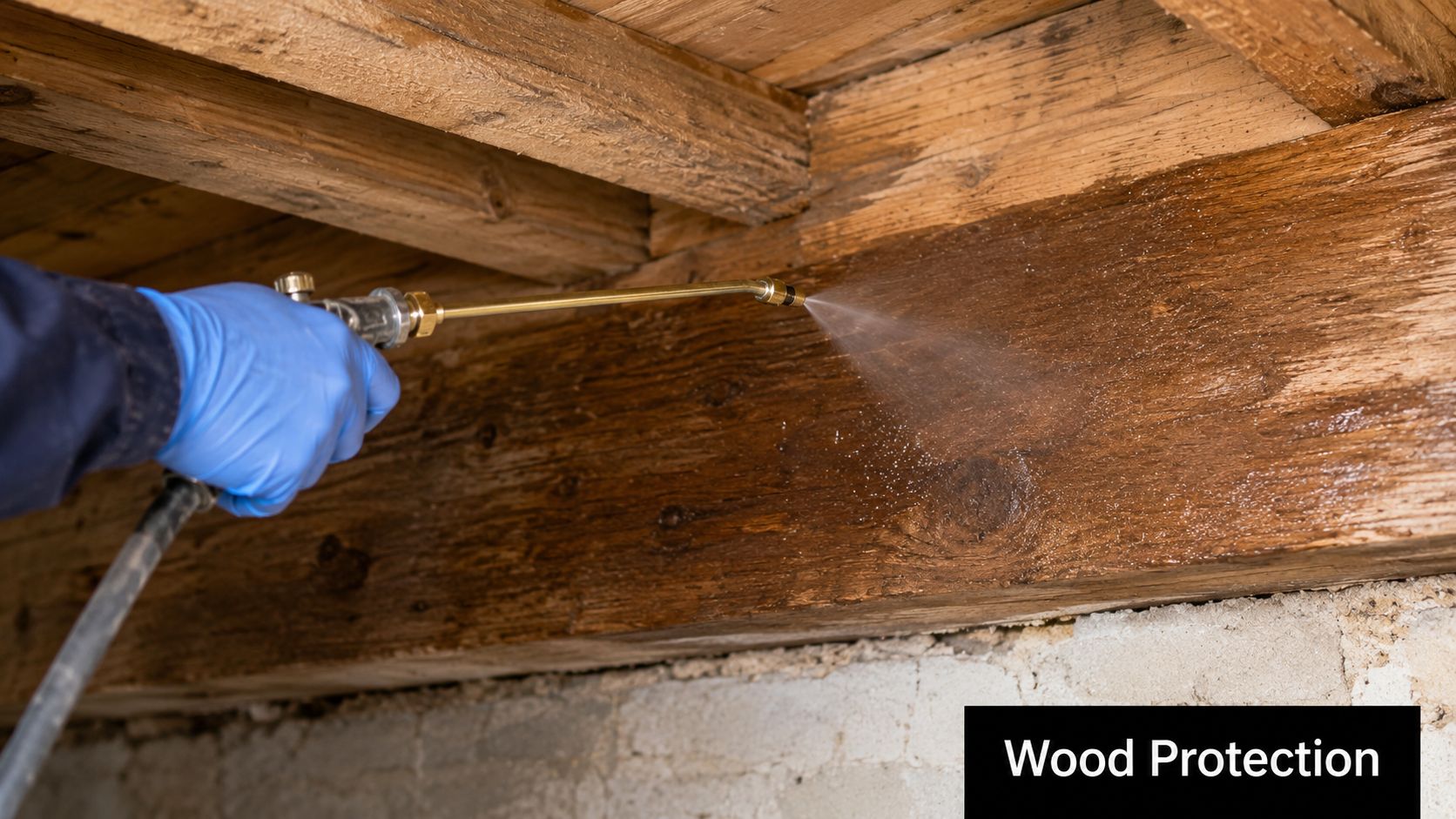
Wood treatments are exactly what they sound like. Instead of focusing first on soil or exterior stations, the treatment is applied directly to vulnerable or infested wood. This can make sense for exposed framing, sill areas, joists, or other accessible structural members.
These treatments are especially useful in two situations:
- During construction or renovation: Exposed wood is easier to treat thoroughly before it's covered up.
- For localized activity: When a known section of wood needs direct protection or direct knockdown.
Wood treatment alone usually isn't the whole answer for a subterranean termite problem if the colony still has soil access to the building. It's often part of a broader site plan.
When fumigation enters the conversation
Fumigation gets a lot of attention because it appears to be a complete solution, but for many suburban homes with subterranean termite issues, it isn't the first conversation. It's a specialized tool with major logistical demands.
Public guidance from Los Angeles County notes that fumigation uses sulfuryl fluoride and requires removal or securing of people, pets, plants, food, and medicines, along with exterior preparation such as cutting back plants and, in some cases, removing fence boards or fixtures, as outlined in the county's guidance on termite treatments and fumigations.
That disruption matters.
The real trade-off homeowners overlook
A treatment's inconvenience can decide whether it's practical for your family, tenants, or business operations.
- Occupied homes: Families with children, pets, or medical routines often prefer options with less relocation pressure.
- Rental properties: Landlords need to think about access, notice, and tenant cooperation.
- Commercial spaces: Downtime and prep work can be more costly than the treatment itself.
If a termite issue is localized, direct wood treatment may be enough as part of a broader plan. If the issue is extensive or involves termite behavior that isn't well addressed by localized work alone, a more intensive treatment may be necessary. The right answer comes from inspection findings, not from assuming the most aggressive method is automatically the most effective.
Why Professional Termite Control Is a Non-Negotiable Investment
A Crown Point homeowner usually sees termites after they have already been active for a while. Maybe a baseboard feels soft, a spring swarm shows up near a window, or paint starts to look bubbled along a wall. By that point, the key question is not whether a store product can kill a few insects. The question is whether anyone has found the entry points, the active areas, and the conditions letting the colony stay established.
That is where professional termite control earns its cost.
DIY products can knock down visible activity, but they rarely solve the full problem in a Northwest Indiana home with a basement, crawl space, attached garage, or multiple foundation transitions. Termite work depends on coverage, access, and correct identification. Miss one section along the structure, or treat the wrong pest entirely, and the colony can keep feeding out of sight.
I have seen homeowners spend money twice. First on sprays, foams, or bait stakes from the hardware store, then again on a full treatment after hidden activity continued behind finished walls or below flooring. The first expense felt cheaper. The total cost was not.
What a professional approach changes
Professional termite control starts with diagnosis, not product selection. The technician needs to confirm the termite species, map likely entry routes, inspect where soil meets structure, and decide whether the property calls for liquid treatment, baiting, localized work, or a combination.
The materials available to licensed pest professionals also matter, but the bigger difference is how they are applied. A good treatment is built around the structure so there are no easy gaps at stoops, utility penetrations, expansion joints, crawl space supports, or other problem areas that homeowners often miss.
That level of detail affects real outcomes.
Where DIY usually falls short
- Coverage is incomplete: One untreated section can leave termites an open path back into the home.
- The wrong method gets used: A localized product may be applied where the property really needs perimeter protection or ongoing monitoring.
- Damage can stay hidden: Surface activity may slow down while termites continue feeding in less visible structural wood.
- Follow-up is inconsistent: Without rechecks, homeowners may assume the problem is solved too early.
Professional service also gives homeowners something many families need. A plan they can live with. That means clear prep instructions, realistic expectations about disruption, and a treatment choice that fits the home, the household routine, and the budget instead of forcing the same answer on every property.
For companies trying to improve service coordination and homeowner communication around visits, tools such as Rosie for pest control can help streamline appointment flow and customer communication. Field skill still matters most, but clear scheduling and follow-up make termite work easier for homeowners to manage.
A termite treatment plan should protect structural wood, close off likely re-entry paths, and include follow-up so the home is not relying on guesswork.
One local option homeowners in Crown Point may consider is The Green Advantage, which emphasizes IPM-oriented service and uses baiting systems and low-toxicity treatment strategies where they fit the site conditions.
Your Termite Treatment Process with The Green Advantage
When homeowners call for pest control near me or an exterminator in Crown Point, IN, they usually want clarity as much as treatment. They want to know what happens first, what the technician is looking for, and whether the process is going to turn into a drawn-out mystery.

Step one starts with the inspection
The first visit should focus on evidence, access points, and conditions that support termite activity. That means more than checking one damaged board. A proper inspection looks at the foundation line, crawl spaces if accessible, basement framing, utility penetrations, moisture patterns, and any places where soil and wood come too close together.
A good inspection also separates termite issues from other wood-destroying or nuisance pest concerns. In Northwest Indiana, homeowners often ask about ant control, rodent control, spider control, mosquito control, or wasp removal during the same call. That broader context helps if the property needs a larger preventive pest strategy.
Then comes a treatment plan you can actually use
After the inspection, the next step is a site-specific recommendation. That recommendation should explain:
- What was found: Active signs, damage indicators, or risk factors.
- What method fits: Soil treatment, baiting, localized wood treatment, or a combined approach.
- What the household should expect: Access needs, prep, timing, and follow-up.
Practical details are important considerations. A homeowner with a busy family schedule may prioritize lower disruption. A seller preparing for a transaction may prioritize documentation and quick scheduling. A commercial property may care most about access windows and operational continuity.
Treatment and follow-up
Licensed technicians then perform the approved treatment based on the property's layout and needs. Depending on the method, that may include perimeter work, bait station installation, targeted treatment of specific structural areas, or monitoring visits.
The follow-up matters as much as the first treatment. Termite work shouldn't end with “we sprayed, call us if you see something.” Monitoring, re-checks, and clear communication are part of what makes professional termite control worth paying for.
The most reassuring termite appointment is the one where the homeowner knows what was found, why a certain method was chosen, and what happens next.
That kind of process is also what people expect from dependable residential pest control and commercial pest control in Crown Point and nearby Northwest Indiana communities.
Schedule Your Crown Point Termite Inspection Today
Good termite prevention starts with simple habits. Fix moisture issues. Keep wood debris and stored lumber away from the foundation. Avoid letting mulch, siding, and soil create hidden contact points. Watch for mud tubes, winged swarmers, and changes in wood or paint that don't look right.
But prevention at home has limits. Termites are hidden pests, and they often show themselves late. The most reliable next step is a professional inspection that looks at the whole property, not just the symptom you happened to notice first.
When it makes sense to call now
- You've seen a warning sign: Mud tubes, wings, soft trim, or suspicious blistering.
- You're buying or selling: Documentation matters during a real estate transaction. A termite inspection for real estate can help clarify conditions before closing.
- You want prevention, not repairs: Annual review is often easier than waiting for visible damage.
If you're in Crown Point or nearby Northwest Indiana and searching for pest control in Crown Point, IN, exterminator near me, or practical termite treatment options, don't wait for a small sign to become a structural problem. A clear inspection gives you real answers, a treatment path that fits your home, and a better chance to protect the property before damage spreads.
If you're ready to take the next step, contact The Green Advantage to schedule a termite inspection or request a quote for your Crown Point home or commercial property in Northwest Indiana.