
You walk into the kitchen in Crown Point first thing in the morning and spot a line of ants running along the counter. Or you hear scratching in the wall after dark and start wondering if mice found a way in before the weather changed. Most homeowners have the same first thought. They want the problem gone, but they don't want to make their home feel less safe in the process.
That's a reasonable instinct. If you have kids, pets, or just don't like the idea of spraying harsh products around food prep areas, searching for how to get rid of pests naturally makes sense. The trouble is that a lot of advice online skips the hard part. It tells you what to spray, but not whether that method is meant to repel pests, kill a few on contact, or solve the hidden source of the problem.
In Northwest Indiana, pest pressure usually comes from a mix of weather, moisture, shelter, and easy food access. That means the most useful natural approach isn't a magic recipe. It's a practical system. Some DIY steps help. Some don't do much at all. And once pests are established inside walls, attics, crawl spaces, or around foundations, a more complete plan is usually the safer route.
A Homeowner's Guide to Natural Pest Control in Crown Point
A lot of natural pest control starts with the same moment. Someone sees one problem and realizes it might be a larger one. Ants by the sink. Spiders in basement corners. Wasps under the eaves. Mice sounds at night. The first reaction usually isn't panic. It's caution. People want an answer that protects the house without turning the house into a chemistry project.
That concern is especially common in family homes around Crown Point. People want a clean kitchen, a usable yard, and a home where pets and children can move around normally. They also want honest advice. Not every natural remedy belongs indoors, and not every infestation can be handled with ingredients from a pantry shelf.
Why homeowners start with natural options
Natural pest control appeals to homeowners for good reasons:
- Less indoor exposure: People want to avoid unnecessary residue on counters, floors, and pet areas.
- Simple first steps: Sealing food, reducing moisture, and cleaning up attractants often helps right away.
- A prevention mindset: Many pest issues start outside, then move in when conditions are right.
In practice, the strongest natural programs start before pests take over. If you also pay attention to the surroundings around your property, that helps. Problems in the yard often feed problems at the house. Homeowners dealing with roots, moisture, and plant stress sometimes find value in broader property maintenance topics such as addressing liquid amber root problems, because outdoor conditions can affect drainage, shelter, and pest activity near the foundation.
Practical rule: If a natural method doesn't change the conditions attracting pests, it usually won't hold for long.
What local experience changes
A technician who works in Crown Point sees patterns that generic articles miss. Northwest Indiana homes deal with seasonal moisture, changing temperatures, garage access, mulch beds, low spots near foundations, and outdoor clutter that becomes pest harborage. Those details matter more than trendy DIY hacks.
That's why the best natural approach is usually measured and specific. Start with prevention. Use low-impact steps where they make sense. Watch for signs that the issue is growing. If you only focus on what you can spray, you miss where pests are feeding, nesting, or entering in the first place.
Prevention Your First and Best Natural Defense
The most effective natural pest control starts before you see pests indoors. The Royal Horticultural Society notes that a foundational principle of natural pest control is prevention through habitat management, with practices such as removing diseased plant sections, using mulch as a barrier, encouraging beneficial insects, and monitoring populations before they boom in order to suppress pests and diseases without chemicals (RHS guidance on controlling pests and diseases without chemicals).
That principle applies just as much to homes in Crown Point as it does to gardens. Pests stay where food, water, shelter, and access line up. Break those conditions early and you make the property far less inviting.
Start outside the house
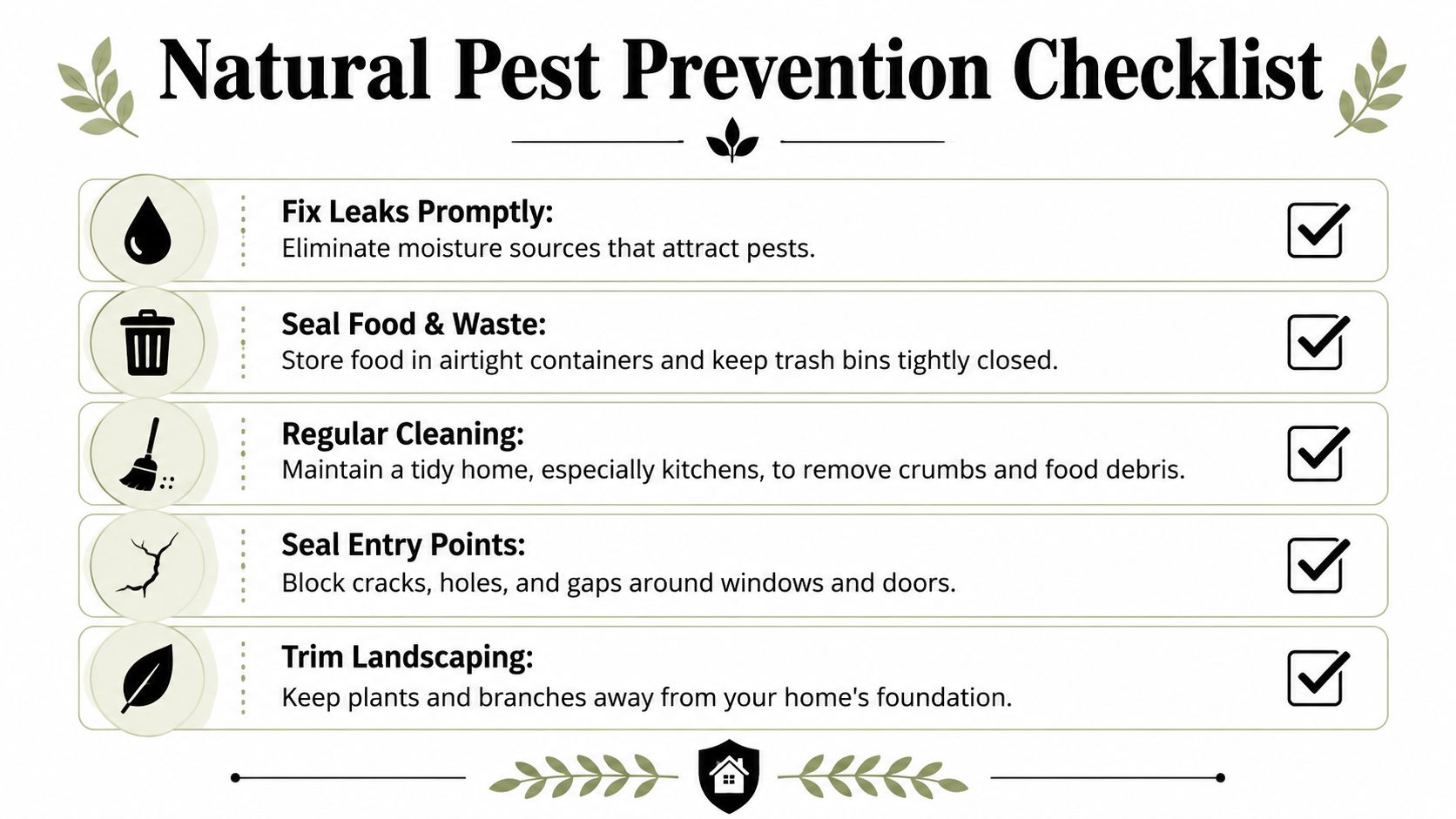
Walk the exterior slowly. Look at the foundation line, door sweeps, utility penetrations, window frames, garage corners, and siding transitions. You're looking for gaps, not dramatic holes. Tiny openings are enough for crawling insects, and larger cracks or worn seals can invite rodents.
Focus on these areas first:
- Entry points: Seal gaps around pipes, wires, and doors where light or air passes through.
- Vegetation contact: Trim branches and shrubs so they don't rest against siding or roofs.
- Stored materials: Keep firewood, cardboard, and clutter away from the house so pests don't settle nearby.
Control moisture before pests do
Moisture is one of the biggest hidden drivers of pest activity. Leaky spigots, clogged gutters, downspouts that dump too close to the foundation, wet crawl spaces, and dense mulch against the home all create more favorable conditions. Ants, mosquitoes, flies, and many occasional invaders show up more often when damp areas are left alone.
If you suspect roof runoff is contributing to wet soil or pest pressure around the foundation, it helps to understand the basics in this guide for Utah homeowners on gutter issues. The climate is different, but the lesson carries over. Poor drainage invites larger home maintenance problems, and pests take advantage of them.
Good prevention isn't glamorous. It usually looks like fixing leaks, improving drainage, reducing clutter, and keeping pests from getting comfortable in the first place.
Clean with pest behavior in mind
General tidiness helps, but targeted sanitation works better. In kitchens, that means wiping up grease and sugar residue, not just visible crumbs. In garages and basements, it means reducing cardboard storage and checking pet food, birdseed, and bulk pantry items. Outdoors, keep trash lids shut and avoid letting bins sit right next to entry doors.
A simple home checklist works well:
| Area | What to check | Why it matters |
|---|---|---|
| Kitchen | Crumbs, spills, food containers | Food residue supports ants and flies |
| Bathroom | Leaks, damp mats, slow drains | Moisture supports pest activity |
| Basement | Cardboard, clutter, humidity | Shelter makes monitoring harder |
| Yard edge | Leaf litter, stacked wood, dense cover | Harborage increases near the structure |
Prevention is still the most natural move you can make. It doesn't rely on a strong smell, a viral recipe, or repeated guessing. It changes the environment so pests have fewer reasons to stay.
DIY Natural Remedies for Common Indiana Pests
Once prevention is in place, some DIY remedies can help with light pest activity. The key is to match the method to the problem. A repellent may interrupt movement. A contact spray may affect exposed insects. Neither one automatically fixes a nest in a wall void or a breeding issue in the yard.
For homemade sprays, consistency is more critical than commonly understood. The Peace Corps standard for botanical sprays recommends drying neem leaf material in shade, then steeping a generous handful of powder in 10 liters of water for 12 to 24 hours, applied in the evening. For soap spray, the listed mix is 2 tablespoons of grated soap per 1.5 liters of water, and the guidance stresses complete surface coverage rather than spot spraying for effectiveness (Peace Corps natural pest control recipes).
Ants and crawling insects
For ants, start with trail disruption and food removal. Clean the trail thoroughly, store sweets and dry goods in sealed containers, and watch where the ants are entering. If you use a soap spray on exposed ants, remember that spraying a few workers on the counter doesn't mean the colony is gone.
What often helps more than a spray:
- Wipe trails fully: Ants follow scent cues, so partial cleanup doesn't do much.
- Check moisture: Sink areas, dishwasher edges, and pet bowls often keep ant traffic going.
- Follow the line: If they're emerging from trim, outlets, or wall gaps, the source is deeper than the visible trail.
Mosquitoes around the yard
Mosquito control is where many natural plans fall short because the problem usually isn't one spot. It's the whole environment. Standing water, shaded resting areas, dense vegetation, and neighboring conditions all play a role. Empty water-holding items regularly, improve drainage where you can, and trim heavy growth around seating areas.
Homeowners who want a few low-chemical ideas for outdoor use can review these home remedies to keep mosquitoes away. The most useful takeaway is that yard comfort usually improves when you combine habitat reduction with targeted action, not when you rely on one scent alone.
A mosquito problem is rarely solved by fragrance. It improves when you remove resting areas and water sources and keep pressure down over time.
Spiders and rodents
Spiders often show up because other insects are present. If you knock down webs but leave the insect food supply untouched, more spiders usually return. Vacuum webs, reduce clutter, limit exterior lighting that attracts insects near doors, and seal gaps around utility lines and basement entries.
For mice, natural deterrents are usually the weakest category of DIY advice. Scent-based methods may discourage activity in a limited area, but they don't replace exclusion. If mice can still get inside and find food, nesting material, or warmth, odor alone won't carry the job.
A better pest-by-pest way to think about DIY methods is this:
| Pest | Natural step that may help | Main limitation |
|---|---|---|
| Ants | Sanitation and trail cleanup | Doesn't remove hidden colony |
| Mosquitoes | Standing water reduction | Doesn't address broader yard pressure |
| Spiders | Web removal and insect reduction | Returns if food source remains |
| Mice | Sealing entry points | Repellents alone are unreliable |
DIY can work best when the problem is small, visible, and recent. It works worst when the pests are nesting out of sight.
Safety First When Natural Isn't Necessarily Harmless
A lot of homeowners hear "natural" and assume "safe everywhere." That isn't always true. A common gap in DIY advice is the safety and effectiveness tradeoff for indoor use, especially with essential oils, vinegar, and borax-like mixtures that are often recommended without enough guidance on exposure risks, residue, or airway irritation. What works in a garden setting may be a poor fit for a kitchen, bedroom, or home with pets (overview of natural garden pest control methods and indoor-use concerns).
That matters because homes aren't all the same. A remedy used on a patio planter isn't judged by the same standard as something sprayed near food prep surfaces, around cat dishes, or in a child's room. Setting changes the risk.
Common mistakes with indoor natural remedies
Some DIY problems come from overapplication. People spray too much, use strong scents in poorly ventilated rooms, or leave powders where they can be kicked up into the air. Others use food-based mixtures that end up feeding the wrong pests or leaving sticky residue behind.
Watch for these trade-offs:
- Essential oils: Strong odors may bother people or pets, especially in closed rooms.
- Powders and dusts: Fine materials can become an inhalation issue if applied carelessly.
- Food-based baits or mixes: Sweet or greasy ingredients can create secondary pest attention if spilled or misplaced.
Match the method to the room
A kitchen ant issue should be handled differently than a mosquito issue outdoors. A child's bedroom should be approached differently than a detached shed. One of the biggest reasons homeowners call for help is that online advice treats all natural options as interchangeable when they aren't.
If you're weighing treatment choices for indoor spaces, this page on home pest control chemicals is useful because it frames the larger safety question homeowners are already asking. The goal isn't just getting rid of pests. It's doing it without creating a new problem for the people living there.
Natural products still need judgment. The safest approach is the one that fits the pest, the room, and the people in the home.
When DIY Natural Pest Control Isn't Enough
The main reason DIY natural pest control disappoints people is simple. It often addresses what they can see, not what's sustaining the infestation. The University of Florida's entomology guidance raises that exact issue by separating deterrence, direct kill, and population control, and noting that practical guidance is shifting toward integrated methods such as sanitation, habitat reduction, and professional help rather than one-off remedies that don't solve the root cause (University of Florida guidance on natural pest control methods that really work).
That distinction matters in real homes.
Deterrence versus elimination
If you spray ants on a countertop and they disappear for a few hours, you may have achieved direct kill on the ants you hit. You have not necessarily changed the colony. If you scatter a scent mice don't like in one room, you may create short-term avoidance, but you haven't closed the entry route.
Those are different outcomes:
- Deterrence: Makes an area less appealing for a while
- Direct kill: Affects exposed pests on contact
- Population control: Reduces the source, access, or reproduction driving the problem
Signs the problem has moved beyond home remedies
A few situations usually signal that DIY is no longer enough:
- Repeat sightings: You clean, spray, or repel, and the pests keep returning to the same area.
- Hidden activity: You hear movement in walls, find droppings, or notice pests around plumbing voids, attics, or crawl spaces.
- Outdoor pressure: Mosquitoes, wasps, or other pests are affecting the whole yard or structure, not one isolated spot.
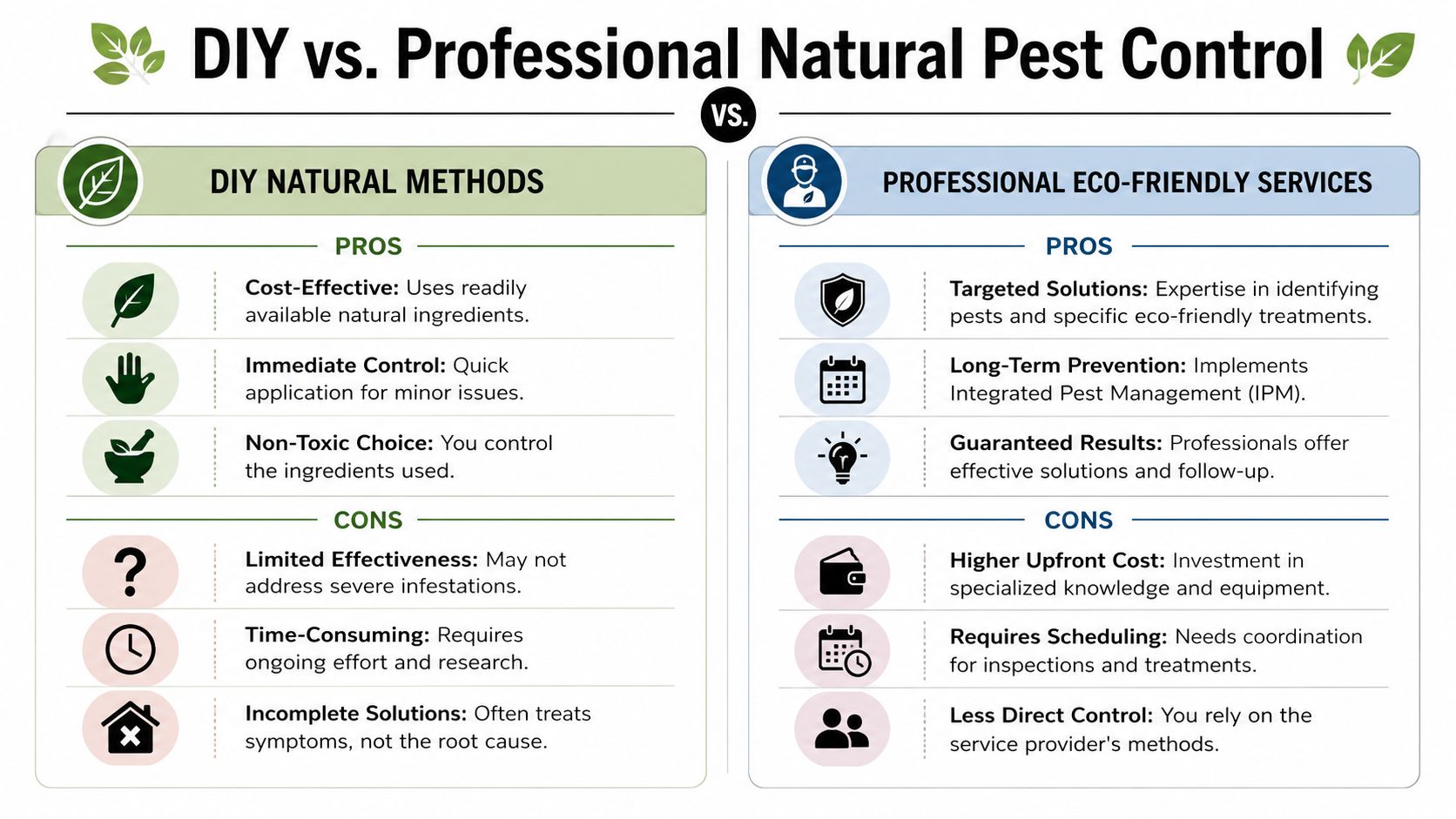
For serious infestations, the issue isn't effort. It's reach. A homeowner can do a good job on visible surfaces and still miss nesting areas, breeding sites, structural gaps, and moisture conditions that keep the cycle going.
Why integrated work lasts longer
The most reliable solutions combine inspection, sanitation, exclusion, habitat reduction, monitoring, and, when needed, targeted treatment. That's why professional eco-friendly service often feels different from DIY. It isn't based on one trick. It's based on identifying the pest, finding the access point, correcting conditions, and following up when needed.
If your goal is lasting peace of mind, that bigger system usually matters more than whether a remedy smells pleasant or came from a natural ingredients list.
The Green Advantage A Professional Eco-Friendly Solution
When homeowners search for pest control near me, exterminator near me, or pest control in Crown Point, IN, they're usually past the point of wanting random tips. They want a clear answer. What's in the house, why is it there, and what's the safest practical way to stop it from coming back?
That's where a professional eco-friendly approach fits. In Crown Point and across Northwest Indiana, the right service doesn't start with over-treating. It starts with inspection, identification, and a plan built around the site.

What a professional process looks like
A sound residential pest control plan usually includes:
- Inspection first: Identify the pest correctly and look for the conditions supporting it.
- Exclusion and correction: Seal likely entry points and address moisture, clutter, and harborage.
- Targeted treatment when needed: Use the lightest effective approach for the actual problem and setting.
- Follow-up: Check whether the pressure dropped and whether additional corrections are needed.
This is also where commercial pest control differs from casual DIY. Restaurants, offices, multifamily buildings, and retail spaces need consistency, documentation, and prevention habits that hold up under daily use.
A lot of property owners also benefit from improving the surrounding outdoor areas. Reducing dense cover, fixing drainage, and making the yard less hospitable to pests supports any treatment plan. For broader property upkeep, these eco-friendly landscaping tips are worth a look because the outside environment often determines how much pest pressure reaches the structure.
What local homeowners can expect
The Green Advantage offers pest inspections and service plans for homes and businesses in Crown Point and nearby Northwest Indiana communities. That includes support for common concerns such as ant control, mosquito control, rodent control, spider control, wasp removal, and preventative pest treatments. The point of that kind of service isn't to replace common sense steps like cleaning and sealing. It's to build on them with trained inspection and problem-solving.
A homeowner dealing with an active infestation usually needs answers to practical questions:
| Question | Why it matters |
|---|---|
| What pest is this? | Correct identification changes the treatment plan |
| Where is it coming from? | Entry points and nesting areas determine recurrence |
| Is this safe for my home setup? | Kitchens, pets, and children change the approach |
| What keeps it from returning? | Lasting control depends on prevention, not just treatment |
If you want to see the kind of approach that supports long-term prevention, this overview is helpful:
For many homeowners, that combination of inspection, eco-conscious planning, and follow-through is the answer to how to get rid of pests naturally. Use low-impact methods where they make sense. Be realistic about their limits. And when the issue is inside walls, across the yard, or recurring no matter what you try, bring in a trained local team that can solve the whole problem instead of the visible part of it.
If pests are disrupting your home or business in Crown Point, the next step is simple. Contact The Green Advantage to schedule an inspection, request a quote, and get a practical pest control plan built for your property, your family, and the realities of Northwest Indiana.