
You found ants in the kitchen, a spider web in the basement, or wasps starting to gather near the eaves. The first move for most homeowners in Crown Point is simple. Grab a spray from the hardware store and try to stop the problem fast.
That reaction is normal. Household pesticide use is routine in the United States. The National Center for Healthy Housing says approximately 4.4 billion pesticide applications are made each year to American homes, gardens, and yards, and more than three-quarters of U.S. households use pesticides according to its pesticide use overview. The issue isn't whether people use home pest control chemicals. The issue is whether they're using the right product, in the right place, with the right method.
That's where many DIY jobs go sideways. The can promises quick results. The label is hard to interpret. The pest comes back anyway. Then the homeowner sprays again, often in more places and in heavier amounts than the label intended.
In Northwest Indiana, that can turn a manageable pest issue into two problems at once. You still have pests, and now you also have unnecessary chemical exposure on surfaces, around pets, or in rooms with limited ventilation.
Your Guide to Home Pest Control in Crown Point IN
A lot of service calls start the same way. Someone in Crown Point notices a trail of ants along a window, sprays the visible insects, and feels better for a day or two. Then the ants return. Or a homeowner hears scratching in a wall, sets out a random bait, and later realizes the original problem was an entry gap near the foundation.
That's the difference between reaction and strategy.
Home pest control chemicals can work. But they don't work equally well for every pest, every room, or every infestation stage. A contact spray that kills the bugs you see may do very little to the nest you don't see. A repellent treatment may scatter a problem instead of solving it. A product that seems mild can still create exposure concerns if it's overapplied or used in the wrong area.
What homeowners are usually trying to solve
Homeowners aren't looking for chemistry lessons. They want to know:
- What's safe around kids and pets
- What works for ants, spiders, roaches, wasps, or rodents
- Why the bugs keep coming back
- Whether they should keep trying DIY products or call for residential pest control
Those are the right questions.
Practical rule: The best pest treatment is the one that hits the pest where it lives while limiting exposure everywhere else.
That's why a professional approach in Crown Point, IN starts with identification and inspection before product choice. Ant control isn't handled the same way as bed bug treatment. Wasp removal isn't approached like rodent control. Mosquito control outside the home isn't the same as treating spiders in a basement corner.
Why local conditions matter
Northwest Indiana homes deal with seasonal moisture, changing temperatures, slab edges, crawlspaces, garages, mulch beds, and lake-effect weather patterns that can influence pest pressure. Those local conditions matter when choosing between a bait, a liquid residual, a dust, or a non-chemical fix like exclusion.
If you're searching for pest control near me, exterminator near me, or pest control in Crown Point, IN, you're probably not just buying a product. You're trying to solve a problem without creating a bigger one inside your home.
Common Chemicals in Your Local Hardware Store
Walk into a hardware store and you'll see shelves full of sprays, foggers, granules, baits, and concentrates. They don't all do the same job, even when the front label makes them sound similar. The key difference is between the active ingredient and the formulation.
The active ingredient is the chemistry intended to affect the pest. The formulation is the full product, including the ingredients that help it spread, stick, dry, or stay stable. That matters because one product may behave very differently from another, even if the active ingredient looks familiar.
Fast knockdown versus population control
The simplest way to think about common home pest control chemicals is this.
A pyrethroid is often the fast punch. An IGR is the long game.
Authoritative pesticide references note that pyrethroids like bifenthrin disrupt the pest nervous system for rapid knockdown, while Insect Growth Regulators such as methoprene prevent pests from maturing and reproducing in this pesticide ingredient guide from NPIC. Those are very different tools.
If you spray a pyrethroid on exposed insects, you may see quick results. That's why many consumer aerosols feel satisfying. But if the actual issue is eggs, juveniles, or a hidden colony, quick knockdown may not finish the job. An IGR usually won't give that dramatic instant result, but it can help interrupt the next generation.
What homeowners usually see on the shelf
Some products are built for direct contact. Some are made to leave a residual on a surface. Others are designed to be eaten and transferred within a colony. That's why choosing by brand name alone is risky.
Here's a practical comparison.
| DIY Home Pest Control Chemical Types | How It Works | Best For | Key Consideration |
|---|---|---|---|
| Pyrethroids | Fast knockdown through the pest nervous system | Visible crawling insects and some perimeter uses | Quick kill doesn't always reach the nest or source |
| Baits | Pest carries or consumes the product over time | Ants, some roaches, and hidden infestations | Wrong placement can make bait ineffective |
| Insect Growth Regulators | Disrupts development and reproduction | Ongoing population suppression | Usually not an instant-result product |
| Dusts and desiccants | Works in voids, cracks, or dry hidden spaces | Certain concealed harborages | Misuse can create unnecessary residue in living areas |
| Repellents | Deters pests from treated areas | Select exterior or entry-point situations | Can push pests into new areas if the source remains |
Why labels are harder than they look
Homeowners often assume stronger smell means stronger control. It doesn't. They also assume a broader spray pattern means better coverage. Often it means more exposure.
A better question is whether the product matches the pest's behavior. Ants following a trail, roaches hiding in voids, and spiders resting in corners all require different decisions. If you want a deeper breakdown of how pest products differ, this guide from Let's Talk Chemicals is useful for understanding what labels are really telling you.
If the only plan is “spray more,” the product selection probably wasn't the real solution.
What works better than guessing
Before you buy any chemical, identify three things:
- The pest itself. Ants are not all controlled the same way.
- Where it's nesting or entering. Surface activity can hide the true source.
- What result you need. Immediate kill, residual control, colony elimination, or prevention.
That's the part professionals train for. Product choice is only one piece. Matching the chemistry and the delivery method to the pest is what makes the treatment make sense.
Health and Home Risks of DIY Pest Treatments
The biggest mistake homeowners make with DIY pest treatments is thinking risk only comes from the word “chemical.” In real homes, risk comes from exposure. Where the product lands, how long it stays there, whether someone inhales it, and whether it's used as a targeted treatment or a room-wide broadcast matters just as much.
Public-facing guidance on safer pest control emphasizes that pesticide risk depends on route of exposure, ventilation, and whether treatments are targeted or broadcast, and that IPM favors the least-toxic, most-targeted option only when needed, as explained in NRDC's piece on controlling household pests with fewer scary poisons.
Where DIY treatments create trouble
A homeowner may spray baseboards, countertops, bed frames, pet areas, window sills, and garage thresholds in the same afternoon. That feels thorough. It can also create unnecessary contact points for children and pets.
The common problem areas are straightforward:
- Overapplication means more residue on surfaces people touch.
- Poor ventilation increases inhalation concern, especially with aerosols.
- Wrong location puts product where it was never meant to be used.
- Improper storage leaves concentrates or ready-to-use cans accessible in garages, basements, or utility rooms.
A treatment can be legal on the label and still be a bad choice for the room, the surface, or the household routine.
Targeted treatment is safer than broadcast treatment
Spot treatment and crack-and-crevice work usually create less exposure than broad fogging or open-air spraying inside the home. That's one reason broad DIY “bomb” treatments often disappoint. They spread product widely but may miss the exact hiding spots that matter most.
The goal isn't to make the whole house toxic to pests. The goal is to put the least amount of product in the one place the pest can't avoid.
For families with dogs, cats, or outdoor play areas, yard decisions matter too. If you're comparing outdoor products and trying to think through pet exposure, these essential tips for a pet-safe yard offer practical context.
This short video is a useful reminder that safe pest control starts with method, not just product choice.
When a chemical should not be your first move
Some pest issues are better handled first with exclusion, sanitation, trapping, or a physical correction to the structure. If a mouse is entering through a gap under a door, spraying won't fix the opening. If moisture is supporting silverfish activity, product alone won't remove the condition feeding the problem.
That's why professional pest control in Crown Point isn't only about applying something stronger. It's about deciding when a chemical is appropriate, where it belongs, and how to limit everyone else's contact with it.
Why Your Pest Problem Keeps Coming Back
Homeowners often assume the product failed because it wasn't strong enough. In many cases, that isn't the actual issue. The primary problem is that the treatment hit the symptom, not the source.
A line of ants on the counter is activity. It is not the colony. Roaches visible at night are the edge of the problem, not the center of it. Bed bugs found on a mattress seam may not represent the full harborage pattern in the room.
Resistance changes the game
Many pests can adapt when the same active ingredient gets used over and over. Guidance aimed at consumers notes that ants, roaches, and bed bugs can develop resistance to frequently used chemicals, so repeated use of the same active ingredient may create a resistant population that requires a different strategy, as discussed in this article on natural insect pest control and treatment limits.
That means repeated re-spraying can train the problem to survive your favorite can.
The hidden source usually survives
Here's what happens in many failed DIY jobs:
- Visible pests die and the homeowner assumes progress.
- Eggs, nymphs, or the nest remain in a wall void, under flooring, or outside near the foundation.
- The entry point stays open so new pests keep coming in.
- The same product gets used again and the cycle repeats.
This is especially common with ant control, roach issues, and recurring spider complaints. Spiders often return because the insects they feed on are still present. Ants return because the trail was treated, but not the colony. Wasps return because the attractant or nesting site remains favorable.
More chemical doesn't fix a bad target. Better diagnosis does.
Why broad spraying often misses the real problem
DIY treatments usually focus on where the homeowner sees movement. Professionals focus on where pests rest, feed, breed, and enter. That difference sounds small, but it changes the result.
If you're searching for an exterminator in Crown Point, IN because the problem keeps reappearing, that's usually the sign to stop changing products and start identifying the pressure point. Sometimes the right answer is a different active ingredient. Sometimes it's baiting instead of spraying. Sometimes it's sealing, drying, cleaning, or removing a harborage site entirely.
The Professional Difference for Crown Point Homes
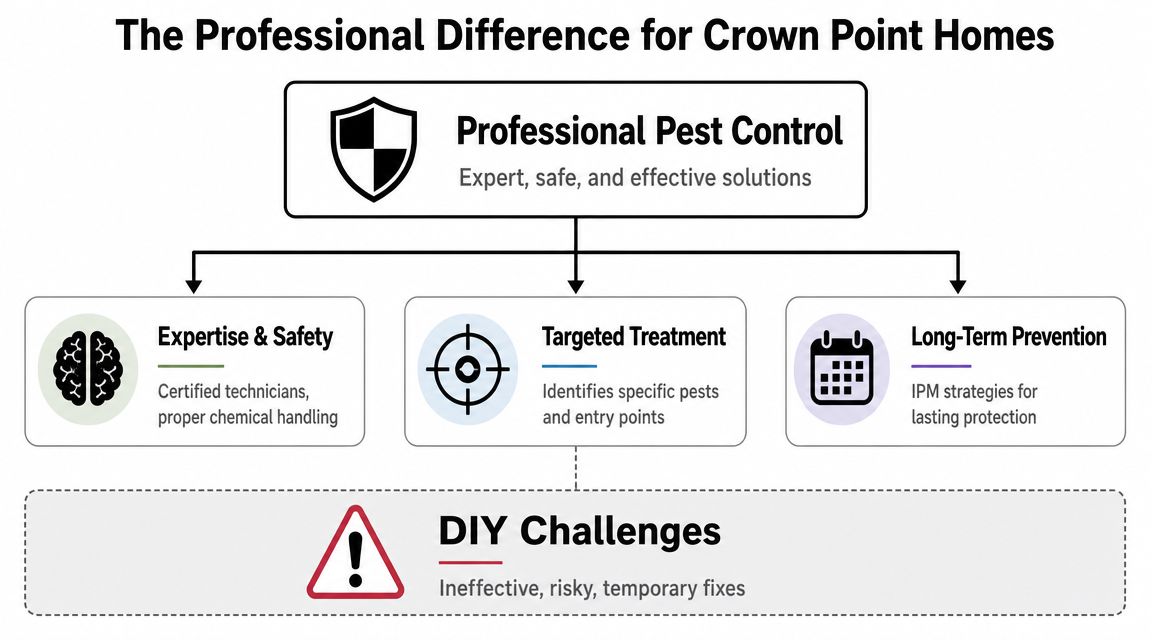
Professional pest control isn't just “DIY, but stronger.” The actual difference is the combination of identification, product selection, placement, and follow-through. A trained technician doesn't start with a random spray. The technician starts with the pest, the layout of the structure, and the exposure concerns inside that specific home.
Precision matters more than volume
EPA label language for a widely used household insecticide directs applicators to use spot-and-crack-and-crevice applications and avoid upward spraying, which reflects an exposure-control principle designed to reduce airborne drift and unnecessary contact, as shown on this EPA product label PDF.
That's a major difference between professional work and common DIY fogging. A careful crack-and-crevice treatment places product where pests hide. It doesn't turn the room into a chemical cloud.
What a professional service is really buying you
For Crown Point homes, the professional difference usually comes down to three things:
- Correct identification so the treatment matches the actual pest
- Targeted placement so the product goes into voids, edges, harborages, and entry points instead of broad living surfaces
- Prevention planning so the problem is less likely to return after the initial service
A professional may use liquid, baiting, dusting, exclusion, monitoring, or a combination. That's why a custom service plan generally outperforms a one-size-fits-all aerosol from the shelf. Homeowners comparing options can also review what a targeted pest control spray approach looks like when treatment is designed around placement and purpose.
Communication is part of safety
Good pest control also depends on clear instructions before and after treatment. Homeowners need to know what was applied, where it was applied, whether follow-up sanitation steps matter, and when to watch for continued activity. Clear scheduling and expectation-setting reduce confusion, especially in occupied homes and multi-unit properties. That's one reason these Phone Staffer communication insights are relevant. They highlight how strong communication improves service outcomes long before the technician arrives.
One local option for that kind of structured residential pest control and commercial pest control is The Green Advantage, which uses licensed application methods that can include liquid, dusting, and baiting depending on the site and pest.
Integrated Pest Management for Lasting Prevention
The best pest control plan doesn't rely on chemicals alone. It uses chemicals as one tool inside a bigger system. That system is Integrated Pest Management, or IPM.
IPM matters because pests don't appear by accident. They enter because the structure gives them access, shelter, moisture, food, or breeding space. If those conditions stay in place, even a good treatment may only provide temporary relief.
The three parts that make prevention work
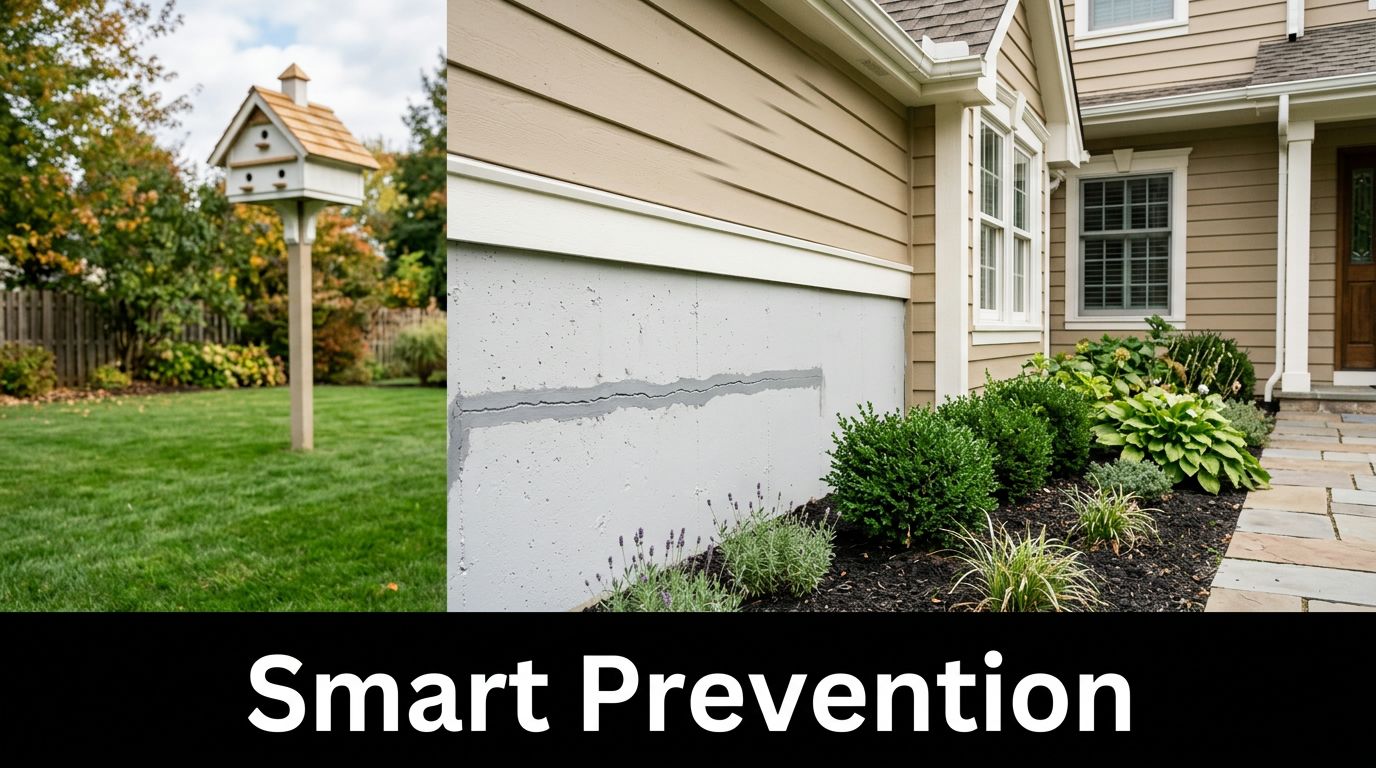
A lasting plan usually includes these pieces:
- Exclusion means sealing gaps around pipes, doors, siding transitions, vents, and foundations. If pests can't get in, the chemistry has less work to do.
- Sanitation means reducing the food, grease, crumbs, standing water, and clutter that support pest survival indoors.
- Monitoring means checking where activity starts, changes, or increases so treatment stays targeted instead of routine and wasteful.
How this applies to real Northwest Indiana properties
A Crown Point home with ants near the kitchen may need exterior entry-point work and interior bait placement. A property dealing with mosquitoes may need a yard-focused reduction program combined with habitat changes that reduce breeding pressure. A termite concern may call for inspection and monitoring around structural risk areas. Rodent control often depends on exclusion as much as trapping.
Long-term control comes from making the property less inviting, not just making the pests uncomfortable for a day.
That's also why “natural” and “chemical” aren't useful categories by themselves. The better question is whether the method fits the problem with the least disruption to the household. In a well-run IPM program, some issues need a chemical treatment. Others are solved by repairs, cleanup, trimming, drainage corrections, or ongoing inspection.
Why prevention saves frustration
Homeowners usually call after repeated annoyance. The better time to act is when you first notice the pattern. Seasonal pest issues in Northwest Indiana often build gradually. Ants show up at a sink. Spiders increase in a garage. Wasps test a roofline. Rodents start with a faint sound in the wall.
IPM turns those early signals into a plan before they become a recurring infestation.
Get Your Free Pest Inspection in Crown Point
If you've used home pest control chemicals once and the issue stopped, that may be the end of it. But if you're spraying repeatedly, changing products, or worrying about kids, pets, residue, or recurring activity, it's time to stop guessing.
Here are the usual signs that professional help makes more sense:
- The pests keep returning after several DIY treatments
- You don't know the pest for sure and don't want to apply the wrong product
- The problem involves a hidden source such as a nest, wall void, crawlspace, or exterior entry point
- You're dealing with sensitive areas like kitchens, bedrooms, pet spaces, or commercial interiors
- You want long-term prevention, not another temporary fix
What to expect when you call
A proper pest inspection should feel straightforward. You describe what you're seeing. Office staff answer questions and help schedule service. Then a technician inspects the property, identifies likely pest pressure points, and recommends a treatment or prevention plan based on the actual conditions at the site.
That matters for homeowners, landlords, and businesses looking for pest control in Crown Point, IN, exterminator near me, or commercial pest control that solves the issue instead of chasing symptoms.
The next step
If you're dealing with ants, spiders, wasps, rodents, mosquitoes, or another persistent pest issue in Crown Point or nearby Northwest Indiana communities, a local inspection gives you clarity. You'll know what the pest is, why it's active, whether a chemical is even needed, and what the safest effective next step looks like.
If you want a clear answer instead of another guess, contact The Green Advantage to schedule your free pest inspection in Crown Point, IN. Their team can assess the problem, explain your options, and help you choose a treatment plan built for safety, effectiveness, and lasting control.