
You're probably here because you just saw a spider on a basement wall, tucked behind storage in the garage, or hanging near a window and thought, “Do I need to worry about this?” That's a normal reaction. In Crown Point and across Northwest Indiana, spiders show up often enough to unsettle homeowners, especially when the spider is larger than expected or turns up in a bedroom, bathroom, or utility area.
A good spider identification guide helps, but most online advice is either too generic or too technical. Homeowners don't need a biology lecture. They need clear ways to tell what they're looking at, whether it's likely harmless, and when it makes sense to call for pest control near me or an exterminator in Crown Point, IN.
Answering Spider Concerns for Crown Point Homeowners
A common local scenario goes like this. A homeowner heads into the basement to grab holiday decorations, sees a fast-moving spider dart under a shelf, and suddenly every corner looks suspicious. That reaction isn't overblown. Spiders trigger concern because they're quiet, hard to track, and easy to misidentify from a quick glance.
Part of the confusion is simple scale. Over 37,000 distinct species of spiders have been scientifically described worldwide, and nearly 1,000 have been documented in the continental U.S. and Canada, which is why even a basic understanding matters for homeowners in places like Northwest Indiana, as noted in the IPM Institute spider guide. Contacting pest control in Crown Point, IN after spotting one spider is usually not an overreaction. They're responding to uncertainty.
What usually worries homeowners most
Most callers aren't asking for a formal species label. They want answers to practical questions:
- Is it dangerous: They want to know whether the spider poses a health concern.
- Is it alone: They want to know if one sighting means more are hidden nearby.
- Why is it inside: They want to know what's drawing spiders into the house.
- Will sprays from the store work: They want to know if DIY treatment will solve it or just scatter the problem.
Those are the right questions. In many homes, the spider itself is only part of the story. Indoor spider activity can point to cluttered harborages, moisture issues, gaps around doors, or a steady food source from other insects.
Practical rule: If you keep seeing spiders in the same rooms, don't focus only on the spider. Look at entry points, lighting, moisture, storage habits, and the insects those spiders may be feeding on.
Why local context matters in Northwest Indiana
Homes in Crown Point deal with changing seasons, attached garages, basements, crawl spaces, and landscaping that puts insects close to the structure. That mix creates regular opportunities for spider sightings. Some are wandering hunters. Others stay near webs in quiet corners, window frames, or utility spaces.
That's why a Northwest Indiana spider identification guide should do more than show photos. It should help you sort nuisance spiders from medically significant ones and decide when residential pest control or even commercial pest control makes sense for a larger property, rental, or business site.
A Homeowners Guide to Spider Identification Clues
If you want to identify a spider without getting too deep into technical jargon, start with what you can safely observe from a distance. The most useful clues are the web, the body shape, the markings, and the place where you found it.
Start with the web
One of the fastest field clues is the web itself. Spider family and genus identification can be efficiently achieved by analyzing web architecture and location, including whether the web is spiral, cobweb, funnel, or sheet-shaped, according to this spider web identification reference from TERRO.
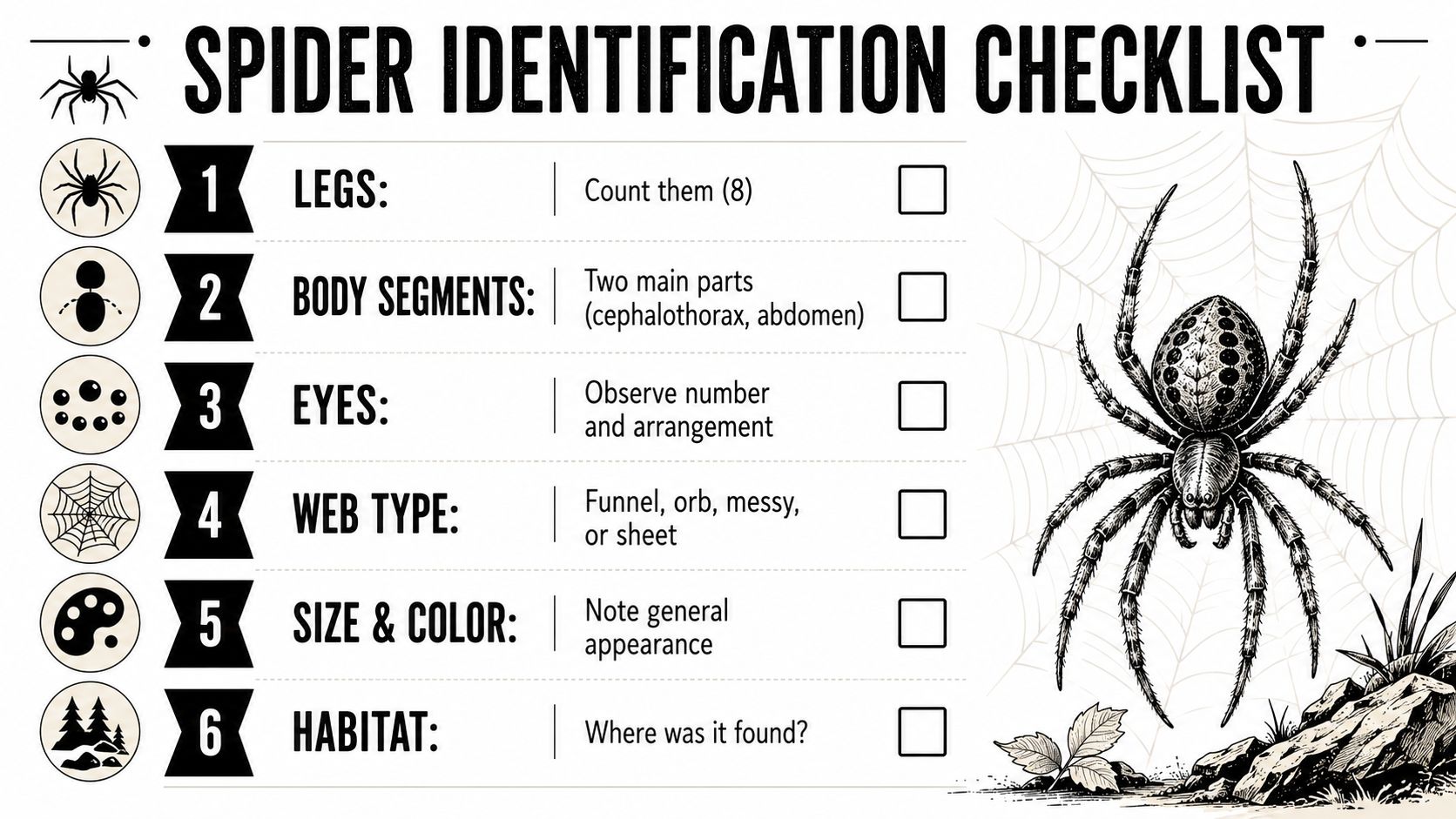
That matters because homeowners often notice the web before they notice the spider.
- Orb-style web: A more organized circular web usually points to a web-building spider outdoors or near exterior lighting.
- Messy cobweb: Irregular, tangled silk often shows up in corners, ceiling lines, garages, and storage areas.
- Funnel web: A flat web that narrows into a retreat often appears in grass, landscaping, or along edges.
- Sheet web: A blanket-like web can appear low to the ground or in sheltered exterior areas.
Then check the spider's look
You won't identify every spider to species level by sight alone, but a few visible traits help a lot.
- Body build matters. A stockier spider with a sturdy appearance often behaves differently than a long-legged, delicate spider.
- Leg length helps. Some common house spiders have very thin, long legs, while hunting spiders look heavier and more athletic.
- Color and markings can narrow things down, especially if you notice striping, banding, a violin-like marking, or a dark glossy abdomen.
- Movement is useful. Fast runners usually aren't the same type as spiders that sit at the center of a web.
Pay attention to where it was found
Location tells you almost as much as appearance.
A spider in a damp basement corner suggests a different pattern than one found in a shrub, a window well, or a garage ceiling.
Ask yourself:
- Inside or outside: Was it in a finished room, utility area, attic, garage, or landscaping bed?
- Hidden or exposed: Was it tucked behind stored items or sitting openly in a web?
- Dry or damp: Moisture can influence where insects gather, and spiders follow food.
What doesn't work well
Many homeowners try to identify spiders from memory after the spider disappears. That usually leads to bad guesses. Cell phone photos help more than memory does, especially if you can capture the web and the location without getting close.
Eye arrangement can matter in expert identification, but for homeowners it's not usually practical to rely on. Focus first on the clues you can observe safely. That's what makes a spider identification guide useful in real homes, not just in a lab or textbook.
Common Spiders You Might Find in Northwest Indiana
Most spiders found in Crown Point homes aren't the spiders people fear most. They're nuisance pests, occasional indoor wanderers, or outdoor species that end up inside by accident. The useful question isn't “Is every spider bad?” It's “What pattern does this spider fit?”
The spiders homeowners usually notice first
Wolf spiders get attention because they're large enough to startle people. They don't build the classic corner web often expected, and they often show up running across floors, especially in basements, garages, and ground-level areas. They look intimidating, but in most homes they're more alarming than dangerous.
Cellar spiders are the long-legged spiders many people call daddy long-legs. They're often found hanging upside down in quiet ceiling corners, basements, and less-disturbed rooms. They tend to stay put, build loose webs, and become a nuisance when webs collect in multiple spots.
Grass spiders are common around the outside of homes in Northwest Indiana. If they move indoors, they usually appear near entry points, garages, or lower-level areas. Their funnel-style web is often easier to notice outside than the spider itself.
Common house spiders also show up around windows, corners, storage areas, and attached garages. They usually build irregular webs and stay near them. Homeowners often notice the web long before they notice the spider.
Common Spiders in Northwest Indiana at a Glance
| Spider Name | Appearance | Web Type | Common Habitat | Risk Level |
|---|---|---|---|---|
| Wolf Spider | Stocky body, sturdy legs, fast-moving | No typical capture web for hunting | Basements, garages, lower levels | Low |
| Cellar Spider | Very long thin legs, delicate body | Loose, irregular web | Basements, corners, utility rooms | Low |
| Grass Spider | Brownish body, quick movement | Funnel web | Landscaping edges, garages, near foundations | Low |
| Common House Spider | Small to medium, variable color | Messy cobweb | Windows, corners, storage spaces | Low |
How to tell nuisance spiders from a bigger concern
A lot of mistaken identification comes from size. Homeowners often assume the bigger spider is the dangerous one. In practice, that isn't a reliable rule. A large wolf spider on the basement floor is more likely to frighten you than harm you.
What matters more is behavior and setting.
- Running across open floors: Often points to a hunting spider.
- Staying in a web corner: Often points to a web-building nuisance species.
- Appearing near insects: Suggests prey activity nearby.
- Showing up repeatedly in one part of the home: Suggests a habitat issue that needs correction.
If the spider is active, common, and tied to clutter, storage, or insect activity, the better fix is usually a broader spider control plan, not just removing the one spider you saw.
For homeowners searching exterminator near me, professional judgment offers significant assistance. A technician doesn't just identify the spider. They read the pattern around it, including entry points, prey pressure, moisture, and where treatment will be most effective.
Identifying Medically Significant Spiders in Indiana
When people ask whether a spider is dangerous, they usually have two spiders in mind. That's reasonable. In the United States, the only two spider species that pose a serious health threat requiring immediate medical attention if bitten are the Black Widow and the Brown Recluse, as explained by the PestWorld spider safety guide.
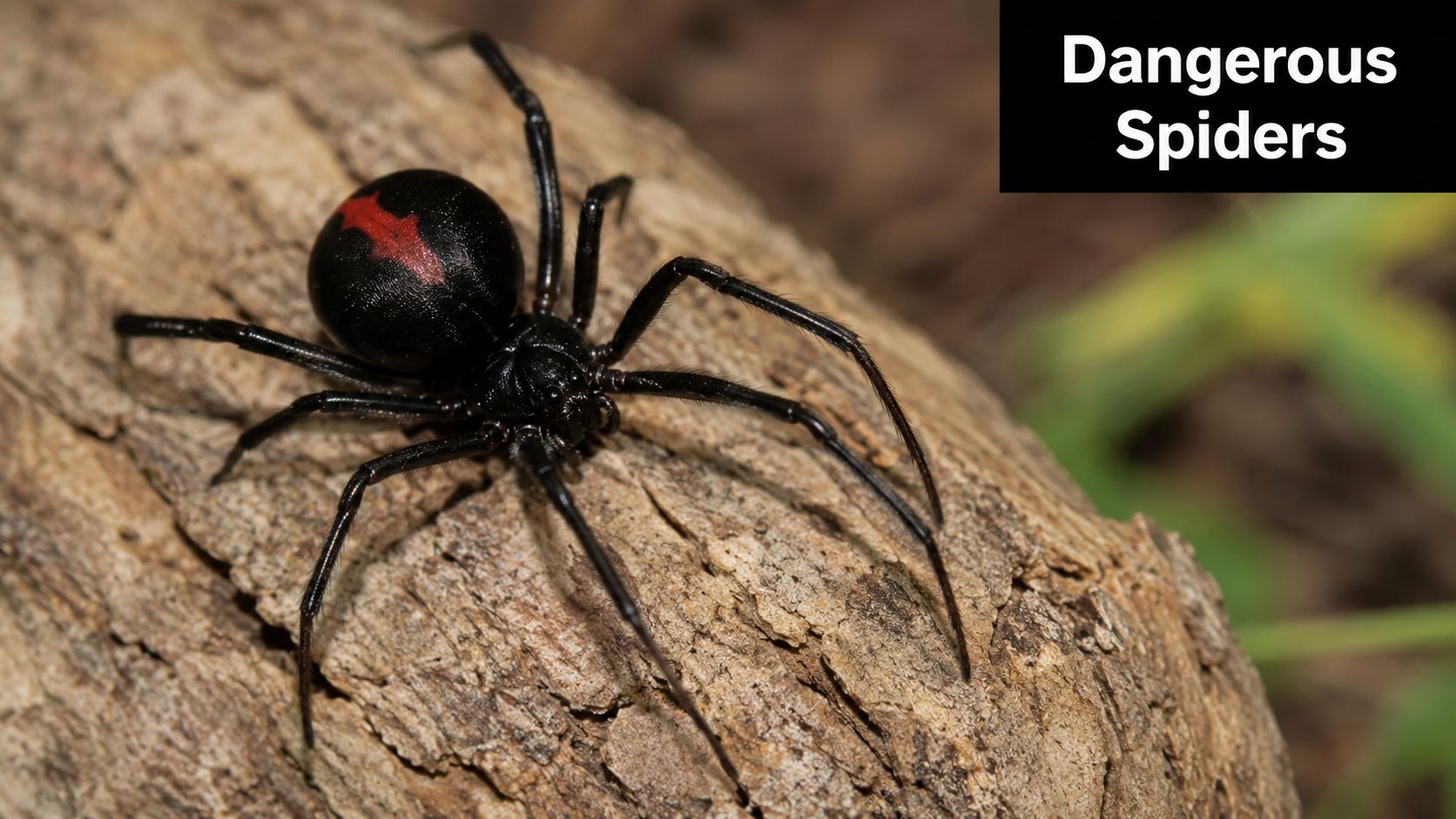
Black Widow
The Black Widow is best known for a distinct red hourglass on the abdomen. It has a glossy dark body and tends to stay in more protected areas rather than out in the open. If a homeowner sees a shiny dark spider in a secluded spot, that hourglass marking is the detail that matters most.
These spiders are associated with sheltered locations such as undisturbed storage, wood piles, sheds, and protected structural voids. That means quick sightings in living spaces are often misidentified. Plenty of harmless dark spiders get mistaken for widows.
Brown Recluse
The Brown Recluse is associated with a dark violin marking on its back. It prefers concealed, quiet spaces and is more likely to be encountered where boxes, storage, clothing, or undisturbed materials create cover.
In real homes, caution is essential. People often overidentify recluse spiders based on any brown spider they find. That's a mistake. A plain brown spider is not automatically a Brown Recluse, and poor identification causes unnecessary panic.
If you suspect either of these spiders and someone may have been bitten, prioritize medical care first. Identification can come second.
For homeowners trying to compare skin irritation, swelling, or a mystery mark, this guide on mosquito bites versus spider bites can help you think more clearly about what you're seeing.
When to stop guessing
Bite symptoms can be confusing, and skin reactions have many causes. The right response is simple. If a bite is suspected from a medically significant spider, seek medical attention right away. Don't wait for an internet image search to settle it.
This short video gives a useful visual reference point before you decide your next step.
For Indiana homeowners, the safest approach is cautious, not panicked. Most spider sightings are not emergencies. But if markings match, the setting fits, or a bite is involved, treat it seriously and bring in professional help.
Why Professional Spider Control Is Your Best Solution
Seeing one spider doesn't always mean you have an infestation. Seeing them repeatedly is different. Recurring spider activity usually points to a home condition that keeps supporting them, such as insect prey, cluttered storage, gaps around the exterior, or quiet undisturbed spaces that rarely get cleaned or sealed.
Why DIY usually falls short
Store sprays can knock down a spider you can see. They rarely solve the reason spiders keep showing up. That's the trade-off. DIY products feel immediate, but they often treat the symptom and miss the pattern.
A real spider control plan usually involves several pieces working together:
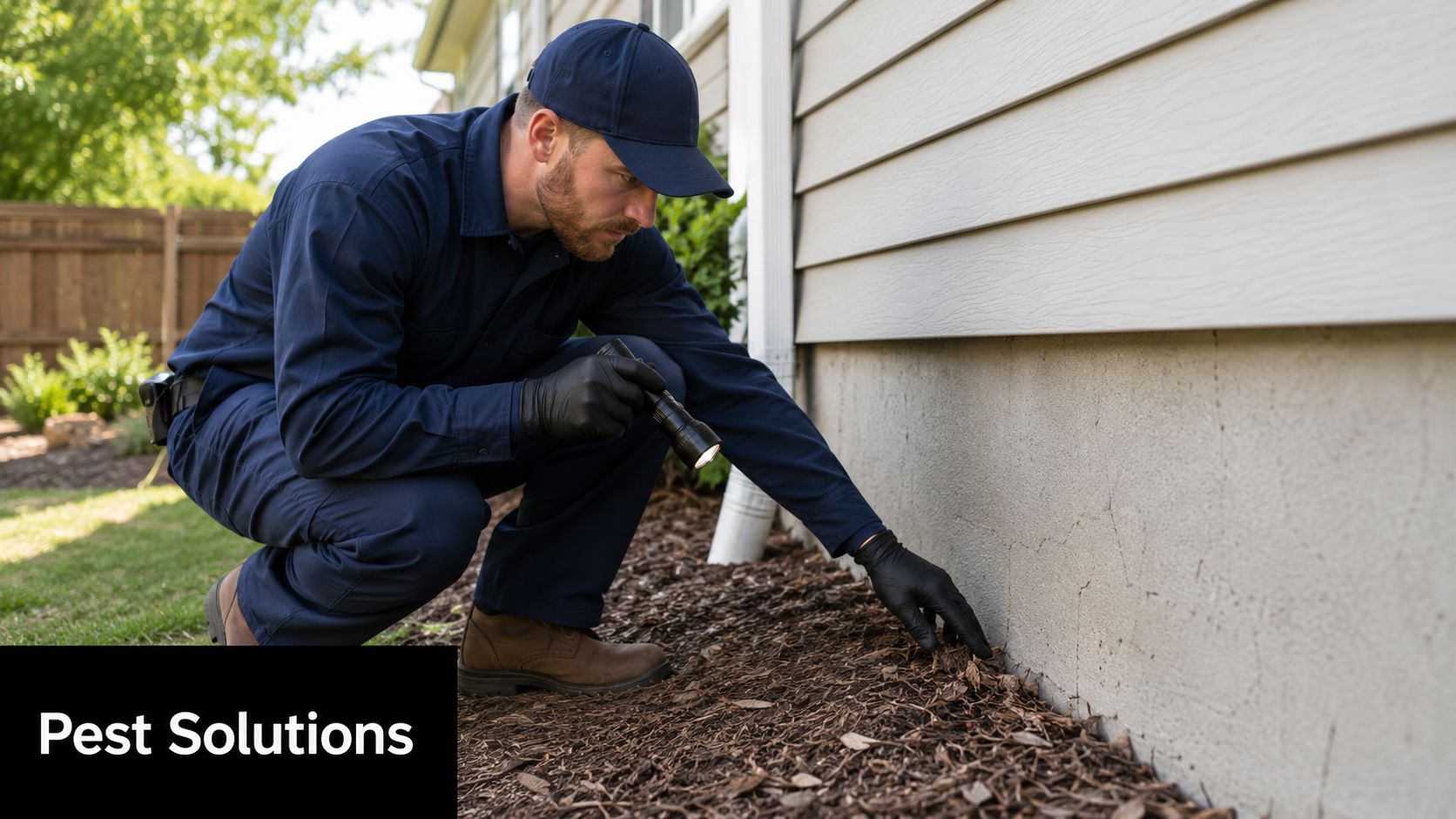
- Exterior inspection: Finding gaps, thresholds, vents, and foundation areas where pests move in.
- Harborage reduction: Addressing storage clutter, web build-up, and sheltered areas spiders favor.
- Prey reduction: Managing the insects that attract spiders in the first place.
- Targeted treatment: Applying products where spiders travel, rest, or build webs, not just where they're noticed.
Accurate identification changes the treatment
This part matters more than many homeowners realize. Spider identification often requires precise morphological detail, and experts may use a stereoscopic microscope at 20x to 50x magnification, which is one reason professionals emphasize getting identification right before treatment, as described in this arachnology overview of spider identification methods.
That doesn't mean every home visit turns into microscope work. It means visual guessing has limits. A professional doesn't need to overpromise species-level certainty to make smart treatment decisions. They know when the spider type, web pattern, location, and activity level are enough to act, and when a closer look matters.
What professional service solves better
Homeowners who search residential pest control or exterminator near me are usually dealing with one of three situations:
- Spiders keep returning after cleanup.
- The home has multiple pest issues, not just spiders.
- Someone in the household is anxious enough that reassurance alone isn't enough.
That's where broader pest service helps. Spider control often overlaps with ant control, wasp removal around entry points, rodent control in garages or crawl spaces, and seasonal insect pressure around foundations and landscaping.
For a practical look at treatment and prevention, this guide on how to get rid of spiders covers what helps and what tends to waste time.
What to Expect from Our Pest Control Service in Crown Point IN
When homeowners call for pest control in Crown Point, IN, they usually want two things right away. They want the issue taken seriously, and they want the process to be simple. A strong service visit should do both.
The inspection comes first
The first step is a property inspection. That means looking at where spiders were seen, what kind of activity is happening, and what conditions are supporting it. In a Northwest Indiana home, that often includes basements, garages, window areas, door thresholds, utility penetrations, attic access points, and exterior foundation lines.
This part matters because spider control isn't just about applying product. If the technician doesn't identify the pressure points, the result is often temporary.
You should get a plan that fits the property
Not every home needs the same approach. A house with occasional cellar spiders in the basement needs a different solution than a property with recurring web build-up around exterior lighting and garage corners. A commercial pest control plan for a local facility also differs from residential pest control because the traffic patterns, sanitation practices, and structural conditions are different.
A useful service plan should address:
- Where treatment belongs: Interior, exterior, or both.
- What conditions need correction: Clutter, gaps, moisture, lighting, or prey insects.
- What follow-up is realistic: One-time relief, ongoing monitoring, or seasonal preventative pest treatments.
Good service should feel clear. You should know where the issue is, what's being done about it, and what changes at home will help keep spiders from returning.
The treatment should be targeted, not random
A professional visit should focus on likely travel routes, entry points, web sites, and harborage areas. In many homes, that includes exterior perimeter work, removal of active webbing, and treatment in areas where spiders rest instead of broad, unnecessary application everywhere.
Homeowners should also expect practical advice after service. That may include reducing insects around the home with better exterior lighting choices, sealing gaps, improving storage practices, or addressing related issues through mosquito control, termite control, or rodent exclusion if those conditions are contributing to overall pest pressure.
In Crown Point, IN, the best pest service is straightforward. It respects your home, explains the reasoning, and gives you a clear path forward instead of a vague promise.
Protect Your Home and Family with The Green Advantage
Spiders create stress out of proportion to their size. One sighting can make a bedroom feel unsettled, a basement feel off-limits, or a garage feel like a problem you've been putting off too long. The right response isn't panic. It's a clear plan.
For many homes in Northwest Indiana, spider issues are tied to broader pest conditions. A good service approach protects more than one room or one moment. It helps protect your property, reduce indoor pest pressure, and restore confidence in the places your family uses every day.
Why homeowners act sooner rather than later
Waiting rarely makes pest issues simpler. If spiders are showing up regularly, there's usually a reason. It may be prey insects. It may be entry points around the home. It may be storage, moisture, or seasonal movement from the exterior inward.
That's why professional help often becomes the smarter option when:
- Sightings are recurring: You're seeing spiders in the same areas again and again.
- DIY hasn't held up: Sprays and traps gave short-term relief or no relief.
- You want certainty: You'd rather have a trained eye assess the situation than keep guessing.
- Other pests are involved: Ants, wasps, rodents, or mosquitoes are part of the bigger picture.
A calm, informed inspection usually solves more worry than another round of guessing from across the room.
If you've been searching pest control near me, exterminator in Crown Point, IN, or eco-friendly pest control for your home or business, the next step is simple. Get the property inspected, identify pressure points, and deal with the problem before it becomes a bigger headache.
If spiders, ants, rodents, wasps, mosquitoes, or other pests are making your Crown Point home feel less comfortable, contact The Green Advantage to schedule an inspection or request a quote. Their team serves Crown Point and nearby Northwest Indiana communities with thoughtful residential pest control and commercial pest control built around clear answers, targeted treatment, and long-term prevention.