
A lot of Crown Point homeowners start thinking about yard pests at the same moment every year. The weather turns nice, the grill comes out, the kids head for the lawn, and the dog starts making laps around the fence line. Then the nagging thought shows up right behind it. What’s living out there in the grass, under the shrubs, and along the shady edges of the yard?
That concern is justified. Fleas and ticks don’t need a neglected property to become a problem. In Northwest Indiana, they settle into ordinary residential properties, especially yards with shade, moisture, mulch, leaf litter, or pet traffic. A clean-looking lawn can still hold the exact conditions these pests need to survive, breed, and hitch a ride indoors.
If you’re searching for the best flea and tick control for yard conditions in Crown Point, the right answer depends on more than buying a spray bottle and hoping for the best. Product choice matters. Timing matters. Yard layout matters. Local climate matters even more. What works in a dry, sunny yard in another region may underperform in a Crown Point property with mature trees, damp edges, and changing spring-to-fall pest pressure.
Your Guide to a Safer Yard in Crown Point IN
Summer yard time is supposed to feel easy. You should be able to let the dog out, watch the kids play, or host friends on the patio without wondering what’s waiting in the grass.
But fleas and ticks change how people use their own property. Many homeowners first notice the problem when a pet starts scratching more than usual, when they find ticks near a wood line, or when one family member avoids the yard altogether because they don’t trust it. Once that happens, the yard stops feeling like part of the home.
In Crown Point and nearby Northwest Indiana communities, that’s a common pattern. Fleas and ticks thrive in the same kinds of outdoor spaces people work hard to create: green lawns, garden beds, privacy shrubs, play areas, and shaded corners that stay cooler longer. The problem isn’t that homeowners are doing something wrong. The problem is that these pests are well suited to our local environment.
What homeowners usually want
Homeowners aren’t looking for a chemistry lesson. They want a yard that feels usable again.
That usually means:
- Less pest activity where the family spends time
- A safer outdoor space for pets
- Fewer surprises along fences, beds, decks, and tree lines
- A treatment plan that lasts longer than a quick weekend fix
A good yard treatment doesn’t just knock pests down for a day. It reduces pressure where fleas and ticks live, breed, and wait for a host.
The best approach is practical, not dramatic. You don’t need every product on the shelf. You need the right combination of inspection, habitat correction, and targeted treatment based on how pests behave in Northwest Indiana.
Why local conditions matter
A Crown Point yard isn’t the same as a yard in a hotter, drier climate. Our region deals with wooded edges, seasonal moisture, storm cycles, and long stretches of pest activity. That’s why generic online advice often feels incomplete. It may tell you to spray the lawn, but it rarely explains where fleas and ticks are really hiding or why they keep coming back after rain, shade, and repeated pet traffic.
Homeowners searching for pest control near me, residential pest control, or pest control in Crown Point, IN are usually trying to solve that exact issue. They don’t just want treatment. They want confidence that the treatment fits the property.
Why Your Yard Is a Flea and Tick Haven
Fleas and ticks don’t spread evenly across a yard. They cluster in the places that protect them. In Crown Point, that usually means the cooler, damper, more sheltered parts of the property.
A sunny open lawn may look like the problem area because it gets the most use, but the primary pressure often starts around the edges. Fleas settle into organic debris and protected soil. Ticks wait in taller grass, under shrubs, beside fences, and near wooded transitions where animals move through.
The parts of a Crown Point yard pests like most
Some features raise flea and tick pressure even when the property is well maintained:
- Shady foundation beds where mulch and shrubs hold moisture
- Fence lines and rear lot edges where grass is thicker and traffic from wildlife is more common
- Leaf litter and debris pockets under trees or behind sheds
- Under decks and low-clearance structures where air movement is limited
- Pet rest areas where animals return again and again
These spots create the kind of protected microclimate fleas and ticks need. They avoid exposure when they can. If a yard has shelter, humidity, and a host nearby, it gives them staying power.
Fleas and ticks return for different reasons
Fleas and ticks aren’t the same pest, so they shouldn’t be treated as if they are.
Fleas are often tied closely to pet movement and protected outdoor resting areas. They build pressure where animals spend time, especially in shaded soil and organic material. Even when you treat the pet, the yard can keep reintroducing the problem.
Ticks behave differently. They don’t need to live in the center of the lawn. They wait in transition zones and move with wildlife, pets, and people. The back edge of a property, a shrub line, or a mulched path can matter more than the open grass.
Practical rule: If you only treat the middle of the lawn and ignore shaded borders, decks, and pet routes, you usually leave the main problem untouched.
Northwest Indiana has become tougher for tick control
General yard advice often misses what’s changed in the Midwest. Blacklegged ticks expanded their territory by 20% in Indiana as of 2025 IDOH data, and the source notes that longer warm seasons and mild winters are helping them thrive, with even new hybrid strains being discussed in that context according to this regional tick control analysis.
For Crown Point homeowners, that means older prevention habits may not be enough. A treatment that seemed to work in the past may break down faster under current pest pressure, especially after rainfall or during long warm stretches. If you want a deeper look at how persistent these pests can be around a property, this guide on how long ticks can live helps explain why one missed area can keep a problem active.
Yard conditions that keep pressure high
If fleas or ticks keep showing up, the issue is usually environmental, not random. Look for these patterns:
-
Dense shade
Mature trees and overgrown ornamentals create cooler zones that stay favorable longer. -
Moisture retention
Wet mulch, compacted soil, and poor airflow help pests hold on after weather shifts. -
Wildlife movement
Rabbits, rodents, and other animals use the same travel lanes over and over, carrying ticks with them. -
Inconsistent maintenance
Mowing helps, but if debris stays under shrubs or around structures, pests still have cover.
A productive treatment plan starts by reading the yard correctly. The best flea and tick control for yard conditions in Crown Point isn’t just about what gets applied. It’s about knowing where pressure starts and cutting it off there.
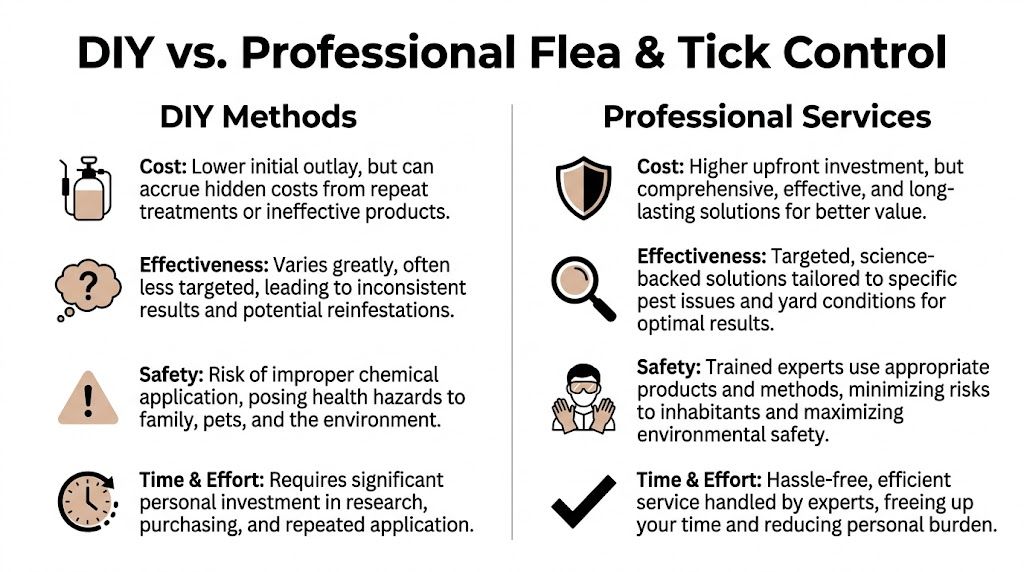
Comparing Yard Treatment Approaches DIY vs Professional
Homeowners usually have three choices. They can spread granules, apply a hose-end spray, or try a natural yard treatment from a garden center or online retailer. Those options can help in some situations, especially when pest pressure is still light.
The problem is that most yards in Northwest Indiana don’t stay simple for long. Once fleas or ticks settle into multiple zones, especially shaded borders and pet-heavy areas, the gap between a basic DIY application and a structured treatment plan becomes obvious.
What DIY gets right
DIY treatment has real appeal. It’s available right away, feels affordable at the start, and gives homeowners direct control over what they apply.
Store shelves usually offer a few common paths:
- Granules for broad lawn coverage
- Hose-end sprays for quick application
- Essential oil products for lighter, more frequent treatment
- Spot treatments around decks, fences, and pet zones
For some properties, especially smaller yards with low pest pressure, that may be enough to reduce activity.
Where DIY starts to break down
The downside isn’t that all store-bought products are useless. The downside is inconsistency.
Homeowners often underapply, treat the wrong areas, skip follow-up timing, or rely on one product type when the yard really needs a layered approach. The visible lawn gets attention, while the problem stays active in edges, shrubs, under structures, and near fence lines.
Permethrin-based yard sprays are recognized as the most effective overall for flea and tick control, killing adults, larvae, and eggs on contact while repelling pests for several weeks, and they can reduce tick encounters by 80-95% in treated zones according to this permethrin yard spray overview. That tells you something important. Product strength and proper use matter a lot. It’s not just whether the yard was treated. It’s whether it was treated in a way that matches pest biology.
DIY vs Professional Yard Treatment Comparison
| Factor | DIY Approach | Professional Service (The Green Advantage) |
|---|---|---|
| Upfront cost | Usually lower at the start, but repeat purchases can add up if results don’t hold | Higher initial investment, but designed for longer-term control |
| Product selection | Limited to consumer options and what the homeowner feels comfortable applying | More strategic selection based on yard conditions, pest pressure, and treatment goals |
| Coverage quality | Often strongest in visible lawn areas, weaker in hidden hotspots | Focused on high-pressure zones like edges, shade, pet routes, and breeding areas |
| Time required | Homeowner handles research, purchasing, application, and reapplication | Service is handled for you with a defined plan |
| Consistency | Depends on weather, schedule, and application accuracy | More reliable because timing and placement are planned |
| Safety management | Homeowner must read labels, judge re-entry timing, and avoid misapplication | Treatment is applied with a process designed to reduce avoidable risk |
| Best fit | Light pest activity and homeowners willing to monitor closely | Recurring yard pressure, heavy infestations, or properties with complex layouts |
Natural products have a place, but know the trade-off
Essential oil concentrates such as Wondercide Flea & Tick Yard + Garden are often chosen by households that want a plant-oil-based option. According to the product specifications, an 8 oz concentrate treats 5,000 sq ft for killing fleas and mosquitoes, or 2,500 sq ft for killing and repelling ticks, with repeat application every few days initially and maintenance every 30-45 days, as described in the Wondercide yard treatment details.
That can be a reasonable fit for mild situations or homeowners committed to frequent maintenance. But in heavy flea or tick pressure, especially in damp, shaded Crown Point yards, natural products usually demand more consistency and more reapplication discipline than homeowners expect.
Professional treatment changes the process
A professional approach starts with diagnosis, not just product. That’s the difference.
Instead of asking, “What can I spray today?” the better question is, “Where is the pressure starting, what is sustaining it, and what combination of treatment and habitat correction will hold up here?” That’s why many homeowners who begin with DIY eventually look for guidance on DIY or hire a pro, especially after repeating the same weekend treatment cycle without lasting relief.
The most expensive yard treatment is the one you have to keep repeating because the original problem was never correctly identified.
For homeowners searching exterminator near me or pest control in Crown Point, IN, that’s usually the tipping point. They’re not looking for another bottle. They’re looking for a result that lasts.
The Case for Professional Pest Control in Northwest Indiana
DIY yard treatment often sounds simple. Buy a product, apply it, wait a few days, and expect the problem to fade. In real Northwest Indiana yards, that sequence often falls apart because flea and tick pressure isn’t coming from one flat piece of lawn. It’s coming from multiple habitats at once.
That matters because the best flea and tick control for yard conditions here isn’t just a kill-on-contact product. It’s a control strategy that accounts for breeding sites, weather, shade, wildlife movement, pet activity, and reinfestation pressure.

The hidden cost of short-term results
A cheap treatment isn’t cheap if it keeps failing. Homeowners often spend money in small amounts over and over, trying one spray, then another, then a granule, then a natural product, without ever getting control across the whole property.
The bigger issue is what happens between applications. Fleas keep cycling through protected areas. Ticks stay active in edge zones the homeowner didn’t realize mattered. Meanwhile, the family still avoids the yard.
A significant gap exists in long-term efficacy data between natural DIY products and professional chemical options. According to this comparison of yard treatment performance, professional combinations with insect growth regulators can reduce pest populations by over 90%, while many natural alternatives show 60-70% short-term reduction. In the Midwest, where pest pressure can be stubborn, that difference is practical, not academic.
What professionals do differently
Professional service changes the outcome because it changes the decision-making.
A trained technician doesn’t just see grass. They see:
- Host pathways where pets and wildlife move
- Sheltered breeding pockets under shrubs, decks, and organic debris
- Perimeter pressure where wooded transitions raise exposure
- Conditions that will weaken treatment performance, such as poor airflow or persistent moisture
That’s why professional residential pest control tends to hold up better. It starts with inspection, then uses application methods and follow-up planning that fit the property instead of treating every yard like a blank rectangle.
Why IPM works better than one-off spraying
The strongest long-term results usually come from Integrated Pest Management, or IPM. That means using more than one control method and correcting the conditions that allow the problem to return.
In plain terms, IPM for a Crown Point yard often includes:
- Targeted product application where pressure is highest
- Mowing and trimming to reduce cover
- Debris cleanup in flea and tick harborages
- Perimeter attention around beds, fences, and wooded edges
- Monitoring and follow-up instead of assuming one visit solves everything
Good pest control is part treatment, part property management. If the yard keeps giving fleas and ticks shelter, they’ll try to come back.
This is also why professional service is often the better fit for households already dealing with broader outdoor pest issues. If a property also struggles with mosquitoes, ants, or wasps, treating the yard as a whole system usually makes more sense than handling each problem in isolation.
For homeowners searching for commercial pest control, residential pest control, or an exterminator in Crown Point, IN, the practical question is simple. Do you want to keep reacting to flare-ups, or do you want a plan that’s built for the way pests behave on your property?
The Green Advantage Method Our Process for Crown Point Homes
When a yard has flea and tick pressure, the process matters as much as the product. A professional treatment should feel organized, understandable, and specific to the property instead of rushed or overly generic.
The strongest service plans in Crown Point start with observation. They identify where fleas and ticks are likely to rest, breed, and travel, then match treatment to those zones rather than blanketing everything the same way.

Step one is reading the property correctly
A proper yard treatment begins with inspection. That means looking at the obvious areas, but also the overlooked ones.
A technician should evaluate:
- Shaded lawn sections and bed edges
- Pet routes and favorite resting areas
- Under-deck zones and fence lines
- Mulch pockets, debris buildup, and dense ornamentals
- Transitions to woods, drainage areas, or neighboring vegetation
This is where local experience matters. A Crown Point property near mature trees or open field edges won’t behave like a tightly packed subdivision lot with more sun and less wildlife traffic.
Step two is choosing the right treatment style
Not every yard needs the exact same material or frequency. Some need immediate knockdown in active zones. Others need a residual product that keeps working through changing weather and continued exposure.
Professional-grade synthetic granules with active ingredients such as bifenthrin offer 30-60 day residual control and can achieve over 95% mortality in fleas and ticks within 24-72 hours when applied correctly, according to this professional granule treatment guidance. The same source notes that, within an IPM protocol, an initial application for heavy infestations followed by monthly maintenance can cut callbacks by 50%.
That kind of result comes from matching product form to the problem. Granules often make sense for broad outdoor coverage and breeding zones. In other cases, a targeted spray may be the better first move for fast contact control.
Some yards need immediate reduction. Others need durability. The best plans account for both.
Step three is reducing the conditions pests like
Treatment works better when the yard becomes less comfortable for fleas and ticks afterward, a goal supported by a local, nature-based mindset. Good pest control doesn’t have to mean treating the property like a sterile surface. It means managing the environment so pests lose their advantage.
That can include trimming dense plant growth, clearing heavy debris, and improving sunlight and airflow in hidden corners. It can also mean understanding the broader ecology around the property. Homeowners who want to support a more balanced yard environment often find it useful to learn about natural tick predators, because it helps explain why habitat design matters along with direct treatment.
A short look at service expectations can make that process easier to visualize.
What homeowners can expect from a complete service approach
A well-run service visit should leave you with clarity, not confusion. That usually includes:
-
A site-specific assessment
The technician identifies the areas driving activity instead of treating the whole property as one uniform space. -
A customized application plan
Product choice and placement reflect the layout, level of pressure, and how the family uses the yard. -
Practical prevention guidance
Homeowners should get straightforward recommendations they can use, including yard maintenance steps and whether related services like mosquito control or broader preventative pest treatments would help.
This is also why the best providers tend to be the ones who can handle more than one issue at a time. A yard with fleas and ticks may also have mosquito pressure, spider activity near structures, or rodent movement along the perimeter. The service should account for how those patterns overlap, especially in Northwest Indiana properties.
Protecting Your Family Property and Peace of Mind
Most homeowners don’t call about fleas and ticks because they enjoy talking about pests. They call because they want normal yard life back. They want to let the dog out without checking fur every time. They want kids to play in the grass without second-guessing every shady corner. They want their outdoor space to feel like part of the home again.
That’s what makes long-lasting yard treatment valuable. It’s not just about killing pests. It’s about restoring confidence in the property.

Why durable yard control matters
High-quality granular treatments can provide three months of protection for up to 10,000 square feet from a single application, and they can reduce reinfestation risks by up to 90% in treated zones when applied correctly during peak seasons, according to this yard granule treatment review. That kind of coverage matters because fleas and ticks rarely stay confined to one small patch. They move through lawns, soil, and garden edges where people and pets spend time.
For larger residential lots in Crown Point, durable coverage can mean fewer interruptions and less worry between treatments. It also means less reliance on constant retreatment just to keep the yard usable.
Yard control should work with pet protection
Outdoor treatment is important, but it’s still only one part of the picture. Pets can bring pests in from untreated areas, neighboring properties, or walks, so on-pet prevention still matters. If you’re comparing options for your dog, this guide to flea treatments for dogs is a helpful companion resource to yard treatment planning.
The strongest protection usually comes from combining pet care with yard management rather than choosing one and ignoring the other.
The real benefit is peace of mind
A treated yard changes how people use their property:
- Families spend more time outside
- Pets move through the yard with less risk
- Homeowners stop reacting to every bite, scratch, or sighting
- Outdoor spaces become more comfortable for guests and everyday routines
A successful yard treatment gives homeowners something simple but important. It lets them enjoy their own property without constant vigilance.
For people searching pest control near me, exterminator near me, or pest control in Crown Point, IN, that’s usually the true goal. Not just a treatment receipt. Relief.
Frequently Asked Questions About Yard Treatments
Are yard flea and tick treatments safe for kids and pets
They can be, when the right products are chosen and applied correctly. The key is following label directions and re-entry guidance. Homeowners should always ask when treated areas are safe to use again, especially if children play in the lawn or pets spend a lot of time outdoors.
Professional service helps because the application isn’t guesswork. The technician can explain where treatment was placed, what precautions matter, and how to use the yard responsibly afterward.
Will rain wash the treatment away
Sometimes yes, sometimes no. It depends on the product type, how recently it was applied, and how much rain falls. Less persistent treatments tend to break down faster after weather, while some residual products hold up better.
This is one reason local timing matters in Northwest Indiana. A treatment plan should account for rain patterns and property drainage, not just calendar dates.
How often does a Crown Point yard need treatment
There isn’t one answer for every yard. Some properties need closer attention during peak season because of shade, wildlife activity, and moisture retention. Others hold control longer because the yard is more open and less favorable to pests.
A good schedule should match actual conditions on the property. Heavier infestations usually need a more active early approach than simple maintenance.
If the yard is treated, does my pet still need protection
Yes. Yard treatment lowers exposure, but it doesn’t replace veterinarian-guided pet protection. Dogs and cats can still encounter fleas or ticks beyond your lawn, including on walks, at parks, or in untreated spaces.
The best approach is layered. Protect the yard, protect the pet, and reduce the chance that pests move indoors.
What can I do between treatments to help
The most useful steps are basic but important:
- Keep grass cut and edges trimmed
- Reduce leaf litter and debris
- Open up dense shrubs where possible
- Pay attention to pet rest areas and fence lines
- Report any continued activity in specific spots
Small yard corrections often improve treatment performance because they remove the shelter fleas and ticks rely on.
If you want a yard that feels comfortable, usable, and better protected in Crown Point and nearby Northwest Indiana communities, contact The Green Advantage to schedule an inspection or request a quote. Their team provides residential pest control, commercial pest control, mosquito control, and preventative pest treatments with a local, environmentally mindful approach built for the way pests behave in this region.