
Protect Your Home: Quarterly Pest Control Service
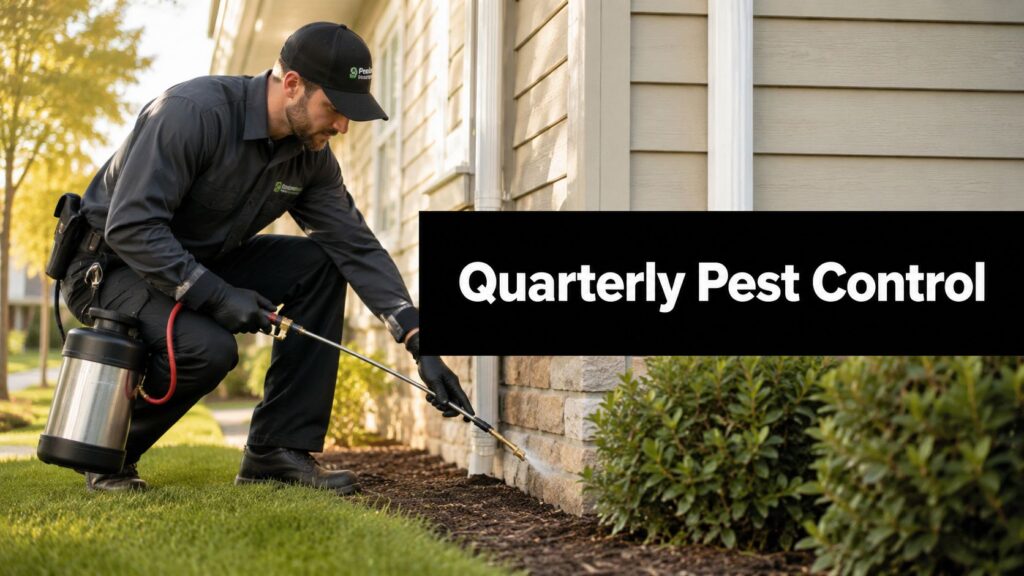
If you're in Crown Point and it feels like the pest problems never really end, you're not imagining it. Spring brings ants across the kitchen counter. Summer means mosquitoes in the yard and wasps near the eaves. Then fall shows up and suddenly spiders turn up in corners and rodents start testing entry points around the garage, basement, and utility lines.
That cycle is exactly why so many homeowners start by searching for pest control near me or exterminator near me, then realize a one-time treatment only solves today's problem. What most properties need in Northwest Indiana is a plan that stays ahead of the next season instead of waiting for it.
Protecting Your Crown Point Home from Unwanted Guests
A lot of homes in Crown Point follow the same pattern. Ants show up when the weather breaks. Mosquitoes take over the backyard once summer settles in. By the time cooler air arrives, spiders and other indoor pests start appearing where nobody wants them, especially basements, mudrooms, and storage areas.
That kind of stop-and-start approach wears people down. You treat one issue, get a little relief, and then another pest pops up a few months later. For homeowners who want a clean, comfortable house, reactive service usually turns into repeated aggravation.

Why this matters in Indiana
The need for professional pest management isn't small or isolated. Indiana's pest control industry includes 597 businesses as of 2026, with the market growing at an average annual rate of 6.0% from 2021 to 2026, and the industry's total market size reaching $417.1 million in 2026, according to IBISWorld's Indiana pest control industry overview. That tells you something simple. Pest issues are common enough across the state that more homeowners and businesses are looking for structured, ongoing help.
In Crown Point, the smarter move is usually prevention. A quarterly plan doesn't wait for ants to become a trail, for spiders to multiply in quiet areas, or for rodents to settle into wall voids. It addresses the conditions that invite pests in the first place.
Local rule of thumb: If you're treating the same kind of pest more than once a year, the problem usually isn't bad luck. It's that the property needs consistent prevention.
That shift matters whether you're looking for pest control in Crown Point, IN, residential pest control, or support for a rental property or commercial building. Instead of firefighting each new pest issue, you build a year-round barrier and keep pressure low before small activity turns into an infestation.
What Is a Quarterly Pest Control Service
A quarterly pest control service is a year-round prevention program with four scheduled visits spread across the year. In Crown Point, that schedule gives a home regular attention before pest activity has time to build. Instead of calling only after ants show up in the kitchen or spiders start collecting in the corners of the garage, the property is checked and treated on a routine cycle.
That difference matters.
A one-time treatment handles the problem you can already see. A quarterly plan is built to reduce the next one.
What a typical visit includes
As outlined in this breakdown of pest control plans, quarterly service commonly includes four visits per year, perimeter treatment, targeted interior service, inspection work, and return visits between appointments if covered pests come back.
On a well-run route, the visit usually focuses on the areas where problems start and where they tend to repeat:
- Exterior perimeter treatment around the foundation and entry points to cut down pest movement into the home
- Targeted interior treatment in places with current activity or higher risk
- Spider web and wasp nest removal around soffits, garages, doors, and window frames as needed
- Inspection for conducive conditions such as moisture, gaps, cluttered harborage, or signs of rodent entry
That is the part many homeowners miss. Good quarterly service is not just an application. It is repeat inspection, correction, and follow-up.
Why this schedule fits so many Crown Point homes
In Northwest Indiana, pest pressure rarely stays solved for long with a single visit. Weather shifts, moisture changes, and normal seasonal movement keep creating openings around the structure. Quarterly service gives those pressure points regular attention without putting the homeowner on a monthly schedule they may not need.
For homes with general crawling insect pressure, occasional spider issues, or recurring exterior activity, four visits a year is often the practical middle ground. It is frequent enough to stay ahead of common problems, but spaced out enough to keep service manageable.
The biggest benefit is consistency. Small issues get addressed while they are still small.
The trade-offs to understand before you sign up
Quarterly service is a strong fit for prevention. It is not always the right stand-alone answer for every situation. A home with an active rodent problem, a heavy German roach infestation, or a termite issue may need an initial corrective plan before regular quarterly maintenance makes sense.
Cost structure matters too. Some companies bill quarterly. Others charge an initial fee and then monthly payments. Ask what the full annual cost is, what pests are covered, whether interior service is included every visit or only on request, and what happens if activity returns between appointments.
For homeowners comparing exterminator options in Crown Point, IN, that clarity is just as important as the treatment itself. A good quarterly plan should explain exactly what is being prevented, how service is delivered, and where the limits are.
Tailoring Treatments to Northwest Indiana's Seasons
The reason quarterly service makes sense in Crown Point is simple. Pest pressure changes with the calendar. What works in early spring isn't the same thing you need in late summer or during the first cold stretch of fall.
A one-off treatment reacts to what's happening now. A seasonal plan prepares for what's about to happen next.

Spring pressure starts outside
Once temperatures begin to rise, overwintering pests become active again. This is when many homeowners first notice ants, occasional invaders, and spider activity around foundations, windows, and garages. Spring is also the time to inspect conditions that can invite bigger problems later, such as gaps at entry points, moisture around the structure, and untreated harborage near mulch lines and landscaping.
A spring visit is often the most important appointment of the year because it sets the perimeter before insect activity ramps up.
Summer tests the exterior
Summer in Northwest Indiana brings the outdoor pressure commonly noticed first. Mosquito activity around shaded yards, wasps near rooflines and outdoor living spaces, and general crawling insect pressure all become more active. If a home already has weak spots around doors, utility penetrations, or foundation transitions, summer pests exploit them.
For properties that also need mosquito control, wasp removal, or close attention to outdoor living areas, the plan becomes more customized. The treatment focus isn't identical on every property because not every yard, drainage pattern, or structure creates the same level of pressure.
Fall is when pests try to move in
Fall is the season many homeowners underestimate. As nights cool down, pests that were content outside start looking for warmth and shelter. That's when spiders become more noticeable indoors and rodents begin probing for entry points around garages, siding gaps, vents, and utility lines.
This is also the time for prevention work that protects the coming winter. If openings and attractants aren't addressed in fall, winter service becomes more reactive than it should be.
Homes don't get pest pressure in neat categories. Seasonal changes push different pests toward the same shelter, and that shelter is often your house.
Winter is about indoor stability
Winter service in Crown Point tends to focus less on heavy exterior activity and more on monitoring and prevention inside the building envelope. Indoor pest issues don't disappear just because it's cold. In fact, once pests find warmth, food, or moisture indoors, they can stay active where homeowners don't see them right away.
That makes the winter visit valuable for inspections, targeted indoor treatment when needed, and checking the areas where low-level activity often lingers.
Northwest Indiana seasonal pest calendar
| Season | Common Pests | Quarterly Treatment Focus |
|---|---|---|
| Spring | Ants, spiders, emerging insect activity | Exterior barrier, inspection, early-season prevention |
| Summer | Mosquitoes, wasps, ants, general outdoor pests | Active perimeter defense, yard-focused treatment, entry point review |
| Fall | Spiders, rodents, overwintering pests | Exclusion-minded inspection, prevention at doors, garage, foundation, utility lines |
| Winter | Lingering indoor pests, occasional invaders | Interior monitoring, targeted spot treatment, prevention-focused follow-up |
For homeowners searching pest control in Crown Point, IN, this is why quarterly scheduling fits the region so well. Each visit has a different job. The point isn't to repeat the exact same treatment every few months. It's to match the service to what Northwest Indiana properties face throughout the year.
Who Benefits from Proactive Pest Management
Quarterly prevention isn't only for people dealing with a serious infestation. In many cases, it's more useful for the people who want to avoid getting to that point at all.
Homeowners who care about property condition, families who want fewer surprises indoors, and managers responsible for shared buildings all benefit from consistent service. The common thread is predictability. Regular inspections and targeted treatments reduce the chance that pests build up unnoticed.

Homeowners who want fewer disruptions
For a typical single-family home, quarterly service makes life easier. You don't have to wait until ants are in the pantry or spiders are showing up in multiple rooms before making a call. The property stays on a regular inspection and treatment cycle, which helps protect comfort and cuts down on repeat surprises.
This is especially useful for households also thinking about related needs such as ant control, spider control, rodent control, or preventive attention around garages, basements, and crawlspaces.
Families who prefer targeted treatment
Many people worry that routine pest service means constant blanket application. Modern prevention should be more thoughtful than that. When a property is monitored properly, treatments can stay targeted and responsive to actual conditions instead of relying on unnecessary broad interior applications.
That's one reason eco-minded households often prefer an inspection-first approach. It supports long-term control while keeping the service focused on what's needed.
Property managers and commercial clients
For shared housing and commercial sites, quarterly service becomes even more important because pest activity affects multiple people at once. In these settings, the cost of waiting is often measured in complaints, tenant frustration, operational interruptions, and reputation risk.
According to a pest control specification for multi-unit housing, quarterly pest control is often mandated as a preventive measure in commercial and multi-unit contexts, and documented evidence shows these interventions reduce pest-related service complaints by 30–40% compared to reactive-only models.
That matters in Northwest Indiana properties such as:
- Apartment and multi-unit buildings where one untreated issue can spread
- Office and commercial spaces that need a clean, professional environment
- Facilities with shared refuse or utility areas that attract recurring pest pressure
- Managed properties where documentation and consistent follow-through matter
Clean buildings don't stay that way by accident. Someone has to inspect, document, and correct small pest issues before occupants start noticing them.
For both residential pest control and commercial pest control, proactive service isn't about overreacting. It's about keeping routine pest pressure from becoming a bigger operational problem.
Quarterly Plans vs Other Pest Control Frequencies
The right service frequency depends on the property, the pest history, and how much pressure the structure gets from surrounding conditions. For most homes in Crown Point, the practical choice comes down to three options. One-time service, quarterly service, or monthly service.
Each has a place. They just don't solve the same problem.
One-time service
A one-time treatment is usually the right fit for a narrow issue. A wasp nest on the porch. A sudden spike in ants after weather changes. A pest concern tied to a specific event, move, or sale. The advantage is obvious. You handle the immediate issue and move on.
The downside is that one-time service is reactive by design. It doesn't create much continuity, and it usually doesn't address what will happen when the next seasonal shift brings a different pest to the same property.
Quarterly service
Quarterly service works well when pest pressure is recurring but not severe enough to justify monthly visits. It gives the property scheduled attention through the year, which fits the normal rhythm of seasonal pest activity in Northwest Indiana.
Indiana residential pest control also follows a structured four-stage process of inspection, identification, treatment selection, and follow-up verification, with follow-up visits typically scheduled 14 to 30 days after the initial application depending on the situation, according to Indiana residential pest control guidance. That framework supports a preventive quarterly model because it leaves room for both routine seasonal care and short-term follow-up when a specific issue needs closer monitoring.
If you're weighing timing and service intervals, this guide on how often pest control should be done gives a useful way to think through the options.
Monthly service
Monthly service has a real role, but usually for higher-pressure situations. Properties with persistent activity, commercial demands, or ongoing sanitation and access challenges may need that level of frequency. For the average home without a severe infestation, monthly service can be more than necessary.
A simple way to compare the options:
- Choose one-time service when the problem is isolated and unlikely to repeat soon.
- Choose quarterly service when you want year-round prevention without over-servicing the home.
- Choose monthly service when pest pressure is persistent, complex, or operationally sensitive.
For many Crown Point homes, quarterly is the sweet spot. It avoids the stress of waiting until something goes wrong, but it doesn't assume every property needs constant visits.
Your Service Visit What to Expect with The Green Advantage
People are often more comfortable with pest service once they know what happens during a visit. Good service shouldn't feel mysterious. It should feel organized, clear, and specific to the property.
For a quarterly plan, the visit is usually part inspection, part prevention, and part problem-solving. If there has been recent activity, the technician looks for evidence, confirms what pest is involved, and applies treatment where it makes sense. If there hasn't been activity, the focus stays on keeping it that way.

The visit usually starts with inspection
The technician checks the areas where pest activity commonly starts or enters. That often includes the foundation, entry points, window and door transitions, garage edges, utility penetrations, and visible exterior harborage. Indoors, service may focus on baseboards, utility areas, kitchens, basements, or other locations tied to current activity.
Modern guidance matters here. Current pest management guidance states that periodic service should focus on inspection and spot treatment rather than routine application once infestations are eliminated, and that a pest professional should show evidence of a live pest before any reactive treatment. That's a core part of Integrated Pest Management, or IPM.
That means the right quarterly service isn't just routine spraying. It's inspection-led work.
What treatment looks like in practice
Treatment depends on the findings. Some visits are mostly exterior prevention. Others involve targeted indoor attention because ants, spiders, or occasional invaders have started to show up in a specific area. If rodent pressure is part of the concern, the service may also include recommendations on exclusion and sanitation, not just product application.
The Green Advantage offers a Quarterly General Pest program that pairs an initial visit with recurring scheduled service for year-round prevention. For homeowners and businesses in Crown Point, that kind of program works best when the treatment is adjusted to site conditions rather than repeated mechanically.
What good service looks like: The technician explains what was found, where pressure is coming from, what was treated, and what the property owner should watch for before the next visit.
How to prepare before service
You usually don't need to do a full-home reset. A few simple steps help the visit go smoothly:
- Clear access where possible around baseboards, sinks, utility areas, and garage walls
- Report recent activity so the technician knows where you've seen ants, spiders, rodents, or stinging insects
- Secure pets as needed during treatment and while instructions are reviewed
- Remove clutter outdoors near the foundation if heavy storage or debris blocks inspection
For a more detailed checklist, this pest control preparation guide is a helpful reference.
After the technician leaves
You should know what was done, what to expect next, and whether any follow-up is recommended. Some pest issues settle quickly. Others need observation, sanitation changes, or a return visit if activity continues.
The best quarterly service doesn't ask homeowners to guess. It gives them a plan and keeps prevention moving forward.
Choosing the Right Pest Control Partner in Crown Point
If you're hiring a provider for pest control in Crown Point, IN or nearby Northwest Indiana service areas, ask direct questions. A reliable company should be comfortable answering them without vague promises or pressure.
Questions worth asking
- Are you licensed and insured? You want a company that treats pest control as a professional trade, not casual side work.
- Do you know local pest patterns? Crown Point homes don't deal with the same timing and pressure as every other market.
- How do you handle quarterly service? Ask whether visits are inspection-led and whether interior treatment is targeted when appropriate.
- What happens if pests return between visits? A clear answer matters more than a low starting price.
- Do you explain what you found and what you treated? Good communication is part of good pest control.
- Can you support more than general pests? Many properties eventually need help with termite control, mosquito control, rodent exclusion, or wasp removal as separate services.
A dependable partner should make the process easier, not harder. That means clear scheduling, honest recommendations, and service that fits the property instead of forcing every customer into the same script.
For homeowners, landlords, and businesses in Crown Point, the right quarterly plan offers more than convenience. It protects the structure, reduces disruption, and gives you a predictable way to stay ahead of Northwest Indiana's seasonal pest pressure.
If you're ready to stop chasing one pest problem after another, contact The Green Advantage to schedule a pest inspection or request a quote for your Crown Point property. Whether you need residential pest control, commercial pest control, mosquito reduction, rodent control, or a practical quarterly prevention plan, you'll get clear answers and a service approach built for Northwest Indiana.
How Long Do Mosquitoes Live Without Food?
Most mosquitoes die within 2 to 4 days if they have no food at all, meaning no sugar and no blood. That sounds simple, but it's misleading for homeowners because mosquitoes almost always find a sugar source outdoors, and female mosquitoes can still survive up to 14 days without feeding when conditions are favorable.
If you're in Crown Point, IN, you've probably dealt with this firsthand. You step outside on a warm evening to sit on the patio, let the kids play, or grill dinner, and within minutes everyone's swatting, itching, and heading back inside. A lot of people then ask the same practical question: if mosquitoes can't live long without food, can you just wait them out or remove what attracts them?
That usually doesn't work in a real Northwest Indiana yard. Mosquitoes don't need much to keep going, and backyards give them plenty of places to rest, hide, breed, and refuel. That's why homeowners searching for pest control near me, exterminator near me, or pest control in Crown Point, IN are often looking for more than a quick spray. They want a solution that effectively holds up.
Your Trusted Local Exterminator in Crown Point IN
In Crown Point, mosquito problems rarely feel small. One family can do the right things, dump standing water, trim back growth, and still get driven indoors because the pressure isn't coming from just one flower pot or one puddle. It's coming from the whole environment around the property.
That's the reality across Northwest Indiana. Summer moisture, shaded landscaping, backyard features, and neighboring conditions all give mosquitoes enough support to hang around longer than most homeowners expect. By the time homeowners search for exterminator in Crown Point, IN or residential pest control, they're usually already tired of trying piecemeal fixes.
Local reality: A mosquito problem in your yard usually isn't one isolated source. It's a combination of resting areas, moisture, nearby breeding spots, and steady access to plant sugars.
The biggest misunderstanding is thinking mosquitoes only depend on blood. They don't. Blood matters for egg production, but sugar keeps them going day to day. That means removing a few attractive plants or assuming they'll disappear if no one is outside for a while won't solve the issue.
What homeowners are really up against
A backyard mosquito issue often builds from several conditions working together:
- Shaded harborage: Dense shrubs, low branches, and overgrown edges give mosquitoes cool places to rest during the day.
- Moisture pockets: Gutters, toys, planters, tarps, and low spots hold water longer than people realize.
- Easy sugar access: Nectar, fruit residue, and natural plant juices are enough to keep mosquitoes alive.
- Constant reinfestation: Even if you reduce activity in one area, mosquitoes can move in from nearby properties.
That's why mosquito work belongs in the same conversation as preventative pest treatments, spider control, rodent control, and other exterior pest management. A home's outdoor environment affects what ends up around doors, patios, garages, and entry points.
How Long Mosquitoes Actually Live Without Food
You walk out to the patio after two quiet days and expect the mosquitoes to be gone. Then the first one lands on your arm before the grill is even hot. That happens because mosquitoes do not need much to stay alive, and in a Crown Point yard, they usually find it.
The short answer to how long do mosquitoes live without food depends on what kind of food is missing. Sugar is their day-to-day fuel. Male mosquitoes live on plant sugars. Female mosquitoes use sugar too, and blood helps them produce eggs.
According to Oh Deer's mosquito lifespan reference, mosquitoes that are completely cut off from food survive only a few days. Female mosquitoes can last longer when they still have access to sugar, even without a blood meal. For a homeowner, that is the part that matters. A mosquito does not need to feed on people every day to remain a problem in the yard.
Sugar keeps the problem going
In real backyards, total starvation almost never happens. Mosquitoes can use nectar, plant fluids, and other natural sugars from landscaping around your home or a neighboring property. Even a clean yard can still support adult mosquitoes long enough for them to rest, bite, and keep the cycle going.
That is why DIY logic often breaks down. People assume less standing water or fewer evenings outside will make the problem fade on its own. What happens is adult mosquitoes keep finding enough sugar to survive while new mosquitoes continue developing in overlooked water sources.
What “without food” means in practice
| Condition | What it means for survival | What it means for your yard |
|---|---|---|
| No food at all | Survival is brief, only a few days, based on the source above | This is rare outdoors |
| Sugar available, no blood meal yet | Females can stay alive and keep searching for a host | Biting pressure can continue even if people are not outside much |
| Favorable shelter and moisture | Adults last longer and remain active around resting areas | Shrubs, low branches, and shaded corners stay productive for mosquitoes |
The trade-off is simple. You can spend time trying to remove every possible sugar source, every damp hiding place, and every breeding pocket, or you can treat the property in a way that reduces adult activity and interrupts the life cycle. In the field, I can tell you the first option is not realistic for most homeowners.
This also explains why mosquito pressure can continue late into the season. If you want the local timing behind that, our guide on when mosquito season ends in Northwest Indiana breaks down what changes and what does not.
A mosquito problem does not disappear just because food seems limited. In Northwest Indiana, the practical answer is that mosquitoes usually survive long enough to keep biting unless the property is treated correctly.
Local Factors in Northwest Indiana That Help Mosquitoes Survive
Northwest Indiana gives mosquitoes more help than most homeowners realize. In Crown Point, warm weather, humidity, environmental shade, and regular access to water all support mosquito activity. Even a well-kept property can stay attractive if there are damp resting zones and nearby breeding pockets.

Why our local environment matters
Mosquitoes don't need a swamp to become a problem. They use low spots in lawns, clogged gutters, birdbaths, patio containers, and drainage trouble around homes and commercial properties. In neighborhoods across Crown Point and nearby Northwest Indiana communities, that adds up fast.
A few local pressure points show up again and again:
- Backyard water sources: Decorative features, pet dishes, planters, and rain collection points can support mosquito development.
- Dense vegetation: Foundation plantings, fence lines, and shaded corners create daytime shelter.
- Regional moisture: Seasonal rain and humid stretches make it harder for breeding areas to dry out quickly.
Overwintering changes the picture
Some mosquito problems don't reset as neatly as people think when summer ends. According to this entomology discussion on overwintering mosquitoes, standard mosquitoes may survive 2 to 4 days without food, but overwintering adult females such as some Culex can survive up to 100 days in a hibernation state without feeding if they remain in cool, leaf-littered environments that limit dehydration.
That matters in Northwest Indiana because it shows why seasonal assumptions can lead homeowners astray. Fall doesn't always mean the issue is finished. Some mosquito populations persist through protected conditions and come back into play later.
For a closer look at seasonal timing in our area, see when mosquito season ends in Northwest Indiana.
A yard can look quiet and still support the next wave of mosquito activity if cool hiding spots and moisture stay in place.
Why Professional Mosquito Control Is Your Best Defense
You step outside after dinner in Crown Point, the yard looks dry, and within five minutes everyone is swatting. That usually means the mosquitoes are not coming from one obvious puddle or one corner of the property. They are cycling through shaded resting spots, small hidden water sources, and neighboring conditions that retail products rarely touch.

Homeowners do help their own situation when they dump water, clean gutters, and cut back heavy growth. I recommend that. The trade-off is that cleanup alone takes time, has to be repeated, and still misses the mosquito life stages you do not see. A bug zapper kills random flying insects. Citronella gives limited, short-range relief. Store-bought sprays may knock down some adults for a day or two, but they do not give consistent control across the whole yard.
Professional mosquito service works better because it is built around how mosquitoes use a property in real life:
- Breeding areas: containers, low spots, drainage edges, and other places that hold enough moisture for development
- Resting sites: shrubs, fence lines, under decks, and shaded foliage where adults wait out the heat
- Travel and bite zones: patios, play areas, entry points, and the humid edges where people notice pressure
As noted earlier, mosquitoes can survive longer than many homeowners assume when temperature, shade, and moisture line up. That is why waiting for them to die off on their own usually fails. In Northwest Indiana, one wet stretch or one overlooked harborage area can keep the cycle going.
A good local program is not just a spray visit. It is inspection, targeted application, timing, and follow-up based on how Crown Point properties hold water, shade, and humidity through the season. That local piece matters. A wide-open lot behaves differently than a fenced yard with dense landscaping and a low, damp rear property line.
Health is part of the decision too. Homeowners who want a clearer picture of that side of the problem should read our guide on mosquito-borne risks and how mosquito control services mitigate them.
Professional mosquito control reduces the source of the problem and the places mosquitoes hide between bites.
That same planned approach is why homeowners comparing commercial pest control, eco-friendly pest control, or residential pest control usually get better results from scheduled service than from shelf products used one weekend at a time.
Protect Your Health and Reclaim Your Crown Point Yard
The goal of mosquito control isn't just fewer bites. It's getting your yard back so your family can use it.

A treated property feels different in everyday life. You can sit on the patio longer, let the kids play outside without constant swatting, and enjoy evenings that don't end the second mosquitoes show up. For many homeowners in Crown Point, that quality-of-life change is what makes mosquito service worth it.
More than comfort
Mosquito reduction also supports a healthier outdoor environment around the home. Less mosquito pressure means fewer bites, less irritation, and less stress about what's hovering around family gathering spaces, play areas, and entry doors.
That peace of mind usually connects with other pest concerns, too. Homeowners who need mosquito control often also need help with ant control, wasp removal, spider control, or broader preventative pest treatments that keep seasonal pest issues from stacking up around the house.
Good pest control protects how you live in your home, not just the structure itself.
This short video gives a useful visual look at the kind of outdoor mosquito challenge many homeowners are dealing with:
For homeowners in Northwest Indiana, that broader protection matters. Mosquitoes may be the reason you start looking for pest control near me, but the right provider should also help you stay ahead of the other pests that show up with the seasons.
Our Pest Control Process for Your Home or Business
When homeowners or property managers call for help, they want to know what happens next. A clear process matters because good pest control isn't guesswork. It's inspection, targeting, treatment, and follow-through.

What to expect
Initial contact
You explain what you're seeing, where activity is worst, and whether the problem affects a home, rental, office, or outdoor common area.On-site evaluation
A technician checks the property for breeding conditions, resting areas, moisture issues, and the parts of the yard or building perimeter where mosquito pressure is strongest.Treatment plan built for the property
No two properties in Crown Point are identical. Shade, drainage, vegetation, use patterns, and nearby conditions all change the approach.
Why the process matters
A professional plan should do more than react to today's swarm. It should improve control over time by addressing the reasons mosquitoes keep returning.
That often includes:
- Targeted applications: Focused treatment in the zones where mosquitoes rest and reproduce
- Site recommendations: Practical guidance on standing water, trimming, storage, and yard conditions
- Ongoing support: Follow-up service when the property needs continued reduction and seasonal protection
For homeowners and businesses alike, that structure creates consistency. It also helps when mosquito control is part of a larger service need that may include termite control, rodent control, or routine exterior pest management.
The best service call is the one where you understand what was found, what was treated, and what you can do between visits to keep pressure down.
If mosquitoes are taking over your yard or outdoor business space, The Green Advantage can help with practical, locally informed pest control in Crown Point, IN and nearby Northwest Indiana communities. Reach out to schedule a pest inspection, request a quote, or talk through a mosquito control plan that fits your property.
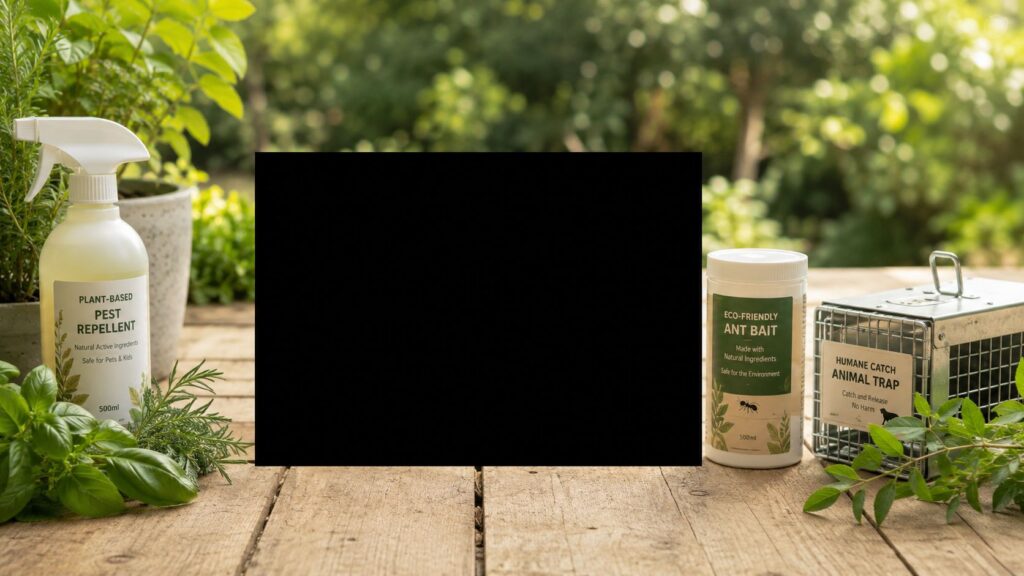
Eco Friendly Pest Control Products: The Green Advantage
You walk into the kitchen in Crown Point, flip on the light, and spot a trail of ants moving along the counter. Or you head into the basement and notice a few spiders tucked into the corners near the laundry area. Most homeowners don't just think about the bugs. They think about their kids, their pets, the air inside the house, and whether fixing one problem will create another.
That's why eco friendly pest control products matter so much right now. People looking for pest control near me or an exterminator near me usually want the same thing. They want the pests gone, but they don't want harsh, careless treatment around the places where their family lives every day.
In Crown Point, IN, that concern is especially understandable. Northwest Indiana homes deal with a mix of seasonal pressure, moisture, changing temperatures, and pest activity that shifts from yard to foundation to interior living spaces. Good pest control has to work with those local conditions, not against them.
Protecting Your Crown Point Home and Family from Pests
A common pattern in Crown Point homes starts small. A few ants near the sink. A spider in the basement. Mosquitoes getting worse around the yard after warm, wet weather. Then the concern grows quickly because nobody wants to guess about what's safe to spray around a child's play area, a dog bed, or a kitchen pantry.
That's where homeowners often get stuck. They don't want to ignore the issue, but they also don't want to overreact with broad, heavy treatment that doesn't fit the problem. The right answer usually isn't “spray more.” It's to treat smarter.
What homeowners are really asking
Most calls for pest control in Crown Point, IN come down to a few practical concerns:
- Family safety: People want to know what can be used around children, pets, and food-preparation areas.
- Real effectiveness: A pleasant-smelling product isn't useful if ants keep returning next week.
- Long-term relief: Homeowners don't want a quick knockdown followed by the same infestation all over again.
- Clear guidance: They want someone to explain what's happening and what to do next in plain language.
In Northwest Indiana, those concerns are valid because pest issues often come from very specific conditions. Damp mulch near the foundation, gaps around utility lines, cluttered storage areas, standing water in the yard, or food sources that seem minor to a homeowner can all drive repeat activity.
Practical rule: If a product only treats the bugs you can see, but not the reason they're there, the problem usually comes back.
Why eco-conscious service makes sense locally
Modern residential pest control doesn't have to force a choice between effectiveness and care. The better approach is targeted, site-specific, and built around how pests behave in Crown Point homes and businesses.
That's why homeowners across Northwest Indiana keep moving toward eco-conscious methods. They want precise treatments, careful placement, exclusion work, and prevention strategies that protect both the property and the people in it. For ants, spiders, mosquitoes, and other common local pests, that approach often produces cleaner and more durable results than old-fashioned blanket spraying.
What Eco-Friendly Pest Control Really Means
A lot of people hear “eco-friendly” and assume it means weak products or a simple homemade spray. That's not what professional eco-conscious pest control looks like. In practice, it means using Integrated Pest Management, often called IPM, to solve the root problem with the least disruptive method that will be effective.
Consider a good doctor. A good doctor doesn't hand every patient the same medicine before asking questions. They identify the problem, look at the cause, and choose the treatment that fits. Pest control works the same way.

The core of IPM
IPM starts with observation, not assumptions. A technician looks at what pest is present, where it's active, what's attracting it, and how it's getting in. That sounds simple, but it's the difference between chasing symptoms and fixing the issue.
The main parts usually include:
- Inspection: Finding nesting areas, moisture issues, food sources, harborage, and entry points.
- Identification: Confirming whether you're dealing with ants, spiders, wasps, mosquitoes, rodents, or another pest entirely.
- Monitoring: Watching where activity increases, where it drops, and whether conditions on the property are changing.
- Least-invasive control first: Using exclusion, sanitation, habitat adjustment, traps, and targeted applications before escalating.
For homeowners who like learning about ingredient-based repellents, a piece on a lemongrass and castor oil pest solution can be a helpful example of how plant-derived approaches fit into a broader prevention mindset. The key is understanding where a product belongs and where it doesn't.
What eco-friendly does not mean
It doesn't mean every pest problem can be solved with essential oils. It also doesn't mean every “natural” product is automatically safer or more effective just because it comes from a plant. Some botanical products work well in the right setting. Some don't last long enough outdoors. Some repel but don't eliminate the source.
That's why eco-conscious pest control has to be strategic.
Eco-friendly pest control works best when the treatment matches the pest, the season, and the structure.
Homeowners in Crown Point who want a deeper look at this philosophy can review these environmentally friendly pest control methods to see how lower-impact solutions fit into professional service. The takeaway is simple. Good pest control isn't about using more product. It's about using the right method, in the right place, for the right reason.
Your Guide to Modern Pest Control Products
The phrase eco friendly pest control products covers several very different tools. Some repel. Some interrupt breeding. Some attract pests into a bait or trap. Some create a physical barrier so pests can't enter in the first place. If you lump them all together, it gets confusing fast.
The easiest way to understand modern products is to look at what each category is designed to do.

Biological controls
These products use living organisms or naturally derived agents to target certain pests. In garden settings, that can mean microbial products aimed at specific insects or beneficial organisms that disrupt pest pressure without broad exposure across the whole property.
For a homeowner, the main benefit is precision. Biological controls are often useful when the goal is to reduce a target pest while limiting impact on the surrounding environment.
A good starting point for understanding this category is what biological pest control is. It helps clarify why these solutions are part of professional planning, especially when treating outdoor pest pressure in a more measured way.
Botanical and mineral-based products
This is often the first category that comes to mind. It includes plant-derived oils and mineral-based materials used to repel, deter, or affect insects in a targeted area. You'll often see ingredients associated with herbs, plant extracts, or dust-based products used in cracks, voids, and dry protected spaces.
These can work well when used correctly. They're especially useful for creating treated zones around likely activity points. But they aren't magic. Rain, sunlight, airflow, and surface type can all shorten how long a product remains effective outdoors.
Field note: A product that performs well on a label can still fail on a property if it's applied in the wrong location or expected to do a job it wasn't built for.
Baits and traps
Smart control proves particularly valuable for many indoor pests. Ants, some crawling insects, and rodents often respond better to a targeted baiting or trapping approach than to broad surface sprays. A bait lets the pest interact with a control point naturally. It doesn't rely on a homeowner chasing every visible insect around the room.
That's one reason modern residential pest control and commercial pest control plans often favor placement over saturation. Less product, used with more accuracy, usually makes more sense.
Exclusion materials and physical barriers
Some of the best pest control products aren't sprays at all. Door sweeps, mesh, sealants, screens, and entry-point repairs stop pests before they become an indoor problem. This matters a lot for spiders and rodents in Northwest Indiana, where small structural gaps often turn into repeat service calls.
If you're trying to understand how sealing fits into rodent prevention, Airtight Spray Foam Insulation's sealant guide offers useful context on where homeowners often focus and where a more careful approach is needed.
Here's a simple breakdown:
| Product type | Best use | Where it often falls short |
|---|---|---|
| Biological controls | Targeted outdoor pest management | Not a universal fix for every indoor infestation |
| Botanical repellents | Short-range deterrence and barrier work | Limited staying power in harsh outdoor conditions |
| Baits and traps | Colony reduction and focused control | Poor results if the pest is misidentified |
| Exclusion materials | Long-term prevention | Requires careful inspection to find all entry points |
This short video gives a helpful visual overview of how lower-impact pest management tools are used in practice.
One local option in this category is The Green Advantage, which uses environmentally mindful methods that can include plant-derived materials, targeted baits, exclusion thinking, and low-impact treatment planning for homes and businesses in Northwest Indiana. The point isn't that one product does everything. The point is that a strong plan combines the right tools for the pest in front of you.
Targeting Common Pests in Northwest Indiana
What works for ants often won't work for spiders. What helps with mosquitoes won't solve a wasp issue under the eaves. In Crown Point and nearby Northwest Indiana communities, effective pest control starts with matching the method to the pest and the conditions around the property.
Ants and why surface spraying often disappoints
Ants are one of the most common reasons people search for exterminator in Crown Point, IN. The mistake many homeowners make is spraying the visible trail and expecting the colony problem to end there. That usually only removes the workers you can see.
For many ant issues, targeted baiting tends to make more sense than broad repellent treatment because it addresses the movement pattern of the colony. The exact choice depends on where the ants are feeding, whether they're trailing indoors or nesting near the foundation, and what conditions are keeping them active.
Spiders, wasps, and structural pressure
Spiders usually tell you something about the environment. They're often following prey insects, using quiet corners, or taking advantage of entry gaps around doors, foundations, and utility penetrations. That's why spider control often improves when exclusion and insect reduction happen together.
Wasps are different. Nest location, traffic pattern, and human activity all matter. A nest near a doorway or outdoor gathering area calls for a careful, direct approach. A random repellent spray around the siding won't reliably solve that kind of issue.
Useful local strategies often include:
- Foundation crack sealing: Helps reduce interior access for spiders and crawling insects.
- Targeted nest treatment: Needed for active wasp harborage in high-contact areas.
- Lighting and insect management: Reducing prey insects can also reduce spider activity.
Mosquitoes and rodents around Northwest Indiana properties
Mosquito control is all about habitat. If standing water, heavy shade, dense foliage, or damp yard conditions remain in place, relief won't last long. Yard treatments can help, but they work best when paired with property-level reduction of breeding and resting areas.
Rodents bring a different challenge because they use warmth, shelter, and food access with remarkable consistency. A trap-only plan may catch activity, but exclusion and sanitation usually determine whether the issue keeps cycling back.
In Northwest Indiana, the most effective eco-conscious pest control usually combines targeted treatment with property corrections. Products matter, but conditions matter more.
One related issue homeowners sometimes overlook is nesting activity around roofs, vents, and exterior structures. While bird problems fall outside standard insect treatment, the discussion in this guide on handling bird nests in Upstate SC is a useful reminder that wildlife-related situations often require a separate, careful response rather than improvised removal.
DIY Dangers vs Professional Pest Control Service
DIY pest control isn't always wrong. For a very minor issue, a homeowner may be able to improve conditions by cleaning up food sources, trimming vegetation away from the house, or sealing a small gap. The problem starts when DIY is expected to function like a full strategy.
Store-bought products often look simple because the label makes the problem sound simple. Real infestations usually aren't. The challenge is less about effort and more about limits. A homeowner might use the wrong product, apply it in the wrong place, or target the wrong pest entirely.

Where DIY eco-friendly treatments go off track
A common example is ant control. People see ants on the counter, spray the counter, and feel like they've done something productive. But if the colony remains active in the wall, under the slab, or along the exterior edge, they've only interrupted the visible symptom.
Another problem is misidentification. Small ants, occasional invader beetles, and moisture-related pests can look similar to a homeowner. If the pest is misidentified, even a good product can produce poor results.
DIY limitations usually fall into a few categories:
- Wrong diagnosis: The visible pest may not be the main source of the problem.
- Wrong placement: Repellents, baits, and dusts all depend on proper location.
- Incomplete coverage: One entry point gets sealed while several others remain open.
- Safety mistakes: Overapplication around kitchens, pet areas, or sleeping spaces creates unnecessary risk.
What professional service changes
Professional pest control near me searches often come from homeowners who are tired of repeating the same weekend treatment with no lasting improvement. That makes sense. A technician isn't just bringing product. They're bringing pattern recognition.
They know how pest pressure changes with the season in Crown Point, how moisture affects activity, how rodents move along edges, where spiders hide, and when mosquito reduction needs yard-focused planning instead of random fogging.
Key distinction: DIY usually reacts to what's visible. Professional service looks for what's causing the visibility.
For both residential pest control and commercial pest control, that difference matters because the right result is not just fewer sightings today. It's a property that is less attractive and less accessible to pests going forward. That requires inspection, selection, placement, and follow-up, all working together.
What to Expect from The Green Advantage in Crown Point
It is common to feel more at ease knowing what the service process entails. Pest problems are stressful enough. You shouldn't have to wonder what happens after you call.
In Crown Point, the experience starts with a real conversation. You describe what you've seen, where it's happening, and how long it's been going on. That first contact matters because details that seem minor to a homeowner often help shape the inspection.

The visit to your property
When the technician arrives, the focus isn't only on the pests you noticed first. The inspection also looks at access points, moisture patterns, likely nesting or harborage areas, and conditions that may be supporting the infestation. That's especially important in Northwest Indiana homes where garages, crawl spaces, basements, mulched beds, and exterior transitions all play a role.
A proper inspection often includes:
- Interior review: Kitchens, bathrooms, utility spaces, basements, and known activity areas.
- Exterior review: Foundation lines, doors, windows, eaves, vegetation contact, and standing water concerns.
- Condition assessment: Food access, clutter, structural gaps, and pest-friendly moisture.
The treatment plan and follow-up
After the inspection, the technician explains what was found and recommends a plan that fits the site. If exclusion matters, that gets discussed. If targeted baiting makes more sense than broad treatment, that gets explained. If mosquito pressure is being driven by yard conditions, you'll hear that directly.
That transparency is a big part of a good service call. Homeowners want to know what's being used, why it's being used, and what results to expect.
A reliable pest control visit should leave you more informed than when it started.
Follow-up matters too. Some pest issues need monitoring, especially when activity changes with weather, nesting cycles, or structural conditions. That's why ongoing support can be just as valuable as the first treatment, whether you're dealing with recurring ants, spider pressure, rodent concerns, or seasonal mosquito activity around the yard.
For homeowners searching for pest control in Crown Point, IN or an exterminator near me, the process should feel clear, calm, and practical from start to finish.
Schedule Your Pest Inspection Today
If pests are showing up in your kitchen, basement, garage, or yard, it's worth addressing the problem before it spreads or becomes harder to control. In Crown Point and across Northwest Indiana, the best outcomes usually come from a plan that's targeted, thoughtful, and built around the actual conditions on your property.
Eco-conscious pest control doesn't mean settling for less. It means using methods that fit the pest, the home, and the people living in it. For ants, spiders, mosquitoes, rodents, and other common local issues, that often delivers a better balance of safety, precision, and long-term prevention than broad DIY treatment.
If you've been searching for pest control near me, exterminator in Crown Point, IN, or dependable residential pest control and commercial pest control, now is a good time to get clear answers. A professional inspection can identify what's attracting the pests, how they're getting in, and which eco friendly pest control products or techniques make sense for your situation.
You don't have to guess your way through labels, internet advice, or repeat infestations. Get a real inspection, a clear explanation, and a practical path forward.
If you're ready to protect your home or business, contact The Green Advantage to schedule a pest inspection, request a quote, and get environmentally mindful pest control in Crown Point, IN and nearby Northwest Indiana communities.
Spider Identification Guide for Northwest Indiana Homes
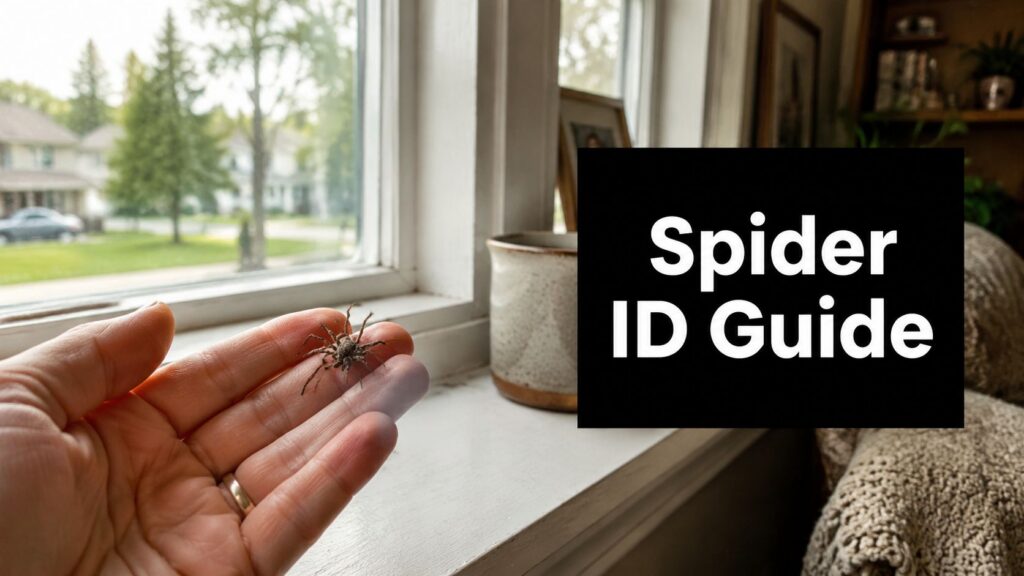
You're probably here because you just saw a spider on a basement wall, tucked behind storage in the garage, or hanging near a window and thought, “Do I need to worry about this?” That's a normal reaction. In Crown Point and across Northwest Indiana, spiders show up often enough to unsettle homeowners, especially when the spider is larger than expected or turns up in a bedroom, bathroom, or utility area.
A good spider identification guide helps, but most online advice is either too generic or too technical. Homeowners don't need a biology lecture. They need clear ways to tell what they're looking at, whether it's likely harmless, and when it makes sense to call for pest control near me or an exterminator in Crown Point, IN.
Answering Spider Concerns for Crown Point Homeowners
A common local scenario goes like this. A homeowner heads into the basement to grab holiday decorations, sees a fast-moving spider dart under a shelf, and suddenly every corner looks suspicious. That reaction isn't overblown. Spiders trigger concern because they're quiet, hard to track, and easy to misidentify from a quick glance.
Part of the confusion is simple scale. Over 37,000 distinct species of spiders have been scientifically described worldwide, and nearly 1,000 have been documented in the continental U.S. and Canada, which is why even a basic understanding matters for homeowners in places like Northwest Indiana, as noted in the IPM Institute spider guide. Contacting pest control in Crown Point, IN after spotting one spider is usually not an overreaction. They're responding to uncertainty.
What usually worries homeowners most
Most callers aren't asking for a formal species label. They want answers to practical questions:
- Is it dangerous: They want to know whether the spider poses a health concern.
- Is it alone: They want to know if one sighting means more are hidden nearby.
- Why is it inside: They want to know what's drawing spiders into the house.
- Will sprays from the store work: They want to know if DIY treatment will solve it or just scatter the problem.
Those are the right questions. In many homes, the spider itself is only part of the story. Indoor spider activity can point to cluttered harborages, moisture issues, gaps around doors, or a steady food source from other insects.
Practical rule: If you keep seeing spiders in the same rooms, don't focus only on the spider. Look at entry points, lighting, moisture, storage habits, and the insects those spiders may be feeding on.
Why local context matters in Northwest Indiana
Homes in Crown Point deal with changing seasons, attached garages, basements, crawl spaces, and landscaping that puts insects close to the structure. That mix creates regular opportunities for spider sightings. Some are wandering hunters. Others stay near webs in quiet corners, window frames, or utility spaces.
That's why a Northwest Indiana spider identification guide should do more than show photos. It should help you sort nuisance spiders from medically significant ones and decide when residential pest control or even commercial pest control makes sense for a larger property, rental, or business site.
A Homeowners Guide to Spider Identification Clues
If you want to identify a spider without getting too deep into technical jargon, start with what you can safely observe from a distance. The most useful clues are the web, the body shape, the markings, and the place where you found it.
Start with the web
One of the fastest field clues is the web itself. Spider family and genus identification can be efficiently achieved by analyzing web architecture and location, including whether the web is spiral, cobweb, funnel, or sheet-shaped, according to this spider web identification reference from TERRO.
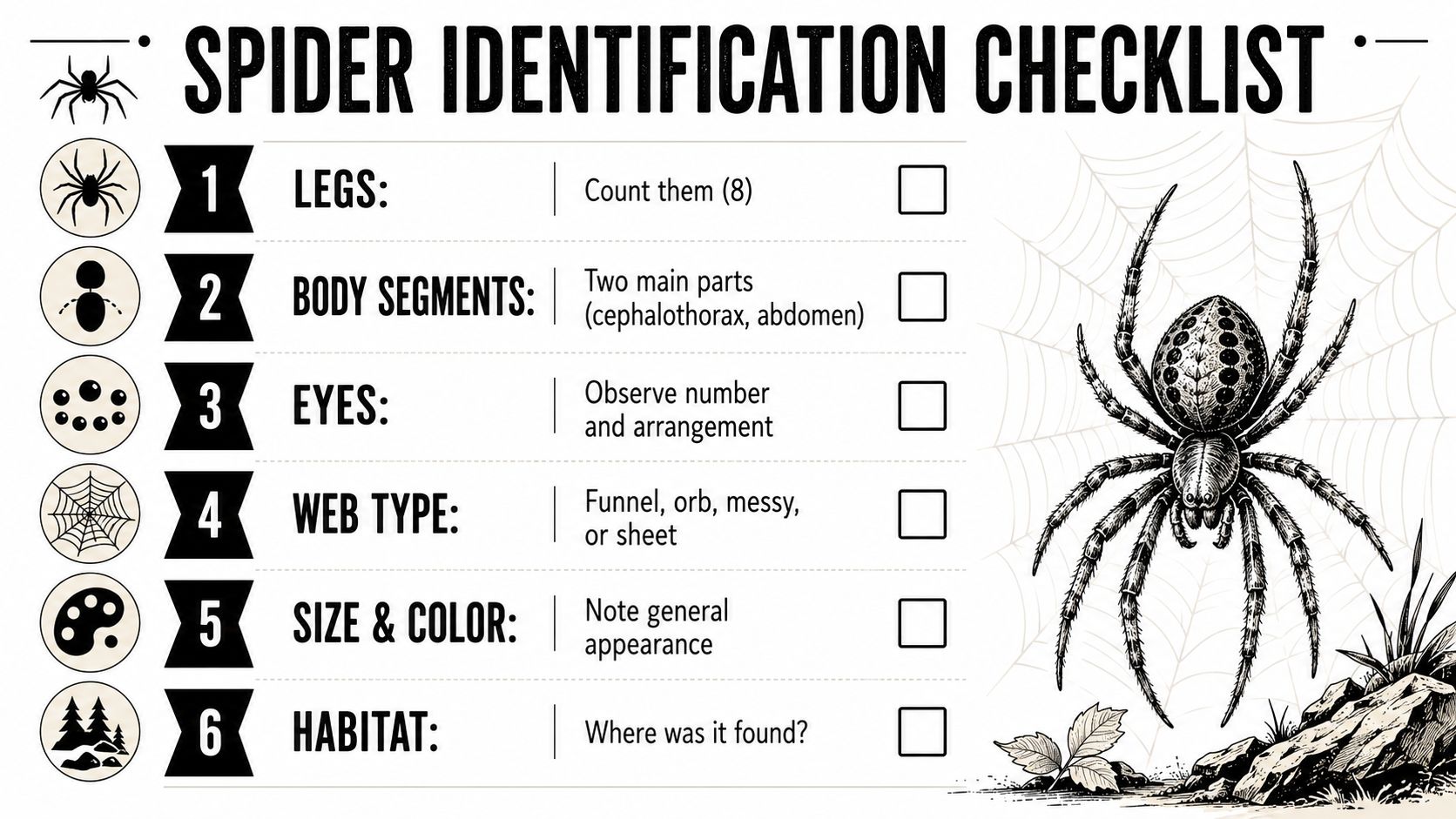
That matters because homeowners often notice the web before they notice the spider.
- Orb-style web: A more organized circular web usually points to a web-building spider outdoors or near exterior lighting.
- Messy cobweb: Irregular, tangled silk often shows up in corners, ceiling lines, garages, and storage areas.
- Funnel web: A flat web that narrows into a retreat often appears in grass, landscaping, or along edges.
- Sheet web: A blanket-like web can appear low to the ground or in sheltered exterior areas.
Then check the spider's look
You won't identify every spider to species level by sight alone, but a few visible traits help a lot.
- Body build matters. A stockier spider with a sturdy appearance often behaves differently than a long-legged, delicate spider.
- Leg length helps. Some common house spiders have very thin, long legs, while hunting spiders look heavier and more athletic.
- Color and markings can narrow things down, especially if you notice striping, banding, a violin-like marking, or a dark glossy abdomen.
- Movement is useful. Fast runners usually aren't the same type as spiders that sit at the center of a web.
Pay attention to where it was found
Location tells you almost as much as appearance.
A spider in a damp basement corner suggests a different pattern than one found in a shrub, a window well, or a garage ceiling.
Ask yourself:
- Inside or outside: Was it in a finished room, utility area, attic, garage, or landscaping bed?
- Hidden or exposed: Was it tucked behind stored items or sitting openly in a web?
- Dry or damp: Moisture can influence where insects gather, and spiders follow food.
What doesn't work well
Many homeowners try to identify spiders from memory after the spider disappears. That usually leads to bad guesses. Cell phone photos help more than memory does, especially if you can capture the web and the location without getting close.
Eye arrangement can matter in expert identification, but for homeowners it's not usually practical to rely on. Focus first on the clues you can observe safely. That's what makes a spider identification guide useful in real homes, not just in a lab or textbook.
Common Spiders You Might Find in Northwest Indiana
Most spiders found in Crown Point homes aren't the spiders people fear most. They're nuisance pests, occasional indoor wanderers, or outdoor species that end up inside by accident. The useful question isn't “Is every spider bad?” It's “What pattern does this spider fit?”
The spiders homeowners usually notice first
Wolf spiders get attention because they're large enough to startle people. They don't build the classic corner web often expected, and they often show up running across floors, especially in basements, garages, and ground-level areas. They look intimidating, but in most homes they're more alarming than dangerous.
Cellar spiders are the long-legged spiders many people call daddy long-legs. They're often found hanging upside down in quiet ceiling corners, basements, and less-disturbed rooms. They tend to stay put, build loose webs, and become a nuisance when webs collect in multiple spots.
Grass spiders are common around the outside of homes in Northwest Indiana. If they move indoors, they usually appear near entry points, garages, or lower-level areas. Their funnel-style web is often easier to notice outside than the spider itself.
Common house spiders also show up around windows, corners, storage areas, and attached garages. They usually build irregular webs and stay near them. Homeowners often notice the web long before they notice the spider.
Common Spiders in Northwest Indiana at a Glance
| Spider Name | Appearance | Web Type | Common Habitat | Risk Level |
|---|---|---|---|---|
| Wolf Spider | Stocky body, sturdy legs, fast-moving | No typical capture web for hunting | Basements, garages, lower levels | Low |
| Cellar Spider | Very long thin legs, delicate body | Loose, irregular web | Basements, corners, utility rooms | Low |
| Grass Spider | Brownish body, quick movement | Funnel web | Landscaping edges, garages, near foundations | Low |
| Common House Spider | Small to medium, variable color | Messy cobweb | Windows, corners, storage spaces | Low |
How to tell nuisance spiders from a bigger concern
A lot of mistaken identification comes from size. Homeowners often assume the bigger spider is the dangerous one. In practice, that isn't a reliable rule. A large wolf spider on the basement floor is more likely to frighten you than harm you.
What matters more is behavior and setting.
- Running across open floors: Often points to a hunting spider.
- Staying in a web corner: Often points to a web-building nuisance species.
- Appearing near insects: Suggests prey activity nearby.
- Showing up repeatedly in one part of the home: Suggests a habitat issue that needs correction.
If the spider is active, common, and tied to clutter, storage, or insect activity, the better fix is usually a broader spider control plan, not just removing the one spider you saw.
For homeowners searching exterminator near me, professional judgment offers significant assistance. A technician doesn't just identify the spider. They read the pattern around it, including entry points, prey pressure, moisture, and where treatment will be most effective.
Identifying Medically Significant Spiders in Indiana
When people ask whether a spider is dangerous, they usually have two spiders in mind. That's reasonable. In the United States, the only two spider species that pose a serious health threat requiring immediate medical attention if bitten are the Black Widow and the Brown Recluse, as explained by the PestWorld spider safety guide.
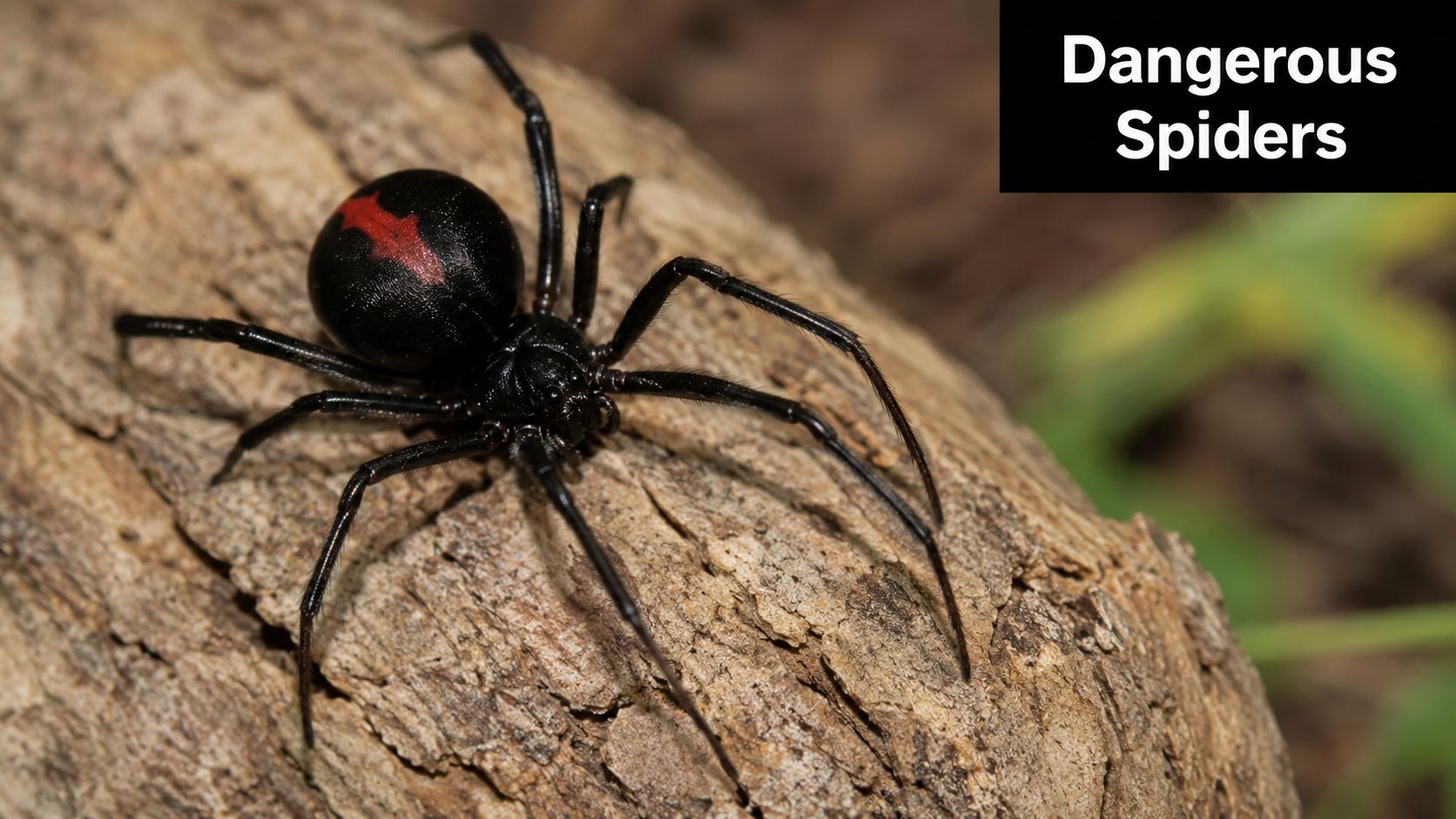
Black Widow
The Black Widow is best known for a distinct red hourglass on the abdomen. It has a glossy dark body and tends to stay in more protected areas rather than out in the open. If a homeowner sees a shiny dark spider in a secluded spot, that hourglass marking is the detail that matters most.
These spiders are associated with sheltered locations such as undisturbed storage, wood piles, sheds, and protected structural voids. That means quick sightings in living spaces are often misidentified. Plenty of harmless dark spiders get mistaken for widows.
Brown Recluse
The Brown Recluse is associated with a dark violin marking on its back. It prefers concealed, quiet spaces and is more likely to be encountered where boxes, storage, clothing, or undisturbed materials create cover.
In real homes, caution is essential. People often overidentify recluse spiders based on any brown spider they find. That's a mistake. A plain brown spider is not automatically a Brown Recluse, and poor identification causes unnecessary panic.
If you suspect either of these spiders and someone may have been bitten, prioritize medical care first. Identification can come second.
For homeowners trying to compare skin irritation, swelling, or a mystery mark, this guide on mosquito bites versus spider bites can help you think more clearly about what you're seeing.
When to stop guessing
Bite symptoms can be confusing, and skin reactions have many causes. The right response is simple. If a bite is suspected from a medically significant spider, seek medical attention right away. Don't wait for an internet image search to settle it.
This short video gives a useful visual reference point before you decide your next step.
For Indiana homeowners, the safest approach is cautious, not panicked. Most spider sightings are not emergencies. But if markings match, the setting fits, or a bite is involved, treat it seriously and bring in professional help.
Why Professional Spider Control Is Your Best Solution
Seeing one spider doesn't always mean you have an infestation. Seeing them repeatedly is different. Recurring spider activity usually points to a home condition that keeps supporting them, such as insect prey, cluttered storage, gaps around the exterior, or quiet undisturbed spaces that rarely get cleaned or sealed.
Why DIY usually falls short
Store sprays can knock down a spider you can see. They rarely solve the reason spiders keep showing up. That's the trade-off. DIY products feel immediate, but they often treat the symptom and miss the pattern.
A real spider control plan usually involves several pieces working together:
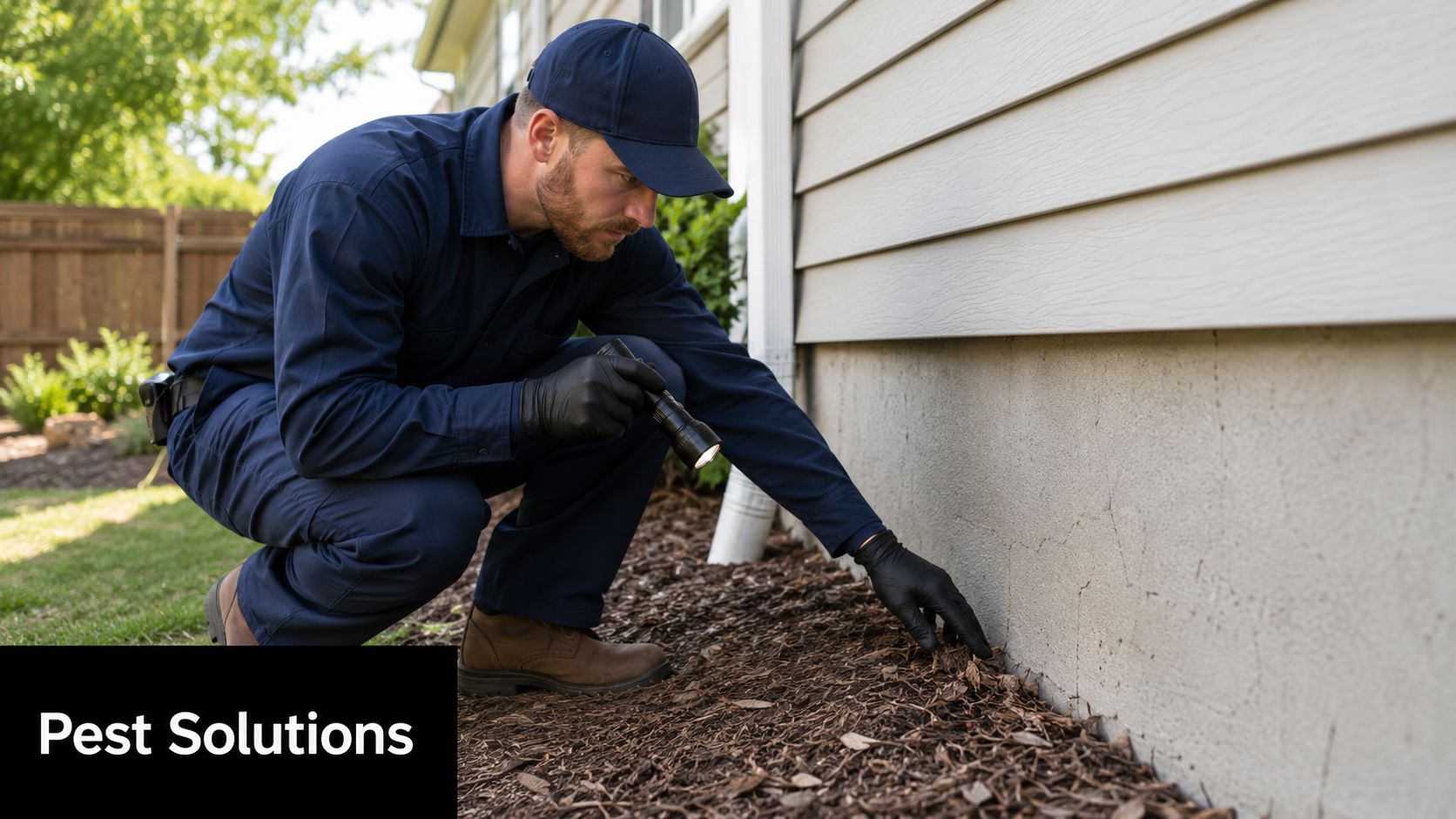
- Exterior inspection: Finding gaps, thresholds, vents, and foundation areas where pests move in.
- Harborage reduction: Addressing storage clutter, web build-up, and sheltered areas spiders favor.
- Prey reduction: Managing the insects that attract spiders in the first place.
- Targeted treatment: Applying products where spiders travel, rest, or build webs, not just where they're noticed.
Accurate identification changes the treatment
This part matters more than many homeowners realize. Spider identification often requires precise morphological detail, and experts may use a stereoscopic microscope at 20x to 50x magnification, which is one reason professionals emphasize getting identification right before treatment, as described in this arachnology overview of spider identification methods.
That doesn't mean every home visit turns into microscope work. It means visual guessing has limits. A professional doesn't need to overpromise species-level certainty to make smart treatment decisions. They know when the spider type, web pattern, location, and activity level are enough to act, and when a closer look matters.
What professional service solves better
Homeowners who search residential pest control or exterminator near me are usually dealing with one of three situations:
- Spiders keep returning after cleanup.
- The home has multiple pest issues, not just spiders.
- Someone in the household is anxious enough that reassurance alone isn't enough.
That's where broader pest service helps. Spider control often overlaps with ant control, wasp removal around entry points, rodent control in garages or crawl spaces, and seasonal insect pressure around foundations and landscaping.
For a practical look at treatment and prevention, this guide on how to get rid of spiders covers what helps and what tends to waste time.
What to Expect from Our Pest Control Service in Crown Point IN
When homeowners call for pest control in Crown Point, IN, they usually want two things right away. They want the issue taken seriously, and they want the process to be simple. A strong service visit should do both.
The inspection comes first
The first step is a property inspection. That means looking at where spiders were seen, what kind of activity is happening, and what conditions are supporting it. In a Northwest Indiana home, that often includes basements, garages, window areas, door thresholds, utility penetrations, attic access points, and exterior foundation lines.
This part matters because spider control isn't just about applying product. If the technician doesn't identify the pressure points, the result is often temporary.
You should get a plan that fits the property
Not every home needs the same approach. A house with occasional cellar spiders in the basement needs a different solution than a property with recurring web build-up around exterior lighting and garage corners. A commercial pest control plan for a local facility also differs from residential pest control because the traffic patterns, sanitation practices, and structural conditions are different.
A useful service plan should address:
- Where treatment belongs: Interior, exterior, or both.
- What conditions need correction: Clutter, gaps, moisture, lighting, or prey insects.
- What follow-up is realistic: One-time relief, ongoing monitoring, or seasonal preventative pest treatments.
Good service should feel clear. You should know where the issue is, what's being done about it, and what changes at home will help keep spiders from returning.
The treatment should be targeted, not random
A professional visit should focus on likely travel routes, entry points, web sites, and harborage areas. In many homes, that includes exterior perimeter work, removal of active webbing, and treatment in areas where spiders rest instead of broad, unnecessary application everywhere.
Homeowners should also expect practical advice after service. That may include reducing insects around the home with better exterior lighting choices, sealing gaps, improving storage practices, or addressing related issues through mosquito control, termite control, or rodent exclusion if those conditions are contributing to overall pest pressure.
In Crown Point, IN, the best pest service is straightforward. It respects your home, explains the reasoning, and gives you a clear path forward instead of a vague promise.
Protect Your Home and Family with The Green Advantage
Spiders create stress out of proportion to their size. One sighting can make a bedroom feel unsettled, a basement feel off-limits, or a garage feel like a problem you've been putting off too long. The right response isn't panic. It's a clear plan.
For many homes in Northwest Indiana, spider issues are tied to broader pest conditions. A good service approach protects more than one room or one moment. It helps protect your property, reduce indoor pest pressure, and restore confidence in the places your family uses every day.
Why homeowners act sooner rather than later
Waiting rarely makes pest issues simpler. If spiders are showing up regularly, there's usually a reason. It may be prey insects. It may be entry points around the home. It may be storage, moisture, or seasonal movement from the exterior inward.
That's why professional help often becomes the smarter option when:
- Sightings are recurring: You're seeing spiders in the same areas again and again.
- DIY hasn't held up: Sprays and traps gave short-term relief or no relief.
- You want certainty: You'd rather have a trained eye assess the situation than keep guessing.
- Other pests are involved: Ants, wasps, rodents, or mosquitoes are part of the bigger picture.
A calm, informed inspection usually solves more worry than another round of guessing from across the room.
If you've been searching pest control near me, exterminator in Crown Point, IN, or eco-friendly pest control for your home or business, the next step is simple. Get the property inspected, identify pressure points, and deal with the problem before it becomes a bigger headache.
If spiders, ants, rodents, wasps, mosquitoes, or other pests are making your Crown Point home feel less comfortable, contact The Green Advantage to schedule an inspection or request a quote. Their team serves Crown Point and nearby Northwest Indiana communities with thoughtful residential pest control and commercial pest control built around clear answers, targeted treatment, and long-term prevention.
VA Home Loan Pest Inspection: Your 2026 Indiana Guide

Buying a home with a VA loan in Northwest Indiana should feel exciting, not confusing. Then the lender or agent mentions a pest inspection, and suddenly you're wondering whether this is one more delay standing between you and the keys.
For many first-time buyers in Crown Point and nearby Northwest Indiana communities, that's the moment the process gets murky. A standard home inspection already feels like a lot. A separate VA home loan pest inspection can sound redundant until you understand what the VA is trying to prevent: hidden wood-destroying insect damage that can turn a solid-looking house into an expensive problem.
That requirement isn't there to make your closing harder. It's there to keep you from buying a home with structural issues that should've been caught before the loan funds.
Securing Your Home with a VA Loan in Northwest Indiana
A lot of buyers hit the same sequence. You find a house that fits your budget, the offer gets accepted, and then someone in the transaction says you may need a wood-destroying insect report. At that point, most buyers ask three questions right away.
- Do I really need it in Indiana
- Who sets it up
- Will this slow down closing
Those are the right questions.
In Northwest Indiana, this issue matters because homes here deal with moisture, seasonal shifts, crawl spaces, basements, and plenty of conditions that can hide pest activity longer than most buyers expect. A house can look clean during a showing and still have signs of termites, carpenter ants, or old wood damage in areas not typically inspected closely.
Practical rule: Treat a VA pest inspection as early due diligence, not a last-minute nuisance.
If you're using your earned VA benefit, you should want clarity before closing. The wrong approach is waiting until the appraisal is nearly done and hoping no one asks for a report. The smart approach is understanding the requirement early, getting the right inspection from the right licensed professional, and dealing with any finding while there's still time to solve it cleanly.
That matters even more for first-time buyers who are also juggling insurance, underwriting, inspection responses, and moving dates. You don't need more noise. You need a simple path.
What Is a VA Pest Inspection and Why Is It Required
A VA pest inspection is a wood-destroying insect inspection, often called a WDI report. It isn't the same as a general home inspection. A home inspector looks broadly at the property. A VA-qualified WDI inspection focuses on pests and damage tied to wood-destroying organisms.
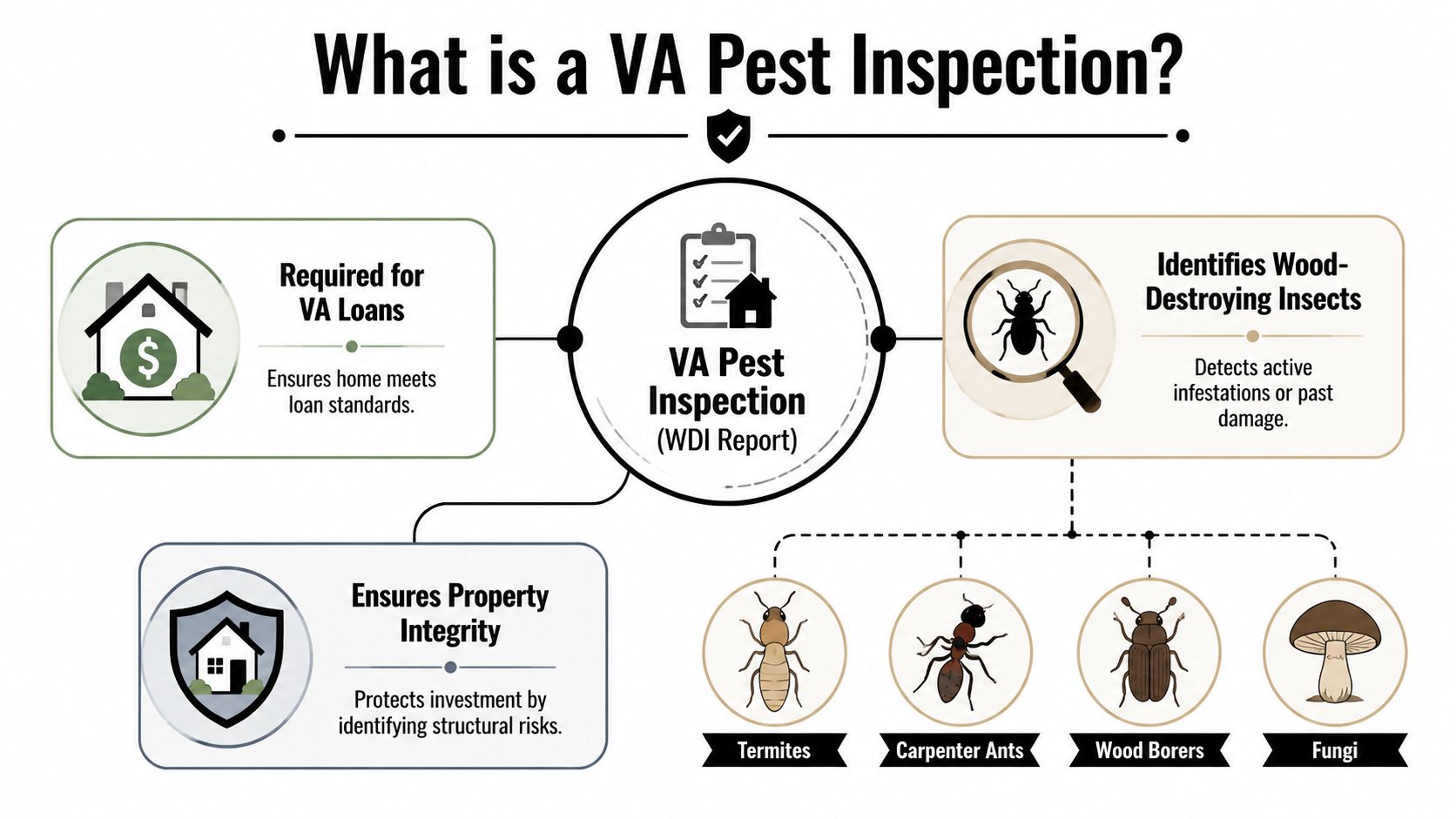
What the inspector is actually checking
The inspection is meant to identify whether the property has active infestation, visible evidence of prior activity, or damage that raises concern about structural soundness. The focus is on wood-destroying pests such as termites, carpenter ants, and powder-post beetles.
That's why this report carries weight with the VA and the lender. They're not checking for everyday nuisance bugs. They're checking for pests that can compromise the house itself.
Why the VA requires it
The VA uses a termite infestation probability map to decide where a WDI inspection is mandatory. According to AmeriSave's guide to pest inspection requirements for mortgages, the VA mandates a wood-destroying insect inspection for all VA home loan purchases in 35 states and U.S. territories classified as having "Moderate to Heavy" or "Very Heavy" termite infestation probability. That includes states such as Alabama, Arizona, Arkansas, California, Florida, Georgia, Texas, and Washington D.C. In those places, the inspection is non-discretionary, must be completed by a licensed pest control operator, and must be done within 90 days of closing. In lower-risk states such as Alaska, Idaho, and Maine, the inspection is required only if the VA appraiser notes evidence of damage during valuation.
That map-based system tells you something important. The VA isn't making this up on a file-by-file whim. It's using geography and risk to protect the borrower and the loan.
The best way to think about a VA WDI report is simple: if the house has hidden wood damage, you want to know before the mortgage closes, not after.
Why this matters for a first-time buyer
A conventional buyer might choose to skip extra inspections. A VA buyer shouldn't take that gamble. If a property has concealed termite activity or old untreated damage, you're the one who inherits the headache once the deed records.
That's why this requirement is smart. It protects the home, your budget, and your peace of mind.
VA Rules for Indiana Who Orders and Who Pays
Buyers often receive outdated information. Older articles still repeat the old rule that the seller has to pay and the buyer can't. That's outdated.
Who usually orders the inspection
In a typical transaction, the inspection gets arranged by the buyer, the agent, or sometimes the lender's side if they're coordinating required items tightly. In practice, you don't want to wait for everyone else to guess whose job it is. Ask early, confirm who's scheduling it, and make sure the inspector knows it must be a VA-compliant WDI inspection.
If you're buying in Crown Point or elsewhere in Northwest Indiana, that's the safest move. Waiting invites avoidable delays.
Who can pay now
According to VA Loan Network's explanation of VA termite and pest inspections, as of June 2022 the VA updated its policy to allow either the homebuyer or the seller to pay for the mandatory termite inspection. Before that, buyers were generally prohibited from covering that cost in most situations. The same source notes that the inspection typically costs $75 to $200 depending on property size and location, and the report must use the NPMA-33 form to be accepted by lenders.
That change matters. It gives buyers flexibility when negotiations get tight. If the seller won't cover it and you don't want the deal stalled over a modest line item, you can pay for it and keep moving.
The practical advice for Northwest Indiana buyers
Don't treat payment as the main issue. Treat speed and correctness as the main issue.
Use this approach:
- Confirm the requirement early with your lender or agent.
- Schedule the inspection fast once the contract is active.
- Verify the inspector uses NPMA-33 and understands VA requirements.
- Negotiate payment if you want to, but don't let a small cost create a big delay.
If a deal in Crown Point is otherwise solid, it rarely makes sense to drag out negotiations over an inspection that keeps the file moving.
A VA home loan pest inspection is one of those transaction details that feels small until it's mishandled. Then it becomes the reason closing gets pushed.
The WDI Inspection Process What to Expect
The inspection itself is straightforward when a licensed professional handles it correctly. Most buyer anxiety comes from not knowing what the inspector is doing or how formal the report needs to be.
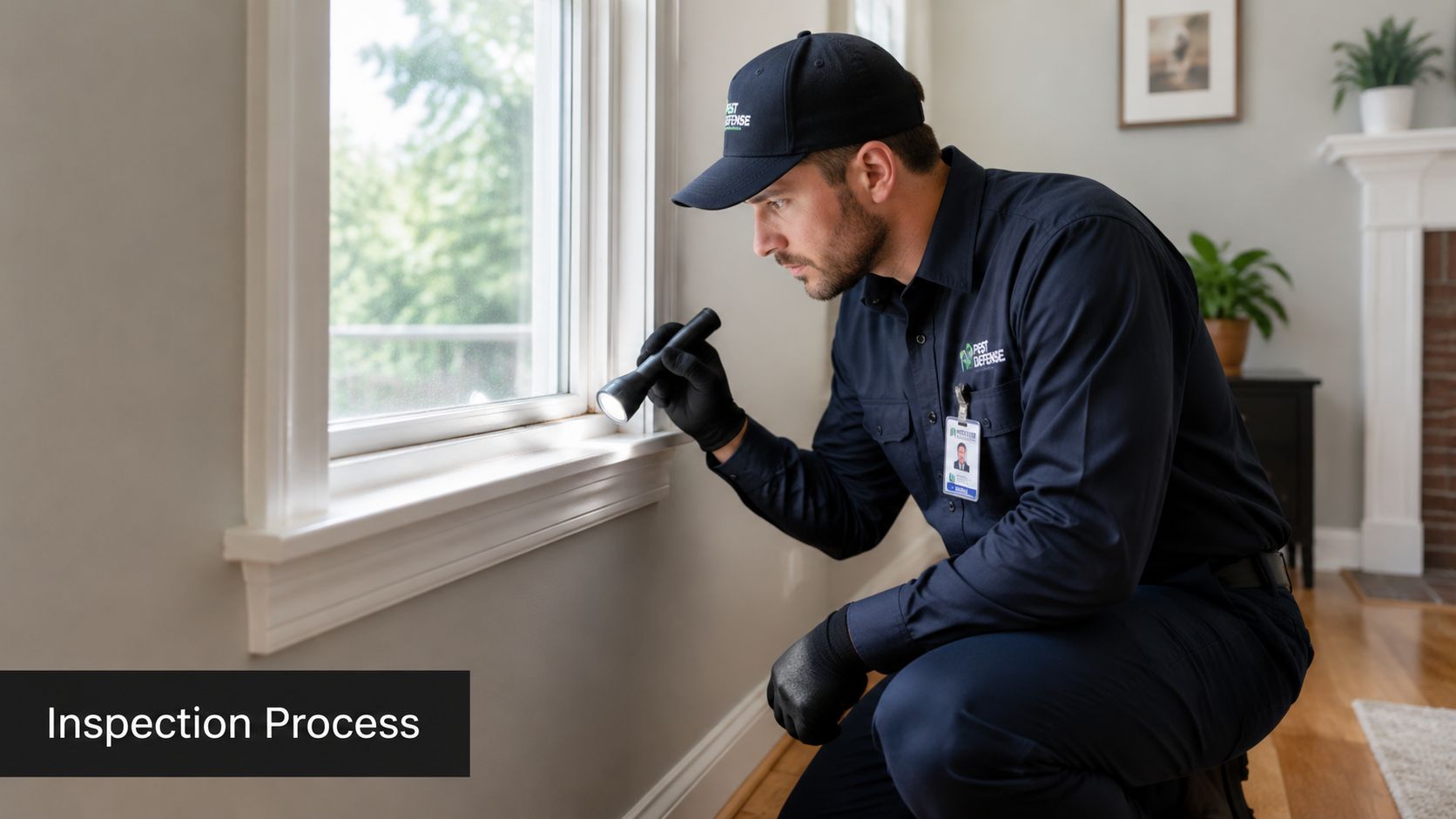
What happens on inspection day
The inspector starts with a visual review of accessible areas inside and outside the home. That usually means checking the foundation line, basement, crawl space, attic access, garage edges, exposed framing, window areas, and other spots where wood-destroying insects leave evidence.
They're looking for specific signs, not guessing. Common clues include mud tubes, hollowed wood, frass, insect wings, damaged trim, and conditions that support infestation. A strong inspection isn't rushed. It follows a pattern and documents what matters.
If you want a broader sense of what trained professionals pay attention to around a structure, this pest control inspection checklist from The Green Advantage is a useful reference for understanding how a methodical inspection works.
Why a general inspection isn't enough
A lot of buyers assume any pest inspection will do. That's where files get kicked back.
According to HC Inspectors' overview of VA termite inspection requirements, the VA requires the NPMA-33 form, and only state-licensed professionals who meet the right criteria can submit the correct report. That same guidance makes clear the report must note findings for termites, carpenter ants, and powderpost beetles, not just general pest issues.
That's a critical distinction. Your lender isn't looking for a casual note saying the home "looks fine." They need the proper form completed by the proper professional.
Here's a quick visual overview of the kind of process buyers often want to see before the appointment.
What the report does for your loan
The WDI report becomes part of the transaction record. It tells the lender whether the property is clear, whether treatment is needed, or whether additional action is required before closing.
That means accuracy matters more than speed alone. Fast is good. Fast and accepted is what you need.
Common Findings and How to Address Them Professionally
When buyers hear that the inspector found something, they often assume the deal is collapsing. That's usually the wrong conclusion.
Most findings fall into a few predictable categories. The key isn't whether something turns up. The important point is whether the problem gets handled correctly and documented in a way the lender can accept.
What inspectors commonly see
The technical scope of a VA-required inspection includes accessible exterior and interior areas such as attics, crawl spaces, basements, and perimeter foundations. A qualified inspector looks for pests including termites, carpenter ants, powder-post beetles, and carpenter bees, along with evidence such as live insects, hollowed wood, mud tubes, frass, and visible timber damage. That set of requirements is described in the verified VA pest inspection guidance already noted earlier.
In practical terms, common findings often include:
- Active termite evidence such as mud tubes, fresh activity, or damaged wood that still suggests a current issue
- Old damage that may no longer be active but still needs evaluation
- Carpenter ant activity in damp or softened wood
- Moisture conditions that make future infestation more likely
- Wood-to-ground contact that creates an easy path for pests
A finding on the report isn't a verdict on the whole house. It's a call to fix a specific problem before it becomes your problem.
How to respond without derailing the sale
The right response depends on what was found. Active infestation typically needs professional treatment. Damaged material may also need repair if structural soundness is in question. Moisture and access conditions should be corrected so the issue doesn't come right back.
If flooring has been affected, buyers often need a better sense of how insect damage shows up in finished surfaces. This article on dealing with pest damage on floors gives helpful context for spotting and understanding wood-related damage in living spaces.
For buyers, agents, and sellers trying to move a deal forward, a dedicated real estate-focused inspection process matters. This termite inspection for real estate resource from The Green Advantage is useful if you're comparing what transaction-driven inspection support should include.
The smartest buyer mindset
Stay calm and stay procedural.
If the report shows activity, get treatment lined up. If repairs are needed, get them addressed. If conditions invite future issues, correct them while the property is still in transaction mode. That's how you protect both the closing and the house.
How Inspection Results Affect Your VA Loan Closing
The WDI report directly affects whether your file can move to the closing table cleanly. Some reports clear quickly. Others trigger a required chain of follow-up steps.
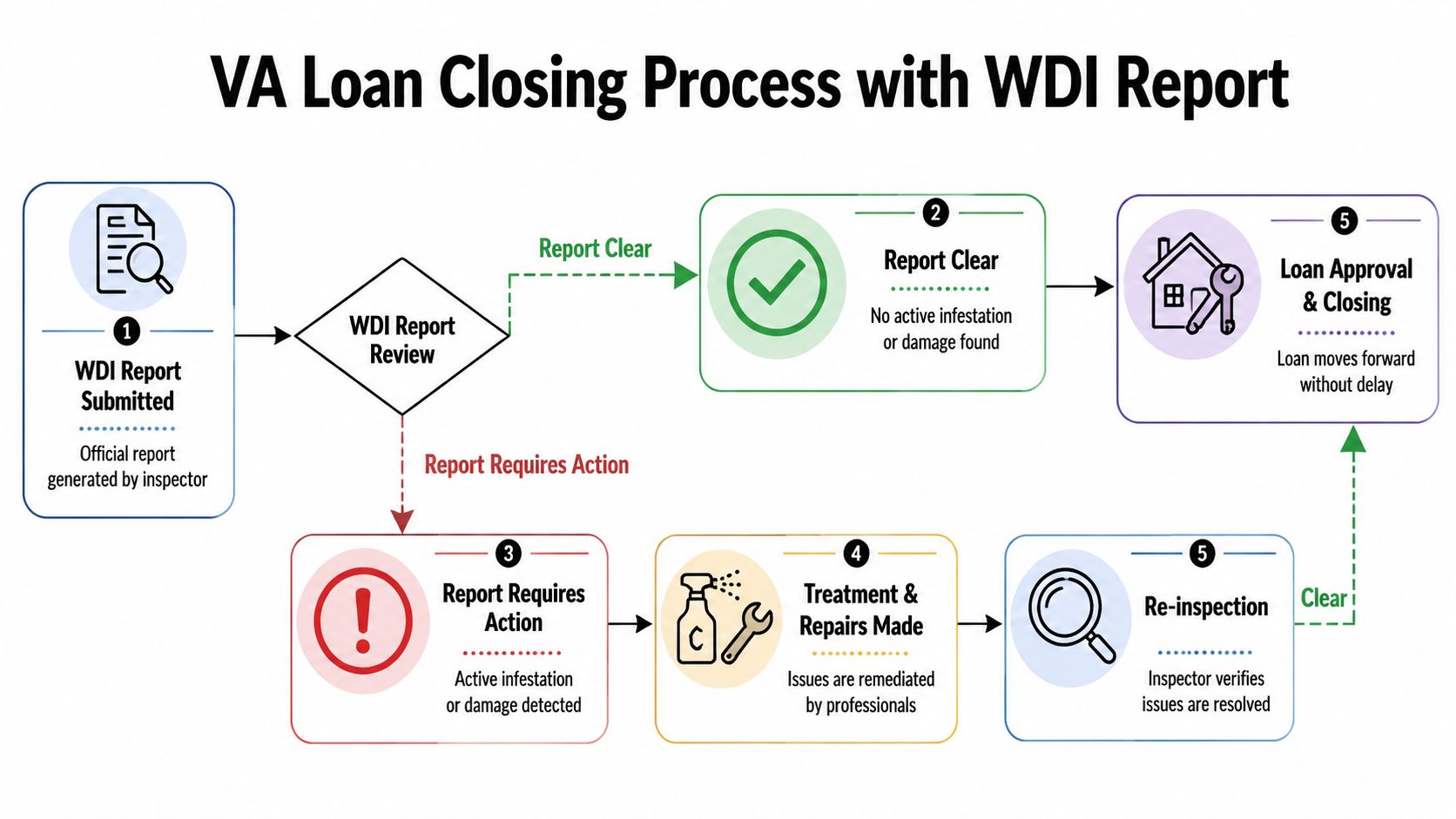
If the report is clear
A clear report is the easy path. The lender gets the documentation it needs, and this item stops being a concern.
That's why getting the inspection done early is smart. A clean report removes uncertainty and keeps your timeline intact.
If the report requires action
Some properties need more than a single inspection. According to the verified VA guidance referenced earlier, VA home loans require pest inspections in 35 or more states and territories in higher-risk zones, while lower-risk states require them when the appraiser spots evidence. The same guidance also notes that approximately 15% to 20% of all VA loan properties require some level of pest inspection regardless of location because of findings in appraisal reports.
Once a report identifies active infestation or qualifying damage, the VA's process becomes very clear. The property must be treated, any required repairs must be made, and a re-inspection must confirm that the infestation has been eliminated before the loan can close. That's not red tape. That's protection.
What buyers should do when closing is on the line
Use a simple decision framework:
| Situation | What it means | Best next move |
|---|---|---|
| Clear report | No active issue documented | Send it to the lender immediately |
| Active infestation | Treatment is required before closing | Schedule licensed treatment without delay |
| Damage noted | Repairs may be needed | Get repair scope clarified fast |
| Re-inspection required | File can't close yet | Book clearance inspection as soon as work is complete |
Don't argue with the process when a WDI issue is documented. Solve the issue, document the solution, and keep the file moving.
Buyers often focus only on the pest report and forget the rest of the property condition still matters. If you're also evaluating the roof as part of a real estate transaction, Penn Ohio Roofing's inspection guide is a practical companion resource for understanding another major area that can affect negotiations and timing.
Why this process is worth it
No one enjoys an extra step before closing. But buying a house with active wood-destroying insect issues is worse. A forced repair-and-clearance sequence before funding is a far better outcome than discovering serious damage after move-in.
For VA buyers, the rule does exactly what it should do. It pushes the problem into the transaction, where it can still be fixed properly.
Your Trusted Partner in Crown Point The Green Advantage
Northwest Indiana buyers don't need a national article written for every market in America. They need local help from people who understand how real estate timelines work here, how pest activity shows up in area homes, and how to keep an inspection issue from turning into a closing disaster.
That matters in Crown Point. It matters in nearby Northwest Indiana communities. And it matters most when you're trying to buy your first home using a benefit you've earned.

Why local service makes the process easier
A VA home loan pest inspection needs to be done correctly, documented correctly, and communicated clearly. Buyers, agents, and sellers all need fast answers. A local company serving Crown Point and Northwest Indiana is in a better position to provide that than a generic call-center operation trying to route requests from somewhere else.
For homeowners and property managers searching for pest control near me, pest control in Crown Point, IN, exterminator near me, or exterminator in Crown Point, IN, that local advantage matters beyond the estate transaction too. The same local knowledge helps with residential pest control, commercial pest control, termite control, rodent control, spider control, wasp removal, mosquito control, and preventative treatments built around Northwest Indiana conditions.
The standard you should expect
You should expect:
- Clear scheduling and communication so the inspection doesn't become a mystery item on your contract checklist
- Licensed, professional service that matches lender and VA expectations
- Plain-English findings so you know whether the report is clean or what needs attention
- Practical solutions if treatment or follow-up is required
If you're buying in Crown Point, don't overcomplicate this. Get the right inspection. Get it done early. If the report finds an issue, address it quickly and professionally.
If you need a VA home loan pest inspection, termite treatment, or follow-up pest support in Crown Point or nearby Northwest Indiana, contact The Green Advantage. They provide licensed, homeowner-focused service with the responsiveness you need when a closing date is on the calendar.
Pest Control Services for Bed Bugs in Crown Point, IN
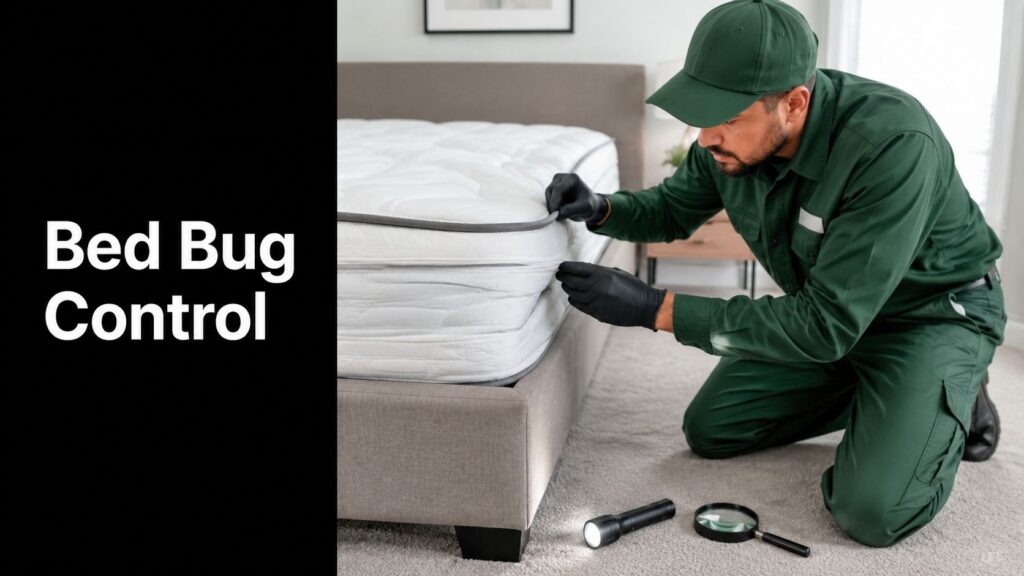
You pull back the sheet late at night, spot a tiny bug near the mattress seam, and suddenly the whole room feels different. Many residents in Crown Point don't panic because of the bug itself. They panic because they don't know if they're looking at one stray insect or the start of a bed bug problem that will spread into bedrooms, couches, luggage, and the rest of the house.
That reaction is normal. Bed bugs make people feel unsettled fast, even in clean, well-kept homes.
In Northwest Indiana, bed bug calls come from single-family houses, apartments, rental units, and commercial properties. They don't show up because a home is dirty. They show up because they travel well, hide well, and stay out of sight until activity becomes hard to ignore. If you've been searching for pest control near me, exterminator near me, or pest control in Crown Point, IN, you're probably looking for clear answers more than anything else.
A steady process is essential. Bed bug work isn't about one spray and a quick goodbye. It takes inspection, the right treatment method for the structure, safe application, and follow-up. For homeowners, landlords, and property managers in Crown Point and nearby Northwest Indiana communities, the smartest move is to match the treatment plan to the building and the level of activity.
Finding Bed Bugs A Homeowners Guide for Crown Point
A lot of bed bug stories start the same way. Someone wakes up with bites, changes the sheets, and hopes it was nothing. A few nights later they notice dark marks on the bedding, or a bug tucked along the piping of the mattress. At that point, worry usually turns into questions. Are they in one room or several? Did they come home in luggage? Are they in the couch too?
The first thing to know is simple. A bed bug problem is not a sign of poor housekeeping. Bed bugs are hitchhikers. They move through travel, used furniture, shared walls, frequent guest turnover, and day-to-day human movement. That's one reason these calls are so common now. Industry surveys summarized by national pest-control organizations show that roughly 99% of U.S. pest control firms treated for bed bugs by 2015, up from about 25% in 2000, which shows how bed bug work became a core service across the industry (bed bug industry trend data from PestWorld).
That matters for Crown Point homeowners because it means bed bugs aren't rare anymore. They're a standard pest problem that requires a professional plan.
What Crown Point residents usually need first
You don't need a lecture on insect biology. You need to know three things:
- Is it really bed bugs
- How far has it spread
- What treatment fits this property
A single-family home near schools, shopping, or commuter routes has a different risk pattern than a rental with frequent move-ins and move-outs. An older apartment building has different treatment needs than a newer condo with limited clutter and fewer adjoining units. Local conditions matter.
Practical rule: If you've found signs in one sleeping area, assume nearby furniture and adjoining spaces also need inspection.
For worried homeowners, the best next step is not random store-bought sprays. It's a calm, methodical inspection and a treatment decision based on the structure itself. That same practical thinking applies whether you're looking for residential pest control, commercial pest control, or a local exterminator in Crown Point, IN who can handle bed bugs without turning the process into guesswork.
Signs of a Bed Bug Infestation and Where to Look
Before anyone treats bed bugs correctly, they have to confirm where the activity is. Start with the places where people rest for long periods. Bed bugs want to stay close to a host, and they hide in narrow, protected spaces.
A quick visual guide can help you check the obvious signs first.
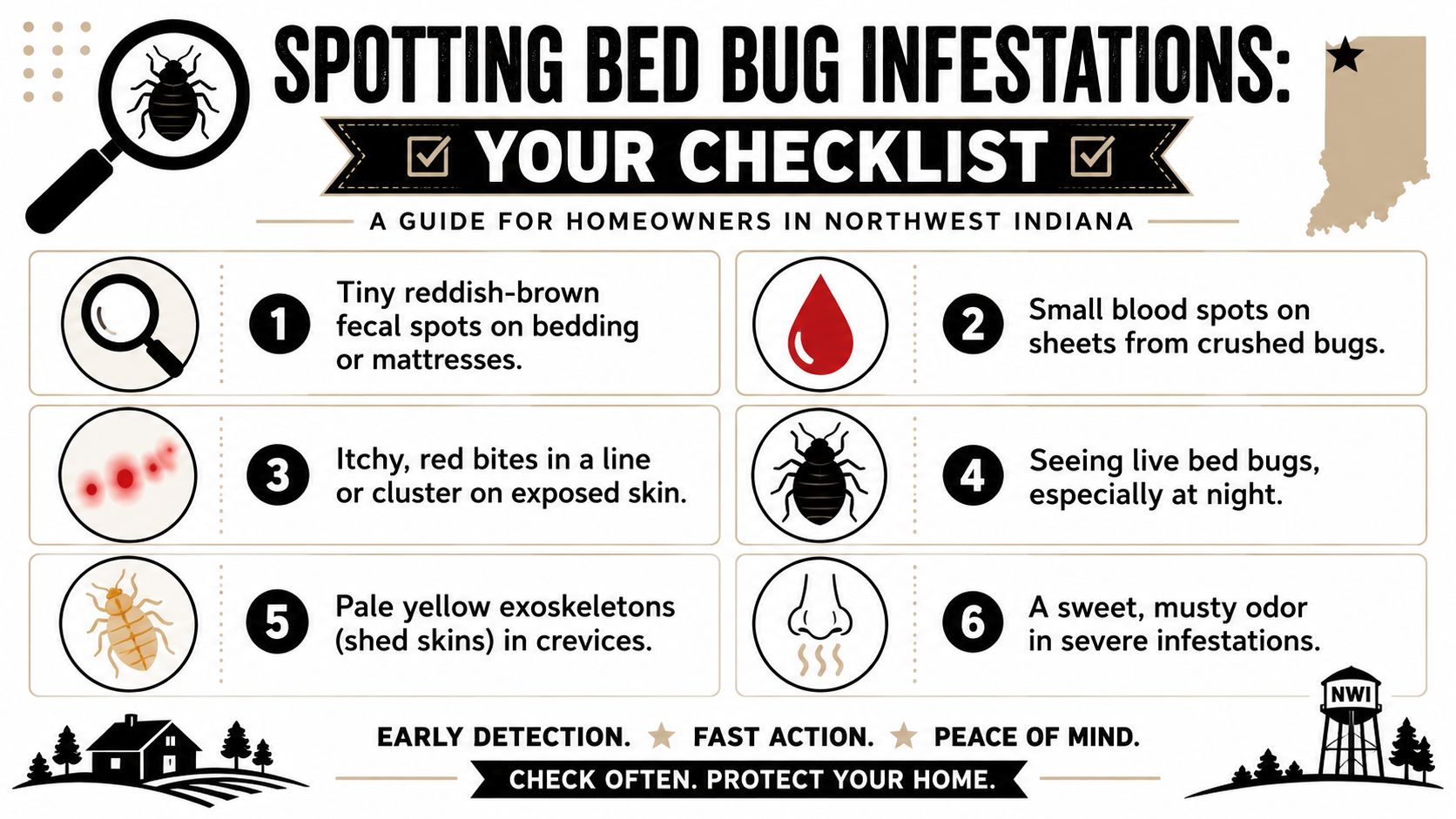
What to look for on beds and bedding
Check the bed before you check the whole room. Strip the sheets and inspect with a flashlight.
- Reddish-brown spotting: Small marks on sheets or near mattress seams can be an early sign.
- Dark specks: Bed bug waste often shows up as tiny dark dots on mattresses, box springs, or bed frames.
- Shed skins: Bed bugs molt as they grow. Those pale cast skins often collect in hidden edges and seams.
- Live insects: Adults and younger bed bugs hide during the day, especially in tight cracks.
- Blood marks: Small smears on sheets can happen when a bug is crushed after feeding.
If you want a second reference point while checking your room, this guide on how to tell if you have bed bugs gives homeowners another practical way to compare what they're seeing.
Where bed bugs hide beyond the mattress
Once activity starts, bed bugs often spread beyond the bed itself. Inspect carefully around:
- Box springs and bed frames: Look under corner guards, wood joints, and stapled fabric areas.
- Headboards: Especially where the headboard meets the wall or has recessed hardware.
- Nightstands and dressers: Check drawer joints, undersides, and back panels.
- Baseboards: Bed bugs use edges and cracks as travel routes.
- Upholstered furniture: Seams, dust covers, tufts, and cushion zippers are common hiding spots.
- Electrical outlets and wall void edges: These areas can become harborages in established infestations.
This short video can help you visualize the inspection mindset before you start moving things around.
Bed bugs don't need a wide-open space. They need a crack, a seam, or a protected edge close to where people sleep.
What not to assume
Not every bite means bed bugs, and not every bug near a bed is a bed bug. That's why homeowners should avoid guessing based on one clue alone. You're looking for a pattern of signs, not one isolated piece of evidence.
If you see signs in a child's room, guest room, or on a couch, don't start carrying items from room to room. That's one of the easiest ways to spread activity through the house before treatment starts.
Comparing Professional Bed Bug Treatment Methods
Bed bug treatment works best when the method fits the building. In Crown Point and across Northwest Indiana, the main decision usually comes down to whole-room heat treatment or an integrated treatment plan that combines targeted products with non-chemical steps such as vacuuming, encasements, steam, and monitoring.
Both can work. Neither is automatic.
Heat treatment and when it makes sense
Heat treatment aims to raise the treated space to lethal temperatures throughout the room, not just near the heaters. For whole-room heat jobs, the EPA states that temperatures must reach at least 120°F for about 90 minutes to kill all life stages, including eggs (EPA bed bug heat treatment guidance).
That's why professional heat service is more than “making the room hot.” Technicians have to manage air flow, watch for cold spots, move items as needed, and make sure heat reaches the places bed bugs use.
Heat is often a strong fit when:
- the infestation is concentrated in a limited area
- the resident wants a low-residue approach
- fast knockdown is a priority
- the unit can be prepared properly before treatment
Heat can be less reliable in some multi-unit settings if adjoining spaces still have active bed bugs and the structure allows movement between units.
Integrated treatment and when it makes sense
Integrated treatment is usually the better fit when the property has several risk factors at once. That may include adjoining units, cluttered rooms, sensitive furnishings, repeat introductions, or a need for ongoing monitoring after the initial service.
This approach may include:
- careful inspection and mapping of activity
- vacuuming and physical removal where practical
- steam in targeted areas
- mattress and box spring encasements
- interceptors or monitoring devices
- targeted product application in cracks, crevices, and travel routes
- follow-up visits to catch newly hatched bugs
Some local providers also offer biologically based or lower-impact options within that framework. For example, The Green Advantage offers bed bug treatments for affected areas and a prevention plan that includes non-toxic products and follow-up support.
Bed Bug Treatment Comparison Heat vs Integrated Methods
| Feature | Heat Treatment | Integrated (Eco-Mindful/Chemical) Treatment |
|---|---|---|
| Primary method | Raises room contents to lethal temperatures | Combines targeted applications with physical methods and monitoring |
| Speed | Often used for rapid knockdown in a treated space | Usually unfolds over multiple steps and follow-up visits |
| Residue | Leaves no chemical residue from the heat itself | May include residual materials depending on the plan |
| Best fit | Limited-area infestations, quick turnaround needs, well-prepared rooms | Multi-unit buildings, recurring introductions, complex layouts, long-term management |
| Main challenge | Cold spots, poor prep, and untreated adjacent spaces can reduce success | Requires resident cooperation and patience through the full process |
| Post-treatment need | Monitoring remains important because heat has no ongoing residual effect | Monitoring is built into the process |
| Furniture impact | Some heat-sensitive items must be removed or protected | Usually more flexible with heat-sensitive belongings |
| Decision point | Strong option when the treated area can be sealed and managed correctly | Strong option when the goal is control plus prevention over time |
Decision point: In apartments and attached housing, the best treatment on paper can still fail if the neighboring unit stays active.
For people searching pest control services for bed bugs in Crown Point, that's a key takeaway. The right method depends on the layout, the spread, the amount of preparation possible, and whether the problem is isolated or moving through a building.
Why Professional Pest Control Is Essential for Bed Bugs
Bed bugs are one of the clearest examples of why DIY pest control often falls short. Homeowners usually buy a spray, treat the mattress surface, and feel better for a few days. Then the bugs come back because their true hiding spots were in seams, furniture joints, behind the headboard, under trim, or in nearby rooms.
Part of the problem is detection. Field studies found that visual inspections alone detect bed bug infestations about 72% of the time, while visual checks combined with mechanical monitors can raise detection rates to approximately 99% (multi-tool detection findings in PMC review). That gap explains a lot. If the inspection misses activity, the treatment misses it too.
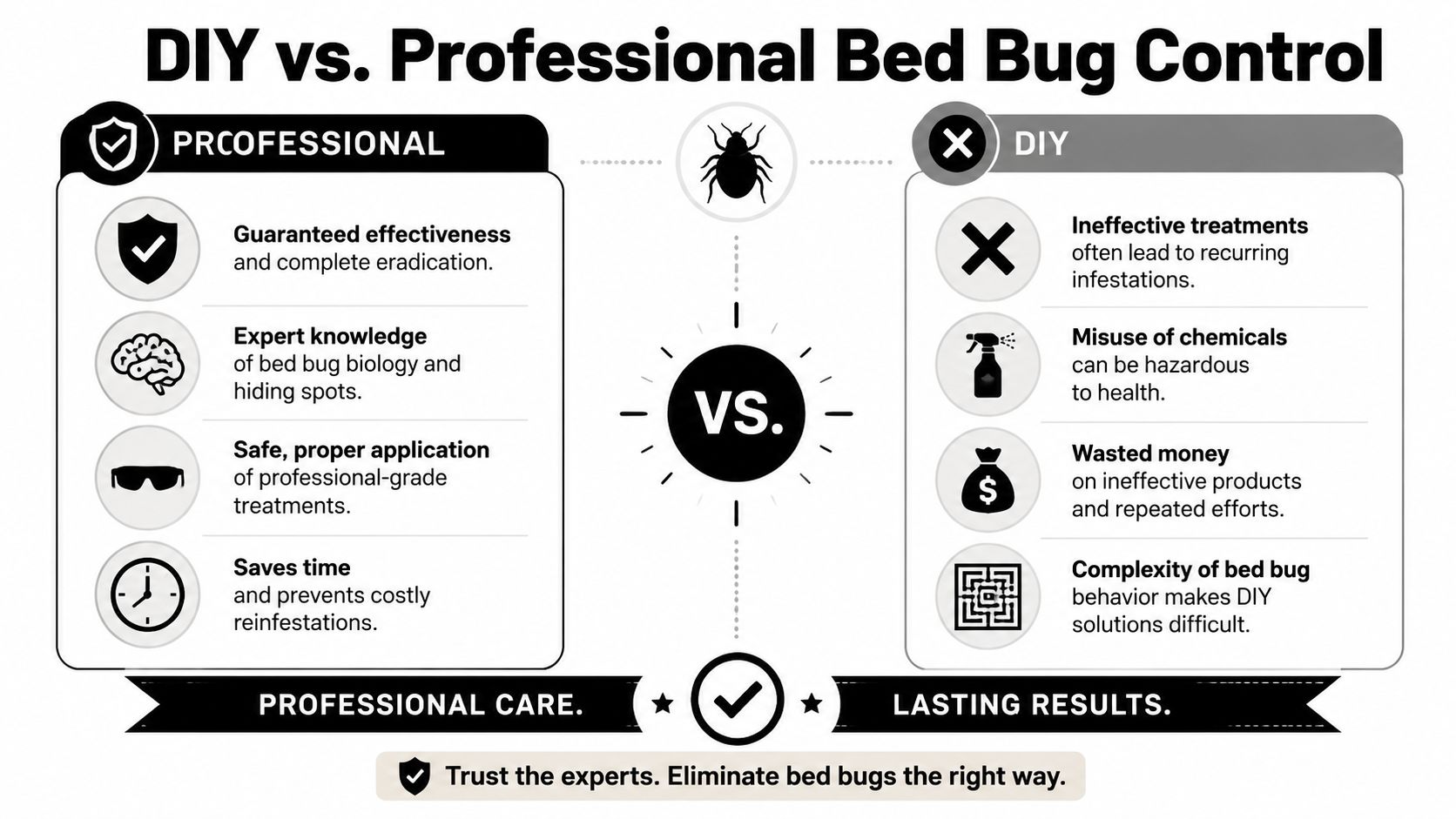
Why store-bought treatments often disappoint
The label may say bed bugs, but the product still has to reach the insect in the place it's hiding. That's hard enough. Resistance makes it harder. Bed bug populations have developed resistance to several commonly used insecticide groups, which is one reason professionals rely on broader treatment plans that include steam, heat, monitoring, and careful product selection instead of a spray-only approach.
DIY work also creates practical problems:
- Overapplication: People treat too much surface area and too many belongings.
- Missed harborages: Bugs survive in untouched cracks and protected joints.
- Spread during cleanup: Moving infested items improperly can push activity into other rooms.
- False confidence: Short-term reduction looks like success until eggs hatch and activity restarts.
What professionals do differently
A professional bed bug plan isn't just stronger chemistry. It's a structured process.
- Inspection with tools: Beds, furniture, edges, and likely travel routes get checked systematically.
- Method selection: The treatment matches the home, apartment, rental turnover pattern, and level of spread.
- Physical control: Vacuuming, steam, encasements, and clutter reduction help remove hiding opportunities.
- Monitoring: Interceptors and follow-up inspections confirm whether activity remains.
You can't solve a hidden pest with a surface-only response.
That same problem-solving approach matters across other services too. Homeowners who call for residential pest control often ask about ant control, rodent control, spider control, wasp removal, termite control, and mosquito control in the same conversation. Bed bugs are the pest where inspection quality and follow-up matter the most.
How to Prepare Your Home for Bed Bug Treatment
Preparation has a direct effect on the outcome. When the room is accessible and belongings are handled correctly, treatment reaches more hiding spots and follow-up is easier to evaluate. When preparation is rushed, bed bugs keep their shelter.
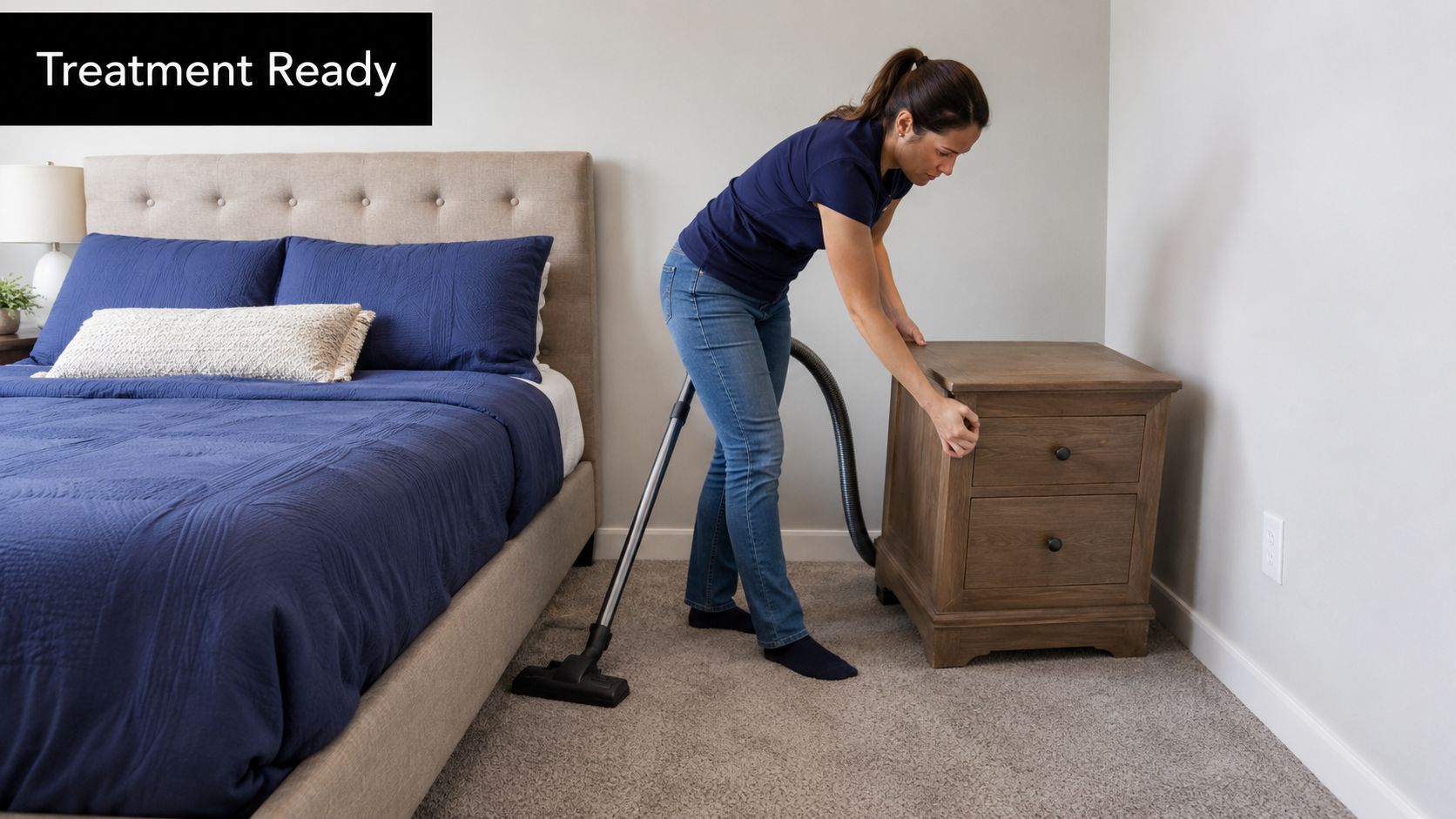
Before treatment day
Use a simple checklist and follow the technician's instructions closely. If you want a broader prep guide, this local resource on how to prepare for pest control is a useful starting point.
- Launder fabrics on high heat: Wash and dry bedding, clothing, and washable fabrics from affected rooms as directed.
- Bag items correctly: Keep cleaned items sealed until the technician tells you they can be returned.
- Reduce clutter: Floors, closets, and under-bed storage often create protected hiding areas.
- Pull furniture slightly from walls: This helps access baseboards, bed frames, and rear edges.
- Vacuum carefully: Focus on seams, bed frames, and floor edges, then dispose of vacuum contents as directed.
For mattresses and box springs that need to stay protected after service, quality mattress removal covers can help contain items during handling and reduce unnecessary contact while rooms are being prepared.
After treatment and during follow-up
Post-treatment discipline matters just as much as prep. Don't start moving items back too early or replace the monitoring plan with guesswork.
A strong follow-up routine usually includes:
- Using encasements where advised
- Leaving monitors in place
- Avoiding untreated secondhand furniture
- Reporting any new signs quickly
- Keeping sleeping areas stable so monitoring stays meaningful
For apartments and other shared-wall properties, treatment choices also need to account for what's happening nearby. In multi-unit buildings, one key decision is whether heat is suitable or whether an IPM-style program is better. Heat can fail if adjacent units are infested, while IPM programs in Midwest housing studies have reduced re-infestations by up to 60% over 12 months (multi-unit bed bug treatment comparison).
That's why property managers in Crown Point shouldn't think about one room in isolation. They need a building-aware plan.
What to Expect with The Green Advantage in Crown Point
When homeowners call about bed bugs, they usually want a straight answer on what happens next. They don't want vague promises. They want to know who shows up, what gets inspected, how the treatment works, and whether someone is coming back if eggs hatch later.
That's the right way to think about bed bug service.
The service process from first call to follow-up
The process starts with a conversation about what you've seen, where you've seen it, and what type of property is involved. A single-family home in Crown Point, a rental unit with frequent turnover, and a commercial lodging or office setting all need different treatment planning. Clear communication on the front end saves time later.
The next step is the field inspection and treatment recommendation. Professional bed bug control plans typically involve at least two to three service visits because retreatment is often needed to catch eggs that hatch after the initial work (professional bed bug service timeline).
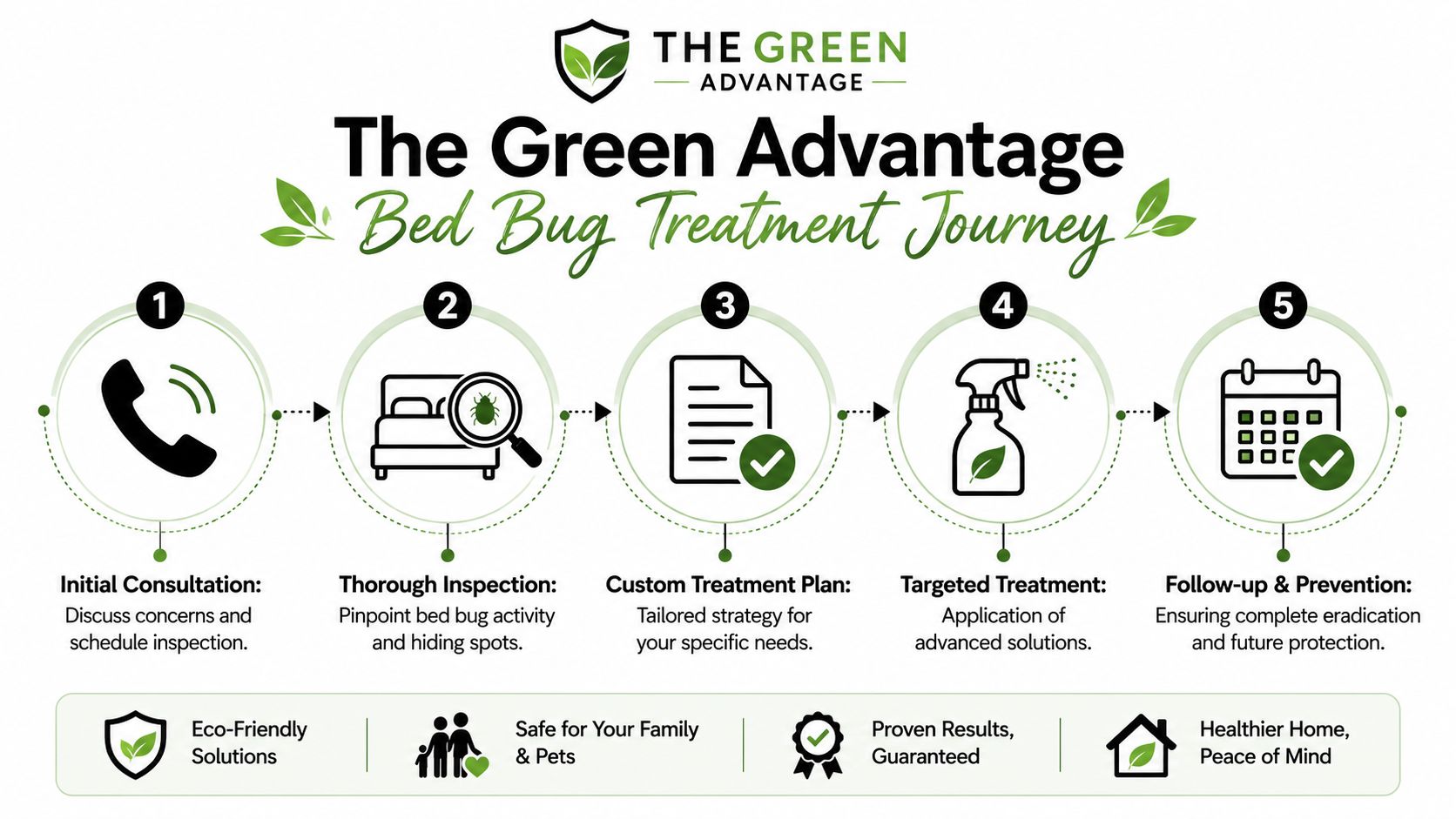
What homeowners in Crown Point should expect
Expect direct instructions. Expect practical prep guidance. Expect a treatment plan based on where activity is found, not a one-size-fits-all script.
That means the visit may involve:
- Room-by-room review: Sleeping areas, upholstered furniture, and nearby harborages are checked.
- Property-specific treatment choice: Heat, integrated treatment, or a combination depends on the property.
- Safety guidance: Residents get clear direction about access, item handling, and re-entry timing.
- Scheduled follow-up: The job isn't judged complete just because the first visit is over.
Bed bug control works best when the resident and technician follow the same plan from start to finish.
For comfort and sanitation after treatment, many families also want to reset their routine around bedding care. This guide on how to maintain fresh bedding for comfort is helpful for building good post-treatment habits without overcomplicating the process.
If you've been searching for exterminator in Crown Point, IN, pest control near me, or commercial pest control for a rental or managed property, the biggest thing to look for is consistency. Bed bug jobs succeed when communication stays clear and the follow-up happens.
Common Questions About Bed Bug Services
How is the cost of bed bug treatment determined
Cost depends on the size of the affected area, how widely the bed bugs have spread, the type of structure, the amount of preparation needed, and whether the plan calls for heat, integrated treatment, or both. A single bedroom is different from a whole-house issue, and a detached home is different from a multi-unit property with shared walls.
Are bed bug treatments safe for kids and pets
Professional treatment plans are designed around safe use practices, label directions, and the conditions inside the home. The important part is following all instructions on preparation, temporary room access, laundering, and re-entry. If there are pets, children, or sensitive health concerns in the home, mention that during scheduling so the treatment plan can reflect it.
Can I get rid of bed bugs on my own
Small signs can tempt people to try a do-it-yourself approach first, but bed bugs are hard to eliminate without a full inspection, careful product selection, and monitoring. Surface sprays usually miss hidden activity. In many cases, DIY efforts delay proper treatment and give bed bugs more time to spread.
How do I help prevent bed bugs from coming back
Keep luggage and used furniture under control, inspect sleeping areas when travel or tenant turnover is involved, use encasements where recommended, and respond quickly if you see new signs. In apartments, rentals, and short-turnover housing, prevention works best when inspections happen routinely between occupants.
If you need pest control services for bed bugs in Crown Point, IN or nearby Northwest Indiana communities, the simplest next step is a professional inspection and a treatment plan matched to your property. Contact The Green Advantage to request a quote, schedule an inspection, and get clear guidance on the safest and most effective path forward.
Indoor Mosquito Repellent Spray: Crown Point Guide
You hear it first as a faint buzz near the lamp. Then one lands on your arm while you're watching TV, and another shows up in the bedroom right after you turn out the light. If you're dealing with mosquitoes inside your house in Crown Point, grabbing an indoor mosquito repellent spray feels like the obvious move.
Sometimes it is the right first move.
It just isn't the whole answer. Indoor sprays can knock down the mosquitoes you see. They usually don't fix why mosquitoes are getting inside in the first place, why they keep showing up, or why the problem returns after a few days. That's where homeowners lose time, money, and patience.
If you've been searching for pest control near me, exterminator near me, or pest control in Crown Point, IN, you're probably past the point of wanting another generic product roundup. You want a straight answer. Here it is. Use indoor mosquito spray for short-term relief, but don't mistake it for a complete mosquito control plan.
Battling Indoor Mosquitoes in Your Crown Point Home
A lot of indoor mosquito problems start the same way. A door opens after sunset. A torn screen goes unnoticed. Moisture builds up around the home, and mosquitoes stay active around entry points. Then they end up in the kitchen, the bathroom, or circling the living room window when you're trying to relax.
For Northwest Indiana homeowners, this gets frustrating fast because indoor mosquitoes feel personal. They're in your safe space. They're near your kids' rooms, your pets' bedding, your food prep area, and the places where you should be comfortable. So you spray the room, swat what you can, and hope that handles it.
Why the quick fix keeps disappointing
Indoor mosquito sprays can help, but they don't erase the conditions that let mosquitoes enter and linger. If entry points stay open, if resting spots remain untouched, or if mosquitoes are breeding outside and moving in, the problem keeps resetting.
Local reality: If you're spraying the same room over and over, the spray isn't your main problem. Your house is telling you mosquitoes still have access.
That matters in Crown Point because mosquito activity around homes often overlaps with broader pest issues. The same house that needs mosquito control may also benefit from residential pest control, screen inspection, moisture correction, and seasonal prevention around the exterior.
What homeowners should do next
Start by treating the indoor sightings seriously, especially if they keep happening. If mosquitoes are surviving long enough to bother you indoors, there is usually a reason.
A useful place to begin is learning how long mosquitoes can live inside a home. That helps you understand why one mosquito tonight can turn into several nights of frustration if the conditions are right.
If you're looking for an exterminator in Crown Point, IN, the smarter goal isn't just killing the mosquitoes you can see. It's stopping the cycle so your home feels normal again.
Understanding Indoor Mosquito Sprays and How They Work
Most homeowners use the phrase indoor mosquito repellent spray to describe any product they spray inside the house. That's too broad. Some products repel. Some kill. Some do both poorly if they're used for the wrong job.
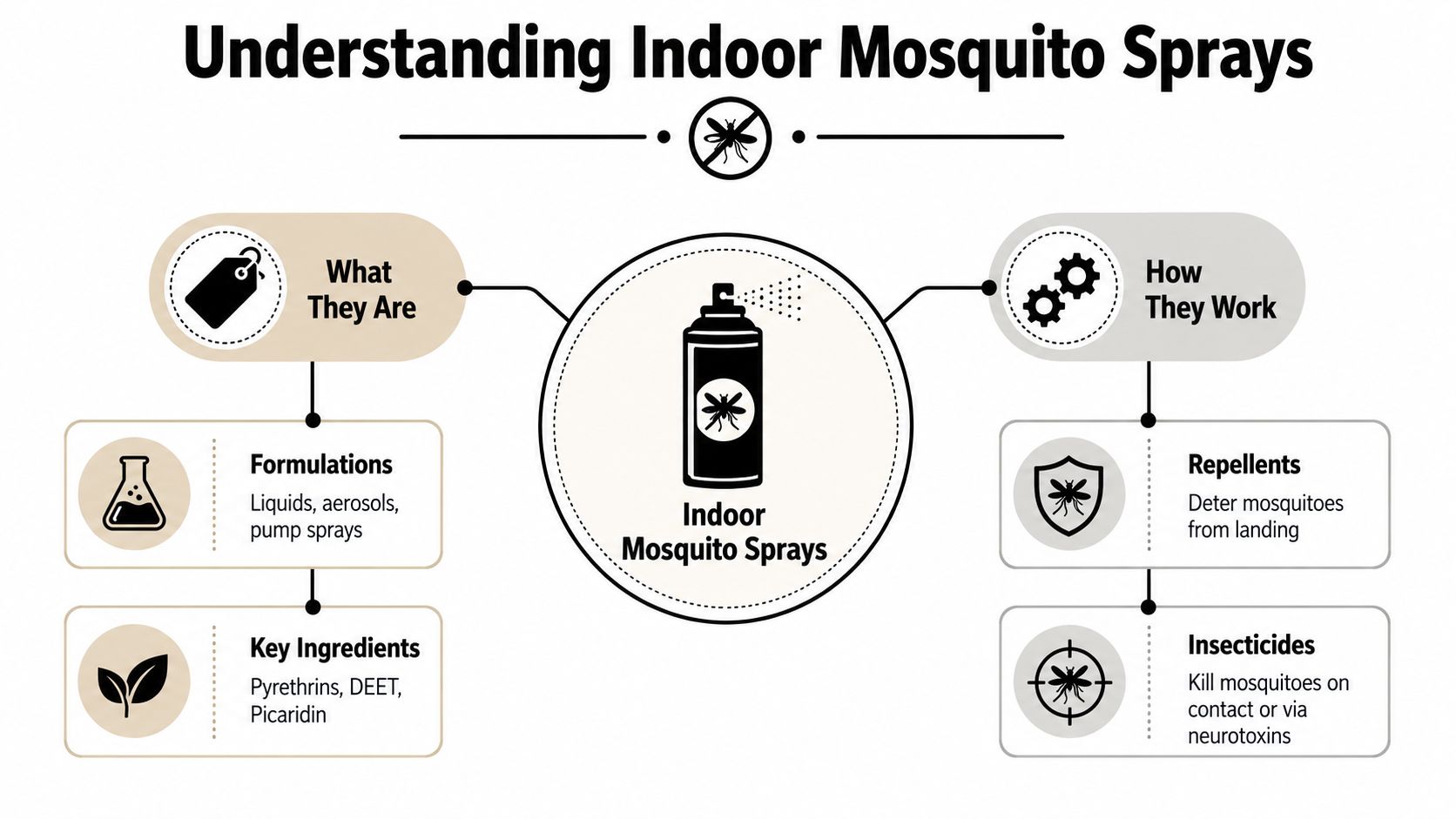
The two indoor spray categories that matter
The CDC separates indoor mosquito products into foggers or aerosols and surface sprays. Foggers and aerosols kill mosquitoes in the air. Surface sprays kill when mosquitoes land on treated indoor resting sites like under sinks, in closets, and behind furniture, according to CDC guidance on indoor spraying.
That distinction matters because mosquitoes indoors don't just fly around randomly. They rest. They hide in protected areas. If you only spray open air, you may knock down a few adults and miss the places where others settle.
Repellent versus insecticide
Homeowners also mix up repellents and insecticides, and that leads to bad expectations. Public health guidance treats those as different tools. A repellent is meant to keep mosquitoes away from you. An insecticide is meant to kill mosquitoes.
If you spray a personal repellent around a room and expect the product to eliminate the infestation, you're using the wrong tool for the job. If you use an indoor insect spray but ignore re-entry points, you're still leaving the door open to the next round.
Sprays work better when you match the product to the problem. Air knockdown for active flyers. Targeted treatment for indoor resting areas. Prevention at the entry points and around the home.
What this means in real homes
If you're standing in a store aisle comparing cans, keep this simple:
| Product type | Primary job | Typical use case |
|---|---|---|
| Fogger or aerosol | Kill mosquitoes in the air | Fast knockdown when mosquitoes are actively flying indoors |
| Surface spray | Kill on contact after landing | Treat indoor resting spots where mosquitoes settle |
| Personal repellent spray | Keep mosquitoes off skin | Bite prevention for people, not room-wide elimination |
The mistake I see most often is using one category and expecting results from another. That's why brand comparisons alone don't solve much. The issue isn't just what product you bought. It's whether the product matches the behavior of the mosquitoes in your house.
Safe and Effective Use of Mosquito Sprays Indoors
If you're going to use an indoor mosquito repellent spray, use it with discipline. A lot of DIY frustration comes from two bad assumptions. First, that more product means better protection. Second, that if a product is sold on a shelf, it must be safe to use however you want.
Neither is true.
Higher concentration doesn't automatically mean better results
For personal mosquito repellent sprays, the active ingredient concentration matters, but higher isn't always better. The Mississippi State Department of Health reports that DEET products are sold from about 5% to 100%, but 10% to 35% DEET provides adequate protection under most circumstances, and concentrations above about 50% don't provide significantly greater protection. It gives a practical example. 50% DEET provides about 4 hours of protection, while 100% DEET gives only about 1 extra hour according to the department's mosquito repellent guidance.
That should change how you shop. Stop chasing the strongest label just because it sounds tougher. For many homeowners, that's wasted exposure without a meaningful gain.
Indoor use needs a safety-first routine
The CDC's indoor spraying guidance says foggers or aerosols require occupants and pets to leave the home until the spray has dried. That's not a minor detail. It's the difference between proper use and careless use.
Use this checklist before you spray indoors:
- Read the label all the way through: Don't assume two products work the same way.
- Remove people and pets when required: If the label or product category requires vacancy, follow it.
- Keep sprays away from food areas: Kitchens, counters, utensils, and food storage need extra caution.
- Treat the right spots: Random spraying wastes product and increases exposure.
- Reapply only as directed: Overapplication doesn't create bonus protection.
If you're also trying to reduce residue concerns in a house with animals, this guide on what to use for pet-safe cleaning is a useful companion resource for handling the surfaces around your living space more carefully.
The label is not optional
Homeowners get into trouble when they improvise. They spray bedding, overuse products in closed rooms, treat the wrong surfaces, or mix products that were never meant to be combined.
Practical rule: Use mosquito products exactly where the label allows, exactly how the label allows, and no more often than the label allows.
If you need a broader primer on indoor application habits, this article on how to spray pest control in your home is worth reviewing before you start. Indoor spraying can be useful, but once you need to think this hard about location, drying time, people, pets, and surfaces, you can see the limit of DIY pretty quickly.
DIY Sprays vs Professional Mosquito Control Strategies
DIY indoor sprays have a role. They just have a narrow one. They help when you need immediate relief from mosquitoes already inside. They don't give most Crown Point homeowners what they want, which is fewer mosquitoes around the property and fewer mosquitoes getting indoors in the first place.
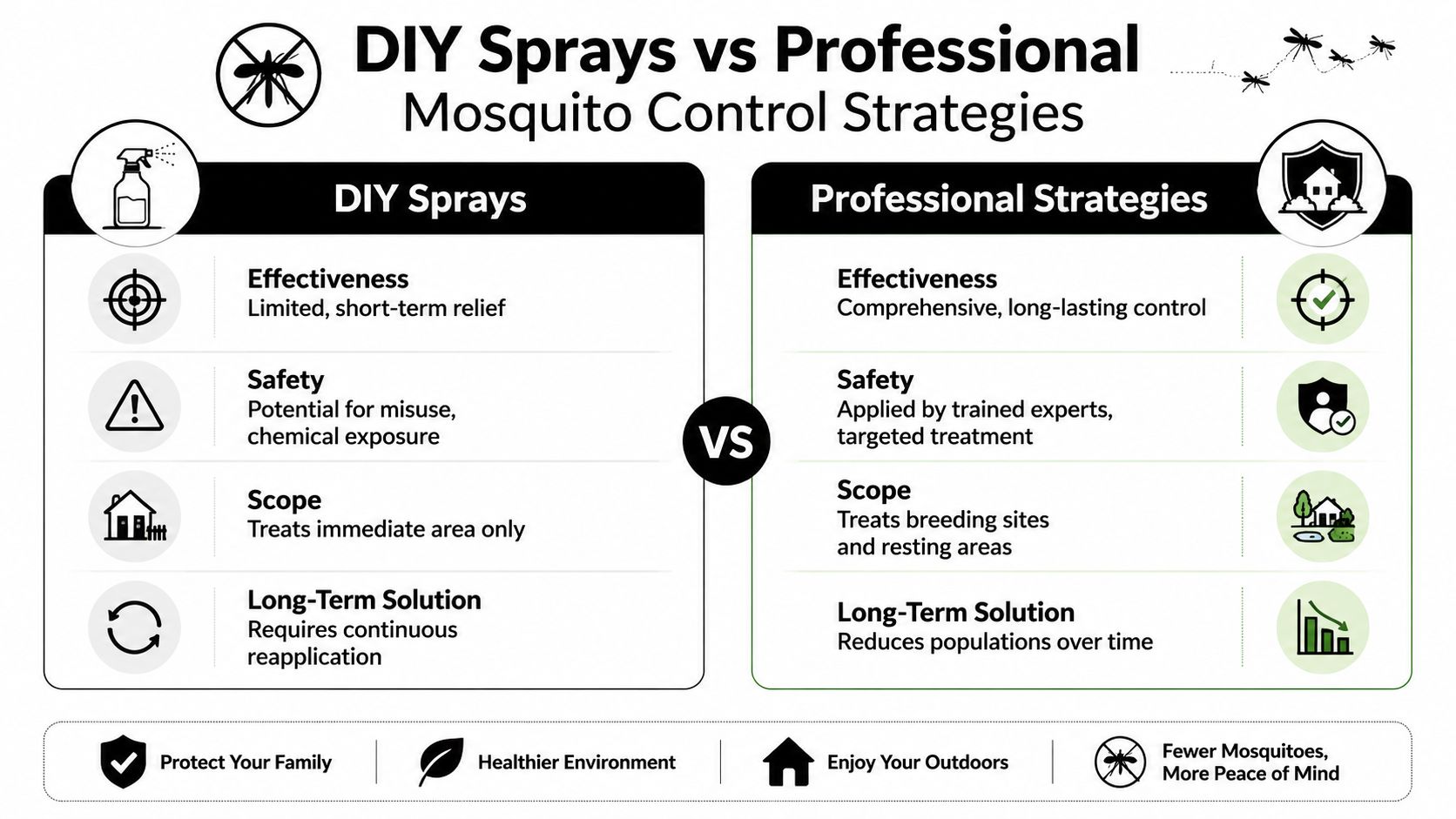
What DIY does well and where it stops
A can of spray is reactive. You see mosquitoes, so you spray mosquitoes. That can make the room better tonight.
Public-health guidance is clear that indoor spraying belongs inside a broader system. The American Mosquito Control Association says indoor use works best when combined with screened windows, air conditioning, and removal of standing water in its mosquito control guidance. That's the part too many homeowners skip.
Side-by-side comparison
| Issue | DIY indoor spray | Professional mosquito strategy |
|---|---|---|
| Immediate knockdown | Good for visible mosquitoes indoors | Good, plus evaluation of where mosquitoes are coming from |
| Root cause control | Weak | Stronger because the plan includes entry points, resting areas, and breeding pressure around the property |
| Consistency | Depends on homeowner timing and technique | Depends on inspection, targeted treatment, and follow-up |
| Safety burden | Falls on the homeowner | Managed through trained application and site-specific decisions |
| Long-term peace of mind | Limited | Better when the whole property is part of the plan |
A more complete strategy can include indoor assessment, exterior reduction, standing-water inspection, and recommendations on screens, doors, and moisture-prone areas. One available option in Crown Point is The Green Advantage, which provides mosquito reduction as part of broader pest management for local properties.
Here's a useful video if you want a quick visual overview before deciding how far to take DIY.
My recommendation
If you get the occasional mosquito indoors, use the right spray correctly and move on. If you're repeatedly buying products, reapplying, and still getting bit inside, stop treating this as a spray-shopping problem.
It's a control-plan problem.
When to Call a Pest Control Exterminator in Crown Point IN
A lot of homeowners wait too long to call. They keep testing one more aerosol, one more room spray, one more weekend cleanup. Meanwhile, the mosquitoes keep showing up.
The trigger point is straightforward. The CDC recommends hiring a pest control professional if mosquitoes persist after you've taken steps like using indoor sprays, fixing screens, and removing standing water, according to its guidance on mosquito control at home. That's the line between a manageable nuisance and a problem that needs diagnosis.
Clear signs it's time to stop experimenting
Call a professional if any of these sound familiar:
- Mosquitoes keep returning indoors: You knock them down, but new ones show up anyway.
- You already fixed the obvious issues: Screens, doors, and standing water have been addressed, but the activity continues.
- You're seeing them in multiple rooms: That usually points to a broader access or resting pattern.
- You want a whole-property solution: Indoor relief isn't enough if the source pressure outside remains high.
- You need confidence around family spaces: Bedrooms, bathrooms, kitchens, and pet areas require smarter treatment choices.
Why persistence matters
Persistent mosquitoes usually mean one of two things. Either they're continuing to enter the house, or they're surviving in overlooked areas connected to a larger property issue. Both problems call for inspection, not guesswork.
If you've already done the obvious work and mosquitoes are still winning, the next step isn't another can. It's a professional diagnosis.
For homeowners comparing service approaches, this overview of Effective mosquito management is a helpful example of what a broader mosquito-control mindset looks like. The key takeaway is simple. Serious mosquito problems don't respond well to isolated indoor spraying.
This is the moment that warrants a search for an exterminator in Crown Point, IN or pest control near me. Not at the first mosquito. At the point where repeated DIY effort isn't solving the problem.
Your Solution for a Mosquito-Free Home in Northwest Indiana
Indoor mosquito repellent spray has a place. It's useful for fast relief. It is not a complete defense for your home, and it shouldn't carry that burden by itself.
What protects your family better is a layered approach. Control the mosquitoes you find indoors. Reduce the reasons they get inside. Address conditions around the home that support them. Then keep pressure on the problem before it rebuilds. That's how homeowners move from constant swatting to real peace of mind.

If you're in Crown Point or nearby Northwest Indiana communities, don't treat mosquitoes as a one-room issue when they're clearly a property issue. The same home may also benefit from broader residential pest control, seasonal exterior treatments, spider control, rodent control, wasp removal, or prevention for other recurring pest pressures.
For homeowners budgeting and comparing service categories, Home Project Services' pest control guide can help you think through the bigger picture. Then take the next practical step and talk to a local team that can inspect the situation directly.
You don't need another summer of spraying the same corners and hoping for a different outcome. If mosquitoes are getting inside your home, fix the cause and take control of the whole problem.
If you're ready for a practical plan instead of another temporary fix, contact The Green Advantage to schedule a pest inspection or request a quote in Crown Point, IN and Northwest Indiana. Whether you need mosquito control, residential pest control, or help tracking down a recurring indoor pest issue, the goal is simple. Protect your home, reduce the stress, and make your space comfortable again.
Diatomaceous Earth Pest Control: A Crown Point Guide
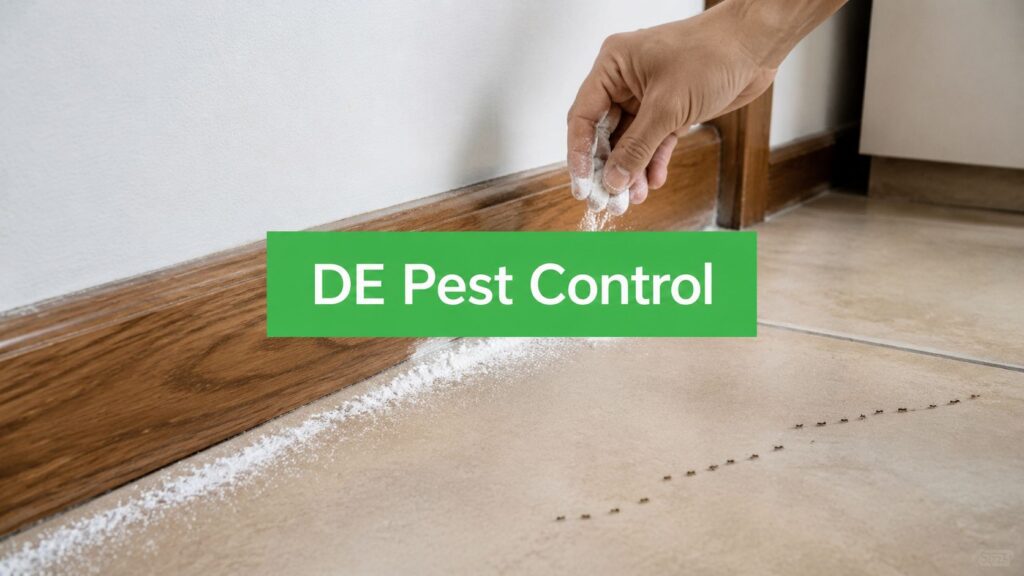
You find a line of ants under the kitchen window, or a few spiders showing up in the basement corners, and the search usually starts the same way. You want something quick, affordable, and safe to use around the house. Before long, diatomaceous earth pest control pops up in your search results as the popular DIY answer.
That appeal makes sense in Crown Point and across Northwest Indiana. Homeowners want practical solutions, not harsh guesswork. Landlords and property managers often want something they can try before calling in service, especially when they're already juggling maintenance, turnover, and tenant communication. If you manage rentals, this overview on solving pest issues for landlords gives good context on why pest problems tend to become bigger operational headaches when they're handled too late.
The issue is that diatomaceous earth, often called DE, isn't a magic powder. It can work in specific situations, but it also has limits that many DIY articles skip over. If you use it in the wrong place, in the wrong amount, or for the wrong pest, you can end up with dusty rooms, lingering activity, and no real answer to the source of the infestation.
Your Local Guide to Pest Control in Crown Point IN
Why homeowners keep trying DE first
A lot of pest problems begin with a small sighting and a simple hope. Maybe it's ants near the dishwasher, crickets in the garage, or a spider problem that seems to get worse whenever the weather changes. For many, a complicated process is undesirable. They want the pests gone without turning the house upside down.
DE sounds like that kind of solution. It's commonly described as a more natural option, and that alone makes many homeowners feel more comfortable trying it than a conventional over-the-counter spray. That's especially true in family homes where kids, pets, or sensitive indoor spaces are part of the decision.
Local reality: In Crown Point, a pest problem usually isn't just about the insects you can see. It's about where they're nesting, how they're getting in, and what conditions are letting them stay.
What usually gets missed
The part that DIY advice often leaves out is that pests don't live where you notice them. Ants may trail through the kitchen while the colony sits deeper in a wall void or outside near the foundation. Spiders may collect in a basement because other insects are already active there. Fleas may still be developing in overlooked areas even after an owner dusts a few visible spots.
That's why a one-product approach often falls short. A dust can only do so much if the infestation source stays active, moisture conditions keep helping pests survive, or entry points are still open around doors, utility lines, and foundation gaps.
Why a broader pest control plan matters
Residential pest control works best when the treatment matches the pest and the location. Commercial pest control needs that same logic, just with more attention to traffic patterns, sanitation pressures, storage areas, and ongoing monitoring. Whether someone searches for pest control near me, exterminator near me, or pest control in Crown Point, IN, what they usually need isn't just a product recommendation. They need a reliable diagnosis.
That matters for common Northwest Indiana issues beyond crawling insects too. The same property may also need rodent control, wasp removal, spider control, mosquito control, termite control, or seasonal preventative pest treatments. DE can be one small tool in the conversation, but it isn't a complete pest management strategy.
What Is Diatomaceous Earth and How Does It Work
The basic idea
Diatomaceous earth is a fine powder made from fossilized microscopic aquatic organisms. In pest control, it isn't used as a chemical poison. It works as a contact insecticide. Formal pesticide use in the modern United States began in 1960, and there are now over 150 registered products for indoor and outdoor use. Regulatory guidance also identifies it as most useful on hard-bodied arthropods such as bed bugs, fleas, cockroaches, ticks, spiders, and crickets because it works by absorbing oils from the insect cuticle and abrading the exoskeleton, as explained by the National Pesticide Information Center fact sheet on diatomaceous earth.
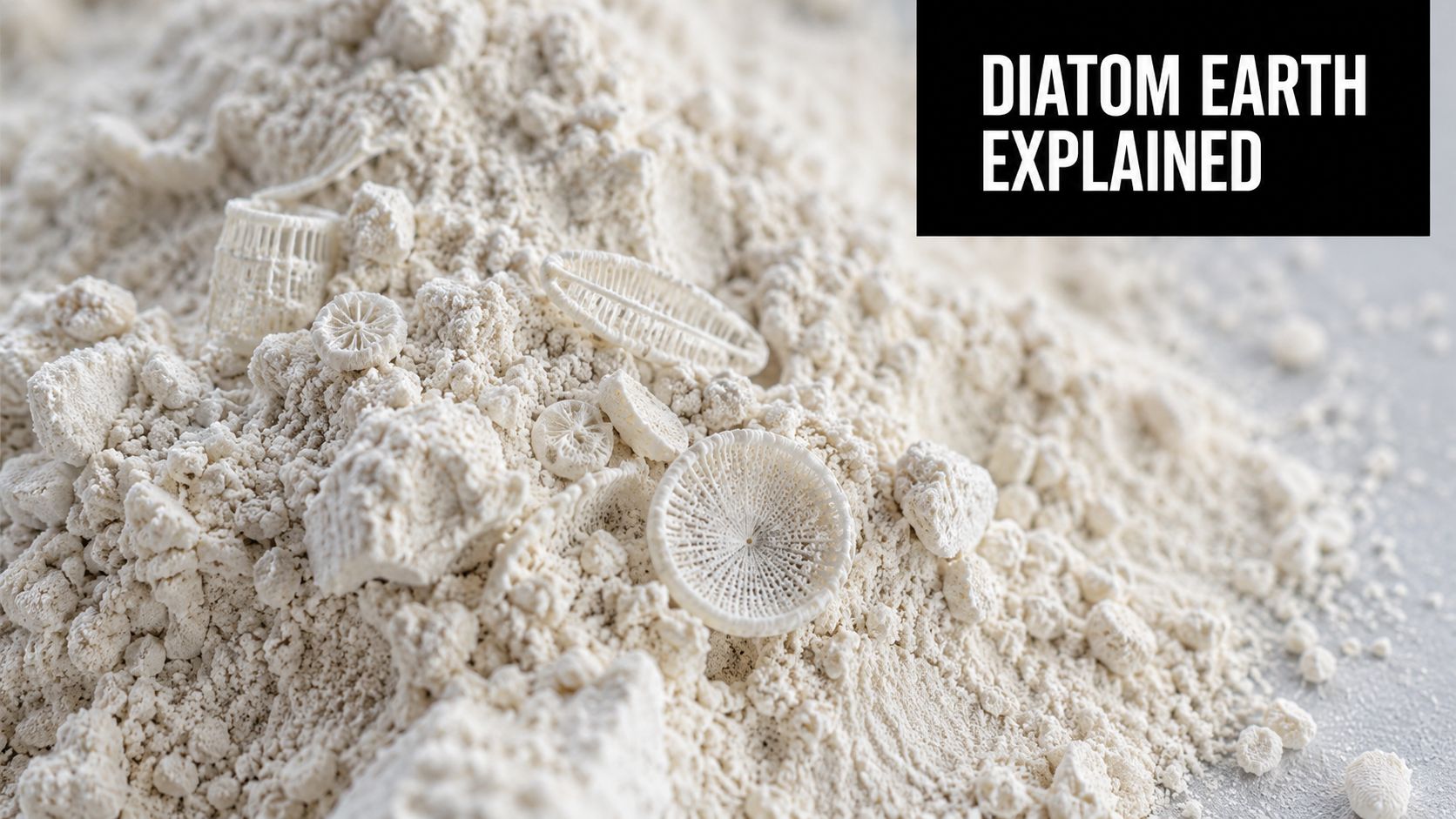
A simple way to think about it is this. DE doesn't poison pests after they eat it. It has to get on their bodies.
How the powder affects insects
When a crawling pest moves through a thin layer of DE, the particles damage the protective outer layer and pull away oils that help the insect retain moisture. Over time, that pest loses water and dries out. The action is physical.
That matters because it explains several things homeowners often find confusing:
- It isn't instant. Pests usually don't drop dead on the spot.
- It requires contact. If insects avoid the dust, nothing happens.
- It favors certain pests. Hard-bodied crawling pests are better targets than insects that don't spend much time moving through treated zones.
- It depends on placement. A light, well-placed application works better than dumping visible piles around the room.
A more detailed explanation of that physical action is available in this overview of how diatomaceous earth works in pest control.
Why light application matters more than heavy application
Many DIY users make the same mistake. They assume more powder means more control. In practice, insects may avoid thick piles, and heavy application creates more mess than benefit.
Controlled research on Tribolium castaneum found that DE's insecticidal effect is dose- and exposure-time dependent, with 2 days of exposure significantly increasing insect mass loss. The study also showed higher water emission and signs of increased cuticle permeability and lipid absorption, supporting the idea that DE works through sustained dehydration rather than immediate knockdown, as reported in the PubMed study on DE exposure and water loss.
A short visual helps if you've never seen DE discussed in practical terms:
A thin dust in the right harborage beats a thick white line in the middle of the floor.
The True Effectiveness of DE on Household Pests
Where DE can help
DE has a place in pest control, but it has a narrow one. It can help when the target is a crawling pest, the powder stays dry, and the insects keep crossing the treated area. In real homes, that usually means protected cracks, voids, and harborage paths rather than open room surfaces.
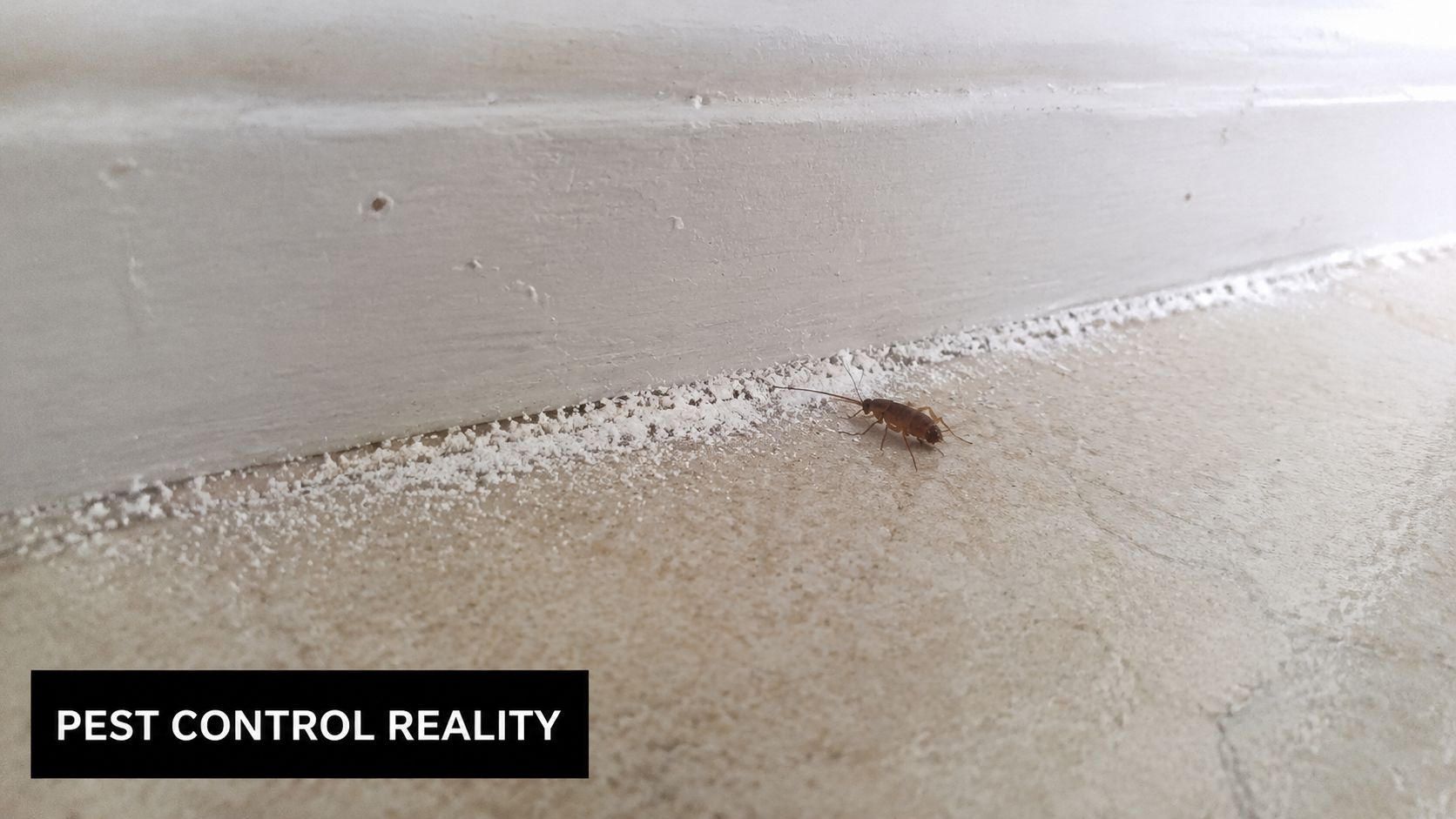
For example, some homeowners try it for:
- Cockroaches in protected edges behind appliances or inside wall voids
- Spiders in less-disturbed basement or crawl space edges
- Fleas in limited dry-contact areas as part of a broader cleanup effort
- Crickets and similar crawling pests where travel routes are predictable
It can also fit into a broader low-impact strategy when used carefully. If you're exploring non-broadcast options, this page on natural pest control for home is a useful starting point for understanding where selective methods make sense.
Where it commonly disappoints
The biggest weakness of DE is that the environment controls the outcome. It is less effective when humidity is high because moisture weakens the desiccation process, and it works best as a dry, residual dust in cracks and voids, not on damp or exposed surfaces, according to this explanation of environmental limits of diatomaceous earth.
That becomes a real problem in lived-in homes. People mop floors. Air moves through rooms. Pets track through treatment areas. Basements get damp. Bathrooms hold moisture. Indiana weather doesn't always cooperate with products that need dry, undisturbed conditions.
Bed bugs are the clearest warning sign
Bed bugs are a good example of why internet claims about DE can be misleading. In a 2019 peer-reviewed synthesis, diatomaceous-earth-based bed bug treatments produced results over a 4-week period ranging from 29.1% to 97.5%, depending on the product and application conditions, according to the peer-reviewed review on arthropod control and DE performance.
That range is huge. It tells you the material itself isn't the whole story. Conditions and application quality drive the result.
Practical rule: If a treatment only works well when it stays dry, thin, undisturbed, and exactly in the pest's travel path, many households won't get the result they expect.
Why flea control often needs more than dust
Fleas are another area where people overestimate what DE can do. Even when it plays a role, the bigger job is sanitation, pet treatment guidance, and repeated attention to the places fleas develop and hide. Homeowners looking for broader housekeeping support can review this guide on preventing flea infestations at home, which helps explain why vacuuming, fabrics, pet bedding, and follow-through matter so much.
The short version is simple. DE isn't useless. It's just highly conditional, and pest problems in Crown Point homes rarely stay inside ideal conditions for long.
DIY Risks vs The Green Advantage Professional Pest Control
The part DIY guides soften
A lot of articles say food-grade DE is safe, then stop there. That's incomplete. Food-grade DE is considered low-toxicity, but it should not be inhaled, and guidance emphasizes masks, gloves, sparing application in protected areas, and avoiding airborne dust, especially in homes with children, pets, or people with respiratory sensitivities, as noted in this consumer safety guidance on using diatomaceous earth at home.
That doesn't mean every DE application is dangerous. It means homeowners should stop thinking of it as harmless dust they can spread freely across carpet, baseboards, mattresses, or open floors.
Common DIY mistakes include:
- Overapplying it: Heavy visible piles create more airborne dust and are easier for pests to avoid.
- Using it in active living spaces: Disturbance from walking, sweeping, or pets breaks up the deposit.
- Treating symptoms instead of the source: Seeing ants by the sink doesn't mean the nest is there.
- Repeating the same failed approach: More dust rarely fixes a placement or moisture problem.
DIY dust vs a complete service plan
Professional pest control starts with identification and inspection. That's the main difference. Instead of asking, "What powder should I buy?" the better question is, "Why are these pests active here in the first place?"
For some homes, the answer is moisture. For others, it is food access, hidden entry points, cluttered harborage, an exterior condition near the foundation, or a seasonal pattern that calls for preventative treatment rather than repeated spot reactions.
If you want a fuller picture of low-impact methods beyond one DIY product, this guide to environmentally friendly pest control methods shows how targeted, environmentally mindful approaches work best when they're part of a real plan.
A surprisingly helpful comparison comes from outside pest control. This London House Cleaners' expert guide reflects the same principle seen in many home services. Surface-level cleaning or treatment often looks easier at first, but hidden buildup and missed areas are what keep problems coming back.
Diatomaceous Earth vs. Professional Pest Control
| Factor | DIY Diatomaceous Earth | The Green Advantage Professional Service |
|---|---|---|
| Pest identification | Homeowner has to guess the pest and choose placement | Service begins with identifying the pest and activity pattern |
| Safety handling | Dust exposure is easy to underestimate | Application decisions account for occupied spaces, children, pets, and sensitivities |
| Moisture and environment | Product performance drops when conditions aren't right | Treatment plan is adjusted to the environment and infestation pressure |
| Coverage | Usually limited to visible areas | Inspection includes hidden harborage, entry points, and contributing conditions |
| Long-term control | Often symptom-focused | Strategy addresses source, pressure points, and prevention |
| Time and cleanup | Reapplication and dust management often fall on the homeowner | Service is structured, targeted, and easier to maintain over time |
The hidden cost of DIY isn't just the product. It's the time spent treating the wrong place while the infestation keeps going.
Why professional help is usually more reliable
A seasoned exterminator in Crown Point, IN doesn't rely on one trick. Real pest control combines inspection, targeted treatment, monitoring, exclusion advice, and prevention. That's what gives homeowners better peace of mind than trial-and-error dusting.
The same logic applies whether you're dealing with ant control, spider control, rodent control, wasp removal, or recurring seasonal pests. A reliable plan protects the house, reduces indoor stress, and keeps a small problem from turning into a stubborn one.
What to Expect from Your Local Crown Point Exterminator
When homeowners search for exterminator in Crown Point, IN or residential pest control, they're often unsure what the visit will look like. A good service call should feel straightforward, not confusing.
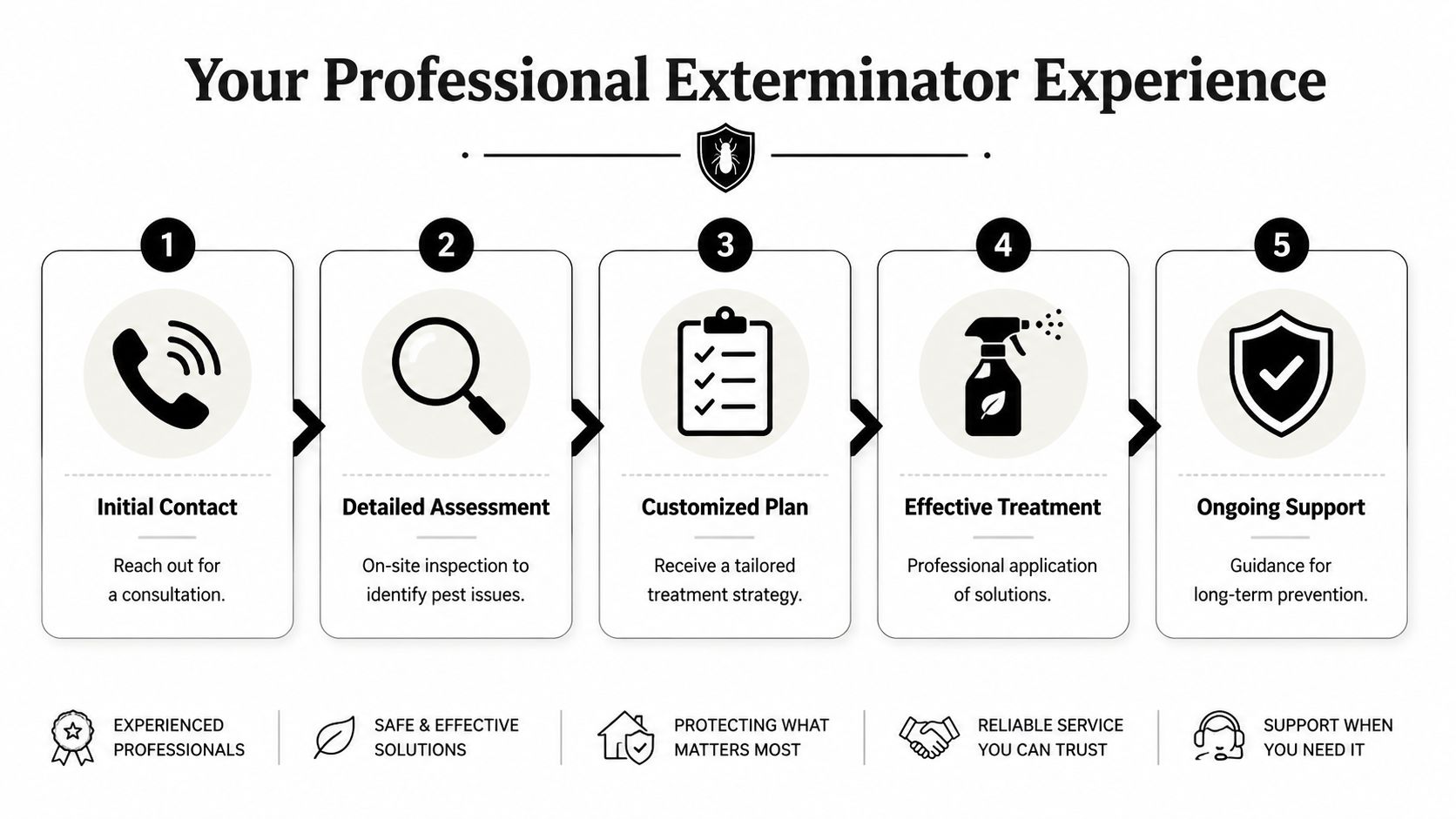
The visit starts with diagnosis
A professional inspection looks at more than the insects you noticed first. The technician checks where pests are active, where they may be entering, what conditions are helping them survive, and whether there are signs of broader pressure elsewhere on the property.
That could include:
- Interior clues: Baseboards, utility penetrations, under-sink areas, basements, garages, crawl spaces, and storage zones
- Exterior contributors: Foundation gaps, mulch lines, door sweeps, moisture areas, and nearby harborage
- Pattern recognition: Whether the problem points to ants, spiders, roaches, fleas, rodents, or a different pest entirely
Treatment is tailored, not generic
A good exterminator near me should never force every problem into the same treatment style. Different pests need different tactics, and the same pest may require a different plan in two different homes.
That often means using an integrated approach rather than a one-product approach. A technician may combine targeted materials, exclusion recommendations, sanitation guidance, habitat corrections, and follow-up support based on what the property needs.
Some infestations need dust in a protected void. Others need exterior treatment, entry-point correction, or a full prevention plan. The right tool depends on the pest and the site.
Ongoing support matters
Professional service offers a distinct advantage over DIY trial and error. If you're dealing with recurring ant activity, spider pressure around the home, seasonal mosquito issues in the yard, termite concerns, or rodent activity around a structure, consistency is the primary value.
Homeowners and businesses in Northwest Indiana often benefit from services such as:
- Preventative pest treatments for seasonal pressure before it grows
- Mosquito control for outdoor areas where family time matters
- Termite control when property protection is the priority
- Commercial pest control for offices, retail spaces, storage areas, and facilities that need routine oversight
Communication should be clear
You shouldn't have to guess what was found or what happens next. A reliable pest professional explains the issue in plain language, outlines the treatment plan, and gives practical advice for what you can do between visits. That's especially important for families, landlords, and business owners who want confidence that the problem is being handled responsibly.
Frequently Asked Questions About Pest Control
Can diatomaceous earth get rid of bed bugs by itself
It might help in limited circumstances, but it isn't something to count on as a standalone bed bug solution. Peer-reviewed studies on bed bug control with DE showed 4-week results ranging from 29.1% to 97.5%, which shows how heavily success depends on ideal application conditions in a problem that's already difficult to control.
Is food-grade DE safe around kids and pets
Low-toxicity doesn't mean risk-free in daily use. The main concern is dust inhalation and overapplication in occupied areas. If a home includes children, pets, or anyone with respiratory sensitivity, broad DIY dusting is a poor choice.
Why didn't DE work when I used it for ants
Usually because ants were not forced through the right deposit, the treated area got disturbed, or the visible trail wasn't the true source of the infestation. Ant control often fails when people focus on the countertop or floor activity but miss the colony location and entry pattern.
Does DE work better indoors or outdoors
It tends to make more sense in protected, dry spaces where it can stay undisturbed. Open, damp, or frequently cleaned areas usually work against it. That's one reason homeowners who search for pest control near me often move on from DIY products after trying them.
When should I call a professional exterminator
Call when the activity keeps returning, when you're seeing pests in multiple rooms, when the problem involves bites or health concerns, or when you've already tried store-bought products without a clear result. That applies to ants, spiders, fleas, roaches, rodents, wasps, and many seasonal pests common in Crown Point, IN.
Is professional pest control only for severe infestations
No. Many calls are preventative, especially for homeowners who want to avoid repeat issues. Early service is often simpler, cleaner, and easier than chasing a more established infestation later.
If you're tired of guessing with DIY dusts and want a safer, more dependable answer, contact The Green Advantage for help in Crown Point, IN and nearby Northwest Indiana communities. Whether you need a pest inspection, recurring residential pest control, commercial pest control, mosquito control, rodent control, spider control, or a full prevention plan, their team can help you solve the problem at the source and restore peace of mind.
What Is Biological Pest Control? Safe Solutions Explained
You notice ants along the baseboard, mosquitoes building up near the backyard, or spiders showing up in the corners of the garage. Your first thought is simple. You want them gone. Your second thought is just as common. You don't want to spray harsh products around your kids, pets, or the places your family uses every day.
That's where a lot of Crown Point homeowners start asking the same question: what is biological pest control, and can it work at home?
In plain English, biological pest control means using a pest's natural enemies to help reduce the pest population. Instead of relying only on broad chemical treatments, this approach uses living organisms or habitat-based strategies to put pressure on the pest in a more targeted way. It's not a gimmick, and it's not new. Professionals have used these principles for a long time in agriculture, grounds management, and integrated pest programs.
For homeowners in Northwest Indiana, that matters because pest control doesn't have to be a choice between doing nothing and using the strongest product on the shelf. There's a middle ground. It starts with understanding how nature already controls pests, then applying that science carefully around real homes, real yards, and real families.
A Smarter, Safer Approach to Pest Control in Crown Point IN
A homeowner in Crown Point might spot aphids on garden plants, deal with mosquitoes near standing water, or wonder why ant activity keeps returning after a quick store-bought treatment. The frustrating part isn't just the pest itself. It's the feeling that every option seems too weak, too harsh, or too temporary.
Biological pest control offers a different way to think about the problem. Instead of asking, “What can I spray to kill this right now?” the better question is often, “What naturally keeps this pest in check, and how do we support that safely?” That shift matters for families who want residential pest control that's effective without treating the home like a chemistry experiment.
One reason this approach gets serious attention is scale. Augmentative biological control is already used across approximately 16 million hectares worldwide, which shows it's a real, large-scale strategy rather than a niche idea, as reported in this peer-reviewed review of biological control use.
Practical rule: Biological control isn't about releasing random bugs and hoping for the best. It's about matching the right natural enemy, habitat, or treatment strategy to the pest you actually have.
Around Northwest Indiana, that often connects with broader outdoor care choices too. If you're trying to reduce pest pressure in a more natural way, resources like Barefoot Organics for healthy, pest-free lawns can help homeowners think about how lawn health, moisture, and plant stress all affect pest activity.
For people searching pest control near me, exterminator near me, or pest control in Crown Point, IN, this matters because the safest plan isn't always the simplest one. Good pest control starts with diagnosis, not guesswork. That's especially true when you want a solution that protects your home and still respects the people and pets living in it.
Understanding Nature's Pest Control Agents
Biological pest control works because pests already have enemies in nature. The trick is knowing which natural enemy matters, what pest it affects, and whether that relationship helps in a home or outdoor area.
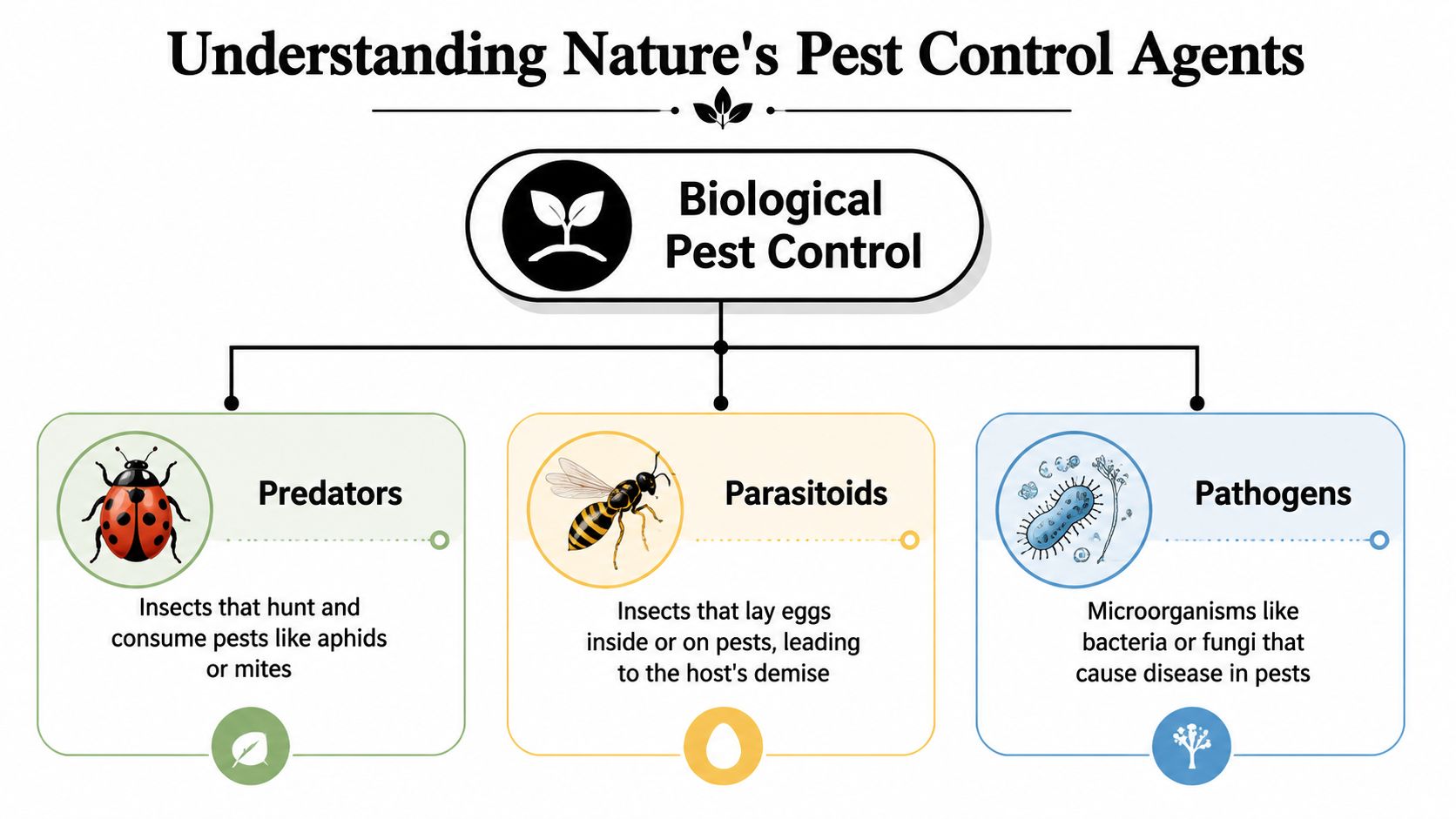
Predators that hunt pests
Some beneficial organisms are straightforward. They hunt and eat pests. Lady beetles feeding on aphids are the classic example people know, but the larger lesson is simple. A predator lowers pest numbers by consuming them directly.
For a homeowner, that's an easy mental model. Think of predators as the yard's built-in patrol team. When conditions support them, they help keep certain pest populations from taking off.
Parasitoids that target a host
Readers often get confused because the word sounds technical. A parasitoid is usually a small insect, often a wasp, that uses another insect as a host. Over time, that host dies.
It sounds intense, but it's a natural pest-control relationship, not a horror movie. In practical terms, these organisms can be highly targeted, which is one reason professionals pay attention to them.
Some of the most effective biological control agents are tiny enough that homeowners never notice them, even though they may be helping reduce pest pressure in the background.
Pathogens that make pests sick
The third group includes pathogens, which are microorganisms such as bacteria or fungi that cause disease in pests. These aren't the same as tossing chemicals at every insect in sight. They're part of a more selective biological approach.
That's one reason “natural” doesn't mean casual. A pathogen-based product still has to be chosen correctly, applied correctly, and used where it makes sense.
Three different game plans
Biological pest control also has three core operating models: classical, augmentative, and conservation, as outlined in this overview of biological pest control methods. Those terms describe how professionals use natural enemies, not just what kind of organism they are.
- Classical control involves importing a natural enemy for a pest problem.
- Augmentative control means releasing more beneficial organisms to boost what's already available.
- Conservation control focuses on protecting and supporting the beneficial organisms already present.
If you want a homeowner-friendly example of how food webs shape pest pressure, Magic Eagle's tick control insights offer a useful look at animals that naturally interact with tick populations.
For homes and outdoor areas, the most useful question isn't “Are beneficial insects good?” It's “Which biological tool fits this exact pest problem?” If you want a practical local overview of that kind of approach, natural pest control for home is a helpful place to start.
How Professionals Implement Biological Pest Control
Knowing what biological control is helps. Knowing how professionals use it is what turns the idea into a real pest management plan.
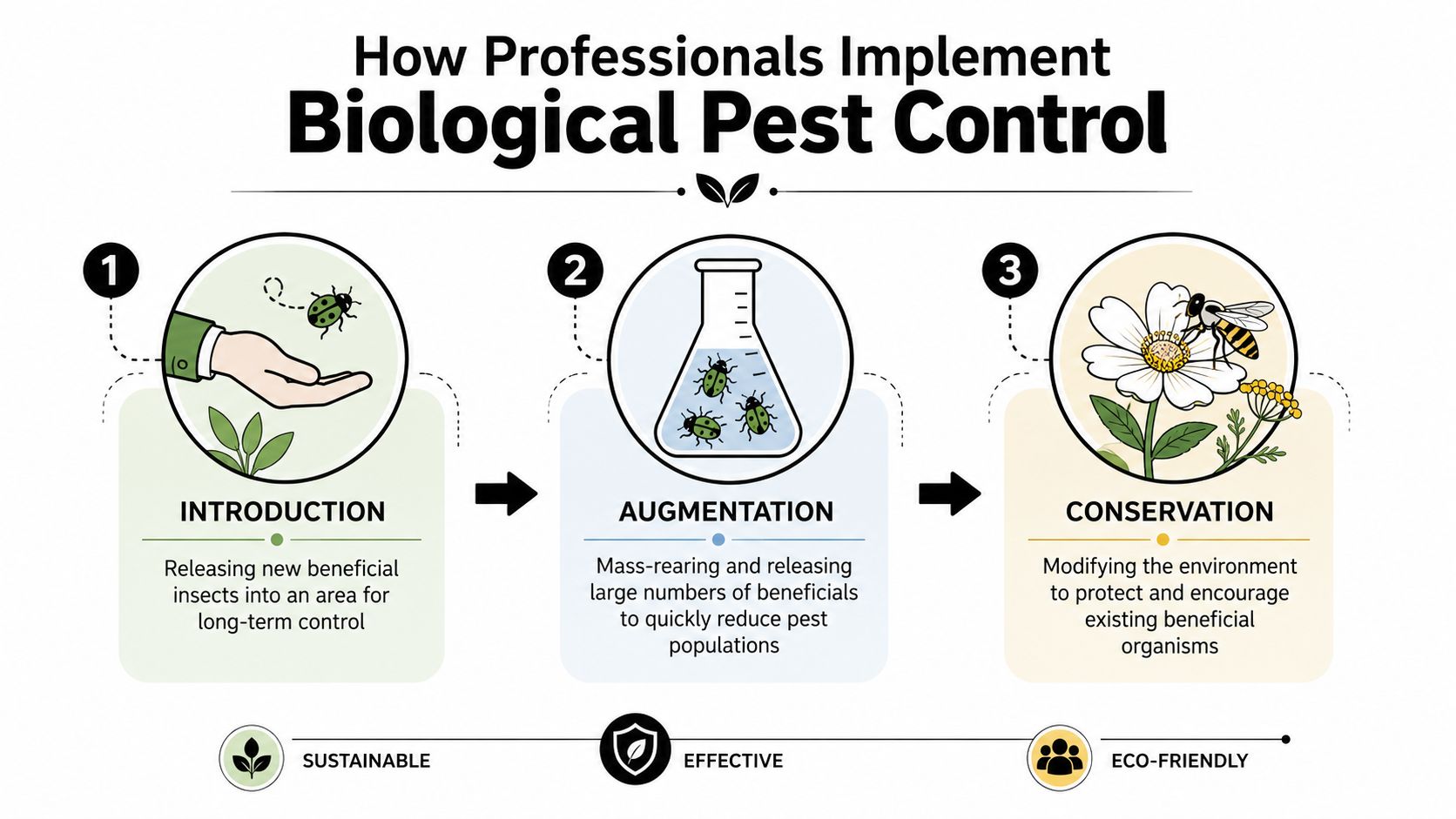
Introduction for long-term pest problems
Sometimes a pest isn't well controlled by the local environment. In those situations, professionals may look at introduction, also called classical biological control. This is not a homeowner DIY project. It's a specialized, regulated strategy used in narrow circumstances and handled at a professional or institutional level.
For most readers in Crown Point, the important takeaway is this. Not every biological solution means buying a box of beneficial insects online. Some forms are highly technical and far outside normal home treatment.
Augmentation when extra help is needed
Augmentation means increasing the number of beneficial organisms to improve pest suppression. This is often the method people picture first when they hear about biological control.
According to technical guidance from extension sources, augmentative releases work best when matched to the pest. They're most effective against slow-moving pests like aphids and mites, and success drops when broad-spectrum pesticides kill the beneficials you're trying to establish, as explained in this extension guidance on biological control.
That's why professionals don't just ask what pest is present. They ask:
- How fast does it reproduce
- Where is it active
- Is it exposed or hidden
- Has the site recently been treated with broad-spectrum products
Conservation by changing the environment
Conservation biological control is often the most practical concept for homeowners. Instead of importing or releasing large numbers of organisms, the goal is to make the property less disruptive to beneficial species that already help control pests.
That can include reducing unnecessary broad-spectrum applications, improving ecological balance, and paying attention to how moisture, excess plant growth, and hiding spots affect pest populations. In many cases, the smartest pest plan isn't “more product.” It's a better environment.
If a treatment wipes out the beneficial organisms along with the pest, the pest often comes back faster than the natural enemies do.
This is one reason integrated planning matters. A service approach that combines inspection, pest identification, exclusion, and targeted treatment is usually more dependable than a one-step fix. Homeowners who want that broader framework can learn more about integrated pest management, which brings biological, physical, and chemical tools together based on the site.
Benefits and Limitations Compared to Chemical Treatments
Biological control has real advantages, but a trustworthy explanation also needs to cover where it can fall short. Homeowners deserve a clear comparison, especially when choosing between immediate knockdown and longer-term prevention.
Side-by-side comparison
| Feature | Biological Control | Chemical Control |
|---|---|---|
| Primary approach | Uses living organisms or habitat support to suppress pests | Uses pesticide products to kill or repel pests |
| Targeting | Often more selective when properly matched to the pest | Can be broad, depending on the product |
| Impact on beneficials | Can support beneficial organisms if managed carefully | Broad-spectrum products may harm helpful organisms too |
| Speed | May take longer to show full effect | Often faster for immediate knockdown |
| Long-term role | Can support ongoing suppression in a broader IPM plan | May need repeated applications if root causes remain |
| Complexity | Requires close matching of pest, timing, and environment | Often simpler to apply, but not always simpler to manage long term |
| Homeowner fit | Best when guided by inspection and strategy | Useful when fast action is necessary |
Where biological control stands out
One of the strongest arguments for biological control is long-term value. New Jersey's Department of Agriculture notes that a 1965 U.S. presidential science review concluded that every $1 spent on biocontrol research and development returned about $30 in benefits, which is one reason biological control remains important in pest management strategy, according to New Jersey's overview of biological control.
For homeowners, that doesn't mean every pest issue should be handled biologically. It means biological control has a long track record as a practical tool, not just an eco-friendly talking point.
Where chemical treatments still matter
Some infestations need quick suppression. Wasp issues near entry points, active rodent problems, or a serious indoor pest situation may require a more direct treatment response. A good pest professional won't force every problem into the same method.
That's especially important with termite control, rodent control, or urgent stinging insect concerns. In those cases, speed, access, and safety can outweigh the slower pace of a biology-first plan.
The right question isn't “biological or chemical?” It's “What solves this pest problem with the least disruption and the most control?”
That balanced view is what builds trust. A strong residential pest control or commercial pest control plan in Crown Point should use the tool that fits the pest, the property, and the people living or working there.
Biological Pest Control for Northwest Indiana Homes
A home in Crown Point doesn't have the same pest pressures all year. Spring moisture, summer mosquitoes, fall invaders, and sheltered winter activity all change what works. That's why local knowledge matters so much.
Where these ideas show up around the home
In Northwest Indiana, biological principles often connect to pest issues such as:
- Mosquito pressure outdoors by targeting breeding areas and using selective strategies where they fit
- Ant activity around landscaping by reducing favorable conditions and avoiding disruption that can make rebounds worse
- Spider populations in garages and exterior corners by changing the environment that supports the insects spiders feed on
- Aphids and mites on ornamentals where beneficial organisms may play a role if the site and timing are right
This is also where homeowners need a caution flag. Some people hear “biological control” and assume they should order non-native beneficial organisms online and release them around the property. That's not a safe shortcut.
Why professional oversight matters
The risk and regulation side is important. Introducing non-native biological control agents is a highly regulated process that requires extensive quarantine and testing by agencies like the USDA, as described by USDA APHIS biocontrol guidance. That's one reason classical biological control is strictly for professionals and institutions working within regulation.
For a homeowner in Crown Point, the practical message is simpler. Good biological pest control is local, targeted, and informed by the property itself. It depends on what pest is present, what's attracting it, what season you're in, and whether the environment supports a stable solution.
That local lens is why one-size-fits-all pest control rarely works well in Northwest Indiana. A wet backyard, dense shrubs near the foundation, cluttered garage edges, and untreated entry gaps all create different pest opportunities. The best results come from reading those conditions correctly and building the response around them.
Trust The Green Advantage for Your Pest Control Needs
Biological pest control sounds simple on the surface. Let nature handle the pests. In reality, it takes knowledge to use it well. Someone has to identify the pest, understand its life cycle, decide whether biological methods fit the situation, and know when another treatment is the safer choice.
That's why homeowners searching exterminator in Crown Point, IN, pest control near me, or commercial pest control usually benefit from a full inspection rather than a quick guess. Ants, mosquitoes, rodents, spiders, and stinging insects all create different risks for families, buildings, and outdoor spaces.

The Green Advantage provides pest inspection and treatment planning for homes and businesses in Crown Point and nearby Northwest Indiana service areas. In practice, that means looking at the full picture. Entry points, moisture, sanitation, pest biology, seasonal pressure, and the right balance between biological, mechanical, and conventional tools.
A safer pest plan starts with an accurate diagnosis. You can't choose the right control method until you know exactly what you're dealing with.
If you've been trying to figure out what biological pest control is, the short answer is this. It's a science-based way to manage pests by working with natural enemies and ecological balance instead of relying only on broad chemical force. Used correctly, it can be part of a smart, family-conscious pest strategy. Used casually, it can disappoint or create new problems.
That's why professional guidance matters for pest control in Crown Point, IN. The goal isn't just to remove pests today. It's to protect your home, reduce repeat issues, and give you confidence that the treatment plan makes sense for your property.
If pests are taking over your home, yard, or business, contact The Green Advantage to schedule an inspection or request a quote. You'll get a practical plan built for your property in Crown Point and Northwest Indiana, with clear recommendations for safe, effective pest control that fits your family's needs.
How to Get Rid of Pests Naturally: A Crown Point Guide
You walk into the kitchen in Crown Point first thing in the morning and spot a line of ants running along the counter. Or you hear scratching in the wall after dark and start wondering if mice found a way in before the weather changed. Most homeowners have the same first thought. They want the problem gone, but they don't want to make their home feel less safe in the process.
That's a reasonable instinct. If you have kids, pets, or just don't like the idea of spraying harsh products around food prep areas, searching for how to get rid of pests naturally makes sense. The trouble is that a lot of advice online skips the hard part. It tells you what to spray, but not whether that method is meant to repel pests, kill a few on contact, or solve the hidden source of the problem.
In Northwest Indiana, pest pressure usually comes from a mix of weather, moisture, shelter, and easy food access. That means the most useful natural approach isn't a magic recipe. It's a practical system. Some DIY steps help. Some don't do much at all. And once pests are established inside walls, attics, crawl spaces, or around foundations, a more complete plan is usually the safer route.
A Homeowner's Guide to Natural Pest Control in Crown Point
A lot of natural pest control starts with the same moment. Someone sees one problem and realizes it might be a larger one. Ants by the sink. Spiders in basement corners. Wasps under the eaves. Mice sounds at night. The first reaction usually isn't panic. It's caution. People want an answer that protects the house without turning the house into a chemistry project.
That concern is especially common in family homes around Crown Point. People want a clean kitchen, a usable yard, and a home where pets and children can move around normally. They also want honest advice. Not every natural remedy belongs indoors, and not every infestation can be handled with ingredients from a pantry shelf.
Why homeowners start with natural options
Natural pest control appeals to homeowners for good reasons:
- Less indoor exposure: People want to avoid unnecessary residue on counters, floors, and pet areas.
- Simple first steps: Sealing food, reducing moisture, and cleaning up attractants often helps right away.
- A prevention mindset: Many pest issues start outside, then move in when conditions are right.
In practice, the strongest natural programs start before pests take over. If you also pay attention to the surroundings around your property, that helps. Problems in the yard often feed problems at the house. Homeowners dealing with roots, moisture, and plant stress sometimes find value in broader property maintenance topics such as addressing liquid amber root problems, because outdoor conditions can affect drainage, shelter, and pest activity near the foundation.
Practical rule: If a natural method doesn't change the conditions attracting pests, it usually won't hold for long.
What local experience changes
A technician who works in Crown Point sees patterns that generic articles miss. Northwest Indiana homes deal with seasonal moisture, changing temperatures, garage access, mulch beds, low spots near foundations, and outdoor clutter that becomes pest harborage. Those details matter more than trendy DIY hacks.
That's why the best natural approach is usually measured and specific. Start with prevention. Use low-impact steps where they make sense. Watch for signs that the issue is growing. If you only focus on what you can spray, you miss where pests are feeding, nesting, or entering in the first place.
Prevention Your First and Best Natural Defense
The most effective natural pest control starts before you see pests indoors. The Royal Horticultural Society notes that a foundational principle of natural pest control is prevention through habitat management, with practices such as removing diseased plant sections, using mulch as a barrier, encouraging beneficial insects, and monitoring populations before they boom in order to suppress pests and diseases without chemicals (RHS guidance on controlling pests and diseases without chemicals).
That principle applies just as much to homes in Crown Point as it does to gardens. Pests stay where food, water, shelter, and access line up. Break those conditions early and you make the property far less inviting.
Start outside the house
Walk the exterior slowly. Look at the foundation line, door sweeps, utility penetrations, window frames, garage corners, and siding transitions. You're looking for gaps, not dramatic holes. Tiny openings are enough for crawling insects, and larger cracks or worn seals can invite rodents.
Focus on these areas first:
- Entry points: Seal gaps around pipes, wires, and doors where light or air passes through.
- Vegetation contact: Trim branches and shrubs so they don't rest against siding or roofs.
- Stored materials: Keep firewood, cardboard, and clutter away from the house so pests don't settle nearby.
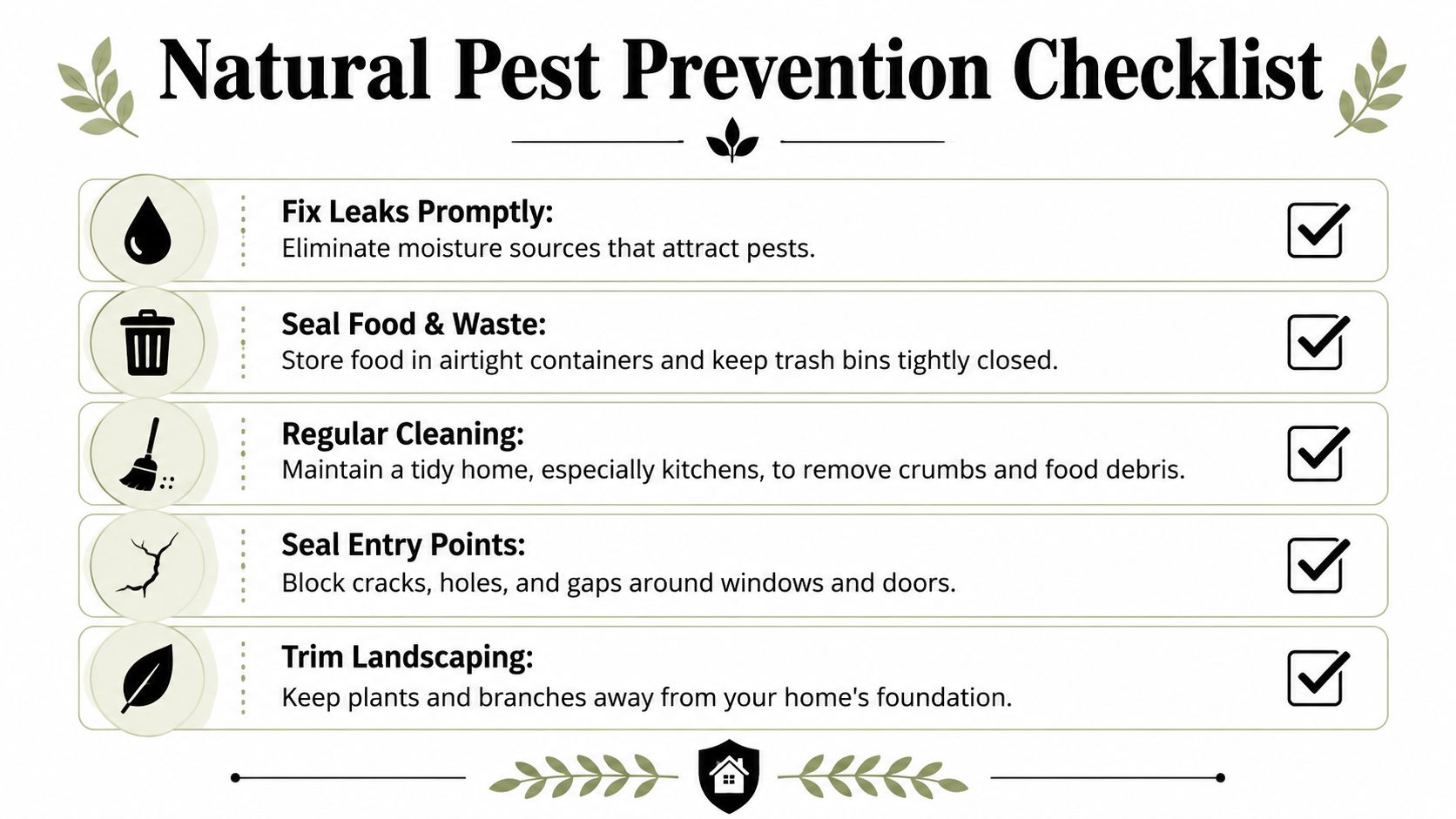
Control moisture before pests do
Moisture is one of the biggest hidden drivers of pest activity. Leaky spigots, clogged gutters, downspouts that dump too close to the foundation, wet crawl spaces, and dense mulch against the home all create more favorable conditions. Ants, mosquitoes, flies, and many occasional invaders show up more often when damp areas are left alone.
If you suspect roof runoff is contributing to wet soil or pest pressure around the foundation, it helps to understand the basics in this guide for Utah homeowners on gutter issues. The climate is different, but the lesson carries over. Poor drainage invites larger home maintenance problems, and pests take advantage of them.
Good prevention isn't glamorous. It usually looks like fixing leaks, improving drainage, reducing clutter, and keeping pests from getting comfortable in the first place.
Clean with pest behavior in mind
General tidiness helps, but targeted sanitation works better. In kitchens, that means wiping up grease and sugar residue, not just visible crumbs. In garages and basements, it means reducing cardboard storage and checking pet food, birdseed, and bulk pantry items. Outdoors, keep trash lids shut and avoid letting bins sit right next to entry doors.
A simple home checklist works well:
| Area | What to check | Why it matters |
|---|---|---|
| Kitchen | Crumbs, spills, food containers | Food residue supports ants and flies |
| Bathroom | Leaks, damp mats, slow drains | Moisture supports pest activity |
| Basement | Cardboard, clutter, humidity | Shelter makes monitoring harder |
| Yard edge | Leaf litter, stacked wood, dense cover | Harborage increases near the structure |
Prevention is still the most natural move you can make. It doesn't rely on a strong smell, a viral recipe, or repeated guessing. It changes the environment so pests have fewer reasons to stay.
DIY Natural Remedies for Common Indiana Pests
Once prevention is in place, some DIY remedies can help with light pest activity. The key is to match the method to the problem. A repellent may interrupt movement. A contact spray may affect exposed insects. Neither one automatically fixes a nest in a wall void or a breeding issue in the yard.
For homemade sprays, consistency is more critical than commonly understood. The Peace Corps standard for botanical sprays recommends drying neem leaf material in shade, then steeping a generous handful of powder in 10 liters of water for 12 to 24 hours, applied in the evening. For soap spray, the listed mix is 2 tablespoons of grated soap per 1.5 liters of water, and the guidance stresses complete surface coverage rather than spot spraying for effectiveness (Peace Corps natural pest control recipes).
Ants and crawling insects
For ants, start with trail disruption and food removal. Clean the trail thoroughly, store sweets and dry goods in sealed containers, and watch where the ants are entering. If you use a soap spray on exposed ants, remember that spraying a few workers on the counter doesn't mean the colony is gone.
What often helps more than a spray:
- Wipe trails fully: Ants follow scent cues, so partial cleanup doesn't do much.
- Check moisture: Sink areas, dishwasher edges, and pet bowls often keep ant traffic going.
- Follow the line: If they're emerging from trim, outlets, or wall gaps, the source is deeper than the visible trail.
Mosquitoes around the yard
Mosquito control is where many natural plans fall short because the problem usually isn't one spot. It's the whole environment. Standing water, shaded resting areas, dense vegetation, and neighboring conditions all play a role. Empty water-holding items regularly, improve drainage where you can, and trim heavy growth around seating areas.
Homeowners who want a few low-chemical ideas for outdoor use can review these home remedies to keep mosquitoes away. The most useful takeaway is that yard comfort usually improves when you combine habitat reduction with targeted action, not when you rely on one scent alone.
A mosquito problem is rarely solved by fragrance. It improves when you remove resting areas and water sources and keep pressure down over time.
Spiders and rodents
Spiders often show up because other insects are present. If you knock down webs but leave the insect food supply untouched, more spiders usually return. Vacuum webs, reduce clutter, limit exterior lighting that attracts insects near doors, and seal gaps around utility lines and basement entries.
For mice, natural deterrents are usually the weakest category of DIY advice. Scent-based methods may discourage activity in a limited area, but they don't replace exclusion. If mice can still get inside and find food, nesting material, or warmth, odor alone won't carry the job.
A better pest-by-pest way to think about DIY methods is this:
| Pest | Natural step that may help | Main limitation |
|---|---|---|
| Ants | Sanitation and trail cleanup | Doesn't remove hidden colony |
| Mosquitoes | Standing water reduction | Doesn't address broader yard pressure |
| Spiders | Web removal and insect reduction | Returns if food source remains |
| Mice | Sealing entry points | Repellents alone are unreliable |
DIY can work best when the problem is small, visible, and recent. It works worst when the pests are nesting out of sight.
Safety First When Natural Isn't Necessarily Harmless
A lot of homeowners hear "natural" and assume "safe everywhere." That isn't always true. A common gap in DIY advice is the safety and effectiveness tradeoff for indoor use, especially with essential oils, vinegar, and borax-like mixtures that are often recommended without enough guidance on exposure risks, residue, or airway irritation. What works in a garden setting may be a poor fit for a kitchen, bedroom, or home with pets (overview of natural garden pest control methods and indoor-use concerns).
That matters because homes aren't all the same. A remedy used on a patio planter isn't judged by the same standard as something sprayed near food prep surfaces, around cat dishes, or in a child's room. Setting changes the risk.
Common mistakes with indoor natural remedies
Some DIY problems come from overapplication. People spray too much, use strong scents in poorly ventilated rooms, or leave powders where they can be kicked up into the air. Others use food-based mixtures that end up feeding the wrong pests or leaving sticky residue behind.
Watch for these trade-offs:
- Essential oils: Strong odors may bother people or pets, especially in closed rooms.
- Powders and dusts: Fine materials can become an inhalation issue if applied carelessly.
- Food-based baits or mixes: Sweet or greasy ingredients can create secondary pest attention if spilled or misplaced.
Match the method to the room
A kitchen ant issue should be handled differently than a mosquito issue outdoors. A child's bedroom should be approached differently than a detached shed. One of the biggest reasons homeowners call for help is that online advice treats all natural options as interchangeable when they aren't.
If you're weighing treatment choices for indoor spaces, this page on home pest control chemicals is useful because it frames the larger safety question homeowners are already asking. The goal isn't just getting rid of pests. It's doing it without creating a new problem for the people living there.
Natural products still need judgment. The safest approach is the one that fits the pest, the room, and the people in the home.
When DIY Natural Pest Control Isn't Enough
The main reason DIY natural pest control disappoints people is simple. It often addresses what they can see, not what's sustaining the infestation. The University of Florida's entomology guidance raises that exact issue by separating deterrence, direct kill, and population control, and noting that practical guidance is shifting toward integrated methods such as sanitation, habitat reduction, and professional help rather than one-off remedies that don't solve the root cause (University of Florida guidance on natural pest control methods that really work).
That distinction matters in real homes.
Deterrence versus elimination
If you spray ants on a countertop and they disappear for a few hours, you may have achieved direct kill on the ants you hit. You have not necessarily changed the colony. If you scatter a scent mice don't like in one room, you may create short-term avoidance, but you haven't closed the entry route.
Those are different outcomes:
- Deterrence: Makes an area less appealing for a while
- Direct kill: Affects exposed pests on contact
- Population control: Reduces the source, access, or reproduction driving the problem
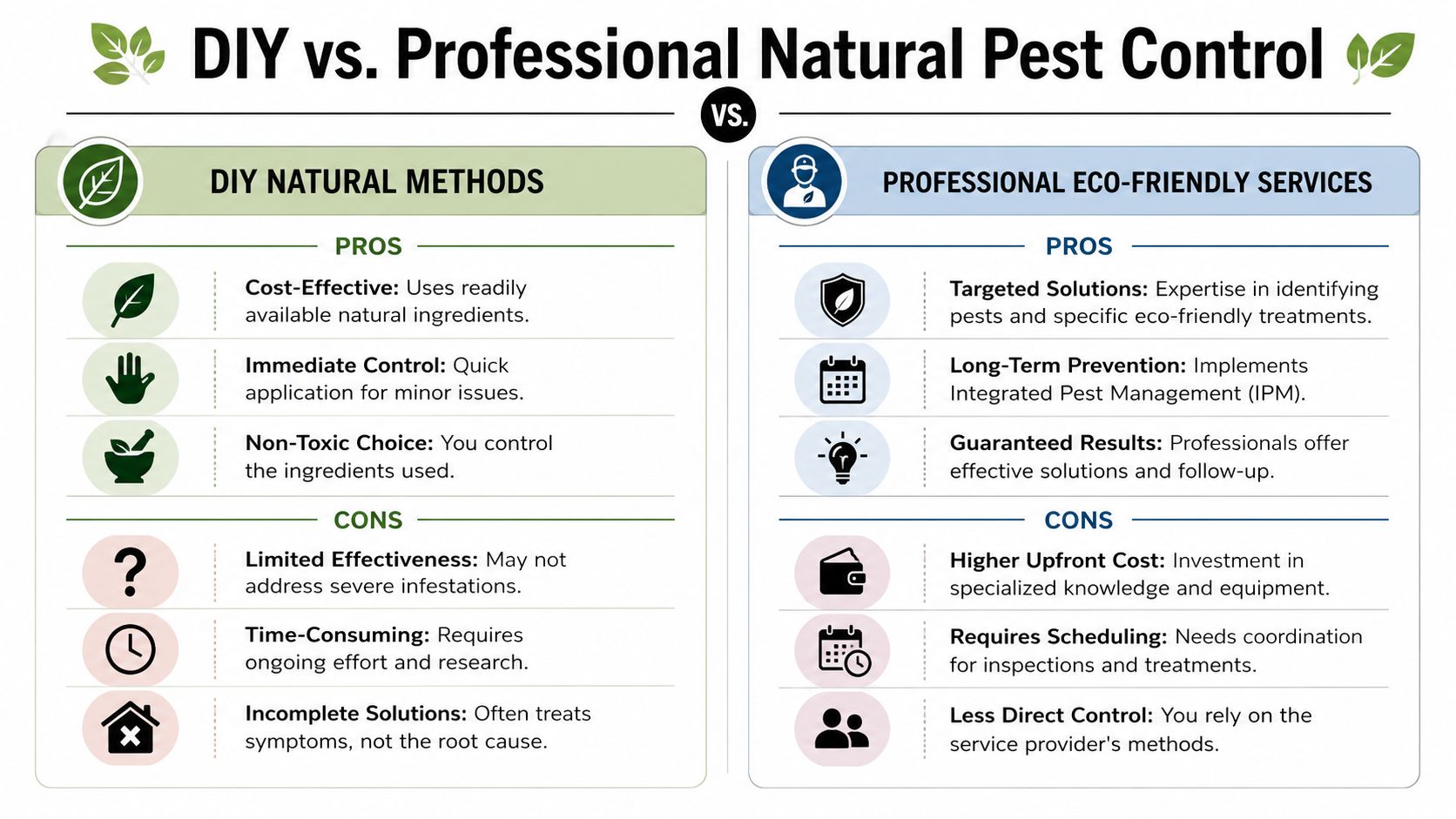
Signs the problem has moved beyond home remedies
A few situations usually signal that DIY is no longer enough:
- Repeat sightings: You clean, spray, or repel, and the pests keep returning to the same area.
- Hidden activity: You hear movement in walls, find droppings, or notice pests around plumbing voids, attics, or crawl spaces.
- Outdoor pressure: Mosquitoes, wasps, or other pests are affecting the whole yard or structure, not one isolated spot.
For serious infestations, the issue isn't effort. It's reach. A homeowner can do a good job on visible surfaces and still miss nesting areas, breeding sites, structural gaps, and moisture conditions that keep the cycle going.
Why integrated work lasts longer
The most reliable solutions combine inspection, sanitation, exclusion, habitat reduction, monitoring, and, when needed, targeted treatment. That's why professional eco-friendly service often feels different from DIY. It isn't based on one trick. It's based on identifying the pest, finding the access point, correcting conditions, and following up when needed.
If your goal is lasting peace of mind, that bigger system usually matters more than whether a remedy smells pleasant or came from a natural ingredients list.
The Green Advantage A Professional Eco-Friendly Solution
When homeowners search for pest control near me, exterminator near me, or pest control in Crown Point, IN, they're usually past the point of wanting random tips. They want a clear answer. What's in the house, why is it there, and what's the safest practical way to stop it from coming back?
That's where a professional eco-friendly approach fits. In Crown Point and across Northwest Indiana, the right service doesn't start with over-treating. It starts with inspection, identification, and a plan built around the site.

What a professional process looks like
A sound residential pest control plan usually includes:
- Inspection first: Identify the pest correctly and look for the conditions supporting it.
- Exclusion and correction: Seal likely entry points and address moisture, clutter, and harborage.
- Targeted treatment when needed: Use the lightest effective approach for the actual problem and setting.
- Follow-up: Check whether the pressure dropped and whether additional corrections are needed.
This is also where commercial pest control differs from casual DIY. Restaurants, offices, multifamily buildings, and retail spaces need consistency, documentation, and prevention habits that hold up under daily use.
A lot of property owners also benefit from improving the surrounding outdoor areas. Reducing dense cover, fixing drainage, and making the yard less hospitable to pests supports any treatment plan. For broader property upkeep, these eco-friendly landscaping tips are worth a look because the outside environment often determines how much pest pressure reaches the structure.
What local homeowners can expect
The Green Advantage offers pest inspections and service plans for homes and businesses in Crown Point and nearby Northwest Indiana communities. That includes support for common concerns such as ant control, mosquito control, rodent control, spider control, wasp removal, and preventative pest treatments. The point of that kind of service isn't to replace common sense steps like cleaning and sealing. It's to build on them with trained inspection and problem-solving.
A homeowner dealing with an active infestation usually needs answers to practical questions:
| Question | Why it matters |
|---|---|
| What pest is this? | Correct identification changes the treatment plan |
| Where is it coming from? | Entry points and nesting areas determine recurrence |
| Is this safe for my home setup? | Kitchens, pets, and children change the approach |
| What keeps it from returning? | Lasting control depends on prevention, not just treatment |
If you want to see the kind of approach that supports long-term prevention, this overview is helpful:
For many homeowners, that combination of inspection, eco-conscious planning, and follow-through is the answer to how to get rid of pests naturally. Use low-impact methods where they make sense. Be realistic about their limits. And when the issue is inside walls, across the yard, or recurring no matter what you try, bring in a trained local team that can solve the whole problem instead of the visible part of it.
If pests are disrupting your home or business in Crown Point, the next step is simple. Contact The Green Advantage to schedule an inspection, request a quote, and get a practical pest control plan built for your property, your family, and the realities of Northwest Indiana.