
Flea and Tick Control in Crown Point, in: A Homeowner Guide
You let the dog out, the kids run through the grass, and later that evening someone finds a tick crawling on a sock or attached near a pet's ear. That's usually the moment flea and tick control stops feeling like a minor nuisance and starts feeling personal.
In Crown Point and across Northwest Indiana, that reaction is completely reasonable. Fleas and ticks aren't just annoying. They create stress inside the home, put pets at risk, and turn your yard into a place you stop trusting. What makes these problems harder is that they rarely stay in one place. A pet brings something in from the yard. Eggs end up in carpet and furniture. Wildlife activity along fence lines keeps pressure on the property.
The good news is that this problem is manageable when you treat it as a system instead of a single product purchase. That means looking at the pet, the home, and the yard together. It also means knowing when a do-it-yourself plan is enough and when it's time to bring in professional help.
Flea and tick prevention has also become a major part of routine pet care, not an occasional add-on. The flea and tick control medication market is estimated at USD 7.7 billion in 2025 and projected to reach USD 15.3 billion by 2035, with 7.1% CAGR over that period, while chewable products account for 38.0% of the 2025 segment and over-the-counter products are projected to hold 61.0% of revenue in 2025, according to Future Market Insights flea and tick market projections. That scale reflects how many households now treat prevention as part of normal care.
Your Guide to Flea and Tick Control in Northwest Indiana
A lot of homeowners start in the same place. The pet scratches more than usual. You notice small black specks on bedding. Or you find a tick after a walk around the yard and suddenly every room in the house feels suspect.
That concern makes sense in Northwest Indiana because our mix of lawns, tree lines, shaded beds, pet traffic, and changing weather creates steady opportunities for fleas and ticks to move between outdoor and indoor spaces. In Crown Point, the issue often builds gradually. Pets rest in the same sunny patch near the patio. Rabbits or other wildlife pass through the edges of the yard. Then the problem shows up all at once inside the home.
What local homeowners usually miss
The issue isn't ignored, but efforts often tackle the wrong part first. This means buying a treatment for the dog, spraying a room, or mowing the grass lower. Each step can help, but none of them solves the whole problem by itself.
Practical rule: If you only treat the pet, the house and yard can keep feeding the infestation. If you only treat the house, the pet can bring it right back in.
For dog owners who want a grooming-focused perspective on early warning signs and basic prevention habits, this roundup of expert dog parasite control advice is a useful companion to the property side of the problem.
What a calm response looks like
Start by assuming there are three possible zones of activity:
- On the pet where fleas feed and ticks attach
- Inside the home where eggs, larvae, and hiding adults can persist
- Outside in the yard especially in shaded, protected areas
That framework keeps you from wasting time on one-off fixes. It also makes your next steps clearer. First, confirm what you're seeing. Then choose a treatment plan that matches the actual scale of the problem. If the activity is light and recent, some homeowners can get ahead of it. If it's established, recurring, or spread across multiple rooms and animals, the smart move is often faster professional intervention.
How to Identify a Flea or Tick Problem
The fastest way to lose time is guessing. Flea and tick control works better when you confirm what pest you're dealing with, where it's active, and whether it's limited to one animal or already established in the home.
How to check for fleas
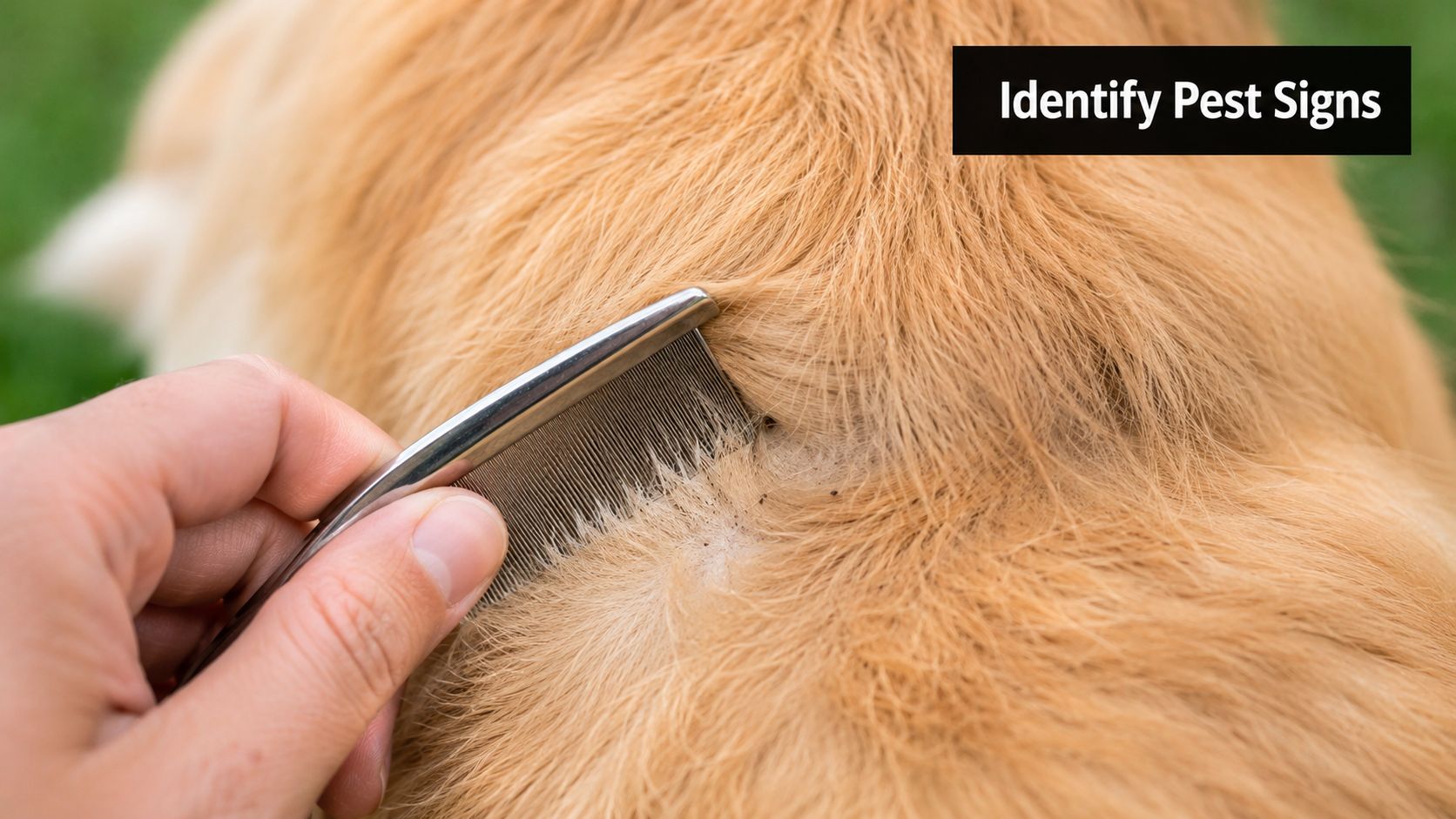
Fleas are small, fast, and easy to miss when you're only doing a quick visual scan. A fine-toothed flea comb is more reliable than your eyes alone. Comb slowly around the base of the tail, lower back, belly, and neck. After each pass, tap the comb onto a damp white paper towel or tissue.
If you see pepper-like black specks that smear reddish-brown when wet, that's often flea dirt. Check pet bedding too. Flea dirt on bedding, along with scratching and restlessness, is a strong sign that fleas are active somewhere in the home environment.
A simple home check can also help. Put on white socks and walk slowly through carpeted rooms and areas where pets spend time. Then inspect the socks closely. Fleas are easier to spot against a light background.
For a deeper look at why a few visible fleas can turn into a much larger indoor issue, review the flea reproduction cycle. Understanding that life cycle helps explain why surface-level treatment often disappoints.
How to check for ticks
Ticks create a different kind of problem. They may be crawling on a pet or person, or they may already be attached. On pets, check behind the ears, around the collar line, under the front legs, between the toes, around the eyelids, and near the groin and tail base. On people, pay attention to warm, hidden areas such as the scalp, armpits, waistband, and behind the knees.
An attached tick usually feels like a small bump fixed in place. A crawling tick moves across the coat or skin and hasn't embedded yet. Both matter, because if you find one tick, there may be more in the yard or along the route the pet uses most often.
Signs the problem is larger than it first appears
A mild problem often stays close to pet resting spots. A larger one starts showing up in multiple places.
Look for patterns like these:
- Repeated scratching after a recent walk or yard time
- Specks on bedding that return soon after washing
- Ticks in more than one area of the yard or on more than one family member
- Activity in rooms without carpet which can signal a broader indoor spread
This short visual can help homeowners understand where fleas hide and how pet checks should be done:
If you're seeing activity on pets and in the house at the same time, don't treat those as separate problems. They're connected.
A Coordinated Plan for Your Pets Home and Yard
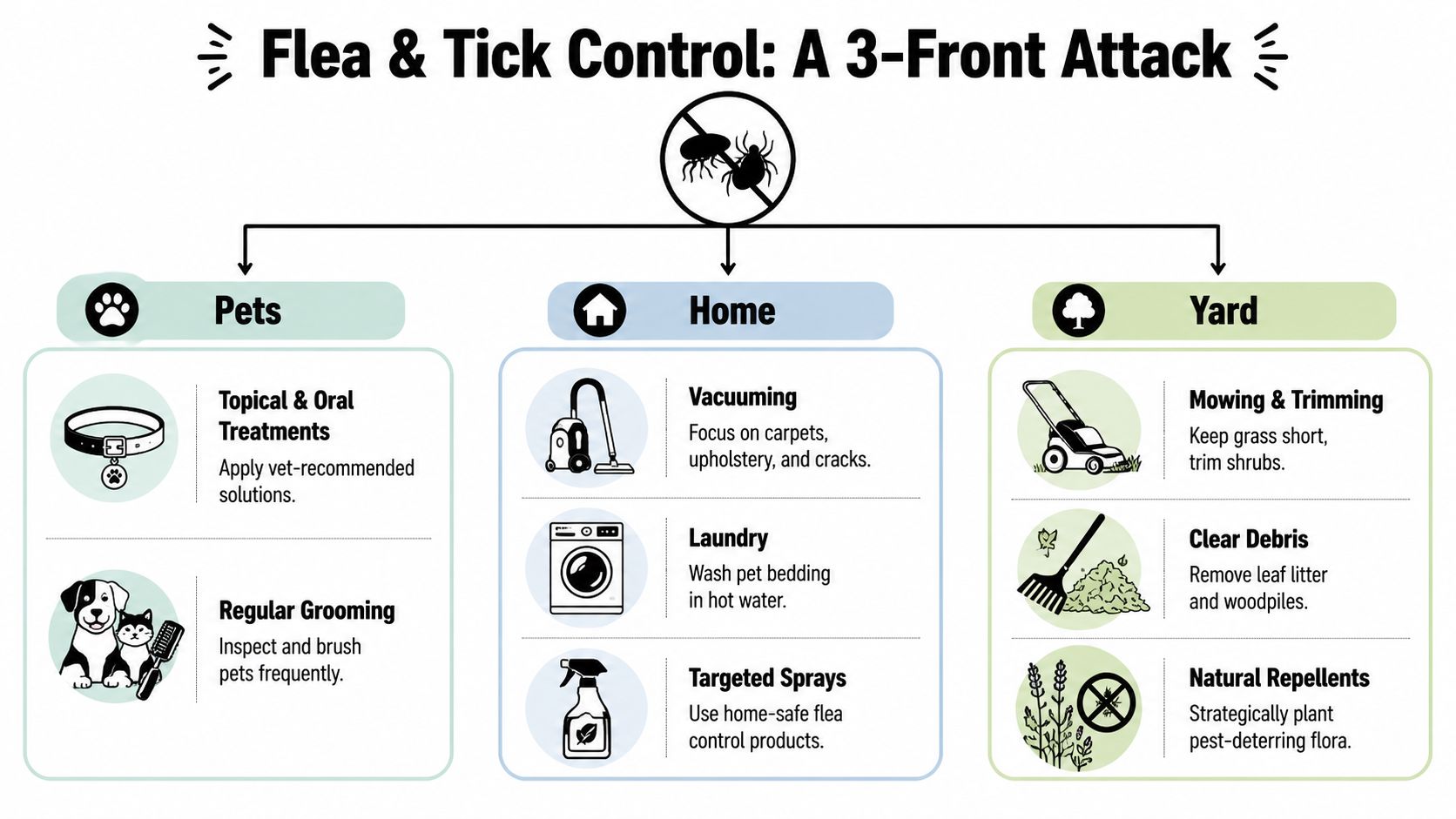
Flea and tick control breaks down when homeowners treat one area and ignore the others. Veterinary and EPA guidance emphasizes that fleas and ticks can be controlled with a mix of oral, topical, and collar products on pets, while home control may also require vacuuming and laundering bedding, as described by VCA's flea and tick prevention guidance. The key is coordination.
Start with the pets
If even one pet remains untreated, the rest of your work can unravel quickly. Every dog and cat in the home needs to be part of the plan, even if only one seems affected.
Product type matters. Some households do well with topicals. Others prefer collars or chewables because they're easier to keep consistent. The right choice depends on the pet's age, size, health history, and habits. Cornell notes that pet owners should follow species and weight labels carefully, avoid using dog products on cats, and pay attention to special situations such as seizure-prone dogs, puppies, kittens, and pregnant or nursing pets in its flea and tick prevention guidance from Cornell.
Safety matters as much as effectiveness. A product that works well for one pet may be the wrong choice for another.
If your dog swims often, gets frequent baths, or spends long periods outdoors, that should shape the product decision too. Convenience affects follow-through, and follow-through is a large part of success.
Clean the home like you mean it
For indoor flea work, half-measures usually just stir things up. You need repeated, thorough cleaning targeted to the places where pets rest and where vibrations trigger flea activity.
Focus on:
- Vacuuming floors and edges especially along baseboards, under furniture, and where carpet meets wall
- Washing pet bedding and washable fabrics including throw blankets and removable covers
- Checking upholstered furniture where pets nap or climb
- Reducing clutter in rooms where pests have more places to hide
Homeowners often ask whether one deep cleaning is enough. It usually isn't. Vacuuming and laundering need to continue alongside pet treatment, not as a one-day project.
Make the yard less inviting
Outside, fleas and ticks prefer protection. They build up in shade, under shrubs, along fence lines, around wood piles, and in pet resting zones where moisture and host activity overlap.
A practical yard checklist looks like this:
| Area | What to do | Why it helps |
|---|---|---|
| Shaded lawn edges | Mow and trim regularly | Reduces cover and humidity |
| Landscape beds | Remove leaf litter and debris | Limits protected harborage |
| Pet hangout areas | Keep surfaces cleaner and drier | Lowers repeated exposure |
| Fence lines and brushy spots | Open them up where possible | Makes the area less tick-friendly |
If you're evaluating outdoor surfaces and pet-use zones, even design choices can support long-term management. Homeowners comparing low-maintenance options sometimes look at Modern Yard Landscapes' Austin turf solutions for ideas on creating cleaner pet areas that are easier to inspect and maintain.
For a property-focused look at outdoor treatment options, review this guide to yard flea and tick control.
Timing is what ties it together
Treating pets on Saturday, vacuuming once on Wednesday, and thinking about the yard next weekend is how infestations linger. The pet, home, and yard have to be addressed as one coordinated effort. That's the missing piece in most DIY attempts.
One practical option for homeowners in Crown Point, IN who need property-level help is The Green Advantage, which provides pest inspection and treatment support for residential and commercial sites in Northwest Indiana.
Proactive Prevention for Year-Round Peace of Mind
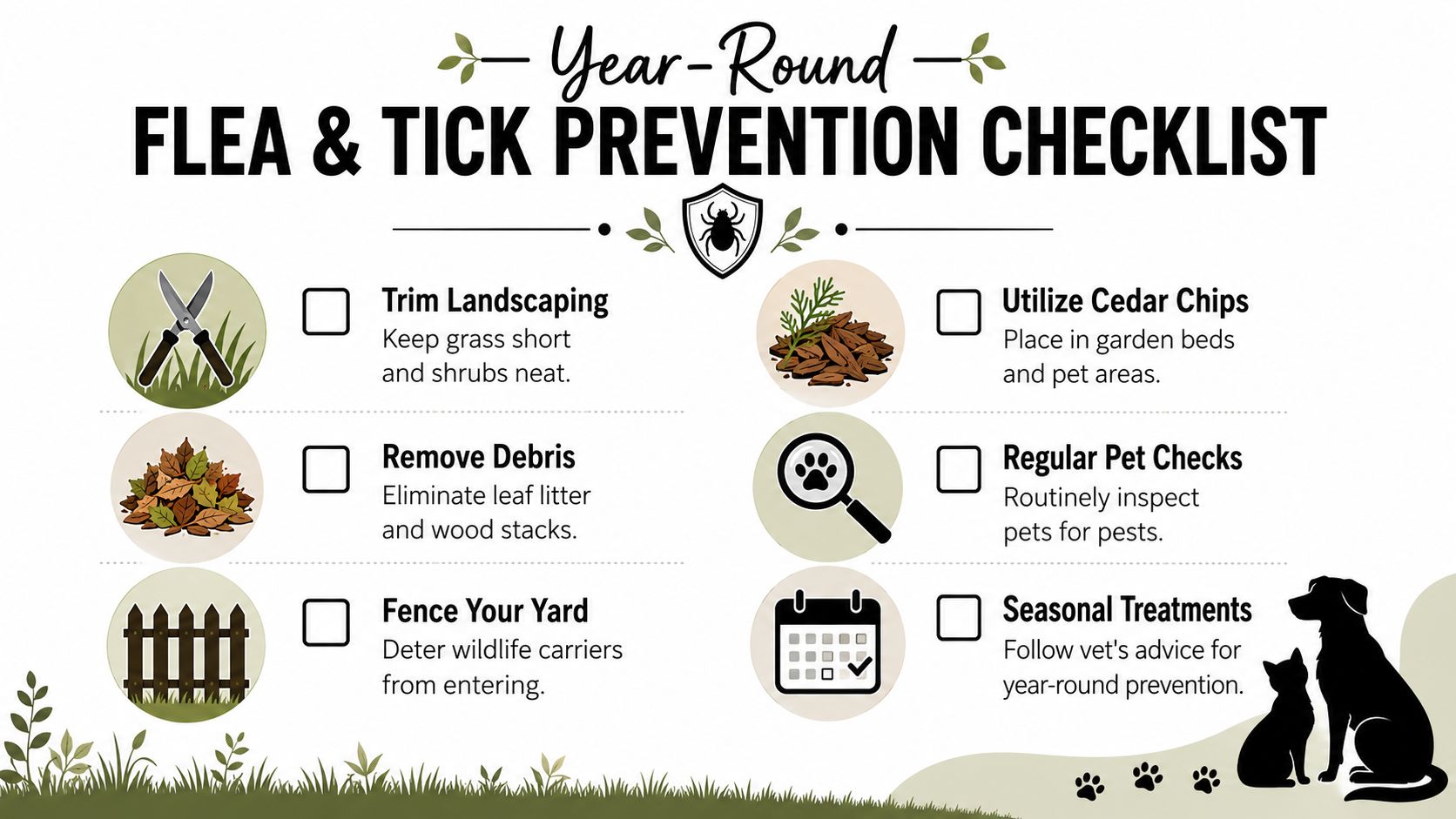
Reactive flea and tick control feels expensive because it always starts when you're already behind. Prevention is different. It turns the property into a less friendly place for pests and reduces the odds that one hitchhiking flea or one tick from the yard becomes a household problem.
Why consistency beats catch-up treatment
A major reason prevention works better is simple. People are more consistent with protection that's easier to maintain. In a study of over 30,000 dogs, those prescribed 12-week fluralaner were more likely to achieve 7 to 12 months of protection, with 15.7% reaching that range compared with shorter-acting monthly products, according to this real-world adherence study on canine flea and tick protection.
That doesn't mean every pet needs the same format. It means regimen design matters. If a product schedule is hard for the household to maintain, gaps happen. Gaps are where reinfestation starts.
CAPC also notes in the same source that residual insecticides such as selamectin, fipronil, and imidacloprid can kill many newly acquired fleas within 24 hours, but that short window still matters because fleas may feed and transmit pathogens before they die. That's one more reason year-round coverage makes more sense than sporadic treatment.
Property habits that lower pressure
You can't seal your yard off from every pest, but you can make it less comfortable for them.
Use habits like these:
- Trim grass and shrubs so shaded, damp hiding areas don't build up near walking paths
- Remove leaf litter and stacked debris especially where pets cut through the yard
- Discourage wildlife traffic by reducing sheltered edge zones and food attractants
- Check pets after outdoor time with extra attention to ears, paws, legs, and collar line
- Keep screens and entry points in good repair so hitchhiking pests are easier to catch before they spread indoors
The households that struggle most are usually not the ones who missed one step. They're the ones who stop prevention as soon as the immediate problem seems gone.
For cat owners sorting through prevention options, this overview of effective cat flea products is a helpful supplement to your veterinarian's guidance, especially when product form and tolerance are part of the decision.
Think of prevention as home maintenance
In Northwest Indiana, homeowners already plan for weeds, mosquitoes, rodents, and seasonal ants. Fleas and ticks belong in that same category. Not because every property has a major issue, but because waiting until you see activity usually means the pests have had time to settle in.
A good prevention mindset also pairs well with other services homeowners often need, including mosquito control, rodent control, and general residential pest control. The common thread is reducing conditions that let pests stay established around the home.
Why DIY Flea Control Fails and When to Call an Exterminator
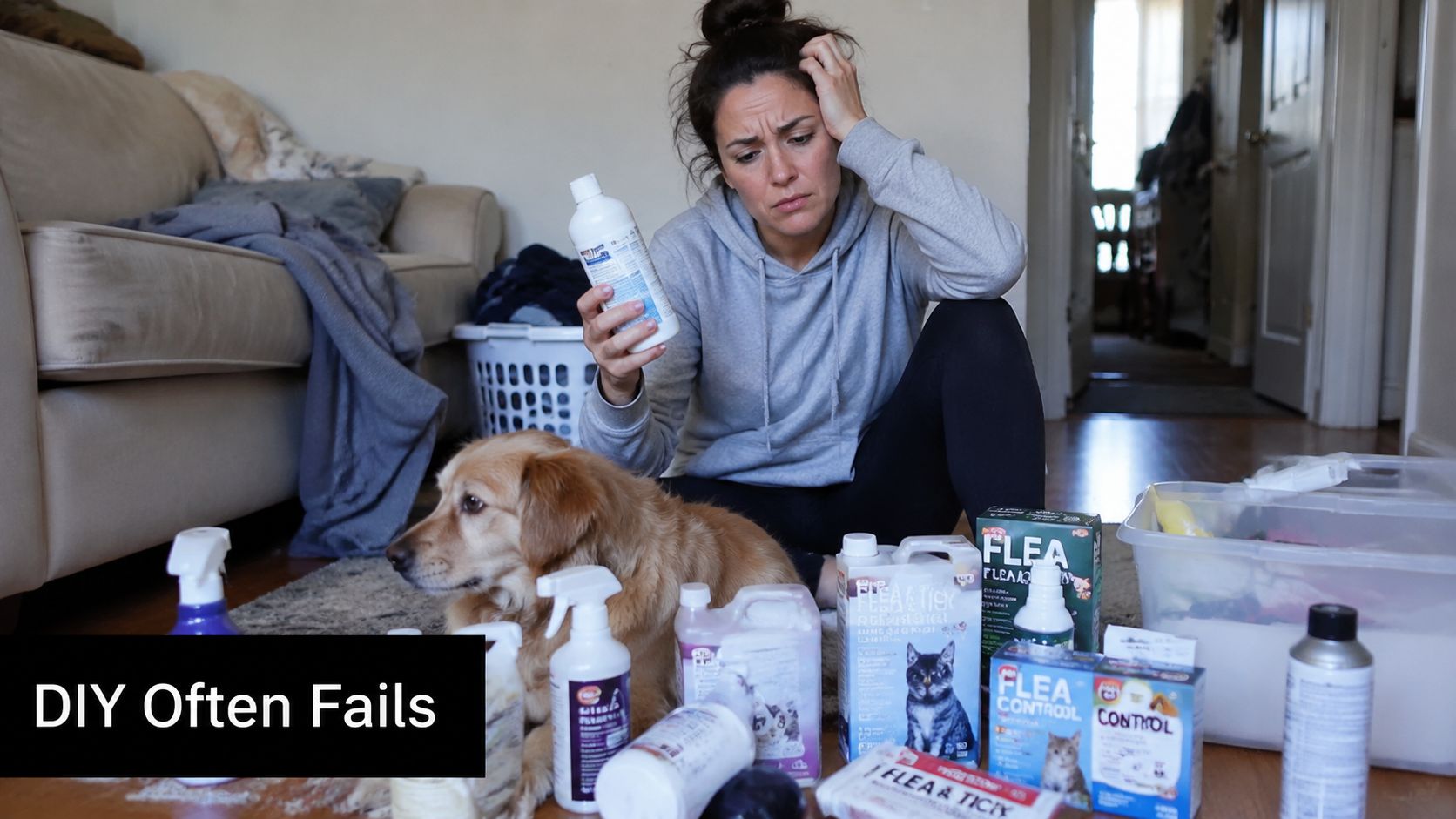
DIY flea and tick control often fails for a frustrating reason. The product may do something, but the homeowner expects it to do everything.
The timeline is longer than most people expect
The CDC lays out a four-step IPM sequence for flea control: sanitize by washing bedding and vacuuming floors, walls, and carpet edges; treat every pet in the home; start home treatment at the same time as pet treatment with outdoor applications focused on shaded and pet-resting areas; and schedule two or more follow-up treatments within 5 to 10 days because some flea life stages are insecticide-resistant. The CDC also states that moderate to severe infestations can take months to control, as explained in the agency's guidance for getting rid of fleas.
That's the point many people miss. They treat once, see fewer bites, and assume they're done. Then hidden life stages keep developing, and the home gets repopulated.
Common DIY failure points
The pattern is usually one of these:
- Pet-only treatment while carpets, bedding, and furniture still support the life cycle
- Indoor-only treatment while pets continue picking up pests outside
- One-time application with no follow-up on the interval the infestation requires
- Inconsistent dosing because the household forgets, delays, or changes products midstream
- Unsafe product use such as applying the wrong species-specific product to the wrong animal
Professional help isn't about giving up. It's about recognizing when biology and logistics are working against the do-it-yourself plan.
When it's time to bring in a professional
Some trigger points are clear. Call for help when:
| Situation | Why it matters |
|---|---|
| You still see fleas or ticks after repeated treatment attempts | The problem may be larger or more widespread than expected |
| Multiple pets or multiple rooms are involved | Control becomes harder to coordinate without a full plan |
| The infestation keeps returning | There may be an untreated outdoor or structural source |
| You have high-risk pets or young children in the home | Product selection and application need tighter safety control |
| You're preparing a rental, sale, or turnover | Fast, property-wide resolution matters more than trial and error |
In Crown Point, IN, this is especially relevant for busy families, landlords, and homeowners dealing with repeat yard pressure. Professional pest control near me searches usually happen after people have already spent time and money on partial fixes. In many cases, an earlier inspection would have shortened the whole process.
The Green Advantage Solution in Crown Point
When homeowners call for flea and tick control in Crown Point, they usually want three things. They want the problem identified correctly, they want a treatment plan that makes sense for their property, and they want to know the process will be handled safely.
That professional process should feel straightforward. It starts with an inspection that looks at where the activity is happening. On the pet side, that often means confirming whether the issue appears limited to hitchhiking exposure or whether there are signs of active indoor establishment. On the property side, it means checking shaded yard zones, pet paths, bedding areas, floor transitions, and furniture where fleas tend to build up.
What homeowners should expect from service
A useful service visit should give you clear answers, not vague reassurance.
You should expect:
- A property-specific assessment based on indoor and outdoor conditions
- A treatment recommendation that matches the scale of the issue
- Straightforward safety instructions for people and pets
- A follow-up plan when the infestation level calls for one
- Clear communication about what you should do between visits
That matters because flea and tick problems aren't solved by product alone. They're solved by matching the right treatment to the right places on the right schedule.
Why local experience matters in Northwest Indiana
Homes in Crown Point and nearby Northwest Indiana communities don't all face the same pest pressure. Some properties back up to wooded edges. Some have heavy pet traffic and shaded landscaping. Some are dealing with recurring issues after trying to manage it alone.
A local exterminator in Crown Point, IN should understand those patterns and be able to tell the difference between a light, recent issue and a more established infestation that needs broader action. That same practical approach usually helps with related concerns too, whether a homeowner is also dealing with mosquitoes in the yard, rodents around the structure, or general residential pest control needs.
If you're tired of second-guessing what's crawling in the house or what's hiding in the yard, it's time to get a real plan in place.
If you need flea and tick control, residential pest control, or an experienced exterminator in Crown Point, IN, contact The Green Advantage to schedule an inspection or request a quote. They'll help you sort out whether the issue is on the pet, in the home, in the yard, or all three, so you can get back to feeling comfortable in your home again.
Expert Certified Pest Control Operators in Crown Point
You find the issue when your house is supposed to feel calm. Ants show up on the kitchen counter before school. A wasp nest appears over the patio the day you plan to have people over. At night, you hear scratching in the wall and start wondering what is in there.
The search usually starts fast with pest control near me or exterminator near me. The hard part comes a few minutes later. Now you have to decide who should inspect your home, apply products safely around food areas, kids, and pets, and fix the problem instead of stirring it up for a week and letting it return.
Certification is part of that decision.
A certified pest control operator has training, state oversight, and a legal responsibility to handle pest problems the right way. For a homeowner in Crown Point, that shows up in practical ways. The inspection is more thorough. The pest is identified before treatment starts. The products, placement, and timing are chosen for the site instead of pulled from a one-size-fits-all routine.
That difference protects more than the house. It reduces the risk of misapplied pesticides around baseboards, kitchens, pet areas, and entry points. It also improves the odds of getting control the first time, because the work is based on pest biology, entry conditions, moisture issues, nesting habits, and seasonal pressure in Northwest Indiana.
Local experience matters too.
Ants, mosquitoes, rodents, wasps, spiders, and termites do not behave the same way in Crown Point from spring through fall, and they definitely do not respond to the same treatment plan. A certified operator knows when a line of ants points to a moisture issue, when mosquito activity calls for source reduction as well as treatment, and when scratching in a wall needs a proper inspection before anyone reaches for a product.
Homeowners are not just paying for someone to spray. They are paying for judgment, safe handling, and a treatment plan that fits the pest and the property. That is the true value behind certification.
Pests in Crown Point and Finding a Pro You Can Trust
A lot of service calls start with a homeowner who's already tried something from the store.
They've sprayed the baseboards for ants, hung a wasp trap near the deck, or put a few bait stations in the garage for mice. Sometimes that slows activity down for a few days. Sometimes it makes the problem look gone when it really isn't. Then the pests come back, often in a different part of the house.
That's the moment when people start searching for exterminator in Crown Point, IN and trying to figure out who's legitimate.
What homeowners are really asking
Clients aren't just asking, “Who can kill this pest?”
They're asking different questions underneath that one:
- Is this safe around my family and pets
- Will the treatment work
- Am I paying for a real solution or a temporary patch
- Does this company understand the kinds of pest issues we get in Crown Point and the rest of Northwest Indiana
Those are fair questions. Pest problems are stressful because they affect comfort quickly. A line of ants in the pantry feels invasive. A yellowjacket nest near the front walk changes how you use your own yard. Rodent activity in an attic or crawlspace can keep people awake at night.
Homeowners don't need someone who sounds convincing. They need someone who can identify the pest, explain the cause, and choose a treatment that fits the site.
The difference between help and qualified help
A handyman might seal a gap. A general maintenance person might knock down a visible nest. Those actions can help in a narrow sense.
But certified pest control operators are trained to look at the full problem. They inspect entry points, moisture conditions, harborage areas, product selection, label compliance, and follow-up needs. They also understand when a pest issue is part of a larger pattern, such as recurring ant pressure from grading and mulch contact, or mosquito activity tied to standing water and dense vegetation.
That's why choosing a professional matters so much more than choosing the lowest price. The wrong treatment wastes time, delays control, and can create unnecessary exposure without solving the infestation.
For residential pest control and commercial pest control in Crown Point, trust should be built on credentials, inspection quality, and clear communication. If a company can't explain what they found, why it's happening, and what the plan is, keep looking.
What a Certified Pest Control Operator Actually Does
A certified operator starts by slowing the problem down.
Homeowners in Crown Point often call after trying the obvious fix. They sprayed the ant trail under the sink. They knocked down the wasp nest by the garage. They put out a few mosquito treatments from the hardware store. The pressure comes back because the visible pest was only part of the problem.
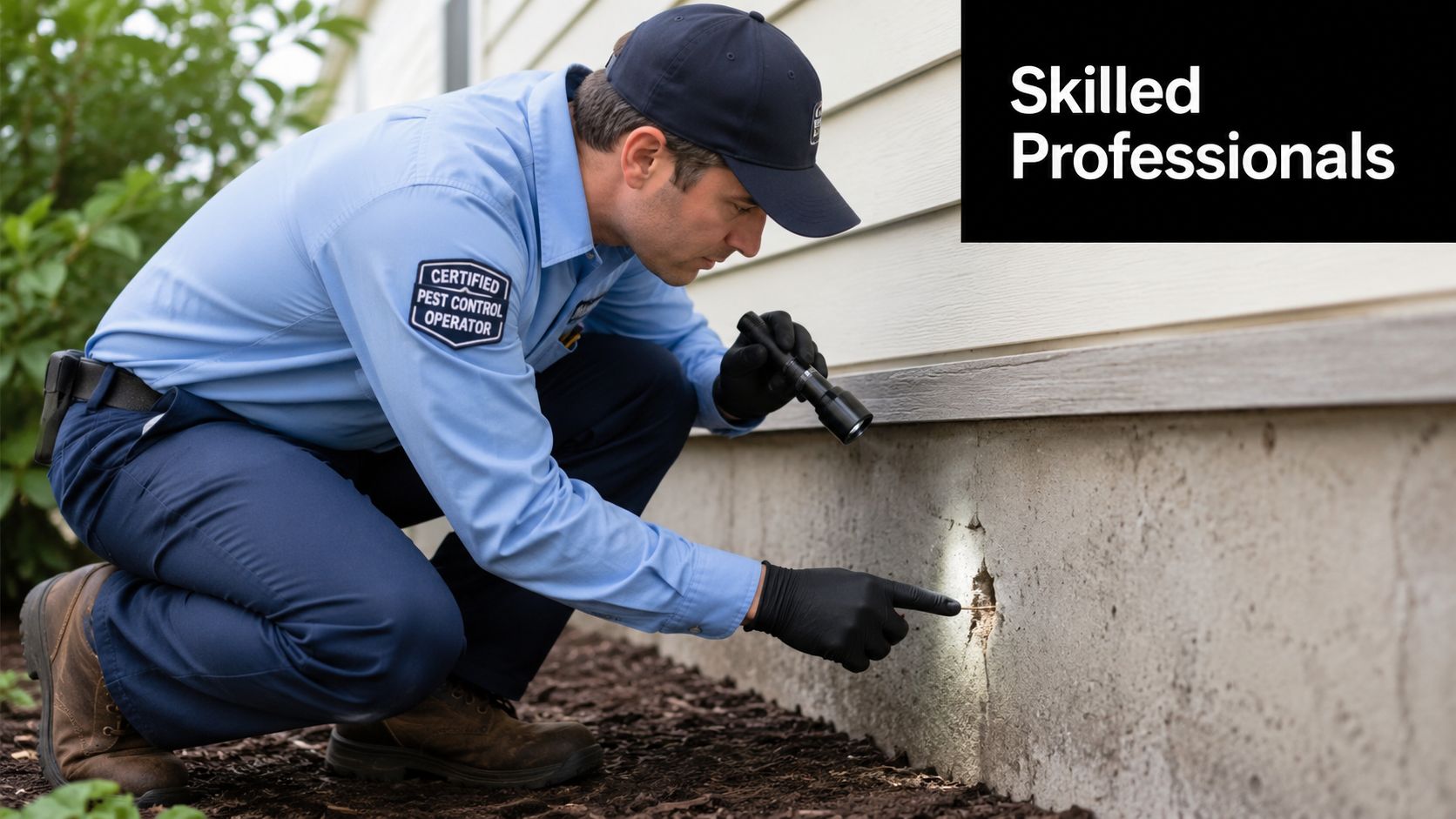
A certified operator is trained to identify the pest, inspect the site, choose a legal and appropriate treatment, and explain how to keep the issue from returning. That work protects more than comfort. It affects where products can be used, how exposure is limited around children and pets, and whether the service solves the source instead of chasing symptoms.
Inspection first, treatment second
A strong visit usually includes checking:
- Foundation lines and entry points where insects and rodents can get inside
- Moisture-prone areas such as basements, crawlspaces, sump areas, and plumbing penetrations
- Exterior conditions like stacked firewood, mulch against siding, clogged gutters, and vegetation touching the home
- Signs of activity such as droppings, trails, nesting, rub marks, frass, or insect debris
That inspection stage is where certification shows up in real life. The operator has to know whether the small ants in the kitchen are odorous house ants, pavement ants, or carpenter ants, because the treatment plan changes with the species. The same is true for mosquitoes. Some yards need targeted reduction around harborage and standing water. Others need a broader plan that starts with drainage, gutter correction, or trimming heavy vegetation.
For homeowners who want a closer look at the service process, this guide on what pest control companies do gives a useful overview.
The job involves judgment, safety, and accountability
Certified operators do more than apply products. They read labels, measure application rates, watch for sensitive areas, and document what was used and where it was applied. In a family home, those details matter.
A treatment around a play area, a dog run, a vegetable garden, or a kitchen cannot be approached carelessly. Product choice, placement, timing, and follow-up all have to fit the site. In Northwest Indiana, that often means balancing quick relief with long-term correction for recurring ants in spring, stinging insects in summer, rodents in colder months, and mosquito pressure during humid stretches.
A good operator also knows when chemical treatment should be limited or supported by other steps. Sealing a mouse entry point, correcting a moisture issue behind a bathroom wall, or removing leaf clutter from a shaded foundation can do more than another round of spray.
Here's a short look at the field in action:
What works and what usually doesn't
The strongest pest control programs use inspection, exclusion, habitat correction, monitoring, and targeted treatment together.
A few examples:
| Situation | What usually works | What usually fails |
|---|---|---|
| Ants in kitchen | Identify the species, trace entry routes, use targeted materials, reduce food and moisture sources | Repeated over-the-counter surface spraying |
| Rodents in garage or attic | Seal gaps, place traps and devices correctly, monitor activity, address food sources | Setting random traps without exclusion |
| Mosquito pressure in yard | Reduce breeding sites, trim dense harborage, use targeted service where needed | Treating blindly without addressing standing water |
| Wasp activity near entry doors | Treat the active nest safely, inspect nearby voids and repeat sites | Knocking nests down without dealing with live insects |
Practical rule: If the plan is just to spray every surface and leave, keep looking.
Understanding Pest Control Certifications and Licensing
Certification sounds abstract until you break it down into the parts that protect a homeowner.
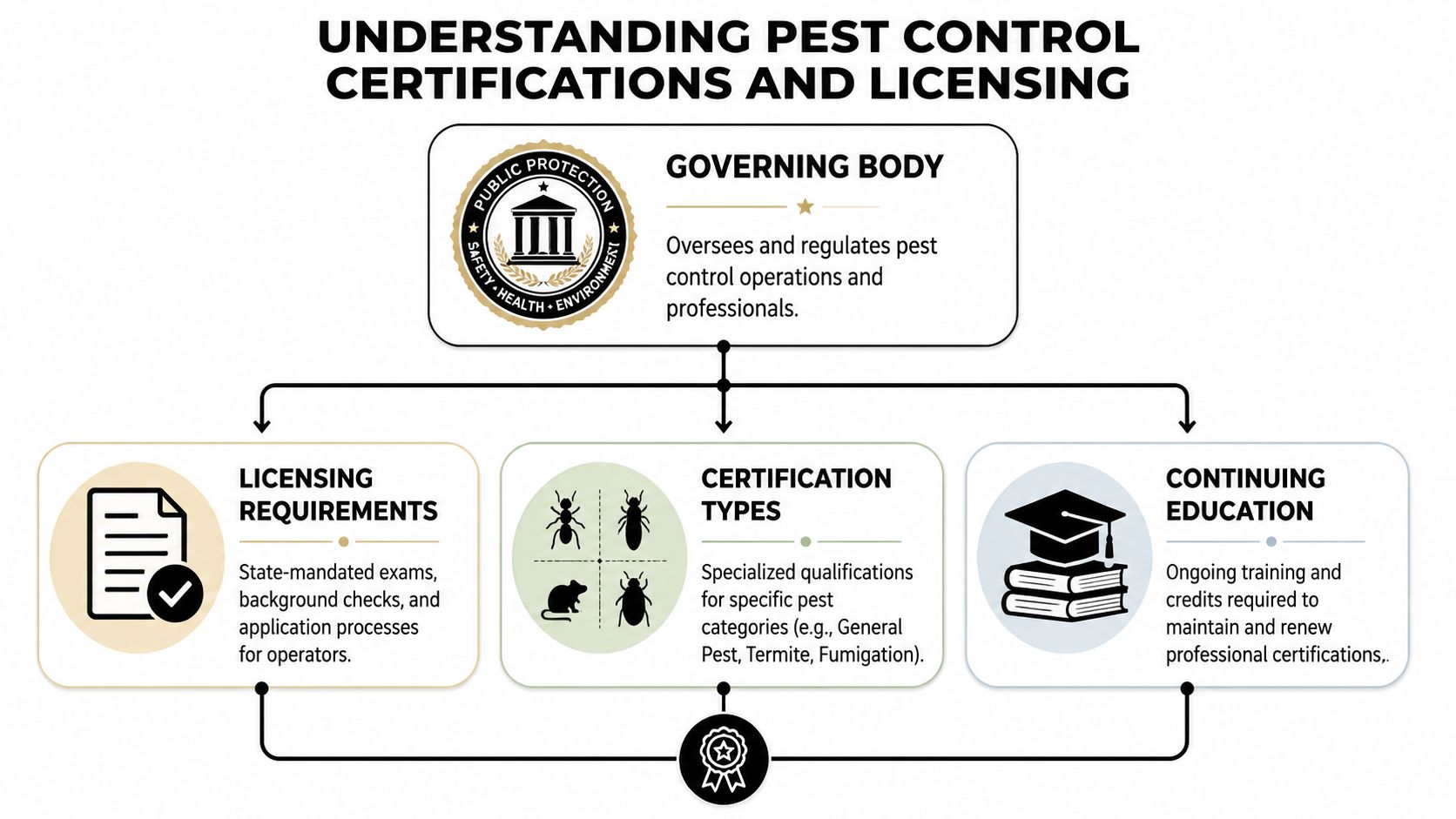
Certification means the person responsible for pest control work has met formal standards for experience, testing, and ongoing renewal. That's important because pest control involves product handling, legal restrictions, recordkeeping, and treatment decisions that affect health and property.
What certification typically requires
A good benchmark comes from Georgia's certified operator model. Applicants need at least two years of verifiable structural pest control experience within the last five years, or a related degree plus one year of actual service experience in that same period. They must pass the core exam plus a category exam. Each exam category costs $45, the credential fee is $100, and certification lasts for a five-year period. Renewal requires continuing education or reexamination, including 25 credits for Household Pest Control and 12 credits for Fumigation, according to Georgia's certified operator license requirements.
That's a useful example because it shows how the trade is built. It isn't one quick test and done. It's field work, exams, category knowledge, and renewal over time.
Exams are about judgment, not memorization alone
In many places, applicants must pass both a core pesticide safety exam and a category-specific exam. Some jurisdictions require a 75%+ passing mark on each module. In Ontario, the certification course also has to be completed within the last 12 months before applying, as described in the Ontario exterminator certification guide.
That matters because current knowledge counts. Labels change. best practices change. Pest pressure changes. A person who hasn't stayed current may still sound experienced while missing newer safety or treatment standards.
Certification should be viewed the way homeowners view electrical or plumbing credentials. It's proof that someone is allowed to do regulated work and expected to stay competent.
Why there are layers of responsibility
Homeowners sometimes assume the person at the door and the person legally responsible for the work are always the same person. Sometimes they are. Sometimes the technician performs service under the supervision of a certified operator who oversees the program, approves methods, and ensures compliance.
That layered accountability is a strength, not a flaw. It means there's a structure behind the visit.
Here's the simple version:
- Technician or applicator handles field service, inspection details, and treatment execution.
- Certified operator holds responsibility for category knowledge, supervision, and compliant service decisions.
- The company maintains licensing, records, and operational standards.
When you hire a firm for pest control in Crown Point, IN, you want all three parts to be in place. That's what separates a real professional operation from someone doing side work with store-bought materials and no oversight.
Key Benefits of Hiring a Certified Pro for Your NWI Home
Certification matters most when it changes the outcome for your household. For a homeowner in Northwest Indiana, that usually comes down to three things. Safety, effectiveness, and peace of mind.
Safer handling around people, pets, and property
Some products and use categories carry tighter rules for a reason. Government guidance in several markets requires certified applicators for restricted-class pesticides and limits assistant applicators to supporting certified applicators in application, transport, storage, and security, according to British Columbia pesticide certification and training guidance.
That tells homeowners something practical. Certification is not just personal knowledge. It's a workflow control. It affects who can handle what, who supervises whom, and how materials are stored and applied.
In everyday terms, a certified professional is more likely to make disciplined choices such as:
- Using targeted placement instead of broad, unnecessary application
- Reading site conditions carefully before treating near pet areas, food zones, or play spaces
- Choosing the right formulation for the location rather than using the same approach everywhere
Better diagnosis means better control
A lot of failed pest work comes from treating the visible symptom and missing the reason the pests are there.
That's common with ant control, rodent control, and spider control. A homeowner sees activity in one room, treats that room, and wonders why the problem returns. The certified pro is trained to work backwards from the evidence. Where are they getting in. What are they feeding on. What conditions are helping them stay. What treatment reaches the source instead of only the traffic path.
That's also why termite control, wasp removal, and mosquito control should never be approached casually. Each one has its own safety concerns and service logic.
Less guesswork, less stress
Good pest control should make your life simpler.
You should get a clear explanation of what was found, what the plan is, what preparation is needed, and what kind of follow-up makes sense. You shouldn't feel pushed into a one-size-fits-all package or a vague promise that “everything will be sprayed.”
The best service call often feels calm, not dramatic. The operator identifies the issue, explains the plan in plain language, and leaves you knowing what happens next.
For homes in Crown Point, that kind of clarity matters because many pest issues are seasonal, recurring, or tied to exterior conditions. A trained professional helps you solve the current problem and reduce the chance of the next one.
Your Checklist for Hiring a Pest Control Operator in Crown Point
When you're comparing residential pest control or commercial pest control options, don't judge by price alone. Ask better questions.
A strong company should be comfortable answering them.
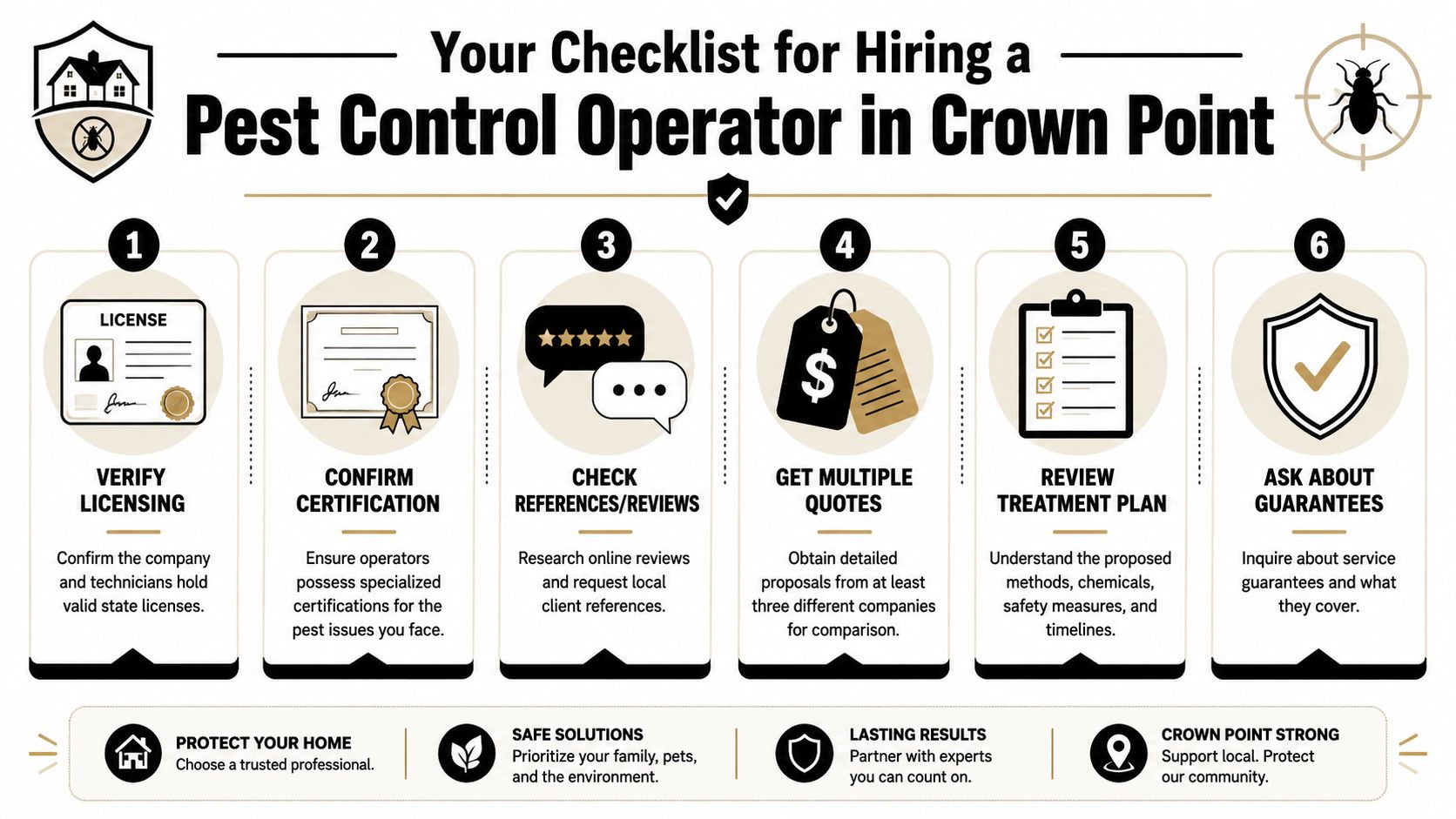
What to verify before you hire
Use this checklist when speaking with any exterminator in Crown Point, IN.
- Ask for licensing information. A legitimate company should be able to provide its state licensing details without hesitation. If someone gets evasive, that's a warning sign.
- Confirm certification for the type of work you need. General pest service, termite work, mosquito programs, and specialty treatments may involve different responsibilities and qualifications.
- Ask who supervises the service work. If a technician is coming out, find out who the certified operator or responsible manager is.
- Request proof of insurance. Pest control is regulated work performed on your property. Insurance is part of basic professionalism.
- Read local reviews carefully. Look for comments about communication, follow-through, punctuality, and whether the company solved the issue instead of repeating the same treatment.
What a professional consultation should look like
A quality inspection usually leads to a better result than a fast quote over the phone.
Watch for these signs:
| Good sign | Why it matters |
|---|---|
| The inspector asks where activity started | Helps establish pattern, severity, and likely source |
| They check inside and outside | Most pest issues connect to exterior conditions |
| They explain the pest clearly | Good service starts with correct identification |
| They describe prep and follow-up | Professional work includes expectations and next steps |
| They put the plan in writing | Clear scope protects both homeowner and company |
A weak consultation often skips inspection details and jumps straight to pricing. That may feel convenient, but it usually means the plan is generic.
Smart questions that protect you
Ask direct questions and listen to how specific the answers are.
- What exactly are you treating for
- Where will treatment be applied
- What do I need to do before or after service
- How do you handle children, pets, and sensitive areas
- What happens if activity continues after the first visit
For owners of rental property or commercial sites, it's also worth understanding the insurance side of operations. This resource on protecting your Tennessee pest control operations is focused on another state, but it gives a useful picture of why insurance and operational safeguards matter in the pest control industry.
Cheap service can be expensive if it leads to repeat infestations, unclear liability, or treatments that don't match the pest.
The best company to hire is usually the one that inspects carefully, documents clearly, and doesn't rush you past the questions.
The Green Advantage Experience Your Local Certified Solution
Homeowners in Crown Point don't need more jargon. They need a company that shows up, knows the difference between a surface issue and a structural one, and treats the property with care.
That's where a local, licensed team stands out. A company rooted in Northwest Indiana understands the seasonal rhythm here. Spring ant activity, summer mosquito complaints, fall rodent pressure, overwintering insects, and the outdoor conditions that drive pests toward homes and businesses. Local knowledge changes how inspections are done and how prevention plans are built.
Prevention-first service matters more now
Public health organizations have warned that mosquito-borne disease risk is expanding as warmer conditions and invasive mosquitoes affect more places. That's why modern pest management has shifted toward inspection, habitat modification, and targeted prevention-first programs instead of simple blanket chemical use.
For homeowners, that means better service should include looking for standing water, dense resting sites, drainage trouble, clogged areas, and yard conditions that support mosquito activity. The same prevention-first mindset helps with ants, rodents, and many recurring perimeter pests.

What good local service should feel like
The experience should be straightforward from the first phone call.
You should be able to talk with knowledgeable staff, get answers without runaround, and schedule an inspection that looks at the actual site conditions. The technician should explain what's happening in plain English, whether that's ant control, spider control, rodent control, mosquito control, termite control, or wasp removal. From there, the treatment plan should match the property instead of forcing the property into a canned plan.
For homeowners comparing providers, this page on why you should choose The Green Advantage for your pest control needs gives a clear picture of what that local service model looks like in practice.
When you hire certified professionals, you're not just paying for a treatment. You're paying for judgment, compliance, safer handling, and a better chance of fixing the problem correctly the first time.
If you're looking for pest control in Crown Point, IN, or searching for a dependable exterminator near me, contact The Green Advantage. Their licensed, certified team serves Crown Point and nearby Northwest Indiana communities with thoughtful inspections, effective treatment plans, and homeowner-focused service that puts safety and long-term prevention first.
Expert Lawn Care and Pest Control Services Near Me

A lot of people start searching for lawn care and pest control services near me after the same kind of day. The grass is finally looking decent. The kids or grandkids want to be outside. Then mosquitoes push everyone back indoors, wasps start circling the deck, or ants show up in the kitchen and make it obvious that the problem isn't just “out there.”
In Crown Point and across Northwest Indiana, that pattern is common. Outdoor pest pressure and indoor pest problems often connect more than homeowners realize. What happens in the turf, mulch beds, around the foundation, and near standing water can shape what ends up around your doors, windows, and living spaces.
That's why the smartest solution usually isn't to treat lawn care and pest control as two unrelated chores. A property does better when someone understands the whole exterior environment and knows how to reduce pest pressure before it turns into a bigger problem inside the home.
Your Trusted Local Exterminator in Crown Point IN
A Crown Point homeowner might notice the first warning signs in small ways. Ants start appearing near the sink after a warm stretch. Spiders show up in corners of the garage. By evening, mosquitoes make the backyard hard to enjoy. Soon the search begins for pest control near me, exterminator near me, or a company that can handle both the yard and the pests around it.
That search makes sense because individuals typically prefer not to juggle separate providers, separate schedules, and separate explanations. They want one reliable local team that understands Northwest Indiana conditions and can tell the difference between a one-time nuisance and a pattern that will keep coming back.
What local homeowners are usually trying to solve
In my experience, homeowners aren't just asking for a spray. They're asking for relief from a chain reaction:
- Outdoor irritation: Mosquitoes, wasps, and turf-related pest activity make the yard less usable.
- Indoor frustration: Ants, spiders, rodents, and crawling insects turn a comfortable home into a place where people keep checking corners and baseboards.
- Uncertainty: DIY products might knock down visible activity, but they often miss nesting sites, entry points, and moisture issues that keep feeding the problem.
Most pest issues don't start with the bug you saw. They start with the conditions that allowed that bug to stay.
That's where local experience matters. A family-owned company serving Crown Point, IN and nearby Northwest Indiana communities sees recurring patterns in neighborhoods, lot layouts, drainage, seasonal shifts, and the way pests move from lawn edges to structures.
Why trust matters before treatment starts
Homeowners also want clear communication. They want to know what's happening, what treatment makes sense, and what they should expect afterward. That's one reason the broader industry pays so much attention to communication and service presentation. If you're curious how companies think about connecting with homeowners before the first appointment, this overview of Pest control marketing strategies is a useful look at what builds trust and what feels generic.
When you call for pest control in Crown Point, IN, you shouldn't feel like just another stop on a route. You should feel like you're talking with people who know the area, respect your home, and can solve the actual cause of the problem.
The Advantage of an Integrated Lawn and Pest Program
A common Crown Point call goes like this. The grass is thinning near the fence, mosquitoes are bad by the patio, and ants keep showing up near the back door. If those problems get handled by separate providers who never compare notes, the symptoms may improve for a while, but the cause often stays in place.
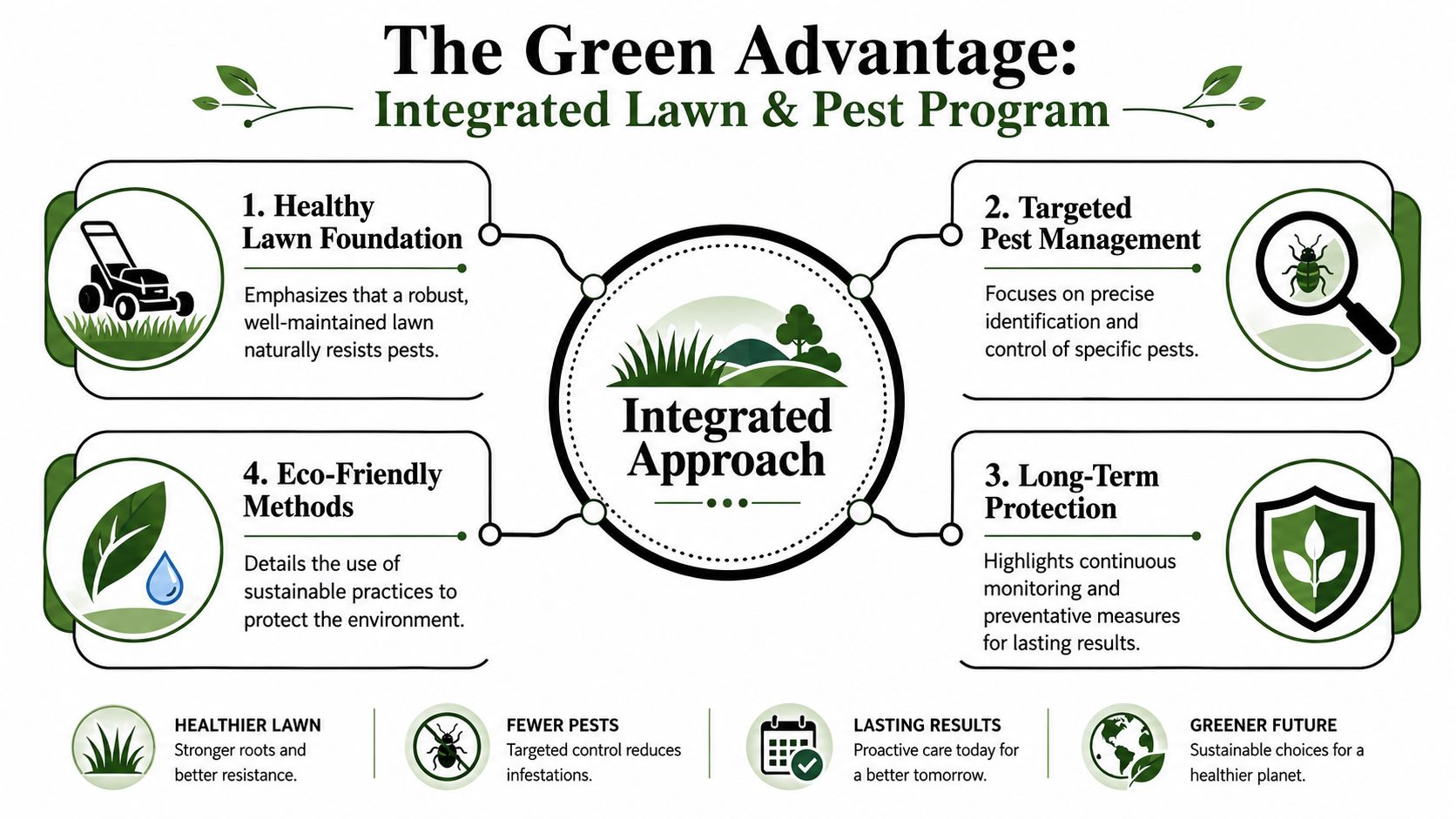
An integrated lawn and pest program works better because the yard, the foundation edge, drainage, shade, turf stress, and insect activity all affect each other. That perspective matters here in Northwest Indiana, where spring moisture, summer heat, and heavy clay soils can create pest pressure fast. A company that started in lawn care and grew into pest control brings a different set of eyes to the property. It sees how outdoor conditions feed indoor problems.
Why the lawn matters to pest pressure
Pests respond to conditions first.
Thin turf, excess thatch, standing water, compacted soil, overwatered areas, and overgrown edges create cover, moisture, and breeding space. Those conditions can support mosquitoes, ants, stinging insects, and other pests before they ever reach the house. Treat the pest without correcting the site conditions, and the problem often comes back sooner than homeowners expect.
Healthy turf helps, but it is not a cure by itself. Dense grass can reduce exposed soil and cut down on some harborage. Better drainage can make a yard less attractive to mosquitoes. Cleaner edges along patios, walkways, and foundations make inspections more accurate and treatments more targeted.
Why combining services can be smarter, and when it is not
A combined plan makes the most sense when the same outdoor conditions are driving both lawn stress and recurring pest activity. That is often the case on properties with damp low spots, shaded fence lines, heavy insect pressure around outdoor living areas, or repeated activity near entry points.
Separate service can still be the right choice in some situations. If the lawn is in good shape and the problem is a one-time interior issue, a standalone pest visit may be enough. If a homeowner already has a lawn specialist they trust, the better move may be coordination instead of replacement.
| Property situation | Integrated plan usually makes sense when | Separate service may make sense when |
|---|---|---|
| Yard and house both show recurring activity | exterior conditions are clearly driving repeat pest issues | pest issue is isolated and not tied to outdoor conditions |
| Family uses the yard often | mosquito reduction and perimeter prevention need to work together | lawn health is fine and only one interior pest issue needs attention |
| Turf problems and insect pressure overlap | technician needs to judge both site conditions and pest timing | homeowner already has a separate lawn specialist they want to keep |
The key trade-off is simple. One coordinated plan usually gives a clearer diagnosis and better timing. Separate services can work, but only if both sides are paying attention to the same conditions on the property.
What integrated management looks like in practice
Good integrated work does not mean applying more product. It means inspecting first, fixing favorable conditions where possible, and treating the right areas at the right time. That is the foundation of integrated pest management, and it fits homes in Crown Point especially well because no two lots hold moisture, shade, and pest pressure the same way.
For homeowners who want practical upkeep tips between service visits, SkipCalls' Lawn Care Advice offers a useful general reference on routine yard care.
A key advantage is coordination. When one team understands turf health, drainage patterns, pest harborage, and how insects move from the yard toward the structure, it can solve problems with fewer blind spots and a safer, more deliberate plan.
Common Seasonal Pest Threats in Northwest Indiana
Northwest Indiana doesn't have one pest season. It has several. Pest pressure shifts with temperature, rainfall, mowing patterns, moisture around foundations, and when insects and rodents start looking for food, water, or shelter.
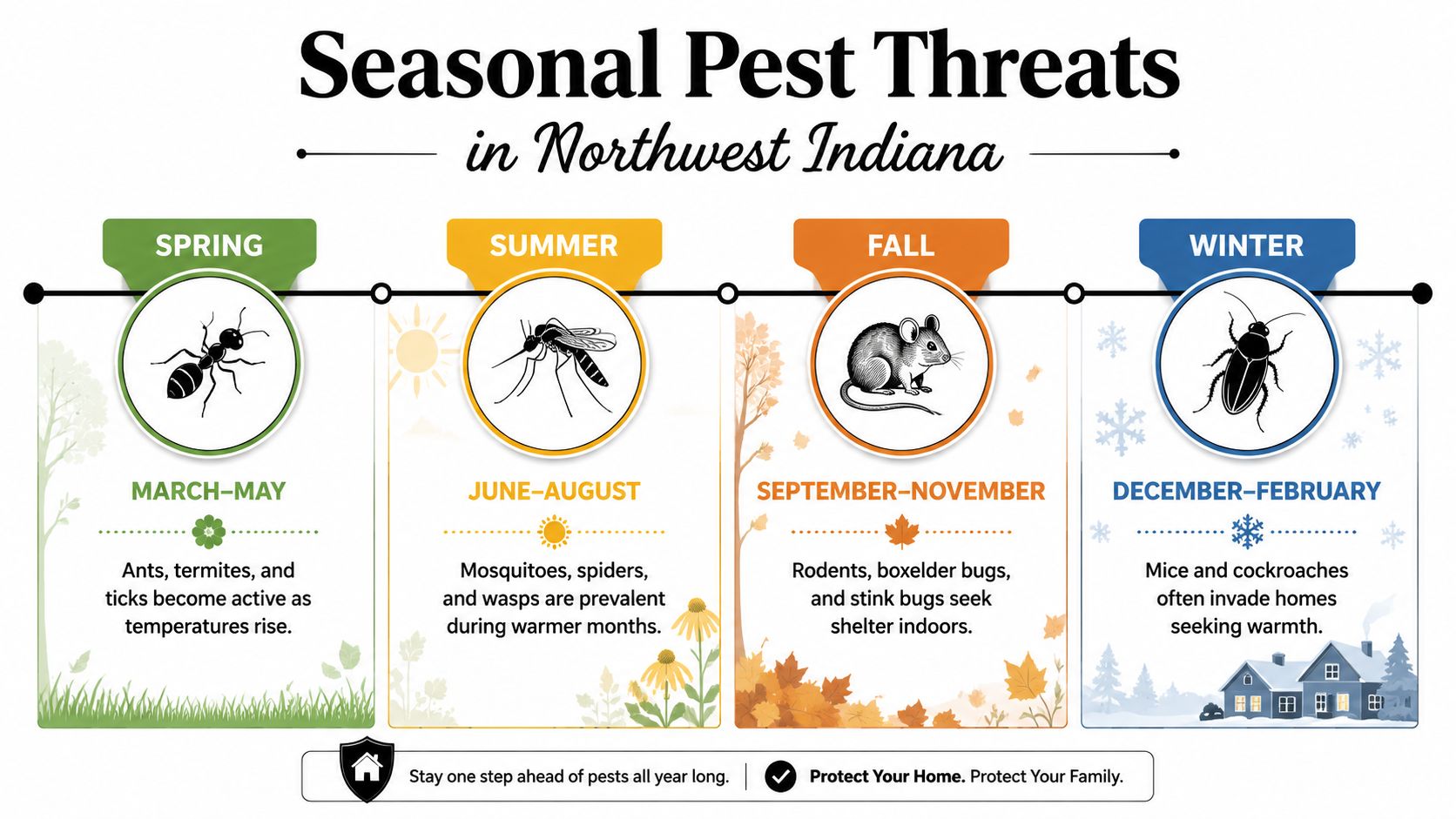
Spring and summer pressure around the yard
As the weather breaks, ants start foraging more aggressively. Spiders become more noticeable as insect activity builds around lights, soffits, and garages. Mosquitoes take advantage of standing water in gutters, low spots, toys, planters, and shaded zones that stay damp.
Wasps also become more active as nesting sites develop under eaves, around play sets, in sheds, and near entry points. The mistake many homeowners make is waiting until activity feels severe. By then, nests are established and mosquito breeding has already been underway.
For lawn-related insects, timing matters just as much as product choice. The Massachusetts homeowner IPM guide notes that grub action thresholds are typically around 8 to 10 grubs per square foot and that some insecticide timing works best 2 to 3 weeks after peak moth flight activity, which shows why measured density and lifecycle timing beat guesswork (homeowner IPM timing and thresholds).
Fall and winter invaders
When temperatures cool, the pest story changes. Rodents start exploring garages, utility penetrations, crawl spaces, and foundation gaps. Boxelder bugs, stink bugs, and other overwintering pests collect on sunny exterior walls and look for sheltered entry points.
Once they're inside, the issue stops being seasonal annoyance and starts becoming a household problem. That's why fall exclusion work matters so much. The best rodent control often starts before you ever hear scratching in a wall.
What to watch for by season
- Early warm weather: Ant trails, spider web buildup, and pest activity around mulch beds and foundation lines.
- Peak outdoor months: Mosquito pressure near shade and standing water, plus wasp activity near rooflines and outdoor gathering spaces.
- Cooling weather: Mice seeking shelter, insects gathering on siding, and more pest movement into garages and storage areas.
If a pest shows up in the same season every year, that's usually a prevention problem, not a surprise problem.
What doesn't work well
A one-size-fits-all schedule rarely works in Northwest Indiana. The pests aren't the same in April, July, and November, so the response shouldn't be either. Good service adjusts with the season, the property, and what the inspection shows.
Our Professional Residential and Commercial Pest Services
A good service plan starts with how the property functions. A single-family home in Crown Point has different pressure points than a restaurant, office, warehouse, or multi-unit building. The work should reflect that from day one.
Our background in both lawn care and pest control matters here. Outdoor pest pressure rarely starts at the door. It usually builds in turf, planting beds, moisture zones, shaded edges, trash areas, and along the foundation. Teams that understand those outdoor conditions can usually solve problems faster because they are treating the source, not just the symptom showing up indoors.
Residential pest control that addresses the source
In homes, the first job is finding out why the pest activity keeps returning. That means identifying the pest correctly, checking likely entry points, and looking at the conditions that support it. I look for gaps at doors and windows, garage transitions, mulch piled too high at the foundation, damp areas, cluttered storage, and signs that insects are feeding other pests.
Common residential concerns in Crown Point and nearby Northwest Indiana neighborhoods include:
- Ant control: Tracing where the colony is feeding and entering, then treating the source of activity.
- Spider control: Reducing web buildup, harborage areas, and the insect activity that keeps spiders around.
- Rodent control: Using traps, exclusion, and practical sanitation corrections together.
- Wasp removal: Removing active nests and reducing repeat activity near doors, patios, soffits, and play areas.
- Mosquito control: Treating resting areas outdoors and cutting down breeding sites where possible.
- Termite and inspection work: Checking for hidden risk factors before damage becomes obvious.
The trade-off is straightforward. Quick spray-only service may knock activity down for a short time, but recurring issues usually call for exclusion, habitat correction, and follow-up.
Commercial pest control requires consistency and documentation
Commercial work has less room for guesswork. Property managers, business owners, and facility teams need clear records, reliable scheduling, and service that fits how the building is used. A retail storefront, professional office, food service space, and multi-tenant property each create different risks.
Consistency matters more than one heavy treatment. If staff keeps seeing pest activity, there is usually an unresolved access point, sanitation issue, or exterior condition feeding the problem. The right plan accounts for traffic patterns, storage practices, delivery areas, dumpsters, utility penetrations, and seasonal changes around the building.
Why IPM fits both home and business service
Integrated Pest Management works because it combines inspection, monitoring, targeted treatment, and correction of the conditions pests need to thrive. For a company that grew from lawn care into pest control, that approach is a natural fit. The same property conditions that affect turf and plant health often affect insect and rodent pressure too.
That shows up in day-to-day service:
- Correct identification first: The plan changes depending on the pest, the season, and where activity is starting.
- Monitoring before over-application: Some problems need ongoing observation, not automatic over-treatment.
- Targeted product use: Materials should be applied where they will do the job, and only where they are warranted.
- Habitat correction: Moisture, food sources, entry points, and shelter usually need attention along with treatment.
The Green Advantage provides residential and commercial pest services in Northwest Indiana with that integrated approach. That gives homeowners and businesses a clearer answer to a common question. Lawn care and pest control work better together when the same team understands the whole outdoor environment around the property.
Protect Your Health Property and Peace of Mind
People sometimes treat pest control like an optional add-on until they've had a real infestation. Then the value becomes obvious very quickly. Professional service protects more than comfort. It helps protect the way a property functions day to day.
Health concerns aren't just about visible pests
Mosquitoes can make yards hard to use. Rodents can contaminate areas you don't check every day. Cockroaches and other indoor pests can spread through hidden spaces before activity becomes obvious. Even when the immediate issue seems minor, the stress it creates for a household is real.
Parents, pet owners, older adults, and anyone caring for guests usually want two things at once. They want the problem handled effectively, and they want a treatment approach that is thoughtful and site-specific.
A home feels different when you stop wondering what's crawling behind the wall, under the sink, or around the back door at night.
Property protection is part of routine maintenance
Exterior pest management belongs in the same conversation as lawn upkeep, drainage correction, and seasonal property care. The market itself reflects that scale. The U.S. landscaping services industry generated $188.8 billion in revenue in 2025, with about 1.32 million workers across roughly 635,000 firms, according to LawnStarter's landscaping industry statistics. That scale shows this isn't a niche service category. It's a normal part of maintaining residential and commercial property.
For homeowners, that means prevention usually costs less stress than repair. It's easier to keep rodents out than to clean up after them. It's easier to reduce mosquito habitat than to give up the yard all summer. It's easier to catch a developing issue at inspection time than after damage or repeated infestations.
Peace of mind has practical value
A pest-free home changes how people live in it. You use the patio. You stop checking the pantry every morning. You don't worry about hearing movement in the attic when the weather turns cold.
That peace of mind is why recurring service plans exist. They aren't just about treatment. They're about keeping small issues from turning into disruptive ones.
The Green Advantage Process from Start to Finish
Homeowners usually feel better once they know exactly what happens after they call. A clear process removes a lot of the uncertainty.
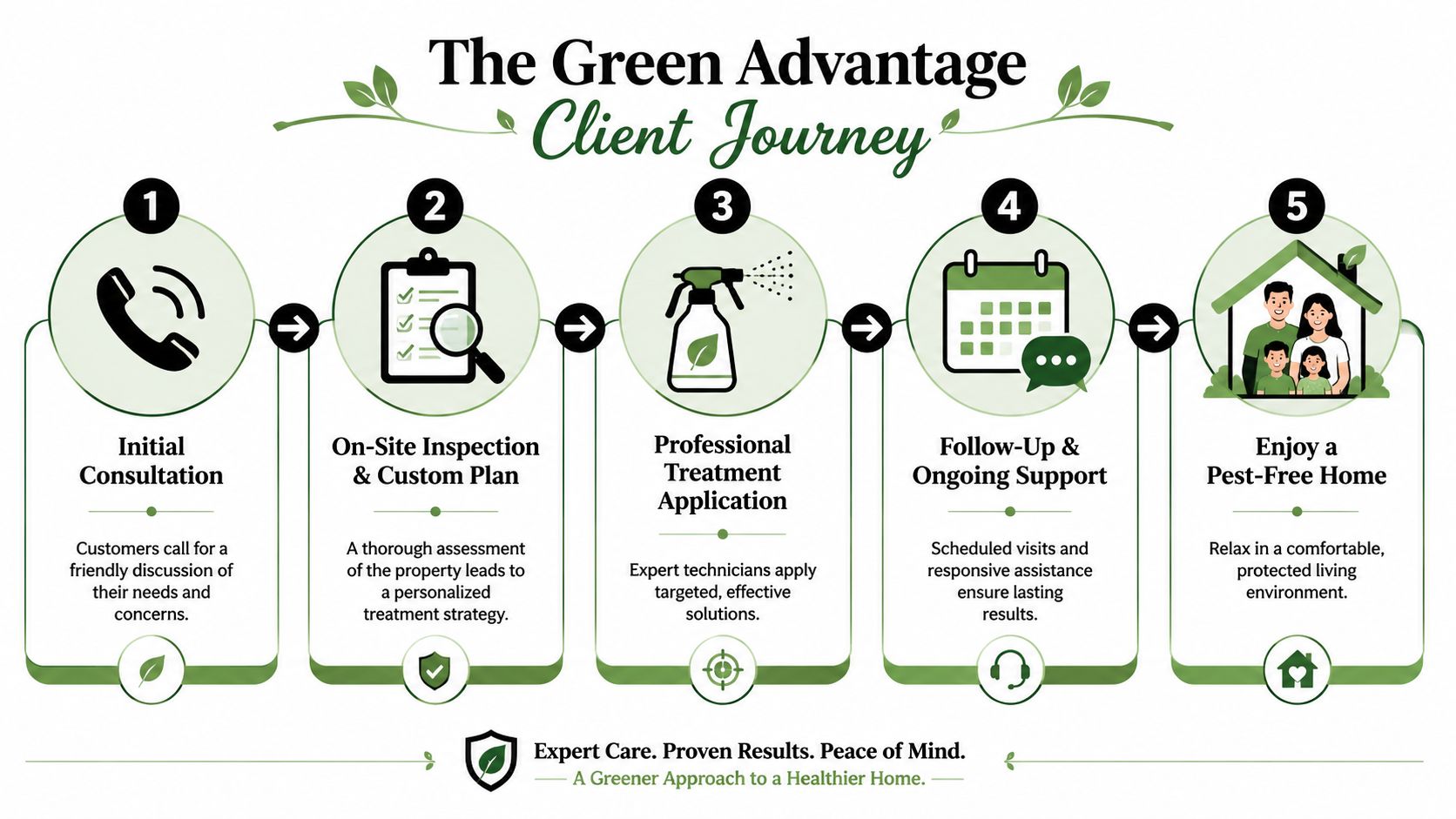
Step one through step three
The process starts with a real conversation. Office staff gathers the basics, including what pests you're seeing, where activity is happening, how long it's been going on, and whether there are outdoor conditions that may be contributing.
Then comes the on-site inspection. That's where a technician checks the structure, the exterior zones that matter, and the signs that separate a surface-level nuisance from a recurring pattern. After that, the property gets a customized treatment plan rather than a generic script.
A typical early flow looks like this:
- Initial consultation: Discuss the pest issue, timing, and property concerns.
- Inspection: Identify the pest, contributing conditions, and likely access points.
- Treatment plan: Match service to the property instead of forcing the property into a preset package.
Treatment and follow-up
Once the plan is in place, treatment focuses on the right areas and the right methods. Depending on the issue, that may involve exterior applications, nest treatment, rodent control measures, monitoring devices, exclusion recommendations, or adjustments to outdoor conditions that are helping the infestation.
After service, good follow-up matters. Homeowners should know what was done, what activity may continue briefly, and what changes they can make to support longer-term control. For properties that also need guidance on keeping turf, ornamentals, and beds looking clean after outdoor service, this page on post-care perfection for turf trees and landscape beds is a helpful companion.
A pest plan should never feel mysterious. You should know what the technician found, why the treatment fits, and what happens next.
Why recurring service keeps growing
More property owners are choosing preventive plans because they want convenience and fewer surprises. The combined global lawn maintenance and pest control service market was valued at $97.3 billion in 2024 and is projected to reach $150 billion by 2035, with about 4.0% CAGR from 2025 to 2035, according to Wise Guy Reports' lawn maintenance and pest control service market overview. That projected growth points to steady demand for ongoing, preventive service rather than waiting for problems to escalate.
That trend makes sense. Many individuals don't want to keep starting from zero every season.
Schedule Your Pest Inspection in Crown Point Today
If you're searching for lawn care and pest control services near me, you're probably not looking for theory. You want a clear answer, a reliable appointment, and a plan that fits your home or business in Crown Point and nearby Northwest Indiana communities.

An integrated approach gives you that. Instead of looking at the lawn, the perimeter, and the pest issue as separate headaches, it treats them as connected parts of the same property. That leads to smarter inspections, more targeted service, and fewer blind spots.
What to do before you book
Before scheduling, it helps to make a short list of what you've seen and where you've seen it. Note whether activity is worse after rain, during evening hours, or in certain rooms or sections of the yard. If you're coordinating with family members, tenants, or staff, consistent reminders can also make appointments easier to keep. This article on Call Loop for better appointment reminders has practical ideas for reducing missed visits.
When homeowners are ready to act, they usually want three things:
- A prompt inspection
- An explanation in plain language
- A treatment plan that respects the property and the people living on it
For a closer look at the kind of service homeowners are often looking for, this short video gives helpful context.
If pests are interrupting your yard, creeping into your home, or making you second-guess your property maintenance, now's the right time to get it checked.
Contact The Green Advantage to schedule a pest inspection, request a quote, and get a practical plan for your Crown Point home or Northwest Indiana property.
Expert Tick Control Near Me in Crown Point, IN

A 2022 survey of 140 vector-borne disease professionals found that 97.6% of respondents who could comment said their jurisdiction did at least one form of tick surveillance, while fewer than half reported routine active surveillance and nearly two-thirds reported passive surveillance, which tells you tick control starts with knowing where ticks are instead of spraying blindly (survey findings on U.S. tick surveillance). If you're finding multiple ticks on pets, seeing them after yard work, or living beside woods, brush, or unmanaged edges in Crown Point, it's time to call for professional tick control.
You want to enjoy your yard without second-guessing every step through the grass. That could mean kids playing near the fence line, the dog cutting through shrubs, or friends staying outside after dinner instead of heading in early because everyone is checking ankles and socks.
In Northwest Indiana, that concern usually starts the same way. Someone finds a tick after mowing, a pet comes inside with one attached, or a family realizes the problem seems worst near the back edge of the property where lawn meets trees and leaf litter. That's the point where basic prevention may not be enough.
Enjoy Your Crown Point Yard Without the Worry of Ticks
A lot of homeowners in Crown Point call about ticks after a simple moment changes how they feel about their own yard. The family barbecue is still on. The patio looks great. Then somebody spots a tick crawling on a pant leg, or the dog needs another check before coming inside. The space is still beautiful, but it doesn't feel relaxing anymore.
That shift matters because people don't hire tick control just to remove a nuisance. They want to use their property again without worrying every time kids play near shrubs, a pet cuts along the fence, or someone walks out to the woodpile.

What homeowners notice first
Most yards with tick pressure don't look neglected. In Crown Point and the surrounding Northwest Indiana area, the problem often shows up on otherwise well-kept properties with a few risk features:
- Wooded borders: Lawn that backs up to trees, drainage areas, or brush holds more shade and moisture.
- Yard clutter: Leaf litter, ornamental beds, stacked firewood, and overgrown edges give ticks cover.
- Pet traffic: Dogs often pick up ticks first because they move through perimeter areas people don't pay attention to.
- Wildlife movement: Deer and other animals travel the same edges and carry ticks back into the property.
Ticks don't use a yard evenly. They collect where cover, moisture, and hosts come together.
A good tick service starts by identifying those pressure points. It doesn't start with treating every square foot the same way.
When the problem needs more than maintenance
Homeowners can do a lot with mowing, cleanup, and pet checks. But if you're seeing recurring activity, especially near the same edge zones, that's usually a sign the population is tied to habitat around the property. In those cases, the right answer isn't more guesswork. It's a focused inspection and a treatment plan built around where ticks survive.
Why Ticks Are a Growing Concern in Northwest Indiana
Ticks aren't just a problem in a few isolated pockets anymore. The CDC says that by 2025 the lone star tick is estimated to be widely distributed in the Northeast, South, and Midwest United States, with established populations across a broad multi-state range. The CDC also identifies the lone star tick as a particularly aggressive human biter and notes that nymphs and adult females most frequently bite humans and spread disease (CDC lone star tick surveillance overview).
That matters in Crown Point because our area has many of the environmental characteristics that support tick activity. Neighborhoods near wooded lots, park edges, creek corridors, and unmanaged vegetation create the kind of transition zones where ticks persist. Even a tidy property can have a problem if the back line stays shaded, humid, and connected to nearby habitat.
Why local yards create risk
Ticks do well where lawn meets cover. In Northwest Indiana, that often means the strip behind the shed, the mulch bed along the fence, the brushy side yard, or the rear lot line that blends into trees. Homeowners often assume the open lawn is the issue because that's where people walk. In practice, the pressure usually starts at the margins and moves inward through pets, wildlife, and foot traffic.
A second issue is visibility. Ticks don't announce themselves the way wasps, ants, or rodents do. Families may have activity on the property for a while before they connect it to a recurring pet issue or a bite after yard work.
Why this isn't just a rural problem
Suburban properties get hit too, especially where development sits close to natural areas. Larger lots, privacy plantings, and decorative beds can all create pockets of shade and moisture. That's one reason homeowners searching for tick control near me often aren't dealing with a wild property. They're dealing with a normal residential yard with a few high-risk features.
If you've already had concerns about species identification or disease questions, it helps to understand brown dog tick disease and related risks so you can separate general worry from the conditions that require service.
DIY Prevention vs Professional Tick Control Services
A lot of Crown Point homeowners do the right basic maintenance and still end up finding ticks on a dog, on pant legs, or near the back edge of the yard. That usually happens because routine upkeep lowers risk, but it does not always stop tick activity coming from shaded borders, pet routes, and wildlife travel corridors common across Northwest Indiana.
What DIY does well
DIY prevention has real value. It reduces the conditions ticks prefer and makes service more effective when professional treatment is needed later.
Good homeowner prevention usually includes:
- Keep turf trimmed: Short grass is less favorable than damp, overgrown cover.
- Clear leaf litter: Debris along edges, beds, and under shrubs holds moisture where ticks last longer.
- Check pets often: Dogs often pick up ticks first, especially after time near fence lines, beds, or wooded edges.
- Use repellents when needed: Personal protection helps during yard work, gardening, and time spent near brush or heavy vegetation.
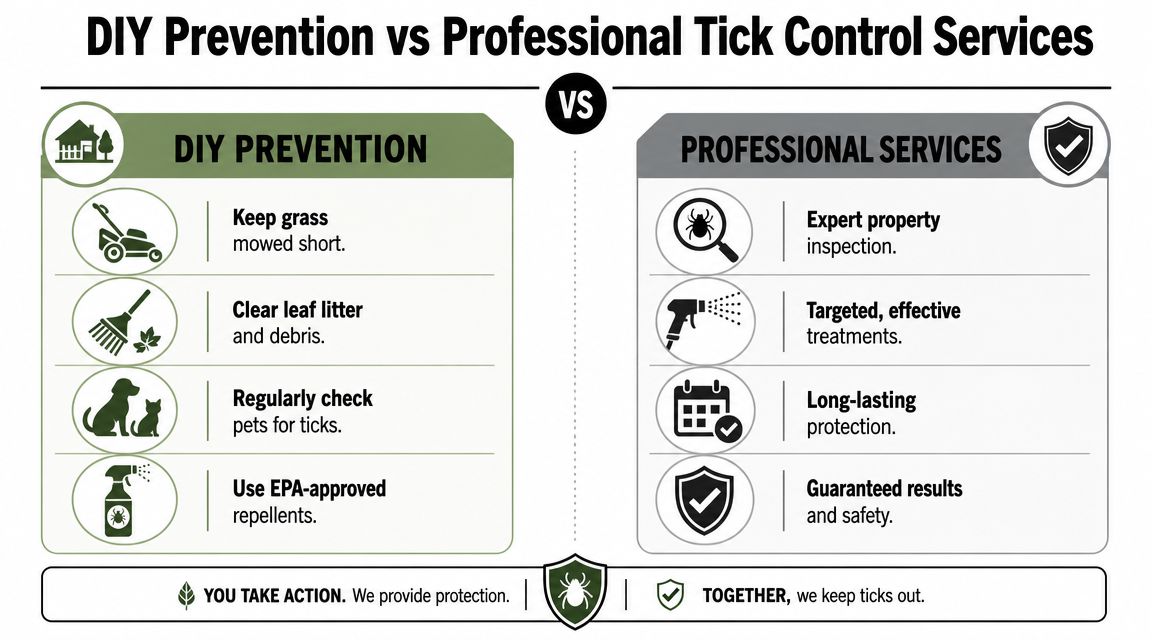
On lower-pressure properties, those steps may be enough to keep activity manageable for a while. On lots with tree lines, shaded bed edges, drainage swales, or neighboring natural cover, DIY work often slows the problem without fully suppressing it.
Where DIY starts to fall short
The biggest issue with store-bought tick control is coverage without strategy. Homeowners tend to focus on the open areas they see every day, while ticks hold in protected zones that stay cooler and more humid.
In Crown Point and nearby communities, those trouble spots are often the rear property line, the strip behind a shed, mulch along the fence, groundcover near ornamentals, or the side yard that stays shaded after rain. Treating every part of the yard the same way usually wastes material and misses the places where ticks persist.
That leads to a practical trade-off:
| Approach | Usually works for | Usually misses |
|---|---|---|
| Basic DIY cleanup | Lowering moisture and reducing hiding spots | Tick pressure coming from adjoining cover and repeated wildlife activity |
| Store-bought broad spray | Short-term treatment in obvious areas | Accurate placement, timing, and follow-up where ticks are most active |
| Professional service | Inspection, targeted applications, and season-long control planning | The routine trimming and cleanup the homeowner still needs to keep up |
A good professional service is not just a stronger version of DIY. It is a more precise one. The job is to inspect the property, identify where tick pressure is starting, and treat the zones that matter most instead of applying product everywhere.
Practical rule: If ticks keep showing up in the same part of the yard, the source is usually consistent habitat and host traffic, not random chance.
For homeowners weighing the difference between cleanup and targeted treatment, this guide to yard flea and tick control for residential properties can help clarify what a service plan should include beyond a one-time spray.
The Green Advantage Process What to Expect During Your Service
A good tick service visit should answer a simple question for a Crown Point homeowner: where are ticks likely coming from on this property, and what are we going to do about it?
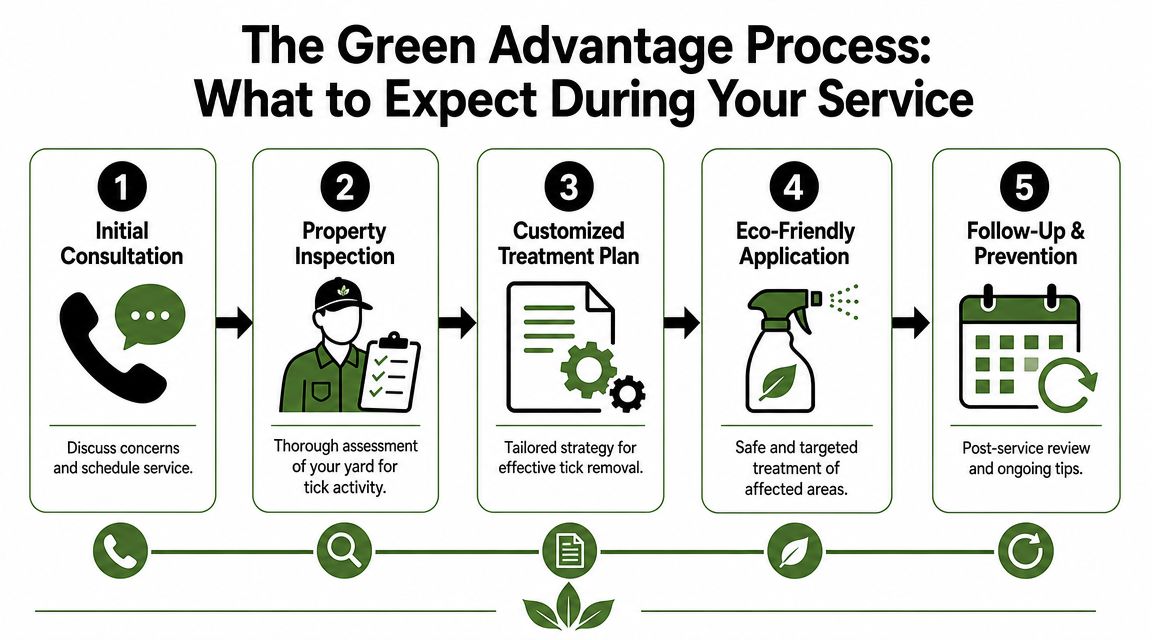
The visit starts with inspection, not guessing
The first step is a conversation on site. We want to know where ticks have been found, whether dogs cut the same route along the fence each day, which parts of the yard stay damp after a Northwest Indiana rain, and whether the property backs up to woods, drainage ground, or a brushy easement.
Then the inspection focuses on the places that hold moisture and host traffic. In Crown Point, that often means rear fence lines, shaded mulch beds, groundcover near ornamentals, wood lines, brush piles, and transitions where maintained lawn gives way to taller cover. Those edge zones matter because they are where people and pets usually brush against vegetation and pick ticks up.
A careful inspection also helps avoid treating low-risk areas that do not need it.
The treatment plan is built around the site and the season
Tick work in Northwest Indiana is not a one-size-fits-all service. A compact subdivision yard near open drainage ground has different pressure than a larger lot with mature trees and deer movement along the back edge. The treatment plan should reflect that difference.
Timing matters too. Guidance from the Indiana Department of Health on tick prevention and habitat reduction supports the same practical approach we use in the field: reduce contact in shaded edge habitat, manage the yard conditions ticks favor, and stay alert during the parts of the season when local activity rises. In Crown Point and nearby communities, that usually means paying close attention through spring, early summer, and again during the fall shoulder season when yards are still in use.
Good tick work focuses on the edges, the shade, and the travel paths. That is where pressure builds on real properties in our area.
For homeowners who want one local option, The Green Advantage provides residential pest control and outdoor pest services in Crown Point and Northwest Indiana with site-specific inspections and treatment recommendations.
A helpful part of any service is setting expectations. This short video gives a broader look at how pest professionals approach property treatment and prevention.
Follow-up matters more than most people expect
One visit can reduce active pressure, but lasting control usually depends on what happens after that first treatment. Nearby habitat, wildlife movement, heavy irrigation, and fast summer growth can all rebuild favorable conditions if nobody is watching the property over time.
That is why a serious service includes follow-up and clear homeowner guidance. You should know when treated areas are safe to reenter, what cleanup steps will support the work, and which spots need extra attention between visits. On some properties, the trade-off is straightforward. More frequent monitoring gives better control along difficult edges, while lighter service may be enough for a yard with limited shade and fewer habitat pockets.
The goal is a yard that is being managed on purpose, not sprayed on a generic schedule.
Protecting Your Health Property and Peace of Mind
A Crown Point yard should feel like part of the home, not a place where you second-guess every trip to the swing set, fire pit, or fence line. Tick control helps reduce that stress by lowering contact in the areas where ticks are most likely to wait for people and pets.
That matters because the risk is not only about comfort. Ticks in Northwest Indiana can carry diseases that affect people and animals, and the Indiana Department of Health advises prevention steps such as avoiding tick habitat, checking for ticks after time outdoors, and reducing exposure around the home (Indiana Department of Health Lyme disease guidance).
What tick service really gives you
Good tick service changes how a property functions day to day.
- More confidence outdoors: Family members, visitors, and pets can spend time outside with less concern about brushy edges and shaded transition zones.
- Usable space again: Backyards feel more practical when play areas, patios, and dog paths are not bordered by untreated harborage.
- A clearer risk-reduction plan: Instead of guessing whether activity started in your yard or came in from a neighboring lot, you know the pressure points are being addressed on purpose.
The trade-off is important to understand. Professional service lowers tick pressure, but no responsible company should promise zero ticks or zero disease risk. In Crown Point and across Northwest Indiana, deer movement, mice, wooded borders, and adjoining untreated properties can keep introducing new ticks. Strong control means reducing exposure as much as possible and staying ahead of the conditions that support them.
The practical goal is a yard with lower tick activity, fewer pickup points, and a plan that fits the way your property is actually used.
Why whole-property pest care often makes sense
Ticks often show up in the same parts of the yard that support other outdoor pest problems. Moist shade behind shrubs, leaf buildup along fences, clutter near sheds, and overgrown edges can also contribute to mosquito resting sites and general pest activity.
For many homeowners in our area, treating the property as a whole gets a better result than looking at ticks by themselves. That does not mean every yard needs every service. It means the inspection should account for how the lot drains, how much tree cover it has, where pets travel, and what borders the property. In Crown Point neighborhoods with mature trees, drainage swales, and wooded edges, that local context makes a real difference.
Your Checklist for Tick Control Service in Crown Point
A good tick program starts with good questions. In Crown Point, that matters because one yard may back up to a drainage swale or wooded edge, while the next sits in full sun with far less tick pressure. The right provider should be able to explain that difference and show how it changes the service plan.
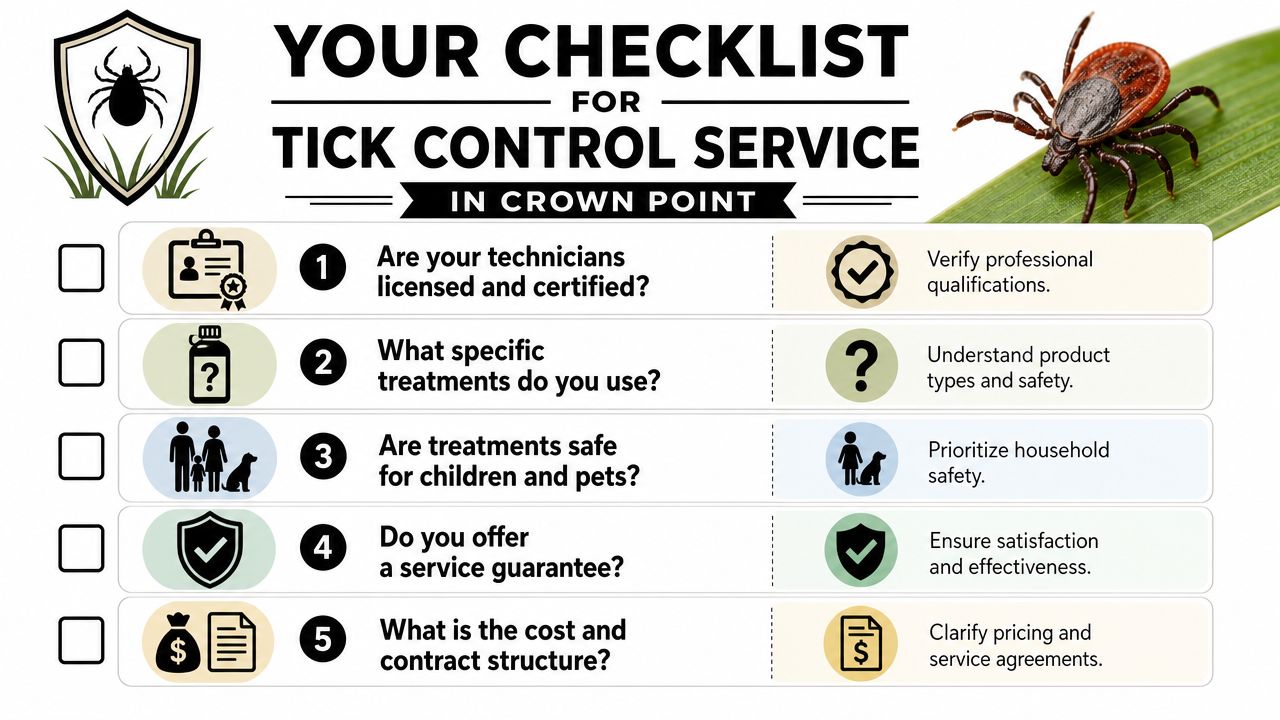
Questions worth asking before you book
Use this checklist when you're getting quotes for tick control in Crown Point:
- Ask about licensing: Make sure the technicians are properly licensed for pesticide application in Indiana.
- Ask what gets treated: A good company should explain whether it targets fence lines, bed edges, wooded borders, shrubs, and other high-risk areas where ticks tend to hold.
- Ask about family and pet guidance: You should get clear instructions for before and after treatment, including when the yard can be used again.
- Ask whether follow-up is included: Tick control usually works better as an ongoing plan than a single visit, especially during active season in Northwest Indiana.
- Ask how pricing is structured: Cost usually depends on property size, habitat complexity, level of activity, and service frequency.
What a strong answer sounds like
Specifics matter. A useful answer sounds like this: we inspect the property first, identify shaded edge habitat, point out cleanup or trimming that will reduce tick harborage, treat the areas where ticks are most likely to quest, and set a follow-up schedule based on the conditions on your lot.
That level of detail is important in our area. Crown Point properties often have the exact features that keep ticks active longer, including mature trees, leaf litter, heavy foundation plantings, fence lines, and neighboring untreated ground. A company that treats every yard the same will miss those pressure points.
Look past the first visit price. Ask whether the company understands why ticks are showing up on your property and whether the plan fits how your family uses the yard. That usually tells you more than a low quote ever will.
If you're in Crown Point or nearby Northwest Indiana and want a clear plan for tick control, contact The Green Advantage. We'll answer your questions, review the conditions on your property, and help you decide whether a targeted treatment program makes sense for your yard, pets, and outdoor routine.
Brown Dog Tick Disease in NWI: Prevention & Control 2026

You find a tick on your dog after a walk, remove it, and hope that's the end of it. Then a few days later you spot another one near the dog bed. After that, one shows up on the baseboard. That's the moment many homeowners in Crown Point realize they may not be dealing with a one-time outdoor pest.
Brown dog tick disease worries people for good reason. The health concern isn't just the bite itself. It's the possibility that a dog has been exposed to more than one pathogen, and that signs of illness may be vague or delayed. For Northwest Indiana families, the bigger problem is often practical. Vet advice helps protect the dog, but it doesn't solve a seeded infestation inside the home.
That's where a lot of frustration starts. Homeowners do the right things. They check their pets, wash bedding, vacuum, and use prevention products. Yet the problem keeps coming back because the brown dog tick behaves differently from the ticks commonly considered.
Your Trusted Exterminator for Tick Control in Crown Point IN
A Crown Point pet owner usually notices this issue in stages. First, a dog comes in scratching more than usual. Then someone finds a small brown tick attached near the ear or between the toes. By the weekend, the family is checking blankets, crate seams, and corners of the room, wondering if this is a yard problem or a house problem.
With brown dog ticks, that distinction matters.
Unlike the outdoor tick problems many Northwest Indiana homeowners expect in spring and summer, this one can turn into an indoor infestation tied closely to where dogs rest, sleep, and travel through the house. That changes the response completely. Treating only the yard or relying only on pet products often leaves part of the problem untouched.
Local reality: In homes with dogs, tick control isn't just about what's outside. It's often about what hitchhiked indoors and stayed there.
Homeowners searching for pest control near me, exterminator near me, or pest control in Crown Point, IN are usually looking for clear answers fast. They want to know whether the ticks they're seeing are dangerous, whether their dog could get sick, and whether the home itself now needs treatment.
In Crown Point and nearby Northwest Indiana communities, that concern is understandable. Families want a practical plan, not alarm. The right approach starts with identifying whether the pest is the brown dog tick, then deciding whether you're dealing with isolated exposure or a breeding population inside the structure.
That's the difference between casual advice and real pest control. For a live indoor tick issue, the goal isn't just to remove what you can see. The goal is to break the cycle where ticks keep reappearing in the same rooms, on the same pet, and around the same resting areas.
Identifying the Brown Dog Tick Problem in Your Home
The brown dog tick is easy to underestimate because it doesn't always arrive with the same outdoor warning signs homeowners associate with wooded lots or tall grass. In many cases, the first clue is repeated tick sightings on the dog or around indoor pet areas.
What makes this tick different
The most important thing to understand is that the brown dog tick is uniquely suited to indoor life. According to PetMD's overview of brown dog ticks, it is the only tick species that can become fully established indoors in homes and kennels, and a single engorged female can lay up to 3,000 eggs. That's why one overlooked tick can become a much bigger problem.
Most ticks depend more heavily on wildlife and outdoor habitat. Brown dog ticks are different. They stay close to dogs and exploit indoor hiding places such as:
- Cracks and crevices around baseboards, trim, and flooring
- Pet resting areas including beds, crates, blankets, and furniture
- Utility spaces like laundry rooms, garages, and kennel-style setups
- Travel paths where dogs repeatedly lie down or brush against walls
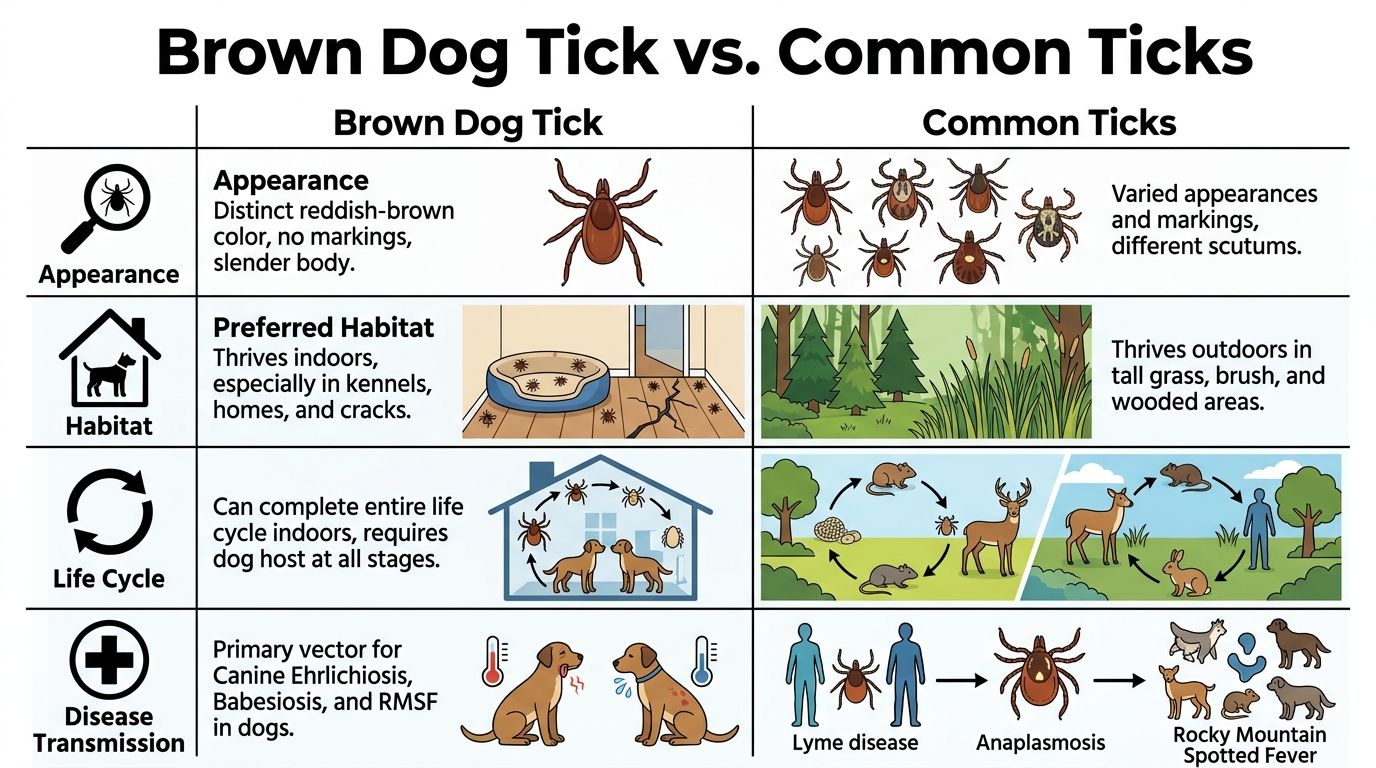
What homeowners usually notice first
You may not identify the species immediately, but the pattern often gives it away. Brown dog tick issues tend to show up where the dog spends time, not just where people enter from the yard.
A few signs stand out:
| Sign | Why it matters |
|---|---|
| Repeated ticks on the same dog | Suggests ongoing exposure rather than a one-off hitchhiker |
| Ticks near bedding or crates | Points toward indoor harborages |
| Sightings in cooler months | Indicates the problem may not be tied only to seasonal outdoor activity |
| Ticks on walls or baseboards | Often means the infestation has spread beyond the pet |
Brown dog ticks are generally brown to reddish-brown, without the more obvious patterned look some other tick species have. Homeowners often describe them as small, plain, and easy to miss until they move.
If you're removing ticks from your dog at home, use a proper method instead of twisting, crushing, or applying folk remedies. This guide on how to remove ticks safely from dogs gives a clear, simple overview.
What doesn't work well
Many homeowners try to solve this by deep cleaning alone. Cleaning helps, but it rarely finishes the job once ticks have dispersed into cracks, seams, and protected indoor areas. The same goes for treating only the pet. If the house is seeded, the dog can keep getting re-exposed.
That's why identification matters early. If you're seeing ticks indoors more than once, especially near dog areas, treat it as a structural pest issue and not just a grooming problem.
Brown Dog Tick Disease Risks to Your Pets and Family
When people say brown dog tick disease, they usually mean one of two things. Either they're asking whether this tick can make a dog sick, or they're referring to a vague set of symptoms after a tick bite. The problem is that this phrase sounds singular when the underlying problem often isn't.
It's not one disease
Research summarized in a peer-reviewed review of brown-dog-tick-associated pathogens makes the key point homeowners and even some pet owners miss. A dog may not have a single brown dog tick disease. The tick can carry multiple pathogens, and there is a high prevalence of coinfection. The same review notes that symptoms may be vague, subclinical, or delayed.
That matters because a dog with fever, low energy, anemia, appetite loss, or weight loss may not be dealing with one straightforward infection. Diagnosis can require testing rather than guesswork.
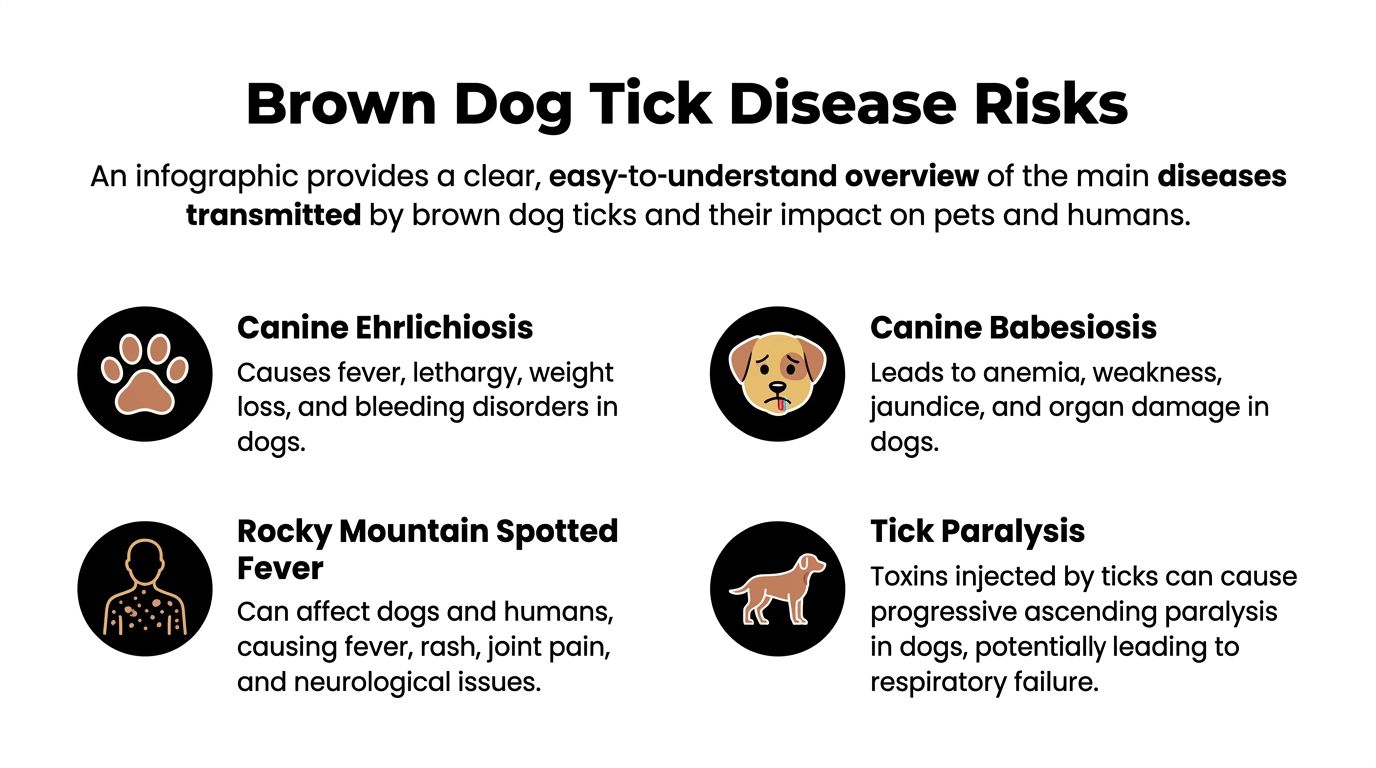
The main health concerns
Brown dog ticks are linked with several important diseases in dogs. The ones homeowners hear about most often include:
Canine ehrlichiosis
This can involve fever, lethargy, weight loss, and bleeding disorders.Canine babesiosis
This may lead to anemia, weakness, and other systemic illness.Rocky Mountain spotted fever
This matters because brown dog ticks have historically been recognized as an important vector of RMSF in certain parts of the United States.
Some of these illnesses can overlap in how they look at home. A tired dog that skips meals and seems “off” doesn't give you enough information to tell one infection from another. That's why veterinary testing matters so much after known exposure.
For a broader homeowner view of persistence and survival, it also helps to understand how long ticks can live. Longevity affects how long a hidden infestation can keep producing problems after the first sighting.
Why delayed symptoms make infestations harder
A frustrating part of brown dog tick disease is timing. Owners often expect a clear cause-and-effect pattern. Tick bite today, sick dog tomorrow. Real life isn't that neat.
The video below gives useful visual context on tick risks and what pet owners should watch for.
Symptoms can show up long after the tick was removed. That delay creates two separate risks:
- Medical delay because the household may not connect current illness with an earlier tick exposure
- Control delay because the infestation source inside the home may continue unchecked
A tick problem can outpace your diagnosis timeline. By the time a dog looks sick, the house may already have an established population.
What about people
Human risk needs a balanced explanation. Brown dog ticks are best known as a major veterinary pest, but they also matter from a public health standpoint. Homeowners don't need panic. They do need clarity.
If ticks are appearing indoors, especially in rooms where pets spend time, families should take the issue seriously. Daily checks, prompt removal, and veterinary evaluation for concerning symptoms are the practical first steps. For the home itself, repeated sightings mean the environmental source needs attention too.
A Homeowner's Guide to Tick Prevention
Homeowners in Crown Point usually start in the right place. They use vet-recommended preventives, inspect their dogs after time outside, wash pet bedding, and try to keep the yard less inviting. None of that is wasted effort. In fact, those habits are the foundation of good tick prevention.
What you should keep doing
If you want to lower exposure, these steps matter:
- Check your dog daily after walks, boarding, grooming visits, or time in the yard
- Use veterinary prevention consistently instead of waiting for warm weather
- Wash bedding and vacuum carefully around pet sleeping areas
- Keep outdoor areas maintained so dogs aren't brushing through overgrowth unnecessarily
Year-round prevention matters because modern guidance recognizes that seasonal treatment alone doesn't address a tick that can persist indoors. Ohio State notes this shift in its brown dog tick fact sheet, especially because the species can continue reproducing in protected environments.
Where DIY prevention falls short
The mistake isn't doing too little for the dog. It's assuming pet-only prevention solves a home infestation.
A dog can be protected and still carry in a live tick before that product does its work. Bedding can be washed while ticks remain in cracks, behind trim, or near crate hardware. The yard can be improved while the primary breeding pressure is inside.
That's why prevention and elimination are different jobs.
If your concern includes outdoor exposure around decks, fence lines, and dog run areas, this guide to the best flea and tick control for yard is a useful starting point. Just keep in mind that a brown dog tick issue may require more than a yard-focused plan.
Practical rule: If you've treated the dog, cleaned the house, and still keep seeing ticks indoors, stop thinking in terms of maintenance and start thinking in terms of infestation control.
The trade-off homeowners need to understand
Home prevention reduces odds. It doesn't always remove hidden life stages once the problem is established. That's the hard truth with brown dog ticks.
For a one-off outdoor hitchhiker, home care may be enough. For repeated indoor sightings, the trade-off changes. Waiting can save money today, but it often gives the infestation more time to spread through the exact areas that are hardest for homeowners to treat completely.
How Professional Pest Control Eliminates Brown Dog Ticks
Brown dog tick control works only when the treatment plan matches the way this tick lives. That means the solution can't focus on one zone alone. You have to account for the animal, the structure, and the outside areas that may support reintroduction.
Why the environment has to be treated
The canine health issue and the pest issue move on separate timelines. According to the AKC Canine Health Foundation's guidance on canine tick-borne disease, symptoms of diseases such as canine ehrlichiosis may not appear for months after transmission. That long latency matters because the infestation can continue spreading before illness is recognized.
That's why professional treatment targets the source. If ticks are living in the home, waiting for symptoms or relying only on what's visible won't stop the cycle.
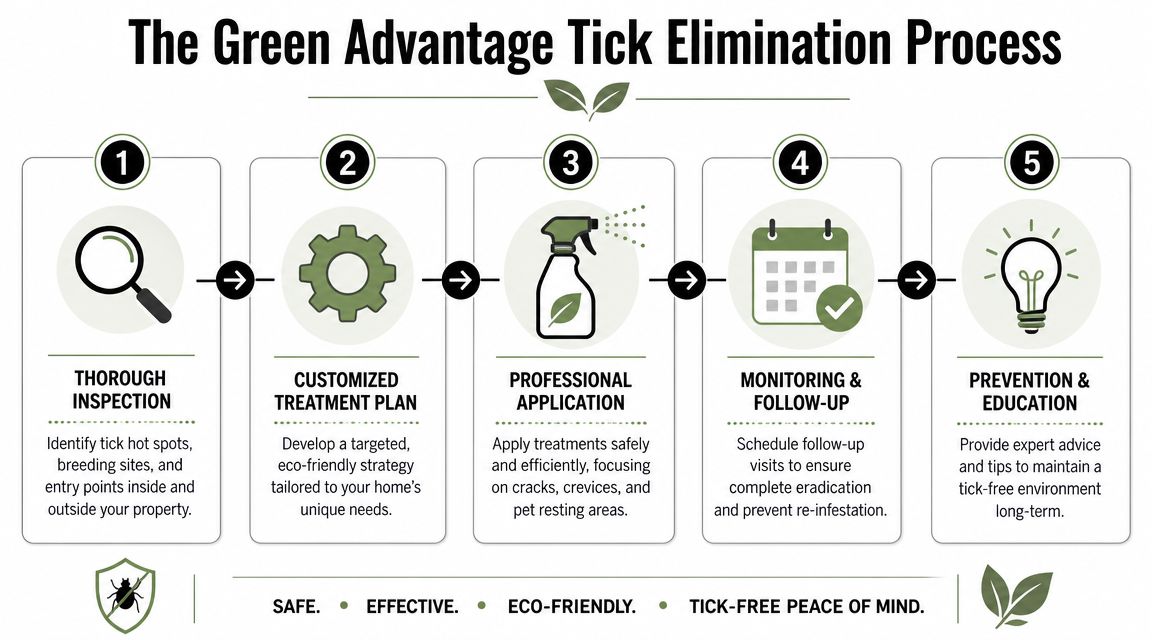
What an effective control program includes
A serious brown dog tick treatment plan usually has several parts working together:
Inspection of indoor hotspots
Technicians look closely at baseboards, pet bedding zones, crate areas, upholstered edges, utility rooms, and other protected harborage sites.Targeted interior treatment
The goal is to reach places homeowners commonly miss, especially tight cracks, seams, and resting areas associated with dogs.Exterior attention where needed
While brown dog ticks are known for indoor persistence, the outside still matters when pets move through kennels, patios, runs, or perimeter areas.Coordination with veterinary care
Pest control handles the environment. A veterinarian handles the dog's medical prevention, testing, and treatment decisions.Follow-up and monitoring
Tick control is rarely about one spray and done thinking. Rechecks help confirm the cycle has been broken.
What works and what usually disappoints
Homeowners often ask whether foggers, single over-the-counter sprays, or constant laundering can solve it. Those tools may reduce visible activity, but they often underperform when ticks are tucked into inaccessible spots.
Professional service is stronger because it's systematic. It treats where ticks hide, not just where people notice them.
A good program also respects the home as a lived-in space. Families want treatment that is effective, clearly explained, and mindful of pets and daily routines. That same whole-property thinking often helps with related residential pest control concerns in Northwest Indiana, including mosquitoes, ants, spiders, and rodent pressure around the exterior.
Why local pest control matters in Northwest Indiana
In Crown Point and surrounding communities, homes vary a lot. Some have finished basements, attached garages, mudrooms, or pet transition spaces that change how pests move indoors. A local exterminator in Crown Point, IN looks at those practical conditions instead of applying a generic script.
That matters because successful tick work depends on finding the actual pressure points in the home, then matching treatment and follow-up to those exact conditions.
Working With The Green Advantage in Crown Point
Hiring a pest control company shouldn't feel like handing over your home and hoping for the best. Homeowners want straight answers, a clear process, and people who understand how pest issues show up in Northwest Indiana properties.
What a good service experience looks like
When you work with a local provider for residential pest control or commercial pest control, the experience should be simple. You call. You describe what you're seeing. A knowledgeable team helps sort out whether the issue sounds urgent, structural, or pet-related, then schedules an inspection that fits the problem.
On site, a technician should do more than glance around and recommend a generic treatment. Tick issues require questions. Where does the dog sleep? Have ticks been found in one room or several? Have there been recent boarding visits, travel, grooming appointments, or sightings around the yard?

Why local matters
A Crown Point company serving Northwest Indiana brings practical familiarity with the kinds of homes, seasonal habits, and pet routines common in the area. That doesn't mean every tick problem is the same. It means the inspection starts with realistic assumptions and then gets specific.
Here's what homeowners usually value most:
- Clear communication so they know what was found and what happens next
- Customized treatment plans instead of one-size-fits-all packages
- Respect for family routines including pet safety, access needs, and follow-up timing
- Broader pest knowledge when tick issues overlap with mosquito control, wasp removal, spider activity, or rodent concerns around the property
The best pest service isn't the one with the longest script. It's the one that can look at your home, identify the real source, and explain the fix in plain language.
What builds trust
For most families, trust comes from consistency. The phone gets answered. Questions get addressed without jargon. The technician arrives prepared, inspects thoroughly, and explains what's realistic.
That matters for tick work because homeowners are often stressed before the appointment even starts. They're worried about their dog, their furniture, their kids, and whether they somehow caused the problem. A reliable local provider helps take that uncertainty down to size and turns it into a practical plan.
Schedule Your Tick Inspection and Protect Your Home Today
If you're finding ticks on your dog more than once, or seeing them around beds, baseboards, crates, or furniture, don't treat it like a minor nuisance. Brown dog tick problems can linger inside the home, and waiting usually gives them more time to spread.
The right next step is simple. Get the property inspected, identify where the ticks are hiding, and build a plan that addresses the house and the pet environment together. That protects your dog, reduces repeat exposure, and gives your family confidence that the problem is being handled completely.
For homeowners and property managers looking for pest control in Crown Point, IN, exterminator near me, or practical help with a stubborn indoor tick issue, local service makes the process easier. You need an inspection, honest guidance, and treatment that fits how the problem behaves in Northwest Indiana homes.
If you need help with brown dog ticks, The Green Advantage provides local pest control support for Crown Point and nearby Northwest Indiana communities. Reach out to schedule an inspection, request a quote, and get a clear plan to protect your home, your pets, and your peace of mind.
Is Pest Control Worth It? Crown Point 2026 Guide

You notice the problem at the worst time. Maybe it's a line of ants along the kitchen baseboard before work, scratching in the wall when the house is finally quiet, or a wasp circling the back patio when the kids want to go outside. In that moment, most homeowners in Crown Point ask the same question: Is pest control worth it, or should I just handle it myself?
The honest answer is that it depends on what you're dealing with, how long it's been going on, and what could happen if it keeps going. A one-off insect near a door isn't the same as recurring ants, rodents in the attic, or termites working out of sight. In Northwest Indiana, pest issues often follow the seasons, moisture, and easy access points around the home, so what looks minor can turn into an ongoing problem fast.
For many homes and commercial properties, pest control isn't just about getting rid of what's crawling around today. It's about protecting the structure, the food storage areas, the wiring, the insulation, and the people living or working inside.
Is Professional Pest Control Truly Worth It in Crown Point
A lot of people call only after they've tried to wait it out. They wiped up the ant trail. They set a couple of traps. They sprayed the corner where they saw a spider. Then the pests came back.
That pattern matters. If the issue repeats, the question usually changes from "Can I kill what I see?" to "Why does this keep happening?" That's where professional pest control starts to earn its value.
What homeowners are really paying for
You're not just paying for a spray treatment. You're paying for someone to identify the pest correctly, find where it's nesting or entering, and choose a treatment plan that fits the home and the season.
In Crown Point, that often means looking at more than the obvious symptom:
- Ants in the kitchen might trace back to moisture, exterior cracks, or hidden activity behind cabinets.
- Rodents in winter usually point to entry gaps, garage issues, attic access, or food sources that stay available.
- Wasps around the eaves often mean a nest is developing in a place that gets overlooked until traffic around the home increases.
- Mosquito pressure in the yard usually ties back to standing water, shaded harborage, and recurring outdoor conditions.
Practical rule: If you're treating the same pest more than once and still seeing activity, you're no longer dealing with a simple nuisance.
When the answer is yes
For many local homeowners, the answer to "is pest control worth it" is yes when any of these are true:
- The problem keeps returning
- You can't find the source
- The pest can damage property
- You don't want to guess around children or pets
- You want prevention instead of another surprise infestation
Peace of mind has real value too. A home feels different when you're not checking corners, listening for movement, or wondering what will show up next.
The True Cost of Ignoring Pests in Northwest Indiana
The biggest mistake homeowners make isn't always choosing the wrong treatment. It's waiting too long because the problem doesn't feel urgent yet.
Pests rarely stay in the same category for long. A few ants become repeated kitchen activity. One mouse becomes scratching in multiple walls. A small wasp issue turns into a nest right above the entry door. In Northwest Indiana, changing temperatures push pests indoors and back outdoors in cycles, which is why delaying often gives them more time to settle in.

Property damage doesn't announce itself
Some of the most expensive pest problems are quiet ones. Termites and carpenter ants don't usually give homeowners a dramatic warning. They work in hidden wood, voids, and structural areas where damage can build before anyone connects the dots.
Rodents cause a different kind of trouble. They chew, nest, contaminate stored items, and move through attics, basements, garages, and crawl spaces. Even when the visible damage looks minor, the disruption can spread through insulation, food storage, and utility areas.
A small pest issue also tends to pull homeowners into repeated spending on store products that never solve the actual source. The money isn't only in repairs. It's in all the half-measures along the way.
Health and comfort take a hit too
Not every pest damages wood, but plenty of them affect how safe and livable a home feels.
| Pest issue | Hidden cost of ignoring it |
|---|---|
| Rodents | Contamination, odor, noise, and constant uncertainty about where they're traveling |
| Cockroaches | Unsanitary conditions and a strong signal that deeper harborage may be present |
| Wasps | Risk around doors, decks, soffits, and family gathering areas |
| Mosquitoes | Less use of the yard and more frustration during warm-weather evenings |
| Spiders and occasional invaders | Ongoing stress when pest activity becomes routine indoors |
A pest problem doesn't have to be severe to be worth fixing. It only has to keep you from using your home normally.
Why local conditions matter
Crown Point homes deal with a mix of lawns, landscaping, wooded edges, water-prone spots, garages, sheds, and seasonal temperature swings. Those conditions create openings for ants, spiders, rodents, mosquitoes, and stinging insects at different times of year.
Common triggers include:
- Moisture around foundations
- Mulch and dense landscaping near the home
- Gaps around doors, utility lines, and garage frames
- Food sources in kitchens, pet areas, and trash zones
- Shelter in attics, crawl spaces, and cluttered storage areas
Ignoring those conditions doesn't save money if the result is a larger infestation later. It usually just delays the bill.
DIY Solutions vs Professional Exterminator Services
A Crown Point homeowner usually tries the easy fix first. Spray the ants by the back door, set a trap in the garage, knock down the visible nest, and hope that ends it. Sometimes it does. Often, it only quiets things down long enough for the same problem to show back up a week or two later.
DIY pest control can work for small, isolated issues. One spider in the basement, a minor trail of ants you catch early, or a low, exposed wasp nest away from doors and play areas may be manageable with careful cleanup and the right over-the-counter product.
The limit is simple. Store-bought products usually address what you can see. They rarely explain why pests chose that spot, where they are nesting, or how they keep getting in around the home.

Where DIY works and where it falls apart
| Situation | DIY can help | Professional service makes more sense |
|---|---|---|
| One-time sighting | Yes, if the pest is isolated | Not always necessary |
| Recurring ants or spiders | Usually temporary relief only | Yes, to find entry points and nesting patterns |
| Rodents | Limited, often reactive | Yes, because exclusion matters as much as trapping |
| Wasps in risky locations | Not recommended | Yes, especially near doors, rooflines, or play areas |
| Termites or suspected wood damage | No | Yes, inspection and correct identification are critical |
Why licensing and training matter
Pest work involves inspection, product selection, placement, safety rules, and state licensing. The U.S. Bureau of Labor Statistics says employment for pest control workers is projected to grow 5% from 2024 to 2034, faster than the average for all occupations, with about 13,400 openings each year, and notes that state laws require pest control workers to be licensed on its Bureau of Labor Statistics pest control workers outlook.
For homeowners, that matters because the hard part is usually diagnosis. Ants in the kitchen may start outside along the foundation. Mice in the attic may be entering at the garage trim. Wasps around a deck may be coming from a hidden void under a rail cap or soffit. If the pest is identified wrong, or the treatment is placed in the wrong area, money gets spent without solving much.
That is why recurring pest problems in Northwest Indiana tend to move past the DIY stage faster than people expect. Our mix of moisture, freeze-thaw gaps, mulch beds, detached garages, and wooded edges gives pests several ways to stay active around a property even after a shelf product knocks back the visible activity.
Homeowners who are weighing that decision can get a clearer picture from this guide on DIY pest control or hiring a pro.
A short overview can help put the difference in perspective.
What pros do differently
Professional service follows a repeatable process, especially when the issue has been active for a while or keeps returning with the season.
- Identify the pest correctly so the treatment matches the biology and behavior
- Inspect interior and exterior conditions including likely entry points and pressure zones
- Place materials where they will work instead of treating every room the same way
- Address prevention issues such as exclusion gaps, moisture, and harborage
- Monitor results over time so the problem does not keep cycling back
If DIY has turned into a regular monthly purchase, the home usually needs a better plan, not another can of spray.
How Professional Pest Control Solves Problems for Good
A lasting pest solution starts with finding out why the problem keeps coming back. Around Crown Point, I see the same pattern all the time. A homeowner knocks down the visible activity, then ants show up again after a rain, mice reappear when temperatures drop, or mosquitoes build back up once the yard stays wet for a week. The house needs more than a quick treatment. It needs a plan built around how pests are using the property.
Professional service works better because it follows a process and applies products according to the label. The EPA also stresses hiring qualified help, using materials correctly, and following safety steps around children and pets. Their tips for selecting a pest control service are a good reference for what responsible treatment should look like.
Inspection comes first
A proper visit starts with a conversation and inspection before any treatment is considered. The goal is to identify the pest, confirm where activity is happening, and spot the conditions that are keeping it active.
A technician checks for:
- Entry points around doors, utility lines, vents, siding transitions, foundation gaps, and garage edges
- Moisture problems near crawl spaces, sump discharge areas, bathrooms, kitchens, and low spots in the yard
- Shelter areas in mulch beds, attic insulation, stored boxes, wood piles, and cluttered corners
- Clear signs of activity such as droppings, frass, grease marks, nesting, webbing, or travel patterns
That step matters in Northwest Indiana because pest pressure often comes from outside conditions as much as what is happening indoors.
Treatment should match the pest, the structure, and the season
Good pest control is specific. Carpenter ants near damp trim call for a different response than pavement ants in the driveway. A wasp nest over a side entry is handled differently than mice using a garage wall void. In Crown Point, the season matters too. Spring moisture, summer mosquito pressure, and fall rodent movement all change the work.
A service plan often includes several pieces working together:
- Targeted treatments placed where they will do the most good
- Physical control such as trapping, nest removal, or sealing access points
- Sanitation and prevention recommendations to reduce food, water, and hiding places
- Follow-up checks to confirm the pressure is down and staying down
That is the difference between temporary relief and control that holds. The Green Advantage handles residential pest control, commercial pest control, inspections, mosquito reduction, and pest-specific work such as rodent control and termite-related concerns by matching the response to the actual conditions on site. Homeowners who want a clearer picture of what pest control services typically cost can compare that with the cost of repeated DIY attempts and ongoing repair risk.
Long-term control comes from fixing access and pressure points
Once pest activity drops, the next job is keeping it from building again. That usually means sealing gaps, trimming vegetation back from the house, correcting moisture issues, and keeping an eye on the areas that attract repeat activity.
A few examples show how this plays out on local properties:
- Rodents keep finding their way back if the same opening along the garage, soffit, or utility line is still there.
- Ants return when wet wood, saturated mulch, or foundation gaps stay in place.
- Mosquitoes remain a yard problem if standing water and shaded resting spots are left alone.
- Spiders stay active around entries and windows when exterior insect pressure remains high near lights and siding.
Professional pest control earns its value when it solves the reason the infestation started, not just the part you can see today.
Understanding Pest Control Costs and Long-Term ROI
A Crown Point homeowner usually asks about price after weeks of trying to live around the problem. Mice in the garage, ants showing up after every rain, mosquitoes keeping the yard empty by dusk. By that point, the main question is not the price of one visit. It is how much longer the house keeps absorbing the cost of delay.
Pest control fits the same category as gutter work, moisture correction, and seasonal HVAC service. It protects the structure, reduces repeat problems, and helps avoid larger bills later. In Northwest Indiana, where damp springs, wooded lots, older homes, and strong seasonal pest pressure all play a part, that prevention has real value year after year.
Analysts at IBISWorld report that the U.S. pest control industry had 34,076 businesses in 2026 and generated an estimated $29.7 billion in revenue after expanding at a 3.4% CAGR from 2021 to 2026, with revenue expected to rise by 1.8% in 2026 according to the IBISWorld U.S. pest control industry overview. That matters because it shows pest management is a routine property service for many homeowners, not an occasional panic purchase.

What changes the price
No two pest jobs cost the same because no two properties have the same pressure, layout, or access issues.
Common pricing factors include:
Pest type
Rodents, ants, termites, mosquitoes, and stinging insects each call for different materials, follow-up needs, and labor time.Severity of activity
Early activity in one area is usually faster to correct than a problem that has spread through walls, attics, crawl spaces, or multiple rooms.Size and layout of the property
Larger homes, detached garages, heavy landscaping, and tight crawl spaces all affect inspection and treatment time.One-time work versus ongoing prevention
Some situations call for a targeted correction. Others are better handled with scheduled service that keeps seasonal pressure from building again.
In this area, timing affects cost too. A small ant trail in May is often simpler than a full summer pattern with repeat interior activity. The same goes for rodents. Catching entry early is cheaper than cleaning up after months of nesting and contamination.
Why ROI is the better way to judge cost
Homeowners rarely overspend on pest control all at once. They usually spend it a little at a time. Traps. Sprays. Baits. Sealing products. Damaged food. Replaced insulation. Extra cleaning supplies. Then they still call for service because the problem never really stopped.
That is where return on investment becomes practical, not theoretical.
Bottom line: Pest control pays off when it cuts off repeat spending, lowers the chance of property damage, and gives the household a stable plan instead of a string of temporary fixes.
A simple comparison helps:
| Approach | Short-term feeling | Long-term result |
|---|---|---|
| Wait and see | Saves money today | Higher chance of spread, contamination, and more expensive correction later |
| Repeated DIY | Feels cheaper one purchase at a time | Often turns into ongoing spending without solving the source |
| Professional prevention | Planned expense | More consistent control, fewer surprise flare-ups, and clearer responsibility for follow-up |
For homeowners weighing those options, this guide on what pest control services usually cost helps explain what drives pricing and why steady prevention often costs less than reacting over and over.
What to Expect When You Work with The Green Advantage
A lot of hesitation comes from not knowing how the process will go. People worry they'll get a rushed sales pitch, a vague answer, or a treatment they don't understand. A good service experience should feel much simpler than that.
The first call
When you call, the goal is to understand what's happening at your property. That usually starts with what you've seen, where you've seen it, how long it's been happening, and whether the issue seems urgent.
If you're dealing with ants in the kitchen, rodents in the garage, wasps near the front door, or mosquito pressure in the yard, those details help shape the next step. Clear scheduling and straightforward communication matter here because callers are often already stressed enough.
The visit and inspection
When the technician arrives, the visit should begin with a conversation and an inspection, not an automatic treatment. That means walking the problem areas, checking likely entry points, and looking for the conditions that support pest activity.
You should expect an explanation in plain language:
- What pest is likely involved
- What signs support that conclusion
- Where activity may be starting
- What treatment approach makes sense
- What you can do between visits if needed
That process is useful for both residential pest control and commercial pest control. Businesses in Crown Point and nearby Northwest Indiana communities often need that same clarity because pest issues affect employees, customers, inventory, and routine operations.
A trustworthy exterminator in Crown Point, IN should be able to explain the problem without talking over your head.
After service
Once treatment is complete, you should know what was done and what to expect next. Some pest problems settle quickly. Others need follow-up, monitoring, or seasonal prevention.
That matters because good pest control is not mysterious. Homeowners should leave the appointment with a practical understanding of the problem, the response, and the next checkpoint.
Your Home Protection Checklist and Next Steps
If you're comparing providers for pest control in Crown Point, IN, don't focus only on who can get there first. Ask better questions. The quality of the answers will tell you a lot.
Questions worth asking any pest control company
Are your technicians licensed and insured
Licensing matters because pest control is a regulated professional service, not just someone applying products.Will you inspect before treating
A serious provider should want to identify the pest, the pressure points, and the conditions behind the activity.How do you handle family and pet safety
You should get direct instructions about treatment areas and any precautions after service.Do you offer ongoing service if the problem is seasonal or recurring
This is important for ants, spiders, rodents, mosquitoes, and other pests that often return with weather changes.Can you explain the plan in plain language
If a company can't clearly explain what it's doing, that's a red flag.Do you handle both corrective treatment and prevention
The best long-term outcome often comes from combining removal, exclusion, and monitoring.
A quick checklist for your property
Before you book, it helps to note what you're seeing so the inspection starts with useful information.

Write down:
- Where the pests appear most often
- When you notice them
- Any sounds, droppings, nesting, or damage
- What DIY products you've already tried
- Whether the issue is inside, outside, or both
That short list helps speed up the diagnosis and keeps the visit focused on the actual problem.
When evaluating pest control near me, exterminator near me, or residential pest control in Crown Point and Northwest Indiana, the key question isn't whether pests are annoying. They are. Instead, the central question is whether leaving them alone is likely to cost you more in stress, damage, repeated effort, and lost peace of mind.
For many homes, it is.
If you're dealing with a recurring pest problem or want a clear answer before it gets worse, contact The Green Advantage to schedule an inspection or request a quote in Crown Point and nearby Northwest Indiana communities. You'll get a practical assessment, straightforward recommendations, and a plan built around protecting your home, family, and property.
Best Home Pest Control DIY: When to Call the Green Advantage
You flip on the kitchen light and find ants tracking along the counter. Later that night, you hear scratching near the basement ceiling. That is usually the point where Crown Point homeowners head to the hardware store and try to solve it themselves first.
That instinct makes sense. Many pest issues start as manageable DIY jobs, especially when the problem is limited, the pest is clearly identified, and the entry point or food source can be corrected. The trouble is that local pest pressure is not the same in every season. In Northwest Indiana, damp spring weather, summer mosquito breeding, fall mouse movement, and winter indoor sheltering all change what works and how long it works.
The most reliable DIY approach starts with prevention, inspection, and targeted treatment. The National Pesticide Information Center explains that a prevention-first method includes cutting off food and water, reducing access, and using pesticides carefully only when needed. Their guidance also makes an important distinction. Some pests, such as occasional ants or spiders, are often reasonable for homeowners to handle, while bed bugs, termites, and established rodent problems usually call for more than store-bought products can offer. You can review that framework in the National Pesticide Information Center's DIY pest control guidance.
This guide is built to help Crown Point homeowners make that call with less guesswork. It focuses on which DIY methods fit common local pests, where those methods tend to fall short, and how to spot the point where repeated treatments are wasting time. If you want a clearer way to weigh your options, this DIY or hire a pro guide for homeowners lays out the decision clearly.
Some fixes also pull double duty. Sealing gaps and improving insulation can help block pests and lower energy costs at home.
Use this article as a practical filter. Start with the method that matches the pest, the location, and the size of the problem. If activity keeps spreading, damage shows up, or you cannot identify the source, that is usually the point where calling The Green Advantage is the safer and more cost-effective move.
1. Sealing, Caulking, and Insulation Upgrades for Pest-Proof Barriers
If I had to pick one method that helps the widest range of homes, it would be exclusion. Pests get inside because the structure gives them a path. In Northwest Indiana, that often means foundation cracks, utility penetrations, garage door edges, attic vents, rim joists, and worn weatherstripping around side doors.
Start small and stay methodical. Use silicone or acrylic caulk on narrow cracks, expanding foam on larger voids where it makes sense, and hardware cloth where chewing pests could reopen the gap. Pay close attention to band boards, basement transitions, crawlspace entries, and the spots where siding meets foundation lines.
Where Crown Point Homes Usually Need Attention
A lot of older and mid-age homes in Crown Point have vulnerable points that don't look serious until cold weather or heavy rain pushes pests indoors. Mice, ants, and spiders all benefit from the same overlooked gaps.
- Check door bottoms first: If you can see daylight under a door, pests can use it.
- Inspect rim joists and sill plates: Basements often hide entry points behind storage.
- Seal around pipes and cable lines: Utility entries are common weak spots.
- Replace torn screens: Window and vent screens fail unnoticed.
Practical rule: Seal first, then treat. If the opening stays open, the pest pressure usually comes back.
If you're weighing whether this is still a DIY job or it's becoming a bigger repair issue, The Green Advantage has a useful breakdown on DIY or hire a pro? What's right for you.
This work can also overlap with comfort and efficiency upgrades. Homeowners who improve weather barriers often also look for ways to lower energy costs at home, which makes sealing projects easier to justify over time.
A quick visual helps if you're planning your own sealing work:
2. Natural Diatomaceous Earth (Food-Grade)
Food-grade diatomaceous earth can be useful, but it's often misused. Homeowners tend to dump down thick piles, and that usually works worse than a light, targeted dusting. Insects avoid heavy deposits, and the material loses value when it gets damp.
Used correctly, food-grade DE fits best in dry indoor areas where crawling insects travel. Think along baseboards, behind appliances, near pet bedding, and in dry basement corners. It's a mechanical treatment, not a quick knockdown product, so patience matters.
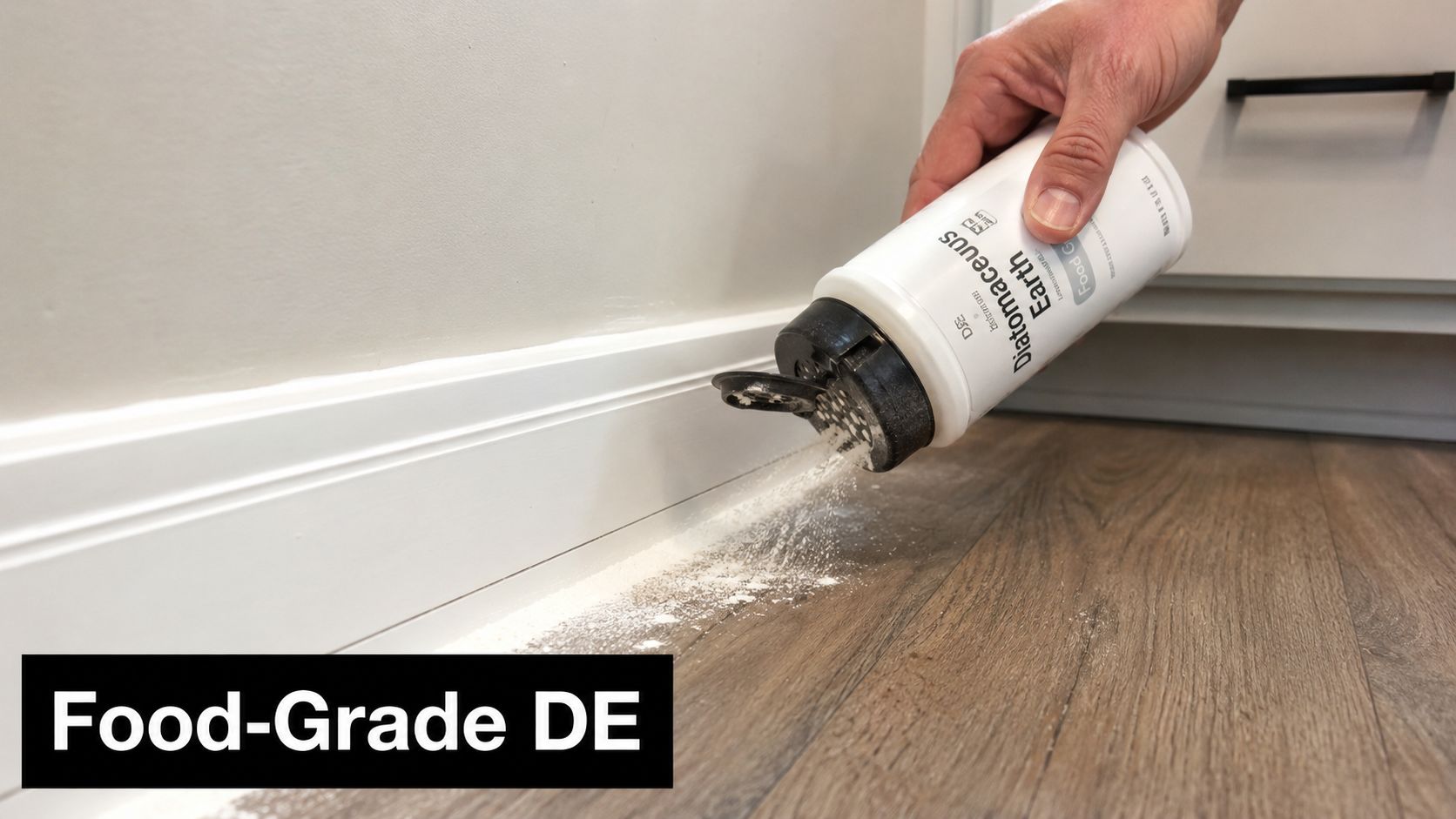
How to Use It Without Creating a Mess
Wear a dust mask when you apply it, especially indoors. Even products people view as “natural” still need careful handling around indoor air and family spaces.
The bigger point is safety and selectivity. Many DIY articles blur the line between repellents, contact killers, and dusts, but that distinction matters around kids, pets, and food areas. As noted in this overview of DIY pest control safety and integrated pest management, label directions are legal instructions and thoughtful product selection matters more than blanket spraying or random home remedies.
A realistic Crown Point use case is a dry basement where occasional ants or flea activity shows up near storage areas. A light DE application can help there, but it won't replace sanitation, vacuuming, exclusion, and moisture control. If the problem is spreading room to room, DE alone usually isn't enough.
3. Sticky Traps and Monitoring Stations
Sticky traps are underrated because they don't feel dramatic. They don't smell like spray, and they don't give instant satisfaction. What they do give you is information, and that's often what separates smart DIY pest control from wasted effort.
Place them where pests travel, not where people notice them. Along walls, under sinks, behind toilets, beside appliances, in utility rooms, and near basement perimeter walls are all better choices than open floor space. Pests tend to follow edges.
Use Traps to Read the House
One trap in one room won't tell you much. A small grid tells you where activity is concentrated, whether it's getting better, and whether you're dealing with occasional invaders or a bigger pattern.
- Track location: Write the room and date on each trap.
- Check weekly: Don't wait until the adhesive is full of dust.
- Replace routinely: Old glue boards lose stickiness even when they look fine.
- Match the pest to the response: Ants, roaches, spiders, and occasional invaders all call for different next steps.
A property manager might place traps under sinks and behind shared-appliance areas before complaints build. A homeowner in Crown Point might use them in spring to learn whether insects are entering from the garage side, the basement, or a plumbing wall. That's useful because your treatment only works if you know where activity starts.
The trap doesn't solve the whole problem. It tells you where to solve it.
For homeowners trying to avoid guesswork, this is one of the best home pest control DIY tools because it prevents random product use. If the traps keep filling up after sealing and sanitation, that's often the point where residential pest control makes more sense than another retail purchase.
4. Essential Oil and Natural Spray Solutions
Essential oil sprays have a place, but they need realistic expectations. They work better as repellents and short-term deterrents than as complete control plans. If you use them like a perimeter reminder around likely entry spots, they can help. If you use them as a stand-alone answer to a hidden infestation, they usually disappoint.
Peppermint is the one most homeowners reach for first. It's commonly used around baseboards, garage entries, mudrooms, and utility spaces where ants, spiders, or occasional rodent movement is suspected. Eucalyptus, clove, and cinnamon are also popular in homemade mixes.
Where Natural Sprays Help Most
Use them where you want a lower-residue option and where staining risk is manageable. Always test first on hidden surfaces. Oils can mark painted trim, wood finishes, fabrics, and some stone.
A simple spray routine usually works better than overapplying once. Shake the bottle each time, apply in the evening when pest movement often increases, and reapply consistently around the same trouble spots. That's especially true in garages, entryways, and patio-adjacent rooms in Northwest Indiana homes.
If mosquitoes are part of your outdoor frustration, The Green Advantage also has a helpful article on natural mosquito repellent essential oils.
Natural sprays are best viewed as support tools. Pair them with sealing, habitat cleanup, and monitoring. If ants are trailing through the kitchen or roaches are active around appliances, repellent-only strategies can scatter pests into new hiding spots instead of ending the issue.
5. Proper Waste Management and Sanitation Practices
Sanitation isn't the glamorous answer, but it's often the answer that changes the whole pressure level in a house. The EPA's integrated pest management approach emphasizes sanitation, exclusion, and careful product selection rather than routine blanket spraying. That prevention-first guidance is reflected in the EPA's overview of integrated pest management principles.
For Crown Point homeowners, the practical version is simple. Crumbs under the stove, grease beside the range, unsealed cereal boxes, pet food left out overnight, and moisture under the sink all create repeat invitations. If food, water, and shelter remain easy to access, even a good treatment often underperforms.
Small Cleaning Habits That Matter
Most homes don't need perfection. They need consistency.
- Seal pantry goods: Move flour, cereal, rice, and snacks into airtight containers.
- Empty trash regularly: Use tight-fitting lids, especially in kitchens and garages.
- Clean hidden zones: Pull out the toaster, fridge, and pet bowls, not just countertops.
- Fix moisture fast: Leaks and standing water keep pest pressure alive.
This matters outside, too. Overflowing bins, greasy grill areas, and old organic debris near the house can attract activity that later moves indoors. If you're already cleaning up exterior problem spots, broader yard maintenance jobs like this guide to tree stump removal can also reduce hiding areas around the property.
In apartments and multi-unit settings, sanitation works best when the whole building follows it. One clean unit helps, but shared walls and common trash areas can keep pests circulating if management isn't addressing the full picture.
6. Nematodes for Grub and Larvae Control
Beneficial nematodes are one of the more targeted DIY options for outdoor pest pressure. They're used in soil, not on shelves or countertops, and they make the most sense when the actual pest problem starts underground. That can include flea larvae in pet-use areas or lawn pests that develop below the surface.
This is a better fit for homeowners who want to manage the source rather than just the adult pest they notice later. In a Crown Point yard, that might mean addressing flea pressure before it follows pets inside or dealing with lawn-damaging grubs before stressed turf creates a larger maintenance problem.
What Makes This Method Worth Trying
Nematodes aren't a general cure-all. They need the right conditions. Moist soil, proper timing, and fresh product matter a lot more here than they do with shelf-stable sprays and traps.
Apply in the cooler part of the day, water before and after, and avoid dry, high-heat conditions. If the soil dries out immediately, the treatment loses value. That's why this tends to work best for homeowners who are willing to follow through with watering and timing instead of treating it like a one-step shortcut.
A practical example is a yard with recurring flea issues around shaded runs, fence lines, or areas where pets spend time. Nematodes can be part of that plan, but indoor vacuuming, pet-care coordination, and entry-point control still matter. Outdoor treatments help most when they're tied to a clear source area.
7. Boric Acid Baits for Cockroaches and Ants
For ants and cockroaches, baiting often works better than chasing visible insects with contact spray. That's because you need the pest to carry the toxicant back into the places you can't reach. Spraying the insects you see may kill a few, but it can leave the larger population untouched.
Boric acid baits can be effective when used carefully and placed where pests travel. The key word is carefully. This isn't something to scatter loosely around kitchen edges, especially in homes with children or pets. Use contained placements or tamper-resistant bait stations whenever possible.
The Main Mistake Homeowners Make
They bait and spray the same spot. That usually backfires.
- Keep bait dry: Moisture reduces performance.
- Place it along travel routes: Under appliances, near wall voids, and beside plumbing lines are common examples.
- Don't contaminate bait placements: Strong cleaners and spray residues can reduce bait acceptance.
- Label and secure stations: Safety comes first in kitchens, baths, and utility rooms.
A realistic Northwest Indiana scenario is ant activity near a sink or a basement half-bath where moisture stays high. Another is roach movement around warm appliance zones. Baits can help in those settings. But if you're seeing daytime roach activity, repeated sightings across multiple rooms, or pests returning no matter how often you rebait, the problem may be bigger than a DIY colony reduction effort.
8. Physical Exclusion for Rodents, Door Sweeps and Hardware
Rodent prevention often fails at the door line. Homeowners will seal foundation cracks, set traps, and clean the garage, then leave a gap under the service door wide enough for a mouse to use every night. Door sweeps, threshold seals, hardware cloth, and proper fastening hardware fix a lot of that.
This is especially important in Crown Point garages, side entries, utility rooms, and basement exterior doors. Seasonal shifts in Northwest Indiana push rodents to look for warmth, shelter, and food. A worn sweep or loose corner seal can undo a lot of other prevention work.
What to Install and What to Check
Choose durable materials. Thin rubber pieces wear out quickly, especially on doors with rough concrete contact. Brush or vinyl styles often hold up better in daily-use entries.
If light shows under the closed door, treat it like an open invitation.
Use hardware cloth at vulnerable vents, gaps near garages, and other openings where rodents could chew or squeeze through. Fasten it securely with screws or nails rather than relying on weak attachment points. Then inspect monthly. Exclusion hardware isn't a set-it-and-forget-it fix if the door is used hard all year.
This is one of the clearest examples of the best home pest control DIY strategy in practice. Don't start with poison if the building shell is still open.
9. Mosquito Habitat Elimination in Yards
Mosquito control starts long before a spray treatment. If the yard keeps producing breeding sites, the pressure keeps rebuilding. In Crown Point, that often means clogged gutters, low spots that hold water, neglected containers, birdbaths, kids' toys, wheelbarrows, and dense shrub lines where adults rest during the day.
Yard correction is often more effective than homeowners expect. You don't have to eliminate every damp area. You do need to identify the spots that repeatedly hold water and the shady areas that give adult mosquitoes a place to wait out the day.
A Better Outdoor Routine
Walk the property after rain. That's when the problem spots reveal themselves.
- Dump and refresh containers: Birdbaths, pet bowls, buckets, and planters matter.
- Clean drainage paths: Gutters and downspout exits shouldn't hold water.
- Trim dense vegetation: Mosquitoes rest in cool, shaded cover.
- Store items upside down: Toys, pots, and tarps collect more water than people realize.
If your yard still feels mosquito-heavy after habitat cleanup, the issue may involve neighboring conditions or a larger pressure pattern around the property. That's when local mosquito control becomes more practical than repeated retail foggers. The Green Advantage can help homeowners in Crown Point, IN evaluate whether outdoor conditions are driving the problem and whether a broader treatment plan makes sense.
10. Pantry Pest Prevention Through Storage Management
Pantry pests frustrate homeowners because they often arrive with the food itself. You can keep a clean kitchen and still end up with moths, beetles, or weevils if an infested package comes home from the store. Once they get established, they spread unnoticed through dry goods.
The fix is less about spraying and more about inspection, disposal, and storage discipline. Check flour, cereal, rice, nuts, dried fruit, and pet food. If you see webbing, damaged packaging, or insect activity, bag it and remove it from the house right away.
A Pantry Reset That Actually Works
Often, only the obviously affected item is inspected. This overlooks nearby products that are already compromised.
- Transfer dry goods immediately: Glass or sturdy food-grade plastic containers work best.
- Label and rotate items: Older products should get used first.
- Vacuum shelves and corners: Crumbs and spilled grains support repeat activity.
- Don't save questionable packages: One “maybe it's fine” item can restart the problem.
This matters even more for households that buy in bulk. Large bags of grain products and pet food sit longer, which gives hidden pantry pests more time to develop. For property managers and landlords, pantry pests also create repeat complaints in multi-unit housing unless residents understand that storage changes, not room spray, solve the root problem.
10-Method DIY Home Pest Control Comparison
| Item | Implementation complexity | Resource requirements | Expected outcomes | Ideal use cases | Key advantages |
|---|---|---|---|---|---|
| Sealing, Caulking, and Insulation Upgrades for Pest-Proof Barriers | Moderate–High: requires thorough inspection and precise installation | Specialty sealants, foam board/batt insulation, tools or contractor; $200–$800+ | Long-term prevention of entry routes; durable 10+ years; secondary energy savings | Whole-home prevention, attics, rim joists, renovation projects | Permanent, non-toxic barrier; reduces energy loss; complements other measures |
| Natural Diatomaceous Earth (Food-Grade) | Low: simple dusting application by homeowner | Food-grade DE, applicator, dust mask; $20–$40 per application | Mechanical control of crawling insects; effective until wet; slower (3–7 days) | Dry basements, crawlspaces, around pet bedding, organic-focused homes | Organic, no resistance, long shelf life, low environmental impact |
| Sticky Traps and Monitoring Stations | Low: place and check regularly | Adhesive traps, optional pheromone lures; $1–$3 per trap | Immediate detection and localized capture; useful for trend data but not full elimination | Diagnostics, monitoring in kitchens, basements, commercial areas | Very inexpensive, chemical-free, helps target treatments |
| Essential Oil and Natural Spray Solutions | Low: DIY mixing and spot application | Essential oils, spray bottles, carrier (water/soap); $5–$15 per batch | Short-term repellent/mild contact effect; frequent reapplication needed | Light infestations, preventive use, homeowners preferring natural scents | Pleasant aroma, low toxicity when used correctly, versatile |
| Proper Waste Management and Sanitation Practices | Low–Moderate: habit and routine changes | Airtight containers, tight-lid bins, cleaning supplies; minimal cost | Foundational long-term reduction in pest attraction; visible improvement in 2–4 weeks | All homes and food-handling facilities; multi-unit living with coordination | Zero-cost habits, immediate hygiene benefits, reduces chemical reliance |
| Nematodes for Grub and Larvae Control | Moderate: timed application with moisture requirements | Live nematodes (species-specific), sprayer, refrigeration until use; $30–$60 per yard | Targeted underground control; results in 2–4 weeks; may persist multiple seasons | Lawns/gardens with grubs, mosquito pupae control, organic landscapes | OMRI-certified, safe for non-targets, can establish beneficial populations |
| Boric Acid Baits for Cockroaches and Ants | Low–Moderate: careful placement and safety measures | Boric acid formulations, tamper-resistant bait stations; $10–$25 | Slow-acting colony control; results in 1–2 weeks for moderate infestations | Ant and roach infestations where children/pets are not at risk of ingestion | Highly effective, low-cost, long shelf life when stored dry |
| Physical Exclusion for Rodents, Door Sweeps and Hardware | Low–Moderate: measurement and installation accuracy required | Door sweeps, threshold seals, hardware cloth, fasteners; $50–$150 typical | Continuous physical exclusion when installed correctly; minimal upkeep | Basements, exterior doors, vents, garages, sites of rodent entry | Permanent, non-toxic, reduces drafts and energy loss |
| Mosquito Habitat Elimination in Yards | Low–Moderate: ongoing weekly maintenance | Time and basic yard tools; minimal material cost | Preventive reduction (≈50–70%) over 2–3 weeks; durable if maintained | Outdoor living areas, pre-season mosquito control, community efforts | Free, safe for people/pets, improves yard health and usability |
| Pantry Pest Prevention Through Storage Management | Low–Moderate: organization and consistent habits | Airtight containers, labels, storage solutions; $30–$80 upfront | Prevents infestation of stored foods; protects quality and reduces waste | Pantries, bulk buyers, households storing dried goods | Food-safe, cost-effective, long-term prevention with minimal maintenance |
Know When to Call Your Crown Point Pest Control Pro
You treat the ants in the kitchen, wipe down the counters, and the trail is back three days later. A week later, you hear scratching in the wall near the garage. That is usually the point where a Crown Point homeowner stops asking, "What product should I buy?" and starts asking, "What am I missing?"
DIY pest control still has a real place in home maintenance. For light, isolated problems, store products and basic prevention steps can work well enough. I tell homeowners to start there when the issue is small and clearly identified. But repeated activity usually means the visible pest is only part of the problem. The source may be inside a wall void, under insulation, around a foundation gap, near a crawlspace moisture issue, or tied to a recurring exterior entry point that is easy to miss in older Northwest Indiana homes.
Some pests cross that line faster than others. Bed bugs, termites, German cockroaches, and rodents rarely stay simple for long. Public-facing guidance also points out that once an infestation involves hidden harborage, repeated reproduction, or building access points, the answer is usually a mix of inspection, monitoring, exclusion, moisture correction, and targeted treatment, not another round of general spray. A helpful overview appears in this article on when DIY stops being cost-effective or effective at all.
Product buying habits explain part of the confusion. Analysts at Grand View Research found that sprays and aerosols made up the largest product segment in the U.S. pest control products market in 2024, within a market valued at https://www.grandviewresearch.com/industry-analysis/us-pest-control-products-market-report. Homeowners buy what is easy to find and easy to use. That makes sense. The trade-off is that fast knockdown products often solve the symptom you can see, not the nesting site, access route, or breeding source that keeps the problem active.
In Crown Point and nearby Northwest Indiana, that decision point often shows up in a few predictable ways. Mice activity tends to pick up as temperatures drop. Ant problems often return in spring and early summer, especially after wet periods. Mosquito complaints can usually be reduced with yard maintenance, but heavy pressure near standing water, drainage issues, or shaded harborage may need a broader treatment plan than a homeowner wants to manage alone.
Call for an inspection when you see one or more of these signs:
- You have treated more than once and pest activity keeps returning.
- Droppings, gnawing, damaged food packaging, or wood damage are showing up.
- Pests are appearing in multiple rooms, not just one isolated spot.
- You suspect termites, bed bugs, or German cockroaches.
- The problem involves rental units, food areas, pets, children, or anyone with health sensitivities.
- You cannot identify the pest with confidence, which makes product choice guesswork.
The Green Advantage works with Crown Point homeowners and nearby Northwest Indiana properties on residential pest control, commercial pest control, inspections, mosquito reduction, and targeted treatment plans based on the pest and the structure involved. If your DIY efforts are no longer working and you need professional help in Crown Point, a thorough inspection is the next logical step.
If pests keep returning despite your best efforts, contact The Green Advantage to schedule an inspection or request a quote. For homeowners and property managers in Crown Point, IN and nearby Northwest Indiana service areas, it is a practical way to move from repeated DIY treatments to a clearer plan for ant control, rodent control, spider control, termite concerns, mosquito issues, and year-round residential pest control.
What Is Pest Control at Home: Your 2026 Guide
If you're searching for pest control near me after finding ants on the counter, hearing scratching in a wall, or spotting a wasp near the porch, you're probably asking a simpler question first. What is pest control at home, really?
For homeowners in Crown Point, IN and nearby Northwest Indiana communities, it isn't just “spraying for bugs.” Good home pest control means finding out why pests are there, how they're getting in, what conditions are helping them stay, and what treatment fits that specific problem. That matters in this part of Indiana, where seasonal changes, damp areas, attached housing, garages, crawl spaces, and older homes can all affect pest pressure.
A lot of people wait because they hope it's a one-time sighting. Sometimes it is. Sometimes it's the early sign of a larger issue. Knowing the difference is what protects your home, your routine, and your peace of mind.
Finding Pests in Your Home? You Are Not Alone
You wipe down the kitchen before bed, and the next morning there's a line of ants near the sink. Or you step into the basement and notice movement along the wall. For a lot of homeowners, that moment comes with the same reaction. Concern first, then questions about safety, damage, and how fast the problem could grow.
In Crown Point and across Northwest Indiana, these calls are common because pest problems are common. Home pest control remains a large, recurring household service category in the United States, with about $6.5 billion in annual spending in 2024, and market estimates rising from $14.3 billion in 2012 to over $24 billion in 2023 and about $29.2 billion in 2025 as a projection according to household pest industry estimates. Homeowners keep dealing with ants, termites, bed bugs, mosquitoes, and rodents because these are persistent household pests, not unusual events.
What homeowners usually notice first
The first sign usually isn't dramatic. It's something small that repeats.
- Kitchen activity like ants near crumbs, pet food, or the dishwasher
- Garage or basement sightings such as spiders, centipedes, or mice
- Outdoor-to-indoor movement from wasps, boxelder bugs, or stink bugs near doors and windows
- Noise or odor that suggests hidden activity behind walls or in attic spaces
That's one reason pest issues feel stressful. The pest you see may not be the whole problem.
Most infestations don't begin with a flood of pests. They begin with access, moisture, shelter, and time.
Why local conditions matter
Northwest Indiana homes deal with shifting seasons, humidity, storms, freeze-thaw cycles, and periods when pests move indoors looking for stable shelter. A dry summer can push pests toward water sources inside. A cold stretch can send rodents and overwintering insects into wall voids, garages, and attics.
That's why homeowners looking for residential pest control in Crown Point, IN usually need more than a quick product off the shelf. They need a clear answer, a calm plan, and a service approach that solves the source of the issue instead of chasing each new sighting.
What Modern Home Pest Control Actually Means
Modern pest control starts with one idea. Identify before you treat. If a doctor prescribed medicine before asking symptoms, you'd question it. Pest control works the same way.
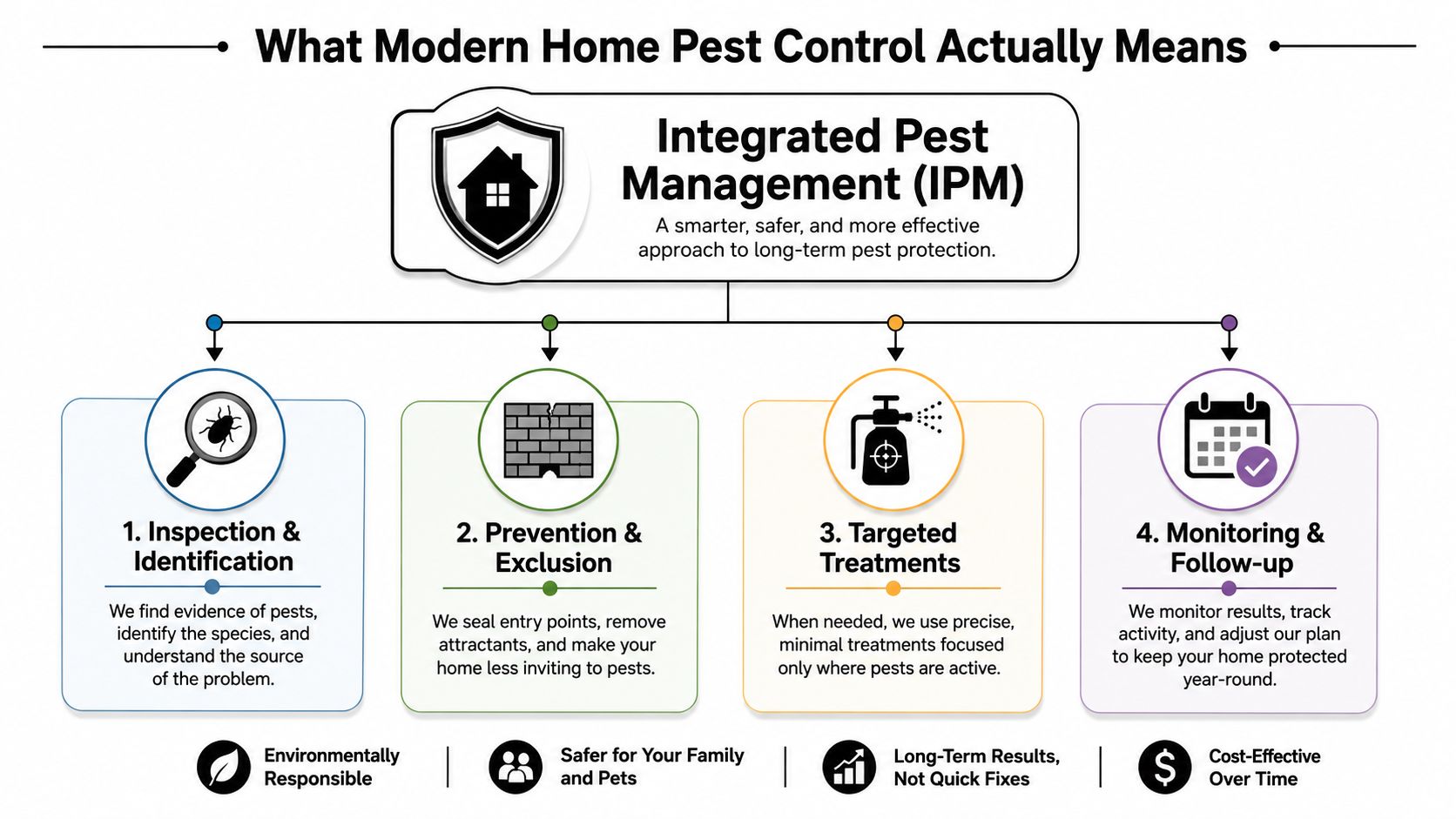
When people ask what pest control at home means today, the best answer is Integrated Pest Management, often shortened to IPM. The University of Tennessee recommends regular inspections and IPM-based control methods instead of routine calendar spraying. That approach uses monitoring, pest identification, sanitation, exclusion, traps, and vacuuming to reduce the conditions pests need to survive.
The four parts that matter most
IPM is practical. It usually looks like this in a home:
Inspection and identification
A technician checks where pests are active, how they're entering, and what species is involved. Ant control, rodent control, and wasp removal all require different strategies.Prevention and exclusion
This is the work that makes treatments hold. Sealing gaps, correcting moisture issues, reducing food access, and improving sanitation can lower pest pressure before products are even considered.Targeted treatment
Treatment still matters. It just needs to match the problem. Baits, traps, limited applications, dusts in voids, or nest treatment may make sense depending on the pest and the location.Monitoring and follow-up
Good service doesn't stop at the first visit. Pest patterns change, especially with seasonal pest issues in Northwest Indiana.
A closer look at the process helps. This short video gives useful context on how home pest management fits into a broader prevention-first model.
Why old “spray everything” thinking falls short
Blanket treatment sounds simple. In practice, it often misses the root cause. If moisture under a sink is attracting ants, or a foundation gap is allowing mice inside, broad spraying won't fix the reason the pests showed up.
For homeowners, that means the smarter question isn't “What can I spray?” It's “What's feeding this activity?”
That same mindset also matters in commercial settings. Facility teams focused on achieving pest-free operations use the same logic. Inspection, exclusion, sanitation, and targeted response beat guesswork. If you want a local explanation of that approach in a residential setting, The Green Advantage outlines it clearly in its guide to integrated pest management.
Good pest control removes the invitation, not just the insect.
Common Pests Threatening Homes in Northwest Indiana
Northwest Indiana doesn't have one “pest season.” It has rotating pressure. Different pests become active as temperature, moisture, and shelter conditions change, and homes in Crown Point often give them exactly what they need.
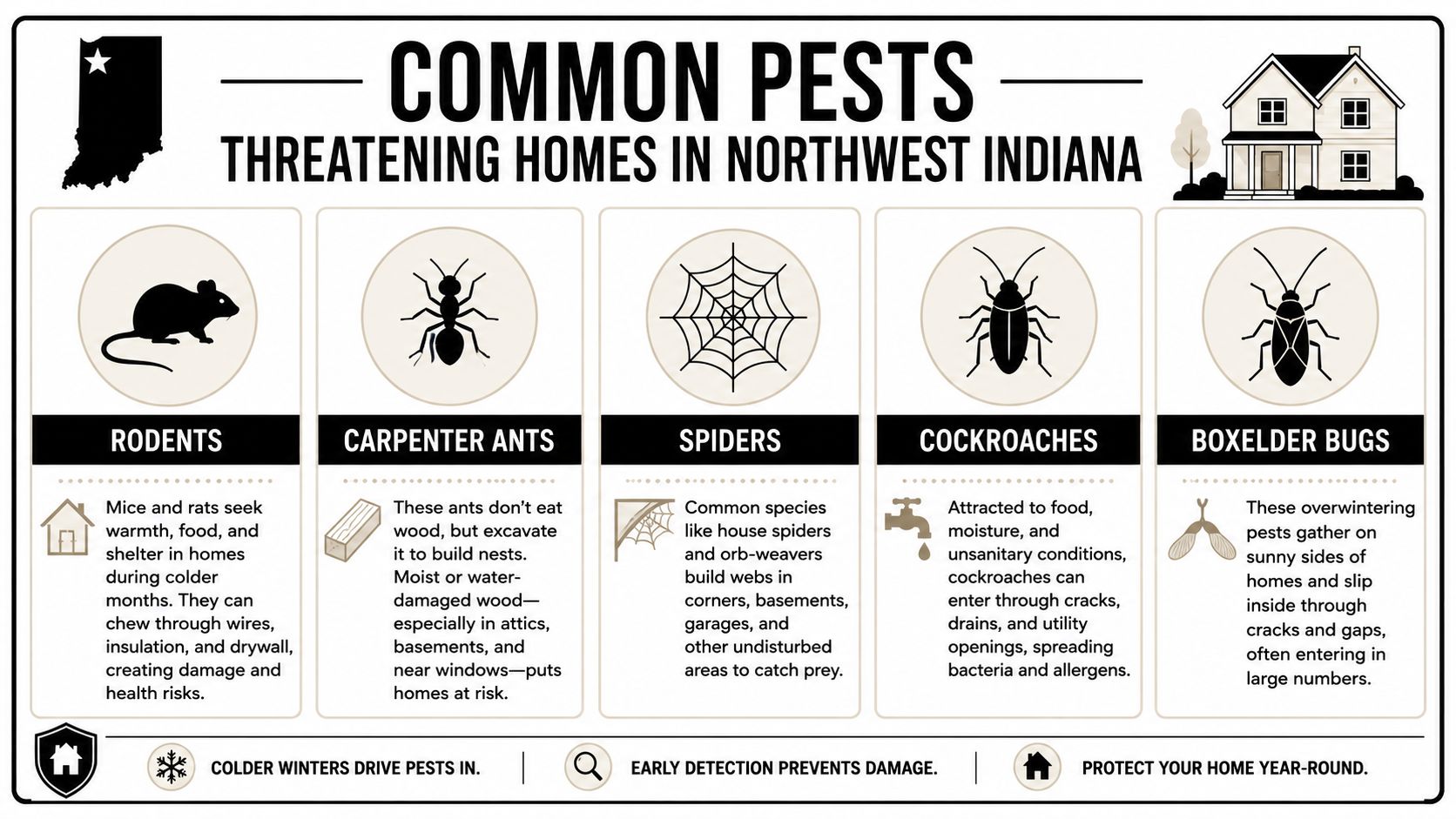
What shows up and why
| Pest | Why it enters homes | Why it matters |
|---|---|---|
| Ants | Food, moisture, and easy entry around windows, doors, and utility lines | Small trails can turn into recurring indoor activity |
| Rodents | Warmth, nesting cover, and access to food or pet feed | They contaminate areas and can damage materials inside the home |
| Spiders | They follow other insects and settle in quiet corners | Webs are a nuisance, and sightings usually mean prey is available |
| Wasps | Protected overhangs, soffits, decks, and rooflines offer nesting spots | Stings are a serious concern for families, guests, and pets |
| Cockroaches | Moisture, clutter, drains, and hidden entry points support survival | They're hard to eliminate once established in concealed spaces |
| Boxelder bugs and similar overwintering pests | Wall voids and sunny exterior walls help them gather before colder weather | They often become a seasonal indoor nuisance in large numbers |
The local conditions behind the problem
Crown Point homes see pest movement shaped by rain, humidity, cold snaps, and the kind of seasonal transitions that push insects and rodents to seek stable shelter. Homes with crawl spaces, attached garages, dense landscaping, or aging seals around doors and windows tend to give pests more opportunities.
Moisture is one of the biggest drivers. Damp basements, condensation near plumbing, clogged gutters, and poor ventilation all create the kind of environment that helps pests stay active longer.
A few pests deserve faster attention
Some pests are mostly a nuisance. Others should move you toward fast action.
- Termites and carpenter ants can threaten wood over time, especially where moisture is present.
- Rodents often indicate an access issue that won't solve itself.
- Wasps and hornets become a safety issue around entryways, patios, and play areas.
- Mosquitoes build pressure outdoors where standing water and shaded resting areas exist.
If you're seeing pest activity in more than one part of the house, it usually points to a condition problem, not a single stray pest.
That's where local knowledge matters. A treatment plan for a dry, sealed home isn't the same as one for a house with a damp crawl space, older trim gaps, and heavy vegetation near the foundation.
DIY Pest Control vs Professional Exterminator Services
DIY pest control has a place. If you clean up a spill, store pantry goods properly, seal a visible gap under a door, or use a trap in the right spot, you may stop a minor issue early. That's worth doing.
The problem starts when homeowners assume visible pests are the whole story.
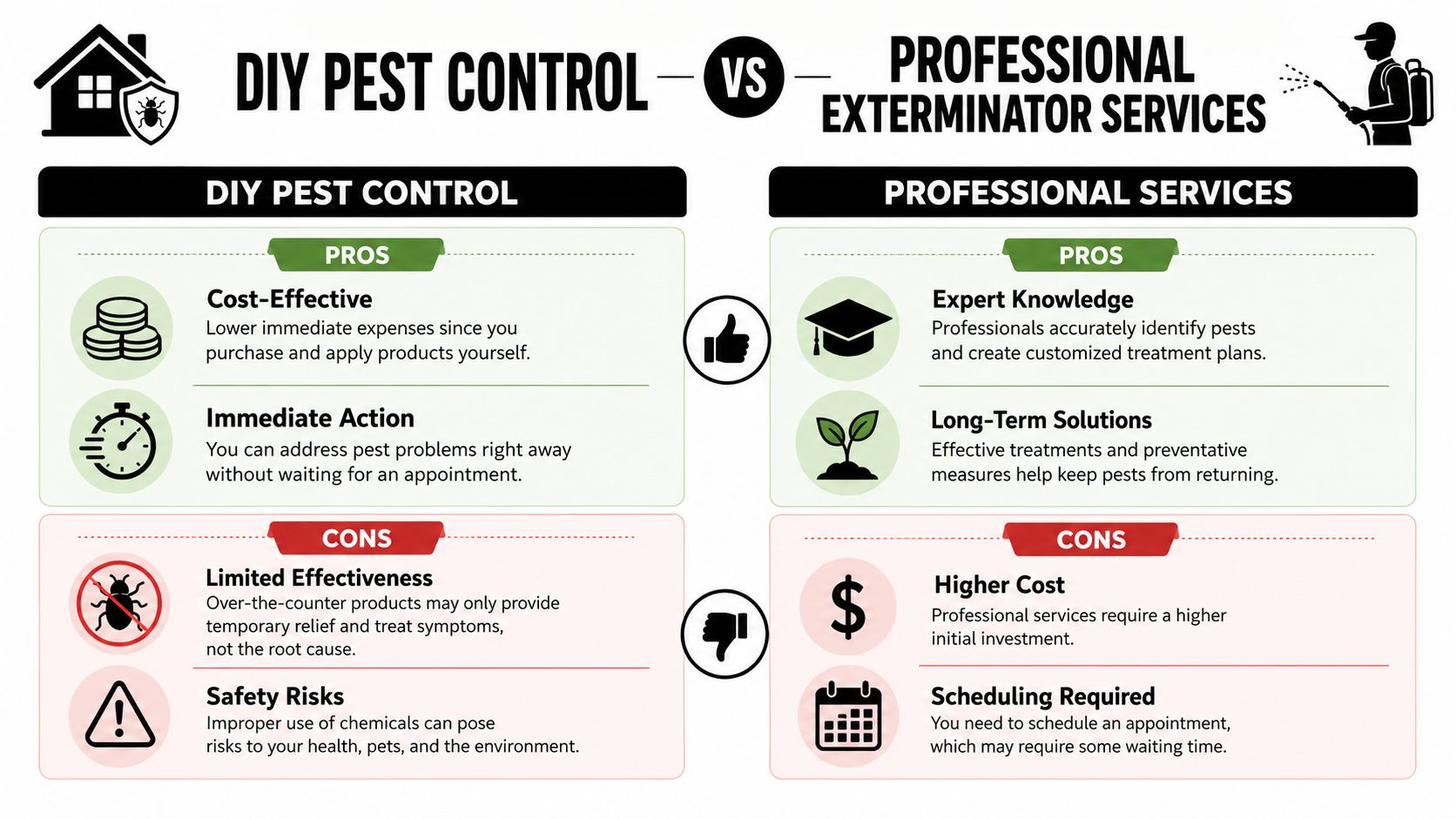
Where DIY helps
DIY prevention is often useful for low-level pressure or follow-through between service visits.
- Sanitation work helps reduce food access in kitchens, pantries, and pet areas
- Simple exclusion like replacing worn weatherstripping or sealing an obvious gap can cut down entry
- Moisture control from fixing a leak or using ventilation in damp spaces can make a big difference
- Basic traps can help confirm where activity is happening
For general cleaning support, some homeowners also prefer lower-toxicity household products. A practical example is this tea tree cleaner guide, which fits well for routine surface cleaning. Just keep the role of cleaners in perspective. Cleaning helps remove attractants. It doesn't replace pest diagnosis, exclusion, or infestation treatment.
Where DIY usually breaks down
A major gap in mainstream advice is the decision point. Homeowners often get generic prevention tips, but not a clear rule for when the problem has moved beyond DIY. EPA guidance highlights an important version of that problem in its home pest control dos and don'ts. Repeated sightings in multiple rooms, ongoing moisture sources, nesting evidence, or pest-specific behavior that suggests hidden breeding sites are all signs that the issue may be recurring rather than isolated.
A simple comparison helps.
| Situation | DIY may be enough | Call an exterminator |
|---|---|---|
| One or two ants after a spill | Yes | Not usually |
| Ants returning every few days | Maybe briefly | Yes |
| Single spider in a garage | Often | Not always |
| Mouse droppings, scratching, or repeat sightings | No | Yes |
| Wasp nest near an entry door | No | Yes |
| Ongoing activity in kitchen and basement at the same time | Unlikely | Yes |
The real trade-off
DIY looks cheaper at first because it's immediate. Professional service usually costs more up front, but it can save time, repeated product purchases, and the risk of treating the wrong pest in the wrong way.
If you're deciding between store-bought options and a service call, this local guide on DIY or hire a pro is a useful next read.
The True Benefits of Professional Pest Control
Professional pest control protects more than comfort. It protects how your home functions day to day.
The biggest benefit is accuracy. A trained technician doesn't just react to the pest you noticed. They look for entry points, moisture patterns, harborage zones, and signs of hidden activity. That's how ant control, termite control, rodent control, mosquito reduction, and spider control become part of one plan instead of separate emergency fixes.
Why precision matters
EPA guidance makes an important point for household treatment. The benchmark is precision application, not whole-room coverage. In the EPA's citizen guide to pest control and pesticide safety, most surface sprays are limited to cracks and crevices, and exclusion work such as sealing openings with caulk, weatherstripping, and screens helps reduce both pest entry and the amount of pesticide needed later.
That's a major difference between professional work and the common homeowner instinct to “treat everywhere.”
- Targeted work lowers unnecessary exposure because treatment stays where pest activity exists
- Exclusion supports long-term control so the home becomes harder for pests to re-enter
- Correct product choice matters because baits, traps, and limited applications perform differently depending on the pest and the site
- Reentry guidance is clearer when treatment follows label directions and site-specific planning
Broad coverage feels thorough. Precision is what usually solves the problem with less disruption.
Why it pays off in everyday life
Professional service also gives homeowners something they often don't have when pests appear. A decision-maker who can tell the difference between a one-off issue and a recurring infestation.
That matters when you're seeing rodents near the pantry, wasps around the eaves, or signs of wood-damaging pests near damp areas. It matters for families with pets and children. It matters for landlords, homebuyers, and anyone trying to protect the condition and value of a property in Crown Point, IN.
Your Local Pest Control Plan with The Green Advantage
A good pest control process should feel straightforward from the first call. You explain what you're seeing, where you're seeing it, and how long it's been happening. Then the inspection focuses on the details that change the plan. Entry points, moisture, nesting conditions, and the type of pest all matter.
That's especially important for homes in Crown Point and nearby Northwest Indiana communities, where seasonal change can shift pest activity fast. A spring ant problem, a summer mosquito complaint, and a winter rodent issue may all come from different conditions around the same house.
What a service plan should include
An eco-conscious service plan doesn't rely on “natural” claims alone. Authoritative consumer guidance on home pest control priorities points to a more reliable hierarchy. Exclusion, moisture control, sanitation, and traps come first, with low-toxicity, targeted products used when needed. That's the practical version of greener pest control. It's measured, not performative.
A homeowner should expect:
- A clear inspection that identifies the pest and likely contributing conditions
- Plain-language recommendations about what to fix, clean, seal, or monitor
- Targeted treatment when needed instead of automatic blanket application
- Follow-up guidance so you know what to watch for next
The Green Advantage provides pest management for homeowners and businesses in Crown Point and surrounding Northwest Indiana areas, including common household pests, mosquito reduction, inspections, and service plans built around site conditions rather than one standard formula.
If you're searching for an exterminator in Crown Point, IN, the safest next step is usually an inspection before the problem spreads or turns into repeated DIY trial and error.
If pests keep showing up in your kitchen, basement, attic, yard, or around entry points, you don't have to guess what's causing it. Contact The Green Advantage to schedule a pest inspection, request a quote, and get a clear plan for protecting your home in Crown Point, IN and nearby Northwest Indiana communities.
Home Pest Control in Crown Point, in: A Local Guide
On a damp spring evening in Crown Point, it usually starts small. A line of ants shows up by the sink, something rustles in the wall after dark, or a basement spider sighting turns into a second and third one a few days later. Homeowners are not overreacting when they pay attention to those signs. In Northwest Indiana, our wet springs, humid summers, leaf-heavy falls, and cold snaps give pests regular reasons to move closer to the house.
Good pest control around here is less about spraying on sight and more about solving the condition that allowed the pest in. That can mean sealing a gap at the garage slab, drying out a crawl space, trimming back heavy foundation growth, or treating a specific nesting area instead of blanketing the whole home. Families in Crown Point usually want the same thing. They want the problem handled safely, and they want a clear answer about whether it is a one-off issue or the start of something larger.
That local piece matters.
A ranch home near mature trees and a newer subdivision lot near retention ponds can have very different pest pressure, even within the same part of town. I also see how moisture management affects pest activity. Roof edges, gutters, and drainage shape what happens around the foundation, much like protecting Western Washington homes from rain starts with controlling where water goes. Around Northwest Indiana homes, the same principle applies. Water, shelter, and entry points decide a lot of what shows up indoors.
Protecting Your Crown Point Home from Unwanted Pests
You walk into the kitchen early, flip on the light, and spot ants running the edge of the sink. Later that week, a wasp circles the back eave. By the first cold stretch, you hear scratching in the garage wall. In Crown Point, that pattern is common, and it usually means the house is offering something pests want.

For families here, a pest problem never feels minor for long. It raises real questions about sanitation, hidden damage, and whether kids or pets could come into contact with droppings, stings, or unnecessary pesticide use. The right response is not broad, routine spraying. The right response is to inspect carefully, identify the pest correctly, find the entry or nesting area, and treat only where it makes sense.
That distinction matters in Northwest Indiana.
Homes near wooded lots, drainage swales, retention ponds, or older tree lines often deal with different pest pressure than homes in newer subdivisions with tighter grading and less shade. Wet springs push moisture-loving pests closer to foundations. Hot, humid summers keep ant and mosquito activity going. Fall drives rodents and overwintering insects toward wall voids, attics, and garages. A plan that works in one season, or on one block, may miss the underlying issue on the next street over.
Why homeowners are paying closer attention
Pest control is not a niche home service. Homeowners deal with these problems often enough that the industry has grown steadily, with thousands of companies and specialists working across the country, as noted earlier. That lines up with what we see locally. Calls come in for recurring ants, stinging insects around rooflines, mice after the first temperature drop, and spider activity that usually points to a broader insect food source nearby.
There is also a cost to waiting. A small ant trail can turn into repeated kitchen activity. A single mouse in the garage can become nesting in insulation or stored items. Wasps under an eave can stay manageable for a short window, then become a safety problem near entry doors and play areas.
The trade-off is simple. Early action usually means a smaller, more targeted fix. Waiting often means more labor, more disruption, and more places to inspect and seal.
A house also responds as a system. Roof edges, clogged gutters, damp mulch beds, poor grading, and foundation moisture all affect pest pressure. Homeowners looking at exterior water control can see the same principle in protecting Western Washington homes from rain. Around Crown Point homes, moisture control changes pest activity just as much as it changes wear on the structure.
Practical rule: If pests keep coming back, the house still has an opening, a moisture issue, or an easy food source.
What local service should feel like
Homeowners in Crown Point usually want a calm answer, not a sales pitch. They want to know what the pest is, why it showed up, whether the problem is isolated, and what can be done without turning the house into a chemical cloud.
That is a reasonable standard. Good service should include a plain explanation of what was found, what was treated, what needs to be corrected by the homeowner, and what level of follow-up makes sense. Sometimes a one-time treatment handles the issue. Sometimes the honest answer is that seasonal service, exclusion work, or moisture correction will do more than another spray ever will.
Safe pest management is not about using the most product. It is about using the right method, in the right place, at the right time, for the actual pest in front of you.
Northwest Indiana's Most Common Pests by Season
A typical Crown Point pest call changes with the calendar. In April, it is ants in the kitchen after a wet stretch. In July, it is mosquitoes around the patio and wasps under the eaves. In October, it is scratching in the wall or a mouse in the garage by the first cold snap.
That pattern is normal for Northwest Indiana. Our mix of wet spring weather, humid summers, older neighborhoods, detached garages, and cold winters gives different pests their opening at different times of year.
Seasonal pest activity in Northwest Indiana
| Season | Common Pests | Typical Behavior |
|---|---|---|
| Spring | Ants, spiders, wasps | Ants start foraging indoors as colonies expand and moisture shifts around the foundation. Spiders become easier to notice as insect activity increases. Wasps scout soffits, porch ceilings, sheds, and other protected spots for new nests. |
| Summer | Mosquitoes, wasps, ants | Mosquitoes build up around standing water, dense shade, clogged gutters, and low areas that stay wet. Wasps become more defensive once nests are established near rooflines, decks, and play areas. Ant pressure often spreads from mulch beds, patios, and exterior walls into kitchens, bathrooms, and utility rooms. |
| Fall | Rodents, spiders, overwintering insects | Cooler nights push mice and other pests toward garages, attics, basements, wall voids, and gaps around utility lines. Spiders show up more often because the insects they feed on are also moving inward. Stink bugs and similar overwintering pests gather on sunny exterior walls, then slip inside through small cracks. |
| Winter | Rodents, occasional hidden infestations | Outside insect activity drops, but pests already inside keep moving near warmth, stored food, and water sources. Winter also exposes problems that started earlier, especially in crawlspaces, basements, attics, and storage areas that do not get checked often. |
What homeowners in Crown Point usually notice first
Ants are still one of the first things homeowners spot because they leave visible trails and keep coming back if the colony is established nearby. A few ants at the sink can mean a simple moisture issue under the counter, or it can point to an exterior nest using a gap at the sill plate, window frame, or utility entry.
Rodent activity usually shows up in quieter ways first. Droppings in the pantry. Chewed pet food bags in the garage. A scratching sound after dark in the wall or ceiling.
Mosquito complaints tend to start with the yard, not the house. In Crown Point, that often comes back to shaded fence lines, clogged gutters, birdbaths, low spots in the lawn, or containers that hold water longer than people realize.
For homeowners weighing shortcuts, this breakdown of why DIY pest control often costs more in the long run lines up with what we see locally. The product is only part of the job. Finding the source is what changes the outcome.
Pests follow conditions. Seasonal changes shift moisture, shelter, food access, and entry pressure around the home.
Why generic advice often misses the local issue
National advice has its place, but Northwest Indiana homes have a few patterns that change the job. Freeze-thaw movement opens small gaps around foundations and door frames. Spring rain leaves mulch beds and low grading areas damp for days. Detached garages, older brick, and additions create extra transition points where pests slip in.
Local treatment plans need to account for those details. A summer ant issue near a slab patio is different from ant activity in a damp crawlspace. A fall mouse problem in a newer subdivision still needs exterior exclusion, but an older Crown Point home may also need attention around settling cracks, aging weatherstripping, and utility penetrations that have widened over time.
Season matters. So does the way your property holds water, where the shade sits, what touches the siding, and how tight the structure really is.
Prevention Best Practices and DIY Limitations
A Crown Point homeowner cleans the kitchen, sprays the baseboards, and still finds ants a week later. Or the scratching in the wall stops for a few nights, then starts again when the temperature drops. That usually means the problem was disturbed, not solved.
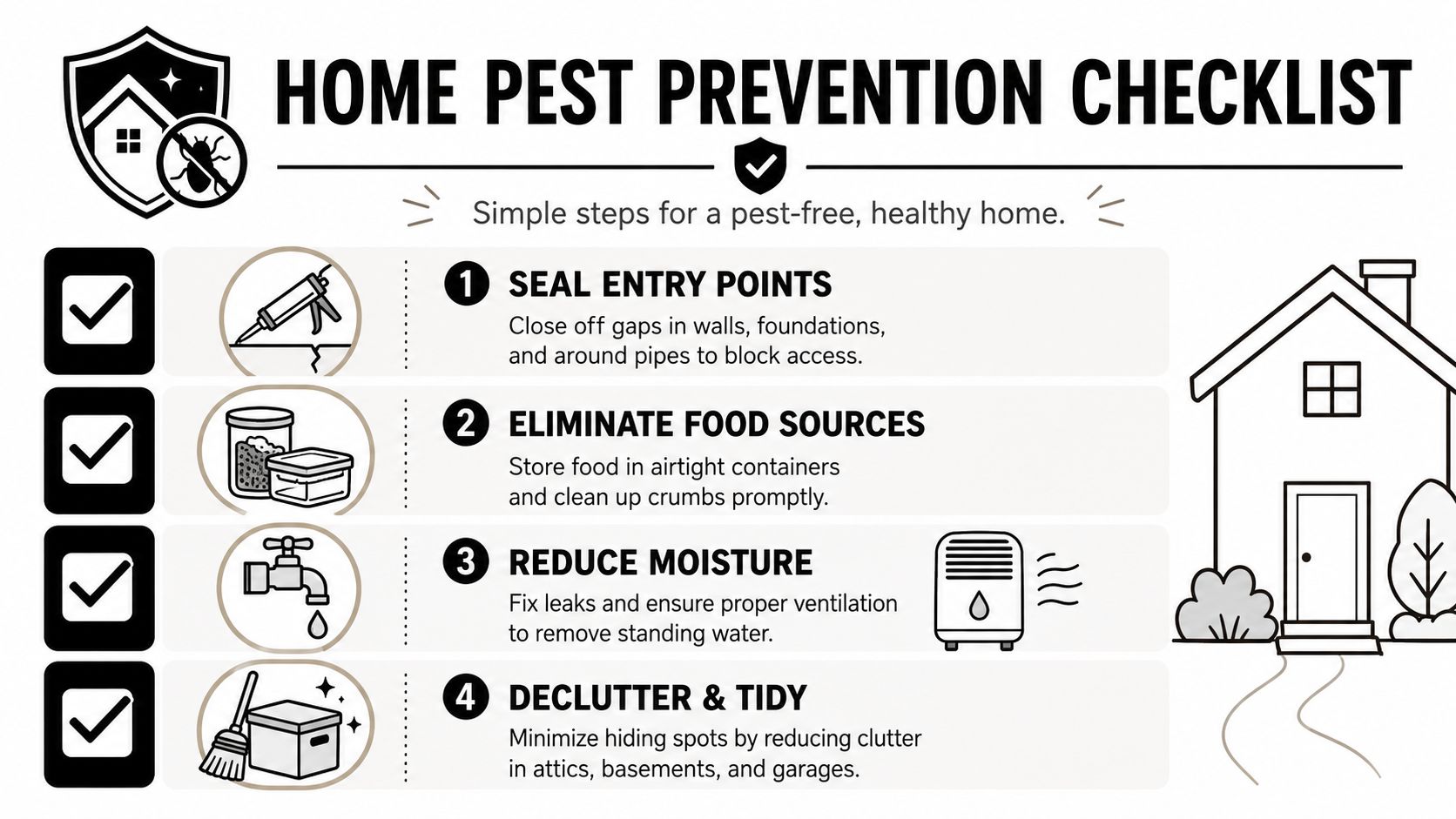
Good prevention focuses on the conditions that let pests stay active around a home. In Northwest Indiana, those conditions often shift with the season. Wet spring soil along the foundation, summer food sources on patios, and fall gaps that open as materials expand and contract all change pest pressure in real ways.
Four prevention steps that matter
Start with the parts of the house pests use every day.
- Seal entry points. Check utility penetrations, garage door corners, worn sweeps, loose weatherstripping, foundation cracks, and gaps around window frames. In older Crown Point homes, small settling gaps and aging trim are common trouble spots.
- Remove food and water sources. Store pantry items well, clean under appliances, avoid leaving pet food out overnight, fix leaks, and empty standing water near the house. Even minor moisture around a laundry area or basement sink can keep activity going.
- Reduce shelter. Cardboard in basements, clutter in garages, firewood stacked against the house, and shrubs touching siding all give pests cover close to the structure.
- Control moisture. Keep gutters clear, improve drainage where water sits, and pay attention to crawlspaces, mulch beds, and shaded areas that stay damp longer than they should.
Those steps sound simple because they are. The hard part is consistency.
A quick visual checklist can help homeowners spot weak points before they turn into an infestation.
Where DIY methods usually fall short
Store-bought products have a place. For a light, occasional issue, a trap or a targeted treatment may reduce activity. The trade-off is that over-the-counter solutions rarely answer the bigger question. Why are pests using this part of the property in the first place?
That is where DIY efforts often stall. Homeowners treat the visible trail, the one mouse, or the insects around a window, but the nesting site, moisture source, or entry route stays active. Repellents can push pests to a different area. Broad spraying can miss the crack, void, or exterior condition that keeps the problem alive.
Natural options have similar limits. Some products can discourage activity for a short period, but they usually do not remove an established colony or stop repeat entry on their own. For families in Northwest Indiana who want lower-impact solutions, the better approach is targeted treatment paired with exclusion and habitat correction.
When it makes sense to stop experimenting
Repeated treatments in the same spot usually point to a missed cause. If ants keep returning to the same kitchen corner, if mice activity picks up every fall, or if spiders and occasional invaders keep showing up in the basement, more product is rarely the answer by itself.
At that stage, inspection saves time and guesswork. This article on why DIY pest control is a false economy explains the pattern well. Homeowners often spend money on short-term relief while the underlying access point or attractant keeps driving the issue.
The goal is not to spray more. The goal is to make the home harder to use.
The True Value of Professional Pest Control Services
You see a few ants near the sink or hear scratching over the garage ceiling, and the first question is usually, "Do I need a spray, or do I need something more?" In Crown Point, that answer depends on what is happening behind the surfaces. Our homes deal with freeze-thaw gaps, damp basements, mulch lines, attached garages, and seasonal pest pressure that changes fast from spring to fall. A treatment only has value if it fits those conditions.
Property protection comes first
Professional pest control protects the parts of the home you do not inspect during a normal week. Sill plates, attic corners, crawlspaces, utility penetrations, window frames, and wall voids are where many problems start and keep going. By the time pests are fully visible in living areas, they have often been using those hidden areas for a while.
That is why a good service call starts with inspection, not product. The job is to identify how pests are getting in, what is helping them stay, and whether the issue is isolated or part of a larger pattern around the structure.
A good technician looks for moisture, nesting pressure, food access, exterior gaps, and movement between indoors and outdoors.
A dead pest on the floor is evidence of activity. Inspection findings show whether the home is actually protected.
Safety and peace of mind matter too
Families here ask practical questions, and they should. Do children or pets need to stay out of certain areas? Is an interior treatment necessary? Can the issue be handled with exclusion, baiting, trapping, or targeted exterior work instead of broad application inside the home?
The right professional answer is not the same for every property. A ranch with a crawlspace in Crown Point has different risk points than a newer two-story on a slab. A home backing up to a retention area may need a different mosquito and occasional-invader plan than a house in a tighter subdivision. Safe pest control means choosing the least disruptive effective method for the pest, the season, and the layout of the property.
There is also a cost trade-off homeowners feel quickly. Store-bought products can look cheaper at first, but repeated trial-and-error adds up, especially when the original entry point or nesting area stays active. Professional service earns its value through accurate identification, better placement, follow-up when needed, and fewer repeat surprises.
For homeowners comparing providers, this guide on what to look for when choosing a pest control company is a useful place to start. The value is straightforward. You are paying for diagnosis, risk reduction, and a treatment plan that fits Northwest Indiana conditions instead of a one-size-fits-all approach.
How The Green Advantage Treatment Process Works
A good treatment process should answer two questions right away. What is driving the pest activity, and what will stop it with the least disruption to your family and home?
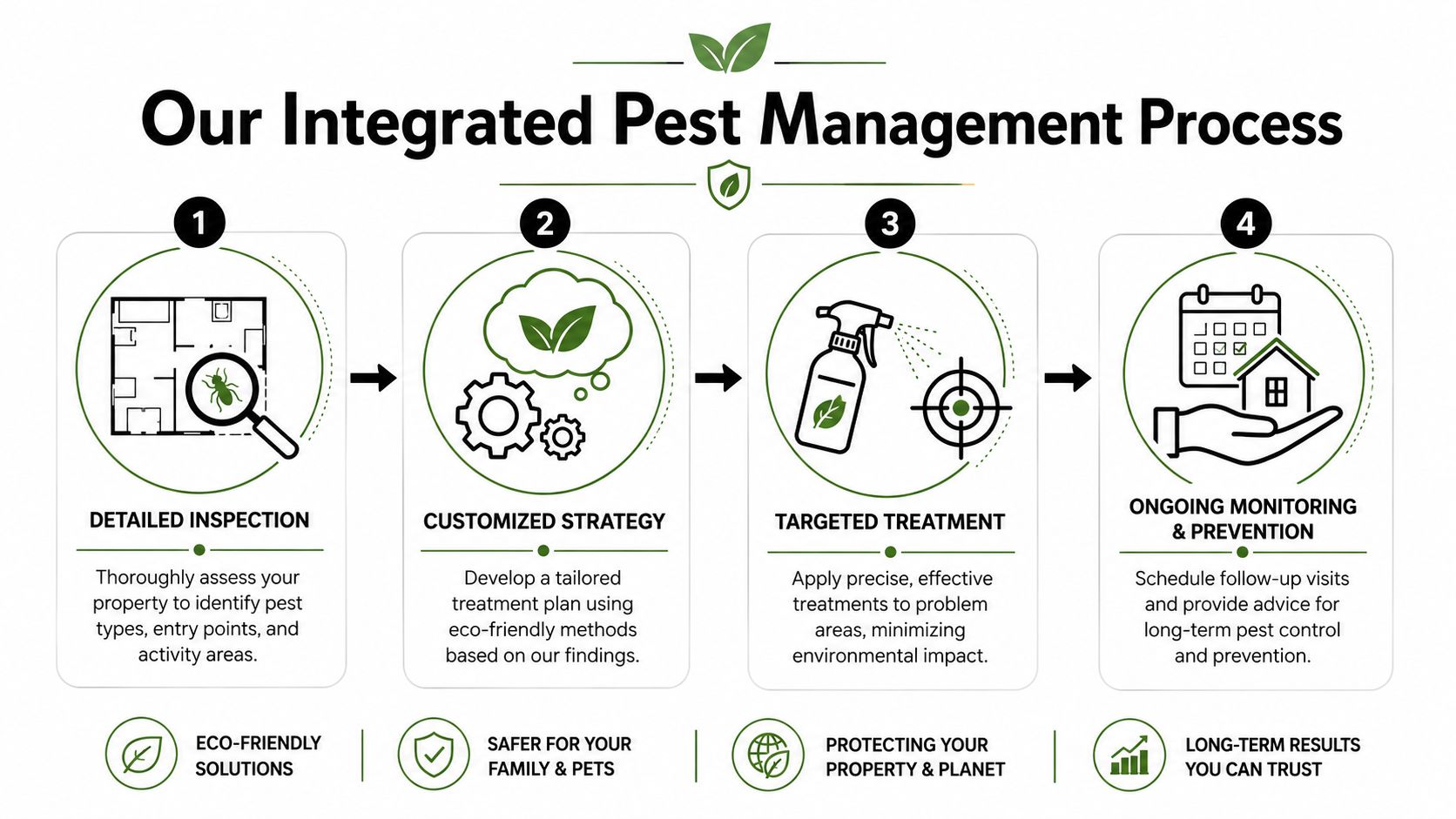
In Crown Point and across Northwest Indiana, that process has to account for real seasonal patterns. Spring brings ant trails and wasp starts. Summer adds mosquito pressure near shaded yards and standing water. Fall pushes mice toward garages, basements, and wall voids. Winter often exposes the homes with small entry gaps that went unnoticed during warmer months.
Step one starts with inspection
Correct identification comes first because different pests call for different tools. Pavement ants at the front walk are a different problem from carpenter ants near damp wood. A mouse using the garage weatherstrip is a different job from activity in an attic insulation line. Spiders around entry lights may be reduced with exterior work and habitat changes, while a yellowjacket issue may require nest-specific treatment.
As noted earlier, Integrated Pest Management starts with inspection and source control, not broad application for the sake of coverage. The practical goal is to find where pests are feeding, nesting, entering, or being drawn to the structure. Once that is clear, treatment decisions get easier and results are usually better.
Then the strategy gets matched to the property
No two homes in this part of Indiana have the same pressure points. A house near open fields, tree lines, ponds, or retention areas will often deal with a different mix of insects than a home in a tighter subdivision. Older homes may have more entry gaps around utility lines, soffits, and foundation transitions. Newer homes can still develop pest issues if mulch is piled high, gutters overflow, or garage doors leave small openings.
A sound treatment plan may include:
- Exterior entry-point work around doors, windows, utility penetrations, soffits, and foundation lines.
- Targeted interior treatment only where activity is confirmed, such as along an ant trail, at a rodent runway, or near a wasp nesting site.
- Habitat correction to reduce standing water, thick vegetation against the house, excess clutter, and damp areas that support pest activity.
- Monitoring and follow-up for problems that tend to return with the season, including mosquitoes, recurring ants, and cold-weather rodent movement.
That balance matters. Some issues can be controlled with exclusion and a focused exterior program. Others need direct treatment in active indoor areas to get the problem under control.
The Green Advantage uses this process for homes in Crown Point and nearby Northwest Indiana communities, including mosquito work, termite-focused service, and rodent exclusion when conditions point in that direction.
Why eco-conscious doesn't mean weak
Homeowners sometimes hear "eco-friendly" and expect a lighter version of pest control that does not hold up through an Indiana season. In practice, the opposite is often true. The stronger approach is to use the least amount of product needed, place it where it will do the job, and fix the condition that allowed the pests in to begin with.
Field insight: The safest useful treatment is the one that is targeted correctly and backed up by exclusion.
That is how families get safer, more reliable control. It also avoids a common mistake with do-it-yourself products and low-effort service calls. More product does not always mean better control. Better inspection usually does.
What to Expect When You Call The Green Advantage
The first contact should lower stress, not add to it. When a homeowner in Crown Point calls about ants in the kitchen, mice in the garage, or wasps over the back patio, the process should feel clear from the start.

The first conversation
Three questions are often top of mind right away. What kind of problem does this sound like, how soon can someone come out, and what should we do before the visit? Clear scheduling and practical guidance matter because pest issues rarely feel minor to the person dealing with them.
You shouldn't have to guess whether the technician will inspect the property or just show up and spray. The EPA states that a reputable pest control service should begin with a complete inspection, and service protocols should include exterior evaluation, removal of webs and nests, and written reporting that documents where pests entered and what conditions attracted them, according to the EPA's tips for selecting a pest control service.
What happens on site
A proper visit usually includes a look at both the inside and outside of the property. That means checking likely access points, signs of moisture, harborage areas, pest evidence, and the specific locations where the homeowner has seen activity.
Homeowners should expect straightforward communication, including:
- What was found
- Where the pressure is coming from
- What treatment makes sense
- What changes at the property will help prevent recurrence
That kind of transparency matters because a treatment only solves part of the issue if the source isn't addressed.
After the service
Written notes are more important than many people realize. They create a record of where activity was found, what was treated, and what the homeowner should monitor next. That becomes especially useful for recurring seasonal issues, rental properties, and homes with several possible entry points.
For families, another practical point matters. Indoor-use guidance should keep children and pets out of treated areas until sprays are dry, as noted in the EPA guidance above. That kind of simple, specific instruction is exactly what homeowners should receive from a careful provider.
Your Partner for Safe and Effective Pest Management
Home pest control in Northwest Indiana works best when it's approached as a partnership between the homeowner and the service provider. The technician handles diagnosis, treatment selection, and monitoring. The homeowner helps by correcting the conditions that pests are using, such as moisture, clutter, food access, and exterior openings.
What eco-conscious service looks like in practice
Eco-conscious pest management isn't about avoiding action. It's about avoiding unnecessary action. In practice, that means focusing on inspection, precise treatment, and prevention measures that lower future pressure on the home.
For families in Crown Point, that approach has practical benefits:
- Less guesswork because the problem is identified before treatment begins
- More durable results because exclusion and habitat correction are part of the plan
- Better household comfort because the goal is prevention, not constant reaction
Why year-round planning often makes sense
Northwest Indiana doesn't have one pest season. It has several. Ants, wasps, mosquitoes, spiders, rodents, and overwintering pests all show up under different conditions. That makes ongoing home pest control a sensible option for properties that repeatedly deal with changing seasonal pressure.
The goal isn't to make homeowners think about pests all the time. It's the opposite. A sound plan should let you use your kitchen, basement, garage, patio, and yard without wondering what's moving behind the scenes.
Frequently Asked Home Pest Control Questions
Are pest control treatments safe for kids and pets
They should be planned with household safety in mind. A careful provider identifies the pest first, treats only where needed, and gives clear instructions about treated areas. If indoor products are used, children and pets should stay out of treated areas until sprays are dry.
Do I need a one-time service or an ongoing plan
That depends on the pest and the conditions around the home. A one-time service can make sense for an isolated issue. Seasonal pests, recurring ant activity, mosquito pressure, and rodent concerns often benefit from ongoing monitoring and prevention.
Do you handle commercial pest control too
Yes. Many of the same principles apply, but commercial pest control also depends on the building type, sanitation practices, entry points, storage areas, and how the space is used day to day.
If you're dealing with pest activity in Crown Point, IN or nearby Northwest Indiana communities, The Green Advantage can help you sort out what's happening and what it will take to fix it. Reach out to schedule a pest inspection, request a quote, or talk through a home or commercial pest control plan that fits your property.
Best Home Pest Control Companies: Crown Point, in 2026
You hear scratching in the wall at night. Or you flip on the kitchen light and catch ants working a trail along the counter. Maybe it's wasps around the soffit, spiders in the basement corners, or a mouse problem that started with one sighting and now feels a lot less minor.
That's usually the moment people start searching for pest control near me or an exterminator in Crown Point, IN. The hard part isn't just finding a company. It's figuring out which home pest control companies will solve the problem instead of giving you one quick treatment and leaving the underlying cause behind.
In a home, pest issues can become expensive fast. For an average 3,000-square-foot home, pest control can cost between $400 and $950, while bedbugs and termites can cost thousands to treat, according to ConsumerAffairs pest control statistics. The same source notes that homeowners most often worry about ants, spiders, mice, and termites. That's why a professional evaluation matters early, before a small nuisance turns into recurring damage, stress, or repeat callbacks.
Your Guide to Finding a Pest Control Partner in Crown Point
A lot of Crown Point homeowners call only after they've already tried the obvious fix. They cleaned the pantry, set traps, sprayed the baseboards, or knocked down the same web three times. The pests slowed down for a bit, then came right back.
That pattern usually points to a larger issue. The pests still have what they need. Entry points haven't been sealed. Moisture is still present. Food sources are still accessible. The nest, colony, or harborage area was never fully addressed.
What homeowners are really looking for
Homeowners aren't looking for a fancy sales pitch. They want a local company that shows up, explains the situation clearly, and treats the home with care. In Northwest Indiana, that also means finding someone who understands our seasonal swings, older housing stock, garages, crawl spaces, and the way pests move indoors when weather changes.
When people compare home pest control companies, I tell them to focus on three practical questions:
- Will they inspect first: If a company starts talking treatment before asking where you've seen activity, that's a problem.
- Will they explain the cause: A good technician should connect the pest issue to conditions around the home.
- Will they recommend the right service level: Some problems need a one-time service. Others need monitoring and prevention.
Practical rule: If the proposal sounds like “we spray and see what happens,” keep looking.
A homeowner also benefits from understanding how pest companies present themselves online. If you're curious how local service businesses structure their messaging, these pest control advertising resources give useful context on what companies emphasize and why. It can help you separate polished marketing from a process that makes sense for your home.
Why the right fit matters locally
In Crown Point, pest control isn't just about reacting to what you see today. It's about reducing the odds that the same issue returns next month or next season. A strong provider should feel less like a one-time exterminator and more like a steady pest control partner who understands residential pest pressure in Northwest Indiana.
That's what homeowners usually want anyway. Clear answers. Safe, sensible treatment. Fewer surprises.
Identifying Common Pests in Northwest Indiana
Before you hire anyone, it helps to narrow down what you're dealing with. Not every pest problem calls for the same response, and not every sighting means you need the same type of service plan.
What shows up around Crown Point homes
In Northwest Indiana, the calls tend to cluster around a handful of familiar pests.
- Ants indoors: Usually found near kitchens, sinks, windows, and foundation edges. They're often drawn by food residue or moisture.
- Spiders in basements and corners: Spiders usually follow insect activity. If you're seeing more spiders, there may be another pest feeding them.
- Rodents in attics, garages, and wall voids: Mice and rats look for warmth, shelter, and easy access to food.
- Wasps around eaves and entry points: These become a bigger concern when nests are near doors, decks, play areas, or rooflines.
- Mosquitoes in yards: Standing water, dense vegetation, and shaded areas all contribute to mosquito pressure.
- Termite concerns: Homeowners often don't notice this issue until they see damage, swarmers, or mud tubes.
- Seasonal invaders: Boxelder bugs, stink bugs, and similar pests often become a nuisance during transition seasons.
Why these pests keep showing up
Pests don't move into a house randomly. They follow conditions.
A leaky spigot or damp crawl space can support ants, roaches, and rodents. Gaps around utility penetrations or garage doors give mice an easy entry route. Heavy vegetation against the home creates shelter and a bridge toward the structure. Even clutter in a basement or storage area can give pests a quiet place to hide long enough to establish.
Don't judge the problem by the first insect or rodent you saw. Judge it by what the property is allowing.
That's one reason seasonal timing matters here. Warmer stretches, heavy rain, sudden temperature swings, and longer active seasons can all change when pests appear and how long they remain active. Guidance on urban pest trends notes that pest pressure is increasing in many regions as warming temperatures and extreme weather expand the seasonality and geographic range of some household pests, which means homeowners benefit from proactive monitoring before peak activity instead of waiting until an infestation is obvious, as discussed in this note on changing urban pest pressure.
A quick self-check before you call
Use this simple homeowner checklist:
| Sign you notice | What it may suggest |
|---|---|
| Ant trails near counters or windows | A food source, moisture source, or outdoor colony pushing inside |
| Droppings in pantry or garage | Rodent movement and likely repeated access |
| New webs appearing fast | Ongoing insect activity, not just isolated spiders |
| Buzzing near soffits or deck areas | Active wasp or bee nesting nearby |
| Bites outdoors at dusk | Mosquito breeding habitat close to the yard |
If you can tell a company where the activity is, when it started, and whether it's getting worse, you'll get a much more useful inspection.
Screening Credentials of Pest Control Companies
Not all home pest control companies work the same way. Some build their service around inspection and problem-solving. Others still rely on broad treatment with very little diagnosis. If you're hiring someone to work in and around your home, the difference matters.
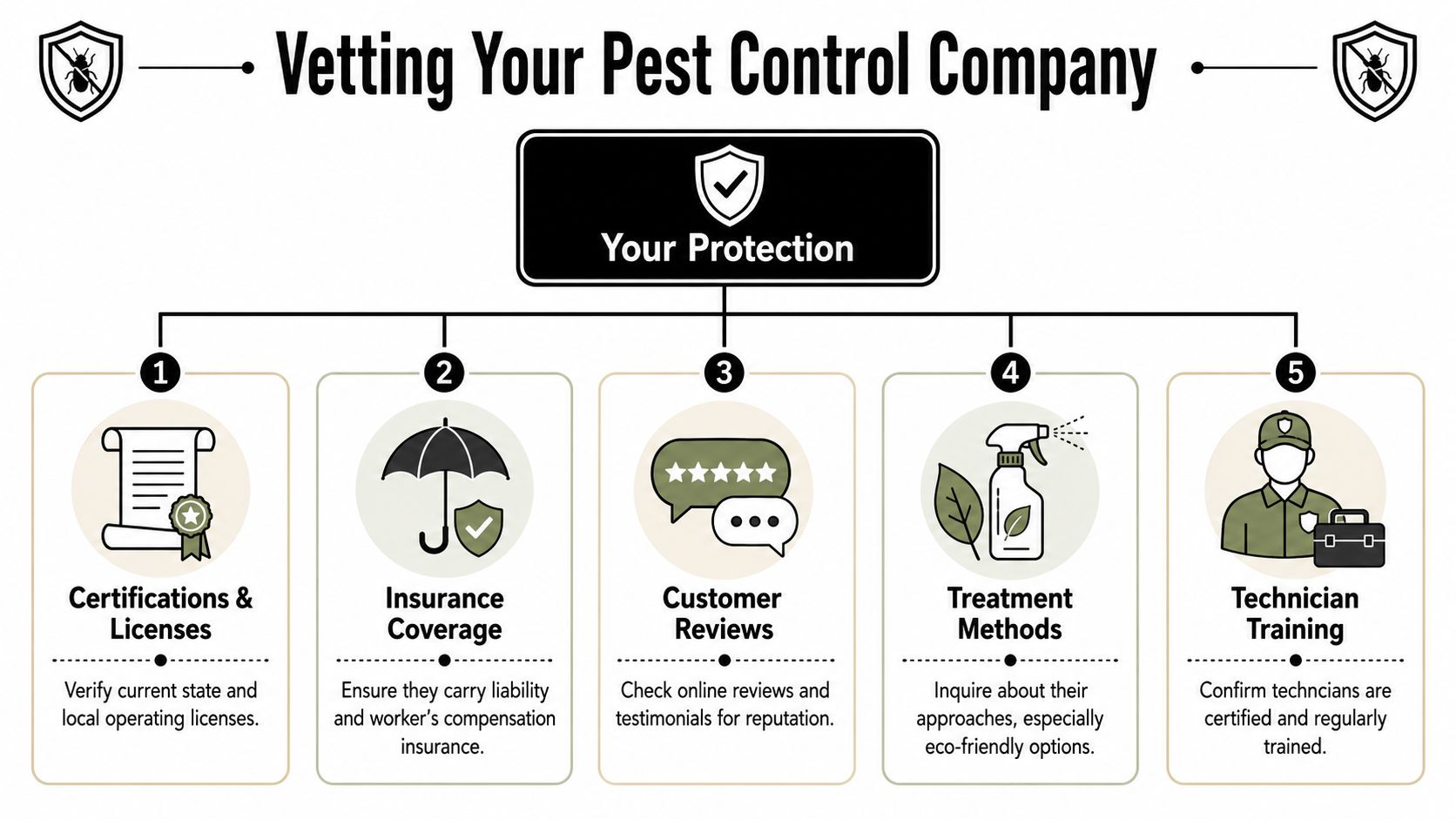
What to verify first
Start with the basics. A legitimate provider should be able to answer straightforward questions without getting defensive.
- State licensing: Ask whether the company and applicators are properly licensed for pest control work in Indiana.
- Insurance coverage: Make sure they carry appropriate liability and worker-related coverage.
- Local reputation: Read reviews from Crown Point and nearby Northwest Indiana communities. Look for comments about communication, follow-through, and whether problems stayed solved.
- Clear service scope: Ask what's included in the visit, what isn't, and whether exclusion or follow-up is part of the recommendation.
If a company is vague about credentials or avoids specifics, that's a warning sign.
Ask how they actually solve the problem
A better question than “What do you spray?” is “How do you decide what to do first?”
The strongest residential pest work follows integrated pest management, or IPM. In plain language, that means the company inspects the property, monitors activity, blocks access, and uses targeted controls instead of treating everything the same way. A practical overview of effective pest workflows explains that a high-performing approach is built around inspection, monitoring, exclusion, and targeted controls, and it warns that treating symptoms without fixing access routes often leads to re-infestation, as outlined in this discussion of how pest control actually works.
That matters because many homes don't have a “spray problem.” They have a gap problem, moisture problem, storage problem, or sanitation problem.
Questions worth asking on the phone
You don't need technical jargon. A few practical questions will tell you a lot.
Do you inspect before recommending treatment?
If the answer is no, move on.Will you identify entry points and contributing conditions?
That's how recurring issues get addressed at the source.What follow-up do you recommend if activity continues?
Good companies expect some pests to require monitoring, not instant perfection.How do you handle homes with children or pets?
You want clear post-treatment instructions and realistic safety guidance.
A trustworthy company should make you feel informed, not rushed.
Red flags homeowners miss
Some warning signs are obvious, like high-pressure sales tactics. Others are easier to miss.
| Red flag | Why it matters |
|---|---|
| Quoting before inspection | Suggests a generic treatment mindset |
| Promising a one-visit cure for every pest | Ignores how different infestations behave |
| No discussion of exclusion | Leaves the home vulnerable to repeat activity |
| Vague product answers | Makes it harder to understand safety and expectations |
| No written plan | Creates confusion about what you're paying for |
In Crown Point, an exterminator near me search will pull up plenty of options. The better move is to slow down long enough to choose a provider that diagnoses before it treats.
Comparing Service Plans and Eco-Friendly Treatments
Homeowners usually compare two things at the same time. They want to know what type of service they need, and they want to know whether the treatment approach fits their household.
One-time service or recurring protection
A one-time treatment can make sense when the issue is isolated. Think of a wasp nest at one entry point, a short-lived ant flare-up tied to one area, or a single pest event that doesn't reflect a broader vulnerability.
Recurring service makes more sense when the home has repeat pressure, seasonal patterns, or structural conditions that invite pests back. That can include ongoing perimeter activity, rodent pressure, regular spider issues, mosquito management, or properties where nearby woods, water, outbuildings, or foundation gaps increase exposure.
Here's the practical comparison:
| Service type | Usually a fit when | Main trade-off |
|---|---|---|
| One-time treatment | Problem is limited and clearly defined | May not prevent future pest pressure |
| Recurring plan | Problem is seasonal, repeated, or tied to the property | Higher commitment, but better ongoing prevention |
The right answer depends on what the inspection finds. A homeowner shouldn't be pushed into a recurring plan for every issue. But it's also not wise to treat a recurring pest pattern like a one-off event.
What eco-friendly pest control really means
A lot of people ask for “green” treatment, but they don't always get a clear explanation of what that means in practice. The most honest answer is that eco-friendly pest control usually means using an IPM-based approach that reduces unnecessary pesticide use through inspection, sealing, sanitation, monitoring, trapping, and carefully selected products. It does not automatically mean chemical-free. Public-facing guidance on residential services makes this point clearly in this explanation of green pest control and IPM.
That's an important distinction for families in Crown Point who want effective control without more treatment than necessary.
- Low-impact starts with inspection: If a technician doesn't know where pests are entering or nesting, “green” becomes just another label.
- Exclusion often matters more than product choice: Door sweeps, crack sealing, moisture correction, and trimming back vegetation can do more for long-term control than repeated sprays.
- Targeted treatment beats broad treatment: Baits, traps, and selective applications are often more sensible than blanket applications.
For homeowners who want a clearer picture of what environmentally mindful treatment looks like in real residential settings, The Green Advantage offers an overview of environmentally friendly pest control methods.
A short visual overview can also help if you're comparing methods and expectations:
Matching the plan to the pest
The treatment plan should follow the pest, not the other way around.
A termite concern needs a very different conversation than mosquito reduction. Rodent control often requires exclusion work, sanitation adjustments, and follow-up. Ant control may involve identifying the colony source and choosing baits or targeted treatment instead of surface spraying alone. Wasp removal can be simple if the nest is exposed and isolated, but more involved if activity is tied to rooflines or hidden voids.
The best providers will say when a low-impact approach is enough, and they'll also say when stronger intervention is justified.
Your Service Experience with The Green Advantage
When homeowners call for pest control in Crown Point, IN, they usually want to know what happens next. The process should be easy to understand and easy to follow.
The first call and inspection
The experience starts with a conversation about what you're seeing. That includes where activity is happening, how long it's been going on, whether it seems seasonal, and whether you've already tried anything on your own. Those details help shape the inspection.
At the property, the technician should look beyond the visible pest. In a solid residential visit, that means checking likely entry points, harborage areas, moisture conditions, and the parts of the structure that support recurring activity. The goal isn't just to confirm that pests are present. It's to understand why.
The treatment plan and what you'll be told
After the inspection, the findings should be explained in plain language. You should know what pest is likely involved, what conditions are contributing to the problem, what treatment is recommended, and what you need to do before or after service.
That's especially important because pest control works best as an integrated, ongoing system. Many homeowners ask why pests keep coming back, and the reason is often that food, water, or entry points remain available. Effective service has to address those root causes, not just spray for pests, as explained in this discussion of why pests return and when recurring service matters.
Good pest control doesn't stop at product application. It changes the conditions that let pests stay.
What the service visit should feel like
A professional visit should be organized and respectful. Homeowners should expect clear instructions, careful work around the property, and direct answers when they ask what was done.
The Green Advantage provides residential pest control, commercial pest control, inspections, mosquito reduction, rodent control, termite-related services, and other targeted treatments in Crown Point and surrounding Northwest Indiana communities. In practical terms, that means the service plan can be matched to the property instead of forcing every customer into the same template.
After the treatment
Follow-up matters. Some pest issues improve quickly. Others need monitoring, environmental corrections, or a second phase. A good company should tell you what activity may continue temporarily, what signs mean the plan is working, and when to call back.
For many homeowners, that clarity is what lowers the stress. You're not left wondering whether the service “took.” You know what to watch for and what the next step is.
Your Northwest Indiana Pest Control Decision Checklist
If you're comparing residential pest control options in Crown Point, keep the decision simple. You don't need a perfect spreadsheet. You need a shortlist of practical checks that protect your home and your budget.
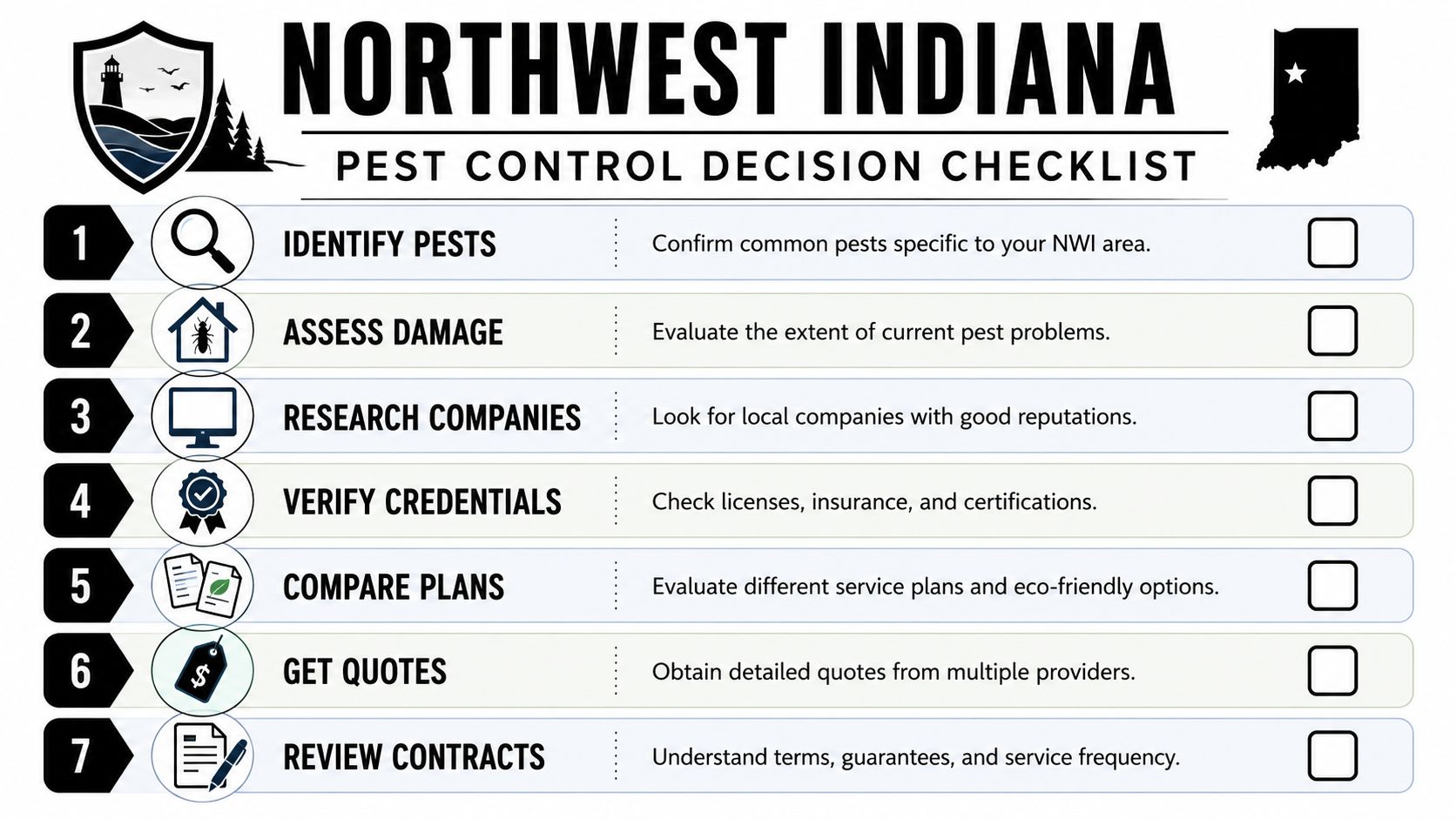
Use this checklist before you hire
- Confirm the pest problem: Be ready to describe where you saw activity, what it looked like, and whether it's getting worse.
- Verify credentials: Ask about licensing, insurance, and technician training.
- Ask about inspection first: The company should diagnose before recommending treatment.
- Look for an IPM mindset: You want inspection, exclusion, monitoring, and targeted control, not just routine spraying.
- Compare service plans carefully: Make sure the recommendation fits your pest issue and your property conditions.
- Request a detailed quote: The estimate should explain the scope of work and any follow-up.
- Read the agreement: If you want help getting ready for an inspection, this pest control inspection checklist is a useful starting point.
Red flags to avoid
Some companies make the choice easier by showing you what not to accept.
- Pressure to sign immediately: You should have room to ask questions.
- Vague pricing: If the quote is unclear, service expectations usually will be too.
- No mention of entry points or conditions: That often leads to repeat pest issues.
- Big promises with no inspection: Pest control doesn't work well on guesses.
- Poor communication: If getting answers is hard before service, it usually won't improve later.
Choose the company that explains the problem clearly, not the one that talks the fastest.
For homeowners and property managers in Northwest Indiana, that's a key decision framework. Identify the pest. Understand the cause. Hire the company that treats the structure and the conditions, not just the symptom.
If you're dealing with ants, spiders, rodents, wasps, mosquitoes, termites, or recurring seasonal pest issues, The Green Advantage serves Crown Point and nearby Northwest Indiana communities with practical inspections and treatment plans built around real conditions at the property. Reach out to schedule a pest inspection, request a quote, and get clear answers about the next step for your home.