
You hear scratching in the wall at night. Or you flip on the kitchen light and catch ants working a trail along the counter. Maybe it's wasps around the soffit, spiders in the basement corners, or a mouse problem that started with one sighting and now feels a lot less minor.
That's usually the moment people start searching for pest control near me or an exterminator in Crown Point, IN. The hard part isn't just finding a company. It's figuring out which home pest control companies will solve the problem instead of giving you one quick treatment and leaving the underlying cause behind.
In a home, pest issues can become expensive fast. For an average 3,000-square-foot home, pest control can cost between $400 and $950, while bedbugs and termites can cost thousands to treat, according to ConsumerAffairs pest control statistics. The same source notes that homeowners most often worry about ants, spiders, mice, and termites. That's why a professional evaluation matters early, before a small nuisance turns into recurring damage, stress, or repeat callbacks.
Your Guide to Finding a Pest Control Partner in Crown Point
A lot of Crown Point homeowners call only after they've already tried the obvious fix. They cleaned the pantry, set traps, sprayed the baseboards, or knocked down the same web three times. The pests slowed down for a bit, then came right back.
That pattern usually points to a larger issue. The pests still have what they need. Entry points haven't been sealed. Moisture is still present. Food sources are still accessible. The nest, colony, or harborage area was never fully addressed.
What homeowners are really looking for
Homeowners aren't looking for a fancy sales pitch. They want a local company that shows up, explains the situation clearly, and treats the home with care. In Northwest Indiana, that also means finding someone who understands our seasonal swings, older housing stock, garages, crawl spaces, and the way pests move indoors when weather changes.
When people compare home pest control companies, I tell them to focus on three practical questions:
- Will they inspect first: If a company starts talking treatment before asking where you've seen activity, that's a problem.
- Will they explain the cause: A good technician should connect the pest issue to conditions around the home.
- Will they recommend the right service level: Some problems need a one-time service. Others need monitoring and prevention.
Practical rule: If the proposal sounds like “we spray and see what happens,” keep looking.
A homeowner also benefits from understanding how pest companies present themselves online. If you're curious how local service businesses structure their messaging, these pest control advertising resources give useful context on what companies emphasize and why. It can help you separate polished marketing from a process that makes sense for your home.
Why the right fit matters locally
In Crown Point, pest control isn't just about reacting to what you see today. It's about reducing the odds that the same issue returns next month or next season. A strong provider should feel less like a one-time exterminator and more like a steady pest control partner who understands residential pest pressure in Northwest Indiana.
That's what homeowners usually want anyway. Clear answers. Safe, sensible treatment. Fewer surprises.
Identifying Common Pests in Northwest Indiana
Before you hire anyone, it helps to narrow down what you're dealing with. Not every pest problem calls for the same response, and not every sighting means you need the same type of service plan.
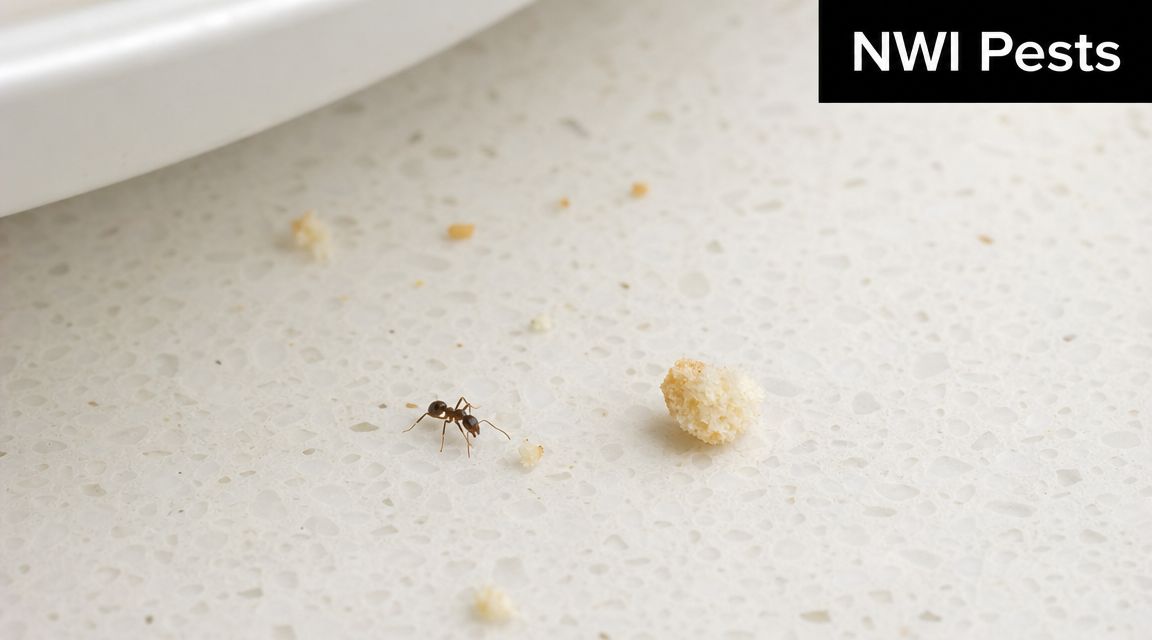
What shows up around Crown Point homes
In Northwest Indiana, the calls tend to cluster around a handful of familiar pests.
- Ants indoors: Usually found near kitchens, sinks, windows, and foundation edges. They're often drawn by food residue or moisture.
- Spiders in basements and corners: Spiders usually follow insect activity. If you're seeing more spiders, there may be another pest feeding them.
- Rodents in attics, garages, and wall voids: Mice and rats look for warmth, shelter, and easy access to food.
- Wasps around eaves and entry points: These become a bigger concern when nests are near doors, decks, play areas, or rooflines.
- Mosquitoes in yards: Standing water, dense vegetation, and shaded areas all contribute to mosquito pressure.
- Termite concerns: Homeowners often don't notice this issue until they see damage, swarmers, or mud tubes.
- Seasonal invaders: Boxelder bugs, stink bugs, and similar pests often become a nuisance during transition seasons.
Why these pests keep showing up
Pests don't move into a house randomly. They follow conditions.
A leaky spigot or damp crawl space can support ants, roaches, and rodents. Gaps around utility penetrations or garage doors give mice an easy entry route. Heavy vegetation against the home creates shelter and a bridge toward the structure. Even clutter in a basement or storage area can give pests a quiet place to hide long enough to establish.
Don't judge the problem by the first insect or rodent you saw. Judge it by what the property is allowing.
That's one reason seasonal timing matters here. Warmer stretches, heavy rain, sudden temperature swings, and longer active seasons can all change when pests appear and how long they remain active. Guidance on urban pest trends notes that pest pressure is increasing in many regions as warming temperatures and extreme weather expand the seasonality and geographic range of some household pests, which means homeowners benefit from proactive monitoring before peak activity instead of waiting until an infestation is obvious, as discussed in this note on changing urban pest pressure.
A quick self-check before you call
Use this simple homeowner checklist:
| Sign you notice | What it may suggest |
|---|---|
| Ant trails near counters or windows | A food source, moisture source, or outdoor colony pushing inside |
| Droppings in pantry or garage | Rodent movement and likely repeated access |
| New webs appearing fast | Ongoing insect activity, not just isolated spiders |
| Buzzing near soffits or deck areas | Active wasp or bee nesting nearby |
| Bites outdoors at dusk | Mosquito breeding habitat close to the yard |
If you can tell a company where the activity is, when it started, and whether it's getting worse, you'll get a much more useful inspection.
Screening Credentials of Pest Control Companies
Not all home pest control companies work the same way. Some build their service around inspection and problem-solving. Others still rely on broad treatment with very little diagnosis. If you're hiring someone to work in and around your home, the difference matters.
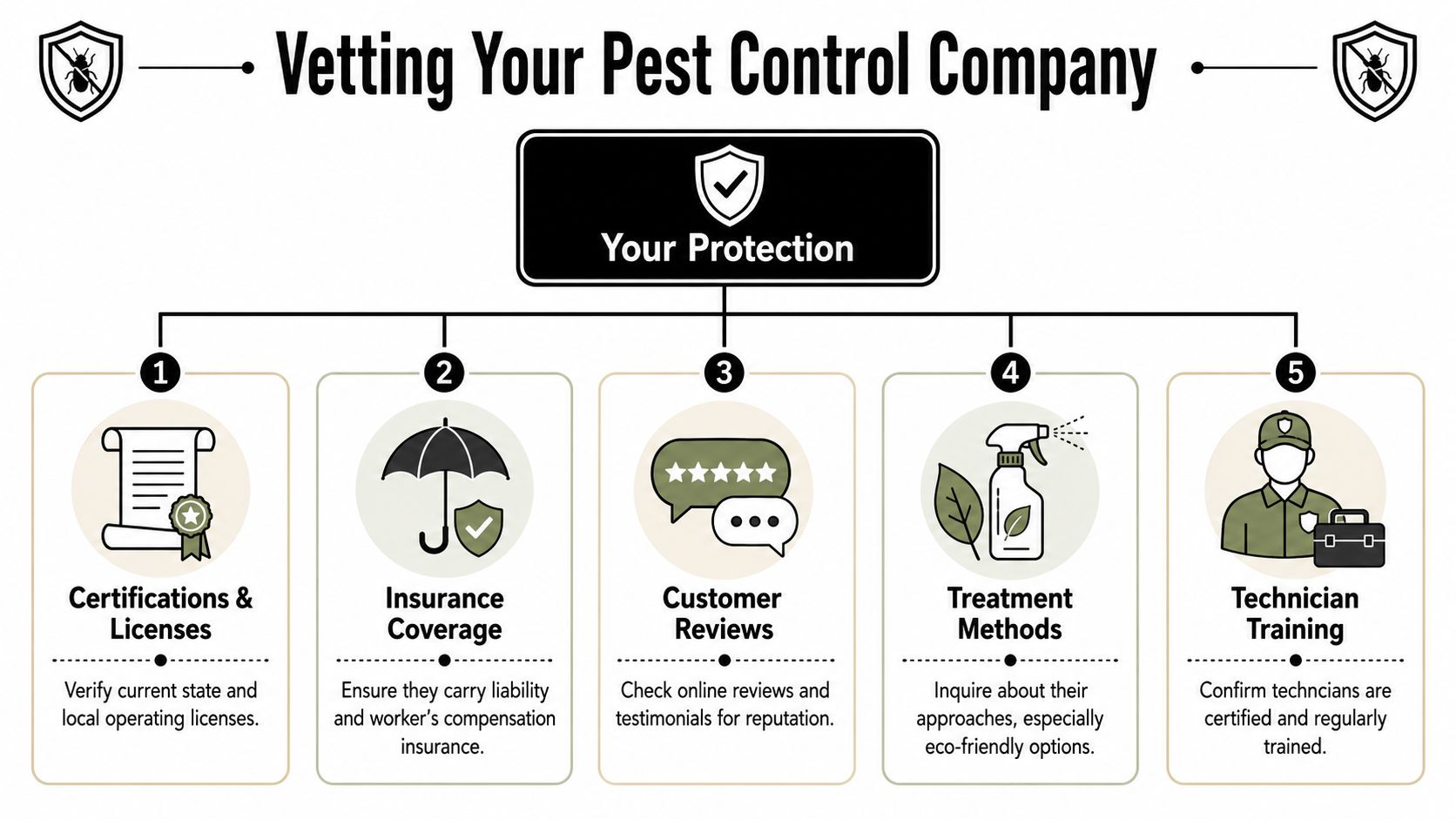
What to verify first
Start with the basics. A legitimate provider should be able to answer straightforward questions without getting defensive.
- State licensing: Ask whether the company and applicators are properly licensed for pest control work in Indiana.
- Insurance coverage: Make sure they carry appropriate liability and worker-related coverage.
- Local reputation: Read reviews from Crown Point and nearby Northwest Indiana communities. Look for comments about communication, follow-through, and whether problems stayed solved.
- Clear service scope: Ask what's included in the visit, what isn't, and whether exclusion or follow-up is part of the recommendation.
If a company is vague about credentials or avoids specifics, that's a warning sign.
Ask how they actually solve the problem
A better question than “What do you spray?” is “How do you decide what to do first?”
The strongest residential pest work follows integrated pest management, or IPM. In plain language, that means the company inspects the property, monitors activity, blocks access, and uses targeted controls instead of treating everything the same way. A practical overview of effective pest workflows explains that a high-performing approach is built around inspection, monitoring, exclusion, and targeted controls, and it warns that treating symptoms without fixing access routes often leads to re-infestation, as outlined in this discussion of how pest control actually works.
That matters because many homes don't have a “spray problem.” They have a gap problem, moisture problem, storage problem, or sanitation problem.
Questions worth asking on the phone
You don't need technical jargon. A few practical questions will tell you a lot.
Do you inspect before recommending treatment?
If the answer is no, move on.Will you identify entry points and contributing conditions?
That's how recurring issues get addressed at the source.What follow-up do you recommend if activity continues?
Good companies expect some pests to require monitoring, not instant perfection.How do you handle homes with children or pets?
You want clear post-treatment instructions and realistic safety guidance.
A trustworthy company should make you feel informed, not rushed.
Red flags homeowners miss
Some warning signs are obvious, like high-pressure sales tactics. Others are easier to miss.
| Red flag | Why it matters |
|---|---|
| Quoting before inspection | Suggests a generic treatment mindset |
| Promising a one-visit cure for every pest | Ignores how different infestations behave |
| No discussion of exclusion | Leaves the home vulnerable to repeat activity |
| Vague product answers | Makes it harder to understand safety and expectations |
| No written plan | Creates confusion about what you're paying for |
In Crown Point, an exterminator near me search will pull up plenty of options. The better move is to slow down long enough to choose a provider that diagnoses before it treats.
Comparing Service Plans and Eco-Friendly Treatments
Homeowners usually compare two things at the same time. They want to know what type of service they need, and they want to know whether the treatment approach fits their household.
One-time service or recurring protection
A one-time treatment can make sense when the issue is isolated. Think of a wasp nest at one entry point, a short-lived ant flare-up tied to one area, or a single pest event that doesn't reflect a broader vulnerability.
Recurring service makes more sense when the home has repeat pressure, seasonal patterns, or structural conditions that invite pests back. That can include ongoing perimeter activity, rodent pressure, regular spider issues, mosquito management, or properties where nearby woods, water, outbuildings, or foundation gaps increase exposure.
Here's the practical comparison:
| Service type | Usually a fit when | Main trade-off |
|---|---|---|
| One-time treatment | Problem is limited and clearly defined | May not prevent future pest pressure |
| Recurring plan | Problem is seasonal, repeated, or tied to the property | Higher commitment, but better ongoing prevention |
The right answer depends on what the inspection finds. A homeowner shouldn't be pushed into a recurring plan for every issue. But it's also not wise to treat a recurring pest pattern like a one-off event.
What eco-friendly pest control really means
A lot of people ask for “green” treatment, but they don't always get a clear explanation of what that means in practice. The most honest answer is that eco-friendly pest control usually means using an IPM-based approach that reduces unnecessary pesticide use through inspection, sealing, sanitation, monitoring, trapping, and carefully selected products. It does not automatically mean chemical-free. Public-facing guidance on residential services makes this point clearly in this explanation of green pest control and IPM.
That's an important distinction for families in Crown Point who want effective control without more treatment than necessary.
- Low-impact starts with inspection: If a technician doesn't know where pests are entering or nesting, “green” becomes just another label.
- Exclusion often matters more than product choice: Door sweeps, crack sealing, moisture correction, and trimming back vegetation can do more for long-term control than repeated sprays.
- Targeted treatment beats broad treatment: Baits, traps, and selective applications are often more sensible than blanket applications.
For homeowners who want a clearer picture of what environmentally mindful treatment looks like in real residential settings, The Green Advantage offers an overview of environmentally friendly pest control methods.
A short visual overview can also help if you're comparing methods and expectations:
Matching the plan to the pest
The treatment plan should follow the pest, not the other way around.
A termite concern needs a very different conversation than mosquito reduction. Rodent control often requires exclusion work, sanitation adjustments, and follow-up. Ant control may involve identifying the colony source and choosing baits or targeted treatment instead of surface spraying alone. Wasp removal can be simple if the nest is exposed and isolated, but more involved if activity is tied to rooflines or hidden voids.
The best providers will say when a low-impact approach is enough, and they'll also say when stronger intervention is justified.
Your Service Experience with The Green Advantage
When homeowners call for pest control in Crown Point, IN, they usually want to know what happens next. The process should be easy to understand and easy to follow.
The first call and inspection
The experience starts with a conversation about what you're seeing. That includes where activity is happening, how long it's been going on, whether it seems seasonal, and whether you've already tried anything on your own. Those details help shape the inspection.
At the property, the technician should look beyond the visible pest. In a solid residential visit, that means checking likely entry points, harborage areas, moisture conditions, and the parts of the structure that support recurring activity. The goal isn't just to confirm that pests are present. It's to understand why.
The treatment plan and what you'll be told
After the inspection, the findings should be explained in plain language. You should know what pest is likely involved, what conditions are contributing to the problem, what treatment is recommended, and what you need to do before or after service.
That's especially important because pest control works best as an integrated, ongoing system. Many homeowners ask why pests keep coming back, and the reason is often that food, water, or entry points remain available. Effective service has to address those root causes, not just spray for pests, as explained in this discussion of why pests return and when recurring service matters.
Good pest control doesn't stop at product application. It changes the conditions that let pests stay.
What the service visit should feel like
A professional visit should be organized and respectful. Homeowners should expect clear instructions, careful work around the property, and direct answers when they ask what was done.
The Green Advantage provides residential pest control, commercial pest control, inspections, mosquito reduction, rodent control, termite-related services, and other targeted treatments in Crown Point and surrounding Northwest Indiana communities. In practical terms, that means the service plan can be matched to the property instead of forcing every customer into the same template.
After the treatment
Follow-up matters. Some pest issues improve quickly. Others need monitoring, environmental corrections, or a second phase. A good company should tell you what activity may continue temporarily, what signs mean the plan is working, and when to call back.
For many homeowners, that clarity is what lowers the stress. You're not left wondering whether the service “took.” You know what to watch for and what the next step is.
Your Northwest Indiana Pest Control Decision Checklist
If you're comparing residential pest control options in Crown Point, keep the decision simple. You don't need a perfect spreadsheet. You need a shortlist of practical checks that protect your home and your budget.
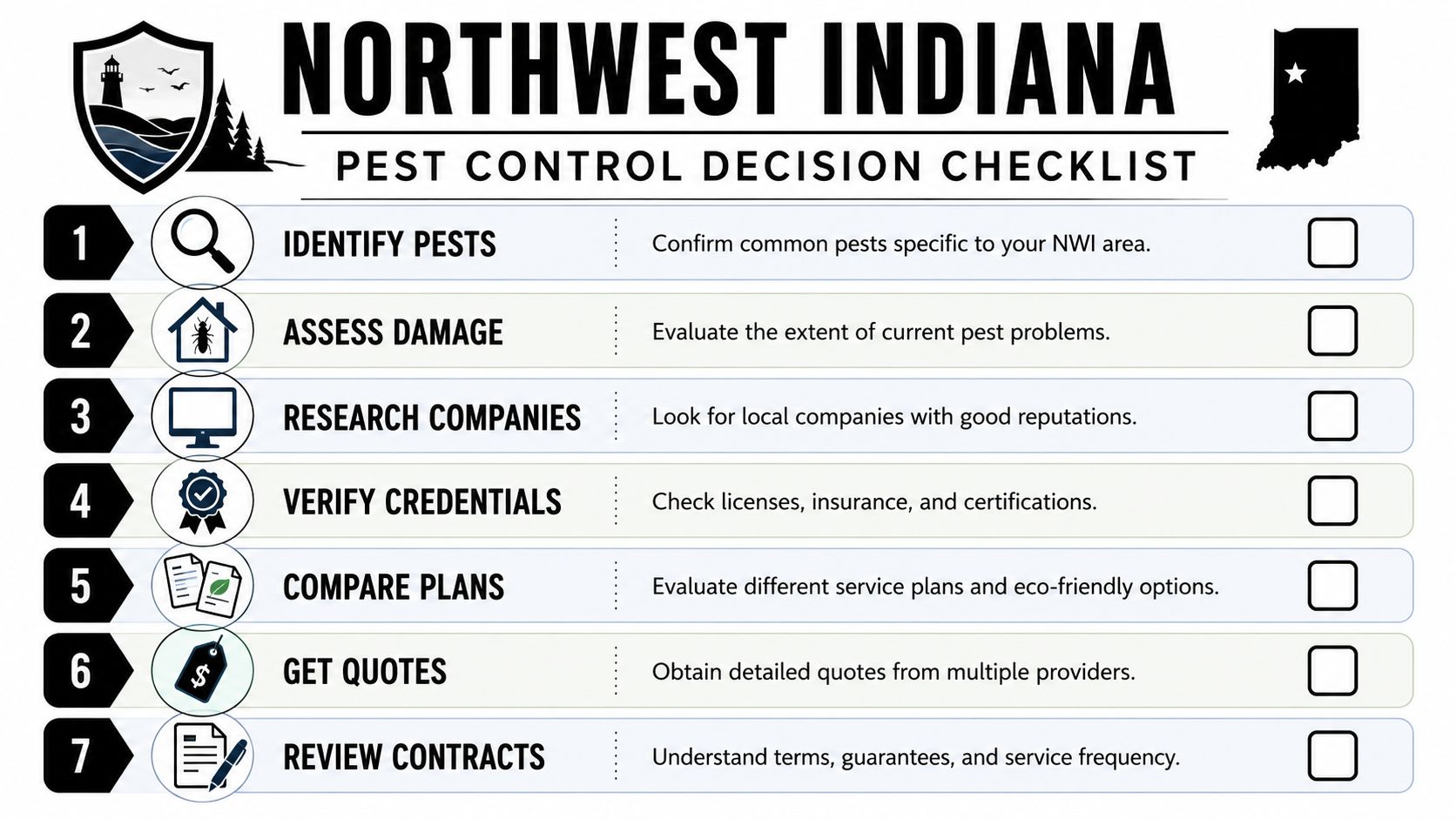
Use this checklist before you hire
- Confirm the pest problem: Be ready to describe where you saw activity, what it looked like, and whether it's getting worse.
- Verify credentials: Ask about licensing, insurance, and technician training.
- Ask about inspection first: The company should diagnose before recommending treatment.
- Look for an IPM mindset: You want inspection, exclusion, monitoring, and targeted control, not just routine spraying.
- Compare service plans carefully: Make sure the recommendation fits your pest issue and your property conditions.
- Request a detailed quote: The estimate should explain the scope of work and any follow-up.
- Read the agreement: If you want help getting ready for an inspection, this pest control inspection checklist is a useful starting point.
Red flags to avoid
Some companies make the choice easier by showing you what not to accept.
- Pressure to sign immediately: You should have room to ask questions.
- Vague pricing: If the quote is unclear, service expectations usually will be too.
- No mention of entry points or conditions: That often leads to repeat pest issues.
- Big promises with no inspection: Pest control doesn't work well on guesses.
- Poor communication: If getting answers is hard before service, it usually won't improve later.
Choose the company that explains the problem clearly, not the one that talks the fastest.
For homeowners and property managers in Northwest Indiana, that's a key decision framework. Identify the pest. Understand the cause. Hire the company that treats the structure and the conditions, not just the symptom.
If you're dealing with ants, spiders, rodents, wasps, mosquitoes, termites, or recurring seasonal pest issues, The Green Advantage serves Crown Point and nearby Northwest Indiana communities with practical inspections and treatment plans built around real conditions at the property. Reach out to schedule a pest inspection, request a quote, and get clear answers about the next step for your home.