
Spider Inspection in Crown Point, IN

A homeowner in Crown Point, IN, sweeps the basement stairwell clean on Saturday and finds fresh webs in the same corner a few days later. Another homeowner notices spiders near the garage light, while a property manager sees webs returning around several utility rooms. These findings can feel like an infestation, but one spider or one web usually isn't enough to justify treatment.
A practical spider inspection looks for the pattern behind the sighting. Where are spiders appearing? Are webs, egg sacs, and prey insects returning? Could gaps, moisture, clutter, or outdoor lighting be supporting activity? The Green Advantage serves Crown Point and surrounding Northwest Indiana communities with inspection-focused pest control for homeowners, landlords, businesses, and commercial facilities. The process is designed to identify the reason spiders are present before recommending the lightest effective next step.
What a Spider Inspection Solves
A Crown Point homeowner may sweep the basement stairs repeatedly and still find fresh webs in the same quiet corner. The cleanup removes visible evidence for a short time, but it does not explain why spiders keep using that location. A useful inspection follows the pattern across repeated checks instead of treating each sighting as a separate event.
The inspection looks beyond the spider
Spiders are predators. Their presence often reflects access to prey insects, shelter, moisture, and entry points, rather than a problem caused by spiders alone. Inspection therefore considers insects near windows or lights, clutter beneath stairs, damp areas around a sump pump, and openings along the foundation.
The process also checks whether activity is tied to a particular room, wall, window, foundation section, or exterior light. Regular observations, flashlights, sticky traps, and systematic checks around edges and corners help separate occasional outdoor movement from recurring indoor pressure. Recording the location and type of evidence gives the technician something more useful than a single spider count.
The technician is trying to answer four practical questions:
- Where is activity concentrated? A basement stairwell suggests a different pathway than a bedroom windowsill or exterior eave.
- Is the activity recurring? Reappearing webs carry more weight than one web left after a door or window was opened.
- Are spiders reproducing indoors? Egg sacs and repeated findings may indicate an ongoing indoor cycle.
- What conditions support them? Prey insects, cracks, clutter, outdoor lighting, and moisture can shape the recommendation.
A single sighting may call for observation and cleanup. Repeated signs can justify monitoring, exclusion, or targeted treatment, depending on where the evidence appears and what supports it.
The result is a property-specific diagnosis, not an automatic pesticide application. It helps distinguish harmless outdoor activity from recurring indoor activity and identifies the prey, entry points, or harborage conditions that warrant action. That distinction matters for residential pest control, commercial pest control, and homeowners seeking a lasting solution instead of repeated surface cleanup. The inspection approach is consistent with EPA school integrated pest management guidance, which emphasizes regular monitoring and documentation in preventive pest management.
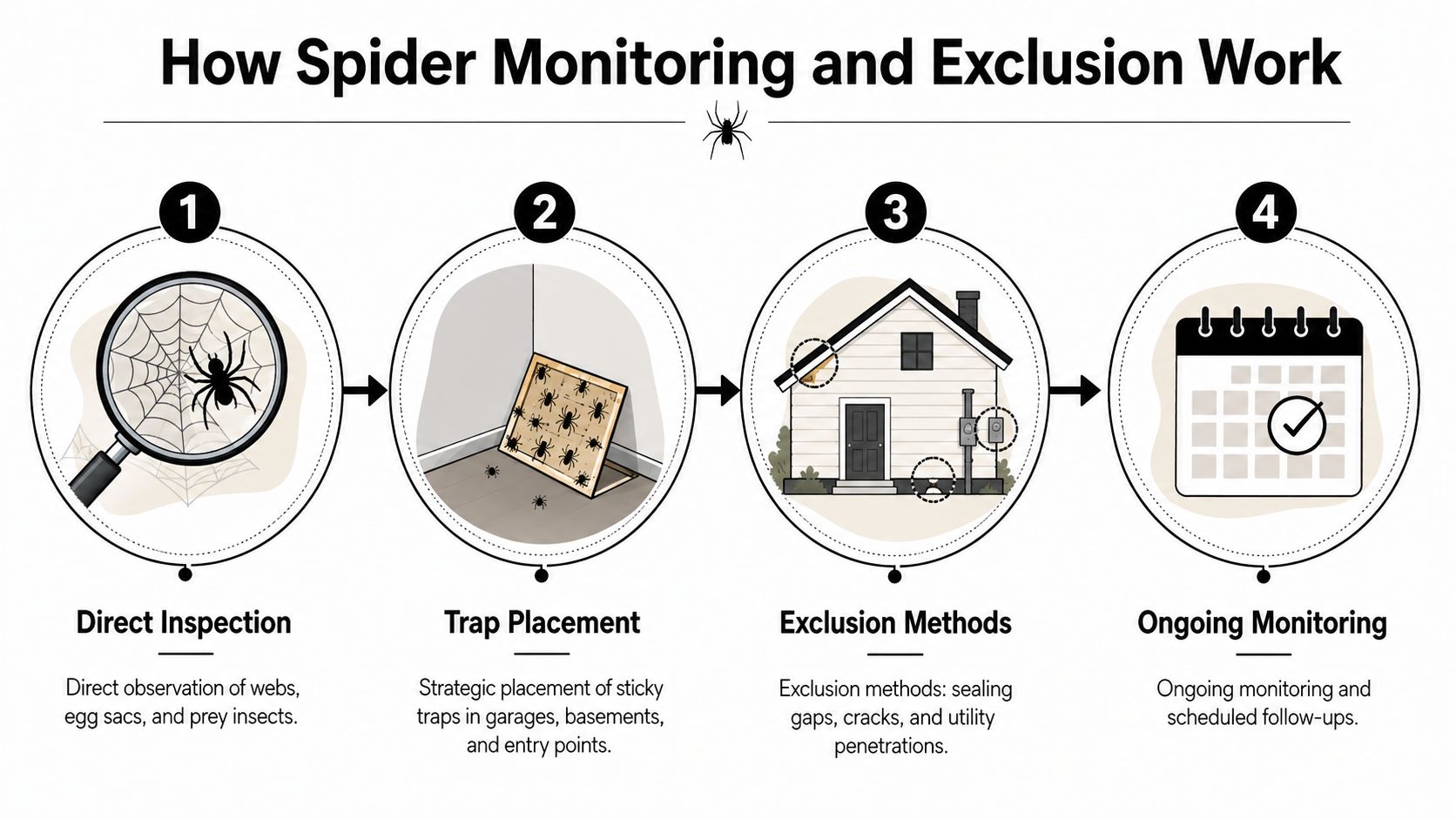
How Spider Monitoring and Exclusion Work
Monitoring and exclusion address different parts of the same problem. Monitoring identifies where and when activity occurs. Exclusion closes the routes and removes the conditions that keep spiders and their prey near the structure.
Start with direct observation
Begin with evidence you can locate and compare. Check for live spiders, fresh and old webs, egg sacs, shed skins, and prey insects. Web shape and placement help show whether a corner is rarely disturbed or has become a regular hunting site.
Place glue boards in quiet areas such as garages, basements, utility rooms, corners, and along baseboards. A trap confirms movement where sightings are uncommon. Household inspection guidance recommends glue board monitors in corners and along baseboards, especially in closets, garages, basements, attics, and crawlspaces, as described in this practical home spider inspection guide.
Repeat the check and record the location
One observation may reflect a door opened that day or a web that had been left undisturbed. Repeat checks over one to two weeks show whether the same room, wall, trap, or window continues to produce evidence. Record the date, location, sign type, and nearby insects. Facilities may use numbered, dated traps and record captures after 24 to 48 hours, following a monitoring method described in EPA monitoring instructions for pest management.
For a homeowner, a phone note is enough:
- Record the room and exact location.
- Identify the sign as a web, spider, egg sac, or prey insect.
- Photograph recurring areas before cleaning.
- Compare the findings at each later check.
Use exclusion as the long-term layer
Seal gaps around windows, doors, screens, weather stripping, and utility penetrations. Move stored materials away from walls, manage vegetation near the foundation, and correct conditions that attract prey. Outdoor lighting also matters. Insects gather around bright fixtures, supplying spiders with food near entry points. Reduce unnecessary lighting, reposition fixtures, and keep doors closed. These changes reduce insect traffic and spider presence near entry points. Spider inspection guidance for structures recommends reviewing interior and exterior entry points, including low areas such as decking and patio furniture and high areas such as eaves and light fixtures.
After the first trap check, keep the records and mark the locations that produced repeated evidence. Clean isolated webs, correct the nearby condition, and check the same traps again. If activity continues in the same areas, show the record to a pest professional so the inspection can focus on those entry points and harborage conditions.
Interior and Exterior Inspection Walkthrough
A thorough inspection starts indoors, then follows the structure outward. That order helps connect the place where a spider was seen with the entry point or outdoor condition that may be supporting it.
Begin with quiet interior spaces
Spiders prefer areas with little disturbance, available shelter, and access to prey. In a Crown Point home, check:
- Basements and stairwells: Look along baseboards, ceiling corners, window wells, and behind stored items.
- Crawlspaces and sump pump rooms: Check moisture, foundation gaps, pipes, and areas that rarely receive foot traffic.
- Garages and utility rooms: Inspect corners, door edges, electrical boxes, shelves, and the space around equipment.
- Attics and storage areas: Examine rafters, boxes, clothing, boots, and the edges where walls meet ceilings.
- Windows and doors: Review damaged screens, worn weather stripping, and webs near exterior-facing openings.
Homeowners can safely sweep visible webs, reduce clutter, and note exactly where signs return. Those actions provide useful information, but they don't replace a closer review of crawlspace access, attic voids, or structural gaps that aren't easy to see from floor level.
Follow the exterior perimeter
Outside, walk the foundation line and inspect the places that combine shelter, web-building surfaces, and insect activity. Check under decks, patio furniture, window ledges, eaves, soffits, gutters, exterior lights, and shed perimeters. Look for shrubs touching the siding, uncut grass, mulch or leaf buildup, stacked wood, and old webs around doors and windows.
Repeated activity at an exterior light often says more about nearby insect pressure than about a spider entering directly through that fixture.
The property's water management also matters. Downspouts that discharge beside the foundation, damp mulch, and moisture near a sump pump can make surrounding areas more favorable to insects and spiders. Inspectors should document these conditions rather than assume that spraying the visible web will solve them.
Account for Northwest Indiana construction conditions
Crown Point homes experience seasonal temperature changes that can stress caulk, screens, door sweeps, and weather stripping. Freeze-thaw cycles may widen small gaps around windows, foundations, and utility lines, so a gap that looked insignificant during one inspection can become a more useful entry route later.
Exterior guidance recommends checking cracks, gaps, damaged window screens, and degraded weather stripping, along with low harborages and high attractors. A professional inspection also considers accessibility and safety, particularly around attic voids, crawlspaces, rooflines, and high eaves. A trained technician can identify relationships that a quick visual sweep may miss.
Signs That Activity Needs Attention
One spider doesn't prove an infestation. Neither does one web in a basement corner, one specimen near a window, or a brief outdoor sighting after a storm. Treating every sighting as equally urgent can waste time and obscure the condition that needs attention.
Sort evidence by signal strength
The useful threshold is repetition, location, and supporting evidence. A spider seen once may have entered through an open door. Webs that return in the same place after cleaning suggest that the location continues to offer shelter or prey.
Low-signal findings usually support observation and basic cleanup:
- An isolated web in a basement or garage corner.
- A single spider near a window or door.
- A short-lived outdoor sighting after weather changes.
Medium-signal findings deserve closer monitoring:
- Webs reappearing in the same location.
- Activity in several rooms on the same level.
- Daytime sightings in dark, undisturbed interior spaces.
- Repeated webs around a garage light, window well, or foundation section.
High-signal findings support prompt professional follow-up:
- Visible egg sacs indoors.
- Multiple spiders in a garage, basement, or utility room.
- Prey insects, including small flies or stored-product pests, in the same area.
- Shed skins or evidence of continued development.
- Recurring activity across consecutive weeks.
This pattern-based approach is especially useful in Northwest Indiana homes with finished basements, sump pump rooms, attached garages, and storage areas that may sit undisturbed for long periods.

Let the evidence guide the response
A web that appears once and stays gone after cleaning may not require a service visit. A web that returns repeatedly, especially alongside egg sacs or prey insects, tells a different story. The inspection's job is to determine whether you're seeing a snapshot or a pattern.
For a homeowner searching for pest control near me, that distinction creates a more measured decision. Monitoring may be enough for isolated outdoor activity. Exclusion and targeted spider control become more reasonable when repeated indoor evidence shows that the property is supporting ongoing activity.
Identification and Conducive Conditions
A phone photo can help start a conversation, but it rarely provides dependable species identification by itself. Lighting, distance, camera angle, molt stage, and image quality can alter the features a technician needs to examine. Color and markings alone are especially unreliable.
Compare the evidence before choosing a response
A professional identification may consider body shape, leg arrangement, web structure, web location, and time of day. Webs may appear as loose cobwebs, flat sheets, or funnel-like structures, and their placement can help explain how the spider is using the property.
Some spiders found around homes, sheds, and outdoor areas are typically low concern, including orb weavers, cellar spiders, and common house spiders. Recurring sightings of larger or more secretive spiders indoors deserve closer attention, especially when paired with egg sacs, prey insects, or repeated activity in protected spaces. Species confirmation can require magnification, from a 10× hand lens for basic morphology to a 20×–50× stereoscopic microscope for advanced identification, and sometimes a 40×–200× compound microscope for fine structures, as explained in this arachnid identification reference.
| Evidence Factor | Reliable Pattern Observation | Appearance-Only Judgment |
|---|---|---|
| Location | Repeated signs near a foundation gap, window well, or utility room | “It looks like the same spider” |
| Web structure | Cobweb, sheet, or funnel pattern connected to a specific harborage | General web shape seen briefly |
| Supporting signs | Egg sacs, shed skins, and prey insects in the same area | A single color or marking |
| Timing | Activity that returns across consecutive checks | One sighting at an unknown time |
| Property conditions | Moisture, clutter, lighting, or entry gaps nearby | No review of the surrounding structure |
Identify what keeps the area attractive
The inspection should connect identification with conducive conditions, such as exterior lights that draw insects, woodpiles or mulch against the foundation, gaps around utility lines, cluttered storage, and moisture near sump pumps or downspouts. Spider management protocols also recommend checking vegetation, debris, stacked wood, uncut grass, and old webs around doors and windows, as outlined in this spider management protocol.
Those two inputs, reliable identification and property evidence, shape the recommendation. Depending on what the inspection finds, the right next step may be cleanup and monitoring, exclusion work, prey-insect control, or targeted treatment. The spider identification guide from The Green Advantage can help homeowners organize observations before a service visit, but a technician should evaluate recurring or uncertain activity in context.
Cost and Inspection Frequency
The cost of a spider inspection depends on the work required at the property, not just on the number of spiders seen. A small home with accessible areas may require a different inspection scope than a larger property with a finished basement, attached garage, shed, crawlspace, and extensive exterior perimeter.
What shapes the service scope
Common pricing variables include:
- Property size: More rooms and more perimeter require more inspection time.
- Basement configuration: Finished areas can hide activity behind stored items, while unfinished spaces may expose foundation gaps and pipes.
- Attached garages and outbuildings: These add separate entry points, lighting, and harborage zones.
- Finding severity: Egg sacs, recurring webs, prey insects, and multiple active areas may require more detailed follow-up.
- Service format: A standalone inspection differs from an assessment bundled with broader residential or commercial pest control.
A one-time visit is often diagnostic rather than curative. It can identify active areas and conditions, but it may not show whether activity is persistent unless the property also uses monitoring and later comparison.
Match frequency to risk
Many Northwest Indiana homes benefit from an annual exterior check. Properties with prior spider activity, moisture concerns, extensive landscaping, wooded lots, or recurring prey insects may justify seasonal monitoring, particularly during periods when homeowners notice more activity in late summer and fall.
Commercial facilities and multi-unit buildings often gain more from consistent walkthroughs and dated records than from occasional reactionary service. Recent spider inspection guidance recommends glue boards in storage areas, consistent monthly walkthroughs, and logs tracking date, location, sign type, and counts so patterns can emerge after three to four months, as described in this spider inspection monitoring guide.
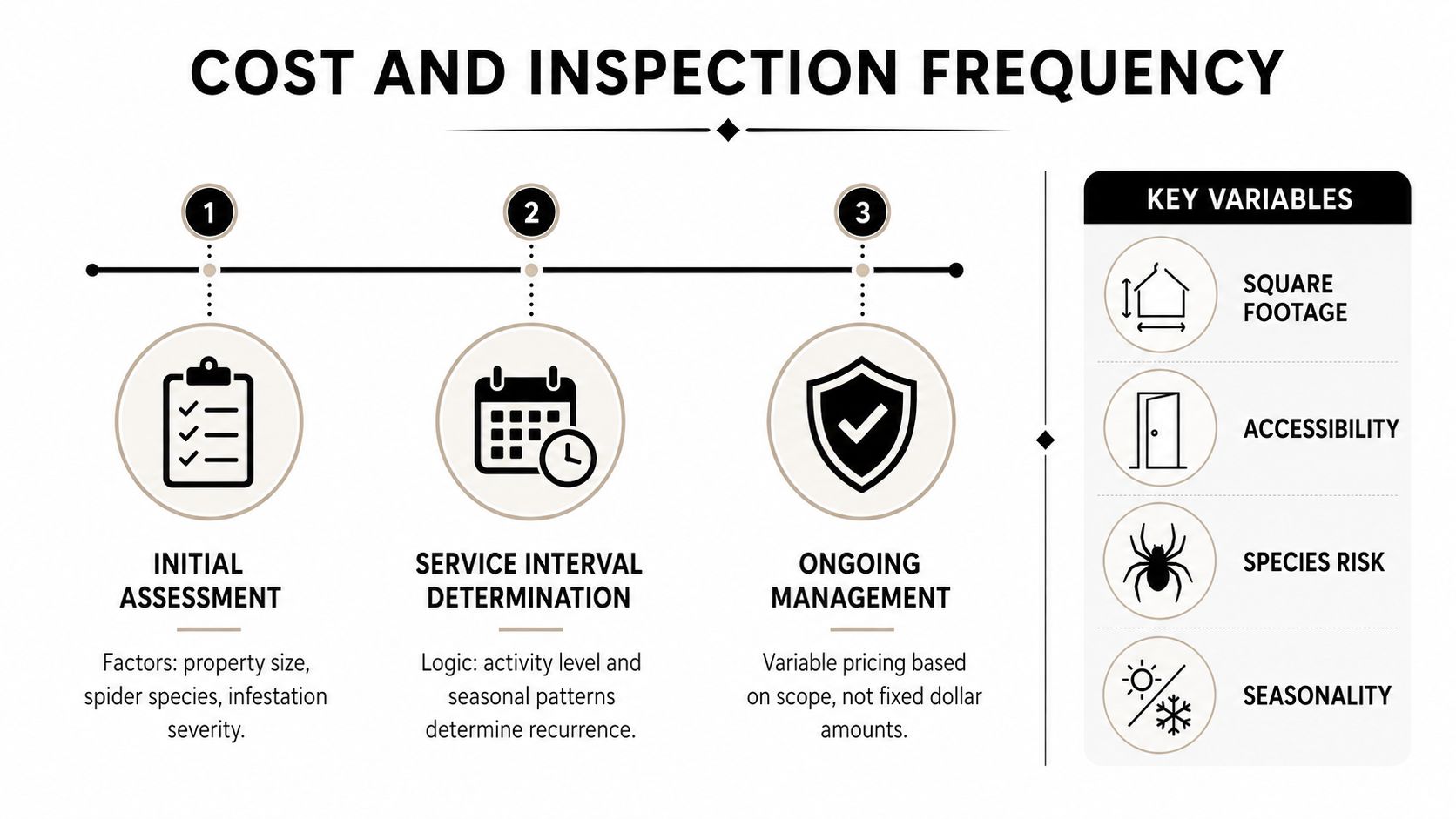
Bundling inspections into a quarterly pest program typically reduces the per-visit cost compared with standalone service, though the right model depends on the property and documented risk. The Green Advantage should explain which cadence fits the evidence and recommend the lightest effective approach rather than an unnecessarily aggressive schedule.
The Green Advantage Service Experience
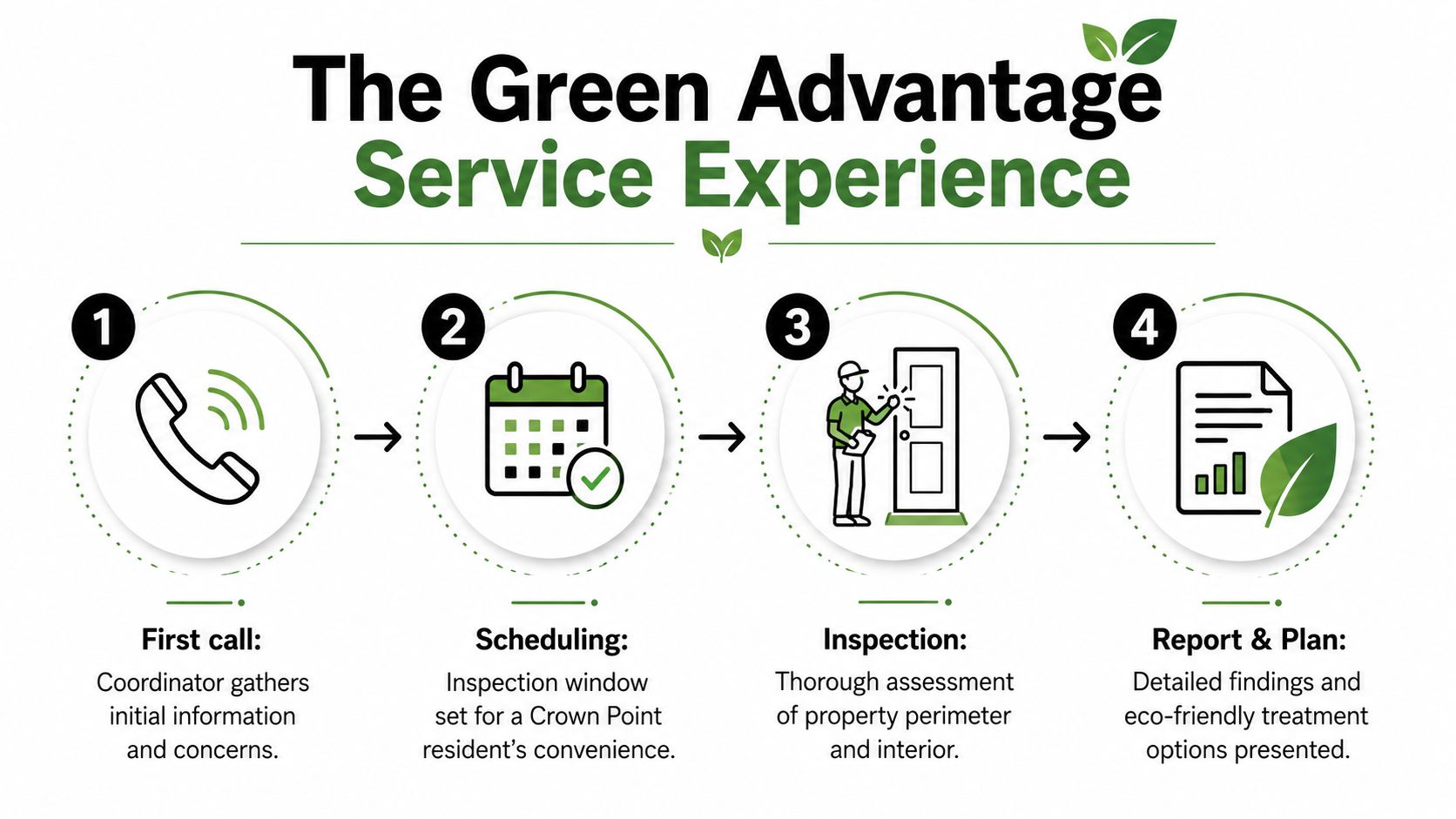
A concerned homeowner usually starts with a simple description, “The webs keep coming back in the basement,” or “There are spiders around the garage every morning.” The first call should turn that concern into useful inspection information. A coordinator can gather the locations, timing, visible signs, property features, and any related pest concerns before scheduling an inspection window that suits the Crown Point resident.
The visit starts with diagnosis
On arrival, the technician explains what will be examined and walks through the property systematically. Interior areas may include basements, stairwells, utility rooms, garages, storage zones, window wells, and accessible crawlspaces. The exterior review follows foundation lines, doors, windows, eaves, lighting, sheds, landscaping contact points, and possible entry gaps.
The technician isn't looking only for live spiders. They're also checking for webs, egg sacs, prey insects, moisture, clutter, damaged screens, worn weather stripping, and other conditions that could support recurring activity. That broader assessment helps separate a harmless outdoor visitor from a property condition that needs attention.
Findings become a plain-language plan
After the walkthrough, the homeowner should receive a clear explanation of what was found and what wasn't. Recommendations may include sealing entry points, moving wood or debris away from the foundation, reducing clutter, adjusting outdoor lighting, improving moisture management, adding glue board monitoring, or scheduling a follow-up check.
Treatment options should be discussed when evidence supports them. If the inspection finds only isolated outdoor activity, monitoring and maintenance may be more appropriate than immediate indoor treatment. If it finds recurring indoor signs, egg sacs, prey insects, or multiple active areas, targeted spider control and related pest management may make sense.
Keep the record useful after the visit
Written findings and photo records can make follow-up more consistent, especially for repeat customers, landlords, and commercial facilities. A documented location, condition, and recommendation gives the next technician a meaningful comparison instead of forcing the property owner to start from memory.
The Green Advantage provides pest inspections and spider-specific pest control for residential and commercial properties in Crown Point and nearby Northwest Indiana communities. Its service approach focuses on diagnosing the site, discussing environmentally mindful options, and keeping customers informed from scheduling through follow-up.
Prevention and Next Steps
A spider inspection becomes more valuable when homeowners use the findings to change the property. Sweeping webs can improve appearance, but it won't address a foundation gap, a damp storage area, or the insects gathering around an exterior light. Prevention works best when it reduces the shelter, access, and food conditions identified during the inspection.
Improve the exterior perimeter
Start outside, where many indoor problems begin. Keep firewood away from the foundation, trim vegetation off siding, clear leaf litter from corners and gutters, and remove debris that creates low, protected harborages. Review porch, garage, and outdoor lighting, especially fixtures that attract insects close to doors and windows.
Use the inspection record to prioritize repairs:
- Entry points: Replace damaged screens, install effective door sweeps, and caulk gaps around windows, doors, and utility lines.
- Moisture zones: Check downspout discharge, sump pump areas, crawlspaces, and damp foundation edges.
- Storage areas: Move boxes and seasonal items away from walls where practical, and avoid creating dense piles under decks or in sheds.
- Vegetation contact: Keep shrubs, grass, mulch, and branches from forming a continuous bridge against the structure.
These changes can also support broader residential pest control goals, including ant control, mosquito control, rodent exclusion, and seasonal pest prevention.
Make indoor spaces easier to monitor
Basements, garages, attics, and closets become easier to inspect when clutter is reduced. Store clothing, boots, decorations, and seasonal equipment in sealed bins instead of open piles. Manage humidity in crawlspaces and basements, and keep the areas around sump pumps and utility penetrations accessible for future checks.
A recurring web should be photographed and logged before it's removed. That small habit helps reveal whether the same location is active, whether several rooms are involved, and whether an exterior repair changed the pattern. Homeowners looking for additional property-specific ideas can review these Crown Point spider prevention techniques.
The most practical response isn't always an exterminator near me for an immediate spray. Sometimes it's observation, cleanup, and entry-point maintenance. When signs repeat across locations or consecutive checks, a professional spider inspection can identify the prey, harborage, moisture, and access conditions that DIY cleanup misses.
The Green Advantage offers spider inspections, residential pest control, commercial pest control, and environmentally mindful treatment options for properties in Crown Point, IN, and surrounding Northwest Indiana communities. Visit The Green Advantage to schedule an inspection or request a quote based on the activity pattern at your home or business.
Pest Control Treatment in Crown Point, in: A Homeowner Guide

You notice a thin line of ants along the kitchen counter, hear movement near the basement pantry, or find a wasp nest tucked beneath the eaves. The first question is usually simple: should you handle it yourself, or search for pest control near me?
For a Crown Point, IN homeowner, effective pest control treatment isn't just a product sprayed around the house. It's a decision process that starts by identifying the pest, locating its activity, and understanding why it reached the property. The Green Advantage serves Crown Point and surrounding Northwest Indiana communities with residential pest control, commercial pest control, inspections, mosquito reduction, termite services, rodent control, and other targeted solutions.
What Pest Control Treatment Really Means for Your Home
A professional visit should begin with questions, not a sprayer. A technician needs to know where you've seen pests, when activity started, whether anyone has noticed droppings or damage, and whether children, pets, or sensitive household members need special precautions.
The inspection then connects those observations to the home itself. The technician looks for active areas, entry points, moisture, clutter, gaps around the foundation, damaged screens, and other conditions that make the property easier for pests to enter or remain in. That information determines whether the right response is baiting, exclusion, trapping, a targeted interior application, exterior protection, or a combination.
A treatment plan has several parts
A well-designed pest control treatment usually includes:
- Identification: Confirming the pest instead of treating every insect or sign as the same problem.
- Inspection: Locating trails, nests, runways, harborage areas, and access points.
- Preparation: Explaining what residents should move, cover, clean, or temporarily remove.
- Targeted control: Applying the selected method only where it fits the pest and the property.
- Prevention: Addressing food, moisture, gaps, vegetation, and other conditions that support activity.
- Follow-up: Checking whether the plan worked and adjusting monitoring stations, bait, exclusion, or treatment if needed.
A visible pest is often only the part of the problem you can see. Ants may be traveling from a hidden colony, mice may be entering through a small opening, and spiders may be responding to insects around exterior lights. A single broad application might reduce activity temporarily without correcting the reason pests arrived.
Practical rule: The right treatment is the least disruptive method that addresses the confirmed pest, its access route, and the conditions supporting it.
For a household searching for an exterminator near me, the goal should be clear expectations from the first call through follow-up. You should know what the technician found, what will be treated, what preparation is required, and what happens after the service dries or the monitoring period begins.
Common Pests That Drive Treatment Decisions in Northwest Indiana
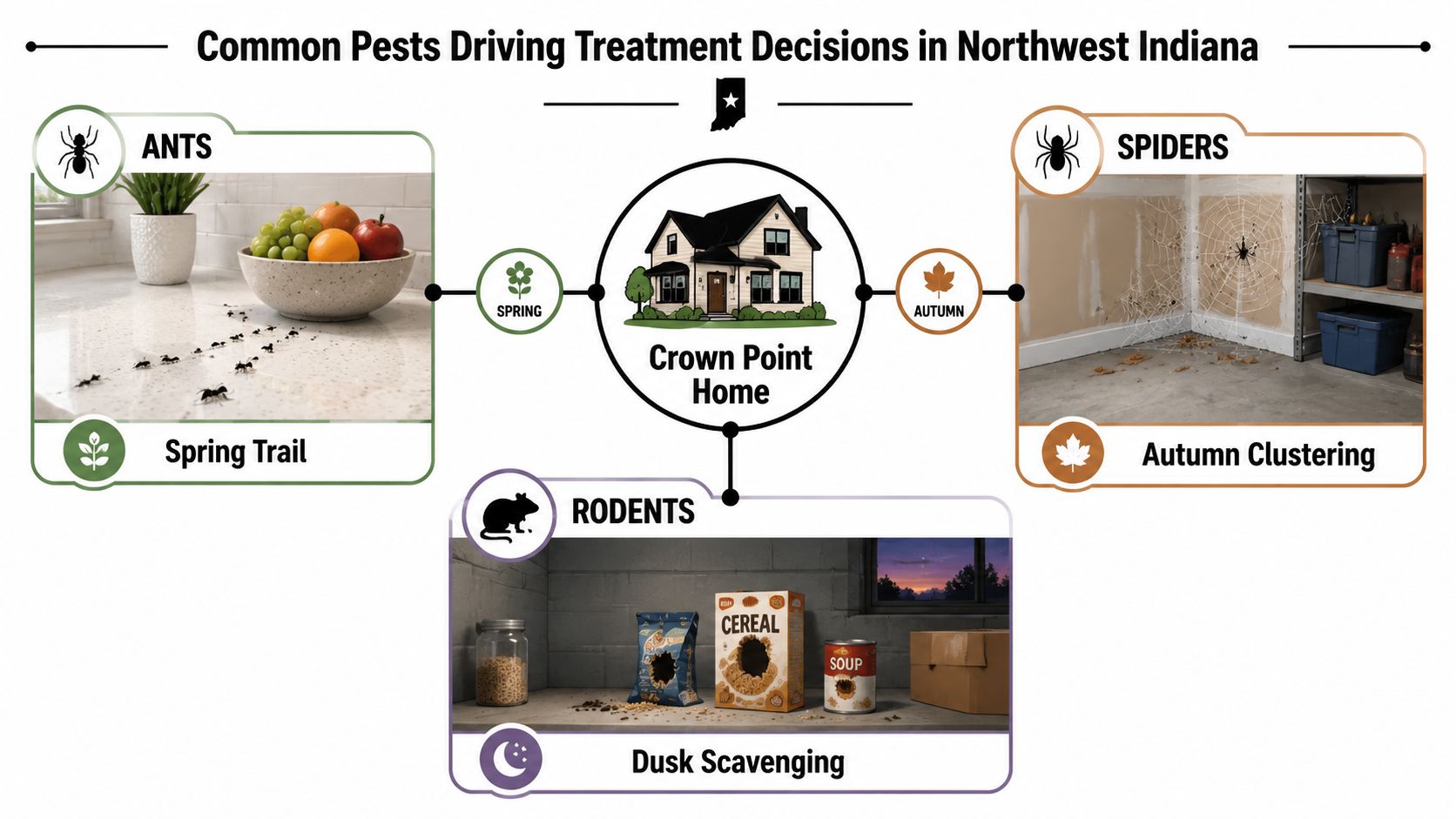
A homeowner in Crown Point may see ants marching toward a bowl of fruit when spring temperatures rise. Another may find spiders gathering in a garage corner as autumn weather changes. Those situations look different, and the treatment decision should be different too.
Recognizing the pattern
Ants often create a visible trail along counters, windows, or floor edges. Wiping away the workers may remove the evidence for a short time, but baiting can be more appropriate when the goal is to transfer control through the colony. The technician may also look for moisture and gaps around windows, doors, utility penetrations, or the foundation.
Spiders usually call for a different approach. Activity in a basement, garage, or porch may relate to insects collecting near lights, vegetation touching the home, or sheltered cracks. Exterior perimeter work, web removal, habitat reduction, and control of the insects spiders feed on can fit better than treating every indoor corner.
A home near downtown Crown Point or in an older neighborhood may also develop mouse activity as colder weather drives rodents toward warmth and food. Droppings, gnaw marks, scratching, or disturbed pantry items point toward a plan that combines trapping with exclusion. Without closing access points, removing trapped mice may not prevent new activity.
Seasonal invaders and stinging insects
Wasps may build nests under eaves, around porches, or near roof edges during late summer. Nest location, stinging risk, and the species involved affect whether removal and a targeted application are appropriate. Residents shouldn't disturb an active nest before receiving professional guidance.
Boxelder bugs and stink bugs can also enter during seasonal shifts. They may gather around sunny exterior walls and find their way through small gaps. Sealing access points and reducing entry opportunities can matter more than treating every insect indoors.
These examples explain why one-size-fits-all service often disappoints. Ant control, spider control, rodent control, wasp removal, termite control, and mosquito control each depend on different behavior, access routes, and timing. The first useful question isn't just which product works. It's what the pest is doing at this property and what intervention can stop the pattern.
Main Treatment Types and When Each One Fits
Homeowners often compare chemical and non-chemical methods as though one must always replace the other. In practice, a Crown Point technician may combine them because each solves a different part of the problem.
Chemical treatment can fit an active infestation that needs prompt reduction. Liquid residual applications may be used in appropriate exterior or targeted interior locations, while baits can work where pests carry material back to a colony or consume it at a controlled placement. The choice depends on the pest, label directions, treatment area, and household needs.
Non-chemical control focuses on stopping access or changing the conditions that attract pests. Examples include door sweeps, mesh covers, sealing gaps, mechanical traps, sanitation, moisture correction, and vegetation management. This approach often becomes essential for mice, recurring invaders, and households that prefer fewer product applications.
Targeted treatment concentrates on confirmed activity zones, such as an ant trail near a kitchen window, a mouse run beside basement equipment, or a wasp nest under an eave. Perimeter treatment focuses on exterior areas around the foundation, garage, doors, windows, and other likely entry routes. Exterior defense can reduce the need for broad interior work, but it won't replace exclusion when a clear opening remains.
| Treatment Type | Best Use Case | Typical Application | When It Fits |
|---|---|---|---|
| Chemical | Active pest pressure | Residual products or baits placed according to the label | When rapid reduction or colony control is needed |
| Non-chemical | Prevention and sensitive environments | Exclusion, traps, sanitation, and habitat changes | When access points or conditions are driving activity |
| Targeted | Confirmed indoor or localized activity | Crack-and-crevice work, bait placement, or nest treatment | When activity is concentrated in known zones |
| Perimeter | Exterior interception | Treatment around foundations, doors, garages, and eaves | When pests are entering from outdoors |
A useful comparison: Broad application treats space. Targeted service treats evidence.
The best plan may include interior targeted work, exterior perimeter defense, and repairs to entry points. Household composition also matters. If you're comparing indoor cooling fan options for ventilation or comfort during home maintenance, these indoor cooling fan options provide a separate resource, but they don't replace pesticide label instructions or technician guidance.
What Happens During a Professional Treatment Visit
A service visit should feel organized, not mysterious. The technician begins with a walkthrough of the Crown Point property, asking about sightings and inspecting likely activity zones. They may examine foundation gaps, garage transitions, basement walls, eaves, utility openings, moisture sources, and areas where food or clutter gives pests shelter.
Before applying anything, you should receive a verbal or written explanation of the findings and proposed treatment. That discussion gives you an opportunity to ask why a method fits, whether interior work is necessary, how long people and pets should stay away, and what follow-up will involve.
Preparing the home
Preparation varies by pest and treatment, but common steps may include:
- Clear access: Move stored items away from baseboards, utility areas, and corners that need inspection.
- Protect food and pet items: Cover or remove exposed food, pet bowls, toys, and items that could contact treated surfaces.
- Plan re-entry: Follow the technician's instructions about leaving the area and returning after the product has dried or as the label directs.
- Address moisture and clutter: Correcting conducive conditions helps the treatment work as part of a broader plan.
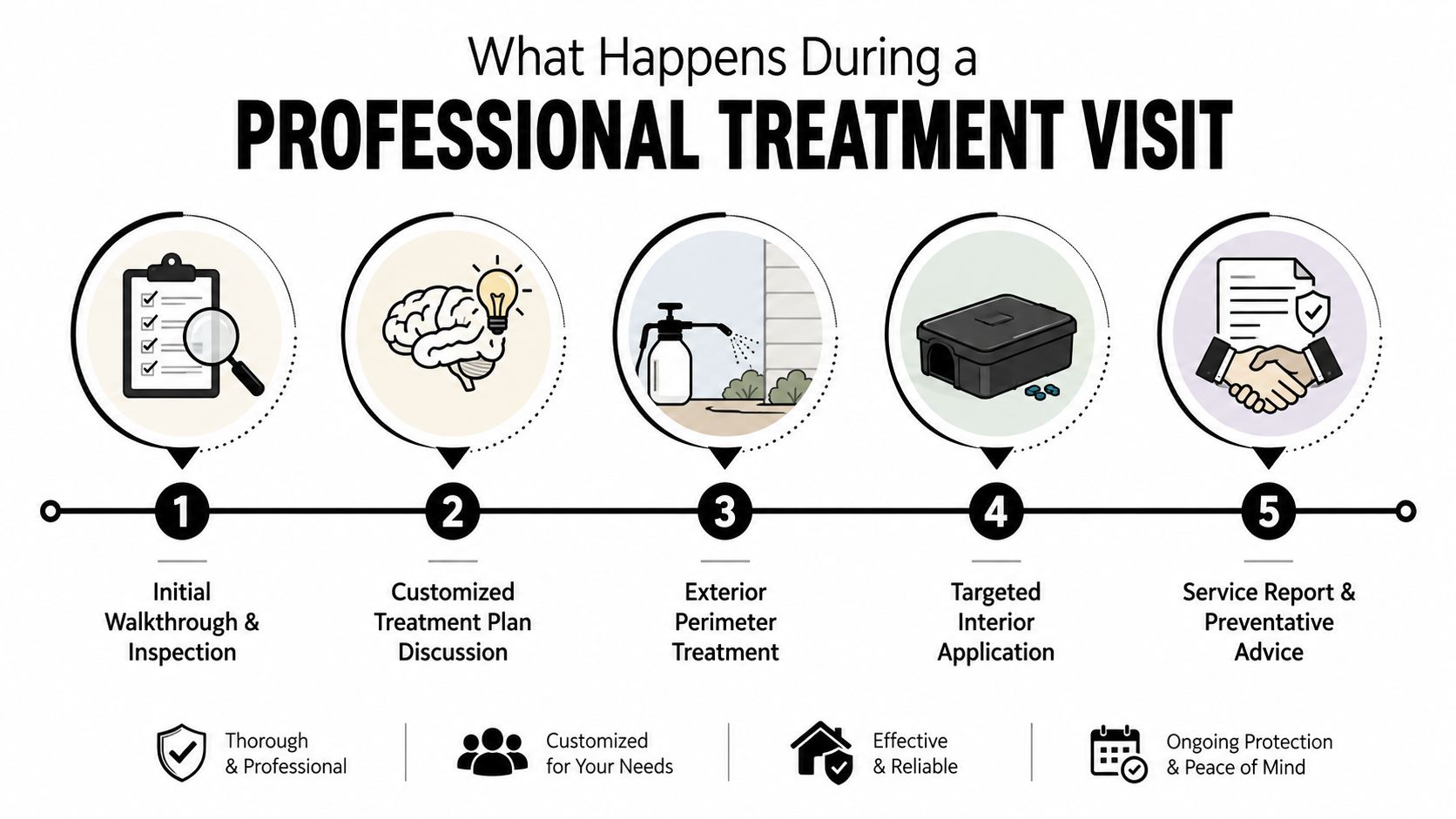
Interior service may involve crack-and-crevice treatment, bait placement, traps, or other localized work. Exterior service may focus on the foundation, entry points, garage, eaves, or perimeter. Drying time and ventilation guidance depend on the product and application, so the label and technician's directions take priority. The guide to preparing for pest control can help you organize before the appointment.
EPA guidance says users should read the label, remove children, toys, and pets before application, keep them away until the product has dried or as directed, and never use extra pesticide because more product doesn't mean better control. EPA pesticide safety guidance also explains these basic precautions.
A follow-up may include re-inspection, adjusted bait, refreshed monitoring stations, additional exclusion work, or another treatment when the plan calls for it. This short video provides a visual overview of the process:
What Drives the Cost of a Treatment Plan
A quote for pest control in Crown Point, IN reflects the work required at a particular property, not just the product used. A compact ranch home with easy exterior access may need a different service scope than a two-story home with a basement, crawl space, attached garage, and detached outbuilding.
Pest type is another major factor. A one-time ant visit may require focused inspection and baiting, while subterranean termite work can involve specialized inspection, treatment, and monitoring. Rodent control may include traps, sanitation advice, inspection of attic or basement areas, and exclusion repairs that continue beyond the first visit.
The main quote variables
| Cost Factor | Why It Matters |
|---|---|
| Property size and layout | Larger or more complex properties take more time to inspect and service |
| Pest type | Termites, rodents, bed bugs, stinging insects, and general invaders require different methods |
| Infestation severity | Widespread or established activity may require more visits and broader investigation |
| Treatment method | Targeted baiting, exclusion, perimeter work, and IPM programs have different labor and material needs |
| Service frequency | One-time, seasonal, quarterly, or annual plans create different service structures |
| Follow-up requirements | Monitoring, re-treatment, and verification add work when the issue needs continued attention |
Early action can simplify a treatment plan because technicians may find fewer affected areas and clearer entry routes. An entrenched issue can spread into wall voids, nesting spaces, or inaccessible structural areas, making diagnosis and follow-up more involved.
Ask whether the quote includes inspection, preparation guidance, treatment, exclusion, monitoring, and follow-up. A transparent provider should explain what each visit accomplishes instead of presenting a vague recurring charge. The aim isn't to choose the cheapest-looking option. It's to compare whether the proposed work matches the pest, property, and household priorities.
Eco-Minded and Family-Safe Treatment Options
Eco-friendly pest control doesn't mean pretending products are never necessary. It means using the smallest practical treatment area, selecting an appropriate product, and putting prevention ahead of unnecessary broadcast application. In a Crown Point home, that may include exclusion, sanitation, moisture correction, habitat reduction, monitoring, and carefully placed products.
A technician might use gel bait in a tamper-resistant station, an insect growth regulator where appropriate, or mechanical controls such as a door sweep and mesh over a foundation vent. These tools work in different ways. Bait targets feeding behavior, growth regulators interrupt development, and exclusion keeps pests from entering in the first place.
What family-conscious service looks like
A responsible plan considers where children and pets touch surfaces. Interior products may be placed in cracks, voids, or protected stations instead of across accessible floors and play areas. Exterior work can focus on entry zones, but residents still need to follow the label and technician instructions about drying, re-entry, food, toys, and pet access.
The U.S. EPA explains that a pesticide label tells users how to apply a product safely and effectively, how to store it, and what first-aid steps to follow. EPA label guidance also makes clear that the label is central to proper use. An EPA registration number isn't a general endorsement. It means the agency determined the product can be used with minimal or low risk only when label directions are followed, as explained in the EPA consumer safety guide.
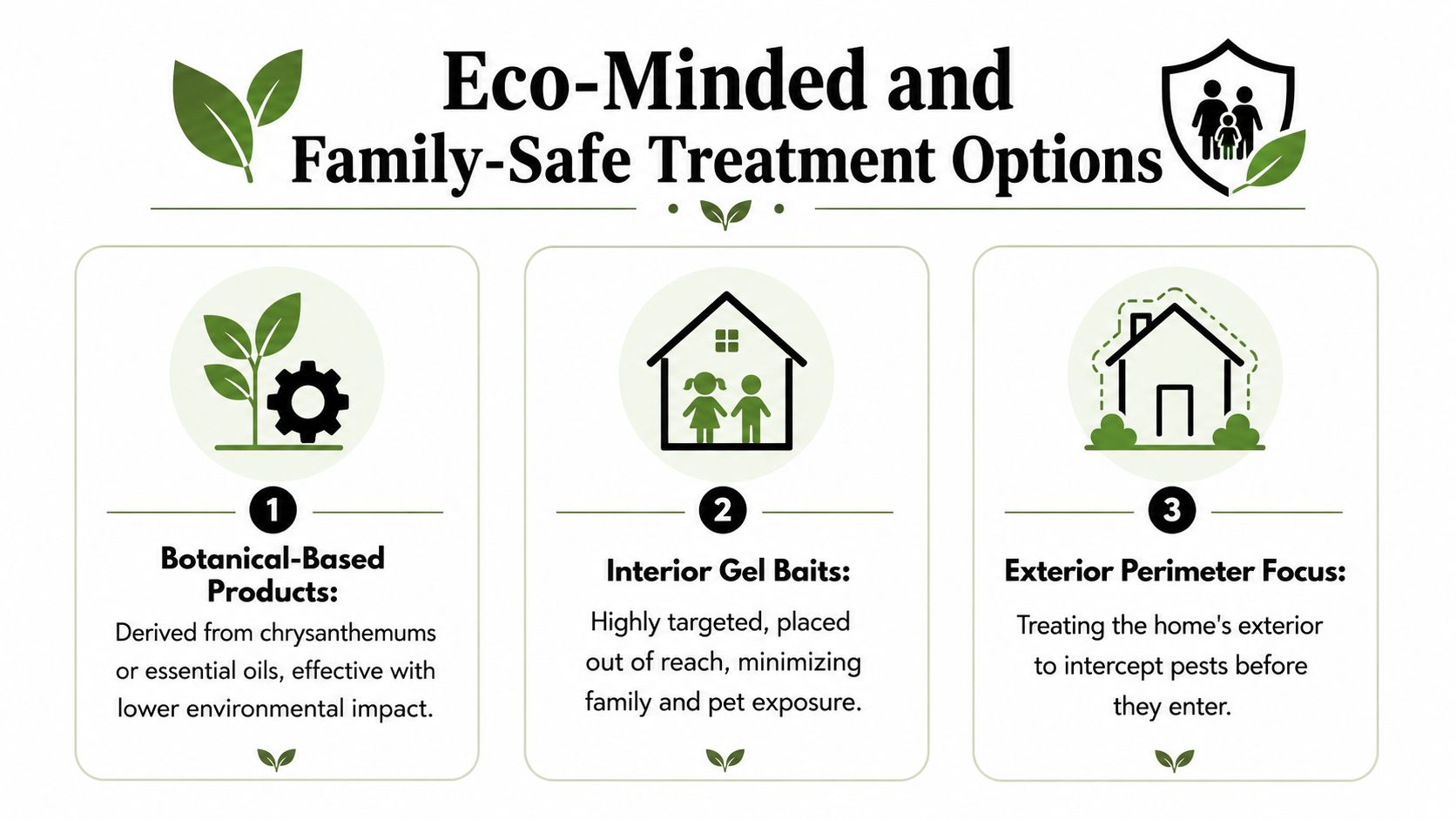
Seasonal timing can also support lower-input service. Exterior attention during spring and fall may reduce the chance that pests establish indoors later, although the right timing depends on the pest and property. For technical background, environmentally friendly pest control methods offers additional context.
Integrated pest management, or IPM, combines monitoring, treatment thresholds, and non-chemical controls to reduce selection pressure. Repeating the same mode of action can erode effectiveness, so rotating across different mode-of-action groups is a core resistance-management practice, according to Washington State University's resistance guidance. A peer-reviewed review also reports that rotating insecticides can cut resistance frequency by about 50% across generations, while building-wide IPM outperformed conventional service for cockroaches and bed bugs when paired with scouting, sanitation, and targeted applications, as described in this ACS publication.
Choosing a Trusted Local Provider in Crown Point, IN
When you search for an exterminator in Crown Point, IN, compare the process before comparing promises. A trustworthy provider should be able to explain who performs the work, what licensing or certification applies, how the inspection works, and what happens if activity continues.
Look for local knowledge that reflects Northwest Indiana conditions. A technician familiar with Crown Point, Lake County, and Porter County can better recognize seasonal patterns, older construction, basement moisture, garage access, and the property features that influence local pest activity. Ask whether the provider understands residential and commercial needs, since a family home and a retail, office, or multifamily property require different service coordination.
A practical provider checklist
- Verify credentials: Ask for current Indiana licensing and relevant certification before service begins.
- Request an inspection: A provider should identify activity and entry points before recommending treatment.
- Review the plan: Look for clear descriptions of products, targeted areas, preparation, drying, re-entry, and follow-up.
- Ask about IPM: Exclusion, sanitation, monitoring, and thresholds should be considered alongside chemical control.
- Clarify service terms: Understand whether the plan is one-time, recurring, seasonal, or tied to follow-up visits.
- Check local reputation: Read verifiable reviews and ask for neighborhood references when available.
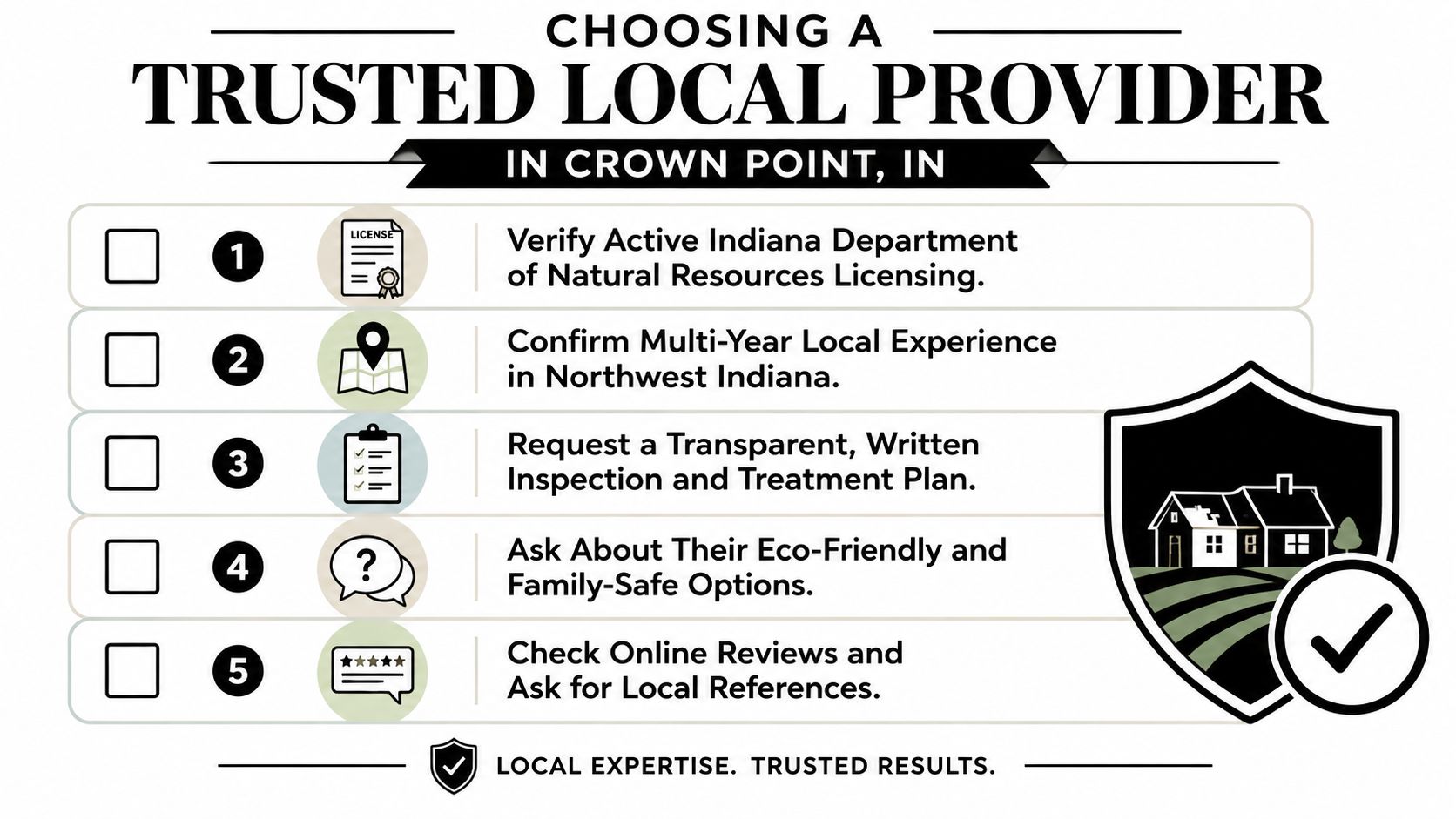
A written service plan helps prevent confusion. It should connect the observed pest to the selected method instead of listing generic applications. For commercial clients and property managers, documentation, scheduling, monitoring, and communication matter just as much as the treatment itself.
The Green Advantage is a family-owned company serving Crown Point and Northwest Indiana with licensed, certified residential and commercial pest management, inspections, mosquito reduction, and environmentally mindful treatment options. Its process emphasizes direct communication, site diagnosis, and follow-up information so customers understand what the service is designed to accomplish.
Taking the Next Step With The Green Advantage
The most useful first action isn't automatically booking a recurring plan or buying another spray. Start with an inspection that answers three questions: what pest is present, where is it active, and what is allowing it to continue?
That approach gives homeowners a clearer path whether the issue involves ant control, spider control, rodent exclusion, wasp removal, termite inspection, mosquito reduction, or a seasonal invader. It also helps property managers and local businesses choose a commercial pest control plan based on actual activity, access points, operating requirements, and follow-up needs.
A new customer should expect a property walkthrough, identification of pest activity and entry points, and an explanation of the recommended treatment type. Ask for the plan in writing, including service frequency, preparation requirements, drying and re-entry expectations, monitoring, and what follow-up looks like.
Threshold-based decision-making can reduce unnecessary applications without ignoring active problems. A 2025 peer-reviewed study assessing 466 field trials found that threshold-based management reduced insecticide use by 44%, supporting a more precise question than “How often should I spray?” The findings are reported in this Nature study. For a homeowner, the practical lesson is simple: treatment should respond to evidence, not habit.
Don't wait until a small trail becomes a recurring infestation or a few basement signs become an established rodent problem. Contacting a local pest control company in Crown Point, IN gives you a chance to address entry points, conditions, and treatment choices before the issue becomes harder to manage.
The Green Advantage provides residential and commercial pest control treatment in Crown Point, IN, including inspections, targeted service, preventative pest treatments, mosquito reduction, termite support, and rodent control. Visit The Green Advantage to request a quote or schedule a pest inspection built around your property, your pest concern, and your household's safety priorities.
Integrated Pest Management Plan for Crown Point Homes

You spot ants crossing the kitchen counter in early spring, reach for a store-bought aerosol, and watch the trail disappear. Two weeks later, the ants are back, often in greater numbers, because the spray killed visible workers without correcting the nest, entry point, moisture, or food source. For Crown Point homeowners and businesses, an integrated pest management plan offers a more durable answer than repeating the same reactive treatment.
The Green Advantage serves Crown Point, IN and surrounding Northwest Indiana properties with a practical approach built around inspection, prevention, monitoring, and targeted control. That approach applies to residential pest control, commercial pest control, ant control, termite control, mosquito control, rodent control, spider control, and seasonal pest issues. The objective isn't to spray everything. It's to understand why pests are present and use the least disruptive effective solution.
Why Crown Point Properties Need an Integrated Pest Management Plan
Northwest Indiana properties face changing pest pressure throughout the year. Humid summers support ants, mosquitoes, spiders, and moisture-loving insects. Freezing winters push mice and other rodents toward warm shelter. Properties influenced by Lake Michigan weather can also experience seasonal movement from boxelder bugs, stink bugs, and other overwintering insects. Spring termite swarms and carpenter ant activity create additional concerns for older homes, commercial buildings, and properties with damp wood or landscaping close to the structure.
IPM began in agriculture, but its central idea works well for homes and businesses. Scientists introduced the concept of “integrated management” in the United States in 1959. The term “integrated pest management” was coined in 1967, formally recognized by the U.S. National Academy of Sciences in 1969, and supported through broader federal and state programming during the following years. The Food Quality Protection Act defined IPM in 1996 as a sustainable approach combining biological, cultural, physical, and chemical tools to minimize economic, health, and environmental risks. See the history and development of integrated pest management for the full progression.
Practical rule: A recurring pest problem deserves a plan, not another round of the same spray.
A structured plan starts by identifying the pest and its biology, then correcting conditions that let it survive. For example, ant control may require sealing a foundation gap, correcting a plumbing leak, changing food storage, and placing bait where workers can carry it back to the colony. Rodent control may depend more on exclusion and sanitation than on interior traps alone. Termite control requires careful attention to moisture, soil contact, wood conditions, and evidence of active colonies.
IPM also has a proven record beyond individual properties. USDA survey data found that more than half of U.S. fruit, vegetable, and major field crop acreage used IPM at some level, while a California analysis found 75% or greater use by acreage for 11 pest-management practices in vegetable production in 2022 and for seven practices in fruit-and-nut production in 2021 (USDA-related adoption data). Adoption remains uneven, which reinforces an important point for property owners: IPM works only when people consistently inspect, prevent, document, and adjust.

A useful residential or commercial plan follows an adaptive cycle. It defines objectives, aligns the people responsible for the property, studies site conditions, identifies pests, monitors activity, sets action thresholds, compares control options, applies the lowest-risk effective tactic, evaluates results, and repeats the process through education and follow-up. That 11-step workflow is described by the National Park Service IPM framework. For Crown Point properties, this means fewer blind treatments and more decisions based on what the building and pest activity show.
For a practical overview of why this approach can outperform repeated spraying, review the integrated pest management benefits.
Inspecting and Monitoring Your Property for Pest Activity
A good IPM plan begins before anyone chooses a product. Start outside and work inward, because many infestations begin at a small structural weakness that homeowners overlook.
Start with the exterior
Walk the foundation slowly and inspect cracks, gaps around utility lines, window wells, door thresholds, and areas where siding meets masonry. Mice can use surprisingly small openings, while ants often follow plumbing, wiring, vegetation, or foundation seams into the structure. Check soffit vents and roofline openings for damaged screening, especially if you hear scratching or find nesting material in an attic.
Northwest Indiana homes also need seasonal attention. In fall, boxelder bugs and stink bugs may gather on warm exterior walls before moving indoors. In spring, termite swarmers may appear near windows, doors, foundations, crawl spaces, or woodpiles. A swarm doesn't prove that structural damage exists, but it does justify prompt identification and inspection.

Check the interior evidence
Move through basements, crawl spaces, attics, garages, kitchens, utility rooms, and storage areas. Look for:
- Droppings and gnaw marks: These point toward rodent travel routes and feeding activity.
- Frass or damaged wood: Carpenter ants can leave sawdust-like material near galleries, while termites may leave other evidence that requires professional identification.
- Shed wings: Discarded wings near windows or light sources can signal termite swarm activity.
- Moisture: Damp areas near plumbing, foundation walls, or crawl spaces can support ants, spiders, and other pests.
- Nesting materials: Shredded paper, insulation, fabric, and plant matter often reveal rodent shelter sites.
Monitoring tools help turn a sighting into useful information. Place sticky traps along baseboards and behind appliances, pheromone traps in pantries when appropriate, and moisture meters in persistently damp areas. Don't scatter traps randomly. Position them near walls, corners, suspected travel routes, and areas where you found evidence.
A simple property map makes the information easier to use. Mark the kitchen, basement, attic, utility penetrations, exterior doors, traps, and sightings. Record the pest type, location, count, date, and surrounding conditions. A homeowner can use a notebook, while a property manager may prefer a spreadsheet shared with maintenance staff.
The pest control inspection checklist can help organize this process before a professional visit.
Spring inspections are especially useful for catching termite swarms and ant activity early. Fall inspections prepare the property for rodent intrusion by identifying gaps before the next cold snap. For a visual explanation of inspection practices, watch this short resource before beginning your walkthrough.
Setting Action Thresholds and Preventing Infestations
IPM doesn't treat every pest sighting as an emergency. It uses an action threshold, the point at which pest activity becomes serious enough to justify control. The EPA describes that point as the level where a pest becomes a nuisance, health hazard, or economic threat (EPA IPM principles).
That threshold depends on the pest, location, damage risk, and people using the space. A single house spider in an unfinished basement may call for monitoring. A growing trail of odorous house ants beside food storage demands faster action. A few boxelder bugs on exterior siding in autumn may be tolerable, but clusters inside bedrooms or living areas cross a practical comfort threshold.
Use prevention to stay below the threshold
Prevention combines physical changes with daily property habits. Seal foundation gaps with appropriate mesh and caulk, repair window screens, install effective door sweeps, and correct openings around pipes and wires. Trim branches away from rooflines, manage mulch so it doesn't stay piled against the foundation, and remove standing water that can support mosquitoes and attract other moisture-associated pests.
Sanitation matters just as much:
- Store pet food securely: Use sealed containers instead of leaving food exposed overnight.
- Control waste access: Keep garbage closed and maintain a consistent removal schedule.
- Reduce storage clutter: Cardboard, fabric, and unused materials give rodents and insects hiding places.
- Correct water problems: Repair leaks, improve drainage, and use dehumidification where persistent dampness supports pests.
- Manage vegetation: Keep dense plant growth from touching siding, vents, and roof edges.
A property that stays clean but has open entry points can still develop a rodent problem. A tightly sealed property with leaking plumbing can still support ants. Strong IPM plans address both the building and the habits around it.

The Virginia Cooperative Extension explanation of IPM mechanics summarizes the practical sequence as identification, prevention, monitoring, threshold setting, control, and evaluation. That sequence keeps chemical treatment in its proper place. If prevention keeps activity below the threshold, treatment may not be necessary. If activity rises, the response can be limited to the affected area instead of applied broadly across the property.
Choosing Targeted Treatments for Common Northwest Indiana Pests
Treatment selection should follow the evidence gathered during inspection and monitoring. Start with mechanical, physical, or biological controls when they can solve the problem. Traps, exclusion, sanitation, habitat correction, and beneficial nematodes for lawn grubs can reduce pest pressure without putting a broad application across the property.
Eco-friendly options can support that strategy, but homeowners must use them carefully. Diatomaceous earth can help with some crawling insects in dry, appropriately protected locations. Boric acid products may help with cockroach control when placed where children and pets can't access them. Essential oil-based repellents may provide limited support for some outdoor situations, but they shouldn't replace identification, exclusion, or professional treatment when an infestation is established.
Chemical control becomes appropriate when monitoring shows that nonchemical methods aren't enough or when the pest presents a meaningful property, health, or comfort concern. Even then, precision matters more than volume. Bait stations, crack-and-crevice applications, and spot treatments generally fit an IPM approach better than automatic broadcast spraying. Always use products according to their labels, including whether they're approved for indoor or outdoor use, and apply them with attention to the pest's life cycle.
| Pest | Least-Risk Control | Eco-Friendly Option | Targeted Chemical Treatment |
|---|---|---|---|
| Carpenter ants | Correct moisture, remove damaged wood, seal entry points | Targeted baiting and habitat correction | Limited treatment at active galleries or entry points |
| Boxelder bugs | Seal cracks, repair screens, vacuum indoor insects | Exterior exclusion and habitat management | Targeted exterior treatment when seasonal pressure is high |
| Rodents | Traps, door sweeps, sealing gaps, sanitation | Exclusion-focused service and monitored traps | Enclosed bait stations only where appropriate |
| Spiders | Remove webs, reduce indoor clutter, manage insects | Habitat correction and targeted repellents | Focused treatment in basements, crawl spaces, and entry zones |
| Lawn grubs | Improve lawn conditions and reduce favorable habitat | Beneficial nematodes where suitable | Carefully timed labeled lawn treatment when thresholds justify it |
Older Crown Point structures often need a different carpenter ant response than newer construction. A basement or crawl space with moisture may require correction before any treatment can remain effective. Fall boxelder bug activity calls for sealing and exterior management, while spider control works better when technicians address the insects that serve as their food source.
Wildlife and nesting issues also require judgment. Before disturbing a bird nest or similar structure, review this resource on DIY vs professional nest removal to understand why timing, species, and safe removal practices matter.
The strongest plan uses products that match the pest, site, season, and exposure risk. That protects families and pets while reducing the chance that repeated, poorly targeted applications will solve only the visible symptom.
Tracking Results Through Recordkeeping and Ongoing Evaluation
A treatment without records is difficult to improve. A written log shows whether pest activity is falling, staying steady, or moving to another part of the property. It also gives a professional exterminator a clearer starting point when the same issue returns.
Record the date of each inspection, the pest identified, the location, the number or level of activity observed, the weather, the treatment used, and the result. For a Crown Point property, seasonal notes can reveal useful patterns, such as rodent activity increasing during late-fall cold snaps or ant activity rising after spring rains. These observations help separate a new issue from a predictable seasonal pattern.
Use a simple property log
A notebook works. So does a spreadsheet or pest management app. Keep the format simple enough that everyone involved will use it.
| Date | Pest type | Location and count | Action taken | Outcome |
|---|---|---|---|---|
| Inspection date | Ants, rodents, or other pest | Room or exterior zone, observed activity | Exclusion, trap, bait, or treatment | Activity reduced, unchanged, or increased |
Review the log after each visit and compare results with the action threshold. A homeowner might notice that ants appear only beside one damp wall. A property manager might find that rodent signs cluster near one loading area or utility chase. Those patterns point toward specific corrections instead of repeated treatment across unaffected spaces.
Use evaluation checkpoints at 30, 60, and 90 days to decide whether the plan is working. These intervals are a practical management schedule, not a promise that every pest problem follows the same timeline. The right review point depends on pest biology, weather, property conditions, and the control method selected.

Use the review to ask direct questions:
- Is activity below the threshold: If yes, maintain prevention and monitoring.
- Is activity unchanged: Look for missed entry points, moisture, food sources, or incorrect identification.
- Is activity increasing: Escalate to a more targeted control and reassess the property conditions.
- Are pests appearing elsewhere: Expand the inspection map rather than automatically expanding the treatment area.
This recordkeeping turns pest control into a continuous improvement cycle. The Purdue University IPM overview describes IPM as a decision-making process based on inspection, monitoring, records, and evaluation. For Crown Point homeowners and businesses, evidence-based decisions mean fewer repeat treatments and more predictable long-term maintenance.
What to Expect from Professional Pest Control in Crown Point
A professional IPM visit should begin with questions, not a sales pitch or an automatic spray. The technician should inspect the building and grounds, identify the pest, document conducive conditions, explain the risk, and recommend controls that fit the property. You should also receive clear information about any products used, where they'll be applied, what precautions are necessary, and what follow-up will look like.
The Green Advantage provides pest inspections and ongoing residential and commercial pest control for Crown Point, IN and nearby Northwest Indiana service areas. Its approach can include exclusion, monitoring, sanitation and habitat correction, and targeted treatment, depending on the pest and site conditions. That framework is useful for homeowners, landlords, property managers, and businesses that need a repeatable plan rather than an isolated visit.
A service visit should answer practical questions
- What pest is present: Correct identification prevents mismatched treatments.
- How is it entering or surviving: The technician should identify cracks, moisture, food, nesting areas, or conditions.
- What should happen first: Prevention and exclusion may come before treatment.
- What happens after service: Follow-up monitoring shows whether the response worked.
- How should the property be maintained: Clear recommendations make prevention realistic.
Safety deserves a direct conversation. Ask where products will be applied, how long treated areas should remain undisturbed, and what steps protect children, pets, employees, customers, and sensitive spaces. A responsible plan won't treat safety as an afterthought.
Service frequency should also match risk. Federal building-focused guidance gives examples of inspection schedules that vary by hazard and site conditions, including annual inspections in the highest-hazard settings, biennial inspections in many moderate-to-heavy hazard regions, and triennial inspections in lower-hazard regions (federal building IPM guidance). A home, restaurant, warehouse, rental property, and historic downtown building won't require identical monitoring.
Professional service is especially valuable when pests return after DIY treatment, when activity involves termites or rodents, or when a commercial facility needs documentation and coordinated follow-up. The goal isn't to promise that pests will never appear. The goal is to detect problems earlier, correct the conditions supporting them, and respond with the narrowest effective intervention.
The Green Advantage can build an integrated pest management plan for your Crown Point home or business, including inspection, prevention, monitoring, and targeted pest control for ants, termites, rodents, mosquitoes, spiders, and seasonal invaders. Schedule a pest inspection or request a quote by visiting The Green Advantage, and take the first step toward fewer repeat treatments and better long-term protection.
Pest Control Service Plans in Crown Point, IN
A line of ants reaches across the kitchen counter, or scratching starts above the ceiling just as summer humidity settles over Crown Point. You clean, seal what you can, and call an exterminator near you, only to see the same pest activity return later. Pest control service plans replace that cycle with scheduled inspection, prevention, and follow-up care for homes and businesses in Crown Point, IN and nearby Northwest Indiana communities.
The right plan isn't just about how often a technician visits. It's about which pests are covered, what happens between visits, whether re-services cost extra, how cancellation works, and when seasonal upgrades make sense. The Green Advantage helps local property owners evaluate those details before they commit, so a service agreement supports the property instead of creating surprises.
Why Crown Point Homeowners Choose Pest Control Service Plans
A Crown Point homeowner notices ants marching toward the pantry during a humid Indiana summer. Another hears movement in the attic as colder weather pushes rodents toward shelter. Both problems can trigger the same rushed response, search for pest control near me, schedule the soonest appointment, and hope one treatment solves everything.
That approach can work for an isolated issue, but it often leaves the conditions that attracted pests untouched. A one-time visit may reduce visible activity without addressing moisture, food access, entry gaps, nesting areas, or pressure from the surrounding property. When activity returns, the homeowner starts the process again, sometimes with emergency scheduling and unclear callback charges.
A service plan creates a different rhythm. A technician visits on a defined schedule, checks for developing activity, treats targeted areas, and records what changed since the previous visit. The plan can include exterior prevention, interior attention when needed, and recommendations for repairs or sanitation that make the property less inviting.
Local advice: A recurring plan makes the most sense when pests return with the seasons, enter through repeat pathways, or affect a property that can't afford long gaps in protection.
Northwest Indiana properties face changing pressures throughout the year. Homes near wooded areas, drainage features, gardens, older structures, or heavily used outdoor spaces may need a different approach from a newer home with limited activity. Restaurants, rental properties, warehouses, and multi-unit buildings also need documentation and response procedures that a casual one-time treatment usually doesn't provide.
The Green Advantage serves Crown Point and surrounding Northwest Indiana areas with residential pest control, commercial pest control, pest inspections, and seasonal services. Property owners who want to understand how local service providers build visibility in the community can also explore this resource on how to reach homeowners with postcards, a practical channel for local home-service outreach.

What Pest Control Service Plans Actually Cover
A pest control service plan is a scheduled agreement between a property owner and a licensed pest professional. Instead of waiting for a major infestation, the technician visits at regular intervals to inspect conditions, identify activity, apply appropriate treatments, and help prevent new problems.
That differs from a one-time treatment. A one-time service focuses on the issue reported today. A recurring plan adds monitoring and maintenance, which can reveal activity before residents, employees, or customers see a serious infestation.
The standard service sequence
Most well-designed plans follow a practical sequence:
- Initial inspection: The technician looks for pest evidence, entry points, moisture concerns, harborage areas, and conditions that support activity.
- Property assessment: The provider identifies priority areas and explains which pests belong in general coverage versus a specialized service.
- Exterior prevention: Perimeter treatments may focus on foundation lines, doors, windows, utility penetrations, and other likely entry routes.
- Interior attention: Interior treatments are generally directed at confirmed activity rather than applied everywhere automatically.
- Monitoring and follow-up: The technician checks changes over time and adjusts the plan when pest pressure changes.
Common targets for general coverage in Crown Point include ants, spiders, wasps, centipedes, silverfish, and other occasional invaders. Rodent control typically requires additional attention because effective management depends on removing food, water, and shelter, then sealing entry points inside and outside the home, as advised by the CDC's rodent-control guidance.

A technically strong commercial or residential plan should define action thresholds, monitoring intervals, communication procedures, and records for inspections, treatments, and pest trends. That structure reflects the principles of Integrated Pest Management, or IPM. The EPA's IPM overview describes IPM as a common-sense approach that places prevention and monitoring ahead of routine pesticide use.
The result should be a protective maintenance program, not an automatic spray appointment with no inspection or explanation.
Inclusions and Exclusions You Should Know Before Signing
The biggest mistake customers make is comparing plans by visit frequency alone. Two plans may both advertise quarterly service while offering very different callback rules, pest lists, interior coverage, and cancellation terms.
A written agreement should clearly identify what the technician will do, which pests are included, and what happens when activity appears between scheduled visits. Ask for the actual service scope, not just a sales summary.
Compare the fine print
| Typically Included | Often Excluded or Requires Upgrade |
|---|---|
| General insect and spider coverage | Termite treatment and termite monitoring |
| Exterior perimeter treatments | Bed bug remediation |
| Interior treatment when activity is reported | Wildlife removal, including raccoons or bats |
| Re-service options between visits | Fleas and mosquitoes on some general plans |
| Treatment and inspection records | Specialty rodent exclusion or extensive repairs |
Termite control deserves separate attention. Termites threaten structural components and generally require a dedicated inspection and treatment agreement rather than a standard general-pest barrier. Bed bugs also need specialized remediation because technicians must address hidden harborages throughout sleeping and living areas.
Wildlife is another common point of confusion. Raccoons, bats, and similar animals aren't usually handled through an ordinary insect service plan. Rodent control may include monitoring or treatment, but sealing openings and correcting building conditions can require a separate scope of work.
Re-service guarantees change the value
Read the callback clause carefully. Some providers include re-services when pests return between scheduled appointments. Others charge for each callback, limit the guarantee to certain pests, or require customers to upgrade before a technician returns.
Ask these questions before signing:
- Return visits: If ants or spiders reappear next week, is the callback included?
- Pest limits: Does the guarantee cover all listed pests or only selected insects?
- Response time: How quickly does the company respond to an urgent sighting?
- Seasonal additions: Can mosquito control, wasp removal, or rodent work be added when conditions change?
- Cancellation: Are there renewal terms, notice requirements, or cancellation fees?
A plan should match the property's actual risk. A standard quarterly program may suit general household pests, while mosquito pressure, recurring rodents, termite concerns, or a commercial kitchen may justify a separate service tier.
Pricing Factors and Scheduling Options Explained
There isn't one universal price for pest control service plans in Crown Point. Providers build quotes around the property, the pest, the treatment method, and the amount of follow-up required. A small home with occasional ants doesn't carry the same service burden as a commercial kitchen with persistent rodent or cockroach pressure.
The most useful quote separates the initial visit from recurring service. It should also show whether billing is based on each visit or spread across an annual agreement. Use the pest control cost per month guide to organize questions before comparing proposals, but judge every quote by its included work rather than by the monthly figure alone.
What changes the price
| Factor | Impact on Cost | Typical Options |
|---|---|---|
| Property size | Larger areas take more inspection and treatment time | Small home, large home, commercial facility |
| Pest type | Specialized pests require different tools and labor | General insects, rodents, termites, mosquitoes |
| Infestation severity | Established activity may require corrective work before maintenance | Preventive service, initial cleanout, intensive treatment |
| Visit frequency | More visits create a higher ongoing service commitment | Quarterly, bi-monthly, monthly |
| Product selection | Treatment needs vary by location, pest, and sensitivity | Targeted exterior treatment, interior spot treatment, monitoring |
| Contract structure | Billing terms affect cash flow and cancellation decisions | Per visit, recurring agreement, annual arrangement |
For many residential properties with standard pest pressure, quarterly service provides a practical maintenance schedule. Bi-monthly visits can fit homes with more activity or greater exterior exposure. Monthly service is more appropriate for commercial kitchens, high-turnover properties, or sites with persistent infestation risks.
Seasonal planning matters. Spring may bring increased ant and termite activity. Fall is a sensible time to inspect rodent entry points and address gaps before colder weather drives animals indoors. Mosquito control is a distinct seasonal program, not automatically part of general pest protection.
Quote rule: Don't accept “starting at” language without asking what the initial service, recurring visits, callbacks, exclusions, and specialty add-ons include.
Watch for hidden cost drivers. An initial cleanout may be separate from maintenance. Emergency call-outs may carry an additional fee. Bed bugs, wildlife, termites, fleas, ticks, and mosquitoes may require separate pricing. A lower recurring quote can become less attractive if every return visit or specialty pest is billed separately.
Benefits of Service Plans Over One-Time Treatments
One-time treatments solve a moment. Service plans manage a pattern.
A homeowner may treat ants in May and see fewer workers around the kitchen. If the property still has entry gaps, moisture, food residue, or exterior nesting pressure, carpenter ants or other ants can appear again in July. The second appointment doesn't mean the first technician failed. It may mean the property needed monitoring and prevention rather than a single response.
Recurring pest control maintains attention on the property. Each visit gives the technician an opportunity to inspect common entry routes, identify new evidence, reinforce exterior protection where appropriate, and recommend corrections before the issue becomes harder to manage.
Why recurring coverage fits local properties
Northwest Indiana homes experience changing conditions. Cold weather can push rodents toward warmer shelter. Humid summer conditions support more insect activity around buildings, vegetation, and outdoor living areas. A plan gives homeowners a way to respond to those shifts without starting from zero every time.
Service plans can also make budgeting easier. Instead of waiting for an infestation and paying for an urgent treatment, the customer pays for a defined maintenance schedule. Some agreements bundle follow-up visits or include re-service protection, while one-time services usually don't provide an ongoing callback structure.
Commercial property managers gain another advantage, documentation. A written record of inspections, findings, treatments, and recommendations helps managers demonstrate consistent pest-management practices and coordinate repairs with maintenance teams. For food-service, rental, warehouse, and multi-unit properties, that record supports accountability.

The environmental case also favors a thoughtful plan. Integrated Pest Management emphasizes prevention, monitoring, and targeted intervention instead of routine pesticide use without regard to actual activity. The Cornell IPM history overview traces this model through milestones beginning in 1880, the introduction of economic thresholds and integrated control concepts in 1959, federal support in 1972, and interagency coordination efforts in 1979.
A service plan is a property-protection investment. It protects comfort, reduces surprises, and gives pest decisions a process.
How to Choose the Right Plan for Your Property
Start with the property, not the advertised package. A newer home in a developed neighborhood may have different pest pressure from an older home near wooded land, drainage areas, gardens, or heavy outdoor use. Your history matters too. Repeated ants, spiders, rodents, or wasps point to a recurring condition that deserves investigation.
Match frequency to risk
Use these decisions as a starting point:
- Standard residential activity: Quarterly general pest control often provides a reasonable maintenance rhythm for homes with routine insect pressure.
- High exterior exposure: Homes near woods, water, gardens, or dense vegetation may need closer monitoring and seasonal adjustments.
- Older structures: Aging foundations, utility penetrations, crawl spaces, and roofline gaps can increase the need for inspection and exclusion work.
- Recurring termite concerns: Request a dedicated termite inspection and written recommendation instead of assuming general service includes it.
- Commercial operations: Restaurants, warehouses, rental properties, and multi-unit housing often need more frequent visits, detailed records, and clear communication with managers.
- Outdoor nuisance pressure: Mosquitoes and ticks may require a seasonal program that addresses yards and resting areas rather than only the building perimeter.
A provider should explain why a frequency fits your site. Monthly service isn't automatically better, and quarterly service isn't automatically enough. The schedule should follow observed activity, building vulnerabilities, business requirements, and the consequences of a missed pest sighting.
Questions that expose weak proposals
Ask for answers in writing:
- Which pests are included?
- Are termites, bed bugs, wildlife, rodents, fleas, ticks, and mosquitoes separate services?
- Are between-visit callbacks included, and are they unlimited?
- What response time applies to urgent sightings?
- What products are used, and where are they applied?
- How are children, pets, gardens, food areas, and sensitive occupants protected?
- Are technicians licensed or certified for the services they perform?
- What are the cancellation, renewal, and transfer terms?
Compare two or three local quotes on equal terms. Avoid proposals with no pest list, no written guarantee, vague “whole property” language, unclear renewal terms, or a price that excludes the initial inspection and likely specialty work.

What to Expect When Working with The Green Advantage
The process should begin with a conversation, not a rushed treatment. You describe the pest, where you found it, how long activity has continued, and whether anyone in the household or facility has safety concerns. The office team can then arrange an inspection and identify whether the problem calls for general service, rodent exclusion, mosquito control, termite work, or another specialized approach.
During the inspection, the technician evaluates the property's individual conditions. That can include seasonal invaders, moisture-related activity, structural gaps, vegetation near the building, attic or crawl-space concerns, and signs of rodents or other pests. The goal is to connect visible activity with the conditions supporting it.
The Green Advantage provides residential and commercial service options in Crown Point and Northwest Indiana. Customers can review the company's approach to choosing The Green Advantage for pest control needs before scheduling.
A clear service conversation
The proposal should identify the recommended service tier, included pests, visit schedule, treatment areas, callback policy, and any exclusions. Ask about the re-service guarantee directly. If pests return between scheduled visits, the agreement should explain whether a technician returns without an additional charge and which conditions apply.
Routine quarterly or monthly visits may include exterior perimeter work, interior inspection when needed, monitoring, and documentation of findings. Customers should know what changed, what the technician treated, and what repairs or sanitation steps would reduce future activity.
That neighbor-first process matters locally. Direct communication, flexible scheduling, and clear records make it easier for homeowners, landlords, and business managers to keep one person informed from the first call through follow-up service.
Frequently Asked Questions About Pest Control Plans
Can I transfer a plan if I sell my home?
Sometimes, but transfer rules depend on the written agreement. Ask whether the plan follows the property, the original customer, or neither, and confirm any required notice before closing.
What happens if I cancel mid-contract?
Review the cancellation and renewal clauses before signing. Some agreements may require notice or charge a cancellation fee, while others offer more flexibility.
Are treatments safe for children, pets, and gardens?
Safety depends on the product, application area, timing, and site conditions. Tell the technician about children, pets, gardens, food areas, and sensitive occupants, then follow all preparation and re-entry directions.
How quickly will I see results?
Visible activity may change after the first treatment, but established problems can require monitoring and follow-up. A good technician should explain what improvement to expect and when to report continued sightings.
Do plans cover wildlife or birds?
Usually not under standard general pest coverage. Raccoons, bats, birds, and similar wildlife concerns should be discussed as separate services.
Does the schedule change with Indiana seasons?
It can. Spring insect activity, summer mosquito pressure, and fall rodent entry risks may justify seasonal adjustments rather than a rigid schedule.
Do commercial properties need different plans?
Often. Commercial sites may need more frequent inspections, defined action thresholds, monitoring records, and communication with managers. Businesses evaluating their marketing and service systems can also review this guide to how pest firms get more leads, while keeping customer service and documentation central.
What if I see pests between visits?
Contact the provider promptly and check the re-service clause. The Green Advantage can explain whether the sighting falls under the plan, requires an adjustment, or points to a specialty service.
Schedule a pest inspection with The Green Advantage to review your Crown Point property, pest history, service frequency, exclusions, and callback protection. Request a clear quote for residential pest control, commercial pest control, termite control, mosquito control, or rodent exclusion, and choose a plan that protects your home or business through Northwest Indiana's changing seasons.
How to Prepare for a Pest Inspection in Crown Point, IN

You've got a pest inspection scheduled for tomorrow in Crown Point, IN. The instinct is familiar: vacuum every corner, scrub every surface, move boxes into another room, and make the property look flawless. Don't do that. The most useful preparation preserves evidence, opens hidden areas, and gives the inspector enough history to understand what's happening.
Whether you're searching for pest control near me, an exterminator near me, or a professional assessment before buying or renting a property, the same principle applies. Prepare the property so the technician can investigate it properly. The Green Advantage serves Crown Point and surrounding Northwest Indiana communities with residential pest control, commercial pest control, termite control, rodent control, mosquito reduction, and other services.
Why Preparation Determines Your Inspection Results
A Crown Point homeowner may spend the evening before an inspection carrying laundry baskets out of the basement and wiping down the kitchen. The house looks orderly by bedtime, but the inspector may have a harder time finding the small clues that explain where pests are coming from. A cleaned-up room isn't necessarily an inspection-ready room.
A thorough inspection follows a deliberate path. Authoritative facility guidance recommends reviewing previous inspection reports and floor plans, then examining the building from the outside in and from the lowest level toward the attic and roof. The same guidance identifies practical equipment such as a bright flashlight, clipboard and paper, collection vials, labels, tweezers, forceps, and protective gear. That approach shows why inspection preparation is about evidence collection, not visual guesswork. The Canadian Conservation Institute's inspection guidance outlines this methodical process.

Access reveals what surfaces hide
Pests often use places homeowners rarely inspect, including crawlspaces, basements, utility openings, wall gaps, exterior features, and roofline areas. If stored items block those locations, the technician may have to record limited access instead of evaluating the actual entry point or harborage area.
Before the visit, focus on four outcomes:
- Clear visibility: Remove clutter that hides droppings, damage, trails, or nesting material.
- Safe movement: Make crawlspaces, basements, utility areas, and exterior walls reachable.
- Useful history: Keep prior reports, treatment records, and floor plans available.
- Evidence preservation: Leave signs of activity in place for the inspector to document.
A checklist-driven inspection can cover many conditions, including structural concerns, pest activity, environmental factors, and treatment planning. A residential pre-treatment checklist contains 39 inspection items across 7 sections, demonstrating why a technician needs more than a quick walk through the kitchen. The residential pre-treatment checklist reflects the level of detail a proper assessment can require.
Practical rule: Make the property easier to inspect, not merely nicer to look at.
Clearing Access and Managing Moisture Around Your Property
Start outside. Northwest Indiana properties face seasonal moisture, dense landscaping, wet foundations, and sheltered exterior spaces that can support pest activity. The highest-yield preparation tasks are straightforward, but they need to be completed in the right order.
Begin at the foundation
Trim vegetation at least 24 inches from the structure so the inspector can see siding, foundation walls, window wells, and potential entry points. Move debris, unused materials, and firewood away from the foundation. Technical guidance also recommends storing firewood off the floor and away from walls, where it's less likely to conceal pests or create a direct path toward the building. Oregon State University Extension's moisture and insect inspection guidance identifies vegetation, debris, water, gutters, and structural rot as important conditions to evaluate.
Check the perimeter for standing water, clogged gutters, leaking downspouts, and soil or mulch that keeps the structure damp. Look closely at deck attachments and other wood-to-structure connections for rot. Moisture and deteriorated wood can create conditions associated with termites, carpenter ants, rodents, and other pests.
Open the interior inspection path
Inside the property, clear access to:
- Crawlspaces and basements: Move containers, furniture, and stored materials away from access doors and foundation walls.
- Utility openings: Open areas around plumbing, electrical lines, vents, and other penetrations so the inspector can evaluate gaps.
- Under-sink cabinets: Remove items that block plumbing connections and cabinet corners.
- Storage areas: Keep boxes and supplies off the floor and away from walls.
- Doors and screens: Check thresholds, weatherstripping, screens, and door edges so possible entry points remain visible.
Sealing obvious cracks and crevices can help, but don't cover a suspicious opening before documenting it or telling the inspector. The location may matter more than its appearance.
The moisture connection extends beyond pest control. If a leak or flood has created damp materials, our 2026 flood cleanup advice offers practical guidance for handling water damage before it creates additional property problems.
Stop Over-Cleaning Before the Inspector Arrives
Deep cleaning can undermine the inspection you're paying for. If you scrub droppings from a pantry shelf, wipe away an insect trail, fill a gnawed opening, or throw out nesting material, you may remove the evidence needed to identify the pest and trace its route.
Leave these signs visible when they're safe to leave in place:
- Droppings: They help identify activity locations and movement patterns.
- Insect trails: Trails can point toward nesting or feeding areas.
- Gnaw marks: Chewed wood, plastic, insulation, or wiring may reveal rodent access.
- Nests and nesting material: These can show where pests are sheltering.
- Damaged materials: Staining, holes, frass, and disturbed insulation may indicate hidden activity.
Current preparation guidance specifically advises clients not to scrub away droppings, insect trails, gnaw marks, nests, or other signs immediately before an inspection. It also cautions against moving infested items between rooms or using sprays and foggers just before the technician arrives. This pest inspection preparation guidance explains why evidence preservation supports a more accurate diagnosis.

Clean around the evidence
You should still remove food waste, secure exposed food, and take out overflowing trash. Clean conditions help the inspector separate active attractants from established pest signs. The distinction is simple: remove conditions that invite more pests, but don't erase clues that show where pests have already been.
Avoid foggers and strong contact sprays before the appointment. Those products can disturb pest movement, scatter activity into other areas, and mask the original scope of the problem. If you've already applied a product, write down its name if you know it and tell the technician when and where you used it.
If you find droppings or nesting material in an area that may pose a health risk, don't handle it unnecessarily. Photograph it from a safe distance, note the location, and tell the inspector. A clear description is more useful than a spotless surface.
Gathering Documents and Records for a Thorough Inspection
A property's history gives the inspector a head start. Put everything in one folder, whether that folder is paper, digital, or both. Include previous pest inspection reports, treatment records, repair invoices, warranty documents, floor plans, and correspondence with prior service providers.
Build a useful property record
Organize the information by location rather than placing every document in one undifferentiated stack. Note where you saw activity, when it appeared, what it looked like, and whether the signs changed after treatment.
Use this checklist:
- Previous reports: Keep earlier inspection findings and recommendations together.
- Treatment records: Record products or methods used, service dates when available, and the areas treated.
- Property plans: Add floor plans or a simple sketch marking crawlspace access, utility openings, moisture areas, and pest signs.
- Photos: Save time-stamped images of droppings, damage, insects, nests, or entry gaps.
- Repair history: Include work involving leaks, decks, siding, roofing, foundations, or other areas connected to pest access.
Institutional integrated pest-management checklists commonly address sealed cracks and crevices, garbage areas, standing water, perimeter vegetation, and storage placement. One residential pre-treatment checklist groups 39 inspection items across 7 sections, including credentials, activity documentation, structural assessment, sensitive-site screening, environmental considerations, product verification, and treatment planning. This pest control inspection checklist can help you organize the information your technician needs.
Prepare for rentals, sales, and commercial access
Landlords and property managers need to coordinate more than a single appointment. Confirm which units, mechanical spaces, basements, attics, storage rooms, and exterior areas require access. Provide tenants with written notice according to the applicable lease and local requirements. One landlord toolkit recommends written tenant notice 1–3 days before inspection, while transaction-related guidance emphasizes scheduling early in the contract window and coordinating access in advance. The Hamilton landlord toolkit provides related access and notice considerations.
For a home purchase, keep the contract timeline visible and ask who receives the report, which forms are required, and whether follow-up access will be needed. The pest inspection home purchase guide covers these coordination questions in a property-transaction context.
What to Expect During and After Your Pest Inspection
Expect the inspector to begin by asking what you've noticed. Be specific about sounds, odors, locations, timing, damaged materials, and any treatments already attempted. Then the technician can compare your observations with conditions found throughout the property.
The physical inspection generally follows a systematic route from exterior features to interior spaces, starting at lower levels and continuing upward. The technician may examine foundations, siding, doors, windows, roofline features, basements, crawlspaces, kitchens, bathrooms, attics, utility openings, storage areas, and other locations where pests can enter or hide. Findings should be documented by location, condition, visible evidence, and recommended next step.
Read the report as a priority list
A useful report separates urgent concerns from maintenance recommendations. Ask these questions:
- What is active now? Find out which signs indicate current activity rather than old damage.
- Where is the entry point? Ask whether the source is structural, environmental, sanitation-related, or uncertain.
- What needs treatment? Clarify whether the recommendation involves baiting, trapping, exclusion, targeted application, monitoring, or another method.
- What should be repaired? Separate pest treatment from moisture correction, sealing, rot repair, or cleanup.
- What happens next? Confirm follow-up timing, preparation requirements, and what success will look like.
A report for a real-estate transaction deserves prompt review because findings can affect repairs, credits, access, or contract decisions. Buyers should schedule early in the contract window, confirm any lender or transaction forms, and avoid waiting until the final moment to resolve access problems. For broader moisture-related concerns, this mold inspection guide for Florida offers useful context on why water conditions deserve separate attention, even though pest and mold inspections address different problems.
Choose treatment based on the finding
A visible ant trail may call for a different response than termite evidence, rodent entry, mosquito breeding conditions, or a wasp nest. The right plan should match the pest, the location, the source, and the property's occupants. That's where professional ant control, termite control, rodent exclusion, spider control, wasp removal, and preventative pest treatments become more useful than treating every symptom with the same product.
Schedule Your Crown Point Pest Inspection Today
Good preparation takes pressure off the appointment. Clear the foundation and interior access points, control moisture, preserve signs of activity, and gather the property records. Those actions help the technician spend time diagnosing the problem instead of moving obstacles or guessing what was cleaned away.
The Green Advantage is a family-owned, licensed, and certified pest control company serving Crown Point and the broader Northwest Indiana community. Its services cover residential pest control and commercial pest control, including inspections, termite services, mosquito reduction programs, rodent solutions, and environmentally mindful treatment plans designed for the site.
You'll communicate directly with knowledgeable office staff for questions and scheduling, while field technicians focus on diagnosis and treatment. That separation keeps the process clear, whether you need an urgent inspection, support for a home purchase, seasonal mosquito control, or an ongoing commercial service plan.
Your next step: Don't clean away the clues. Make the property accessible, document what you've seen, and schedule the inspection while the evidence is still clear.
Call, request a quote, or schedule online with a local team that can assess the property and explain the available options. The sooner the technician can evaluate entry points, moisture conditions, and visible activity, the sooner you can make a practical decision about treatment and prevention.
The Green Advantage provides pest inspections and follow-up treatments for homes and businesses in Crown Point, IN and nearby Northwest Indiana communities. Visit The Green Advantage to schedule an inspection, request a quote, and start protecting your property with a clear plan.
Professional Mosquito Yard Treatment in Crown Point, IN
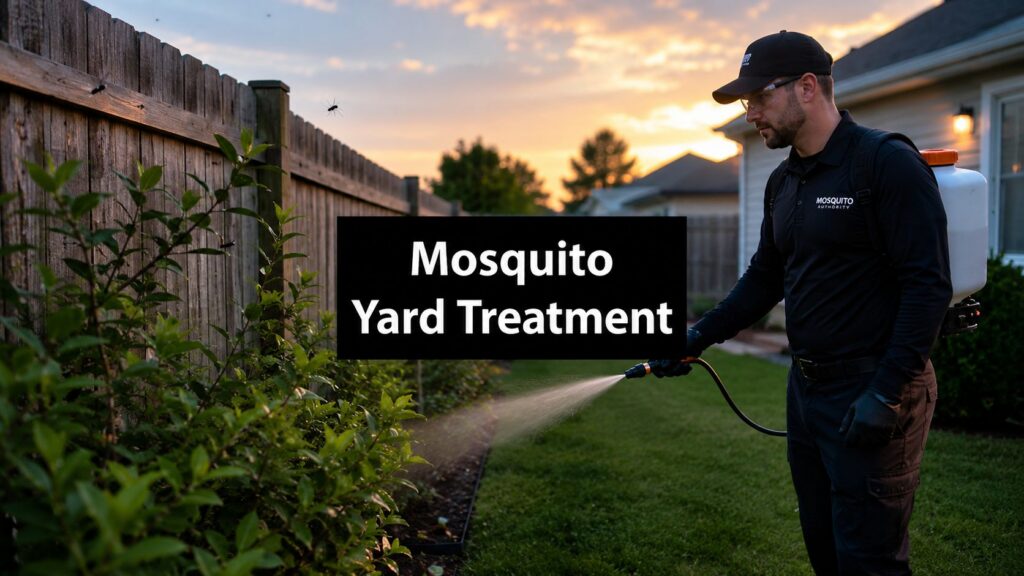
A midsummer dinner in Crown Point can go from relaxing to miserable in minutes. The grill is ready, the patio table is set, and then mosquitoes start working every exposed ankle and arm until everyone retreats indoors. If you're searching for pest control near me, an exterminator near me, or a dependable mosquito program in Northwest Indiana, the right answer isn't always another quick spray. It starts with understanding what's producing mosquitoes on and around your property.
The Green Advantage serves Crown Point, IN and nearby Northwest Indiana communities with practical pest management for homes, businesses, rental properties, and outdoor spaces. A thorough professional mosquito yard treatment combines inspection, habitat correction, larval control, and targeted adult mosquito treatment. That approach matters whether you also need residential pest control, commercial pest control, ant control, termite control, rodent control, spider control, or wasp removal.
Why Mosquito Yard Treatment Matters in Crown Point
A family in Crown Point may step onto the patio expecting a quiet evening and find the yard unusable before dinner is finished. Mosquitoes often gather around shaded landscaping, fence lines, decks, drainage areas, and nearby water. In Lake County, yards can sit beside retention ponds, wooded lots, drainage easements, or low areas that refill after storms, giving mosquitoes repeated opportunities to develop close to the home.
The local setting creates a difficult combination. Humid summer weather, thunderstorms, shaded vegetation, and water that lingers in containers or low spots all support mosquito activity. A property doesn't need a visible pond to have a problem. A clogged gutter, a tipped-over toy, or a folded tarp can hold enough water to keep the local population going.

The problem is bigger than outdoor discomfort
Mosquitoes are more than an interruption to patio meals. West Nile virus and other mosquito-borne illnesses remain public health concerns in Northwest Indiana, so reducing contact with biting mosquitoes is a reasonable part of responsible property care. Homeowners can also use practical pest control tips for dining to make outdoor meals less attractive to flying pests, but those measures won't correct breeding conditions across the yard.
The goal of a mosquito program is not to promise a completely insect-free property. Mosquitoes can arrive from surrounding areas, and weather can change pressure quickly. The goal is to reduce mosquito pressure enough to restore usable outdoor space, protect the investment in landscaping, and make time outside more comfortable.
A habitat-first program also gives homeowners a clearer explanation for recurring activity. If the same low spot, gutter, or decorative water feature keeps producing larvae, spraying adult mosquitoes without correcting that source only treats the visible symptom. For information about the health concerns involved, homeowners can review Indiana mosquito-borne illnesses and discuss property-specific concerns during an inspection.
Practical rule: If a treatment plan only discusses where to spray and never asks where mosquitoes are developing, it's incomplete.
How Professional Mosquito Yard Treatment Actually Works
Mosquitoes pass through four stages, egg, larva, pupa, and adult. The first three stages depend on water, while the adult mosquito rests in vegetation and moves through the yard looking for a host. A household bucket is a useful comparison. If a bucket collects rain and stays undisturbed, it can become a small mosquito nursery even though it looks harmless from a distance.
A bottle cap of standing water can produce dozens of mosquitoes in under two weeks. That's why many of the mosquitoes biting around a home are connected to conditions on the property or nearby, rather than appearing without a local source.

Four layers of a working program
Inspect and correct habitat. A technician checks gutters, downspout discharge areas, tarp folds, wheel ruts, plant saucers, birdbaths, dense ground cover, and other places where water can remain. The simplest fix is often to empty, cover, turn over, or remove the item.
Control larvae before they mature. Some water can't be drained or covered. EPA guidance distinguishes larvicides, which target mosquitoes in breeding water, from adulticides, which target flying adult mosquitoes. CDC guidance recommends using larvicides only for larger water bodies that can't be dumped or covered, and not in drinking water. Products may include biological or insect-growth-regulating materials selected for the site and applied according to the label.
Treat adult resting areas. Adult mosquitoes commonly rest in shaded foliage, under decks, along fence lines, and around structure perimeters. A residual barrier treatment places a labeled product on those surfaces so mosquitoes encounter it when they land.
Provide immediate knock-down. The service can also reduce the adult mosquitoes present during the visit. That creates faster relief, while habitat work and residual treatment address the next wave.
The CDC describes integrated mosquito management as a combination of surveillance, source reduction, larval control, adult control, resistance testing, public education, and evaluation. For a Crown Point property, the important point is simple: spraying is one tool in an adaptive program, not the entire program.
What Happens During a Professional Service Visit
A Crown Point yard can look dry at the patio and still produce mosquitoes near a downspout, deck, or drainage easement. A professional visit starts with finding those pressure points before any application begins. The technician walks the property, checks recent moisture patterns, and notes access, shade, vegetation, and areas where water remains after rain.
The inspection should produce a treatment plan, not just a route around the foundation. The technician records conditions such as dense ivy, low spots, birdbaths, ornamental water features, poor downspout discharge, and shaded areas beneath decks. Each finding affects whether the right response is removal, drainage correction, larval control, or targeted adult treatment.
A practical visit usually follows this sequence:
Inspect the property. The technician maps water-holding sites, adult resting areas, drainage patterns, gates, pets, play spaces, and pollinator activity.
Separate correctable sources from unavoidable ones. Water that can be emptied, covered, drained, or modified should be handled that way. Treating removable water leaves the underlying problem in place.
Set application boundaries. Adult treatment is directed toward labeled residential surfaces where mosquitoes rest, including shaded vegetation, fence lines, under-deck spaces, and suitable foundation areas. A calibrated backpack mist blower or low-volume sprayer generally allows more controlled placement than a broad fogging pass.
Explain the work before leaving. Service notes should identify treated areas, conditions that need homeowner attention, and the follow-up window.
Coverage quality depends on reaching the places mosquitoes use, not coating exposed turf for appearances. Dense foliage, shrub interiors, and shaded edges require careful technique, while unnecessary drift should be limited around people, pets, play areas, and pollinator activity.
The final conversation matters because mosquito pressure changes with rainfall, vegetation growth, and nearby breeding sources. A homeowner should know what was found, what was treated, and which source-reduction tasks will have the greatest effect before the next visit. That documentation distinguishes a habitat-first management visit from a quick perimeter pass.
Professional Treatment Compared to DIY Options
DIY products can help with a small gathering or a temporary problem, but they usually don't replace a property-specific program. Citronella candles and torches create a limited comfort zone near the flame. Bug zappers may attract and kill some flying insects, but they don't remove breeding water or create a residual barrier in shaded vegetation.
Residential foggers provide a short burst of adult knock-down. They don't reliably reach every leaf underside, dense shrub interior, or hidden water source. Natural sprays can be useful as a supplemental measure, but their performance depends heavily on coverage, weather, and how often the product must be reapplied.
The comparison below uses the figures supplied for this service discussion. The exact performance and cost for any product can vary, so homeowners should read the label and request an itemized quote rather than treating these figures as a guarantee.
| Method | Effective Duration | Coverage Area | Knockdown Rate | Avg. Cost per Week |
|---|---|---|---|---|
| Professional barrier treatment | 21 to 30 days, depending on conditions and product label | Broad, targeted coverage of foliage, shaded resting zones, fence lines, and structure perimeters | About 90% for a professional application | Varies by property size, service plan, and quote |
| Citronella candle or torch | Roughly 2 to 4 hours near the burn area | Small comfort zone around the device | Not a yard-wide knock-down method | Varies by fuel and replacement needs |
| Store-bought bug zapper | Variable and limited to insects reaching the device | Immediate area around the unit | Not a reliable mosquito population treatment | Varies by equipment and electricity |
| Residential fogger | Short-term, weather-sensitive relief | Areas reached during a single pass | About 30% to 50% reduction on one pass | Varies by canister use and yard size |
| Garden pump sprayer with natural spray | Often short-lived and dependent on conditions | Operator-dependent, with gaps common in dense plants | Variable | Varies by product and reapplication frequency |
The strongest professional advantage is not just stronger chemistry. It's calibrated application, label-driven dosing, equipment reach, and source inspection. A technician can direct material into the shaded foliage and undersides of leaves where mosquitoes rest, while a garden sprayer may leave untreated pockets.
Homeowners improving the rest of their outdoor space can also consult this DreamYard DIY landscaping guide, especially when planning drainage, plant placement, and maintenance access. DIY landscaping can support mosquito control, but it won't replace larval management when water remains on the property.
For a smaller yard with low pressure, DIY measures may be enough as a supplement. When pressure is high, the property is larger than a quarter acre, or dense landscaping blocks coverage, professional service is usually the more practical option.
Why Source Reduction Is the Hidden Key
Monthly spraying sounds like a complete mosquito plan because it's the most visible part of the service. It isn't. Adult mosquitoes can be reduced on treatment day, but new adults can continue emerging if the property still contains water where larvae develop.
Crown Point properties often hide those sources in ordinary places:
- Clogged gutters: Leaves and sediment hold water after rain.
- Container clutter: Tires, toys, buckets, plant saucers, and trash lids collect small pools.
- Lawn depressions: Low areas can stay wet after storms.
- Decorative water: Birdbaths and ornamental features need regular maintenance.
- Tarp folds: Covers over firewood, equipment, or furniture can trap rain.
- Poor discharge: Downspout extensions may empty into a low area that drains slowly.
The CDC recommends emptying, scrubbing, turning over, covering, or throwing away water-holding items once a week. It also notes that small amounts of standing water can support breeding when they persist. Stormwater guidance recommends keeping stored water for less than 72 hours whenever possible, because water held longer than 3 days can create mosquito habitat. These recommendations make weekly property checks a core part of the program, not a cosmetic cleanup task.
What a technician does with each source
A technician may remove the source, recommend a drainage or structural correction, or treat unavoidable water with a labeled larvicide such as BTI or methoprene. The choice depends on whether the water can be dumped, covered, drained, or safely managed.
This is why homeowners should ask about habitat findings before asking only how often the yard is sprayed. The practical details of standing water and mosquito control often determine whether a barrier treatment delivers useful suppression or gets overwhelmed by fresh emergence.
The higher-value question: Which conditions on this property are producing the next generation of mosquitoes?
A habitat-first approach can reduce the pressure that repeatedly feeds the adult population. Sprays still have a role, particularly on shaded resting sites, but chemistry works more efficiently when the property isn't continuously supplying new mosquitoes.
Seasonal Treatment Schedule for Northwest Indiana
In Crown Point, the first warm evenings can arrive before a yard looks ready for service. A useful schedule follows mosquito development and property conditions, so inspection and source reduction start before repeated barrier applications become necessary.
How the season typically unfolds
- Late March through April: Check gutters, containers, drainage, and low areas for winter water and debris. Correct conditions that hold water, and treat unavoidable water when appropriate.
- May through early June: Watch for adult emergence as temperatures and moisture support activity. Schedule the first barrier treatment when needed, then reassess shaded landscaping and water sources.
- July through August: Pressure is often highest near tree lines, dense plantings, decks, and evening-use areas. Reapply according to the property, weather, vegetation, and treatment conditions, often within the 21 to 30 day service window described in the supplied treatment guidance.
- September: Reduce service as activity changes, but continue checking containers, low spots, and gutters blocked by leaves.
- October through early November: Remove remaining water sources, prepare the yard for winter, and record corrections that can improve conditions next season.

A five-to-six-visit annual program can maintain steadier control than one application because each visit creates another opportunity to find new water, adjust coverage, and respond to rain or growing vegetation. The schedule still belongs to the property, not the calendar. A yard beside dense woods or a retention pond may need closer monitoring, while an open, well-drained lot may require less frequent attention. The application is only one part of the plan. Inspection, correction, and follow-up determine whether it keeps working.
Benefits of Working with The Green Advantage
In Crown Point, a mosquito service earns its value by finding what keeps pressure coming back. The Green Advantage serves Crown Point, IN and nearby Northwest Indiana communities, where heavy shade, clay-heavy soils, wooded lots, retention areas, and changing stormwater patterns can all affect a yard.
The technician's inspection should connect mosquito activity to the property's layout. Water near downspouts, damp ground cover, catch basins, drainage easements, and shaded vegetation can remain productive or attractive habitat after the lawn appears dry. That information gives the service a clear target instead of turning every visit into the same driveway-side spray.
A useful program may include:
- Habitat mapping: Recording water sources and shaded resting areas across the property.
- Larval control: Treating water that cannot be removed, according to the product label and site conditions.
- Barrier treatments: Applying adult mosquito control to suitable foliage and structural perimeter areas.
- Follow-up communication: Documenting findings, homeowner corrections, and the next service window.
- Residential and commercial planning: Adjusting the approach for a backyard, rental property, restaurant patio, office site, or other commercial facility.
The practical difference is coordination. If a blocked gutter, wet planting bed, or drainage problem remains, an application may reduce adult mosquitoes temporarily while the same source continues feeding new activity. Inspection and source correction give the treatment a better chance to hold.
Product choice and application technique also need to account for children, pets, pollinators, and outdoor use. The technician should explain treated areas, access restrictions during application, and when the space can be used again. Pollinator-conscious work avoids actively blooming plants where bees forage and focuses on mosquito resting habitat when the label permits.
Field research supports barrier treatment as one part of an integrated service. A residential study found pyrethroid barriers reduced mosquito abundance by 87% in the first week, with cumulative reductions of 72% at four weeks and 61% at six weeks. Other yard-scale and residential studies reported reductions of 77.1% and 74.6% over a 56-day post-treatment interval. These findings are summarized in PCT Online's mosquito spray research update, and they do not guarantee identical results in every yard.
For homeowners comparing an exterminator in Crown Point, IN, ask how the company inspects breeding habitat, explains treatment areas, records recommendations, and follows up. Those process details show whether the service is addressing mosquito habitat or repeating an application.
Frequently Asked Questions About Mosquito Yard Treatment
Is treatment safe for dogs, cats, and children?
Professional applications should follow the product label and site-specific safety instructions. People and pets need to remain away from treated areas during application and until the technician confirms the required reentry conditions. The Green Advantage should provide clear instructions for your property, including any drying or access window.
How long does a treatment last?
The residual period depends on rainfall, sunlight, vegetation growth, mosquito pressure, and the product label. Field research has documented meaningful reductions lasting through several weeks, including up to six weeks in one residential study, although performance varies by site and conditions. A recurring program helps address re-entry and new emergence rather than relying on one visit.
Will treatment kill bees and butterflies?
Pollinator protection depends on timing, placement, and product use. Technicians should avoid treating blooming plants where pollinators forage and focus adult mosquito treatment on shaded resting areas when permitted by the label. Tell the technician about gardens, hives, and flowering plants before service.
Do I need to be home?
Usually, you don't need to be home if the technician can access the property, gates are unlocked, pets are secured, and any treatment instructions are available. Confirm access requirements when scheduling.
What should I do about standing water?
CDC guidance recommends emptying, scrubbing, turning over, covering, or discarding water-holding items once a week. Cover stored water with a tight lid or mosquito-resistant mesh, and use larvicides only in larger water bodies that cannot be dumped or covered, never in drinking water.
When should treatment start?
Begin with a pre-season inspection in late March or April, then time adult mosquito treatment around observed emergence and outdoor activity. Starting before pressure becomes severe gives the technician an opportunity to correct habitat before repeated biting dominates the yard.
How much does service cost?
Pricing depends on yard size, landscaping density, access, water sources, and the complexity of the treatment plan. The right quote should be itemized after an inspection, so you can see what the service includes rather than comparing unexplained flat prices.
The Green Advantage provides habitat-focused mosquito inspections, larval management, targeted barrier treatments, and seasonal follow-up for homes and businesses in Crown Point, IN and nearby Northwest Indiana communities. Visit The Green Advantage to request a property assessment, receive a written quote, and start a professional mosquito yard treatment plan that helps you use your outdoor space again.
Crack and Crevice Treatment: Targeted Pest Control
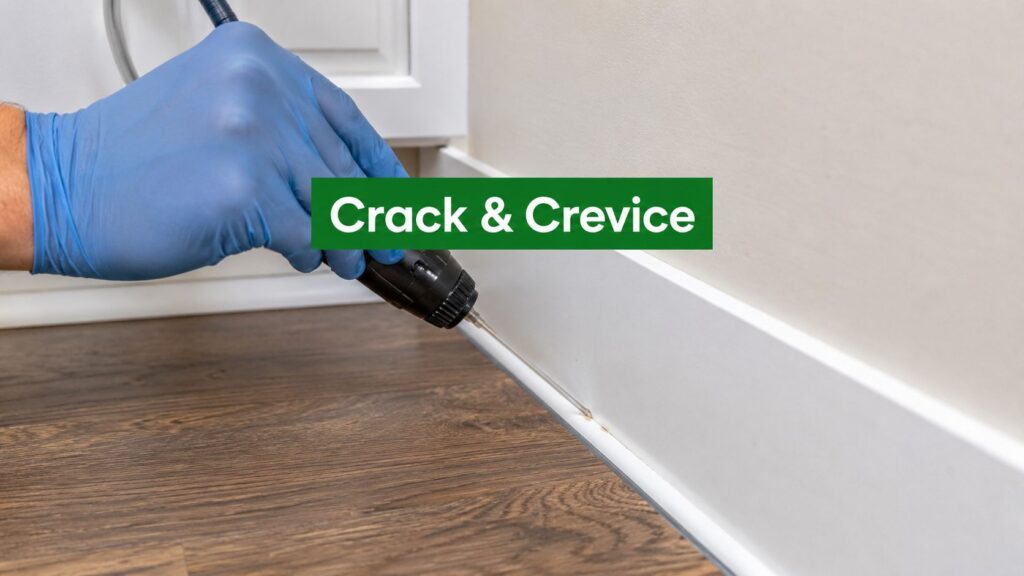
You're probably seeing the same thing many Crown Point homeowners see first, a few pests that seem to vanish the moment the lights come on, then show up again behind a cabinet, under a sink, or along a baseboard. That's usually the sign of hidden harborage, not a random one-off problem. Crack and crevice treatment is built for that exact situation, because it targets the narrow spaces pests use instead of flooding open surfaces.
For homeowners looking for pest control in Crown Point, IN or an exterminator near me, this method often makes more sense than broad spraying. The Green Advantage works with that idea in mind, focusing on precise application, sensible follow-up, and sealing practices that help keep pests from walking right back in. If you've been comparing residential pest control options, or you need commercial pest control for a kitchen, office, or storage area, understanding how this method works can make the whole process feel a lot less confusing.
Introduction to Crack and Crevice Treatment
A lot of pest problems in Crown Point start in often-overlooked places. Behind the refrigerator, under the stove, around plumbing penetrations, and in the slim gap where a baseboard meets the wall, pests can stay hidden during the day and move out at night. That's why people searching for pest control near me often end up needing more than a perimeter spray.
Why hidden gaps matter
Cracks and crevices are more than small openings. They're protected pathways, resting spots, and nesting edges for insects that avoid open space. Roaches, ants, spiders, and similar pests can stay tucked into those zones where food crumbs, moisture, and warmth are close by.
Practical rule: if a pest can stay sheltered and still reach food or water, it'll use that gap again.
That's where a local expert matters. The Green Advantage serves Crown Point and surrounding Northwest Indiana homes with treatment plans that focus on where pests are living, not just where they're occasionally seen. For a homeowner, that means the work is designed around the layout of the house, the moisture problem, and the likely entry points.
If you're dealing with a kitchen issue, a bathroom issue, or repeated sightings in finished living areas, the point isn't to spray more. The point is to treat the right spaces, then reduce the chance of reinfestation. That combination is what makes crack and crevice work useful in homes that need careful, targeted service rather than heavy-handed application.
Understanding Crack and Crevice Treatment
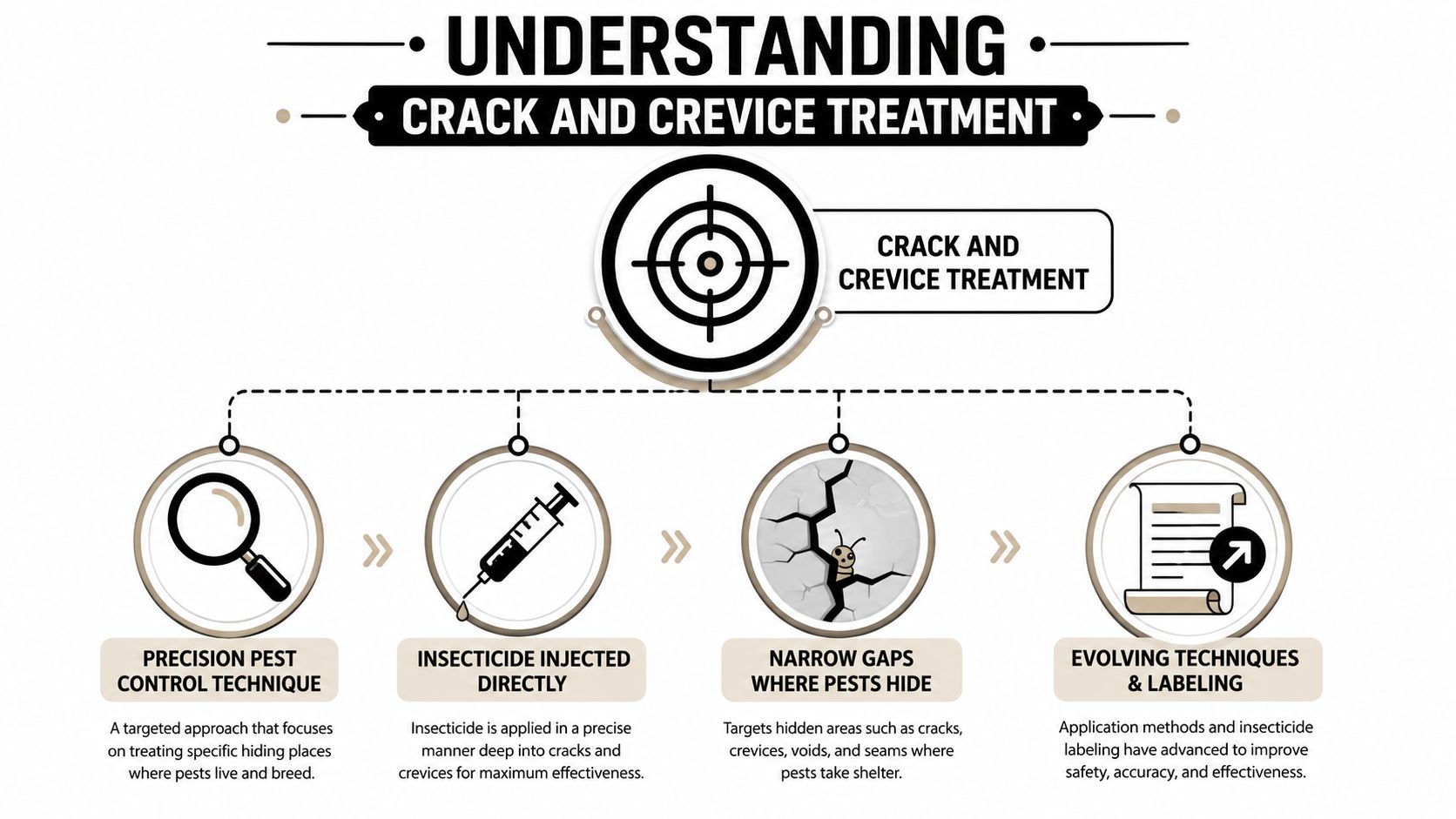
Crack and crevice treatment is a precision pest-control method. It applies insecticide directly into tight harborage points, such as gaps between cabinets and walls, behind baseboards, under appliances, around plumbing openings, and inside hollow structural voids. In other words, it's made for the places pests use as shelter, not for coating every visible inch of a room. The Journal of Economic Entomology evaluation of German cockroach control showed why that precision matters, because mortality depended heavily on technique.
Precision beats broad coverage
That study found the highest mortality when the crack-and-crevice nozzle was inserted 4 mm inside the crack, and mortality dropped as nozzle height increased. A fan nozzle performed worst. That's a good reminder for homeowners in Crown Point, the tool matters, but so does the angle, depth, and placement of the application.
The reason this method became so important in integrated pest management is simple. Many pests don't spend their time on open surfaces where a broad spray would hit them directly. They live in protected spaces, so targeted treatment makes more sense than soaking the whole room. It also fits better in sensitive interiors like homes, food-handling areas, and utility spaces where you want control without unnecessary residue.
A second layer of research helped shape that approach. Exposure and residue work on crack and crevice treatment showed that residue can be measured after application, with dislodgeable residue after 8 days reported at 1.5 ± 1.1 µg/kg for children and 0.55 ± 0.21 µg/kg for teens/adults in one pyrethroid residue study. That residue research matters because it supports the move toward localized, lower-volume treatment methods that can be monitored rather than guessed at.
What it really means for a homeowner
For a homeowner, the takeaway is straightforward. Crack and crevice treatment is about placing the product exactly where pests hide, then leaving the rest of the home less exposed. That's a very different philosophy from broad spraying, and it's one reason the method is so useful in modern pest control.
Targeted Pests and Use Cases in Northwest Indiana
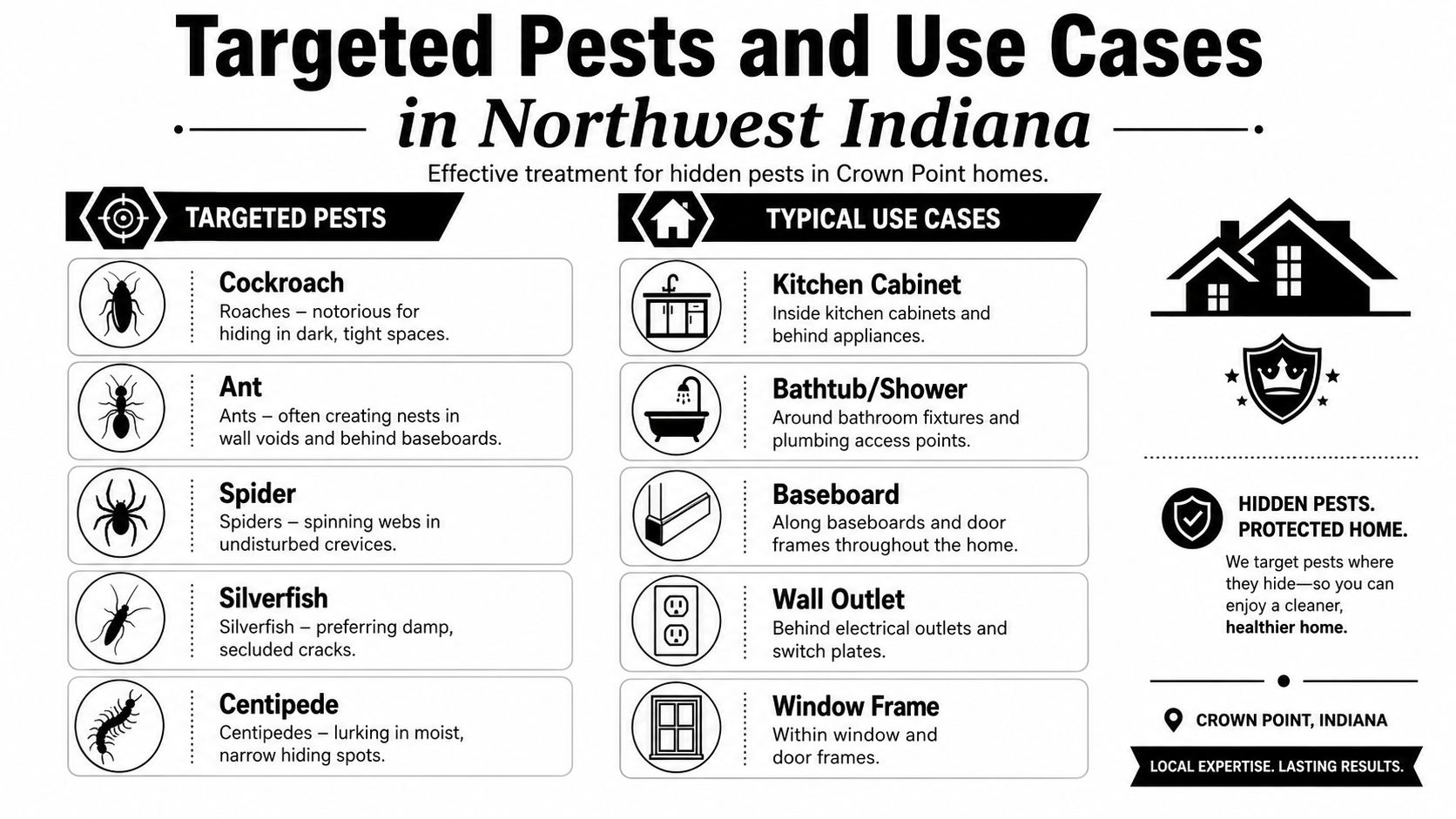
Hidden gaps in Crown Point homes tend to attract the same kinds of pests over and over. Roaches use dark seams and utility chases. Ants work their way into wall voids and trim gaps. Spiders, silverfish, and centipedes also settle into undisturbed spaces where they won't be disturbed by day-to-day activity.
Where pests hide inside the home
A local pest control plan usually starts with the zones homeowners overlook most:
- Kitchen cabinets and appliance gaps where crumbs, grease, and warmth meet.
- Bathroom fixtures and plumbing access points where moisture stays available.
- Baseboards and door frames that form narrow travel lanes through the house.
- Electrical outlets and switch plates where voids create hidden shelter.
- Window and door frames that can open the door to recurring entry activity.
These are the kinds of spaces where targeted application makes the most sense. A cabinet gap doesn't need a room-wide spray, it needs treatment in the opening where pests are moving through. The same goes for a utility chase or a wall penetration around pipes.
Why timing matters in Crown Point
Seasonal pest pressure in Northwest Indiana makes precision even more useful. Spring often brings more ant pressure as outdoor colonies become active, while cooler fall weather can push insects to scout for indoor shelter. When that happens, cracks, seams, and voids become the easiest routes inside.
For homeowners comparing exterminator in Crown Point, IN options, the biggest difference is whether the service addresses the hiding place or just the symptom. A targeted plan can help reduce activity in the spots pests use most often, and it can be repeated only when needed. The EPA product label for crack-and-crevice use says repeat treatment should be done only when pests are seen and not more often than every 6 to 8 weeks for roaches, spiders, crickets, silverfish, firebrats, centipedes, millipedes, pill bugs, and sowbugs.
For readers who want a broader background on pest patterns in urban settings, a useful outside resource is the comprehensive guide on Toronto pests. The climate and geography are different, but the habit of pests using hidden entry points is the same.
Professional Treatment Process with The Green Advantage
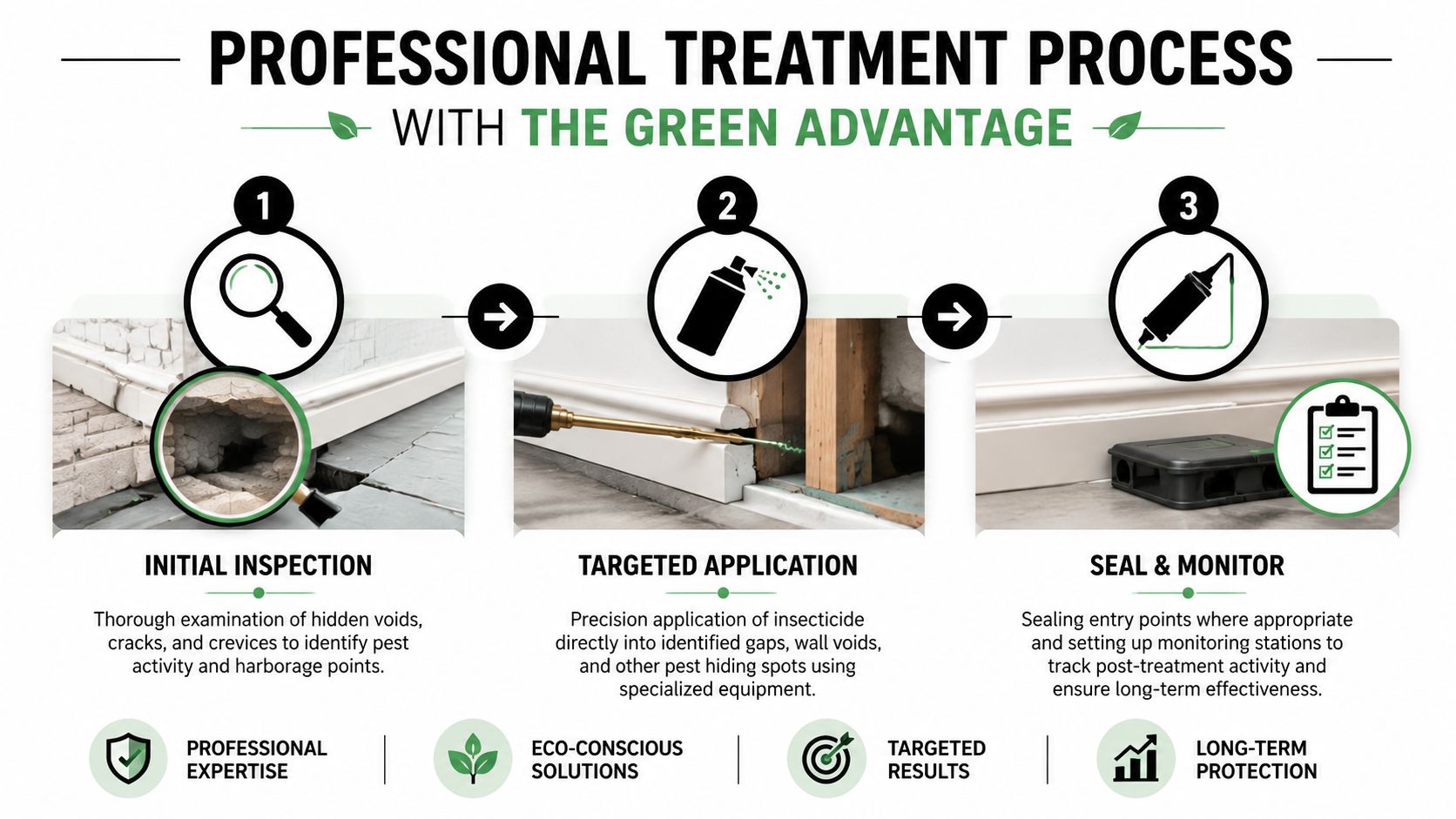
A proper service call starts with inspection, not spraying. Technicians look for gaps around baseboards, plumbing, cabinets, appliance voids, and other protected areas where pests can live out of sight. Once the harborages are identified, the treatment is placed where it can reach the pest, not just the surface around it.
What the application looks like
Industry guidance for aerosol crack and crevice work recommends short 1 to 2 second bursts with a thin injector tube into hidden voids such as electrical outlets, baseboards, appliance motors, and plumbing penetrations, then ventilating the area and sealing openings afterward to reduce reinfestation pressure. That guidance from PCT Online lines up with the way careful technicians work in real homes. The point is to kill pests already occupying those spaces and make the openings less useful afterward.
The Green Advantage's approach in Crown Point follows that logic. The service is designed for the layout of the home, the type of pest activity, and the places where sealing can reduce future movement. In practical terms, that means treating first, then closing off the pathway when it's appropriate to do so.
For homeowners who want to see how the company frames service choices, the why should you choose The Green Advantage for your pest control needs page is a useful read. It gives context for how the team thinks about inspection, treatment, and follow-through.
The best crack and crevice work doesn't end with product application. It ends with fewer open routes for pests to use again.
How to prepare your home
A few simple steps make service smoother:
- Clear under sinks so plumbing voids and cabinet seams are reachable.
- Move small appliances away from walls if you can do it safely.
- Keep pets secured during the visit and until the area is ready for reentry.
- Leave access open to problem rooms, utility spaces, and basement edges.
That preparation helps technicians work faster and more precisely, especially in homes where pests are moving through multiple small gaps.
Safety and Environmental Considerations
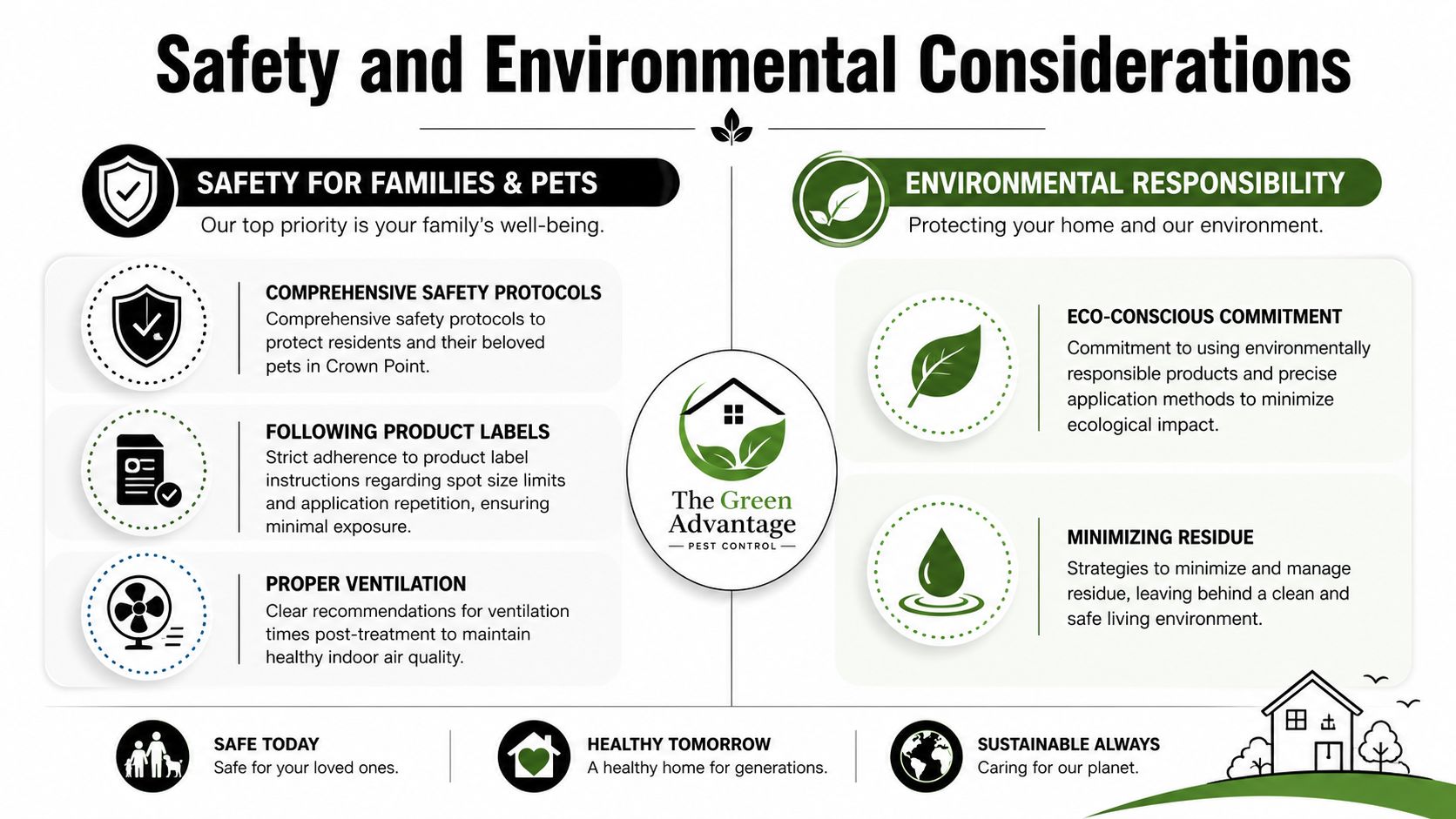
Targeted treatment is often easier on the home because it puts product where it's needed instead of everywhere else. That doesn't replace label compliance, though. It makes label compliance more important, since the application has to stay within the defined limits.
What product labels require
One crack-and-crevice label says to apply at 20 seconds per 1,000 ft³ for a general volumetric treatment, then keep the area closed for 15 minutes and ventilate thoroughly before reoccupying. For spot treatment, individual spots should not exceed 2 square feet and should cover no more than 20% of the treated surface. That label language shows how tightly this method is defined.
Those limits matter for families and pets in Crown Point. A precise treatment reduces the amount of product used, limits off-target exposure, and keeps the process focused on hidden voids instead of open living space. It also supports better residue management in sensitive areas like kitchens, bathrooms, and mechanical rooms.
Safer use comes from restraint
Simple rule: less area treated, more control over where the product goes.
That's why a careful technician pays attention to nozzle placement, spot size, and reentry timing. The goal isn't to fill the room. The goal is to reach the pest while keeping the rest of the environment as undisturbed as possible.
For homeowners worried about indoor air quality, temporary closure and ventilation are part of the process, not an afterthought. The same is true for children and pets, who should stay out of the treated area until it's ready for normal use. Empty container handling should follow local disposal rules and product label directions, since cleanup is part of responsible service.
This is also where eco-friendly pest control really means something practical. Precision treatment uses less product than broad spraying and gives technicians a better chance to limit unnecessary exposure. In homes where sensitivity matters, that can make the difference between a service that feels disruptive and one that feels controlled.
Comparing DIY and Professional Services
Homeowners can buy aerosol products and try to handle crack and crevice work themselves, but that often leads to the same mistakes. The nozzle gets aimed at open trim instead of the void itself. Product goes onto visible surfaces instead of into the seam. Hidden entry points get missed entirely.
Where DIY usually falls short
DIY treatment often fails in three predictable ways:
- It misses pest harborage. The pest is in the void, not on the surface.
- It overapplies in the wrong place. More product on a countertop or baseboard doesn't equal better control.
- It skips sealing. If the opening stays open, pests can use it again.
The exterminator near me search usually starts because the problem keeps coming back. That's the clue that simple spot spraying isn't enough. If you want a broader decision framework, the DIY or hire a pro what's right for you page helps homeowners compare risk, effort, and results.
What professional service adds
Professional service brings better nozzle control, cleaner placement, and a plan for follow-up. It also means the technician knows when to treat lightly, when to treat only visible activity, and when to recommend exclusion work instead of relying on chemistry alone. For homes and businesses that need residential pest control or commercial pest control, that follow-through matters.
The difference is simple. DIY work tends to stop at the spray. Professional work keeps going into inspection, targeted application, and sealing where appropriate. That's why the method is so effective for people who want less chemical exposure without giving up control.
If pests are showing up in your Crown Point home, don't guess at the source. Schedule an inspection, ask where the entry points are, and get a treatment plan built around the places pests hide.
A CTA for The Green Advantage.
Bed Bug Treatment Near Me Guide for Crown Point Homeowners

You wake up with fresh bites, strip the bed, and start checking seams with your phone light. By bedtime, you're online searching for bed bug treatment near me, hoping this is a small problem and not the start of a drawn-out infestation. That reaction is normal. Bed bugs unsettle people fast because they invade the one place that should feel safe.
In Crown Point, IN, speed matters. Bed bugs hide well, spread through furniture and personal items, and they don't go away because you sprayed one corner of the room. Homeowners in Northwest Indiana also deal with busy households, shared walls in some properties, travel, and secondhand furniture moving in and out of homes, all of which can complicate the timeline.
If you're comparing pest control near me, exterminator near me, or pest control in Crown Point, IN, you need clear answers on signs, prep, treatment options, and what the process costs. Generic guides usually skip the two parts homeowners care about most. How long this takes, and what works without turning your house upside down.
What to Know About Bed Bug Treatment Near Me
Individuals often begin with the same question. Can one quick treatment fix this?
Usually, that's the wrong expectation. Bed bugs are hard to eliminate because they hide in seams, cracks, furniture joints, and nearby clutter. A surface-level spray doesn't reach enough of the infestation, and panic-buying retail products often burns time while the problem grows.
Why homeowners get stuck
Bed bugs don't act like ants or occasional spiders. You can kill the ones you see and still leave eggs or hidden bugs behind. That creates the false impression that the problem is gone for a few days, then it starts again.
For Crown Point homeowners, the practical issue is timing. If you catch the infestation early, you have more options and less disruption. If you wait, the inspection gets broader, prep gets heavier, and treatment usually becomes more involved.
Practical rule: If you've seen bites, spotting, shed skins, or a live bug, stop guessing and start confirming.
What a local search should really lead to
When someone is looking for an exterminator in Crown Point, IN or residential pest control, they aren't looking for theory. They want a company that can inspect the home, explain the method, set realistic follow-ups, and handle the issue without confusing instructions.
That same local mindset matters for landlords, real estate professionals, and commercial clients too. Bed bugs can affect tenant satisfaction, move-in schedules, and reputation. If you're already comparing providers for commercial pest control, termite control, rodent control, or mosquito control in Northwest Indiana, bed bug service should be evaluated with the same standard. Clear process. Clear preparation. Clear follow-through.
Understanding Bed Bug Signs and Inspection
Bed bugs leave clues before most homeowners ever see a live one. The problem is that people often dismiss those clues as dry skin, random bites, or old stains. A basic inspection helps you stop guessing.
Start with the bed, then expand outward. Use a flashlight and a thin card or old gift card to check mattress seams, piping, bed frame joints, headboards, nearby furniture, baseboards, and cracks close to where people sleep. If you have a magnifying glass, use it. Small signs are easy to miss.
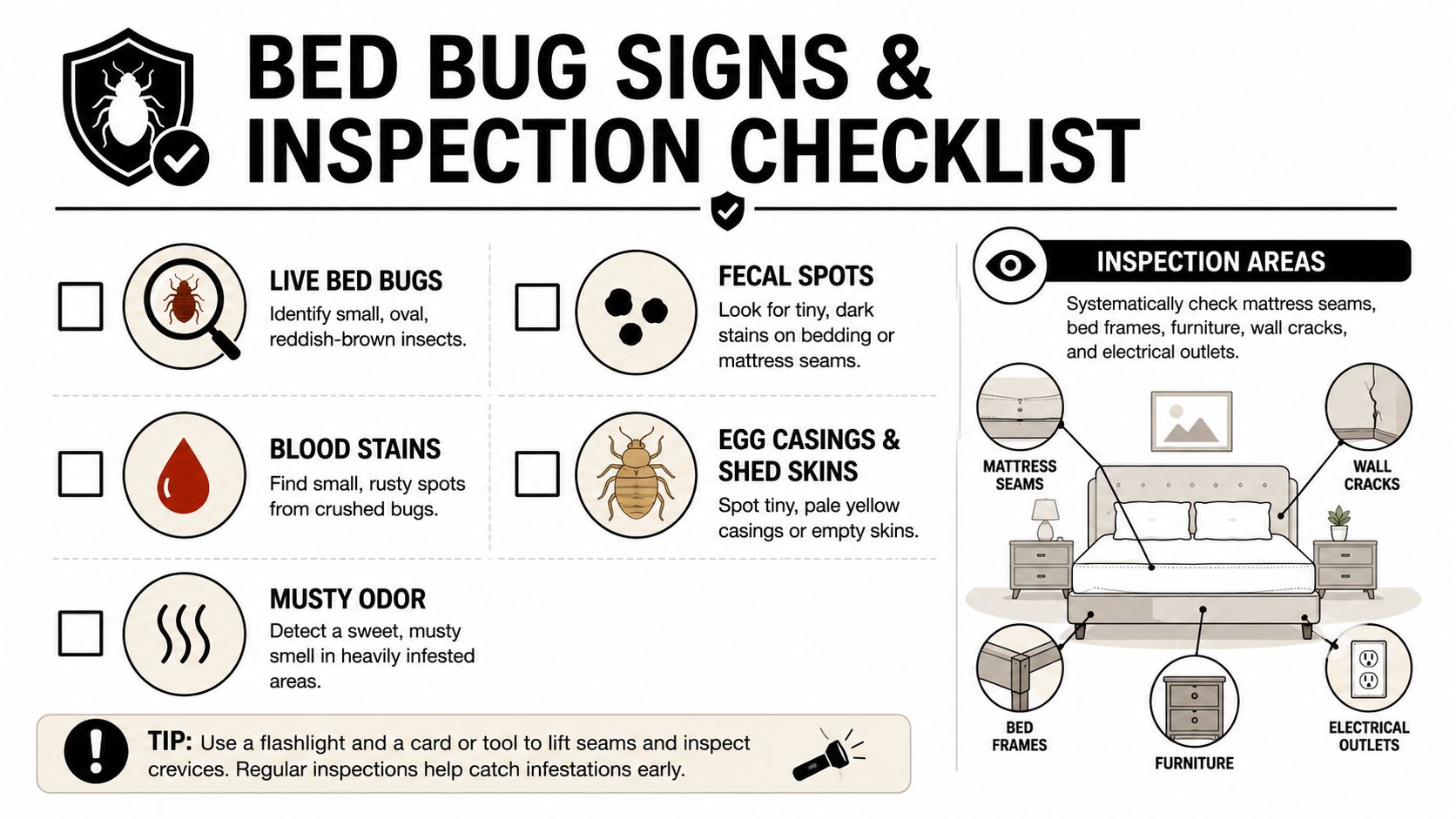
What to look for
- Live bed bugs that are small, oval, and reddish-brown
- Dark fecal spots on mattress seams, bedding, or furniture
- Rust-colored blood stains on sheets or pillowcases
- Egg casings and shed skins tucked into seams and crevices
- A musty odor in heavier infestations
Don't rely on bites alone. Skin reactions vary too much from person to person.
One reason early inspection matters is that bed bugs have become much harder to knock down with simple pesticide use. Bed bug populations have developed genetic resistance to common pesticides, and they can survive months without feeding and lay over 500 eggs, which is why quick detection matters so much, as noted in the BBC's reporting on why bed bugs are difficult to deal with.
Useful tools for a home check
Interceptor traps are worth using under bed and furniture legs because they help confirm movement around sleeping areas. They won't solve the infestation, but they do help you monitor it.
If you're trying to sort out whether your sleep setup itself is part of the problem, this guide on how to choose a new mattress can help you separate mattress wear issues from actual pest evidence. For a more focused walkthrough on signs inside your home, review this local resource on how to tell if you have bed bugs.
A short visual can help if you're still unsure what you're seeing.
If you find signs in one bedroom, inspect adjacent furniture and nearby sleeping areas the same day. Bed bugs rarely stay confined to the most obvious spot.
Preparing Your Home for Treatment
Prep work isn't busywork. It directly affects how well treatment reaches bed bug hiding spots.
A strong prep plan reduces hiding places, exposes travel routes, and helps the technician spend more time treating and less time moving household items. If you skip prep, you lower the odds of a clean result.

The prep checklist that matters
Integrated Pest Management protocols recommend laundering fabrics at 120°F for 30 minutes and using interceptors under furniture legs to break the infestation cycle without over-relying on chemicals, according to Rutgers NJAES bed bug guidance.
Use that guidance in a practical way:
- Launder bedding and clothing that may be affected, then bag clean items until treatment is complete.
- Reduce clutter around beds, upholstered furniture, closets, and baseboards.
- Vacuum seams and crevices carefully, then dispose of vacuum contents promptly.
- Pull furniture slightly from walls so treatment can reach behind headboards and baseboards.
- Keep floors clear of toys, shoes, loose linens, and storage piles.
A few prep mistakes to avoid
Don't move infested items into another bedroom. That spreads the problem.
Don't throw away beds or furniture until a professional tells you it's necessary. Many items can be treated, isolated, or encased. If you're looking at sleep-surface protection after treatment, this roundup of best mattress protectors is useful for comparing options. Before your appointment, it's smart to review a local checklist on how to prepare for pest control.
Treatment Methods Explained
Not every bed bug method deserves your money. Some are proven. Some are half-measures. Some are a complete waste of time.
The biggest mistake homeowners make is treating bed bugs like a general pest issue. Bed bugs require precision, reach, and follow-up. That's why residential pest control for bed bugs is a different conversation than routine ant control, spider control, or wasp removal.
Comparison of Bed Bug Treatment Methods
| Method | Effectiveness | Visits Required | Cost Range | Considerations |
|---|---|---|---|---|
| Professional heat treatment | 95% success rate when performed by trained professionals | Often paired with inspection and follow-up | $300 to $5,000 | Strong single-session performance, but requires specialized equipment and professional execution |
| DIY methods | 10% of infestations eliminated | Often repeated unsuccessfully | Varies | Cheap upfront, poor results, easy to misuse |
| Targeted spray programs | Qualitatively useful in some plans | Multiple visits are commonly needed | Varies | Resistance is a major issue, and eggs complicate full elimination |
| Steam treatment | Effective for direct treatment and crack penetration | Usually part of a broader plan | Varies | Works well in seams and crevices, but coverage has to be thorough |
| Foggers | Completely ineffective against bed bugs | Not recommended | Varies | Waste of time and can push bugs deeper into hiding |
The strongest hard numbers here favor heat. Professional bed bug heat treatments achieve a 95% success rate when performed by trained professionals, compared with 10% for DIY methods, and they typically cost $300 to $5,000 depending on infestation severity, according to this compiled bed bug treatment data.
What each method really means
Heat treatment is the closest thing to a reset button when done correctly. It attacks bed bugs at all life stages at once, which is why many homeowners ask about it first when searching for bed bug treatment near me.
Spray-only treatment can play a role, but I wouldn't recommend relying on it alone. Bed bugs hide too well, and resistance has changed the game. Retail sprays especially give homeowners false confidence.
Steam is a practical tool for seams, edges, and cracks where bugs hide close to the surface. It can be a smart part of an eco-friendly integrated plan.
Desiccant dusts also matter in serious programs. They work physically rather than asking the bug to be chemically susceptible, which makes them useful in wall voids, void edges, and protected harborages when applied correctly.
The right plan isn't the cheapest line item. It's the one that reaches hidden bugs, fits the layout of the home, and includes follow-up.
One option available locally is The Green Advantage, which provides bed bug removal as part of its Crown Point pest control service lineup.
My recommendation for Crown Point homes
If the infestation is established, lean toward a professional integrated plan that uses heat, steam, desiccants, monitoring, and follow-up as needed. If the issue appears small, don't confuse "small" with "easy." Early-stage infestations still fail when homeowners under-treat furniture, miss adjacent rooms, or stop after the first improvement.
For people also comparing eco-friendly pest control or preventative pest treatments, bed bug service should still be judged by one standard. Can the provider explain where the bugs are hiding, what method will reach them, and what follow-up is required? If they can't answer that clearly, keep looking.
Timeline and Cost Expectations
Homeowners usually ask two questions first. How long will this take, and what will it cost in Crown Point?
The honest answer is that bed bug work isn't a one-visit mindset. Eggs and hidden bugs make follow-up part of the job, not an optional add-on.
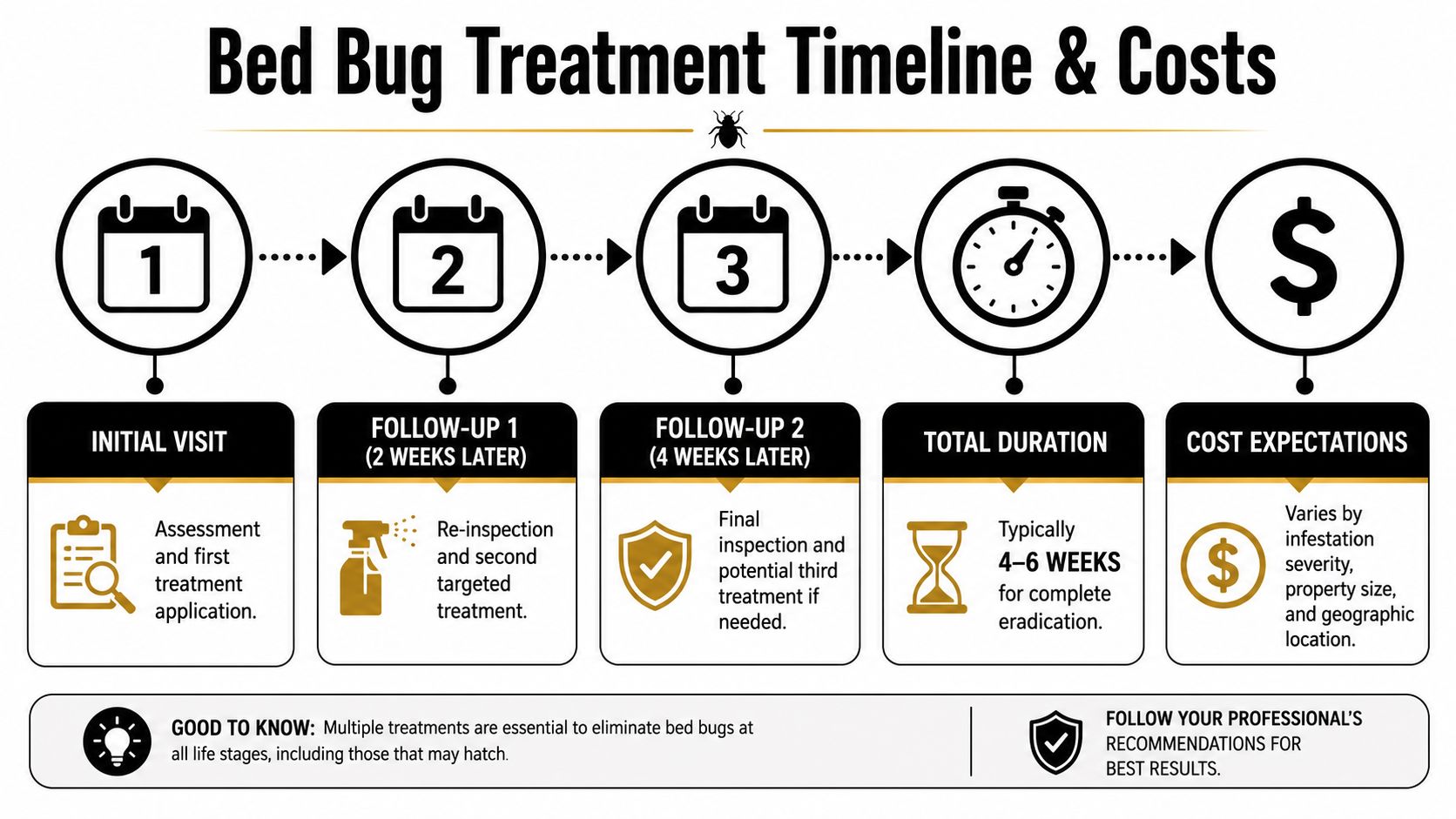
The timeline most homeowners should expect
EPA guidance and recent IPM reviews confirm that skipping the two essential follow-up treatments, recommended at two-week intervals, accounts for 80–90% of repeat bed bug complaints, as explained in the EPA's do-it-yourself bed bug control guidance.
That means a realistic schedule looks like this:
- Initial visit for inspection and first treatment.
- First follow-up about two weeks later.
- Second follow-up about two weeks after that.
For many households, that creates a treatment window that stretches across several weeks. That's normal. It isn't a sign the plan failed. It's what responsible bed bug control looks like.
What the local cost picture looks like
In Crown Point, Angi lists the average cost of pest control for a homeowner at $175, with a typical range from $100 to $500 or more, depending on infestation size, number of visits, and the pest involved, according to local Crown Point pest control pricing information. Bed bugs often land toward the more involved end because they usually require more time, more prep, and more than one visit.
If you're budgeting for whole-home recovery, don't forget surrounding soft surfaces and floor care. For example, homeowners comparing post-treatment cleaning expenses sometimes look at Rubber Ducky's rug cleaning rates to get a general sense of how specialty cleaning services can add to the overall project.
Budget for the full process, not just the first appointment. Bed bugs punish shortcuts.
Safety and Environmental Considerations
If you're worried about kids, pets, and chemical exposure, that's the right concern. Bed bug treatment should solve the infestation without creating a second problem inside the home.
Where lower-residue methods make sense
Steam is one of the most practical tools in an eco-conscious plan because it reaches cracks and seams without leaving chemical residue behind. Steam treatments can reach temperatures above 120°F to penetrate cracks and crevices where sprays fail, killing all life stages faster while avoiding pesticide residues that bed bugs increasingly resist, according to research published in the Journal of Economic Entomology.
Heat-based methods follow the same basic advantage. They target the pest with temperature rather than relying only on residual chemistry. That matters in bedrooms, around upholstered furniture, and in homes where residents want lower-toxicity options.
Where caution still matters
Even lower-impact methods require discipline. Homeowners should follow re-entry instructions, avoid moving untreated items through the house, and ask what can stay in place during treatment.
For integrated plans, desiccant materials and selective product use often make more sense than broad, repeated chemical spraying. That's especially true when the goal is eco-friendly pest control that still gets results. The same commonsense approach applies to related services like rodent control and seasonal pest issues in Northwest Indiana. Use the least disruptive method that still reaches the actual problem.
Disposal decisions should also be deliberate. Throwing furniture out too early can spread bugs through hallways, garages, or shared pickup areas.
Working With The Green Advantage
If you're booking pest control in Crown Point, IN for bed bugs, expect the process to start with questions about where you've seen signs, how long it's been happening, and which rooms are affected. That's not small talk. It helps shape inspection and treatment.
A good service visit should feel straightforward. The technician inspects likely harborages, explains the treatment approach in plain language, gives you prep and post-treatment instructions, and sets expectations for follow-up. Homeowners shouldn't have to drag basic answers out of the company they're hiring.
For Crown Point homes, condos, rentals, and nearby Northwest Indiana properties, clarity is key. You want a provider that can address bed bugs while also understanding broader property needs like commercial pest control, termite concerns, mosquito reduction, or ongoing preventative service. The process should be organized, not improvised.
If you're still searching exterminator near me or residential pest control and trying to compare options, keep it simple. Ask how they inspect. Ask how they treat. Ask what follow-up is included. Ask what you need to do before and after service. If those answers are vague, move on.
If bed bugs are disrupting sleep in your Crown Point home, don't wait for the problem to spread. Contact The Green Advantage to schedule an inspection, request a quote, and get a clear treatment plan built around your home, your timeline, and the practical realities of bed bug control in Northwest Indiana.
How Long Does Pest Control Take? Get Estimates
A standard pest control visit in Crown Point typically takes 45 to 60 minutes, but complete results can take longer depending on the pest and how established the problem is. If you're worried about how much of your day this will take, and whether you'll still see bugs afterward, the timeline usually makes a lot more sense once you separate the visit itself from the full treatment process.
If you're reading this after spotting ants in the kitchen, hearing scratching in a wall, or finding wasps around the eaves, you're probably asking the same practical question every homeowner asks first: how long does pest control take? That concern is reasonable. You want the issue handled quickly, but you also want to know what to expect inside your home, around your family, and across the next few days or weeks.
In Crown Point, IN and nearby Northwest Indiana communities, pest issues don't all follow the same clock. A straightforward residential pest control visit may be brief and efficient. A more involved rodent control, termite control, or mosquito control job can take much longer, and the visible result may not match the time spent on site.
The biggest misunderstanding comes from assuming a short appointment should mean instant elimination. That's not how many treatments work. A technician may only need about an hour in the home, but the product, bait, or exclusion strategy may keep working well after the truck pulls away. That's why a good exterminator near me should explain both timelines clearly: service time and result time.
Your Guide to Pest Control Timelines in Crown Point IN
Homeowners in Crown Point usually aren't looking for abstract advice when pests show up. They want to know whether they'll need to clear the whole morning, whether the kids or pets need to stay out of treated areas, and whether the bugs should be gone by tomorrow.
Those are the right questions.
Two timelines matter
The first is how long the appointment takes. The second is how long the pest problem takes to resolve. Those aren't the same thing, and mixing them together is where frustration starts. A visit can be short, while the biological process of eliminating a colony, interrupting breeding, or forcing pests out of hiding takes longer.
For homeowners searching for pest control in Crown Point, IN, that distinction matters because it helps you judge results fairly. If you're dealing with ant control, spider control, wasp removal, mosquito control, or rodent control, the treatment plan has to match the pest. Fast isn't always thorough, and thorough isn't always disruptive.
Practical rule: Judge a pest service by whether the treatment matches the problem, not just by how quickly the technician leaves the driveway.
Why timing varies from house to house
Two homes on the same street can have very different timelines. One may need a quick preventative pest treatment around the exterior. The other may need interior work, inspection of hidden entry points, follow-up service, and more detailed recommendations.
Common factors include:
- Pest type: Ant control and mosquito control follow different treatment patterns than termite control or bed bug work.
- Severity: A few occasional invaders are simpler than an established infestation.
- Access: Cluttered basements, packed garages, dense landscaping, and difficult crawlspaces slow things down.
- Goal: Residential pest control for prevention is different from active extermination.
For commercial pest control, timing can become even more site-specific because kitchens, warehouses, offices, and tenant properties all have different access and sanitation conditions.
What homeowners should expect
A reliable local provider should explain the visit in plain language, tell you what happens first, and prepare you for what happens after. That means no vague promises and no pretending every treatment works instantly.
In Northwest Indiana, seasonal pest pressure changes throughout the year, so timelines do too. Spring ants, summer mosquitoes, fall rodents, and winter overwintering pests all create different service patterns. Clear expectations are part of the job.
On-Site Treatment Times What to Expect During Our Visit
You book a visit because you want to know one thing fast. How long will someone be at the house, and what will they do while they are there?
For most homes in Crown Point, the on-site part is usually finished in about an hour. Smaller homes on a routine preventative plan can be closer to 30 minutes. A first visit or a mosquito treatment can take longer because the work includes inspection, treatment decisions, and coverage of more outdoor areas, as noted in this residential treatment timing overview.
What changes the visit length
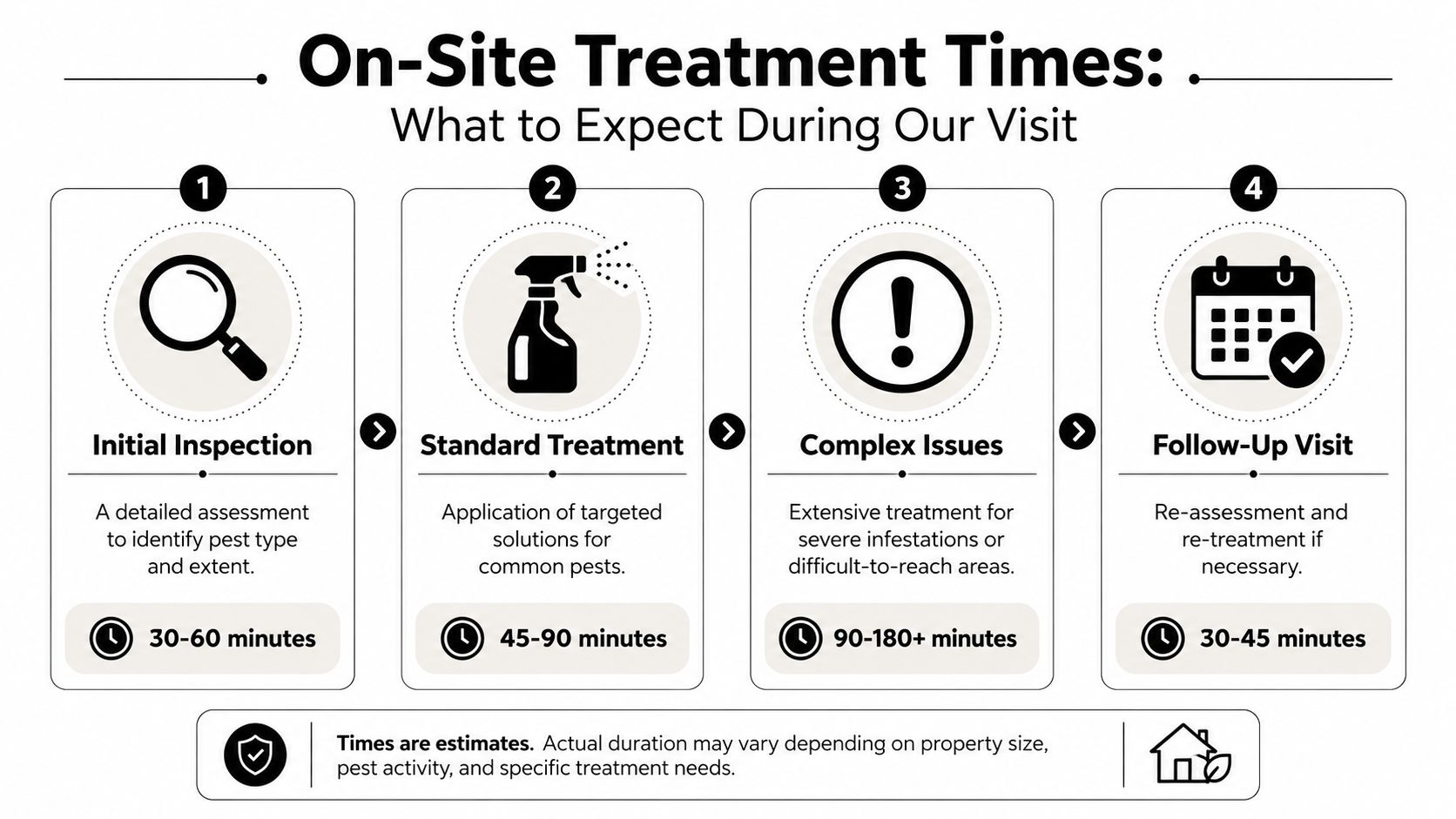
A proper visit includes inspection, not just product application. I look for active areas, likely entry points, moisture issues, and the spots where treatment will hold up best.
Here is the usual pattern:
| Visit type | What usually happens | Typical time |
|---|---|---|
| Routine preventative service | Exterior treatment, targeted interior service if needed, quick review of current activity | About 30 to 60 minutes |
| First visit | Inspection, problem history, treatment planning, and application | Often longer than a maintenance visit |
| Active infestation service | Focused work in problem zones, added product placement, and more detailed instructions | Often longer than standard service |
| Yard-focused mosquito control | Treatment of breeding and resting areas outdoors | About 30 minutes to 2 hours |
The biggest difference between a quick stop and a longer appointment is usually access and detail. If the garage is packed wall to wall, the crawlspace is tight, or the problem is centered around kitchen voids, utility lines, or exterior gaps, the visit slows down for a good reason. Rushing through those areas saves minutes and costs results.
First visits vs recurring service
First appointments take longer because the plan is being built in real time. We need to confirm what pest is present, where activity is strongest, and whether the issue is isolated or spread through several areas.
Recurring service is more efficient. The property history is already there, pressure points are known, and the visit is focused on maintaining control instead of starting from zero. If you want to help the appointment go smoothly, this guide on how to prepare for pest control covers the simple prep steps that save time and help treatment reach the right areas.
A shorter visit does not mean less care. In many homes, it means the technician knows exactly where to inspect and what to treat.
For homeowners looking for residential pest control, that is the normal rhythm. Commercial service follows the same basic process, but timing depends more on facility layout, restricted-access areas, and whether service has to work around business hours.
The Timeline to Results When Will You See Fewer Pests
You come home after service, check the kitchen that night, and spot a few ants again. Or you see a roach where you had not seen one in days. That usually feels like bad news. In many cases, it is a normal part of the timeline.
The visit itself may take about an hour. The results usually do not. For many common household pests, control takes shape over several weeks because baits, residual products, and follow-up adjustments need time to affect the full population. As explained in this breakdown of pest control result timelines, it is common for full results to take 4 to 6 weeks, and activity can even increase during the first couple of weeks after treatment.
Why you may see more pests first
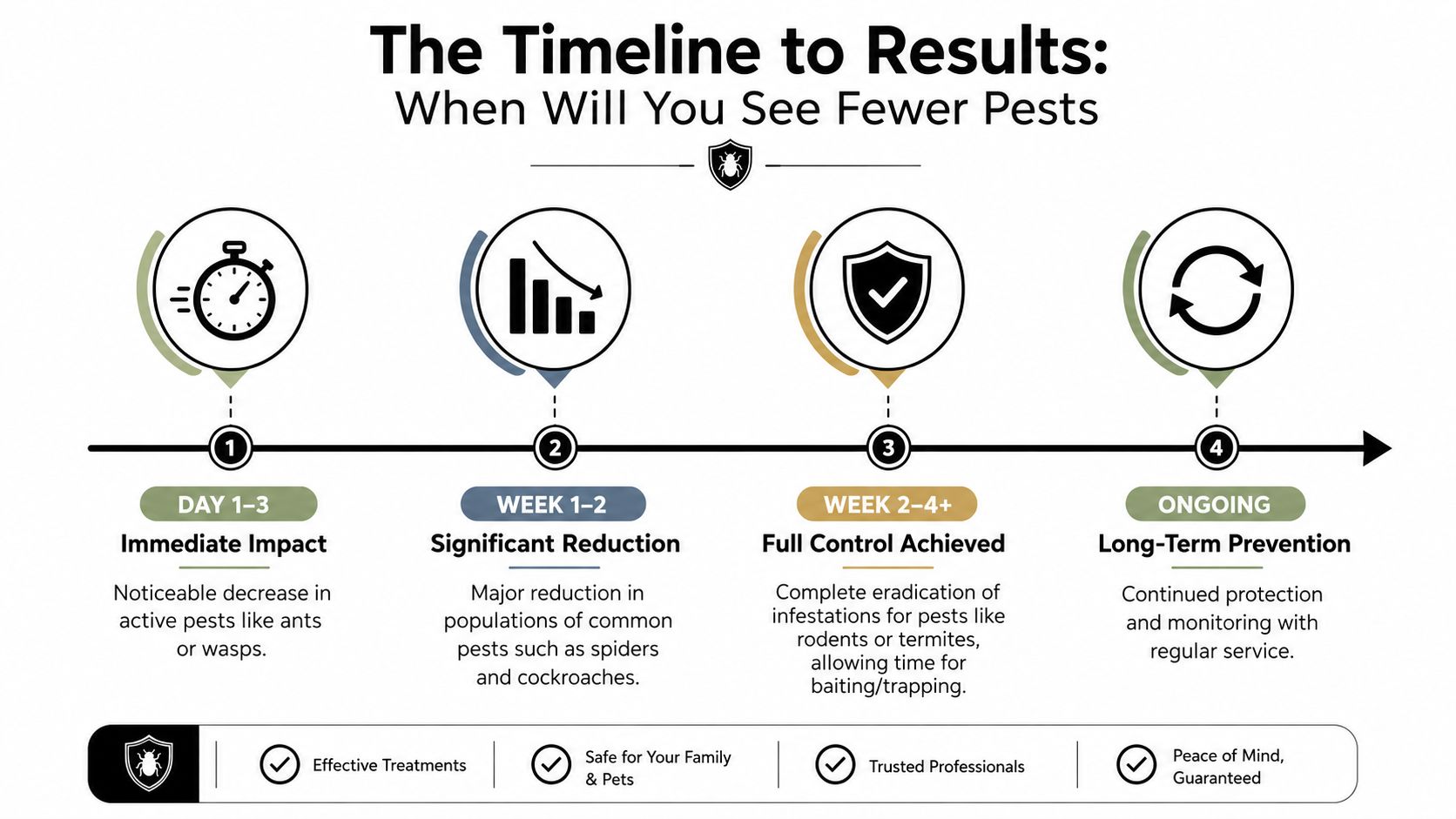
Pests do not all die in place the minute a treatment goes down.
A lot of the work happens after they cross a treated area or pick up bait and carry it back to where the colony is nesting. That is why a homeowner may notice more visible movement at first. The product is affecting behavior, flushing pests out of wall voids, under appliances, around pipe gaps, and along baseboards where they were hiding before.
This is one of the biggest expectation gaps in pest control. Homeowners often judge the service by what they see in the first few days. The better measure is whether activity starts changing over the next few weeks.
What the first weeks usually look like
In a typical home, the pattern goes something like this:
- First few days: You may notice pests out in the open more often.
- First 1 to 2 weeks: Activity can look inconsistent. One room improves, another still has movement.
- Weeks 3 to 6: Numbers usually drop more steadily as the treatment reaches more of the active population and nesting pressure starts to break.
That timeline is especially common with ants, roaches, and other pests where transfer or baiting is part of the strategy. Fast knockdown sounds good, but it is not always the best approach if the goal is getting control at the source instead of just killing the few pests you happen to see.
A short visual can help clarify what homeowners often experience over time.
Results depend on the pest
Mosquitoes, stinging insects, ants, roaches, rodents, and termites all behave differently, so the timeline is never exactly the same from one job to the next. Some pests respond quickly to direct treatment. Others take longer because the treatment is targeting nesting sites, hidden travel routes, or a larger population you may never see.
That is why I always tell homeowners to ask one simple question after the first service. Are we still in the expected process, or are we seeing signs that this needs an adjustment? That conversation matters more than counting every bug you see in the first week.
If you want a clearer picture of what ongoing protection looks like after the initial treatment, this guide on how often pest control should be done helps explain the service rhythm that keeps pest pressure from building back up.
Pest Control Schedules for Northwest Indiana Homes
A lot of Crown Point homeowners call after a one-time treatment and ask the same fair question. If the visit only took about an hour, why are we talking about service over several months?
Because the visit is only part of the timeline. The schedule is what keeps new pest pressure from rebuilding after the first round starts working.
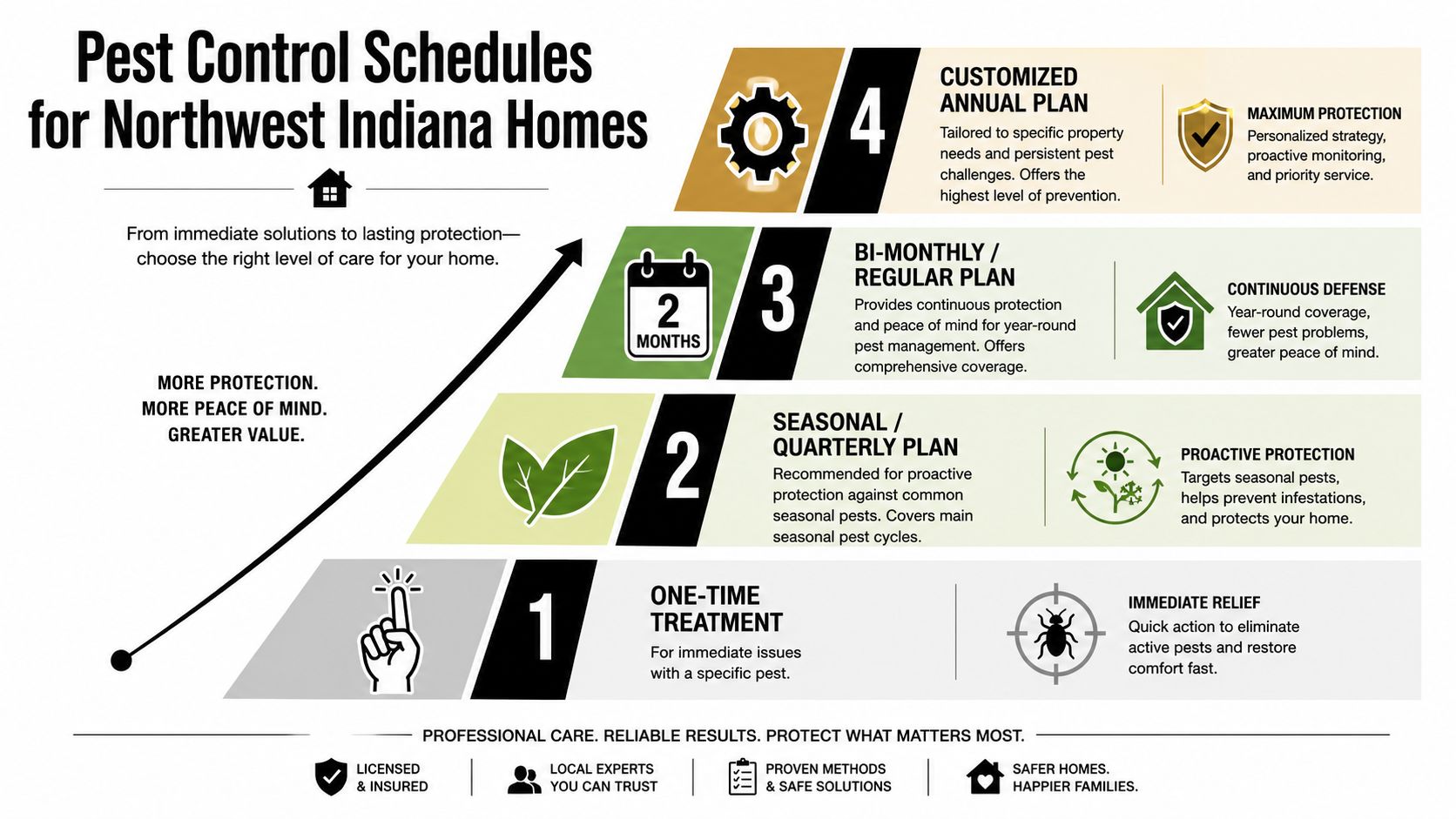
Why quarterly service makes sense here
Northwest Indiana homes deal with shifting pest activity through every season. A recurring schedule lines treatment up with those patterns instead of waiting until insects or rodents are already established.
Typical seasonal pressure looks like this:
- Spring: Ants start foraging, and early perimeter activity shows up around foundations, door thresholds, and mulch beds.
- Summer: Mosquitoes, wasps, and general outdoor insect pressure pick up.
- Fall: Rodents, spiders, and other occasional invaders start pushing indoors for shelter.
- Winter: Pest problems get quieter, but they do not disappear. Mice, roaches, and hidden activity can keep going inside wall voids, crawlspaces, and utility areas.
For many homes, that is why quarterly service is the standard recommendation. CBS News' summary of common pest control scheduling guidance notes that many services recommend quarterly visits, and it also points out that some pests still need time after treatment, with ants often taking about seven to ten days and fleas about two weeks.
Why the schedule matters after the first treatment
That timing matters more than people expect.
If ants are still active a few days after service, or flea activity feels uneven at first, that does not automatically mean the treatment failed. In many cases, the material is doing exactly what it is supposed to do. Pests are contacting treated areas, bait is being shared, and hidden populations are still cycling through before numbers drop.
That is also why a recurring plan works better than a one-and-done approach for many properties. The first service reduces the active problem. Follow-up service keeps outside pressure, seasonal reinfestation, and leftover hotspots from turning into the same callback a month or two later.
Homeowners comparing one-time service with prevention can get a clearer picture from this guide on how often pest control should be done for ongoing home protection.
One-time vs recurring protection
A one-time service can be the right call when the issue is isolated, access is good, and the conditions that caused it are easy to correct.
A recurring plan usually makes more sense when:
- The same pests come back every season: Ants in spring, wasps in summer, mice in fall.
- The property keeps attracting activity: Moisture, thick landscaping, nearby woods, or easy entry points raise pressure.
- You want fewer surprises: Preventative service is usually easier, cheaper, and less disruptive than chasing a larger infestation later.
For Northwest Indiana homes, the schedule is part of the treatment. It gives the initial visit time to work, then keeps pressure down before the next seasonal wave starts.
Factors That Influence Pest Control Duration
The reason two pest control jobs can look similar from the street but take very different amounts of time comes down to diagnosis. Pest control isn't just application. It's inspection, access, strategy, and correction.
Preventative treatments for common pests may take 15 to 30 minutes per technician, while active extermination can extend to 90 to 120 minutes or longer. Severe rodent removal can reach 15 hours of labor across multiple days because trapping, exclusion, and sanitation add complexity, according to this service duration comparison for preventative and active infestations.
Pest type changes everything
A light spider treatment and a rodent job aren't remotely the same workload.
Rodent control often includes inspection of droppings, travel routes, entry gaps, trap placement, exclusion recommendations, and sometimes cleanup planning. Termite control and bed bug work also sit in a completely different category from standard residential pest control because they require broader coverage and tighter process control.
Property conditions matter
The condition of the property can speed a job up or slow it down.
A technician can move efficiently when access is clear and the problem is visible. Service gets more involved when there are packed storage areas, dense vegetation against the home, heavy yard clutter, or sanitation issues feeding the infestation. Those conditions don't make treatment impossible, but they can add time and may also affect how fast results appear.
The best treatment plan doesn't start with the product. It starts with what the property is allowing pests to do.
Severity and scope are different issues
Severity is about how established the pest problem is. Scope is about how much of the property is involved. A mild issue in one area may be easier than a moderate issue spread across a basement, garage, exterior perimeter, and yard.
Consider the difference:
| Factor | Simpler job | More involved job |
|---|---|---|
| Infestation level | Early activity | Established infestation |
| Treatment area | One or two zones | Multiple interior and exterior zones |
| Access | Clear and open | Cluttered or obstructed |
| Method | Direct treatment | Traps, baiting, exclusion, sanitation steps |
That's why a trustworthy exterminator near me won't promise one fixed timeline before seeing the site. Good pest control in Crown Point, IN should be specific, but it should also be honest about variables.
What doesn't work
Homeowners often lose time when they wait too long, treat the wrong pest, or rely only on store-bought sprays for a problem requiring exclusion or bait transfer. Quick contact kills can make an area look better for a moment while leaving the source untouched.
What works better is matching the method to the actual issue. Sometimes that's a short preventative service. Sometimes it's a multi-visit process. The timeline should come from the pest and the conditions, not from guesswork.
Your Local Solution The Green Advantage Process
Good pest control should feel organized from the first phone call. You shouldn't have to chase answers, wonder when someone is arriving, or guess what happens after the service.
With a local Crown Point company, the process usually starts with a conversation about what you're seeing, where you're seeing it, and how urgent the issue feels. That early detail matters. Ants in one bathroom call for a different response than rodent sounds in an attic or a larger commercial pest control concern in a facility with multiple access points.
What working with a local team should feel like

A strong service experience usually follows a practical sequence:
- You describe the problem. The office gathers enough detail to schedule appropriately.
- The technician inspects before acting. That keeps the treatment tied to the actual issue, not assumptions.
- You get clear expectations. That includes how long the visit may take, what preparation is helpful, and when to expect improvement.
- Follow-up happens when needed. Especially for persistent or high-risk pests.
That clarity matters even more for complicated jobs. For termite work, extensive barrier treatments can require a full day's work for two technicians to create a complete and unbroken chemical barrier, according to this explanation of labor requirements for complex termite treatments. That's a good example of why the right pest control company won't treat every service call like a quick spray appointment.
Why local knowledge helps
Northwest Indiana properties come with their own patterns. Moisture conditions, seasonal swings, older construction details, wooded edges, and neighborhood pest pressure all affect what technicians find and how they plan service.
For homeowners and businesses searching pest control near me, exterminator near me, or eco-friendly pest control in Crown Point, the advantage is simple. You want someone who can tell the difference between a short visit, a longer treatment, and a problem that needs an ongoing prevention plan.
Clear communication is part of the treatment. People handle pest problems better when they know what “normal” looks like after service.
If you need answers about pest control in Crown Point, IN, want help with residential pest control or commercial pest control, or you're ready to schedule an inspection, contact The Green Advantage. Their team serves Crown Point and nearby Northwest Indiana communities with practical pest solutions, straightforward guidance, and treatment plans built around the actual timeline of the job.
Protect Your Home: Quarterly Pest Control Service
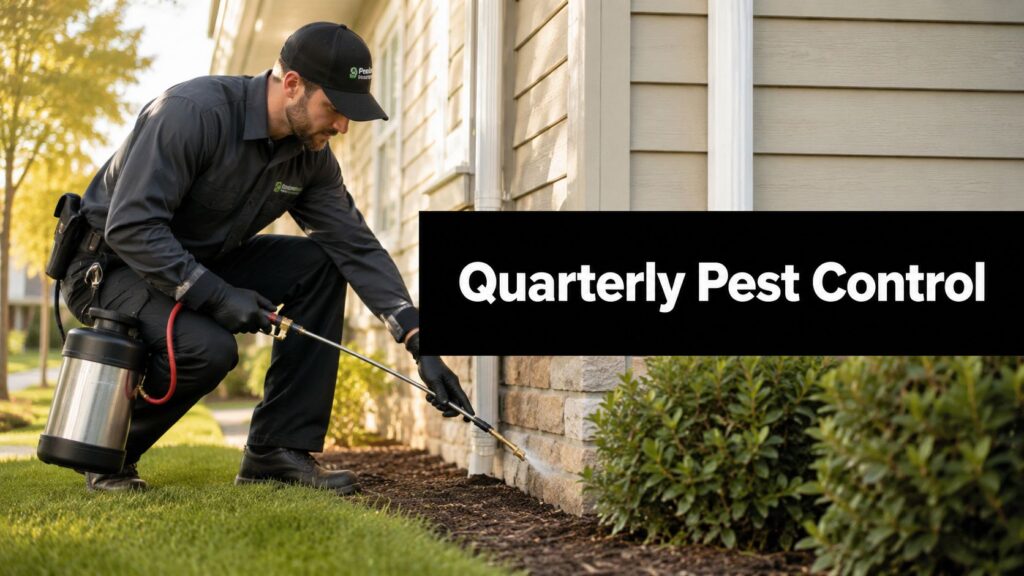
If you're in Crown Point and it feels like the pest problems never really end, you're not imagining it. Spring brings ants across the kitchen counter. Summer means mosquitoes in the yard and wasps near the eaves. Then fall shows up and suddenly spiders turn up in corners and rodents start testing entry points around the garage, basement, and utility lines.
That cycle is exactly why so many homeowners start by searching for pest control near me or exterminator near me, then realize a one-time treatment only solves today's problem. What most properties need in Northwest Indiana is a plan that stays ahead of the next season instead of waiting for it.
Protecting Your Crown Point Home from Unwanted Guests
A lot of homes in Crown Point follow the same pattern. Ants show up when the weather breaks. Mosquitoes take over the backyard once summer settles in. By the time cooler air arrives, spiders and other indoor pests start appearing where nobody wants them, especially basements, mudrooms, and storage areas.
That kind of stop-and-start approach wears people down. You treat one issue, get a little relief, and then another pest pops up a few months later. For homeowners who want a clean, comfortable house, reactive service usually turns into repeated aggravation.

Why this matters in Indiana
The need for professional pest management isn't small or isolated. Indiana's pest control industry includes 597 businesses as of 2026, with the market growing at an average annual rate of 6.0% from 2021 to 2026, and the industry's total market size reaching $417.1 million in 2026, according to IBISWorld's Indiana pest control industry overview. That tells you something simple. Pest issues are common enough across the state that more homeowners and businesses are looking for structured, ongoing help.
In Crown Point, the smarter move is usually prevention. A quarterly plan doesn't wait for ants to become a trail, for spiders to multiply in quiet areas, or for rodents to settle into wall voids. It addresses the conditions that invite pests in the first place.
Local rule of thumb: If you're treating the same kind of pest more than once a year, the problem usually isn't bad luck. It's that the property needs consistent prevention.
That shift matters whether you're looking for pest control in Crown Point, IN, residential pest control, or support for a rental property or commercial building. Instead of firefighting each new pest issue, you build a year-round barrier and keep pressure low before small activity turns into an infestation.
What Is a Quarterly Pest Control Service
A quarterly pest control service is a year-round prevention program with four scheduled visits spread across the year. In Crown Point, that schedule gives a home regular attention before pest activity has time to build. Instead of calling only after ants show up in the kitchen or spiders start collecting in the corners of the garage, the property is checked and treated on a routine cycle.
That difference matters.
A one-time treatment handles the problem you can already see. A quarterly plan is built to reduce the next one.
What a typical visit includes
As outlined in this breakdown of pest control plans, quarterly service commonly includes four visits per year, perimeter treatment, targeted interior service, inspection work, and return visits between appointments if covered pests come back.
On a well-run route, the visit usually focuses on the areas where problems start and where they tend to repeat:
- Exterior perimeter treatment around the foundation and entry points to cut down pest movement into the home
- Targeted interior treatment in places with current activity or higher risk
- Spider web and wasp nest removal around soffits, garages, doors, and window frames as needed
- Inspection for conducive conditions such as moisture, gaps, cluttered harborage, or signs of rodent entry
That is the part many homeowners miss. Good quarterly service is not just an application. It is repeat inspection, correction, and follow-up.
Why this schedule fits so many Crown Point homes
In Northwest Indiana, pest pressure rarely stays solved for long with a single visit. Weather shifts, moisture changes, and normal seasonal movement keep creating openings around the structure. Quarterly service gives those pressure points regular attention without putting the homeowner on a monthly schedule they may not need.
For homes with general crawling insect pressure, occasional spider issues, or recurring exterior activity, four visits a year is often the practical middle ground. It is frequent enough to stay ahead of common problems, but spaced out enough to keep service manageable.
The biggest benefit is consistency. Small issues get addressed while they are still small.
The trade-offs to understand before you sign up
Quarterly service is a strong fit for prevention. It is not always the right stand-alone answer for every situation. A home with an active rodent problem, a heavy German roach infestation, or a termite issue may need an initial corrective plan before regular quarterly maintenance makes sense.
Cost structure matters too. Some companies bill quarterly. Others charge an initial fee and then monthly payments. Ask what the full annual cost is, what pests are covered, whether interior service is included every visit or only on request, and what happens if activity returns between appointments.
For homeowners comparing exterminator options in Crown Point, IN, that clarity is just as important as the treatment itself. A good quarterly plan should explain exactly what is being prevented, how service is delivered, and where the limits are.
Tailoring Treatments to Northwest Indiana's Seasons
The reason quarterly service makes sense in Crown Point is simple. Pest pressure changes with the calendar. What works in early spring isn't the same thing you need in late summer or during the first cold stretch of fall.
A one-off treatment reacts to what's happening now. A seasonal plan prepares for what's about to happen next.

Spring pressure starts outside
Once temperatures begin to rise, overwintering pests become active again. This is when many homeowners first notice ants, occasional invaders, and spider activity around foundations, windows, and garages. Spring is also the time to inspect conditions that can invite bigger problems later, such as gaps at entry points, moisture around the structure, and untreated harborage near mulch lines and landscaping.
A spring visit is often the most important appointment of the year because it sets the perimeter before insect activity ramps up.
Summer tests the exterior
Summer in Northwest Indiana brings the outdoor pressure commonly noticed first. Mosquito activity around shaded yards, wasps near rooflines and outdoor living spaces, and general crawling insect pressure all become more active. If a home already has weak spots around doors, utility penetrations, or foundation transitions, summer pests exploit them.
For properties that also need mosquito control, wasp removal, or close attention to outdoor living areas, the plan becomes more customized. The treatment focus isn't identical on every property because not every yard, drainage pattern, or structure creates the same level of pressure.
Fall is when pests try to move in
Fall is the season many homeowners underestimate. As nights cool down, pests that were content outside start looking for warmth and shelter. That's when spiders become more noticeable indoors and rodents begin probing for entry points around garages, siding gaps, vents, and utility lines.
This is also the time for prevention work that protects the coming winter. If openings and attractants aren't addressed in fall, winter service becomes more reactive than it should be.
Homes don't get pest pressure in neat categories. Seasonal changes push different pests toward the same shelter, and that shelter is often your house.
Winter is about indoor stability
Winter service in Crown Point tends to focus less on heavy exterior activity and more on monitoring and prevention inside the building envelope. Indoor pest issues don't disappear just because it's cold. In fact, once pests find warmth, food, or moisture indoors, they can stay active where homeowners don't see them right away.
That makes the winter visit valuable for inspections, targeted indoor treatment when needed, and checking the areas where low-level activity often lingers.
Northwest Indiana seasonal pest calendar
| Season | Common Pests | Quarterly Treatment Focus |
|---|---|---|
| Spring | Ants, spiders, emerging insect activity | Exterior barrier, inspection, early-season prevention |
| Summer | Mosquitoes, wasps, ants, general outdoor pests | Active perimeter defense, yard-focused treatment, entry point review |
| Fall | Spiders, rodents, overwintering pests | Exclusion-minded inspection, prevention at doors, garage, foundation, utility lines |
| Winter | Lingering indoor pests, occasional invaders | Interior monitoring, targeted spot treatment, prevention-focused follow-up |
For homeowners searching pest control in Crown Point, IN, this is why quarterly scheduling fits the region so well. Each visit has a different job. The point isn't to repeat the exact same treatment every few months. It's to match the service to what Northwest Indiana properties face throughout the year.
Who Benefits from Proactive Pest Management
Quarterly prevention isn't only for people dealing with a serious infestation. In many cases, it's more useful for the people who want to avoid getting to that point at all.
Homeowners who care about property condition, families who want fewer surprises indoors, and managers responsible for shared buildings all benefit from consistent service. The common thread is predictability. Regular inspections and targeted treatments reduce the chance that pests build up unnoticed.

Homeowners who want fewer disruptions
For a typical single-family home, quarterly service makes life easier. You don't have to wait until ants are in the pantry or spiders are showing up in multiple rooms before making a call. The property stays on a regular inspection and treatment cycle, which helps protect comfort and cuts down on repeat surprises.
This is especially useful for households also thinking about related needs such as ant control, spider control, rodent control, or preventive attention around garages, basements, and crawlspaces.
Families who prefer targeted treatment
Many people worry that routine pest service means constant blanket application. Modern prevention should be more thoughtful than that. When a property is monitored properly, treatments can stay targeted and responsive to actual conditions instead of relying on unnecessary broad interior applications.
That's one reason eco-minded households often prefer an inspection-first approach. It supports long-term control while keeping the service focused on what's needed.
Property managers and commercial clients
For shared housing and commercial sites, quarterly service becomes even more important because pest activity affects multiple people at once. In these settings, the cost of waiting is often measured in complaints, tenant frustration, operational interruptions, and reputation risk.
According to a pest control specification for multi-unit housing, quarterly pest control is often mandated as a preventive measure in commercial and multi-unit contexts, and documented evidence shows these interventions reduce pest-related service complaints by 30–40% compared to reactive-only models.
That matters in Northwest Indiana properties such as:
- Apartment and multi-unit buildings where one untreated issue can spread
- Office and commercial spaces that need a clean, professional environment
- Facilities with shared refuse or utility areas that attract recurring pest pressure
- Managed properties where documentation and consistent follow-through matter
Clean buildings don't stay that way by accident. Someone has to inspect, document, and correct small pest issues before occupants start noticing them.
For both residential pest control and commercial pest control, proactive service isn't about overreacting. It's about keeping routine pest pressure from becoming a bigger operational problem.
Quarterly Plans vs Other Pest Control Frequencies
The right service frequency depends on the property, the pest history, and how much pressure the structure gets from surrounding conditions. For most homes in Crown Point, the practical choice comes down to three options. One-time service, quarterly service, or monthly service.
Each has a place. They just don't solve the same problem.
One-time service
A one-time treatment is usually the right fit for a narrow issue. A wasp nest on the porch. A sudden spike in ants after weather changes. A pest concern tied to a specific event, move, or sale. The advantage is obvious. You handle the immediate issue and move on.
The downside is that one-time service is reactive by design. It doesn't create much continuity, and it usually doesn't address what will happen when the next seasonal shift brings a different pest to the same property.
Quarterly service
Quarterly service works well when pest pressure is recurring but not severe enough to justify monthly visits. It gives the property scheduled attention through the year, which fits the normal rhythm of seasonal pest activity in Northwest Indiana.
Indiana residential pest control also follows a structured four-stage process of inspection, identification, treatment selection, and follow-up verification, with follow-up visits typically scheduled 14 to 30 days after the initial application depending on the situation, according to Indiana residential pest control guidance. That framework supports a preventive quarterly model because it leaves room for both routine seasonal care and short-term follow-up when a specific issue needs closer monitoring.
If you're weighing timing and service intervals, this guide on how often pest control should be done gives a useful way to think through the options.
Monthly service
Monthly service has a real role, but usually for higher-pressure situations. Properties with persistent activity, commercial demands, or ongoing sanitation and access challenges may need that level of frequency. For the average home without a severe infestation, monthly service can be more than necessary.
A simple way to compare the options:
- Choose one-time service when the problem is isolated and unlikely to repeat soon.
- Choose quarterly service when you want year-round prevention without over-servicing the home.
- Choose monthly service when pest pressure is persistent, complex, or operationally sensitive.
For many Crown Point homes, quarterly is the sweet spot. It avoids the stress of waiting until something goes wrong, but it doesn't assume every property needs constant visits.
Your Service Visit What to Expect with The Green Advantage
People are often more comfortable with pest service once they know what happens during a visit. Good service shouldn't feel mysterious. It should feel organized, clear, and specific to the property.
For a quarterly plan, the visit is usually part inspection, part prevention, and part problem-solving. If there has been recent activity, the technician looks for evidence, confirms what pest is involved, and applies treatment where it makes sense. If there hasn't been activity, the focus stays on keeping it that way.

The visit usually starts with inspection
The technician checks the areas where pest activity commonly starts or enters. That often includes the foundation, entry points, window and door transitions, garage edges, utility penetrations, and visible exterior harborage. Indoors, service may focus on baseboards, utility areas, kitchens, basements, or other locations tied to current activity.
Modern guidance matters here. Current pest management guidance states that periodic service should focus on inspection and spot treatment rather than routine application once infestations are eliminated, and that a pest professional should show evidence of a live pest before any reactive treatment. That's a core part of Integrated Pest Management, or IPM.
That means the right quarterly service isn't just routine spraying. It's inspection-led work.
What treatment looks like in practice
Treatment depends on the findings. Some visits are mostly exterior prevention. Others involve targeted indoor attention because ants, spiders, or occasional invaders have started to show up in a specific area. If rodent pressure is part of the concern, the service may also include recommendations on exclusion and sanitation, not just product application.
The Green Advantage offers a Quarterly General Pest program that pairs an initial visit with recurring scheduled service for year-round prevention. For homeowners and businesses in Crown Point, that kind of program works best when the treatment is adjusted to site conditions rather than repeated mechanically.
What good service looks like: The technician explains what was found, where pressure is coming from, what was treated, and what the property owner should watch for before the next visit.
How to prepare before service
You usually don't need to do a full-home reset. A few simple steps help the visit go smoothly:
- Clear access where possible around baseboards, sinks, utility areas, and garage walls
- Report recent activity so the technician knows where you've seen ants, spiders, rodents, or stinging insects
- Secure pets as needed during treatment and while instructions are reviewed
- Remove clutter outdoors near the foundation if heavy storage or debris blocks inspection
For a more detailed checklist, this pest control preparation guide is a helpful reference.
After the technician leaves
You should know what was done, what to expect next, and whether any follow-up is recommended. Some pest issues settle quickly. Others need observation, sanitation changes, or a return visit if activity continues.
The best quarterly service doesn't ask homeowners to guess. It gives them a plan and keeps prevention moving forward.
Choosing the Right Pest Control Partner in Crown Point
If you're hiring a provider for pest control in Crown Point, IN or nearby Northwest Indiana service areas, ask direct questions. A reliable company should be comfortable answering them without vague promises or pressure.
Questions worth asking
- Are you licensed and insured? You want a company that treats pest control as a professional trade, not casual side work.
- Do you know local pest patterns? Crown Point homes don't deal with the same timing and pressure as every other market.
- How do you handle quarterly service? Ask whether visits are inspection-led and whether interior treatment is targeted when appropriate.
- What happens if pests return between visits? A clear answer matters more than a low starting price.
- Do you explain what you found and what you treated? Good communication is part of good pest control.
- Can you support more than general pests? Many properties eventually need help with termite control, mosquito control, rodent exclusion, or wasp removal as separate services.
A dependable partner should make the process easier, not harder. That means clear scheduling, honest recommendations, and service that fits the property instead of forcing every customer into the same script.
For homeowners, landlords, and businesses in Crown Point, the right quarterly plan offers more than convenience. It protects the structure, reduces disruption, and gives you a predictable way to stay ahead of Northwest Indiana's seasonal pest pressure.
If you're ready to stop chasing one pest problem after another, contact The Green Advantage to schedule a pest inspection or request a quote for your Crown Point property. Whether you need residential pest control, commercial pest control, mosquito reduction, rodent control, or a practical quarterly prevention plan, you'll get clear answers and a service approach built for Northwest Indiana.