
How to Prepare for a Pest Inspection in Crown Point, IN

You've got a pest inspection scheduled for tomorrow in Crown Point, IN. The instinct is familiar: vacuum every corner, scrub every surface, move boxes into another room, and make the property look flawless. Don't do that. The most useful preparation preserves evidence, opens hidden areas, and gives the inspector enough history to understand what's happening.
Whether you're searching for pest control near me, an exterminator near me, or a professional assessment before buying or renting a property, the same principle applies. Prepare the property so the technician can investigate it properly. The Green Advantage serves Crown Point and surrounding Northwest Indiana communities with residential pest control, commercial pest control, termite control, rodent control, mosquito reduction, and other services.
Why Preparation Determines Your Inspection Results
A Crown Point homeowner may spend the evening before an inspection carrying laundry baskets out of the basement and wiping down the kitchen. The house looks orderly by bedtime, but the inspector may have a harder time finding the small clues that explain where pests are coming from. A cleaned-up room isn't necessarily an inspection-ready room.
A thorough inspection follows a deliberate path. Authoritative facility guidance recommends reviewing previous inspection reports and floor plans, then examining the building from the outside in and from the lowest level toward the attic and roof. The same guidance identifies practical equipment such as a bright flashlight, clipboard and paper, collection vials, labels, tweezers, forceps, and protective gear. That approach shows why inspection preparation is about evidence collection, not visual guesswork. The Canadian Conservation Institute's inspection guidance outlines this methodical process.

Access reveals what surfaces hide
Pests often use places homeowners rarely inspect, including crawlspaces, basements, utility openings, wall gaps, exterior features, and roofline areas. If stored items block those locations, the technician may have to record limited access instead of evaluating the actual entry point or harborage area.
Before the visit, focus on four outcomes:
- Clear visibility: Remove clutter that hides droppings, damage, trails, or nesting material.
- Safe movement: Make crawlspaces, basements, utility areas, and exterior walls reachable.
- Useful history: Keep prior reports, treatment records, and floor plans available.
- Evidence preservation: Leave signs of activity in place for the inspector to document.
A checklist-driven inspection can cover many conditions, including structural concerns, pest activity, environmental factors, and treatment planning. A residential pre-treatment checklist contains 39 inspection items across 7 sections, demonstrating why a technician needs more than a quick walk through the kitchen. The residential pre-treatment checklist reflects the level of detail a proper assessment can require.
Practical rule: Make the property easier to inspect, not merely nicer to look at.
Clearing Access and Managing Moisture Around Your Property
Start outside. Northwest Indiana properties face seasonal moisture, dense landscaping, wet foundations, and sheltered exterior spaces that can support pest activity. The highest-yield preparation tasks are straightforward, but they need to be completed in the right order.
Begin at the foundation
Trim vegetation at least 24 inches from the structure so the inspector can see siding, foundation walls, window wells, and potential entry points. Move debris, unused materials, and firewood away from the foundation. Technical guidance also recommends storing firewood off the floor and away from walls, where it's less likely to conceal pests or create a direct path toward the building. Oregon State University Extension's moisture and insect inspection guidance identifies vegetation, debris, water, gutters, and structural rot as important conditions to evaluate.
Check the perimeter for standing water, clogged gutters, leaking downspouts, and soil or mulch that keeps the structure damp. Look closely at deck attachments and other wood-to-structure connections for rot. Moisture and deteriorated wood can create conditions associated with termites, carpenter ants, rodents, and other pests.
Open the interior inspection path
Inside the property, clear access to:
- Crawlspaces and basements: Move containers, furniture, and stored materials away from access doors and foundation walls.
- Utility openings: Open areas around plumbing, electrical lines, vents, and other penetrations so the inspector can evaluate gaps.
- Under-sink cabinets: Remove items that block plumbing connections and cabinet corners.
- Storage areas: Keep boxes and supplies off the floor and away from walls.
- Doors and screens: Check thresholds, weatherstripping, screens, and door edges so possible entry points remain visible.
Sealing obvious cracks and crevices can help, but don't cover a suspicious opening before documenting it or telling the inspector. The location may matter more than its appearance.
The moisture connection extends beyond pest control. If a leak or flood has created damp materials, our 2026 flood cleanup advice offers practical guidance for handling water damage before it creates additional property problems.
Stop Over-Cleaning Before the Inspector Arrives
Deep cleaning can undermine the inspection you're paying for. If you scrub droppings from a pantry shelf, wipe away an insect trail, fill a gnawed opening, or throw out nesting material, you may remove the evidence needed to identify the pest and trace its route.
Leave these signs visible when they're safe to leave in place:
- Droppings: They help identify activity locations and movement patterns.
- Insect trails: Trails can point toward nesting or feeding areas.
- Gnaw marks: Chewed wood, plastic, insulation, or wiring may reveal rodent access.
- Nests and nesting material: These can show where pests are sheltering.
- Damaged materials: Staining, holes, frass, and disturbed insulation may indicate hidden activity.
Current preparation guidance specifically advises clients not to scrub away droppings, insect trails, gnaw marks, nests, or other signs immediately before an inspection. It also cautions against moving infested items between rooms or using sprays and foggers just before the technician arrives. This pest inspection preparation guidance explains why evidence preservation supports a more accurate diagnosis.

Clean around the evidence
You should still remove food waste, secure exposed food, and take out overflowing trash. Clean conditions help the inspector separate active attractants from established pest signs. The distinction is simple: remove conditions that invite more pests, but don't erase clues that show where pests have already been.
Avoid foggers and strong contact sprays before the appointment. Those products can disturb pest movement, scatter activity into other areas, and mask the original scope of the problem. If you've already applied a product, write down its name if you know it and tell the technician when and where you used it.
If you find droppings or nesting material in an area that may pose a health risk, don't handle it unnecessarily. Photograph it from a safe distance, note the location, and tell the inspector. A clear description is more useful than a spotless surface.
Gathering Documents and Records for a Thorough Inspection
A property's history gives the inspector a head start. Put everything in one folder, whether that folder is paper, digital, or both. Include previous pest inspection reports, treatment records, repair invoices, warranty documents, floor plans, and correspondence with prior service providers.
Build a useful property record
Organize the information by location rather than placing every document in one undifferentiated stack. Note where you saw activity, when it appeared, what it looked like, and whether the signs changed after treatment.
Use this checklist:
- Previous reports: Keep earlier inspection findings and recommendations together.
- Treatment records: Record products or methods used, service dates when available, and the areas treated.
- Property plans: Add floor plans or a simple sketch marking crawlspace access, utility openings, moisture areas, and pest signs.
- Photos: Save time-stamped images of droppings, damage, insects, nests, or entry gaps.
- Repair history: Include work involving leaks, decks, siding, roofing, foundations, or other areas connected to pest access.
Institutional integrated pest-management checklists commonly address sealed cracks and crevices, garbage areas, standing water, perimeter vegetation, and storage placement. One residential pre-treatment checklist groups 39 inspection items across 7 sections, including credentials, activity documentation, structural assessment, sensitive-site screening, environmental considerations, product verification, and treatment planning. This pest control inspection checklist can help you organize the information your technician needs.
Prepare for rentals, sales, and commercial access
Landlords and property managers need to coordinate more than a single appointment. Confirm which units, mechanical spaces, basements, attics, storage rooms, and exterior areas require access. Provide tenants with written notice according to the applicable lease and local requirements. One landlord toolkit recommends written tenant notice 1–3 days before inspection, while transaction-related guidance emphasizes scheduling early in the contract window and coordinating access in advance. The Hamilton landlord toolkit provides related access and notice considerations.
For a home purchase, keep the contract timeline visible and ask who receives the report, which forms are required, and whether follow-up access will be needed. The pest inspection home purchase guide covers these coordination questions in a property-transaction context.
What to Expect During and After Your Pest Inspection
Expect the inspector to begin by asking what you've noticed. Be specific about sounds, odors, locations, timing, damaged materials, and any treatments already attempted. Then the technician can compare your observations with conditions found throughout the property.
The physical inspection generally follows a systematic route from exterior features to interior spaces, starting at lower levels and continuing upward. The technician may examine foundations, siding, doors, windows, roofline features, basements, crawlspaces, kitchens, bathrooms, attics, utility openings, storage areas, and other locations where pests can enter or hide. Findings should be documented by location, condition, visible evidence, and recommended next step.
Read the report as a priority list
A useful report separates urgent concerns from maintenance recommendations. Ask these questions:
- What is active now? Find out which signs indicate current activity rather than old damage.
- Where is the entry point? Ask whether the source is structural, environmental, sanitation-related, or uncertain.
- What needs treatment? Clarify whether the recommendation involves baiting, trapping, exclusion, targeted application, monitoring, or another method.
- What should be repaired? Separate pest treatment from moisture correction, sealing, rot repair, or cleanup.
- What happens next? Confirm follow-up timing, preparation requirements, and what success will look like.
A report for a real-estate transaction deserves prompt review because findings can affect repairs, credits, access, or contract decisions. Buyers should schedule early in the contract window, confirm any lender or transaction forms, and avoid waiting until the final moment to resolve access problems. For broader moisture-related concerns, this mold inspection guide for Florida offers useful context on why water conditions deserve separate attention, even though pest and mold inspections address different problems.
Choose treatment based on the finding
A visible ant trail may call for a different response than termite evidence, rodent entry, mosquito breeding conditions, or a wasp nest. The right plan should match the pest, the location, the source, and the property's occupants. That's where professional ant control, termite control, rodent exclusion, spider control, wasp removal, and preventative pest treatments become more useful than treating every symptom with the same product.
Schedule Your Crown Point Pest Inspection Today
Good preparation takes pressure off the appointment. Clear the foundation and interior access points, control moisture, preserve signs of activity, and gather the property records. Those actions help the technician spend time diagnosing the problem instead of moving obstacles or guessing what was cleaned away.
The Green Advantage is a family-owned, licensed, and certified pest control company serving Crown Point and the broader Northwest Indiana community. Its services cover residential pest control and commercial pest control, including inspections, termite services, mosquito reduction programs, rodent solutions, and environmentally mindful treatment plans designed for the site.
You'll communicate directly with knowledgeable office staff for questions and scheduling, while field technicians focus on diagnosis and treatment. That separation keeps the process clear, whether you need an urgent inspection, support for a home purchase, seasonal mosquito control, or an ongoing commercial service plan.
Your next step: Don't clean away the clues. Make the property accessible, document what you've seen, and schedule the inspection while the evidence is still clear.
Call, request a quote, or schedule online with a local team that can assess the property and explain the available options. The sooner the technician can evaluate entry points, moisture conditions, and visible activity, the sooner you can make a practical decision about treatment and prevention.
The Green Advantage provides pest inspections and follow-up treatments for homes and businesses in Crown Point, IN and nearby Northwest Indiana communities. Visit The Green Advantage to schedule an inspection, request a quote, and start protecting your property with a clear plan.
Residential Pest Control Services: Trusted Home Protection

A humid July evening in Crown Point can turn ordinary home maintenance into a pest problem quickly. You notice carpenter ants moving along the kitchen baseboard, or you find mouse droppings behind the pantry shelves as temperatures fall in late October. For pest control near me, pest control in Crown Point, IN, or an exterminator near me, you need more than a quick spray. You need someone to identify why pests entered, treat the active problem, and help keep the next seasonal invasion outside.
The Green Advantage serves Crown Point and nearby Northwest Indiana communities with residential pest control services designed around inspection, targeted treatment, and practical prevention. This guide explains which household pests are common here, when a one-time treatment makes sense, when recurring service is worth considering, and how an eco-conscious approach can protect your home, family, pets, and property.
Why Crown Point Homeowners Need Reliable Pest Control
Northwest Indiana gives pests several opportunities to move indoors. Hot, humid summers support ants, mosquitoes, spiders, and other outdoor activity. Freezing winters push mice and rats toward warmer basements, crawl spaces, garages, and wall voids. Older homes in Crown Point and surrounding Lake County communities may also have aging foundations, attic vents, weathered sill plates, or utility penetrations that create convenient entry routes.
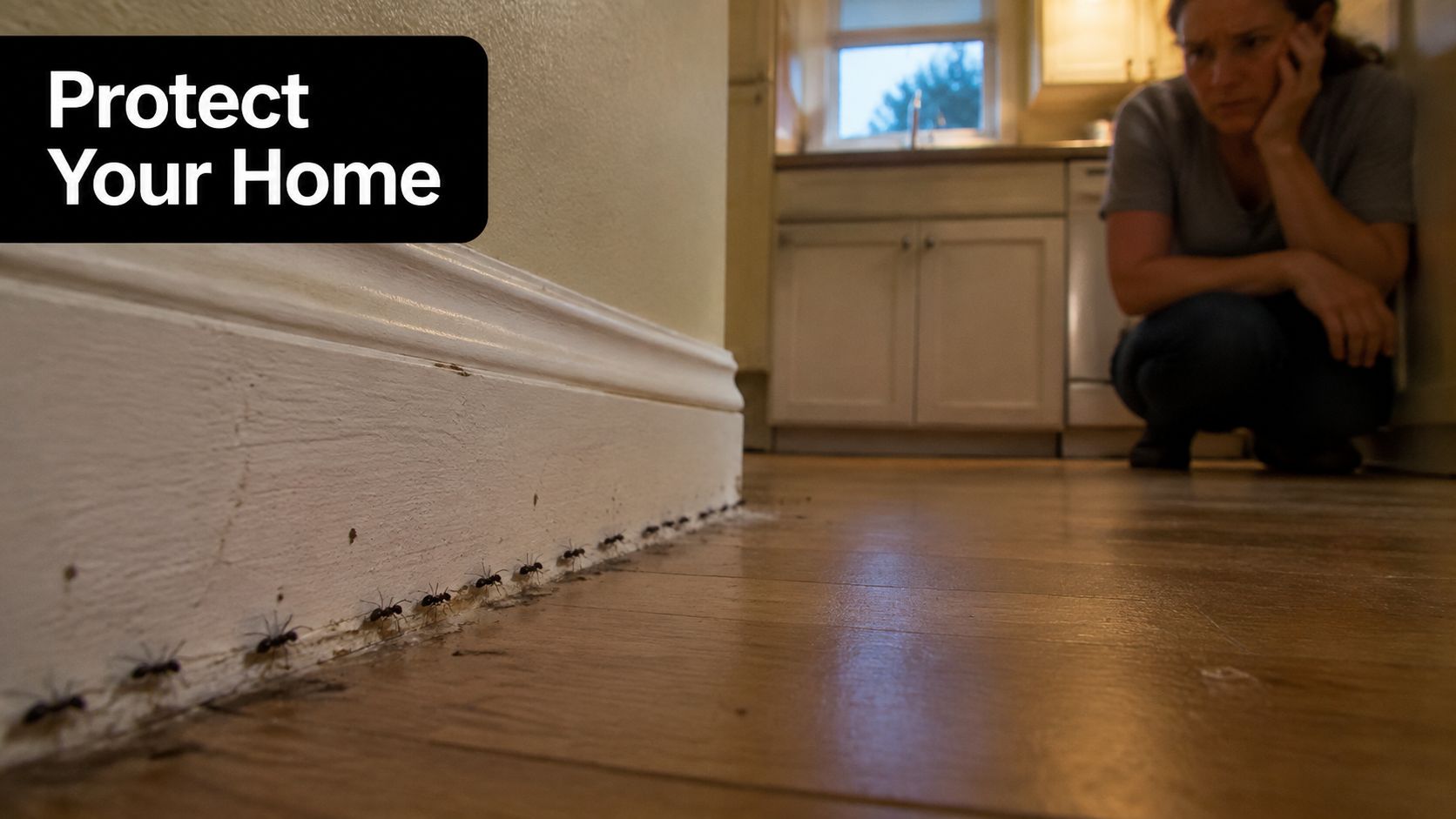
A line of ants in the kitchen doesn't always mean the colony lives inside the wall. It may be following moisture, food residue, or a hidden route from the exterior. A few droppings in the pantry may be the first visible sign of a mouse traveling through a much larger network of gaps. The right response depends on the pest, the building, and the conditions that support it.
Why prevention matters
Professional pest control has become a recurring household service because many infestations return when the underlying conditions remain. Industry coverage cited nearly 13.29 million U.S. residential customers receiving professional pest control services in 2025, while recurring revenue represented 85.4% of residential service revenue. The same coverage reported roughly 31,000 pest control businesses and 167,232 pest control specialists, evidence of a labor-intensive industry built around ongoing inspections, follow-ups, and maintenance rather than one-time visits. Consumer Affairs coverage of pest control industry statistics
The Green Advantage brings that prevention mindset to Crown Point homes without treating every property as though it has the same risk. A house near wooded areas, an older home with a crawl space, and a newer tightly sealed home may need very different recommendations.
Practical rule: Treat the pest you can see, but investigate the moisture, food, shelter, and entry point that brought it there.
Common Household Pests in Northwest Indiana
Pest identification matters because similar-looking insects can require very different responses. Carpenter ants excavate galleries in damp or damaged wood, but they don't consume wood the way termites do. German cockroaches thrive in warm, humid indoor areas and can spread through kitchens, bathrooms, and utility spaces. Mice and Norway rats look for warmth and dependable food as outdoor conditions worsen.
Local conditions that invite pests
Carpenter ants often take advantage of moisture-damaged wood around roofs, windows, porches, foundations, and plumbing leaks. Odorous house ants and pavement ants commonly follow protected routes into kitchens and bathrooms during spring and summer, especially where vegetation, mulch, cracks, and damp soil meet the foundation.
House mice and Norway rats can enter through surprisingly small openings around doors, vents, pipes, garages, and foundations. From September through March, crawl spaces, basements, wall voids, and attic insulation offer shelter from cold weather. German cockroaches can remain active year-round in warm indoor environments, particularly where food residue, water, clutter, and appliance heat are available.
Boxelder bugs, stink bugs, and spiders become more noticeable in autumn as they gather around siding, windows, attic vents, and other protected areas. They may not all cause the same structural concern, but a sudden increase can reveal gaps in the building envelope that other pests can also use.
| Pest | Peak Season | Primary Risk | Common Entry Points |
|---|---|---|---|
| Carpenter ants | Spring through summer | Wood excavation and moisture concerns | Foundation cracks, siding gaps, roof and window areas |
| Odorous house ants and pavement ants | Spring through summer | Food contamination and recurring trails | Baseboards, plumbing penetrations, foundation gaps |
| House mice and Norway rats | Fall through winter | Droppings, gnawing, contamination, and nesting | Doors, vents, utility lines, garages, crawl spaces |
| German cockroaches | Year-round indoors | Allergens, contamination, and rapid population growth | Deliveries, plumbing openings, appliances, shared walls |
| Boxelder bugs and stink bugs | Autumn | Nuisance activity and indoor congregation | Windows, attic vents, siding, roofline gaps |
| Spiders | Seasonal, often autumn indoors | Webs, nuisance activity, and possible bites from certain species | Exterior cracks, garages, basements, vegetation contact |
Early professional identification helps separate an isolated visitor from an established infestation. Broad spraying can miss a nest, colony, breeding site, or entry route. Fleas deserve the same careful approach because adults may be only part of the problem. For practical household guidance alongside professional evaluation, review these natural flea control tips.
Cockroaches, rodents, termites, bed bugs, and recurring ant activity deserve prompt attention. A technician can look for conditions homeowners usually can't see, including rub marks, droppings in hidden areas, frass, nesting material, moisture damage, and travel routes behind cabinets or through utility spaces.
What to Expect from a Professional Pest Inspection
A reliable inspection starts with a conversation, not a product. The technician should ask what you've seen, where you saw it, when activity began, whether you've heard scratching, and whether anyone has already applied sprays, traps, or bait. Questions about the home's age, renovations, moisture problems, pets, children, and previous treatments help shape a useful inspection.
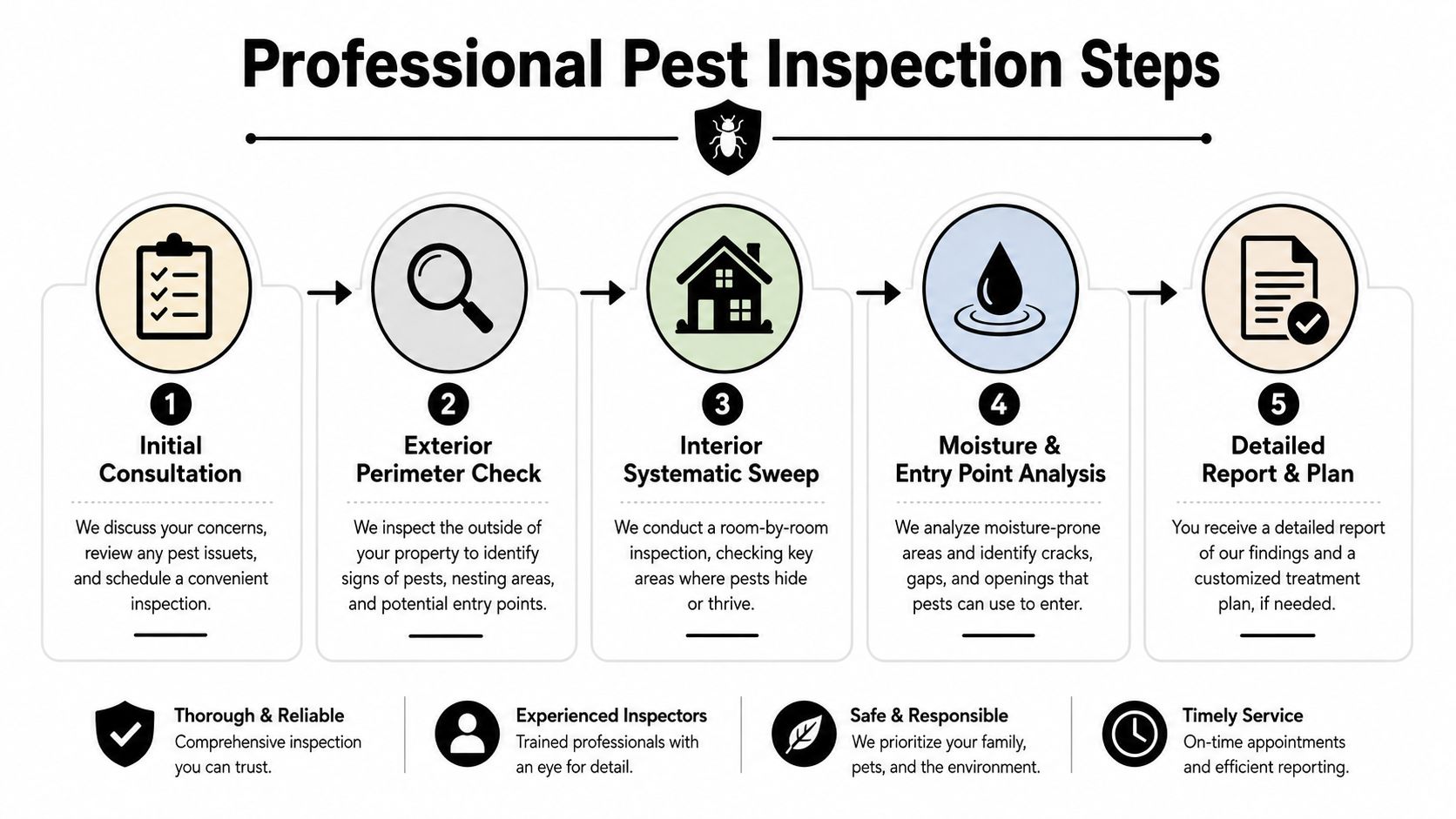
The inspection path
A Crown Point inspection typically follows the home's pest pathways rather than relying on a quick visual glance.
Start with the exterior perimeter. The technician checks the foundation, siding, doors, windows, roofline areas, vegetation, mulch, and exterior penetrations for cracks, gaps, and conditions that let pests reach the structure.
Examine lower levels. Basements and crawl spaces can reveal moisture intrusion, wood damage, rodent travel, droppings, nesting materials, and gaps around pipes or ductwork.
Check attic areas. Technicians look for rodent activity, disturbed insulation, rub marks, droppings, chewed materials, and openings around vents or roof details.
Sweep activity zones indoors. Kitchens, bathrooms, utility rooms, garages, and storage areas often provide the food, water, warmth, or clutter pests need.
Document the findings. The final recommendation should identify the pest, explain contributing conditions, outline treatment options, and clarify any exclusion or sanitation work that belongs in the plan.
Homeowners can make the visit more useful by keeping a record of sightings, saving insect samples or clear photographs, and making accessible areas available. You don't need to empty the house, but stored items may need to move away from walls, basement corners, attic access points, or utility rooms.
Clear recommendations before treatment
Inspection time depends on the home's size, access, pest concern, and complexity. Rather than promise a universal duration, a professional should explain what the visit includes before arriving. Pricing should also be communicated clearly before work begins, with separate attention to general pest control, rodent exclusion, termite control, mosquito control, bed bug treatment, or other specialized services.
For a homeowner preparing for an appointment, this residential pest control inspection checklist can help organize observations and access points.
Recurring Service Plans Versus One-Time Treatments
A single treatment can be appropriate when the problem is isolated, visible, and unlikely to return after the source is removed. A wasp nest that has been located and safely treated may not justify a long-term plan. One mouse sighting after a door was left open may call for monitoring and exclusion rather than an automatic recurring contract.
Recurring service makes more sense when pest pressure follows the property, not just the calendar. Ants, spiders, cockroaches, and seasonal invaders can exploit the same foundation cracks, vegetation bridges, moisture conditions, and utility penetrations repeatedly. Older homes, houses with crawl spaces, properties near wooded areas or water sources, and homes with a history of pest activity generally deserve closer consideration.
A practical Crown Point decision framework
Ask these questions before choosing a service level:
- Does the activity repeat? Repeated trails, droppings, webs, or sightings indicate a pattern rather than a one-off visitor.
- Does the property have persistent vulnerabilities? Aging foundations, damp crawl spaces, attached garages, and unsealed vents can keep inviting pests inside.
- Does the season create a predictable problem? Spring ants, summer mosquitoes, and fall rodents may each require a different prevention emphasis.
- Would missed activity create a larger risk? Cockroaches, rodents, termites, and bed bugs shouldn't be evaluated like an occasional outdoor insect.
- Do you want active monitoring? Recurring service can identify changes before a small problem becomes disruptive.
| Factor | One-Time Treatment | Recurring Service Plan |
|---|---|---|
| Best fit | Isolated nest, visitor, or clearly limited issue | Repeating activity or continuing structural vulnerability |
| Main focus | Immediate control and source assessment | Monitoring, seasonal adjustment, and prevention |
| Property profile | Tightly maintained home with little history of activity | Older home, crawl space, wooded lot, or repeated pest pressure |
| Limitation | May not address new activity or hidden entry points later | Requires ongoing scheduling and homeowner cooperation |
| Typical decision | Use when risk appears limited | Use when conditions make recurrence likely |
The residential market's reliance on recurring service reflects this distinction. Coverage of 2025 industry conditions reported recurring revenue at 85.4% of residential service revenue, compared with 85.2% in 2024, and reported that 70% of consumers named protecting their home and family as the top reason for a contract or regular service. National Pest Management Association industry coverage
That doesn't mean every Crown Point home needs frequent visits. It means the decision should match pest biology, building conditions, and the household's tolerance for risk. Repeated emergency calls can also become less predictable than a structured maintenance plan, especially when the same entry points remain open.
Eco-Friendly Pest Management Methods That Work
For a Crown Point home, environmentally responsible pest control starts with inspection, not a routine spray. The goal is to choose the least disruptive effective method, place products where they matter, and correct the conditions that let pests survive. The Environmental Protection Agency describes integrated pest management, or IPM, as an approach that combines monitoring, exclusion, sanitation, habitat modification, and targeted pesticide use when needed. EPA principles of integrated pest management
Why targeted treatment outperforms routine spraying
A broad contact spray may kill exposed insects without reaching a nest, eggs, wall void, harborage, or entry route. Targeted baiting, crack-and-crevice treatment, exclusion, moisture correction, and monitoring address why pests remain on the property.
In a Crown Point household, the work might involve placing bait along an ant trail, sealing a foundation gap, repairing a leak that supports carpenter ants, or removing standing water that supports mosquitoes. Botanical or lower-toxicity products can fit the plan, but “natural” does not automatically mean effective or risk-free. The product, placement, and application must match the pest and the site. Our environmentally friendly pest control methods reflect that inspection-led approach.
Lower-impact pest control works best when “green” describes the entire strategy, not just the label on a product.
Resistance can make casual, repeated pesticide use unreliable. The 2025 BPCA Future of Pest Management survey reported that 82% of professionals had encountered some form of pesticide resistance, up from 77% in 2023. Coverage of the 2025 BPCA survey
That supports rotating tactics and improving inspection instead of repeatedly applying the same product. It also explains why professional judgment matters when cockroaches, ants, or other pests return after DIY treatment.
Professional control remains the most common consumer approach at 62%, while DIY methods account for 28%, according to survey coverage. Coverage of consumer pest control sentiment A practical middle ground combines targeted professional work, fewer unnecessary applications, and monitoring when the home's construction or seasonal pest pressure warrants it.
The Green Advantage may use inspection-led exclusion, targeted products, and prevention recommendations suited to the property. That approach protects people and pets while addressing the infestation with methods matched to the home and pest involved.
Year-Round Prevention Tips for Your Home
Professional treatment controls the immediate problem, but homeowner habits influence what happens between visits. Small maintenance tasks reduce food, water, shelter, and access, which are the same conditions IPM targets during professional service.
Spring preparation
Inspect the foundation before ant activity builds. Seal visible cracks, check thresholds, and look for gaps around pipes and utility lines. Trim shrubs and groundcover away from siding so branches don't create a bridge from damp soil to the house.
Clean gutters and confirm that downspouts move water away from the foundation. Moisture near the structure can support carpenter ants, earwigs, and other pests while making entry points harder to notice.
Summer moisture control
Repair leaking faucets, hose connections, and basement plumbing. Remove debris from gutters and avoid leaving containers, toys, buckets, or other items where they can hold water.
Mosquitoes lay eggs in or near water. The CDC recommends that homeowners empty, scrub, turn over, cover, or throw out water-holding items once a week, because even small containers can become breeding sites. CDC mosquito control guidance
The CDC also advises holding stormwater for less than 72 hours whenever possible, because standing water held longer than 3 days can create mosquito breeding habitat. CDC stormwater guidance
Fall exclusion
Install or repair door sweeps, screen attic and crawl-space vents, and seal openings around utility penetrations. Store firewood away from the home and keep leaves, cardboard, and unused materials from accumulating against the foundation.
Female Culex mosquitoes can use ponds, swamps, unmaintained pools, and wastewater areas, but also household items such as buckets, tires, planters, toys, birdbaths, and flowerpots. CDC information about Culex mosquitoes The EPA similarly recommends removing standing water from gutters, tires, buckets, plastic covers, and toys, while changing water in birdbaths, fountains, wading pools, rain barrels, and plant trays at least weekly. EPA integrated mosquito control guidance
Winter monitoring
Store pantry food in sealed containers, clean crumbs promptly, and reduce clutter in basements and crawl spaces. Check for new droppings, gnaw marks, scratching, insect skins, or activity around stored items.
These habits won't replace residential pest control when an infestation is established. They do make professional treatments more effective by removing the conditions that keep drawing pests back.
Choosing The Green Advantage for Your Pest Control Needs
Choosing an exterminator in Crown Point, IN should involve more than comparing a treatment label. The company should understand Northwest Indiana homes, seasonal pest movement, older construction, moisture problems, crawl spaces, garages, and the practical concerns of families living in the property.
The Green Advantage is a family-owned pest control company serving Crown Point and the broader Northwest Indiana community. Its licensed and certified technicians provide residential and commercial pest control, inspections, mosquito reduction programs, rodent exclusion support, and site-specific treatment plans. The company emphasizes environmentally mindful methods, direct communication, transparent recommendations, and follow-up that keeps homeowners informed.
The most useful service plan is the one that fits the home. A property with one isolated issue may need a one-time response. A home with recurring ants, seasonal rodents, moisture, older foundations, or repeated outdoor mosquito pressure may benefit from ongoing monitoring and preventative pest treatments. Inspection findings should guide that choice, not a generic package.
If you're unsure whether you need commercial pest control, termite control, rodent control, spider control, wasp removal, or general residential service, start with an inspection. Clear identification gives you a safer and more practical path forward.
The Green Advantage offers inspection-driven residential and commercial pest control services, targeted treatments, mosquito reduction, rodent exclusion, and environmentally mindful prevention for Crown Point and nearby Northwest Indiana homes and businesses. Visit The Green Advantage to schedule a pest inspection, request a quote, and speak with a local team about the right one-time or recurring protection for your property.
Professional Mosquito Yard Treatment in Crown Point, IN
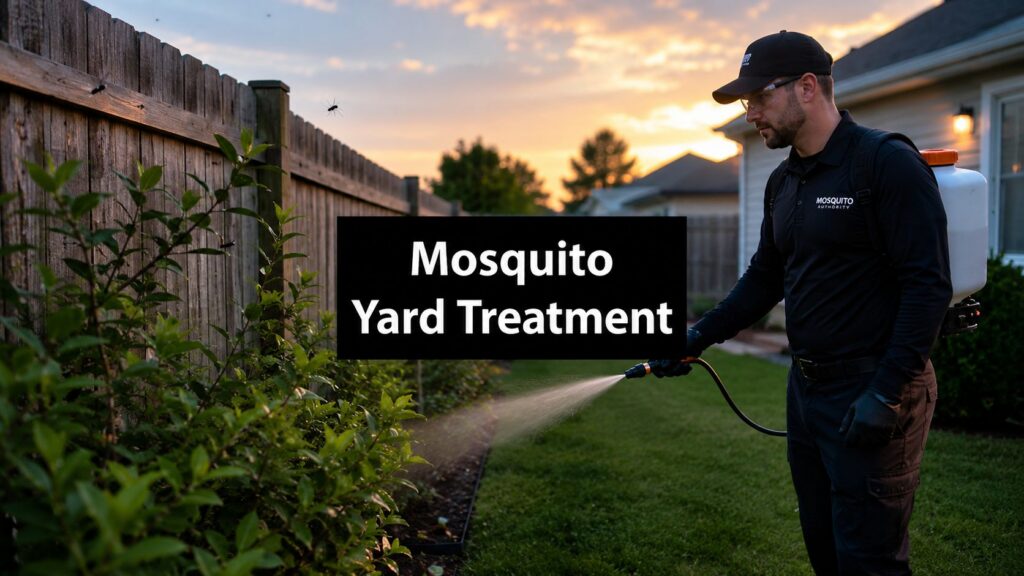
A midsummer dinner in Crown Point can go from relaxing to miserable in minutes. The grill is ready, the patio table is set, and then mosquitoes start working every exposed ankle and arm until everyone retreats indoors. If you're searching for pest control near me, an exterminator near me, or a dependable mosquito program in Northwest Indiana, the right answer isn't always another quick spray. It starts with understanding what's producing mosquitoes on and around your property.
The Green Advantage serves Crown Point, IN and nearby Northwest Indiana communities with practical pest management for homes, businesses, rental properties, and outdoor spaces. A thorough professional mosquito yard treatment combines inspection, habitat correction, larval control, and targeted adult mosquito treatment. That approach matters whether you also need residential pest control, commercial pest control, ant control, termite control, rodent control, spider control, or wasp removal.
Why Mosquito Yard Treatment Matters in Crown Point
A family in Crown Point may step onto the patio expecting a quiet evening and find the yard unusable before dinner is finished. Mosquitoes often gather around shaded landscaping, fence lines, decks, drainage areas, and nearby water. In Lake County, yards can sit beside retention ponds, wooded lots, drainage easements, or low areas that refill after storms, giving mosquitoes repeated opportunities to develop close to the home.
The local setting creates a difficult combination. Humid summer weather, thunderstorms, shaded vegetation, and water that lingers in containers or low spots all support mosquito activity. A property doesn't need a visible pond to have a problem. A clogged gutter, a tipped-over toy, or a folded tarp can hold enough water to keep the local population going.

The problem is bigger than outdoor discomfort
Mosquitoes are more than an interruption to patio meals. West Nile virus and other mosquito-borne illnesses remain public health concerns in Northwest Indiana, so reducing contact with biting mosquitoes is a reasonable part of responsible property care. Homeowners can also use practical pest control tips for dining to make outdoor meals less attractive to flying pests, but those measures won't correct breeding conditions across the yard.
The goal of a mosquito program is not to promise a completely insect-free property. Mosquitoes can arrive from surrounding areas, and weather can change pressure quickly. The goal is to reduce mosquito pressure enough to restore usable outdoor space, protect the investment in landscaping, and make time outside more comfortable.
A habitat-first program also gives homeowners a clearer explanation for recurring activity. If the same low spot, gutter, or decorative water feature keeps producing larvae, spraying adult mosquitoes without correcting that source only treats the visible symptom. For information about the health concerns involved, homeowners can review Indiana mosquito-borne illnesses and discuss property-specific concerns during an inspection.
Practical rule: If a treatment plan only discusses where to spray and never asks where mosquitoes are developing, it's incomplete.
How Professional Mosquito Yard Treatment Actually Works
Mosquitoes pass through four stages, egg, larva, pupa, and adult. The first three stages depend on water, while the adult mosquito rests in vegetation and moves through the yard looking for a host. A household bucket is a useful comparison. If a bucket collects rain and stays undisturbed, it can become a small mosquito nursery even though it looks harmless from a distance.
A bottle cap of standing water can produce dozens of mosquitoes in under two weeks. That's why many of the mosquitoes biting around a home are connected to conditions on the property or nearby, rather than appearing without a local source.

Four layers of a working program
Inspect and correct habitat. A technician checks gutters, downspout discharge areas, tarp folds, wheel ruts, plant saucers, birdbaths, dense ground cover, and other places where water can remain. The simplest fix is often to empty, cover, turn over, or remove the item.
Control larvae before they mature. Some water can't be drained or covered. EPA guidance distinguishes larvicides, which target mosquitoes in breeding water, from adulticides, which target flying adult mosquitoes. CDC guidance recommends using larvicides only for larger water bodies that can't be dumped or covered, and not in drinking water. Products may include biological or insect-growth-regulating materials selected for the site and applied according to the label.
Treat adult resting areas. Adult mosquitoes commonly rest in shaded foliage, under decks, along fence lines, and around structure perimeters. A residual barrier treatment places a labeled product on those surfaces so mosquitoes encounter it when they land.
Provide immediate knock-down. The service can also reduce the adult mosquitoes present during the visit. That creates faster relief, while habitat work and residual treatment address the next wave.
The CDC describes integrated mosquito management as a combination of surveillance, source reduction, larval control, adult control, resistance testing, public education, and evaluation. For a Crown Point property, the important point is simple: spraying is one tool in an adaptive program, not the entire program.
What Happens During a Professional Service Visit
A Crown Point yard can look dry at the patio and still produce mosquitoes near a downspout, deck, or drainage easement. A professional visit starts with finding those pressure points before any application begins. The technician walks the property, checks recent moisture patterns, and notes access, shade, vegetation, and areas where water remains after rain.
The inspection should produce a treatment plan, not just a route around the foundation. The technician records conditions such as dense ivy, low spots, birdbaths, ornamental water features, poor downspout discharge, and shaded areas beneath decks. Each finding affects whether the right response is removal, drainage correction, larval control, or targeted adult treatment.
A practical visit usually follows this sequence:
Inspect the property. The technician maps water-holding sites, adult resting areas, drainage patterns, gates, pets, play spaces, and pollinator activity.
Separate correctable sources from unavoidable ones. Water that can be emptied, covered, drained, or modified should be handled that way. Treating removable water leaves the underlying problem in place.
Set application boundaries. Adult treatment is directed toward labeled residential surfaces where mosquitoes rest, including shaded vegetation, fence lines, under-deck spaces, and suitable foundation areas. A calibrated backpack mist blower or low-volume sprayer generally allows more controlled placement than a broad fogging pass.
Explain the work before leaving. Service notes should identify treated areas, conditions that need homeowner attention, and the follow-up window.
Coverage quality depends on reaching the places mosquitoes use, not coating exposed turf for appearances. Dense foliage, shrub interiors, and shaded edges require careful technique, while unnecessary drift should be limited around people, pets, play areas, and pollinator activity.
The final conversation matters because mosquito pressure changes with rainfall, vegetation growth, and nearby breeding sources. A homeowner should know what was found, what was treated, and which source-reduction tasks will have the greatest effect before the next visit. That documentation distinguishes a habitat-first management visit from a quick perimeter pass.
Professional Treatment Compared to DIY Options
DIY products can help with a small gathering or a temporary problem, but they usually don't replace a property-specific program. Citronella candles and torches create a limited comfort zone near the flame. Bug zappers may attract and kill some flying insects, but they don't remove breeding water or create a residual barrier in shaded vegetation.
Residential foggers provide a short burst of adult knock-down. They don't reliably reach every leaf underside, dense shrub interior, or hidden water source. Natural sprays can be useful as a supplemental measure, but their performance depends heavily on coverage, weather, and how often the product must be reapplied.
The comparison below uses the figures supplied for this service discussion. The exact performance and cost for any product can vary, so homeowners should read the label and request an itemized quote rather than treating these figures as a guarantee.
| Method | Effective Duration | Coverage Area | Knockdown Rate | Avg. Cost per Week |
|---|---|---|---|---|
| Professional barrier treatment | 21 to 30 days, depending on conditions and product label | Broad, targeted coverage of foliage, shaded resting zones, fence lines, and structure perimeters | About 90% for a professional application | Varies by property size, service plan, and quote |
| Citronella candle or torch | Roughly 2 to 4 hours near the burn area | Small comfort zone around the device | Not a yard-wide knock-down method | Varies by fuel and replacement needs |
| Store-bought bug zapper | Variable and limited to insects reaching the device | Immediate area around the unit | Not a reliable mosquito population treatment | Varies by equipment and electricity |
| Residential fogger | Short-term, weather-sensitive relief | Areas reached during a single pass | About 30% to 50% reduction on one pass | Varies by canister use and yard size |
| Garden pump sprayer with natural spray | Often short-lived and dependent on conditions | Operator-dependent, with gaps common in dense plants | Variable | Varies by product and reapplication frequency |
The strongest professional advantage is not just stronger chemistry. It's calibrated application, label-driven dosing, equipment reach, and source inspection. A technician can direct material into the shaded foliage and undersides of leaves where mosquitoes rest, while a garden sprayer may leave untreated pockets.
Homeowners improving the rest of their outdoor space can also consult this DreamYard DIY landscaping guide, especially when planning drainage, plant placement, and maintenance access. DIY landscaping can support mosquito control, but it won't replace larval management when water remains on the property.
For a smaller yard with low pressure, DIY measures may be enough as a supplement. When pressure is high, the property is larger than a quarter acre, or dense landscaping blocks coverage, professional service is usually the more practical option.
Why Source Reduction Is the Hidden Key
Monthly spraying sounds like a complete mosquito plan because it's the most visible part of the service. It isn't. Adult mosquitoes can be reduced on treatment day, but new adults can continue emerging if the property still contains water where larvae develop.
Crown Point properties often hide those sources in ordinary places:
- Clogged gutters: Leaves and sediment hold water after rain.
- Container clutter: Tires, toys, buckets, plant saucers, and trash lids collect small pools.
- Lawn depressions: Low areas can stay wet after storms.
- Decorative water: Birdbaths and ornamental features need regular maintenance.
- Tarp folds: Covers over firewood, equipment, or furniture can trap rain.
- Poor discharge: Downspout extensions may empty into a low area that drains slowly.
The CDC recommends emptying, scrubbing, turning over, covering, or throwing away water-holding items once a week. It also notes that small amounts of standing water can support breeding when they persist. Stormwater guidance recommends keeping stored water for less than 72 hours whenever possible, because water held longer than 3 days can create mosquito habitat. These recommendations make weekly property checks a core part of the program, not a cosmetic cleanup task.
What a technician does with each source
A technician may remove the source, recommend a drainage or structural correction, or treat unavoidable water with a labeled larvicide such as BTI or methoprene. The choice depends on whether the water can be dumped, covered, drained, or safely managed.
This is why homeowners should ask about habitat findings before asking only how often the yard is sprayed. The practical details of standing water and mosquito control often determine whether a barrier treatment delivers useful suppression or gets overwhelmed by fresh emergence.
The higher-value question: Which conditions on this property are producing the next generation of mosquitoes?
A habitat-first approach can reduce the pressure that repeatedly feeds the adult population. Sprays still have a role, particularly on shaded resting sites, but chemistry works more efficiently when the property isn't continuously supplying new mosquitoes.
Seasonal Treatment Schedule for Northwest Indiana
In Crown Point, the first warm evenings can arrive before a yard looks ready for service. A useful schedule follows mosquito development and property conditions, so inspection and source reduction start before repeated barrier applications become necessary.
How the season typically unfolds
- Late March through April: Check gutters, containers, drainage, and low areas for winter water and debris. Correct conditions that hold water, and treat unavoidable water when appropriate.
- May through early June: Watch for adult emergence as temperatures and moisture support activity. Schedule the first barrier treatment when needed, then reassess shaded landscaping and water sources.
- July through August: Pressure is often highest near tree lines, dense plantings, decks, and evening-use areas. Reapply according to the property, weather, vegetation, and treatment conditions, often within the 21 to 30 day service window described in the supplied treatment guidance.
- September: Reduce service as activity changes, but continue checking containers, low spots, and gutters blocked by leaves.
- October through early November: Remove remaining water sources, prepare the yard for winter, and record corrections that can improve conditions next season.

A five-to-six-visit annual program can maintain steadier control than one application because each visit creates another opportunity to find new water, adjust coverage, and respond to rain or growing vegetation. The schedule still belongs to the property, not the calendar. A yard beside dense woods or a retention pond may need closer monitoring, while an open, well-drained lot may require less frequent attention. The application is only one part of the plan. Inspection, correction, and follow-up determine whether it keeps working.
Benefits of Working with The Green Advantage
In Crown Point, a mosquito service earns its value by finding what keeps pressure coming back. The Green Advantage serves Crown Point, IN and nearby Northwest Indiana communities, where heavy shade, clay-heavy soils, wooded lots, retention areas, and changing stormwater patterns can all affect a yard.
The technician's inspection should connect mosquito activity to the property's layout. Water near downspouts, damp ground cover, catch basins, drainage easements, and shaded vegetation can remain productive or attractive habitat after the lawn appears dry. That information gives the service a clear target instead of turning every visit into the same driveway-side spray.
A useful program may include:
- Habitat mapping: Recording water sources and shaded resting areas across the property.
- Larval control: Treating water that cannot be removed, according to the product label and site conditions.
- Barrier treatments: Applying adult mosquito control to suitable foliage and structural perimeter areas.
- Follow-up communication: Documenting findings, homeowner corrections, and the next service window.
- Residential and commercial planning: Adjusting the approach for a backyard, rental property, restaurant patio, office site, or other commercial facility.
The practical difference is coordination. If a blocked gutter, wet planting bed, or drainage problem remains, an application may reduce adult mosquitoes temporarily while the same source continues feeding new activity. Inspection and source correction give the treatment a better chance to hold.
Product choice and application technique also need to account for children, pets, pollinators, and outdoor use. The technician should explain treated areas, access restrictions during application, and when the space can be used again. Pollinator-conscious work avoids actively blooming plants where bees forage and focuses on mosquito resting habitat when the label permits.
Field research supports barrier treatment as one part of an integrated service. A residential study found pyrethroid barriers reduced mosquito abundance by 87% in the first week, with cumulative reductions of 72% at four weeks and 61% at six weeks. Other yard-scale and residential studies reported reductions of 77.1% and 74.6% over a 56-day post-treatment interval. These findings are summarized in PCT Online's mosquito spray research update, and they do not guarantee identical results in every yard.
For homeowners comparing an exterminator in Crown Point, IN, ask how the company inspects breeding habitat, explains treatment areas, records recommendations, and follows up. Those process details show whether the service is addressing mosquito habitat or repeating an application.
Frequently Asked Questions About Mosquito Yard Treatment
Is treatment safe for dogs, cats, and children?
Professional applications should follow the product label and site-specific safety instructions. People and pets need to remain away from treated areas during application and until the technician confirms the required reentry conditions. The Green Advantage should provide clear instructions for your property, including any drying or access window.
How long does a treatment last?
The residual period depends on rainfall, sunlight, vegetation growth, mosquito pressure, and the product label. Field research has documented meaningful reductions lasting through several weeks, including up to six weeks in one residential study, although performance varies by site and conditions. A recurring program helps address re-entry and new emergence rather than relying on one visit.
Will treatment kill bees and butterflies?
Pollinator protection depends on timing, placement, and product use. Technicians should avoid treating blooming plants where pollinators forage and focus adult mosquito treatment on shaded resting areas when permitted by the label. Tell the technician about gardens, hives, and flowering plants before service.
Do I need to be home?
Usually, you don't need to be home if the technician can access the property, gates are unlocked, pets are secured, and any treatment instructions are available. Confirm access requirements when scheduling.
What should I do about standing water?
CDC guidance recommends emptying, scrubbing, turning over, covering, or discarding water-holding items once a week. Cover stored water with a tight lid or mosquito-resistant mesh, and use larvicides only in larger water bodies that cannot be dumped or covered, never in drinking water.
When should treatment start?
Begin with a pre-season inspection in late March or April, then time adult mosquito treatment around observed emergence and outdoor activity. Starting before pressure becomes severe gives the technician an opportunity to correct habitat before repeated biting dominates the yard.
How much does service cost?
Pricing depends on yard size, landscaping density, access, water sources, and the complexity of the treatment plan. The right quote should be itemized after an inspection, so you can see what the service includes rather than comparing unexplained flat prices.
The Green Advantage provides habitat-focused mosquito inspections, larval management, targeted barrier treatments, and seasonal follow-up for homes and businesses in Crown Point, IN and nearby Northwest Indiana communities. Visit The Green Advantage to request a property assessment, receive a written quote, and start a professional mosquito yard treatment plan that helps you use your outdoor space again.
Carpenter Ant Damage: Signs, Repair, and Prevention Guide
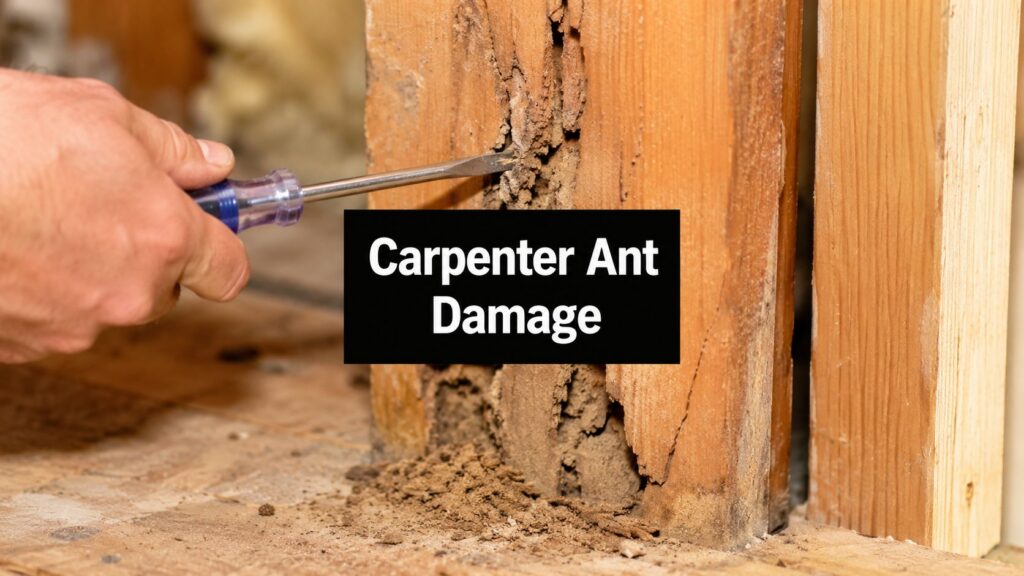
You hear faint rustling inside the wall after dark, tap the baseboard, and get a hollow echo. Then you notice a small pile of sawdust-like material beneath a window. For a homeowner in Crown Point, IN, that combination is unsettling, but it doesn't automatically mean the house is about to fail. Carpenter ant damage ranges from minor surface evidence to serious localized weakening, and the right response depends on what caused it, where it is, and whether the colony is still active.
The Green Advantage helps homeowners and businesses in Crown Point and nearby Northwest Indiana communities identify carpenter ants, locate moisture-related conditions, and choose a practical treatment plan. This guide separates cosmetic damage from structural risk and hidden moisture problems, so you know when a simple repair may be enough and when to call an exterminator near me for a professional inspection.
What Carpenter Ant Damage Actually Looks Like
At night, a wall can sound busy without revealing much. A homeowner may hear a dry, faint movement near a window or porch, then find fine debris on the sill the next morning. The first instinct is often to blame termites, but carpenter ants work differently.
Carpenter ants excavate wood to build nesting galleries. They don't eat the wood. Their tunnels can be smooth and clean inside, almost as if someone sanded the channels. Termites consume wood, while carpenter ants remove it and push the debris out of the nest. North Carolina State Extension explains this distinction and notes that carpenter ant galleries can leave wood appearing intact on the outside while becoming hollowed from within. Learn how carpenter ants excavate galleries.

Why one debris pile may not show the nest
A carpenter ant colony generally has a primary nest in moist wood and satellite nests in drier parts of a building. Satellite nests may sit in wall voids, under insulation, or inside other hollow spaces, and they can contain workers, larvae, pupae, and winged reproductives without containing the queen or eggs. This technical overview of carpenter ant colony organization helps explain why ants can appear near a dry window frame even when the original moisture problem is elsewhere.
That matters for repairs. Replacing the visible trim may remove the evidence but leave the colony undisturbed. A single pile of frass, the sawdust-like material ants eject, can indicate activity inside a wall, porch beam, window frame, crawl space, or another connected area.
Carpenter ants are widely recognized as a major structural pest in North America. Rutgers Extension places them among the top five pest ant groups in the United States, and a New Jersey survey conducted from 1981 to 1982 found carpenter ants infesting 75% of sampled urban shade trees, showing how readily they occupy moisture- or decay-prone wood systems. Rutgers Extension explains carpenter ant damage and habitat.
Practical rule: A clean-looking exterior doesn't clear the wood. Tap suspicious areas, inspect nearby moisture, and treat the colony before closing the evidence behind new trim.
For homeowners comparing carpenter ants and termites, the key point is simple. Carpenter ant damage is carved into galleries, often associated with wet or decayed wood, and may remain hidden until the structure feels soft, sounds hollow, or begins to deform.
The Five Most Common Signs Homeowners Notice First
You don't need specialized equipment to gather useful information before calling pest control near me. You do need to look carefully and record where, when, and how often each clue appears.

Faint rustling inside walls: Listen after the house is quiet, especially near windows, exterior walls, ceilings, and porches. Dry, intermittent movement can point to activity inside a void, though plumbing, ductwork, and other pests can create similar sounds. Record the room and the time rather than opening the wall.
Frass piles: Carpenter ant frass often resembles sawdust, but it may include insect parts and material of varying texture. Uniform sawdust beneath a fresh cut points more toward recent woodworking, while recurring debris from a crack or trim joint deserves inspection. Photograph the pile beside a common object for scale and mark the location with removable tape.
Hollow-sounding wood: Use the handle of a screwdriver to tap trim, sills, exposed framing, porch supports, and other accessible wood. A resonant sound doesn't prove an infestation, but it identifies an area that needs closer evaluation, especially if the wood also shows staining, softness, or cracks.
Discarded wings near light sources: Winged reproductive ants may leave shed wings near windowsills and other bright areas. Save a few in a small container if you can do so safely, and photograph the surrounding frame. Don't assume every winged insect is a termite or carpenter ant, because identification affects treatment.
Large ants indoors: Repeated sightings of large black ants, particularly at night or in rooms beyond the kitchen, raise the concern level. Note whether the ants travel along baseboards, window trim, plumbing routes, or ceiling lines. One outdoor forager can wander inside, but recurring indoor activity calls for a closer look.
What to document before service
Take wide photos showing the room, close photos showing the debris or entry point, and a short video of any repeated movement or sound. Write down whether the area is near a leak, condensation, a bathroom, kitchen plumbing, a roof edge, or a porch.
A technician can diagnose the problem more efficiently when you provide the exact location, timing, photos, and moisture clues. Don't vacuum up every trace before documenting it, and don't spray randomly into a wall void. Surface treatment may kill visible workers while leaving the nest and the building condition untouched.
Ranking the Damage From Cosmetic to Structural Threat
Carpenter ants deserve a calm assessment, not an automatic disaster label. Illinois public health guidance says they are usually more of a nuisance than a threat to structural integrity, while Penn State notes that unchecked activity can damage softer materials and, in some cases, structural wood. Review the Illinois guidance on carpenter ants.
Use the scale below to decide how quickly to act.
| Tier | What It Looks Like | Typical Response |
|---|---|---|
| Tier 1, cosmetic evidence | Small frass piles, surface scratches, or isolated activity with firm wood and no deformation | Photograph it, inspect for moisture, seal accessible gaps, and arrange monitoring or an inspection if activity continues |
| Tier 2, structural concern | Sagging floors, bowed framing, soft joists, weakened porch beams, or hollow-sounding load-bearing wood | Stop treating it as a cosmetic repair. Arrange professional pest and building assessment promptly |
| Tier 3, hidden moisture-driven damage | Active leaks, rot, water staining, condensation, or persistently damp wood associated with ant activity | Prioritize leak and decay repair alongside colony elimination. Treating ants alone won't solve the cause |
Tier 1 means evidence, not permission to ignore it
A small pile beneath a sound window sill may be limited to a damaged trim section. You can photograph it, check the exterior, and look for water entry. If the debris returns or ants appear repeatedly, move to professional diagnosis rather than repeatedly wiping the surface clean.
Tier 2 calls for urgent help
Sagging floors, bowed framing, and softened structural timbers indicate that the issue may extend beyond finish materials. Carpenter ants excavate rather than consume wood, but persistent galleries can weaken members, especially when decay has already reduced the wood's strength. A screwdriver can help identify suspicious softness, but it can't establish whether a beam, joist, or header remains safe.
Tier 3 is the most commonly missed
In many buildings, moisture is the original invitation. UC Statewide Integrated Pest Management explains that carpenter ants commonly begin in wood affected by water damage or rot, then expand into sound wood. See the UC IPM guidance on carpenter ants and moisture-related nesting.
For a Crown Point home, that might mean a leaking gutter above a porch, condensation near a basement window, a wet crawl-space rim joist, or a plumbing leak below a kitchen sink. Fix the source and replace decayed wood while addressing the colony. Otherwise, the next group of ants may use the same conditions.
How to Inspect Your Home Room by Room
Start outdoors. Carpenter ants often enter where exterior wood meets moisture, soil, vegetation, or a building gap. Walk the perimeter with a flashlight, phone camera, screwdriver, and moisture meter if you own one.
Outside first
Check gutters, downspouts, fascia, roof edges, porch beams, deck joists, window trim, siding transitions, and areas where firewood or dead branches sit close to the house. Shine the light across the wood rather than directly at it. Side lighting reveals soft spots, raised grain, staining, and small openings that a straight beam can miss.
Tap accessible wood lightly with the screwdriver handle. Don't puncture sound siding or pry into painted trim. Photograph frass, water stains, ant trails, and any place where exterior wood stays shaded and damp.
Interior inspection points
Move inside in a consistent order:
- Kitchen: Check beneath sinks, around plumbing penetrations, behind toe-kicks, and near dishwashers for dampness, staining, or recurring ants.
- Bathrooms: Inspect window frames, baseboards, vanity plumbing, and wall areas adjoining showers or tubs.
- Basement and crawl space: Look at sill plates, rim joists, insulation edges, support posts, and areas beneath plumbing. A moisture meter can compare suspicious wood with nearby dry material.
- Attic: Examine roof sheathing, rafters near flashing, insulation around ventilation paths, and any water marks. Don't step between joists without proper footing.
- Bedrooms and living areas: Focus on windows that sweat, exterior corners, ceiling transitions, and places where you hear nighttime rustling.
Don't open a wall just because you found one ant. Document the evidence first, then let an experienced technician decide whether targeted access is justified.
Create a simple inspection record with the room, exact location, date, weather conditions, visible ants, debris, sound, wood condition, and moisture readings if available. That record helps a professional distinguish a one-off outdoor visitor from a hidden satellite nest and makes the service visit more productive.
DIY Fixes Versus Professional Treatment in Crown Point
A homeowner can handle limited maintenance. A homeowner shouldn't guess at a colony hidden behind finished walls or assume fresh caulk has solved a structural pest problem.

| Homeowner work | Professional service |
|---|---|
| Seal a visible gap with exterior-grade caulk after identifying the entry route | Locate parent and satellite nests across connected areas |
| Replace a small, accessible section of cosmetic trim | Evaluate wall voids, porch framing, joists, and other concealed locations |
| Remove damp debris and correct simple drainage issues | Apply a targeted treatment suited to the infestation and structure |
| Use sticky monitors to track movement | Assess whether carpenter ant activity is linked to decay or active moisture |
| Photograph and record recurring evidence | Coordinate pest remediation with recommendations for building repairs |
What you can reasonably do
If the wood is firm and the damage is limited to accessible trim, clean the area, replace the compromised finish material, and seal cracks around windows or utility penetrations. Correct obvious water flow problems, move firewood away from the structure, and use monitors where ants travel. These steps support control, but they don't eliminate a nest you can't locate.
Don't drill pesticide into walls, fog rooms, or combine products. Those approaches can expose people and pets to unnecessary chemicals while leaving the colony untouched. The case against treating DIY pest control as a false economy comes down to diagnosis, not fear. A cheap surface fix can become wasted effort if the source remains active.
When professional treatment is the sensible choice
Call a licensed pest company when ants are active indoors, activity appears in multiple rooms, debris keeps returning, or the suspected nest is inside a wall, ceiling, porch, attic, crawl space, or structural timber. Professional help also makes sense before selling a property, during a real estate inspection, or when a landlord needs documentation for a tenant or building file.
The Green Advantage provides licensed pest inspection and wood-destroying insect remediation that includes carpenter ants. Its service approach focuses on targeted nest treatment and the damp wood or leak conditions that attract activity. Ask for an inspection and a written plan rather than purchasing a product based only on a label promise.
Why Moisture Control Is the Real Prevention Strategy
The spray isn't the prevention plan. Moisture control is. Carpenter ants usually establish nests where wood stays damp, decayed, or water-damaged, then may move into nearby sound wood. Iowa State Extension identifies leaks, condensation, gutters, roofs, decks, porches, and plumbing as common moisture connections. Read Iowa State's explanation of carpenter ants as a sign of a bigger moisture problem.
Northwest Indiana homes face familiar trouble spots. Prioritize repairs in this order:
- Roof and flashing leaks: Water around chimneys, roof edges, and attic framing needs prompt roofing attention. Replace wet or decayed wood after the leak is corrected.
- Clogged gutters and poor downspouts: Clean the gutters and make sure downspouts move water away from the foundation rather than dumping it beside the wall.
- Plumbing leaks: Check under sinks, around dishwashers, near tubs, and at pipe penetrations. A slow leak can keep framing damp long after the visible drip stops.
- Crawl-space condensation: Improve airflow, address standing moisture, and inspect the rim joist and sill plate. Homeowners dealing with persistent humidity can review this resource on how to stop crawl space dampness problems.
- Ice dams and winter water entry: Inspect attic insulation and ventilation, then repair stained or softened sheathing after the water path is understood.
Break the cycle at the building
Replace decayed wood instead of covering it with new trim. Seal gaps around windows, doors, siding transitions, and utility lines after the underlying moisture is controlled. Keep firewood, dead branches, mulch, and soil from creating damp contact zones beside the structure.

A treatment plan that ignores wet wood is incomplete. The colony may disappear temporarily, but another colony can use the same damaged area if the leak, rot, or condensation remains. That principle applies to residential pest control and commercial pest control alike. Buildings with kitchens, loading areas, crawl spaces, roof penetrations, or exterior decks need both pest monitoring and maintenance discipline.
What to Expect From The Green Advantage in Crown Point
Start with a clear account of what you found. Tell the office where you saw ants or frass, whether the activity is indoors, whether you hear movement, and whether the area is near a leak or damp spot. That information helps staff arrange the appointment and gives the technician useful context before arriving.
At the property, a licensed technician checks exterior entry points, moisture-prone wood, accessible framing, wall and ceiling clues, and the areas in your photographs. The inspection should settle four practical questions: Is a colony active? Is the damage limited to trim? Could another nest be nearby? Does the building need a broader wood or moisture assessment?
A clear service path
- Initial intake: You describe the symptoms, timing, rooms involved, and any previous treatment.
- On-site inspection: The technician traces the activity instead of treating only the most visible ant.
- Digital documentation: Findings, photographs, affected areas, and recommendations are recorded for review.
- Targeted treatment plan: The plan addresses the colony and identifies damp wood, leaks, or other conditions requiring correction.
- Follow-up: The team checks activity and confirms whether more treatment, monitoring, or building repair is needed.
The Green Advantage serves Crown Point and surrounding Northwest Indiana communities with licensed, certified pest services for homes, businesses, property managers, and real estate professionals. Its services include pest inspections, wood-destroying insect remediation, termite control, rodent exclusion, mosquito reduction, ant control, spider control, wasp removal, and preventative pest treatments. Choose the service that matches the evidence. A wood clue alone does not prove termites.
Local experience helps because technicians regularly see the area's seasonal pest pressure, varied construction, damp basements, crawl spaces, porches, roof drainage issues, and weather-related moisture. That local contact also helps when a pest concern overlaps with a repair, property sale, rental turnover, or commercial maintenance schedule.
Ask for a written explanation of the findings. You should know where the activity is, what condition attracted it, and which repair or treatment comes next.
In Crown Point, don't wait for a sagging floor or widespread wall activity before asking for help. Schedule a pest inspection, request a quote, or contact The Green Advantage through The Green Advantage to investigate carpenter ant damage and hidden moisture conditions at your home or commercial property. A focused inspection can keep a small repair from becoming a larger building problem.
Why Are There Mosquitoes in My House?
You're getting ready for bed, the lights are low, and one mosquito is still buzzing around the bedroom like it owns the place. Then another shows up in the bathroom, and now you're wondering if the problem is outside, inside, or both. In Crown Point, that's the kind of call The Green Advantage hears all the time, and it usually comes down to more than a single open door or a stray bite.
Mosquitoes are a public-health issue, not just a nuisance. The World Health Organization identifies mosquitoes as vectors for several serious illnesses, including malaria and dengue, and it notes that indoor mosquito presence is shaped by factors such as housing type, mosquito control measures, nearby water, the number of people in the home, and how attractive a person is to mosquitoes (WHO vector-borne disease fact sheet). Indoors, mosquitoes are usually looking for blood meals, shelter, and resting sites, and houses with entry points or moisture can make that easier.
For Northwest Indiana homeowners, that means the question isn't only why are there mosquitoes in my house, it's where they're getting in, where they're resting, and whether there's a hidden water source keeping them around. Local weather and yard conditions matter too, especially in areas where standing water and humid pockets let mosquitoes build up around the home. If you're also worried about mosquito-borne illness, see this local overview of mosquito-borne illnesses in Indiana for a practical local perspective.
The Unwanted Houseguest in Your Crown Point Home
A homeowner calls because the mosquitoes “aren't that bad,” then mentions they've killed three in the kitchen, one in the hallway, and another near the baby's room. That is usually the point where the problem stops feeling like a small annoyance and starts affecting how the whole house feels. In Crown Point, that can happen fast when summer humidity, shaded yards, and easy entry points all work together.
Why mosquitoes keep showing up indoors
Mosquitoes do not drift inside by mistake and then stay because they are confused. They move toward heat, carbon dioxide, shelter, and moisture, and a house can give them all four when it stays warm, damp, or easy to enter. A few mosquitoes indoors often point to a bigger pattern, especially when the property outside gives them places to breed and rest.
Entry is often tied to the outdoor conditions around the home, not just one bad screen. The same mosquito problem that starts in a yard can keep feeding itself indoors if water collects in planters, gutters, low spots, or other hidden places around the property. In Northwest Indiana, that connection matters because local weather, shade, and damp areas can keep mosquito pressure high around the house, then push the insects inside.
For a local perspective on the health side of the issue, see this Crown Point guide to mosquito-borne illnesses in Indiana.
Practical rule: if mosquitoes keep showing up in more than one room, treat it like a source problem until proven otherwise.
The concern is comfort, but the reason people call for pest control in Crown Point, IN is usually peace of mind. A house with mosquitoes rarely feels clean or restful, and families do not want to guess whether the problem is coming from outside, inside, or both. A local pest inspection helps sort out where the pressure is coming from and whether the house itself is part of the cycle.
How Mosquitoes Are Getting Into Your House
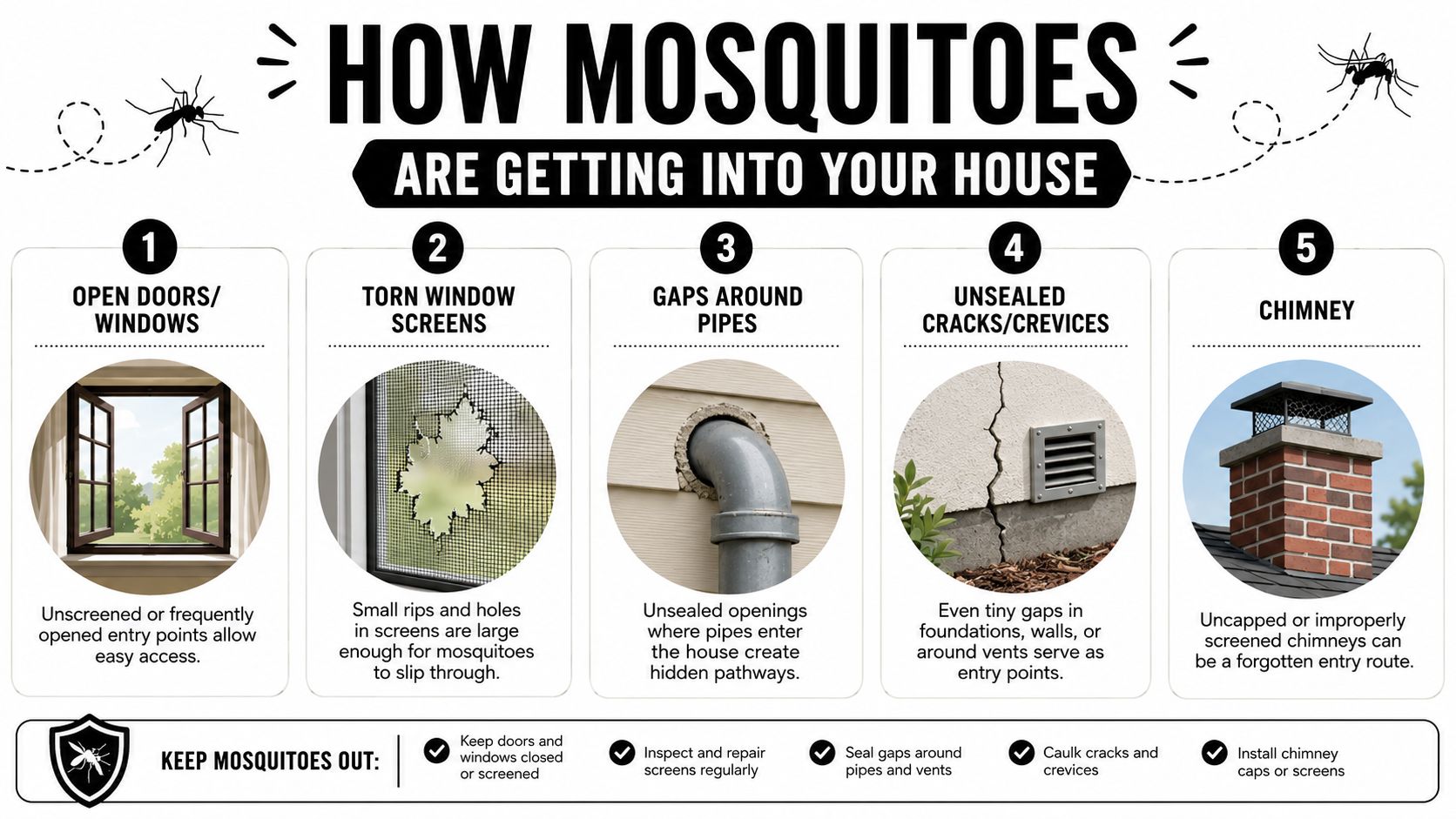
The most common mistake is assuming mosquitoes only come in through a wide-open door. In reality, they use small, boring-looking openings that homeowners walk past every day. Damaged screens, loose weather stripping, utility gaps, and unsealed vents can all become routes inside.
The entry points people miss
A quick walk-around often reveals the same trouble spots. Mosquitoes can slip through small gaps around doors and windows, damaged screens, vents, garages, chimneys, and utility openings, and they can even hitchhike indoors on clothing, pets, or people returning from outside (Agile Pests). That's why a home can seem sealed up and still have a steady mosquito problem.
Here's the homeowner checklist I'd use first:
- Door and window edges: Look for daylight, loose sweeps, or gaps where the frame doesn't seal tightly.
- Screen condition: Check for tears, bent frames, or screens that pull away when touched.
- Utility openings: Inspect where cables, pipes, or lines enter the house, especially near basements and garages.
- Vent and chimney screens: These get forgotten because they're higher up or out of sight.
- Garage and mudroom traffic: Mosquitoes can ride in when doors stay open during loading, unloading, or yard work.
Why entry control alone sometimes falls short
A homeowner can repair a screen and still see mosquitoes the next night. That usually means the house has more than one access route, or the insects are already inside and resting in a cool, shaded spot. A single fix helps, but it doesn't always solve a pattern that's coming from multiple weak points.
A sealed house matters, but a sealed house with moisture still gives mosquitoes somewhere to survive.
For readers comparing exterminator near me options, an experienced inspection pays off. If you want a deeper look at how indoor mosquito service works, The Green Advantage's interior mosquito control page gives a useful local reference.
The Hidden Breeding Sites Inside Your Home
Not every mosquito in a house flew in from outside. Some are born right there, in water you may barely notice. That's the part many homeowners miss, and it's why a few bites can become a recurring indoor problem.
Small water, big problem
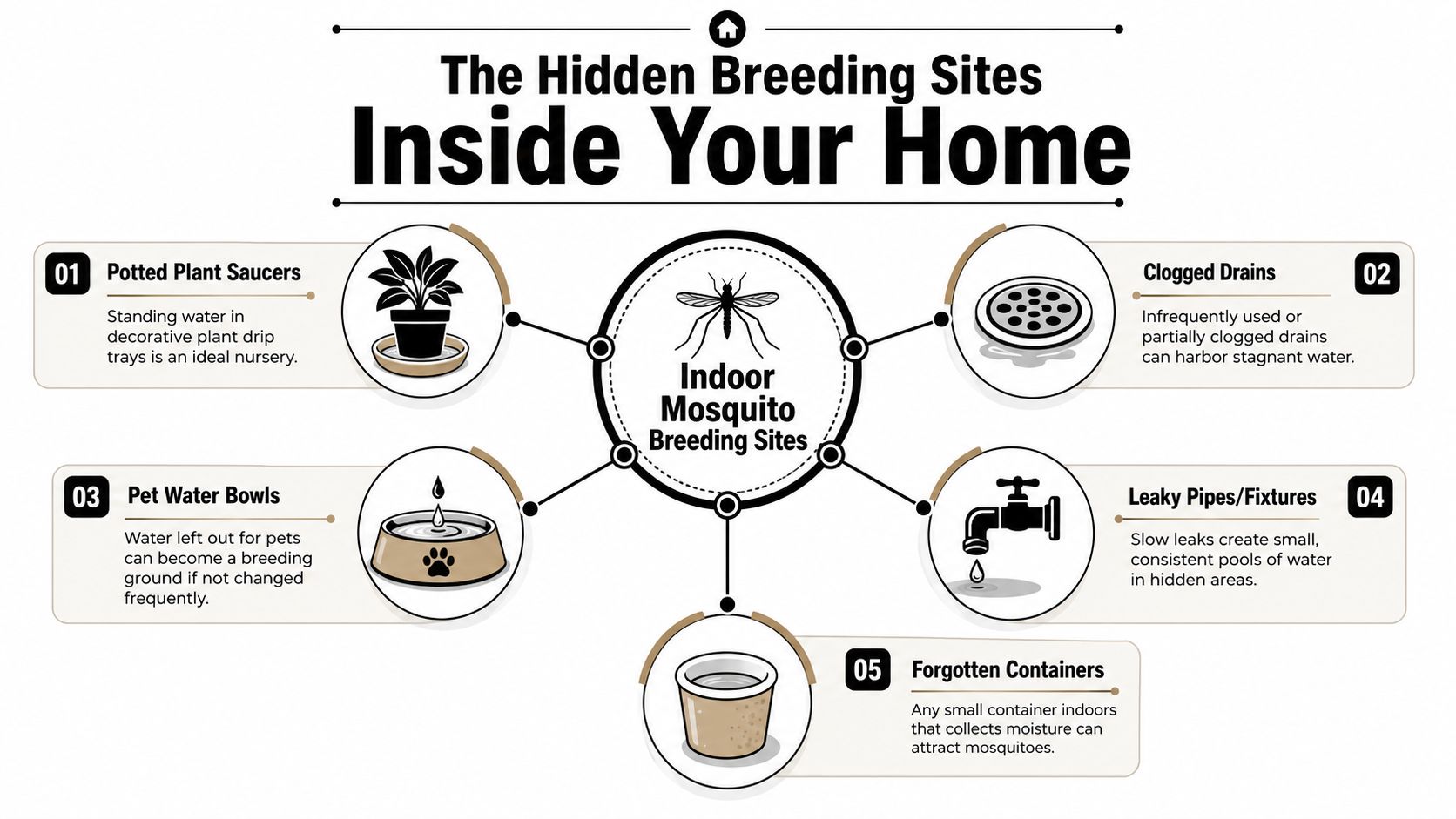
Mosquitoes do not need much water to breed. Female mosquitoes can lay eggs in very small standing-water sources, and one source notes that even a tablespoon of water can be enough for a breeding site (Engineer Fix). That means the usual suspects, plant saucers, drip trays, and small forgotten containers, can turn into indoor nurseries if the water sits long enough.
The older assumption is that breeding only happens in big puddles or swampy yard water. In practice, indoor sources are often tiny and persistent. A plant tray near a window, a pet bowl left unchanged, a slow leak under a sink, or a drain that doesn't get much use can all hold enough moisture for mosquitoes to cycle through again and again.
The rooms that deserve a closer look
Bathrooms, laundry rooms, basements, kitchens, and utility spaces are the places I'd inspect first. Those rooms often combine humidity, shade, and hidden water, which makes them attractive resting spots even when the source is small. A good home humidity guide, like this one from Sunset Shine Home Cleaning, can also help homeowners understand why damp indoor air keeps pests comfortable.
Rule of thumb: if a space stays damp, shaded, or underused, don't assume it's harmless just because it looks clean.
The bigger takeaway is simple. If mosquitoes remain after you've looked at doors, screens, and obvious entry points, the house may already be supporting an indoor cycle. That's the point where mosquito control becomes less about chasing adults and more about finding the water source they're using to keep coming back.
Your First Line of Defense Against Mosquitoes
The best homeowner defense is still the basic one. Clean out water, keep screens intact, and make the house less inviting. Those steps matter because they cut off the easiest survival conditions, and they're worth doing even if you plan to call for help.
What to do every week
The CDC says to once a week empty and scrub items that hold water, and it also notes that if mosquitoes remain after screen repair and container cleanup, professional treatment inside the home may be needed (CDC mosquito control at home). That advice is plain, practical, and hard to beat.
A homeowner can start with a short routine:
- Empty standing water: Check saucers, buckets, pet dishes, and anything that catches rain or condensation.
- Scrub water-holding items: Eggs can cling to surfaces, so dumping water alone isn't always enough.
- Repair screens quickly: Small tears are easier to ignore than they are to live with.
- Improve airflow: Stagnant, damp rooms tend to be more attractive resting spots.
- Watch the basement and garage: These areas often stay cooler and moister than the rest of the home.
Where DIY ends
DIY prevention works best when the issue is minor and the source is obvious. It's less effective when mosquitoes are coming from multiple access points, or when one hidden water source keeps replenishing the problem. That's why persistent indoor activity often needs a more complete inspection.
If you're comparing residential pest control providers, it helps to look at the whole home, not just the obvious window problem. A resource like identify household health risks can also help homeowners think more broadly about the conditions that make indoor spaces uncomfortable or unhealthy.
The practical line is this. If you've cleaned, repaired, and still see mosquitoes indoors, you're past the point where a spray can solve everything. At that stage, source identification matters more than guesswork.
The Green Advantage Solution for Mosquito Control

The strongest mosquito treatment starts with a full inspection, not a single product. A trained technician looks for entry points, moisture sources, and resting areas inside and around the structure, then matches the response to what's driving the problem. That matters because a house with mosquitoes needs source control, not just a quick knockdown.
What a professional service looks for
A proper visit usually focuses on the places homeowners miss. That includes utility openings, crawl spaces, basement moisture, shaded corners, and any indoor or outdoor source that can keep water in place long enough for mosquitoes to breed. The point is to find the chain, not just the symptom.
In the field, that can also include mosquito control around the property to reduce pressure from outside. For many homes in Crown Point and nearby Northwest Indiana neighborhoods, the issue is a mix of indoor access and outdoor activity. A complete plan may include targeted treatment, source reduction, and follow-up guidance for the season.
The Green Advantage also handles related commercial pest control and residential pest control needs, which helps when a home, rental property, or business all need consistent service standards. For homeowners who want a practical local option, The Green Advantage can provide a focused mosquito inspection and treatment plan suited to the structure and surrounding property.
Why timing matters
Mosquito breeding moves fast. New York State health guidance says many mosquitoes lay eggs in even small amounts of standing water, and eggs can develop in water that remains for more than four days (New York State health guidance). That short timeline is why a delay gives mosquitoes room to rebuild.
A professional approach breaks that cycle by treating the problem at the source, not just the adult mosquitoes you happen to see flying by. For families in Crown Point, that usually means less guessing, less repeat cleanup, and a clearer plan for keeping mosquitoes out of living spaces.
Working With Your Local Crown Point Exterminator
When a mosquito problem keeps coming back, homeowners usually want three things. They want the house to feel comfortable again, they want to know the problem was handled correctly, and they want a plan that doesn't turn into another seasonal headache. That's a fair expectation.
What you can expect from service
A good inspection should feel straightforward. The technician should look at the structure, identify likely sources, explain what's making the house attractive to mosquitoes, and recommend the next step in plain language. You shouldn't have to guess what was found or why the treatment matters.
That's especially important for pest control in Crown Point, IN, where moisture, season changes, and property layouts can vary a lot from one home to the next. A local team understands that mosquito pressure doesn't come from one cause every time. Sometimes it's a screen issue. Sometimes it's indoor moisture. Sometimes it's both.
Here's what usually helps most:
- Clear diagnosis: You know whether the issue is entry, breeding, or both.
- Targeted treatment: You're not paying for blanket work that doesn't match the problem.
- Prevention guidance: You get practical steps to reduce the chance of a return visit.
- Local follow-through: You can work with a company that understands Northwest Indiana homes and seasons.
The right service makes the house easier to live in, not just quieter for one night.
That's the reason people call an exterminator in Crown Point, IN instead of trying to chase mosquitoes room by room. Professional mosquito control protects comfort, supports better indoor conditions, and gives you a plan that fits the property instead of a generic answer.
If mosquitoes keep turning up in your home, schedule a pest inspection with The Green Advantage and get a local plan built for Crown Point and Northwest Indiana. Visit The Green Advantage to request a quote, ask about mosquito control, and take the next step toward a more comfortable home.
Natural Flea Control for Yard in Crown Point
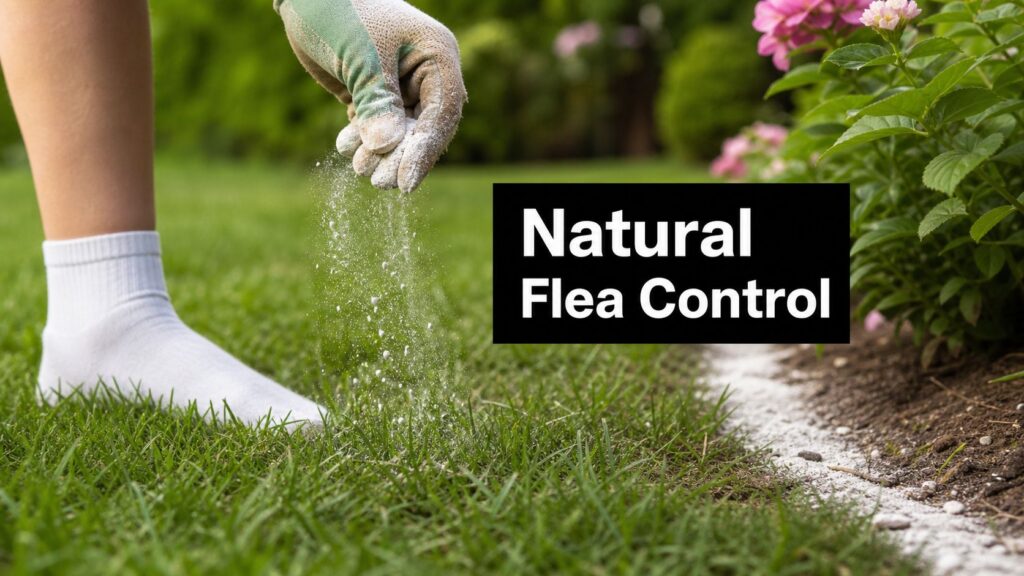
A flea problem in the yard usually starts the same way in Crown Point. The dog comes in scratching, the kids avoid the back lawn, and you start wondering whether the shaded strip along the fence is the primary problem. That's where natural flea control for yard work makes sense, because fleas build pressure in the places pets regularly use, not just in the open grass.
For homeowners looking for pest control in Crown Point, IN or searching pest control near me after a weekend spent outside, the right answer is usually not a single spray. Fleas reproduce fast enough that yard control has to be integrated. One source notes that just 10 female fleas can produce about 250,000 fleas in 30 days under favorable conditions, and another widely cited estimate says adults are only about 1% of the total flea population in the home or yard, which is why environmental management matters so much in a place like Northwest Indiana where moisture and shade can line up quickly (DoodyBug).
The Green Advantage works with that reality every day. Families who want a more environmentally mindful approach to residential pest control, or businesses looking for commercial pest control that doesn't rely on broad, reactive spraying, usually get better results when the property is treated as a system. That means the yard, the pet traffic patterns, the shaded edges, and the follow-up all matter.
Practical rule: if the yard stays damp and overgrown, fleas keep getting a place to rebuild.
Natural Flea Control for Yard in Crown Point
Crown Point yards have a lot in common with the rest of Northwest Indiana. We get the same mix of shade, wet periods, and protected corners that let fleas hang on in the spots that aren't always inspected closely. That's why homeowners searching for an exterminator in Crown Point, IN or even an exterminator near me often need a plan that starts outdoors, not just inside the house.
The strongest natural yard strategy is prevention-first. Fleas prefer moist, dark, and overgrown areas, so mowing regularly, trimming shrubs, clearing weeds, and removing thick brush or debris reduce the sheltered habitat they depend on (PetMD). That's not just routine landscaping. It's the foundation of flea pressure reduction.
Why the yard matters before the house
Fleas don't stay in one place for long. They move with pets, wildlife, and people, then settle into the cool edges of a yard where grass is taller and the soil stays protected. In practice, that means the back fence line, under decks, around dog paths, and near dense foundation plantings often become the first places to check.
The Green Advantage often approaches these jobs the same way it approaches other eco-friendly pest control problems, whether the issue involves spiders, ants, mosquito control, or rodent control. The goal is to make the property less welcoming, not just to knock back the surface activity for a day.
The most useful natural flea control is usually the least dramatic one, because it changes the habitat fleas rely on.
That's also why this guide focuses on field-tested steps instead of broad promises. Some natural methods work well in the right conditions, but they need targeted placement and repeat attention. If a yard has both pet traffic and protected shade, the best results usually come from matching the method to the microclimate, not from treating every square foot the same way.
Inspect Yard Flea Hotspots with White Socks

A quick white-sock walk gives you a better map than guessing ever will. WebMD and the Ecology Center both recommend walking the yard in white socks, because fleas jump onto the socks and expose the active zones. That lets you spot-treat the worst areas instead of blanketing the whole property (Ecology Center).
How to read the yard in 15 minutes
Start where pets rest, then move into the yard edges, the shaded side of the house, and any damp spots near shrubs or mulch. Wear tall white socks over pants cuffs if possible, then walk slowly through the grass and pause for a few seconds in each area. If fleas show up on the socks, that spot needs attention first.
A small test like this is useful after rain, after mowing, or any time the yard feels especially humid. It also helps in Crown Point because a lot of lots have mixed sun and shade, which can make one corner act very differently from the next. A homeowner who finds the worst zone quickly can conserve product and protect beneficial insects by avoiding a broad, unnecessary treatment.
For readers who want to understand why fleas spread so fast, the internal guide on the flea reproduction cycle is a good companion piece. It reinforces why the socks check matters. One visible flea often means the yard or nearby interior spaces are already supporting a much larger cycle.
Field note: the socks test works best as a scouting tool, not as the cure itself.
What to do with the results
Use the socks check to create a simple hit list.
- Heaviest flea activity: target these zones first with habitat cleanup and a focused treatment.
- Light activity under shade: trim back cover and improve sunlight exposure.
- No activity in open turf: leave it alone unless pets spend time there.
That targeted approach is what keeps natural flea control practical. It avoids overspraying and helps you focus on the parts of the yard that support flea survival.
Modify Habitat to Starve Fleas Out
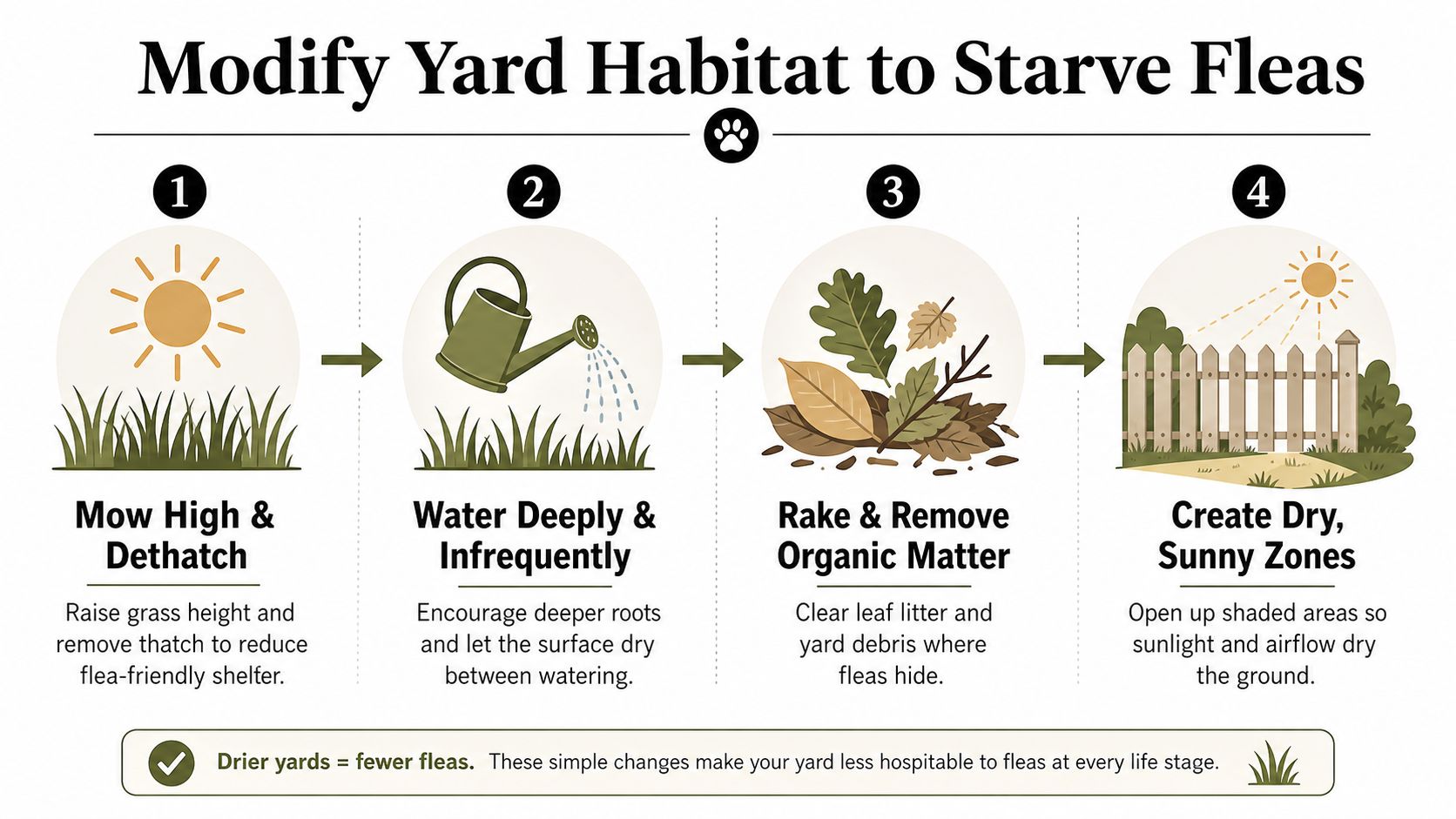
Habitat work comes first because fleas do not need much help to keep going once they find shade, cover, and steady moisture. In Crown Point, that usually means the problem shows up fastest in the same places you already avoid after a rain, near dense foundation plantings, under low branches, and along edges that stay damp longer than the rest of the yard. If you keep those spots open and drier, you make the yard less forgiving for fleas without spraying every square foot.
Keep the yard open and less forgiving
The goal is to take away the protected places fleas use between hosts. Mow regularly, trim weeds, clear brush, and remove leaves or other debris that hold moisture and block airflow. If irrigation is running long enough to keep shaded areas damp, cut that back too.
A steady maintenance pattern works better than a rescue effort after fleas spread. Cut grass, rake out organic matter, and open air movement near fence lines and foundation beds. When one corner stays thick and wet, it keeps acting like a shelter, especially in Crown Point yards where sun and shade can change quickly across a single property.
That same plant growth can also hide other health problems in beds and borders. If the yard needs more than pest cleanup, Prestonwood Commercial Landscape Services plant care can be a useful reference for keeping plants healthier while you cut back the dense cover fleas prefer. Healthy beds still need restraint, because crowded growth and trapped moisture work against flea control.
Where the weather works for fleas
Crown Point summers and shoulder seasons can create damp, sheltered pockets that fleas use well. The practical answer is moisture control. Reduce overwatering, shorten the time soil stays wet, and avoid letting shaded spots stay packed with mulch, leaves, or tall grass.
For homeowners who want the biology behind that approach, biological pest control basics explain why changing the habitat matters as much as treating the pest itself. Fleas stay active where the environment keeps giving them cover. When the yard dries faster and sees more light, the cycle has a harder time rebuilding in the same spots.
If the shade stays thick and the soil stays wet, fleas keep rebuilding in the same spots.
For homeowners balancing residential pest control with day-to-day yard care, the lesson is straightforward. A dryer, sunnier yard puts steady pressure on flea survival, and that often does more than a single broad treatment that fades before the next warm spell.
Apply Beneficial Nematodes the Right Way
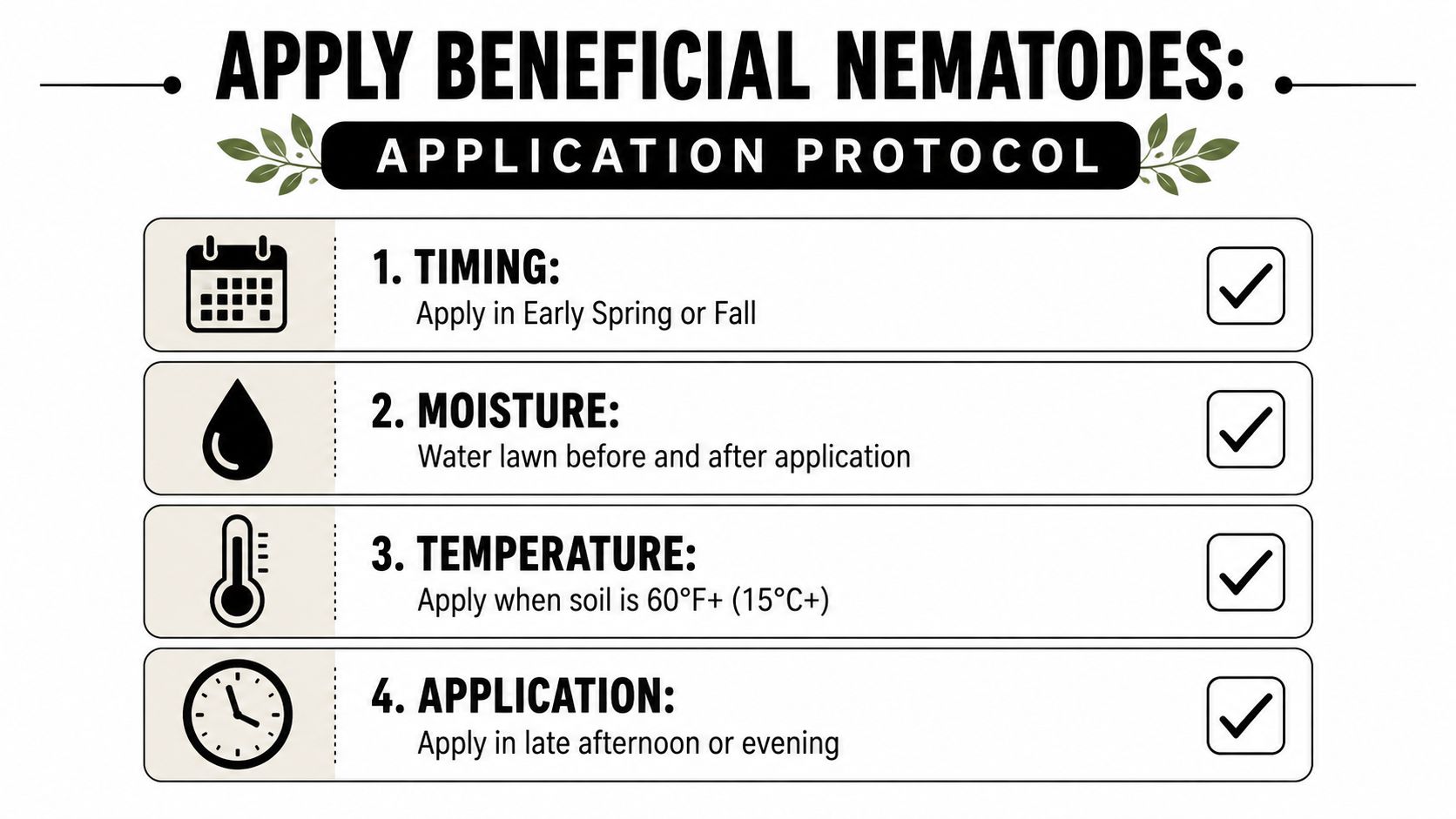
Beneficial nematodes are one of the most practical natural tools for flea pressure in the soil. Texas A&M AgriLife Extension says they can be applied to heavily infested yard areas, and the Ecology Center recommends using them in soil where fleas have been found rather than spraying the whole yard (Texas A&M AgriLife Extension). That makes them a good fit for shaded pet hotspots.
The protocol that protects the treatment
The workflow is consistent across independent guides. Lightly pre-wet the soil, apply the nematodes in the evening or on a cloudy day to avoid UV damage, then keep the treated zone lightly moist for several days to two weeks so the nematodes remain active and do not dry out (LeafyZen). A dry, hot application window wastes the treatment. So does saturated soil.
That moisture balance matters in Crown Point yards with mixed drainage. Too much water can wash the nematodes away or reduce placement accuracy. Too little water can kill them before they do their job. The best target is shaded, pet-used soil after mowing and debris removal, where fleas tend to concentrate in cool, protected microhabitats.
For homeowners who want to understand the biology behind this kind of treatment, the internal guide on what is biological pest control gives broader context. Nematodes fit into that category because they use a living control agent instead of relying only on a chemical barrier.
Practical rule: apply late, keep the soil lightly moist, and focus on the flea hotspots instead of the entire lawn.
Where nematodes help most
They are most useful when the yard has already been cleaned up and you're trying to reduce larvae in the remaining problem areas. That means they work best after mowing, edging, and removing debris. They're not a shortcut around maintenance, they're a biological follow-up that fits into a larger plan.
Mechanical Removal and Diatomaceous Earth
Mechanical cleanup has a different role from living controls. It doesn't chase fleas with biology, it removes the places where they shelter. That includes dethatching, raking leaf litter, and clearing the dense edges where debris collects under shrubs, porches, and fences.
Use dry-contact dust only where it can stay dry
Diatomaceous earth, or DE, only works when the yard surface is dry and rain is not expected for 24 to 48 hours, because moist DE loses effectiveness (LawnStarter). That makes it most useful in sheltered, low-moisture zones like under porches, along fence lines, and in dense ground cover. Open turf is usually a poor place for it.
The best workflow is straightforward. Clean first, then spot-treat. Dethatch the problem area if buildup is heavy, rake out leaves and clippings, and use a thin targeted layer of DE where fleas still have a refuge. Reapply after rain or heavy dew if the area stays in the treatment zone.
A lot of homeowners make the same mistake with dust products. They spread them broadly before rainfall or irrigation, then assume the yard is covered when the product has already lost its edge. That creates a false sense of control and wastes the material.
Keep the cleanup paired with sunlight
The mechanical side matters because sunlight and drying reduce egg and larval survival. The less organic cover the yard has, the faster the remaining moisture leaves the surface. That's why open, sunlit borders tend to stay more manageable than shaded, cluttered areas.
If you're already using white socks to find the worst spots, use that same map to guide your cleanup. The work doesn't need to be glamorous, it needs to be specific. Clear the exact places where fleas have shelter, then leave the open areas alone.
Botanical Sprays Pet Care and Seasonal Timing
Natural sprays can still help a Crown Point yard, but only if they are used with a clear plan. Some essential oils have been reported as effective against fleas at low concentrations, and natural options usually lose their residual effect faster than chemical insecticides, so they need more frequent reapplication. That trade-off matters in yards with mixed sun, tree cover, and pockets of trapped moisture, because the spray has to line up with the places fleas keep rebuilding.
Align the yard, the pets, and the calendar
The practical approach is to treat the yard and the pets as one system. If pets keep carrying fleas back onto the property, the yard starts over. If the yard stays active and the pets are not protected, the problem keeps moving inside.
A homeowner handling backyard care can use a simple order of operations:
- Botanical oils: use cedarwood or lemon eucalyptus around perimeters where they make sense for the site.
- Pet coordination: keep pet flea prevention aligned with yard work so one side does not undo the other.
- Follow-up timing: return to outdoor treatment on a regular schedule because natural products do not linger as long.
- Shade checks: give extra attention to cool, moist corners after weather changes.
For pet owners who want a dog-focused perspective on safer spray use around outdoor activity, our guide for Denver trail dogs gives a useful comparison for how people weigh repellents around animals. The point is simple, product choice should stay within the limits of safety, especially in yards where pets and kids use the same space.
Why moisture control keeps coming back
Moisture still drives the pattern. Damp ground helps fleas stay active longer, and that is why natural programs need repeat checks. In a Crown Point yard, the shaded north side or the low spot near a downspout usually needs more attention than the sunny center of the lawn.
Match the spray to the season
Seasonal timing also changes how far a botanical spray can go. Early in the season, a lighter touch may be enough for perimeter pressure, while later stretches with thicker shade and lingering humidity can bring faster rebound in the same places. After a wet stretch, the safest assumption is that the treated area needs another look before fleas get comfortable again.
Botanical sprays work best as part of a broader routine, not as a stand-alone fix.
Families who want a calmer outdoor season usually get better results by keeping pet care, lawn maintenance, and reapplication timing in sync. That approach is easier to manage than reacting after bites start again, and it gives you a better read on whether a natural plan is still holding or whether the yard needs a stronger response.
Trust The Green Advantage for Flea Freedom
When a yard keeps producing fleas despite mowing, cleanup, nematodes, and spot treatments, the problem has usually moved beyond a simple DIY job. Persistent bites, recurring activity in the same shaded areas, or months of pressure are all signs that the infestation is not staying contained. At that point, it makes sense to call a pest control near me provider that understands both the local property conditions and the limits of natural methods.
The Green Advantage serves Crown Point and nearby Northwest Indiana communities with residential pest control and commercial pest control that look at the whole property. That matters for fleas, but it also matters for other seasonal problems like ants, spiders, mosquitoes, rodents, termites, and wasps. A good inspection doesn't just look for what's visible. It looks for where the problem is rebuilding.
For homeowners who want an exterminator near me without a hard sell or a one-size-fits-all spray plan, The Green Advantage offers a straightforward process. The team can inspect the yard, identify the protected areas that keep harboring fleas, and recommend a practical treatment path that fits the site. That may include eco-friendly options, prevention-focused follow-up, or a broader pest plan if the property has more than one issue at once.
The biggest advantage of professional help is not speed alone. It's precision. A trained technician knows how to separate a temporary hotspot from a yard that keeps feeding the cycle, and that difference saves time, frustration, and repeated guesswork.
If the backyard still feels like it belongs to the fleas, don't wait for another round of bites. Schedule a pest inspection, ask for a quote, and get a property-specific plan from a local team that works across Crown Point and Northwest Indiana.
If you're ready to stop chasing flea activity around the yard, contact The Green Advantage for a focused inspection and a natural-minded treatment plan built for Crown Point properties. Visit The Green Advantage to request service and get help restoring comfort outside.
8 Natural Ways to Repel Insects for Crown Point Homes

As the seasons shift in Northwest Indiana, insects start testing every seam, screen, and doorway they can find. If you're in Crown Point and you want to keep pests out without reaching first for harsh sprays, you're probably looking for natural ways to repel insects that fit real life, not just a blog headline. The good news is that there are sensible DIY options that can reduce pressure around patios, entryways, gardens, and storage areas. The tougher truth is that natural repellents work best as part of a broader plan, because an established infestation usually needs more than scent alone.
Homeowners around Crown Point often start with peppermint, citronella, vinegar mixes, or plant-based sprays because they feel safer for families and pets. That instinct makes sense, especially when you're trying to protect a kitchen, porch, or back yard where kids and guests spend time. Still, the evidence is uneven. Some plant compounds deliver strong results in controlled testing, while many everyday products offer only short-lived relief, especially when weather, moisture, and pest pressure change fast browse pest prevention guide.
For mosquito control, ant control, spider control, and the bigger picture of residential pest control or commercial pest control in Crown Point, IN, the best approach is usually practical and layered. Use natural repellents where they make sense, then back them up with sealing, cleaning, water removal, and, when needed, professional service from The Green Advantage. That's how you move from temporary relief to real protection.
1. Essential Oils and Natural Plant Extracts
Some of the strongest plant-based repellents come from essential oils, but they're not all equal. In laboratory testing summarized in a 2018 review, clove essential oil delivered 100% protection against Aedes aegypti for 120 minutes, against Culex quinquefasciatus for 240 minutes, and against Anopheles dirus for 210 minutes PMC review of plant-based repellents. That same review also reported that Lippia javanica extract gave 100% protection against Aedes aegypti for 8 hours, while Cymbopogon martini oil reached 98.8% protection against Culex quinquefasciatus for 10 hours same review.
Those numbers sound impressive, and they are, but the catch is consistency. A homeowner in Crown Point can spray peppermint or eucalyptus around a window sill, and it may help keep spiders or ants from lingering there. A porch diffuser with lavender may make summer evenings more comfortable. The problem is that results can fade quickly outside the lab, especially in wind, rain, or hot weather.
What works best in real homes
A practical mix often looks like this:
- Use a diluted spray near entry points. Fifteen to 20 drops of essential oil in water can work as a light maintenance spray on screens, door frames, and windowsills.
- Choose specific oils for the pest pressure you have. Peppermint, eucalyptus, lavender, and cedarwood are common examples for household use.
- Reapply often. Natural sprays usually need renewed coverage after rain or routine cleaning.
- Test first. Wood trim, painted surfaces, and fabrics can stain or discolor.
Practical rule: If a scent fades from your nose, it's usually fading for the insect too.
For Crown Point homeowners who want a greener approach, The Green Advantage also watches how plant-based repellents fit into broader eco-friendly pest control plans. The key is using them as support, not as your only defense.
2. Diatomaceous Earth
Diatomaceous earth works well for crawling insects because it does not depend on scent. Food-grade powder comes from fossilized diatoms, and when insects cross it, the tiny particles damage their outer coating and dry them out. That makes it useful for ants, fleas, and other pests that travel along baseboards, cracks, and tucked-away edges.
Homeowners often choose it because the method is simple and controlled. Put it in the right places, keep it dry, and it can help in corners where liquid sprays are not a good fit. It is also common in storage rooms, crawl spaces, and pet areas when it is used carefully and only in food-grade form. The limit is clear, though. It will not fix an infestation on its own if insects still have open entry points, moisture, and shelter.
A dry basement wall is a good example. If ants are tracking along the same seam, a light dusting can interrupt that route and give short-term relief. In a carpeted room with flea pressure, it can also be part of a broader plan, as long as it is used with care around pets and vacuumed areas are treated again as needed.
Where to place it and where not to
Targeted placement usually works better than heavy dusting, and the setup matters more than the amount.
- Use food-grade only. Pool-grade material is not the same product and is not appropriate for home use.
- Apply lightly along baseboards and cracks. A thin line is more effective than a visible pile.
- Target dry zones. Damp areas reduce performance.
- Wear a dust mask. Fine powder can irritate if it becomes airborne during application.
- Reapply after vacuuming or wet weather. The material has to stay in place to keep working.
Keep it where insects travel, not where people and pets constantly disturb it.
For persistent crawling pests, The Green Advantage can inspect the source, identify harborage zones, and pair targeted treatment with exclusion. That separates a temporary dusting from a real fix, especially when the pests are coming from hidden gaps or damp structural areas.
3. Neem Oil
A homeowner in Crown Point can use neem oil on a patio border, near ornamental plants, or on indoor leaves where spider mites are showing up, but the product works best as a steady maintenance step. It is a plant-derived option that affects insect growth and reproduction, so it comes up often in conversations about mosquitoes, flies, aphids, mites, and other pests around landscaping and outdoor living spaces. That makes it useful for keeping a yard more manageable in warm weather, as long as it is applied correctly and with realistic expectations.
The practical value of neem oil is that it fits into a broader routine. It can help on shared outdoor areas for a property manager, and it can support a homeowner who is trying to keep patio plants in better shape through the season. It also has a place on houseplants when soft-bodied pests are the problem. The limit is straightforward. One treatment does not solve an infestation if insects still have entry points, breeding sites, or shelter nearby.
Keep the application gentle and deliberate
Neem oil works best when it is diluted according to the label and sprayed under conditions that do not stress the plant. Heat and direct sun can cause leaf burn, and heavy application can leave an oily film that some plants do not tolerate well.
- Apply in early morning or late evening. That lowers the chance of sun stress and avoids spraying when pollinators are most active.
- Test a small area first. Some leaves react badly to oil-based products, especially tender or stressed plants.
- Reapply on a schedule. Many users refresh treatment every 7 to 14 days, or after rain.
- Use it as part of a perimeter plan. Screening, pruning, and sealing matter just as much.
If mosquitoes are the problem around a porch, neem oil may help with nearby plant surfaces, but it will not replace standing-water cleanup or screening. In Northwest Indiana, that trade-off matters because seasonal pest pressure can rise quickly once weather warms, and the source usually sits somewhere else.
The Green Advantage sees that pattern in real homes all the time, one product reduces activity, but the property setup decides how far the relief goes. Neem oil can be a useful piece, especially in preventative pest treatments, yet it works best when entry points and breeding areas are addressed at the same time.
4. Citrus-Based Natural Repellents
A citrus spray has a place in the toolbox when a homeowner wants something that smells clean and still helps reduce insect activity around the house. These repellents usually use peel extracts from orange, lemon, lime, or grapefruit, and they're commonly applied near patios, decks, foundations, and garden edges. The compounds in citrus can interfere with how insects find food and travel across treated surfaces, so they're often used for mosquitoes, ants, fleas, and ticks.
For a family in Crown Point that spends time outside in the evening, citrus-based repellents can help keep a porch or patio more comfortable. They're easy to use around door thresholds, railings, and seating areas, and they fit well with routine cleaning because they usually leave less residue than heavier products. The limitation is simple. They reduce activity on the surface, but they do not solve an infestation that starts in wall voids, hidden cracks, or damp ground nearby.
A useful citrus plan starts with the areas insects cross. If you spray the same walkway every week, you get more from the product than if you use it once and hope for lasting control. I also tell homeowners to treat it like a support measure, not a stand-alone fix, because the source of the problem usually sits somewhere else.
Put citrus to work where insects enter
Direct application matters more than scent alone. The goal is to create a light perimeter treatment at the points where insects are most likely to travel.
- Spray around entry points on a regular schedule. Doors, windows, and utility openings deserve the first pass.
- Use diluted concentrates only where the label allows it. That gives broader coverage for patios and foundation lines without wasting product.
- Reapply after rain or heavy dew. Outdoor repellents do not hold up well once weather breaks the barrier.
- Store the bottle in a cool, dark place. That helps preserve the strength of the active ingredients.
Citrus repellents are handy between service visits because they let you do light maintenance without relying on harsher products. They can also make a freshly cleaned area less attractive to crawling insects for a short time, which is useful when you want the home to feel controlled while you sort out the bigger issue. For homeowners who want to understand where mosquito pressure really starts around a property, this guide on mosquitoes and their natural enemies gives useful context, but standing water and harborage still need direct attention.
If ants or mosquitoes keep returning in Crown Point, The Green Advantage can inspect the property and sort out whether you're dealing with a surface nuisance or a deeper entry problem. Citrus helps as part of the routine, but persistent activity usually means sealing gaps, controlling moisture, and using targeted professional service for reliable results.
5. Beneficial and Predatory Insects
A yard does not always need another spray or repellent. Sometimes the better move is to support the insects that already keep pests under control. Ladybugs, lacewings, parasitic wasps, and ground beetles all help suppress garden pests and other unwanted insects around outdoor spaces. For homeowners who want a longer-term approach with less hands-on maintenance, that makes this strategy a practical part of the plan.
The payoff depends on what is growing in the yard and what gets sprayed there. Native flowering plants can support beneficial insects through the season, while a yard cleared out with broad-spectrum sprays often leaves fewer helpers behind. In Crown Point, that matters around vegetable beds, shrubs, and ornamental borders where aphids and other soft-bodied pests tend to return.
A homeowner can make this work without turning the property into a habitat project. Flowers that bloom at different times keep beneficial insects fed through the season. A tucked-away patch of leaf litter or wood debris can also support ground beetles. In the right setting, those small choices can reduce pest pressure without constant spraying.
Build habitat, not just barriers
A yard that supports the right insects gives them a reason to stay.
A few practical moves help:
- Plant native flowers in rotation. Staggered bloom periods keep beneficial insects nearby.
- Avoid broad-spectrum pesticides. They can remove the insects that help with pest control.
- Provide shallow water. Pebbles help insects drink without getting trapped.
- Leave some habitat structure. Small pockets of leaf litter and wood can support ground beetles and similar helpers.
- Use insect houses selectively. They can support native beneficial species in a managed yard.
For homeowners who want a closer look at mosquito ecology and support strategies, The Green Advantage has a useful resource on mosquitoes and natural enemies that fits this approach.
Beneficial insects are a good long-game tactic, especially for gardens and commercial properties. They will not clear out an active infestation, but they can lower the conditions that let one build back up. When pest activity keeps coming back anyway, that usually means the property needs a more direct inspection, along with targeted control from a professional who can separate helpful insects from the ones causing the problem.
6. Physical Barriers, Heat, Light, and Sound-Based Methods
A natural approach works best when it blocks pests instead of just trying to make them leave. Caulk, weatherstripping, door sweeps, and fine mesh screens do that job better than most scent-based repellents because they close off the path in. In Crown Point homes, that matters around utility penetrations, foundation seams, loose door frames, and older windows, where ants, spiders, and flying insects often find their way inside.
Once pests are outside, the next question is whether the space feels worth using. Fans help with that. Consumer guidance notes that fans can reduce bug landings by up to 60% MedlinePlus-style mosquito guidance, which is why a porch or patio often feels more comfortable with moving air. Yellow or orange bug lights can also cut down on attraction compared with standard bright outdoor bulbs, especially near patios and deck spaces.
Make the barrier match the entry point
Different openings call for different fixes.
- Seal cracks around pipes and vents. Small gaps can still give insects a route inside.
- Install or repair screens. Fine mesh helps keep tiny insects out while still allowing airflow.
- Add door sweeps and weatherstripping. These are simple upgrades with real impact.
- Use fans at seating areas. Moving air makes landing harder for mosquitoes.
- Switch exterior lights when possible. Lower-attraction bulbs help near doors and patios.
A homeowner might seal a basement crack to cut down on ant entry, then add a screened porch fan to make summer evenings more usable. A small business might tighten weatherstripping on exterior doors to reduce flying insect pressure at customer entrances. These steps are straightforward, and they do not create the strong odor, staining, or constant reapplication issues that come with many DIY repellents.
Physical barriers and airflow help most when the pest pressure is light to moderate. They can also support other natural controls by making the property less attractive in the first place. Still, a barrier only works where it is installed correctly, and it cannot fix a hidden nesting site, a saturated crawl space, or an active infestation inside a wall.
A good barrier fits tightly, stays maintained, and matches the problem you are actually seeing.
That is the part many homeowners miss. If insects keep showing up after the obvious openings are sealed, the issue is usually larger than one gap or one patio light. The Green Advantage often finds that exclusion, inspection, and targeted treatment together solve what a single natural deterrent cannot, especially in older homes and busy commercial spaces.
7. Garlic and Spice-Based Natural Deterrents
A garlic spray on the deck. Cinnamon dusted near a pantry corner. Clove or cayenne mixed into a homemade repellent. These are the kinds of quick fixes Crown Point homeowners reach for when insects start turning up in places they should not. They are cheap, easy to prepare, and usually already on hand, which makes them appealing for a same-day response.
The trade-off is simple. Garlic and spice-based repellents can make an area less inviting, but they do not solve the source of the problem. They are better suited to short-lived pressure around patios, garden borders, cabinets, and other small areas where you want to discourage ants, mosquitoes, or crawling pests for a while. A resident might mist garlic water along a deck railing before guests arrive, while another might place cinnamon in a cabinet where moth activity has started. Both uses can help, but neither one replaces a real inspection when insects keep coming back.
A few practical points make these homemade mixes less frustrating.
- Strain sprays before use. Fine particles clog sprayers fast.
- Test on a hidden spot first. Wood, fabric, and painted trim can stain or react.
- Use them as a spot treatment. Broad spraying usually adds smell without adding much control.
- Refresh after rain or cleaning. Outdoor residue does not last long.
- Keep sealing and sanitation in place. Those steps do more to cut repeat activity.
Garlic and spice deterrents can buy time between treatments, and that has real value when you are waiting on a more complete plan. They work best as a temporary buffer, not as a stand-alone fix. If insects keep returning to the same gap, cabinet, or room, scent is not the main issue. In that case, the problem is usually an entry route, a nest, or a source nearby that keeps feeding the activity.
For homeowners who want a cleaner answer, a professional inspection helps separate nuisance activity from a hidden infestation. The Green Advantage can look at the pattern, find the source, and recommend a treatment that fits the property instead of relying on repeated kitchen-based sprays.
8. Mosquito-Reducing Yard Management and Standing Water Elimination
Mosquito control often starts with the water that sits still in a yard. Standing water gives mosquitoes a place to breed, so clearing it out is one of the most direct natural steps a homeowner can take. Bird baths, plant saucers, clogged gutters, tarps, low spots in the yard, and anything else that holds water after rain all deserve attention.
In Crown Point, this issue shows up fast around patios, shaded landscaping, drainage trouble spots, and outdoor areas where families want to spend time. A homeowner can spray repellent all summer and still fight mosquitoes if a bird bath, downspout, or hidden puddle keeps feeding the cycle. Fixing the source usually does more than repeating adult-mosquito treatments.
A yard check works best when it starts at the spots mosquitoes use, not the ones that look messy.
Empty and refill bird baths and pet water dishes on a regular schedule. Keep gutters and downspouts clear so water moves away from the foundation instead of pooling along the house. Cover rain barrels and decorative containers with fine mesh. Check plant saucers and low areas after storms, then remove any standing water. Ponds and water features need recirculating pumps or approved mosquito dunks where they make sense for the setup.
For properties with decorative water or backyard ponds, The Green Advantage also offers practical mosquito control guidance for ponds, which helps when water features are part of the problem. That kind of targeted upkeep can keep a small mosquito issue from turning into a season of constant bites.
Mosquito activity also tends to be higher at dawn and dusk, so timing matters as much as cleanup. If the yard still feels unusable after drainage work and basic repellents, professional mosquito service can add the missing layer and give a more reliable result.
The best mosquito control starts before the bite, with water removal, drainage, and steady maintenance.
8-Point Comparison of Natural Insect Repellents
| Item | Implementation Complexity | Resource Requirements | Expected Outcomes | Ideal Use Cases | Key Advantages |
|---|---|---|---|---|---|
| Essential Oils and Natural Plant Extracts | Low, simple sprays/diffusers | Low, bottled oils, spray bottle, periodic reapplication | Short-term repellency for multiple household pests | Preventative indoor/outdoor maintenance, family homes | Pleasant-smelling, non-toxic, renewable |
| Diatomaceous Earth (Food-Grade) | Low–Medium, targeted powder application | Low, DE powder, duster, mask; must keep dry | High against crawling insects if kept dry; slow acting | Crawling insect control, chemical-sensitive settings | Mechanical, long-lasting when dry, non-toxic |
| Neem Oil | Medium, dilution and careful spraying | Medium, concentrated oil, sprayer, repeat applications | Moderate to high; disrupts growth and reproduction | Garden and landscape pest control, organic programs | Biodegradable, targets life cycle, broad-spectrum |
| Citrus-Based Natural Repellents | Low, sprays or granules | Low, citrus extracts/concentrates, sprayer or spreader | Short-term repellency for multiple pests | Preventative yard/home maintenance, fresh-smelling deterrent | Natural, affordable, pleasant aroma |
| Beneficial and Predatory Insects | High, habitat creation and monitoring | Medium–High, plants, habitat features, time to establish | Long-term suppression when established; variable timing | Long-term landscape pest management, biodiversity goals | Self-sustaining, chemical-free, ecosystem benefits |
| Physical Barriers, Heat, Light & Sound-Based Methods | Medium–High, inspection and installation | Medium, screens, caulk, fans, lights, electricity | Long-term exclusion and deterrence when installed properly | Whole-home exclusion, outdoor comfort, energy efficiency | Permanent barriers, continuous protection, non-chemical |
| Garlic and Spice-Based Natural Deterrents | Low, homemade sprays/dusts | Very low, kitchen ingredients, spray bottle | Short-term, variable deterrence; supplemental effect | Budget-conscious prevention, supplemental yard use | Inexpensive, readily available, no synthetic chemicals |
| Mosquito-Reducing Yard Management & Standing Water Elimination | Medium, thorough inspection and maintenance | Medium, yard tools, drainage fixes, ongoing labor | High long-term reduction of mosquito populations | Yards, outdoor spaces seeking sustainable mosquito control | Eliminates breeding at source, durable and chemical-free |
When Natural Methods Aren't Enough
Natural methods can absolutely help, especially when you're trying to reduce pest pressure around a Crown Point home without jumping straight to heavy treatment. Essential oils, diatomaceous earth, neem oil, citrus sprays, beneficial insects, barriers, garlic mixes, and water removal all have a place. They can make a porch more comfortable, cut down on nuisance activity, and help you stay ahead of seasonal pest issues in Northwest Indiana.
They don't always end the problem, though. That's especially true with established infestations, repeated ant trails, hidden spider activity, mosquito breeding near the property, or destructive pests like termites. If insects keep coming back after you've sealed gaps, cleaned up standing water, and tried the safer DIY options, the issue is likely deeper than surface repellency. In those cases, the most practical move is to bring in a licensed professional who can inspect the property, identify the source, and apply the right treatment plan for the pest and the setting.
The Green Advantage serves Crown Point, IN and nearby Northwest Indiana communities with residential pest control and commercial pest control that's built around real-world conditions, not guesswork. That matters when you want solutions that fit your property, your family, your schedule, and your comfort level. It also matters when you're trying to protect a home sale, a rental property, a storefront, or a worksite from repeated pest pressure.
A professional inspection can separate a minor nuisance from a recurring infestation, and that's where lasting peace of mind starts. If you want help deciding whether natural repellents are enough or whether it's time for a more complete plan, The Green Advantage can give you a clear answer and a quote that matches your property's needs.
If you're dealing with insects that keep returning around your home or business, The Green Advantage can help you sort out what's a nuisance and what's an infestation. Visit The Green Advantage to request a pest inspection, ask about mosquito control or preventative pest treatments, and get a plan built for Crown Point homes and businesses.
Outdoor Ultrasonic Pest Control: Facts vs. Fiction for 2026

You can stand on a Crown Point patio with a drink in one hand and still watch mosquitoes work your ankles like nothing is plugged in at all. That's why outdoor ultrasonic pest control keeps selling. It promises an easy fix, no sprays, no mess, no poison, just a little box and a quieter backyard.
I understand why homeowners keep trying it. A low-chemical option feels safer, especially when the garage has a mouse problem, the deck has mosquitoes, or the fence line keeps attracting ticks and other pests. But the honest question is simple, does the device pull its weight, or is the money better spent on pest control in Crown Point, IN that holds up in the real world?
The Green Advantage has seen these gadgets come and go around Northwest Indiana yards. The pattern doesn't change much. People buy them, hope for a clean perimeter, then call when the insects, rodents, or wildlife never got the memo.
The Patio Problem Every Crown Point Homeowner Knows
A summer evening in Crown Point usually starts the same way. The grill's hot, the kids are outside, the citronella candle is smoking away, and there's a little ultrasonic box glowing near the deck railing. Then the mosquitoes show up anyway, and somebody is back inside swatting at ankles and asking why the “fix” didn't fix anything.
That's the part most shoppers recognize right away. They are not buying a gadget because they love gadgets. They're buying it because they want to keep pests off the patio without turning the yard into a chemical zone. That instinct makes sense, especially for families looking for residential pest control options that feel practical and simple.
Outdoor ultrasonic pest control sits in that exact emotional lane. It sounds modern, discreet, and easy. Plug it in, stake it in the ground, and let the sound do the work. For homeowners searching for pest control near me or an exterminator near me, it looks like a cheap first step before calling a pro.
The problem is that outdoor pests don't care about marketing copy. They respond to food, water, shelter, and access. If a device can't change those conditions, it usually can't deliver dependable control. That's why this topic matters for anyone comparing a patio gadget with real mosquito control, rodent control, or preventative pest treatments.
Practical rule: if a product promises perimeter control outdoors, but it doesn't change the habitat, the result is usually disappointment.
For a yard in Crown Point, the better question isn't whether the box lights up. It's whether it keeps pests from getting comfortable where you live, relax, and entertain.
What Outdoor Ultrasonic Pest Control Actually Does
Outdoor ultrasonic pest control refers to plug-in or battery-powered devices that emit high-frequency sound above human hearing. Manufacturers sell them as a way to repel mosquitoes, rodents, raccoons, deer, ticks, and other pests around yards, patios, garages, sheds, and gardens. Newer models often include solar charging, motion activation, wider emission angles, and weatherproof housings.
The sales pitch is simple. The sound is supposed to be irritating enough that pests leave the area. That is why these products are usually marketed as a perimeter solution rather than a trap or bait system. The label sounds straightforward, but the category is broad, and the claimed effects vary from one unit to the next.
Core promise, core limit: the device emits sound pests may dislike, but the question is whether that sound changes pest behavior enough to matter outdoors.
What buyers are really comparing
| Pest | Finding | Evidence Strength |
|---|---|---|
| Rodents | Some short-term movement reduction, but effects fade fast | Weak for dependable outdoor control |
| Mosquitoes | No demonstrated field efficacy | Weak |
| Ticks | Too little repellency to prevent bites | Weak |
| Other pests | Claims vary widely, with inconsistent real-world results | Weak |
That table says it plainly. Some products may create a brief nuisance, but that is not the same as reliable control. For readers who care about tick pressure in the yard, the practical option is a proven yard strategy, not another hope-and-pray device, and that is why yard tick control guidance from The Green Advantage belongs in the conversation.
The key difference is species and setting. A device that looks impressive on a package can still perform poorly against mosquitoes in open air, rodents along a fence line, or ticks in leaf litter. Ultrasonic is a category, not a guarantee.
What the Science Actually Shows for Rodents, Mosquitoes, and Ticks
Rodents don't stay bothered for long
The clearest takeaway from the extension literature is that ultrasonic rodent devices can look decent for a moment and then fall apart. A Nebraska Cooperative Extension review reported only marginal repellency in controlled tests, with 30% to 50% reductions in movement activity in some cases, but also rapid habituation after just 3 to 7 days of exposure. That means the animals get used to it fast.
A later synthesis cited 27 peer-reviewed studies and found no statistically significant reduction across 19 controlled experiments, with reported significance values of p > 0.42 versus placebo devices, which is a long way of saying the devices did not outperform a fake unit in a dependable way. The University of Arizona Cooperative Extension also says commercially available sonic pest devices have not been shown effective in scientific studies.
Rodents are a serious issue in Northwest Indiana because garages, sheds, decks, and storage areas create easy shelter. That's why a blinking box is not a plan. Sealing access, removing food sources, and using actual exclusion methods are the tools that hold up.
Mosquitoes and ticks need better tools
For mosquitoes, the technical consensus is blunt. Commercial ultrasonic devices have no demonstrated field efficacy, and recent review work says the field evidence remains consistently low across categories. In plain terms, if your yard has biting mosquitoes, the sound from a repeller is not the lever that changes the outcome.
Ticks are no better. A peer-reviewed PLOS ONE study tested nine commercial devices against the paralysis tick Ixodes holocyclus and found less than 19.5% repellency, which the authors said was too low to recommend for preventing bites. That is not a yard solution. It is a weak signal at best.
A Cornell University IPM blog also reported “no effect” in scientific evaluations on pests including German cockroaches, bed bugs, and rodents, and it noted that some manufacturers' claimed frequency and intensity don't match actual output. The species matters, and the evidence keeps pointing in the same direction.
Why Yards Are Harder Than Living Rooms
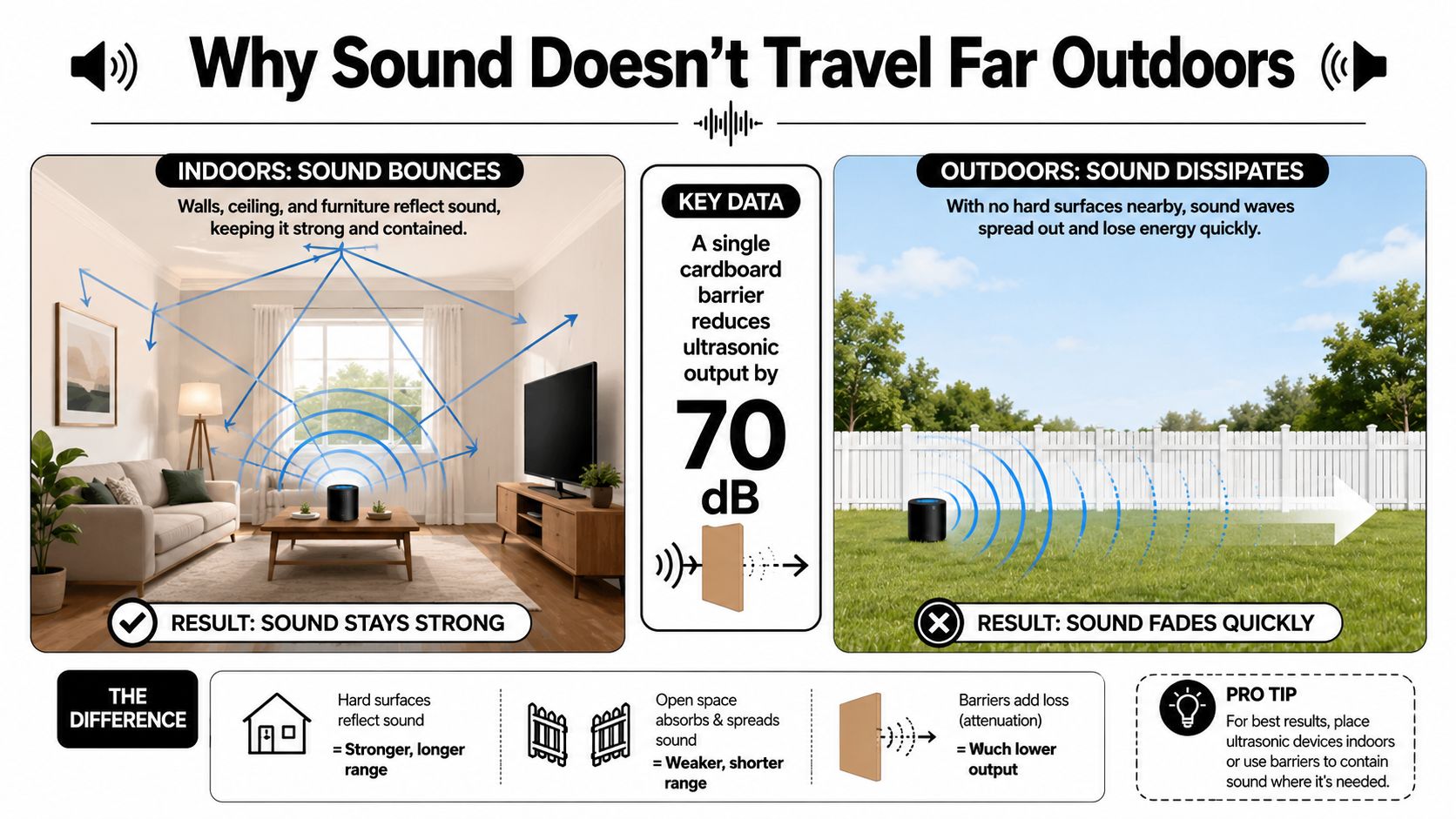
A yard in Crown Point is not a sealed room. That's the first thing product pages leave out. Sound outdoors gets interrupted, scattered, and weakened by whatever is in the way, and the published acoustical testing backs that up. In a classic evaluation of commercial ultrasonic pest devices, a single 0.30 cm cardboard barrier reduced output by about 70 dB, and the devices underperformed manufacturer claims in both intensity and peak frequency regions.
That matters because real yards are full of barriers. Siding, fences, patio furniture, shrubs, garden sheds, and even simple changes in layout can break the line of sight. Add wind and humidity, and the actual coverage gets smaller and more uneven than the box suggests. The result is dead zones, which is exactly where pests keep moving.
What “coverage” really means outdoors
A lot of shoppers read a square-foot claim and assume it means a hard perimeter. It doesn't. It usually assumes open air, clean sightlines, and ideal placement that most Northwest Indiana properties don't have. The practical range is far more variable than the packaging implies.
Newer models with solar charging, motion activation, and multi-directional emitters can improve convenience. They can also make installation easier. But convenience is not the same as outcome data, and independent proof that those features cut pest activity outdoors is still thin.
Homeowner rule: if the environment can block, absorb, or scatter the sound, the device's real-world coverage is already compromised.
That's why “how far does it reach?” is the wrong question by itself. The better question is whether the yard has enough open, unobstructed space for the device to matter at all. In most Crown Point yards, the answer is no.
The Honest Pros and Cons for Homeowners
Here's the fair version, not the sales version. These devices do have some appeal, but the tradeoffs are real, and every Crown Point homeowner should weigh them before buying.
What makes people keep trying them
- Low chemical footprint: Some families want to avoid sprays first, and a plug-in unit feels cleaner than a yard treatment.
- Low maintenance: Once installed, there's little day-to-day effort.
- No bait or poison handling: That matters for homes with children, pets, or frequent guests.
- Simple setup: Many units are easy to stake in the ground or plug into a weatherproof outlet.
Those are real conveniences. They explain why ultrasonic devices still show up on patios, porches, and garden edges even after the science let them down.
Where they fall short
- Weak evidence base: University extension sources keep saying the products have not been shown effective, and the broader study record is not encouraging.
- Fast habituation: Rodents can get used to the sound quickly, so any early reaction may not last.
- Inconsistent outdoor coverage: The yard environment works against the device.
- Questionable marketing history: The University of Arizona Cooperative Extension notes the FTC charged several companies with false advertising in the 1980s and required refunds.
- Possible sound exposure concerns: Cornell's IPM note says some devices exceed OSHA limits for human tolerance of sound exposure.
- Cost versus payoff: A device can cost enough to feel like a wasted service call if it doesn't change the pest pressure.
That is the comparison hardware stores rarely walk through with customers. If your main goal is peace on the patio, a little less hassle, and fewer bugs at dusk, a gadget with shaky performance is a poor bet.
If You Still Want to Use One, Do It This Way
A homeowner who already owns one should at least use it intelligently. Put it where the manufacturer can't pretend the environment is perfect. That means a weatherproof outlet, clear line of sight to the area where pests travel, and placement away from dense vegetation whenever practical.
Stake-mounted units make more sense when a cord would otherwise stretch across a walkway. Solar units can work for convenience, but the panel needs to stay clean, and batteries still need seasonal checks. Do not bury the device under snow, leaves, mulch, or patio clutter and expect it to perform.
Use it as a supplement, not a shield
The better setup is still the boring one that works:
- Remove standing water so mosquitoes have fewer breeding spots.
- Trim vegetation away from the home so pests lose cover near entry points.
- Seal gaps and cracks where rodents and insects get inside.
- Clear leaves and clutter where ticks and other pests hide.
- Use the device only as a secondary layer if you insist on keeping it.
That is the smartest way to think about it. A repeller might sit in the mix, but it does not replace exclusion, sanitation, or targeted treatment. For homeowners comparing device promises with a structured prevention plan, The Green Advantage's integrated pest management approach fits the way real yards work.
If the goal is a patio that stays usable, the device is a maybe. The habitat work is the part that matters.
What Actually Works in Northwest Indiana Yards
Start with the stuff pests are already using
Source reduction comes first because pests need something to live on, drink, or hide in. For mosquitoes, standing water is the obvious target. For raccoons and other nuisance wildlife, unsecured trash and pet food are invitations. For ticks, leaf litter and thick ground cover create the kind of edge habitat they love.
Block the easy entry points
Exclusion is the next layer. Seal gaps around the foundation, repair torn screens, install door sweeps, and close up vents that don't need to stay open. That works because it attacks access instead of hoping pests will get uncomfortable and leave on their own. If rodents are finding their way into a garage or crawl space, the problem gets real.
Use direct control where it fits
Mechanical traps and other targeted methods are still the right call for many rodent problems. They are not flashy, but they're direct. For mosquitoes, professional reduction programs can reduce pressure around outdoor living areas, especially when paired with habitat cleanup and smart placement around the property.
The Green Advantage offers mosquito control, rodent control, commercial pest control, and residential pest control for Crown Point and surrounding Northwest Indiana properties. It also handles pest inspections and preventive service plans, which matters when the issue is seasonal and keeps coming back.
Bottom line: the winning plan is layered. One gadget cannot do the job of source reduction, exclusion, and targeted treatment.
If you want fewer ants in spring, fewer spiders in corners, fewer wasps around eaves, and fewer rodent headaches going into fall, the fix is a consistent service plan, not a box that hopes pests hate sound enough to move out.
Talk to a Crown Point Pest Pro Before You Buy Another Gadget
If you've read this far, you probably aren't just curious. You're tired of mosquitoes chewing up the yard, worried about rodents in the garage, or trying to protect a property before a sale or inspection. That's exactly when a local pro makes more sense than another device on the patio.
The Green Advantage works the way busy homeowners need. You call once, reach knowledgeable office staff, and get scheduled without a lot of back-and-forth, which is more practical than waiting on generic pest control receptionist solutions that don't know your property. Then a technician comes out, checks the site, and builds a treatment plan around what's happening there, not around a one-size-fits-all package.
That matters for pest control in Crown Point, IN because every property is different. Some yards need mosquito reduction. Some homes need rodent exclusion. Some businesses need commercial service plans. And some people just need a pest inspection before a closing so they know what they're walking into.
If you want a real answer instead of a gadget gamble, call The Green Advantage and ask for a pest inspection or quote. You'll get a clear plan for the problem in front of you, not another promise that sound alone will solve it.
If you're ready to stop guessing, visit The Green Advantage and ask for a pest inspection, a quote, or a service plan built for your Crown Point property. The right fix starts with a real look at your yard, your home, and the pests that are present.
How to Keep Mosquitoes Out of Rain Barrel: 2026 Guide
A lot of Crown Point homeowners set up a rain barrel for the right reasons. You want to save water, keep a garden healthy, and make better use of every heavy Northwest Indiana rain. Then a few warm evenings pass, and the same setup that felt smart starts drawing buzzing, biting mosquitoes right where your family wants to relax.
That's the frustrating part about mosquito problems. A rain barrel can look clean, useful, and harmless while still acting like a reliable breeding spot. If you've been searching for how to keep mosquitoes out of rain barrel systems without giving up your garden routine, the answer starts with solid DIY habits. It ends with a bigger view of your whole property.
Your Crown Point Backyard Oasis or a Mosquito Magnet?
A homeowner in Crown Point might spend a Saturday doing everything right. The flower beds are mulched, the vegetable garden is thriving, and the rain barrel is hooked up neatly to the downspout behind the shed. By early evening, the patio should be the best spot in the yard.
Instead, people start swatting.
That's a common pattern in Northwest Indiana. Rain barrels support eco-conscious landscaping, but they also create exactly what mosquitoes look for if the system isn't managed carefully. The problem usually isn't the idea of rainwater collection itself. The problem is that mosquitoes only need access to still water and a small opening.
Why good intentions still lead to bites
Most homeowners don't ignore mosquito prevention. They install a lid, maybe add a screen, and assume they've handled it. Then the bites continue, often because the actual access point isn't obvious. It may be an overflow opening, a loose connection, or a bit of water that never fully drains.
Local reality: In Crown Point, warm weather, summer storms, shaded yards, and dense landscaping give mosquitoes plenty of backup habitat even when the barrel seems like the only issue.
That's why a rain barrel problem rarely stays isolated. The mosquitoes coming from one water source don't stay politely near the spigot. They move into seating areas, around entry doors, and across the whole yard.
Why local help matters
Homeowners searching for pest control near me, exterminator near me, or pest control in Crown Point, IN usually aren't looking for theories. They want a practical fix that protects their home life. Families want to grill, kids want to play outside, and property owners want outdoor spaces to feel usable again.
For mosquito issues, local experience matters because Northwest Indiana yards have recurring patterns. Heavy rainfall, clogged gutters, low spots in turf, ornamental containers, and rain barrels all work together. A company serving this area needs to understand the full picture, not just the single container holding water.
Understanding Why Mosquitoes Love Your Rain Barrel
A rain barrel gives mosquitoes what they need most. It holds water in one place, often in a shaded or partially shaded area, and many setups stay undisturbed for days at a time. That combination is enough to turn a useful gardening tool into a dependable mosquito nursery.
The key timing issue is simple. Rain barrels must be completely drained within five days of filling to prevent standing water from becoming a high-risk breeding habitat, because the mosquito life cycle from egg to adult typically takes 7 to 10 days depending on temperature, as explained in Blue Water Baltimore's rain barrel mosquito guidance.
What happens inside the barrel
Female mosquitoes look for still water where they can lay eggs. Once eggs hatch, larvae stay in the water and continue developing. If the water sits long enough, the cycle keeps moving.
That's why a barrel can become a problem quickly after rain, especially during warm spells in Crown Point. Homeowners often think, “It's just one barrel.” Mosquitoes don't see it that way. They see protected water with very little disturbance.
If you want a broader look at how standing water drives yard infestations, The Green Advantage's mosquito breeding and mosquito control guide is a useful companion resource.
Why this gets worse in Northwest Indiana
A rain barrel doesn't sit in isolation. In many Crown Point yards, it sits near shrubs, fences, mulch beds, and shaded corners that give adult mosquitoes places to rest during the day. After they emerge, they already have shelter nearby.
Here's where homeowners often underestimate the problem:
- Warm weather speeds activity. Mosquito development and feeding pressure increase during the season when families spend the most time outdoors.
- Storm cycles refill the problem. A barrel that was safe one week can become risky again after the next heavy rain.
- Backyards add support habitat. Gutters, toys, planters, tarps, and low spots can keep the local mosquito population going even if one source is addressed.
Mosquito control works better when you treat the barrel as one part of a yard-wide system, not the whole system.
That shift in thinking matters. If your goal is learning how to keep mosquitoes out of rain barrel setups, the first step is understanding that the water itself is only part of the issue. The second step is making sure every opening, every maintenance habit, and every surrounding condition supports prevention.
First-Line Defense A Homeowner's Guide to Rain Barrel Safety
The most effective DIY prevention starts with blocking access, treating water when needed, and keeping the barrel from holding old water. Homeowners can make real progress with a few disciplined habits, especially when they focus on details instead of assumptions.
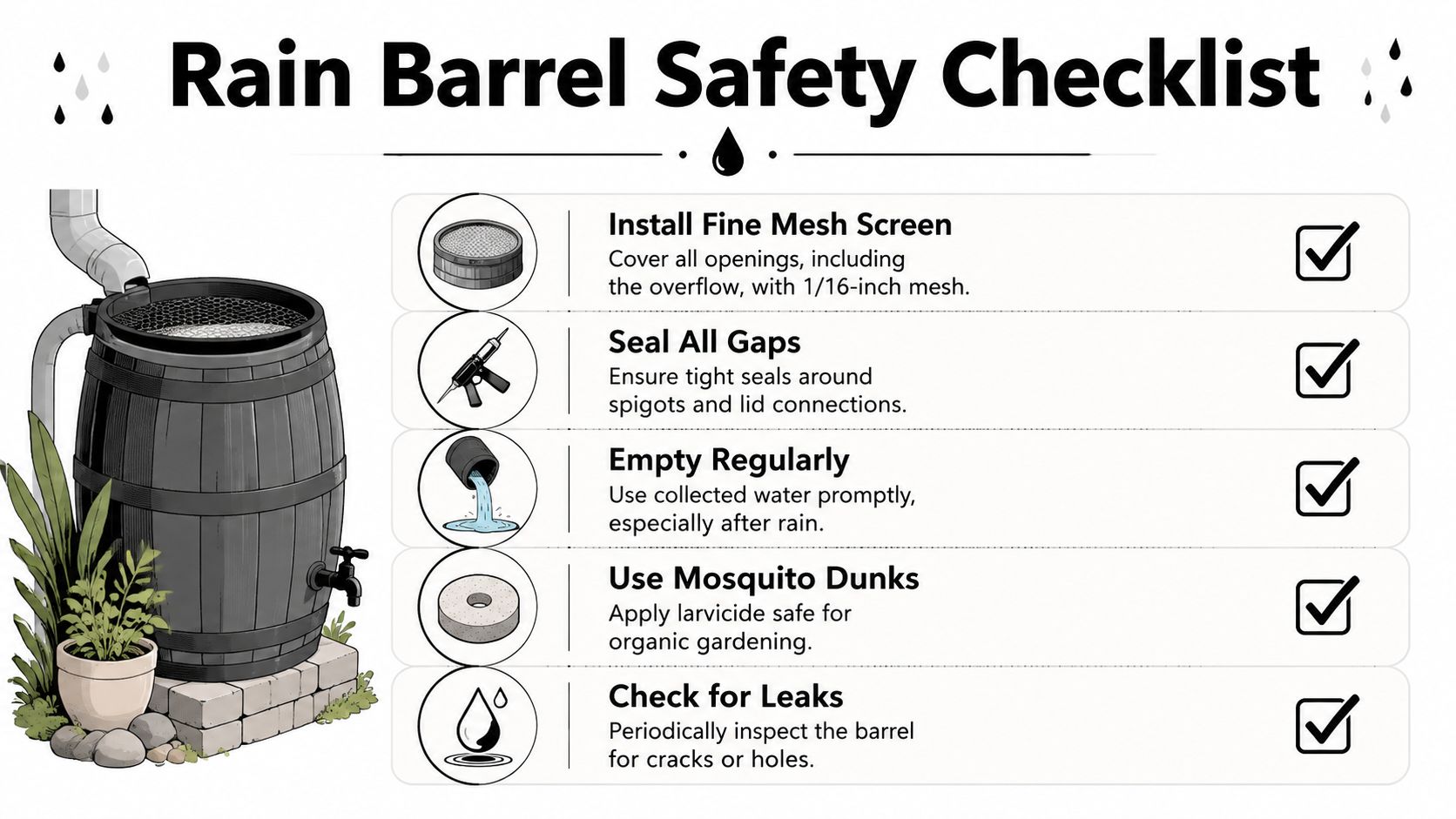
Start with the screen, not guesswork
A lid alone isn't enough if mosquitoes can get through the mesh or around it. Mosquito presence in rain barrels is reduced by over 90% when a mesh covering with a 1/16-inch (about 1.6 mm) aperture is installed over the lid, according to the University of Illinois rain barrel guidance. That size matters because smaller mosquito species can pass through standard window screen mesh.
Use that fact as your baseline standard, not as an upgrade.
What to check on the barrier side
- Use the right mesh size. Install 1/16-inch mesh over the lid opening, not standard window screen.
- Cover every opening. The overflow port, intake points, and any access holes need the same level of protection.
- Tighten the fit. A high-quality screen won't help if edges lift or gaps form around the frame.
Practical rule: If a mosquito can reach the water from any opening, the barrel is still vulnerable.
A lot of DIY setups fail because the homeowner screens the obvious opening and misses the smaller one.
Here's a visual walkthrough to reinforce the basics before you inspect your own setup:
Use BTI correctly
If your barrel regularly holds water, Bacillus thuringiensis israelensis, or Bti, is one of the most practical larval control tools available. Vector control guidance says Bti products such as mosquito dunks or bits eliminate 95 to 100% of mosquito larvae in rain barrels when applied at one dunk, about 4 grams, per 50 to 100 gallons of water monthly, according to San Diego County rain barrel mosquito prevention guidance.
Bti works on mosquito larvae in the water and is described there as non-toxic to humans, pets, plants, and wildlife. That makes it a solid fit for homeowners using collected rainwater in garden beds.
If you want product-specific guidance before you buy, this mosquito dunks overview from The Green Advantage helps explain what to look for.
Keep water moving out, not sitting in
Drain and use the water promptly after rain. The most effective barrel is the one that doesn't sit full for long periods. If your gardening routine doesn't use the stored water often enough, the system may be oversized for how your household operates.
A simple maintenance routine usually looks like this:
- Inspect after every rainfall. Check the lid, screen, overflow area, and spigot connections.
- Use the stored water quickly. Don't let the barrel become a long-term holding tank unless it's managed consistently.
- Reapply Bti on schedule. Follow the label and your barrel volume carefully.
DIY rain barrel safety can work. It just works best when homeowners stay exact about the details.
When DIY Isn't Enough The Hidden Risks You Might Miss
Many online guides make rain barrel mosquito control sound simple. Screen the lid, drop in a dunk, and move on. In practice, that's where a lot of homeowners get tripped up.
The missed issue is often residual water. The BlueBarrel rain barrel mosquito article points out that water trapped below outflow valves or in decorative top depressions can create hidden breeding zones, even when the lid is screened. In other words, a barrel can look protected from the top while still holding mosquito-friendly water elsewhere in the design.
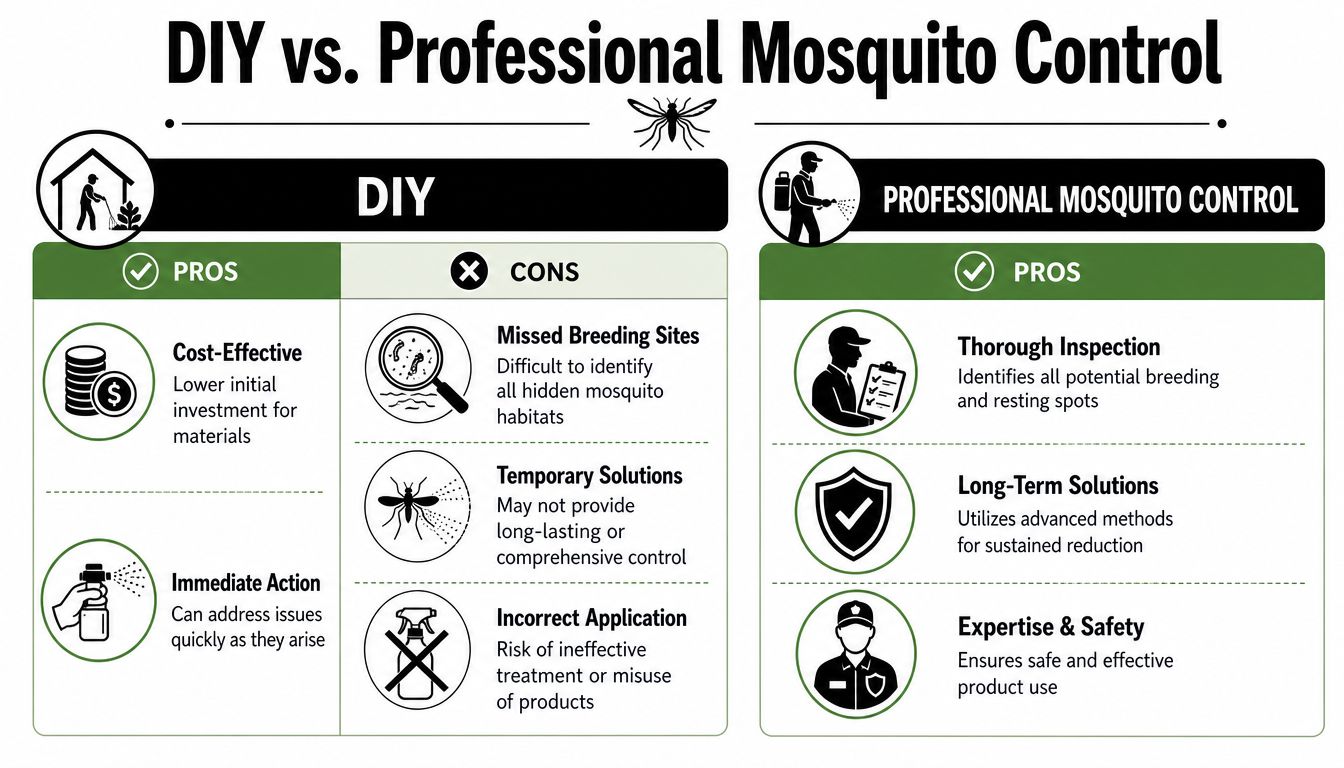
The failure points homeowners overlook
A barrel doesn't have to be obviously open to become a problem. Small mechanical details matter.
| Hidden issue | Why it causes trouble |
|---|---|
| Overflow ports | Mosquitoes may access water if these openings aren't screened securely |
| Water below the spigot | The barrel may appear drained while a small pocket of water remains |
| Top depressions | Certain designs hold water above the main chamber |
| Loose fittings | Tiny gaps around connections can defeat otherwise careful screening |
That's why some homeowners feel like they're doing everything right and still getting bitten.
BTI has a limit
Bti targets larvae. It does not solve every water-quality issue inside a barrel. Homeowners sometimes notice stagnant water starts smelling unpleasant, especially when organic debris builds up and oxygen levels drop. That rotten-egg type odor pushes people to look for aeration or other maintenance changes, because larval control alone doesn't make stored water fresher.
A rain barrel can be mosquito-managed and still be poorly maintained.
That distinction matters. DIY steps are useful, but they're narrow. They address one part of one breeding site. They don't inspect nearby gutters, shaded puddling, clogged drains, or dense foliage where adult mosquitoes rest during the day.
For many homeowners in Crown Point, that's the turning point. The issue isn't whether DIY advice is wrong. It's that mosquitoes exploit the small things that are often overlooked during routine checks.
A Comprehensive Mosquito Control Plan for Your Indiana Home
A well-maintained rain barrel is a smart start. It isn't a full mosquito control program.
If mosquitoes are active across your yard, the barrel may be one contributor among many. Northwest Indiana properties often have several repeat problem areas at the same time. Gutters hold water after storms, low spots stay damp, kids' items collect rain, and thick shrubs give adult mosquitoes daytime shelter. Sealing one container won't remove pressure from the rest of the property.
What a property-wide approach looks like
Professional mosquito control works better when it combines inspection, habitat reduction, and targeted treatment. For homeowners seeking residential pest control, that means looking beyond visible water and asking where mosquitoes are breeding, where they're resting, and why the property keeps supporting them.
A complete plan typically includes:
- Yard inspection. Identify standing water sources, drainage trouble spots, and shaded resting areas.
- Prevention guidance. Correct barrel issues, gutter problems, and routine moisture traps around the home.
- Targeted mosquito reduction. Address active mosquito pressure where people use the yard.
- Seasonal follow-up. Recheck conditions as weather patterns change.
This is also where broader pest management matters. Homes that need mosquito help often benefit from other preventative pest treatments at the same time, especially when dense landscaping, moisture, and exterior clutter also support spiders, wasps, ants, or rodents. For businesses and shared properties, the same logic extends to commercial pest control programs that protect entrances, outdoor common areas, and customer-facing spaces.
Why local service beats one-size-fits-all advice
In Crown Point, IN, mosquitoes respond to local weather, yard layout, and how each property drains after rain. A generic checklist won't tell you which low corner of the fence line stays wet longest or which shrub mass is holding the most adult activity.
That's where The Green Advantage fits. Their mosquito control service can be used alongside homeowner maintenance steps such as proper screening and Bti use, while also addressing the broader outdoor conditions that a rain barrel guide alone won't solve.
Peace of mind usually comes from layered control, not a single product or a single fix.
That's the difference between searching for exterminator in Crown Point, IN and buying one more DIY item. One path gives you tools. The other gives you a plan.
Enjoy Your Yard Again with The Green Advantage
Individuals don't contact a pest company because they enjoy talking about insects. They call because mosquitoes are changing how they live at home. The patio goes unused. Kids come inside covered in bites. Even basic yard work becomes miserable.
That's why professional mosquito control has value beyond convenience. It helps protect comfort, routine, and confidence in your own outdoor space. Homeowners looking for pest control near me or exterminator near me usually want a clear answer to one question. Can someone help me get this under control without turning it into a full-time job?
What working with a local pest professional should feel like
The process should be simple and direct.
First, the property needs a careful review. That includes the rain barrel, but it shouldn't stop there. A serious inspection also looks at drainage patterns, vegetation, recurring moisture points, and other breeding or resting sites around the home.
Second, you should get practical recommendations that match how you use your yard. Some families need a stronger focus on patio and play areas. Some properties need more prevention work near landscaping and structures. For landlords and local businesses, the priority may be keeping shared outdoor areas more usable and reducing complaints.
Thorough service matters when the barrel is already active
When larvae are already present or the water smells foul, the proper mechanical response is immediate. The San Gabriel Valley Mosquito and Vector Control District rain barrel guidance says to remove 100% of the water and scrub the interior walls with a scrub pad and warm, soapy water to detach mosquito eggs that stick to the barrel sides.
That kind of detail matters because mosquitoes don't only rely on what's floating in the water today. They take advantage of what remains stuck to surfaces and what gets overlooked during cleanup.
Homeowners get better results when they stop treating mosquito activity as a one-time annoyance and start treating it like an outdoor pest issue that needs structure.
For families in Crown Point and nearby Northwest Indiana communities, the right solution is usually a blend of good homeowner habits and consistent local expertise. That applies whether you're dealing mainly with mosquitoes or also need support with spider control, wasp removal, ant control, rodent control, or other seasonal pest issues around the property.
If you want your yard back, the next step isn't complicated. Get the problem inspected, get a realistic plan, and stop letting one overlooked water source dictate how your family uses the outdoors.
If mosquitoes are taking over your yard in Crown Point, IN or nearby Northwest Indiana communities, contact The Green Advantage to schedule a pest inspection or request a quote. Whether you need help with a rain barrel issue, ongoing mosquito control, residential pest control, or commercial pest control, you'll get clear guidance, practical solutions, and a service plan built for your property.
Can Pest Control Get Rid of Rats? Expert Solutions 2026

Yes, pest control can get rid of rats, but lasting control usually takes more than traps or bait alone. Rats can enter through openings greater than 1/2 inch, and removed rats can be replaced by new ones within about 4 weeks if the home isn't sealed and cleaned up, so the permanent fix is a professional plan that combines removal, exclusion, sanitation, and follow-up.
If you're hearing scratching in the walls at night, finding droppings in the garage, or noticing something got into pet food, your concern is justified. Rat problems feel personal fast. They affect how safe your home feels, how comfortably you sleep, and whether you trust what's happening behind the walls.
In Crown Point and nearby Northwest Indiana communities, the answer to "can pest control get rid of rats" isn't just yes. It's yes, if the job is done completely. A few traps in the attic might catch some activity. They won't solve the reason the rats got in, why they stayed, or what will bring the next group back.
Answering Your Rat Concerns in Crown Point IN
Homeowners usually call about rats after the problem has already crossed a line. They hear movement overhead. They find droppings under the sink. They smell something stale in a crawl space or utility area. At that point, homeowners want one thing. They want the rats gone, and they want to know they aren't coming right back.
That's a reasonable expectation, but the method matters. Professional rat control works when it treats the infestation as both a population problem and a building problem. If you only remove rats, you get temporary relief. If you remove rats and block access, you give your home a real chance to stay clear.
What homeowners usually mean by get rid of rats
Homeowners aren't asking whether a trap can catch a rat. They're asking whether their house can be made safe again. They want the noise gone, the contamination cleaned up, the risk reduced, and the repeat problem prevented.
That's where professional service separates itself from trial-and-error DIY work.
Practical rule: If the plan doesn't include entry-point sealing and cleanup guidance, it isn't a permanent rat solution.
A complete rat control strategy usually includes:
- Inspection of active areas so the technician can identify travel routes, nesting zones, and structural gaps.
- Targeted population reduction using the right devices in the right locations, rather than random trap placement.
- Exclusion work to close off access points around the structure.
- Sanitation and habitat correction so rats have less reason to stay near the property.
- Monitoring and follow-up to confirm the problem is resolved.
Why local experience matters in Crown Point
Northwest Indiana properties present a mix of conditions that make rodent control more than a one-visit service. Older homes may have settled gaps, worn door sweeps, or utility penetrations that open over time. Newer construction can still leave hidden voids, unfinished transitions, or landscaping that gives rodents cover close to the house.
That's why homeowners looking for pest control near me, exterminator near me, or pest control in Crown Point, IN should ask a simple question before hiring anyone. Are they just removing rats, or are they solving the access and attractant issues too?
The right answer should reassure you. Rat control can work. It just has to be thorough.
The Reality of Rat Infestations in Northwest Indiana
Rats are persistent because our homes give them exactly what they need. Warm shelter, hidden voids, accessible food, and quiet travel routes around foundations, garages, crawl spaces, and rooflines. In Crown Point and nearby Northwest Indiana areas, seasonal weather shifts also push rodents toward structures when outdoor conditions get harder.
A rat problem is never just about seeing one animal. It's about what that activity means for the property. Rats contaminate spaces they travel through, chew materials they encounter, and settle where people rarely look until damage is already underway.
Why infestations keep returning
The biggest mistake homeowners make is assuming visible rat activity is the entire problem. It usually isn't. The larger issue is that many properties stay open to reinfestation.
Guidance summarized in the verified data notes a key reality for areas like Northwest Indiana. Even after a major reduction in activity, reinfestation can happen quickly from nearby outside populations if owners don't seal openings larger than 1/2 inch and remove exterior food sources. That same verified data also states that IPM-focused service reduces long-term regression by 40% compared with bait-only approaches.
In plain language, that means a bait-only fix can leave the door open for the next wave.
If you're seeing droppings, rub marks, gnawing, or nighttime sounds, it helps to compare those clues with common signs of rodent infestation before the issue spreads deeper into the structure.
What rats damage inside a home
The visible mess is only part of it. The more serious concern is what happens out of sight.
| Problem area | What homeowners often notice |
|---|---|
| Attics and wall voids | Scratching sounds, disturbed insulation, odor |
| Kitchens and pantries | Droppings, gnawed packaging, contamination |
| Garages and storage areas | Shredded materials, activity along edges and corners |
| Utility zones | Chewing on soft materials around lines and openings |
Rats don't need a dramatic opening or a large nest site. They need a repeatable route, a food source, and enough cover to move unnoticed.
Why DIY usually stalls out
Store-bought traps can remove individual rats. They rarely correct the conditions that made the infestation possible. Homeowners also tend to place traps where it feels logical to them, not where rodents travel.
Rats are cautious around new objects. That hesitation is one reason control isn't instant, and it's one reason scattered DIY efforts often produce inconsistent results. In rodent work, speed matters less than precision.
How Professional Pest Control Gets Rid of Rats for Good
Long-term rat control follows a system. The most reliable model is Integrated Pest Management, usually shortened to IPM. That approach combines inspection, proofing, sanitation, and targeted removal instead of relying on poison or traps alone.
Here's the process at a glance.
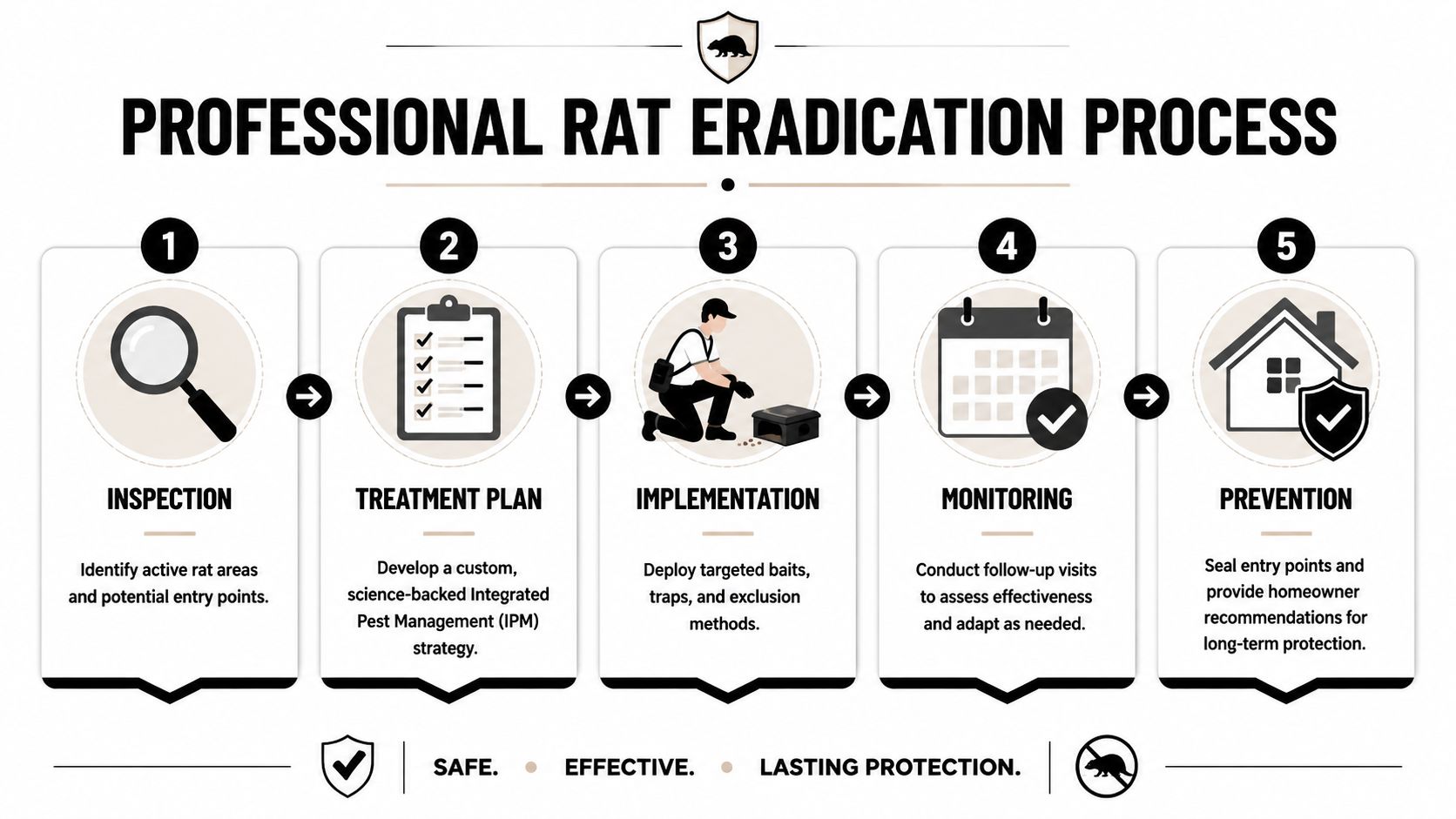
Inspection comes first
A technician starts by finding out where rats are active, how they're getting in, and what is sustaining them. That means checking foundations, garage edges, roof transitions, vents, utility entries, crawl spaces, attics, and exterior conditions that may support nesting or travel.
Many failed treatments fall apart due to the following reason. If nobody identifies the actual access points, the service only addresses symptoms.
Industry guidance supports that approach. professional rat control guidance notes that rats can enter through openings greater than 1/2 inch and emphasizes exclusion, sanitation, vegetation management, clutter removal, and traps as part of a customized plan.
Exclusion is what makes it last
Removing rats without sealing the building is temporary. Proofing is what turns a treatment into a long-term solution.
Texas A&M IPM guidance states that effective rodent control requires sanitation, structural exclusion, and population control together, and it recommends sealing openings larger than 1/4 inch in areas such as foundations, walls, fascia, and roofs, along with screening vents and installing door sweeps. That same guidance also notes that traps work best when placed along runways with the trigger side against the wall.
That's the difference between random placement and professional placement.
A rat program starts working faster when the house stops functioning like a shelter.
A complete proofing plan may include:
- Sealing gaps at utility penetrations where pipes or lines pass through walls
- Correcting door and garage thresholds that leave space at the bottom edge
- Screening vulnerable vent openings with durable materials
- Cutting back heavy vegetation and clutter that give rodents protected travel lanes
For homeowners searching for residential pest control or exterminator in Crown Point, IN, this is the part to ask about in detail.
The Green Advantage provides rodent control service in Crown Point and surrounding Northwest Indiana with that broader inspection-and-exclusion focus, rather than treating rodent activity like a simple trap placement problem.
After the inspection and proofing discussion, it helps to see the process in action.
Removal and monitoring finish the job
Once access and attractants are addressed, targeted traps or bait stations can do their job more effectively. Devices are placed where rats already travel, not out in the middle of open spaces where they're more likely to avoid them.
Monitoring matters because rat control is rarely instant. Activity usually declines in stages. A technician checks what's working, adjusts placements, confirms whether entry points remain secure, and decides whether more follow-up is needed.
That steady, methodical approach is how professional pest control gets rid of rats for good.
Your Rat Control Service What to Expect
Most homeowners feel better once they know what the process looks like. Rat work should feel organized, not mysterious. You should know what happens first, what happens next, and why the issue may take more than one visit to close out properly.
The first contact usually starts with symptoms. You describe noises in the attic, droppings in the pantry, activity in the garage, or concern around a crawl space. From there, the appointment focuses on confirming the level of activity, identifying likely access points, and mapping out a practical treatment plan.
The first visit
The first service is about diagnosis and action. The technician inspects the problem areas, looks for entry routes, checks for conditions that support rats, and determines where control devices should go.
Some homes need immediate population reduction. Others reveal a clear structural issue first, such as an unsealed utility line opening, a worn sweep, or a vent that needs attention. Good rodent work isn't one-size-fits-all.
Here's what a homeowner can usually expect during that stage:
- A detailed walkthrough of active and vulnerable areas.
- An explanation of findings in plain language, without guesswork.
- A treatment recommendation that balances removal with exclusion and cleanup priorities.
- Clear next steps so you know what changes should happen between visits.
The goal of the first appointment isn't to create the appearance of action. It's to start the right sequence of action.
Why follow-up isn't optional
One of the most important facts homeowners should understand comes from a large field study on rat control. That study found short-term reductions in rat activity with professional control methods, but it found no evidence of a longer-term effect on rodent abundance in houses versus untreated sites unless prevention and follow-up were part of the process. Researchers also concluded that removed rats tend to be replaced by incoming rats within about 4 weeks and reported that after 5 months of intermittent control there was no evidence of increased reproduction in treated in-house populations, reinforcing that the core issue is replacement from outside rather than a simple rebound inside the same home. You can review that study in the Madagascar field research on rat control outcomes.
That finding lines up with what technicians see in the field. If a home remains accessible, surrounding rat pressure can refill the vacancy.
What success looks like
Success doesn't always mean every sign disappears overnight. It means the pattern changes in the right direction. Noise drops off. Fresh droppings stop appearing. Devices show declining activity. Exterior vulnerabilities are corrected. Follow-up confirms the house is no longer easy to enter.
For commercial pest control accounts, rentals, and occupied homes, communication matters just as much as treatment. Property owners need realistic timelines, practical housekeeping guidance, and a clear understanding of what has been corrected and what still needs attention.
That's how you turn a stressful rodent problem into a controlled process.
Protecting Your Home Beyond Rodent Control
A rat entry point is usually more than a rat issue. The same gaps around doors, vents, siding lines, and utility penetrations can also invite ants, spiders, and other pests that show up throughout the year in Northwest Indiana. When a home gets tighter and cleaner from a rodent exclusion project, the benefit often extends well beyond rodents.
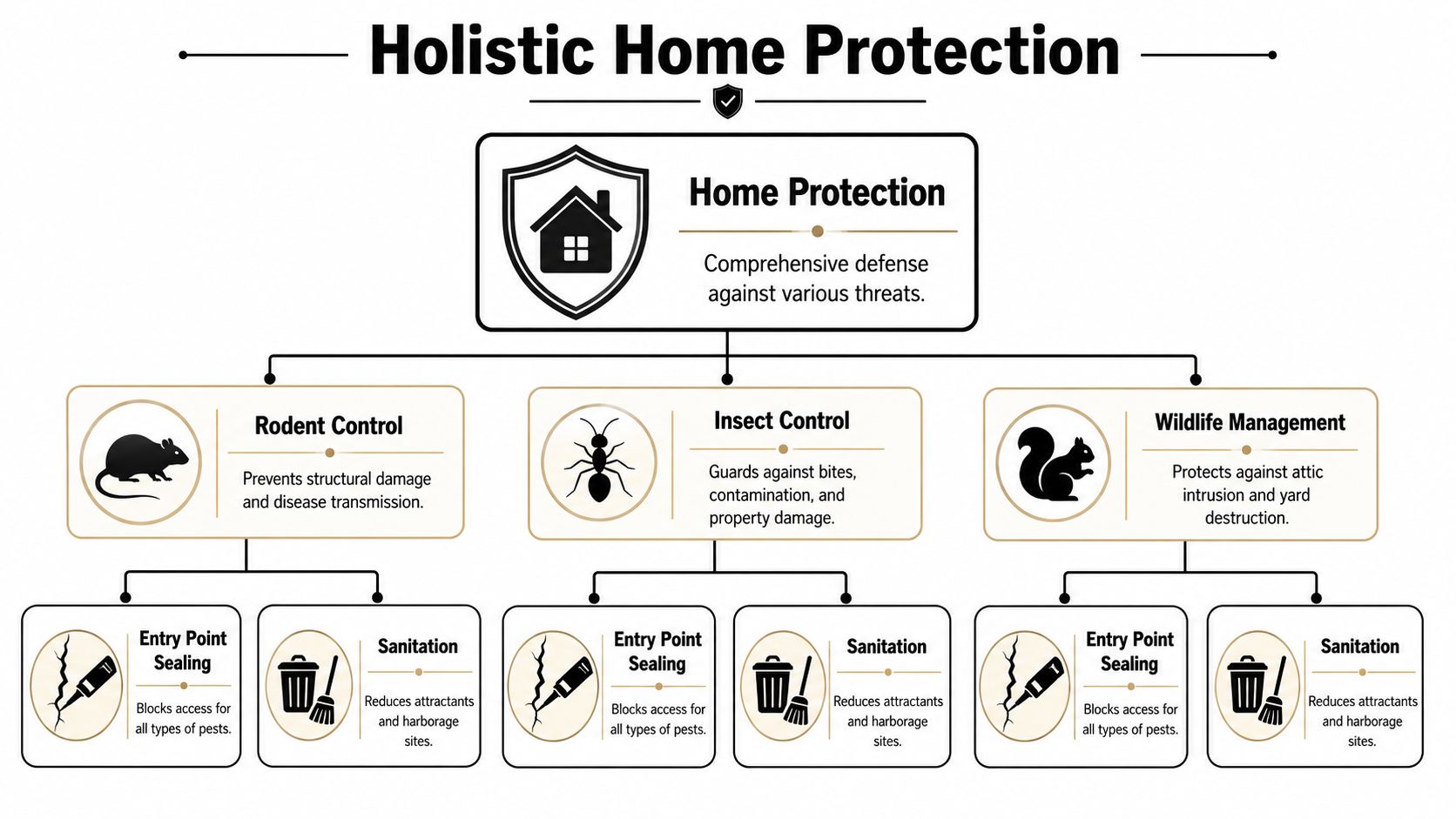
That's why smart pest management isn't just about solving the urgent problem in front of you. It's about reducing the property conditions that attract multiple pest types at once.
Exclusion helps more than one pest category
Verified data for this article includes an important point for homeowners with kids or pets. Emerging data from 2025 shows that exclusion-based methods such as sealing cracks and installing door sweeps prevent 65% of new infestations without poison. That's especially relevant for families who want a more environmentally mindful path and want to understand the role of proofing, not just products.
If you want to learn more about that style of service, this page on eco-friendly rodent control is useful background.
A broader protection plan may include:
- Rodent exclusion to block attic, crawl space, garage, and wall access
- General pest prevention for seasonal invaders such as ants, spiders, and wasps
- Moisture and structure awareness because damp or neglected spaces often support repeat pest pressure
- Yard and perimeter management to reduce sheltered movement close to the home
Crawl spaces and hidden conditions matter
Rodent issues often overlap with moisture, insulation, and air-quality concerns in lower parts of the house. That's one reason homeowners exploring long-term prevention often also look into why crawl space encapsulation matters. A cleaner, drier, better-sealed crawl space can remove shelter conditions that attract pests and make future inspections easier.
The strongest pest barrier usually isn't a product. It's a house that no longer offers easy food, water, and access.
One property plan is better than separate reactions
A homeowner who fixes a rat problem but ignores exterior clutter, unsecured trash, standing moisture, or foundation gaps may end up calling again for a different pest a few months later. A coordinated protection strategy is more efficient. It protects property value, reduces repeat disruptions, and gives you a clearer standard for what “under control” means.
That same thinking applies whether you need rodent control, mosquito control, spider control, or help evaluating a commercial facility. Prevention doesn't just reduce pests. It reduces uncertainty.
Partner with The Green Advantage for a Pest-Free Home
The answer to "can pest control get rid of rats" is yes, but the permanent answer is never just about killing or trapping what you see. It's about closing entry points, reducing attractants, monitoring results, and making the structure harder to invade again.
That matters in Crown Point because homes and businesses here face ongoing pest pressure from changing weather, surrounding habitat, and the simple fact that rodents look for the easiest shelter available. If one property gets cleaned out but stays open, the problem can restart. If the property gets sealed and managed correctly, the odds shift in the homeowner's favor.

Choose a complete solution, not a temporary fix
Whether you're dealing with rats now or trying to prevent the next infestation, look for a service approach that includes inspection, exclusion, sanitation guidance, and follow-up. That same mindset often helps homeowners spot related repair needs too. For example, if rodent activity has led to staining, moisture concerns, or damage around upper levels of the home, these Restore Heroes' ceiling repair tips can help you understand what to check next.
For homeowners searching pest control near me, pest control in Crown Point, IN, or exterminator near me, the right next step is simple. Get the property inspected before the problem spreads deeper into walls, insulation, stored items, or utility areas.
A thorough rat control plan protects more than the house. It protects how you live in it. It helps your family feel comfortable again, lowers the chance of repeat contamination, and gives you a path toward real peace of mind instead of temporary relief.
If you need help with rat control, residential pest control, or commercial pest control in Crown Point and nearby Northwest Indiana communities, contact The Green Advantage to schedule an inspection or request a quote. A clear plan, honest findings, and a long-term prevention strategy can turn a stressful rodent issue into a fixable one.