
Yes, pest control can get rid of rats, but lasting control usually takes more than traps or bait alone. Rats can enter through openings greater than 1/2 inch, and removed rats can be replaced by new ones within about 4 weeks if the home isn't sealed and cleaned up, so the permanent fix is a professional plan that combines removal, exclusion, sanitation, and follow-up.
If you're hearing scratching in the walls at night, finding droppings in the garage, or noticing something got into pet food, your concern is justified. Rat problems feel personal fast. They affect how safe your home feels, how comfortably you sleep, and whether you trust what's happening behind the walls.
In Crown Point and nearby Northwest Indiana communities, the answer to "can pest control get rid of rats" isn't just yes. It's yes, if the job is done completely. A few traps in the attic might catch some activity. They won't solve the reason the rats got in, why they stayed, or what will bring the next group back.
Answering Your Rat Concerns in Crown Point IN
Homeowners usually call about rats after the problem has already crossed a line. They hear movement overhead. They find droppings under the sink. They smell something stale in a crawl space or utility area. At that point, homeowners want one thing. They want the rats gone, and they want to know they aren't coming right back.
That's a reasonable expectation, but the method matters. Professional rat control works when it treats the infestation as both a population problem and a building problem. If you only remove rats, you get temporary relief. If you remove rats and block access, you give your home a real chance to stay clear.
What homeowners usually mean by get rid of rats
Homeowners aren't asking whether a trap can catch a rat. They're asking whether their house can be made safe again. They want the noise gone, the contamination cleaned up, the risk reduced, and the repeat problem prevented.
That's where professional service separates itself from trial-and-error DIY work.
Practical rule: If the plan doesn't include entry-point sealing and cleanup guidance, it isn't a permanent rat solution.
A complete rat control strategy usually includes:
- Inspection of active areas so the technician can identify travel routes, nesting zones, and structural gaps.
- Targeted population reduction using the right devices in the right locations, rather than random trap placement.
- Exclusion work to close off access points around the structure.
- Sanitation and habitat correction so rats have less reason to stay near the property.
- Monitoring and follow-up to confirm the problem is resolved.
Why local experience matters in Crown Point
Northwest Indiana properties present a mix of conditions that make rodent control more than a one-visit service. Older homes may have settled gaps, worn door sweeps, or utility penetrations that open over time. Newer construction can still leave hidden voids, unfinished transitions, or landscaping that gives rodents cover close to the house.
That's why homeowners looking for pest control near me, exterminator near me, or pest control in Crown Point, IN should ask a simple question before hiring anyone. Are they just removing rats, or are they solving the access and attractant issues too?
The right answer should reassure you. Rat control can work. It just has to be thorough.
The Reality of Rat Infestations in Northwest Indiana
Rats are persistent because our homes give them exactly what they need. Warm shelter, hidden voids, accessible food, and quiet travel routes around foundations, garages, crawl spaces, and rooflines. In Crown Point and nearby Northwest Indiana areas, seasonal weather shifts also push rodents toward structures when outdoor conditions get harder.
A rat problem is never just about seeing one animal. It's about what that activity means for the property. Rats contaminate spaces they travel through, chew materials they encounter, and settle where people rarely look until damage is already underway.
Why infestations keep returning
The biggest mistake homeowners make is assuming visible rat activity is the entire problem. It usually isn't. The larger issue is that many properties stay open to reinfestation.
Guidance summarized in the verified data notes a key reality for areas like Northwest Indiana. Even after a major reduction in activity, reinfestation can happen quickly from nearby outside populations if owners don't seal openings larger than 1/2 inch and remove exterior food sources. That same verified data also states that IPM-focused service reduces long-term regression by 40% compared with bait-only approaches.
In plain language, that means a bait-only fix can leave the door open for the next wave.
If you're seeing droppings, rub marks, gnawing, or nighttime sounds, it helps to compare those clues with common signs of rodent infestation before the issue spreads deeper into the structure.
What rats damage inside a home
The visible mess is only part of it. The more serious concern is what happens out of sight.
| Problem area | What homeowners often notice |
|---|---|
| Attics and wall voids | Scratching sounds, disturbed insulation, odor |
| Kitchens and pantries | Droppings, gnawed packaging, contamination |
| Garages and storage areas | Shredded materials, activity along edges and corners |
| Utility zones | Chewing on soft materials around lines and openings |
Rats don't need a dramatic opening or a large nest site. They need a repeatable route, a food source, and enough cover to move unnoticed.
Why DIY usually stalls out
Store-bought traps can remove individual rats. They rarely correct the conditions that made the infestation possible. Homeowners also tend to place traps where it feels logical to them, not where rodents travel.
Rats are cautious around new objects. That hesitation is one reason control isn't instant, and it's one reason scattered DIY efforts often produce inconsistent results. In rodent work, speed matters less than precision.
How Professional Pest Control Gets Rid of Rats for Good
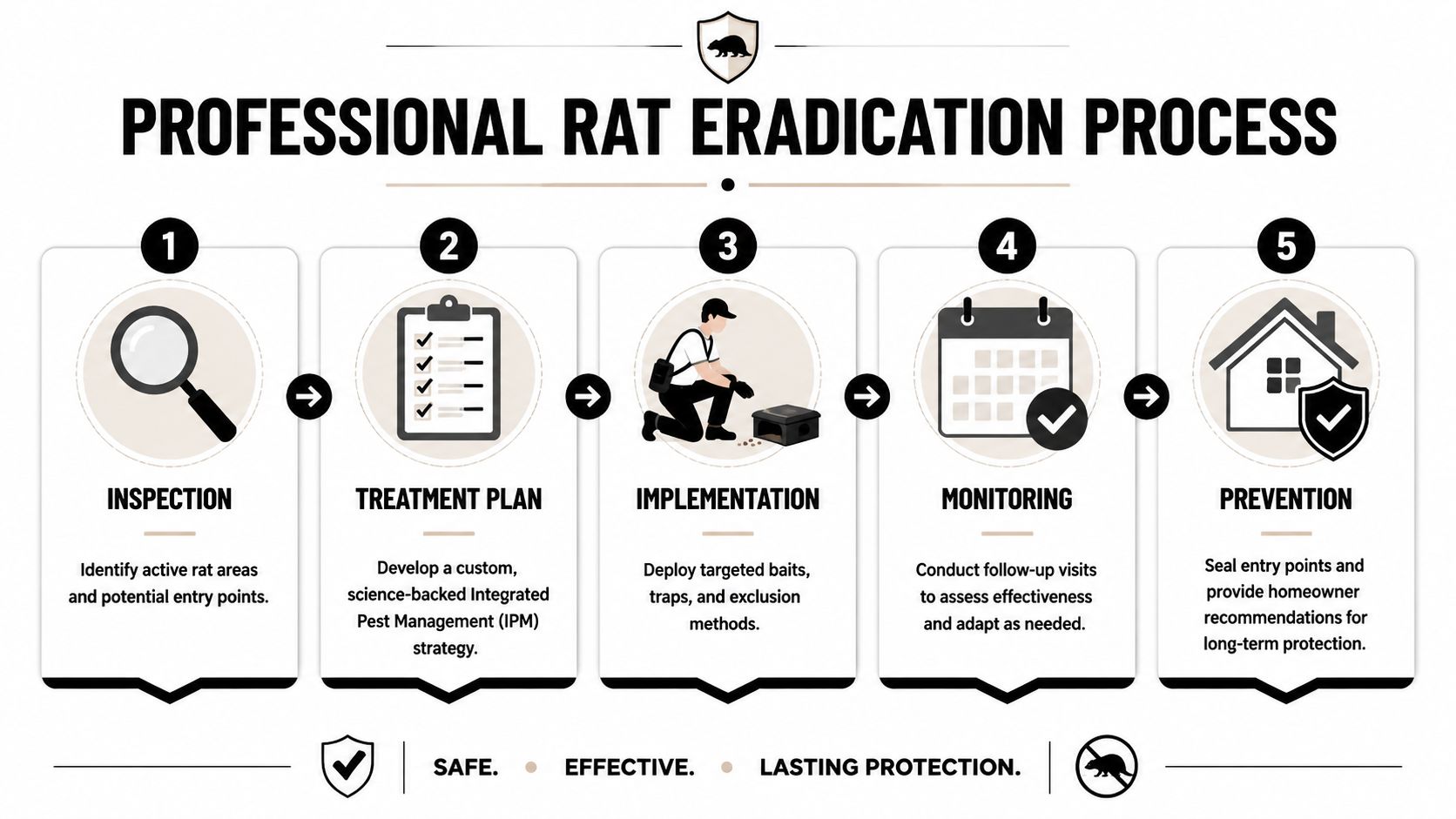
Long-term rat control follows a system. The most reliable model is Integrated Pest Management, usually shortened to IPM. That approach combines inspection, proofing, sanitation, and targeted removal instead of relying on poison or traps alone.
Here's the process at a glance.
Inspection comes first
A technician starts by finding out where rats are active, how they're getting in, and what is sustaining them. That means checking foundations, garage edges, roof transitions, vents, utility entries, crawl spaces, attics, and exterior conditions that may support nesting or travel.
Many failed treatments fall apart due to the following reason. If nobody identifies the actual access points, the service only addresses symptoms.
Industry guidance supports that approach. professional rat control guidance notes that rats can enter through openings greater than 1/2 inch and emphasizes exclusion, sanitation, vegetation management, clutter removal, and traps as part of a customized plan.
Exclusion is what makes it last
Removing rats without sealing the building is temporary. Proofing is what turns a treatment into a long-term solution.
Texas A&M IPM guidance states that effective rodent control requires sanitation, structural exclusion, and population control together, and it recommends sealing openings larger than 1/4 inch in areas such as foundations, walls, fascia, and roofs, along with screening vents and installing door sweeps. That same guidance also notes that traps work best when placed along runways with the trigger side against the wall.
That's the difference between random placement and professional placement.
A rat program starts working faster when the house stops functioning like a shelter.
A complete proofing plan may include:
- Sealing gaps at utility penetrations where pipes or lines pass through walls
- Correcting door and garage thresholds that leave space at the bottom edge
- Screening vulnerable vent openings with durable materials
- Cutting back heavy vegetation and clutter that give rodents protected travel lanes
For homeowners searching for residential pest control or exterminator in Crown Point, IN, this is the part to ask about in detail.
The Green Advantage provides rodent control service in Crown Point and surrounding Northwest Indiana with that broader inspection-and-exclusion focus, rather than treating rodent activity like a simple trap placement problem.
After the inspection and proofing discussion, it helps to see the process in action.
Removal and monitoring finish the job
Once access and attractants are addressed, targeted traps or bait stations can do their job more effectively. Devices are placed where rats already travel, not out in the middle of open spaces where they're more likely to avoid them.
Monitoring matters because rat control is rarely instant. Activity usually declines in stages. A technician checks what's working, adjusts placements, confirms whether entry points remain secure, and decides whether more follow-up is needed.
That steady, methodical approach is how professional pest control gets rid of rats for good.
Your Rat Control Service What to Expect
Most homeowners feel better once they know what the process looks like. Rat work should feel organized, not mysterious. You should know what happens first, what happens next, and why the issue may take more than one visit to close out properly.
The first contact usually starts with symptoms. You describe noises in the attic, droppings in the pantry, activity in the garage, or concern around a crawl space. From there, the appointment focuses on confirming the level of activity, identifying likely access points, and mapping out a practical treatment plan.
The first visit
The first service is about diagnosis and action. The technician inspects the problem areas, looks for entry routes, checks for conditions that support rats, and determines where control devices should go.
Some homes need immediate population reduction. Others reveal a clear structural issue first, such as an unsealed utility line opening, a worn sweep, or a vent that needs attention. Good rodent work isn't one-size-fits-all.
Here's what a homeowner can usually expect during that stage:
- A detailed walkthrough of active and vulnerable areas.
- An explanation of findings in plain language, without guesswork.
- A treatment recommendation that balances removal with exclusion and cleanup priorities.
- Clear next steps so you know what changes should happen between visits.
The goal of the first appointment isn't to create the appearance of action. It's to start the right sequence of action.
Why follow-up isn't optional
One of the most important facts homeowners should understand comes from a large field study on rat control. That study found short-term reductions in rat activity with professional control methods, but it found no evidence of a longer-term effect on rodent abundance in houses versus untreated sites unless prevention and follow-up were part of the process. Researchers also concluded that removed rats tend to be replaced by incoming rats within about 4 weeks and reported that after 5 months of intermittent control there was no evidence of increased reproduction in treated in-house populations, reinforcing that the core issue is replacement from outside rather than a simple rebound inside the same home. You can review that study in the Madagascar field research on rat control outcomes.
That finding lines up with what technicians see in the field. If a home remains accessible, surrounding rat pressure can refill the vacancy.
What success looks like
Success doesn't always mean every sign disappears overnight. It means the pattern changes in the right direction. Noise drops off. Fresh droppings stop appearing. Devices show declining activity. Exterior vulnerabilities are corrected. Follow-up confirms the house is no longer easy to enter.
For commercial pest control accounts, rentals, and occupied homes, communication matters just as much as treatment. Property owners need realistic timelines, practical housekeeping guidance, and a clear understanding of what has been corrected and what still needs attention.
That's how you turn a stressful rodent problem into a controlled process.
Protecting Your Home Beyond Rodent Control
A rat entry point is usually more than a rat issue. The same gaps around doors, vents, siding lines, and utility penetrations can also invite ants, spiders, and other pests that show up throughout the year in Northwest Indiana. When a home gets tighter and cleaner from a rodent exclusion project, the benefit often extends well beyond rodents.
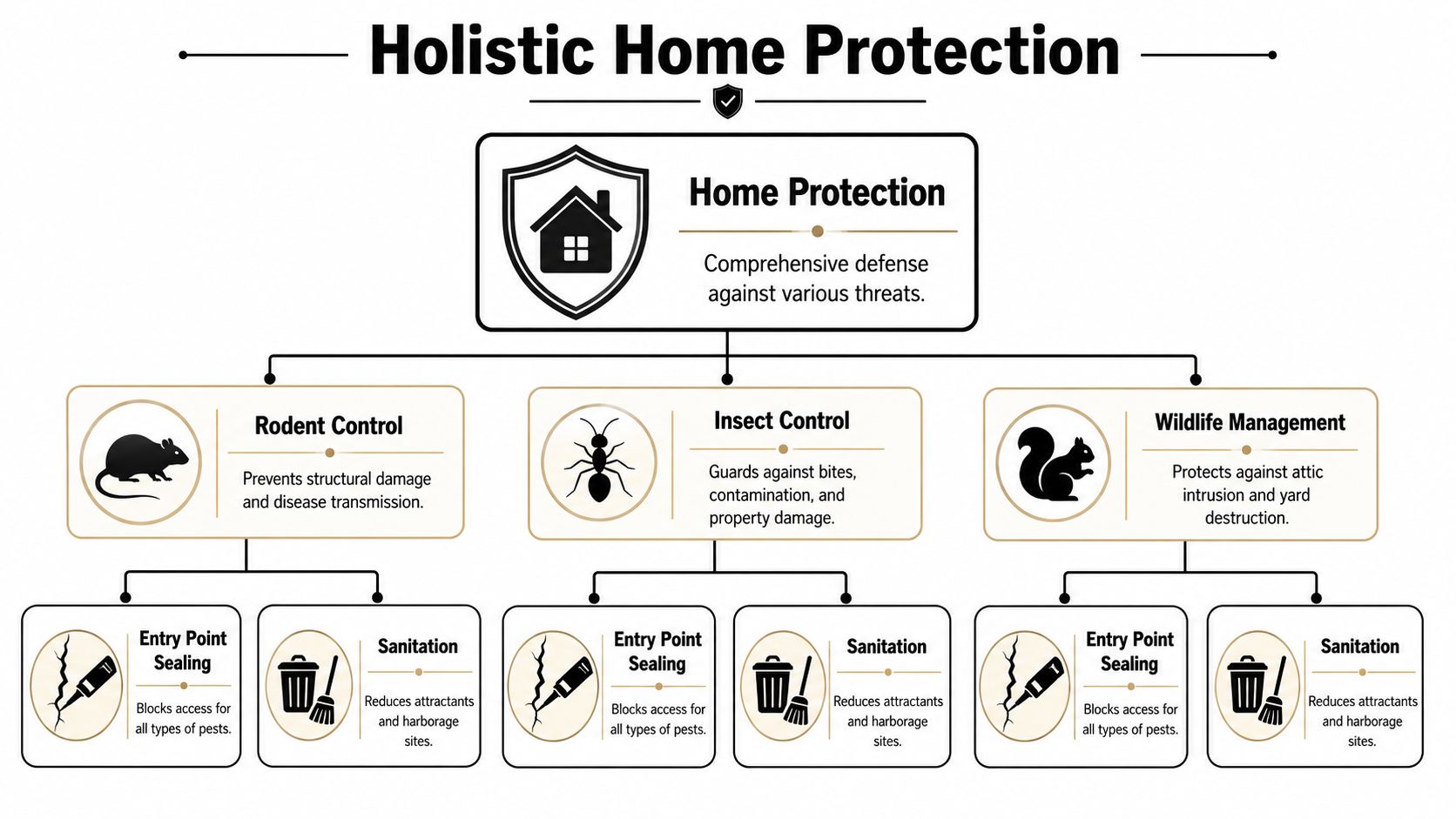
That's why smart pest management isn't just about solving the urgent problem in front of you. It's about reducing the property conditions that attract multiple pest types at once.
Exclusion helps more than one pest category
Verified data for this article includes an important point for homeowners with kids or pets. Emerging data from 2025 shows that exclusion-based methods such as sealing cracks and installing door sweeps prevent 65% of new infestations without poison. That's especially relevant for families who want a more environmentally mindful path and want to understand the role of proofing, not just products.
If you want to learn more about that style of service, this page on eco-friendly rodent control is useful background.
A broader protection plan may include:
- Rodent exclusion to block attic, crawl space, garage, and wall access
- General pest prevention for seasonal invaders such as ants, spiders, and wasps
- Moisture and structure awareness because damp or neglected spaces often support repeat pest pressure
- Yard and perimeter management to reduce sheltered movement close to the home
Crawl spaces and hidden conditions matter
Rodent issues often overlap with moisture, insulation, and air-quality concerns in lower parts of the house. That's one reason homeowners exploring long-term prevention often also look into why crawl space encapsulation matters. A cleaner, drier, better-sealed crawl space can remove shelter conditions that attract pests and make future inspections easier.
The strongest pest barrier usually isn't a product. It's a house that no longer offers easy food, water, and access.
One property plan is better than separate reactions
A homeowner who fixes a rat problem but ignores exterior clutter, unsecured trash, standing moisture, or foundation gaps may end up calling again for a different pest a few months later. A coordinated protection strategy is more efficient. It protects property value, reduces repeat disruptions, and gives you a clearer standard for what “under control” means.
That same thinking applies whether you need rodent control, mosquito control, spider control, or help evaluating a commercial facility. Prevention doesn't just reduce pests. It reduces uncertainty.
Partner with The Green Advantage for a Pest-Free Home
The answer to "can pest control get rid of rats" is yes, but the permanent answer is never just about killing or trapping what you see. It's about closing entry points, reducing attractants, monitoring results, and making the structure harder to invade again.
That matters in Crown Point because homes and businesses here face ongoing pest pressure from changing weather, surrounding habitat, and the simple fact that rodents look for the easiest shelter available. If one property gets cleaned out but stays open, the problem can restart. If the property gets sealed and managed correctly, the odds shift in the homeowner's favor.

Choose a complete solution, not a temporary fix
Whether you're dealing with rats now or trying to prevent the next infestation, look for a service approach that includes inspection, exclusion, sanitation guidance, and follow-up. That same mindset often helps homeowners spot related repair needs too. For example, if rodent activity has led to staining, moisture concerns, or damage around upper levels of the home, these Restore Heroes' ceiling repair tips can help you understand what to check next.
For homeowners searching pest control near me, pest control in Crown Point, IN, or exterminator near me, the right next step is simple. Get the property inspected before the problem spreads deeper into walls, insulation, stored items, or utility areas.
A thorough rat control plan protects more than the house. It protects how you live in it. It helps your family feel comfortable again, lowers the chance of repeat contamination, and gives you a path toward real peace of mind instead of temporary relief.
If you need help with rat control, residential pest control, or commercial pest control in Crown Point and nearby Northwest Indiana communities, contact The Green Advantage to schedule an inspection or request a quote. A clear plan, honest findings, and a long-term prevention strategy can turn a stressful rodent issue into a fixable one.