
You can stand on a Crown Point patio with a drink in one hand and still watch mosquitoes work your ankles like nothing is plugged in at all. That's why outdoor ultrasonic pest control keeps selling. It promises an easy fix, no sprays, no mess, no poison, just a little box and a quieter backyard.
I understand why homeowners keep trying it. A low-chemical option feels safer, especially when the garage has a mouse problem, the deck has mosquitoes, or the fence line keeps attracting ticks and other pests. But the honest question is simple, does the device pull its weight, or is the money better spent on pest control in Crown Point, IN that holds up in the real world?
The Green Advantage has seen these gadgets come and go around Northwest Indiana yards. The pattern doesn't change much. People buy them, hope for a clean perimeter, then call when the insects, rodents, or wildlife never got the memo.
The Patio Problem Every Crown Point Homeowner Knows
A summer evening in Crown Point usually starts the same way. The grill's hot, the kids are outside, the citronella candle is smoking away, and there's a little ultrasonic box glowing near the deck railing. Then the mosquitoes show up anyway, and somebody is back inside swatting at ankles and asking why the “fix” didn't fix anything.
That's the part most shoppers recognize right away. They are not buying a gadget because they love gadgets. They're buying it because they want to keep pests off the patio without turning the yard into a chemical zone. That instinct makes sense, especially for families looking for residential pest control options that feel practical and simple.
Outdoor ultrasonic pest control sits in that exact emotional lane. It sounds modern, discreet, and easy. Plug it in, stake it in the ground, and let the sound do the work. For homeowners searching for pest control near me or an exterminator near me, it looks like a cheap first step before calling a pro.
The problem is that outdoor pests don't care about marketing copy. They respond to food, water, shelter, and access. If a device can't change those conditions, it usually can't deliver dependable control. That's why this topic matters for anyone comparing a patio gadget with real mosquito control, rodent control, or preventative pest treatments.
Practical rule: if a product promises perimeter control outdoors, but it doesn't change the habitat, the result is usually disappointment.
For a yard in Crown Point, the better question isn't whether the box lights up. It's whether it keeps pests from getting comfortable where you live, relax, and entertain.
What Outdoor Ultrasonic Pest Control Actually Does
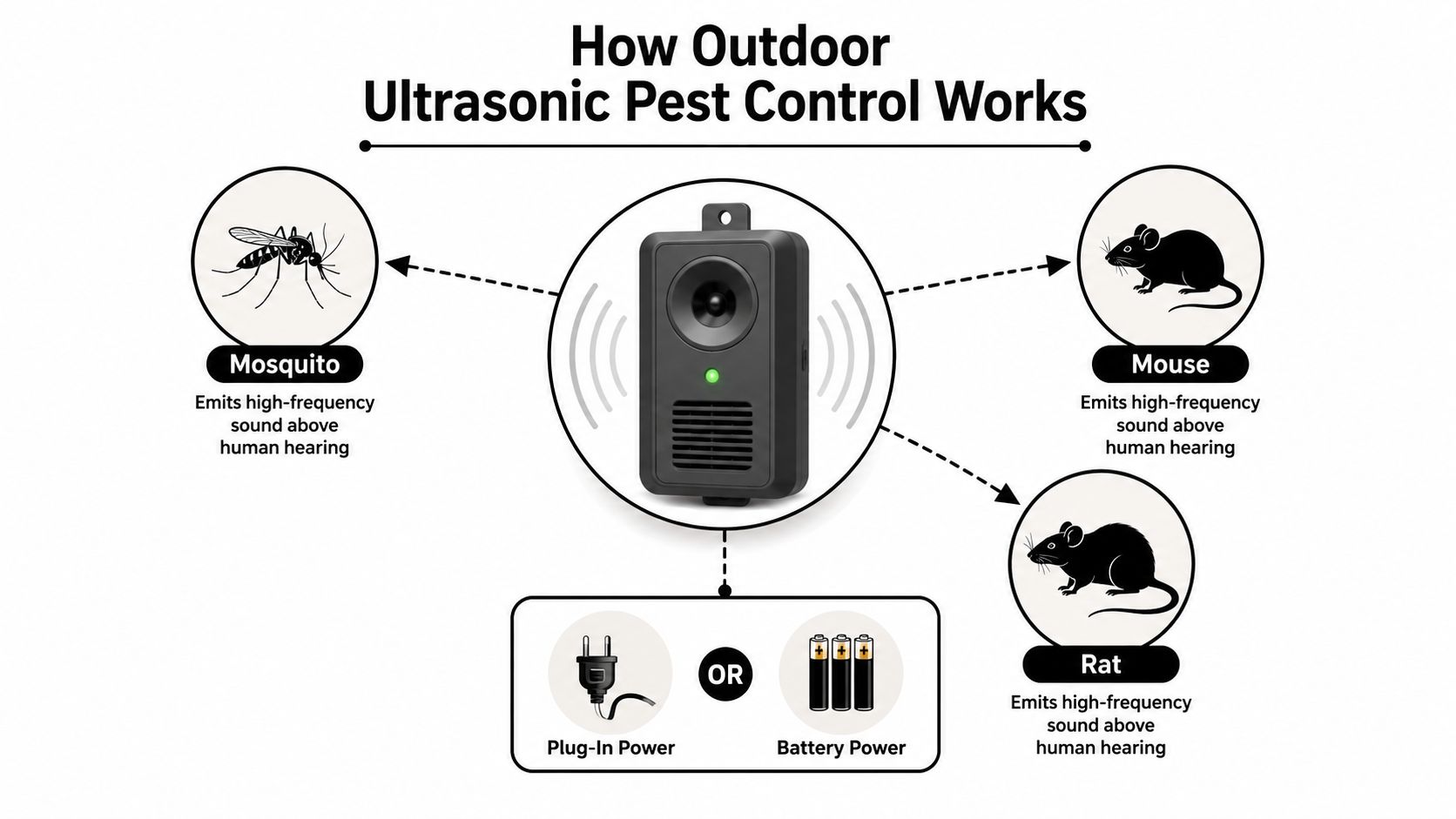
Outdoor ultrasonic pest control refers to plug-in or battery-powered devices that emit high-frequency sound above human hearing. Manufacturers sell them as a way to repel mosquitoes, rodents, raccoons, deer, ticks, and other pests around yards, patios, garages, sheds, and gardens. Newer models often include solar charging, motion activation, wider emission angles, and weatherproof housings.
The sales pitch is simple. The sound is supposed to be irritating enough that pests leave the area. That is why these products are usually marketed as a perimeter solution rather than a trap or bait system. The label sounds straightforward, but the category is broad, and the claimed effects vary from one unit to the next.
Core promise, core limit: the device emits sound pests may dislike, but the question is whether that sound changes pest behavior enough to matter outdoors.
What buyers are really comparing
| Pest | Finding | Evidence Strength |
|---|---|---|
| Rodents | Some short-term movement reduction, but effects fade fast | Weak for dependable outdoor control |
| Mosquitoes | No demonstrated field efficacy | Weak |
| Ticks | Too little repellency to prevent bites | Weak |
| Other pests | Claims vary widely, with inconsistent real-world results | Weak |
That table says it plainly. Some products may create a brief nuisance, but that is not the same as reliable control. For readers who care about tick pressure in the yard, the practical option is a proven yard strategy, not another hope-and-pray device, and that is why yard tick control guidance from The Green Advantage belongs in the conversation.
The key difference is species and setting. A device that looks impressive on a package can still perform poorly against mosquitoes in open air, rodents along a fence line, or ticks in leaf litter. Ultrasonic is a category, not a guarantee.
What the Science Actually Shows for Rodents, Mosquitoes, and Ticks
Rodents don't stay bothered for long
The clearest takeaway from the extension literature is that ultrasonic rodent devices can look decent for a moment and then fall apart. A Nebraska Cooperative Extension review reported only marginal repellency in controlled tests, with 30% to 50% reductions in movement activity in some cases, but also rapid habituation after just 3 to 7 days of exposure. That means the animals get used to it fast.
A later synthesis cited 27 peer-reviewed studies and found no statistically significant reduction across 19 controlled experiments, with reported significance values of p > 0.42 versus placebo devices, which is a long way of saying the devices did not outperform a fake unit in a dependable way. The University of Arizona Cooperative Extension also says commercially available sonic pest devices have not been shown effective in scientific studies.
Rodents are a serious issue in Northwest Indiana because garages, sheds, decks, and storage areas create easy shelter. That's why a blinking box is not a plan. Sealing access, removing food sources, and using actual exclusion methods are the tools that hold up.
Mosquitoes and ticks need better tools
For mosquitoes, the technical consensus is blunt. Commercial ultrasonic devices have no demonstrated field efficacy, and recent review work says the field evidence remains consistently low across categories. In plain terms, if your yard has biting mosquitoes, the sound from a repeller is not the lever that changes the outcome.
Ticks are no better. A peer-reviewed PLOS ONE study tested nine commercial devices against the paralysis tick Ixodes holocyclus and found less than 19.5% repellency, which the authors said was too low to recommend for preventing bites. That is not a yard solution. It is a weak signal at best.
A Cornell University IPM blog also reported “no effect” in scientific evaluations on pests including German cockroaches, bed bugs, and rodents, and it noted that some manufacturers' claimed frequency and intensity don't match actual output. The species matters, and the evidence keeps pointing in the same direction.
Why Yards Are Harder Than Living Rooms
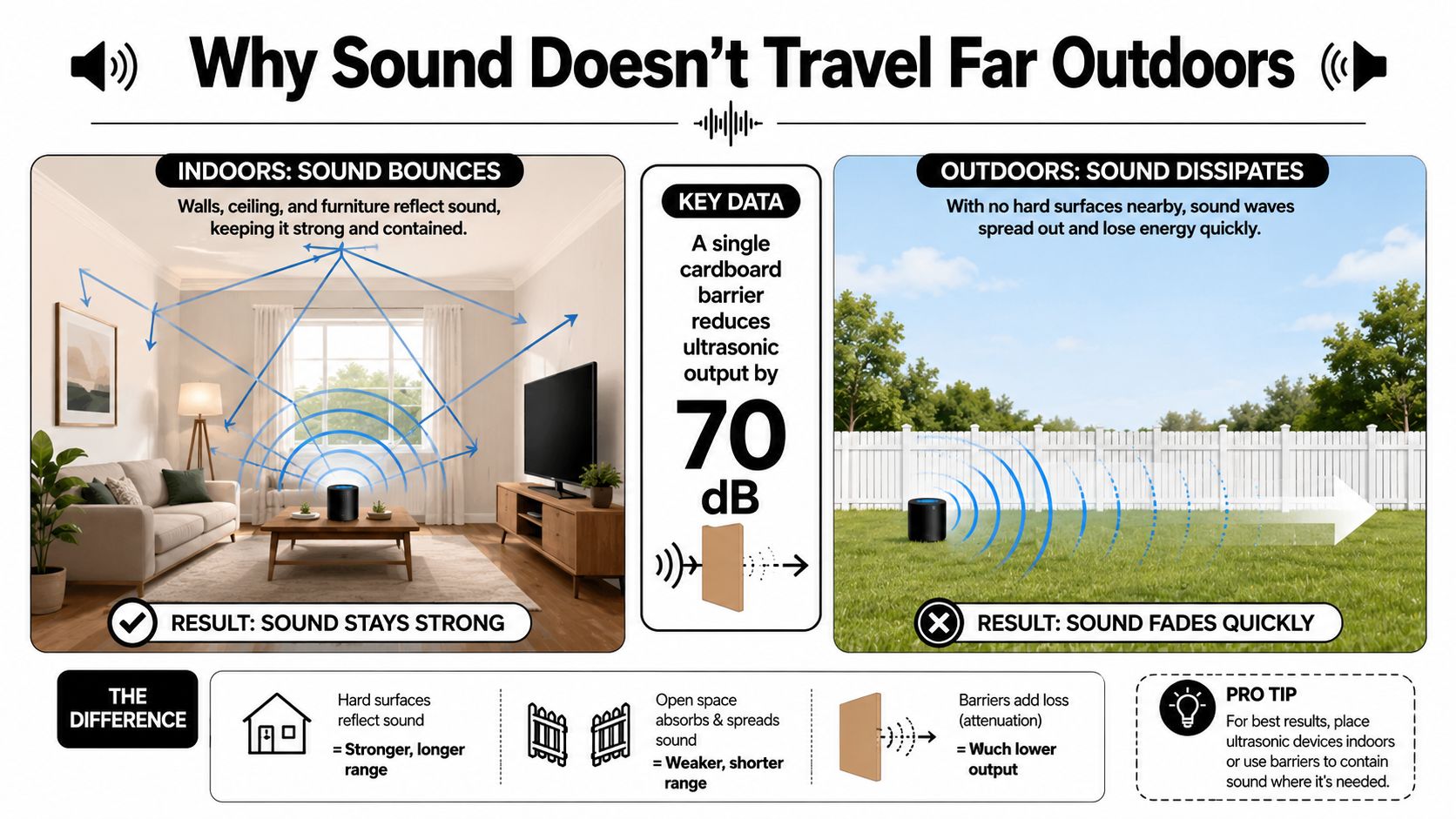
A yard in Crown Point is not a sealed room. That's the first thing product pages leave out. Sound outdoors gets interrupted, scattered, and weakened by whatever is in the way, and the published acoustical testing backs that up. In a classic evaluation of commercial ultrasonic pest devices, a single 0.30 cm cardboard barrier reduced output by about 70 dB, and the devices underperformed manufacturer claims in both intensity and peak frequency regions.
That matters because real yards are full of barriers. Siding, fences, patio furniture, shrubs, garden sheds, and even simple changes in layout can break the line of sight. Add wind and humidity, and the actual coverage gets smaller and more uneven than the box suggests. The result is dead zones, which is exactly where pests keep moving.
What “coverage” really means outdoors
A lot of shoppers read a square-foot claim and assume it means a hard perimeter. It doesn't. It usually assumes open air, clean sightlines, and ideal placement that most Northwest Indiana properties don't have. The practical range is far more variable than the packaging implies.
Newer models with solar charging, motion activation, and multi-directional emitters can improve convenience. They can also make installation easier. But convenience is not the same as outcome data, and independent proof that those features cut pest activity outdoors is still thin.
Homeowner rule: if the environment can block, absorb, or scatter the sound, the device's real-world coverage is already compromised.
That's why “how far does it reach?” is the wrong question by itself. The better question is whether the yard has enough open, unobstructed space for the device to matter at all. In most Crown Point yards, the answer is no.
The Honest Pros and Cons for Homeowners
Here's the fair version, not the sales version. These devices do have some appeal, but the tradeoffs are real, and every Crown Point homeowner should weigh them before buying.
What makes people keep trying them
- Low chemical footprint: Some families want to avoid sprays first, and a plug-in unit feels cleaner than a yard treatment.
- Low maintenance: Once installed, there's little day-to-day effort.
- No bait or poison handling: That matters for homes with children, pets, or frequent guests.
- Simple setup: Many units are easy to stake in the ground or plug into a weatherproof outlet.
Those are real conveniences. They explain why ultrasonic devices still show up on patios, porches, and garden edges even after the science let them down.
Where they fall short
- Weak evidence base: University extension sources keep saying the products have not been shown effective, and the broader study record is not encouraging.
- Fast habituation: Rodents can get used to the sound quickly, so any early reaction may not last.
- Inconsistent outdoor coverage: The yard environment works against the device.
- Questionable marketing history: The University of Arizona Cooperative Extension notes the FTC charged several companies with false advertising in the 1980s and required refunds.
- Possible sound exposure concerns: Cornell's IPM note says some devices exceed OSHA limits for human tolerance of sound exposure.
- Cost versus payoff: A device can cost enough to feel like a wasted service call if it doesn't change the pest pressure.
That is the comparison hardware stores rarely walk through with customers. If your main goal is peace on the patio, a little less hassle, and fewer bugs at dusk, a gadget with shaky performance is a poor bet.
If You Still Want to Use One, Do It This Way
A homeowner who already owns one should at least use it intelligently. Put it where the manufacturer can't pretend the environment is perfect. That means a weatherproof outlet, clear line of sight to the area where pests travel, and placement away from dense vegetation whenever practical.
Stake-mounted units make more sense when a cord would otherwise stretch across a walkway. Solar units can work for convenience, but the panel needs to stay clean, and batteries still need seasonal checks. Do not bury the device under snow, leaves, mulch, or patio clutter and expect it to perform.
Use it as a supplement, not a shield
The better setup is still the boring one that works:
- Remove standing water so mosquitoes have fewer breeding spots.
- Trim vegetation away from the home so pests lose cover near entry points.
- Seal gaps and cracks where rodents and insects get inside.
- Clear leaves and clutter where ticks and other pests hide.
- Use the device only as a secondary layer if you insist on keeping it.
That is the smartest way to think about it. A repeller might sit in the mix, but it does not replace exclusion, sanitation, or targeted treatment. For homeowners comparing device promises with a structured prevention plan, The Green Advantage's integrated pest management approach fits the way real yards work.
If the goal is a patio that stays usable, the device is a maybe. The habitat work is the part that matters.
What Actually Works in Northwest Indiana Yards
Start with the stuff pests are already using
Source reduction comes first because pests need something to live on, drink, or hide in. For mosquitoes, standing water is the obvious target. For raccoons and other nuisance wildlife, unsecured trash and pet food are invitations. For ticks, leaf litter and thick ground cover create the kind of edge habitat they love.
Block the easy entry points
Exclusion is the next layer. Seal gaps around the foundation, repair torn screens, install door sweeps, and close up vents that don't need to stay open. That works because it attacks access instead of hoping pests will get uncomfortable and leave on their own. If rodents are finding their way into a garage or crawl space, the problem gets real.
Use direct control where it fits
Mechanical traps and other targeted methods are still the right call for many rodent problems. They are not flashy, but they're direct. For mosquitoes, professional reduction programs can reduce pressure around outdoor living areas, especially when paired with habitat cleanup and smart placement around the property.
The Green Advantage offers mosquito control, rodent control, commercial pest control, and residential pest control for Crown Point and surrounding Northwest Indiana properties. It also handles pest inspections and preventive service plans, which matters when the issue is seasonal and keeps coming back.
Bottom line: the winning plan is layered. One gadget cannot do the job of source reduction, exclusion, and targeted treatment.
If you want fewer ants in spring, fewer spiders in corners, fewer wasps around eaves, and fewer rodent headaches going into fall, the fix is a consistent service plan, not a box that hopes pests hate sound enough to move out.
Talk to a Crown Point Pest Pro Before You Buy Another Gadget
If you've read this far, you probably aren't just curious. You're tired of mosquitoes chewing up the yard, worried about rodents in the garage, or trying to protect a property before a sale or inspection. That's exactly when a local pro makes more sense than another device on the patio.
The Green Advantage works the way busy homeowners need. You call once, reach knowledgeable office staff, and get scheduled without a lot of back-and-forth, which is more practical than waiting on generic pest control receptionist solutions that don't know your property. Then a technician comes out, checks the site, and builds a treatment plan around what's happening there, not around a one-size-fits-all package.
That matters for pest control in Crown Point, IN because every property is different. Some yards need mosquito reduction. Some homes need rodent exclusion. Some businesses need commercial service plans. And some people just need a pest inspection before a closing so they know what they're walking into.
If you want a real answer instead of a gadget gamble, call The Green Advantage and ask for a pest inspection or quote. You'll get a clear plan for the problem in front of you, not another promise that sound alone will solve it.
If you're ready to stop guessing, visit The Green Advantage and ask for a pest inspection, a quote, or a service plan built for your Crown Point property. The right fix starts with a real look at your yard, your home, and the pests that are present.