
Best Pest Control for Home in Crown Point, IN

You hear it at night first. A faint scratching in the wall. Then a line of ants shows up by the sink. A few days later, you're swatting mosquitoes in your own backyard and wondering whether you need a spray from the hardware store or a real exterminator near you.
That moment is stressful because most homeowners don't know if they have a small nuisance or the start of a bigger problem. In Crown Point, IN, that uncertainty gets worse because our pest pressure isn't generic. Moisture, changing seasons, dense vegetation, and the way many homes sit against mulch beds, leaf litter, and damp soil all affect what shows up and how fast it spreads.
Good pest control starts with calm, local judgment. You need to know what pest you're dealing with, why it's there, and what will hold up in a Northwest Indiana home after the first treatment wears off.
That same thinking applies to the house itself. Small gaps that let outside air leak in can also give pests a route indoors, which is why practical home-shell fixes matter. If you want a solid homeowner overview of that side of the problem, this guide on air sealing for Tucson homeowners is useful because the core principle is the same. Tighten the home, reduce access, and make the structure less inviting.
Your Guide to a Pest-Free Home in Northwest Indiana
In Crown Point and nearby Northwest Indiana communities, the best pest control for home isn't just about killing what you see. It's about fixing the conditions that brought pests in to begin with.
A lot of people assume pest issues mean a house is dirty. Usually, that's not the full story. I've seen clean, well-kept homes deal with ants because mulch stayed too wet against the foundation, spiders because insects were gathering around entry lights, and rodents because one small utility gap stayed open all winter.
Practical rule: If pests keep coming back after store-bought products, the problem usually isn't the product alone. It's the combination of entry points, moisture, shelter, and missed nesting areas.
The right residential pest control plan should answer four questions:
- What pest is active: Ants, spiders, wasps, rodents, mosquitoes, termites, and bed bugs all behave differently.
- Where it's coming from: Foundation gaps, attic vents, crawl spaces, landscaping, standing water, or wall voids.
- What conditions support it: Excess moisture, clutter, food sources, overgrown plants, or untreated exterior zones.
- What treatment fits the risk: Light prevention, targeted baiting, exclusion work, mosquito reduction, or more intensive treatment.
That matters whether you're searching for pest control near me, pest control in Crown Point, IN, or a local exterminator near me because the quality gap between providers often comes down to diagnosis. A generic spray can make activity look better for a short time. A smarter plan keeps the problem from rebuilding.
Identifying Common Pests in Crown Point and Beyond
Northwest Indiana has its own pest patterns. Lake-effect humidity, wet periods, shaded lots, and soil that holds moisture can all push insects and rodents toward the structure.
Ants, spiders, and crawling pests around the foundation
Ants often show up first in kitchens, around windows, or where plumbing lines enter. If you see a steady trail rather than a random few scouts, they're usually tracking between a food source and a nesting area. Spiders are different. They follow insect activity, so webs in corners, basements, garages, and around exterior lights usually mean the home is feeding their food supply.
Millipedes and similar moisture-loving pests are also common around damp foundations. They don't usually signal structural damage, but they do signal a perimeter condition that needs correction.
In Indiana, 65% of homeowner complaints involve perimeter breaches due to poor drainage and leaf litter buildup, according to regional pest vector reporting tied to Purdue Extension findings. That's why a good exterminator in Crown Point, IN won't stop at the bug itself. They'll look at grading, gutter discharge, mulch depth, damp corners, and the vegetation touching the house.
Mosquitoes, wasps, and stinging pests in the yard
Mosquito pressure rises fast when water sits in gutters, planters, toys, low spots, or dense shaded landscaping. If your family gets bitten in the same areas of the yard every evening, that's usually a pattern, not bad luck.
Wasps and hornets tend to build where they get shelter and low disturbance. Watch eaves, soffits, playsets, deck framing, sheds, and fence lines. Early nests are easier to address than mature ones.
Look for these signs:
- Mosquito activity at dusk: Bites cluster around ankles, legs, and shaded seating areas.
- Wasp traffic in one direction: Repeated flight to the same roofline, post, or overhang often points to a nest site.
- Spider web buildup outdoors: Heavy webbing around lights and entryways means prey insects are gathering there first.
Rodents, termites, and hidden interior pests
Rodents leave clues before you see them. Listen for scratching, look for droppings, and check for gnawing around stored food, garage corners, utility penetrations, and attic access points. They don't need a large opening.
Termites and bed bugs are harder because both stay hidden early. Soft wood, damaged trim, or unexplained insect wings around windows deserve attention. Bed bug activity often starts with bite concerns, mattress seam spotting, or bugs hiding near sleeping areas and upholstered furniture.
If you notice pests in more than one room, or both inside and outside, it's usually no longer just a spot-treatment issue.
Assessing the Severity of Your Pest Infestation
Not every pest sighting means you need a full treatment plan. But some signs tell you right away that the problem has moved past DIY.
When it's a nuisance and when it's an infestation
A few ants near a door on a rainy day may only mean temporary activity. One spider in the basement isn't unusual. A single wasp near the deck doesn't mean a nest is established.
The situation changes when patterns repeat. Daily ant trails, fresh droppings, multiple rooms with activity, new bites overnight, damaged wood, or recurring insects after repeated sprays all point to an established source.
Use this quick self-check:
- Minor issue: Isolated sightings, no repeated trail, no visible nesting, no signs in multiple rooms.
- Moderate issue: Repeat sightings in the same area, visible exterior activity, attractants present, DIY gives only short relief.
- Serious issue: Rodent evidence, stinging insect nesting near living areas, suspected termites, bed bugs, or pests spreading through the house.
Why DIY often stalls out
DIY products can knock down visible pests. They often don't reach the nest, void, harboring area, or colony core. That's the main reason homeowners feel like they're treating the same problem over and over.
One-time professional treatments average $300-$550, while annual plans range $660-$1,220, and professionals can eliminate entire colonies in 24-48 hours in situations where DIY sprays with a 20-foot limit fall short, according to This Old House's pest control cost and treatment review. A key trade-off isn't just upfront price. It's whether the treatment reaches the source.
Short-term relief can be expensive if you keep buying products that never touch the nesting zone.
Signs you should call for residential pest control now
Some situations shouldn't wait.
- Rodent evidence indoors: Droppings, gnaw marks, or scratching in walls usually mean hidden activity.
- Stinging insects near doors or play areas: Nesting close to family traffic raises the risk quickly.
- Possible termite damage: Soft or hollow-sounding wood needs inspection, not guesswork.
- Bed bug indicators: Repeated overnight bites or spotting near beds should be handled with a defined treatment plan.
- Recurring perimeter invasions: If pests return after each weather change, the exterior conditions need a broader fix.
If you're searching pest control near me because the problem keeps returning, that's usually your answer already. You don't need more spray. You need a better diagnosis.
Comparing Pest Control Treatments Nature-Based vs Chemical
Most homeowners in Crown Point aren't asking whether pest control should work. They're asking how to make it work without creating a new safety concern for kids, pets, pollinators, or the yard.
A March 2026 survey of 991 homeowners found that 81% prefer eco-friendly pest control methods, reflecting a clear move toward sustainable solutions and supporting Integrated Pest Management (IPM), which blends prevention, non-chemical controls, and targeted treatment for longer-term results, as summarized by Modern Pest's homeowner statistics review.
What conventional chemical control does well
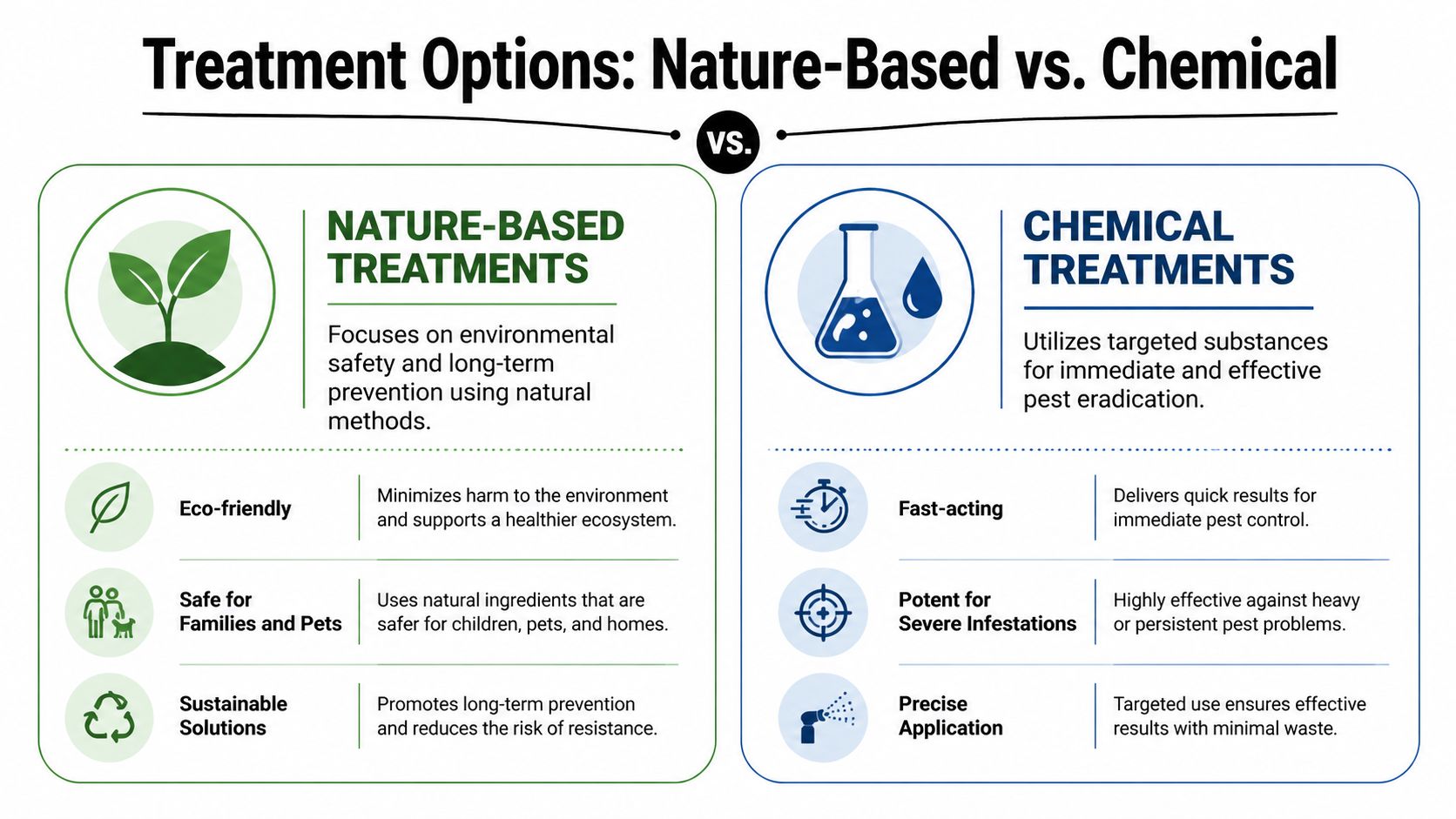
Chemical treatments have a place. For severe or fast-moving infestations, a targeted product can reduce active pressure quickly. That's useful when stinging insects are nesting close to a doorway, when roaches are established, or when a colony has to be hit in a specific area.
The downside is that chemical-only service often treats the symptom better than the cause. If moisture, access points, clutter, or harborage stay the same, the pests can cycle back.
Why nature-based IPM holds up better over time
IPM starts with inspection and monitoring. Then it moves into sanitation, sealing, habitat correction, trapping, baiting, and carefully limited product use only where needed. That approach makes sense in Northwest Indiana because so many pest issues start at the edge of the property. Wet mulch, leaf litter, clogged gutters, low spots, and dense plantings all contribute.
If you want a closer look at that style of service, this page on environmentally friendly pest control methods outlines how lower-impact strategies fit into practical home protection.
One local option homeowners use for this kind of work is The Green Advantage, which provides residential pest control, inspections, mosquito reduction programs, and treatments built around nature-based practices in Crown Point and nearby Northwest Indiana communities.
Pest Control Method Comparison
| Feature | Conventional Chemical Control | Nature-Based IPM (The Green Advantage Approach) |
|---|---|---|
| Primary goal | Fast knockdown of active pests | Long-term control through prevention and targeted action |
| First step | Apply product to affected areas | Inspect, identify, monitor, then treat |
| Chemical use | More central to the service | Minimized and used only when needed |
| Best fit | Acute infestations and immediate pressure | Ongoing residential pest control and prevention |
| Risk of rebound | Higher if conditions stay the same | Lower when moisture, access, and harborage are corrected |
| Homeowner role | Usually limited after treatment | Important for sanitation, drainage, and exclusion follow-through |
The smartest home pest control plan usually isn't all-natural or all-chemical. It's selective, measured, and built around the pest's behavior.
How to Choose the Best Pest Control Company Near You
If you're comparing pest control in Crown Point, IN, the easiest mistake is picking the company that promises the fastest spray and the lowest first visit. That's not how you judge long-term value.

Look for a real process, not a generic promise
A quality provider uses IPM, and that matters because it can reduce pesticide use by 50-75% while producing lower pest counts at 3 and 6 months, with 89% of residents in one cited study shifting to lower-toxicity products, according to FieldRoutes' summary of IPM methods and outcomes.
That should shape what you ask during your estimate or inspection call.
Here are the right questions:
- How do you identify the source: If the answer is just "we spray the baseboards," keep looking.
- What does your inspection include: You want interior, exterior, entry points, moisture zones, and nesting conditions.
- How do you handle prevention: Good service includes exclusion, sanitation advice, and monitoring.
- What happens if activity returns: Clear follow-up policies matter.
- Do you tailor treatment by pest type: Ant control, mosquito control, rodent control, wasp removal, and termite concerns shouldn't all get the same plan.
Favor local knowledge over broad scripts
A provider serving Northwest Indiana should understand how our seasonal swings affect ant movement, spider pressure, mosquito breeding, and rodent entry. Local experience shows up in the details. They notice the wet back corner by the downspout, the flower bed piled too high against the siding, and the garage sweep that doesn't seal anymore.
That kind of judgment is hard to fake. It's one reason many homeowners read through a company's values and service approach before booking. If you want to see what that looks like in practice, review why homeowners choose The Green Advantage for pest control needs.
Use this short checklist before you hire
A reliable exterminator near me search should end with a few hard filters, not guesswork.
- Licensed and insured: Basic, but absolutely essential.
- Clear communication: You should know what they're treating and why.
- Local service area focus: Crown Point and nearby Northwest Indiana homes have different patterns than generic national scripts assume.
- Written scope of service: You need to know if the plan covers one-time work, recurring prevention, or both.
- Practical prevention advice: The company should help you reduce future activity, not just sell the visit.
A pest control company earns trust by explaining why a treatment fits your home, not by pushing the largest package first.
What to Expect When You Work With The Green Advantage
A good service visit should feel organized from the first phone call. You shouldn't be left guessing what the technician will do, whether you need to move furniture, or how long results will take.

Before the visit
Be ready to describe what you've seen, where you saw it, and when activity is worst. That helps narrow down the likely pest and the likely entry or nesting zone.
It also helps to do a few simple prep steps:
- Clear access to problem areas: Under sinks, along baseboards, utility rooms, garage edges, and attic access if relevant.
- Reduce clutter where pests hide: Especially in storage rooms, basements, and closets.
- Note moisture issues: Leaks, damp spots, gutter overflow areas, and condensation matter.
- Keep pets and kids away from active work areas: Your technician can give specific guidance for the service being performed.
During and after treatment
Expect a full inspection first, not just immediate spraying. The most useful visits involve identifying the pest, locating likely access points, checking the perimeter, and matching treatment to the actual problem. That may include baiting, dusting, liquid treatment, exclusion recommendations, mosquito reduction steps, or follow-up monitoring.
After service, you should know what was found, what was treated, and what changes at home will help the result last. In practical terms, that often means adjusting drainage, trimming back vegetation, cleaning up leaf litter, repairing screens, sealing gaps, and changing how food or pet items are stored.
The goal is simple. Make the house less available to pests next week, not just less active today.
Frequently Asked Questions About Home Pest Control
Are eco-friendly treatments always safer?
Not automatically. Some homeowners assume "natural" means harmless, but that's too simple. According to University of Florida IFAS guidance on natural pest control options, some essential oils can be toxic to pets, while professional-grade biological controls can be effective and safe when used properly. That's one reason a professional evaluation matters.
Is natural pest control strong enough for a real infestation?
Sometimes yes, sometimes no by itself. For light or moderate pest pressure, prevention, trapping, habitat correction, exclusion, and lower-impact materials can do a lot. For heavier infestations, targeted chemical use may still be the right tool inside a broader IPM plan.
How do I know if I need one-time or ongoing service?
If the issue was isolated and tied to a single event, a one-time service may be enough. If your home has recurring ant activity, seasonal spiders, mosquito pressure, rodent risk, or repeated perimeter issues, ongoing residential pest control usually makes more sense because it keeps the exterior conditions from rebuilding pest pressure.
What pests should Crown Point homeowners take most seriously?
Any pest can become disruptive if ignored, but hidden pests deserve the quickest response. Rodents, termites, bed bugs, and stinging insects near entry areas move into the urgent category faster than an occasional spider or a few stray ants.
What's the best first step if I'm unsure?
Start with an inspection. That's the fastest way to separate a nuisance from a structural or recurring problem. It also keeps you from spending money on products that don't match the pest.
If you're looking for practical, local help with pest control in Crown Point, IN, the next step is simple. Contact The Green Advantage to schedule a pest inspection, request a quote, and get a treatment plan built for your home, your family, and the conditions that drive pest problems in Northwest Indiana.
Tick and Mosquito Control for Crown Point, IN Homes

A lot of Crown Point homeowners reach the same point every summer. The patio is clean, the grill is ready, the kids want to stay outside longer, and then the mosquitoes show up. If you back up to the edge of the lawn, brush past tall grass, or let the dog run near the tree line, ticks become part of the worry too.
That frustration is real in Northwest Indiana. These pests don't just interrupt a nice evening. They change how people use their own property.
At The Green Advantage, tick and mosquito control starts with that simple goal. Help you enjoy your yard again without second-guessing every bite, every patch of brush, or every damp corner near the house.
Enjoy Your Crown Point Yard Without Worry
A Crown Point backyard should feel like an extension of the home. It should be where family dinners run late, where dogs sprawl near the patio, and where guests don't spend the whole evening swatting at their legs and ankles.
Many homeowners start with the same idea. They'll add better seating, improve the lighting, maybe even create the ultimate backyard sanctuary with an outdoor kitchen or gathering area. Then reality hits. If mosquitoes are breeding around the property or ticks are waiting in shaded edges and leaf litter, that outdoor space doesn't get used the way it should.
This isn't a small issue. Vector-borne diseases transmitted by mosquitoes and ticks account for more than 17% of all infectious diseases and cause over 700,000 deaths annually, according to the World Health Organization fact sheet on vector-borne diseases.
What local homeowners usually notice first
In Crown Point and nearby Northwest Indiana neighborhoods, the first signs are often easy to dismiss:
- Evening bites near patios: Mosquito activity spikes when people are finally trying to relax outside.
- Pets bringing the problem closer: Dogs move through grass, mulch beds, and fence lines that people don't think of as risk areas.
- A yard that feels off-limits: Families start cutting outdoor time short, especially in late spring, summer, and early fall.
Practical rule: If your family changes its routine to avoid parts of the yard, the pest issue is already affecting quality of life.
The local part matters. Yards in this area often combine open lawn with wooded edges, ornamental plantings, low drainage spots, and shaded mulch beds. That's exactly the kind of mix that can support both mosquito breeding and tick activity.
Peace of mind comes from a plan
Homeowners don't need more generic internet advice. They need practical guidance that fits Northwest Indiana conditions. That's where a local approach helps. The right tick and mosquito control plan doesn't start with overapplying product. It starts with identifying what on the property is supporting the pests.
Some homes need aggressive standing-water reduction. Some need habitat correction along the back fence. Some need a treatment plan built around family use, pets, and regular outdoor traffic.
The good news is that these problems are manageable. With the right mix of prevention, targeted treatment, and follow-up, a yard can become usable again.
Northwest Indiana's Unwanted Summer Guests
Ticks and mosquitoes don't show up by accident. In Crown Point and surrounding Northwest Indiana communities, they follow the same patterns again and again. If you understand where they live and what allows them to build up on a property, the problem gets much easier to solve.
Where mosquitoes gain ground
Mosquitoes need water. Not a pond-sized amount. Just enough standing water to stay in place long enough for breeding.
In Northwest Indiana yards, the usual trouble spots include clogged gutters, low spots that hold rainwater, kiddie toys, buckets, plant saucers, corrugated drain extensions, and neglected edges near sheds or fences. One wet week can change a quiet yard into a mosquito-producing property.
Shaded resting areas matter too. Even when mosquitoes breed elsewhere, they often settle into cool, protected zones during the day. Dense shrubs, overgrown foundation plantings, under-deck spaces, and damp corners around the home give them shelter until people come outside.
Where ticks wait
Ticks operate differently. They don't breed in standing water, and they don't fly in from nowhere. They build pressure where habitat supports them and where animal hosts move through consistently.
In this region, the most common risk areas are:
- Wooded borders: Especially where lawn meets brush
- Leaf litter: A major shelter zone for immature ticks
- Tall grass and unmanaged edges: Places where ticks can wait for passing hosts
- Pet routes and wildlife paths: Repeated travel corridors matter
- Mulch beds with heavy shade: These often stay cooler and moister than open lawn
The challenge for homeowners is that a property can look neat from the patio and still have serious activity at the perimeter.
Ticks don't need your whole yard. They only need enough protected habitat near the spaces your family and pets use.
Why this has become harder to ignore
This is not just a nuisance trend. In the United States, there were an estimated 640,000 cases of diseases in humans transmitted by mosquito, tick, and flea bites from 2004 to 2016, and that marked a 3-fold increase over prior periods. Ticks account for about 90% of those bite-related diseases according to the CDC publication on vector-borne disease trends.
That aligns with what property owners feel on the ground. Tick concerns have become part of everyday yard planning, especially for homes with dogs, children, wooded lots, or neighboring undeveloped areas.
The seasonal pattern in Crown Point
Most homeowners notice mosquitoes first because they're obvious. You hear them, feel them, and react immediately. Tick pressure is quieter. It often becomes clear after someone finds one on clothing, on a pet, or attached after time near the edge of the lawn.
A typical Crown Point property sees risk build when these conditions line up:
- Spring growth starts fast and yard edges thicken.
- Rain leaves water behind in containers and low spots.
- Summer shade deepens under shrubs and decks.
- Outdoor activity increases right when pests are most active.
Why one-size-fits-all advice falls short
National articles tend to say the same things. Dump water. Mow grass. Use repellent. That's not wrong, but it doesn't diagnose the actual source of activity on a specific property.
A Northwest Indiana yard may have drainage issues on one side, deer traffic in the rear easement, and thick shade by the patio. Another may have almost no tick habitat but major mosquito pressure from hidden water collection. Those are different problems. They require different control decisions.
That's why effective tick and mosquito control begins with understanding the environment correctly, not just reacting to bites.
Your First Line of Defense Integrated Pest Prevention
Most yards improve when homeowners handle the basics well. Prevention won't replace a full treatment plan when pressure is already high, but it does remove the conditions that let ticks and mosquitoes keep coming back.
Start with the landscape
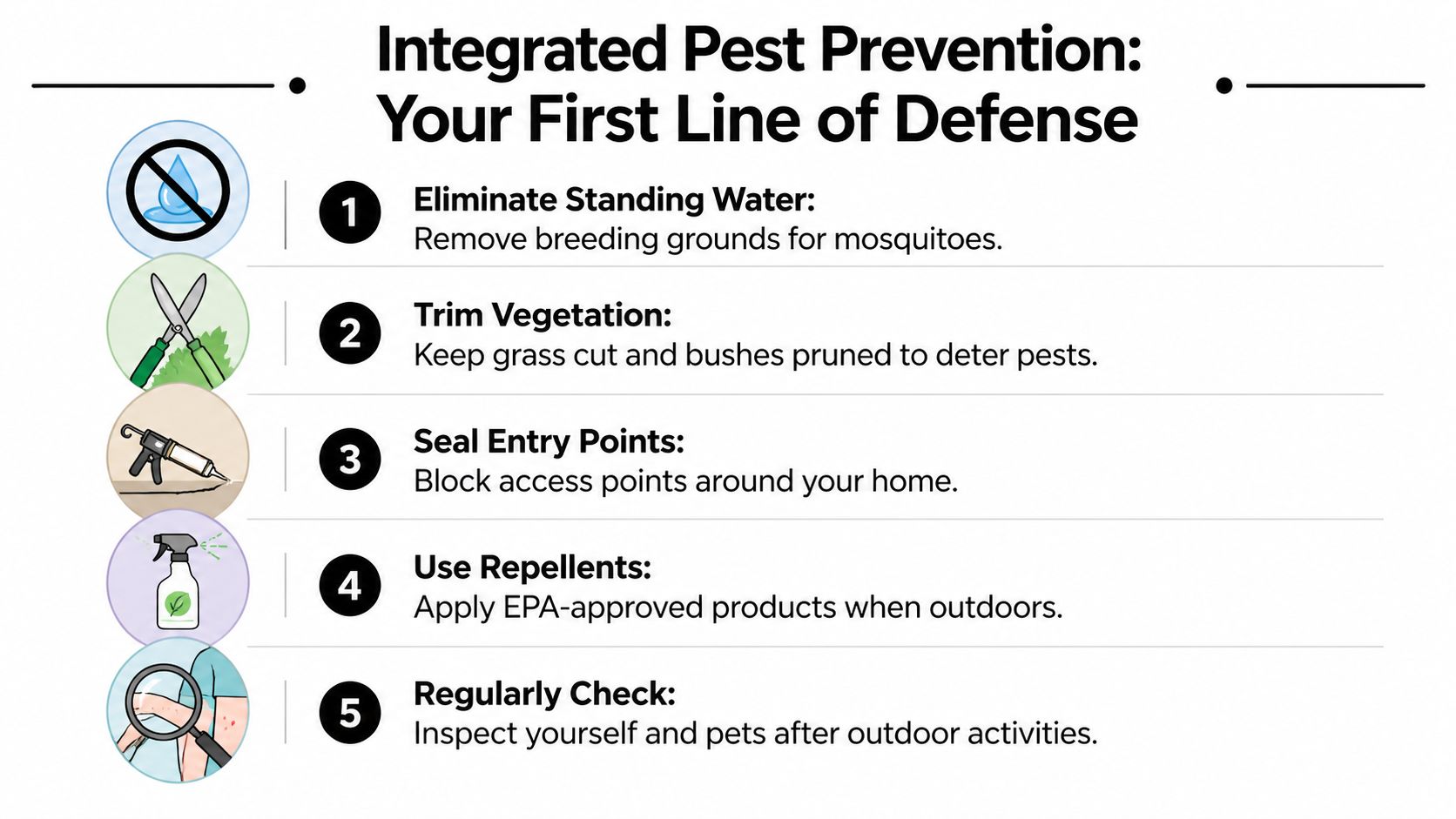
The fastest way to make a yard less welcoming is to reduce shelter. That means mowing consistently, trimming back overgrown edges, and opening up areas that stay damp and shaded for too long.
Leaf litter deserves special attention. Homeowners often focus on the lawn and ignore the back edge, fence line, and wooded transition zones. That's where ticks hold.
A cleaner edge changes how the whole property functions. It reduces hiding places, interrupts animal movement, and makes inspections easier.
Remove mosquito breeding sites
If you're serious about mosquito reduction, walk the property after rain. Not during a dry week. After rain.
Look for anything that catches and keeps water:
- Containers and toys: Flip them over or store them inside.
- Gutters and downspouts: Keep them flowing so water doesn't pool.
- Low spots in the yard: Fill or correct them when possible.
- Tarps and covers: Tighten them so they don't sag and collect water.
- Decorative items: Check planters, birdbaths, and outdoor storage areas.
For homeowners who want a more complete, structured approach, this is the same logic used in integrated pest management. The goal is to reduce pest pressure before treatment is even applied.
A yard with untreated breeding sites will keep recreating the problem, even if you spray it.
Protect people and pets during daily use
Personal protection still matters, especially in yards with wooded edges or heavy summer mosquito activity. EPA-registered repellents can reduce bite risk. Verified guidance includes repellents with 20% to 50% DEET and permethrin applied to clothing, as noted in the earlier CDC-backed guidance.
That doesn't mean homeowners need to live in protective gear. It means using common sense during high-risk times, especially around dusk, after mowing near brushy zones, or after kids and pets spend time near the perimeter.
A few habits help right away:
- Check after outdoor time: Inspect ankles, socks, waistbands, and pets.
- Stay alert near transitions: Lawn-to-woods edges are where many tick encounters begin.
- Keep play areas visible: Open, dry spaces are easier to monitor and maintain.
Prevention works best when it's specific
Some DIY prevention steps are worth doing every season. Others only matter if your property has a certain risk profile. A home with thick ornamental shrubs by the patio may need pruning more than drainage work. A home with rear tree cover may need leaf litter and wildlife-path attention more than anything else.
Homeowners often get better results when they stop thinking in terms of one big pest problem and start thinking in terms of micro-areas on the property. Back gate. Under deck. AC pad. Fence line. Drainage swale. Dog run.
Those are the places where prevention either works or fails.
DIY Treatments vs Professional Services
DIY products are appealing for one reason. They're easy to buy. You can walk into a store, grab a fogger, hose-end spray, or yard granule, and feel like you're taking action the same day.
Sometimes that helps temporarily. Often it doesn't solve much.
Where DIY usually falls short
The biggest problem with store-bought tick and mosquito control is coverage. Homeowners tend to treat visible areas and miss the places that matter most. Mosquitoes breed in hidden water. Ticks hold in leaf litter, brush edges, rodent harborages, and shaded transition zones that aren't obvious unless you know what to look for.
Another issue is timing. A product may be applied after mosquito numbers are already high or after tick activity has already moved deeper into the property. By then, homeowners are reacting instead of controlling the source.
There is also a planning gap that many families don't realize exists. Mosquito control is often supported by publicly funded community programs, but tick control largely falls to private efforts with minimal public infrastructure support, according to the research on mosquito and tick abatement program differences. In practical terms, that means homeowners often need to address tick pressure on their own property in a much more deliberate way.
The decision becomes clearer when you compare them side by side
| Factor | DIY Store-Bought Products | The Green Advantage Professional Service |
|---|---|---|
| Property assessment | Usually based on guesswork and label instructions | Starts with site-specific inspection of habitat, moisture, shade, edges, and activity zones |
| Treatment targeting | Often broad and inconsistent | Applied to the areas that are actually sustaining the pests |
| Root-cause control | May knock down visible activity without fixing breeding or harborage issues | Built around source reduction, habitat pressure, and treatment timing |
| Safety management | Homeowner is responsible for reading, mixing, storing, and applying correctly | Licensed technicians handle selection and application according to label and site conditions |
| Tick strategy | Often limited to general yard spraying | Can incorporate more focused yard-level approaches, including guidance like yard flea and tick control options where site conditions call for it |
| Follow-up | Usually starts over from scratch if the first attempt underperforms | Adjustments can be made based on the property's response and seasonal conditions |
What works and what doesn't
DIY can make sense for very low-pressure properties or for minor short-term relief before an outdoor event. It can also support a larger plan when the homeowner is disciplined about cleanup, drainage, and vegetation management.
What usually doesn't work is relying on one retail product to solve a mixed tick and mosquito problem across an entire yard. That's especially true in Crown Point properties with wooded edges, pets, or recurring water issues.
If the problem returns right after a treatment window, the product probably didn't fail by itself. The property conditions were still feeding the infestation.
Why professional service is different
A professional approach isn't just stronger product. It's better diagnosis, better placement, and better sequencing.
That matters because tick and mosquito control isn't one problem. It's several smaller problems happening at once. Adults may be active near the patio while mosquito breeding continues behind the shed. Tick pressure may be concentrated along a back fence while the front lawn has almost none.
Professional service is built to separate those zones and respond accordingly. That's what homeowners are really paying for. Not just application, but judgment.
How Professional Treatments Create a Safer Outdoor Space
Professional tick and mosquito control works best when it matches the biology of the pests instead of just chasing visible activity. That means stopping mosquitoes where they develop, reducing adult pressure where people spend time, and treating tick habitat where contact is most likely.

Mosquito control starts before they fly
One of the most important trade-offs in mosquito work is this. Adult mosquito spraying may give quick relief, but source control is what changes the population on the property.
Verified guidance shows that effective mosquito integrated pest management prioritizes larviciding over adulticiding, using products such as Bacillus thuringiensis israelensis (Bti) to target aquatic immature mosquitoes. This approach can achieve 95% to 100% larval mortality in breeding sites and is considered safe for pollinators, according to the Pollinator Partnership guidance on mosquito control.
That matters in real yards. If a property keeps holding water in overlooked spots, adult mosquito pressure will keep rebuilding. Larvicide-focused work interrupts the cycle earlier.
Tick control requires placement, not just product
Tick treatments fail when they're applied like a lawn cosmetic service. Ticks don't use the property evenly. They cluster where moisture, shade, cover, and host movement overlap.
A technician who understands environmental structure will pay attention to:
- Perimeter transitions: Where turf meets brush or woods
- Leaf litter bands: Often ignored, often critical
- Under-deck and fence-line zones: Protected, shaded, and undisturbed
- Pet travel corridors: Repeated exposure areas
- Wildlife access points: Places where deer and smaller hosts move through
For some properties, a seasonal service plan makes sense. For others, a one-time event treatment is enough to lower immediate mosquito pressure before guests arrive. The Green Advantage offers both mosquito reduction options as part of its service mix for Northwest Indiana properties.
Good treatment plans respect trade-offs
Not every homeowner wants the same thing. Some want the strongest possible knockdown. Others care about minimizing impact on beneficial insects and avoiding unnecessary broad treatment. A good plan should account for that.
That doesn't mean choosing between "natural" and "effective" as if those are the only options. It means combining habitat correction, targeted product selection, and careful placement so that each part of the plan has a purpose.
Here's a helpful look at the kind of yard conditions that often drive treatment decisions:
Why lawn and landscape knowledge matters
A company with outdoor-care roots reads a property differently. Drainage patterns, turf density, shade retention, ornamental overgrowth, and seasonal growth habits all influence where mosquitoes and ticks gain an advantage.
That's especially useful in Crown Point and nearby Northwest Indiana neighborhoods where one side of a yard may dry out quickly while the other side stays shaded and damp. Generic treatment doesn't account for that. Site-aware treatment does.
The safest effective application is usually the one that goes only where it's needed, at the time it's needed, for the reason it's needed.
When a treatment plan is built that way, homeowners usually notice two things. The yard becomes more comfortable to use, and the pest pressure feels less unpredictable.
Your Partnership with The Green Advantage in Crown Point
Hiring pest control shouldn't feel confusing or opaque. Homeowners usually want the same basic things. Clear answers, a practical plan, and confidence that someone understands the property they're treating.
That customer experience matters more now because conditions are shifting. Recent 2025 data indicates a 25% increase in tick encounters in Indiana due to warmer springs, increasing the need for adaptive control strategies that combine natural and synthetic protocols to reach over 90% efficacy, based on the 2025 extension guidance on tick and mosquito habitats. Since that source is future-dated, it's best understood as a recent reported trend cited in that guidance.
What the process feels like
The first step is usually a conversation, not a sales pitch. A homeowner calls with a concern that sounds familiar. Mosquitoes around the patio. Ticks on the dog. A yard that looks fine from the house but doesn't feel comfortable to use.
From there, the focus should be on specifics. Where do you spend time outside? Is the lot open or wooded? Are there drainage issues after rain? Do pets run a fence line or cut through a back corner repeatedly?
Those details shape the plan.

What good communication looks like
A local service relationship works better when the customer knows what is being treated and why. That means plain language, realistic expectations, and clear scheduling.
Homeowners should expect guidance on things like:
- Activity zones: Which parts of the yard are driving the issue
- Preparation steps: Whether anything needs to be moved, cleared, or avoided temporarily
- Seasonal expectations: Why some periods require more attention than others
- Follow-through: What to watch for after service and when to check back in
Why local knowledge changes the outcome
Crown Point and nearby Northwest Indiana properties aren't all the same, but they do share common patterns. Wet stretches, tree lines, suburban wildlife movement, and mixed-use yards all affect pest pressure.
A local provider sees those patterns repeatedly. That means less time guessing and more time reading the property correctly from the start.
Homeowners don't need a canned program. They need someone who can look at one backyard in Crown Point and understand why the rear edge behaves differently from the side yard.
That kind of partnership is what removes uncertainty. You know who you're talking to, you know what the plan is, and you know the recommendations fit the property rather than a script.
Take Back Your Yard Today
Ticks and mosquitoes change how people live at home. They push families indoors, make pets more vulnerable, and turn a comfortable yard into a place people avoid. In Crown Point and across Northwest Indiana, that problem is common, but it isn't something you have to accept.
The right tick and mosquito control plan is practical. It starts with habitat reduction, addresses key pressure points on the property, and uses treatment methods that fit how the yard is used. That's how outdoor spaces become usable again.
If you've tried DIY sprays, cleanup efforts, or one-off fixes and the pests keep returning, the issue usually isn't effort. It's that the source of activity hasn't been fully identified or treated in the right way.
For homeowners looking for pest control near me, pest control in Crown Point, IN, or an exterminator near me who understands local yard conditions, this is the moment to act before the next stretch of warm weather brings the problem right back.
A safer, more comfortable yard is possible. It just takes a plan that fits Northwest Indiana conditions and follows through.
If you're dealing with mosquitoes around the patio, tick pressure near wooded edges, or seasonal pest problems that keep interrupting life outside, contact The Green Advantage to request a quote and schedule an inspection for your Crown Point property.
How to Get Rid of Earwigs in Crown Point, IN

You walk into the bathroom late at night, flip on the light, and see a small brown insect dart across the baseboard with a pair of pincers at the back. Most Crown Point homeowners who find an earwig indoors have the same first reaction. They assume something is seriously wrong, or that the problem started inside the house.
Usually, it starts outside.
In Northwest Indiana, earwigs are a common moisture-driven nuisance pest. They settle into mulch beds, damp soil, leaf litter, clogged gutters, window wells, and shaded foundation areas. When outdoor conditions stay wet, they move closer to the home. Then they slip inside through gaps around doors, utility penetrations, and foundation cracks. If you're searching for pest control near me, exterminator near me, or pest control in Crown Point, IN, you're probably not just looking for bug facts. You're looking for a permanent fix that makes sense for this area.
That matters, because generic internet advice often leaves out the local piece. Crown Point and nearby Northwest Indiana communities deal with humidity, wet spring conditions, heavy mulch use, and drainage problems that can keep earwig pressure going even after a homeowner tries traps or store-bought sprays. A lasting solution has to account for that.
An Unwelcome Visitor in Your Crown Point Home
Earwigs look worse than they are. Their pincers make people think they're dangerous, aggressive, or destructive to the house itself. In most homes, they aren't a structural pest like termites, and they don't mean your home is unsanitary. They're a nuisance pest that follows moisture and shelter.
That said, nuisance doesn't mean harmless to your comfort.
A steady stream of earwigs in bathrooms, basements, laundry rooms, garages, or near patio doors is a sign that conditions around the home are supporting them. In Crown Point, that often means damp mulch against the foundation, wet soil around downspouts, cluttered garden beds, or basement humidity that stays high enough to keep them comfortable.
Why homeowners in Crown Point keep seeing them
Earwigs are active where it's dark, cool, and damp. That makes our region a natural fit for them, especially during wetter stretches of the season. Homes with shaded foundations, dense planting beds, older weather sealing, or recurring drainage issues tend to see the most activity.
A few common situations bring them inside:
- Foundation moisture from poor grading, oversaturated mulch, or water holding near the house
- Entry gaps around thresholds, siding transitions, weep holes, and utility lines
- Basement conditions where damp air and low light give them a daytime hiding place
- Outdoor harborage such as leaf piles, stones, edging, stacked firewood, and thick ground cover
Practical rule: If you only kill the earwigs you can see, but you don't change the moisture and shelter conditions around the house, they'll keep coming.
What concerned homeowners usually need most
Panic isn't necessary. A clear plan is what's needed.
The right approach starts with identifying where earwigs are hiding, what is keeping those areas damp, how they're entering the structure, and whether the problem is limited to a few hot spots or spread across the whole perimeter. Once you know that, the treatment becomes much more straightforward.
For homeowners looking for residential pest control in Crown Point, the value isn't in a quick knockdown alone. It's in stopping the cycle that keeps sending earwigs back to the same property.
Understanding Why Earwigs Have Invaded Your Space
Earwigs don't invade randomly. They go where the environment works for them. In Crown Point and the surrounding Northwest Indiana area, that usually means properties that stay damp longer than expected, especially around the foundation.
The outdoor conditions that attract earwigs
Earwigs spend most of their time outside. During the day, they tuck themselves into protected areas. At night, they forage and wander. Around a home, the most common hiding zones include mulch, wet leaves, yard timbers, pavers, flower beds, and any spot where organic material holds moisture close to the soil.
In Northwest Indiana, several property features make this worse:
- Mulch piled against the home keeps the soil cool and damp near the foundation
- Clogged gutters or short downspouts dump water right where earwigs want it
- Dense plantings shade the soil and slow drying
- Window wells and basement areaways trap moisture and debris
- Leaky spigots and hose connections create a constant wet zone
Those same conditions can also support other nuisance pests. Homeowners who notice earwigs often also deal with spiders, ants, and occasional invaders that use the same protected areas around the structure.
Why DIY advice often misses the real issue
A lot of earwig advice online focuses on catching them. That's helpful, but it leaves a major gap. For Northwest Indiana homeowners with ongoing moisture pressure, declining trap catches don't always tell the full story. The issue may be improving, or the insects may be avoiding an exhausted trap or shifting to another hiding area. The University of Minnesota earwig guidance highlights this maintenance problem and supports the need for continued monitoring and environmental correction through earwig nuisance insect management guidance.
That distinction matters.
If catches drop, a homeowner may assume the problem is gone. In practice, earwigs often remain active in mulch beds, behind siding edges, under thresholds, or in a damp basement corner that never fully dried out.
When earwig activity changes, the question isn't only how many you caught. It's whether the property stopped giving them what they need.
What earwigs usually mean, and what they don't
Earwigs are a sign of a moisture and harborage issue. They are not the same kind of warning sign as termites or carpenter ants. They aren't chewing through structural wood and they aren't turning your house into a nest site the way some other pests can.
Still, they tell you something useful about the property:
| What you’re seeing | What it often points to |
|---|---|
| Earwigs in bathrooms or laundry rooms | Humidity, condensation, or nearby entry points |
| Earwigs near sliding doors or garage doors | Exterior gaps plus damp perimeter conditions |
| Earwigs around basement walls | Moisture retention outside or inside the lower level |
| Earwigs in mulch beds and flower borders | Harborage close to the foundation |
Once you understand that relationship, how to get rid of earwigs becomes less about chasing individual bugs and more about changing the environment that's supporting them.
Immediate Steps You Can Take for Earwig Control
If you've just started seeing earwigs, there are a few practical steps you can take right away. These methods can reduce activity, help you monitor where the pressure is strongest, and buy you some relief while you decide whether the issue needs professional treatment.
They work best when you use them together instead of relying on a single trick.
Start with simple trapping
Earwigs like tight, dark shelter. That's why rolled newspaper, corrugated cardboard, and similar hiding-style traps can collect them overnight. The goal isn't just to remove a few insects. It's to learn where they're concentrated.
A more deliberate version uses corrugated cardboard as a trap material. The Utah State guidance notes that combining food-grade Diatomaceous Earth with corrugated cardboard traps can yield 200 to 500 earwigs per trap per night during peak infestations, and applying DE at 0.5 to 1 lb per 1,000 sq ft can deliver 90 to 100% mortality in 24 to 48 hours under the right dry conditions, according to Utah State earwig control guidance.
Place traps where earwigs already want to hide:
- Near entry points by patio doors, garage thresholds, and basement access doors
- At the edge of mulch beds where the foundation meets landscaping
- Around plant bases in dense or shaded beds
- Beside cluttered storage areas in garages or unfinished basements
Check them regularly. If you stop servicing traps, they stop telling you much.
Use DE the right way
Diatomaceous Earth can be useful, but only if it's applied thinly in dry areas where earwigs will cross it. Broadcast piles are less effective than a light barrier in the right location. Focus on dry foundation edges, protected voids, and indoor crack-and-crevice areas where moisture isn't constantly breaking it down.
The biggest limitation in Indiana is weather. The same Utah State guidance states that DE effectiveness drops by 80% after irrigation or rain, which is exactly why many homeowners feel like it works one day and fails the next when the yard stays damp.
That doesn't make DE worthless. It means expectations need to be realistic.
Cut off the easiest hiding spots
If you want visible improvement fast, remove the things earwigs use during the day.
Try these first:
- Pull mulch back from the foundation so the house edge can dry more easily.
- Remove leaf litter and grass clippings from borders, corners, and under shrubs.
- Lift and inspect stored items in the garage, especially cardboard and fabric near the floor.
- Reduce unnecessary watering around beds that stay wet overnight.
- Dry indoor problem areas with better ventilation where possible.
Field insight: Traps and DE are often most useful as a short-term reduction plan. If the moisture source stays in place, the population usually rebuilds.
What these steps can and can't do
DIY control can absolutely help with light activity. It can also reveal whether the problem is concentrated in one part of the yard or spread around the structure. But homeowners often run into the same wall: they catch earwigs for a few days, sightings drop, then the problem comes back after rain, irrigation, or another humid stretch.
That pattern doesn't mean you failed. It means the property still has the conditions earwigs need.
For a minor issue, these immediate steps may be enough. For a recurring issue, they usually become part of a larger treatment and prevention plan rather than a complete answer by themselves.
The Green Advantage Professional Earwig Extermination
When earwigs keep coming back, the difference between DIY and professional service is precision. Earwigs don't respond well to random spraying or occasional trap placement when the whole perimeter is supporting them. A lasting result usually comes from treating the structure correctly and correcting the conditions that are feeding the problem.
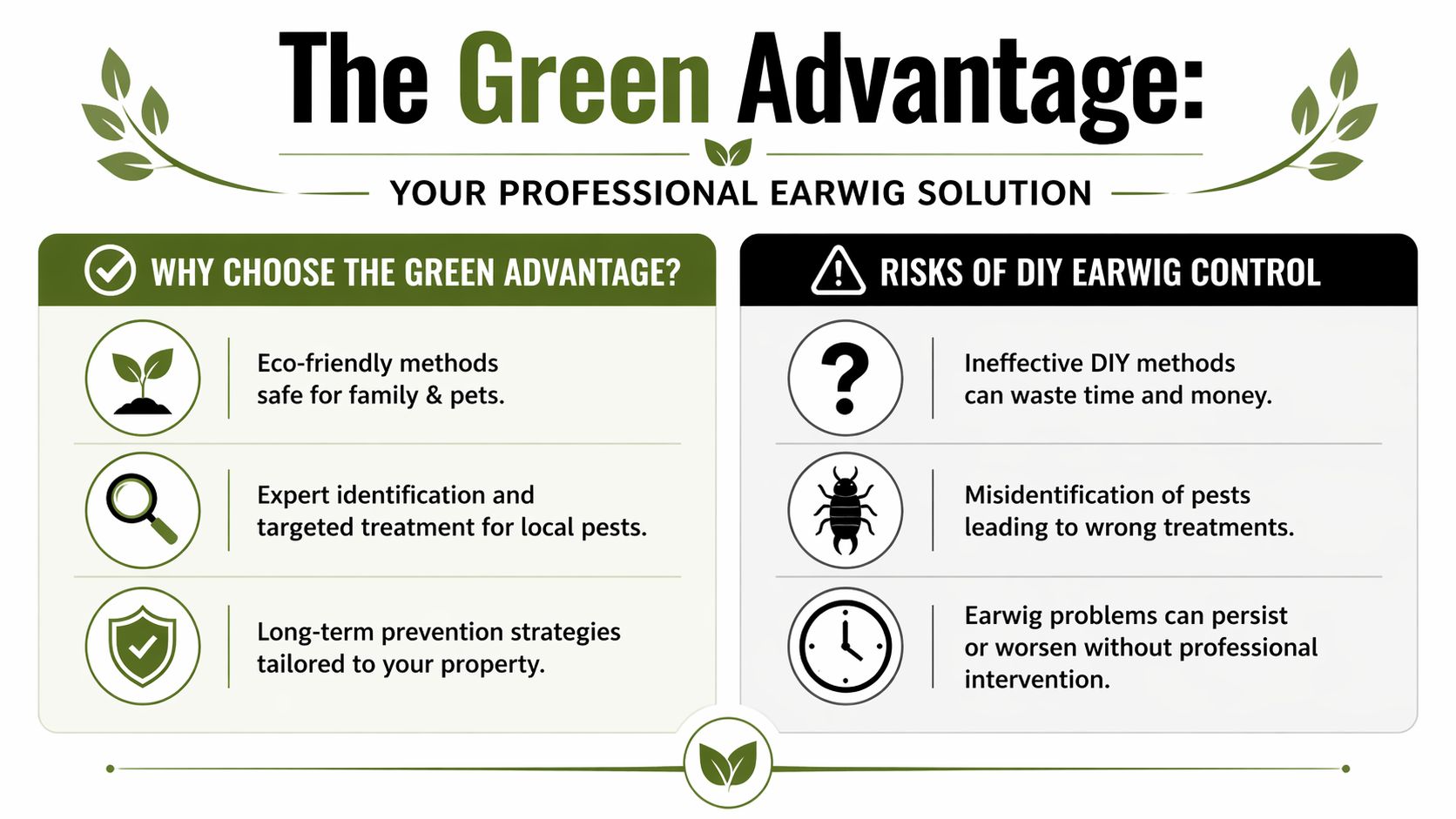
What a professional treatment actually looks like
A proper exterior earwig treatment is not a casual hose-end spray around the yard. Verified field guidance for perimeter earwig control describes a liquid insecticide application in a 3-foot band around the foundation and 3 feet up the exterior wall, using a calibrated sprayer and a coarse spray pattern that improves adhesion and reduces drift. Applied correctly, this approach achieves an 85 to 95% reduction in earwig populations within 7 to 14 days and can provide residual protection for up to 90 days, while also outperforming baits by 2x in high-moisture regions like Indiana, based on the perimeter treatment protocol shown in this professional earwig perimeter treatment reference.
That kind of result depends on technique.
The application has to hit the actual earwig travel zones and harborage points, including cracks, crevices, weep holes, and utility entries. Over-application isn't better. Under-mixing isn't good enough. Precision matters because the goal is control with as little unnecessary exposure as possible.
Why store-bought spraying often disappoints
Most homeowners who try sprays make one of three mistakes. They spray too lightly and miss the hiding zones. They spray too broadly and waste product where it won't help. Or they treat once, see a brief change, and then assume the issue should be over.
Professional service works differently because the technician looks at the whole pest picture:
- Where earwigs are harboring
- How they are entering
- Which side of the structure holds moisture
- Whether the issue is isolated or perimeter-wide
- What environmental corrections need to happen alongside treatment
One option homeowners in Crown Point can consider is a broader integrated pest management approach, which combines inspection, targeted treatment, and habitat correction instead of leaning on one tactic alone.
A good earwig service doesn't just knock down what you see tonight. It reduces the population outside, where the next wave would have come from.
DIY vs. Professional Earwig Control
| Factor | DIY Methods | The Green Advantage Professional Service |
|---|---|---|
| Treatment coverage | Often limited to visible areas or a few traps | Targets the exterior perimeter, entry points, and problem zones |
| Consistency | Depends on homeowner time, weather, and repeated maintenance | Built around a structured service plan and inspection findings |
| Moisture diagnosis | Usually guessed at | Evaluated as part of the property-specific problem |
| Product placement | Commonly overapplied or underapplied | Applied with calibrated equipment and targeted technique |
| Long-term control | Often partial when conditions stay favorable | Combined with prevention recommendations for lasting relief |
Where professional service makes the most sense
Professional earwig control is usually the better route when:
- Sightings keep returning after rain or humid weather
- You find earwigs in multiple rooms or around several sides of the home
- The home has a basement, crawlspace, or recurring drainage issue
- You also want broader residential pest control or commercial pest control support
- You suspect the same exterior conditions are drawing ants, spiders, or other pests
For homeowners searching exterminator in Crown Point, IN, the most effective service is the one that addresses both the infestation and the environment that's keeping it alive.
Preventing Future Earwig Infestations in Your Indiana Home
The long game with earwigs is moisture control. That sounds simple until you own a home in Northwest Indiana and realize how many different ways moisture can collect around a structure.
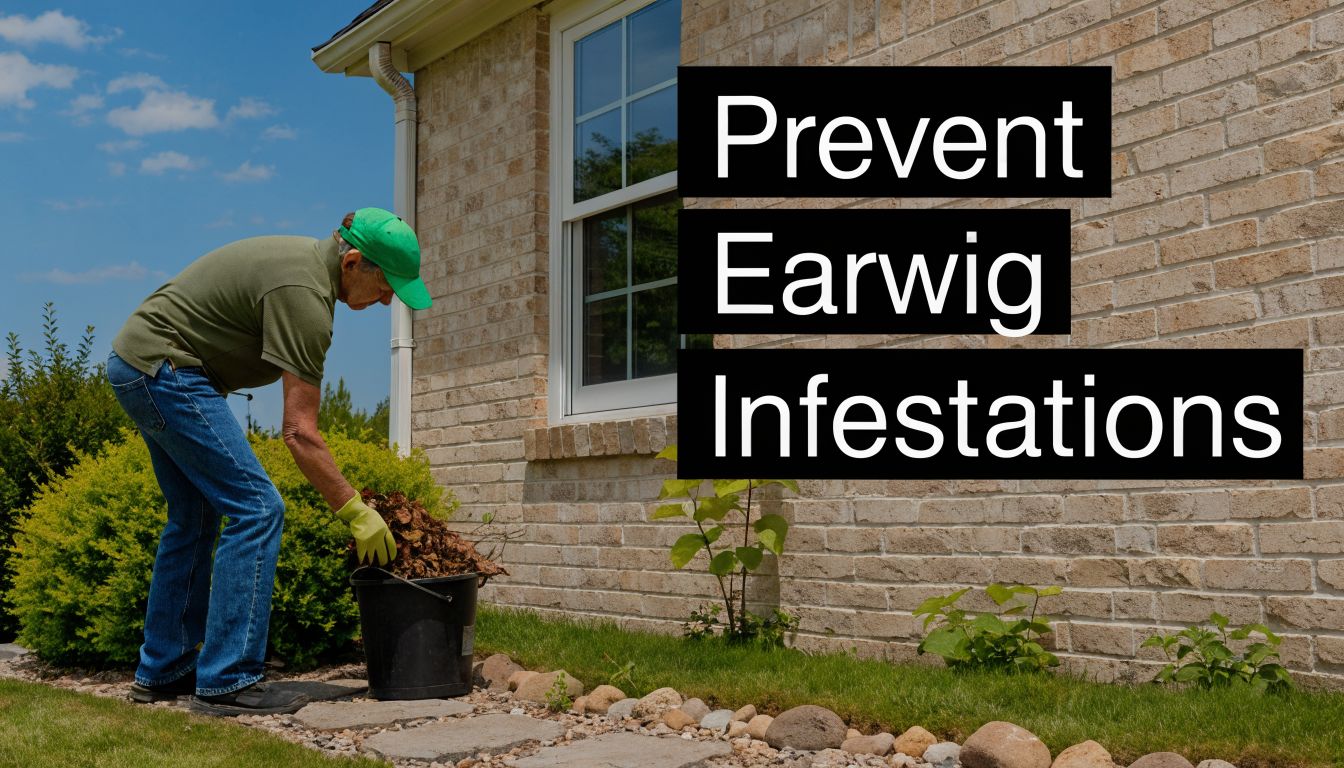
Start outside, not inside
Earwigs usually build pressure around the yard before they show up in the house. That means prevention begins with the outdoor area and the drainage pattern around the foundation.
Focus on these property adjustments:
- Keep mulch back from the house. Guidance commonly recommends maintaining mulch 6 to 12 inches away from the foundation, which helps reduce the damp shelter earwigs use near entry points.
- Clean gutters and extend water flow away from the structure so water doesn't keep saturating the perimeter.
- Trim dense plant growth that traps moisture and shades the soil all day.
- Pick up leaves and organic debris before they mat down into a cool hiding layer.
- Repair leaking spigots and hose bibs that create a constant damp patch.
These changes help with more than earwigs. A drier perimeter is also less inviting to ants, spiders, and some rodent activity.
Why generic moisture advice often falls short here
Homeowners are often told to "reduce moisture" as if that's a quick fix. In Crown Point, it isn't always that easy. Verified guidance specific to this topic notes that generic advice often fails in Northwest Indiana because of regional groundwater issues and humidity patterns, and that professional services may need to provide site-specific moisture assessments when simple DIY drying isn't enough, as discussed in this overview of earwig moisture problems and control limits.
That local reality is why some homes struggle even after the owner does many things right.
You may improve the obvious issues and still need to address grading, drainage flow, window well water retention, or persistently damp lower-level spaces. If your yard tends to hold water, this practical guide on how to improve soil drainage gives a useful overview of drainage concepts that can support a broader property plan.
Indoor prevention matters too
Once the exterior pressure comes down, tighten the house itself.
Key prevention steps indoors include:
- Seal cracks and utility gaps where insects can slip inside from the exterior wall void
- Refresh weather stripping on ground-level doors
- Reduce basement clutter that gives earwigs a quiet daytime hiding area
- Dry laundry, utility, and storage spaces that tend to stay humid
- Watch recurring damp corners instead of assuming they're harmless
This short visual gives a helpful look at common pest-proofing ideas homeowners can apply around the home:
The prevention mindset that works
The best prevention plan is not one big change. It's several smaller corrections that make the property less comfortable for moisture-loving pests.
Homeowner takeaway: Earwig prevention works when the yard dries faster, the foundation stays cleaner, and the structure gives insects fewer protected entry points.
That same mindset supports broader residential pest control. A property that's dry, sealed, and well maintained gives fewer opportunities to many of the seasonal pests common in Crown Point.
Working with Your Local Crown Point Pest Experts
Most homeowners call for help only after they've already tried a few things on their own. They've swept up earwigs in the bathroom, set out traps in the garage, or sprayed the base of the house and hoped for the best. What they want next is a straightforward process and an honest answer about what it will take to fix the problem.
That's where a local service experience matters.
What the process usually looks like
It starts with a phone call or message. You explain what you're seeing, where you're seeing it, and whether the problem seems tied to a certain room, side of the home, or weather pattern. From there, scheduling is based on the urgency of the issue and the kind of inspection needed.
At the property, the technician looks beyond the insects themselves. Earwig work is often about conditions, not just sightings. That means checking the perimeter, mulch lines, moisture-prone areas, likely entry points, and any indoor spaces where activity has been reported.
After the inspection, you should expect clear communication:
- What was found around the home and inside problem areas
- What likely caused the activity based on conditions at the property
- What treatment is appropriate for the situation
- What prevention steps the homeowner should handle between visits
Why local service feels different
When you hire a local company, you're also hiring familiarity with local pest patterns, weather effects, and common property layouts. That's especially valuable in Crown Point, where drainage, seasonal moisture, and shaded landscaping can all shape pest activity.
Choosing local service also keeps money in the community. If that matters to you, this short piece on supporting local businesses in your community is a good reminder that local hiring has benefits beyond the immediate job.
How to prepare before service day
A little preparation helps the visit go more smoothly. Make note of where you've seen activity, when it tends to happen, and whether rain or watering seems to increase it. If you've used any DIY products, mention that too. It helps the technician avoid guesswork.
For a practical checklist, homeowners can review this guide on how to prepare for pest control.
Good service should feel simple. You shouldn't have to decode vague recommendations or wonder what happens next. You should know what the issue is, what the treatment addresses, and what to watch for afterward.
Frequently Asked Questions About Earwigs
Are earwigs dangerous to people or pets
Earwigs are mainly a nuisance pest. Their appearance alarms people more than their actual risk. The bigger concern in most homes is repeated indoor sightings and the moisture conditions that allowed them to thrive nearby.
Why do I mostly see them at night
Earwigs prefer dark, protected conditions. They usually hide during the day and become more active after dark. That's why many homeowners think the problem appeared suddenly when it has been building outside for some time.
Will earwigs go away on their own
Sometimes light activity fades with drier weather or a change in conditions, but recurring infestations usually don't resolve for good without addressing moisture, harborage, and entry points. If the property still offers shelter and damp soil, the problem often returns.
Do earwigs mean I have a dirty house
No. Earwigs are usually drawn by environmental conditions, not poor housekeeping. A very clean home can still have earwigs if the exterior perimeter stays damp and the structure has accessible gaps.
What's the fastest way to reduce them
For immediate reduction, trapping and removing outdoor hiding spots can help. For recurring problems, a properly targeted perimeter treatment and property-specific prevention plan usually provide more reliable relief than repeated DIY efforts.
Are store-bought products enough
They can help in small, isolated situations. They often fall short when earwigs are established around multiple sides of the home or when moisture conditions keep rebuilding the population. That's when professional diagnosis becomes more important than adding more product.
Can the same conditions attract other pests
Yes. Damp mulch, clutter, foundation gaps, and wet lower-level spaces can also support ants, spiders, and other occasional invaders. Solving the earwig issue often improves broader pest pressure around the home.
When should I call a professional
Call when sightings continue despite cleanup and trapping, when activity spreads indoors, or when the yard and foundation seem to stay damp no matter what you do. That's usually the point where you need a treatment plan tied to the actual conditions at the property, not another round of guesses.
If earwigs keep showing up around your Crown Point home, the right next step is a clear inspection and a treatment plan built for Northwest Indiana conditions. The Green Advantage helps homeowners identify where earwigs are coming from, reduce the outdoor pressure around the structure, and address the moisture and harborage issues that keep the problem going. If you need practical help from a local pest control team, reach out to schedule an inspection or request a quote.
Best Flea and Tick Control for Yard: Crown Point Yard Pest

A lot of Crown Point homeowners start thinking about yard pests at the same moment every year. The weather turns nice, the grill comes out, the kids head for the lawn, and the dog starts making laps around the fence line. Then the nagging thought shows up right behind it. What’s living out there in the grass, under the shrubs, and along the shady edges of the yard?
That concern is justified. Fleas and ticks don’t need a neglected property to become a problem. In Northwest Indiana, they settle into ordinary residential properties, especially yards with shade, moisture, mulch, leaf litter, or pet traffic. A clean-looking lawn can still hold the exact conditions these pests need to survive, breed, and hitch a ride indoors.
If you’re searching for the best flea and tick control for yard conditions in Crown Point, the right answer depends on more than buying a spray bottle and hoping for the best. Product choice matters. Timing matters. Yard layout matters. Local climate matters even more. What works in a dry, sunny yard in another region may underperform in a Crown Point property with mature trees, damp edges, and changing spring-to-fall pest pressure.
Your Guide to a Safer Yard in Crown Point IN
Summer yard time is supposed to feel easy. You should be able to let the dog out, watch the kids play, or host friends on the patio without wondering what’s waiting in the grass.
But fleas and ticks change how people use their own property. Many homeowners first notice the problem when a pet starts scratching more than usual, when they find ticks near a wood line, or when one family member avoids the yard altogether because they don’t trust it. Once that happens, the yard stops feeling like part of the home.
In Crown Point and nearby Northwest Indiana communities, that’s a common pattern. Fleas and ticks thrive in the same kinds of outdoor spaces people work hard to create: green lawns, garden beds, privacy shrubs, play areas, and shaded corners that stay cooler longer. The problem isn’t that homeowners are doing something wrong. The problem is that these pests are well suited to our local environment.
What homeowners usually want
Homeowners aren’t looking for a chemistry lesson. They want a yard that feels usable again.
That usually means:
- Less pest activity where the family spends time
- A safer outdoor space for pets
- Fewer surprises along fences, beds, decks, and tree lines
- A treatment plan that lasts longer than a quick weekend fix
A good yard treatment doesn’t just knock pests down for a day. It reduces pressure where fleas and ticks live, breed, and wait for a host.
The best approach is practical, not dramatic. You don’t need every product on the shelf. You need the right combination of inspection, habitat correction, and targeted treatment based on how pests behave in Northwest Indiana.
Why local conditions matter
A Crown Point yard isn’t the same as a yard in a hotter, drier climate. Our region deals with wooded edges, seasonal moisture, storm cycles, and long stretches of pest activity. That’s why generic online advice often feels incomplete. It may tell you to spray the lawn, but it rarely explains where fleas and ticks are really hiding or why they keep coming back after rain, shade, and repeated pet traffic.
Homeowners searching for pest control near me, residential pest control, or pest control in Crown Point, IN are usually trying to solve that exact issue. They don’t just want treatment. They want confidence that the treatment fits the property.
Why Your Yard Is a Flea and Tick Haven
Fleas and ticks don’t spread evenly across a yard. They cluster in the places that protect them. In Crown Point, that usually means the cooler, damper, more sheltered parts of the property.
A sunny open lawn may look like the problem area because it gets the most use, but the primary pressure often starts around the edges. Fleas settle into organic debris and protected soil. Ticks wait in taller grass, under shrubs, beside fences, and near wooded transitions where animals move through.
The parts of a Crown Point yard pests like most
Some features raise flea and tick pressure even when the property is well maintained:
- Shady foundation beds where mulch and shrubs hold moisture
- Fence lines and rear lot edges where grass is thicker and traffic from wildlife is more common
- Leaf litter and debris pockets under trees or behind sheds
- Under decks and low-clearance structures where air movement is limited
- Pet rest areas where animals return again and again
These spots create the kind of protected microclimate fleas and ticks need. They avoid exposure when they can. If a yard has shelter, humidity, and a host nearby, it gives them staying power.
Fleas and ticks return for different reasons
Fleas and ticks aren’t the same pest, so they shouldn’t be treated as if they are.
Fleas are often tied closely to pet movement and protected outdoor resting areas. They build pressure where animals spend time, especially in shaded soil and organic material. Even when you treat the pet, the yard can keep reintroducing the problem.
Ticks behave differently. They don’t need to live in the center of the lawn. They wait in transition zones and move with wildlife, pets, and people. The back edge of a property, a shrub line, or a mulched path can matter more than the open grass.
Practical rule: If you only treat the middle of the lawn and ignore shaded borders, decks, and pet routes, you usually leave the main problem untouched.
Northwest Indiana has become tougher for tick control
General yard advice often misses what’s changed in the Midwest. Blacklegged ticks expanded their territory by 20% in Indiana as of 2025 IDOH data, and the source notes that longer warm seasons and mild winters are helping them thrive, with even new hybrid strains being discussed in that context according to this regional tick control analysis.
For Crown Point homeowners, that means older prevention habits may not be enough. A treatment that seemed to work in the past may break down faster under current pest pressure, especially after rainfall or during long warm stretches. If you want a deeper look at how persistent these pests can be around a property, this guide on how long ticks can live helps explain why one missed area can keep a problem active.
Yard conditions that keep pressure high
If fleas or ticks keep showing up, the issue is usually environmental, not random. Look for these patterns:
-
Dense shade
Mature trees and overgrown ornamentals create cooler zones that stay favorable longer. -
Moisture retention
Wet mulch, compacted soil, and poor airflow help pests hold on after weather shifts. -
Wildlife movement
Rabbits, rodents, and other animals use the same travel lanes over and over, carrying ticks with them. -
Inconsistent maintenance
Mowing helps, but if debris stays under shrubs or around structures, pests still have cover.
A productive treatment plan starts by reading the yard correctly. The best flea and tick control for yard conditions in Crown Point isn’t just about what gets applied. It’s about knowing where pressure starts and cutting it off there.
Comparing Yard Treatment Approaches DIY vs Professional
Homeowners usually have three choices. They can spread granules, apply a hose-end spray, or try a natural yard treatment from a garden center or online retailer. Those options can help in some situations, especially when pest pressure is still light.
The problem is that most yards in Northwest Indiana don’t stay simple for long. Once fleas or ticks settle into multiple zones, especially shaded borders and pet-heavy areas, the gap between a basic DIY application and a structured treatment plan becomes obvious.
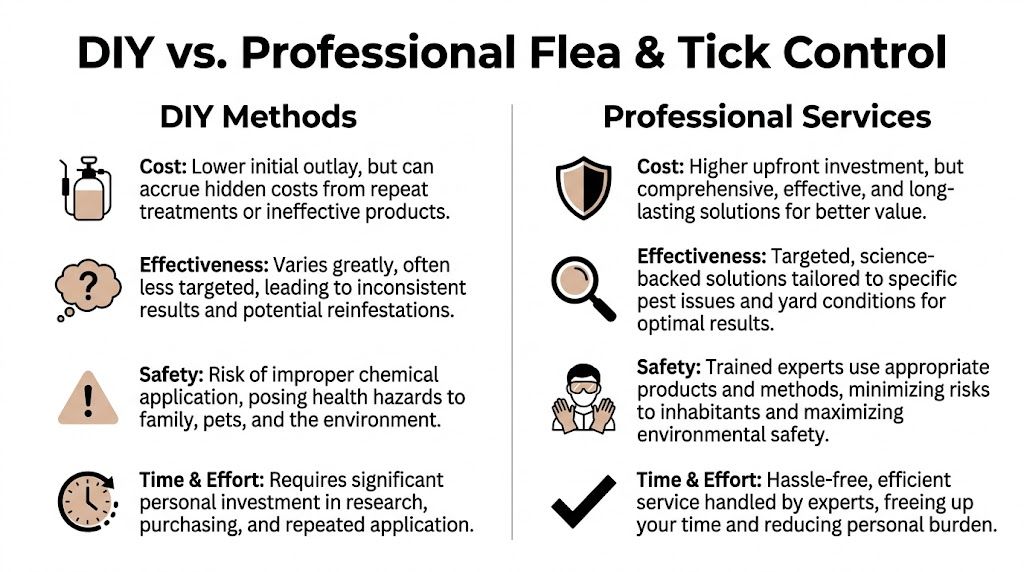
What DIY gets right
DIY treatment has real appeal. It’s available right away, feels affordable at the start, and gives homeowners direct control over what they apply.
Store shelves usually offer a few common paths:
- Granules for broad lawn coverage
- Hose-end sprays for quick application
- Essential oil products for lighter, more frequent treatment
- Spot treatments around decks, fences, and pet zones
For some properties, especially smaller yards with low pest pressure, that may be enough to reduce activity.
Where DIY starts to break down
The downside isn’t that all store-bought products are useless. The downside is inconsistency.
Homeowners often underapply, treat the wrong areas, skip follow-up timing, or rely on one product type when the yard really needs a layered approach. The visible lawn gets attention, while the problem stays active in edges, shrubs, under structures, and near fence lines.
Permethrin-based yard sprays are recognized as the most effective overall for flea and tick control, killing adults, larvae, and eggs on contact while repelling pests for several weeks, and they can reduce tick encounters by 80-95% in treated zones according to this permethrin yard spray overview. That tells you something important. Product strength and proper use matter a lot. It’s not just whether the yard was treated. It’s whether it was treated in a way that matches pest biology.
DIY vs Professional Yard Treatment Comparison
| Factor | DIY Approach | Professional Service (The Green Advantage) |
|---|---|---|
| Upfront cost | Usually lower at the start, but repeat purchases can add up if results don’t hold | Higher initial investment, but designed for longer-term control |
| Product selection | Limited to consumer options and what the homeowner feels comfortable applying | More strategic selection based on yard conditions, pest pressure, and treatment goals |
| Coverage quality | Often strongest in visible lawn areas, weaker in hidden hotspots | Focused on high-pressure zones like edges, shade, pet routes, and breeding areas |
| Time required | Homeowner handles research, purchasing, application, and reapplication | Service is handled for you with a defined plan |
| Consistency | Depends on weather, schedule, and application accuracy | More reliable because timing and placement are planned |
| Safety management | Homeowner must read labels, judge re-entry timing, and avoid misapplication | Treatment is applied with a process designed to reduce avoidable risk |
| Best fit | Light pest activity and homeowners willing to monitor closely | Recurring yard pressure, heavy infestations, or properties with complex layouts |
Natural products have a place, but know the trade-off
Essential oil concentrates such as Wondercide Flea & Tick Yard + Garden are often chosen by households that want a plant-oil-based option. According to the product specifications, an 8 oz concentrate treats 5,000 sq ft for killing fleas and mosquitoes, or 2,500 sq ft for killing and repelling ticks, with repeat application every few days initially and maintenance every 30-45 days, as described in the Wondercide yard treatment details.
That can be a reasonable fit for mild situations or homeowners committed to frequent maintenance. But in heavy flea or tick pressure, especially in damp, shaded Crown Point yards, natural products usually demand more consistency and more reapplication discipline than homeowners expect.
Professional treatment changes the process
A professional approach starts with diagnosis, not just product. That’s the difference.
Instead of asking, “What can I spray today?” the better question is, “Where is the pressure starting, what is sustaining it, and what combination of treatment and habitat correction will hold up here?” That’s why many homeowners who begin with DIY eventually look for guidance on DIY or hire a pro, especially after repeating the same weekend treatment cycle without lasting relief.
The most expensive yard treatment is the one you have to keep repeating because the original problem was never correctly identified.
For homeowners searching exterminator near me or pest control in Crown Point, IN, that’s usually the tipping point. They’re not looking for another bottle. They’re looking for a result that lasts.
The Case for Professional Pest Control in Northwest Indiana
DIY yard treatment often sounds simple. Buy a product, apply it, wait a few days, and expect the problem to fade. In real Northwest Indiana yards, that sequence often falls apart because flea and tick pressure isn’t coming from one flat piece of lawn. It’s coming from multiple habitats at once.
That matters because the best flea and tick control for yard conditions here isn’t just a kill-on-contact product. It’s a control strategy that accounts for breeding sites, weather, shade, wildlife movement, pet activity, and reinfestation pressure.

The hidden cost of short-term results
A cheap treatment isn’t cheap if it keeps failing. Homeowners often spend money in small amounts over and over, trying one spray, then another, then a granule, then a natural product, without ever getting control across the whole property.
The bigger issue is what happens between applications. Fleas keep cycling through protected areas. Ticks stay active in edge zones the homeowner didn’t realize mattered. Meanwhile, the family still avoids the yard.
A significant gap exists in long-term efficacy data between natural DIY products and professional chemical options. According to this comparison of yard treatment performance, professional combinations with insect growth regulators can reduce pest populations by over 90%, while many natural alternatives show 60-70% short-term reduction. In the Midwest, where pest pressure can be stubborn, that difference is practical, not academic.
What professionals do differently
Professional service changes the outcome because it changes the decision-making.
A trained technician doesn’t just see grass. They see:
- Host pathways where pets and wildlife move
- Sheltered breeding pockets under shrubs, decks, and organic debris
- Perimeter pressure where wooded transitions raise exposure
- Conditions that will weaken treatment performance, such as poor airflow or persistent moisture
That’s why professional residential pest control tends to hold up better. It starts with inspection, then uses application methods and follow-up planning that fit the property instead of treating every yard like a blank rectangle.
Why IPM works better than one-off spraying
The strongest long-term results usually come from Integrated Pest Management, or IPM. That means using more than one control method and correcting the conditions that allow the problem to return.
In plain terms, IPM for a Crown Point yard often includes:
- Targeted product application where pressure is highest
- Mowing and trimming to reduce cover
- Debris cleanup in flea and tick harborages
- Perimeter attention around beds, fences, and wooded edges
- Monitoring and follow-up instead of assuming one visit solves everything
Good pest control is part treatment, part property management. If the yard keeps giving fleas and ticks shelter, they’ll try to come back.
This is also why professional service is often the better fit for households already dealing with broader outdoor pest issues. If a property also struggles with mosquitoes, ants, or wasps, treating the yard as a whole system usually makes more sense than handling each problem in isolation.
For homeowners searching for commercial pest control, residential pest control, or an exterminator in Crown Point, IN, the practical question is simple. Do you want to keep reacting to flare-ups, or do you want a plan that’s built for the way pests behave on your property?
The Green Advantage Method Our Process for Crown Point Homes
When a yard has flea and tick pressure, the process matters as much as the product. A professional treatment should feel organized, understandable, and specific to the property instead of rushed or overly generic.
The strongest service plans in Crown Point start with observation. They identify where fleas and ticks are likely to rest, breed, and travel, then match treatment to those zones rather than blanketing everything the same way.

Step one is reading the property correctly
A proper yard treatment begins with inspection. That means looking at the obvious areas, but also the overlooked ones.
A technician should evaluate:
- Shaded lawn sections and bed edges
- Pet routes and favorite resting areas
- Under-deck zones and fence lines
- Mulch pockets, debris buildup, and dense ornamentals
- Transitions to woods, drainage areas, or neighboring vegetation
This is where local experience matters. A Crown Point property near mature trees or open field edges won’t behave like a tightly packed subdivision lot with more sun and less wildlife traffic.
Step two is choosing the right treatment style
Not every yard needs the exact same material or frequency. Some need immediate knockdown in active zones. Others need a residual product that keeps working through changing weather and continued exposure.
Professional-grade synthetic granules with active ingredients such as bifenthrin offer 30-60 day residual control and can achieve over 95% mortality in fleas and ticks within 24-72 hours when applied correctly, according to this professional granule treatment guidance. The same source notes that, within an IPM protocol, an initial application for heavy infestations followed by monthly maintenance can cut callbacks by 50%.
That kind of result comes from matching product form to the problem. Granules often make sense for broad outdoor coverage and breeding zones. In other cases, a targeted spray may be the better first move for fast contact control.
Some yards need immediate reduction. Others need durability. The best plans account for both.
Step three is reducing the conditions pests like
Treatment works better when the yard becomes less comfortable for fleas and ticks afterward, a goal supported by a local, nature-based mindset. Good pest control doesn’t have to mean treating the property like a sterile surface. It means managing the environment so pests lose their advantage.
That can include trimming dense plant growth, clearing heavy debris, and improving sunlight and airflow in hidden corners. It can also mean understanding the broader ecology around the property. Homeowners who want to support a more balanced yard environment often find it useful to learn about natural tick predators, because it helps explain why habitat design matters along with direct treatment.
A short look at service expectations can make that process easier to visualize.
What homeowners can expect from a complete service approach
A well-run service visit should leave you with clarity, not confusion. That usually includes:
-
A site-specific assessment
The technician identifies the areas driving activity instead of treating the whole property as one uniform space. -
A customized application plan
Product choice and placement reflect the layout, level of pressure, and how the family uses the yard. -
Practical prevention guidance
Homeowners should get straightforward recommendations they can use, including yard maintenance steps and whether related services like mosquito control or broader preventative pest treatments would help.
This is also why the best providers tend to be the ones who can handle more than one issue at a time. A yard with fleas and ticks may also have mosquito pressure, spider activity near structures, or rodent movement along the perimeter. The service should account for how those patterns overlap, especially in Northwest Indiana properties.
Protecting Your Family Property and Peace of Mind
Most homeowners don’t call about fleas and ticks because they enjoy talking about pests. They call because they want normal yard life back. They want to let the dog out without checking fur every time. They want kids to play in the grass without second-guessing every shady corner. They want their outdoor space to feel like part of the home again.
That’s what makes long-lasting yard treatment valuable. It’s not just about killing pests. It’s about restoring confidence in the property.

Why durable yard control matters
High-quality granular treatments can provide three months of protection for up to 10,000 square feet from a single application, and they can reduce reinfestation risks by up to 90% in treated zones when applied correctly during peak seasons, according to this yard granule treatment review. That kind of coverage matters because fleas and ticks rarely stay confined to one small patch. They move through lawns, soil, and garden edges where people and pets spend time.
For larger residential lots in Crown Point, durable coverage can mean fewer interruptions and less worry between treatments. It also means less reliance on constant retreatment just to keep the yard usable.
Yard control should work with pet protection
Outdoor treatment is important, but it’s still only one part of the picture. Pets can bring pests in from untreated areas, neighboring properties, or walks, so on-pet prevention still matters. If you’re comparing options for your dog, this guide to flea treatments for dogs is a helpful companion resource to yard treatment planning.
The strongest protection usually comes from combining pet care with yard management rather than choosing one and ignoring the other.
The real benefit is peace of mind
A treated yard changes how people use their property:
- Families spend more time outside
- Pets move through the yard with less risk
- Homeowners stop reacting to every bite, scratch, or sighting
- Outdoor spaces become more comfortable for guests and everyday routines
A successful yard treatment gives homeowners something simple but important. It lets them enjoy their own property without constant vigilance.
For people searching pest control near me, exterminator near me, or pest control in Crown Point, IN, that’s usually the true goal. Not just a treatment receipt. Relief.
Frequently Asked Questions About Yard Treatments
Are yard flea and tick treatments safe for kids and pets
They can be, when the right products are chosen and applied correctly. The key is following label directions and re-entry guidance. Homeowners should always ask when treated areas are safe to use again, especially if children play in the lawn or pets spend a lot of time outdoors.
Professional service helps because the application isn’t guesswork. The technician can explain where treatment was placed, what precautions matter, and how to use the yard responsibly afterward.
Will rain wash the treatment away
Sometimes yes, sometimes no. It depends on the product type, how recently it was applied, and how much rain falls. Less persistent treatments tend to break down faster after weather, while some residual products hold up better.
This is one reason local timing matters in Northwest Indiana. A treatment plan should account for rain patterns and property drainage, not just calendar dates.
How often does a Crown Point yard need treatment
There isn’t one answer for every yard. Some properties need closer attention during peak season because of shade, wildlife activity, and moisture retention. Others hold control longer because the yard is more open and less favorable to pests.
A good schedule should match actual conditions on the property. Heavier infestations usually need a more active early approach than simple maintenance.
If the yard is treated, does my pet still need protection
Yes. Yard treatment lowers exposure, but it doesn’t replace veterinarian-guided pet protection. Dogs and cats can still encounter fleas or ticks beyond your lawn, including on walks, at parks, or in untreated spaces.
The best approach is layered. Protect the yard, protect the pet, and reduce the chance that pests move indoors.
What can I do between treatments to help
The most useful steps are basic but important:
- Keep grass cut and edges trimmed
- Reduce leaf litter and debris
- Open up dense shrubs where possible
- Pay attention to pet rest areas and fence lines
- Report any continued activity in specific spots
Small yard corrections often improve treatment performance because they remove the shelter fleas and ticks rely on.
If you want a yard that feels comfortable, usable, and better protected in Crown Point and nearby Northwest Indiana communities, contact The Green Advantage to schedule an inspection or request a quote. Their team provides residential pest control, commercial pest control, mosquito control, and preventative pest treatments with a local, environmentally mindful approach built for the way pests behave in this region.
8 Home Remedies to Keep Mosquitoes Away
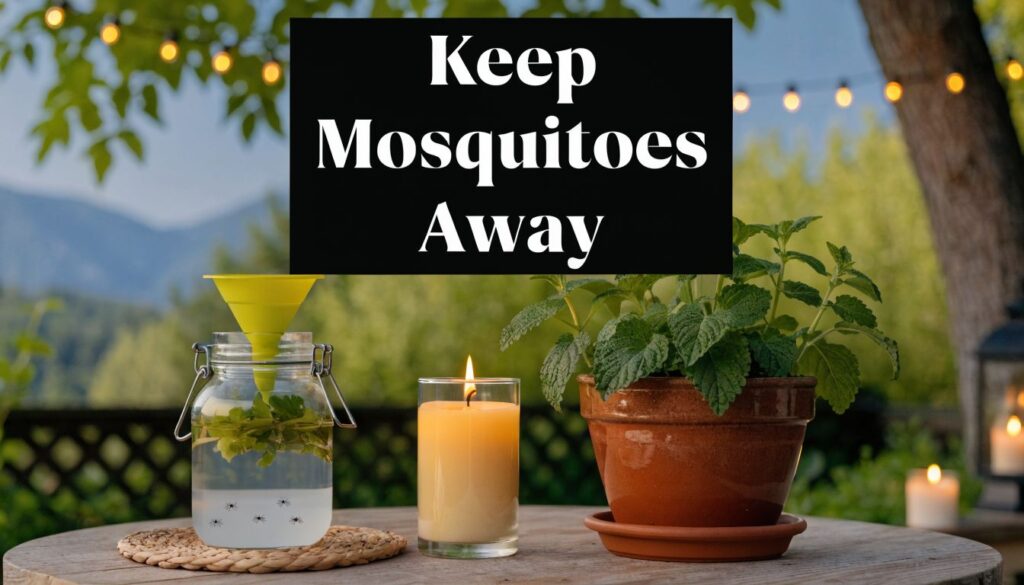
That perfect summer evening on your patio in Crown Point can turn fast. The grill is going, the air is warm, and then the whine starts. One bite becomes several, and suddenly nobody wants to stay outside.
That’s why so many homeowners search for home remedies to keep mosquitoes away before they start looking for full mosquito control. Some DIY steps absolutely help. Others only work in a very small area, for a short window, or under ideal conditions. Around Northwest Indiana, where humid weather, wet springs, shaded yards, and water-holding spots all work in mosquitoes’ favor, the difference between a helpful remedy and a complete solution matters.
The Green Advantage works with homeowners across Crown Point and nearby Northwest Indiana communities who want practical answers, not hype. Some families want a quick fix for a weekend cookout. Others are dealing with a yard that feels unusable every evening. In both cases, the best approach is usually layered. Start with the simple home steps that reduce pressure. Then, if mosquitoes keep coming back, bring in a professional mosquito reduction program that targets the whole property.
Consumer behavior reflects that mix of approaches. In an online survey of 5,209 mosquito repellent users, spray-on mosquito repellent containing DEET was the most commonly used option at 48%, followed by citronella candles at 43% and natural spray-on repellents at 36% (survey findings on mosquito repellent usage patterns). People clearly try a range of remedies, and that makes sense. The key is knowing what each one can and cannot do in a real yard.
1. Elimination of standing water and breeding sites
If you only do one thing, do this first. Mosquitoes don't need a swamp to multiply. In Crown Point neighborhoods, a clogged gutter, a forgotten bucket, a sagging tarp, or a birdbath that sits too long can keep a mosquito problem going even when the rest of the yard looks tidy.
This is the remedy that attacks the source instead of the symptom. Repellents help protect people. Water control helps reduce the next wave of mosquitoes before they emerge.
Here’s a helpful visual on where the problem often starts:
Where Crown Point yards usually hold water
Some breeding sites are obvious. Others hide in plain sight. I often tell homeowners to stop thinking only about puddles and start thinking about anything that can collect and hold water after rain or irrigation.
Common trouble spots include:
- Gutters and downspouts: Leaves and roof grit can slow drainage and create shallow, stagnant water.
- Birdbaths and plant saucers: These are easy to overlook because they seem harmless.
- Buckets, toys, and unused pots: Anything left upright outdoors can become a water container.
- Low spots in the lawn: Poor grading lets water sit near patios, fences, and foundations.
- Tarps and covers: A small dip in a grill cover or firewood tarp is enough to hold water.
- Water features: Decorative ponds and fountains need active management, not just good intentions.
Practical rule: If a container can hold water after a rain, treat it like a mosquito nursery until you’ve checked it.
What actually helps
Good DIY prevention is repetitive. That's the part many homeowners underestimate. One cleanup doesn't carry you through the season.
A few habits make a real difference:
- Turn containers over: Store buckets, flower pots, and bins upside down.
- Flush problem areas often: Refresh birdbath water regularly and clear out debris from drainage points.
- Fix drainage issues: Add soil where water consistently pools and redirect runoff away from the house.
- Inspect hidden edges: Look under decks, behind sheds, and along fence lines where damp pockets linger.
For a more complete yard strategy, The Green Advantage has a solid guide on how to reduce mosquitoes in your yard.
Homeowners who want long-term relief usually get the best results when water control is part of broader Integrated Pest Management strategies. That matters in Northwest Indiana, where mosquitoes don't respect property lines. If your yard is clean but nearby breeding sites remain active, pressure can stay high.
2. Mosquito-repelling plants and landscaping
Mosquito-repelling plants are popular because they feel natural, attractive, and easy to maintain. Citronella, lavender, basil, marigolds, mint, and lemongrass all show up on remedy lists for good reason. They smell strong, and many homeowners like the idea of building bite protection right into their outdoor spaces.
The trade-off is range. Plant-based protection tends to be very local, not property-wide. The underserved gap in a lot of online advice is that these plants may help close to the leaves or in small container groupings, but they don't create broad yard coverage in the way many people hope.

Where plants help and where they don't
Plants make the most sense near places where people sit. A row of basil and lavender in pots around a deck table can support other remedies. A few marigolds mixed into a garden bed can add some localized scent. Mint near a doorway may be useful at the threshold.
What plants don't do well is protect a full backyard with shade, damp soil, dense shrubs, and hidden breeding areas. A review of plant-based advice highlighted that many of these remedies work only in very small zones, not across expansive yards where mosquitoes continue breeding in standing water (discussion of the limits of plant-based mosquito remedies).
Plants are best treated as support tools. They can complement a mosquito plan, but they won’t replace source reduction or a targeted yard program.
Smarter planting for Indiana properties
If you want to use plants, placement matters more than quantity. A few strategic clusters beat random plantings across the yard.
Try these practical moves:
- Cluster pots near seating: Group basil, mint, lavender, or citronella-type plants near patios and porches.
- Use containers at entry points: Place aromatic plants by doors where people pass in and out.
- Keep growth trimmed: Crushed or freshly handled leaves release stronger scent than untouched foliage.
- Avoid overwatering: Ironically, the pots themselves can become mosquito habitat if saucers stay full.
In Crown Point, landscaping should also reduce mosquito resting areas. Dense, damp shrubs near patios create cool daytime shelter for adult mosquitoes. Pruning for airflow often helps more than adding another plant that's supposed to repel them.
3. Fan-based mosquito prevention systems
Fans are one of the most underrated home remedies to keep mosquitoes away. They don't attract much attention because they seem too simple, but for patios, porches, decks, and outdoor kitchens, moving air can make a noticeable difference right away.
Mosquitoes are fragile flyers. They prefer still, sheltered air and like to approach from shaded edges, under railings, and through landscaping gaps. A steady breeze disrupts that approach and also makes it harder for them to zero in on people nearby.

Best places to use fans outdoors
This remedy works best where people stay in one area for a while. If you're hosting dinner on a patio or sitting on a covered porch, a fan can help create a usable comfort zone.
Good setups include:
- Pedestal fans beside seating groups: Aim airflow across legs and lower body, where mosquitoes often target.
- Oscillating fans on decks: These help cover a wider seating area.
- Ceiling fans on porches: They add comfort and support bite reduction at the same time.
- Portable fans for kids' play areas: Helpful during evening outdoor time.
Position matters more than power. You don't need a wind tunnel. You need consistent airflow where people gather.
How to make this remedy work better
Fans don't lower mosquito numbers across the property. They protect a zone. That's why they're strongest when paired with other measures, especially water control and vegetation management.
A few practical tips improve performance:
- Create a perimeter of airflow: Don't point one fan at one chair. Cover the group.
- Face the problem edges: Aim fans toward shrubs, fence lines, or dark corners where mosquitoes approach.
- Use them before dusk: Start airflow before mosquito activity ramps up around your gathering area.
- Choose weather-rated equipment: Outdoor spaces in Northwest Indiana need fans built for moisture exposure.
If you're shopping for a more permanent setup, this guide to best outdoor ceiling fans can help you compare options for porches and covered spaces.
Fans are a strong example of a remedy that works exactly as advertised, but only within a defined space. For a Crown Point homeowner planning frequent outdoor use, that can still be a very worthwhile fix.
4. Essential oil-based mosquito repellent sprays
Homemade sprays are often the first thing people try because they're portable and easy to mix. Some are useful for short-term personal protection, especially when you're walking the dog, weeding the garden, or sitting outside for a brief stretch in the evening.
Not all natural sprays perform the same. Oil of lemon eucalyptus stands out from the pack. It has stronger support than the usual assortment of lavender, peppermint, or citronella DIY blends.
The natural option with the strongest support
Oil of lemon eucalyptus has emerged as the most effective natural alternative in this category. Consumer Reports testing found OLE products provided between 5 and 7 hours of complete protection, and a 2014 study showed that a mixture containing 32 percent lemon eucalyptus oil provided more than 95 percent protection against mosquitoes for 3 hours (overview of oil of lemon eucalyptus performance and public health approval).
That doesn't mean every homemade spray gives the same result. It means ingredient choice matters. If a homeowner in Crown Point wants a plant-based option with the best track record, OLE is the one to look for first.
For more detail on plant-based options, The Green Advantage also covers natural mosquito repellent essential oils.
A homemade spray can help protect people. It usually doesn't protect the whole yard.
Using essential oil sprays the right way
The most common mistake is treating a personal repellent like a property treatment. Spraying a little oil blend on patio furniture may add scent, but it won't substitute for removing breeding sites or treating heavy resting areas.
Use these sprays with realistic expectations:
- Apply to exposed skin or clothing carefully: Always dilute essential oils appropriately and patch test first.
- Reapply as needed: Natural sprays fade faster than many homeowners expect outdoors.
- Target short outings: These work best when you need temporary protection, not all-evening yard control.
- Be cautious around children and sensitive skin: Follow product directions and age guidance.
In practice, essential oil sprays are great as part of a layered routine. Use one before heading outside, then support it with fans, trimmed vegetation, and a yard plan that deals with mosquitoes before they reach the patio.
5. DIY mosquito traps and attractant-based devices
DIY traps appeal to people who want mosquitoes drawn away from the family instead of only repelled. The idea is straightforward. Use carbon dioxide, scent, moisture, or darkness to lure mosquitoes into a container or capture zone.
In real yards, traps can help, but placement and expectations matter. A single homemade trap beside the grill usually won't solve the problem. Several properly placed devices may reduce nuisance activity around the edges of a yard, especially when adult mosquitoes are resting nearby.
Where traps make sense
Bottle traps with a yeast-and-sugar mixture are common because they're inexpensive and easy to assemble. Homeowners in Crown Point often place them near shrub lines, along fences, or at the back of the lot where mosquito activity seems strongest.
That approach is smarter than setting traps next to people. You want to pull mosquitoes away from seating areas, not invite them closer.
A useful setup often looks like this:
- Put traps away from the patio: Place them near perimeter vegetation.
- Use dark, sheltered locations: Mosquitoes tend to rest in humid, shaded spots.
- Refresh contents regularly: Stale bait won't keep drawing interest.
- Monitor results: If the trap isn't collecting much, move it.
The limit of attract-and-catch remedies
Traps don't address breeding sites. They also don't form a defensive barrier around the property. If there are active water sources and dense mosquito harborage in the yard, traps become more of a supporting tactic than a primary answer.
That's why I usually describe them as a useful experiment for problem corners, not a complete mosquito control strategy. For a homeowner who likes to test solutions, they can be worth trying. For a family that wants reliable evening comfort across the yard, traps alone usually won't get them there.
Put traps where mosquitoes live, not where your guests sit.
If you use traps, pair them with source reduction. Otherwise you're trying to scoop adults out of the air while new ones continue emerging nearby.
6. Smoke-based mosquito repellent methods
Smoke has been used for a long time to make outdoor spaces less inviting to mosquitoes. Citronella candles, mosquito coils, burning sage, and similar approaches all work on the same basic idea. They interfere with the cues mosquitoes use to find people and create an area that's less comfortable for them to enter.
For a short backyard gathering, this can be useful. For a season-long mosquito issue, it’s temporary by design.

Best uses for candles, coils, and smoke
These products are event tools. They help most when the goal is to improve one dinner, one firepit night, or one outdoor party.
They tend to perform best when:
- The air is fairly still: Wind disperses smoke too quickly.
- People stay in one defined area: A compact patio is easier to protect than an open yard.
- You use several points, not one candle: Perimeter placement works better than a single centerpiece.
- They’re lit before people settle in: Give the scent and smoke time to build.
This is one reason citronella stays popular with homeowners even though it isn't a total solution. People want simple, visible action they can take right before guests arrive.
Real trade-offs to keep in mind
Smoke-based remedies can annoy mosquitoes, but they can also annoy people. Some homeowners don't like the smell, and some don't want open flames around children, pets, decks, mulch beds, or breezy outdoor spaces.
Use them carefully:
- Keep flames away from structures and combustibles: Especially on wood decks and near cushions.
- Never use coils or heavy smoke sources in enclosed spaces: Ventilation matters.
- Treat them as a short-term shield: They don't solve the source problem.
- Combine them with fans for better distribution: Light smoke plus moving air can improve comfort in a seating zone.
This method fits the “part 1 of a complete solution” mindset well. It can absolutely make a patio feel better tonight. It just won't keep tomorrow's mosquitoes from emerging.
7. Neem oil and natural botanical insecticides
Neem oil sits in the middle ground between a casual home remedy and a more intentional pest management product. Homeowners who want something botanical but stronger than a lightly scented spray often look here.
Used carefully, neem-based products may help on vegetation and outdoor surfaces where insects rest. They’re often applied to ornamental plantings, perimeter shrubs, or shaded areas around patios. That’s especially relevant in Northwest Indiana yards with dense greenery and moisture-retaining landscaping.
Where neem may fit in a yard plan
Neem isn't a magic yard reset. It’s better thought of as a targeted support treatment for specific problem areas. If mosquitoes consistently rise from a shaded hedge line or gather near thick hostas and foundation beds, a homeowner may use neem there as part of a broader cleanup effort.
The bigger trend behind that interest is real. The U.S. natural mosquito repellents market was valued at $726.0 million in 2024 and is projected to grow at a compound annual growth rate of 7.9% from 2025 to 2030 (U.S. natural insect repellent market outlook). More homeowners are actively looking for nature-based options, especially when they want eco-friendly pest control that still feels practical.
What homeowners should be careful about
Botanical doesn't automatically mean foolproof. Neem products still need to be used according to label directions, with attention to plant sensitivity, beneficial insects, and application timing.
A few sensible guidelines:
- Spot-treat problem vegetation: Focus on likely resting areas, not random broadcast spraying.
- Avoid overreliance: Neem may support your efforts, but standing water still has to be addressed.
- Test plants first if needed: Some ornamentals react poorly to oils, especially in heat.
- Read the label closely: Yard use, dilution, and timing matter.
For many Crown Point homeowners, neem is worth considering when the goal is to stay on the more natural end of the spectrum while still taking action beyond candles and potted herbs. It works best when expectations stay realistic and the yard plan tackles both adult mosquitoes and breeding conditions.
8. Garlic and herbal mosquito deterrents
Garlic remedies have a loyal following. Some people swear by eating more garlic in summer. Others make garlic sprays for shrubs, patios, and fence lines. Herbs like basil, mint, and catnip are often added to the mix.
These remedies can play a supporting role, but they tend to be inconsistent from yard to yard. Odor-based deterrents may help in tight areas for a limited time, yet they usually fade quickly outdoors, especially after irrigation, rain, or humid evenings.
Garlic sprays and herb gardens in practice
A homeowner in Crown Point might spray a garlic mixture around deck railings or the outer edge of a patio before a weekend gathering. Another may keep pots of basil and mint near chairs and entry doors. Those aren't bad ideas. They’re just modest tools.
The stronger opportunity here is combining repellency with breeding control. An emerging prevention angle highlighted for home water features is targeting mosquito development directly with options like mosquito fish in permitted settings or Bti dunks for water that can't be emptied (practical mosquito prevention methods for yards and water features). That’s more effective than relying on garlic scent alone when the primary issue is active breeding nearby.
If your yard has a pond, fountain, or chronic drainage issue, breeding control will matter more than any herbal spray.
Where these remedies belong
Garlic and herbs make sense for homeowners who enjoy DIY, gardening, and layering small defenses. They don't make sense as the only line of protection for a heavily pressured yard.
Use them as add-ons:
- Spray around edges before gatherings: Temporary deterrence is the realistic target.
- Grow herbs near seating areas: Helpful for localized scent and convenient access.
- Reapply after rain or watering: Outdoor odor barriers don't last long.
- Support them with habitat reduction: Otherwise you're only treating the surface annoyance.
Home Mosquito Remedies: 8-Way Comparison
| Item | Implementation complexity | Resource requirements | Expected outcomes | Ideal use cases | Key advantages |
|---|---|---|---|---|---|
| Elimination of Standing Water and Breeding Sites | Low–Moderate; routine inspections and maintenance required | Time, basic tools, occasional professional inspection/drainage work | Long-term, substantial reduction in local mosquito populations; addresses root cause | All residential properties; foundation of integrated pest management and neighborhood campaigns | Chemical-free, cost-effective long-term control; prevents multiple species from breeding |
| Mosquito-Repelling Plants and Landscaping | Low–Moderate; planning, planting and seasonal care | Plants, soil, water, gardening time, periodic replacement | Localized reduction near plantings; variable effectiveness with density and placement | Homeowners seeking aesthetic improvements near patios, entryways and seating areas | Natural, chemical-free barrier; enhances landscape and supports pollinators |
| Fan-Based Mosquito Prevention Systems | Low; simple setup but requires power and placement planning | Electric or solar fans, mounts, power source | Immediate, localized protection in fan-covered areas; also cools spaces | Patios, decks, outdoor dining and seating zones | Immediate, reusable, chemical-free and covers larger seating areas |
| Essential Oil-Based Mosquito Repellent Sprays | Low; easy DIY but requires proper dilution and testing | Essential oils, carriers, spray bottles; frequent reapplication | Short-duration personal protection; portable and customizable | Outdoor activities, family gatherings, camping and personal use | Pleasant scents, customizable, natural alternative to synthetic repellents |
| DIY Mosquito Traps and Attractant-Based Devices | Moderate; construction, strategic placement and maintenance | Household materials, yeast/CO2 sources, lights or containers; regular upkeep | Gradual reduction of local populations; most effective near traps | Yards where passive trapping is feasible; supplemental to other controls | Reduces actual populations, low ongoing cost, visible evidence of capture |
| Smoke-Based Mosquito Repellent Methods | Low; simple to use but needs active management and safety | Candles, coils or burnable plant materials; supervision and ventilation | Immediate but temporary protection while smoke is present; area-dependent | Outdoor events, evening gatherings and temporary seating areas | Fast-acting, inexpensive, creates ambiance while repelling mosquitoes |
| Neem Oil and Natural Botanical Insecticides | Moderate; correct mixing and targeted application required | Neem oil, emulsifier, sprayer, PPE; repeated applications | Reduces adults and larvae; longer-lasting than essential oils but not as potent as professional treatments | Properties with dense vegetation or moderate infestations seeking stronger natural control | Disrupts lifecycle, biodegradable, minimal non-target toxicity |
| Garlic and Herbal Mosquito Deterrents | Low; dietary changes and planting or simple sprays | Garlic, herbs, simple spray materials, consistent consumption | Variable and often modest protection; best as complementary measure | Budget-conscious homeowners, herb gardeners, complementary strategy | Inexpensive, safe, dual use as food/herbs, culturally familiar method |
When DIY isn't enough Professional mosquito control in Crown Point
Home remedies can absolutely help. They can make a porch more comfortable, reduce pressure around a patio, and give you better control over the parts of the problem that are sitting right in front of you. For many households, that first layer of action is worth taking.
But DIY has limits, especially in Northwest Indiana. Mosquitoes breed fast when water collects in hidden spots. They rest in dense shrubs, under decks, near low drainage areas, and along cool shaded edges that most homeowners don't inspect closely. Even if you stay on top of your own yard, mosquitoes can still move in from neighboring properties, tree lines, drainage corridors, and unmanaged water sources nearby.
That’s why persistent mosquito activity usually needs more than sprays, candles, herbs, and fans. Those tools mostly help with immediate relief. They don't consistently interrupt the full mosquito lifecycle across the property. They also require steady upkeep, and most families don't want mosquito control to become a second job every week of the summer.
Professional mosquito service is different because it’s built around inspection, targeting, and follow-through. At The Green Advantage, the work starts by reading the property correctly. That means identifying the shaded resting zones, the overlooked water-holding areas, and the site features that keep mosquitoes active near the home. A good program doesn't rely on one tactic. It layers habitat reduction with carefully applied treatments where they count.
For Crown Point homeowners, that matters because local conditions often work against simple remedies. Wet stretches, summer humidity, mature landscaping, and backyard features like decorative water, clogged drainage, and thick perimeter plantings create ideal mosquito pressure. A patio fan may help where you sit. A candle may help during dinner. A personal repellent may help while you mow. None of those alone gives you reliable, property-level relief.
The Green Advantage approaches mosquito reduction as part of an integrated plan. Licensed technicians inspect the yard, flag breeding sources you may have missed, and apply targeted treatments to foliage and shaded areas where adult mosquitoes rest. When water can't be dumped or drained, a professional can recommend the right next step instead of leaving that source active. The result is broader coverage and more dependable control than most homeowners can achieve with scattered DIY efforts.
That broader support also fits families who are already searching for pest control near me, exterminator near me, or pest control in Crown Point, IN because mosquito issues rarely stay isolated. The same homeowner dealing with mosquitoes may also need residential pest control for ants, wasps, spiders, or seasonal invaders. A company that understands local pest pressure can help protect the whole property, not just one symptom.
For property managers, landlords, and local businesses in Northwest Indiana, the value is even clearer. Outdoor mosquito activity affects tenant satisfaction, customer comfort, and the usability of shared spaces. A planned service program is more practical than asking people to rely on citronella candles and homemade sprays around entryways, patios, and common areas.
If you're still enjoying your yard with a few DIY steps, keep using them. They can be useful. If you're avoiding the patio, cutting evenings short, or fighting the same mosquito problem over and over, it's time for a stronger answer. The Green Advantage provides eco-friendly pest control and mosquito reduction programs designed for real Crown Point properties, real summer conditions, and real peace of mind.
If mosquitoes are taking over your backyard, porch, or business exterior in Crown Point or nearby Northwest Indiana communities, The Green Advantage can help you move beyond temporary fixes. Reach out for a quote, schedule an inspection, and get a customized mosquito control plan from a local team that understands how to protect outdoor spaces with practical, environmentally mindful pest management.
How To Get Rid Of Bed Bugs For Good

You notice the bite first. Then a tiny dark spot on the sheet. Then you start pulling apart the bed, checking the mattress seam with your phone flashlight, and that’s when the stress kicks in. Most homeowners in Crown Point don’t call about bed bugs because they’re calm. They call because they’re exhausted, embarrassed, and worried they’re about to carry the problem into every room of the house.
That reaction is normal.
Bed bugs get under your skin long before they’re confirmed. People lose sleep, throw away furniture they didn’t need to throw away, wash the same bedding over and over, and spend money on sprays that never touch where they hide. The problem isn’t just the bugs. It’s the feeling that your bedroom suddenly isn’t safe or restful anymore.
If you’re searching for how to get rid of bed bugs, you need two things right away. You need a clear way to confirm what you’re seeing, and you need an honest explanation of what works. In Crown Point, IN, and nearby Northwest Indiana communities, that usually means moving quickly, containing the problem, and avoiding the DIY mistakes that turn one room into several.
This guide is written the way I’d explain it to a homeowner standing in a hallway with a trash bag in one hand and a can of spray in the other. Stay calm. Move carefully. And if the evidence points to bed bugs, treat the job like a full inspection and control problem, not a quick cleaning project.
That Sinking Feeling Discovering Pests in Your Crown Point Home
The first sign is rarely dramatic. It’s often a small clue that doesn’t make sense on its own. A bite line on your arm. Specks on the fitted sheet. A bug casing in the corner of the box spring. By the time residents in Crown Point start searching for pest control in Crown Point, IN or exterminator near me, they’ve already spent a few days hoping it’s anything else.
That delay is understandable, but bed bugs reward hesitation.
What makes them so upsetting is how personal they feel. Ants in a kitchen are frustrating. Wasps near a porch are alarming. Bed bugs are different because they affect sleep, routines, laundry, guests, and how comfortable you feel in your own bedroom. Homeowners often start isolating themselves socially before they’ve even confirmed the problem. Renters worry about neighbors. Parents worry about children carrying bugs in backpacks or on clothing.
Why panic leads to bad decisions
The worst moves usually happen in the first day. People drag a mattress into the garage, carry blankets through the house uncovered, or soak surfaces with products that were never going to solve the infestation. Those actions can make the job harder because bed bugs don’t stay politely on the mattress. They hide in seams, joints, cracks, furniture, and nearby clutter.
Practical rule: Don’t treat bed bugs like a visible surface pest. Treat them like a hidden-void pest that happens to feed at night.
A lot of homeowners also assume bed bugs mean the home is dirty. That isn’t true. Bed bugs are hitchhikers. They move in on luggage, used furniture, shared walls, guests, deliveries, and everyday travel. Clean homes get them. Busy homes get them. Careful people get them.
What you need right now
Start with a simple goal. Confirm whether you’re dealing with bed bugs or something that only looks like bed bugs.
If the signs are real, residential pest control is usually the fastest route back to normal sleep. If you manage rentals or commercial property in Crown Point, the stakes are even higher because one delayed response can create a building-wide issue. That same mindset applies across other infestations too, whether you’re dealing with rodent control, termite control, mosquito control, or wasp removal. Early, accurate identification always beats guessing.
For bed bugs, the path forward starts with inspection. Not panic. Not internet remedies. Inspection.
Confirming Your Suspicions A Homeowner's Guide to Bed Bug Detection
Before you buy anything, inspect. Bites alone aren’t enough. Skin reactions vary, and plenty of pests leave marks that homeowners mistake for bed bugs. Good detection starts with visible evidence.
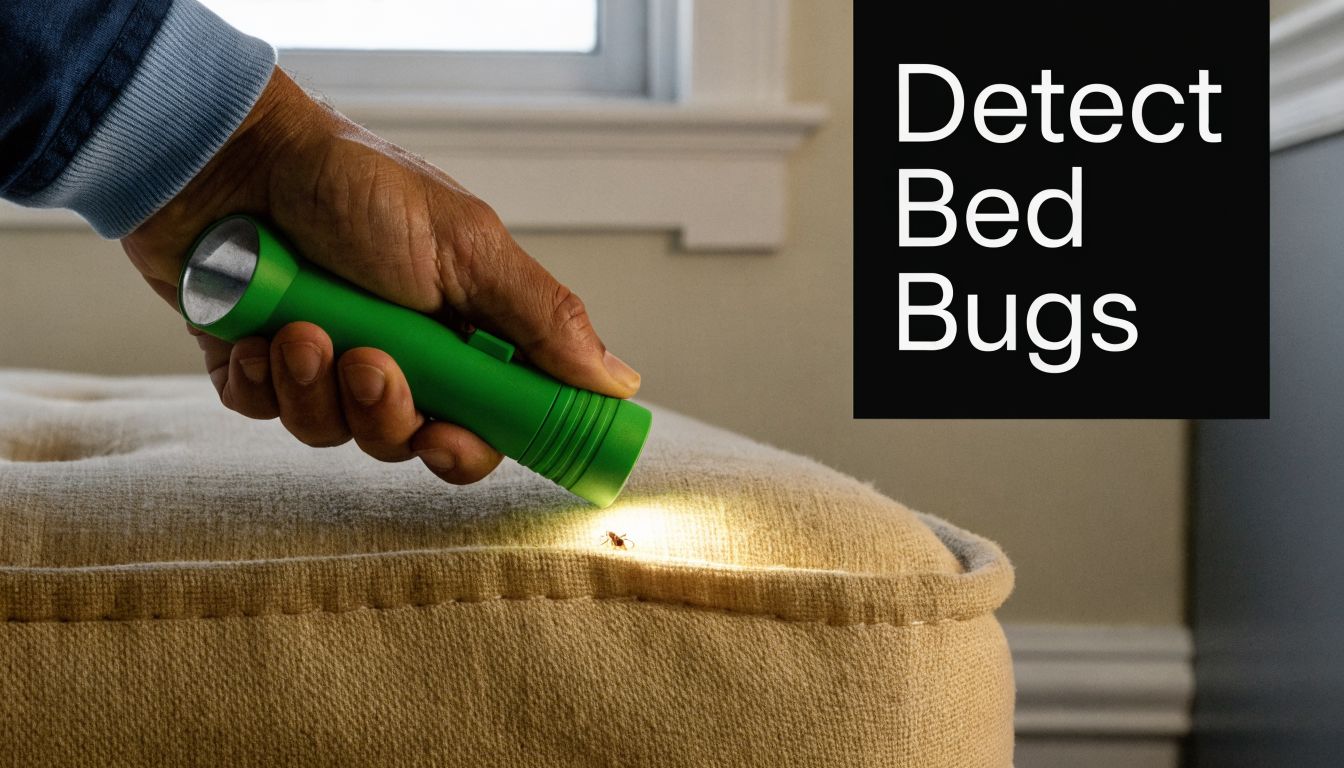
What to look for first
Focus on four types of evidence:
- Live bugs that are hiding in seams, folds, joints, or cracks near where people sleep or rest.
- Dark fecal spots on sheets, mattress seams, box springs, bed frames, or nearby furniture.
- Shed skins or casings left behind as immature bugs grow.
- Tiny white eggs tucked into protected areas.
Don’t start by searching the whole house. Start where people sleep, then expand outward.
Where bed bugs hide most often
Begin with the bed itself. Use a flashlight and something thin like an old gift card to check tight seams and creases.
Mattress seams and piping
Check along stitched edges, labels, tufts, and corner guards.Box spring fabric and frame
Look underneath, especially around staples, wood joints, and the dust cover.Bed frame and headboard
Inspect screw holes, slats, brackets, and the back side of the headboard.Nearby furniture
Nightstands, upholstered chairs, couches, and drawer joints can all harbor bed bugs.Room edges and wall voids
Check baseboards, picture frames, curtain folds, carpet edges, and around outlet covers.
A proper inspection is slow because bed bugs fit into extremely narrow spaces. That’s why homeowners often miss them even when they’re actively looking.
How to tell bed bugs from other pests
Homeowners commonly confuse bed bugs with carpet beetles, fleas, or random small insects found near a bed.
A few practical distinctions help:
- Carpet beetles leave shed skins too, but they’re usually connected to natural fibers, stored fabrics, or pet hair, not blood spots and bed-frame harborages.
- Fleas are more likely to be found around pets, pet bedding, and floor-level areas. They jump. Bed bugs don’t.
- Spiders and mosquitoes can cause bites, but they don’t leave fecal spotting on mattress seams or eggs hidden in bed hardware.
If you find signs but aren’t fully sure, save a sample in a sealed container or clear tape and get a professional identification. That’s far better than treating the wrong pest.
For a more detailed visual walkthrough, this guide on how to tell if you have bed bugs can help you compare what you’re seeing in your own room.
Why early detection matters more in apartments
Renters and landlords in Crown Point have an extra challenge. Bed bugs don’t respect unit lines.
For multi-unit housing, Rutgers notes that 68% of U.S. infestations occur in apartments, and uncoordinated neighbor treatments fail in 75% of cases. That matters because bugs can move through shared walls and adjoining spaces. A tenant who treats only one bedroom while the next unit does nothing may feel temporary relief, but the infestation often comes back.
In apartments, a bed bug problem is rarely just a single-room problem for long.
That’s one reason professional inspections matter so much in rental properties, condos, and attached housing.
Here’s a helpful visual if you want to see common signs and likely hiding zones before you keep inspecting:
A quick way to organize your inspection
Use this short checklist as you go room by room:
| Area | What to check | What matters |
|---|---|---|
| Bed | Seams, tufts, labels, frame joints | Live bugs, spots, eggs, shed skins |
| Furniture | Upholstery seams, drawer joints, undersides | Nearby harborages beyond the bed |
| Wall areas | Baseboards, frames, outlet edges | Hidden spread around sleeping areas |
| Linens | Sheets, pillowcases, blankets | Spotting and cast skins |
| Adjacent rooms | Sofas, recliners, guest beds | Whether the issue has spread |
If you find confirmed signs, move from inspection to containment. Don’t jump straight to sprays.
Immediate Containment and The Limits of DIY Solutions
The first 24 hours matter. A rushed response can turn one infested room into a problem that follows laundry baskets, backpacks, and overnight guests through the rest of the house.
In Crown Point, I often see the same pattern. A homeowner finds signs, starts washing everything, sprays a few products, then begins sleeping in another room to get some rest. A week later, the bugs have a second harboring area, everyone is exhausted, and the cleanup has doubled. Containment is about slowing that chain reaction while you get a treatment plan in place.
What to do right away
Start with actions that reduce spread without scattering bugs into new areas.
- Bag suspect fabrics before moving them. Use sealed plastic bags for bedding, clothing, stuffed items, and anything stored near the bed.
- Use high heat on dryable items. Put clothing, bedding, and similar fabrics in the dryer first. Washing helps with cleaning, but heat is what kills bed bugs on those items.
- Vacuum methodically. Focus on mattress seams, box spring edges, bed frame joints, baseboards, recliners, and nearby furniture. Empty the vacuum contents into a sealed bag and take it out promptly.
- Contain clutter before you relocate it. Loose piles give bed bugs more places to hide and more chances to hitchhike to another room.
- Keep sleeping arrangements stable unless a professional tells you otherwise. Moving to the couch or guest room often spreads activity instead of stopping it.
These steps help reduce the chance of bed bugs traveling deeper into the home. They do not remove hidden populations in cracks, furniture joints, wall gaps, or neighboring rooms.
What usually makes the problem worse
Bed bugs punish half-measures. A tactic can feel productive and still leave the infestation largely intact.
Avoid these common mistakes:
Bug bombs and foggers
They do not reach the tight harborages where bed bugs spend most of their time.Rubbing alcohol sprays
They create a fire hazard and only affect direct contact in the moment.Dragging furniture through the home uncovered
That can drop bugs and eggs along the route.Throwing out beds too early
Many homeowners spend money replacing furniture before the infestation is controlled, then the new items get exposed too.Assuming one weekend of cleaning solves it
Bed bugs can survive in protected spots that routine cleaning never touches.
If you only kill the bugs out in the open, the infestation keeps going in the places you cannot see.
Why store-bought and DIY treatments so often stall out
The hard part is not killing a bed bug. The hard part is killing all of them, including eggs and hidden groups, in every place they settled.
That is where DIY efforts usually break down. A spray may knock down visible activity along a baseboard. A steamer may help on certain seams if used correctly. Mattress encasements can remove one hiding area. Those are support tools, not a full solution. They do not address wall voids, bed frame interiors, upholstered furniture, luggage, nightstands, or spread into adjacent rooms.
Heat creates the same false confidence. A room can feel hot and still have cool pockets inside a box spring, behind trim, under clutter, or deep in furniture where bed bugs survive. Professional heat work depends on measured temperatures, equipment placement, air movement, and follow-up inspection. Space heaters and improvised setups rarely produce even lethal temperatures throughout the room.
I have walked into homes where people worked for weeks, spent hundreds on sprays and covers, and still had live activity because one recliner, one bed frame joint, or one overlooked room kept the infestation going.
The hidden cost of repeated DIY attempts
The stress builds fast.
Laundry piles up in bags. Kids stop having friends over. People lose sleep and start checking every speck on the sheet. In apartments, condos, and duplexes, delays also raise the chance of bugs spreading through shared walls or being carried into common areas, vehicles, and workplaces. What started as a bedroom problem becomes a household routine problem, then a building problem.
That is why I do not frame professional service as a convenience item. It is the most reliable way to stop the cycle, protect neighboring units, and give your home a clear path back to normal.
What DIY can help with, and where it stops
| Task | DIY can help with | DIY usually cannot do |
|---|---|---|
| Laundry and drying | Kill bed bugs on dryable fabrics | Clear hidden harborages throughout the room |
| Vacuuming | Remove some live bugs, shed skins, and debris | Reach protected eggs and deep cracks |
| Decluttering | Reduce hiding spots and improve access for treatment | Eliminate the infestation on its own |
| Mattress encasements | Limit hiding on the mattress and box spring exterior | Control bugs in frames, furniture, walls, and nearby rooms |
| Store-bought products | Kill some exposed bed bugs when used correctly | Deliver consistent room-by-room eradication |
Use DIY for containment and preparation. Do not mistake it for closure.
If you have already cleaned, bagged, sprayed, washed, and dried items and you are still finding activity, that usually means the infestation is established beyond the spots you can treat on your own.
The Green Advantage Solution Professional Bed Bug Treatment in Northwest Indiana
Professional bed bug control works when it treats the infestation as a system. Inspection, heat, targeted applications when needed, follow-up, and monitoring all have to work together. That’s the principle behind Integrated Pest Management, or IPM.
For bed bugs, IPM consistently outperforms spray-only programs. In the Journal of Integrated Pest Management, IPM programs achieved up to 96.8% reduction in bed bug populations, compared with 85% for insecticide-only approaches. That gap matters because a partial reduction can still leave enough hidden activity to restart the infestation.
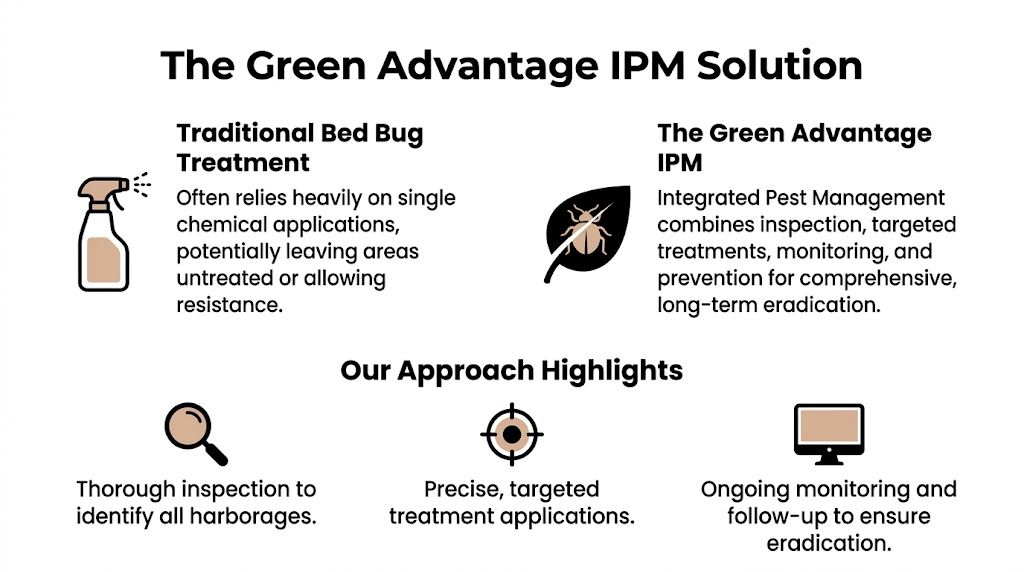
What professional IPM looks like in practice
An effective plan usually includes:
- Thorough inspection to identify primary and secondary hiding areas.
- Heat treatment for broad, non-chemical kill across life stages.
- Targeted measures for difficult voids, furnishings, or structural details.
- Monitoring tools to confirm whether activity remains.
- Follow-up guidance so the home doesn’t slide back into risk conditions.
A local provider matters in Crown Point and nearby Northwest Indiana communities, where homes vary widely in layout, furniture density, attached garages, basements, and multi-unit configurations. A treatment plan has to fit the site, not just the pest.
Why heat is so valuable
When technicians use whole-room heat correctly, it reaches where surface sprays often don’t. It can penetrate mattresses, furniture, cracks, and tucked-away harborages without leaving chemical residue behind. That matters for homeowners who want a more environmentally mindful option and for families who don’t want to rely on repeated broad pesticide use around sleeping areas.
The process is technical. Equipment placement, airflow, temperature mapping, and sensor checks all matter. Professionals don’t just warm up a room and hope for the best. They build conditions that bed bugs can’t survive.
Heat works because it targets the bug’s biology, not because the room feels hot.
The Green Advantage uses an IPM approach for bed bug work as one local option among professional services in Crown Point. That same inspection-first mindset also carries over into other local needs like ant control, spider control, rodent control, mosquito reduction, and termite control, where a one-size-fits-all spray rarely solves the underlying issue.
DIY vs Professional Bed Bug Treatment
| Factor | DIY Methods | The Green Advantage (Professional IPM) |
|---|---|---|
| Inspection | Usually limited to visible areas | Structured inspection of primary and secondary harborages |
| Heat delivery | Inconsistent room temperature | Controlled heat strategy with verified treatment conditions |
| Egg control | Often incomplete | Designed to address all life stages |
| Spread risk | Higher when items are moved incorrectly | Lower with a coordinated plan and prep guidance |
| Follow-up | Homeowner guesses whether it worked | Monitoring and post-treatment direction built into the process |
| Long-term control | Often piecemeal | Multi-tactic approach focused on lasting reduction |
What this means for homeowners and property managers
For a single-family home, professional treatment is about restoring comfort and stopping the cycle of failed attempts. For a landlord or property manager, it’s also about coordination. Bed bugs in one unit can become complaints in several. Fast identification, clear prep instructions, and whole-building awareness matter.
For commercial clients, especially lodging-related settings, offices, or facilities with upholstered furniture, the same principle applies. Delayed action can turn a manageable issue into an operational headache.
Bed bug work also highlights a broader truth about commercial pest control and residential pest control in Crown Point. The right service isn’t the one that applies the most product. It’s the one that correctly identifies the pest, matches the treatment to the site, and verifies results afterward.
How to Prepare Your Home for a Bed Bug Treatment
Preparation decides whether treatment reaches every hiding place or leaves cool, protected pockets behind. Homeowners are often surprised by how important their role is before a heat job begins.
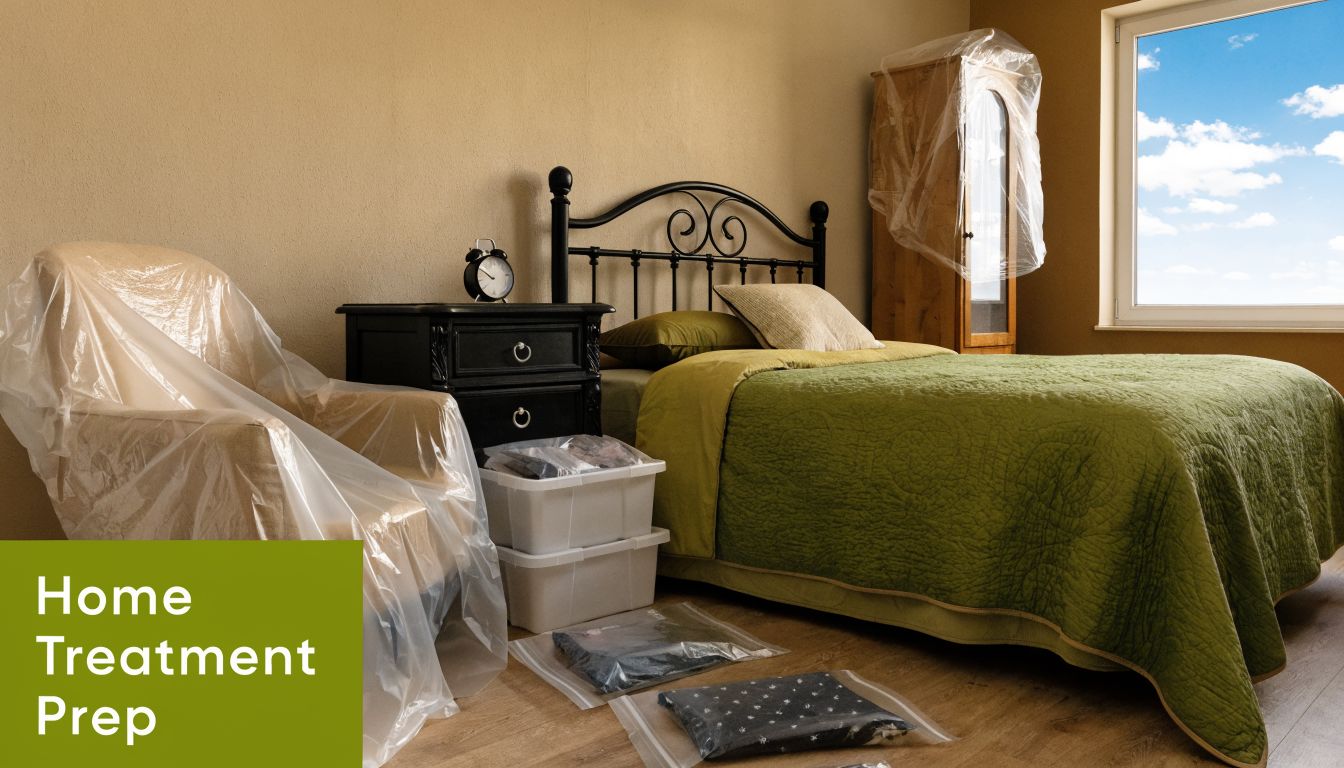
A professional treatment team can bring the equipment and the process, but the home still needs to be set up correctly. The treatment guidance referenced here notes that professionals must sustain core temperatures of 135-145°F, and that failure to declutter or dismantle bed frames can reduce efficacy by up to 30% because those conditions create cool spots where bugs survive.
The preparation checklist that matters most
Use your technician’s specific instructions first, but these are the common priorities.
Declutter floors and room edges
Piles of clothes, storage bins, loose papers, and packed closets block airflow and create protected hiding zones.Launder linens and clothing as directed
Bag items before moving them. Dry eligible items on high heat, then keep cleaned items sealed until the home is ready.Empty or simplify nightstands and dresser tops
Fewer loose contents means fewer hidden harborage points and better treatment access.Pull furniture away from walls when instructed
This improves access to bed frames, baseboards, and rear surfaces.Disassemble bed components if requested
Bed bugs love joints, brackets, screw holes, and slat connections. If the frame stays fully assembled, those areas can remain protected.Vacuum visible debris and seams
This doesn’t replace treatment, but it removes some bugs and debris that can interfere with inspection.
Items that usually need special attention
Not everything should stay in place, and not everything should be bagged the same way.
| Item type | Typical concern | Why it matters |
|---|---|---|
| Clothing and bedding | Spread during transport | Must be contained before moving |
| Electronics | Heat sensitivity and hidden voids | Need technician guidance |
| Houseplants | Heat intolerance | Usually need removal from treatment areas |
| Candles, aerosols, sensitive products | Temperature risk | Must be removed for safety |
| Under-bed storage | Prime hiding zone | Needs to be emptied or managed correctly |
Don’t improvise your own prep plan
One of the biggest mistakes homeowners make is over-preparing in the wrong direction. They move too many items into hallways, garages, or other rooms. That can spread bed bugs into spaces that weren’t originally active.
A better approach is controlled preparation. Bag. Label. Contain. Follow the room-by-room instructions you’re given.
Your job is to make the infestation easier to treat, not to relocate it.
If you’re already doing a full reset of a rental unit or preparing a room after tenant turnover, a structured cleaning list can help you avoid missing soft goods and hidden storage zones. This ultimate cleaning checklist is useful for organizing that process alongside pest prep.
For homeowners who want a broader walkthrough of what technicians usually ask for before a service visit, this guide on how to prepare for pest control helps explain the logic behind access, sanitation, and item handling.
What to ask before treatment day
If you’re unsure, ask direct questions:
- Which rooms are being treated?
- What needs to be bagged, dried, removed, or left in place?
- Should bed frames be dismantled ahead of arrival?
- What should I do with medications, plants, electronics, and pets?
- When can cleaned items come back into normal use?
Good prep removes guesswork. It also lowers stress because you know exactly what’s expected. When the house is prepared correctly, treatment has a much better chance of reaching the spaces where bed bugs survive.
After the Treatment Staying Vigilant and Preventing Future Infestations
The hardest part for many homeowners comes after the service truck leaves. The bugs may be dying off, but the stress often lingers. People keep waking up at night, checking sheets, and wondering if every itch means the problem is back. That reaction is normal, especially after a long DIY battle that cost time, sleep, and money.
What helps now is a clear follow-up plan.

What to expect after treatment
Your technician may place interceptor monitors, schedule a reinspection, or have you watch for specific signs in the treated rooms. Bites alone are not a reliable way to judge success. Bed bugs hide well, and post-treatment decisions should be based on evidence you can see, not anxiety during the night.
Keep the treated areas orderly for a while. Avoid piling clothes on the floor, stuffing items back under the bed, or bringing in extra furniture too soon. An open, easy-to-inspect room gives you and your technician a much better chance of spotting any lingering activity early.
In multi-unit housing, vigilance matters even more. Bed bugs do not respect unit lines, and delayed follow-up in one apartment can turn into a building-wide problem.
Habits that lower the chance of another infestation
A few steady habits make a real difference:
- Inspect second-hand furniture before it comes indoors, especially beds, couches, upholstered chairs, and nightstands.
- Handle travel items carefully. Unpack away from sleeping areas, dry clothing on high heat when appropriate, and do not store luggage next to the bed.
- Use extra caution in shared laundry spaces if you live in an apartment, condo, or other multi-unit property.
- Keep beds and nearby floors clear so fresh signs are easier to spot.
- Use mattress and box spring encasements when your technician recommends them to reduce hiding spots and simplify inspections.
Routine linen care also helps you notice changes sooner. If you want a practical household reference, this guide on how often to wash bedding is a useful baseline.
Why follow-up matters so much
I have seen plenty of cases in Crown Point where the physical infestation was under control before the homeowner felt at ease. That is one reason follow-up matters. The goal is not only to eliminate bed bugs. It is to restore normal life in the room, help you trust your home again, and reduce the chance of bugs spreading to relatives, neighbors, tenants, or adjoining units.
Check the monitors. Follow the instructions for washed and bagged items. Reintroduce belongings in the order your technician gave you, not all at once. Small decisions after treatment can either protect the work that was done or create new hiding opportunities.
That same prevention mindset protects the rest of your property too, and it protects your peace of mind the longest. If you are in Crown Point or nearby Northwest Indiana and you are tired of second-guessing every bite, stain, or late-night inspection, The Green Advantage can help you move from suspicion to a clear treatment plan, with inspection, treatment, and follow-up that are built to hold up in real homes.
Do Bug Zappers Work During the Day: Uncovering the Truth

TL;DR: No, bug zappers don't work well during the day. Sunlight overwhelms the zapper's UV light, making it far less noticeable to insects, and research found that only 0.25% of nearly 14,000 insects killed by bug zappers were biting mosquitoes or gnats, while over 99.75% were beneficial or harmless non-biting insects.
If you're standing in your Crown Point backyard on a bright summer afternoon, hearing almost no zaps and still swatting at mosquitoes, your bug zapper probably isn't broken. It's doing what bug zappers usually do in daylight. Very little.
That can be frustrating because the idea sounds simple. Hang a light, attract bugs, kill the pests, enjoy the yard. In practice, daytime mosquito control doesn't work that way. The insects you want gone aren't strongly drawn to UV light, and the sun makes the trap even less useful during the hours when many homeowners hope it will help most.
For families in Northwest Indiana, that matters. You don't want to spend the season relying on a device that gives a false sense of protection while disrupting the helpful insects your yard needs.
The Real Science Behind Bug Zappers and Mosquitoes
A bug zapper works on a straightforward principle. It emits ultraviolet light, insects fly toward that light, and an electrified grid kills them on contact. That mechanism does attract some flying insects.
The problem is that the bug you care about most in summer isn't using the same cues.

What bug zappers actually attract
Many insects show phototaxis, which means they're drawn to light. Moths, beetles, and other insects that move in low-light conditions are much more likely to head toward a UV bulb.
That's why bug zappers often seem busy at night. The device can kill insects. It just isn't selective about which ones.
A lot of homeowners assume that if the unit is zapping, it must be taking care of mosquitoes. That's the core misunderstanding.
Why mosquitoes ignore the trap
Mosquitoes don't mainly hunt by looking for UV light. They find people by sensing carbon dioxide, body heat, and human odors. A bug zapper doesn't produce those signals, so it isn't speaking the mosquito's language.
Research summarized by HowStuffWorks on bug zappers and mosquitoes reported that out of nearly 14,000 insects killed by bug zappers, only 0.25% were biting mosquitoes or gnats. That tiny share tells you the issue isn't placement or brand preference. It's a mismatch between the trap and the pest.
Practical rule: If a device doesn't mimic how mosquitoes actually locate a host, it won't be a dependable mosquito-control tool.
This is why bug zappers often create a misleading result. You see dead insects. You hear activity. But the mosquitoes around your patio, deck, or garden in Crown Point may be mostly untouched.
The takeaway for mosquito season in Northwest Indiana
In Northwest Indiana, homeowners usually aren't shopping for random flying insect control. They're trying to reduce bites around backyards, pools, patios, grilling areas, and play spaces.
For that goal, species-specific tools matter. A trap built around UV attraction isn't built around mosquito behavior. If you're comparing options, it's worth reviewing guides on outdoor mosquito traps with that distinction in mind.
A bug zapper may kill some insects after dark. It just won't solve the mosquito problem you bought it for.
Why Sunlight Makes Your Bug Zapper Useless During the Day
Daytime performance falls apart for a simple reason. The sun outshines the zapper.
Imagine trying to notice a small flashlight in the middle of a bright parking lot at noon. The flashlight is still on, but it doesn't stand out. A bug zapper faces the same problem with its UV bulb during the day.
The sun overwhelms the bulb
During sunny conditions, ambient UV radiation from the sun overwhelms the zapper's artificial light. That makes the device much less visible to insects. As noted in Mosquito Joe's explanation of how bug zappers work, user reports and expert observations also line up with that reality, with the audible zap happening far less often during the day than at dusk or overnight.
That part matters because bug zappers depend on contrast. They need their light source to stand out in the environment. At night, they can. In broad daylight, they usually can't.
Why the daytime yard still feels buggy
Homeowners often notice a frustrating pattern. The zapper is plugged in all afternoon, but mosquitoes still hover near shaded seating areas, landscaping, mulch beds, and damp corners of the yard.
That's because the device isn't competing well with the sun, and mosquitoes aren't strongly pursuing UV light anyway. So you're dealing with two separate failures at once:
- Weak attraction signal: The bulb doesn't stand out in daylight.
- Wrong attraction signal: Mosquitoes are looking for host cues, not a UV lamp.
- Poor practical payoff: You use electricity and get very little meaningful protection where people gather.
A daytime bug zapper can make you feel like you're treating the problem when you're mostly just running a light.
Does shade help at all
Some homeowners try moving the zapper under a porch roof, beneath a tree canopy, or near a shaded fence line. That can make the bulb slightly more noticeable than it would be in direct sun.
But even then, the improvement is limited. Insects still have abundant natural light around them, and the mosquito biology problem doesn't go away. Shade may change visibility a bit. It doesn't transform a UV trap into a mosquito control system.
A better question isn't whether a bug zapper works during the day under ideal placement. It's whether the result is strong enough to protect your outdoor living space in any reliable way. For most Crown Point properties, it isn't.
The Unseen Ecological Cost of Running a Bug Zapper
The biggest issue isn't only that bug zappers miss mosquitoes. It's that they kill so many of the wrong insects.
When homeowners look at a tray full of dead bugs, it can feel like progress. In reality, that pile often represents pollinators, harmless insects, and species that help keep the yard balanced.
Most of the kill isn't your target pest
A landmark University of Delaware study, summarized by the San Gabriel Valley Mosquito and Vector Control District, found that over 99.75% of insects killed by bug zappers were beneficial or harmless non-biting species.
That's the part most product packaging doesn't emphasize. The machine isn't acting like a precision tool. It's acting like an indiscriminate trap.
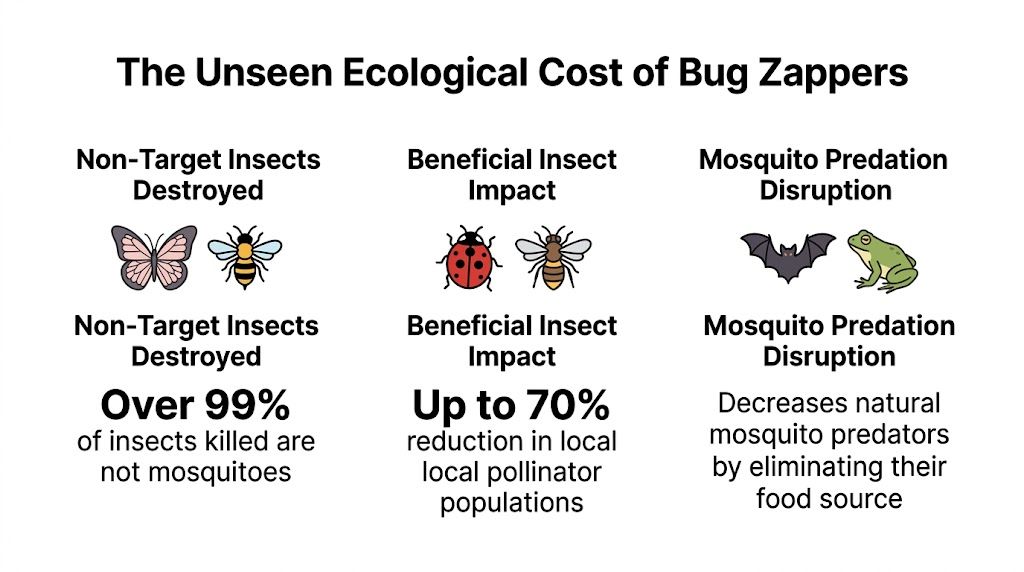
What that means in a Crown Point yard
Your yard works better when beneficial insects are active. Pollinators support flowers and gardens. Predatory insects help limit other pests. The local food web depends on those species staying in place.
When a zapper kills large numbers of non-target insects, the effects show up in ways homeowners do notice:
| Yard feature | What helpful insects do | What happens when they're removed |
|---|---|---|
| Flower beds | Support pollination | Plants can lose some natural pollination support |
| Vegetable gardens | Contribute to a healthier garden ecosystem | Pest pressure can become harder to manage naturally |
| Landscape balance | Feed birds and other beneficial wildlife | The food web gets thinner around the property |
| Natural pest control | Some species prey on nuisance insects | Fewer beneficials can mean more imbalance |
The zapper may look active, but the activity isn't necessarily helping the space where your family spends time.
Daytime use adds another problem
Running a bug zapper during the day can expose more daytime-active beneficial insects. According to the YouTube source provided in the verified data, daytime use is particularly harmful to pollinators like bees and butterflies, and it can also kill pest controllers like predatory wasps and up to 30% of helpful hoverflies in treated areas, as discussed in this video on bug zapper ecological impact.
That's a serious trade-off for a device that still doesn't address mosquito behavior well.
Killing beneficial insects to avoid mosquito bites is a bad bargain when the mosquitoes are barely responding to the trap in the first place.
Why this matters more than many homeowners realize
A healthy yard isn't just grass and shrubs. It's a living system. When you remove the insects that pollinate, prey on pests, or feed birds and other wildlife, you can create problems that don't look connected at first.
A homeowner might say, "The zapper catches a lot, so it must be helping." But volume isn't the same as value. If almost everything it catches is the wrong insect, the device is working against the kind of outdoor environment most families in Northwest Indiana want to maintain.
A Smarter Mosquito Control Strategy for Your Crown Point Home
If bug zappers fail because they target the wrong cue, the answer is to use a mosquito strategy built around how mosquitoes live, breed, and rest.
That approach is more practical. It focuses on where the problem starts and where adult mosquitoes spend time between bites.
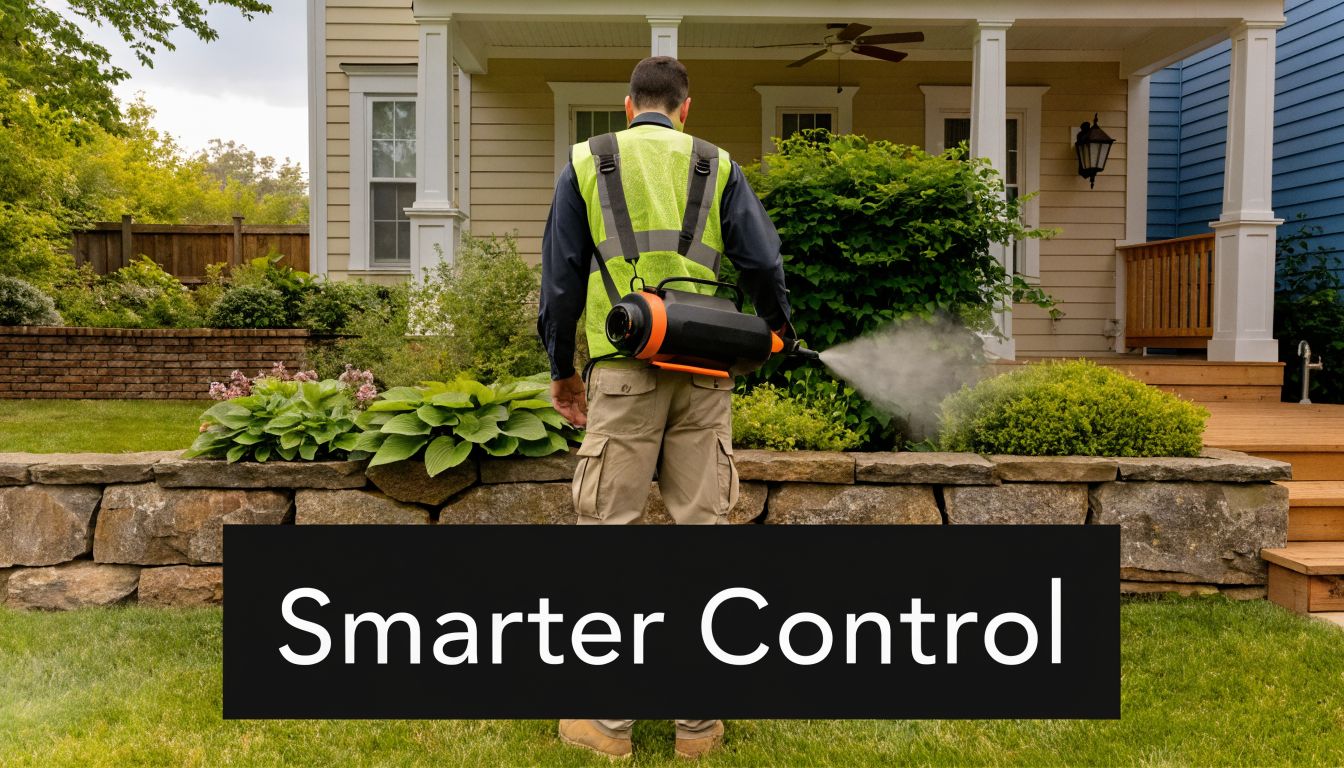
Start with breeding sites
Mosquito control begins with inspection. Female mosquitoes need standing water to reproduce, so the first job is finding the places on a property that hold water after rain or irrigation.
On many Crown Point properties, that includes:
- Low spots in the yard: Depressions that stay wet after storms
- Containers and accessories: Buckets, toys, plant saucers, tarps, and clogged gutters
- Outdoor features: Decorative items or drainage trouble spots that hold water
- Hidden problem areas: Edges of sheds, fence lines, and dense plantings where moisture lingers
Removing or correcting those sites matters more than hanging another gadget near the patio.
Treat the places mosquitoes use
Some water sources can't be dumped or eliminated. In those cases, a professional mosquito plan can address those sites directly and then target adult resting areas in a measured way.
A real program differs from a bug zapper. Instead of waiting for insects to fly into one device, the treatment strategy follows mosquito habits:
- Inspect where activity begins. Standing water and moisture issues get identified first.
- Reduce the source when possible. Property conditions get corrected before relying on treatment alone.
- Target resting zones. Mosquitoes often hold in shaded foliage, dense shrubs, and humid border areas.
- Maintain the result. Ongoing service keeps pressure down during the active season.
According to the verified data summarized by Seacoast Turf Care on bug zappers and mosquito populations, bug zappers are estimated to kill over 70 billion non-target insects annually in the U.S. while having no measurable effect on reducing mosquito populations. That's why targeted control is the smarter route.
For homeowners looking at automated options for ongoing coverage, a mosquito misting system can also fit into a broader property-specific plan when the site and use pattern make sense.
Why professional service feels different
A professional mosquito visit shouldn't feel like someone just shows up and sprays everything in sight. It should feel deliberate.
The best plans account for family use, pets, high-traffic outdoor spaces, and the layout of the property. They also connect mosquito work to the bigger picture. Drainage, vegetation, and seasonal pest pressure all matter.
That same practical thinking often helps with related concerns homeowners search for when they need pest control near me or residential pest control in Northwest Indiana. Mosquito issues rarely exist in total isolation from other outdoor pest conditions.
Protect Your Family with The Green Advantage
Homeowners in Crown Point don't just want fewer bugs. They want to enjoy the yard without second-guessing every evening outside.
That means choosing a provider that understands local conditions, explains the plan clearly, and treats mosquito control as part of protecting the whole property. For families comparing pest control in Crown Point, IN or searching for an exterminator near me, that local knowledge matters.
What homeowners should expect from a local pest professional
A good service experience starts before the treatment truck arrives. You should be able to ask questions, describe what you're seeing, and get straightforward guidance about what is and isn't likely to work.
You should also expect a provider to think beyond one symptom. If a company treats mosquitoes, it should understand how that work fits with broader residential pest control and even commercial pest control needs across Northwest Indiana properties.

Why the eco-minded difference matters
Families often ask for solutions that work without creating new problems in the yard. That's a reasonable concern.
A mosquito plan should reduce nuisance pressure while respecting the outdoor environment around your home. That matters even more when you know daytime bug zapper use can harm beneficial pollinators like bees and butterflies, kill predatory wasps, and affect up to 30% of helpful hoverflies in treated areas, as noted earlier from the verified video source.
The best mosquito control protects people first, but it also avoids the careless, broad collateral damage that bug zappers can create.
The value of working with a trusted local team
The Green Advantage serves Crown Point and nearby communities in Northwest Indiana with licensed, certified pest management focused on practical results and environmentally mindful service. For homeowners, that means you aren't left guessing whether an off-the-shelf device is enough.
A reliable local provider helps with more than mosquitoes, too. The same property may also need help with ant control, spider control, wasp removal, rodent control, or seasonal pest prevention around the home's exterior.
Many homeowners want this from the process:
- Clear communication: Real answers about what the pest is and what's driving it
- Customized treatment: Service shaped to the layout and pressure of the property
- Consistent follow-up: Ongoing support instead of one quick visit and silence
- Peace of mind: Confidence that someone local is paying attention to the problem
If you're comparing options for pest control near me or exterminator in Crown Point, IN, that combination of local experience and clear guidance is often what separates a lasting solution from another seasonal frustration.
Take Back Your Yard This Summer
So, do bug zappers work during the day. Not in the way most homeowners hope.
The science points in the same direction. Mosquitoes don't primarily use UV light to find you. Sunlight makes a zapper's bulb much less visible during the day. The insects most likely to die in the unit often aren't the pests you're trying to eliminate.
That leaves you with a familiar Northwest Indiana problem. You spend money on a device, hear a few occasional zaps after dark, and still deal with mosquito pressure around the spots that matter most. Meanwhile, the yard can lose beneficial insects that support pollination and natural balance.
A better approach is more targeted and more grounded in how mosquitoes behave. Reduce breeding sites. Address the wet areas and hidden water sources on the property. Treat the places adult mosquitoes use. Keep the plan consistent through the season.
For homeowners, landlords, and property managers in Crown Point, that's the difference between a gadget and a real pest-control strategy. It also lines up with what people are usually looking for when they search for pest control in Crown Point, IN, residential pest control, or an exterminator near me. They want relief that lasts and guidance they can trust.
If your yard still isn't comfortable during the day or at dusk, don't assume you need a bigger zapper. You probably need a smarter plan.
If you're ready for practical, local help, contact The Green Advantage to schedule a pest inspection or request a quote for your Crown Point property. Their team can help you move past ineffective bug zappers and toward a mosquito control plan that protects your yard, your family, and your peace of mind.
What Attracts Mosquitoes to Humans? A Crown Point Guide
A lot of Crown Point evenings start the same way. The grill is hot, the patio lights are on, the kids want to stay outside a little longer, and within minutes someone is swatting at their ankles or scratching a fresh bite.
That frustration isn’t random. Mosquitoes aren’t just “out more this year” or picking on your family by chance. They’re following specific signals your body gives off, and Northwest Indiana’s warm, humid summer conditions make it easier for them to find people and stay active around yards, decks, and commercial properties.
If you’ve ever wondered what attracts mosquitoes to humans, the answer is a mix of biology and environment. Some of it affects everyone. Some of it makes certain people get bitten more than others. Once you understand the difference, prevention gets much more practical.
Why Mosquitoes Are Ruining Your Summer in Crown Point
In Crown Point, mosquito problems usually show up when people want to use their yard the most. Early morning coffee on the patio gets cut short. Evening cookouts turn into a race indoors. Property managers hear complaints from tenants about bites around entryways, dumpsters, and shaded lawn areas.
That pattern makes sense in Northwest Indiana. Humid summer weather, thick vegetation, and pockets of standing water around homes create ideal conditions for mosquito activity. Even a well-kept yard can have problem spots if water collects in gutters, planters, toys, bird baths, or low areas in the lawn.
Why your yard can feel worse than the next one
Two homes on the same street can have very different mosquito pressure. Shade, moisture, drainage, dense shrubs, and nearby breeding areas all change how bad the problem feels.
A yard with heavy foliage often gives mosquitoes places to rest during the day. A yard with poor drainage gives them more opportunity to reproduce. A patio tucked near landscaping may look great, but it can also put people right where mosquitoes wait before moving in to feed.
Mosquito pressure is local. Sometimes the biggest issue isn’t the neighborhood. It’s a few conditions on one property that let them build up fast.
Why this matters for homeowners and businesses
Mosquitoes are more than a nuisance. They disrupt outdoor living, make guests uncomfortable, and create a real quality-of-life issue for families, landlords, and businesses trying to keep exterior spaces usable.
That’s why people searching for pest control near me, exterminator near me, or pest control in Crown Point, IN often aren’t just looking for general advice. They want a way to enjoy their property again without planning every outdoor activity around bites.
The good news is that mosquito behavior isn’t mysterious. They come in for specific reasons, and once those reasons are clear, prevention and treatment become much more targeted.
The Science Behind the Bite What Attracts Mosquitoes
Mosquitoes don’t find people by luck. They use a sequence of signals, and the most important one starts before they ever get close enough to land.
Carbon dioxide is the long-range signal
The biggest answer to what attracts mosquitoes to humans is carbon dioxide, or CO2, from breathing. Female mosquitoes use it as their primary long-range cue when they’re looking for a blood meal. They can detect CO2 from up to 50 meters away through specialized receptors, which starts their movement toward a person, according to GoodRx’s explanation of mosquito host-seeking behavior.
Think of CO2 like the smell of bread drifting out of a bakery. You may not see the building yet, but you know the signal is there and you move toward it. Mosquitoes do something similar with the CO2 plume humans release as they breathe.
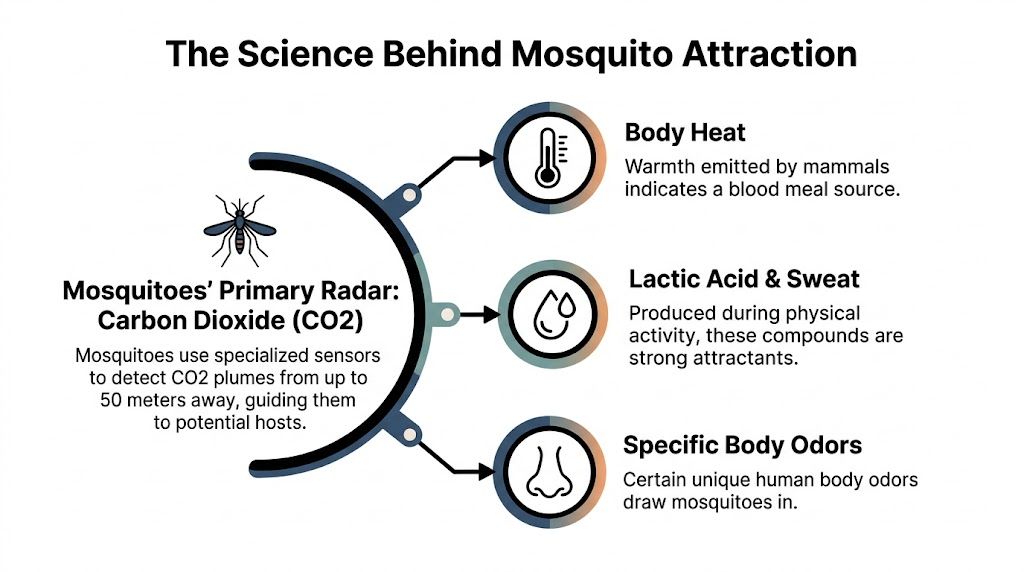
What happens when they get closer
CO2 gets their attention first. Once mosquitoes close the distance, they refine the target using other cues. Body heat matters. Sweat-related compounds matter. So do the odors your skin naturally gives off.
That’s why mosquito activity feels so personal. They don’t just enter a yard and bite at random. They’re sorting through signals and choosing where to land.
If you’re curious about the local species that can show up around Northwest Indiana properties, this guide to mosquito species gives helpful context on the kinds of mosquitoes property owners may deal with.
What this means in real life
You can’t stop breathing, and that’s an important practical point. Some mosquito prevention advice sounds good but ignores the basic science. If mosquitoes can detect a person from a distance, then control has to focus on reducing resting sites, limiting breeding areas, and protecting the spaces where people gather.
A few common situations can make attraction worse:
- Outdoor activity: Exercise increases breathing output, which can make you easier for mosquitoes to locate.
- Warm gathering spaces: Patios, decks, and fire pit areas keep people outside longer and closer to landscaping where mosquitoes rest.
- Low air movement: Still air lets mosquito activity feel more concentrated around seated groups.
Practical rule: If a yard has shade, moisture, and still evening air, mosquitoes usually don’t need much help finding people.
That’s why the best mosquito control plans don’t rely on one trick. They work by interrupting the insect at multiple points, before it breeds, while it rests in foliage, and while it tries to move into human activity areas.
Are You a Mosquito Magnet Unpacking Personal Factors
Some families notice the same pattern every summer. One person gets covered in bites while someone sitting right beside them barely notices a thing. That isn’t just imagination.

Your skin chemistry matters
Research from Rockefeller University found that body odor from skin chemicals, particularly carboxylic acids produced by skin bacteria, can make some people up to 100 times more attractive to mosquitoes, and that this pattern stayed stable over several years in the people studied, as described by Rockefeller University.
That matters because it shifts the conversation away from blame. If you feel like mosquitoes always choose you first, there may be a biological reason. Your skin bacteria and the compounds they produce can create a scent profile mosquitoes strongly prefer.
It isn’t just one factor
Personal mosquito attraction is more like a stack of signals than a single cause. A person may be more attractive because of their skin chemistry, body heat, breathing output, or other traits that are difficult to control in everyday life.
Some of those factors are temporary. Others appear to be much more stable.
- Skin microbiome: The bacteria on your skin can influence the odors mosquitoes respond to.
- Genetics: Some attraction patterns appear tied to inherited traits rather than habits.
- Body chemistry: Natural differences in sweat and skin oils can make one person easier for mosquitoes to track.
That’s one reason quick-fix advice often disappoints people. If a person’s attraction level is tied to persistent body odor chemistry, then changing one small habit usually won’t solve the whole problem.
Here’s a helpful overview if you want to see the topic explained visually.
Why “just do this” advice often fails
Homeowners often hear that eating a certain food, switching soap, or using one candle should fix the issue. In practice, that advice tends to overpromise because it ignores how many signals mosquitoes use and how individual those signals can be.
If you’re a mosquito magnet, the most useful takeaway is this: it’s probably not because you’re doing something wrong. It may mean your body gives off the cues mosquitoes prefer.
Some people aren’t more careless. They’re more detectable.
That’s also why area-wide mosquito reduction matters so much. When the environment around the home supports large mosquito populations, the people who are naturally more attractive usually feel the problem first and worst.
Mosquito Myths vs Effective Home Prevention Strategies
A lot of mosquito advice gets passed around because it sounds easy. Easy isn’t always effective. Homeowners in Crown Point usually get better results when they focus on habitat reduction and realistic personal protection.
Mosquito Control Myths vs. Reality
| Common Myth | What Science Says | Effective Strategy |
|---|---|---|
| Citronella alone will solve the yard problem | Scent-based products may help a little in a small area, but they don’t remove breeding sites or resting mosquitoes across the property | Reduce standing water, improve airflow, and use a broader mosquito control plan |
| Bug zappers are the best answer | They may kill flying insects, but they don’t address the places mosquitoes breed and hide | Target the yard itself, especially shaded foliage and water-holding spots |
| If you keep the grass short, mosquitoes will disappear | Mowing helps appearance and can reduce some harborage, but mosquitoes also rest in shrubs, under leaves, and in damp shade | Trim dense vegetation and pay attention to moisture-heavy landscaping zones |
| Eating garlic will keep mosquitoes off you | Folk remedies are unreliable and usually don’t match what homeowners need in active mosquito season | Use proven repellents and property-based prevention steps |
| A pretty water feature is always fine if the yard looks clean | Moving water can be lower risk than stagnant water, but design and maintenance matter | If you’re considering low-maintenance backyard water features, choose options that are easier to clean and less likely to collect stagnant water |
What actually helps at home
The best DIY prevention comes down to consistency. Mosquitoes take advantage of overlooked areas.
- Dump standing water: Check flowerpot saucers, buckets, toys, tarps, wheelbarrows, clogged gutters, and bird baths.
- Adjust timing: If mosquitoes are worst around dawn or dusk, move yard work or family outdoor time when activity is lighter.
- Dress for fewer bites: Long sleeves, long pants, and lighter-colored clothing can help reduce exposed skin.
- Use repellents that work: For individual protection, a product with a proven active ingredient is much more dependable than a trendy hack.
- Improve air movement: Fans can make patios more comfortable and disrupt mosquito flight near seating areas.
For homeowners looking for practical repellency ideas, this page on what scent repels mosquitoes is worth reviewing alongside property cleanup steps.
The trade-off homeowners should know
DIY prevention works best when mosquito pressure is light to moderate and the property doesn’t have major surrounding pressure from neighboring yards, drainage areas, or dense vegetation. It becomes less effective when the environment keeps reintroducing mosquitoes faster than a homeowner can manage them.
That’s where people often hit the wall. They’ve emptied containers, burned candles, bought sprays, and still can’t sit outside comfortably. At that point, the issue usually isn’t effort. It’s that the property needs a broader control approach than home remedies can deliver.
Professional Mosquito Control The Green Advantage Solution
Professional mosquito control works because it deals with the whole pattern, not just the bite itself. That matters when mosquitoes are finding people through body signals that homeowners can’t fully change and breeding around the property in places they may not notice.
Why treatment has to match mosquito behavior
A good mosquito program focuses on where mosquitoes live between bites. They don’t spend all day hovering around people. They rest in shaded vegetation, damp hidden areas, and protected spots around the yard. They also reproduce in water sources that are easy to miss.
That’s why a professional approach usually combines several tactics instead of relying on one product.
- Inspection of problem zones: Technicians look for breeding pockets, heavy shade, drainage trouble, and areas where mosquitoes rest during the day.
- Targeted treatment of foliage and harborage: Barrier-style applications are aimed at the places mosquitoes use, not sprayed randomly across the property.
- Breeding site management: Standing water concerns are identified so they can be removed, corrected, or treated where appropriate.
- Seasonal follow-up: Mosquito pressure changes through the summer, so control works better when it’s maintained instead of treated once and forgotten.

Why this helps even if you attract mosquitoes more than others
Some factors that increase attraction are temporary. Pfizer notes that exercise or consuming beer can temporarily increase mosquito attraction, and one study showed beer consumption significantly increased mosquito landings. The same overview explains that professional treatments create a protective barrier that reduces mosquito activity regardless of those temporary behavioral changes.
That’s the practical value of professional service. You may still produce the signals mosquitoes want, but there are fewer mosquitoes in the space around you, fewer places for them to rest, and fewer chances for them to build up on the property.
Why local experience matters in Northwest Indiana
Mosquito control in Crown Point, IN isn’t exactly the same as mosquito control somewhere with a different climate or physical environment. Northwest Indiana properties often deal with humid stretches, backyard tree lines, drainage concerns, retention areas, and dense summer vegetation. Each one changes how mosquitoes move through a property.
The same local knowledge that helps with mosquito control also supports broader residential pest control and commercial pest control work. Homes and businesses rarely deal with one issue in isolation. The property conditions that support mosquitoes can overlap with conditions that matter for ant control, rodent control, spider control, wasp removal, and other seasonal pest issues. That’s one reason many property owners prefer a provider that understands the site as a whole rather than treating each pest as a separate emergency.
The goal isn’t just to kill a few mosquitoes. It’s to make the yard less supportive of mosquito activity week after week.
What professional service does better than DIY
Store-bought products can help in the moment. They usually don’t provide the same level of coverage, consistency, or site-specific decision-making as a trained technician.
A professional doesn’t just ask, “What should I spray?” They ask better questions:
- Where are mosquitoes resting during the day?
- What water sources are feeding the problem?
- Which parts of the yard are creating repeat exposure around patios, play areas, entrances, or employee break spaces?
- How should treatment change as the season develops?
That’s the difference between temporary relief and a real mosquito reduction plan.
Reclaim Your Yard What to Expect From Our Service
When people search for an exterminator in Crown Point, IN or pest control near me, they usually want two things. They want the problem handled, and they want the process to feel straightforward.
That’s especially true with mosquitoes because the issue feels personal. Families want to use the yard. Businesses want customers and staff to be comfortable outside. Nobody wants a vague answer or a rushed visit.
What the process should feel like
A solid mosquito service experience starts with listening. Not every property has the same pressure points, and not every customer uses their outdoor space the same way.
Some people need better comfort around a patio and grill area. Others care most about children’s play spaces, pet areas, tenant common spaces, or building entry zones. The treatment plan should reflect how the property is used.
What a technician looks for
During service, the focus should be on conditions, not guesswork. That usually includes:
- Shaded resting areas: Shrubs, ornamental grasses, low tree cover, fence lines, and dense planting beds.
- Moisture problems: Standing water, poor drainage, clogged gutters, and containers that hold rain.
- Human activity zones: Decks, patios, walkways, pool areas, and entrances where bites are most disruptive.
- Seasonal patterns: How rainfall, humidity, and plant growth are affecting mosquito pressure over time.
A useful mosquito plan protects the places where people actually live, relax, and work. Not just the parts of the yard that are easiest to spray.
Why homeowners feel better after getting help
Professional mosquito service does more than reduce nuisance insects. It gives people confidence to use the property again without second-guessing every outdoor plan.
That peace of mind matters. It’s hard to enjoy a backyard if you’re constantly watching for bites. It’s hard to host guests if everyone ends up retreating indoors. It’s hard for a business or managed property to present well if outdoor areas feel uncomfortable.
For many customers, the biggest benefit isn’t just fewer mosquitoes. It’s getting normal use of the property back.
A local partner makes the difference
Northwest Indiana homeowners usually prefer clear communication, honest expectations, and technicians who understand what summer pest pressure looks like here. That local familiarity matters because mosquito issues rarely come from one cause.
A dependable provider should be able to explain what they’re seeing, why it’s happening, and what can realistically improve. That’s what turns a service call into an actual solution.
Your Mosquito Control Questions Answered
Are mosquito treatments safe for children and pets
Homeowners should always ask this question. A reputable provider should explain the products used, how they’re applied, and any simple precautions to follow after treatment. Clear instructions matter.
How long does a treatment last
That depends on weather, property conditions, and how much mosquito pressure surrounds the site. Rainfall, irrigation, plant growth, and nearby breeding areas all affect how long protection holds up, which is why seasonal service is often more reliable than a one-time visit.
Do I need service all summer long
Many properties do best with recurring service during mosquito season. Mosquitoes don’t stay static, and a yard can change quickly as heat, humidity, and rainfall shift through the season.
Will treatment alone fix everything
Usually not. The best results come from combining professional service with homeowner steps like removing standing water and reducing heavy harborage around the yard.
Is this only for homes
No. Mosquito control can also help commercial properties, outdoor common areas, and sites where people gather outside and comfort matters.
If mosquitoes are keeping you from enjoying your yard, The Green Advantage can help you take it back. As a family-owned pest control company serving Crown Point and Northwest Indiana, they provide knowledgeable guidance, licensed service, and practical mosquito reduction built around local conditions. If you’re ready to schedule an inspection, request a quote, or talk through a recurring mosquito problem, reach out and get a plan that fits your property.
Mosquito Control Systems Guide for Crown Point, IN

A lot of Crown Point homeowners call about mosquitoes at the same point in the season. They finally have a free evening, the grill is hot, the kids are outside, and within minutes everyone is swatting, itching, and heading back indoors. The yard looks great, the patio is ready, but the space still doesn’t feel usable.
That’s the frustrating part about mosquitoes. They can make a well-kept property feel off-limits. They don’t care whether you’re trying to host friends, let the dog out, or sit on the deck after work. If conditions are right, they take over fast.
Mosquito control systems can help, but not all systems work the same way, and not every option makes sense for a home in Northwest Indiana. Some methods reduce pressure for a short time. Some target the source. Some sound convenient but create problems of their own.
Homeowners searching for pest control near me, exterminator near me, or mosquito control in Crown Point, IN usually want a simple answer. What works, what doesn’t, and what’s worth paying for? That’s where practical guidance matters more than marketing language.
Reclaim Your Yard from Mosquitoes in Crown Point
A mosquito problem usually shows up in everyday moments. You water the flowers, then get bitten walking back to the garage. You step out to pull weeds and hear that familiar buzzing near your ears. You plan a cookout, light a candle, maybe try a store-bought spray, and still end up rushing everyone inside.
In Crown Point, that pattern is common because outdoor living is a big part of the warm season. People want to use their patios, backyards, pool areas, decks, and fire pits. They want comfort, not a cloud of pests.
What homeowners usually notice first
The first complaint isn’t always the number of mosquitoes. It’s the way they change how a property feels.
- Evenings get cut short. Families stop using the yard around dusk because bites start piling up.
- Guests notice right away. A backyard that should feel inviting suddenly feels uncomfortable.
- Quick fixes wear off. Aerosol sprays, citronella products, and random DIY treatments may help briefly, but they rarely solve the underlying problem.
- The issue keeps returning. After rain, humidity, or irrigation, the pressure often comes right back.
That’s why mosquito control should be treated like a property management issue, not just a nuisance. If the conditions that support mosquitoes stay in place, they’ll keep showing up.
Your yard should feel usable again
Homeowners often spend time and money improving landscaping, edging beds, cleaning up the entry, and making the outside of the home look sharp. If you’re already thinking about outdoor improvements, this guide on how to improve curb appeal is a useful companion, because mosquito reduction works best when the yard is both attractive and easier to maintain.
A comfortable yard usually comes from a combination of cleanup, habitat reduction, and targeted treatment. It rarely comes from one gadget alone.
For families looking for pest control in Crown Point, IN or residential pest control that addresses outdoor living, the goal isn’t just killing adult mosquitoes on contact. The goal is reducing activity enough that the property becomes enjoyable again.
That takes a clear look at why mosquitoes are thriving in the first place.
Why Mosquitoes Thrive in Northwest Indiana
Mosquitoes don’t appear randomly. They show up where moisture, shelter, and breeding sites are easy to find. In Northwest Indiana, those conditions are common around homes for long stretches of the warmer season.

The local conditions that drive activity
A Crown Point property doesn’t need a pond to have a mosquito problem. Small, ordinary water sources are often enough.
Common trouble spots include:
- Low areas in the yard where rainwater sits after a storm
- Clogged gutters that hold moisture longer than expected
- Buckets, toys, planters, and tarps that collect water
- Dense shrubs and shaded foliage where adult mosquitoes rest during the day
- Birdbaths, drainage areas, and decorative features that stay damp
Mosquitoes also benefit from the way many neighborhoods are laid out. Fence lines, privacy landscaping, mulch beds, and shaded corners all give them places to hide when the sun is up and temperatures climb.
Why older ideas gave way to better ones
Mosquito control in the United States has changed over time because the industry learned that no single method solves every problem. A review of mosquito control history notes three distinct eras. The mechanical control era (1900–1942) focused on water management and physical barriers. The chemical control era (1942–1972) was marked by widespread DDT use. The current integrated mosquito management era (1972–present) combines chemical, mechanical, and biological strategies in a more holistic approach (historical overview of mosquito control strategy).
That shift matters for homeowners because it explains why a modern mosquito program shouldn’t rely on one tactic alone.
Practical rule: If the plan doesn’t address standing water, resting areas, and adult activity together, it’s incomplete.
Why this matters for health and peace of mind
Most homeowners start by thinking about bites. That’s understandable. Bites are annoying, and heavy pressure can make the yard hard to use.
There’s also a bigger reason to take mosquito activity seriously. Mosquitoes are associated with public health concerns, including West Nile Virus. You don’t need panic. You do need a sensible plan that reduces exposure around the home.
For commercial pest control clients, property managers, and homeowners alike, the lesson is simple. In Northwest Indiana, mosquito control works better when it’s adapted to the site, the season, and the specific places mosquitoes breed and rest.
Comparing Mosquito Control Systems for Your Home
Homeowners looking into mosquito control systems usually run into the same list of options. Professional barrier sprays. Automatic misting systems. Traps. DIY foggers. Larval control products. Yard cleanup. Each one sounds promising on its own.
The problem is that these options solve different parts of the mosquito issue. Some target flying adults. Some target larvae in water. Some mainly offer convenience. Some require a lot of homeowner effort to keep working.
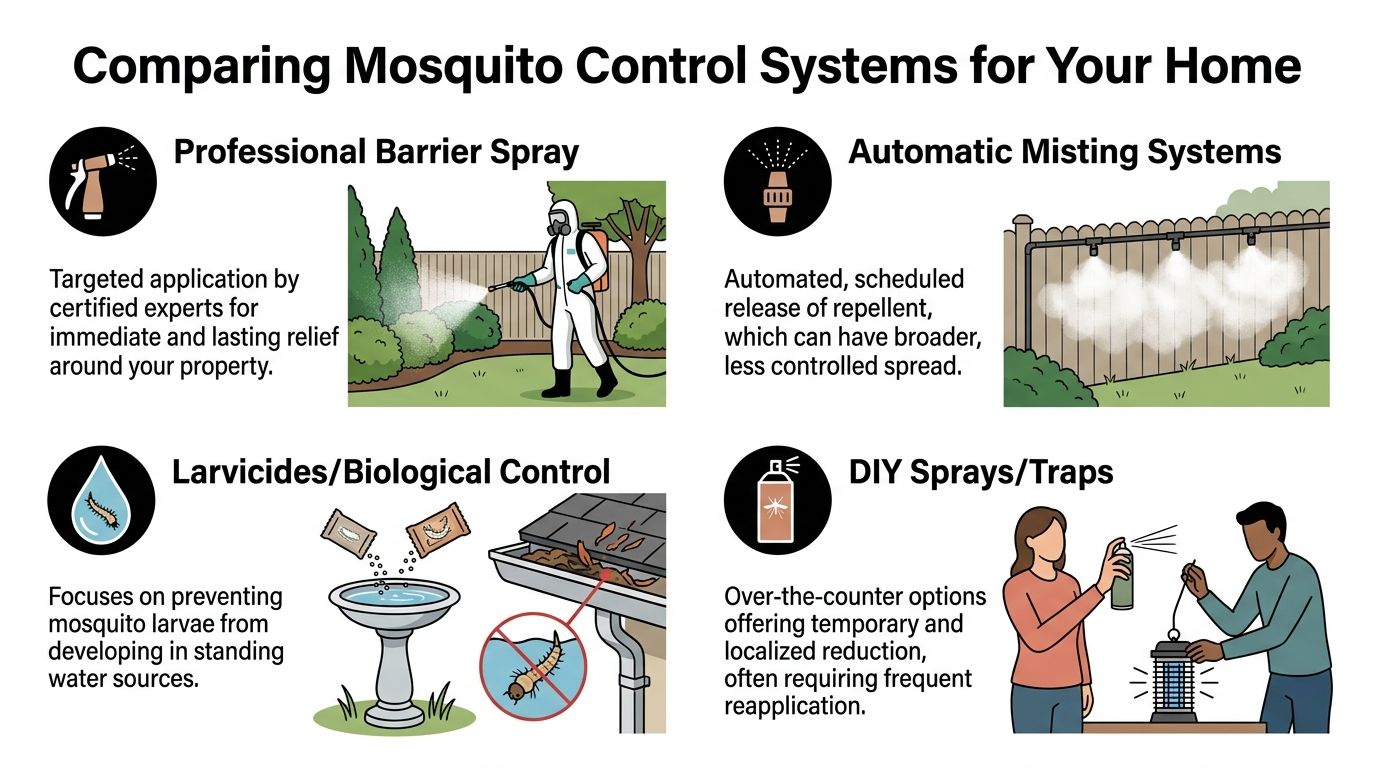
The main system types homeowners consider
Professional barrier spray
This is one of the most practical choices for residential properties. A technician applies product to the places mosquitoes use, such as shaded foliage, under decks, around fence lines, and other protected resting areas.
Done correctly, this isn’t random blanket spraying. It’s targeted work based on where mosquitoes hide and move on your lot.
Automatic misting systems
These systems release insecticide at preset times through installed nozzles around the property. They appeal to homeowners because they sound hands-off.
The trade-off is control. A timer can’t tell whether mosquitoes are active, whether weather changed, or whether the actual problem is coming from a breeding site that still hasn’t been addressed.
Larval control and source reduction
This method goes after the beginning of the mosquito life cycle. It includes removing standing water where possible and treating water that can’t be eliminated.
This is foundational work. It doesn’t replace adult mosquito treatment when populations are already active, but it often makes every other method perform better.
DIY sprays and traps
Store-bought aerosols, foggers, and traps can help in small ways. They may reduce activity temporarily in a patio area or knock down a few adults.
Most homeowners find that DIY tools need frequent attention, careful placement, and realistic expectations. They rarely provide whole-property relief by themselves.
Comparison of Mosquito Control Methods
| Control Method | How It Works | Typical Effectiveness | Cost & Maintenance | Safety Considerations |
|---|---|---|---|---|
| Professional barrier spray | Targets mosquito resting areas on the property with focused application | Often strong for reducing adult activity when paired with habitat correction | Service cost is ongoing, but homeowner effort is lower | Depends on proper application, site assessment, and following label directions |
| Automatic misting systems | Sprays insecticide on a timer through installed nozzles | Can sound convenient, but performance depends on setup and doesn’t automatically address breeding sources | Installation, refills, upkeep, and system maintenance add commitment | Scheduled spraying can mean applications even when mosquitoes aren’t present |
| Larvicides and source reduction | Removes or treats water where mosquitoes develop | Highly valuable for prevention and long-term reduction | Usually requires regular inspection and repeat attention by homeowner or technician | Best fit when used carefully and only where needed |
| DIY sprays and traps | Uses over-the-counter products or devices for localized reduction | Usually limited and temporary, especially on larger properties | Lower upfront spend, higher hands-on effort | Success depends on correct use, timing, and realistic coverage expectations |
What works best in real yards
If you want the shortest honest answer, a layered approach usually performs better than a single product or device.
That means:
- Reduce breeding sites first. Empty containers, improve drainage where possible, and cut down hidden water sources.
- Treat where adults rest. Shrubs, heavy plantings, shaded corners, and under structures matter.
- Match the method to the property. A small lot with limited vegetation needs a different plan than a yard with dense landscaping and nearby moisture.
- Reassess as conditions change. Rain, irrigation, new plant growth, and yard clutter can all change mosquito pressure.
A lot of homeowners compare every option as if all mosquito control systems do the same job. They don’t. If you want a deeper look at the differences, this breakdown on is all mosquito control the same is worth reviewing before you choose a service model.
The best mosquito plan is usually the one that targets the places mosquitoes actually use, instead of treating the whole yard as if every square foot matters equally.
When each option makes sense
Professional treatment makes sense when the property has recurring pressure and the homeowner wants reliable reduction with less trial and error.
Source reduction makes sense on every property. It’s not optional. Even the strongest treatment plan gets undercut if water-filled containers and damp hiding zones stay untouched.
Traps can make sense for monitoring or localized help. DIY tools can make sense for short-term relief and smaller expectations. Automatic systems may appeal to homeowners who value convenience, but convenience isn’t the same thing as a well-informed mosquito strategy.
For people searching exterminator in Crown Point, IN or eco-friendly pest control options, the right question isn’t “Which gadget is most impressive?” It’s “Which system reduces mosquito pressure while avoiding waste, overapplication, and missed breeding sites?”
How Professional Barrier Spray Treatments Work
Barrier spray treatments work because they target mosquito behavior, not just open air. Adult mosquitoes spend much of their time resting in cool, protected areas around a property. If you treat those places carefully, you interrupt the spots they rely on between feeding periods.
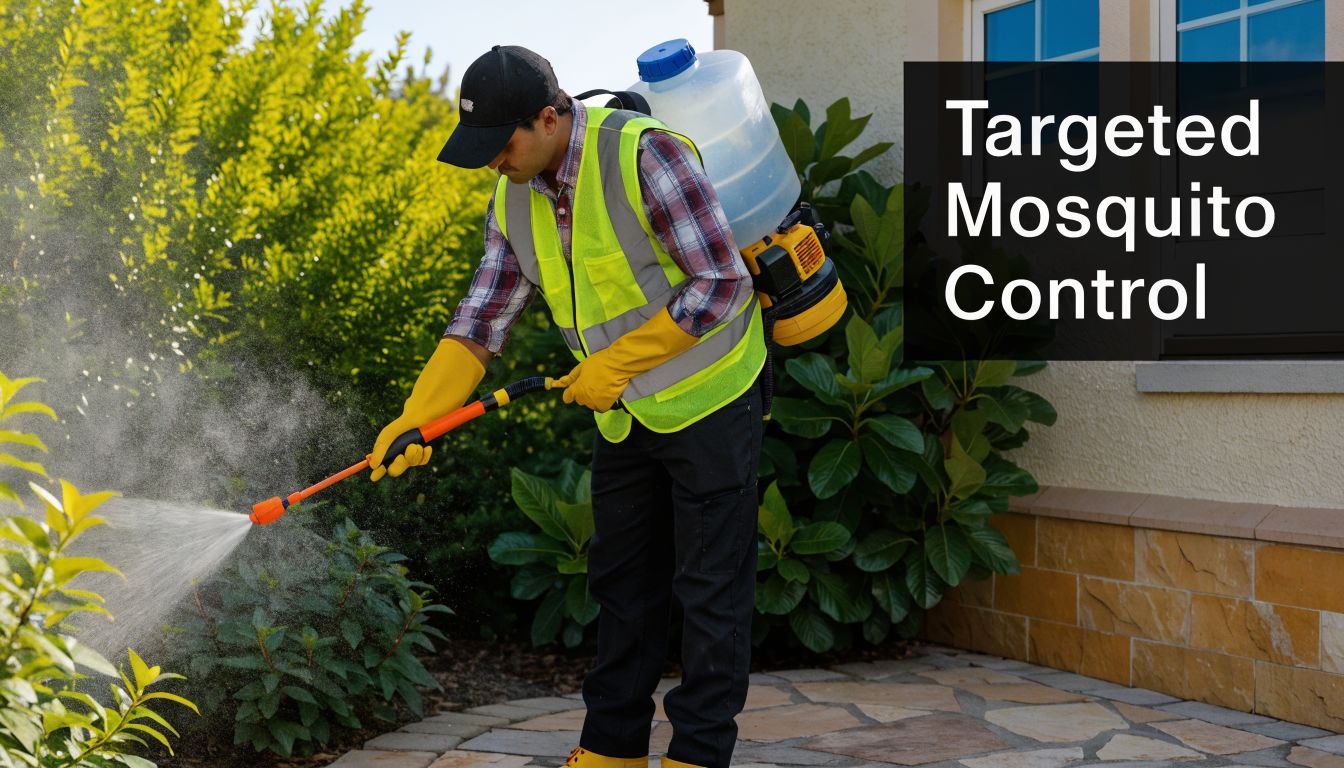
Where the treatment goes
A professional application usually focuses on areas like:
- Leafy vegetation and shrub lines
- The underside of decks and covered structures
- Fence lines and shaded perimeter zones
- Dense ornamental plantings
- Places near known mosquito movement paths
That’s a big difference from the way many homeowners picture “spraying for mosquitoes.” Effective treatment isn’t about soaking the yard. It’s about placing product where contact is most likely.
Why droplet size matters
The technical side is more critical than commonly understood. The EPA explains that ultra-low volume (ULV) adulticide applications use droplet sizes of 80 microns or smaller, which helps droplets stay airborne longer for contact with flying mosquitoes while minimizing pesticide volume. The same EPA guidance states that professional equipment must be calibrated and verified annually to make sure those droplet sizes are achieved (EPA guidance on ULV mosquito applications).
That tells you something important. Professional mosquito work isn’t just about having a sprayer. It’s about using equipment that’s adjusted, tested, and applied correctly.
Smaller, controlled droplets can improve coverage while using less material than a coarse, poorly aimed application.
A backpack fogger or similar professional tool can deliver treatment into foliage and protected areas that mosquitoes use regularly. But the outcome still depends on the operator’s judgment. Knowing where to treat matters just as much as the equipment itself.
Why precision beats broad spraying
Homeowners often assume more product means better results. In mosquito control, that’s not a safe assumption. Precision is usually what improves outcomes.
This video gives a useful visual sense of how professional mosquito treatment equipment is used in the field.
When barrier treatments are done well, they fit into a broader property plan. The technician looks at vegetation density, moisture patterns, shade, and how people use the yard. That’s why professional service often feels more effective than a quick pass with a handheld DIY fogger.
For homeowners wanting residential pest control that supports outdoor comfort, barrier treatments are often one of the strongest tools available. They’re especially useful when paired with the less visible work of habitat correction and larval reduction.
The Hidden Risks of Automatic Misting Systems
Automatic misting systems get attention because they sound easy. Nozzles are installed around the property, the system runs on a schedule, and the homeowner doesn’t have to think much about it day to day.
That convenience is real. The problem is that convenience can hide weak decision-making.
What the major agencies warn about
The CDC, EPA, and American Mosquito Control Association warn that the effectiveness of residential mosquito misting systems remains unproven. They note that these systems spray insecticides at fixed intervals without surveillance data, which can lead to unnecessary chemical applications, increased costs, and neglect of core integrated mosquito management practices such as larval habitat removal (CDC guidance on residential mosquito misting systems).
That warning matters because it addresses the exact sales pitch many homeowners hear. The pitch is often about automation. The agencies are pointing out that automation by itself doesn’t prove effectiveness.
Where homeowners get misled
A misting schedule doesn’t know whether:
- mosquitoes are actually present that day
- rain washed conditions into a different pattern
- the biggest problem is a hidden breeding source
- foliage growth changed how the product is dispersing
That can leave homeowners paying for repeat applications without solving the cause of the infestation.
If you’re evaluating this option, review the practical trade-offs on this page about mosquito misting system. It helps clarify why these systems shouldn’t be viewed as a complete mosquito solution.
A timer can automate spraying. It can’t replace inspection, surveillance, or habitat correction.
The bigger concern
The hidden risk isn’t only cost. It’s false confidence.
When homeowners assume the system is “handling it,” they may stop checking for standing water, stop cleaning problem areas, or overlook spots where larvae are developing. That’s exactly the kind of over-reliance that weakens a mosquito plan.
For many properties in Crown Point and nearby Northwest Indiana communities, automatic misting systems are better understood as a narrow tool with notable limitations, not a stand-alone answer. If the goal is dependable mosquito reduction with fewer unnecessary applications, there are usually smarter ways to build the program.
The Green Advantage Integrated Mosquito Reduction Program
The strongest mosquito control systems don’t work as one isolated system. They work as a process. Adult reduction, breeding site correction, and property-specific recommendations all need to support each other.
That’s the logic behind an integrated mosquito reduction program for homes in Crown Point and surrounding Northwest Indiana areas.
What a complete program includes
A practical program usually combines several actions instead of leaning on one treatment type.
- Property inspection and site reading. The first step is identifying where mosquitoes are resting, where water is collecting, and which site elements are helping them stay active.
- Targeted adult mosquito treatment. This reduces pressure in the places people use, such as patios, play areas, walkways, and yard edges.
- Larval control where water can’t be removed. Some water sources can be corrected. Others need management.
- Source reduction guidance. Homeowners may need to empty containers, change how certain items are stored, or adjust irrigation and drainage habits.
- Outdoor environment and sanitation recommendations. Overgrown vegetation, cluttered corners, and poorly drained pockets often keep mosquito pressure high.
Why homeowner participation matters
A technician can treat a property well, but the homeowner still lives with the site every day. That makes homeowner observation valuable.
Research on community-driven surveillance notes that tools such as GLOBE Observer’s Mosquito Habitat Mapper can help residents identify and map hidden container-based breeding sites that traditional control methods may miss. The article also describes this as a proactive approach that complements professional service by targeting the source of mosquito problems and reducing reliance on sprays over time (community mosquito habitat mapping tools).
That idea fits residential service well. Homeowners are often the first to notice the forgotten bucket behind the shed, the saucer under a planter, or the spot near a downspout that stays wet after every storm.
How this looks in practice
One option available locally is The Green Advantage, which offers mosquito reduction service that targets both adult mosquitoes and larvae and can be set up as seasonal treatments or a one-time event treatment. That kind of structure makes sense for homeowners who either want ongoing yard use during mosquito season or relief before an outdoor gathering.
The important point isn’t branding. It’s the model. A better mosquito program acts like integrated pest management, not like a one-button device.
Good mosquito control is part treatment plan, part property correction, and part routine vigilance.
That’s also why this conversation fits naturally alongside broader pest control in Crown Point, IN. Homes dealing with mosquitoes often benefit from other exterior services too, such as wasp removal, spider control around entry points, or seasonal pest treatments that keep the outdoor edge of the property more manageable overall.
Your Mosquito Control Service in Crown Point What to Expect
Most homeowners want to know what service will look like before they book. That’s reasonable. People don’t want vague promises. They want to know what happens, what gets checked, and how the work is adjusted over time.
Step one is the conversation
The process usually starts with a call or service request. You describe what you’re seeing. Heavy evening activity, bites near landscaping, standing water concerns, or an upcoming event all help shape the next step.
A useful intake conversation should narrow down where the pressure is worst and how the yard is being used. A family that wants the backyard treated for everyday use may need a different schedule than someone planning a one-time gathering.
The inspection should guide the plan
At the property, the technician should be looking for mosquito-supporting conditions, not just reaching for equipment.
That includes:
- Resting sites in dense foliage and shaded edges
- Moisture sources that keep breeding cycles going
- Activity zones around decks, patios, entries, and play spaces
- Correctable issues such as containers, blocked drainage, or neglected corners
Modern integrated mosquito management programs also use GIS mapping to map surveillance data from trap types, track application locations, and analyze population trends. This helps professionals move beyond broad treatments and focus on confirmed problem areas (GIS in modern mosquito management).
For homeowners, the practical meaning is simple. Better mosquito service is increasingly data-driven, not guess-driven.
Application and follow-up
Once the treatment plan is set, the application should focus on the parts of the property that support mosquito activity. If larval sites are present, they should be addressed according to the site conditions and treatment plan.
After service, homeowners should expect clear guidance on what to do next. That may include reducing standing water, trimming back dense vegetation, or watching specific problem areas after rain.
A solid mosquito program should feel transparent. You should know:
- what was treated
- what conditions need correction
- whether ongoing service makes sense
- when to call back if activity changes
That same practical mindset is what people expect when they search for exterminator in Crown Point, IN, commercial pest control, or preventative pest treatments. Clarity matters. So does follow-through.
Common Questions About Mosquito Reduction Services
Are mosquito treatments safe for kids and pets
Homeowners should always ask this. Professional applications should follow label directions and site-specific precautions. A good technician will explain any steps you need to take before or after treatment and will answer questions clearly instead of brushing them off.
How long does a treatment last
That depends on weather, property conditions, vegetation, moisture, and the level of mosquito pressure around the home. Heavy rain, fast plant growth, and untreated breeding sources can shorten how long relief feels noticeable. That’s why many homeowners do better with a scheduled program than with one random treatment.
When should I start mosquito service in Northwest Indiana
Earlier is usually better than waiting until the yard is already miserable. Starting before populations build gives you a better chance to reduce activity before it disrupts daily use of the property.
Can I handle mosquitoes myself
You can improve conditions yourself by dumping standing water, cleaning gutters, trimming dense growth, and reducing clutter that traps moisture. Those steps help. If pressure stays high, professional treatment is usually the faster path to meaningful reduction.
Do mosquito services help with outdoor events
Yes. A one-time treatment can make sense before parties, cookouts, graduations, and other outdoor gatherings, especially if mosquitoes have already become noticeable around the yard.
If you’re ready to enjoy your yard again, contact The Green Advantage for mosquito reduction service in Crown Point and nearby Northwest Indiana communities. Whether you need help with seasonal mosquito pressure, a one-time event treatment, or broader residential pest control, the team can walk the property, identify what’s driving the problem, and recommend a practical plan that fits your home.
Find Your Alternative Mosquito Repellent in Crown Point

A calm summer evening in Crown Point should end with dessert on the patio, not a rush back indoors swatting at ankles and elbows. Yet that’s how mosquito problems usually show up around Northwest Indiana homes. The grill is still warm, the kids are still outside, and within minutes everyone is reaching for a candle, a spray, or whatever “alternative mosquito repellent” happened to be in the garage.
That search makes sense. Many homeowners want something that feels safer, less harsh, and easier to live with than old-school bug spray. The trouble is that most advice online treats every yard the same. Crown Point isn’t every yard. Our standing water, humid stretches, shaded landscaping, drainage areas, and nearby wetlands create very specific mosquito pressure, and what helps a little on a travel blog often falls short in a Northwest Indiana backyard.
Good mosquito control starts with honest trade-offs. Some alternatives work well for personal protection. Some help around a patio table. Some barely move the needle. If you want your yard back, it helps to know which is which.
Your Guide to Mosquito Control in Crown Point IN
One of the most common scenes around Crown Point goes like this. Dinner gets moved outside because the weather is finally nice. Someone lights a candle. Someone else sprays their legs. Ten minutes later, the conversation turns into swatting, scratching, and asking who left water in the flowerpots.

That pattern isn’t random. Northwest Indiana gives mosquitoes what they want. Rain collects in low spots. Gutters hold debris. Kids’ toys, plant saucers, tarps, and wheelbarrows trap water. Dense shrubs hold moisture and shade through the day, then release hungry mosquitoes at dusk.
Why Crown Point yards stay active
Mosquitoes don’t need a pond to become a problem. Small, overlooked water sources are often enough to support breeding. Add summer humidity and thick landscaping, and your yard becomes a resting area plus a launch point.
A few of the local pressure points include:
- Low-lying lawn areas: Water sits longer after rain, especially where grading isn’t ideal.
- Decorative features: Birdbaths, rain barrels, and planters collect water faster than most homeowners realize.
- Dense plant cover: Mosquitoes hide in cool, shaded leaves during the heat of the day.
- Wetland influence: Properties near natural water or drainage corridors often see heavier mosquito activity.
The local species matter too. Local mosquito species resistance patterns in Northwest Indiana are a growing concern. While some oils like clove show temporary repellency, they’re often ineffective against species like Aedes vexans and Aedes triseriatus prevalent in Indiana wetlands, which is why generic advice often misses the mark in this region, as noted by GoodRx’s overview of natural mosquito repellents.
Why one-size-fits-all advice falls short
A lot of “natural mosquito repellent” advice assumes a mosquito is a mosquito. In practice, behavior changes by species, weather, and habitat. A product that seems acceptable for a short evening walk might disappoint fast in a yard with standing water nearby and heavy dusk activity.
Local reality: The same repellent can feel effective on a breezy driveway and almost useless beside dense shrubs and damp mulch.
That’s why homeowners often feel like they’re doing everything right and still getting bitten. They may be using a product that works only on skin, only at close range, or only for a short window. Meanwhile, mosquitoes are still breeding on the property.
What’s happening before you notice bites
By the time adults are buzzing around your patio, the problem started earlier. Mosquitoes lay eggs where water remains long enough for development. After that, adult mosquitoes rest in protected areas until it’s time to feed.
That’s why the problem keeps coming back when people rely only on repellents. Personal repellents can help reduce bites. They do not remove breeding sites. They do not reduce resting populations in shrubs. They do not solve the part of the problem you can’t see.
A smarter approach for Crown Point homes starts with two questions:
- What protects people right now?
- What reduces mosquito pressure across the property?
Those are related, but they aren’t the same thing. That distinction is where many homeowners finally stop wasting money on products that only help a little.
Evaluating Natural and DIY Mosquito Repellents
Homeowners usually start with plant-based products first, and that’s understandable. They’re easy to buy, easy to apply, and they fit the goal of reducing reliance on harsher-feeling ingredients. Some are worth keeping around. Some are best treated as backup tools.
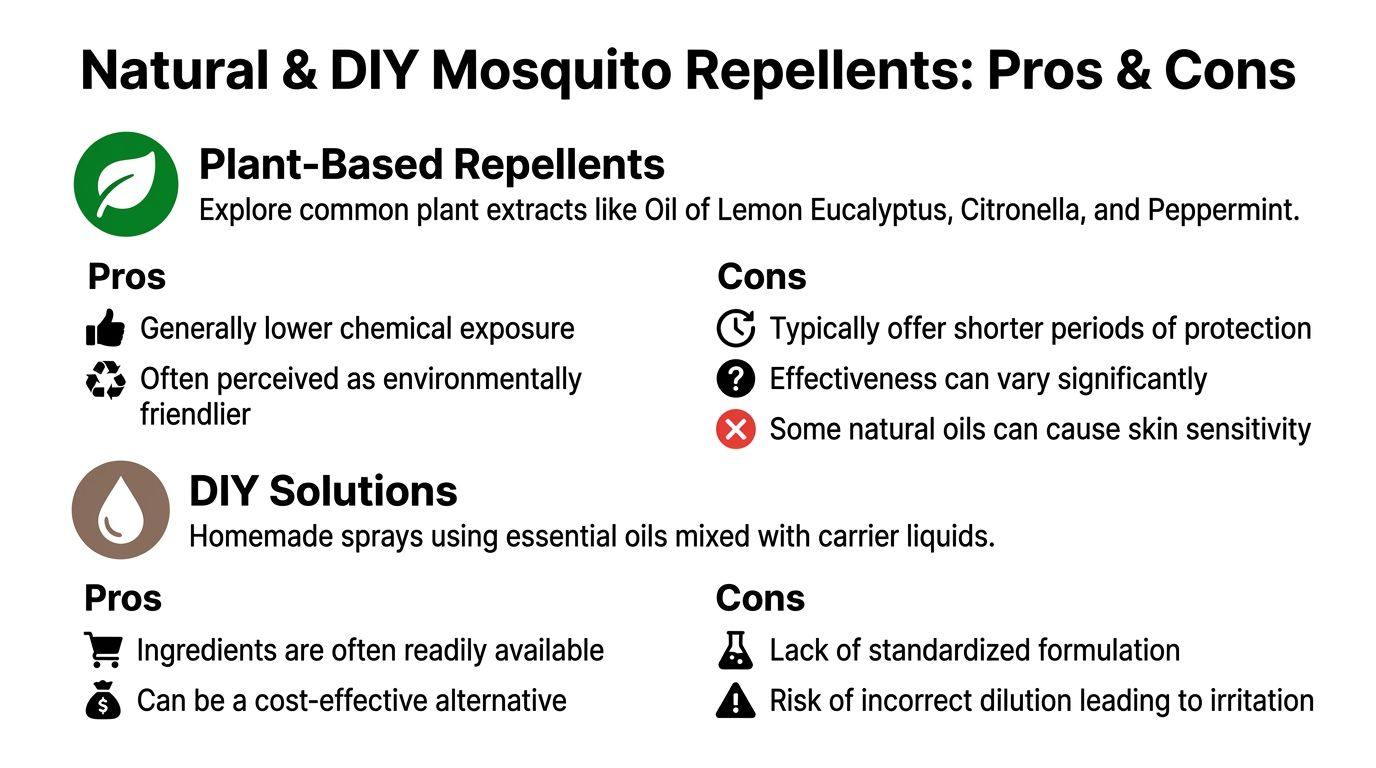
What performs best among plant-based options
If you want the strongest natural-leaning option for personal use, Oil of Lemon Eucalyptus (OLE) is the standout. Scientific comparisons show that 30% OLE can provide 96.88% protection for up to 4 hours, while a 5% citronella solution may only last about 10 to 15 minutes, which is why many natural repellents need frequent reapplication, according to Consumer Reports on natural insect repellent effectiveness.
That gap matters in real life. Four hours can cover a soccer game, an evening on the deck, or mowing the lawn. Ten to fifteen minutes is closer to “better than nothing” than dependable protection.
Here’s a practical side-by-side look:
| Option | Best use | Main strength | Main limitation |
|---|---|---|---|
| OLE products | Personal outdoor use | Strongest plant-based performance in common retail options | Doesn’t protect the whole yard |
| Citronella | Very short stationary use | Familiar, easy to find | Short-lived |
| Lavender or peppermint blends | Light personal use | Pleasant scent for some users | Results vary |
| Neem-based products | Occasional personal use | Appeals to natural-minded buyers | Can be inconsistent and may have a strong odor |
| DIY essential oil sprays | Casual, short exposure | Flexible and inexpensive to mix | No standardized strength or staying power |
Citronella, candles, and the comfort factor
Citronella is probably the most recognized alternative mosquito repellent. It has a place, but that place is narrow. It works best as a comfort-layer product for a short, calm, stationary setting.
Candles and torches can help create a more pleasant patio environment. They should not be mistaken for full protection. In field use, citronella-based options reduce nuisance more than they eliminate it.
A citronella candle can make a patio feel more comfortable. It usually won’t make a mosquito-heavy yard feel solved.
That’s the difference many families notice after buying several candles and still ending the night with bites.
DIY sprays and lotions
DIY recipes are popular because they feel simple and customizable. A typical homemade spray uses essential oils in a carrier like witch hazel, alcohol, or another skin-safe base. The biggest drawback is consistency. You don’t know if the final concentration is effective, mild, or irritating.
Common DIY issues include:
- Weak dilution: The scent is noticeable, but the repellency is poor.
- Short residual life: Essential oils evaporate fast outdoors.
- Skin sensitivity: “Natural” doesn’t automatically mean gentle on all skin types.
- Patchy application: Homemade formulas often don’t spread or hold evenly.
If you want ideas focused specifically on plant-based options, this guide to natural mosquito repellent essential oils is a useful starting point. The key is to treat DIY blends as limited personal protection, not yard control.
When natural options make sense
Natural repellents fit best when the goal is temporary personal protection, not property-wide relief. They’re reasonable for:
- Short patio sits: A little help during a quiet evening.
- Gardening or light yard work: Especially when reapplication is easy.
- Parents looking for options: Many families want to compare lower-odor alternatives first.
- Layered protection: Used alongside screens, fans, and habitat reduction.
Where they disappoint most often
The usual frustration points are predictable. People expect a spray or candle to do the job of a control program. It won’t.
Natural products struggle most when:
- mosquito pressure is already heavy,
- the yard has multiple breeding sources,
- people are active and sweating,
- there’s even mild breeze,
- coverage needs to extend beyond one person.
That doesn’t make them useless. It just means expectations need to match the tool. A well-chosen OLE product can be a smart item in the cabinet. A random homemade spray with citronella and lavender might smell nice and still leave you swatting before the burgers are off the grill.
Mosquito Repellent Devices and Physical Barriers
When homeowners get tired of spraying skin, they usually start looking at devices. That’s often a good move, especially for patios, decks, and other spots where people stay put.

Spatial repellents like clip-ons and diffusers can be more practical than topicals when the goal is protecting a table, a seating area, or a grill station. For static activities, they can outperform many topical repellents, with products like the OFF! Clip-On doing well in limited-movement situations, according to Lab Muffin’s review of natural mosquito repellents and spatial devices.
Where devices help most
These tools work best when people aren’t moving around much. A patio dinner, a card game on the deck, or sitting around a fire pit are the ideal situations.
Good uses include:
- Patio tables
- Small deck seating areas
- Porch corners with light air movement
- Outdoor events where guests stay in one zone
They’re less dependable when kids are running across the yard, people are doing lawn work, or wind keeps pushing the protective zone around.
Fans and airflow matter more than people think
A simple oscillating fan is one of the most underrated mosquito deterrents for a porch or patio. Mosquitoes are weak fliers, and moving air makes it harder for them to land and track people by scent.
That’s especially helpful in sticky Northwest Indiana evenings, where still air lets mosquitoes settle in. A fan won’t solve the whole property, but near a table or seating area, it often improves comfort fast.
Practical rule: If your goal is to protect one dinner table, think in terms of a protected pocket, not the whole yard.
That same rule applies to diffusers and clip-on devices. The smaller and more defined the activity zone, the better they tend to perform.
Screens, clothing, and physical exclusion
Not every alternative mosquito repellent comes in a bottle or a gadget. Physical barriers are often the most dependable low-maintenance upgrade because they don’t evaporate, wash off, or rely on scent.
For homeowners trying to tighten up porches, screen rooms, and openings where tiny biting insects slip through, upgraded no see um screen mesh can be a valuable resource. Standard screens may be enough for larger insects but still allow very small pests through.
Other strong barrier options include:
- Repairing torn window and door screens
- Using long sleeves and long pants for yard work
- Choosing treated clothing for hiking or brush-heavy tasks
- Closing gaps around screen doors and porch enclosures
A lot of frustration comes from overlooking these simple barriers while chasing one more spray.
Traps and device expectations
Homeowners also ask about traps. Some can play a useful support role, especially when they’re placed correctly and paired with source reduction. They tend to work better as part of a wider strategy than as a standalone answer. If you’re comparing setups, this overview of the best outdoor mosquito traps can help sort through what belongs near a patio versus what belongs farther out in the yard.
For a quick visual on device use and setup, this short video is helpful:
The bottom line is simple. Devices and barriers can improve a specific area. They rarely provide dependable, round-the-clock relief across an entire Crown Point property.
DIY Mosquito Control Limitations
Most DIY mosquito plans fail for the same reason. They stack several partial solutions and hope the combination adds up to full control.
A candle on the table. A natural spray by the back door. A diffuser near the chairs. Maybe a homemade essential oil mix for the kids before they head outside. Each item may help a little. The yard still feels mosquito-heavy because the underlying population is untouched.
The weak spots in patchwork control
Homeowners usually run into four practical limits.
First, many alternative products don’t last long enough outdoors. Wind, sweat, humidity, and movement all work against them.
Second, coverage is too small. A product can protect skin, or maybe a table, but not the lawn, landscaping, and shady resting sites around the property.
Third, results are inconsistent. Conditions change from one evening to the next. What felt acceptable on a calm night can feel useless after rain or during a humid dusk.
Fourth, DIY methods don’t stop breeding. That’s the biggest gap of all.
The problem is especially clear with top botanical choices. The CDC-endorsed Oil of Lemon Eucalyptus is one of the better alternatives, but its effectiveness decays over time, with a half-life of about 2 hours in a light breeze, and its performance can drop by 40% after exposure to water or sweat, as described by the San Gabriel Valley Mosquito and Vector Control District’s repellent guide.
Why the yard still feels “full of mosquitoes”
People often assume the repellent failed because they picked the wrong brand. Sometimes that’s true. More often, the product was being asked to do a job it was never meant to do.
A repellent’s job is to discourage bites. A control program’s job is to reduce mosquito pressure on the property.
Those are different jobs.
If mosquitoes are breeding around the home, personal repellents become maintenance tools, not solutions.
That’s why families in Crown Point often say they’ve “tried everything” when what they’ve really tried is a series of bite-reduction products. The source population is still developing in water-holding areas and resting in shaded cover.
What reliable control requires
A dependable mosquito strategy needs to do more than create a temporary bubble around people. It has to account for:
- Breeding water
- Dense foliage and damp shade
- Changing weather
- Repeated reinfestation from nearby areas
- The need for ongoing monitoring
DIY methods still have a place. They’re useful as personal layers. They just shouldn’t carry the whole burden. Once a property has active mosquito pressure, piecemeal control usually turns into repeated spending, repeated bites, and repeated disappointment.
The Green Advantage Solution Professional Mosquito Control
Homeowners looking for a safer-feeling alternative usually aren’t asking for less effective service. They’re asking for something more thoughtful. That shift is one reason the natural insect repellent market is projected to reach $4.37 billion by 2030, driven by demand for safer options, according to Grand View Research’s natural insect repellent market report.

That demand makes sense in Crown Point. Families want relief, but they also want treatments that are practical for homes with kids, pets, outdoor living spaces, and pollinator concerns. Professional mosquito control works best when it combines effectiveness with a careful site-specific plan instead of a one-size-fits-all spray routine.
What a professional mosquito program should include
A program starts with inspection, not guessing. Every property has its own pressure points. One yard may struggle because of clogged gutters and dense arborvitae. Another may have standing water under a deck, poor drainage along the fence, or heavy activity near a shaded play area.
A strong service approach includes:
- Property inspection: Identifying likely breeding zones, resting sites, and activity pockets.
- Source reduction guidance: Calling out containers, drainage issues, and yard habits that contribute to recurring pressure.
- Targeted treatment: Focusing where mosquitoes rest and develop.
- Ongoing visits: Because mosquito pressure changes through the season.
- Clear communication: Homeowners should know what was found, what was treated, and what to watch next.
Why inspection changes everything
Inspection is where professional service separates itself from retail products. A technician can spot patterns homeowners miss because mosquito issues are often hidden in ordinary objects and overlooked corners.
Common trouble spots include:
| Area | Why it matters |
|---|---|
| Gutters and downspouts | Debris holds water and supports breeding |
| Plant saucers and containers | Small water volumes are enough |
| Dense shrubs | Adult mosquitoes rest in cool, shaded foliage |
| Tarps and stored items | Water collects in folds and low points |
| Drainage edges | Moist areas keep activity going after rain |
That kind of property reading matters more than any single alternative mosquito repellent product. You can buy a better spray. You can’t buy a trained inspection with a shelf item.
Treatment that works with the property, not against it
Good mosquito service isn’t about blanketing everything. It’s about targeting the places mosquitoes use. That usually means treating resting zones in vegetation, addressing water-holding areas where appropriate, and reducing adult activity around the spaces people use.
For homeowners who prefer environmentally mindful service, the best programs are transparent about where treatments go and why. The goal is to reduce mosquito pressure while staying thoughtful about families, pets, and beneficial activity around the yard.
The most effective mosquito treatment is the one matched to the property’s layout, moisture patterns, and use of outdoor space.
That’s especially important in Crown Point neighborhoods where one block may have open sun and another has dense tree cover, drainage swales, and far heavier dusk activity.
What homeowners can expect from professional support
The right provider should make the process feel straightforward, not mysterious. You should expect clear scheduling, practical recommendations, and honest answers about what a service can and can’t do.
A well-run program usually means:
- A technician evaluates the yard and identifies mosquito-friendly conditions.
- The treatment plan is adapted to those conditions.
- You get guidance on what to empty, trim, repair, or monitor between visits.
- Service continues through the season so the population doesn’t rebound unchecked.
Professional mosquito control doesn’t replace homeowner effort. It makes that effort far more effective. Instead of throwing candles, sprays, and gadgets at a yard-wide problem, you get a plan that targets mosquitoes where they live, rest, and reproduce.
Your Local Partner for Pest Control in Crown Point
When homeowners search for pest control near me, exterminator near me, or pest control in Crown Point, IN, they’re usually looking for one thing. Confidence that someone local can solve the problem without making the process harder than it needs to be.
That’s where local experience matters. Mosquitoes in Northwest Indiana don’t show up in isolation. The same property conditions that support mosquitoes often overlap with other pest issues, from ants around foundations to spiders in shaded corners and wasps around eaves and outdoor living spaces.
Why local service beats generic advice
A national article can tell you what citronella is. It can’t tell you why your specific side yard stays active after every rain or why the back fence line turns into a mosquito resting zone by dusk.
Local pest control means someone understands the patterns common to Crown Point and nearby service areas, including:
- Residential mosquito pressure near drainage and wooded edges
- Commercial pest control needs for outdoor seating and entry areas
- Seasonal ant and spider activity around landscaping and foundations
- Wasp removal concerns near rooflines, play areas, and patios
- Broader residential pest control needs that call for prevention, not just reaction
That broader view matters because homeowners rarely want five separate service companies. They want one trusted team that can help protect the property as a whole.
What the right experience should feel like
Good pest control should feel organized and personal. You shouldn’t have to chase answers, guess what the technician is doing, or wonder whether anyone noticed the standing water behind the shed.
A dependable provider should offer:
- Friendly scheduling support: Help when you call with questions.
- Clear explanations: Plain-language answers instead of vague promises.
- Specific recommendations: Advice based on your yard, not a script.
- Reliable follow-through: Service that matches what was discussed.
Peace of mind comes from knowing the problem is being managed by someone who understands the property and the local pest pressure around it.
That standard matters whether you need mosquito control, ant control, rodent control, spider control, or help protecting a commercial property from recurring pest issues.
Benefit of Professional Pest Control
The best outcome isn’t just fewer bites or fewer sightings. It’s using your home normally again. Kids play outside longer. You stop dreading dusk on the patio. Guests don’t leave scratching. You spend less time experimenting and more time enjoying the yard.
For Crown Point homeowners and businesses, that’s what professional service is supposed to deliver. Not gimmicks. Not guesswork. Reliable protection that fits the property and the season.
Frequently Asked Questions About Mosquitoes
Do bug zappers work against mosquitoes
Usually not in the way homeowners hope. Bug zappers kill some flying insects, but they’re not a dependable answer for mosquito-heavy yards. They don’t address breeding sites, and they don’t create reliable relief where people sit and gather.
Are ultrasonic mosquito repellents worth buying
In most cases, no. They’re a common example of a product that sounds convenient but doesn’t solve the problem outdoors. Homeowners generally get better results from proven physical barriers, effective personal repellents, and targeted mosquito reduction service.
What can I do in my yard today to reduce mosquitoes
Start with the basics and be thorough:
- Dump standing water: Check pots, toys, buckets, tarps, and plant saucers.
- Clean gutters: Debris and trapped water are common mosquito sources.
- Trim dense vegetation: Open up shaded, damp areas where adults rest.
These steps won’t eliminate mosquitoes on their own, but they cut down the conditions mosquitoes rely on.
What’s the best alternative mosquito repellent for personal use
For many homeowners, a properly formulated Oil of Lemon Eucalyptus product is the strongest plant-based option for personal protection. It’s a better choice for skin-level protection than relying on candles alone. It still won’t replace yard-wide control when mosquito pressure is heavy.
Are patio diffusers and clip-on repellents useful
Yes, when people stay in a defined area. They tend to work best for dinner tables, porches, and small seating zones. They’re far less effective when people are moving all over the yard or when wind disrupts the protective area.
Why do mosquitoes keep coming back after I spray myself
Because spraying yourself only protects you for a while. It doesn’t remove breeding water, reduce resting adults in landscaping, or lower the property-wide population. If the yard keeps producing or harboring mosquitoes, bites return as soon as the personal barrier weakens.
When should I call for professional help
Call when the problem keeps interrupting normal use of the yard, when DIY efforts haven’t held up, or when you want a plan that addresses the source of the issue instead of one more temporary fix. That’s especially true for homes with recurring dusk activity, standing water challenges, or outdoor spaces your family uses often.
If you're tired of testing one temporary fix after another, contact The Green Advantage for mosquito control and full-service pest control in Crown Point, IN and nearby Northwest Indiana communities. Whether you need help with a backyard mosquito problem, residential pest control, or commercial pest control, their team can inspect the property, explain your options clearly, and build a treatment plan that helps you enjoy your space again.