
A lot of Crown Point homeowners call about mosquitoes at the same point in the season. They finally have a free evening, the grill is hot, the kids are outside, and within minutes everyone is swatting, itching, and heading back indoors. The yard looks great, the patio is ready, but the space still doesn’t feel usable.
That’s the frustrating part about mosquitoes. They can make a well-kept property feel off-limits. They don’t care whether you’re trying to host friends, let the dog out, or sit on the deck after work. If conditions are right, they take over fast.
Mosquito control systems can help, but not all systems work the same way, and not every option makes sense for a home in Northwest Indiana. Some methods reduce pressure for a short time. Some target the source. Some sound convenient but create problems of their own.
Homeowners searching for pest control near me, exterminator near me, or mosquito control in Crown Point, IN usually want a simple answer. What works, what doesn’t, and what’s worth paying for? That’s where practical guidance matters more than marketing language.
Reclaim Your Yard from Mosquitoes in Crown Point
A mosquito problem usually shows up in everyday moments. You water the flowers, then get bitten walking back to the garage. You step out to pull weeds and hear that familiar buzzing near your ears. You plan a cookout, light a candle, maybe try a store-bought spray, and still end up rushing everyone inside.
In Crown Point, that pattern is common because outdoor living is a big part of the warm season. People want to use their patios, backyards, pool areas, decks, and fire pits. They want comfort, not a cloud of pests.
What homeowners usually notice first
The first complaint isn’t always the number of mosquitoes. It’s the way they change how a property feels.
- Evenings get cut short. Families stop using the yard around dusk because bites start piling up.
- Guests notice right away. A backyard that should feel inviting suddenly feels uncomfortable.
- Quick fixes wear off. Aerosol sprays, citronella products, and random DIY treatments may help briefly, but they rarely solve the underlying problem.
- The issue keeps returning. After rain, humidity, or irrigation, the pressure often comes right back.
That’s why mosquito control should be treated like a property management issue, not just a nuisance. If the conditions that support mosquitoes stay in place, they’ll keep showing up.
Your yard should feel usable again
Homeowners often spend time and money improving landscaping, edging beds, cleaning up the entry, and making the outside of the home look sharp. If you’re already thinking about outdoor improvements, this guide on how to improve curb appeal is a useful companion, because mosquito reduction works best when the yard is both attractive and easier to maintain.
A comfortable yard usually comes from a combination of cleanup, habitat reduction, and targeted treatment. It rarely comes from one gadget alone.
For families looking for pest control in Crown Point, IN or residential pest control that addresses outdoor living, the goal isn’t just killing adult mosquitoes on contact. The goal is reducing activity enough that the property becomes enjoyable again.
That takes a clear look at why mosquitoes are thriving in the first place.
Why Mosquitoes Thrive in Northwest Indiana
Mosquitoes don’t appear randomly. They show up where moisture, shelter, and breeding sites are easy to find. In Northwest Indiana, those conditions are common around homes for long stretches of the warmer season.
The local conditions that drive activity
A Crown Point property doesn’t need a pond to have a mosquito problem. Small, ordinary water sources are often enough.
Common trouble spots include:
- Low areas in the yard where rainwater sits after a storm
- Clogged gutters that hold moisture longer than expected
- Buckets, toys, planters, and tarps that collect water
- Dense shrubs and shaded foliage where adult mosquitoes rest during the day
- Birdbaths, drainage areas, and decorative features that stay damp
Mosquitoes also benefit from the way many neighborhoods are laid out. Fence lines, privacy landscaping, mulch beds, and shaded corners all give them places to hide when the sun is up and temperatures climb.
Why older ideas gave way to better ones
Mosquito control in the United States has changed over time because the industry learned that no single method solves every problem. A review of mosquito control history notes three distinct eras. The mechanical control era (1900–1942) focused on water management and physical barriers. The chemical control era (1942–1972) was marked by widespread DDT use. The current integrated mosquito management era (1972–present) combines chemical, mechanical, and biological strategies in a more holistic approach (historical overview of mosquito control strategy).
That shift matters for homeowners because it explains why a modern mosquito program shouldn’t rely on one tactic alone.
Practical rule: If the plan doesn’t address standing water, resting areas, and adult activity together, it’s incomplete.
Why this matters for health and peace of mind
Most homeowners start by thinking about bites. That’s understandable. Bites are annoying, and heavy pressure can make the yard hard to use.
There’s also a bigger reason to take mosquito activity seriously. Mosquitoes are associated with public health concerns, including West Nile Virus. You don’t need panic. You do need a sensible plan that reduces exposure around the home.
For commercial pest control clients, property managers, and homeowners alike, the lesson is simple. In Northwest Indiana, mosquito control works better when it’s adapted to the site, the season, and the specific places mosquitoes breed and rest.
Comparing Mosquito Control Systems for Your Home
Homeowners looking into mosquito control systems usually run into the same list of options. Professional barrier sprays. Automatic misting systems. Traps. DIY foggers. Larval control products. Yard cleanup. Each one sounds promising on its own.
The problem is that these options solve different parts of the mosquito issue. Some target flying adults. Some target larvae in water. Some mainly offer convenience. Some require a lot of homeowner effort to keep working.
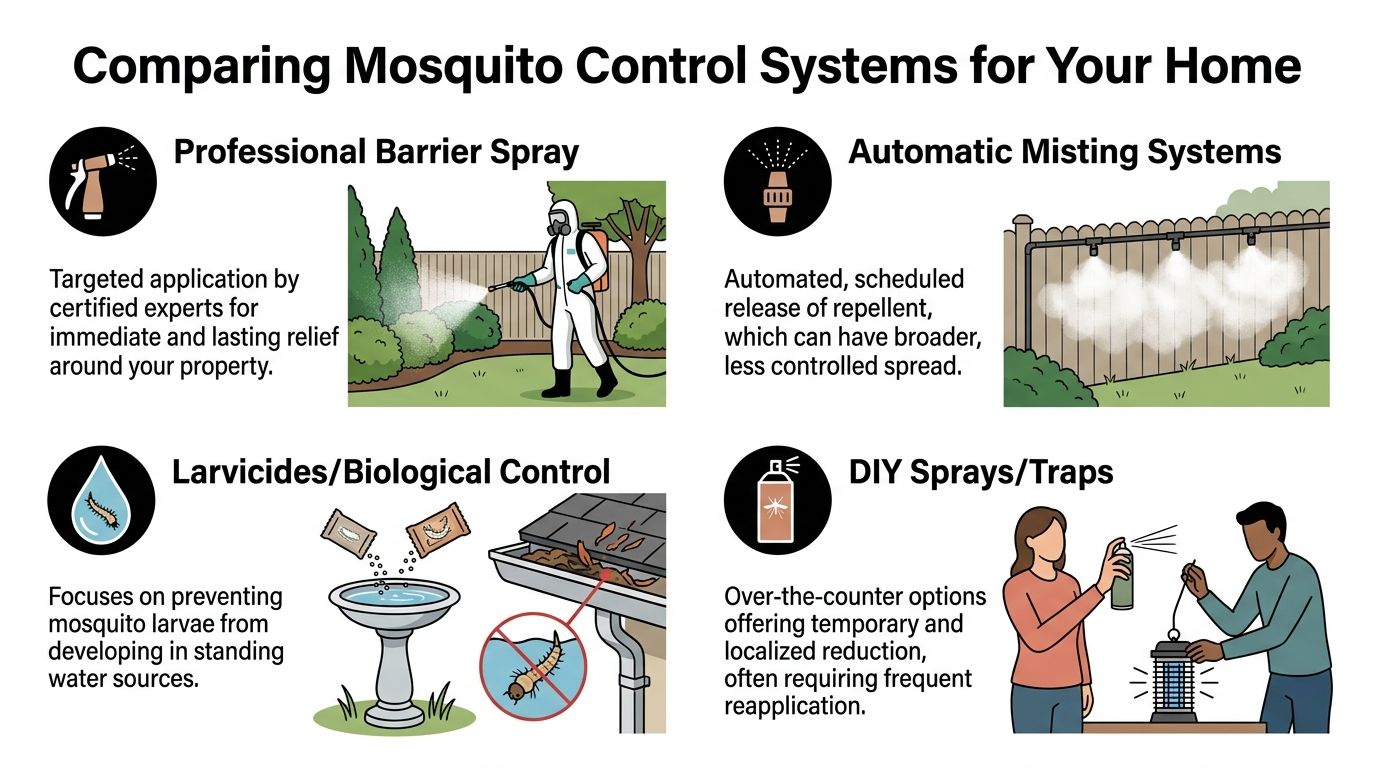
The main system types homeowners consider
Professional barrier spray
This is one of the most practical choices for residential properties. A technician applies product to the places mosquitoes use, such as shaded foliage, under decks, around fence lines, and other protected resting areas.
Done correctly, this isn’t random blanket spraying. It’s targeted work based on where mosquitoes hide and move on your lot.
Automatic misting systems
These systems release insecticide at preset times through installed nozzles around the property. They appeal to homeowners because they sound hands-off.
The trade-off is control. A timer can’t tell whether mosquitoes are active, whether weather changed, or whether the actual problem is coming from a breeding site that still hasn’t been addressed.
Larval control and source reduction
This method goes after the beginning of the mosquito life cycle. It includes removing standing water where possible and treating water that can’t be eliminated.
This is foundational work. It doesn’t replace adult mosquito treatment when populations are already active, but it often makes every other method perform better.
DIY sprays and traps
Store-bought aerosols, foggers, and traps can help in small ways. They may reduce activity temporarily in a patio area or knock down a few adults.
Most homeowners find that DIY tools need frequent attention, careful placement, and realistic expectations. They rarely provide whole-property relief by themselves.
Comparison of Mosquito Control Methods
| Control Method | How It Works | Typical Effectiveness | Cost & Maintenance | Safety Considerations |
|---|---|---|---|---|
| Professional barrier spray | Targets mosquito resting areas on the property with focused application | Often strong for reducing adult activity when paired with habitat correction | Service cost is ongoing, but homeowner effort is lower | Depends on proper application, site assessment, and following label directions |
| Automatic misting systems | Sprays insecticide on a timer through installed nozzles | Can sound convenient, but performance depends on setup and doesn’t automatically address breeding sources | Installation, refills, upkeep, and system maintenance add commitment | Scheduled spraying can mean applications even when mosquitoes aren’t present |
| Larvicides and source reduction | Removes or treats water where mosquitoes develop | Highly valuable for prevention and long-term reduction | Usually requires regular inspection and repeat attention by homeowner or technician | Best fit when used carefully and only where needed |
| DIY sprays and traps | Uses over-the-counter products or devices for localized reduction | Usually limited and temporary, especially on larger properties | Lower upfront spend, higher hands-on effort | Success depends on correct use, timing, and realistic coverage expectations |
What works best in real yards
If you want the shortest honest answer, a layered approach usually performs better than a single product or device.
That means:
- Reduce breeding sites first. Empty containers, improve drainage where possible, and cut down hidden water sources.
- Treat where adults rest. Shrubs, heavy plantings, shaded corners, and under structures matter.
- Match the method to the property. A small lot with limited vegetation needs a different plan than a yard with dense landscaping and nearby moisture.
- Reassess as conditions change. Rain, irrigation, new plant growth, and yard clutter can all change mosquito pressure.
A lot of homeowners compare every option as if all mosquito control systems do the same job. They don’t. If you want a deeper look at the differences, this breakdown on is all mosquito control the same is worth reviewing before you choose a service model.
The best mosquito plan is usually the one that targets the places mosquitoes actually use, instead of treating the whole yard as if every square foot matters equally.
When each option makes sense
Professional treatment makes sense when the property has recurring pressure and the homeowner wants reliable reduction with less trial and error.
Source reduction makes sense on every property. It’s not optional. Even the strongest treatment plan gets undercut if water-filled containers and damp hiding zones stay untouched.
Traps can make sense for monitoring or localized help. DIY tools can make sense for short-term relief and smaller expectations. Automatic systems may appeal to homeowners who value convenience, but convenience isn’t the same thing as a well-informed mosquito strategy.
For people searching exterminator in Crown Point, IN or eco-friendly pest control options, the right question isn’t “Which gadget is most impressive?” It’s “Which system reduces mosquito pressure while avoiding waste, overapplication, and missed breeding sites?”
How Professional Barrier Spray Treatments Work
Barrier spray treatments work because they target mosquito behavior, not just open air. Adult mosquitoes spend much of their time resting in cool, protected areas around a property. If you treat those places carefully, you interrupt the spots they rely on between feeding periods.
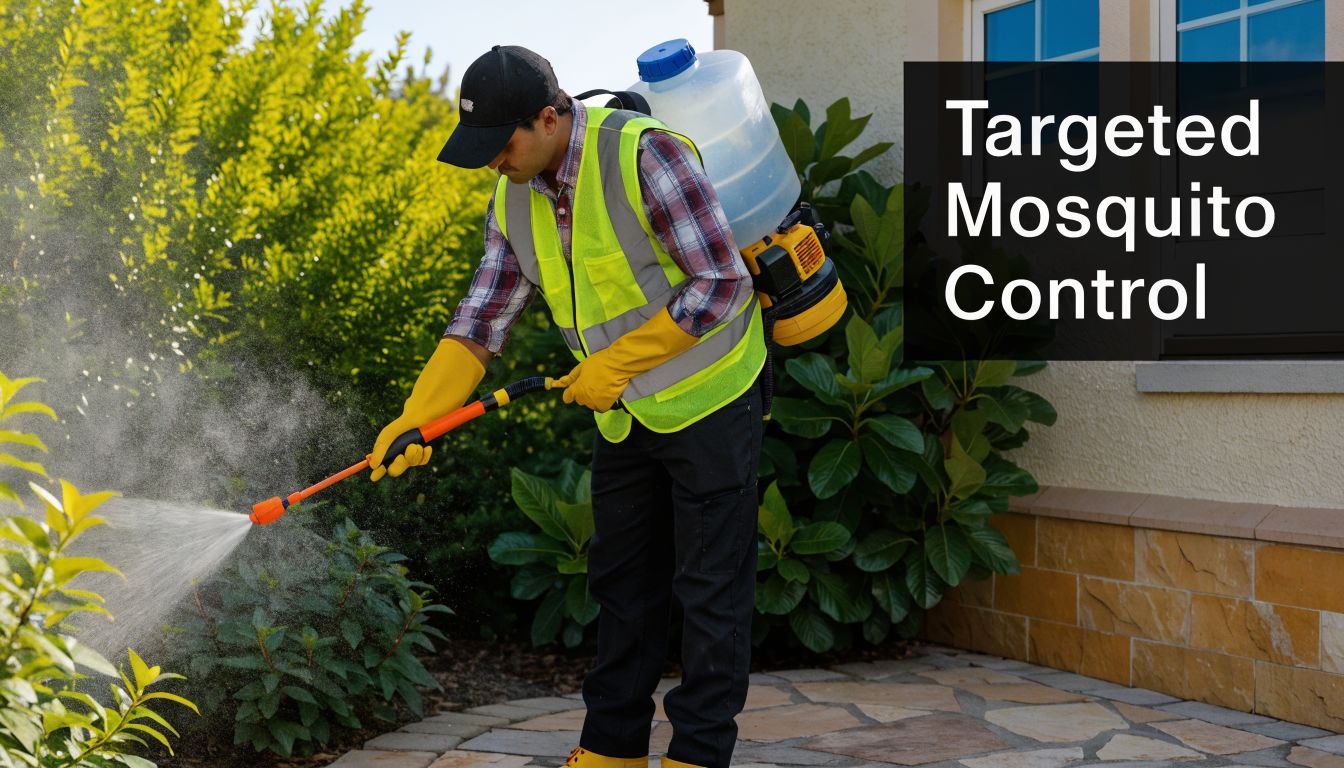
Where the treatment goes
A professional application usually focuses on areas like:
- Leafy vegetation and shrub lines
- The underside of decks and covered structures
- Fence lines and shaded perimeter zones
- Dense ornamental plantings
- Places near known mosquito movement paths
That’s a big difference from the way many homeowners picture “spraying for mosquitoes.” Effective treatment isn’t about soaking the yard. It’s about placing product where contact is most likely.
Why droplet size matters
The technical side is more critical than commonly understood. The EPA explains that ultra-low volume (ULV) adulticide applications use droplet sizes of 80 microns or smaller, which helps droplets stay airborne longer for contact with flying mosquitoes while minimizing pesticide volume. The same EPA guidance states that professional equipment must be calibrated and verified annually to make sure those droplet sizes are achieved (EPA guidance on ULV mosquito applications).
That tells you something important. Professional mosquito work isn’t just about having a sprayer. It’s about using equipment that’s adjusted, tested, and applied correctly.
Smaller, controlled droplets can improve coverage while using less material than a coarse, poorly aimed application.
A backpack fogger or similar professional tool can deliver treatment into foliage and protected areas that mosquitoes use regularly. But the outcome still depends on the operator’s judgment. Knowing where to treat matters just as much as the equipment itself.
Why precision beats broad spraying
Homeowners often assume more product means better results. In mosquito control, that’s not a safe assumption. Precision is usually what improves outcomes.
This video gives a useful visual sense of how professional mosquito treatment equipment is used in the field.
When barrier treatments are done well, they fit into a broader property plan. The technician looks at vegetation density, moisture patterns, shade, and how people use the yard. That’s why professional service often feels more effective than a quick pass with a handheld DIY fogger.
For homeowners wanting residential pest control that supports outdoor comfort, barrier treatments are often one of the strongest tools available. They’re especially useful when paired with the less visible work of habitat correction and larval reduction.
The Hidden Risks of Automatic Misting Systems
Automatic misting systems get attention because they sound easy. Nozzles are installed around the property, the system runs on a schedule, and the homeowner doesn’t have to think much about it day to day.
That convenience is real. The problem is that convenience can hide weak decision-making.
What the major agencies warn about
The CDC, EPA, and American Mosquito Control Association warn that the effectiveness of residential mosquito misting systems remains unproven. They note that these systems spray insecticides at fixed intervals without surveillance data, which can lead to unnecessary chemical applications, increased costs, and neglect of core integrated mosquito management practices such as larval habitat removal (CDC guidance on residential mosquito misting systems).
That warning matters because it addresses the exact sales pitch many homeowners hear. The pitch is often about automation. The agencies are pointing out that automation by itself doesn’t prove effectiveness.
Where homeowners get misled
A misting schedule doesn’t know whether:
- mosquitoes are actually present that day
- rain washed conditions into a different pattern
- the biggest problem is a hidden breeding source
- foliage growth changed how the product is dispersing
That can leave homeowners paying for repeat applications without solving the cause of the infestation.
If you’re evaluating this option, review the practical trade-offs on this page about mosquito misting system. It helps clarify why these systems shouldn’t be viewed as a complete mosquito solution.
A timer can automate spraying. It can’t replace inspection, surveillance, or habitat correction.
The bigger concern
The hidden risk isn’t only cost. It’s false confidence.
When homeowners assume the system is “handling it,” they may stop checking for standing water, stop cleaning problem areas, or overlook spots where larvae are developing. That’s exactly the kind of over-reliance that weakens a mosquito plan.
For many properties in Crown Point and nearby Northwest Indiana communities, automatic misting systems are better understood as a narrow tool with notable limitations, not a stand-alone answer. If the goal is dependable mosquito reduction with fewer unnecessary applications, there are usually smarter ways to build the program.
The Green Advantage Integrated Mosquito Reduction Program
The strongest mosquito control systems don’t work as one isolated system. They work as a process. Adult reduction, breeding site correction, and property-specific recommendations all need to support each other.
That’s the logic behind an integrated mosquito reduction program for homes in Crown Point and surrounding Northwest Indiana areas.
What a complete program includes
A practical program usually combines several actions instead of leaning on one treatment type.
- Property inspection and site reading. The first step is identifying where mosquitoes are resting, where water is collecting, and which site elements are helping them stay active.
- Targeted adult mosquito treatment. This reduces pressure in the places people use, such as patios, play areas, walkways, and yard edges.
- Larval control where water can’t be removed. Some water sources can be corrected. Others need management.
- Source reduction guidance. Homeowners may need to empty containers, change how certain items are stored, or adjust irrigation and drainage habits.
- Outdoor environment and sanitation recommendations. Overgrown vegetation, cluttered corners, and poorly drained pockets often keep mosquito pressure high.
Why homeowner participation matters
A technician can treat a property well, but the homeowner still lives with the site every day. That makes homeowner observation valuable.
Research on community-driven surveillance notes that tools such as GLOBE Observer’s Mosquito Habitat Mapper can help residents identify and map hidden container-based breeding sites that traditional control methods may miss. The article also describes this as a proactive approach that complements professional service by targeting the source of mosquito problems and reducing reliance on sprays over time (community mosquito habitat mapping tools).
That idea fits residential service well. Homeowners are often the first to notice the forgotten bucket behind the shed, the saucer under a planter, or the spot near a downspout that stays wet after every storm.
How this looks in practice
One option available locally is The Green Advantage, which offers mosquito reduction service that targets both adult mosquitoes and larvae and can be set up as seasonal treatments or a one-time event treatment. That kind of structure makes sense for homeowners who either want ongoing yard use during mosquito season or relief before an outdoor gathering.
The important point isn’t branding. It’s the model. A better mosquito program acts like integrated pest management, not like a one-button device.
Good mosquito control is part treatment plan, part property correction, and part routine vigilance.
That’s also why this conversation fits naturally alongside broader pest control in Crown Point, IN. Homes dealing with mosquitoes often benefit from other exterior services too, such as wasp removal, spider control around entry points, or seasonal pest treatments that keep the outdoor edge of the property more manageable overall.
Your Mosquito Control Service in Crown Point What to Expect
Most homeowners want to know what service will look like before they book. That’s reasonable. People don’t want vague promises. They want to know what happens, what gets checked, and how the work is adjusted over time.
Step one is the conversation
The process usually starts with a call or service request. You describe what you’re seeing. Heavy evening activity, bites near landscaping, standing water concerns, or an upcoming event all help shape the next step.
A useful intake conversation should narrow down where the pressure is worst and how the yard is being used. A family that wants the backyard treated for everyday use may need a different schedule than someone planning a one-time gathering.
The inspection should guide the plan
At the property, the technician should be looking for mosquito-supporting conditions, not just reaching for equipment.
That includes:
- Resting sites in dense foliage and shaded edges
- Moisture sources that keep breeding cycles going
- Activity zones around decks, patios, entries, and play spaces
- Correctable issues such as containers, blocked drainage, or neglected corners
Modern integrated mosquito management programs also use GIS mapping to map surveillance data from trap types, track application locations, and analyze population trends. This helps professionals move beyond broad treatments and focus on confirmed problem areas (GIS in modern mosquito management).
For homeowners, the practical meaning is simple. Better mosquito service is increasingly data-driven, not guess-driven.
Application and follow-up
Once the treatment plan is set, the application should focus on the parts of the property that support mosquito activity. If larval sites are present, they should be addressed according to the site conditions and treatment plan.
After service, homeowners should expect clear guidance on what to do next. That may include reducing standing water, trimming back dense vegetation, or watching specific problem areas after rain.
A solid mosquito program should feel transparent. You should know:
- what was treated
- what conditions need correction
- whether ongoing service makes sense
- when to call back if activity changes
That same practical mindset is what people expect when they search for exterminator in Crown Point, IN, commercial pest control, or preventative pest treatments. Clarity matters. So does follow-through.
Common Questions About Mosquito Reduction Services
Are mosquito treatments safe for kids and pets
Homeowners should always ask this. Professional applications should follow label directions and site-specific precautions. A good technician will explain any steps you need to take before or after treatment and will answer questions clearly instead of brushing them off.
How long does a treatment last
That depends on weather, property conditions, vegetation, moisture, and the level of mosquito pressure around the home. Heavy rain, fast plant growth, and untreated breeding sources can shorten how long relief feels noticeable. That’s why many homeowners do better with a scheduled program than with one random treatment.
When should I start mosquito service in Northwest Indiana
Earlier is usually better than waiting until the yard is already miserable. Starting before populations build gives you a better chance to reduce activity before it disrupts daily use of the property.
Can I handle mosquitoes myself
You can improve conditions yourself by dumping standing water, cleaning gutters, trimming dense growth, and reducing clutter that traps moisture. Those steps help. If pressure stays high, professional treatment is usually the faster path to meaningful reduction.
Do mosquito services help with outdoor events
Yes. A one-time treatment can make sense before parties, cookouts, graduations, and other outdoor gatherings, especially if mosquitoes have already become noticeable around the yard.
If you’re ready to enjoy your yard again, contact The Green Advantage for mosquito reduction service in Crown Point and nearby Northwest Indiana communities. Whether you need help with seasonal mosquito pressure, a one-time event treatment, or broader residential pest control, the team can walk the property, identify what’s driving the problem, and recommend a practical plan that fits your home.