
At 2 a.m., a faint scratching sound behind the bedroom wall can make every homeowner in Crown Point sit up and listen. The usual search leads to a small opening behind the dryer vent, a loose section where vinyl siding meets the foundation, or a gap around a utility line. The kitchen crumbs may attract a mouse, but the building envelope is what lets it inside.
That distinction matters. Rodent problems in Northwest Indiana homes often continue because someone places traps without finding the route rodents use to enter. Rodent exclusion services address the structure, the active infestation, and the workmanship needed to keep the problem from returning. The Green Advantage serves Crown Point, IN and surrounding Northwest Indiana communities with residential pest control, commercial pest control, inspections, and rodent control solutions built around that practical approach.
The Quiet Knock in the Wall at Night
A homeowner may first notice the sound near a bedroom, laundry room, or kitchen wall. The noise comes and goes, usually when the house is quiet. Then a flashlight inspection reveals the likely route: a gap behind the dryer vent where the siding meets the foundation.
That opening may look unimportant, but mice don't need much room. The CDC describes a mouse entry hole as about the width of a pencil, approximately 1/4 inch, or 6 millimeters, as summarized in this rodent prevention guidance. A larger gap near a vent can function like an open door.
The problem isn't housekeeping
Rodents can take advantage of food, clutter, warmth, and shelter, but a clean kitchen won't correct a structural opening. Blaming crumbs alone can send a homeowner toward repeated cleaning and bait stations while the same entry route remains open.
A seasoned technician reads the scratching, droppings, gnaw marks, and exterior gap as connected clues. The sound identifies possible activity. The gap identifies a vulnerability. The inspection then looks for the second, third, and less obvious openings that often sit around foundations, vents, garages, roof transitions, and utility penetrations.
Practical rule: Traps address rodents already inside. Exclusion addresses how new rodents get inside.
That doesn't mean trapping has no place. Interior trapping can help clear existing activity, while repairs prevent replacement rodents from following the same route. Objective is to stop treating the symptom as though it were the source.
For Crown Point homeowners, this building-focused view is especially useful across older ranch homes, newer construction, attached garages, basements, and properties with aging masonry. The question isn't, “Where should I put a trap?” It's, “What part of this structure is allowing access, and has anyone verified that the opening is closed?”
What Rodent Exclusion Services Actually Are
Rodent exclusion is a structured inspection and repair service. A technician examines the structure, maps exterior and interior vulnerabilities, seals openings with rodent-resistant materials, addresses conditions that support activity, and checks whether the repair is working.
It isn't a spray treatment, a handful of snap traps in the garage, or a bead of caulk over the first suspicious crack. Those actions may have a limited role, but they don't replace a complete inspection.
The core service sequence
A proper visit usually starts with the perimeter. The technician examines the foundation, siding transitions, doors, vents, roofline, garage, and utility penetrations. Interior areas such as the basement, attic, crawlspace, utility room, and wall-adjacent zones are then checked for signs that help connect an opening to active use.
The repair plan should match the defect. Metal flashing can protect vulnerable edges. Hardware cloth can screen vents and larger openings. Concrete or mortar can restore masonry. Exterior sealant can finish irregular joints when it has a suitable backing and is applied to a stable surface.
Structural IPM guidance recommends sealing exterior openings around 1/4 inch or larger and using 1/4-inch hardware cloth, sheet metal, mortar, or similar rodent-resistant materials for larger openings. The National Park Service rodent exclusion manual also discusses backer rods and exterior sealant for irregular gaps.
Existing rodents still need attention. Depending on the findings, technicians may use interior and exterior traps, monitor activity zones, and remove or clean affected materials when appropriate. Sealing a structure without considering animals already inside can leave scratching, odor, and damage unresolved.
For a broader look at how exclusion work can intersect with building repairs, this resource on pest exclusion for hunting cabins is useful because it treats pest access as part of the structure rather than an isolated pest event.
Why local construction changes the inspection
Crown Point properties don't all fail in the same places. An older home may have deteriorated mortar or a worn sill area. New construction may have openings around recent utility work, vents, siding, or garage details. A generic treatment plan can miss those differences.
The technician's job is therefore diagnostic. The sealant tube is only one tool. The quality of the result depends on finding the defect, choosing a material rodents can't defeat, installing it cleanly, and verifying the work afterward.
How a Crown Point Inspection and Sealing Visit Works
A good exclusion appointment should feel organized before anyone begins making repairs. The technician needs a clear history of what you've heard, where you've found droppings, whether activity changes with weather, and which areas are accessible.
Stage one, intake and perimeter review
During the initial conversation, note the room where activity is strongest, the time of day sounds occur, visible damage, and any previous rodent control. On site, the technician walks the full exterior rather than going straight to the most obvious hole.
The perimeter review should include:
- Foundation openings and cracks, including gaps large enough to permit access.
- Utility penetrations for cables, plumbing, gas, and HVAC lines.
- Dryer and bath vents, including missing or damaged screening.
- Garage door weather seals and corners where the slab meets the wall.
- Transitions between siding, masonry, foundation walls, soffits, and fascia.
- Roof-to-fascia areas where construction materials meet.
A dime-sized opening can be relevant, but the inspection shouldn't rely on a single visual threshold. Rodent signs, sheltered locations, gnawing, and access to warm interior spaces help determine which defects deserve priority.
Stage two, interior inspection
Inside the home, droppings patterns can show travel routes. Grease or run marks may appear along sill plates and wall edges. Gnaw marks on wiring deserve prompt attention because they can indicate both activity and a property hazard.
Basements receive special attention around the ceiling where HVAC lines and other utilities pass through. Attics need review around roof penetrations, vents, insulation edges, and framing transitions. A technician may also compare interior signs with exterior openings to determine whether the suspected route is active.
Stage three, proofing and documentation
The repair day should prioritize openings that connect directly to active areas or expose the home to repeated entry. Expanding foam alone is usually a temporary fix because rodents can chew through it. Foam may serve as a backing or part of a properly finished repair, but it shouldn't be treated as the primary gnaw barrier.
Metal mesh, hardware cloth, flashing, mortar, and concrete repairs are selected according to the opening and substrate. The technician should photograph or record completed work, identify any inaccessible defects, and explain what remains open and why.
The rodent exclusion service offered by The Green Advantage provides a useful reference point for homeowners comparing inspection and proofing options. Follow-up verification matters because a building can look sealed while hidden or missed defects remain. The 2026 New Jersey field study found that 46% to 92% of selected apartments still showed incomplete exclusion after contracted work, demonstrating why diagnosis, workmanship, and verification belong in the same service plan (study details).
Professional Proofing Versus DIY Seal-Up
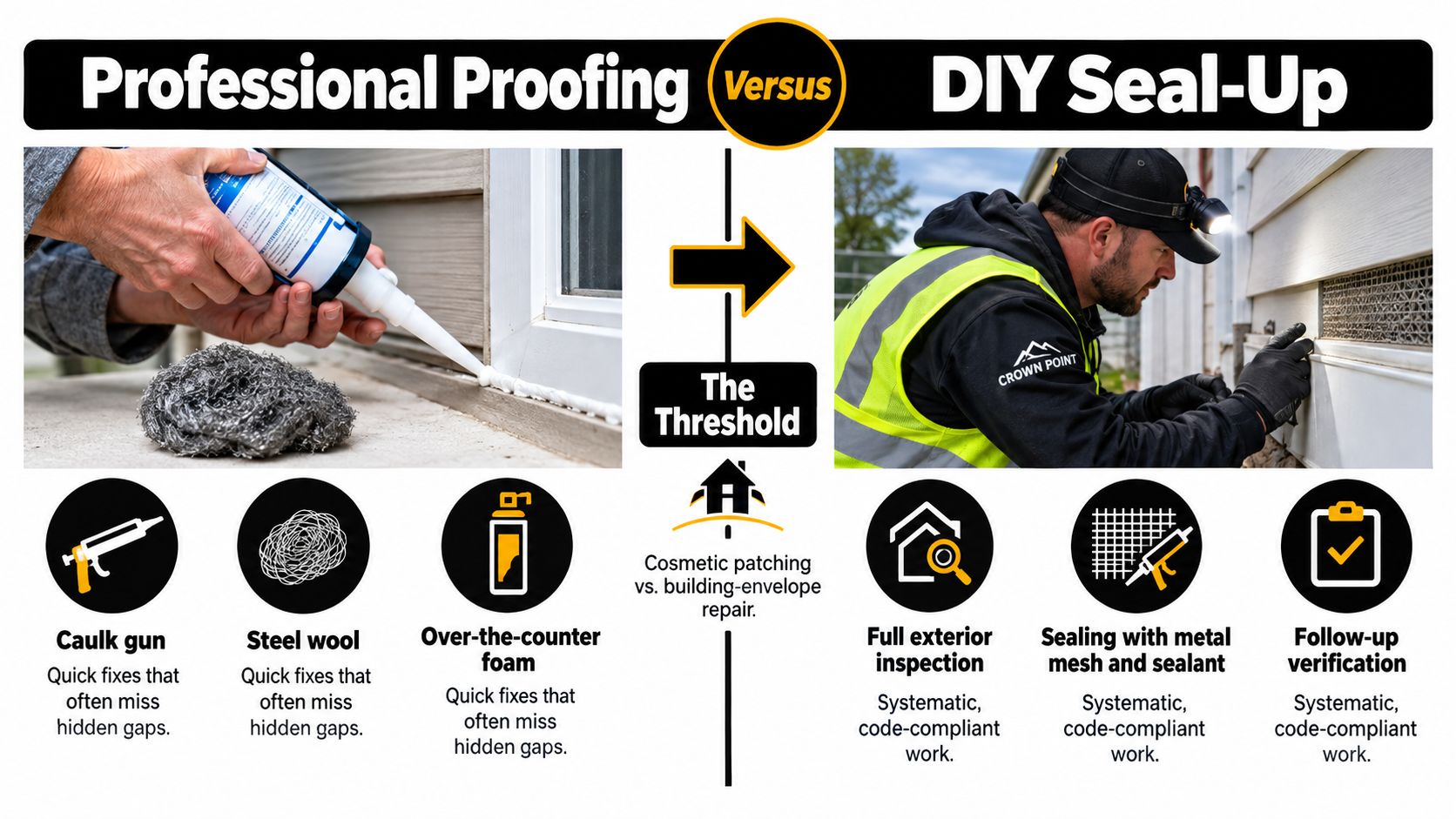
A tube of caulk and a wad of steel wool can be reasonable for a small, clearly understood gap. They become a weak strategy when the homeowner hasn't inspected the entire structure or when the material sits where rodents can pull, chew, or dislodge it.
The dividing line is not effort. Many homeowners work carefully. The dividing line is whether the repair closes the full route with materials and workmanship suited to the building.
Where DIY work commonly falls short
Steel wool can fill an opening, but it may corrode, loosen, or leave edges that don't integrate with the surrounding surface. Over-the-counter foam expands into visible voids, yet foam by itself isn't a dependable gnaw-resistant barrier. Caulk can close a joint temporarily when the surface is clean and stable, but it won't correct deteriorated mortar, a failed vent screen, or a missing section of flashing.
Professional proofing looks beyond the first gap. It checks sill plates along the foundation, mortar joints in brick, soffit and vent connections, garage seals, and utility penetrations. The technician also considers whether the repair will move, shed water, or withstand seasonal temperature changes.
A practical comparison
| DIY seal-up | Professional exclusion |
|---|---|
| Usually starts with a visible gap | Starts with a whole-structure inspection |
| May rely on caulk, steel wool, or foam | Matches metal, mesh, mortar, concrete, and sealant to the defect |
| Often treats the easiest opening first | Maps primary and secondary entry routes |
| May not include activity monitoring | Can combine proofing with trapping and follow-up verification |
| Appearance and speed can drive the repair | Durability, drainage, and building integration guide the work |
Homeowners researching the condition of a property may also benefit from this buyer's home inspection guide, particularly when rodent access appears connected to broader maintenance concerns.
For residents seeking lower-chemical methods, eco-friendly rodent control can be part of a prevention conversation. The key is still physical integrity. A green label doesn't compensate for a missed opening or a weak repair.
What the Service Timeline Looks Like for Homeowners
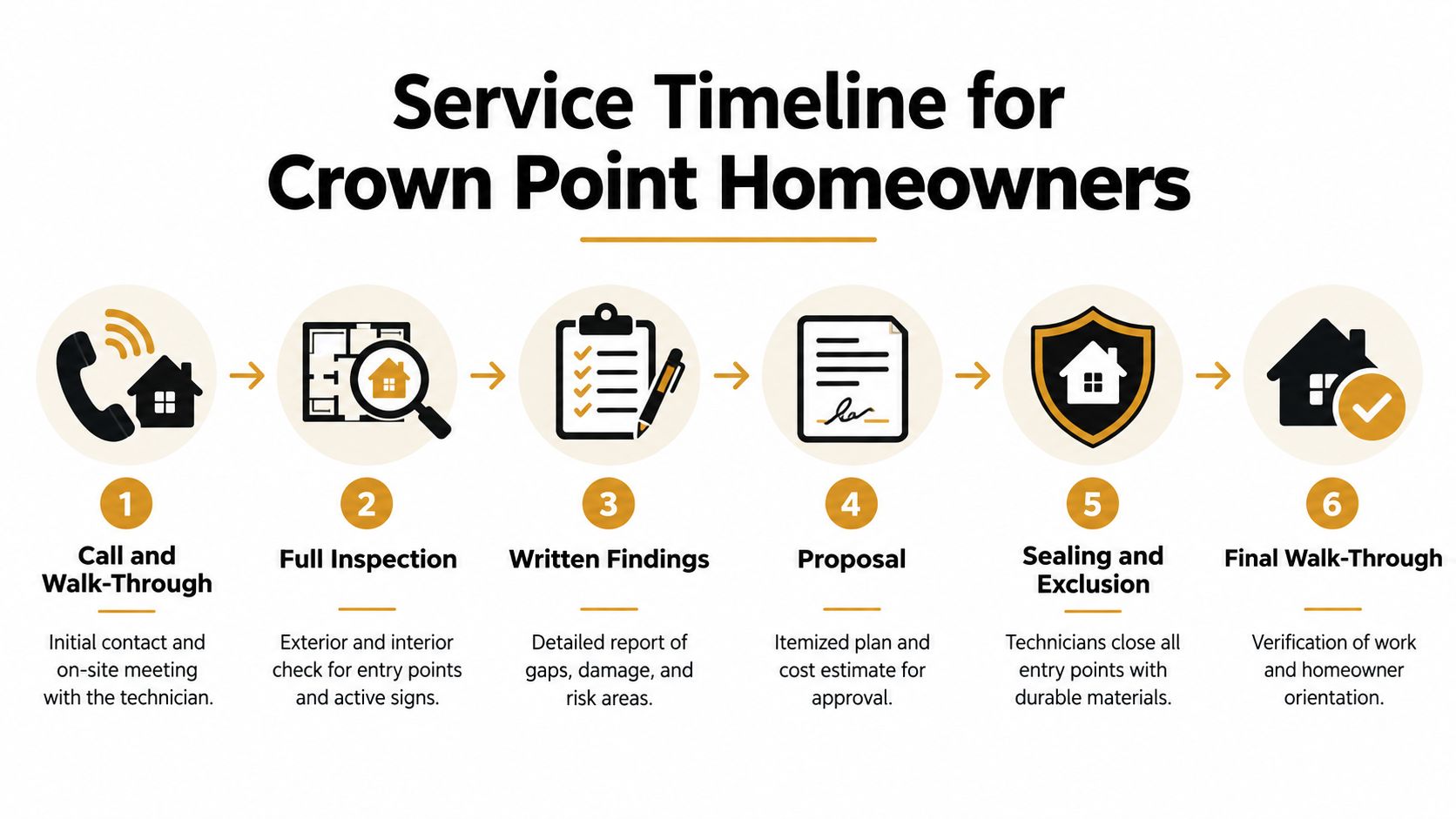
A Crown Point exclusion project normally begins with a phone call or online request, followed by an on-site walk-through. Share the address, approximate age of the home, location of sounds or droppings, and any prior pest history so the technician can plan the inspection properly.
The inspection produces findings rather than a guess. The technician reviews exterior and interior access points, active signs, repair conditions, and areas that need more access. Written findings should separate recommended sealing from optional monitoring or related cleanup.
Preparing for the repair visit
Before the technician arrives, clear storage along basement walls, garage corners, and the utility room. Make attic, crawlspace, and mechanical areas accessible when those zones are part of the inspection. Secure pets and move fragile items away from work areas.
For an average single-family home, the repair portion may take two to four hours, depending on access and the number of defects. Larger homes, detached outbuildings, multi-unit buildings, and light commercial properties require a customized schedule. A written proposal should explain whether work is planned for one visit or several.
A follow-up check is commonly scheduled two to four weeks after repairs. That visit gives the technician an opportunity to review trap results, inspect repaired areas, and determine whether signs of activity have stopped. The exact schedule should reflect the property and the findings, not an automatic promise.
Costs and Estimates for Northwest Indiana Properties
Rodent exclusion pricing in Crown Point and nearby Northwest Indiana communities depends more on the building and the repair list than on the label “mouse service.” A small, accessible home with a limited number of defects is a different project from a multi-unit building with deteriorated masonry, attic contamination, or difficult crawlspace access.
The main cost factors include:
- Property size: Larger footprints create more perimeter, roofline, and utility transitions to inspect.
- Entry-point count: Multiple openings require more materials, labor, and documentation.
- Foundation type: Brick, block, poured concrete, crawlspace foundations, and mixed materials need different repair methods.
- Access and remediation: Attic, crawlspace, insulation, nesting, and sanitation work can add labor beyond exterior sealing.
- Property use: Commercial sites and multi-unit buildings may need coordinated access, unit-by-unit inspection, and monitoring.
The 2026 New Jersey field study offers useful labor context, though it isn't a Crown Point price sheet. It recorded labor-specific exclusion costs of US$117 to US$139 per hour and average materials costs of US$36 per apartment (field study information). Local estimates still need to account for travel, access, building condition, scope, and the work required at each property.
Typical Rodent Exclusion Cost Ranges in Northwest Indiana
| Property Type | Typical Cost Range | What Is Included |
|---|---|---|
| Standard Crown Point single-family home | Custom estimate after inspection | Perimeter inspection, identified sealing repairs, and recommended follow-up |
| Larger home or property with outbuildings | Custom estimate based on access and defects | Expanded inspection, exterior proofing, and possible interior monitoring |
| Multi-unit property | Custom estimate by building and unit scope | Unit or building inspection, prioritized repairs, and coordinated verification |
| Light commercial site | Custom estimate based on operations and access | Commercial inspection, exclusion repairs, and optional monitoring plan |
A one-time exclusion project and an ongoing monitoring plan serve different purposes. The first focuses on correcting identified vulnerabilities. The second may make sense where buildings have frequent deliveries, shared walls, food handling, complicated utility routes, or recurring exterior exposure.
A low quote can reflect a narrow inspection rather than better value. Ask whether the proposal includes the perimeter, attic or basement zones, material specifications, photographs, follow-up, and clear exclusions. Skilled diagnosis costs more than a quick patch, but incomplete repairs can create another service cycle.
Why Exclusion Protects More Than the Building
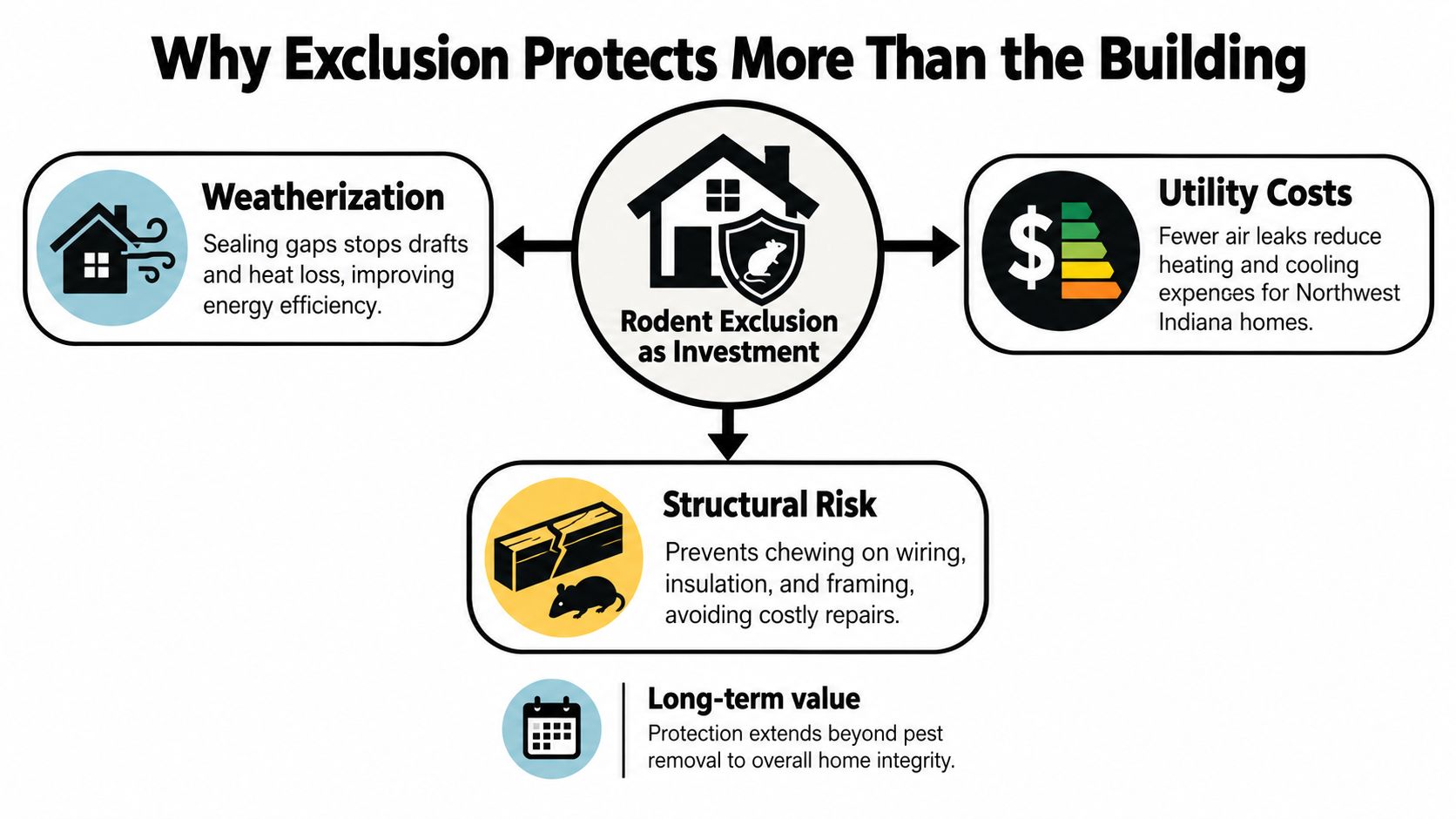
Rodent exclusion belongs in the same conversation as weatherization and preventative maintenance. An unsealed gap can admit pests, cold air, and moisture at the same time. In Northwest Indiana, that matters during cold, windy weather when air leakage places extra demands on the home's heating system.
The building-performance connection is supported by research summarized in a housing study that found housing condition, retrofitting, and retrofit duration significantly reduced final rodent populations. Another 2024 apartment mouse-management study found that combining traps with exterior and interior mouse-proofing reduced infestation rates to 2% at 12 months, compared with 44% in the control group (research summary and study).
The risks behind the noise
Rodents can chew wiring, disturb insulation, and use plumbing or HVAC penetrations as travel routes. Droppings, urine trails, and nesting material can spread contamination through attics, basements, wall voids, and duct-adjacent spaces. The appropriate response depends on the location and extent of the evidence, but ignoring it allows the problem to remain inside the structure.
Sealing also helps keep moisture and drafts from entering wall and foundation areas. Durable repairs can support a drier, tighter home, although homeowners should still address drainage, ventilation, roof leaks, and other moisture sources separately.
The return on exclusion isn't limited to one season. It can mean fewer late-night sounds, fewer bait-station rotations, fewer repeat service calls, and less chance that a small exterior defect becomes a larger repair issue. The strongest result comes from treating pest control as part of overall property care.
Experimental evidence supports that approach. In rural southwestern U.S. homes, rodent-proofing resulted in infestation at 3 of 28 treatment houses versus 13 of 36 control houses, while the National Park Service manual reports that repairing access points reduced overall rodent infestations by more than 90% compared with similar unrepaired structures (experimental study).
Scheduling Your Rodent Exclusion Visit in Crown Point
Booking an inspection is straightforward when you have a few details ready. Provide the property address, approximate age of the home, rooms where you hear activity, visible droppings or damage, and any previous mouse or rat treatments. Photos of exterior gaps can help the office understand the concern, but they shouldn't replace an on-site inspection.
Demand often rises in fall and late winter as rodents seek protected indoor spaces or homeowners prepare for weatherization work. Spring can also fill quickly as property owners combine pest prevention with exterior maintenance. Scheduling early gives the technician more flexibility, especially for larger homes, rentals, and commercial facilities.
Preparing the property
Clear access to the attic, basement, garage, crawlspace, and utility room. Pull stored items a few feet away from exterior walls where possible, and secure pets before the technician arrives. These simple steps let the inspection focus on the structure rather than moving obstacles.
During the visit, expect a perimeter walk, interior review, discussion of findings, and a written estimate that separates required sealing from optional monitoring. The technician should explain which openings are being repaired, which materials are planned, and whether any areas couldn't be inspected safely or completely.
The Green Advantage provides rodent control and exclusion for homeowners and businesses in Crown Point, IN and surrounding Northwest Indiana service areas. The process can also connect with broader residential pest control or commercial pest control needs, including ant control, termite control, mosquito control, spider control, wasp removal, and seasonal pest prevention when those concerns appear during the inspection.
Before you book: Ask for the inspection scope, repair materials, follow-up plan, and any work that isn't included in the estimate.
A local provider should communicate clearly from the first call through the final walk-through. You shouldn't have to guess whether the technician checked the roofline, the foundation, the garage, or the utility penetrations.
If scratching, droppings, or a gap near the foundation has you searching for an exterminator near me or pest control in Crown Point, IN, schedule a rodent inspection with The Green Advantage. Their team can assess entry points, recommend durable exclusion repairs, and build a practical plan for your Crown Point home or Northwest Indiana business.