
Lawn Tick Control in Crown Point, in: A Homeowner’s Guide

If you've seen kids on the trampoline, the dog running the back fence line, and that damp strip of leaves where the lawn gives way to woods, you already know why ticks feel like a real yard problem in Crown Point, IN. Lawn tick control isn't about blasting every square foot of turf and hoping for the best. It's about understanding where ticks live, when they move, and which edges of your property deserve attention first.
For homeowners in Northwest Indiana, that shift matters. Well-kept turf can be a low-risk area, while shaded borders, leaf litter, stone walls, and ornamental plantings create the conditions ticks like most. The Green Advantage works with that reality, not against it, using local pest control knowledge that fits Crown Point yards, not a one-size-fits-all approach.
What Lawn Tick Control Really Means in Northwest Indiana
Hearing lawn tick control often brings to mind “spray the grass.” That's not wrong, but it misses the part that changes the risk in a residential yard. In practice, lawn tick control means reducing tick habitat, interrupting host movement, and treating the places where ticks are most likely to wait for contact, especially the border where the yard meets woods, brush, or heavy landscaping.
The perimeter matters more than open turf
A long-term residential yard study in the CDC's Emerging Infectious Diseases supplement found that active tick-control bait boxes were associated with a 53% reduction in questing nymphal ticks in forest habitat compared with placebo controls, and the combined treatment arms produced about a 20% lower cumulative number of reported human tick encounters, though that human reduction was not statistically significant. The same study also found about a 50% reduction in ticks feeding on rodents, which is a useful reminder that the yard is an ecosystem, not just a patch of grass. CDC Emerging Infectious Diseases supplement study
The practical takeaway is simple. If you only treat open lawn, you're likely spending effort where ticks are least concentrated. The work starts at the lawn edge, along tree lines, around stone walls, and near shaded plantings.
Practical rule: Treat the border first. That's where wildlife moves, humidity stays higher, and ticks have the best chance to wait for a host.
For homeowners looking for pest control near me or pest control in Crown Point, IN, that perimeter-first logic is what makes professional lawn tick control different from a generic yard spray. It also explains why a local exterminator in Crown Point, IN should talk about habitat, not just products.
Know the Ticks and Where They Hide on Your Property

Crown Point yards can host more than one kind of tick, and the response changes with the species present. Homeowners usually hear about the American dog tick, lone star tick, and blacklegged tick, also called the deer tick. Each one favors slightly different conditions, but the pattern is the same. They stay low in the environment and grab onto people, pets, or wildlife as they move through.
Learn the yard, not just the pest
A Connecticut tick-management handbook found that only 2% of ticks were in lawn habitat compared with 9% in ornamental vegetation, and 82% of lawn-dwelling ticks were within 3 yards of the perimeter, especially near woods, stone walls, or ornamental plantings. That is the map to study first. Connecticut tick-management handbook
A practical way to read a property is by zone:
- Cool shaded edges, especially where the lawn meets the tree line.
- Leaf litter pockets, because they hold moisture and give ticks cover.
- Stone walls and woodpiles, which shelter wildlife and create travel paths.
- Ornamental beds and shrubs, which can be more active than open turf.
Open lawn usually is not the main problem. A homeowner can mow on schedule and still run into ticks at the border, under shrubs, or along a shaded fence line. That is why residential pest control for tick pressure often starts with the edge habitat, while a broader commercial pest control plan for an outdoor property may need the same kind of perimeter focus.
Walk the lawn edge and follow the path a child, pet, or guest would naturally use. If that route cuts through leaf litter, brush, or a stone edge, those are the spots that deserve attention first. That is the field work behind exterminator near me calls. Identify the hot spots before you choose the treatment.
A Seasonal Schedule That Fits a Crown Point Yard

Spring in Northwest Indiana is when a lot of tick problems get set in motion. Leaf litter and dead plant material from the winter sit along the border, and that's where the first cleanup matters most. If the edges stay messy, nymphs and other ticks have cover before a spray ever goes down.
The timing that actually matters
A technically strong lawn tick-control program is most effective when it combines habitat management with acaricide timing. Connecticut guidance notes that one application of most ornamental-turf insecticides typically gives 85–90%+ control, and CDC-reviewed studies report highly controlled pyrethroid applications often achieve >85% reduction in host-seeking ticks. Connecticut agricultural guidance
Late spring into early summer is the key window for nymphal blacklegged ticks. That's the spray window that deserves the most attention. Summer then becomes a maintenance season, with mowing, edge trimming, and barrier upkeep doing a lot of the heavy lifting. Fall can bring an optional treatment for adults if pressure stays high, and winter is the time to plan, inspect, and clear any new debris before the next cycle starts.
The rhythm is straightforward:
- Early spring: clear leaf litter and overwintering debris from edges.
- Late spring and early summer: time the main treatment to nymph activity.
- Summer: keep grass mowed and borders trimmed.
- Fall: remove leaves again and consider a follow-up if activity remains.
- Winter: inspect the perimeter and fix trouble spots before warm weather returns.
A single well-timed treatment beats repeated spraying that misses the life stage you're trying to hit.
That seasonal approach is one reason preventative pest treatments work better than panic treatments. It also connects naturally to broader services like mosquito control, since a yard that holds moisture, shade, and brush tends to invite more than one outdoor pest issue.
Habitat Changes That Cut Tick Pressure Before You Spray

A yard does not need to be spotless to be harder for ticks to use. The pressure points are the shaded borders, brushy corners, and damp transition zones where lawn meets woods, stone, mulch, or stacked debris. That is where I look first on a service visit, because spraying open turf alone usually misses the places ticks are spending their time.
The strongest lawn tick-control programs start with the lawn itself, then move to the perimeter. A Massachusetts suburban lawn study found no ticks in 144 tick drags over two years across lawns mowed every 1, 2, or 3 weeks, which points to a simple truth, well-kept turf is a poor place for tick questing. Massachusetts suburban lawn study
What to change first
If you want the biggest effect with the least guesswork, start at the border and work inward.
- Mow regularly. Short, maintained turf is less inviting than overgrown lawn.
- Remove leaf litter. This takes away the damp cover ticks need.
- Trim shrubs and branches. More light and less humidity make edges less favorable.
- Build a wood-chip barrier. The CDC recommends a 3-foot-wide barrier of wood chips or gravel between lawns and wooded areas to help restrict tick migration. CDC tick prevention guidance
- Move woodpiles away from play areas. Woodpiles can shelter rodents and create protected travel corridors.
These changes work because they target the conditions ticks depend on. Ticks stay low to the ground, hold close to humidity, and wait in places where a host is likely to pass. Open the border, dry out the edge, and separate lawn from brush, and the property gives them fewer places to hold.
The CDC and university guidance also point homeowners toward tick-safe zones along wooded borders, stone walls, and shady edges where kids and pets tend to roam. Connecticut tick control fact sheet
For a practical weekend punch list, start here:
- Clear every leaf pile at the border.
- Prune back low branches and dense shrubs.
- Reset playsets, seating, and pet routes away from the tree line.
- Add a barrier where lawn meets woods or brush.
- Keep the border neat before the main spray window arrives.
For homeowners who want plant-based support, plants that repel ticks can fit into the overall layout, but they work best after the habitat has been changed. They are a support, not a substitute for cutting shade, moisture, and cover. If pets use the yard often, the 2026 guide to pet safety is worth keeping in mind while you plan the yard work and any treatment choices.
Natural and Chemical Treatments Compared for Families and Pets
A yard with ticks does not force families into a simple either-or choice. In most Crown Point properties, the practical answer starts with habitat work at the perimeter, then adds treatment only where the pressure and the yard layout justify it. That approach keeps focus on the shaded edges, brush lines, and travel corridors where ticks wait, instead of spending product on open turf that offers little return.
Families ask the same question all the time, do they need chemicals, or can they handle this with lower-chemical methods? The honest answer is that some of the most effective steps are habitat-based, while spray decisions depend on how much pressure the yard has and how much control the household wants. A lot of the “natural” talk sounds good, but not every add-on has the same level of support.
What tends to work and what tends to fall short
Consumer-oriented guidance says a yard can be tickproofed without pesticides by removing leaf litter, reducing shade, and managing habitat. That lines up with the perimeter-first strategy above. The weaker area is the product add-on category, cedar chips, essential oils, and homemade repellents get talked about a lot, but the neutral sources here don't back them at the same level as habitat modification or properly timed treatment. Consumer Reports on tickproofing without spraying
On the chemical side, field data are more consistent. A peer-reviewed review found EPA-registered tick-labeled synthetic pesticides usually produced >80% killing efficacy, and residential trials reported 97% nymph reduction one week after application and 89–97% reduction at 3–4 weeks with granular gamma-cyhalothrin. Some fungal biopesticide treatments dropped to 38–59% control in less favorable conditions. Peer-reviewed tick-control review
| Approach | Typical Effectiveness | Kid and Pet Notes | Best Fit |
|---|---|---|---|
| Habitat modification | Qualitative reduction through less favorable yard conditions | Strongest when paired with common-sense access control | Homes that want lower-chemical prevention |
| Wood chip or gravel barriers | Helps interrupt movement at the border | Safe when installed properly and kept tidy | Yards that border woods or brush |
| Synthetic pyrethroid treatment | Often delivers strong knockdown when applied correctly | Keep kids and pets off treated surfaces until dry and follow label directions | Higher-pressure yards needing more immediate suppression |
| Lower-efficacy natural add-ons | Results vary widely | Product claims can sound better than they perform | Only as a supplement, not the main plan |
For a more detailed comparison of product options, see our guide to the best flea and tick control for yard use. It helps separate what is meant to support the yard from what is expected to do the heavy lifting.
For pet households, the main safety issue is timing and access. Keep pets and children off treated areas until the surface is fully dry and follow the product label exactly. If you want a plain-language reminder for household routines, the 2026 guide to pet safety is a useful companion resource for daily precautions around animals.
Professional application usually beats DIY because coverage matters. Edges, shrubs, and transition zones are easy to miss with consumer equipment, and missed spots are where tick pressure hangs on. A pest control in Crown Point, IN visit can be worth more than a bottle from the store, especially when the yard has kids, pets, and a wooded border.
Monitoring, Inspection, and Knowing Whether the Program Is Working
Most homeowners treat once and assume the job is done. That's not a good way to judge lawn tick control. A better method is to check the same edge areas before and after treatment, then use simple sampling to see whether the program is lowering activity where your family walks.
How to look for change without guessing
Tick drags and flagging are basic field tools. A white cloth or drag cloth is moved slowly over the border habitat, especially near leaf litter, brush, and the lawn edge, then checked for ticks that grab on. The point isn't to sample the middle of a neatly cut lawn first, it's to focus on the transition zones where the risk lives.
A useful monitoring rhythm looks like this:
- After treatment, walk the borders and note where you still see activity.
- Mid-summer, sample the same spots again to see whether counts are creeping back.
- If pets or kids are still picking up ticks, call a pro for a fresh inspection.
A good program in Northwest Indiana should show a sharp drop after the late spring window, with counts rising again later if pressure stays high. Persistent ticks on pets, ticks found indoors, or activity right where kids play are signs the plan needs adjustment. That might mean another edge treatment, more habitat work, or a closer look at rodent access.
If the same strip of yard keeps producing ticks, the problem usually isn't the product, it's the zone you're treating.
The value of a professional pest inspection is that a technician can compare what's on your property to a local baseline and see whether the border, not the open lawn, is driving the problem. For homeowners comparing service options, that's also where exterminator near me searches become useful, because the right inspection tells you whether you need spot treatment, broader perimeter work, or help with a related issue like rodents or mosquitoes.
Working With a Local Pro and Getting Started in Crown Point
When a yard needs more than DIY cleanup, professional lawn tick control usually starts with a perimeter-and-habitat inspection. A technician looks at the edge zones, identifies the likely pressure points, and times a treatment to the nymph window instead of spraying on a random schedule. Optional follow-up can help if the property borders woods, brush, or heavy shade.
The Green Advantage offers a dedicated tick control yard service that includes property inspection, identification of tick hotspots, and targeted treatment based on site conditions. It fits naturally alongside other outdoor services like mosquito control and rodent exclusion when the yard has more than one pressure point. If you're also comparing broader home services, resources like top Peoria lawn care companies can show how outdoor-focused care often overlaps with pest prevention, but in Crown Point, the useful question is whether your own perimeter is being managed the right way.
That's the core of good lawn tick control in Northwest Indiana. Treat the edges, time the spray, and use a plan instead of just a product.
If you're ready to stop guessing about the border of your yard, schedule a pest inspection with The Green Advantage. Their team can look at your Crown Point property, talk through the tick hotspots that matter, and build a treatment plan that fits your lawn, pets, and seasonal pressure.
What Kills Ticks in the Yard: Crown Point Solutions
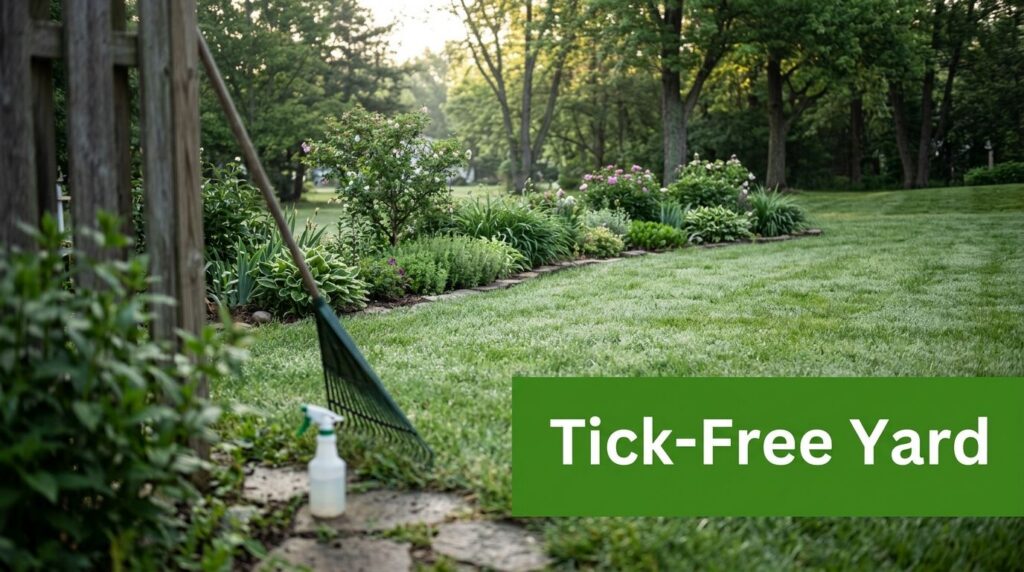
A lot of Crown Point homeowners hit the same point every year. The weather turns nice, the kids want to play outside, the dog heads straight for the back fence, and suddenly nobody feels relaxed in the yard anymore because ticks are on your mind.
That concern is reasonable. Ticks change how people use their property. Instead of enjoying the patio or letting pets roam, you start checking pant legs, watching the edges of the lawn, and wondering whether the shady spot behind the shed has turned into a problem area. In Northwest Indiana, that worry usually starts in the places that look harmless. Leaf litter along the fence, brush near the tree line, taller grass behind a playset, or a damp border where wildlife passes through.
If you've been searching for pest control near me, exterminator near me, or pest control in Crown Point, IN, you're probably not looking for theory. You want to know what kills ticks in the yard, what works, and how to make the space usable again without creating a new safety concern for your family or pets.
Reclaim Your Yard from Ticks in Crown Point IN
One of the most common situations around Crown Point goes like this. A family spends time cleaning up the yard in spring, gets the grill ready, freshens up the landscaping, and expects to be outside more. Then a pet comes in with a tick, or someone finds one after mowing near the back edge of the lot. The whole yard starts to feel different after that.
Parents get cautious fast, and for good reason. Pet owners do too. Once ticks show up, people stop trusting the spaces where they used to relax. The yard may still look clean, but it doesn't feel comfortable. This is the main problem with ticks. They don't just create a pest issue. They take away normal outdoor living.
Why tick problems feel worse in Northwest Indiana
In Crown Point and nearby Northwest Indiana communities, many properties have exactly the mix ticks like best. There's lawn, but there's also shade. There are maintained areas, but also borders with weeds, mulch beds, ornamental grasses, brushy corners, and neighboring lots that may not be kept the same way.
That means a yard can seem tidy and still support tick activity.
Practical rule: If your yard has cool, protected edges where wildlife or pets move through, ticks can hold there even when the center lawn looks fine.
What helps most is taking a realistic view. Ticks usually aren't solved by one quick trick, one household spray, or one Saturday cleanup. The yards that stay more usable usually have two things working together:
- Targeted treatment that knocks down active tick pressure where ticks hide
- Ongoing yard adjustments that make the property less inviting over time
That's why residential pest control makes such a difference for tick issues. A trained technician doesn't just treat open grass and leave. Critical work happens in transition zones, perimeter edges, low vegetation, leaf buildup, fence lines, and shaded harborage points that generic advice often skips.
For homeowners looking for exterminator in Crown Point, IN or pest control in Crown Point, IN, the goal isn't just killing a few visible ticks. It's getting back to a yard you can use again with more confidence.
Understanding the Tick Threat in Northwest Indiana
Ticks in Northwest Indiana aren't random. They show up where moisture, cover, and host activity come together. That's why some yards in Crown Point seem to have recurring problems while others on the same street have much lighter pressure.
The species many homeowners hear about most is the blacklegged tick, often called the deer tick. This is one reason ticks get serious attention in the Midwest. They're not just annoying pests like a few mosquitoes around dusk. They're tied to health concerns, including Lyme disease, which is one reason homeowners want faster action once ticks are found on pets, people, or around common use areas.
Where ticks hide on local properties
Ticks don't spend most of their time out in the bright middle of a dry lawn. They hold in protected areas where they can avoid heat and wait for a host to pass by.
Common trouble spots in Crown Point yards include:
- Leaf litter under trees where moisture stays longer
- Tall grass along fences and behind sheds
- Wooded edges where yards meet brush or tree cover
- Groundcover and dense ornamentals that stay cool underneath
- Pet paths and wildlife routes along lot lines and rear property edges
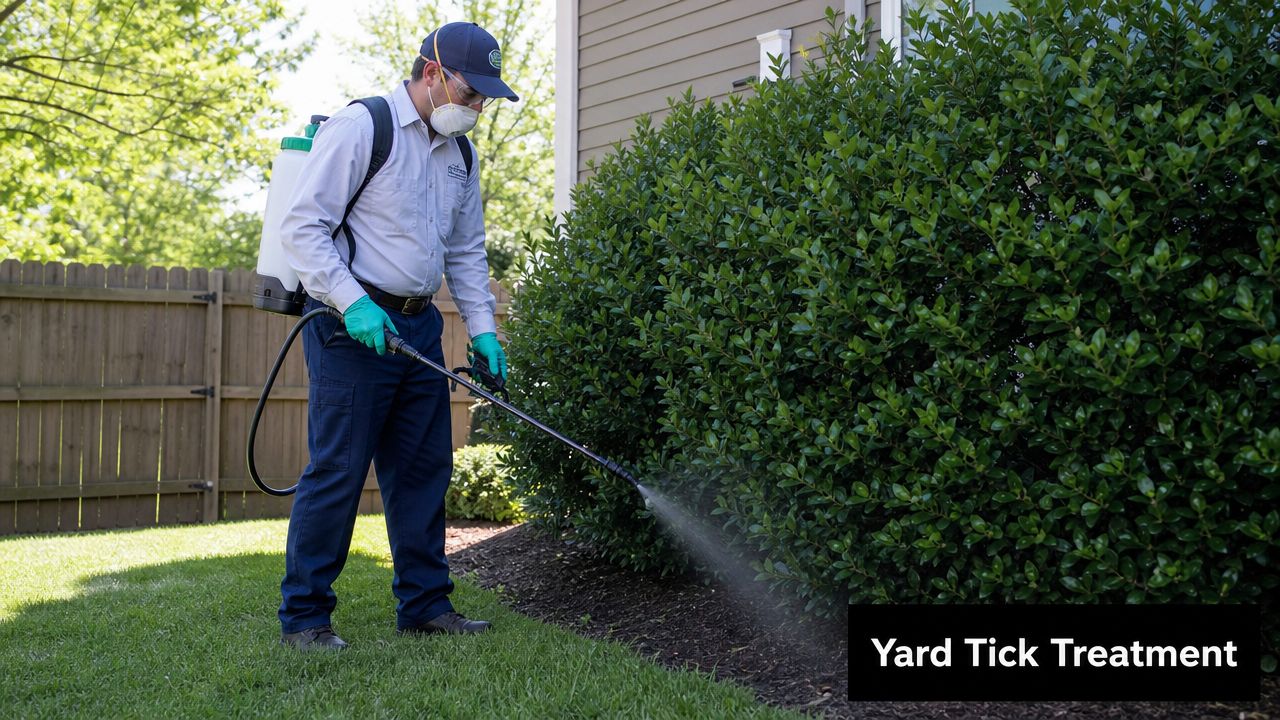
A yard doesn't need to back up to deep woods to have a tick issue. A few connected conditions are enough. Rabbits move through. Deer pass at night. Rodents stay under brush piles or around neglected edges. Pets investigate those areas, then bring the problem back toward the house.
Why Northwest Indiana yards create repeat pressure
The challenge in this part of Indiana is that many properties combine suburban living with nearby natural cover. That mix is beautiful, but it also creates steady tick habitat. Moisture hangs on longer in shaded pockets, especially where airflow is limited and debris collects.
Ticks rarely start in the middle of how you use the yard. They build in the margins, then spread into the places your family and pets actually touch.
That's why homeowners looking for pest control near me often need more than a broad lawn treatment. Tick work has to match the layout of the property. A technician who understands local yards will pay close attention to wooded transitions, mulch lines, fence rows, and the areas where pets cut through every day.
For property managers and business owners, the same logic applies. Commercial pest control for ticks matters anywhere people use outdoor common areas, cultivated borders, or shaded walkways. A nice-looking exterior doesn't always mean a low-risk exterior.
Effective Professional Tick Treatments for Your Yard
When homeowners ask what kills ticks in the yard, the most reliable answer is targeted professional acaricide treatment, combined with smart application in the spots ticks frequent. “Acaricide” is a product designed to control ticks and related pests. In practice, the success of the treatment comes down to where it's applied, how thoroughly it's applied, and whether the technician understands tick behavior on your type of property.

A professional yard treatment is not the same as spraying the whole lawn evenly and hoping for the best. That's one of the biggest misunderstandings homeowners have after trying store-bought products. Ticks aren't spread uniformly across the property, so the treatment shouldn't be either.
What professionals target first
A trained technician usually starts with the harborage zones. These are the cool, protected areas where ticks rest and wait for people, pets, or wildlife to brush by.
The highest-value treatment zones often include:
- Fence lines and property borders
- Wooded perimeters and brush edges
- Leaf buildup under shrubs and trees
- Dense plantings near patios, play areas, and dog runs
- Transitions from lawn to mulch, bed lines, or natural cover
That approach is often called a barrier treatment. It creates a treated zone where ticks are most likely to survive and move, instead of wasting effort on low-risk turf.
Why professional products perform better
Homeowners can buy concentrates, hose-end sprayers, granules, and ready-to-use products, but they usually run into the same problems. Coverage is uneven. Key hiding spots get missed. Product choice doesn't fit the yard conditions. Timing is off. Or the application is too light because the person spraying is trying not to overdo it.
Licensed pest control technicians work with products and equipment designed for controlled application. Just as important, they know when a surface should be treated and when it shouldn't. That matters for effectiveness, but it also matters for safety around families, pets, and routine yard use.
Field note: The best tick treatment plans are precise, not heavy-handed. More product doesn't automatically mean better control.
Some homeowners also want eco-friendly pest control options. That's a reasonable question, especially when children and pets use the yard often. In real-world service, environmentally mindful tick control usually means choosing products and application methods carefully, targeting only the areas that need treatment, and avoiding blanket over-application.
Here's a quick visual look at what professional outdoor treatment work can involve:
Timing matters as much as the product
Tick control works better when treatment lines up with local conditions and active periods. In Northwest Indiana, the wrong timing can leave a yard looking treated but still producing tick encounters because the treatment missed the moments when activity and exposure were highest.
That's another place professional service stands apart. A good technician doesn't just ask, “Do you want a spray?” They ask where ticks were found, where the dog runs, whether the rear lot line stays damp, whether deer cross the back edge, and whether there's brush or ornamental cover that needs attention.
This kind of targeted approach also fits well with related services. Homeowners who need mosquito control, rodent control, or preventative pest treatments often discover the same property conditions are contributing to multiple issues at once. Outdoor pest management works best when the whole site is evaluated, not just one symptom.
Comparing DIY Methods with Professional Tick Control
DIY tick prevention has a place. It just has limits. Homeowners in Crown Point can absolutely make their yard less attractive to ticks, and some of those steps are worth doing whether you hire a professional or not.
Where DIY usually falls short is active control. Once ticks are established in the right protected areas, simple cleanup or a consumer spray often reduces visibility without solving the underlying pressure. That's why so many people think they “treated for ticks” and still find them along the same edges a short time later.
What DIY can help with
The most useful homeowner actions are the basics that reduce tick habitat:
- Mow consistently: Shorter grass allows more sun and airflow.
- Remove leaf litter: Debris under shrubs and trees holds moisture.
- Trim back overgrowth: Dense edging and brush create protected movement lanes.
- Limit wildlife shelter: Brush piles and neglected corners support host activity.
- Check pets often: Early discovery can reveal where the yard pressure is coming from.
Some people also try cedar products, yard-safe botanical sprays, tick tubes, or certain plantings. Those options can be part of a broader prevention plan, but they usually don't provide the same dependable knockdown as a professional treatment targeted to active harborage zones.
For homeowners weighing options, this guide on best flea and tick control for yard is worth reading because it helps sort out what's useful, what's overhyped, and what belongs in a support role rather than the main solution.
DIY vs Professional Tick Control in Crown Point
| Factor | DIY / Natural Methods | Professional Service (The Green Advantage) |
|---|---|---|
| Effectiveness | Best for reducing habitat and supporting prevention. Often inconsistent once ticks are active in multiple hiding areas. | Designed to directly target active tick zones and reduce pressure where ticks live and travel. |
| Cost | Lower upfront purchase cost, but repeat trial-and-error can add up in products and time. | Higher service cost than a single DIY purchase, but more efficient when you want a clear treatment plan and less guesswork. |
| Safety Risks | Risk comes from misreading labels, poor mixing, overapplication, or treating the wrong surfaces. | Licensed application helps reduce misuse and keeps treatment focused on the appropriate areas. |
| Time Commitment | Requires mowing, cleanup, product selection, setup, application, and follow-up monitoring. | Saves homeowner time because inspection, treatment strategy, and application are handled for you. |
| Guarantee | Usually none beyond the product packaging. Results depend on homeowner technique and coverage. | Service expectations are clearer, and homeowners get professional guidance on follow-up and prevention. |
The honest trade-off
DIY works best for homeowners who are disciplined about maintenance and are dealing with light pressure. It's much less dependable when the property backs up to brush, has heavy shade, supports wildlife traffic, or has repeated tick encounters in the same areas.
If you've already cleaned up the yard and you're still finding ticks, the issue usually isn't effort. It's that the remaining problem is in the exact places DIY treatment tends to miss.
That's where residential pest control becomes the practical next step, not because every yard needs a major intervention, but because some yards need precise treatment more than they need more homeowner labor.
The Benefits of a Professional Exterminator for Ticks
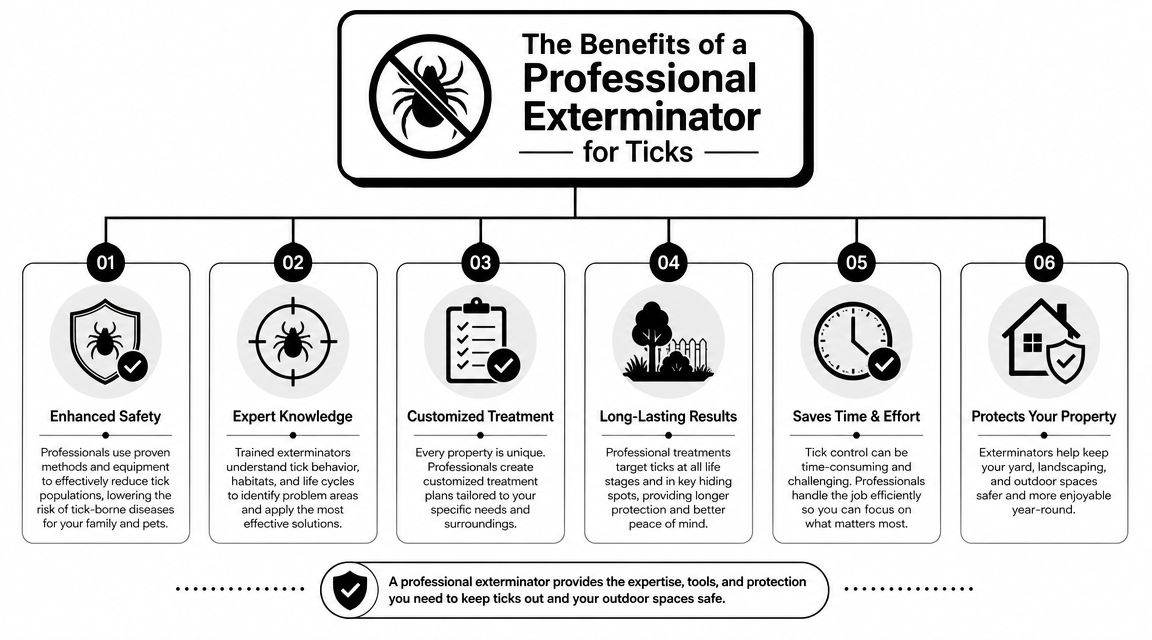
The biggest benefit of hiring a professional exterminator for ticks isn't just that the yard gets treated. It's that the problem gets handled with a plan. That matters when children are playing outside, pets are using the yard every day, or you're tired of second-guessing every shaded corner near the house.
A good tick service protects more than turf and landscaping. It protects how the property feels. Homeowners want to walk to the garden, let the dog out, or sit by the patio without that low-grade worry in the back of their mind.
Why expert service pays off
Professional tick control gives you advantages that are hard to recreate with off-the-shelf products.
- Better diagnosis: Technicians identify the sections of the property driving the issue, not just the places where you happened to spot a tick.
- Safer application choices: Treatment is matched to the site instead of applied broadly without a plan.
- Less wasted effort: You don't spend weekends trying one product after another.
- Stronger prevention: You get guidance on what to cut back, clean up, or monitor between visits.
- More peace of mind: The yard feels usable again because someone experienced has addressed the key pressure points.
This kind of value shows up in other outdoor services too. Anyone comparing proposals for cleanup, mowing, or yard work can learn a lot from how to bid landscaping jobs effectively, because it explains why scope, property conditions, and labor details matter more than a quick surface price. Tick control is similar. The quality of the plan matters.
Health, comfort, and long-term property use
Homeowners often start with one concern, usually finding a tick on a pet or near a child's play area. What they really want back is normal outdoor life. They want to use the yard without turning every outing into an inspection routine.
That's why many people who search exterminator near me or exterminator in Crown Point, IN aren't looking for the cheapest spray. They're looking for confidence that the work was done correctly.
For businesses and shared properties, the same principle applies. Commercial pest control for ticks helps protect staff, tenants, visitors, and the reputation of the property itself. Exterior areas should feel maintained and safe, not uncertain.
Your Tick-Free Yard Plan with The Green Advantage
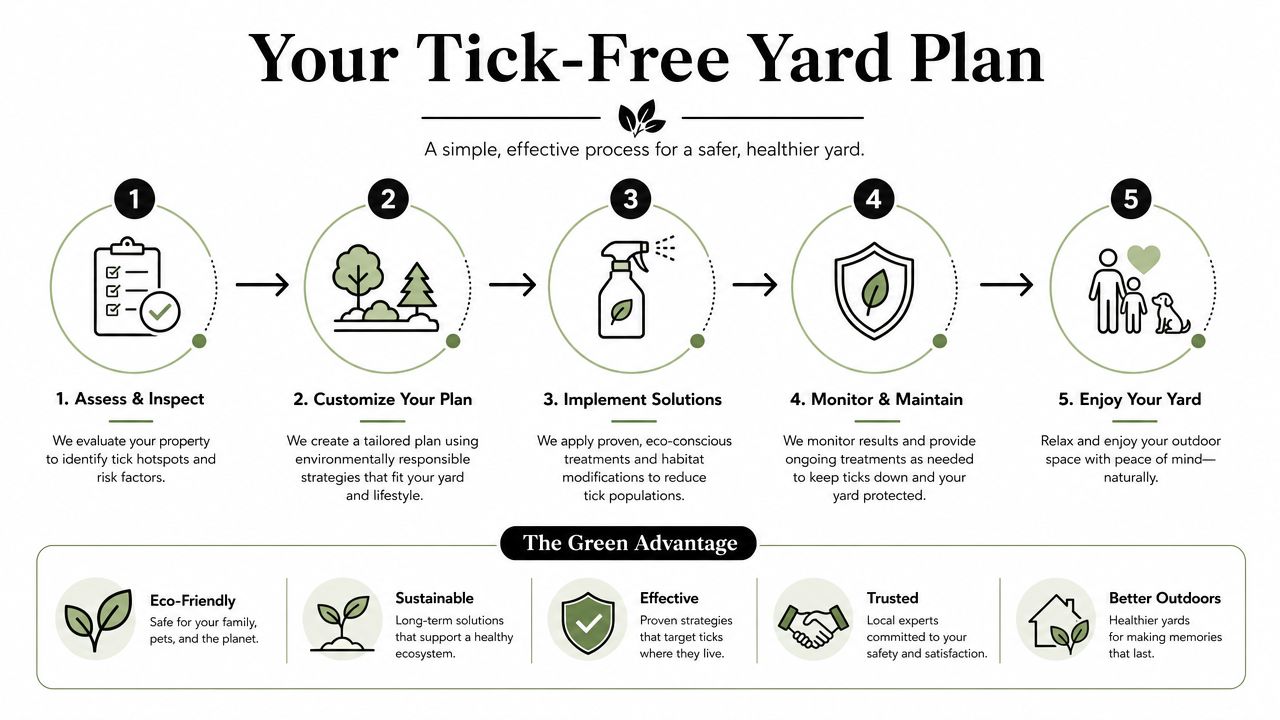
Hiring a pest professional shouldn't feel complicated. Homeowners in Crown Point usually want a straightforward answer to a few practical questions. What happens first, how is the yard evaluated, what gets treated, and what should the family expect afterward?
The process works best when it's simple and transparent.
What the service process looks like
Initial contact
You explain what's happening. Maybe ticks are showing up on pets, maybe someone found them along the back fence, or maybe you've got a wooded edge that's making you uneasy. Clear communication at the start helps narrow down the likely pressure zones.On-site inspection
The property is evaluated with tick behavior in mind. That includes shaded borders, vegetation density, leaf buildup, fence lines, pet traffic routes, and transition areas between maintained lawn and natural cover.Treatment recommendation
You get a clear explanation of what needs attention and why. Good recommendations don't sound vague. They connect the layout of your yard to the treatment approach.Professional application
Service focuses on the highest-value treatment areas rather than wasting material on low-risk open turf. The result is a more efficient and more thoughtful approach to what kills ticks in the yard.Follow-up guidance
You'll know what to do next, whether that means trimming back a planting, clearing debris, monitoring pet routes, or considering related seasonal pest issues such as mosquito control, spider control, wasp removal, or rodent control around the same exterior zones.
What homeowners appreciate most
Homeowners don't want a complicated lecture. They want honest answers, courteous service, and a clear path back to a usable yard.
Local advice: The best service calls leave homeowners feeling informed, not pressured. You should understand what was treated, why it mattered, and what simple yard changes will help hold the line.
That's especially important in Northwest Indiana, where one property may need only light perimeter attention and the next may need a more deliberate plan because of woods, drainage, pet activity, or neighboring overgrowth.
Local Tick Control Questions Answered
Are tick treatments safe for children and pets
That's usually the first question, and it should be. Safe service starts with correct product selection, proper application, and clear instructions about when treated areas are ready for normal use again. Professional treatment is much safer than casual overapplication with consumer products because the technician applies material where it belongs and avoids unnecessary coverage.
How often do I need tick control in the Crown Point area
It depends on your property conditions. A more open, sunny yard with minimal brush may need much less attention than a shaded lot with leaf litter, wildlife traffic, and wooded edges. The right schedule comes from inspection, not guesswork. If your yard has repeat tick activity, a one-time spray usually isn't the whole answer.
Does mosquito control also kill ticks
Sometimes there's overlap in exterior pest management, but mosquito service and tick service are not identical. Mosquitoes rest and move differently than ticks do, so treatment strategy matters. If ticks are the concern, ask for a plan that directly addresses tick harborage instead of assuming general outdoor spraying will handle both.
Should I try bleach or household chemicals on ticks outside
No. Household chemicals aren't a good yard treatment plan and can create unnecessary risks for people, pets, and landscaping. If you've seen advice online about improvised tick remedies, it's smarter to sort myth from reality first. This article on whether bleach will kill ticks helps explain why improvised approaches aren't the answer for outdoor control.
If you're in Crown Point or a nearby Northwest Indiana community and you're still wondering whether your yard needs treatment, that's usually a sign it's time for a professional inspection. A quick conversation can tell you a lot.
If you're ready for a safer, more usable yard, contact The Green Advantage to schedule a pest inspection or request a quote. If you've been searching for pest control near me, pest control in Crown Point, IN, exterminator near me, or exterminator in Crown Point, IN, their local team can help you identify the problem, recommend the right treatment, and put together a practical plan for your home or property in Northwest Indiana.
Pest Control for Restaurants: A 2026 Guide for Crown Point
A dinner rush can be going smoothly until one small movement near the hostess stand changes the whole night. A server sees it. Then a guest sees it. The kitchen is still producing good food, your staff is still working hard, and yet the conversation in the room has shifted to one question no restaurant owner wants attached to their business.
That's why pest control for restaurants isn't just a maintenance task in Crown Point, IN. It's part of food safety, brand protection, and day-to-day operations. In food service, pests don't show up because an owner doesn't care. They show up because restaurants naturally provide heat, moisture, food residue, deliveries, drains, trash, and hidden shelter.
If you own or manage a restaurant in Northwest Indiana, the goal isn't panic. The goal is a repeatable system. You need prevention, monitoring, fast response, and records that hold up during a health inspection.
Protecting Your Reputation from Unwanted Guests
A single pest sighting rarely stays limited to the one table that noticed it. Guests talk to the people they came with, staff members get shaken up, and online reviews can turn a minor incident into a long-term credibility problem.
That reputational risk is real. According to industry surveys of restaurant customers, more than 60% of diners who see a pest in a restaurant say they would tell five or more acquaintances. For a restaurant owner, that means one visible issue can spread far beyond the dining room where it happened.
Why restaurant owners feel this pressure fast
Restaurants are public-facing businesses. A warehouse can have a back-corner problem and deal with it discreetly. A restaurant doesn't get that luxury. Guests are watching the entry, the restroom, the bar, the condiment station, and anything they can see from their table.
A pest problem also creates two separate risks at the same time:
- Guest trust risk. People connect pests with sanitation, even when the source is structural access, drains, or a recent delivery.
- Operational risk. Staff lose time chasing symptoms instead of fixing root causes like leaks, gaps, clutter, and poor storage flow.
- Inspection risk. If your response isn't documented, the business can look reactive instead of controlled.
Practical rule: Treat every sighting as both a pest issue and a communication issue. The pest needs control, but the process behind your response needs to be visible and organized.
What actually works
The owners who handle this well don't rely on occasional spray service and hope. They run pest prevention like they run line checks, temperature logs, and opening duties. Someone inspects. Someone logs. Someone fixes the condition that allowed the pest activity in the first place.
That's the right mindset for restaurants in Crown Point and nearby Northwest Indiana communities. Pest control belongs inside your standard operating procedures. When it's built into the routine, you're far less likely to get caught off guard during service or during an inspection.
Common Pests in Northwest Indiana Restaurants
Some pests are nuisance pests. In restaurants, the common ones are operational pests. They use the exact conditions that make food service possible. Warm kitchens, drains, storage rooms, dumpsters, deliveries, and floor-level hiding spots all give them what they need.
German cockroaches
German cockroaches cause outsized problems in restaurants because they stay hidden until numbers build. They favor tight cracks, equipment voids, warm motor areas, sink bases, and spaces near moisture.
Industry guidance identifies German cockroaches as the #1 pest problem in U.S. restaurants, and notes that professional treatment is often recommended monthly, with high-risk sites sometimes needing service every 2 weeks based on this restaurant pest control guidance. For owners, the practical takeaway is simple. If you see one during business hours, there's usually more activity where staff and guests can't see.
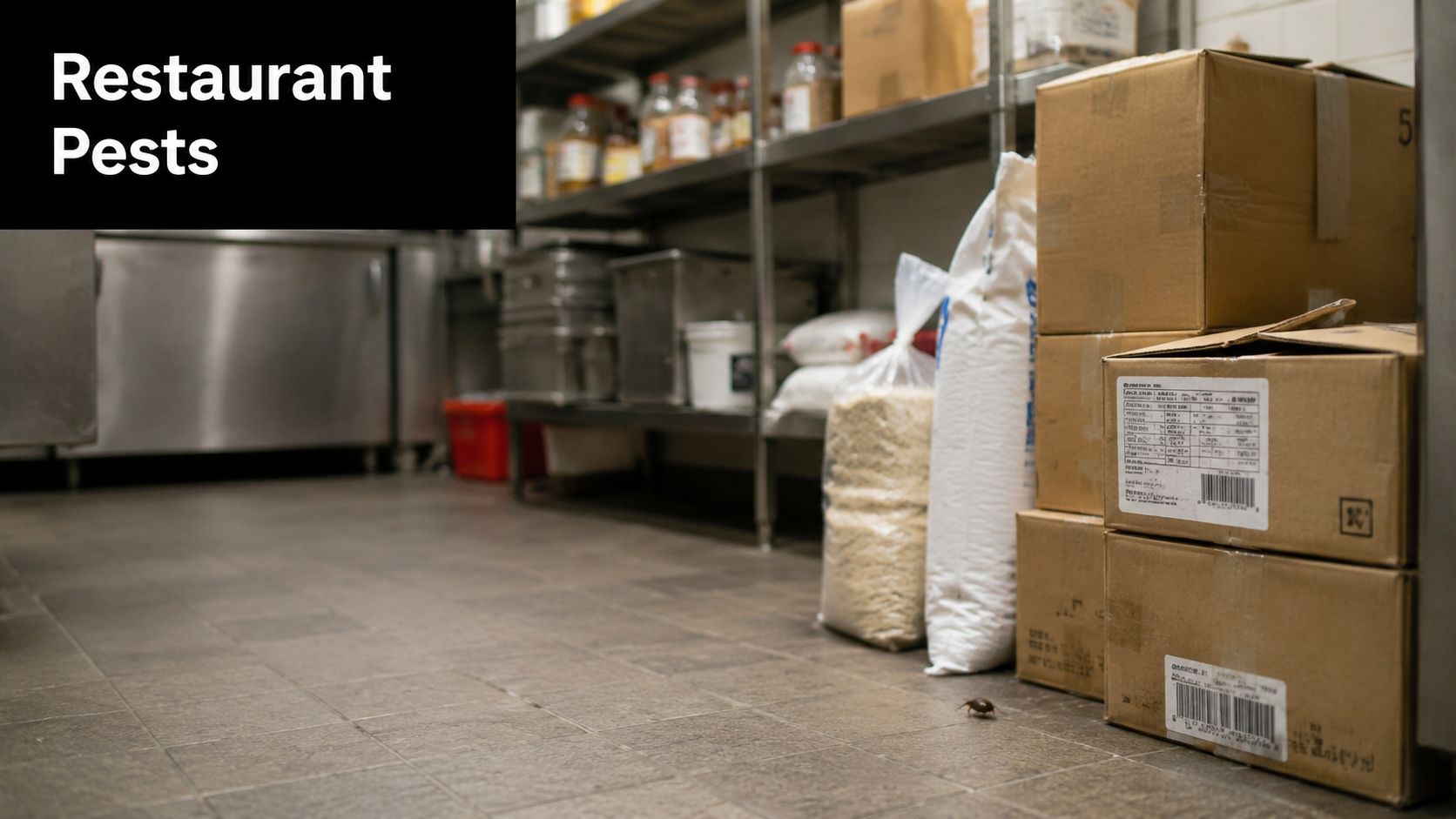
Watch for:
- Live activity near heat and moisture. Behind fryers, dish machines, prep sinks, and beverage stations.
- Small dark spotting. Around hinges, wall junctures, shelving legs, and hidden corners.
- Recurring sightings after cleaning. That often points to harborage inside equipment gaps or wall penetrations.
Rodents
Mice and rats usually enter for shelter first, then settle in because the food source is easy. Back doors, receiving areas, utility penetrations, damaged sweeps, and dumpster zones are common access points.
Rodents create a different kind of pressure than roaches. They travel. They can move from exterior pressure points into dry storage, ceiling voids, and wall lines. In restaurants, that means you can't think only about the kitchen. You have to think like a rodent. How does one get from the alley, pad site, or landscaping edge to a hidden indoor route?
A few signs deserve immediate attention:
| Sign | What it often means |
|---|---|
| Gnawing on packaging or soft materials | Active feeding or nest-building nearby |
| Rub marks along walls | Repeated rodent travel path |
| Droppings in storage or behind equipment | Established movement through the area |
Flies
Flies are often the pest owners underestimate because they seem minor compared with rodents or roaches. In practice, they can be one of the most visible problems in front-of-house and one of the most stubborn in back-of-house.
Drain areas, mop sinks, bar stations, soda lines, floor grout edges, and organic buildup support fly breeding. If the staff only treats the symptom by swatting adults, the issue keeps coming back.
A fly problem usually means there's a breeding site your cleaning routine is missing.
Why these pests are so common here
Northwest Indiana restaurants deal with weather shifts, delivery volume, moisture swings, and older buildings mixed with newer tenant build-outs. That combination creates plenty of hidden gaps, plumbing penetrations, and service access points. If your team focuses only on visible cleanliness, pests will use the places no guest ever sees.
Building Your Restaurant's Defense System
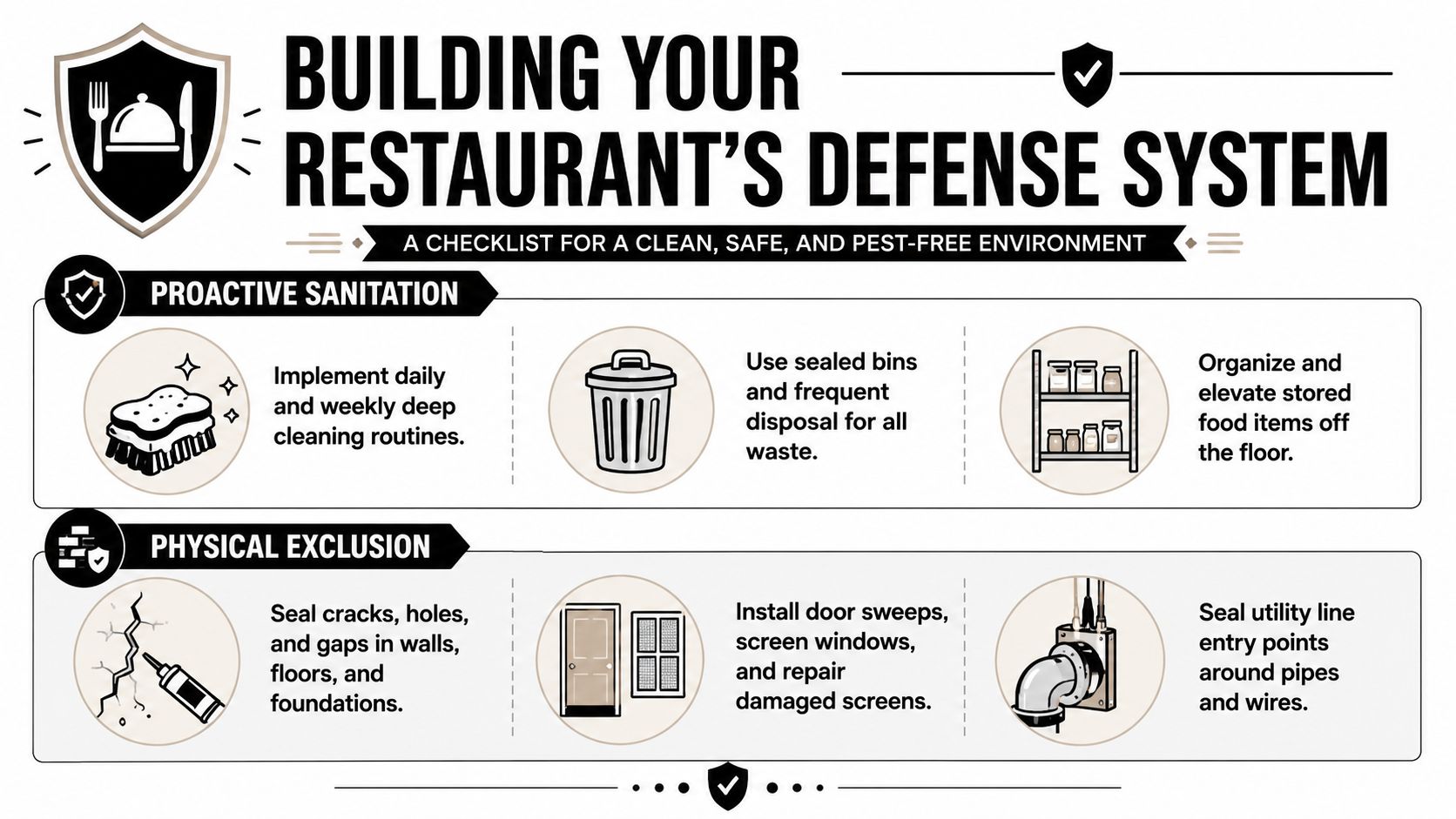
The strongest restaurant pest plans start before any treatment goes down. In practice, your defense system has two parts. Sanitation removes what pests need to survive. Exclusion removes how they get in.
Tighten sanitation where pests actually live
The most common failure points in restaurants include unsealed cracks, standing water from leaks, clutter behind equipment, and overflowing trash, all of which can keep an infestation going even after treatment, as outlined in restaurant pest control tips from RTI.
The useful lesson is that pests don't need a filthy restaurant. They need overlooked conditions.
Daily priorities should be simple and specific:
- Dry the right areas. Check under sinks, around ice machines, near floor drains, and behind dish stations before closing.
- Reset trash correctly. Empty interior waste, clean residue from bin rims, and make sure liners sit inside containers without spills running down the outside.
- Pull and inspect movable equipment. Crumbs and grease build fast behind fryers, coolers, and prep stations.
- Protect ingredients. Keep food in sealed containers and keep storage off the floor where possible.
Weekly work needs to go deeper:
- Audit hidden clutter. Cardboard stacks, unused smallwares, and forgotten supplies create shelter.
- Verify drain care. Staff should clean drains as a procedure, not as a reaction to odor or flies. For drain-specific best practices, this comprehensive guide to drain pest prevention is a useful reference for managers building a stronger routine.
- Check receiving and storage flow. Deliveries can bring in pests or leave doors open long enough to create entry opportunities.
For broader facility habits, many operators also use a written prevention checklist like this commercial pest prevention resource for Crown Point businesses.
Close the building up
Exclusion is where many restaurants leave easy wins on the table. If a door sweep is damaged, if a vent screen is torn, or if utility lines enter through rough openings, the building is inviting pests in every day.
Start outside and work inward:
- Back doors and side doors need tight sweeps and proper closure.
- Window and vent screens should be intact and fitted.
- Pipe and conduit entries should be sealed where they pass through walls.
- Foundation and wall gaps should be identified and repaired before they become routine entry routes.
Local habit that matters: In Northwest Indiana, weather movement and wear around exterior openings can quietly undo previous repairs. Re-check seals and sweeps instead of assuming they're still working.
What doesn't work
Restaurants waste time when they rely on broad, occasional treatment without fixing the condition. Spraying around a leak won't solve moisture. Treating under a sink won't solve an open wall gap. Fogging a room won't solve clutter behind equipment.
Good prevention is less dramatic, but it holds. Staff routines, structural correction, storage discipline, and ongoing inspection do more for restaurant pest control than any quick fix.
Implementing an Integrated Pest Management Program
A week before a county inspection, the owner sees one small roach near the dish area and asks the usual question. “Can you just spray it?” The honest answer is no single treatment fixes what an inspector will care about. You need a repeatable system that shows what was found, what was corrected, who handled it, and whether the pressure dropped after follow-up.
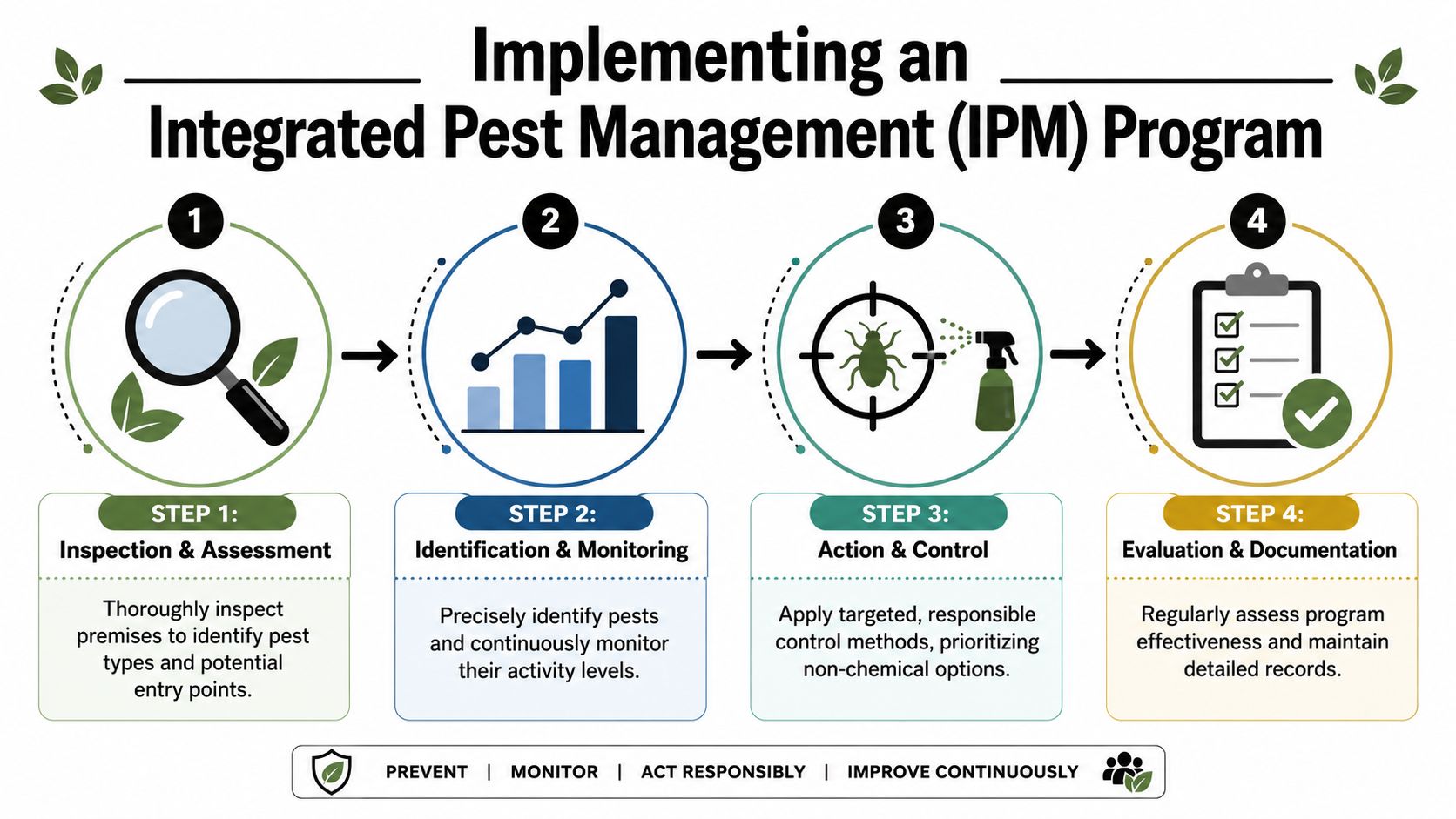
Integrated Pest Management, or IPM, is the operating routine behind that system. It combines inspection, monitoring, targeted correction, limited product use where needed, and written records that hold up during management review and health inspections. A practical restaurant IPM workflow includes those steps, as outlined in this restaurant IPM overview from Rezku.
Inspection should answer operational questions
A useful inspection does more than note where a pest was seen. It should identify the source of pressure, the conditions allowing it, and the department responsible for the fix. In restaurants, that usually means separating a sanitation issue from a maintenance issue, and both from a supplier or exterior-entry issue.
That changes how the walkthrough is done.
Check receiving doors, utility penetrations, mop areas, dish stations, floor drains, bar sinks, soda lines, storage racks, and the hard-to-reach spaces behind hot equipment. In Crown Point restaurants, I also tell owners to inspect after weather swings, delivery schedule changes, and menu shifts that increase grease or moisture load. Those are the moments when a stable building starts showing new pest pressure.
This short video gives a helpful visual on how structured inspection and monitoring fit into a restaurant setting.
Monitoring gives you proof, not guesses
Monitoring devices help managers answer two questions fast. Is activity current, and is the problem getting better or worse?
Sticky monitors, insect light traps where appropriate, rodent devices in mapped locations, and routine visual checks create a record you can act on. They also keep staff from chasing isolated sightings while missing the pattern. A line cook may report a pest near the prep line, but the monitors might show the primary pressure is building near a floor drain, a wall void, or a storage area that is only disturbed once a week.
That record matters for more than pest control. It supports manager handoffs, vendor conversations, and inspection readiness.
One Northwest Indiana issue that gets overlooked is drain condition. If organic buildup is feeding flies, pest service alone will not close the loop. Pairing your IPM plan with grease trap compliance by Anytime Drain Solutions can help address the sanitation side of recurring drain and waste-area pressure.
Control needs to match the cause
The right response depends on what inspection and monitoring found. If the problem is entry, seal the gap and correct the door sweep. If it is moisture, fix the leak and change cleaning or drying routines. If it is harborage, remove clutter, adjust storage, and open access for cleaning. Product application has a place, but in food service it should support the correction, not stand in for it.
That is the trade-off owners need to understand. Quick knockdown can reduce visible activity, which helps in the short term, but unresolved conditions bring the problem back. A slower, disciplined correction process takes more coordination with staff and maintenance, yet it protects the business better and gives you something defensible to show an inspector.
For operators in Crown Point, a commercial pest partner should fit into that process. The Green Advantage provides commercial service plans built around scheduled inspection, mapped monitoring, sanitation review, targeted treatment, and follow-up reporting instead of one-time response alone.
Evaluation keeps the program credible
Every service visit should end with a short review. What changed since the last visit? Which corrections were completed? Which ones are still open? Did activity drop in the monitored areas, or did it shift?
If nothing changes, the plan needs adjustment. That may mean changing device placement, revising staff cleaning steps, involving plumbing or maintenance sooner, or tightening documentation so recurring issues stop getting lost between shifts.
That is what makes IPM work in a restaurant. It gives you a method you can manage, not just a treatment you hope holds.
Documentation for Health Inspection Readiness
A restaurant can look clean and still create concern during an inspection if the owner can't show a repeatable pest prevention process. That's the part many general cleaning guides miss. Inspectors want more than a verbal assurance that you're watching the issue.
Health inspection readiness increasingly depends on documented process. Guidance for food-service compliance emphasizes a site-specific IPM plan, inspection logs, sighting reports, corrective actions, and follow-up verification, as explained in this restaurant compliance article from Smith IPM.

The records that matter most
If you manage a restaurant in Crown Point or elsewhere in Northwest Indiana, keep your pest records organized in one place that managers can access quickly. Paper binder, digital folder, or both. What matters is consistency.
A strong file usually includes:
- Written IPM plan. This should identify target pests, monitoring methods, service expectations, and responsibilities for staff, maintenance, and pest professionals.
- Sighting log. Record what was seen, where, when, and who reported it.
- Corrective action log. Note what changed after the sighting, such as a leak repair, deep clean, sealing work, or storage adjustment.
- Service reports. Keep technician findings, device checks, treatment notes, and recommendations.
- Device map. Show where monitors, traps, or stations are located so your team can verify them during review.
What inspectors are really looking for
Inspectors aren't only checking whether pests are absent in that exact moment. They're also looking for whether management is in control of the system. A sighting without records suggests chaos. A sighting tied to a log, correction, follow-up, and verification shows management.
That's an important distinction. Restaurants are busy environments. Deliveries arrive. Staff changes happen. Equipment breaks. A documented system proves that pest prevention still holds together when the day gets hectic.
Cleanliness matters. Documentation proves that cleanliness is part of a managed program rather than luck.
Documentation gets stronger when maintenance supports it
Many pest records connect directly to facility issues. Leak repair, floor drain condition, wall sealing, and waste-area maintenance all influence whether your logs show recurring problems or resolved ones. That's also why related compliance items matter. For example, grease management often affects sanitation and pest pressure around drains and back-of-house service areas, so this resource on grease trap compliance by Anytime Drain Solutions can help managers connect plumbing maintenance with cleaner pest records.
A simple review rhythm
Don't wait for an inspection to open the binder. Review your records on a routine schedule with whoever oversees kitchen operations. Look for repeated locations, recurring comments, overdue repairs, or missing follow-up notes.
The best documentation is boring. It's current, legible, complete, and easy to understand.
Your Local Action Plan with The Green Advantage
For restaurant owners, the clearest path is also the most practical. Protect the reputation of the business. Know which pests are most likely to show up. Remove the conditions that support them. Run a real IPM process. Keep records that show your response is organized and repeatable.
What a local restaurant should do next
If you want a usable checklist, keep it short:
- Inspect the entire site. Include doors, drains, storage, equipment lines, utility entries, and dumpster areas.
- Fix the pressure points. Leaks, gaps, clutter, and trash handling problems need correction before they become repeat issues.
- Monitor consistently. Don't rely on memory or occasional sightings.
- Document every response. Turn pest activity into a written process.
- Review the plan with your team. Staff habits decide whether prevention holds up between service visits.
For restaurants that need a more kitchen-specific service framework, this commercial kitchen pest control page is a useful next step.
What working with a provider should feel like
A professional restaurant pest program should start with a thorough inspection, not a generic treatment pitch. The site needs to be evaluated based on layout, food handling areas, moisture sources, employee habits, receiving patterns, and structural vulnerabilities.
After that, the plan should be clear. What's being monitored. What needs repair. What staff should change. What gets documented. What follow-up looks like. Restaurant owners shouldn't have to guess whether the program is working.
In Crown Point and nearby Northwest Indiana communities, that local familiarity matters. Restaurant buildings differ, but the pressure points are often similar. Back entries, drain lines, delivery flow, and seasonal moisture conditions all shape what an effective pest control plan looks like.
A strong partnership doesn't just reduce pest activity. It makes the operation easier to manage. Managers get clearer records. Staff know what to watch for. Owners have more confidence going into inspections and less stress when business is busy.
If your restaurant in Crown Point, IN or the surrounding Northwest Indiana area needs a practical pest prevention plan, contact The Green Advantage to schedule an inspection or request a quote. The right system protects your food safety program, your inspection readiness, and the reputation you've worked hard to build.
Expert Tick Control Near Me in Crown Point, IN

A 2022 survey of 140 vector-borne disease professionals found that 97.6% of respondents who could comment said their jurisdiction did at least one form of tick surveillance, while fewer than half reported routine active surveillance and nearly two-thirds reported passive surveillance, which tells you tick control starts with knowing where ticks are instead of spraying blindly (survey findings on U.S. tick surveillance). If you're finding multiple ticks on pets, seeing them after yard work, or living beside woods, brush, or unmanaged edges in Crown Point, it's time to call for professional tick control.
You want to enjoy your yard without second-guessing every step through the grass. That could mean kids playing near the fence line, the dog cutting through shrubs, or friends staying outside after dinner instead of heading in early because everyone is checking ankles and socks.
In Northwest Indiana, that concern usually starts the same way. Someone finds a tick after mowing, a pet comes inside with one attached, or a family realizes the problem seems worst near the back edge of the property where lawn meets trees and leaf litter. That's the point where basic prevention may not be enough.
Enjoy Your Crown Point Yard Without the Worry of Ticks
A lot of homeowners in Crown Point call about ticks after a simple moment changes how they feel about their own yard. The family barbecue is still on. The patio looks great. Then somebody spots a tick crawling on a pant leg, or the dog needs another check before coming inside. The space is still beautiful, but it doesn't feel relaxing anymore.
That shift matters because people don't hire tick control just to remove a nuisance. They want to use their property again without worrying every time kids play near shrubs, a pet cuts along the fence, or someone walks out to the woodpile.

What homeowners notice first
Most yards with tick pressure don't look neglected. In Crown Point and the surrounding Northwest Indiana area, the problem often shows up on otherwise well-kept properties with a few risk features:
- Wooded borders: Lawn that backs up to trees, drainage areas, or brush holds more shade and moisture.
- Yard clutter: Leaf litter, ornamental beds, stacked firewood, and overgrown edges give ticks cover.
- Pet traffic: Dogs often pick up ticks first because they move through perimeter areas people don't pay attention to.
- Wildlife movement: Deer and other animals travel the same edges and carry ticks back into the property.
Ticks don't use a yard evenly. They collect where cover, moisture, and hosts come together.
A good tick service starts by identifying those pressure points. It doesn't start with treating every square foot the same way.
When the problem needs more than maintenance
Homeowners can do a lot with mowing, cleanup, and pet checks. But if you're seeing recurring activity, especially near the same edge zones, that's usually a sign the population is tied to habitat around the property. In those cases, the right answer isn't more guesswork. It's a focused inspection and a treatment plan built around where ticks survive.
Why Ticks Are a Growing Concern in Northwest Indiana
Ticks aren't just a problem in a few isolated pockets anymore. The CDC says that by 2025 the lone star tick is estimated to be widely distributed in the Northeast, South, and Midwest United States, with established populations across a broad multi-state range. The CDC also identifies the lone star tick as a particularly aggressive human biter and notes that nymphs and adult females most frequently bite humans and spread disease (CDC lone star tick surveillance overview).
That matters in Crown Point because our area has many of the environmental characteristics that support tick activity. Neighborhoods near wooded lots, park edges, creek corridors, and unmanaged vegetation create the kind of transition zones where ticks persist. Even a tidy property can have a problem if the back line stays shaded, humid, and connected to nearby habitat.
Why local yards create risk
Ticks do well where lawn meets cover. In Northwest Indiana, that often means the strip behind the shed, the mulch bed along the fence, the brushy side yard, or the rear lot line that blends into trees. Homeowners often assume the open lawn is the issue because that's where people walk. In practice, the pressure usually starts at the margins and moves inward through pets, wildlife, and foot traffic.
A second issue is visibility. Ticks don't announce themselves the way wasps, ants, or rodents do. Families may have activity on the property for a while before they connect it to a recurring pet issue or a bite after yard work.
Why this isn't just a rural problem
Suburban properties get hit too, especially where development sits close to natural areas. Larger lots, privacy plantings, and decorative beds can all create pockets of shade and moisture. That's one reason homeowners searching for tick control near me often aren't dealing with a wild property. They're dealing with a normal residential yard with a few high-risk features.
If you've already had concerns about species identification or disease questions, it helps to understand brown dog tick disease and related risks so you can separate general worry from the conditions that require service.
DIY Prevention vs Professional Tick Control Services
A lot of Crown Point homeowners do the right basic maintenance and still end up finding ticks on a dog, on pant legs, or near the back edge of the yard. That usually happens because routine upkeep lowers risk, but it does not always stop tick activity coming from shaded borders, pet routes, and wildlife travel corridors common across Northwest Indiana.
What DIY does well
DIY prevention has real value. It reduces the conditions ticks prefer and makes service more effective when professional treatment is needed later.
Good homeowner prevention usually includes:
- Keep turf trimmed: Short grass is less favorable than damp, overgrown cover.
- Clear leaf litter: Debris along edges, beds, and under shrubs holds moisture where ticks last longer.
- Check pets often: Dogs often pick up ticks first, especially after time near fence lines, beds, or wooded edges.
- Use repellents when needed: Personal protection helps during yard work, gardening, and time spent near brush or heavy vegetation.
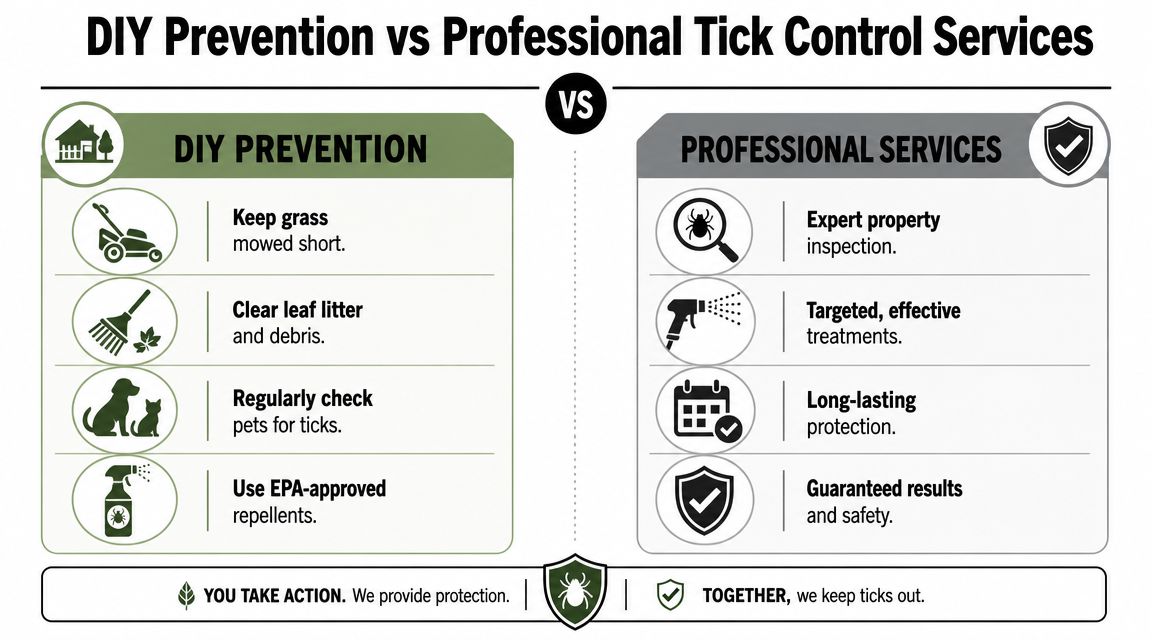
On lower-pressure properties, those steps may be enough to keep activity manageable for a while. On lots with tree lines, shaded bed edges, drainage swales, or neighboring natural cover, DIY work often slows the problem without fully suppressing it.
Where DIY starts to fall short
The biggest issue with store-bought tick control is coverage without strategy. Homeowners tend to focus on the open areas they see every day, while ticks hold in protected zones that stay cooler and more humid.
In Crown Point and nearby communities, those trouble spots are often the rear property line, the strip behind a shed, mulch along the fence, groundcover near ornamentals, or the side yard that stays shaded after rain. Treating every part of the yard the same way usually wastes material and misses the places where ticks persist.
That leads to a practical trade-off:
| Approach | Usually works for | Usually misses |
|---|---|---|
| Basic DIY cleanup | Lowering moisture and reducing hiding spots | Tick pressure coming from adjoining cover and repeated wildlife activity |
| Store-bought broad spray | Short-term treatment in obvious areas | Accurate placement, timing, and follow-up where ticks are most active |
| Professional service | Inspection, targeted applications, and season-long control planning | The routine trimming and cleanup the homeowner still needs to keep up |
A good professional service is not just a stronger version of DIY. It is a more precise one. The job is to inspect the property, identify where tick pressure is starting, and treat the zones that matter most instead of applying product everywhere.
Practical rule: If ticks keep showing up in the same part of the yard, the source is usually consistent habitat and host traffic, not random chance.
For homeowners weighing the difference between cleanup and targeted treatment, this guide to yard flea and tick control for residential properties can help clarify what a service plan should include beyond a one-time spray.
The Green Advantage Process What to Expect During Your Service
A good tick service visit should answer a simple question for a Crown Point homeowner: where are ticks likely coming from on this property, and what are we going to do about it?
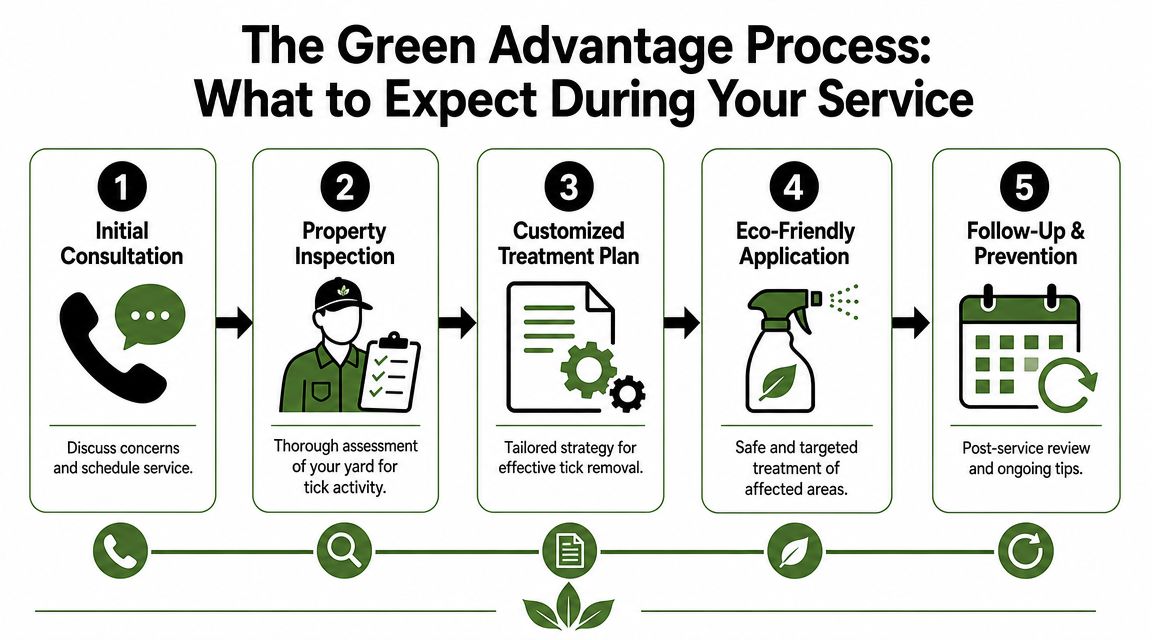
The visit starts with inspection, not guessing
The first step is a conversation on site. We want to know where ticks have been found, whether dogs cut the same route along the fence each day, which parts of the yard stay damp after a Northwest Indiana rain, and whether the property backs up to woods, drainage ground, or a brushy easement.
Then the inspection focuses on the places that hold moisture and host traffic. In Crown Point, that often means rear fence lines, shaded mulch beds, groundcover near ornamentals, wood lines, brush piles, and transitions where maintained lawn gives way to taller cover. Those edge zones matter because they are where people and pets usually brush against vegetation and pick ticks up.
A careful inspection also helps avoid treating low-risk areas that do not need it.
The treatment plan is built around the site and the season
Tick work in Northwest Indiana is not a one-size-fits-all service. A compact subdivision yard near open drainage ground has different pressure than a larger lot with mature trees and deer movement along the back edge. The treatment plan should reflect that difference.
Timing matters too. Guidance from the Indiana Department of Health on tick prevention and habitat reduction supports the same practical approach we use in the field: reduce contact in shaded edge habitat, manage the yard conditions ticks favor, and stay alert during the parts of the season when local activity rises. In Crown Point and nearby communities, that usually means paying close attention through spring, early summer, and again during the fall shoulder season when yards are still in use.
Good tick work focuses on the edges, the shade, and the travel paths. That is where pressure builds on real properties in our area.
For homeowners who want one local option, The Green Advantage provides residential pest control and outdoor pest services in Crown Point and Northwest Indiana with site-specific inspections and treatment recommendations.
A helpful part of any service is setting expectations. This short video gives a broader look at how pest professionals approach property treatment and prevention.
Follow-up matters more than most people expect
One visit can reduce active pressure, but lasting control usually depends on what happens after that first treatment. Nearby habitat, wildlife movement, heavy irrigation, and fast summer growth can all rebuild favorable conditions if nobody is watching the property over time.
That is why a serious service includes follow-up and clear homeowner guidance. You should know when treated areas are safe to reenter, what cleanup steps will support the work, and which spots need extra attention between visits. On some properties, the trade-off is straightforward. More frequent monitoring gives better control along difficult edges, while lighter service may be enough for a yard with limited shade and fewer habitat pockets.
The goal is a yard that is being managed on purpose, not sprayed on a generic schedule.
Protecting Your Health Property and Peace of Mind
A Crown Point yard should feel like part of the home, not a place where you second-guess every trip to the swing set, fire pit, or fence line. Tick control helps reduce that stress by lowering contact in the areas where ticks are most likely to wait for people and pets.
That matters because the risk is not only about comfort. Ticks in Northwest Indiana can carry diseases that affect people and animals, and the Indiana Department of Health advises prevention steps such as avoiding tick habitat, checking for ticks after time outdoors, and reducing exposure around the home (Indiana Department of Health Lyme disease guidance).
What tick service really gives you
Good tick service changes how a property functions day to day.
- More confidence outdoors: Family members, visitors, and pets can spend time outside with less concern about brushy edges and shaded transition zones.
- Usable space again: Backyards feel more practical when play areas, patios, and dog paths are not bordered by untreated harborage.
- A clearer risk-reduction plan: Instead of guessing whether activity started in your yard or came in from a neighboring lot, you know the pressure points are being addressed on purpose.
The trade-off is important to understand. Professional service lowers tick pressure, but no responsible company should promise zero ticks or zero disease risk. In Crown Point and across Northwest Indiana, deer movement, mice, wooded borders, and adjoining untreated properties can keep introducing new ticks. Strong control means reducing exposure as much as possible and staying ahead of the conditions that support them.
The practical goal is a yard with lower tick activity, fewer pickup points, and a plan that fits the way your property is actually used.
Why whole-property pest care often makes sense
Ticks often show up in the same parts of the yard that support other outdoor pest problems. Moist shade behind shrubs, leaf buildup along fences, clutter near sheds, and overgrown edges can also contribute to mosquito resting sites and general pest activity.
For many homeowners in our area, treating the property as a whole gets a better result than looking at ticks by themselves. That does not mean every yard needs every service. It means the inspection should account for how the lot drains, how much tree cover it has, where pets travel, and what borders the property. In Crown Point neighborhoods with mature trees, drainage swales, and wooded edges, that local context makes a real difference.
Your Checklist for Tick Control Service in Crown Point
A good tick program starts with good questions. In Crown Point, that matters because one yard may back up to a drainage swale or wooded edge, while the next sits in full sun with far less tick pressure. The right provider should be able to explain that difference and show how it changes the service plan.
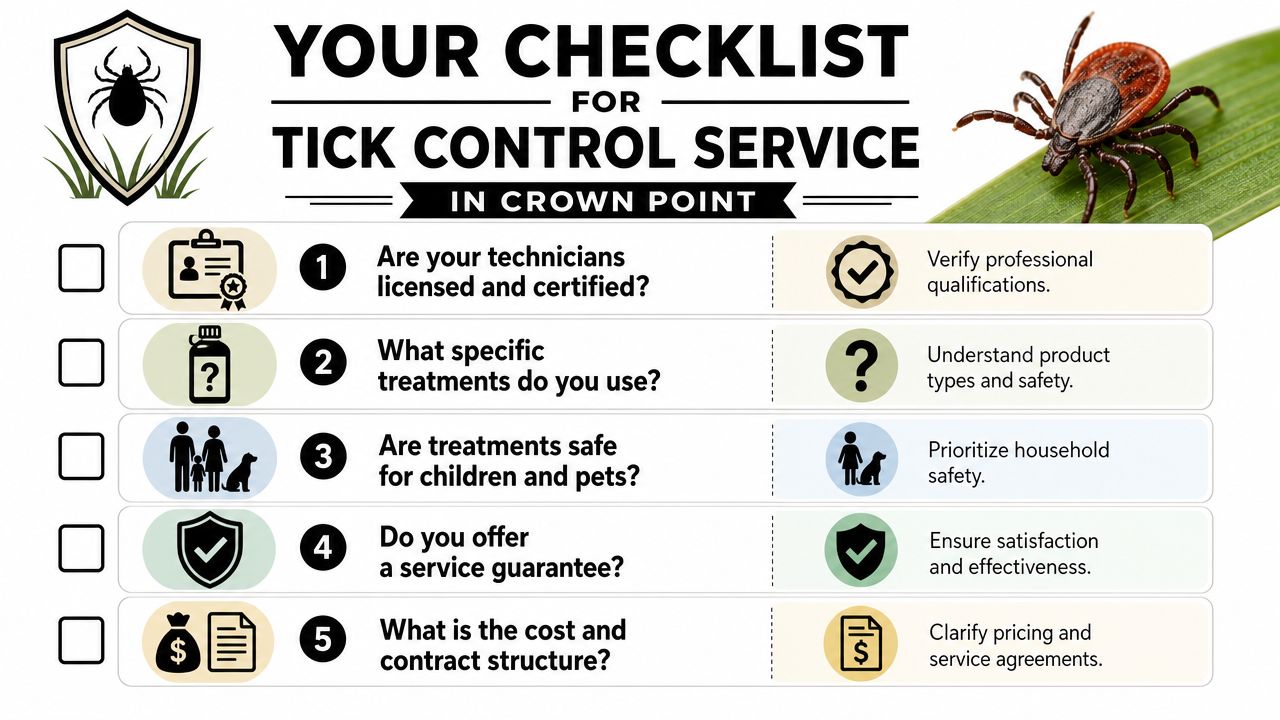
Questions worth asking before you book
Use this checklist when you're getting quotes for tick control in Crown Point:
- Ask about licensing: Make sure the technicians are properly licensed for pesticide application in Indiana.
- Ask what gets treated: A good company should explain whether it targets fence lines, bed edges, wooded borders, shrubs, and other high-risk areas where ticks tend to hold.
- Ask about family and pet guidance: You should get clear instructions for before and after treatment, including when the yard can be used again.
- Ask whether follow-up is included: Tick control usually works better as an ongoing plan than a single visit, especially during active season in Northwest Indiana.
- Ask how pricing is structured: Cost usually depends on property size, habitat complexity, level of activity, and service frequency.
What a strong answer sounds like
Specifics matter. A useful answer sounds like this: we inspect the property first, identify shaded edge habitat, point out cleanup or trimming that will reduce tick harborage, treat the areas where ticks are most likely to quest, and set a follow-up schedule based on the conditions on your lot.
That level of detail is important in our area. Crown Point properties often have the exact features that keep ticks active longer, including mature trees, leaf litter, heavy foundation plantings, fence lines, and neighboring untreated ground. A company that treats every yard the same will miss those pressure points.
Look past the first visit price. Ask whether the company understands why ticks are showing up on your property and whether the plan fits how your family uses the yard. That usually tells you more than a low quote ever will.
If you're in Crown Point or nearby Northwest Indiana and want a clear plan for tick control, contact The Green Advantage. We'll answer your questions, review the conditions on your property, and help you decide whether a targeted treatment program makes sense for your yard, pets, and outdoor routine.
Best Home Pest Control Companies: Crown Point, in 2026
You hear scratching in the wall at night. Or you flip on the kitchen light and catch ants working a trail along the counter. Maybe it's wasps around the soffit, spiders in the basement corners, or a mouse problem that started with one sighting and now feels a lot less minor.
That's usually the moment people start searching for pest control near me or an exterminator in Crown Point, IN. The hard part isn't just finding a company. It's figuring out which home pest control companies will solve the problem instead of giving you one quick treatment and leaving the underlying cause behind.
In a home, pest issues can become expensive fast. For an average 3,000-square-foot home, pest control can cost between $400 and $950, while bedbugs and termites can cost thousands to treat, according to ConsumerAffairs pest control statistics. The same source notes that homeowners most often worry about ants, spiders, mice, and termites. That's why a professional evaluation matters early, before a small nuisance turns into recurring damage, stress, or repeat callbacks.
Your Guide to Finding a Pest Control Partner in Crown Point
A lot of Crown Point homeowners call only after they've already tried the obvious fix. They cleaned the pantry, set traps, sprayed the baseboards, or knocked down the same web three times. The pests slowed down for a bit, then came right back.
That pattern usually points to a larger issue. The pests still have what they need. Entry points haven't been sealed. Moisture is still present. Food sources are still accessible. The nest, colony, or harborage area was never fully addressed.
What homeowners are really looking for
Homeowners aren't looking for a fancy sales pitch. They want a local company that shows up, explains the situation clearly, and treats the home with care. In Northwest Indiana, that also means finding someone who understands our seasonal swings, older housing stock, garages, crawl spaces, and the way pests move indoors when weather changes.
When people compare home pest control companies, I tell them to focus on three practical questions:
- Will they inspect first: If a company starts talking treatment before asking where you've seen activity, that's a problem.
- Will they explain the cause: A good technician should connect the pest issue to conditions around the home.
- Will they recommend the right service level: Some problems need a one-time service. Others need monitoring and prevention.
Practical rule: If the proposal sounds like “we spray and see what happens,” keep looking.
A homeowner also benefits from understanding how pest companies present themselves online. If you're curious how local service businesses structure their messaging, these pest control advertising resources give useful context on what companies emphasize and why. It can help you separate polished marketing from a process that makes sense for your home.
Why the right fit matters locally
In Crown Point, pest control isn't just about reacting to what you see today. It's about reducing the odds that the same issue returns next month or next season. A strong provider should feel less like a one-time exterminator and more like a steady pest control partner who understands residential pest pressure in Northwest Indiana.
That's what homeowners usually want anyway. Clear answers. Safe, sensible treatment. Fewer surprises.
Identifying Common Pests in Northwest Indiana
Before you hire anyone, it helps to narrow down what you're dealing with. Not every pest problem calls for the same response, and not every sighting means you need the same type of service plan.
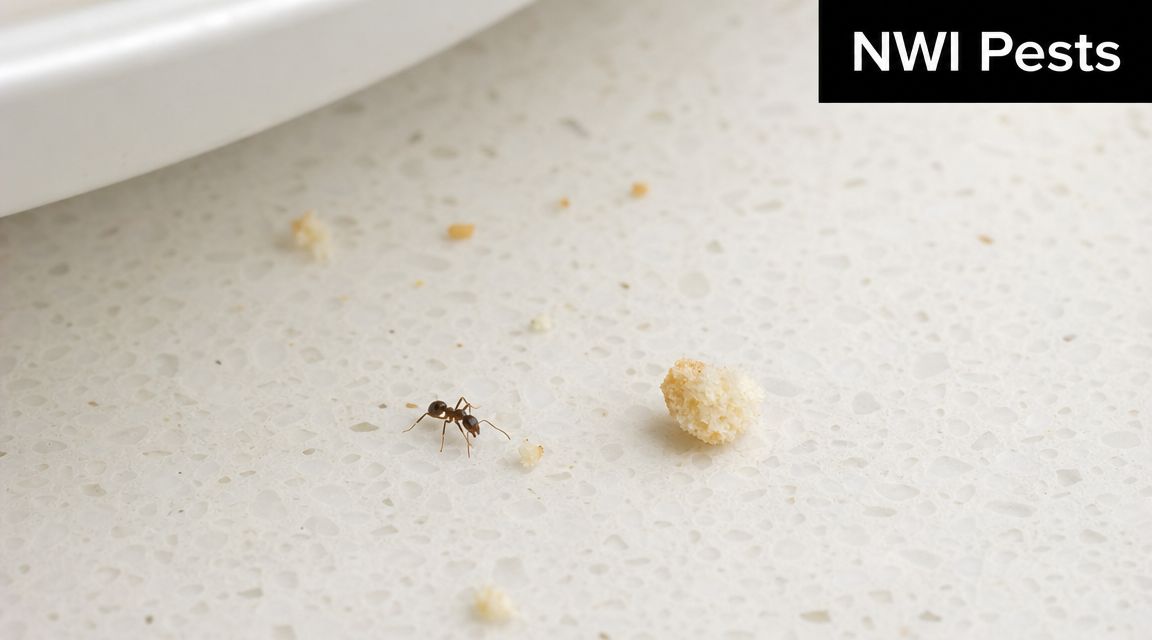
What shows up around Crown Point homes
In Northwest Indiana, the calls tend to cluster around a handful of familiar pests.
- Ants indoors: Usually found near kitchens, sinks, windows, and foundation edges. They're often drawn by food residue or moisture.
- Spiders in basements and corners: Spiders usually follow insect activity. If you're seeing more spiders, there may be another pest feeding them.
- Rodents in attics, garages, and wall voids: Mice and rats look for warmth, shelter, and easy access to food.
- Wasps around eaves and entry points: These become a bigger concern when nests are near doors, decks, play areas, or rooflines.
- Mosquitoes in yards: Standing water, dense vegetation, and shaded areas all contribute to mosquito pressure.
- Termite concerns: Homeowners often don't notice this issue until they see damage, swarmers, or mud tubes.
- Seasonal invaders: Boxelder bugs, stink bugs, and similar pests often become a nuisance during transition seasons.
Why these pests keep showing up
Pests don't move into a house randomly. They follow conditions.
A leaky spigot or damp crawl space can support ants, roaches, and rodents. Gaps around utility penetrations or garage doors give mice an easy entry route. Heavy vegetation against the home creates shelter and a bridge toward the structure. Even clutter in a basement or storage area can give pests a quiet place to hide long enough to establish.
Don't judge the problem by the first insect or rodent you saw. Judge it by what the property is allowing.
That's one reason seasonal timing matters here. Warmer stretches, heavy rain, sudden temperature swings, and longer active seasons can all change when pests appear and how long they remain active. Guidance on urban pest trends notes that pest pressure is increasing in many regions as warming temperatures and extreme weather expand the seasonality and geographic range of some household pests, which means homeowners benefit from proactive monitoring before peak activity instead of waiting until an infestation is obvious, as discussed in this note on changing urban pest pressure.
A quick self-check before you call
Use this simple homeowner checklist:
| Sign you notice | What it may suggest |
|---|---|
| Ant trails near counters or windows | A food source, moisture source, or outdoor colony pushing inside |
| Droppings in pantry or garage | Rodent movement and likely repeated access |
| New webs appearing fast | Ongoing insect activity, not just isolated spiders |
| Buzzing near soffits or deck areas | Active wasp or bee nesting nearby |
| Bites outdoors at dusk | Mosquito breeding habitat close to the yard |
If you can tell a company where the activity is, when it started, and whether it's getting worse, you'll get a much more useful inspection.
Screening Credentials of Pest Control Companies
Not all home pest control companies work the same way. Some build their service around inspection and problem-solving. Others still rely on broad treatment with very little diagnosis. If you're hiring someone to work in and around your home, the difference matters.
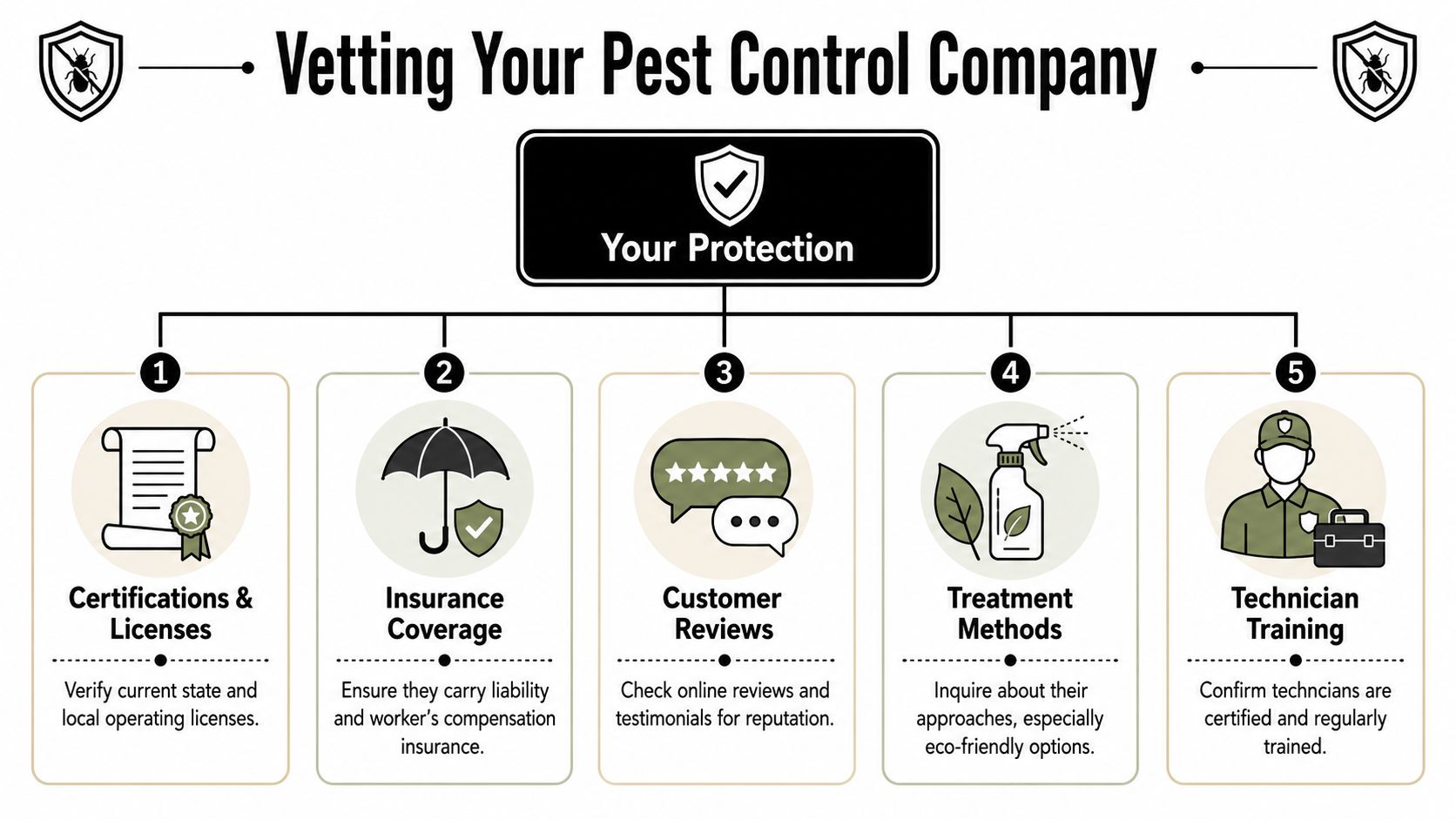
What to verify first
Start with the basics. A legitimate provider should be able to answer straightforward questions without getting defensive.
- State licensing: Ask whether the company and applicators are properly licensed for pest control work in Indiana.
- Insurance coverage: Make sure they carry appropriate liability and worker-related coverage.
- Local reputation: Read reviews from Crown Point and nearby Northwest Indiana communities. Look for comments about communication, follow-through, and whether problems stayed solved.
- Clear service scope: Ask what's included in the visit, what isn't, and whether exclusion or follow-up is part of the recommendation.
If a company is vague about credentials or avoids specifics, that's a warning sign.
Ask how they actually solve the problem
A better question than “What do you spray?” is “How do you decide what to do first?”
The strongest residential pest work follows integrated pest management, or IPM. In plain language, that means the company inspects the property, monitors activity, blocks access, and uses targeted controls instead of treating everything the same way. A practical overview of effective pest workflows explains that a high-performing approach is built around inspection, monitoring, exclusion, and targeted controls, and it warns that treating symptoms without fixing access routes often leads to re-infestation, as outlined in this discussion of how pest control actually works.
That matters because many homes don't have a “spray problem.” They have a gap problem, moisture problem, storage problem, or sanitation problem.
Questions worth asking on the phone
You don't need technical jargon. A few practical questions will tell you a lot.
Do you inspect before recommending treatment?
If the answer is no, move on.Will you identify entry points and contributing conditions?
That's how recurring issues get addressed at the source.What follow-up do you recommend if activity continues?
Good companies expect some pests to require monitoring, not instant perfection.How do you handle homes with children or pets?
You want clear post-treatment instructions and realistic safety guidance.
A trustworthy company should make you feel informed, not rushed.
Red flags homeowners miss
Some warning signs are obvious, like high-pressure sales tactics. Others are easier to miss.
| Red flag | Why it matters |
|---|---|
| Quoting before inspection | Suggests a generic treatment mindset |
| Promising a one-visit cure for every pest | Ignores how different infestations behave |
| No discussion of exclusion | Leaves the home vulnerable to repeat activity |
| Vague product answers | Makes it harder to understand safety and expectations |
| No written plan | Creates confusion about what you're paying for |
In Crown Point, an exterminator near me search will pull up plenty of options. The better move is to slow down long enough to choose a provider that diagnoses before it treats.
Comparing Service Plans and Eco-Friendly Treatments
Homeowners usually compare two things at the same time. They want to know what type of service they need, and they want to know whether the treatment approach fits their household.
One-time service or recurring protection
A one-time treatment can make sense when the issue is isolated. Think of a wasp nest at one entry point, a short-lived ant flare-up tied to one area, or a single pest event that doesn't reflect a broader vulnerability.
Recurring service makes more sense when the home has repeat pressure, seasonal patterns, or structural conditions that invite pests back. That can include ongoing perimeter activity, rodent pressure, regular spider issues, mosquito management, or properties where nearby woods, water, outbuildings, or foundation gaps increase exposure.
Here's the practical comparison:
| Service type | Usually a fit when | Main trade-off |
|---|---|---|
| One-time treatment | Problem is limited and clearly defined | May not prevent future pest pressure |
| Recurring plan | Problem is seasonal, repeated, or tied to the property | Higher commitment, but better ongoing prevention |
The right answer depends on what the inspection finds. A homeowner shouldn't be pushed into a recurring plan for every issue. But it's also not wise to treat a recurring pest pattern like a one-off event.
What eco-friendly pest control really means
A lot of people ask for “green” treatment, but they don't always get a clear explanation of what that means in practice. The most honest answer is that eco-friendly pest control usually means using an IPM-based approach that reduces unnecessary pesticide use through inspection, sealing, sanitation, monitoring, trapping, and carefully selected products. It does not automatically mean chemical-free. Public-facing guidance on residential services makes this point clearly in this explanation of green pest control and IPM.
That's an important distinction for families in Crown Point who want effective control without more treatment than necessary.
- Low-impact starts with inspection: If a technician doesn't know where pests are entering or nesting, “green” becomes just another label.
- Exclusion often matters more than product choice: Door sweeps, crack sealing, moisture correction, and trimming back vegetation can do more for long-term control than repeated sprays.
- Targeted treatment beats broad treatment: Baits, traps, and selective applications are often more sensible than blanket applications.
For homeowners who want a clearer picture of what environmentally mindful treatment looks like in real residential settings, The Green Advantage offers an overview of environmentally friendly pest control methods.
A short visual overview can also help if you're comparing methods and expectations:
Matching the plan to the pest
The treatment plan should follow the pest, not the other way around.
A termite concern needs a very different conversation than mosquito reduction. Rodent control often requires exclusion work, sanitation adjustments, and follow-up. Ant control may involve identifying the colony source and choosing baits or targeted treatment instead of surface spraying alone. Wasp removal can be simple if the nest is exposed and isolated, but more involved if activity is tied to rooflines or hidden voids.
The best providers will say when a low-impact approach is enough, and they'll also say when stronger intervention is justified.
Your Service Experience with The Green Advantage
When homeowners call for pest control in Crown Point, IN, they usually want to know what happens next. The process should be easy to understand and easy to follow.
The first call and inspection
The experience starts with a conversation about what you're seeing. That includes where activity is happening, how long it's been going on, whether it seems seasonal, and whether you've already tried anything on your own. Those details help shape the inspection.
At the property, the technician should look beyond the visible pest. In a solid residential visit, that means checking likely entry points, harborage areas, moisture conditions, and the parts of the structure that support recurring activity. The goal isn't just to confirm that pests are present. It's to understand why.
The treatment plan and what you'll be told
After the inspection, the findings should be explained in plain language. You should know what pest is likely involved, what conditions are contributing to the problem, what treatment is recommended, and what you need to do before or after service.
That's especially important because pest control works best as an integrated, ongoing system. Many homeowners ask why pests keep coming back, and the reason is often that food, water, or entry points remain available. Effective service has to address those root causes, not just spray for pests, as explained in this discussion of why pests return and when recurring service matters.
Good pest control doesn't stop at product application. It changes the conditions that let pests stay.
What the service visit should feel like
A professional visit should be organized and respectful. Homeowners should expect clear instructions, careful work around the property, and direct answers when they ask what was done.
The Green Advantage provides residential pest control, commercial pest control, inspections, mosquito reduction, rodent control, termite-related services, and other targeted treatments in Crown Point and surrounding Northwest Indiana communities. In practical terms, that means the service plan can be matched to the property instead of forcing every customer into the same template.
After the treatment
Follow-up matters. Some pest issues improve quickly. Others need monitoring, environmental corrections, or a second phase. A good company should tell you what activity may continue temporarily, what signs mean the plan is working, and when to call back.
For many homeowners, that clarity is what lowers the stress. You're not left wondering whether the service “took.” You know what to watch for and what the next step is.
Your Northwest Indiana Pest Control Decision Checklist
If you're comparing residential pest control options in Crown Point, keep the decision simple. You don't need a perfect spreadsheet. You need a shortlist of practical checks that protect your home and your budget.
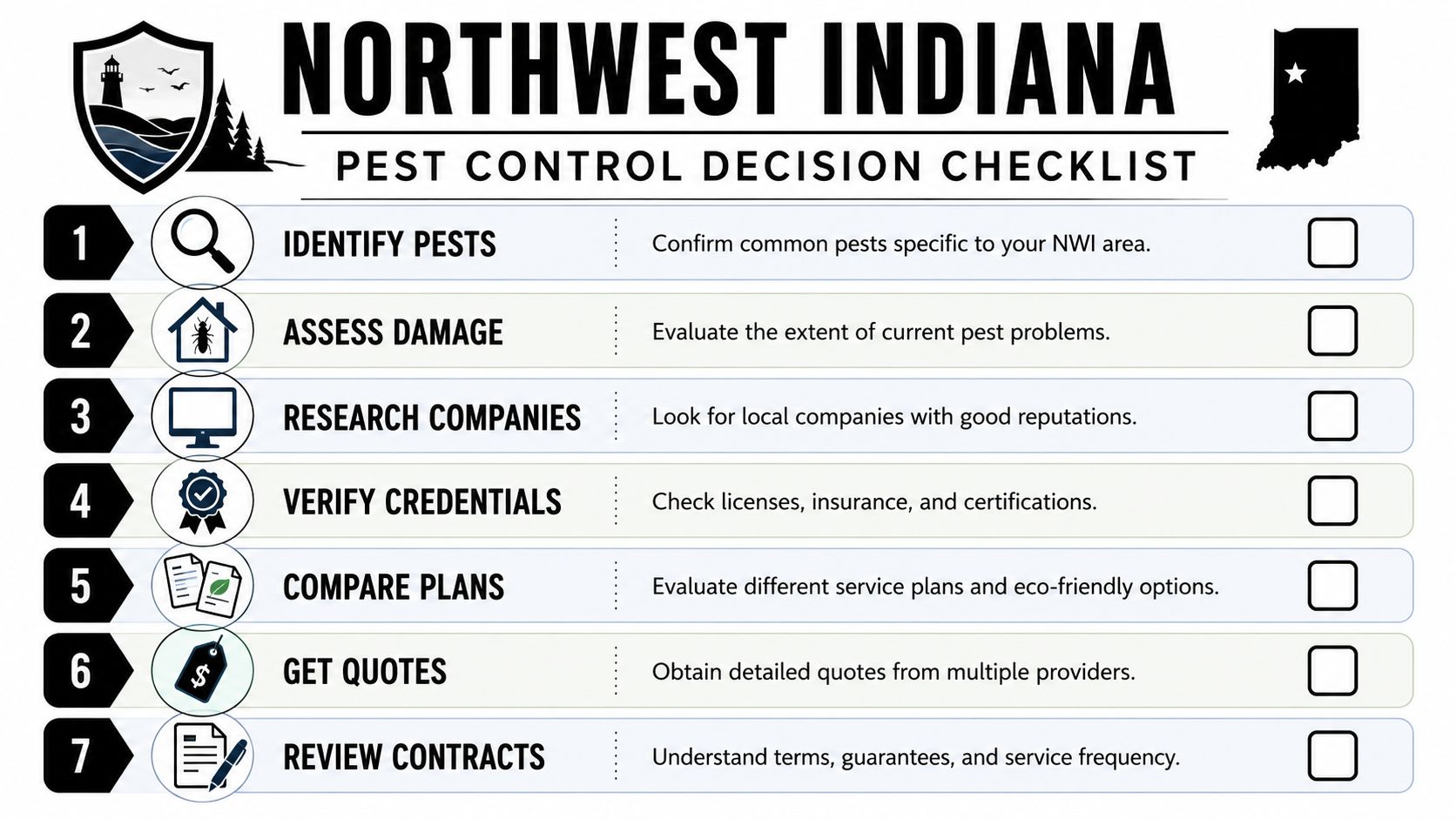
Use this checklist before you hire
- Confirm the pest problem: Be ready to describe where you saw activity, what it looked like, and whether it's getting worse.
- Verify credentials: Ask about licensing, insurance, and technician training.
- Ask about inspection first: The company should diagnose before recommending treatment.
- Look for an IPM mindset: You want inspection, exclusion, monitoring, and targeted control, not just routine spraying.
- Compare service plans carefully: Make sure the recommendation fits your pest issue and your property conditions.
- Request a detailed quote: The estimate should explain the scope of work and any follow-up.
- Read the agreement: If you want help getting ready for an inspection, this pest control inspection checklist is a useful starting point.
Red flags to avoid
Some companies make the choice easier by showing you what not to accept.
- Pressure to sign immediately: You should have room to ask questions.
- Vague pricing: If the quote is unclear, service expectations usually will be too.
- No mention of entry points or conditions: That often leads to repeat pest issues.
- Big promises with no inspection: Pest control doesn't work well on guesses.
- Poor communication: If getting answers is hard before service, it usually won't improve later.
Choose the company that explains the problem clearly, not the one that talks the fastest.
For homeowners and property managers in Northwest Indiana, that's a key decision framework. Identify the pest. Understand the cause. Hire the company that treats the structure and the conditions, not just the symptom.
If you're dealing with ants, spiders, rodents, wasps, mosquitoes, termites, or recurring seasonal pest issues, The Green Advantage serves Crown Point and nearby Northwest Indiana communities with practical inspections and treatment plans built around real conditions at the property. Reach out to schedule a pest inspection, request a quote, and get clear answers about the next step for your home.
Effective Pest Control for Rats in Crown Point, IN

You hear scratching after dark. It's faint at first, then louder the next night. Maybe it's above the ceiling, maybe inside a wall, maybe near the basement rim joist. By morning, you're checking the pantry, looking behind storage bins, and wondering whether you've got one rat or a bigger problem.
That kind of uncertainty is what makes rat issues so stressful in Crown Point homes. People usually don't call because they saw a whole colony in broad daylight. They call because something feels off. A smell they can't place. Pet food disturbed overnight. A noise in the attic when the house is finally quiet.
Pest control for rats works best when the response is calm, methodical, and focused on the whole property instead of one trap in one room. In Northwest Indiana, rats take advantage of shelter, food, clutter, roof access, and tiny structural openings that most homeowners would never notice. Lasting control means finding all of that, correcting it, and then staying ahead of the next intrusion.
Your Guide to Effective Rat Control in Crown Point
A common Crown Point call starts with a small sign that is easy to explain away. Scratching after dark. A few droppings in the garage. Something pushed aside near pet food. Then the pattern builds, and the concern shifts from nuisance to damage, sanitation, and whether rats have already settled into the house.
That concern is justified. Rats contaminate storage areas, chew wiring and wood, and use hidden parts of a home that many people never inspect until the activity is established. In Northwest Indiana, the problem also changes with the season. As temperatures drop, rats press harder into attics, basements, crawl spaces, and attached garages. In warmer months, they often stay closer to exterior cover, sheds, wood piles, and foundation entry points before working their way inside.
People often focus on the room where they heard noise. That rarely solves the whole problem.
Why people miss the source
The rat near the pantry or kitchen is often just the visible part of a larger access issue. Entry usually starts outside, then extends into wall voids, insulation, storage zones, or utility penetrations that do not get much attention during day-to-day home maintenance.
In Crown Point homes, I see the same missed areas again and again:
- Exterior openings: gaps at rooflines, soffits, vents, siding transitions, utility lines, garage door corners, and foundation penetrations
- Food sources: bird seed, pet food, trash, grease residue, pantry spills, fallen fruit, and poorly sealed storage
- Harborage areas: crawl spaces, attic insulation, stacked materials, dense vegetation, sheds, and cluttered garage edges
Rats follow cover, routine, and easy access. If one part of that chain stays in place, trapping alone usually gives temporary relief.
Homeowners searching for common signs of a rodent infestation are usually trying to answer one practical question fast. Is this a one-time scare, or the start of a larger problem? The answer depends on the full property, not just the spot where activity was first noticed.
What reliable pest control for rats looks like
Effective rat control in Crown Point means handling the whole cycle. Inspection comes first. Then containment and removal. After that, the work that DIY guides often skip matters most. Sealing entry points, correcting sanitation issues, and checking whether the property still gives rats a safe route back in.
That is the difference between a short-term catch and a lasting result.
A sound service plan should include careful inspection, targeted trapping or baiting where appropriate, structural exclusion, cleanup guidance, and follow-up. It should also reflect how homes in Northwest Indiana are built and used. Attics over attached garages, older foundation gaps, crawl spaces, and roof-edge transitions all create hiding and travel routes that are easy to miss without experience.
The Green Advantage approaches rat control that way. Find how the rats are living on the property, remove the active population, close the openings they are using, and put a prevention plan in place so the same problem does not return with the next cold snap.
Identifying a Rat Problem in Your Indiana Home
Most homeowners don't confirm a rat issue by seeing a rat. They confirm it by seeing evidence. If you know what to look for, you can usually tell the difference between a one-time scare and an active problem that needs attention.

The signs that matter most
Start with the areas rats like to use without being disturbed. In Crown Point homes, that often means attics, basements, crawl spaces, garages, utility rooms, behind appliances, and along exterior-facing walls.
Look for:
- Droppings: small, dark pellets near stored food, along walls, under sinks, behind boxes, or around basement edges.
- Gnaw marks: chewed wood, cardboard, plastic, weather stripping, or wiring insulation.
- Rub marks: greasy streaks along baseboards, beams, or common travel paths where rats repeatedly brush past surfaces.
- Nesting material: shredded paper, insulation, fabric, dried plant matter, or soft debris gathered in hidden spaces.
- Noises: scratching, scurrying, or movement in walls, ceilings, attics, or under floors, especially at night.
One clue by itself can be misleading. Several clues together usually point to an active rodent issue.
Where Crown Point homeowners often overlook activity
A lot of inspections stop too early. People check the kitchen and pantry, then assume they've covered the risk. Rats often spend more time in transition areas than open living space.
Check these spots carefully:
- Garage corners and storage shelves where pet food, bird seed, and cardboard are kept.
- Basement rim joists and utility penetrations where pipes and lines enter the house.
- Attic edges and insulation runs near soffits, vents, and roof intersections.
- Behind appliances where heat, crumbs, and darkness come together.
- Outdoor edges near sheds, wood piles, heavy ivy, and overgrown landscaping.
UC IPM states that successful rat control usually requires sanitation, structural exclusion, and population control, and it specifically notes that environmental features like dense ivy and tree limbs near the roof can act like travel routes that keep a property attractive to reinfestation (UC IPM guidance on rats).
Practical rule: If you find signs indoors, inspect the exterior the same day. Rats almost always have a route, not just a hiding spot.
If you want a deeper checklist of what active rodent evidence looks like, this guide to signs of rodent infestation helps homeowners compare what they're seeing with common warning signs.
What not to assume
Don't assume silence means the problem is gone. Don't assume one trapped rat means there was only one. And don't assume a clean kitchen means the house isn't vulnerable.
Rats exploit shelter and access as much as food. That's why a neat home can still have a rodent problem if the exterior conditions and structural openings are right.
Immediate Safety and Containment Steps You Can Take
Once you suspect rats, take simple containment steps right away. These won't solve the infestation, but they can reduce risk and keep the problem from getting worse before treatment begins.
Start with food and access inside the home
Secure anything edible. Move pantry goods, pet food, bird seed, and bulk ingredients into hard containers with tight-fitting lids. Clean up crumbs, grease, and spills the same day, especially in kitchens, basements, and garages.
Then reduce easy interior movement:
- Pull storage away from walls: this makes signs easier to spot and removes hidden runways.
- Limit clutter on floors: rats prefer protected edges and covered spaces.
- Close off sensitive areas: if you suspect activity in a utility room, attic access point, or pantry, keep children and pets out until it's assessed.
Handle droppings and contaminated areas carefully
Avoid direct contact with rats, nests, or droppings. Don't sweep or vacuum contaminated material dry. That can stir particles into the air and spread contamination through the room.
Use gloves if you need to handle nearby items, and keep the area isolated until proper cleanup can be done. If there's heavy activity in one section of the home, it's better to leave that area alone than to disturb nesting or chase rodents deeper into the structure.
If you can hear rats but haven't identified the route yet, focus on safety first. Don't start tearing into walls, pulling insulation, or stuffing random materials into openings you haven't traced.
Temporary steps that help, and ones that don't
A few actions can buy you time:
- Helpful: store food securely, remove standing water, pick up pet dishes at night, and keep trash tightly closed.
- Not helpful: scattering poison without a plan, sealing active holes from the inside without inspection, or relying on scent-based repellents as a fix.
The key is not to turn a manageable problem into a hidden one. If a rat dies in a wall void or shifts to a harder-to-reach area, cleanup gets more complicated fast. Temporary containment should support a proper treatment plan, not replace it.
Effective Rat Removal Methods DIY vs Professional Control
A Crown Point rat problem often looks smaller than it is. You hear scratching near the attic on a cold night, set a couple of traps, and the noise drops off for a few days. Then winter pushes them deeper into the house, or spring brings activity back through the same gap that never got sealed.

That is the core DIY versus professional question. Can you catch a rat yourself? Sometimes, yes. Can you stop the full cycle of entry, nesting, feeding, and return on your own? That is where many homeowners get stuck.
What DIY can handle, and where it usually stalls
DIY methods can help with light, early activity. Snap traps placed correctly along known travel routes can remove individual rats. Basic cleanup, better food storage, and fixing one obvious opening, such as a gap under a side door or garage door, can reduce pressure.
The trade-off is visibility.
Homeowners usually work from the signs they can see or hear. Rats work from hidden routes. In Northwest Indiana homes, that often means wall voids, attic edges, crawl spaces, utility penetrations, and garage-to-house transitions. If the route is missed, trapping becomes maintenance instead of a solution.
DIY jobs also tend to slow down after the first improvement. A quieter attic or fewer droppings in the garage can feel like success, but rats often change paths before they leave the property.
Why one tactic rarely solves a rat problem
Rat control works best when removal and exclusion happen together. Catching the animals you have now matters. So does cutting off the shelter, food access, and entry points that allowed them in.
A trap-only plan can lower activity in one room while the colony keeps using another route. A bait-only plan can create other problems, especially if placement is careless or a rat dies in an inaccessible void. Repellents rarely hold up in real homes for long, especially once colder weather drives rats indoors.
Here is the plain version I give homeowners. A trap removes the rat in front of you. A full plan deals with the reason the rat was there at all.
Side-by-side comparison
| Factor | DIY Approach | Professional Service (The Green Advantage) |
|---|---|---|
| Initial response | Usually starts with store-bought traps or bait | Starts with a property-wide inspection and activity mapping |
| Entry point detection | Limited to obvious holes | Looks for subtle structural gaps, roofline access, utility penetrations, and travel routes |
| Safety management | Depends on homeowner placement and handling | Places control measures based on site conditions, access, and household safety concerns |
| Nest and harborage control | Commonly missed | Addressed as part of a complete plan |
| Prevention | Often partial or delayed | Built into the process through exclusion and monitoring |
| Long-term outcome | Can reduce activity temporarily | Aims to remove current pressure and lower reinfestation risk |
What professional control changes
Professional rat control changes the scope of the job. The work is not just setting more traps. It is identifying how rats are using the structure in this season, which openings are active, where nesting is likely, and what needs to be sealed with materials that hold up.
That seasonal piece matters in Crown Point. In fall and winter, I expect more pressure at warm entry points and attic spaces. In spring and summer, I pay closer attention to exterior harborage, garage clutter, overgrowth, and recurring foundation access. A good plan accounts for how rat behavior shifts through the year, not just what happened the day you called.
For homeowners searching for residential pest control, commercial pest control, or an exterminator in Crown Point, IN, the value is a plan that connects removal to repair. The Green Advantage approach is built around that full cycle. Find the activity. Remove the current rats. Close the routes that brought them in. Check the results and adjust if needed.
That last step is what many online guides miss. They explain how to catch one rat. They do not explain how to keep the next wave from using the same house.
The Green Advantage Rodent Control Process in Crown Point
A professional rat-control job should feel organized from the start. You shouldn't be guessing what happens next, whether the entry points were found, or if anyone is coming back to verify results.

Step one is a full inspection, not a quick glance
Real rodent work starts with inspection. That means mapping signs of activity, identifying likely entry points, checking harborage areas, and understanding how rats are moving through the property.
Effective Integrated Pest Management combines inspection, sanitation, sealing structural gaps, targeted control measures, and continuous monitoring instead of relying on one tactic alone (Frontiers review on rat IPM).
A proper inspection should look at more than the room where the homeowner heard a noise. It should include:
- Exterior structure lines: foundation edges, siding transitions, vents, roof intersections, and door thresholds
- Interior evidence zones: attic, basement, crawl space, garage, utility areas, storage rooms
- Contributing conditions: clutter, food storage, vegetation contact, moisture, and sheltered exterior zones
The treatment plan has to match the property
No two rat jobs are exactly alike. A ranch home with heavy shrub coverage has different pressure points than a newer two-story with garage access gaps and attic travel. A restaurant or commercial building has a different set of sanitation and exclusion concerns than a single-family home.
That's why treatment should be customized to the structure and the level of activity. The Green Advantage provides rodent control and exclusion service for homes and businesses in Northwest Indiana, including assessment of entry points and protection strategies inside and outside the structure.
Removal is only one part of the process
Targeted removal methods matter, but they're only one part of the cycle. If activity is confirmed, control tools are placed according to behavior, access, and safety needs. Then the structure itself has to be made less usable to rats.
That usually includes some combination of:
- Sealing active and potential entry points
- Correcting food and storage issues
- Reducing nesting and hiding areas
- Monitoring for remaining activity
The strongest rodent plans are boring in the best way. They're systematic, they're documented, and they don't stop after the first quiet night.
Follow-up is where lasting results are protected
Follow-up tells you whether the first plan was complete. It confirms whether activity is dropping, whether rats changed routes, and whether new evidence appeared in other parts of the structure.
It's also the point where wider pest issues sometimes come into focus. During a broader site inspection, homeowners may also ask about ant activity, spider pressure, wasp nesting, mosquito reduction, or signs of termite risk. For many Crown Point properties, the rodent issue is the reason for the call, but not the only condition worth correcting.
Long-Term Prevention The Key to a Rat-Free Property
Removing the current rats is important. Preventing the next wave is what protects your home.
That's where many properties fall backward. The immediate activity stops, everyone relaxes, and the same outdoor conditions remain in place. A few months later, the noises are back because the food, shelter, and access routes were never fully corrected.

Prevention is maintenance, not a one-time event
Industry data says professional rodent-proofing can achieve success rates over 90%, but long-term success depends heavily on maintenance and monitoring, and a set-it-and-forget-it approach often fails (rodent-proofing success and upkeep). That lines up with what experienced technicians see in the field. The homes that stay quiet are usually the ones where prevention becomes routine.
The most useful prevention work is practical, not dramatic.
What homeowners should keep doing
Focus on recurring property habits that remove attraction and access:
- Trim back contact points: keep branches and dense vegetation from giving rats easy cover near the structure.
- Store attractants properly: bird seed, pet food, grass seed, and bulk pantry items should stay in sealed containers.
- Manage trash tightly: lids should close fully, and overflow should never sit beside the can.
- Reduce hiding zones: stacked lumber, cluttered garage corners, and debris against the house create shelter.
- Watch the building envelope: damaged sweeps, loose vent covers, and small exterior gaps need attention before activity returns.
For many homeowners, it also helps to understand the broader pattern of attraction. This overview of what attracts mice to your home applies to many of the same food, shelter, and access conditions that support rat pressure around a structure.
Why ongoing service makes sense
Prevention plans are especially useful for rental properties, food-related businesses, multi-unit sites, and homes with a history of rodent pressure. In those settings, periodic checks catch new vulnerabilities before they turn into another infestation.
That's also where pest control near me searches often lead people after a repeat issue. They're not looking for another round of short-term relief. They want someone to keep the property from slipping back into the same cycle.
The best long-term result isn't dramatic. It's when nothing happens because the property stopped being easy to invade.
Your Local Rat Control Questions Answered
When are rats most likely to move into Crown Point homes
Rodent pressure tends to rise as temperatures drop and outdoor conditions become less comfortable. One report on urban rat complaints noted that annual complaints in New York reached 35,000 by November 2022, underscoring how seasonal shifts can intensify rodent activity and why fall is such an important prevention period in climates like Northwest Indiana (urban rat complaint trend example). In Crown Point, that usually means it's smart to inspect and seal before cold weather pushes more activity indoors.
Is professional rat treatment safe around kids and pets
It should be planned with the household in mind. Good rodent service accounts for who lives in the home, where pets go, which areas are accessible, and what control methods fit the situation. Ask direct questions about placement, monitoring, exclusion work, and any precautions you need to take before service starts.
How much does rat control cost in Northwest Indiana
The right answer depends on what the inspection finds. Pricing can vary based on the level of activity, the size and layout of the building, how much exclusion work is needed, and whether follow-up visits are part of the plan. If you're comparing quotes, make sure you know whether the service includes inspection, removal, sealing recommendations, and monitoring instead of just a basic trap setup.
Should I wait and see if the problem goes away
No. Rat issues usually get more complicated when they're allowed to settle in. The earlier you address access points, nesting conditions, and activity zones, the simpler the correction tends to be.
If you're hearing movement, finding droppings, or trying to stop repeat rodent problems, The Green Advantage can help you schedule an inspection, review the conditions around your property in Crown Point, and build a practical plan for pest control for rats that addresses removal, exclusion, and long-term prevention.
Expert Commercial Pest Control for Crown Point

A customer points toward a baseboard. A warehouse employee finds gnaw marks near packaged goods. A restaurant manager notices movement behind the prep line right before lunch. In Crown Point, those moments don't just create stress. They put your reputation, inspection readiness, and daily operations on the line.
That's why commercial pest control has to be treated as part of normal business protection, not as an occasional emergency expense. In Northwest Indiana, businesses deal with seasonal pest pressure, shifting weather, older buildings, heavy traffic patterns, and the constant challenge of keeping doors, loading areas, kitchens, and common spaces clean and secure. The right plan addresses those realities before they become visible problems.
Businesses that wait until pests are obvious usually pay more in disruption than they would have paid in prevention. A proactive program protects inventory, supports compliance, reduces repeat issues, and helps your staff stay focused on work instead of reacting to complaints. For local owners searching for pest control near me, exterminator near me, or pest control in Crown Point, IN, the key question isn't whether pest management matters. It's whether the plan in place is built for a commercial property that has real operational demands.
Protecting Your Crown Point Business from Pest-Related Risks
A common call starts with urgency. A business owner has seen one mouse, one cockroach, one cluster of ants, or one suspicious stain near a dock door. The concern isn't just the pest itself. It's what that sighting means if an employee notices it, if a tenant reports it, or if a customer posts about it online before management can respond.
In Crown Point and nearby Northwest Indiana communities, that pressure hits restaurants, offices, warehouses, multifamily properties, and retail spaces differently, but the emotional reaction is usually the same. Panic first. Questions second. Is this a one-time issue, or has something been building behind the scenes for weeks?
Small building gaps become expensive problems
Many commercial infestations start with a simple access point. A damaged sweep under a service door, a gap around utility lines, torn screening, or worn seals along an overhead door can give pests routine access to a building. For facilities with loading zones or storage space, even a well-run operation can stay vulnerable if the envelope of the building isn't tight.
For that reason, property managers often review basics like sanitation and waste handling alongside physical exclusion upgrades such as industrial side seals for garage doors when dock areas or overhead openings are part of the problem. That kind of hardware doesn't solve every pest issue by itself, but it often removes one of the most predictable entry routes.
Practical rule: If pests keep returning after treatment, look at access points and conditions inside the building before assuming the product failed.
Fast action matters, but calm process matters more
The worst response is usually a rushed spray-and-hope approach. It may make a business owner feel like something happened, but it often leaves the underlying causes untouched. A better commercial response starts with inspection, identification, and a clear plan for what's attracting pests, how they're entering, and which areas need attention first.
That's what separates a temporary reaction from real risk management. A business doesn't need drama. It needs a process that restores control and keeps the problem from resurfacing during the next delivery, tenant turnover, or inspection cycle.
Why Professional Pest Management is a Business Essential
A pest issue isn't only a cleanliness problem. It's an operations problem. Once pests show up in a commercial setting, they can affect inventory, staff morale, maintenance budgets, and customer trust all at once.
The market reflects that reality. The commercial segment of the U.S. pest control industry posted a nearly 7.0% increase in service revenue in 2025, outpacing the overall industry's growth, which points to stronger demand for professional commercial service driven by health regulations, hygiene standards, and the financial pressure infestations create, according to Fortune Business Insights.

The hidden costs are usually bigger than the treatment cost
Business owners often focus on the immediate invoice for service. The larger expense usually sits elsewhere.
- Inventory loss: Rodents, stored product pests, and contamination issues can force businesses to discard affected goods.
- Operational interruption: A single visible pest sighting can disrupt dining rooms, leasing activity, receiving schedules, or production workflows.
- Facility damage: Rodents chew packaging, insulation, and wiring. Moisture-loving pests often point to leaks or neglected maintenance.
- Staff distraction: Employees lose time documenting sightings, moving product, fielding complaints, and working around problem areas.
These costs build quickly because they touch multiple departments at once.
Reputation damage happens faster than most owners expect
A business can recover from many routine problems without drawing public attention. Pest sightings rarely stay quiet. In food service, hospitality, and multifamily settings, people talk. They leave reviews. They mention conditions to inspectors, tenants, or corporate supervisors. Once that happens, the issue is no longer only about pest elimination. It becomes a brand repair problem.
A commercial pest program is often less about killing pests and more about preventing visible moments that customers never forget.
That's especially true in Crown Point, where local businesses rely on repeat customers, referrals, and community trust. One bad impression can undercut months of careful service and marketing.
Compliance risk makes reactive pest control a poor strategy
Some owners still treat pest control as something to call for only when there's evidence. That approach usually means the facility is already behind. By the time pests are visible, there may already be sanitation issues, structural gaps, or documentation problems that an inspector or auditor can flag.
Professional commercial pest control works better as a standing operating practice. It protects your bottom line in the same way preventive maintenance protects HVAC systems or refrigeration units. You don't wait for a total breakdown if the cost of failure is high.
Pest Solutions Tailored to Your Industry
A restaurant and a warehouse don't need the same pest plan. Neither does a multifamily property, office building, or hospitality site. The environment decides the pressure points. Food residue, moisture, deliveries, clutter, tenant behavior, loading access, and after-hours traffic all change what works.
What different properties in Northwest Indiana tend to face
Food service properties deal with the most immediate visibility risk. A fly issue in a dining area, roach activity in a kitchen, or rodent signs near dry storage can quickly turn into a compliance problem. Businesses that need more kitchen-specific guidance can review commercial kitchen pest control as part of a broader prevention plan.
Warehouses and light industrial spaces usually struggle with perimeter vulnerability, pallet storage, dock activity, and long periods where pest activity goes unnoticed in less-trafficked zones. Multifamily properties add a different challenge. Shared walls, turnover between units, trash handling, and inconsistent housekeeping can spread issues beyond one tenant space.
Industry-Specific Pest Risks and Solutions in Northwest Indiana
| Industry | Common Pests | Key Risks | Recommended IPM Strategy |
|---|---|---|---|
| Restaurants and commercial kitchens | Cockroaches, flies, rodents, ants | Health code concerns, food contamination, customer complaints | Frequent inspections, drain and sanitation review, exclusion around doors and utility lines, targeted monitoring in prep and storage areas |
| Warehouses and industrial facilities | Rodents, ants, occasional invaders, stored product pests | Inventory damage, unnoticed activity in low-traffic zones, dock door entry | Perimeter inspection, dock and door sealing, monitoring along walls and storage zones, clutter reduction |
| Multifamily housing | Rodents, cockroaches, ants, bed bugs, occasional invaders | Tenant complaints, spread between units, reputational harm | Unit-by-unit inspection where needed, sanitation coordination, exclusion, common-area monitoring, resident communication |
| Offices and retail spaces | Ants, spiders, rodents, flies | Employee concern, customer-facing sightings, breakroom activity | Breakroom sanitation checks, entry-point sealing, discreet monitoring, focused treatment in problem areas |
| Hospitality properties | Bed bugs, flies, cockroaches, rodents | Guest complaints, room downtime, online review damage | Room inspections, laundry and housekeeping coordination, targeted treatment, rapid reporting protocols |
A generic spray plan usually misses the real cause
The wrong commercial approach looks the same in every building. Same visit pattern, same materials, same assumptions. That usually leads to repeat complaints because the service isn't tied to how the property functions.
A better plan accounts for questions like these:
- Where does product enter the building? Receiving areas often create the first opportunity for pest introduction.
- Where do people eat or store food? Breakrooms, trash rooms, and tenant kitchens matter.
- Which zones are quiet and overlooked? Storage corners, utility rooms, and ceiling voids can become steady harborage areas.
- What happens after hours? Cleaning quality and overnight moisture conditions often determine whether pests settle in.
Different industries don't just have different pests. They create different habits, hiding places, and vulnerabilities.
That's why commercial pest control should be customized to the building's use, not copied from a generic route sheet.
The Green Advantage IPM and Eco-Friendly Approach
The strongest commercial programs don't start with broad chemical use. They start with Integrated Pest Management, or IPM. That means looking at why pests are present, how they're getting in, what supports them once they're inside, and where a precise response will work better than blanket treatment.
IPM programs prioritize non-chemical methods and can achieve up to a 70 to 90% reduction in pesticide applications while maintaining efficacy, and exclusion work such as sealing entry points with appropriate screening can reduce rodent ingress by 85 to 95%, according to the Department of Defense technical guidance on IPM.
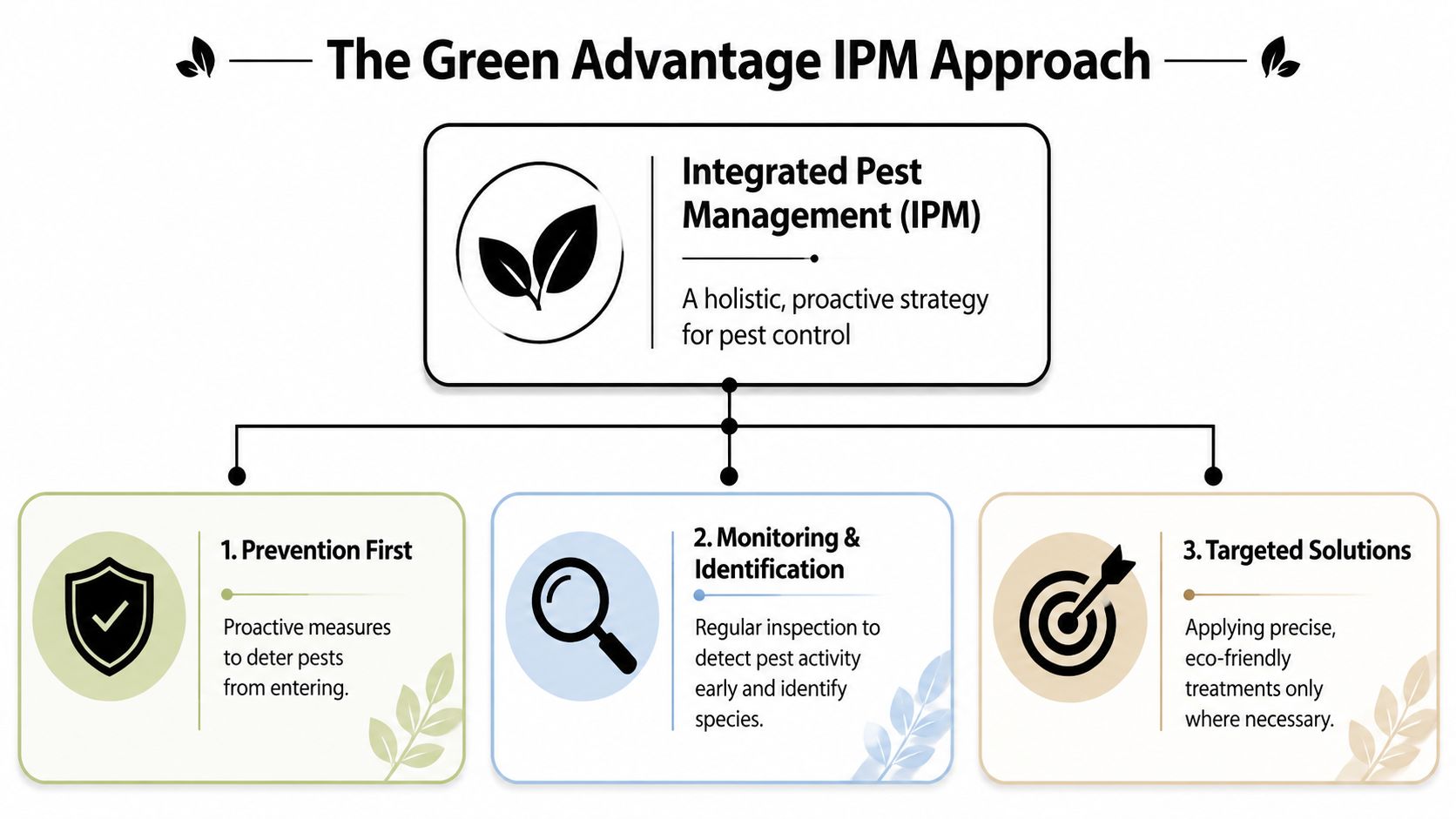
Prevention beats repeated treatment
If ants keep appearing in a breakroom, the answer may involve food residue under cabinets, a moisture source, and an exterior gap near the wall line. If rodents keep showing up in a warehouse, the answer may be dock door light gaps, damaged sweeps, and poorly managed storage along the perimeter.
That's why IPM focuses on a few practical priorities:
- Exclusion: Sealing entry points, improving door sweeps, screening vents, and correcting structural gaps.
- Monitoring: Using traps, stations, and inspection patterns to detect activity before it becomes obvious to staff or customers.
- Sanitation and habitat correction: Reducing food, water, and harborage conditions that let pests settle in.
- Targeted treatment: Applying the least disruptive control where it's needed, instead of treating whole areas blindly.
Why eco-friendly doesn't mean weak
Some owners hear “green” and assume the service will be less effective. In commercial pest control, that's usually the wrong way to think about it. A lower-impact program can be more effective because it's tied to behavior, structure, and site conditions rather than overreliance on repeated spray applications.
For food-related operations, it also aligns better with day-to-day realities. Staff still need to work. Customers still need to feel comfortable. Sensitive areas still need to stay clean and well managed. A prevention-first system supports those needs better than heavy-handed treatment.
For businesses that want a plain-language overview of an integrated pest management approach for caterers, that framework mirrors what many commercial sites need. The details change by property, but the logic stays consistent.
What that looks like on a local route
In practice, a provider may inspect door thresholds, utility penetrations, floor drains, breakrooms, trash handling zones, and exterior transitions before deciding where any product belongs. The Green Advantage's integrated pest management service is one example of that model, using inspection, exclusion, monitoring, and targeted treatment as the basis for ongoing commercial service in Northwest Indiana.
Good IPM doesn't ask, “What can we spray?” It asks, “What's allowing this pest to survive here?”
That difference matters because commercial accounts need durable control, cleaner documentation, and fewer repeat surprises.
Navigating Health Codes and Regulatory Compliance
For many businesses, the pest itself is only half the problem. The other half is what you can prove. If an inspector, auditor, property owner, or corporate manager asks for pest control records, your answer needs to be organized and current.
Commercial pest control requires meticulous logging of pesticide applications, including EPA registration numbers and treatment locations, for compliance with standards such as the FDA Food Code. Non-compliance can risk fines up to $10,000 per violation, which is why audit-ready documentation matters, as explained in this guide to commercial property pest control compliance.
Documentation is part of the service, not extra paperwork
A commercial account should have records that make sense to an inspector and to your own team. If a sighting occurs, someone should be able to review what was found, where activity was noted, what was applied if anything was applied, and what corrective actions were recommended.
That usually includes:
- Service reports: What was inspected, what was found, and what was done.
- Application details: Product information, placement, and treatment locations where applicable.
- Site observations: Entry points, sanitation concerns, moisture issues, and structural recommendations.
- Trend tracking: Recurring activity in the same area tells you more than a single isolated sighting.
Restaurants, warehouses, and multifamily properties all need clear records
Food service operations often need documentation that supports inspection readiness. Warehouses may need logs that show perimeter management and corrective action around receiving zones. Multifamily properties benefit from clean records because complaints can involve units, common areas, and questions about who reported what and when.
A professional commercial pest program should help a manager answer practical questions quickly:
- Where was activity found?
- Was it isolated or recurring?
- What correction was recommended?
- Has the issue improved or spread?
Compliance works better when everyone knows their role
Pest control can't carry a commercial property alone. Staff training, maintenance response, cleaning routines, and reporting habits all affect results. The most reliable accounts usually have one point person who can share sighting information, approve access, and make sure facility corrections happen when they're needed.
If your records are incomplete, your pest control program is incomplete.
That's especially important in businesses where one inspection, tenant complaint, or food safety review can create immediate consequences.
Your Commercial Service Plan with The Green Advantage
Most business owners want the same thing from a pest control provider. They want a clear answer, a sensible plan, and no surprises. The process should feel organized from the first call forward.

The first visit sets the direction
A commercial service plan usually begins with a full inspection. That includes the obvious problem areas, but it also includes the places owners and staff may not look often enough. Exterior entry points, trash staging, utility access, storage practices, moisture sources, and employee food areas all matter.
From there, the plan should answer a few basic questions in plain language:
- What pest pressure is present right now?
- What conditions are encouraging it?
- Which corrections belong to the property, and which belong to the service provider?
- How often should the site be inspected and monitored?
A credible plan won't treat every building the same. A small office suite needs a different schedule and treatment footprint than a restaurant, warehouse, or multifamily complex.
Ongoing service should be easy to understand
After the initial work, the ongoing relationship matters more than the first treatment. Commercial clients should know what happens on routine visits, what gets documented, and how urgent issues are handled between scheduled services.
That often includes regular monitoring, targeted treatment where needed, and practical recommendations for sanitation or exclusion changes. It should also include communication that respects how the business operates. Service timing, tenant access, shift schedules, and customer-facing hours all shape what's realistic.
This short video gives useful context on maintaining results after professional treatment:
Cost depends on the property, not a canned package
Business owners often ask what drives cost. The honest answer is that pricing depends on the site. Facility size matters. So do pest history, building condition, service frequency, sanitation demands, and how complex access is.
A low-pressure office with a minor ant issue won't require the same level of work as a busy commercial kitchen, a shipping facility with multiple dock doors, or a multifamily property with recurring tenant complaints. The right service plan should explain that clearly instead of hiding behind vague package language.
The most cost-effective commercial program is usually the one that catches issues early and avoids disruption.
For businesses searching for exterminator in Crown Point, IN or commercial pest control that fits local conditions, transparency matters as much as treatment itself. You should know what's being done, why it's being done, and what role your team plays in keeping the site stable.
Choosing the Right Pest Control Partner in Crown Point
If you're comparing providers, focus on how they think. Any company can promise to treat pests. The better question is whether they understand commercial properties in Crown Point and the surrounding Northwest Indiana area well enough to prevent repeat problems.
What to look for before you sign
A strong commercial provider should offer:
- Local awareness: They should understand the seasonal patterns, building types, and common pressure points seen in this area.
- Licensing and professionalism: Commercial work requires proper handling, clear communication, and reliable documentation.
- An IPM mindset: Prevention, monitoring, exclusion, and targeted response should come before unnecessary product use.
- Operational fit: The service should work around your business hours, staff movement, and customer-facing needs.
A provider who skips inspection details, gives the same plan to every property, or talks only about spraying usually won't solve the root issue.
The right partner helps you run the business better
Commercial pest control should support your business, not add confusion to it. You want someone who can identify pressure points, explain the trade-offs, keep records straight, and help your staff know what to watch for. That matters whether you manage a restaurant, warehouse, office, retail space, or multifamily property.
For businesses looking for pest control in Crown Point, IN, the best choice is usually the company that treats pest management as part of facility protection, compliance readiness, and long-term cost control. That's the difference between a recurring nuisance and a stable property.
If your business needs commercial pest control in Crown Point or nearby Northwest Indiana, contact The Green Advantage to schedule an inspection or request a quote. A proactive plan can protect your reputation, support compliance, and keep pest problems from interrupting your operation.