
Pest Control Exclusion in Crown Point, in: A Complete Guide
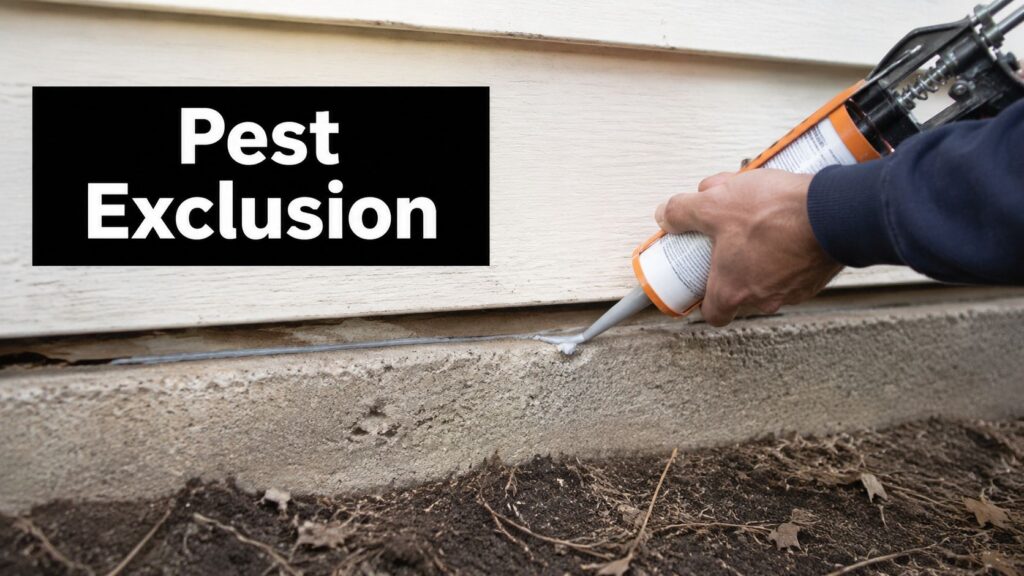
You wake up in Crown Point to find droppings inside a kitchen drawer, even though the yard is tidy and the fall cleanup was thorough. The problem usually isn't housekeeping. A mouse, rat, raccoon, wasp, or bat may have used a small weakness in the building envelope, then followed warmth, food, or shelter inside.
Pest control exclusion addresses that weakness before repeated treatments become the routine. For homeowners and businesses searching for pest control near me, pest control in Crown Point, IN, or an exterminator near me, The Green Advantage approaches the property as a system. The work involves finding entry points, choosing materials that can withstand local weather and pest pressure, and creating a maintenance plan that keeps pests outside.
Why Exclusion Matters for Crown Point Homes
A clean home can still have an open pest pathway. In an older Crown Point ranch, a loose soffit panel may connect directly to an attic void. In a commercial building, an unsealed utility penetration can lead from the exterior wall into a storage or service area. Pests don't need a neglected yard if the structure provides a reliable route indoors.
Exclusion is prevention built around building diagnostics. Technicians map cracks, vents, roofline joints, doors, windows, pipes, and utility penetrations against the size and behavior of the pest involved. Cornell's New York State Integrated Pest Management materials describe exclusion as a long-established prevention strategy that was promoted in the early 1900s, later overshadowed by expanding synthetic pesticide use, and revived as indoor pesticide restrictions made prevention more important in practical pest management (Cornell NYSIPM history of pest exclusion).
Northwest Indiana weather makes quick repairs unreliable. Lake-effect cold, freeze-thaw cycles, wind, and an aging housing stock place repeated stress on exterior seals. A rushed bead of silicone can split, latex caulk can peel from masonry, and unprotected expanding foam can crumble or become an inviting target for rodents.
Exclusion is different from extermination
A trap or treatment can address the pest currently inside. It won't close the route that allowed the pest to enter. Killing a mouse in a wall cavity does nothing if the opening under the garage-door trim remains accessible, and spraying wasps without closing the soffit void leaves the next colony with the same access.
Field rule: Find the route before choosing the remedy.
Government guidance emphasizes sealing exterior cracks and holes, keeping doors and windows tight-fitting, maintaining screens and weather stripping, and documenting pest-control measures as an ongoing practice rather than a one-time repair (Alberta Health Services pest-control checklist). That principle applies to residential pest control, commercial pest control, rodent control, wildlife exclusion, and prevention programs for seasonal pests.
The most useful inspection starts before anyone opens a tube of sealant. Walk the entire structure, identify every penetration, note the substrate and pest evidence, then rank repairs by access, durability, and risk. That sequence prevents cosmetic work that looks complete from the ground but leaves the building vulnerable above the ceiling, behind the garage, or along the foundation.
Walking the Outside of Your Property
A proper exterior inspection follows the building in a deliberate order. Start low, move upward, then finish at doors and attached structures. A flashlight, inspection mirror, notepad, and phone camera reveal more than a quick glance from the driveway.
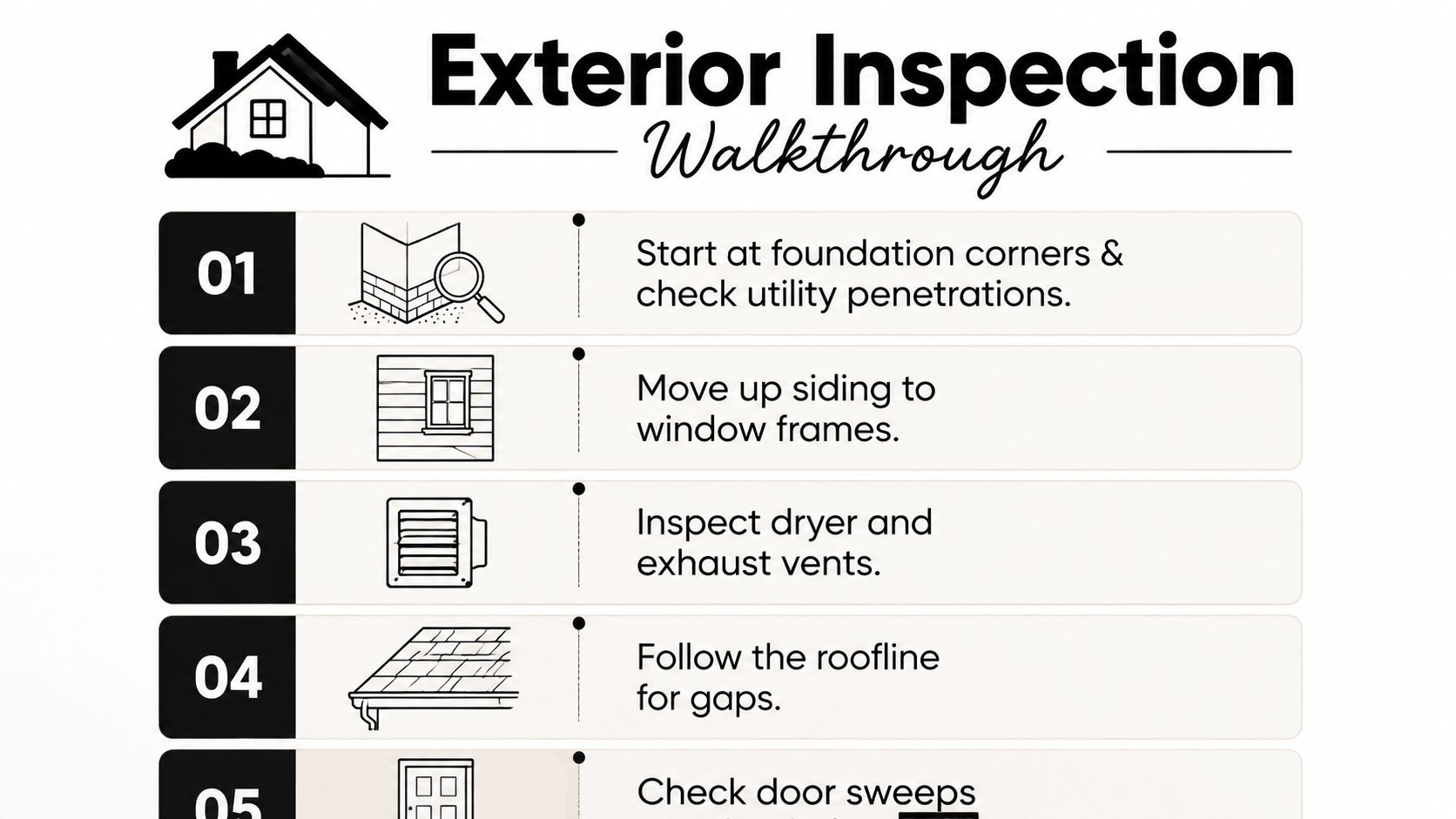
Begin at the foundation
Check foundation corners, basement windows, the rim joist, and every place a pipe, cable, or wire enters the structure. The University of Kentucky identifies utility openings at foundations and siding as common access points for rodents, ants, spiders, and yellowjackets (University of Kentucky guidance on sealing utility openings).
Look for daylight at the basement rim joist, rust trails, loose mortar, cracked parging, and openings wider than a dime. Mice can enter gaps as small as 1/4 inch, while rats can use openings as small as 1/2 inch (University of Nebraska rodent-entry guidance). A tidy foundation bed doesn't prove the envelope is tight.
Move upward across siding and windows
Follow siding seams to window frames, corner trim, hose bibs, and dryer or exhaust vents. Inspect the vent flap for warping, missing screens, and lint buildup. Gnaw marks on plastic conduit or damaged vent covers indicate that a soft component may need reinforcement, not another layer of caulk.
Check brick mortar above grade, especially where an older addition meets the original wall. Freeze-thaw movement can open joints that look insignificant until insects or rodents find them.
Finish at rooflines, doors, and attachments
Use the flashlight and mirror to inspect soffits, fascia, gable vents, chimney caps, and roofline transitions. Aluminum soffit panels can pull loose during annual windstorms, creating concealed access into attic spaces. Deck ledgers, pet doors, and garage trim deserve equal attention. Pet-door flaps may warp after a hard frost, leaving a gap at the bottom.
Gutter downspouts that discharge beside the foundation can keep masonry damp and draw attention to an already vulnerable area. For broader property planning, homeowners working on outdoor structures can also review this practical FenceScape Canada fencing guide, particularly where fencing, gates, and building attachments meet.
A short video can help visualize the inspection sequence:
Don't rely on binoculars for close defects. Get within reach where safe, use a mirror around corners, and photograph each opening before repair. A technician's inspection is less about spotting one dramatic hole and more about documenting the complete path pests could follow.
Choosing Materials That Actually Last Outdoors
The right material depends on the pest, opening, substrate, and exposure. A seal that works around an interior backsplash may fail at a dryer vent or masonry joint after repeated temperature swings. Durable exclusion uses soft sealants only where movement and surface conditions make them appropriate, then adds metal or mesh where gnawing and pressure demand stronger protection.
EPA Indoor airPLUS guidance recommends sealing holes larger than 1/4 inch by 1/4 inch with corrosion-resistant copper or stainless steel wire mesh and installing door sweeps that touch the ground across the full door width (EPA pest-entry prevention guidance). The EPA also advises sealing entryways from outdoors or elsewhere in the building to reduce the chance of pests appearing indoors (EPA pest-control resources for residents).
Match the material to the job
Exterior polyurethane caulk handles many exposed joints because it stays flexible and bonds well to common exterior surfaces. Silicone can work in selected wet areas, but surface preparation and movement matter. Interior latex caulk belongs indoors, not on aging exterior masonry where moisture and temperature movement can pull it loose.
Copper mesh or stainless steel wool can fill small rodent openings before a finished seal is applied. They aren't a complete structural repair by themselves, and exposed steel wool can rust. Hardware cloth is better for vents, larger openings, and screens that need airflow while resisting gnawing.
Expanding foam fills irregular voids and helps hold mesh in place, but exposed foam isn't a dependable final barrier. Rodents can chew it, sunlight degrades it, and foam placed where it traps moisture can contribute to sheathing damage. Sheet metal flashing and metal collars are the stronger choice around persistent gnaw points, roof transitions, and larger wildlife breaches.
| Material | Best Location | Stops |
|---|---|---|
| Exterior polyurethane caulk | Masonry joints, trim seams, small exterior cracks | Small insect and air pathways |
| Silicone | Selected wet, clean, stable joints | Moisture-associated gaps |
| Copper mesh or stainless steel wool | Small rodent openings beneath a finished seal | Mice and small rodents |
| Hardware cloth | Vents, crawlspace openings, larger screened penetrations | Rodents, birds, and insects |
| Expanding foam | Irregular voids behind a durable surface barrier | Fills space, but isn't a stand-alone rodent barrier |
| Sheet metal flashing | Gnaw points, thresholds, roof and wall transitions | Rodents and wildlife |
| Concrete | Foundation defects and larger masonry repairs | Persistent structural openings |
For a useful material-focused comparison, this Miami rodent exclusion guide also helps explain why permanent barriers outperform temporary stuffing. In Crown Point, the same principle applies. The best repair is the one matched to the surface and exposure, not the one already sitting in the garage.
Stopping Rodents, Insects, Bats, Birds, and Mosquitoes
A sealed foundation gap can still leave a bat route open at the ridge, while a repaired wall crack does nothing for mosquitoes entering through torn screens. Each pest follows different building features, so exclusion has to begin with identifying the species and tracing its access route. In Northwest Indiana's aging homes, freeze-thaw movement and lake-effect cold can turn a quick patch into a one-season repair.
Rodents
Mice and rats commonly use foundation penetrations, garage thresholds, crawlspace vents, dryer exhausts, siding joints, and gaps around utility lines. Close the full pathway rather than stuffing the visible opening. Embed corrosion-resistant mesh beneath a durable exterior seal, and install sheet-metal collars where chewing has already damaged plastic or foam.
A rodent-exclusion study found that only 16 to 28 units per site met proper exclusion criteria when inspectors checked gaps at approximately 6 mm or larger. The finding shows why a building-wide inspection catches problems that isolated repairs leave behind (Journal of Integrated Pest Management rodent exclusion study). The same study reported rodent reduction exceeding 90% through maintenance-based programs at roughly $600 per structure, using standard materials and non-specialized crews. The practical lesson is to inspect first, repair the entry system, then monitor for renewed activity.
Wasps and yellowjackets
Wasps enter through uncapped conduit, soffit returns, wall cavities, and outdoor outlet boxes. Control an active nest with an appropriate treatment approach before sealing the access point. Closing the hole while insects remain inside can redirect activity into the wall or another part of the structure.
After activity is controlled, fit tight screening or caps around utility lines and soffits. Check the repair from several angles. A narrow opening at a return or uneven trim joint can keep the route active through the season.
Bats and birds
Bats require a sound chimney cap, breathable screening at gable vents, and a planned one-way exclusion device when animals are leaving. Install the device only after confirming that no bats remain inside. Fiberglass does not replace durable metal mesh, particularly where wind, moisture, or animals can pull at the material.
Bird pressure usually needs a physical deterrent matched to the ledge or structure. Bird spikes, sliding tension wire, or properly fitted netting can work when installed without slack or exposed gaps. Remove nesting incentives where permitted, and inspect roofline transitions after storms.
Mosquitoes and screened openings
Mosquito exclusion depends on intact screens and vents that still drain and breathe. Repair torn window screens, cover suitable weep openings without blocking drainage, and use 20-mesh screen at attic vents where the design permits airflow. Choose mesh for the target pest and install it before pressure rises, then support the work with sanitation and standing-water control.
An orchard trial found that 1.8 × 6 mm hail netting reduced trap catch by 94% for codling moth, 96% for apple maggot, and 56% for red-banded leafroller under low-to-moderate pressure (orchard exclusion trial). The result does not make orchard netting a direct home mosquito solution, but it demonstrates why opening size and installation quality matter.
| Pest | Entry Concern | Primary Exclusion Fix |
|---|---|---|
| Mouse | Small foundation and utility gaps | Corrosion-resistant mesh, metal reinforcement, and durable seal |
| Rat | Larger gnawable openings | Hardware cloth, metal collars, and reinforced vent repairs |
| Wasp or yellowjacket | Conduit, soffit, and wall access | Treat active nest, then cap or screen openings |
| Bat | Roof, chimney, or vent defects | Chimney caps, breathable mesh, and one-way exclusion |
| Bird | Ledges, vents, and sheltered structures | Spikes, tension wire, or fitted netting |
| Mosquito | Torn screens and vent defects | Repaired screens and airflow-compatible screening |
For prevention-first rodent work, The Green Advantage's eco-friendly rodent control service can be considered alongside structural repairs, monitoring, and sanitation.
A Seasonal Maintenance Rhythm for Northwest Indiana
Exclusion lasts longer when inspections follow weather triggers instead of an arbitrary calendar. Crown Point homes shift as snowmelt exposes foundation defects, spring rain stresses seals, summer heat dries wood, and winter cold drives rodents toward sheltered interior spaces.
Tie each inspection to a familiar task
In late March, walk the perimeter after snowmelt and re-check foundation cracks and the caulk lines installed before winter. In May, inspect soffits, gutters, and utility penetrations after the first warm rains, looking for wasp activity, damp joints, and fresh chew marks.
July is a useful time to test garage seals and door sweeps. Heat and drying can warp wood and pull thresholds out of alignment. In September, complete a full exterior sweep before rodents seek indoor harborage, with special attention to crawlspace vents, garage corners, and roofline transitions.
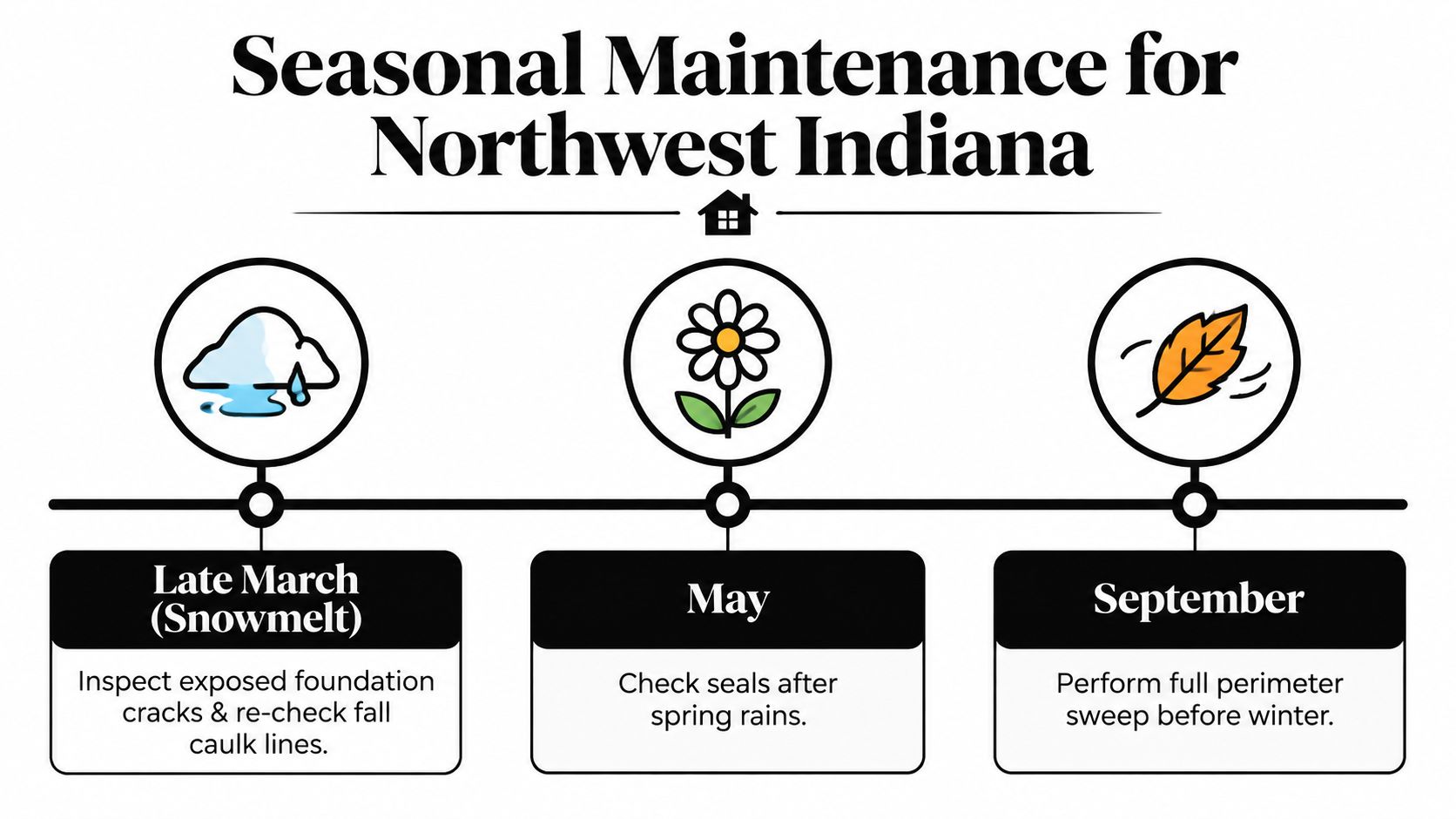
After a deep January freeze, inspect attic penetrations and pipe stacks. Temperature movement can shift collars, seals, and surrounding materials. Each check takes roughly ten minutes, a flashlight, and a phone camera. Keep the habit attached to trash day, mowing, or another task you already do.
Keep a repair record
Photograph the same corners each time. The record shows whether a crack is stable, whether a soffit is pulling loose again, and whether a door sweep is wearing at one end. It also gives a pest professional useful history when recurring seasonal issues need more than a single treatment.
A maintenance rhythm won't replace professional preventative pest treatments, ant control, termite control, mosquito control, or wildlife work when those services are needed. It does reduce the chance that a small structural change remains unnoticed until pests establish themselves indoors.
Cost, Time, and When to Call the Pros
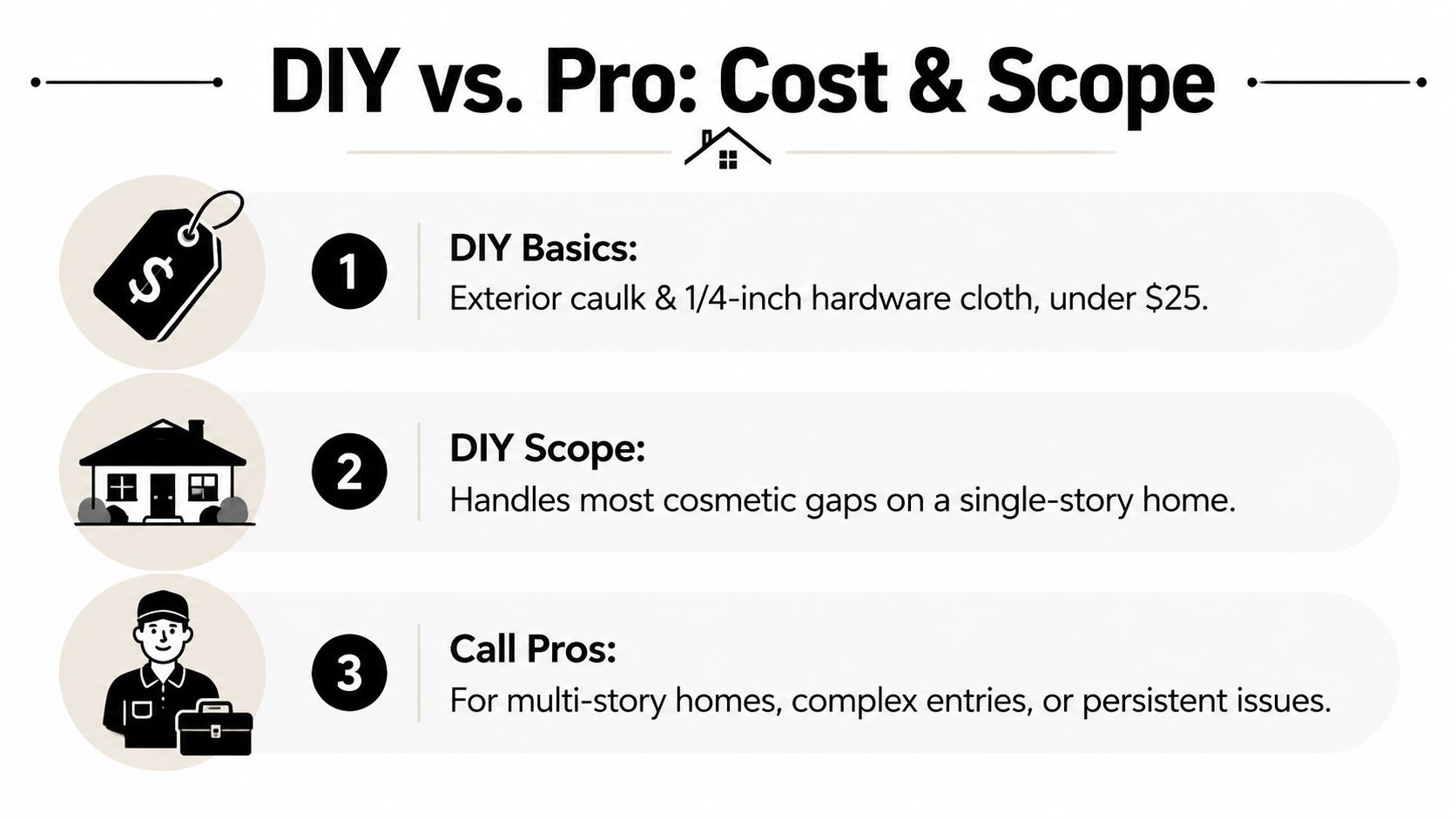
DIY exclusion makes sense when the opening is visible, reachable, and limited to a minor repair. An exterior polyurethane caulk and a roll of 1/4-inch hardware cloth can cost under $25 for basic materials on a single-story home. A skilled homeowner may spend three to five hours completing a full sweep of the foundation, soffits, vents, and garage over a weekend.
Those numbers don't make every repair a DIY project. A rotted door threshold may require carpentry, a chimney cap may require safe roof access, and a damaged gable vent may need a properly sized replacement rather than a patch. A raccoon-sized breach can involve sheathing replacement, insulation removal, or wildlife-exclusion sequencing.
Use a practical decision test
Call a professional when the work involves roofline access above single-story height, chimney crown repairs, structural damage, active wildlife, or a recurring opening you've already sealed twice. Repeated failure usually means the repair addressed the visible symptom but missed movement, moisture, hidden damage, or a second entry point.
A professional inspection also creates a better repair sequence. The Green Advantage's inspection takes about ninety minutes and produces a written priority list, allowing homeowners to phase repairs instead of guessing. That approach is useful for landlords, property managers, homebuyers, and businesses that need to distinguish urgent access points from lower-priority maintenance.
Budget wisely: Spend first on openings that connect directly to occupied areas, food storage, attics, crawlspaces, and commercial service spaces. Cosmetic cracks can wait when a garage threshold or utility penetration remains open.
The goal isn't to sell a larger repair than the building needs. It's to identify the source of recurring pest activity, select materials that match the exposure, and combine exclusion with treatment or monitoring when pests are already established.
Schedule Your Exclusion Inspection in Crown Point
A useful inspection should produce more than a verbal assurance that the property looks fine. The technician should arrive within a stated time window, walk the exterior perimeter, check accessible attic and crawlspace areas, photograph findings, and provide a written estimate organized by urgency.
Homeowners should secure pets, clear the attic access, and prepare notes about droppings, scratching, nest locations, damaged screens, or dates when activity appeared. A recent photo of a hole or pest can help, but it doesn't replace a full envelope inspection. For preparation ideas, use this practical pest control inspection checklist.
Prioritize the property, not the panic
A family home may need immediate attention at a garage threshold or kitchen-adjacent utility entry. A multifamily building may require a floor-by-floor review of shared penetrations, exterior doors, and service chases. A retail or food facility needs special attention to loading doors, waste areas, vents, and documentation. The inspection sequence should follow the building's risk and construction, not a generic list.
Crown Point scheduling often fills quickly in late summer, when mice begin seeking indoor shelter, and again in spring during swarm season. Booking two to four weeks ahead can keep the inspection on the front side of demand. That timing matters for homeowners planning repairs, landlords coordinating access, and businesses trying to avoid emergency service interruptions.
The Green Advantage serves Crown Point and nearby Northwest Indiana communities with residential and commercial pest inspections, rodent exclusion, wildlife exclusion, mosquito reduction, and integrated pest management support. Ask about the inspection fee structure when scheduling, then use the written priority list to decide which repairs to complete immediately and which can wait.
The first visit should focus on diagnostics, not pressure. Exclusion is preventive work, and a clear repair roadmap lets you act on your own timeline while addressing the openings that matter most.
The Green Advantage can inspect your Crown Point property, identify the entry points that allow rodents, insects, or wildlife inside, and recommend durable exclusion repairs alongside residential or commercial pest control. Visit The Green Advantage to schedule an inspection or request a quote, and start with a practical plan for keeping pests outside.
Homemade Mosquito Repellent Smoke a Guide for Crown Point

Summer evenings in Crown Point should end with kids in the yard, neighbors on the patio, and maybe dinner still on the table. Instead, a lot of homeowners end up doing the same thing. Swatting, scratching, and searching for a fast fix on their phone.
That's usually when homemade mosquito repellent smoke shows up in search results. Burn coffee grounds. Light herbs. Smolder leaves in a pot near the patio set. The appeal makes sense. It feels simple, natural, and cheap.
I get why people try it first. In Northwest Indiana, mosquito pressure can build fast around damp shade, clogged gutters, low spots in the yard, and standing water after rain. If your property tends to hold water, fixing drainage can also help reduce pest pressure over time. For yard grading and runoff issues, Task Masters Inc. drainage services are a useful local resource to review alongside mosquito prevention.
Reclaiming Your Crown Point Yard from Mosquitoes
A typical Crown Point backyard problem starts the same way. You clean the patio, fire up the grill, and expect a relaxed night outside. Then the mosquitoes find you before the food even hits the table.
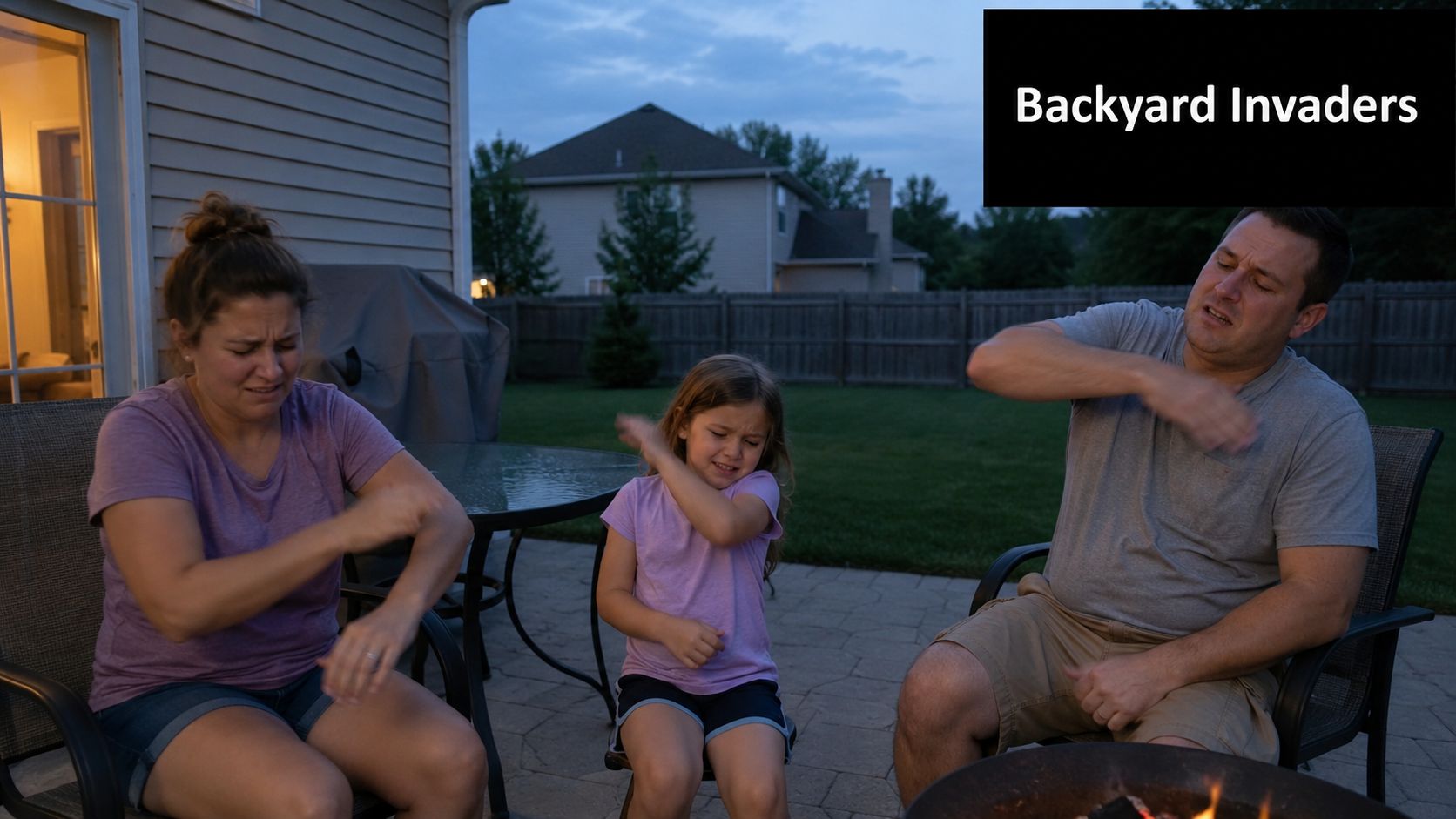
For many families, that turns into a search for pest control near me, exterminator near me, or a DIY idea they can try the same night. Smoke is often the first experiment because it feels old-school and practical. Set something smoldering near the deck and hope the bugs back off.
Why mosquitoes get so bad around Northwest Indiana homes
Mosquitoes don't need a swamp. They need moisture, shade, and places to rest during the day. In Crown Point and nearby Northwest Indiana neighborhoods, that often means:
- Low wet areas: Water collects after storms and stays put longer than people realize.
- Dense landscaping: Overgrown shrubs and shaded corners give mosquitoes cover.
- Everyday containers: Buckets, toys, planters, and clogged gutters can all help mosquito activity build.
- Busy family schedules: Small yard issues get ignored until biting becomes impossible to ignore.
Local rule: If you can't enjoy your yard at dusk, the problem is already bigger than a candle-and-smoke fix.
Homeowners looking for pest control in Crown Point, IN usually aren't looking for abstract advice. They want their patio back. They want their kids and guests outside without becoming a target.
That's why smoke deserves a straight answer. Some versions can repel mosquitoes under certain conditions. But that doesn't make homemade smoke a dependable mosquito-control plan for a real yard.
Popular DIY Mosquito Smoke Methods Homeowners Try
Most DIY smoke methods follow the same logic. Burn something strong-smelling, keep the smoke near the seating area, and hope mosquitoes stay away long enough to finish the evening.
What people usually burn
Homeowners commonly try a few versions:
- Smoldering coffee grounds in a heat-safe dish.
- Herb bundles or smudge sticks made from plants like sage, rosemary, or similar fragrant yard or kitchen herbs.
- Loose dried plant material such as cattails or leaves burned near a fire pit.
Some people also swap in store-bought options like fresh protection incense because it feels cleaner and easier than burning random yard debris. Others compare those options with guides on mosquito repellent incense sticks before deciding what to try outdoors.
The problem most DIY guides skip
Here's the issue. Most online advice tells you what to burn, but not how well it works in real life.
According to a roundup of DIY discussions and homeowner advice, most DIY smoke repellent content fails to quantify the effective range or duration of protection for mosquitoes, leaving people without data on how close the smoke must be or how long a session protects the space (discussion reference).
That's a major gap.
You can smell smoke and still get bitten. Those aren't the same thing.
A patio setup needs answers most DIY articles don't give. Does the smoke protect the whole seating area or only the chair next to it? Does protection drop when the breeze shifts? How long before you need to relight it? If you're hosting friends or trying to keep kids outside comfortably, guessing isn't good enough.
That's why homeowners searching residential pest control or mosquito control often move past DIY after one or two frustrating evenings. The method may feel active, but the results are hard to measure and even harder to repeat.
The Hidden Downsides of Homemade Mosquito Smoke
You light a homemade smoke pot before dinner on the patio. The yard smells like something is working. Then the wind shifts, the smoke drifts away from the chairs, and the bites start anyway.
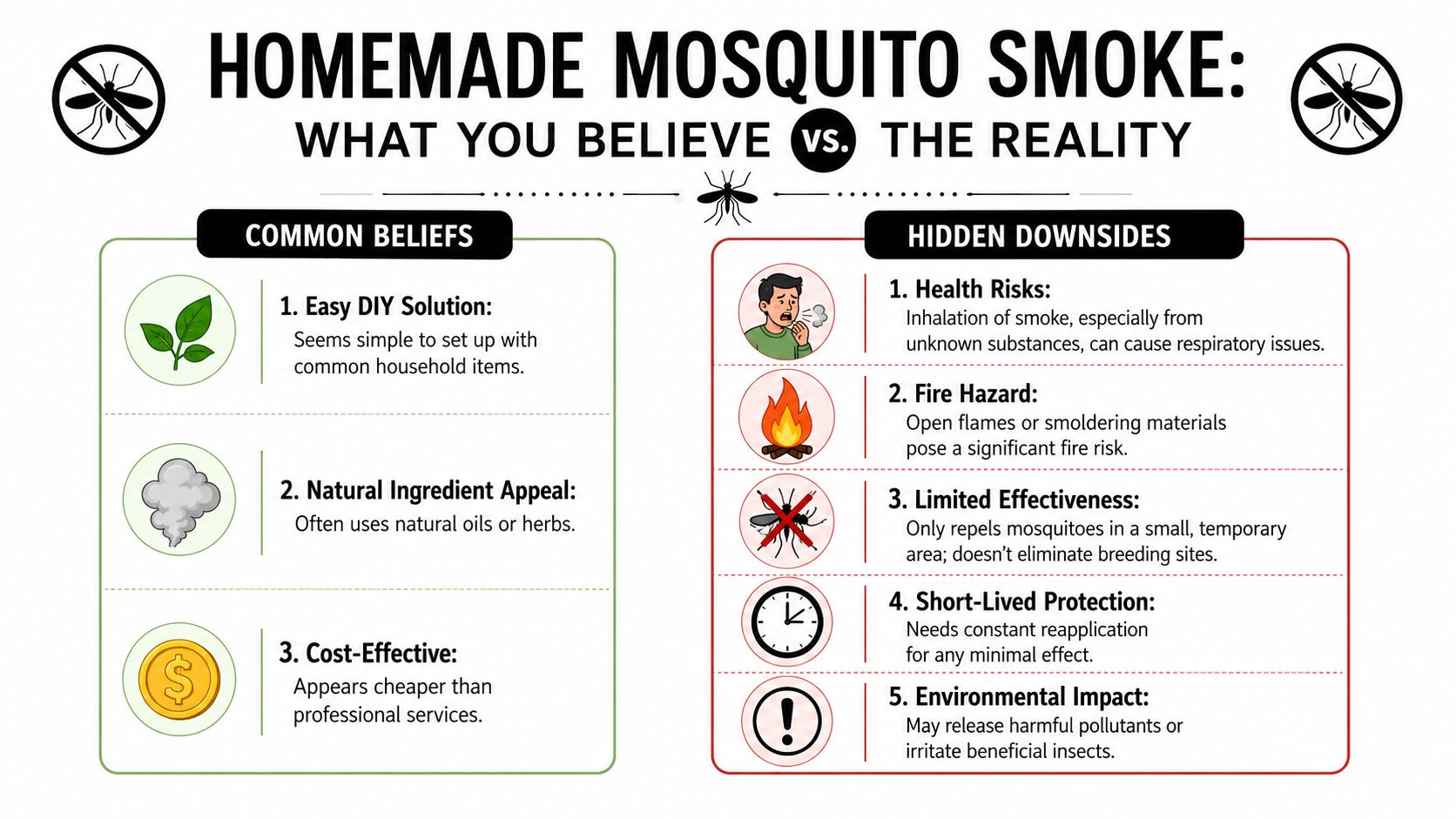
Some plant smoke can repel mosquitoes. Backyard smoke usually does not.
This is the part DIY articles blur together. Tested botanical smoke is not the same as tossing yard waste, coffee grounds, or random dried herbs into a fire pit.
In one field study, smoke from specific plant materials showed measurable repellency against certain mosquito species, while the same research summary noted a World Health Organization conclusion that smoke from common domestic biomass fuels such as firewood or charcoal does not have experimental support as an effective mosquito repellent (field research summary).
That matters in Crown Point because homeowners are rarely recreating controlled conditions. They are burning whatever is available, in open air, with changing wind, uneven smoke, and different mosquito pressure from one yard to the next. Results swing all over the place.
Smoke creates a false sense of control
Homemade mosquito smoke appeals to people because it feels active. You can see it. You can smell it. That does not make it dependable.
Short-term repellency from natural materials can fade fast, and smoke only affects the area it reaches. Once airflow changes, protection changes with it. That is a poor setup for backyards where kids are moving around, guests are spread out, and mosquitoes are resting in shrubs, mulch beds, and damp shade just a few feet away.
If you want practical prevention steps that go beyond burning something and hoping for the best, Natural mosquito control for yards is a useful place to start. If you want reliable relief across the property, a professional mosquito control service for your yard is the stronger choice.
Here's a closer look at the safety side before anyone treats smoke as harmless:
The health risk DIY guides gloss over
Smoke is still smoke. “Natural” does not change what it does to your breathing space.
Public health guidance from the U.S. Environmental Protection Agency explains that fine particle pollution, including PM2.5 from smoke, can irritate the lungs, worsen asthma, and increase risk for people with heart or lung disease (EPA guidance on particle pollution). That is the primary problem with homemade mosquito smoke. You are adding airborne irritation to the exact area where your family is supposed to relax.
Practical rule: If your mosquito fix makes the air harder to breathe, it is the wrong fix for a family patio.
I see this often around Northwest Indiana. A homeowner wants a simple DIY answer, tries smoke for a weekend or two, and ends up with inconsistent bite relief plus a yard full of irritation. The smarter move is to stop chasing temporary smoke clouds and use a treatment plan that targets mosquitoes where they hide and breed.
A Better Solution Professional Mosquito Control
You light a bowl, the smoke drifts sideways, and mosquitoes still find your ankles by dusk. I hear that story all the time in Crown Point. Homemade smoke appeals because it feels simple, cheap, and natural. It also leaves too much to chance.

Why targeted treatment beats backyard guesswork
Professional mosquito control works at the source. A trained technician checks the property for breeding pockets, damp shade, dense foliage, standing water, and the resting areas mosquitoes use between bites. Then the treatment plan is built around your yard, not around whatever happens to burn in a fire-safe dish.
That difference matters. Smoke only affects the air in one small area for a short period, and even that depends on wind, fuel, placement, and how long it stays lit. A service program is built to reduce mosquito pressure across the property, especially in the places homeowners rarely notice on their own.
If you're comparing options, guides on Natural mosquito control for yards can help you clean up habitat and reduce standing water. If you want consistent relief instead of repeated trial and error, a professional mosquito control service for your yard is the better call.
Side-by-side reality check
| Approach | What it does | Main limitation |
|---|---|---|
| Homemade smoke | Creates a temporary smoke barrier near seating areas | Coverage shifts with wind, results are inconsistent, and it does not address breeding sites |
| Store-bought smoke products | Uses more standardized materials than DIY burning | Relief stays localized and temporary |
| Professional mosquito treatment | Targets mosquito activity where it starts and where it spreads | Requires inspection and scheduled service |
A key advantage is consistency. You are not depending on the right leaves, the right container, the right weather, and a high tolerance for smoke. You are using a repeatable process designed to reduce mosquito activity where people live, play, and gather.
That is why homeowners searching for an exterminator in Crown Point, IN or pest control near me usually stop experimenting and book service. They want fewer bites. They want their yard back. They want an answer that works beyond one chair on one patio for one evening.
Professional mosquito control reduces mosquito pressure across the yard instead of trying to mask the problem with smoke in one corner.
For many Northwest Indiana homes, that same visit also helps identify related pest issues around the structure, including ants, spiders, wasps, and rodents.
Benefits for Your Northwest Indiana Home and Family
Homeowners don't buy mosquito control because they love pest management. They buy it because they want to use their property without planning the evening around insect bites.
What you actually gain
A proven treatment plan protects more than comfort.
- More usable outdoor time: You can sit on the patio, mow, garden, or let the kids play without every activity turning into a swatting contest.
- Less guesswork: No more relighting bowls, testing herbs, or wondering if tonight's breeze will ruin your setup.
- A cleaner routine: You avoid filling gathering spaces with smoke just to make the yard tolerable.
- Broader pest protection: Many homeowners who call about mosquitoes also need help with ant control, spider control, wasp removal, or rodent control.
Field trials using ethnomedicinal plant smoke powders showed that exposure to burning powder reduced An. arabiensis by 93.75% and Ae. aegypti by 92%, with overall plant mixtures offering greater than 90% protection against both species compared to untreated huts (field trials). Those results are impressive, but they also prove the bigger point. Effective mosquito reduction comes from specific, tested methods, not random backyard smoke experiments.
Why local homeowners move to service
In Crown Point and across Northwest Indiana, mosquito issues rarely stay isolated. Wet spots can support mosquito activity while overgrown edges invite other pests. That's why people searching pest control in Crown Point, IN often need a company that understands the whole property, not just the one insect biting them tonight.
A strong pest program protects your home, your routine, and your peace of mind. That matters whether you own a house, manage rentals, or run a local business that needs dependable commercial pest control.
Schedule Your Pest Control Service in Crown Point
If mosquitoes are dictating when your family can use the yard, it's time to stop experimenting and get a real plan in place. The process should be simple.
What the service experience should look like
A solid pest control company in Crown Point should make things easy from the first call.
- You reach out and explain the problem. Office staff should answer questions clearly and help you schedule fast.
- A technician inspects the property. That includes problem areas, likely breeding zones, and the outdoor spaces you want to use most.
- You get a clear quote. No vague promises. No confusing language.
- Treatment is performed with a purpose. The work should be based on the site conditions, not a one-size-fits-all spray.
- You know what comes next. Good service includes practical guidance and follow-up expectations.
When to stop trying smoke
Call for help if any of these sound familiar:
- You're getting bitten every evening even after trying candles, coils, incense, or homemade smoke.
- Your yard has standing water or drainage problems that keep coming back after storms.
- You're hosting outdoors less often because the space isn't comfortable.
- You also need help with other pests like wasps, ants, spiders, or rodents.
Homeowners searching exterminator near me or residential pest control usually wait too long because they hope one more DIY fix will finally work. Most of the time, it doesn't.
If you're in Crown Point or nearby Northwest Indiana communities, get the yard inspected and get a plan that matches the property.
If you want dependable mosquito control and straightforward help from a local team, contact The Green Advantage to schedule an inspection, request a quote, and get your outdoor space back.
Best Mosquito Control Companies Near Me: Crown Point 2026

A July evening in Crown Point should end with dinner on the patio, kids in the yard, and maybe a fire pit after sunset. It should not end with everyone rushing indoors because the mosquitoes took over.
That problem usually does not go away with a single spray. Around here, mosquito pressure builds through the warm months, especially in yards with shade, standing water, heavy landscaping, or nearby drainage areas. The right company helps you take your yard back for the full season, not just knock pests down for a weekend.
This guide is built for homeowners who want to make a smart choice, fast. You are not just comparing names. You are comparing treatment plans, local experience, communication, and whether a company can handle the bigger pest picture if mosquitoes are only part of the problem.
I'd start with The Green Advantage. They are a family-owned Northwest Indiana company, and that local experience matters in Crown Point. If you want a clearer picture of the health concerns behind mosquito activity, their article on mosquito-borne risks and how mosquito control services mitigate them is worth reading before you choose a provider.
There are other solid options on this list too. My goal here is to help you compare them clearly, ask better questions, and pick the service that will make your yard usable again.
1. The Green Advantage

The Green Advantage is the company I'd call first in Crown Point. They're family-owned, based in Northwest Indiana, and they understand the yards here. That shows up in the details, from shaded fence lines and wet spots to the other pest issues that often make mosquito season worse.
Their value is simple. They do more than spray and leave. The team handles mosquito reduction, prevention plans, residential pest control, commercial pest control, and inspections, so you can solve the whole pest problem instead of treating one symptom at a time.
Why The Green Advantage Stands Out
What sets them apart is judgment. A good mosquito company should be able to explain where activity is coming from, what on your property is feeding it, and how they plan to keep pressure down through the season. That is the standard I'd use for any provider. If you want a smart framework for comparing treatment plans, their article on whether all mosquito control is the same is useful before you hire anyone.
I also like that they fit the way Crown Point homeowners shop for this service. Many people start with mosquitoes, then realize they also need help with ants, spiders, wasps, rodents, or a general pest issue around the house. The Green Advantage can handle that without sending you to a second company.
Best Fit for Crown Point Homeowners
Choose The Green Advantage if your goal is to make the yard usable again and keep it that way. They're a strong fit for families who want responsive service, clear communication, and a local company that knows Crown Point properties instead of treating every yard the same.
There are two practical tradeoffs. They focus on Crown Point and nearby Northwest Indiana communities, so they are not the right option outside that area. And if you want pricing or licensing details before booking, you'll need to request them directly.
2. Mosquito Authority of Northwest Indiana

You walk outside at dusk, the kids want to stay in the yard, and mosquitoes start circling before you can even sit down. That is the kind of problem Mosquito Authority of Northwest Indiana is built to address. They are a recognizable local option for homeowners who want a mosquito-focused service plan instead of a broader pest package.
Their model is simple. They cover Crown Point and nearby Northwest Indiana communities, and they lean on recurring seasonal treatments to keep pressure down during mosquito season. They also offer one-time sprays for parties and outdoor gatherings, which makes them a practical pick if your biggest concern is getting short-term relief before guests arrive.
What I like here is the clarity. You are not sorting through a long menu of unrelated services. If you want a company that centers its pitch on mosquito control, regular visits, and family-friendly treatment messaging, this is a reasonable option to compare.
Still, do not stop at the sales pitch. Before you hire any provider, read this breakdown of how mosquito control plans actually differ. It will help you ask better questions about treatment frequency, target areas, and what happens if mosquitoes come back between visits.
Where This Option Fits Best
Mosquito Authority makes the most sense for homeowners who want a dedicated mosquito brand and a predictable seasonal schedule.
A few things deserve a close look during your quote call:
- Treatment scope: Ask whether they treat only adult resting areas or also address breeding pressure around standing water.
- Retreatment policy: Get a direct answer on what happens if mosquito activity returns before the next scheduled visit.
- Event service timing: If you want a one-time spray before a party, confirm how far ahead they need to book it.
- Property fit: Tell them about heavy shade, drainage issues, or wooded edges. Those conditions usually decide how well a plan works.
The tradeoff is straightforward. A mosquito-only provider can be a good fit if that is your only problem. If mosquitoes are just one part of a bigger pest issue around the house, you may end up needing a second company. For Crown Point homeowners who want a narrow, easy-to-understand mosquito program, though, Mosquito Authority deserves a spot on the shortlist.
3. Mosquito Squad of Northwest Indiana

Mosquito Squad of Northwest Indiana is a good option for homeowners who want a choice between traditional barrier treatments and a botanically derived alternative. That flexibility is useful when a family wants control but also wants to ask detailed questions about treatment style, timing, and where products will be applied around the yard.
They also offer special-event sprays, which can be appealing if mosquitoes become most noticeable when you're hosting. If your backyard use revolves around graduation parties, cookouts, or evenings by the fire pit, that matters.
Where This Option Fits Best
Mosquito Squad is strongest for buyers who want mosquito service first and like having a menu of treatment approaches. Their recurring programs are built for seasonal management, and their satisfaction-focused model is reassuring for homeowners who don't want to feel stuck if results fall short.
A few things to verify during your quote call:
- Treatment type: Ask which option fits your yard conditions best.
- Residual expectations: Natural options may need closer attention to timing.
- Event timing: Confirm how far ahead to schedule before a party.
According to a This Old House review of mosquito control companies, season-long treatment plans timed to regional mosquito activity and applied consistently every 21 to 30 days can reduce mosquito populations by up to 90% over a full season. That's the standard you want in mind when comparing recurring programs in Crown Point.
Mosquito Squad won't be my first recommendation over a trusted family-owned local provider like The Green Advantage, but it's still a solid contender if you want recurring service and treatment-choice flexibility. You can explore their local program at Mosquito Squad of Northwest Indiana.
4. Monroe Pest Control
Monroe Pest Control stands out for one simple reason. It's been family-owned since 1929. In a service category where consistency matters, that kind of longevity tends to appeal to homeowners who want a stable, established company rather than a trendy seasonal add-on.
Their mosquito and tick services are aligned with Northern Indiana seasonality, which is exactly how this should be handled. Crown Point homeowners don't need broad national advice. They need service timed to local conditions, not a generic calendar.
Why Seasonality Matters
Mosquito pressure builds as the weather settles into the warm season, and the best providers plan around that cycle instead of acting like one spray solves the whole problem. Monroe's no-contract approach is also appealing for people who want flexibility.
A no-contract policy can be a good sign. It forces a company to keep earning your business through service, communication, and results.
Here's where Monroe makes sense:
- Long local history: They know Northwest Indiana conditions well.
- Event support: One-time sprays can help for outdoor gatherings.
- Straightforward service model: You're not boxed into a long commitment.
The drawback is the same one you'll find with many established providers. You'll need to request pricing, and peak summer demand can tighten appointment availability. If you're planning ahead for patio season, don't wait too long to book.
For homeowners comparing pest control in Crown Point, IN with an eye toward local history and seasonal honesty, Monroe Pest Control deserves a look.
5. Franklin Pest Solutions

Franklin Pest Solutions is a larger regional player serving Crown Point from its Hammond branch. If you want an inspection-driven, science-based approach and the option to bundle mosquitoes with broader home pest coverage, Franklin has real appeal.
Their mosquito program emphasizes inspection, identification, source reduction, and recurring treatment. That's a good sign because mosquito control works best when the provider looks beyond spraying and pays attention to conditions that let breeding continue around the property.
Best for Broader Pest Management
This is the option I'd consider if your mosquito problem sits alongside other recurring pest issues and you want a bundled home plan from a regional company. Homeowners searching for residential pest control or commercial pest control in Northwest Indiana often prefer that convenience.
Industry data in the 2024 mosquito market report shows that professional mosquito control commonly combines several methods, with 77% of providers using liquid adulticides, 66% integrating insect growth regulators, and 58% applying larvicides. That multi-part approach is a good benchmark when you're asking Franklin or any provider how they reduce pressure on your property.
- Strong technical structure: Their process starts with inspection and identification.
- Bundling potential: Useful if mosquitoes aren't your only concern.
- Regional coverage: Good for owners with multiple properties in the area.
The tradeoff is that a larger company can feel less personal than a family-owned local specialist. If you value highly local service and direct communication, The Green Advantage still has the edge for Crown Point homes.
You can review Franklin's mosquito service at Franklin Pest Solutions.
6. Ricci's Landscape Management
Ricci's Outdoor Maintenance is a different kind of option. It's especially worth considering if your mosquito issue is tied to the yard itself, meaning drainage trouble, dense planting beds, shady resting zones, or outdoor features that hold moisture.
Because RLM already works in outdoor spaces, they can pair perimeter spraying with habitat-focused yard improvements. That combination can be useful when mosquitoes keep returning because the property keeps giving them places to hide and breed.
Good Choice for Yard-Centered Problems
Their service includes season-long programs and one-time pre-event applications, and they also provide guidance on pollinator-safe practices. For homeowners who care about balancing outdoor comfort with responsible treatment choices, that's a meaningful point.
Crown Point's own municipal mosquito control program uses plant-based adulticide spray for fogging, according to the City of Crown Point mosquito control page. That local context helps explain why many residents ask detailed questions about product type, timing, and environmental impact when they hire a private provider.
- Outdoor layout connection: Helpful if the yard layout is part of the problem.
- Perimeter focus: Good for lawns, beds, and outdoor living zones.
- Event support: Convenient for short-term outdoor use.
The limitation is straightforward. Pest control isn't the company's sole identity. If you want a dedicated pest management specialist with wider residential and commercial service depth, The Green Advantage is the stronger fit.
Still, if your mosquito issue is tightly tied to landscaping and property conditions, Ricci's Landscape Management is worth considering.
7. Siege Pest Management

Siege Pest Management is a veteran-owned local company serving Northwest Indiana, including Crown Point. They aren't positioned as mosquito-only specialists, but they do include mosquitoes in warm-season service offerings and take a prevention-first, inspection-driven approach.
That makes Siege a reasonable option if you're looking for an exterminator in Crown Point, IN who can help with mosquitoes while also handling other pest concerns at the same property. For some homeowners, one provider for multiple issues is the simplest route.
Why Some Homeowners Will Like Siege
The owner-operated feel is the big advantage here. Companies with a hands-on local presence often communicate well and move quickly, especially when you need inspection help or bundled service.
The main question to ask is how detailed their mosquito program is. That's important because homeowners often assume any mosquito add-on includes the same level of yard-specific work as a dedicated plan, and that's not always the case. Standalone residential mosquito programs are often the better fit when the yard itself is the main problem, especially where standing water management and targeted outdoor treatment matter.
If mosquitoes are your biggest issue, ask whether the program specifically addresses breeding areas, harborage zones, and follow-up timing. Don't assume every warm-season pest plan handles those the same way.
Siege is worth contacting if you want local service, broad pest help, and an eco-conscious mindset. Just confirm the mosquito details at booking since the site doesn't present a standalone mosquito page.
You can learn more at Siege Pest Management.
Top 7 Mosquito Control Companies Comparison
A comparison table should help you choose fast. It should also show which company is built to solve a Crown Point yard problem, not just sell another recurring spray. That is the key difference here.
| Provider | Service style | What you need to commit to | What to expect | Best fit for | Key advantages |
|---|---|---|---|---|---|
| The Green Advantage | Moderate. Site diagnosis and customized, nature-based plans | Local technicians, eco-focused products, inspection time, quote based on property conditions | Long-term prevention with lower environmental impact and a stronger focus on breeding conditions | Homeowners who want a family-owned company that studies the property and treats the cause, not just the symptoms | Family-owned local team, licensed technicians, clear communication, strong community reputation |
| Mosquito Authority of Northwest Indiana | Low to moderate. Standard recurring service on a set cycle | Recurring visits during mosquito season, franchise scheduling, routine treatments | Reliable seasonal reduction when visits stay on schedule, with retreat options if needed | Homeowners who want predictable timing and a straightforward maintenance plan | Easy scheduling, visible local service area, established recurring program |
| Mosquito Squad of Northwest Indiana | Moderate. Traditional, natural, and special event options | Licensed crews, recurring visits or event scheduling, choice of treatment type | Good short-term and seasonal relief, depending on the product selected and visit timing | Households that want product options or one-time treatment before outdoor events | Treatment variety, satisfaction guarantee, event service availability |
| Monroe Pest Control (NWI) | Low to moderate. Seasonal mosquito service with flexible scheduling | Service beginning during mosquito season, optional one-time event visits, no long contract commitment | Solid seasonal control when treatments start on time and continue through peak months | Homeowners who prefer a long-running local company with a simple service model | Long local history, practical seasonal guidance, no-contract approach |
| Franklin Pest Solutions (Hammond) | Moderate to high. Inspection-led mosquito control tied to broader pest service | Detailed inspection, targeted treatments, possible bundling with home pest plans | Technically guided mosquito reduction with a strong focus on diagnosis | Homeowners who want a more technical provider or need mosquito control bundled with other pest work | Scientific approach, regional reach, broad home pest service options |
| Ricci's Landscape Management (RLM) | Moderate. Combines yard work with perimeter mosquito treatment | Outdoor crews, perimeter applications, drainage or habitat improvements, pollinator awareness | Mosquito reduction plus property improvements, though weather can affect results | Property owners who want one company to handle both yard upkeep and mosquito mitigation | Combines outdoor maintenance with pest service, local coverage, pollinator-conscious guidance |
| Siege Pest Management | Low to moderate. Owner-involved, inspection-first service | Inspection time, local scheduling, broader pest service coordination | Responsive prevention-focused control that may work well if mosquitoes are one of several pest issues | Homeowners who want local communication and bundled pest help from one provider | Veteran-owned, owner-operated, communicative, prevention-first mindset |
If you want the shortest path to a confident decision, start with The Green Advantage.
It stands out because the company is built around property-specific inspection, local accountability, and a prevention-first approach that fits how Crown Point homeowners use their yards. Some providers are better for simple recurring sprays. Some make sense if you want mosquito service bundled with wider pest control. But if your goal is to reclaim the yard, keep the treatment plan sensible, and work with a trusted family-owned team, The Green Advantage is the strongest place to start.
Your Buyer's Guide to Choosing Mosquito Control in Crown Point
The pattern is familiar in Crown Point. You set out drinks, light the grill, and plan to stay outside until dark. Twenty minutes later, everyone is slapping at their legs and heading back inside. That is usually the moment homeowners start searching for the nearest mosquito company. Do not choose based on the lowest introductory price. Choose the company that can keep your yard usable through the season.
Ask each provider the same questions. How often do they treat during peak mosquito months? Do they inspect for standing water, shaded resting areas, damp mulch beds, and overgrown edges where mosquitoes hide during the day? Are the products EPA-registered? If mosquitoes flare up between visits, will they come back? If you also need help with ants, wasps, spiders, rodents, or general pest control, can the same company handle it without sending you somewhere else?
DIY sprays and foggers can cut activity for a short stretch. Scheduled professional service is what gives you consistency. Analysts at Business Research Insights point to rising demand for mosquito control services because homeowners want reliable outdoor comfort without treating the yard every few days.
Timing matters. Start before mosquito pressure peaks, not after your backyard has already become annoying to use. Early-season treatments usually give you faster control and a steadier schedule through the hottest part of the year.
Pay close attention to guarantees. The right company should explain what kind of reduction you can expect, how soon you should notice improvement, and what follow-up looks like if the first treatment does not last. Skip vague promises and sales language. Clear answers are a good sign. Evasive answers are not.
My recommendation is simple. Start with The Green Advantage. For Crown Point homeowners who want a family-owned company, property-specific service, and one team that can also handle broader pest issues, that is the strongest first call.
If you are done planning summer evenings around mosquitoes, contact The Green Advantage for a free inspection and customized quote. They can assess the property, identify the pressure points around your home or business, and put together a treatment plan that makes sense for how you use your yard.
Find Top Pest Control Companies in Crown Point

You hear scratching in the wall after sunset. The next morning, there's a line of ants along the kitchen counter, and by the weekend you notice a wasp nest starting under the eave near the front door. That's how pest problems usually feel in real life in Crown Point. They don't arrive as a neat, obvious emergency. They build without notice, then suddenly demand your attention.
For most homeowners, the hardest part isn't just the pest itself. It's not knowing whether the problem is minor, whether store-bought products will make it worse, or whether the company you call will solve the source instead of just spraying and leaving. In Northwest Indiana, that uncertainty matters because our seasons shift fast, moisture changes quickly, and outdoor pest pressure doesn't always stay outside for long.
Your Guide to Pest Control in Crown Point Indiana
A lot of people start looking for pest control near me after one stressful moment. It might be mice sounds in the attic on a cold night, mosquitoes taking over the backyard during a humid stretch, or ants showing up around sinks and baseboards when the weather turns. Those calls are common in Crown Point because homes here deal with a mix of seasonal pressure, moisture, lawn edges, crawl spaces, garages, and wooded or semi-rural surroundings.
Midwestern weather adds another layer. Research tied to U.S. EPA guidance notes that warming temperatures and changing precipitation patterns can expand the range, season length, and activity of pests such as mosquitoes and ticks, increasing pressure on residential properties in Northwest Indiana, as discussed by Infinity Pests. That means a pest plan that worked a few years ago on a fixed schedule may not fit what your property needs now.
Why local experience matters
When homeowners search for pest control in Crown Point, IN or exterminator near me, they're usually not looking for theory. They want someone who can look at the structure, the yard, the season, and the pest pressure together. A line of ants near a patio door isn't the same problem as carpenter ants tied to moisture-damaged wood. Mosquito complaints near shaded landscaping aren't handled the same way as mosquito pressure around standing water after repeated rain.
That's why local knowledge matters more than broad promises. A technician who works in Northwest Indiana should know what tends to show up in spring, what moves indoors in fall, and how yard conditions, drainage, and entry gaps change treatment decisions.
Local reality: The best pest control plan for a Crown Point home usually starts with inspection, not product.
Homeowners also want clear communication. If you've ever hired another home service, you already know the difference between a company that explains the problem and one that talks around it. Even outside pest control, service businesses earn trust by educating customers before asking for a commitment. That same principle shows up in other industries too, including practical guides on dental practice growth strategies, where clear communication and trust-building drive better decisions.
What good help should feel like
A professional visit shouldn't feel rushed or vague. It should feel calm. Someone should ask where you're seeing activity, when it started, what changed recently, and whether the issue is isolated or spreading.
If you're comparing pest control companies, start with one simple standard. Look for a provider that treats the problem in front of you and the conditions causing it. That's the difference between temporary relief and a home that stays more comfortable over time.
Identifying Your Service Needs and Pest Pressures
Before you call an exterminator in Crown Point, IN, take a few minutes to observe what's happening. Good notes help the inspection move faster and help the technician separate a nuisance issue from a developing infestation.

What to notice before you call
Write down what you're seeing and where. You don't need to identify the exact species. You do need details.
- Location matters: Note whether pests are in the kitchen, basement, attic, garage, bathroom, crawl space, or outside around the foundation.
- Timing matters too: Are they active at night, after rain, during warm afternoons, or when temperatures drop?
- Signs count as much as sightings: Droppings, gnaw marks, damaged food packaging, sawdust-like material, mud tubes, nests, and buzzing in wall voids all matter.
- Pattern matters: One ant at a sink is different from repeated trails along the same wall. One mouse sighting can still point to a larger access issue.
Common Northwest Indiana patterns
In Crown Point and nearby Northwest Indiana communities, a “small” pest issue often points to a bigger condition around the property.
A few examples:
| Situation | What it can mean |
|---|---|
| Ants around windows or kitchens | Food access, moisture, or an exterior colony pushing inward |
| Mouse activity in fall | Entry points opening as outdoor temperatures drop |
| Wasps around eaves or sheds | Nesting in protected exterior voids |
| Mosquito complaints in shaded yards | Water-holding spots, dense vegetation, and poor airflow |
| Wood damage concerns | A need to distinguish termites from moisture-related carpenter ant activity |
That last point matters. Homeowners often lump wood-destroying pests together, but the treatment approach changes depending on what's present. Misidentification leads to wasted time and the wrong product in the wrong place.
If you're seeing repeated activity in the same area, treat that as a sign to inspect deeper, not a reason to spray more often.
What to tell the pest professional
The most useful call starts with a few direct observations:
- What you're seeing
- Where you're seeing it
- When it started
- Whether it's getting worse
- Any recent changes, such as moisture issues, construction, landscaping work, or stored items in the garage or basement
For residential pest control, that information helps narrow likely entry points and harborage areas. For commercial pest control, it helps identify sanitation, storage, traffic flow, and structural conditions that may be contributing.
The goal isn't to diagnose the whole issue yourself. It's to give the company enough context to arrive prepared and inspect the right places first.
How to Vet a Pest Control Company's Qualifications
Plenty of homeowners compare prices first. That's understandable, but it shouldn't be the first filter. In a market this crowded, credentials matter more.
Statista reported more than 33,000 pest control businesses in the United States by August 2024, while IBISWorld estimated 34,076 businesses in 2026 as a projection, showing how fragmented the industry is, according to Statista's U.S. pest control industry overview. In a market with that many operators, homeowners need to verify that a company is properly licensed, insured, and certified before letting anyone treat around the home.

The non-negotiables
A qualified pest control company should be able to discuss credentials without hesitation.
- Licensing: The company should hold the required state credentials for pesticide application and pest management work.
- Insurance: Ask whether they carry liability coverage and whether their team is covered while working on your property.
- Training and certification: You want technicians who can identify pests correctly, explain treatment choices, and follow label directions and safety procedures.
If a company gets vague when you ask these questions, keep looking.
Why this protects you
A licensed and insured provider does more than check a box. It lowers your risk. Pest control work can involve restricted products, ladders, crawl spaces, attics, stinging insects, and treatments around children and pets. The company should have processes for all of that.
A professional should also be willing to explain what they do. If you want a clearer picture of the scope of the work, this guide on what pest control companies do is a useful place to start.
Hiring rule: Don't judge a pest company by how confidently it promises results. Judge it by how clearly it explains inspection, safety, and follow-up.
Reviews are helpful, but read them correctly
Online reviews can tell you a lot, especially when you read beyond the star rating. Look for comments about punctuality, communication, documentation, and whether the company solved the issue over time. If you want a practical look at how service businesses build and manage customer feedback, this overview of review generation for service businesses gives good context for what to look for.
A few good questions to ask before booking:
- Who performs the inspection?
- Will I receive a written treatment plan?
- Do you explain preparation steps before the visit?
- What happens if activity continues after treatment?
- Do you offer exclusion or prevention recommendations, not just applications?
The best pest control companies in Crown Point won't dodge those questions. They'll expect them.
Understanding Treatment Options and Service Plans
Homeowners usually have two choices. Solve the problem in front of them right now, or build a plan that lowers the chance of the problem returning. Both have a place. They're just built for different situations.

One-time service versus ongoing protection
A one-time treatment makes sense when the issue is narrow and immediate. Think of a wasp nest near an entry door, a sudden ant trail in one room, or a targeted interior problem that doesn't suggest broad structural risk.
A service plan fits homes and businesses that deal with repeated pressure through the year. That often includes ants, spiders, rodents, stinging insects, and seasonal outdoor pests. Ongoing plans are built around inspection, monitoring, prevention, and treatment as needed.
The industry leans heavily toward prevention. The NPMA reported that 85.4% of residential pest control service revenue in 2025 came from recurring service in its 2025 pest control industry growth report. That reflects how strongly both companies and customers value maintenance over waiting for an emergency.
What modern pest control should include
The strongest plans don't rely on broad, fixed spray calendars. They use Integrated Pest Management, or IPM, which means the treatment matches the pest, the site, and the conditions.
That approach often includes:
- Inspection first: Identify the pest correctly and find where activity is starting
- Exclusion work: Recommend sealing gaps, improving door sweeps, screening vents, or correcting access points
- Habitat correction: Reduce moisture, clutter, harborage, and outdoor conditions that support pest activity
- Targeted application: Use products only where they fit the actual problem
- Follow-up monitoring: Recheck whether the plan is working and adjust if needed
A treatment plan should answer two questions. What removes the current pest activity, and what keeps it from coming right back?
Choosing the right fit for your property
Not every home in Crown Point needs the same service level. A newer subdivision home with occasional ant activity may need a different plan than an older property with recurring mice, heavy mosquito pressure, and multiple outbuildings.
For yards and exterior spaces, especially during warmer Northwest Indiana months, mosquito reduction works best when paired with site inspection and habitat management. For wood-destroying pest concerns, inspection quality matters more than speed. For commercial properties, service should reflect traffic patterns, storage areas, entry points, and documentation needs.
One option available locally is The Green Advantage, which provides residential and commercial pest management, mosquito reduction, inspections, and targeted treatment plans in Northwest Indiana. The important part isn't the label on the service. It's whether the company is solving the cause, not only the symptom.
Preparing Your Home for Inspection and Treatment
A good pest service visit works better when the technician can see the conditions that are attracting pests or helping them hide. Simple prep makes a real difference.

What to do before the technician arrives
You don't need to deep-clean the house. You do want to make inspection areas accessible.
- Clear baseboards and corners: Move boxes, baskets, and stored items away from walls in problem areas.
- Open access points: Make it easy to reach attics, crawl spaces, utility rooms, under sinks, and the garage perimeter.
- Tidy food areas: Wipe counters, store food in sealed containers, and remove standing water from sinks or trays.
- Secure pets: Keep dogs, cats, and pet bowls away from active work areas unless the technician tells you otherwise.
- List your concerns: Put your sightings, sounds, and problem locations in one place so nothing gets forgotten during the appointment.
These steps help the technician inspect more thoroughly and avoid missing the exact spot where activity is beginning.
Outdoor prep matters too
For many properties in Crown Point, the yard is part of the pest problem. Trim back vegetation touching the house when possible. Pick up toys, tarps, or containers that collect water. Let the technician access fence lines, sheds, air-conditioning pads, and the foundation edge.
That matters especially for mosquito work. The EPA's guidance on mosquito IPM says that source reduction, which means eliminating breeding habitat such as standing water, is one of the most effective long-term control actions, often more impactful than relying only on sprays, as explained in the EPA mosquito control guidance.
You'll get better results when the property is set up for inspection, not just treatment.
This video gives a helpful visual example of the kind of home prep that supports a smoother visit:
What not to do
Avoid applying extra DIY products right before the appointment unless the company tells you otherwise. That can scatter pests, interfere with inspection clues, or make it harder to tell what's working.
If you've already used bait stations, foggers, sprays, or traps, tell the technician. That history helps interpret current activity and keeps the treatment plan realistic.
What to Expect When You Work With The Green Advantage
The experience should start with a straightforward conversation. You call, describe what's happening, and get practical questions back. Where are you seeing activity? When did it begin? Is it inside, outside, or both? That first exchange matters because scheduling the right kind of visit starts with accurate intake.
Once the inspection is on the calendar, the on-site process should be methodical. A technician walks the property, checks the areas tied to your concerns, and looks beyond the obvious symptom. If ants are on the counter, the inspection shouldn't stop at the counter. If rodents are in the garage, the visit should include likely entry points, storage conditions, and adjoining areas that support harborage.
Clear findings and a usable plan
Homeowners should expect plain language, not vague reassurances. Good pest management focuses on measurable outcomes, documented findings, exclusion recommendations, and follow-up monitoring, as described in this overview of prevention-focused pest service practices.
That means a useful appointment usually includes:
- What was found: The pest activity, evidence, and likely contributing conditions
- What needs attention first: Immediate treatment needs versus prevention work
- What the homeowner can do: Sanitation, storage, moisture correction, trimming, or access improvements
- What happens next: Whether the issue calls for a one-time response, monitoring, or an ongoing plan
Why communication matters after the first visit
A pest problem rarely improves because someone applied a product once and disappeared. It improves when inspection, treatment, exclusion, and follow-up line up. That's where communication becomes part of the service.
With a local company, homeowners should be able to ask questions about safety, timing, re-entry instructions, and what kind of activity may still appear during the resolution period. They should also know when to report new signs instead of guessing whether something is normal.
Good service leaves you with answers. Better service leaves you with a plan.
If you want a broader view of the company's approach and what homeowners often look for in a local provider, this page on why homeowners choose The Green Advantage for pest control needs adds useful context.
In Crown Point and nearby Northwest Indiana communities, that process matters because pest issues are often tied to season, structure, and site conditions together. The right company won't rush past that. It will inspect carefully, explain what's driving the problem, and help you decide whether you need targeted treatment, ongoing prevention, or both.
If you're looking for pest control companies in Crown Point, IN and want a calm, informed next step, contact The Green Advantage to schedule an inspection or request a quote. Whether you need help with ants, rodents, mosquitoes, wasps, termites, or year-round residential pest control or commercial pest control, the goal is simple: identify the actual cause, treat it safely, and put a practical prevention plan in place.
Spider Control in Crown Point, IN: An Exterminator’s Guide

Finding a spider in your Crown Point home is an unsettling experience. Whether it’s a wolf spider darting across the living room or cobwebs appearing in a freshly cleaned corner, it’s a common concern for homeowners in Northwest Indiana. The good news is that you don't have to share your space with these eight-legged intruders. At The Green Advantage, we're here to provide the peace of mind that comes with a pest-free home.
Effective spider control involves a two-part strategy. First, we address the immediate problem: the spiders, webs, and egg sacs currently in your home. Second, we implement a long-term preventative plan by sealing entry points and eliminating their food source—other common household pests. This combination of smart home maintenance and professional, targeted treatments is the key to reclaiming your home.
As a trusted local pest control company serving Crown Point and the surrounding community, we understand the unique challenges homeowners face. Let's walk through how to protect your property.

Why Spiders Are Invading Your Crown Point Home
If you're finding spiders in your home, they aren't there by accident. They've entered for two primary reasons that make any house attractive: food and shelter. Spiders are predators, and their presence is a strong indicator that your home may also have an underlying issue with other pests like ants, flies, gnats, or silverfish. Your property is essentially providing an all-you-can-eat buffet, making it a prime hunting ground.
Beyond a steady food supply, your climate-controlled home offers a welcome refuge from Northwest Indiana's harsh weather, from hot summers to frigid winters. Spiders are experts at exploiting the smallest cracks and gaps to get inside.
It's surprising just how common they are. One study of 50 homes found spiders in 65% of all rooms. Outdoors, they have plenty of predators, but inside your home, they can live and reproduce undisturbed. Some species can lay a staggering 250 eggs in a single sac. You can learn more about how Integrated Pest Management offers a solution to these indoor populations.
Common entry points our technicians find include:
- Cracks in the Foundation: Tiny fissures in concrete are open doors for pests.
- Gaps Under Doors: A sliver of daylight under an exterior door is a welcome sign for a spider.
- Utility Openings: Gaps around pipes, cables, and vents are common pest highways.
- Damaged Window Screens: A small tear is more than enough for a spider to squeeze through.
- Unsealed Vents: Dryer and attic vents without proper screening offer easy access.
Once inside, spiders seek out quiet, undisturbed areas like basements, attics, cluttered closets, and garages—the perfect places to build a web and wait for their next meal.
Common Spiders in Crown Point and Their Habitats
Identifying the type of spider helps our exterminators in Crown Point, IN, develop a more effective treatment plan. Here are a few spiders we frequently encounter in local homes.
| Spider Type | Common Indoor Location | Common Outdoor Location | Primary Food Source |
|---|---|---|---|
| Wolf Spider | Basements, garages, along walls | Under rocks, in leaf litter, gardens | Crickets, ants, other ground-dwelling insects |
| Cellar Spider (Daddy Long-Legs) | Basements, crawl spaces, corners of rooms | Sheds, garages, damp, dark areas | Small flies, gnats, other spiders |
| Common House Spider | Window frames, upper corners of rooms | Under eaves, porch lights | Flying insects (flies, mosquitoes) |
| Jumping Spider | Around windows and doors | Siding, fences, decks, plants | Flies, moths, and other insects they actively hunt |
Understanding what attracts these spiders—whether it’s an ant problem requiring dedicated ant control or gaps around your windows—is the first step toward a lasting solution.
How Professional Pest Control Solves Your Spider Problem
While DIY efforts like vacuuming webs and sealing cracks can help, they often fall short of resolving a persistent infestation. A professional pest control service from The Green Advantage provides a comprehensive solution that protects your Crown Point home from the outside in. Our goal is to create a secure barrier that stops spiders and other pests before they ever get inside.

Our approach is built on the principles of Integrated Pest Management (IPM), an eco-friendly and highly effective strategy that addresses the root cause of infestations.
1. Sealing and Securing Entry Points
The most effective long-term strategy is to block spiders from entering your home. Our technicians conduct a thorough inspection to identify and seal the vulnerable gaps spiders exploit.
- Foundation and Siding: We identify and seal cracks where the foundation meets your home's siding.
- Utility Lines: We secure gaps around pipes, wires, and vents where they enter your home.
- Windows and Doors: We inspect and recommend repairs for worn weather stripping and damaged screens.
2. Eliminating the Spider's Food Source
Spiders go where the food is. A key part of our service is reducing the populations of other insects in and around your property, which naturally makes your home less attractive to spiders. This often includes:
- Exterior Lighting Advice: Switching standard white outdoor lights to yellow "bug light" bulbs can significantly reduce the number of flying insects attracted to your home.
- Exterior Cleaning: A clean home exterior with no old webs or insect nests leaves fewer places for pests to hide. This professional guide on how to clean your house exterior offers excellent tips.
- Creating a Buffer Zone: We advise trimming shrubs and vegetation at least one foot away from your foundation to eliminate "bridges" pests use to access your home.
3. Decluttering Spider Hotspots
Spiders thrive in quiet, cluttered areas where they can remain undisturbed. Part of our IPM recommendation involves making these areas less hospitable.
- Basements and Crawl Spaces: Storing items in sealed plastic tubs instead of cardboard boxes reduces hiding spots and moisture.
- Garages and Sheds: Keeping tools and supplies organized and off the floor makes these areas easier to keep clean and pest-free.
- Attics: Proper ventilation and organization in attics prevent spiders from setting up residence.
By combining these professional strategies, we don't just react to spiders—we proactively prevent them. For a persistent infestation, it's time to call a licensed exterminator in Crown Point, IN.
The Benefits of Professional Pest Control
Choosing professional spider control is an investment in your property's health, your family's safety, and your peace of mind. A spider infestation is often a symptom of a larger pest issue, and our comprehensive services address the entire ecosystem affecting your home.

Protect Your Property and Health
Spiders themselves rarely cause structural damage, but the other pests they prey on—like termites and carpenter ants—can. Furthermore, many common household pests can introduce bacteria and allergens into your home, triggering asthma and other respiratory issues. Our service not only removes spiders but also the underlying pests that pose a risk to your property and health.
We are committed to environmentally friendly pest control methods that are safe for your family and pets.
The pest control industry is growing, driven by consumer demand for effective and safe solutions. According to these pest control industry trends on Pestpac.com, the market is projected to reach $29.1 billion by 2026 as more homeowners seek professional, long-term protection.
While spiders are pests indoors, they are beneficial predators in the outdoor ecosystem.
Spiders play a critical role in controlling insects that can spread disease. Research highlights the beneficial role of spiders in controlling disease vectors like mosquitoes and flies. Our goal is to keep these predators working for you outside, while ensuring your home remains a pest-free sanctuary.
Year-Round Defense Against Local Pests
A professional plan from The Green Advantage provides a comprehensive shield against the full range of pests common to Northwest Indiana. Our seasonal treatments are designed to proactively defend your home against:
- Ants: We stop ant columns before they march into your kitchen.
- Mosquitoes: Our mosquito control programs help you reclaim your yard.
- Rodents: We focus on rodent exclusion to prevent mice and rats from seeking shelter in your home during colder months.
- Wasps: We safely remove nests and treat eaves to prevent them from rebuilding.
Partnering with a local exterminator near me in Crown Point means shifting from a reactive to a proactive pest management strategy, ensuring year-round protection.
What to Expect When Working with The Green Advantage
Choosing a pest control provider means placing your trust in a company to protect your home and family. As a local business rooted in the Crown Point, IN community, we are committed to earning that trust through professionalism, reliability, and clear communication. When you call The Green Advantage, you'll speak with a member of our local team who understands your concerns and can schedule service at your convenience.
Our process is designed to be straightforward and reassuring:
- Punctual and Professional Service: A licensed, insured technician will arrive on time, ready to listen to your concerns and inspect your property.
- Clear Communication: Before beginning any work, our technician will explain the treatment plan, the products we use, and why it's the right solution for your home. You can review our guide on how to prepare for pest control for additional tips.
- Respect for Your Property: We treat your home as if it were our own, working carefully and ensuring you are comfortable with our eco-conscious approach.
- Lasting Peace of Mind: After the service, we provide a summary of the work performed and what to expect. Our goal is not a one-time fix but a long-term solution that keeps your home protected.
From the second we pull up, our mission is to figure out the why behind your spider problem. We respect your home, explain our methods clearly, and make sure you’re comfortable with our eco-conscious approach before we even begin.
When you choose The Green Advantage, you’re not just hiring an exterminator; you're partnering with a local expert dedicated to the safety and comfort of your home.
Answering Your Questions About Spider Control
It's natural to have questions before starting service. Here are answers to some common concerns we hear from homeowners in Crown Point.
Are Your Spider Treatments Safe for My Kids and Pets?
Yes. The safety of your family and pets is our top priority. We use an Integrated Pest Management (IPM) approach that focuses on exterior treatments to create a protective barrier. This significantly reduces or eliminates the need for products inside your living space, ensuring a safe environment for everyone.
How Often Will I Need Service for Spiders?
For most homes in Northwest Indiana, our seasonal exterior service is sufficient to maintain a strong, year-round pest barrier. This proactive plan defends against spiders and a wide range of other seasonal pests. For severe initial infestations, a one-time interior service may be recommended, followed by our preventative exterior treatments.
Will I Still See Spiders After You've Treated My Home?
It's normal to see a temporary increase in spider activity immediately following a treatment. This is a sign that the service is working, as our products flush them from their hiding places. This activity will subside within a few days as the barrier takes full effect.
Why Is a Professional Service Better Than a Store-Bought Spray?
DIY sprays offer a temporary fix for the one spider you see but do nothing to solve the root cause. A professional service from The Green Advantage addresses the entire problem. Our technicians identify the specific spider species, seal entry points, reduce the insect food source, and apply a durable, professional-grade barrier for long-term protection.
Ready to take back your Crown Point home from spiders and other pests? The team at The Green Advantage is here to help with a solution that's safe, effective, and built to last. Our residential pest control services are designed to restore comfort and security to homes all across Northwest Indiana.
Contact us today to schedule your comprehensive pest inspection and get a free quote!