
A lot of Crown Point evenings start the same way. Dinner is done, the sun is dropping, the kids want to be outside, and the patio finally feels comfortable after a warm Northwest Indiana day. Then the mosquitoes show up. First it's a few bites around the ankles. A few minutes later, everyone's swatting, moving, and heading back inside.
That's usually when people start searching for pest control near me, exterminator near me, or mosquito control service because the problem stops feeling minor. If you can't use your own yard, it's not just annoying. It changes how you live at home.
In Crown Point, IN, mosquito issues rarely come from one obvious source. They build around the edges of everyday life. Gutters that hold water after a storm, low spots near the fence line, damp shade near landscaping, retention ponds in the neighborhood, and wooded pockets that stay humid all season all play a role. That's why a professional answer has to be more complete than a quick spray.
Your Guide to Mosquito Control in Crown Point IN
A family in Crown Point might do everything right for a summer get-together. They mow the lawn, clean the patio furniture, and set out food for a quiet evening outside. Then dusk hits, and the backyard becomes unusable. Guests start waving mosquitoes away from their faces, kids come inside scratching, and the night shifts indoors.
That's the point where many homeowners realize store-bought sprays and candles aren't solving the actual problem. They may knock back activity for a short window, but they usually don't address where mosquitoes are developing around the property.
Why the problem feels worse in Northwest Indiana
Our part of Northwest Indiana gives mosquitoes what they want. We get heat, humidity, shaded landscaping, and plenty of places for water to collect after rain. In neighborhoods around Crown Point, homes near wooded edges, drainage areas, and ponds often deal with repeat mosquito pressure throughout the season.
That's why a good mosquito control service doesn't treat your yard like an isolated square of grass. It looks at the whole environment around the property and asks practical questions:
- Where does water collect after rain or irrigation?
- Which areas stay shaded and damp through the day?
- What foliage gives adults a place to rest between feeding times?
- Are there nearby features like retention ponds or drainage ditches increasing pressure?
Those details matter just as much as the product used.
Practical rule: If a treatment plan only talks about spraying adult mosquitoes, it's probably missing a big part of the job.
What homeowners usually need
Callers for residential pest control in Crown Point don't want a science lesson. They want to use their deck, let the dog outside, and stop getting bitten every evening. That's fair. But the most reliable results come from a process that combines inspection, habitat correction, larval control, and targeted adult treatment.
This local approach also fits broader pest concerns. Homeowners who look for pest control in Crown Point, IN often need help with more than one issue over the season. Mosquitoes may be the immediate problem, but the same property conditions can also support seasonal pest pressure that leads people to seek eco-friendly pest control, preventative pest treatments, or other services such as rodent control, spider control, wasp removal, ant control, or termite control.
A professional mosquito program should make your outdoor space easier to enjoy. Just as important, it should make the reason behind the service easy to understand.
Understanding Your Mosquito Problem in the Region
Mosquitoes don't need a swamp to become a backyard problem. In Crown Point and nearby Northwest Indiana communities, they often breed in ordinary spots homeowners overlook every week.
The landscape around your home matters
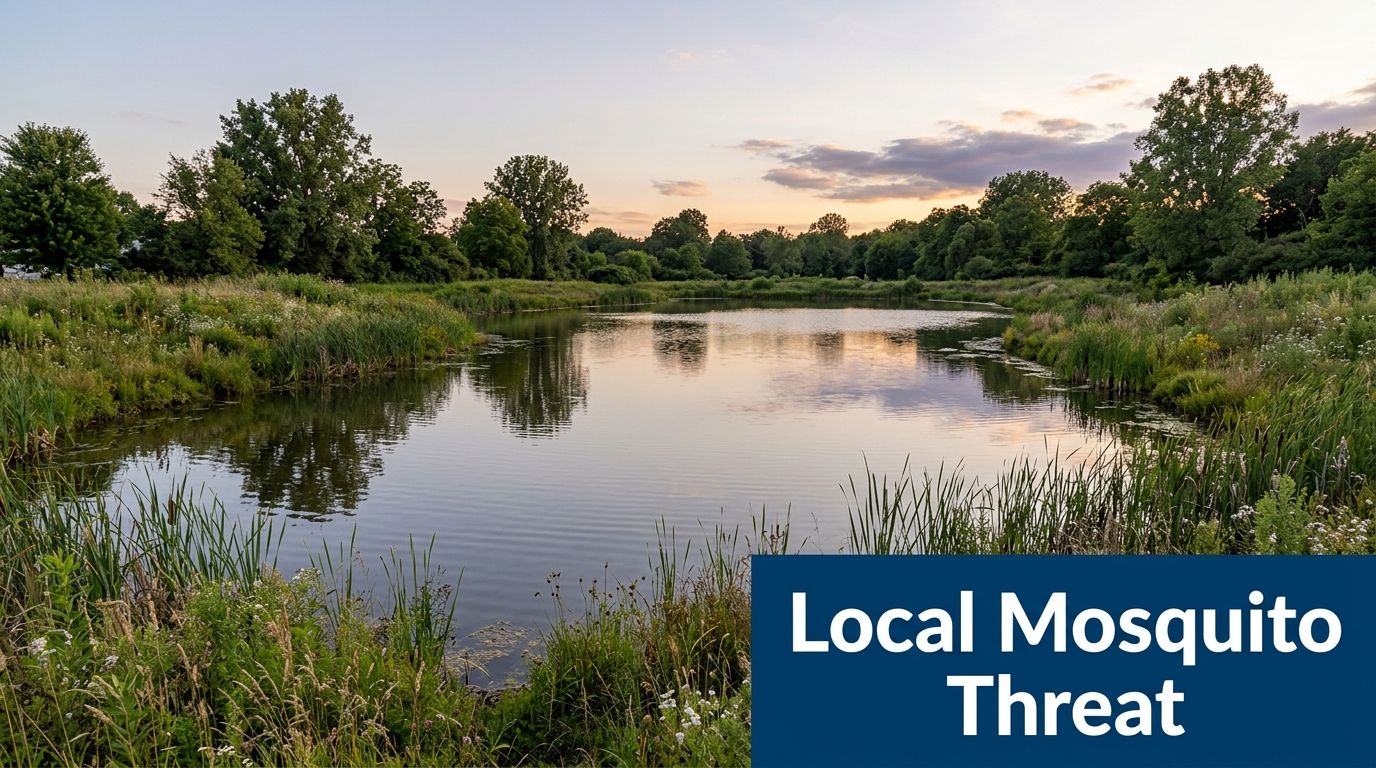
Properties near retention ponds, wooded areas, drainage ditches, and low-lying turf tend to hold moisture longer. Add summer humidity and thick ornamental landscaping, and you've got ideal mosquito harborage. Adults rest in cool, shaded foliage during the day, then move out when light levels drop.
That's why one house can feel much worse than the neighbor's, even on the same street. Small differences in drainage, shade, and clutter can change mosquito activity in a hurry.
The hidden breeding sites most people miss
The bigger issue is standing water. Mosquitoes can develop fast. The Indiana mosquito control guidance notes that mosquito populations can develop from stagnant water into thousands of biting adults within just three to seven days. That short window is exactly why waiting until you're getting bitten usually means you're already behind.
Common problem spots include:
- Clogged gutters that hold water after storms
- Birdbaths and plant trays that sit too long between cleanings
- Kids' toys and buckets left upside down in the yard
- Tarps and covers that sag and trap rainwater
- Old tires or decorative containers tucked beside a garage or shed
A trained technician looks for these because homeowners often focus on where they feel the bites, not where mosquitoes are starting.
The fastest way to lose control of a mosquito problem is to treat the air and ignore the water.
Why local source reduction comes first
In Northwest Indiana, source reduction isn't a side note. It's the foundation. If you remove breeding opportunities and treat the water that can't be eliminated, you cut off the cycle before it keeps replenishing itself.
For a closer look at local health concerns tied to biting mosquitoes, The Green Advantage also covers mosquito-borne risks and how mosquito control services mitigate them.
That's the difference between a yard that gets temporary relief and one that becomes consistently more usable through the season.
How Professional Mosquito Treatments Work
Professional mosquito work is built around Integrated Mosquito Management, not a single pass with a sprayer.
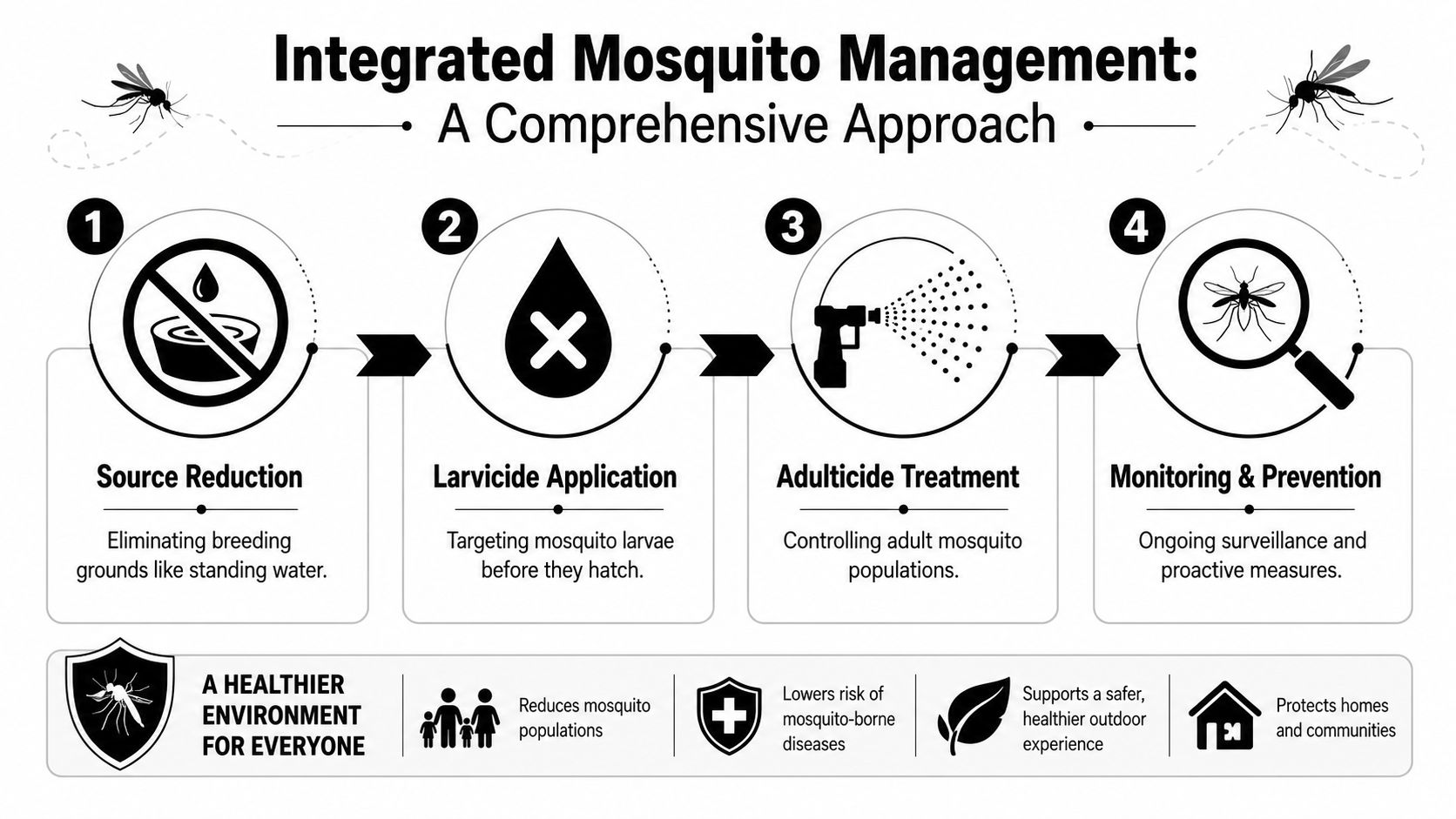
A practical program uses inspection, habitat correction, larval control, adult control, and follow-up. According to this overview of professional mosquito control services, professional mosquito control programs implement Integrated Mosquito Management centered on four critical tactics, with Bacillus thuringiensis israelensis (Bti) being the most widely used larvicide. The same source describes Bti as an EPA-classified low-toxicity bacterium that specifically targets mosquito larvae.
The four parts that actually matter
Homeowners usually notice the adult treatment first because that's the visible part. But that's only one part of the program.
| Treatment part | What it targets | Why it matters |
|---|---|---|
| Source reduction | Standing water and breeding spots | Cuts down future mosquito development |
| Larvicide application | Mosquito larvae in water | Stops mosquitoes before they become biting adults |
| Adulticide treatment | Resting and active adult mosquitoes | Reduces immediate biting pressure |
| Monitoring and prevention | Changing site conditions | Keeps the plan working over time |
What larviciding does
Larviciding is one of the most overlooked parts of mosquito control. When water can't be dumped, drained, or corrected right away, professionals may treat it so larvae don't mature into adults.
Bti is useful here because it's targeted. It's applied to mosquito breeding sites where larvae are active, which helps interrupt the cycle before you see the next wave around the patio or entry door.
A more complete provider, like The Green Advantage, stands apart by offering mosquito reduction programs that address both adult mosquitoes and larvae, which is the practical standard for homes dealing with repeat pressure in Crown Point and surrounding Northwest Indiana neighborhoods.
What adult mosquito treatments do
Adult mosquito treatments focus on the places mosquitoes rest and travel. That usually means shaded foliage, lower branches, dense shrubs, ivy, tall ornamental grasses, and damp edges near fences or tree lines.
Professionals often use ULV equipment or targeted application methods depending on the site and the treatment objective. The point isn't to fog every inch of the yard. The point is to apply product where adult mosquitoes are spending time.
Field insight: The best adult treatment in the world won't hold up well if the property keeps producing new mosquitoes every few days.
Why timing and inspection matter
A mosquito treatment should never be generic. Good service depends on what the technician sees that day. Recent rain, irrigation habits, leaf density, and standing water all affect the plan.
That's also why mosquito service ties into broader residential pest control and commercial pest control thinking. A warehouse lot, apartment grounds, daycare play area, or backyard patio all need different inspection priorities. The same integrated logic applies, even when the setting changes.
DIY Mosquito Traps vs Professional Service Benefits
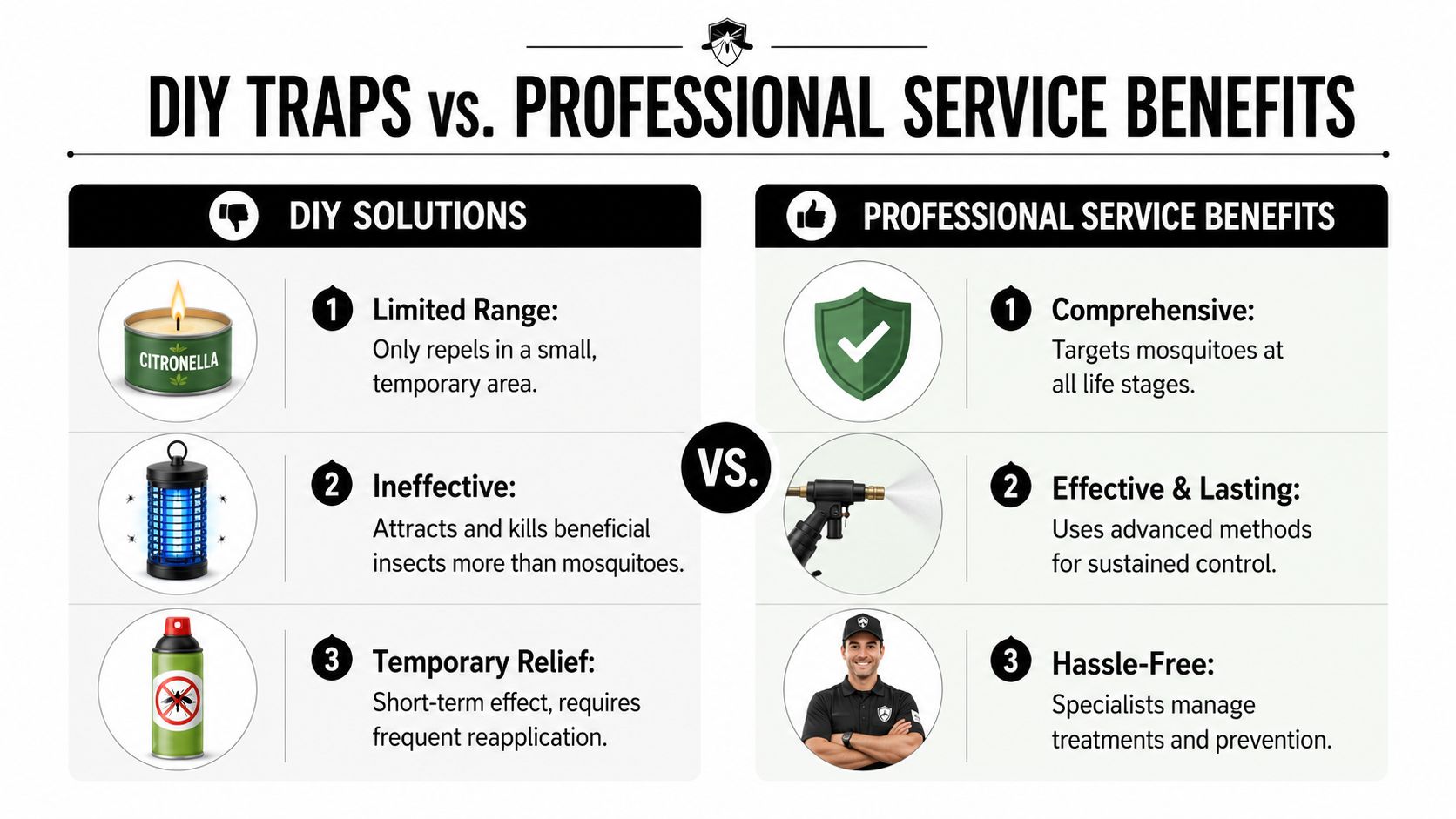
A lot of homeowners try DIY first. That makes sense. Citronella candles, bug zappers, yard foggers, and hardware-store sprays are easy to buy and easy to test. The problem is that most of them work around the edges of the issue, not at the source.
Where DIY methods fall short
DIY options usually struggle for one of three reasons. Their coverage is limited, their effect fades quickly, or they don't touch the breeding cycle.
A candle may help a small seating area when the air is calm. A bug zapper doesn't solve standing water. A spray can may knock down activity for a short time, but it won't give you a property-wide plan.
Here's a practical comparison:
| DIY approach | Common limitation | Professional difference |
|---|---|---|
| Citronella candles | Small temporary zone | Whole-property strategy |
| Bug zappers | Doesn't solve breeding sites | Focus on mosquito habitats and life stages |
| Store-bought sprays | Short-lived relief | Planned treatment intervals and inspection |
The bigger issue is strategy. The EPA's integrated mosquito control guidance states that a successful approach must include removing habitats, using structural barriers, controlling larvae, and controlling adults, and notes that up to 80% of mosquito reduction comes from eliminating breeding sites before adults emerge.
That's why “spray and hope” usually disappoints.
Why professional service holds up better
A professional service looks at the property as a system. It checks where mosquitoes breed, where they rest, how water behaves on the lot, and how the yard layout affects pressure through the season. That approach is more useful than rotating through DIY products and guessing what to try next.
If you've been comparing gadgets and attractants, this guide to the best outdoor mosquito traps is a good place to separate marketing from real-world limitations.
This short video also gives helpful context on why people often outgrow DIY methods once mosquito pressure gets consistent.
If you only attack the mosquitoes you can see, the ones you don't see are already replacing them.
For homeowners searching exterminator in Crown Point, IN or pest control near me, that's usually the turning point. They're not looking for one more gadget. They want the yard back.
What to Expect from Our Mosquito Service
Understanding what happens can improve one's comfort with a mosquito service. The process should be straightforward, not mysterious.
From the first call to the first visit
The first step is usually a conversation about what you're seeing. Some customers notice bites every evening around the deck. Others report activity near fence lines, playsets, dog runs, or landscaping beds. That early detail helps narrow down where pressure is building.
Once service is scheduled, the property gets evaluated for the conditions driving the issue. That includes resting areas for adults, likely breeding spots, drainage patterns, and features such as ornamental plantings, gutters, low spots, or nearby wooded edges. A good technician isn't just looking for mosquitoes. They're looking for the reasons mosquitoes keep coming back.
What treatment day usually looks like
For most homes, treatment focuses on targeted areas rather than blanket application across the entire yard. Shrubs, lower tree limbs, shaded foliage, damp corners, and other likely resting zones are the priority. If standing water can't be removed, that area may need a larval treatment as well.
Homeowners often ask whether they need to be home. In many cases, access to the yard and clear communication about gates, pets, and known problem areas matters more than being physically present the whole time. The key is making sure the property can be treated safely and completely.
A few things help treatment day go smoothly:
- Secure pets until the technician confirms the yard is ready
- Point out trouble spots like kiddie pools, drains, or wet corners
- Mention upcoming events if you're planning a party or family gathering
- Ask questions early if you have concerns about children, gardens, or outdoor seating areas
Safety and return-to-yard timing
Safety is one of the first concerns families bring up, and rightly so. Modern mosquito work should come with clear instructions, not vague reassurance. According to the Auburn mosquito spray FAQ citing CDC and EPA guidance, EPA-registered pesticides like modern ultra-low-volume adulticides are designed for quick environmental breakdown, often requiring no significant waiting period for outdoor safety.
That doesn't mean every product or every treatment type is identical. Residual applications and ULV applications can have different practical guidance, which is why homeowners should always follow the instructions given for their specific service.
Ask one simple question after treatment: “When can kids and pets go back out?” A professional should answer that clearly for the exact application used.
Communication matters as much as the product
A reliable provider should tell you what was treated, what was found, and what you can do between visits. That may include emptying containers, correcting drainage, or trimming dense foliage in areas where mosquitoes rest.
That kind of communication builds confidence. It's also what separates a real service relationship from a rushed one-time spray.
Seasonal Mosquito Plans for Northwest Indiana
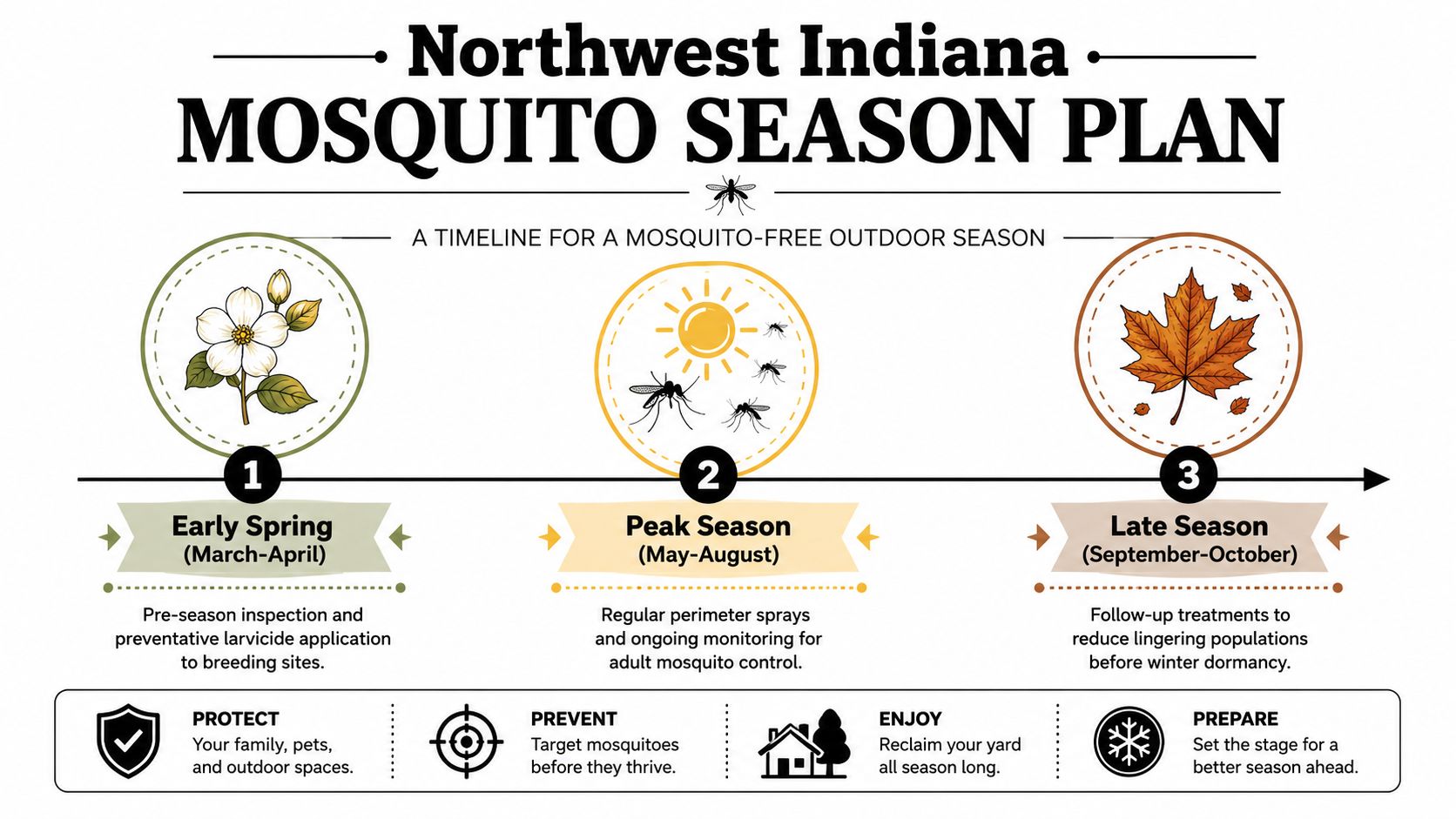
Mosquito control in this region works best when it's treated as a season-long plan, not a single event. Northwest Indiana weather doesn't stay consistent enough for a one-and-done approach.
The schedule that fits local conditions
For Indiana homes, recurring treatment is the normal pattern. Indiana mosquito service guidance says seasonal residential mosquito programs typically operate on recurring 3-week or 4-week treatment cycles from May through September, especially for properties near retention ponds, drainage ditches, or wooded areas.
That timing makes sense in Crown Point because mosquito pressure changes with rain, heat, and breeding conditions. A recurring schedule lets the technician adjust to what the property is doing instead of reacting after the yard becomes uncomfortable again.
How homeowners should think about planning
A sensible seasonal plan usually includes:
- Pre-season review of the property's likely breeding and resting areas
- Recurring service visits during the main mosquito months
- Mid-season adjustments if rainfall or standing water issues increase pressure
- Targeted support for events if you're hosting an outdoor party or gathering
Some homeowners only need ongoing seasonal protection. Others want a one-time treatment before a graduation party, cookout, or backyard event. The right plan depends on the property, the surroundings, and how you use the yard.
Pricing usually varies by factors such as lot size, layout, and how many treatment zones the property has. That's why an exact quote is more useful than a generic online price range. If you're also dealing with broader seasonal pest issues, this is often the time to ask about preventative pest treatments, spider control, wasp removal, or other outdoor-focused services.
Choosing The Right Mosquito Control in Crown Point
If you live in Crown Point, the right mosquito service should do more than make the yard smell treated for a day. It should address why mosquitoes are there, how they're reproducing, and what needs to change to keep pressure down over time.
That's the difference between a quick application and a dependable mosquito control service. Adult treatments help reduce immediate activity. Source reduction and larval control help keep the problem from rebuilding. In Northwest Indiana, you usually need all of that working together.
Homeowners searching for pest control in Crown Point, IN, exterminator near me, or residential pest control are usually looking for a company that communicates clearly, respects the property, and understands local conditions. Businesses and property managers looking for commercial pest control need the same thing. They need practical service, not guesswork.
The Green Advantage serves Crown Point and nearby Northwest Indiana communities with that local, integrated mindset. For mosquito work, that means evaluating the full property, focusing on safety, and building service around real site conditions instead of relying on a one-size-fits-all spray routine.
If your backyard has turned into a place you avoid, it's probably time for a more complete plan.
If you're ready to reclaim your yard, contact The Green Advantage to schedule a mosquito inspection or request a quote for your Crown Point home or property in Northwest Indiana. Clear answers, practical treatment, and a season-long plan can make outdoor time feel like yours again.