
You've just come inside after walking the dog through a Crown Point yard, and you notice a red mark on your ankle. It itches, your child has a swollen spot on an arm, or you find a tiny insect attached to skin. The question comes quickly: spider bite or tick bite?
The answer matters, but guessing from a red spot alone can lead you in the wrong direction. Ticks may attach without causing noticeable pain, while spider bites are often blamed for skin problems that have another cause. Your safest approach combines the bite's timing, appearance, symptoms, and the place where exposure occurred. If ticks or spiders are active around your property, The Green Advantage can also help identify and reduce the outdoor conditions that bring them close to your family.
Discovering a Mystery Bite in Your Backyard
A mystery bite often starts with an ordinary Northwest Indiana afternoon. You mow the lawn, pull weeds, move a stack of firewood, or let the dog explore the edge of the yard. Later, you notice a small red area and start wondering whether it came from a spider, tick, mosquito, or another insect.
The first step is to stay calm and look closely. Take a clear photo of the mark, note when you first noticed it, and check the surrounding skin. If a tick is still attached, the situation calls for prompt removal. If there's no insect present, the mark alone usually can't prove what caused it.
What the location can tell you
Exposure history is useful. A walk through tall grass, brush, leaf litter, or a wooded edge makes a tick more plausible. A bite noticed after reaching into a dark basement corner, shed, garage, crawl space, or woodpile may raise a spider question, but it still doesn't confirm a spider bite.
Children and pets deserve a careful check after outdoor activity. Look through hair, around ears, under collars, between toes, around the waist, and in other protected areas. Ticks can be easy to miss, especially when they're small or attached where clothing hides them.
Practical rule: Treat the source as unknown until you have stronger evidence. A red, swollen spot isn't proof of a spider bite.
Why local property conditions matter
Northwest Indiana homes often combine lawns, landscaping, shaded foundation areas, ornamental plantings, brush, and outdoor storage. Those features can create shelter for ticks and spiders, particularly where vegetation stays dense or debris remains undisturbed.
You don't need to turn your yard into a sterile space. You do need to reduce unnecessary hiding places, inspect outdoor areas regularly, and address recurring pest activity at its source. For homeowners searching for pest control near me, pest control in Crown Point, IN, or an exterminator near me, the right service starts with inspection rather than assuming every unexplained mark has the same cause.
Comparing the Appearance and Symptoms of Bites
A homeowner who notices a red, painful spot after yard work needs to assess the timing, appearance, and exposure setting together. A tick can attach without causing pain, while a suspected spider bite may become painful, swollen, or irritated soon after contact. Those symptoms alone do not identify the pest.
| Feature | Spider Bite | Tick Bite |
|---|---|---|
| How it's usually identified | The strongest evidence is witnessing the bite and identifying the spider | A tick may be found attached, or a delayed expanding rash may develop |
| Early sensation | Localized pain, tenderness, itching, or swelling may occur | Often painless and easy to overlook |
| Skin appearance | Redness or swelling can occur, but the mark is not specific | A small bite mark may precede an expanding erythema migrans rash |
| Symptom timing | Often noticed near the start of the skin reaction, though symptoms vary | Lyme-related symptoms commonly begin 3 to 30 days after the bite, with average onset around 7 days (CDC tick-borne disease guide) |
| Bullseye pattern | Not a dependable spider-bite feature | The classic bullseye appearance may be absent |
| Outdoor clues | A basement, garage, shed, woodpile, or undisturbed storage area may provide context. Use our spider identification guide to review likely household species | Tall grass, brush, leaf litter, trails, and wooded edges increase concern |
| Best next step | Clean the area and seek evaluation if it worsens or the cause remains uncertain | Remove an attached tick promptly and monitor for delayed symptoms |
A Lyme-related rash, called erythema migrans, starts near the bite site and gradually expands over several days. It can reach 12 inches, or 30 centimeters, or more across, may feel warm, and is rarely itchy or painful (CDC tick-borne disease guide). It may be circular or oval, with a center that looks lighter or darker, rather than a neat target.
Don't rely on the bullseye myth
In Lyme-endemic settings, erythema migrans appears in as many as 70% of cases overall, but the classic bullseye form is less consistent. One cited regional study found that only 43% of Maine Lyme patients had that classic appearance (Bay Area Lyme Foundation discussion of the bullseye rash).
No bullseye doesn't reliably rule out Lyme disease. An expanding red or oval patch after outdoor exposure deserves medical attention, especially when a person has spent time around Northwest Indiana grass, brush, or wooded edges.
Treat a suspected spider bite with the same practical caution. A reliable diagnosis generally requires a witnessed bite, recovery of the spider, expert identification, and symptoms that fit. Many lesions labeled spider bites are other insect bites, infections, or skin conditions. For that reason, do not identify the cause from redness, pain, or swelling alone.
Use the setting and timeline to decide your next action. If the mark is expanding, symptoms are developing, or the cause is unclear, arrange medical advice while recording when and where the exposure occurred. After the health concern is addressed, inspect the basement, garage, shed, woodpile, and other shelter areas that may support recurring pest activity.
Taking Immediate Action and Safe Tick Removal
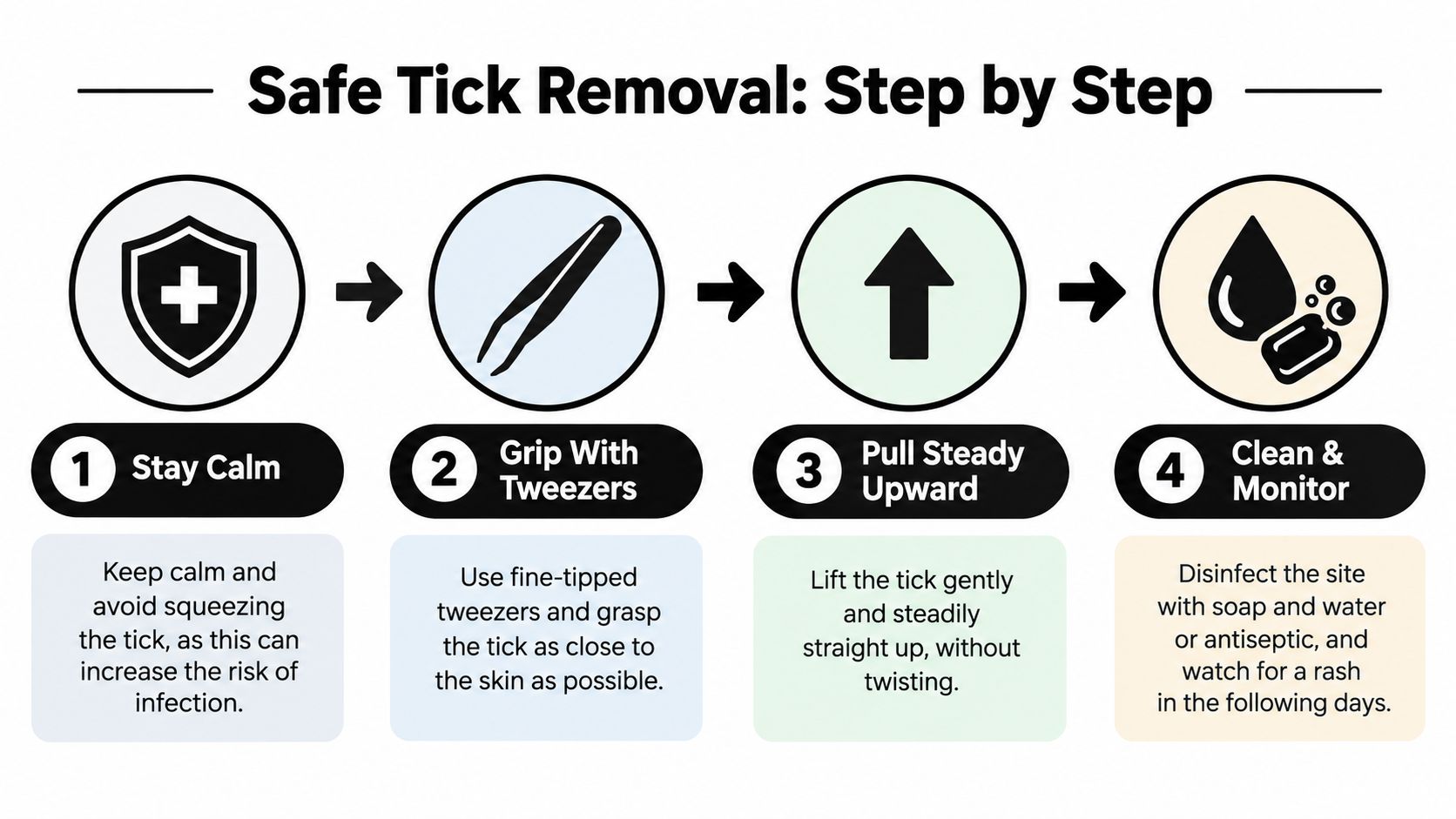
When a tick is attached, remove it now. Don't wait for a rash, don't cover it with petroleum jelly, and don't burn it. The practical goal is simple: shorten the time the tick remains attached.
Remove an attached tick safely
- Use fine-tipped tweezers. Position the tips as close to the skin as possible.
- Grip the tick near its mouthparts. Avoid squeezing the tick's body.
- Pull upward steadily. Use even pressure and don't twist or jerk.
- Clean the area and your hands. Soap and water or an appropriate disinfectant can clean the site.
- Record the exposure. Note the date, location on the body, and any estimate of how long the tick was attached. A photo may help your healthcare provider.
If a small mouthpart remains, don't dig aggressively into the skin. Clean the site and ask a healthcare professional what to do, especially if the area becomes increasingly red, painful, warm, or drains.
Tick-borne bacterial transmission becomes more likely as attachment continues. Experimental work found no transmission during the first 24 hours, with peak transmission between 48 and 72 hours (Clinical Infectious Diseases research on tick attachment and transmission). That doesn't mean a short attachment is automatically harmless, but it does make prompt removal the highest-value action you control.
Care for an unexplained skin reaction
For a suspected spider bite or another minor skin reaction, wash the area with soap and water. Apply a cold compress wrapped in cloth to help with swelling, and avoid scratching or breaking blisters.
Seek urgent help for trouble breathing, swelling of the face, lips, tongue, or throat, widespread hives, fainting, or rapidly worsening symptoms. Those reactions aren't situations for home pest identification.
If you find a tick indoors, disposing of it safely and checking people and pets matters more than trying to determine whether ticks can establish themselves inside. For practical household guidance, see what homeowners should know about ticks living indoors.
Recognizing When to Seek Medical Care
You find a bite after working in the yard, but the skin looks almost normal. Record the exposure date, take a clear photo, and monitor your health. A mild mark does not rule out an illness that appears later.
Call a healthcare professional if fever, fatigue, headache, body aches, joint symptoms, or a spreading rash develops after possible tick exposure. Lyme symptoms can begin 3 to 30 days after a bite, with average onset around 7 days. An initially quiet bite does not settle the question, as noted earlier.
The 72-hour decision window
If Lyme disease prevention may be appropriate, contact a clinician within 72 hours after tick removal to ask about doxycycline prophylaxis. The decision depends on the tick, likely attachment duration, exposure setting, symptoms, and local disease risk. Do not wait for symptoms before seeking advice.
A clinician must determine whether preventive treatment fits the full exposure. Do not make that decision from the bite's appearance or an internet photograph.
Be careful with the spider label
A painful or swollen lesion does not prove a spider bite. Confirmed spider bites are uncommon because diagnosis usually requires witnessing the bite, recovering the spider, identifying it, and matching the symptoms to that species.
Arrange medical evaluation if the lesion grows, becomes markedly more painful, blisters, darkens, drains fluid, or appears with fever or other systemic symptoms. Infection and other skin conditions can look like a spider bite and require different treatment.
Seek emergency help for trouble breathing, swelling of the face, lips, tongue, or throat, widespread hives, fainting, or rapidly worsening symptoms.
Medical priority: Pest control can reduce future exposure around your Crown Point property, but it cannot diagnose or treat a possible tick-borne illness. Use a healthcare professional for symptoms and treatment decisions, then address the yard or home conditions that may be contributing to repeated bites.
Preventing Bites Around Your Crown Point Home
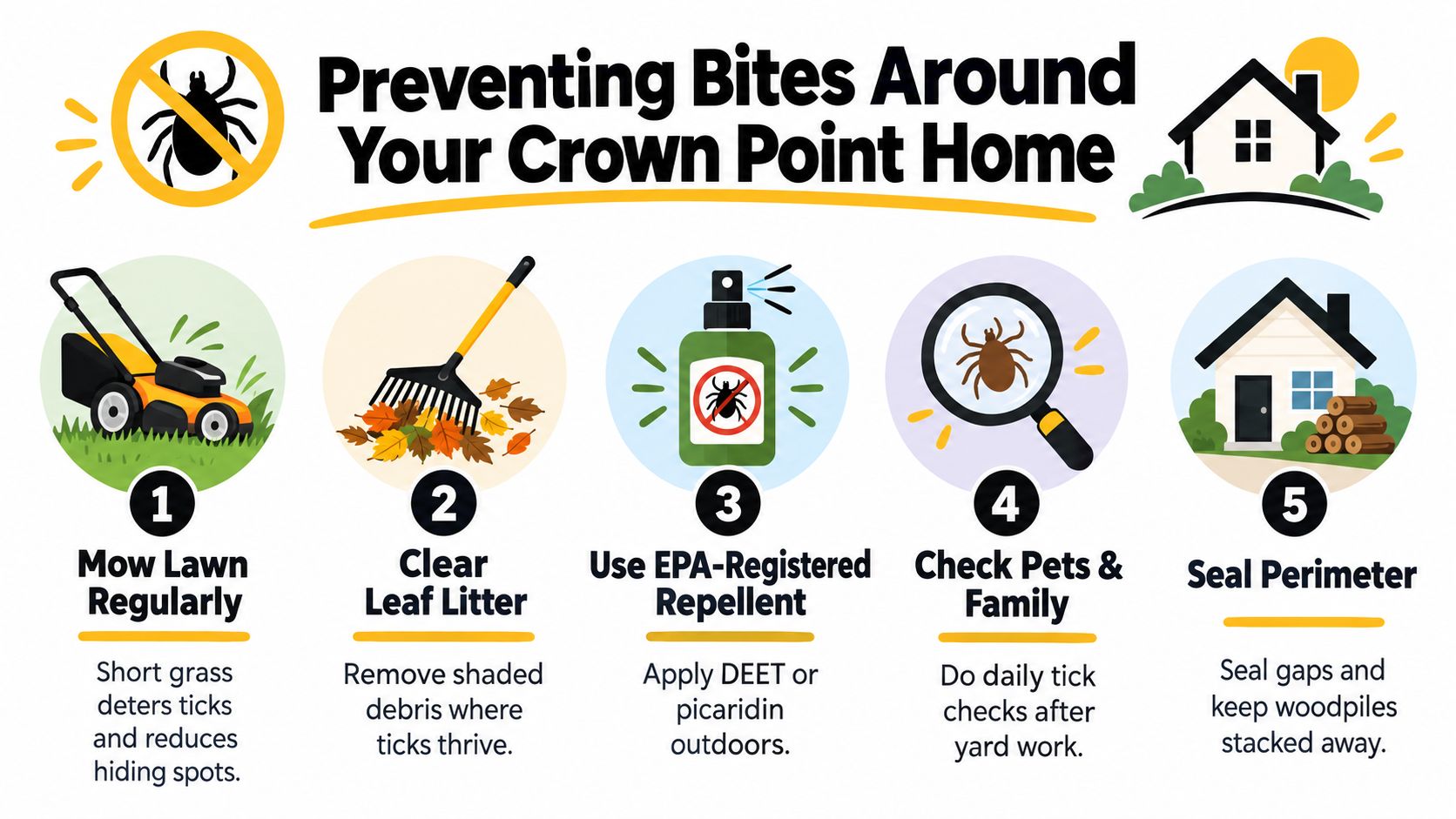
The most effective yard strategy is habitat reduction. Ticks favor protected vegetation and shaded debris, while spiders take advantage of cracks, clutter, and insect activity around foundations. A cleaner perimeter makes your property less inviting without requiring aggressive chemical use everywhere.
Start with routine maintenance:
- Mow the lawn regularly. Shorter grass gives ticks fewer sheltered pathways and makes inspections easier.
- Clear leaf litter. Remove accumulated leaves, brush, and damp debris from play areas, paths, and foundation edges.
- Separate lawn from brush. Use wood chips or gravel as a transition between maintained lawn and wooded or overgrown areas.
- Move storage away from the house. Keep firewood stacked neatly and reduce undisturbed piles near doors, windows, and siding.
- Seal entry points. Inspect foundation cracks, gaps around utility penetrations, door sweeps, window screens, and other openings where spiders can enter.
Match prevention to the season
Tick vigilance should rise during spring and early summer, when the largest seasonal surge occurs, with a smaller peak in fall. CDC surveillance estimates that about 31 million people are bitten by ticks each year in the United States (CDC tick-bite surveillance update).
Use an EPA-registered repellent as directed when working in brush or tall grass. Check children, pets, and clothing after yard work or walks, and wash outdoor clothing according to its care instructions. Daily checks are especially sensible for dogs that run along wooded edges or spend time in leaf-covered areas.
Eco-friendly pest prevention doesn't mean ignoring an active problem. It means starting with exclusion, sanitation, habitat changes, and targeted treatment rather than applying products without understanding where pests are coming from.
Protecting Your Property With Professional Pest Control
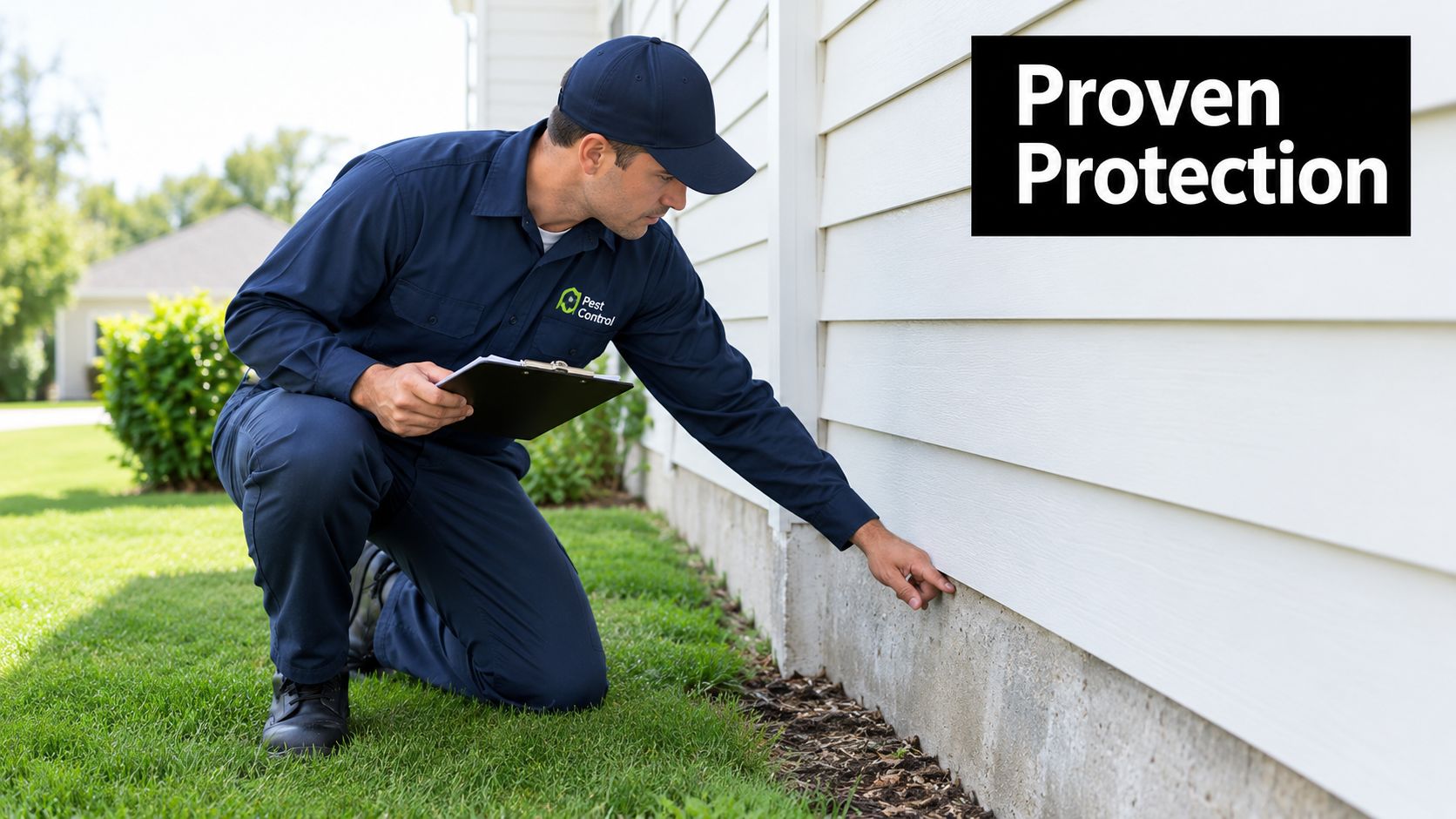
DIY measures help, but recurring activity usually points to a property condition that needs a closer look. A professional inspection can identify harborage areas, entry points, dense vegetation, moisture concerns, and insect activity around the foundation that a quick walk-through may miss.
The Green Advantage offers residential pest control and commercial pest control in Crown Point and nearby Northwest Indiana communities. Its service approach includes site diagnosis, direct communication, and treatments suited to the property. Depending on the inspection, relevant services may include spider control, tick control, mosquito control, ant control, termite control, rodent control, wasp removal, and preventative pest treatments.
What a property-focused visit should include
A useful inspection doesn't stop at the room where someone found a bite. The technician should assess the exterior and connect indoor observations with outdoor conditions.
- Exterior review: Foundation lines, doors, windows, landscaping, decks, sheds, woodpiles, and shaded areas receive attention.
- Source identification: The team looks for conditions supporting ticks, spiders, mosquitoes, rodents, or other pests.
- Treatment planning: Recommendations should match the pest, the location, and the household's concerns about children, pets, employees, or customers.
- Follow-up planning: Seasonal issues may require monitoring or repeat service rather than a single visit.
The same logic applies to a landlord, property manager, or business owner. A recurring bite complaint may signal activity around entrances, landscaping, storage areas, or employee pathways. Commercial service should protect people and operations while addressing the conditions that keep pests returning.
Choose an exterminator in Crown Point, IN who explains what was found, what treatment is being proposed, and what you can do between visits. Clear communication matters as much as the product used.
Scheduling Your Local Pest Inspection
Use this simple decision guide:
- Tick attached: Remove it promptly, document the exposure, and contact a healthcare professional about medical follow-up.
- Expanding rash or delayed illness: Seek medical evaluation, even without a classic bullseye appearance.
- Unknown painful or swollen lesion: Clean it, monitor it, and don't assume it came from a spider.
- Repeated activity around the property: Schedule a pest inspection to find and correct outdoor or structural causes.
For homeowners and businesses in Crown Point, IN and nearby Northwest Indiana service areas, a targeted inspection can turn an uncertain bite concern into a practical property plan. The right response combines timely medical care when symptoms call for it with sensible exclusion and pest management around the home.
The Green Advantage provides local residential and commercial pest inspections, targeted spider and tick control, mosquito reduction, and preventative treatments for Crown Point properties. Visit The Green Advantage to request a quote, schedule an inspection, and discuss a practical plan for keeping biting pests outside.