
Yes, ticks can live indoors for days or weeks. Gulf Coast ticks survived an average of about 18 days indoors, while lone star ticks averaged about 11 days, but only the brown dog tick can establish a permanent indoor breeding population in a home.
You may have found one after your dog came in from a walk, or noticed a small dark speck moving across the floor near the sofa. That discovery is unsettling, especially when children and pets use the same rooms. For homeowners searching for pest control near me or an exterminator near me in Crown Point, IN, the important answer is not merely “yes” or “no.” It depends on the species, how it entered, and whether it can find a suitable host and hiding place.
Understanding If Ticks Can Live Indoors
A tick on your living-room floor is often a temporary hitchhiker, not proof that your house has an established infestation. Ticks commonly enter on pets, clothing, shoes, blankets, or outdoor gear. The CDC's tick prevention guidance confirms that ticks can be carried into homes on clothing and pets.
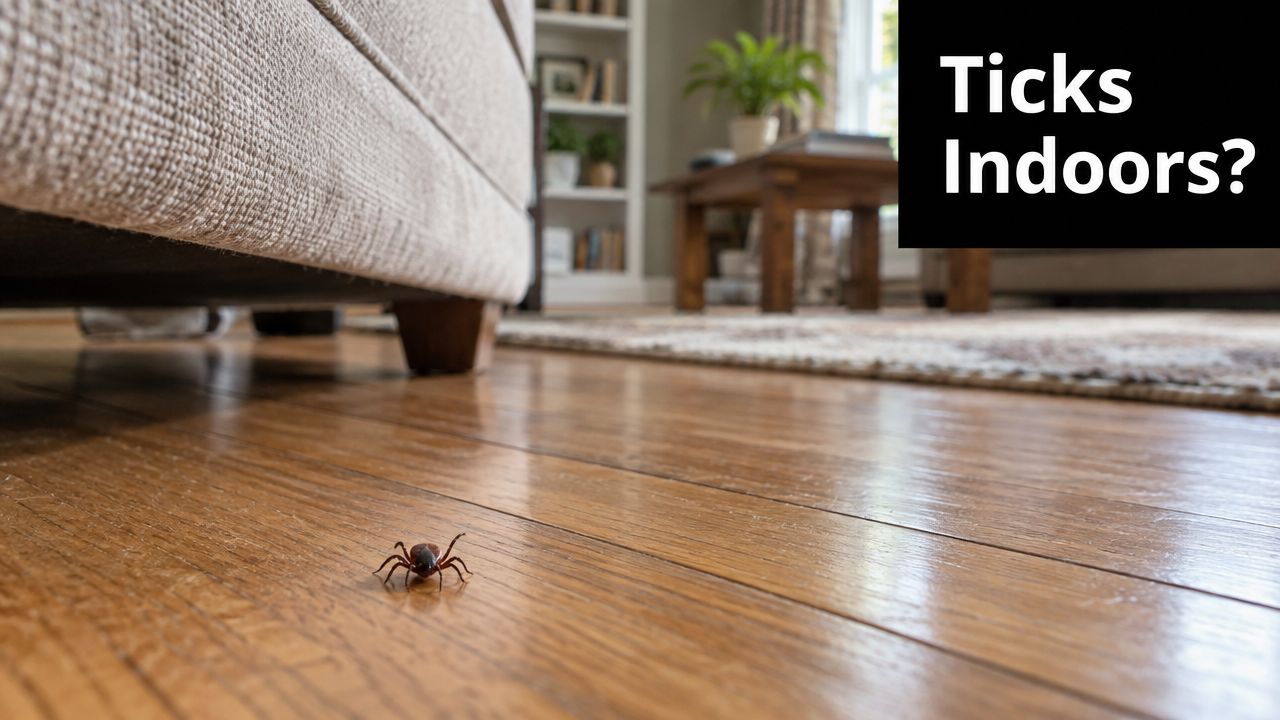
Most species struggle once they leave a humid outdoor environment. Heated or air-conditioned indoor air pulls moisture from their bodies, so many eventually dry out. That doesn't mean they disappear immediately, however. A tick can remain capable of biting while it searches for another host, which is why finding one indoors deserves a calm but prompt response.
Temporary presence versus an infestation
The key distinction is survival versus reproduction. A blacklegged tick or American dog tick may enter on a person or dog and remain alive for a while, but that doesn't mean it can create a self-sustaining household population. The brown dog tick is different. It has adapted to indoor conditions and can complete its life cycle inside a house or kennel when a dog host is available.
In Crown Point and surrounding Northwest Indiana communities, a single tick after time outdoors often calls for inspection and cleanup rather than panic. Repeated ticks, especially around dog bedding, crates, baseboards, upholstered edges, or utility rooms, deserve a more thorough evaluation.
Practical rule: Treat one indoor tick as a warning to inspect. Treat recurring ticks as a reason to investigate the home, pets, and yard together.
For a closer look at survival times, review how long ticks can live indoors. The useful takeaway is straightforward: remove the tick safely, check the person or pet who may have carried it inside, and watch for a pattern instead of assuming the entire home is infested.
How Different Tick Species Survive Inside Your Home
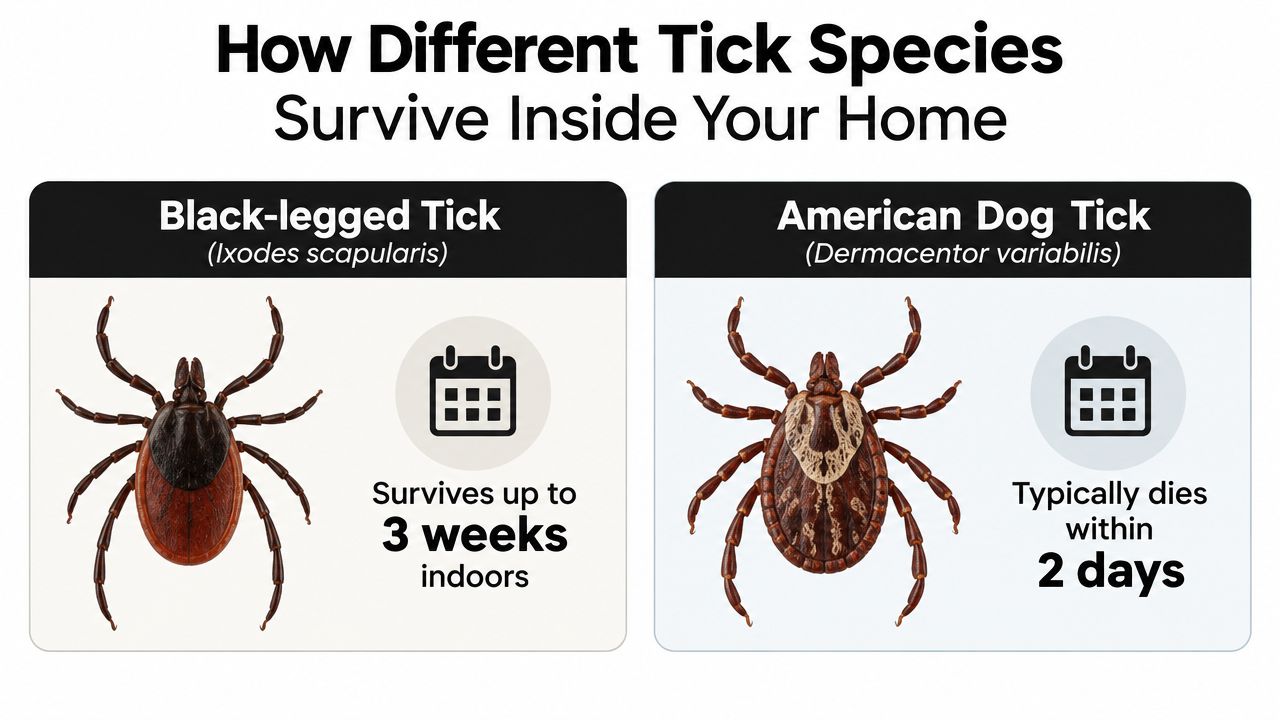
Indoor survival varies because tick species don't all tolerate the same temperature, humidity, or flooring. Research summarized by Ohio State University on indoor tick survival found that Gulf Coast ticks survived an average of about 18 days indoors, while lone star ticks survived an average of about 11 days. Some Gulf Coast ticks lasted up to 25 days on vinyl flooring, and some individuals survived up to 15 days on shag-like carpet.
Those findings matter because they replace an outdated assumption that every tick dies within a few hours. A tick carried into a Crown Point home may remain alive long enough to move from clothing to flooring, bedding, or a pet. Indoor survival still doesn't automatically equal reproduction. For most species, drying is the limiting factor.
The species homeowners are most likely to confuse
Blacklegged ticks generally survive only about a day indoors unless they locate a moist refuge. American dog ticks and lone star ticks may last a few days to a week, but usually don't remain long enough to feed again, according to species-specific indoor survival guidance. These are broad patterns, not a reliable identification method. Temperature, humidity, flooring, access to hosts, and hiding places can change what happens inside a particular property.
A dry floor in an open room is a poor environment. A protected crack beside a baseboard, a damp item of clothing, or dense carpet can provide a temporary microclimate. Even then, most transient ticks eventually die because ordinary household conditions don't supply the humidity they need.
Why brown dog ticks require a different response
The brown dog tick is the major technical exception. Public health information describes it as adapted to indoor life, and it can complete its full life cycle inside homes or kennels if a dog host is available. That makes it the species most associated with an established indoor infestation.
Brown dog ticks may hide in cracks, seams, baseboards, dog crates, pet bedding areas, and other protected resting locations. The presence of a dog, repeated sightings, and ticks appearing in several protected areas raise more concern than a single outdoor tick found in an open room.
A homeowner can't reliably confirm species by casual inspection alone. Save the specimen in a sealed container or take a clear photograph, note where it was found, and arrange professional identification if sightings continue.
Recognizing the Signs of an Indoor Tick Presence
Start with the source, not the floor. If you find a tick indoors, inspect the pet or person who recently spent time in tall grass, wooded edges, parks, or leaf-covered areas. Run your hands over a dog's coat, check around the ears, collar, neck, toes, and between the legs, and examine clothing before it goes into bedrooms or laundry baskets.
A pet may scratch, lick, shake its head, or seem uncomfortable, but ticks don't always cause obvious behavior changes. Check pet bedding, crate seams, rugs, upholstered furniture edges, and baseboards near the places where the animal rests. Keep a flashlight nearby because ticks can blend into dark fabric, flooring gaps, and fur.
A practical indoor inspection
Use a simple sequence:
- Contain the evidence. Don't crush a tick with bare fingers. Place it in a sealed container or a zippered bag, and record the room and surface where you found it.
- Check likely carriers. Inspect pets, cuffs, socks, shoes, coats, backpacks, and outdoor blankets.
- Search resting zones. Look along baseboards, under furniture edges, around crates, beside pet bedding, and near utility-room entry points.
- Look for recurrence. One tick after outdoor exposure suggests introduction. Repeated sightings in protected locations suggest a problem that needs professional assessment.
A recurring pattern is more informative than one isolated discovery. Ticks appearing around the same dog crate or bedding area deserve attention even if you don't see many at once.
If a tick was attached to a person, remove it with fine-tipped tweezers and monitor the bite site and your health. Contact a medical professional if symptoms develop or if you have concerns about the bite. For pets, ask a veterinarian about species identification and an appropriate tick preventive.
Essential Steps for Safe Tick Removal and Cleanup
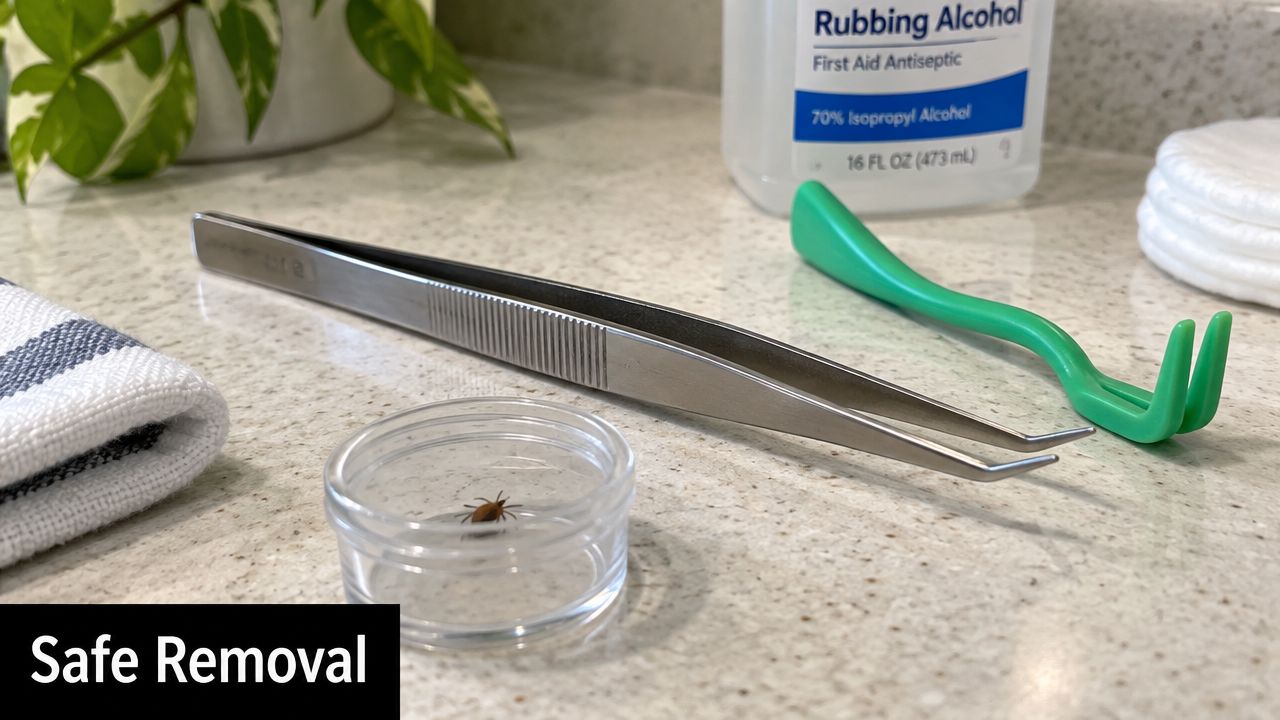
Remove an attached tick promptly with fine-tipped tweezers. Grasp it close to the skin, pull upward with steady pressure, and avoid twisting or squeezing the body. Don't apply heat, nail polish, petroleum products, or other substances that can irritate the skin or cause the tick to regurgitate material into the bite site.
For a loose tick, use tissue, tweezers, or a small container instead of bare hands. Seal it before disposal, then wash your hands and clean the contact area. If you want to document it, keep the specimen in a sealed container rather than leaving it loose on a counter.
Cleaning the room and pet areas
Vacuum carpets, rugs, upholstery, floor edges, and cracks near pet resting areas. Move slowly along seams and baseboards, then empty the vacuum outside into a sealed bag. Wash pet bedding according to its care label, and use the hottest safe wash and dry settings available. Clean crates, carriers, and removable mats rather than treating them as permanent hiding places.
Do the same for clothing and outdoor gear. Place washable items directly into laundry, and keep unwashable gear contained until it can be inspected. Cleaning reduces loose ticks and helps reveal whether sightings continue, but it won't identify or eliminate an established brown dog tick population by itself.
Safety first: Household insecticides aren't interchangeable. Read the label, keep people and pets away as directed, and never apply a product to an animal unless the label specifically permits that use.
A single tick can often be handled with careful removal, inspection, and cleaning. Professional help becomes more sensible when ticks recur, appear in several rooms, show up around dog bedding, or continue after you clean. The following video demonstrates basic tick removal technique and can help you recognize the careful, close-to-skin approach required.
Comparing DIY Prevention and Professional Pest Control
DIY prevention works best when the problem is an isolated introduction. Checking pets after outdoor activity, separating outdoor clothing, vacuuming resting areas, and maintaining veterinarian-recommended prevention can reduce the chance that a tick stays unnoticed. These steps are inexpensive, immediate, and useful even when a professional inspection is scheduled.
They have limits, though. A homeowner may remove the visible tick while missing eggs, developing ticks, or adults hidden behind a baseboard, beneath crate edges, or inside a protected utility-room gap. Spraying every surface can create unnecessary exposure without addressing the source, and over-treating a pet or using a product off-label can be dangerous.
When home measures make sense
DIY action is reasonable when:
- The sighting is isolated. You found one tick after a walk, removed it safely, and found no additional evidence during a careful inspection.
- The carrier is addressed. You checked the pet, clothing, bedding, and gear that could have brought it inside.
- The pattern stops. Cleaning and monitoring produce no further sightings.
Outdoor prevention also matters. Reduce contact between pets and tall grass, leaf litter, and shaded vegetation where ticks can wait for a host. For yard-specific planning, use these flea and tick control strategies for the yard as part of a broader prevention routine.
When professional treatment earns its place
Call a licensed pest professional when sightings repeat or cluster in areas associated with a dog. A technician can inspect likely harborage sites, distinguish a transient tick from signs of an established problem, and select targeted treatment rather than applying a broad, improvised spray. A professional plan should also consider the yard, pet routines, entry points, and any adjacent units in a rental or multifamily property.
Cleaning is part of the answer, especially for fabrics and surfaces that may hold pests. Homeowners dealing with several household pests may also benefit from these bed bug and mite cleaning strategies, while recognizing that tick control requires species-aware inspection and treatment.
Professional pest control isn't a replacement for pet prevention or routine checks. It adds diagnosis, targeted application, documentation, and follow-up when the problem has moved beyond a single hitchhiker. The same decision applies to residential pest control and commercial pest control: recurring evidence calls for a plan, not repeated guesswork.
Why Choose The Green Advantage for Your Home
A sensible response in Crown Point starts with a clear diagnosis. The Green Advantage is a family-owned pest control company serving Crown Point, IN and surrounding Northwest Indiana communities, with licensed and certified services for residential and commercial properties.
A straightforward service process
The first call should establish what happened, where the tick was found, whether pets are present, and whether anyone experienced a bite. Direct communication with knowledgeable office staff helps move questions and scheduling forward, while field technicians focus on inspecting the property and identifying conditions that support pest activity.
During an inspection, the technician can pay close attention to brown dog tick hotspots, including baseboards, pet bedding zones, crate areas, upholstered edges, utility rooms, cracks, and seams. That targeted approach is more useful than treating every room without understanding where ticks may be hiding.
Treatment that fits the property
The Green Advantage provides environmentally mindful pest management for homes and businesses. Depending on the findings, the conversation may include interior tick treatment, yard-focused prevention, pet coordination with a veterinarian, or related services such as ant control, termite control, mosquito control, rodent control, spider control, wasp removal, and seasonal pest planning.
The company also provides pest inspections, mosquito reduction programs, and ongoing service options. Property managers, landlords, homebuyers, and local businesses can request an assessment suited to the building and its occupants rather than applying a one-size-fits-all response.
Transparency matters when a homeowner is worried about family and pet safety. Ask what the technician found, which areas need attention, what preparation is required, and what follow-up should look like. That information helps you decide whether you need one visit, continued monitoring, or a wider preventative pest treatment plan.
The Green Advantage offers targeted tick inspections and pest control for Crown Point homes, including help with indoor brown dog tick hotspots and outdoor exposure areas. Visit The Green Advantage to schedule an inspection or request a quote for residential or commercial pest control in Northwest Indiana.