
A lot of Crown Point homeowners reach the same point every summer. The grass looks good, the patio is ready, the dog is running the fence line, and the kids want to stay outside until dusk. But once you start finding ticks on pets, on pant legs, or near the wooded edge of the yard, relaxing gets harder.
That's especially true in Northwest Indiana, where humid weather, shaded lots, leaf litter, and tree lines give ticks exactly what they want. A generic once-over with a store-bought spray usually doesn't solve the full problem. Real tick control yard work takes a smarter plan, especially on properties near brush, drainage areas, fence rows, and woods.
For homeowners searching for pest control near me, exterminator near me, or pest control in Crown Point, IN, the goal usually isn't just to kill what's visible today. It's to make the yard feel usable again. That means lowering tick pressure, reducing hiding spots, and building a practical routine that fits how families in Crown Point use their property.
Protecting Your Family and Pets in Northwest Indiana
On a warm evening in Crown Point, the backyard should feel simple. Grill on. Kids outside. Dog circling the patio and cutting through the grass. Then somebody notices a tick crawling on a sock, or a pet comes in and needs a close check before anyone settles in for the night.
That worry is common here because many Northwest Indiana yards have the same setup. Lawn in the middle. Shrubs near the house. A fence line, wood line, or brushy border around the back. Add summer humidity and damp shade, and ticks don't have to travel far to move from edge habitat into spaces where families spend time.

Why local yards stay risky
Ticks don't need a neglected property to become a problem. A clean, well-kept yard can still have pressure if it backs up to woods, holds moisture, or gives rodents and deer easy travel routes. That's why broad online advice often falls short for homeowners in Crown Point and nearby Northwest Indiana communities.
A practical plan usually starts with the yard, but pets need attention too. If your dog is the first one bringing ticks inside, it also helps to review basics like choosing effective tick shampoo so your pet care routine matches what you're doing outdoors.
Ticks are a yard-edge problem first, but families feel the impact on patios, play areas, and pets.
What homeowners want from a real solution
Homeowners aren't looking for a complicated lecture. They want to know what works, what doesn't, and whether they can let their kids and pets use the yard without second-guessing every trip outside.
That's where local experience matters. In Crown Point, IN, a tick problem usually isn't just about one pest. The same moisture, brush, and rodent activity that support ticks can also overlap with broader residential pest control concerns like mosquito control, rodent control, spider activity, and seasonal pest issues that show up around garages, sheds, and foundations.
A good plan starts by treating the yard like a system. The wooded edge matters. Pet routes matter. Leaf litter matters. And in this area, the weather matters more than many homeowners realize.
First Steps to a Tick-Safer Yard
The fastest way to improve a tick control yard setup is to make the property less comfortable for ticks before you think about products. Habitat change doesn't replace treatment when tick pressure is already high, but it gives every other step a better chance to work.
Here's the yard checklist many homeowners in Crown Point can start over a weekend.
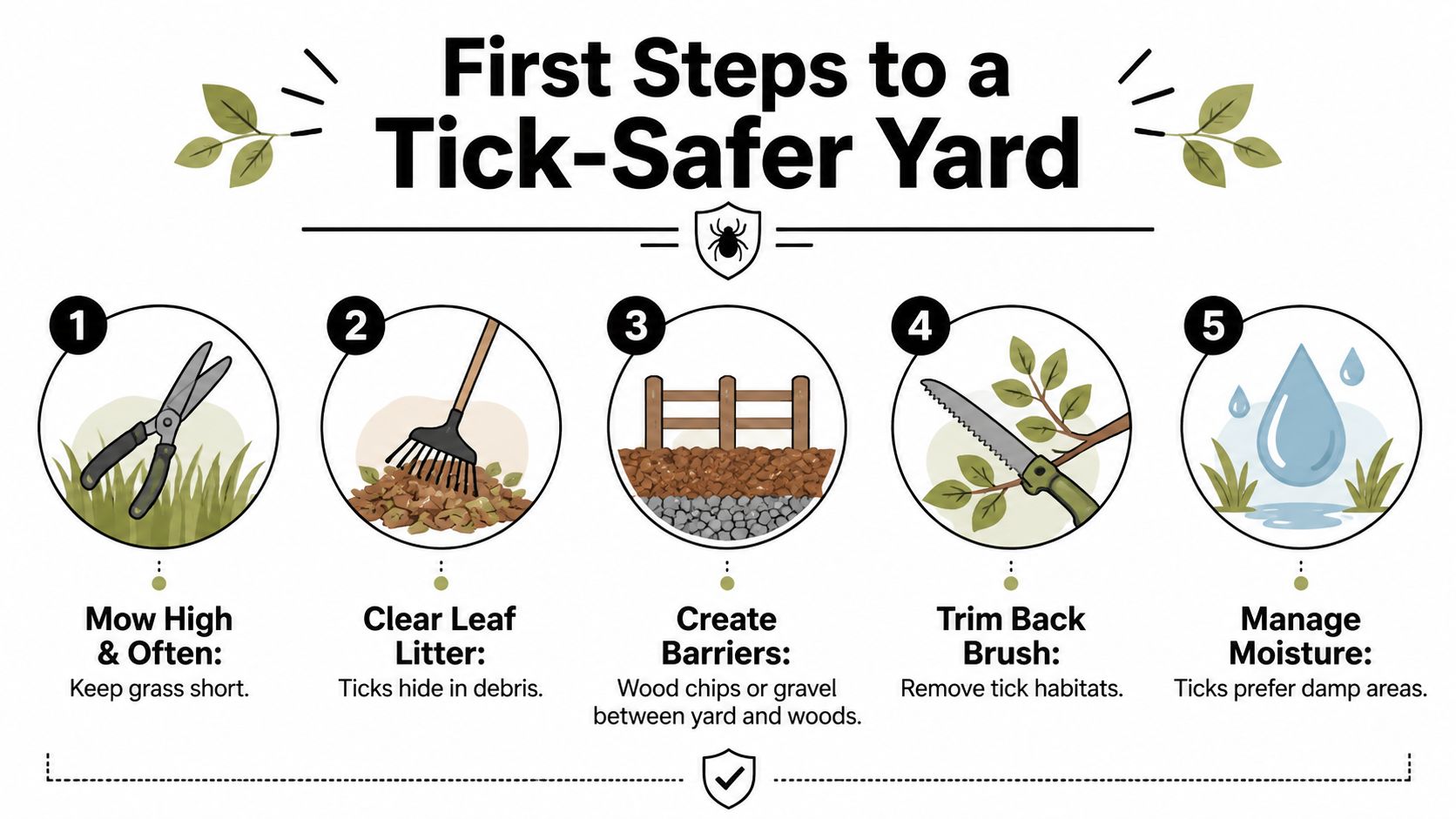
Start with mowing, borders, and cleanup
The clearest evidence-based yard method combines maintaining turf height at 2 to 2.5 inches, creating a continuous 3-foot-wide barrier of dry inorganic material between lawn and woods, and removing leaf litter and tall grasses in March to April before nymphs become active according to this yard management guidance.
That sounds straightforward, but the details matter.
- Keep turf in the right range: Grass that stays around 2 to 2.5 inches dries faster and holds less humidity at ground level. Ticks prefer the cooler, damp layer that builds up when turf gets shaggy.
- Build a real barrier: Use dry inorganic material such as crushed stone or decomposed granite. The target is a continuous 3-foot-wide barrier. Gaps defeat the point because ticks and host animals use those breaks as crossing points.
- Rake out leaf litter early: Leaf piles and matted debris hold moisture and give ticks cover. Clearing those zones before spring activity picks up helps reduce sheltered habitat.
What to avoid in the border zone
Many homeowners install a border and still wonder why activity continues. One common reason is using the wrong material.
Practical rule: Dry stone works better than moisture-holding landscape fill in tick transition zones.
Bark mulch, wood chips, and similar organic fills may look tidy, but they can hold moisture and fit right into the shaded edge habitat ticks prefer. If your yard backs to woods in Crown Point, the material choice around that line matters.
A simple maintenance routine helps keep those improvements from fading:
- Measure the edge barrier a few times through the season so it stays at least 36 inches wide and doesn't get overgrown.
- Check turf height weekly at several spots instead of just eyeballing it from the patio.
- Trim shrubs up from the soil so air and light can move underneath.
- Watch damp pockets near downspouts, play sets, fence corners, and wood storage.
Later in the season, many homeowners also look into natural tick repellent for yard options as part of a lower-impact prevention plan. Those products can play a role, but they work better when the habitat has already been corrected.
A short visual walkthrough can help you spot the weak points most yards miss.
Focus on the places people ignore
Most of the yard usually isn't the problem. The problem is the transition space.
Check these first:
- Fence lines: Tall grass and brush collect moisture and invite rodent traffic.
- Under shrubs: If you can't see bare air under the plant, it's probably holding too much shade and humidity.
- Behind sheds and wood piles: Low disturbance areas often become hiding zones.
- Pet shortcuts: Dogs create predictable routes, often straight through the coolest part of the yard.
This kind of cleanup also supports broader preventative pest treatments. A drier, more open yard is less attractive to mosquitoes, rodents, and some nuisance insects, which is why good outdoor pest management often overlaps from one service to another.
Understanding Your Treatment Options
Once the yard is cleaned up, homeowners usually compare three paths. Do it all yourself, try natural products first, or bring in professional treatment. Each can help, but they don't perform the same way and they don't ask the same amount of time from you.
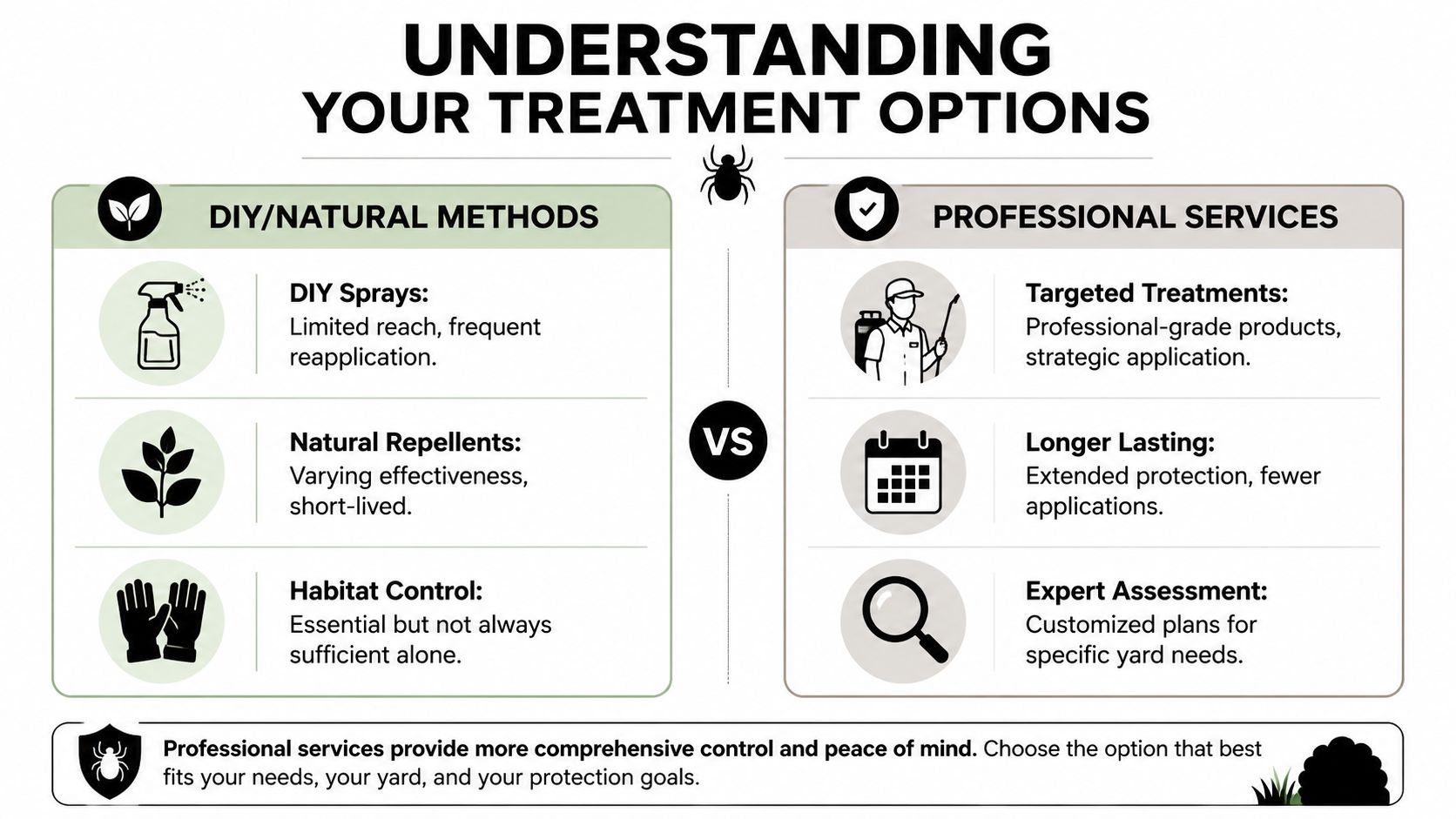
DIY and natural options
A lot of homeowners start with cedar-based sprays, botanical products, hose-end concentrates, or hand-pump applications around the perimeter. That's understandable. People want a lower-impact option, and they want to stay in control of what goes into the yard.
The trade-off is consistency. EPA-registered synthetic pesticide products labeled for ticks have consistently achieved greater than 80% suppression of blacklegged ticks in residential yards, while unregulated minimum risk 25(b) products often suppress ticks for only 1 to 3 weeks before reapplication is needed, based on this review of residential tick control studies.
That doesn't mean every natural approach is useless. It means homeowners should go in with realistic expectations. If you choose a minimum-risk product, you may need a much tighter reapplication schedule to hold the line during active periods.
Where professional service changes the outcome
Professional service isn't just “stronger spray.” A key difference is targeting. Ticks aren't spread evenly across the property, so treating the entire lawn the same way often wastes effort and misses the most important zones.
A thoughtful plan usually prioritizes:
| Area | Why it matters |
|---|---|
| Shaded bed edges | Moist ground and dense plant cover help ticks persist |
| Wooded transitions | Wildlife and rodents move ticks into the yard from here |
| Fence lines and brush | These corridors stay cooler and less disturbed |
| Pet routes and play-adjacent edges | Human and animal traffic turns tick presence into real exposure |
Some homeowners also ask about methods that reduce ticks without directly targeting the animal host. One option often discussed is the use of tick tubes with permethrin-treated cotton for mice. These are different from broad sprays and are meant to interrupt the mouse-tick cycle in a more targeted way.
For homeowners comparing local service paths, best flea and tick control for yard options can help frame the choices between one-time treatment, recurring service, and integrated plans.
The right treatment depends less on what sounds strongest and more on whether it matches the way ticks are entering and surviving on your property.
A balanced way to decide
Choose DIY-only if the yard has light pressure, limited wooded edge, and you're willing to keep up with repeated maintenance and reapplication.
Choose a professional plan when the property has recurring activity, a brushy perimeter, pet exposure, or a wooded lot line. That's often the case in Crown Point, where a clean lawn in the center can still sit next to a high-risk edge.
For many homes, habitat correction plus targeted treatment is the point where the yard starts feeling manageable again.
The Green Advantage ITM Approach for Crown Point
Generic perimeter spraying sounds convenient, but it often breaks down in Northwest Indiana. Crown Point yards deal with humid conditions, dense edge growth, and regular reinfestation pressure from nearby wooded areas. If the plan doesn't account for that, the yard may look treated on paper while ticks keep returning.
Why one-size-fits-all programs fall short here
Research highlighted in this Northwest Indiana tick yard guide notes that in humid, wooded-edge environments, tick re-infestation can occur within 4 to 6 weeks because of early summer nymph surges and heavy rain washout. That's the part many homeowners never hear when they're sold a simple “spray and forget” service.
A real integrated plan has to account for timing, weather, edge habitat, and how the property is used. A play area near a tree line needs different attention than an open front lawn. A dog run behind the garage needs different attention than ornamental beds by the porch.
What an integrated local program looks like
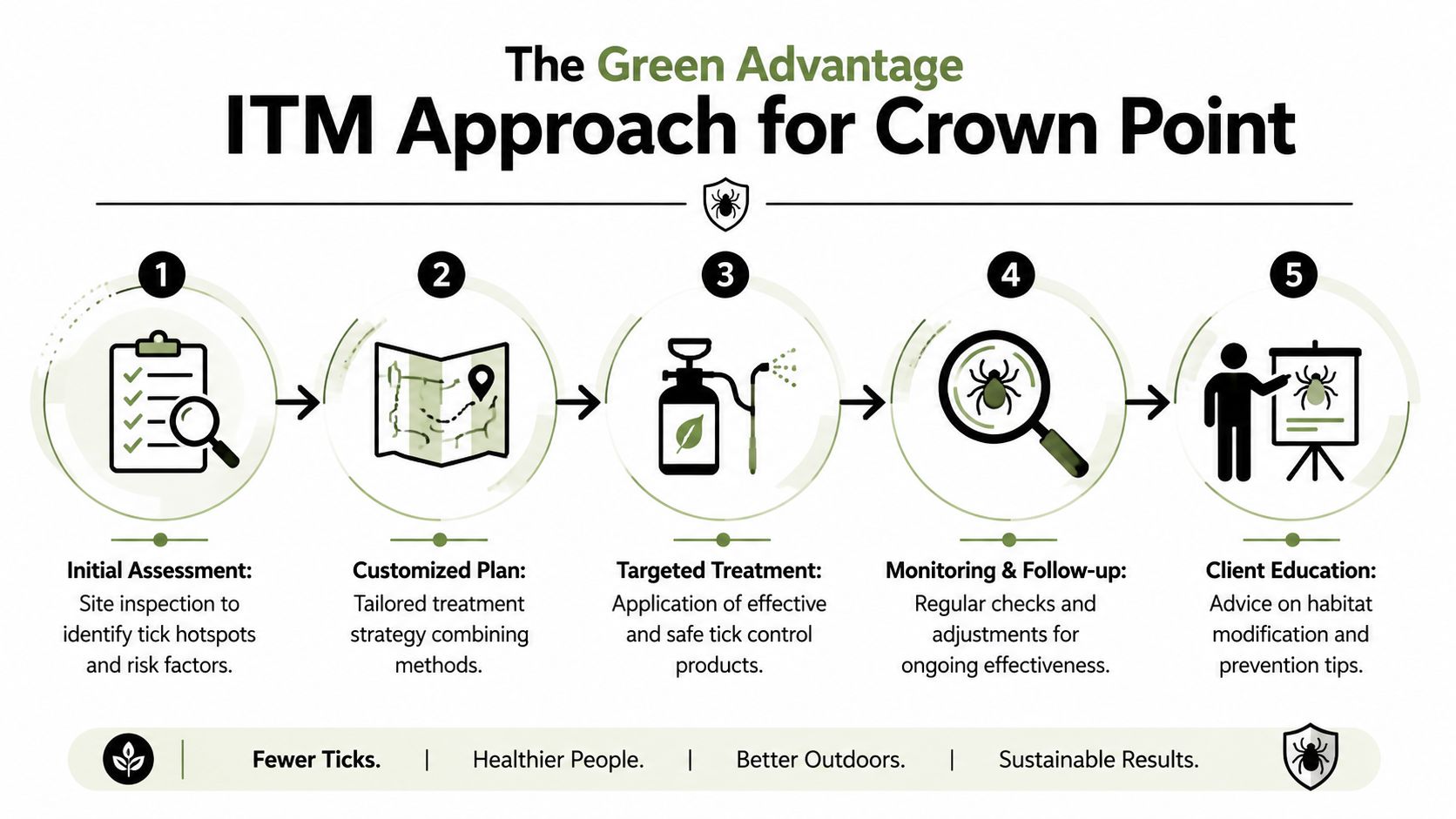
A strong ITM approach usually follows a sequence instead of relying on a single visit.
Property inspection
The first step is walking the whole site, especially the transition areas. Wood lines, leaf buildup, pet paths, low shrubs, damp corners, and rodent activity all affect where ticks hold.Habitat assessment
At this stage, the yard plan gets practical. The question isn't just where ticks are. It's why they're comfortable there.Targeted treatment
Product placement matters more than broad coverage for the sake of coverage. Shaded borders, perennial beds, and edge zones usually deserve the most attention.Follow-up and seasonal adjustment
In Crown Point, service timing has to match the season. Heavy summer rain, fresh growth, and wildlife movement can change pressure fast.Homeowner guidance
Mowing height, border upkeep, leaf cleanup, and pet traffic control all affect results between visits.
How this works on local properties
On many Northwest Indiana lots, the center lawn isn't the battlefield. The main pressure starts where the maintained yard touches brush, trees, or unmanaged neighboring ground. That's why a tick control yard program should behave more like ongoing management than a one-time application.
A season-long plan works better than a calendar reminder that says “spray once in spring.”
One local option homeowners use is The Green Advantage, which provides a thorough property inspection, identifies likely tick hotspots, and builds treatment around site conditions instead of treating every lawn the same way. That kind of approach also fits properties that may need broader commercial pest control or residential pest control support for mosquitoes, rodents, and other outdoor pest activity tied to moisture and site layout.
For Crown Point homeowners searching for an exterminator in Crown Point, IN, the key question isn't whether someone can apply a product. It's whether they can read the property and manage the problem through the season.
Comprehensive Pest Protection for Your Property
Ticks rarely show up alone as a property-management issue. The same conditions that support them often support other pests too. When a yard holds moisture, dense vegetation, debris, and rodent traffic, it becomes easier for multiple pest problems to develop at once.
Why yard conditions affect more than ticks
A shaded, overgrown perimeter can also support mosquito control needs, especially around damp ornamental beds and low-drainage areas. Rodent activity matters as well, because mice and similar animals move through the same edge habitat that supports ticks. If you're already seeing signs of gnawing, nesting, or movement around sheds and foundations, that's not a separate issue. It's part of the same outdoor pressure pattern.
A broader property plan may also include:
- Rodent control: Reducing harborage around wood piles, dense cover, and structures.
- Mosquito control: Targeting damp resting areas and breeding-prone parts of the yard.
- Spider control: Cutting back insect pressure around eaves, garages, and entry points.
- Wasp removal: Addressing nests around rooflines, play areas, and patios.
- Termite control: Protecting structures where moisture and wood contact create risk.
One property, connected pest problems
This is why many homeowners who start by searching for tick control yard services end up asking about full pest control in Crown Point, IN. They want the patio, lawn edge, garage, and foundation protected as one property, not handled as unrelated problems.
A well-managed yard does more than reduce ticks. It removes the conditions that let several pests settle in close to the home.
That's also useful for landlords, real estate professionals, and businesses that need dependable exterior conditions. Good outdoor management protects comfort, supports property value, and cuts down on the cycle of reacting to one pest at a time.
Partnering with The Green Advantage
Homeowners usually feel better once they know what the process looks like. Pest control shouldn't feel vague. You should know who's coming, what they're looking for, what they'll recommend, and what you can do between visits to keep pressure down.
What the experience looks like
The process usually starts with a phone call or quote request. That first conversation should be simple. You explain what you've seen, where you've seen it, whether pets use the yard, and whether the property backs up to trees, brush, or unmanaged ground.
From there, a technician visits the property and inspects the areas where tick pressure usually starts. That includes edges, beds, leaf litter zones, pet routes, shaded corners, and any spots where moisture lingers. If broader outdoor issues are present, this is also when related needs like rodent control, mosquito control, or other preventative pest treatments can be identified.
Why the strategy matters
This part matters because yard treatment alone has limits. A large-scale study found that springtime barrier acaricide applications reduced tick abundance on treated properties by 63%, yet did not produce a statistically significant difference in human-tick encounters or tick-borne disease incidence, according to the Journal of Infectious Diseases study. That's why a professional should treat spraying as one part of a larger plan, not the whole answer.
In practice, that means you should expect advice on yard conditions, not just product application. You should also expect clear communication about timing, follow-up, and what changes on the property may improve results.
What homeowners should expect after service
A reliable service relationship includes more than the visit itself.
- Clear findings: You should understand where the risk is highest on the property.
- Specific recommendations: Not generic cleanup advice, but practical steps tied to your layout.
- Seasonal follow-up: Tick pressure changes with weather and growth.
- Honest expectations: The goal is reduction and smarter management, not a false promise that one treatment solves every exposure risk.
For homeowners looking for pest control near me, exterminator near me, or residential pest control in Crown Point, peace of mind comes from that combination of field experience, transparency, and ongoing support.
If your yard backs up to woods, stays damp through summer, or keeps producing ticks even after DIY treatment, it may be time for a closer look. The Green Advantage works with homeowners and properties across Crown Point, IN and nearby Northwest Indiana communities to inspect risk areas, build practical treatment plans, and help families reclaim their outdoor space with more confidence.