
You step into the backyard after a warm evening in Crown Point, call the dog inside, and notice a tiny dark speck moving near its ear. Later, you find a tick on your child's clothing. That discovery can turn an ordinary night outdoors into a search for answers about tick control methods, yard safety, and whether professional treatment is necessary.
Ticks are a property-management problem, not just a personal-protection problem. A practical plan combines outdoor vegetation work, targeted treatment, wildlife and rodent considerations, and habits that reduce the chance of a tick entering your home. The Green Advantage serves Crown Point, IN and surrounding Northwest Indiana communities with residential pest control, commercial pest control, inspections, mosquito control, and treatment plans customized to individual properties.
Why Ticks Are a Growing Problem in Crown Point Yards
Crown Point homes often sit near wooded lots, drainage areas, fields, tall grass, and mature landscaping. Humid summer conditions create shaded places where ticks can remain active, while deer and small mammals move between natural areas and residential yards. A half-acre property backing up to woods can offer several entry routes, from a brushy fence line to a leaf-covered edge beside the lawn.
That doesn't mean every wooded property has an unmanageable infestation. It does mean homeowners should look beyond the open center of the lawn. Ticks usually become a concern where people, pets, and wildlife meet, especially around vegetation transitions and areas that stay damp.
The Green Advantage is a family-owned, licensed pest control company serving Crown Point and nearby Northwest Indiana communities. Its technicians approach tick problems as site-specific pest management issues, considering the property's layout, vegetation, shade, wildlife traffic, and the areas your family regularly uses.
Practical rule: A tick-free lifestyle doesn't require eliminating every tick outdoors. It requires reducing tick habitat and exposure where people and pets spend time.
A single spray may lower tick activity temporarily, but it won't correct a brushy border, an active rodent route, or a dog that returns indoors without a tick check. The strongest programs layer several measures instead of relying on a miracle product.
This guide will help you identify the highest-risk zones, make useful site changes, understand what professional treatment can and can't do, and decide whether deer or rodent-focused methods belong in your plan. It also explains how residential pest control and related services, such as mosquito control or rodent exclusion, can fit into broader seasonal protection.
How Ticks Live and Where They Hide on Your Property
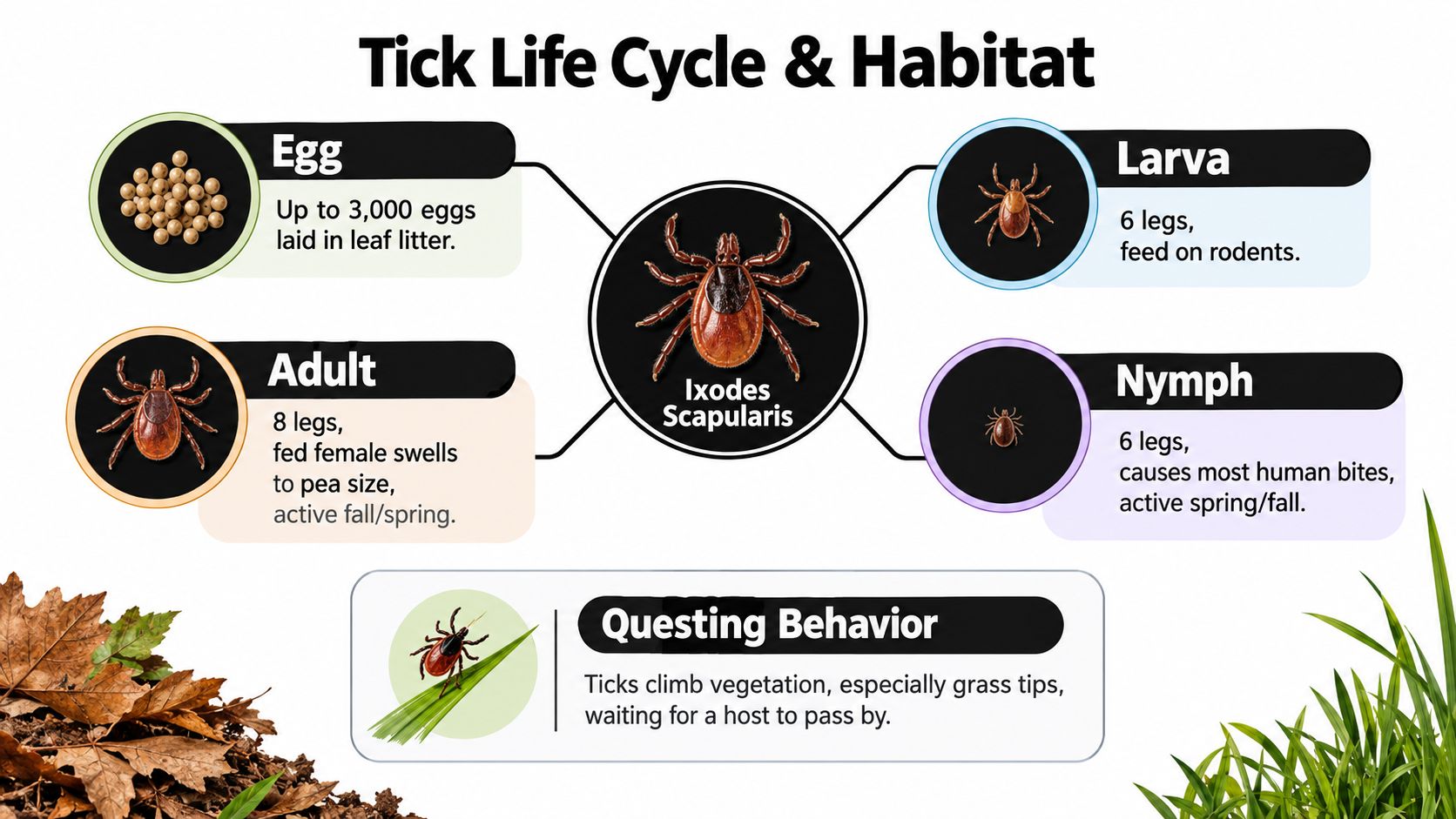
Ticks don't jump or fly. They climb onto grass, low plants, or brush and wait with their legs extended for a passing host. Technicians call this questing behavior, and it explains why a tick can move from an overgrown edge to a child, dog, shoe, or pant leg without crossing the whole yard.
A tick's life cycle includes egg, larva, nymph, and adult stages. Nymphs are especially important for homeowners because they're very small and can be difficult to spot after outdoor activity. Adults are easier to find, but every stage can contribute to the tick population in a suitable habitat.
Walk the property by zones
Start at the lawn-forest edge, which is often the highest-risk area on a Crown Point property. Look for leaf litter, ground cover, fallen branches, tall weeds, dense shrubs, and fence lines connecting the yard to a wooded area.
Next, inspect places where shade and organic debris collect:
- Leaf litter and brush piles: These protect ticks from drying conditions and give small mammals cover.
- Fence lines and stone walls: Wildlife often travels along these boundaries, and vegetation can remain thick beside them.
- Playsets and patios: Risk rises when these areas sit directly beside tall grass, brush, or wooded margins.
- Pet routes: Dogs may repeatedly follow the same perimeter path, making a shaded side yard more important than the open lawn.
A major review in the Journal of Medical Entomology's discussion of integrated tick management describes tick control as a combined strategy involving habitat modification, acaricides, biological control, host reduction or exclusion, and host-targeted tools. In that review, acaricide plus vegetative management achieved 94% average control of all lone star tick life stages, acaricide plus host management achieved 89%, and the three-way combination achieved 96%. Those results support a simple field lesson: the right combination for the right property is more dependable than one product used everywhere.
Yard and Landscape Changes That Reduce Ticks
Yard maintenance won't replace treatment on every property, but it can make the outdoor space less welcoming to ticks and reduce the number of places where they wait. Focus first on the routes people and pets use, then work outward toward the property boundary.
For a half-acre Crown Point yard that backs up to woods, begin with a clean, visible transition between lawn and woodland. Keep the grass edge maintained, remove accumulated leaves and brush, and avoid allowing ornamental beds to merge into the tree line. A fenced yard still needs attention if deer can browse outside the fence or mice can move through the surrounding vegetation.

Make the high-use areas easier to protect
Move playsets, sandbox areas, and frequently used seating away from brush, leaf piles, and the lawn's wooded edge. A gravel, stone, or suitable mulch border can create a clearer separation between a play area and tick habitat. Keep vegetation trimmed so sunlight and airflow reach shaded zones that otherwise stay humid.
A lakeside property may need extra attention around ornamental grasses, ground cover, and damp borders. Those features can look attractive while creating dense, protected habitat close to patios and walkways. Trim vegetation back from the areas where people sit, and keep leaf debris from accumulating beside foundations, sheds, and fences.
Useful weekend tasks include:
- Mow and edge: Keep lawn borders defined, especially beside trees, fences, and tall vegetation.
- Clear organic debris: Remove leaf litter, brush piles, and fallen branches from play and recreation areas.
- Create a transition zone: Use gravel, rock, or maintained mulch to separate lawn from wooded borders.
- Manage shade: Prune dense vegetation where practical so air moves through damp, enclosed spaces.
- Discourage deer: Review fencing, plant choices, and access points where deer repeatedly enter.
Homeowners often receive plenty of advice about sprays but little guidance about the property itself. A survey of residential tick-control providers found synthetic pesticides offered by 80% of respondents, natural or organic products by 34%, habitat management by 24%, and host-targeted devices such as tick tubes by 22%, according to this survey of residential tick-control practices. That imbalance helps explain why a treatment can disappoint when the surrounding habitat remains unchanged.
For plant selection and additional outdoor ideas, review plants that repel ticks, then evaluate whether those choices suit your soil, sunlight, pets, and existing grounds. Planting alone won't solve a tick issue, but it can support a broader property plan.
Protecting Your Family and Pets When Ticks Are Active
Yard work reduces exposure at the source. Personal protection reduces the chance that a tick reaches skin or comes inside after someone spends time outdoors. Use both, especially when children, dogs, or outdoor workers regularly cross the lawn's edges.
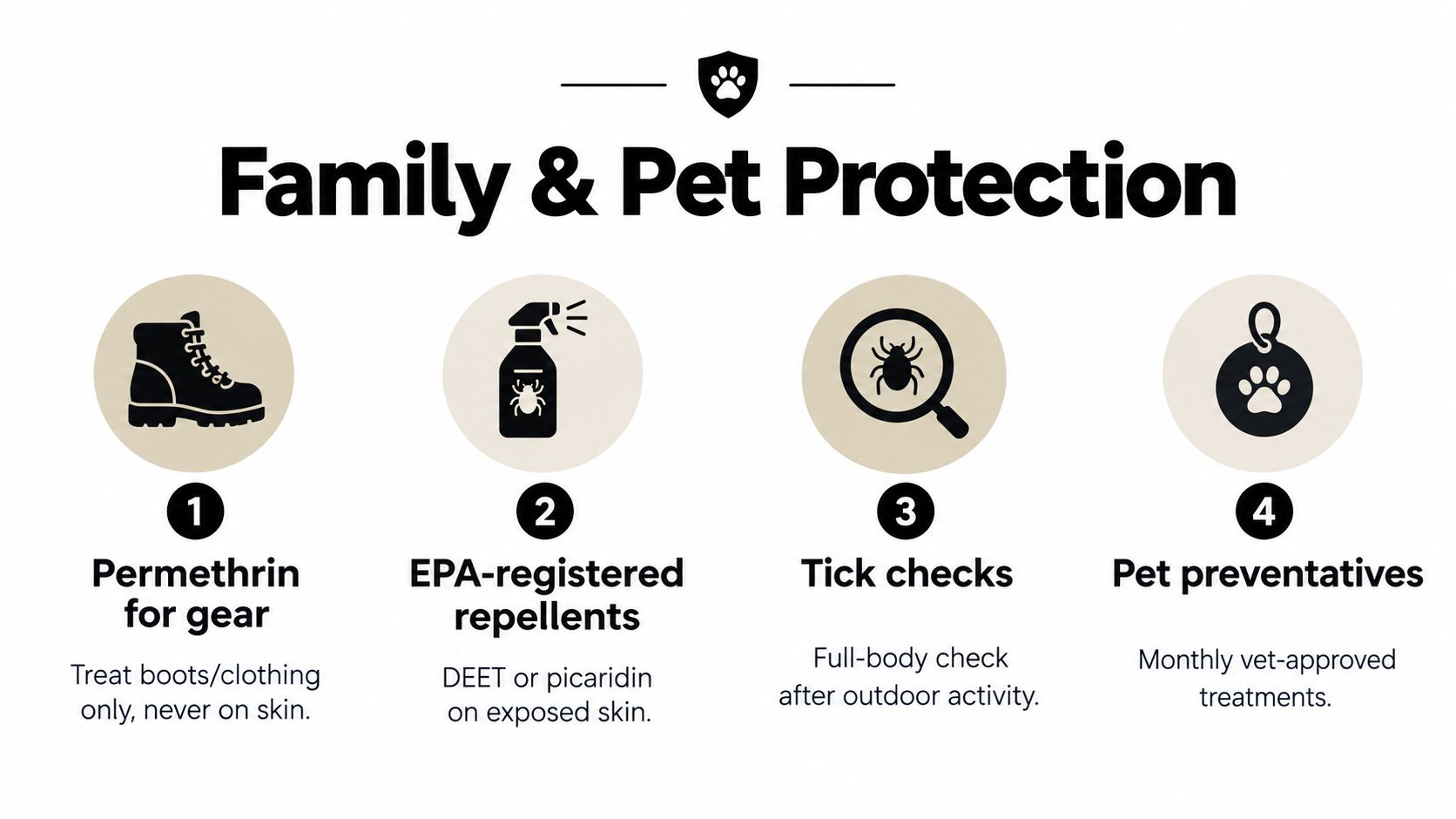
For clothing and gear, the CDC says 0.5% permethrin can be used to pre-treat boots, clothing, and camping gear, and that treated items remain protective through several washings. Permethrin belongs on clothing and gear according to product directions, not directly on skin. For exposed skin, choose an EPA-registered repellent and follow its label.
Use a simple return-home routine
Light-colored clothing makes moving ticks easier to notice. Long sleeves, long pants, and closed footwear provide another physical barrier during yard work, walks, and hikes. Tuck pant legs into socks when you're working along brush or tall grass.
After outdoor time, check the places ticks commonly hide, including the scalp, hairline, behind the ears, waist, underarms, groin, backs of knees, and around sock lines. Inspect clothing, shoes, outdoor gear, and pets before they move through the house.
The CDC tick prevention guidance recommends showering within 2 hours of coming indoors to help wash off unattached ticks and make them easier to find. The recommendation applies after backyard time as well as more obvious outdoor activities.
A careful pet check matters: Dogs can carry ticks into living spaces even when nobody notices a bite outdoors.
Ask your veterinarian which flea and tick preventative fits your pet's species, age, health, and lifestyle. Don't apply a product intended for one animal to another, and don't assume a pet preventative replaces inspection. A dog that spends time beside a wooded fence line still needs its ears, toes, collar area, and coat checked.
The CDC prevention video can help households review practical protective habits.
Professional Tick Treatment for Your Property
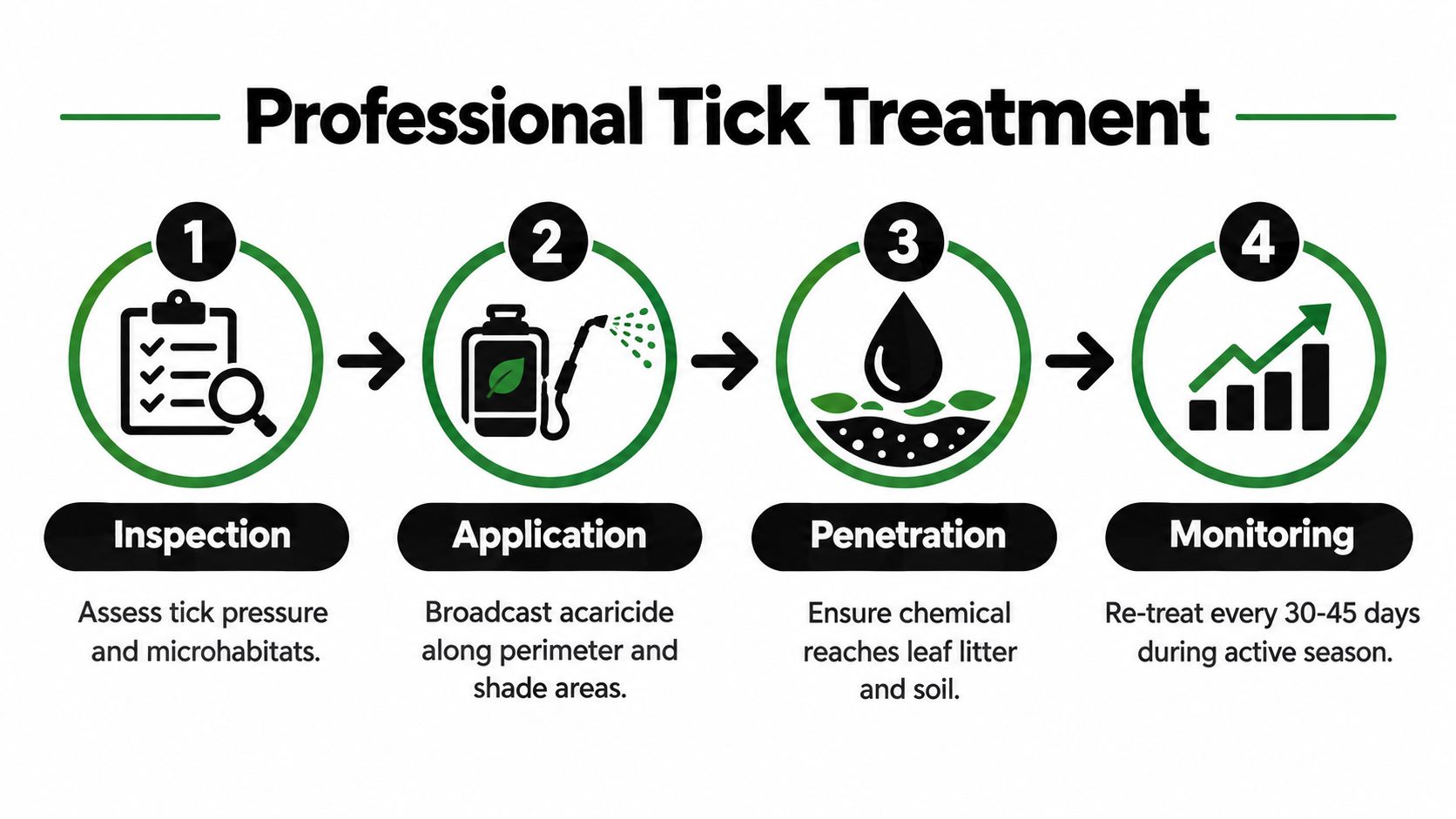
DIY spraying often fails because homeowners treat the visible lawn and miss the places where ticks wait. A professional application focuses on shaded borders, leaf litter, dense vegetation, fence lines, and the lawn-forest edge. The technician also needs to understand how far the managed area extends and whether wildlife routes continue beyond the obvious treatment zone.
Broadcast acaricide treatment can provide a strong reduction when the product reaches tick microhabitats. Published research reports that synthetic acaricides can reduce blacklegged nymph abundance by 64% to 100% for at least 6 weeks, while one deltamethrin application along a lawn-forest edge reduced tick density by 90% or more over the following 9 days, as described in this Bioscience review of residential tick control. Results vary by tick species, weather, habitat, timing, and application quality.
Why coverage and timing matter
Treating only the patio or open grass can leave the main source untouched. Research also indicates that control drops when the full managed area isn't treated, which is why a technician should identify the property's connected risk zones before applying a product.
The Green Advantage can assess tick pressure, locate shaded microhabitats, identify wildlife corridors, and tailor a targeted plan for a Crown Point property. Depending on site conditions, the plan may include perimeter and habitat-edge treatment, seasonal adjustments, and coordination with mosquito reduction programs when both pests affect the same outdoor spaces.
A professional service should also set realistic expectations. Treatment can lower tick abundance in managed areas, but it doesn't make a property permanently immune to ticks arriving on wildlife. Homeowners still need to maintain borders, inspect pets, and follow label-based re-entry and safety directions.
| Method | Typical Effectiveness | Best For |
|---|---|---|
| Broadcast acaricide | Can produce substantial suppression when coverage reaches tick microhabitats | Lawn edges, shaded borders, and connected treatment zones |
| Habitat modification | Reduces shelter and moisture that support tick activity | Leaf litter, brush, dense ground cover, and lawn transitions |
| Personal protection | Reduces attachment and indoor transfer | Family members, pets, yard work, and outdoor recreation |
| Host-targeted control | Can reduce local tick pressure around host activity | Properties with persistent rodent or deer routes, used as one layer |
| Integrated treatment | Combines several controls to address different parts of the tick cycle | Wooded lots, heavy wildlife traffic, and recurring exposure |
Do Deer and Rodent Treatments Work?
Host-targeted tools address animals that carry or feed ticks. Tick tubes contain treated nesting material that rodents may carry into their nests. Deer-focused devices apply treatment through feed or a device that deer pass through, with the goal of reducing ticks on an important host.
These methods can help when the host pattern fits, but they do not solve every tick problem. A 2025 systematic review of environmental and host-targeted tick interventions reported that 4-poster interventions produced 63.4% to 80% reductions in questing nymph density at the four-year mark. That result applies to a specific intervention and outcome, not to every Crown Point yard.
Why host control can disappoint
Many medically important ticks feed on several host species. Reducing contact with mice or deer may leave other wildlife available, especially beside woods, fields, wetlands, or connected green space. A host-targeted tool can reduce one part of the tick cycle while new ticks continue arriving on other animals.
Homeowners also need to separate fewer ticks from fewer human encounters. A bifenthrin-treated property may show lower tick abundance than a placebo property, yet that reduction does not automatically lower human encounters or tick-borne disease cases. Fewer ticks in vegetation do not change how often people use a yard, move through brush, or encounter wildlife.
Federal research interest shows why these methods remain under study. In September 2026, HHS, CDC, and NIH funded research into acaricide-treated feed for deer and rodents, as described in the HHS announcement on tick-control research. The funding supports further investigation, not a guarantee that host treatment will solve an individual property.
If rodents are active around a home, rodent pest control can address entry points and sanitation while supporting a broader tick-management plan. The practical answer is clear: deer and rodent treatments can earn their place as one layer where wildlife activity justifies them. Pair them with habitat changes, targeted treatment, and personal protection rather than relying on host control alone.
Your Seasonal Tick Control Plan for Northwest Indiana
A useful seasonal plan starts before a family member finds a tick. In early spring, clear leaf litter and brush from high-use areas, inspect the lawn-forest edge, repair gaps in borders, and look for new wildlife routes. This is also a good time to schedule a professional inspection if your property borders woods or has a history of recurring tick encounters.
Late spring is a practical point to consider targeted treatment, particularly when nymph activity and family outdoor use begin to overlap. Ask a licensed technician to evaluate the whole connected risk area rather than treating only the patio, playset, or visible lawn. If mosquito pressure is also high, a mosquito reduction program may address overlapping shaded and damp zones.
Keep the plan active through the year
Summer maintenance means keeping grass edges defined, clearing new leaf buildup, checking pets after outdoor time, and using repellents and treated gear when appropriate. Don't let a recently treated border become overgrown, because vegetation can recreate the shelter that the treatment was meant to reach.
Fall brings another cleanup opportunity. Remove leaves from play areas, patios, foundation edges, and fence lines, then reassess deer access and rodent activity. A professional inspection makes sense when bites continue, deer regularly cross the property, or a wooded lot keeps producing ticks despite reasonable maintenance.
DIY work may be enough for a compact, open yard with limited wildlife traffic and no recurring encounters. Licensed help earns its place when the property has multiple habitat zones, heavy deer activity, persistent tick findings, children or pets using the edge areas, or a layout that makes complete coverage difficult.
The Green Advantage provides property inspections and customized tick treatments for Crown Point, IN and surrounding Northwest Indiana communities, with options for residential pest control, commercial pest control, mosquito reduction, and related pest concerns. Visit The Green Advantage to schedule a tick inspection or request a quote for a layered plan built around your yard, family, and pets.