
A nurse notices a cockroach near a patient chair, a clinic manager receives an urgent call about a rodent in a loading area, or staff find bed bug evidence on a transport stretcher. In a healthcare facility, the immediate concern isn't only removing the pest. Leaders must also show how the sighting was reported, investigated, contained, treated, and reviewed.
That makes pest control for healthcare facilities different from ordinary commercial pest service. A hospital or clinic needs an integrated pest management program that protects patients, staff, food, sterile workflows, equipment, and accreditation readiness. The strongest programs treat documentation and governance as the foundation, then use sanitation, exclusion, monitoring, and carefully selected treatments to control risk.
When a Pest Sighting Becomes a Compliance Problem
An outpatient infusion room is busy, bright, and closely managed. A patient sees a cockroach move along the wall beside a treatment chair. A staff member captures the insect, notifies the charge nurse, and records the incident before the next patient enters.
The facility's response should move quickly. Infection prevention and facility leadership need notification, the room may require temporary closure, and housekeeping logs, food transport routes, nearby utility penetrations, and recent service reports become relevant evidence. The pest professional must identify the insect, inspect connected spaces, check monitoring devices, and document the corrective actions.
During the first day, different people own different decisions:
- Clinical staff: Remove patients from the immediate area and protect treatment supplies.
- Infection prevention: Assess whether the sighting creates a contamination or exposure concern.
- Facilities: Open a service ticket, inspect building conditions, and coordinate access.
- Housekeeping and food service: Review cleaning schedules, meal-cart routes, waste handling, and storage practices.
- The pest provider: Identify the pest, inspect adjacent areas, record findings, and recommend the least-risk control method.
- Leadership: Confirm that the response followed the facility's written policy and determine whether escalation is required.
Practical rule: A sighting becomes a compliance problem when the facility can't demonstrate a consistent response.
The EPA Integrated Pest Management Toolkit for healthcare facilities formalized a prevention-first approach built around standard precautions, environmental sanitation, exclusion, and targeted pesticide use only when needed. The CDC also recommends pest-control strategies for kitchens, cafeterias, laundries, central sterile supply areas, operating rooms, loading docks, construction zones, and other infestation-prone locations, including maintained screens on windows that open outdoors.
Bed bugs create a related challenge because they can arrive with patients, visitors, staff, luggage, or furnishings. Staff who need a visual reference can use this bed bug inspection guide when checking mattresses and seams, but a suspected finding still requires the facility's formal reporting and containment process.
A hospital that can produce a report, inspection record, service ticket, treatment rationale, and follow-up review shows controlled risk management. A hospital that only says someone sprayed the room has a much weaker answer.
How Integrated Pest Management Works in Healthcare Settings
The EPA describes healthcare IPM as a commonsense approach that combines policy, assigned roles, inspection, identification, monitoring, prevention, communication, and documentation. In practice, the program works as a repeating decision cycle rather than a single treatment.
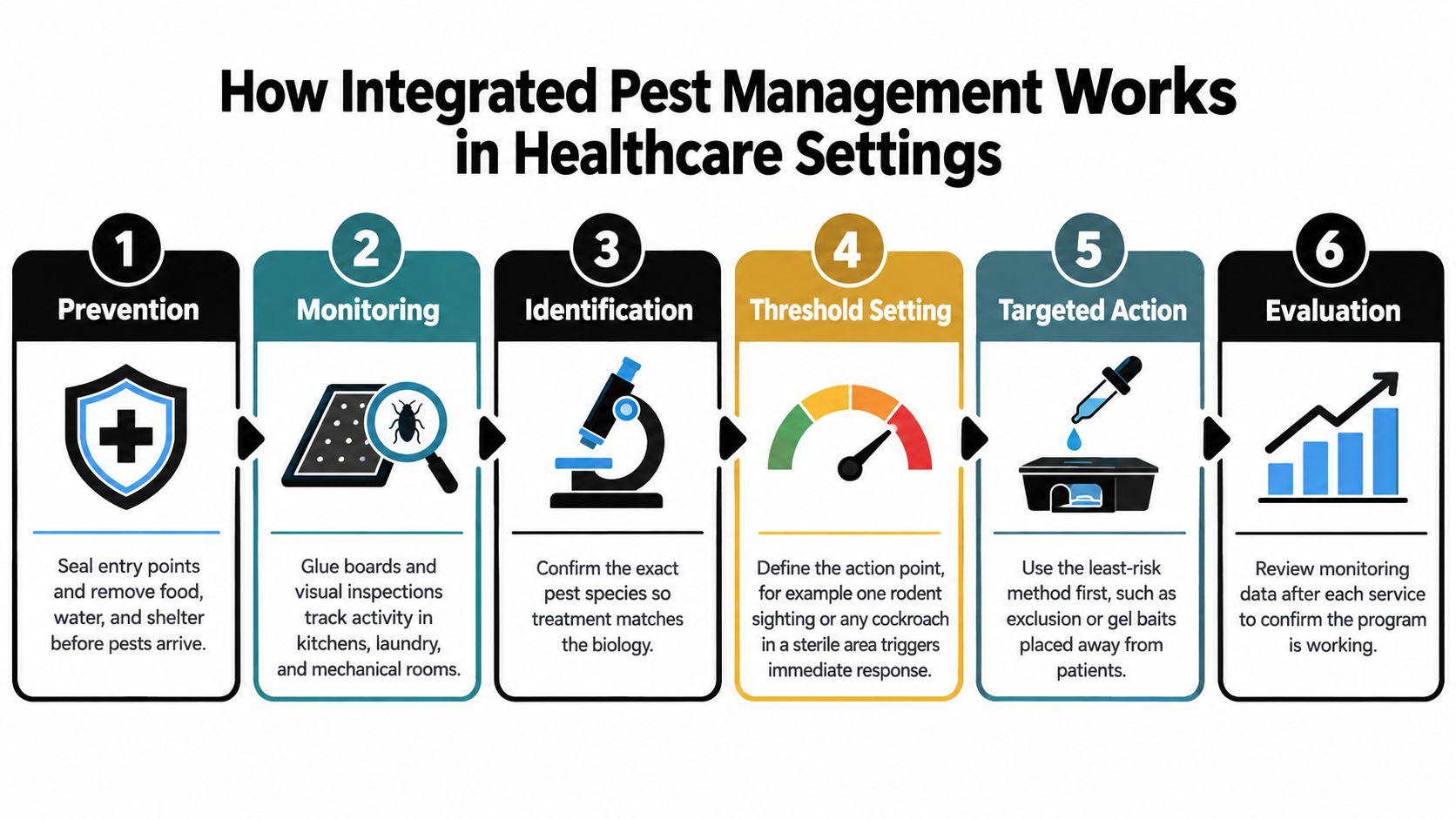
Six connected decisions
Prevention comes first. The facility removes food, water, and shelter while sealing gaps around doors, pipes, conduits, windows, and vents. A leaking pipe, unsealed loading-dock door, or uncovered food cart can create more pest pressure than a product can solve.
Monitoring turns sightings into information. Glue boards, visual inspections, and electronic devices can be placed on a defined map across kitchens, laundry rooms, waste areas, mechanical rooms, and other risk zones. The purpose isn't merely to count insects. Location, timing, species, and repeated activity reveal where building or workflow changes are needed.
Identification prevents the wrong response. A cockroach, drain fly, stored-product insect, and beetle may require different sanitation and exclusion decisions. Rodent evidence also needs species-level attention because entry routes and harborages can differ.
Threshold setting defines escalation. Patient-care areas generally require a more sensitive response than mechanical rooms. A single cockroach in a sterile or treatment zone may trigger immediate investigation, while a monitor finding in a remote service area may prompt intensified inspection and follow-up.
Targeted action uses the least-risk effective method. Exclusion, cleaning, drying, trapping, mechanical removal, tamper-resistant stations, gels, pastes, and crack-and-crevice applications can often address the source without broadcast spraying.
Evaluation closes the loop. The team reviews post-service findings, monitor results, open corrective actions, and recurring locations. If activity continues, the program changes the plan instead of repeating the same treatment.
A facility can document this cycle through an integrated pest management program that assigns responsibilities and connects service activity to prevention work.
For a visual explanation of how monitoring and targeted control fit together, the following video provides additional context.
The central benefit is predictability. Staff know what to report, managers know who responds, and infection prevention can see why a treatment was selected.
How Hospitals Actually Run Their Pest Programs Today
Hospital pest programs have adopted IPM broadly, but adoption doesn't guarantee consistent execution. Historical survey reporting cited by HFM Magazine found that 88% of hospitals used some form of IPM, while 60% used it throughout the entire hospital. The same reporting found that 94% employed outsourced pest-management services in some capacity, and 72% outsourced pest management entirely. These figures are documented in HFM's healthcare pest-control guidance.
The gap appears in written rules and evidence. Only 42% of hospitals had specific written protocols for when and where chemical pest-control products should be used, while another hospital report found that 64% had a written pest-management plan. Those results suggest that many facilities had a program or vendor, but fewer had fully defined chemical-use decisions and consistently defensible records.
| Practice Area | Reported Adoption | Guidance Expectation | Common Gap |
|---|---|---|---|
| Integrated pest management | 88% of hospitals used some form of IPM | A facility-wide, written, prevention-first program | IPM exists on paper but isn't applied consistently by department |
| Hospital-wide IPM | 60% used IPM throughout the entire hospital | Risk-based coverage across clinical and support areas | Remote zones, construction areas, and service corridors receive less attention |
| Outsourced service | 94% used outsourced services in some capacity | Credentialed specialists with defined responsibilities | The contract doesn't specify records, escalation, or corrective-action ownership |
| Fully outsourced service | 72% outsourced pest management entirely | Vendor work integrated with infection prevention and facilities | Internal staff can't explain the response process |
| Chemical-use protocols | 42% had specific written protocols | Site-specific rules for products, locations, and exposure controls | Product decisions depend on individual judgment |
| Written pest plan | 64% had a written plan | Current plan supported by logs and review | The plan isn't connected to trend data or governance meetings |
The figures describe historical practice, not a guarantee about any individual facility today. They also don't prove that larger teaching hospitals always perform better than smaller facilities. In practical terms, staffing can make audit preparation easier, but smaller sites often need the same core evidence, organized clearly and kept current.
Facilities comparing digital workflows may find it useful to compare healthcare EHS systems, especially when pest records need to connect with work orders, hazardous-materials files, and environment-of-care review.
Preventing Infestations Through Sanitation and Exclusion
Treatment works better when the facility removes the conditions that attracted pests. Prevention starts with everyday operations, not with a spray schedule.
In kitchens and break rooms, food should leave work surfaces overnight, dry goods should stay in sealed containers, and spills should be cleaned under refrigerators, vending machines, and preparation equipment. Floor drains need routine cleaning because organic film can support drain-fly activity. Grease traps, mop sinks, dish areas, and waste staging zones deserve attention because moisture and food residue often overlap there.
Loading docks create a different exposure. Exterior doors should close fully, door seals should remain intact, and debris should be removed after deliveries. Staff can inspect incoming cartons and pallets for evidence of insects or rodents, then break down cardboard promptly rather than storing it beside food, linen, or medical supplies.
Patient and treatment areas require cleanable surfaces and controlled storage. Carts, IV poles, transport equipment, and furniture should be cleaned according to facility procedures. Linen should stay off floors, while baseboards, utility penetrations, and gaps behind wall-mounted equipment should be sealed so pests can't travel through concealed routes.
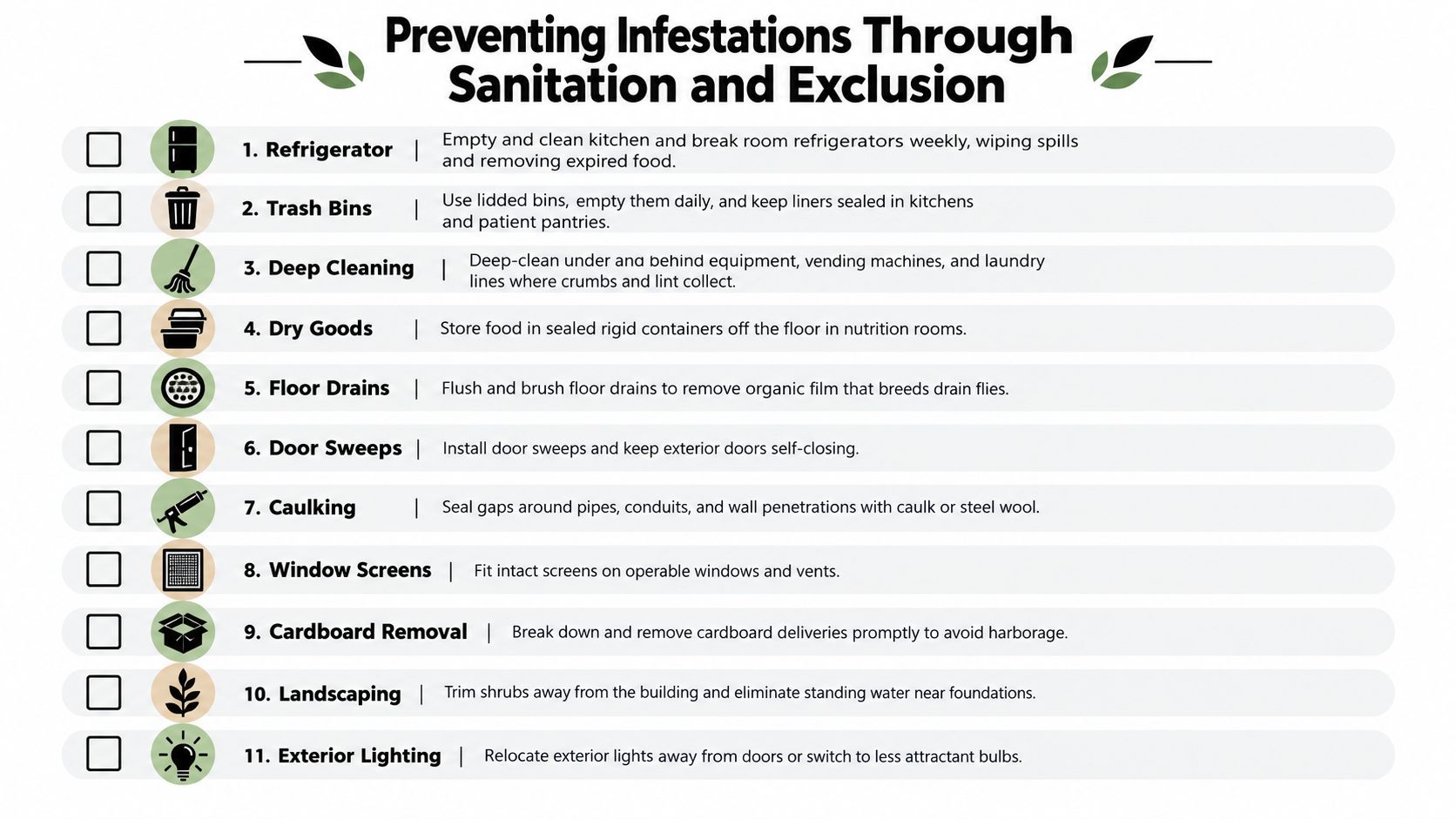
Match the repair to the pest
- Cockroaches: Reduce food residue, clean drains, seal pipe openings, and correct moisture.
- Rodents: Repair door sweeps, secure waste, close wall gaps with durable materials, and inspect loading areas.
- Flies: Remove organic buildup from drains, correct leaks, and protect food storage.
- Bed bugs: Use a defined inspection and containment process for mattresses, chairs, transport equipment, and personal belongings.
- Stored-product pests: Inspect deliveries, discard compromised goods, and improve dry-storage rotation.
The healthcare facility pest-management guidelines also highlight closed entry doors, screened windows, sealed utility openings, repaired leaks, sealed food and garbage containers, vegetation kept at least two feet from buildings, and fluorescent lights placed at least 100 feet from buildings when they must be used.
For a drain-related cockroach concern, facility teams can consult this practical resource on how to stop cockroaches coming up drains, then have maintenance verify drain covers, seals, and plumbing conditions.
Chemical Use Rules in Patient and Treatment Areas
Chemical treatment in a healthcare setting must account for where people are, what equipment is present, and how the product label controls use. U.S. defense medical guidance states that nonchemical controls, including sanitation, surveillance, and mechanical exclusion, should be the primary methods. It also says pesticide applications shouldn't occur while patients are in the immediate area.
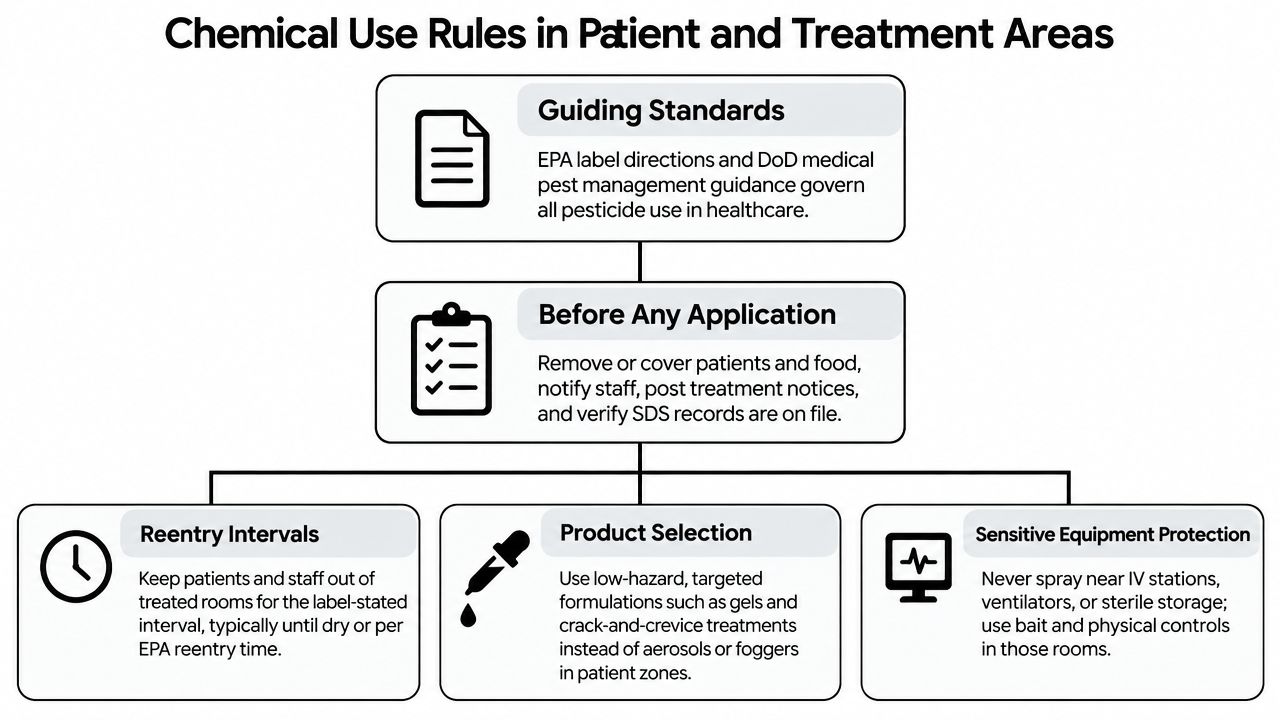
Before an application, the responsible team should identify the target pest, confirm that the product label permits use at that site, coordinate with clinical and facilities leaders, protect or remove patients and food, and communicate access restrictions. The EPA recommends limiting liquid sprays, foggers, and volatile formulations where possible, with preference for baits, gels, pastes, and crack-and-crevice treatments.
If equipment is infested, the medical guidance recommends removing patients from the room, using a nonresidual contact spray when treatment is unavoidable, and thoroughly cleaning equipment before reuse. The treated area must remain unavailable for the label-stated reentry interval, and staff should follow the product label rather than relying on an informal estimate.
Sensitive areas need a separate decision
Pharmacy cleanrooms, central sterile supply, food-preparation rooms, intensive-care spaces, neonatal units, and sterile compounding rooms need coordination before any product is selected. A technician shouldn't spray near IV stations, ventilators, sterile storage, medication preparation surfaces, or exposed supplies.
These restrictions aren't obstacles to effective pest control. They force the program toward exclusion, trapping, sanitation, monitoring, and precisely placed baits, methods that are easier to explain and audit than broad applications.
The EPA healthcare IPM toolkit supports this structure by requiring an official policy, assigned roles, inspection and monitoring, prevention, and documented communication. Product safety depends on the specific label and site, so every application record should preserve that decision trail.
Documentation and Evidence That Satisfy Surveyors
A service visit isn't complete when the technician leaves. It's complete when the facility can connect the visit to a finding, a response, a corrective action, and a follow-up review.
The core file should include signed service reports, pesticide application records, device maps, facility inspection logs, corrective-action tickets, and trend analysis. Application records should identify the product, EPA registration information, target pest, treatment location, amount used where required by the facility process, and reentry interval. Monitoring maps should show where traps, glue boards, and bait stations sit so staff can compare activity by location.
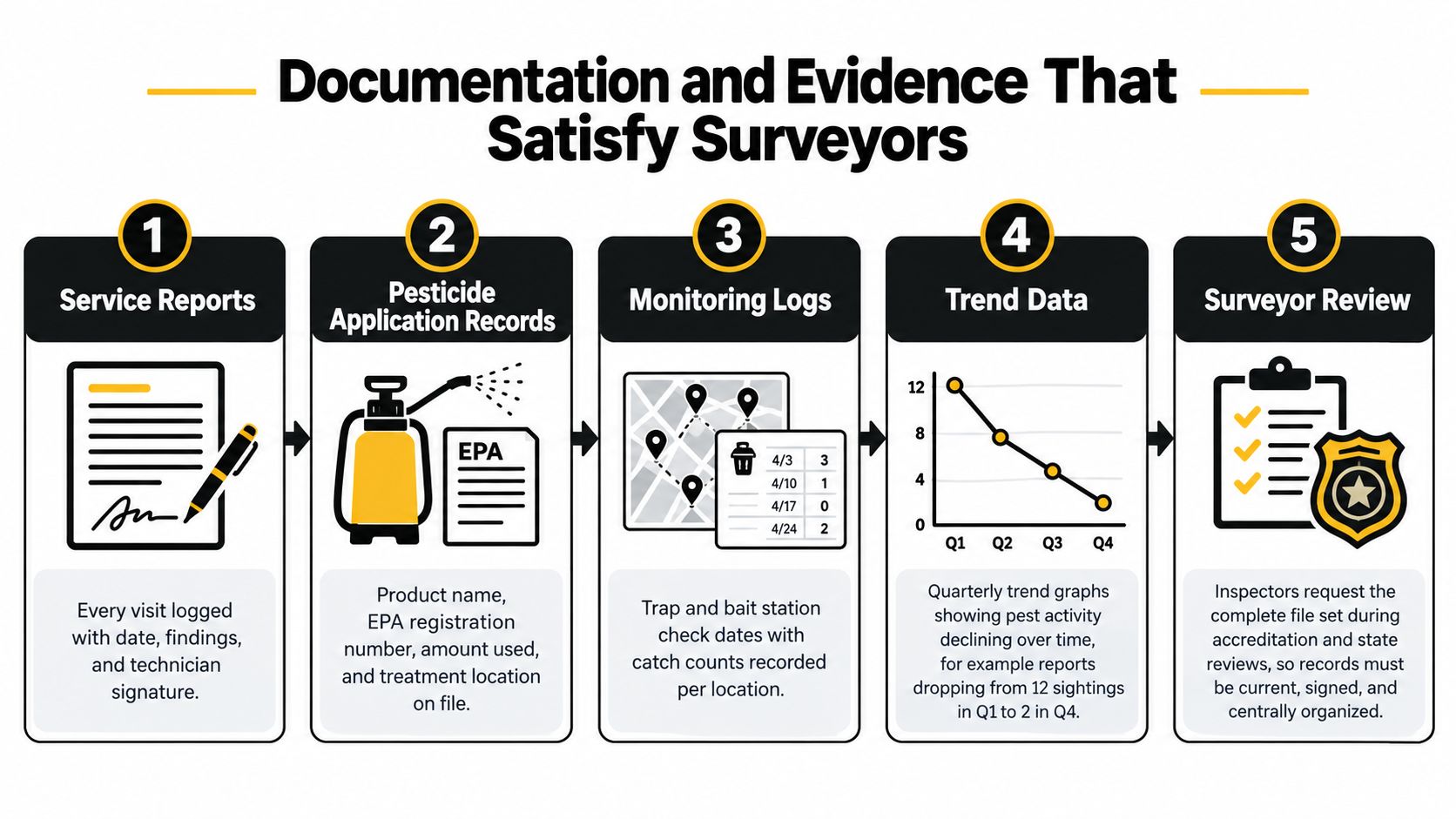
What a defensible record shows
Service reports establish what the technician saw and did. A vague entry such as “treated for insects” doesn't explain the pest, conditions, products, or next action.
Pesticide records show that the facility selected a product for the correct site and pest, followed label directions, and controlled reentry.
Monitoring logs reveal whether activity is isolated, recurring, or moving between departments. Catch counts matter, but the pattern matters more.
Corrective-action tickets connect pest findings to facilities work, such as sealing a wall penetration, repairing a leak, replacing a door sweep, or changing waste-handling practices.
Trend reviews show whether the program changes when evidence changes. A report that documents activity but never records evaluation leaves the most important question unanswered, namely whether the intervention worked.
The pest control monitoring service should fit into the facility's governance process rather than sit in a separate vendor folder. Environment-of-care committees, infection-prevention meetings, quality-assessment activities, or similar groups can review recurring locations, unresolved repairs, chemical-use decisions, and escalation events.
Surveyor-aligned guidance emphasizes that pest activity is often reviewed indirectly under general environmental safety standards rather than under one pest-specific rule. That makes accountability especially important. A facility should be able to identify the program owner, explain how staff report sightings, locate current records, and show that leadership reviews unresolved risk.
Choosing a Pest Management Partner for Your Facility
Selecting a healthcare pest vendor is more than a price comparison. It is a due-diligence exercise focused on whether the provider can operate inside clinical workflows and produce evidence your facility can defend.
Start with healthcare experience. Ask how many hospitals, clinics, or long-term care sites the company currently services, what types of clinical environments its technicians understand, and whether technicians hold relevant structural pest credentials or work with board-certified entomologists when identification requires deeper expertise.
Request sample documents before signing:
- Service reports: Do they identify findings, locations, products, recommendations, and follow-up actions?
- Monitoring maps: Can staff see every device and understand the checking schedule?
- Corrective-action records: Does the provider document building repairs and sanitation changes, or only applications?
- Trend reviews: Will someone explain recurring activity by department and recommend adjustments?
- Chemical records: Do the files preserve product details, site authorization, application information, and reentry requirements?
Product philosophy deserves direct questions. Ask which rodenticides and insecticides are in the facility formulary, where the company prefers bait, gel, trapping, exclusion, and crack-and-crevice work, and how it handles pharmacies, neonatal units, sterile compounding rooms, food preparation, and other sensitive locations.
You should also clarify operations:
- How does a staff member report an urgent sighting?
- Who decides whether a room closes temporarily?
- How does the provider coordinate with infection prevention and facilities?
- What response commitment applies to rodents, bed bugs, or activity in treatment areas?
- How are unresolved repairs escalated?
- Will the provider participate in mock surveys or compliance walkthroughs?
- How does a new vendor assume service without losing monitoring history or interrupting current controls?
- Are insurance, licensing, scope, records ownership, and termination terms clear?
The Green Advantage offers commercial pest inspections, targeted service plans, monitoring, and IPM-oriented support for businesses and facilities in Crown Point, IN and Northwest Indiana. Its family-owned team works with office staff and field technicians to coordinate scheduling, diagnose site conditions, and tailor environmentally mindful pest-management services.
If your healthcare facility needs a clearer response process and better survey-ready records, visit The Green Advantage to discuss commercial pest control, inspections, monitoring, and a site-specific prevention plan in Crown Point, IN and nearby Northwest Indiana communities. Request a consultation so your team can address pest activity with documented decisions, coordinated service, and practical exclusion work.