
Termite Control Crown Point IN

Termite Control Crown Point IN
Owning a home in Crown Point, IN, brings a unique sense of pride. From the historic charm of the downtown square to the peaceful, tree-lined neighborhoods, it’s a wonderful place to put down roots. Whether you are enjoying a sunny afternoon at the Lake County Fairgrounds or simply relaxing in your own backyard, there is a deep satisfaction in maintaining a beautiful, safe home for your family. However, beneath the surface of this idyllic picture, a silent threat could be lurking. Termites are notoriously quiet invaders, often causing significant damage before you even realize they are there. For homeowners in our community, these pests are more than just a nuisance; they are a direct threat to your property value and your wallet. Protecting your biggest investment requires more than just hope; it requires action. At The Green Advantage, we understand the specific challenges Crown Point homeowners face. We are here to guide you through the importance of professional termite control and ensure that the service you receive is the best fit for your household needs.Understanding Termites: What Every Crown Point Homeowner Should Know
To effectively protect your home, it helps to understand what you are up against. In Northwest Indiana, the most common culprit is the Eastern Subterranean Termite. Unlike some other species that might live in dry wood above ground, these termites build their colonies deep in the soil. They are constantly foraging for cellulose—the main component of wood—and they need moisture to survive.How Our Local Climate Plays a Role
Our local climate in Crown Point contributes significantly to termite activity. We experience four distinct seasons, but the humidity during our springs and summers creates an ideal environment for these pests. The moisture in the soil allows them to thrive and build mud tubes, which act as safe highways from the ground up into the wooden structures of your home. Even as temperatures drop in the fall, termites don't simply disappear; they often move deeper into the soil or find warmth within the heated foundations of homes to continue their work.Signs of Activity
Because they work from the inside out, spotting termites can be tricky. Here are a few signs you should watch for around your property:- Mud Tubes: Pencil-sized tunnels made of soil and wood running up your foundation walls.
- Discarded Wings: After a swarm (usually in the spring), you might find piles of small, translucent wings near windowsills or doors.
- Hollow-Sounding Wood: If you tap on wood trim or flooring and it sounds hollow or papery, it may be eaten away from the inside.
- Frass: This looks like sawdust but is actually termite droppings.
- Sticking Doors or Windows: While often attributed to humidity, this can sometimes indicate that the wood frames have been compromised and warped by termite activity.
Termite Control Crown Point IN[/caption]
The Financial Impact of Termite Damage
It is easy to underestimate how much damage a tiny insect can do until you see the bill. Across the United States, termites cause an estimated $5 billion in property damage every year. What is even more alarming is that most standard homeowners insurance policies do not cover termite damage, categorizing it as a preventable maintenance issue. This means the cost of repairs comes directly out of your pocket. Termites are relentless eaters. A mature colony can consume a surprising amount of wood in a short period. Over time, they can compromise the structural integrity of your home. They don't just stop at the frame; they can damage flooring, support beams, ceiling joists, and even wall studs. In severe cases, this damage can make a home unsafe to live in. When it comes to selling your home, a history of termite damage—or an active infestation—can significantly lower your property value. Potential buyers are often wary of purchasing a home with structural issues, and lenders may refuse to approve a mortgage until the problem is resolved. Early detection and professional intervention are truly the best ways to save money in the long run. Investing in protection now costs a fraction of what structural repairs might cost later.Why DIY Termite Control Falls Short
In an era where we can learn to fix almost anything via online tutorials, the temptation to handle pest control yourself is understandable. You might see termite baits or sprays at the local hardware store and think, "I can handle this." However, when it comes to wood-destroying insects, DIY methods often fall short, leaving your home vulnerable.The Limitations of Store-Bought Solutions
Most over-the-counter termite treatments are contact killers. This means they only kill the termites you can see and spray directly. The problem is that the vast majority of the colony—including the queen—is hidden safely underground or deep within your walls. You might kill a few foragers, but the colony will quickly replenish its numbers and continue feeding. Furthermore, applying these chemicals effectively requires specialized knowledge. Without understanding building construction and termite behavior, it is difficult to place baits or barriers where they will actually stop the infestation.Risks of Incomplete Eradication
The biggest risk of DIY control is a false sense of security. You might think you have solved the problem because you don't see any more bugs, while the colony continues to eat away at your home's structure unseen. Professional control involves more than just applying a product; it involves a strategic approach to eliminate the entire colony and prevent future return. This is why working with licensed professionals like The Green Advantage is crucial. We have the training and tools to ensure the job is done right the first time.The Green Advantage: Your Partner in Termite Control
At The Green Advantage, we are more than just a service provider; we are your neighbors. We have decades of experience dedicated to quality services right here in Crown Point and the surrounding areas. Beginning as a small lawn maintenance company, we found ourselves dealing more and more with problems that others had difficulty solving. The knowledge of nature that was gained both in the field and by hobby began to transform the business into the pest control experts we are today. Working with nature is a passion that goes beyond being a career for us. We are constantly researching ways to improve services offered to customers, working hard to find solutions where many have surrendered. We believe in providing eco-friendly and effective pest control solutions that prioritize the safety of your family, your pets, and the local environment. Every customer who signs up for our services will communicate directly with our helpful staff for scheduling and information about the pest problem. This allows our licensed technicians to focus entirely on solving your pest issues when they arrive at your home. We take pride in being a local, knowledgeable resource you can trust. [caption id="attachment_184" align="aligncenter" width="800"] Termite Control[/caption]
The Process of Professional Termite Control
If you suspect you have termites, or if you simply want to be proactive, you might be wondering what the professional process looks like. We believe in transparency, so here is what you can expect when you partner with The Green Advantage.The Inspection
Everything starts with a thorough inspection. Our licensed professionals will come to your home and examine both the interior and exterior. We look for the subtle signs of infestation mentioned earlier, as well as conditions conducive to termite activity, such as wood-to-ground contact or excess moisture. We will check the basement, crawl spaces, and foundation perimeters. We don't just look for bugs; we look for the source of the problem.Customized Treatment Solutions
Once we understand the extent of the issue, we create a customized plan for your home. No two properties are exactly alike, and cookie-cutter solutions rarely work effectively. We utilize advanced methods that might include liquid soil treatments to create a barrier around your foundation or baiting systems that target the colony directly. We will explain our process clearly so you understand exactly what we are doing and why. We want to ensure that the service you receive is the best fit for your household needs!Follow-Up and Prevention
Termite control isn't a "one-and-done" event. Ongoing prevention is key. After the initial treatment, we recommend regular follow-up inspections to ensure the treatment is working and that no new activity has started. This vigilance is what keeps your home safe year after year.Preventative Measures to Protect Your Home
While professional termite treatment is the heavy lifter in termite defense, there are several steps you can take as a homeowner to make your property less attractive to these pests. Think of these as a partnership between you and your pest control team.Moisture Control
Termites love moisture. To discourage them:- Ensure downspouts divert water well away from your foundation.
- Fix leaky faucets and pipes immediately.
- Make sure your crawl spaces and attics are well-ventilated to reduce humidity.
- Eliminate standing water around your home’s perimeter.
Wood Storage and Maintenance
Since wood is their food source, be careful how you store it:- Keep firewood stacked off the ground and away from the side of your house.
- Remove old tree stumps and roots from your yard.
- Avoid wood mulch right up against the foundation; consider using gravel or rubber mulch instead.
- Ensure that any wooden parts of your home (like porch steps or door frames) do not directly touch the soil.
 Termite Control Service Crown Point IN[/caption]
The Long-Term Benefits of Investing in Termite Control
When you look at the big picture, professional termite control is an investment in your financial future and your peace of mind.Safeguarding Property Value
Your home is likely your most valuable asset. By maintaining a termite-free property, you are preserving its market value. When the time comes to sell, being able to provide documentation of professional termite protection gives potential buyers confidence. It shows that the home has been well-cared for and is free of hidden structural surprises.Peace of Mind
The thought of pests silently damaging your home can be overwhelming, causing sleepless nights and constant worry. By partnering with The Green Advantage, you gain the reassurance of knowing your home is in the hands of skilled, licensed experts. Sleep peacefully and enjoy a worry-free life, confident that your property is protected against hidden threats.Cost-Effectiveness
It is far more cost-effective to pay for preventative maintenance and control than it is to pay for major structural repairs. Rebuilding a wall, replacing floor joists, or repairing a foundation can cost tens of thousands of dollars. Regular inspections and treatments are a small fraction of that cost. It is the smart financial choice for any Crown Point homeowner.Safeguard Your Investment Today
Living in Crown Point IN offers a wonderful quality of life, and your home is at the center of that experience. Don't let the silent threat of termites compromise your safety or your investment. Whether you have seen signs of activity or just want to be proactive, taking action now is the best decision you can make for your property. Are you experiencing a pest issue? Would you like to have a local knowledgeable licensed professional assist you in eradicating your pests? The Green Advantage is here to help! We can guide you through our process to ensure that the service you receive is the best fit for your household needs! Contact us today to schedule your inspection. Let us put our decades of experience and passion for nature to work for you, protecting your home so you can focus on enjoying it.Professional Mosquito Control in Crown Point, IN for 2026

Nothing ruins a beautiful Northwest Indiana evening faster than the persistent buzz and bite of mosquitoes. For homeowners in Crown Point, IN, finding effective solutions that are safe for families, pets, and the environment is a top priority. When you're searching for "pest control near me," you need a solution that works. While DIY methods offer some relief, a professional approach is the only way to guarantee a significant reduction in mosquito populations and reclaim your outdoor living spaces.
At The Green Advantage, we understand the specific challenges homeowners and businesses face with pests in Crown Point and the surrounding NWI communities. Mosquitoes aren't just an annoyance; they can carry diseases and make it impossible to enjoy your property. This guide will explain why mosquitoes are a problem in our area and how our professional pest control services provide the most reliable solution.
For severe or persistent mosquito infestations that require a robust strategy, the expertise of a local professional is invaluable. The Green Advantage is your trusted local exterminator in Crown Point, IN, specializing in integrated mosquito reduction programs. We combine our deep knowledge of local pest pressures with proven, family-safe techniques to create a comfortable environment for your home or business. If you're looking for an "exterminator near me" that delivers real results, you've come to the right place.
Understanding the Mosquito Problem in Northwest Indiana
Mosquitoes thrive in the exact conditions our warm, humid summers provide. All they need is a small amount of standing water to lay their eggs, and a single female can produce hundreds of offspring in a short time. Common breeding grounds around your Crown Point home include:
- Clogged gutters
- Birdbaths and pet water bowls
- Flowerpot saucers
- Children's toys and yard equipment
- Low spots in the lawn that collect rainwater
These pests don't just cause itchy bites; they can also transmit diseases like West Nile Virus. Protecting your family and property requires a proactive approach that targets mosquitoes where they live and breed. While some DIY methods can help, they often fail to address the root of the problem, leading to recurring infestations year after year.
How Professional Mosquito Control Solves the Problem
The Green Advantage offers comprehensive mosquito control services designed to reclaim your yard and protect your family. Our approach goes beyond simple sprays; we use an Integrated Pest Management (IPM) strategy that provides effective, long-lasting relief.
1. Thorough Property Inspection: Our service begins with a detailed inspection of your property. A licensed technician from The Green Advantage will identify all active mosquito breeding sites and resting areas. We know exactly where to look for the hidden water sources that DIY efforts often miss, ensuring we address the problem at its source. This is a critical step that sets professional pest control apart.
2. Targeted Larvicide Treatments: The most effective way to control mosquitoes is to stop them before they can fly. We apply eco-friendly, biological larvicides to any standing water that cannot be removed. These treatments specifically target mosquito larvae and are completely safe for people, pets, and other wildlife. This is a key part of our preventative pest treatments.
3. Barrier Spray Application: To control adult mosquitoes, we apply a professional-grade barrier spray to the foliage, shrubs, and other shaded areas where mosquitoes rest during the day. This creates a protective zone around your property that eliminates existing mosquitoes and prevents new ones from moving in. Our team is trained to apply these treatments precisely and safely.
4. Ongoing Protection: Mosquito control is not a one-time event. We offer seasonal mosquito control plans that provide continuous protection from spring through fall. Regular visits from our technicians ensure that your property remains comfortable and enjoyable all season long, addressing any new issues that arise. This service is essential for managing seasonal pest issues in Northwest Indiana.
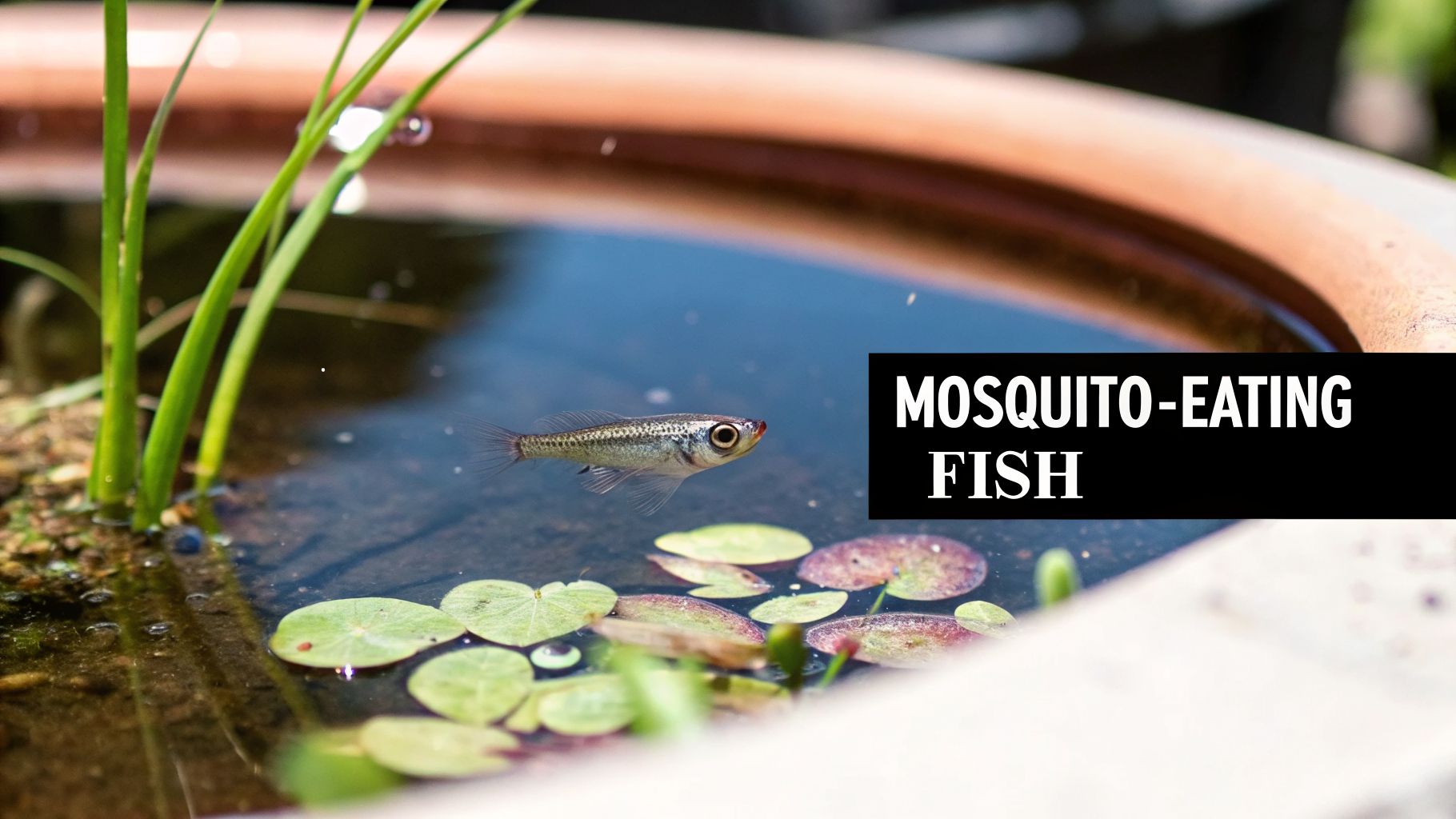
Actionable Tips for Using Mosquito-Eating Fish
To successfully implement this natural way to remove mosquitoes, consider these key steps:
- Timing is Key: Introduce the fish in early spring as water temperatures rise. This allows their population to establish before mosquito season peaks in Crown Point and surrounding areas.
- Water Depth Matters: Ensure your pond or water feature has areas at least 18-24 inches deep. This depth provides a crucial refuge for the fish to survive colder winter temperatures.
- Stocking Density: A good starting point is 100-200 fish per 100 square feet of water surface. For smaller features, even a handful of fish can make a significant difference. When considering specific types, the Blue Delta Guppy Male is one variety that can help control mosquito populations by feeding on their larvae.
- Professional Guidance: For larger or more complex water systems, partnering with a local expert like The Green Advantage can ensure proper species selection and stocking rates for optimal results.
Pro Tip: When first introducing fish, avoid adding features that attract predatory birds, like herons. Give the fish population time to grow and establish itself as the primary defense against mosquito larvae in your pond.
While fish handle the aquatic stages, a complete strategy also addresses adult mosquitoes. Pairing this method with other natural controls, like adding a bat house, can further protect your property. For more information, explore our guide on using bat houses for mosquito reduction.
Actionable Tips for Using Bti
To effectively use this biological control agent as a natural way to remove mosquitoes, follow these guidelines:
- Target the Source: Apply Bti products, available as dunks, pellets, or granules, directly to any standing water on your property. Common breeding grounds include bird baths, rain barrels, clogged gutters, flowerpot saucers, and ornamental ponds.
- Start Early and Be Consistent: Begin treatments in early spring as soon as standing water appears. Reapply every 7 to 30 days, depending on the product formulation, throughout the mosquito season in Crown Point to maintain control.
- Reapply After Rain: Heavy rainfall can dilute the Bti concentration or wash it away. Always check treated areas after a significant downpour and reapply if necessary to ensure continuous protection.
- Proper Storage: Keep Bti products in a cool, dry place away from direct sunlight. This preserves the viability of the bacteria and ensures the product remains effective when you need it.
Pro Tip: While Bti is extremely safe, always read the product label for specific application rates. A single Bti dunk can often treat up to 100 square feet of water surface, making it a cost-effective solution for larger water features.
Using Bti is a powerful step in controlling mosquito populations at their source. To create a more complete defense for your property, consider combining it with other natural methods. For more insights on building a multi-layered approach, see our advice on creating a mosquito-free yard.
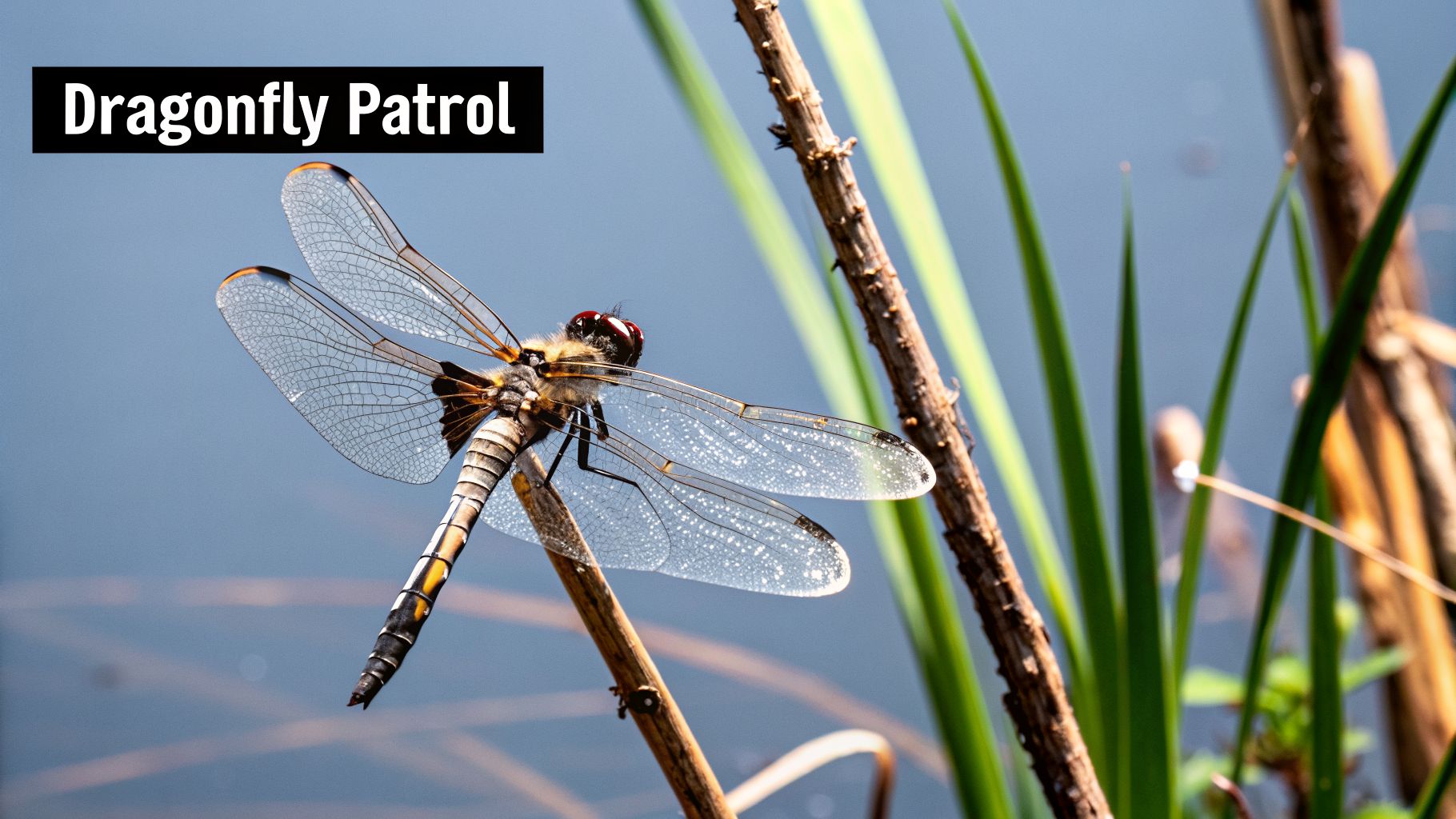
Actionable Tips for Attracting Dragonflies
To successfully implement this natural mosquito control method at your home or business in the Crown Point area, focus on creating an ideal environment:
- Create a Water Source: Install a shallow pond or water feature, ideally 6 to 24 inches deep. Unlike with fish, a shallow design is perfect for dragonfly nymphs.
- Add Native Aquatic Plants: Incorporate native species like cattails, rushes, and water lilies. These plants provide oxygen to the water and give nymphs places to hide and hunt for mosquito larvae. They also offer adults a place to land and lay eggs.
- Provide Perches: Place flat rocks or sticks around the edge of your water feature. Adult dragonflies use these spots for basking in the sun, resting, and hunting for flying pests.
- Avoid Fish: While fish can also control larvae, many species will eat dragonfly nymphs. If your primary goal is attracting dragonflies, it is best to have a fish-free water source.
- Eliminate Pesticides: Refrain from using chemical pesticides in your yard. These products are indiscriminate and will harm or kill beneficial insects like dragonflies, undermining your natural control efforts.
Pro Tip: Plant a variety of native flowering plants around your pond. This attracts other insects, providing an additional food source for dragonflies and creating a more robust and balanced backyard ecosystem.
By building a habitat that supports dragonflies, you are not only reducing mosquitoes but also enhancing the local biodiversity. This method pairs perfectly with other natural solutions, creating multiple layers of defense for a more enjoyable outdoor space.

Actionable Tips for Using Mosquito-Repellent Plants
To effectively integrate this natural way to remove mosquitoes into your yard, follow these practical steps:
- Location is Everything: Plant your repellent species in containers and place them near seating areas, doorways, and windows. Grouping several plants together can amplify their repellent effect.
- Release the Scent: Gently crush the leaves of plants like basil, lavender, or mint when you are nearby. This action releases their essential oils into the air, temporarily boosting their mosquito-deterring power.
- Sunlight is Essential: Most of these repellent plants, including marigolds and lavender, thrive in full sun. Ensure they receive at least 6 hours of direct sunlight daily for optimal growth and oil production.
- Consistent Care: Deadhead flowers like marigolds regularly to encourage continuous blooming throughout the mosquito season. A healthy, thriving plant produces more of the compounds that mosquitoes dislike.
Pro Tip: Create a layered defense by planting taller repellent plants like rosemary behind smaller ones like basil or marigolds in your garden beds. This not only creates visual interest but also helps disperse the repellent scents at different heights.
While repellent plants are a great addition, they are most effective as part of a larger plan. For persistent mosquito issues that overwhelm these natural methods, a professional approach may be necessary. For a thorough evaluation and targeted solutions in the Crown Point area, connect with the experts at The Green Advantage.
Benefits of Professional Pest Control in Crown Point
Choosing professional services from The Green Advantage provides benefits that DIY methods simply can't match:
- Protect Your Family's Health: By effectively reducing mosquito populations, you lower the risk of mosquito-borne illnesses for your family and pets.
- Reclaim Your Property: Enjoy your deck, patio, and yard without being driven indoors by biting pests. Our services help you make the most of your outdoor living spaces.
- Protect Your Investment: A pest-free home is a more valuable and enjoyable home. Our residential pest control services, including mosquito control and termite control, protect your property's value.
- Gain Peace of Mind: Let our experts handle the problem. With our professional treatments, you can relax knowing your home is protected by licensed, experienced technicians who serve the Crown Point, IN community.
Pro Tip: Don't forget to check children's toys, tire swings, and uncovered boats left in the yard. These common items can collect rainwater and become significant mosquito nurseries in just a few days.
A property free of breeding sites is the first line of defense. By combining professional source reduction with other methods like mosquito-repelling plants, you create a powerful, multi-layered strategy for a more enjoyable, mosquito-free outdoor space.
Actionable Tips for Using Mosquito Netting
To successfully implement this natural way to remove mosquitoes, consider these key steps:
- Choose the Right Mesh: Select high-quality, fine-mesh netting with at least 18 holes per inch. This density is small enough to block most mosquito species found in the region while still allowing for airflow and visibility.
- Measure with Precision: Before purchasing screens or netting, carefully measure the area you intend to enclose. Accurate measurements are critical for a snug fit that leaves no gaps for mosquitoes to enter.
- Seal All Gaps: Ensure the netting or screen is tightly sealed around all edges, including door and window frames. Use an overlap technique for curtains or closures to prevent insects from finding their way in.
- Regular Inspections and Maintenance: Periodically check your screens and netting for any tears, holes, or damage. Repair any openings promptly to maintain the integrity of your barrier. Regular cleaning also helps maintain good visibility and airflow.
Pro Tip: For patios and decks, consider installing retractable screens. This gives you the flexibility to have an open-air space on cooler, less buggy days and a fully protected enclosure when mosquitoes are active in the evening.
While physical barriers are excellent for defined areas, a complete mosquito control plan addresses the entire property. Combining netting with other strategies, like eliminating standing water and introducing natural predators, will provide more thorough protection. For a professional assessment of your property’s needs, contact The Green Advantage for expert guidance on integrated pest management.
Actionable Tips for Using Beneficial Organisms
To successfully apply these microscopic allies, a targeted and informed approach is necessary:
- Professional Suitability Assessment: This method is more complex than others. Consulting with a pest management professional like The Green Advantage is crucial to determine if your property's specific environment in the Crown Point area can support nematodes or wasps.
- Maintain Proper Conditions: Beneficial nematodes require specific soil moisture and temperature ranges to be effective. Applying them to overly dry or hot soil will render them useless. They are best applied to moist ground in the evening to avoid UV exposure.
- Strategic Application: Apply nematodes directly to known mosquito breeding grounds, such as low-lying damp areas of your lawn, the edges of ponds, or marshy spots that hold water after rain.
- Combine with Other Methods: Due to their specialized nature, nematodes and wasps are most effective as part of a larger, integrated pest management strategy. Use them to supplement other efforts, like eliminating standing water and encouraging predators.
Pro Tip: When purchasing beneficial nematodes, ensure they are fresh and have been stored correctly. These are living organisms with a limited shelf life. Always follow the supplier’s instructions for mixing and application to ensure the highest chance of success.
While these biocontrol agents target the larval and pupal stages, a complete mosquito control plan must also address adult mosquitoes. Combining this method with other natural solutions can create a more resilient defense for your property.
What to Expect When You Work With The Green Advantage in Crown Point, IN
We are proud to be a local pest control company serving our neighbors in Crown Point and throughout Northwest Indiana. We believe in building trust through transparent communication and effective service. When you choose The Green Advantage, you can expect:
- A Professional & Courteous Team: Our licensed technicians will treat your home and property with respect.
- A Detailed Pest Inspection: We start by understanding the unique challenges of your property before recommending a solution.
- A Customized Treatment Plan: We don't believe in one-size-fits-all solutions. We'll create a plan that targets your specific pest issues, whether it's mosquito control, ant control, or rodent control.
- Clear Communication: We will explain our findings, our recommended treatment, and what you can expect from our service.
- Guaranteed Satisfaction: We stand by our work and are committed to solving your pest problem.
Whether you own a home or a business, our residential and commercial pest control services are designed to provide lasting protection.
Take Back Your Yard: Contact The Best Exterminator in Crown Point Today
When DIY efforts aren't enough, comprehensive professional programs offer the most effective and sustainable mosquito control. These programs use an Integrated Pest Management (IPM) approach, which combines habitat elimination, biological controls, and targeted low-toxicity treatments tailored to your property. This is the most reliable way to handle a mosquito problem.
A licensed pest management professional from The Green Advantage will assess your property, identify breeding sources that may go unnoticed, and implement a multi-faceted plan. This may involve treating standing water with biological larvicides, applying barrier sprays to foliage where adult mosquitoes rest, and providing ongoing monitoring throughout the season to ensure long-term relief for your home in Crown Point or Northwest Indiana.
Don't let mosquitoes keep you from enjoying your property. If you're tired of searching for "exterminator near me" and want a reliable, local solution for pest control in Crown Point, IN, it's time to call the experts. The Green Advantage offers professional mosquito control services that deliver real results.
Take the first step toward a comfortable, mosquito-free yard in Crown Point. Contact The Green Advantage for a comprehensive property inspection and a free quote on a customized mosquito reduction program that prioritizes safety and effectiveness. Visit us at The Green Advantage to reclaim your outdoor space today.
How to Keep Spiders Out of Your Basement: A Crown Point, IN Guide

If you're a homeowner in Crown Point, IN, finding spiders in your basement can be an unsettling experience. It often feels like a sign that your home isn't clean, but the truth is, basements provide the perfect environment for these eight-legged intruders to thrive. At The Green Advantage, we want to reassure you that this is a common issue in Northwest Indiana, and more importantly, it's one you can solve. This guide will walk you through why spiders love your basement and how you can reclaim your space, from DIY tips to professional pest control in Crown Point, IN.
Why Spiders Love Your Basement and What You Can Do
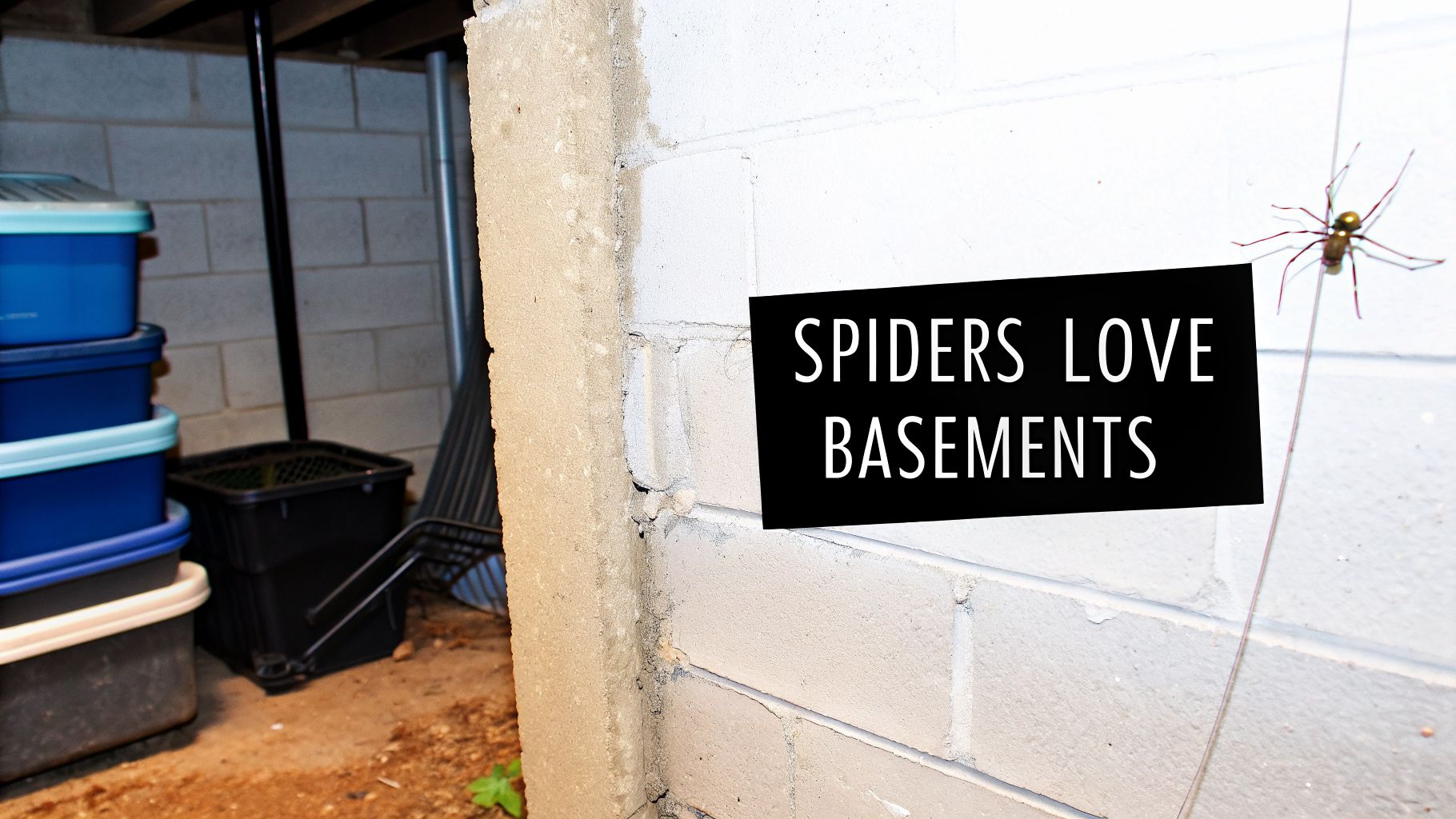
Finding spiders in your Crown Point basement can be unsettling, but it's an incredibly common experience for homeowners here in Northwest Indiana. It's not a reflection of how clean your home is; it just means your basement provides the perfect conditions for these eight-legged intruders to thrive.
The real secret to getting rid of them for good is understanding why they showed up in the first place. Spiders are always on the lookout for three things:
- Shelter: Those quiet, undisturbed corners, exposed rafters, and cluttered piles of boxes are ideal spots for them to build webs, hunt, and lay eggs.
- Moisture: The cool, damp air common in basements is a huge draw for spiders and the little bugs they love to eat.
- Food: If your basement already has other pests like ants, silverfish, or centipedes, you've basically set out a buffet. Spiders will follow the food.
Identifying the Usual Suspects in Crown Point
While you might find a variety of spiders indoors, the most common culprit you'll see is the cellar spider, which many people mistakenly call a "daddy long-legs." With their long, wispy legs, these guys are perfectly adapted to the low-light, sheltered environment your basement offers.
In fact, dozens of cellar spider species across North America have figured out how to live alongside us. They're so good at it that they've spread globally, often by hitching a ride on our stuff. If you want to get to know this frequent basement guest, you can learn more from this detailed guide to cellar spiders.
Seeing cellar spiders or other common house spiders is often a sign. They're telling you that you might have an underlying moisture issue or another insect problem that needs your attention. Tackling those root causes will get you much further than just squishing every spider you find.
Think Proactively, Not Reactively
The best spider control isn’t about chasing down individual spiders after they’re already inside. It’s about methodically making your basement an unwelcoming place for them. When you focus on exclusion and changing the environment, you interrupt their life cycle and make your home a less appealing target from the start.
Quick-Start Spider Prevention Checklist
Here are the most impactful first steps you can take to immediately reduce spider activity in your basement. Tackle these over a weekend, and you'll see a real difference.
| Action Item | Why It Works | Frequency |
|---|---|---|
| Declutter and Organize | Removes spider hiding spots and makes it easier to spot new activity. Switching from cardboard to plastic bins is a game-changer. | Seasonally |
| Run a Dehumidifier | Lowers humidity to below 50%, making the air too dry for spiders and the insects they eat. | Daily during humid months |
| Seal Obvious Gaps | Use caulk to fill small cracks around pipes, windows, and where the foundation meets the house frame. This blocks their main entry points. | Annually or as needed |
| Vacuum Webs and Corners | Physically removes spiders, webs, and egg sacs all at once, which immediately cuts down on the population. | Weekly or bi-weekly |
Focusing on these four key areas directly hits the shelter, moisture, and food sources that spiders depend on, giving you the upper hand right away.
Fortifying Your Foundation to Block Spider Entry Points
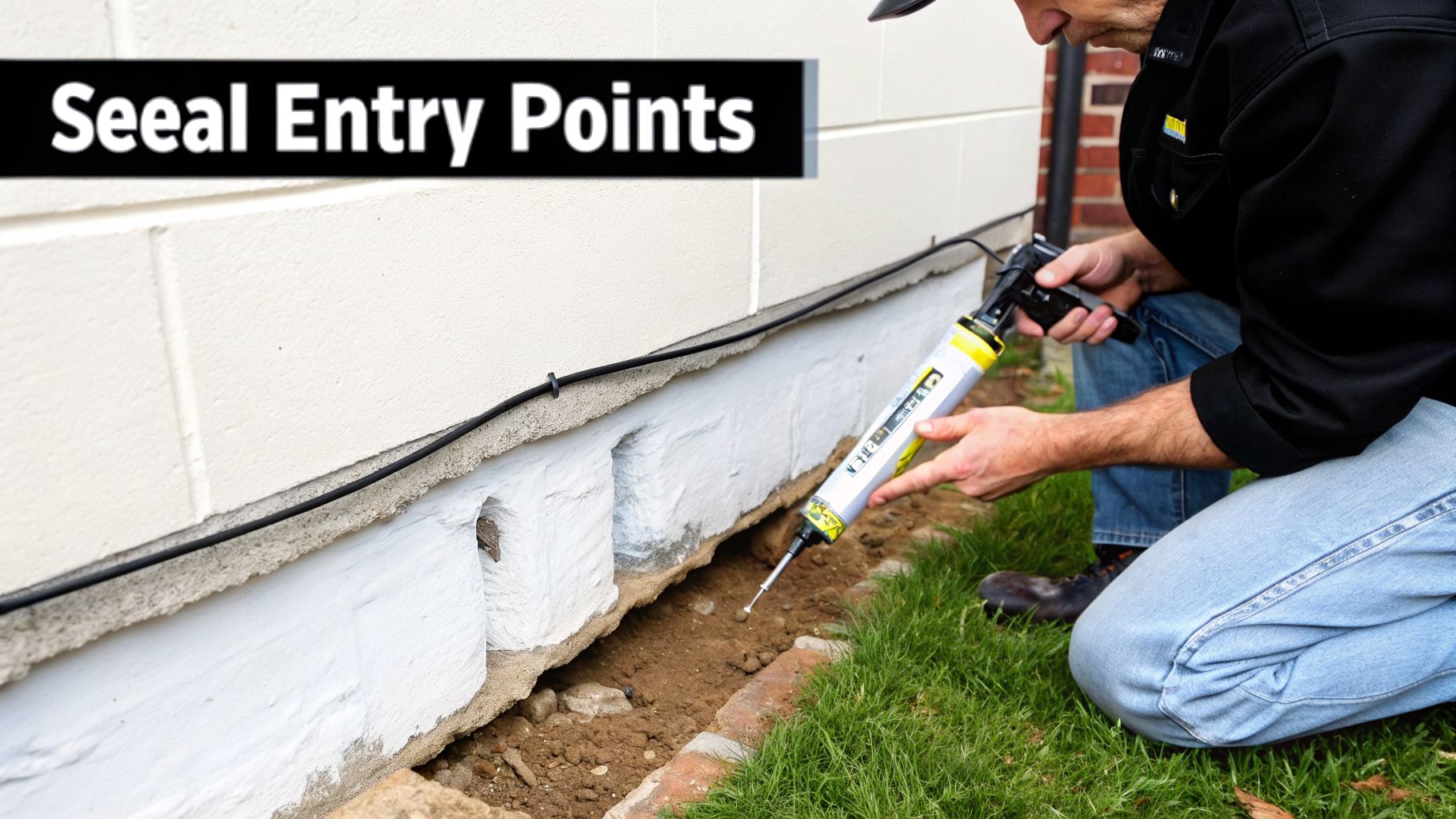
Spiders aren’t Houdinis; they don't just appear out of thin air. They're sneaky opportunists, and the most effective way to keep them out of your basement for good is to build a fortress they can't breach. This means sealing up every last crack and gap, a process we in the pest control industry call "exclusion."
Think of it this way: your foundation is the first line of defense. Here in Crown Point, IN, our freeze-thaw cycles mean houses are constantly settling and shifting. Tiny cracks are bound to appear, and to a spider, those aren't cracks—they're superhighways straight into your home.
Sealing these entry points isn't just a spider solution, either. The same gaps that let spiders in are an open invitation for ants, centipedes, and even mice. That’s why exclusion is the foundation of any solid residential pest control strategy from a trusted exterminator near me.
Pinpointing Common Spider Entry Points
So, where do you even start looking? Spiders can flatten themselves and squeeze through gaps so small you’d barely notice them. Your best bet is to grab a powerful flashlight and do a slow, methodical inspection of your basement's perimeter, both inside and out.
Here are the hot spots we at The Green Advantage always check first:
- Foundation Cracks: Scan the concrete or block walls for any hairline fractures. A crack that looks like nothing to you is a front door for a spider.
- Sill Plate Gaps: This is a big one. The sill plate is the wood plank sitting right on top of your foundation. Gaps almost always form between the wood and concrete, creating a highway for pests.
- Utility Line Openings: Look closely where pipes, wires, and vents come through the wall. The space around plumbing, electrical conduits, and dryer vents is often hastily sealed, if at all.
- Basement Windows and Doors: Check for brittle or missing weather stripping, torn screens, and gaps around window frames. These are basically wide-open doors.
A thorough inspection is half the battle. If you want to think like a pro, using a detailed pest control inspection checklist helps ensure you don't miss a single spot.
Choosing the Right Sealing Materials
Once you've mapped out all the weak points, it's time to seal them up. And trust us, using the right product for the job makes all the difference. A cheap, quick fix will likely fail, and you’ll be right back where you started.
For Small Cracks and Gaps (less than 1/4-inch):
A high-quality silicone or acrylic caulk is your best friend here. It’s flexible enough to handle slight shifting and perfect for those hairline foundation cracks, gaps around windows, and the crucial space between the sill plate and foundation. Just apply a nice, steady bead to fill the opening completely.
For Larger Voids and Openings (greater than 1/4-inch):
For bigger gaps, especially around pipes, expanding foam sealant is the way to go. It expands to create a perfectly tight, pest-proof seal. Pro tip: if you're worried about mice chewing through the foam (and they will), stuff the hole with coarse steel wool first, then seal over it with the foam.
A Note on Moisture Control
It's important to remember that many of these gaps also let in moisture, which is a magnet for spiders and the insects they hunt. A critical part of the process is learning how to waterproof basement walls. A dry basement is an unappealing basement to pests.
Finally, don't overlook the easy wins. Replace those torn window screens and install fresh weather stripping or door sweeps on any basement doors. These small details have a huge impact. By taking the time to truly seal your foundation, you're not just getting rid of spiders—you're making a lasting investment in your Crown Point home's health and integrity.
Make Your Basement a No-Go Zone for Spiders
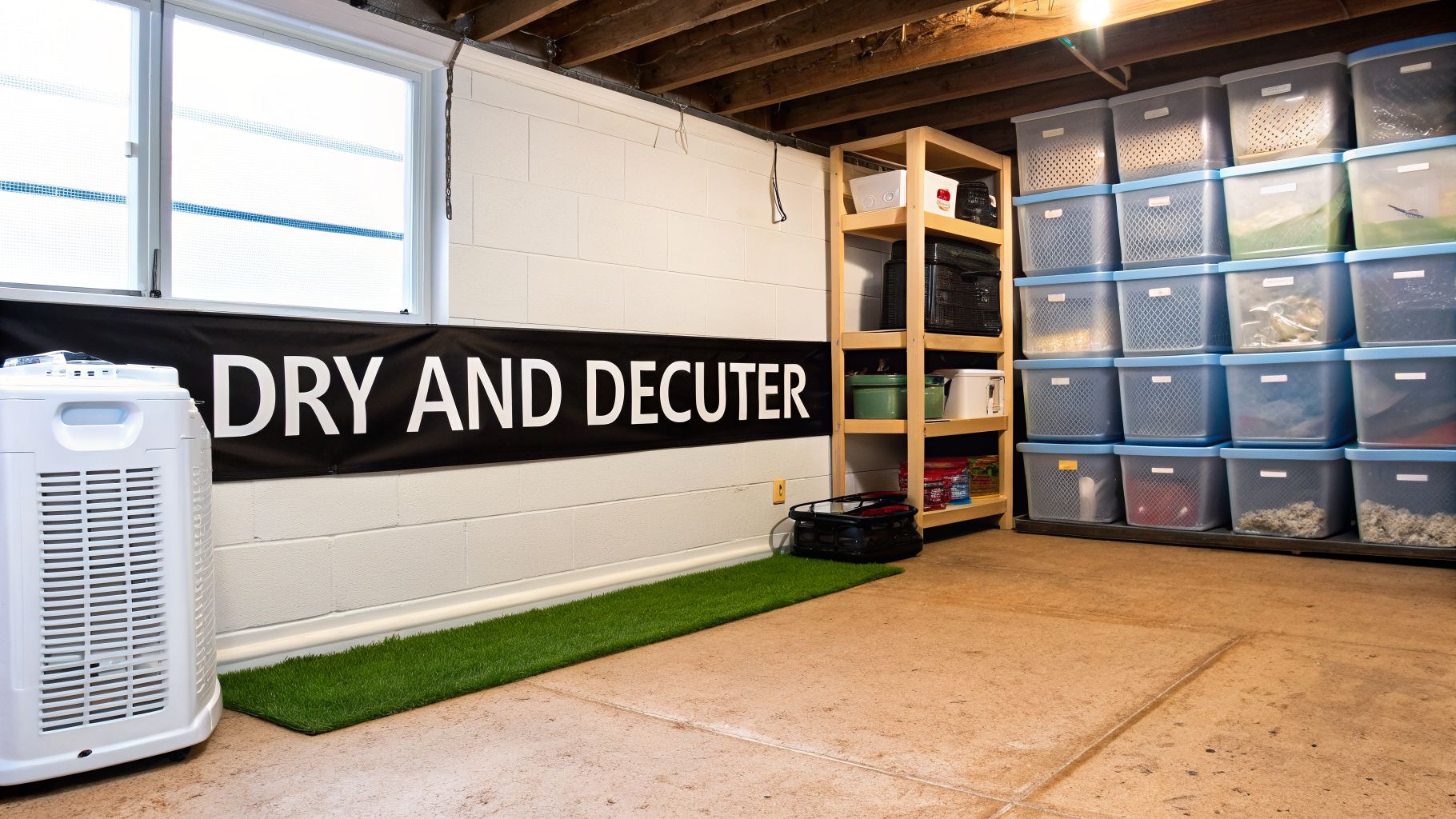
Once you've sealed up all the cracks and gaps, the real work begins. Now, we need to change the environment of your basement so spiders simply don't want to be there. Think of it from their perspective: they're looking for shelter, a bit of moisture, and—most importantly—a reliable food source. If you take away those three things, you’ll turn your basement from a five-star spider resort into a place they’d rather avoid.
We call this "habitat modification" in the pest control world. It’s a fancy term for a simple idea: change the conditions that let pests move in and get comfortable. Here in Northwest Indiana, this is especially crucial during our humid summers and damp springs, when basements naturally become prime real estate for spiders and their prey.
Get a Handle on Humidity
If you do only one thing, make it this: control the moisture in your basement. Spiders, and the little critters they love to eat like silverfish and millipedes, absolutely thrive in damp, clammy air. That musty smell you might notice downstairs? That’s basically a giant "Vacancy" sign for pests.
Your target is to keep the relative humidity below 50%. This makes the air just a little too dry for them to be comfortable. The easiest way to do this is by running a good dehumidifier, especially from late spring through early fall. As a bonus, it also helps stop mold and mildew in their tracks.
Take Away Their Hiding Spots
Spiders are naturally shy. They aren't looking for a fight; they're looking for a dark, quiet, cluttered corner to set up shop, spin a web, and be left alone. An open, organized basement is their worst nightmare.
Look around your basement right now. Are there piles of old magazines, forgotten firewood, or stacks of cardboard boxes? That's what we call a "spider condo." Cardboard is a particularly big offender because it wicks moisture right out of the concrete floor and offers endless dark crevices for spiders to hide.
Here’s how you can reclaim that space:
- Ditch the Cardboard: Make the switch to airtight plastic totes. They don't absorb moisture and seal up tight, keeping pests out for good.
- Get It Off the Ground: Use sturdy shelving—metal or plastic is best—to lift all your storage bins off the floor. This simple move eliminates countless hiding spots underneath boxes and helps with airflow.
- Leave Some Breathing Room: Don't push your shelves right up against the basement walls. Leaving a gap of a few inches lets air circulate and makes it infinitely easier for you to do a quick scan for webs or other pest activity.
A Pro's Perspective
Just getting your basement organized is a huge part of the battle. When every corner and baseboard is visible, you're not just removing spider hideouts—you're making it easy to spot a new web or the start of a problem long before it becomes an infestation.
Cut Off the Buffet
Here’s the thing: spiders rarely end up in your basement by accident. They follow the food. If you’ve got a healthy population of other household pests crawling around, you’re basically ringing the dinner bell for every spider in the neighborhood. That's why a true spider control strategy has to include managing the other insects.
This is where a comprehensive pest control plan, like what we offer at The Green Advantage, makes a real difference. We don't just treat for spiders; we figure out what's attracting them in the first place—be it ants, crickets, silverfish, or something else—and address the root cause. When you take away their food, spiders will quickly move on to better hunting grounds. Our ant control and general pest treatments are essential parts of an effective spider solution.
Think of spiders as a big, flashing sign that you have other pest issues. In fact, a 2016 study of 50 homes found cobweb spiders in 65% of all rooms surveyed. Basements are especially popular because the dark, damp environment is exactly what they seek out. If you're curious, you can read more about the study's spider findings to see just how common they are. It really drives home why tackling the entire pest ecosystem is the only way to get lasting results.
Practical DIY Methods for Managing Spider Activity
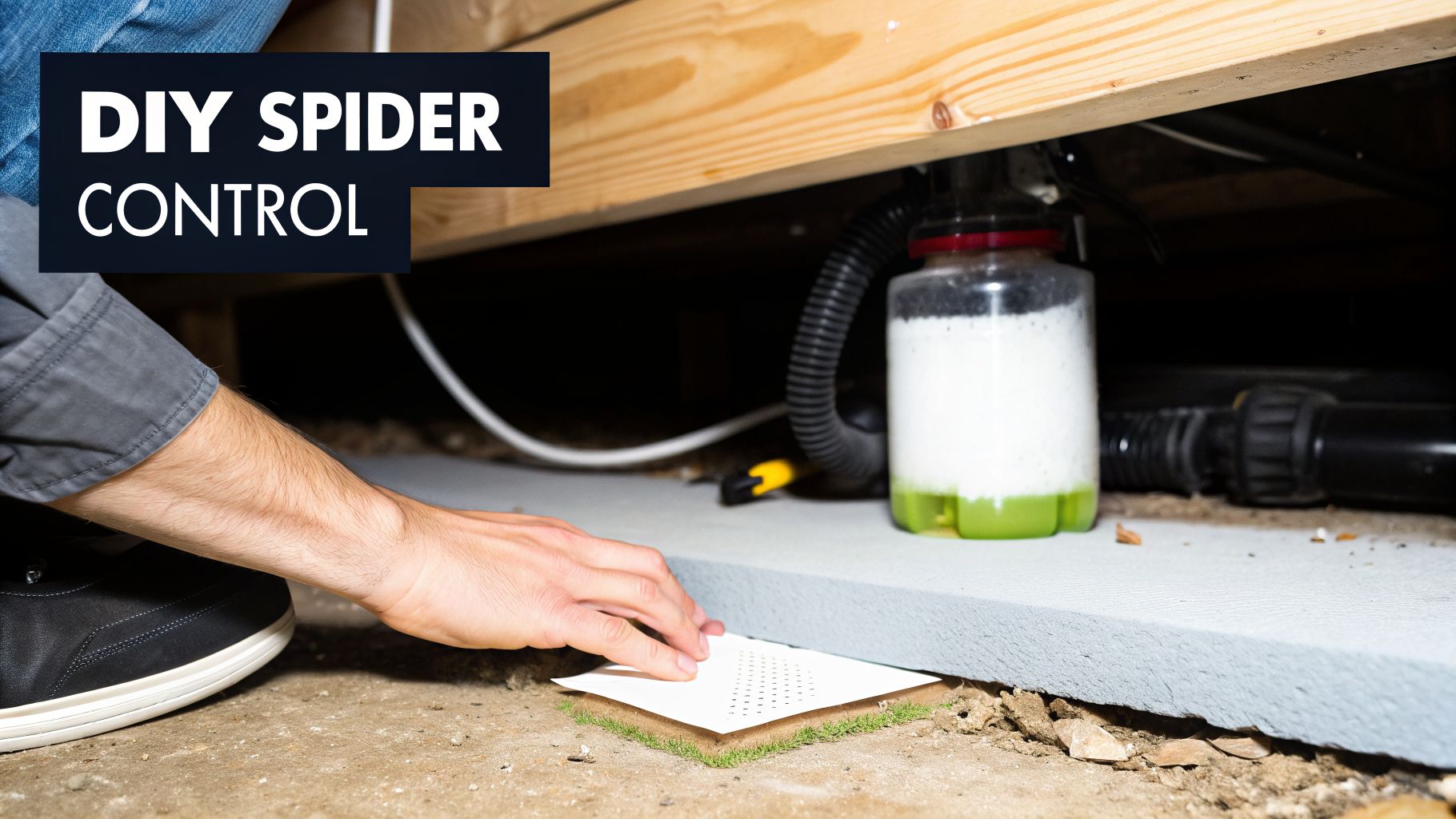
Alright, you've sealed the cracks and are working on the moisture—now for the hands-on part. For homeowners in Crown Point who want to take an active role, a few tried-and-true DIY methods can make a real difference in managing any spiders that still sneak past your defenses.
Let's skip the myths and get right to what we've seen work. These techniques are all about monitoring what's going on, directly reducing the spider population, and making your basement an unwelcome space for them. They're the perfect support system for a professional pest control plan from The Green Advantage.
Strategic Monitoring With Sticky Traps
Never underestimate the humble sticky trap. It’s one of the most effective tools in your DIY kit. They aren't a fix for a major infestation on their own, but they are incredibly valuable for monitoring and capturing wanderers.
By placing traps, you create a roadmap of spider activity. Checking them every week or so tells you exactly where the hot spots are, giving you critical clues about where they might be getting in or hiding out.
For the best data, place traps:
- Along baseboards, tucked into those dark corners where walls meet.
- Behind big furniture or boxes that you don't move often.
- Near potential entry points like basement window wells or where pipes come through the wall.
Think of them as an early-warning system. If you suddenly see more spiders in the traps, it’s a signal to re-inspect your seals or look for a new problem.
The Power of Your Vacuum Cleaner
Your vacuum cleaner is your number one weapon for immediate spider removal. With a long extension wand, it’s perfect for not just getting rid of adult spiders but, more importantly, their egg sacs.
A single egg sac can hatch hundreds of new spiders. Sucking it up prevents a population explosion right at the source. Make it a routine to vacuum the usual spider hangouts: the upper corners of the ceiling, around exposed floor joists, and in and around your shelving. A quick pass every week or two will seriously disrupt their life cycle.
Expert Tip: After you’re done vacuuming up spiders and their webs, take the vacuum outside immediately. Either throw away the bag in your outdoor bin or empty the canister into a sealed bag and then toss it. This prevents any survivors or viable eggs from making their way back into your home.
Natural Deterrents Used Correctly
Many people ask us about natural repellents. While some of the popular DIY sprays are more myth than reality, a couple of options can be helpful when used as part of a bigger strategy.
Diatomaceous Earth (DE): This is a fine, chalky powder that feels soft to us but is razor-sharp to insects. It works by scratching their exoskeleton and causing them to dehydrate. For DE to work, a spider has to crawl through it. Apply a very fine dusting of food-grade DE in dry, out-of-the-way places:
- Along the sill plate (the wood beam on top of your foundation).
- Inside wall voids around outlets (turn the power off first!).
- Deep in crawl spaces where you won't disturb it.
Peppermint Oil: Spiders seem to navigate by scent and touch, and they really don't like strong smells like peppermint. You can mix several drops of peppermint oil with water and spritz it in corners, around window frames, and in doorways. The trick is reapplication. The scent doesn't last, so you'll need to spray every few days for it to have any effect.
These methods are good backup, but nothing beats making your home a place spiders want to avoid. Even simple exterior maintenance, like knowing how to clean siding to remove webs and the insects they eat, reinforces your defenses.
Putting in this DIY effort gives you a major head start. But if you’re still seeing too many spiders after all this work, it’s usually a sign of a bigger, underlying issue. At that point, calling an exterminator in Crown Point, IN is the smartest and most effective next move.
When Professional Spider Control Is the Right Choice
So, you’ve done everything by the book. You sealed every crack you could find, decluttered the entire basement, and even have a dehumidifier humming away. But you’re still seeing spiders. Webs reappear almost as fast as you can knock them down, and you catch that familiar eight-legged scramble when you flick on the lights.
It’s a frustrating spot to be in, and a common one for homeowners here in Crown Point. While your DIY efforts are absolutely crucial for long-term control, a persistent spider problem is a tell-tale sign of a deeper issue—one that usually needs a professional eye to sort out for good. Professional services from The Green Advantage protect your property, health, and peace of mind.
Why Professional Pest Control is the Solution
Knowing when to pass the torch to a professional can save you a ton of time, frustration, and even money in the long run. If any of these sound familiar, it’s probably time to consider calling an exterminator in Crown Point, IN:
- You see spiders constantly. If you feel like you're stuck in a loop of cleaning webs and setting traps, it means the source of the infestation hasn't been touched. Spiders are either still finding easy ways in or are hatching inside faster than you can keep up.
- The problem is getting worse, not better. A sudden boom in the spider population almost always points to a thriving food source. An increase in spiders means you likely have an underlying issue with ants, silverfish, or other insects that requires a broader residential pest control strategy.
- You find potentially dangerous spiders. It’s not common, but medically significant species like black widows or brown recluses do turn up in Northwest Indiana. Correctly identifying and safely handling these spiders is a job for trained and properly equipped professionals. Full stop.
- You just want lasting peace of mind. Let's be honest, DIY pest control requires constant work. A professional service is designed to give you a solid, long-term solution that protects your home so you don't have to be the one on constant patrol.
Professional pest management isn't just about spraying for spiders; it's about diagnosing the 'why.' A trained technician from The Green Advantage looks beyond the web to identify and resolve the root causes, delivering a solution that lasts far longer than any store-bought spray.
What to Expect From The Green Advantage
When you partner with The Green Advantage, you’re not just getting a quick spray-and-pray treatment. You're getting a comprehensive strategy tailored to the specific pest pressures we see right here in Crown Point. We know how to keep spiders out of your basement because our approach goes far deeper than what a homeowner can do alone.
- A Comprehensive Inspection: It all starts with a thorough look at your property, inside and out. We don’t just head straight for the basement. We’re on the lookout for the tiny details, examining everything from the foundation and siding to the soffits and surrounding landscaping. We want to find every single potential entry point and pest-friendly condition.
- Identifying the Root Cause: Is there a hidden moisture issue in a crawl space that’s attracting silverfish (a spider delicacy)? Or maybe a line of ants marching along the foundation is providing a mobile buffet? We connect these dots to map out the entire pest ecosystem around your home. This diagnostic work is the key to truly effective spider control.
- Targeted, Eco-Friendly Treatments: Once we know what we’re dealing with, we use targeted, eco-friendly pest control methods applied where they’ll have the biggest impact—at entry points, inside wall voids, and in other key harborage areas. Our goal is to be tough on pests while being mindful of your family and pets. You can dive deeper into this topic in our detailed guide on how to get rid of spiders with professional help.
- A Proactive, Long-Term Plan: Finally, we’ll leave you with a clear, actionable plan for the future. This isn’t just our treatment schedule; it includes personalized recommendations for your specific property. When you work with The Green Advantage, you get more than just an exterminator—you get a dedicated partner committed to protecting your Crown Point home.
Working with The Green Advantage in Crown Point, IN
Choosing a pest control company in a place like Crown Point isn't just about getting rid of bugs; it’s about who you trust in your home. We get that. As a local, community-focused team, we’re your neighbors, and we’re committed to earning that trust from the first time you call.
When you reach out to our office in Crown Point, IN, you won't get a confusing phone tree or a distant call center. You'll talk to someone right here in Northwest Indiana who actually understands the specific pest challenges we face in our area. We’ll listen to what's going on, answer your questions, and make the whole process feel simple and direct.
What Our Service Looks Like in Action
We believe you should know exactly what's happening every step of the way. No surprises, no confusing jargon—just a clear, effective plan to get your home back to being yours.
Here's what you can expect when working with The Green Advantage:
- A Hands-On Property Assessment: First things first, one of our licensed technicians will come out for a thorough inspection. We don't just spot-treat for spiders. We put on our detective hats to figure out why they’re there in the first place. That means checking for tiny foundation gaps, moisture problems in the basement, and even other insects that are providing a steady food source.
- A Straightforward Breakdown: Once we have the full picture, we’ll walk you through everything we found. We’ll point out the specific entry points and problem areas, explain how they’re contributing to the spider issue, and answer any questions you have. We want you to see what we see.
- Your Custom and Eco-Friendly Plan: Based on our findings, we create a targeted treatment plan for your home. This is never a one-size-fits-all approach. We use eco-friendly pest control methods that are tough on pests but designed to be safe for your family and pets. The goal is to solve the problem at its source for lasting relief.
As a trusted company with deep roots in the Crown Point community, our reputation is everything. We build it one home at a time by delivering real, lasting results for our neighbors.
Your peace of mind is what matters most. We’ll keep you in the loop throughout the entire process and follow up to make sure the treatment worked. We'll also give you practical tips for keeping spiders out for good. It's this partnership approach that has made our residential and commercial pest control services the trusted choice here in Northwest Indiana.
Your Basement Spider Questions Answered
We get a lot of questions from homeowners in Crown Point about spiders in their basements. Here are answers to some of the most common ones we hear.
Are Spiders In My Indiana Basement Dangerous?
The good news is that most of the spiders you'll find in your Northwest Indiana basement are completely harmless. The usual suspects, like cellar spiders (daddy longlegs) and common house spiders, are just looking for a meal of other bugs and want nothing to do with you.
That said, we do have a couple of spiders in our region with medically significant bites: the black widow and the brown recluse. While finding them is uncommon, they prefer dark, quiet, and cluttered spaces—making basements a potential spot. An experienced exterminator in Crown Point, IN can tell you exactly what you're dealing with and make sure any concerning species are handled correctly.
How Often Should My Basement Be Treated For Spiders?
When it comes to keeping spiders out for good, spider control isn't a one-time fix. Pests are constantly trying to get in from the outside, so a consistent approach is key.
For most homes in the Crown Point area, we find that quarterly treatments are the sweet spot. This schedule allows us to maintain a solid protective barrier around your foundation and, just as importantly, adapt to the seasons. We can knock down the insect populations that boom in spring and summer, which removes the spiders' food source and makes your home far less inviting to them. This preventative approach is also key for our termite control and mosquito control services.
Seeing a few more spiders right after we've treated is actually a good thing! It means they're being forced out of their hiding places as the treatment works and their food supply disappears.
Why Do I Still See Spiders After A Pest Control Treatment?
It’s completely normal to spot a few spiders wandering around after a service. In fact, it's a sign that our work is disrupting their routine. As our products take effect, spiders are flushed out of the cracks and crevices where they've been hiding.
Think of it this way: our primary goal with residential pest control is to get rid of the spiders' food—all the other insects crawling around. Once the buffet is closed, the spiders will either leave or die off. If you're still seeing a lot of activity weeks after our visit, don't worry. That's what our guarantee is for. Just give The Green Advantage a call, and we'll be right back out to take another look.
Ready to stop wondering what’s sharing your basement with you? The team at The Green Advantage provides expert pest control near me for lasting peace of mind. We are the trusted choice for homeowners and businesses in Crown Point, IN, and throughout Northwest Indiana. Schedule your professional pest inspection today!
Bed Bug Exterminator Saint John IN

Bed Bug Exterminator Saint John IN
In the welcoming community of Saint John, IN, residents take great pride in maintaining comfortable and safe homes. However, a growing concern has been quietly disrupting this peace of mind: bed bugs. These elusive pests are not just a nuisance found in travel hubs or hotels; they have increasingly made their way into residential neighborhoods, causing stress and discomfort for families. The rise in local infestations highlights the reality that no home is entirely immune to these hitchhikers, regardless of its cleanliness or location. Because bed bugs are experts at staying out of sight, many homeowners remain unaware of an intrusion until the population has grown significantly. This makes the situation far more difficult to manage. Hidden infestations pose a unique challenge because early detection requires a keen eye and specific knowledge of insect behavior. Unlike other pests that might scurry across the kitchen floor in broad daylight, bed bugs prefer to remain concealed in the deepest crevices of furniture and bedding, emerging only to feed. This stealthy nature often allows them to establish a strong foothold before residents even notice the first bite mark or spotting on a sheet. The psychological toll of knowing one's sanctuary has been invaded can be overwhelming, leading to sleepless nights and anxiety. While discovering bed bugs is alarming, proactive prevention and professional bed exterminator offer a clear path to resolution. Attempting to handle these resilient insects without expert assistance often leads to frustration and wasted resources, as over-the-counter solutions rarely address the root of the problem.Understanding Bed Bugs: What Makes Them So Hard to Detect
Behavior and Habits
Bed bugs are notoriously difficult to spot primarily because they are nocturnal creatures that have evolved to avoid detection. They spend the vast majority of daylight hours tucked away in tight, dark cracks and crevices where they are protected from disturbances. Their activity peaks between midnight and 5 a.m., coinciding with the deepest sleep cycles of their human hosts, allowing them to feed without interruption. This survival instinct means that a casual visual inspection during the day will rarely reveal live insects unless the infestation has reached severe levels.Signs of an Infestation
Since seeing a live bug is rare in the early stages, residents must learn to recognize the subtle physical evidence left behind. The most common indicators include:- Unexplained Bites: Small, itchy, red welts on the skin, often arranged in a line or cluster, which appear after waking up.
- Blood Spots: Tiny, rust-colored blood spots on bed sheets or pillowcases, caused by crushed bugs or the aftermath of feeding.
- Fecal Spots: Dark specks, which look like ink dots from a pen, on mattress seams, tags, or surrounding furniture.
- Shed Skins: As bed bugs grow, they shed their exoskeletons, leaving behind translucent, shell-like casings in their hiding spots.
Why They Multiply Quickly
One of the most alarming aspects of a bed bug problem is the speed at which a minor introduction can turn into a full-blown infestation. A single female bed bug can lay hundreds of eggs over her lifetime, typically depositing one to five sticky, hard-to-see eggs each day. She hides these eggs in safe crevices where they can hatch undisturbed in about a week or two. Because the nymphs can begin feeding immediately and reach maturity in as little as a month under favorable conditions, the reproductive cycle accelerates rapidly, quickly overwhelming a household. [caption id="attachment_310" align="aligncenter" width="700"] Bed Bug Exterminator Saint John IN[/caption]
Common Hiding Spots in Saint John Homes
Bedroom and Furniture
The bedroom serves as the primary epicenter for bed bug activity simply because it provides easy access to a meal during the night.- Mattresses and Box Springs: Look along seams, piping, and under tags where the fabric folds over. The plastic corner guards of box springs are a favorite nesting site.
- Bed Frames and Headboards: Wooden frames, in particular, offer countless cracks and screw holes where bugs can nestle deeply.
- Nearby Furniture: Nightstands and dressers placed close to the bed are also prime real estate, allowing the insects to commute short distances to feed before retreating to safety.
Living Areas
While the bedroom is the most likely location for an infestation, living rooms and dens are increasingly becoming hotspots. This is especially true in homes where family members spend time resting on sofas or recliners. Upholstered furniture provides an ideal environment for bed bugs, with deep crevices between cushions and underneath fabric folds offering secure harborage. Baseboards and the spaces behind electrical outlets also serve as transit highways and nesting grounds, allowing pests to move between rooms unnoticed.Luggage and Personal Items
Bed bugs are famously termed "hitchhikers" because they do not fly or jump; instead, they travel by latching onto personal belongings. Luggage, backpacks, and purses are common vectors for bringing these pests into a Saint John home, especially after travel or visits to infested locations. Once inside, the bugs will migrate from the luggage to nearby furniture or clothing piles, effectively bypassing exterior barriers and starting a new infestation.DIY Detection and Prevention Tips
Regular Inspection Techniques
A high-quality flashlight is an essential tool, as bright light can cause bed bugs to scatter, making movement easier to spot in dark crevices. Using a magnifying glass or a smartphone camera with a zoom function can help identify tiny eggs or translucent nymphs that are otherwise invisible to the naked eye. For a more active approach, running a credit card or a stiff piece of paper along the cracks of baseboards and furniture joints can force hiding bugs out into the open for identification.Vacuuming and Steam Cleaning
Vacuuming is a highly effective, immediate way to reduce the number of visible bugs and eggs on surface areas. Using a vacuum with strong suction and a crevice tool allows homeowners to reach deep into mattress seams, carpet edges, and furniture interiors to physically remove the pests. However, it is critical that the vacuum bag or canister be emptied into a sealed plastic bag and disposed of outside immediately to prevent escapees from returning. Steam cleaning can also be effective, as high heat will kill bugs and eggs on contact.Early Warning Systems
To supplement visual inspections, homeowners can install passive monitoring devices that act as early warning systems.- Interceptors: These are small, dish-like traps placed under the legs of beds and furniture. Their slippery interior surfaces trap bugs attempting to climb up or down, confirming their presence before a full infestation develops.
- Encasements: Mattress and box spring encasements are another crucial tool. These specialized, zipper-locked covers trap existing bugs inside while preventing new ones from nesting in the mattress’s complex folds, making future inspections much easier.
Why DIY Treatments Often Fail
Limited Reach
One of the primary reasons self-treatment efforts fall short is the inability of consumer-grade products to reach the pests where they actually live. Bed bugs are masters of concealment, often residing deep within walls, under floorboards, or inside electronics. Store-bought sprays and foggers typically only coat surface areas, leaving the vast majority of the population untouched in their protected sanctuaries. Because these insects can survive for months without feeding, those hidden away simply wait until the chemical residue dissipates before re-emerging.Resistance to Chemicals
Over the past few decades, bed bugs have developed a significant genetic resistance to many of the common pesticides available to the public. Research has shown that the pyrethroids found in most over-the-counter bug sprays are increasingly ineffective, with some populations virtually immune to their effects. When homeowners apply these products, they may kill a few vulnerable insects, but the resistant survivors continue to breed, passing those strong genes to the next generation and making the problem worse over time.Incomplete Solutions
Successful bed bug eradication requires a comprehensive strategy that addresses every life stage of the insect, from egg to adult. DIY attempts often focus on killing the visible adults while neglecting the tiny, resilient eggs that are glued to hidden surfaces. If even a few eggs survive the treatment, a new generation will hatch within weeks, restarting the cycle and leading to recurring infestations. This "yo-yo" effect of knocking down the population only to see it bounce back is a common source of frustration for homeowners. [caption id="attachment_311" align="aligncenter" width="700"] Bed Bug Infestation[/caption]
Professional Bed Bug Extermination in Saint John
Inspection and Assessment
When a professional team like The Green Advantage is called in, the process begins with a rigorous and systematic inspection of the property. Licensed technicians possess the training to identify subtle signs of activity that an untrained eye would likely miss, mapping out the full extent of the infestation. This assessment goes beyond just the bedroom; it includes analyzing traffic patterns in the home, adjacent rooms, and potential entry points to ensure no harborage area is overlooked. This detailed approach is the foundation of an effective treatment plan.Treatment Options
Professional exterminators have access to a wide arsenal of advanced treatment methods that are not available to the general public.- Heat Treatment: This is one of the most powerful options, involving specialized equipment that raises the temperature of the affected area to levels that are lethal to bed bugs and their eggs instantly.
- Chemical Treatments: Using commercial-grade insecticides with residual effects can be applied to key harborage zones, creating a long-lasting barrier against re-infestation.
- Integrated Pest Management (IPM): Often, the best approach is an integrated one, combining chemical and non-chemical methods to attack the problem from multiple angles while minimizing risks to health and property.
Follow-Up Services
The job of a professional exterminator does not end once the initial treatment is applied; follow-up is a critical component of success. Because of the bed bug's elusive nature and resilient life cycle, a secondary inspection or treatment is typically scheduled to catch any stragglers or newly hatched nymphs. This ensures that the reproductive cycle is completely broken and that the home remains pest-free in the long term. The Green Advantage prioritizes this continuity of care, offering peace of mind that the investment in professional services yields permanent results.Eco-Friendly Solutions by The Green Advantage
Safe Chemicals and Treatments
The Green Advantage addresses this concern by utilizing eco-friendly products and application methods designed to be tough on pests but gentle on the household environment. These treatments focus on targeted application in cracks and crevices rather than indiscriminate spraying, which reduces the overall chemical load in the home and ensures safety for your loved ones.Preventive Programs
Beyond immediate extermination, The Green Advantage emphasizes the importance of ongoing prevention to keep homes safe year-round. Customized maintenance programs are available, providing regular inspections and proactive treatments that create a protective shield around the property. These services are particularly valuable for frequent travelers or those living in multi-unit buildings where the risk of re-introduction is higher.Sustainable Practices
Sustainability is at the core of The Green Advantage's philosophy. The company is committed to using methods that minimize environmental impact, such as heat remediation which relies on thermal energy rather than chemicals. This approach not only aligns with the values of eco-conscious homeowners but also proves to be highly effective against pesticide-resistant bed bug strains.Protecting Your Home After Extermination
Cleaning and Decluttering
Rigorous cleaning and decluttering are essential. Removing piles of clothing, old magazines, and unused items eliminates potential hiding spots, forcing any remaining pests out into the open where they can be detected or exposed to residual treatments. Washing all bedding, curtains, and clothing in hot water and drying them on high heat ensures that any lingering bugs or eggs are destroyed.Preventive Measures
To safeguard the home against future invasions, specific physical barriers should remain in place long after the exterminators have left. High-quality mattress and box spring encasements should be kept on permanently to protect the bed, which is the most vulnerable area in the house. When returning from trips, luggage should be kept off the bed and inspected outside or in a garage before being brought inside.Ongoing Monitoring
Vigilance is the final key to long-term protection. Residents should not assume the problem is gone forever without verification. Periodic spot checks of the mattress seams, headboard, and interceptor traps should become a routine habit, perhaps done every time the sheets are changed. If any suspicious signs reappear, such as new bites or blood spots, contacting The Green Advantage immediately allows for a swift response before the population can rebuild.When to Call a Bed Bug Exterminator Immediately
Early Warning Signs
If residents notice persistent, unexplained bites that appear in clusters or lines, it is a strong indication of active feeding. Finding cast skins or actual live bugs during a cleaning session warrants an immediate call to a professional. These early signs suggest that the bugs are already reproducing and feeding, meaning the window for a quick, localized treatment is closing rapidly.Rapid Infestation Scenarios
There are certain scenarios where the speed of professional intervention is critical. If bed bugs are discovered in multiple rooms or if the infestation has spread to shared walls in a duplex or apartment complex, the situation is considered a rapid infestation emergency. In these cases, the pests are utilizing the structure of the building to move freely, and DIY methods will simply chase them from one area to another.Choosing a Trusted Local Exterminator
When facing the stress of a bed bug infestation, choosing the right service provider makes all the difference in the outcome. Saint John residents are encouraged to look for a company with a proven track record, proper licensing, and specific experience in bed bug remediation. The Green Advantage offers the local expertise and dedicated customer service that national chains often lack, providing personalized attention to every unique situation. [caption id="attachment_295" align="aligncenter" width="700"] Bed Bug Extermination Specialist[/caption]
Conclusion
Bed bug infestations are a hidden danger that can disrupt the sanctity of any home in Saint John IN, turning a place of rest into a source of anxiety. The challenge lies not only in the resilience of these pests but in their ability to remain undetected until their numbers have surged. Ignoring the subtle warning signs or relying on ineffective DIY remedies often allows the problem to escalate, leading to greater emotional and financial costs. Ultimately, the most effective defense against bed bugs is a partnership with knowledgeable professionals who possess the tools and expertise to eliminate the threat completely. The Green Advantage offers a beacon of hope for those struggling with infestations, providing eco-friendly, reliable solutions that prioritize the safety of families and pets. There is no need to face this battle alone. Are you experiencing a pest issue? Would you like to have a local knowledgeable licensed professional assist in eradicating your pests? The Green Advantage is here to help! Reach out at the first sign of trouble to ensure that a small intrusion is dealt with swiftly before it becomes a major, life-disrupting problem.Cockroach Exterminator in Crown Point, IN

That sinking feeling when you flick on the kitchen light and see a cockroach scramble for cover—it’s a moment no Crown Point homeowner wants to experience. Your first instinct is to get rid of it, and fast. But what you do next is critical. At The Green Advantage, we understand the stress that pests cause, and we're here to provide professional, reassuring solutions for families in Crown Point and across Northwest Indiana.
This isn’t just about dealing with one bug. It's about understanding that a single roach is often a sign of a larger problem and taking immediate, decisive action to reclaim your home. This guide will walk you through the steps to take and explain why professional pest control is the most reliable path to a pest-free home.
Your First Step to a Cockroach-Free Home in Crown Point
Here in Northwest Indiana, we know our seasons play a huge role in pest pressure. Humid summers help cockroaches thrive outdoors, and our cold winters send them searching for warmth and food right inside our homes. At The Green Advantage, we've seen it all. A single cockroach is often a scout, a sign of a much larger, hidden problem that requires the attention of a professional exterminator.
The good news is, you can take control. This guide walks you through the immediate steps we recommend to every Crown Point homeowner who calls us, combining DIY actions with the knowledge of when to call in a professional for residential pest control.
Why Immediate Action Is Critical
Cockroaches are survivors. They reproduce at an alarming rate, and what starts as a minor issue can explode into a full-blown infestation in just a few weeks. The one you saw is almost never the only one. They are also known to carry pathogens that can affect your family's health.
That’s why your first moves are so important. The goal is to make your home as unwelcoming as possible, right now.
To get ahead of future problems, it's wise to establish a comprehensive preventive maintenance plan that helps you spot and seal up vulnerabilities before pests find them.
Initial Cockroach Response Checklist
Follow these quick-action steps immediately after discovering cockroaches to regain control of your Crown Point home.
| Action Item | Why It's Important | Pro Tip from The Green Advantage |
|---|---|---|
| Deep Clean Kitchen | Roaches need food. Crumbs, grease, and spills are a buffet. Cleaning removes their food source. | Pull appliances away from the wall. The grease and crumbs behind your stove or fridge are a major roach hotspot. |
| Secure All Food | Open containers and bags are an open invitation. This includes pet food. | Store pantry items in airtight glass or hard plastic containers. Cardboard boxes are not roach-proof. |
| Fix Leaks | Cockroaches need water to survive, sometimes more than food. Drippy faucets or pipes create a perfect habitat. | Check under every sink (kitchen, bathrooms) for even the smallest drips. A dry environment is a hostile one for roaches. |
| Set Monitoring Traps | Sticky traps tell you where the roaches are and how many you're dealing with. This is crucial intel. | Place traps along walls, under sinks, and behind appliances. Check them in 24-48 hours to assess the infestation level. |
Taking these steps doesn't just disrupt the pests you have now—it lays the groundwork for a long-term, professional pest control solution.
Understanding the Scale of the Problem
This isn't just a local nuisance; managing cockroaches is a global public health priority. The worldwide cockroach control market was valued at approximately $2.1 billion in 2023 and is expected to hit nearly $3.8 billion by 2032.
What does that mean for you in Northwest Indiana? It means the problem is serious and growing. Cockroaches are known carriers of disease-causing pathogens, and these numbers show a rising awareness of the health risks they pose. This is why relying on proven, professional solutions from an experienced local exterminator in Crown Point, IN is more critical than ever for protecting your home and family.
Key Takeaway: A cockroach sighting is a call to action. By acting quickly, you disrupt their ability to establish a foothold in your home, protecting your family’s health and preventing a minor problem from turning into a costly infestation.
Getting to Know Your Unwanted Guests in Northwest Indiana
Before you can effectively get rid of cockroaches, you have to know what you’re up against. Here in Crown Point and across the region, a roach isn’t just a roach. Different species have completely different behaviors—where they hide, what they eat, and how they breed—which is why that generic spray from the hardware store so often fails.
For a professional pest control technician, identifying the pest is the most critical first step. It dictates our entire strategy, from where we look and what products we use, to how we ensure they don't return. It’s the difference between a temporary fix and a lasting solution for your home.
The Main Suspects in Our Area
In Northwest Indiana, we're mostly dealing with three key players. Knowing which one you’ve seen gives you a huge advantage.
- German Cockroach: This is the one we see most often inside homes, and frankly, it's the one to worry about. They're small (about ½ inch), tan, and have two distinct dark stripes behind their head. Seeing even one in a kitchen or bathroom is a bad sign. They are prolific breeders and absolute experts at hiding in tiny crevices—think appliance motors, cabinet hinges, and even inside electrical outlets.
- American Cockroach: These are the big ones, often called "water bugs," that can grow up to 2 inches long. They’re a reddish-brown color with a yellowish figure-eight shape on their head. American cockroaches are drawn to dark, damp places. In a Crown Point home, that usually means a basement, crawl space, or near a leaky sewer pipe.
- Oriental Cockroach: Known for their shiny black or dark brown bodies, these roaches are about 1 inch long. They love cool, damp, dark environments. You'll typically find them coming in under doors, through floor drains, or from gaps in the foundation, making basements and cellars prime real estate for them.
The strategy for tackling German cockroaches in your kitchen is worlds apart from handling American cockroaches in the basement. If you want to see more pictures and details, check out our post on the creepy crawlies we call roaches.
A Bigger Problem Than You Might Think
Cockroaches aren’t just a local nuisance; they’re a major issue for homeowners across the country. In fact, industry research shows that roaches find their way into roughly 23% of all homes in the U.S., making them one of the most common pests we deal with, alongside ants and spiders.
Weather patterns in Northwest Indiana also play a big role. A dry spell can send them indoors searching for water, and a mild winter can give their populations an explosive head start in the spring, leading to increased demand for services like ant control, spider control, and mosquito control.
This flowchart can help you decide on your next move.

The takeaway here is simple: if you see more than one, it’s a strong signal that a hidden population is already established and it's time to find an exterminator near you.
Expert Insight: That one roach you saw dart under the fridge is almost never a lone wolf. It's a scout. How you respond right then and there can be the difference between stopping a small problem and battling a full-blown infestation later.
If you’ve seen any of these pests, jot down what it looked like and where you saw it. That information is invaluable for a technician from The Green Advantage, helping us quickly get to the heart of the problem and build the most effective, family-safe plan for your Crown Point home.
Your First Moves: An Immediate Action Plan

Seeing even one cockroach is unsettling. While a larger infestation requires a professional, there are powerful steps you can take right now to regain a sense of control and make your home a much less friendly place for them.
Think of it as a two-pronged attack. First, you'll "starve them out" by cutting off their food and water. Then, you'll "lock them out" by sealing the tiny entryways they use to get inside in the first place. These immediate actions will disrupt their life cycle and slow the infestation, giving you a huge advantage while you plan your next move.
Starve Them Out with Deep Sanitation
Cockroaches are survivors, but they absolutely need food, water, and shelter. The goal is to systematically take away all three, starting where they love to hang out most.
The kitchen is the main battleground. A thorough kitchen deep cleaning checklist is a fantastic starting point, as it targets the grime and crumbs that roaches see as a buffet.
Your Sanitation Hit List:
- Wipe Down Every Surface: Go over all counters, your stovetop, and the backsplash to eliminate grease splatters and food debris. Don't forget to wipe down appliances like your toaster, coffee maker, and microwave.
- Tackle the Floors: Mop all hard floors and vacuum carpets thoroughly, getting right up against the baseboards where crumbs hide. Make sure to empty the vacuum canister or throw out the bag in an outdoor trash can immediately.
- Secure All Food: This is non-negotiable. Get all food out of its original cardboard or paper packaging and into airtight glass or hard plastic containers. Pay special attention to pet food; it’s one of the biggest cockroach magnets.
A Pro Tip From Years in the Field: The single most neglected spot we see is the area behind and under the refrigerator and stove. They're dark, warm, and collect an incredible amount of grease, crumbs, and moisture. It’s a five-star resort for roaches. Pull those appliances out and clean everything.
Lock Them Out by Sealing Entry Points
Cockroaches can flatten their bodies and squeeze through cracks you’d swear were solid. Blocking their routes into your home is just as critical as cleaning. It's time to put your house on lockdown.
Grab a flashlight and a tube of caulk, and start thinking like a pest detective. You’re looking for any gap, no matter how small.
Common Entry Points to Seal Up:
- Around Pipes: Check for gaps where pipes for sinks and drains come through the walls, especially in kitchens and bathrooms. Seal them with caulk or expanding foam.
- Foundation and Siding: Do a slow walk around your home’s exterior. Look for any cracks in the foundation or gaps in the siding. A roach can get through a space the thickness of a dime.
- Doors and Windows: Make sure the weather stripping on your exterior doors creates a tight seal. Check all of your window screens for even the smallest tears and repair them. This also helps keep out other pests like ants and spiders.
Even with your best efforts, an established infestation—especially with the fast-breeding German cockroach—is nearly impossible to beat with DIY methods alone. These steps are your crucial first line of defense and will make any professional treatment far more effective.
If you’ve done all this and you’re still seeing roaches, that’s a clear signal the colony is hidden deep within your walls. At this point, calling for residential pest control in Crown Point is the smartest next step. The Green Advantage can build on your hard work, using targeted, eco-friendly treatments to get to the root of the problem and eliminate the infestation for good.
Why DIY Roach Control Fails (And Often Makes Things Worse)
We’ve all been there. You spot a cockroach scuttling across the kitchen floor, and your gut reaction is to run to the hardware store for the strongest-looking can of spray you can find. It’s a totally normal response. But as your local exterminator serving Crown Point, IN, we can tell you that most DIY treatments are a band-aid on a bullet wound.
Worse yet, they can turn a manageable problem into a full-blown nightmare. You might knock out a few roaches and feel like you’ve won, but you've likely only killed the weakest ones while the real colony thrives just out of sight.
The Problem With Store-Bought Sprays and Foggers
Here’s the thing about many over-the-counter products: they’re repellents. Instead of wiping out the nest, they just make the roaches scatter. One central infestation in your kitchen can suddenly become several smaller, satellite colonies hiding deep in your walls, under your floors, and in entirely new rooms.
You've essentially panicked them into spreading out, making the problem much harder to track and treat. Another common issue we see is bait aversion. Roaches are smart and incredibly adaptable. If a bait isn't formulated correctly, the population can quickly learn to avoid it, making that entire strategy useless down the road.
Red Flags That You Need a Professional
So, when does a cockroach problem cross the line from a simple DIY task to something that needs an expert? There are a few dead giveaways that a breeding population has taken hold in your home.
If you spot any of these signs, it's time to call for professional pest control in Crown Point, IN:
- Daytime Sightings: Cockroaches are nocturnal. Seeing them out in the open during the day is a huge red flag. It usually means their hiding spots are so overcrowded they’re being forced out to find food and water.
- Roaches in Multiple Rooms: One roach in the kitchen is annoying. But finding them in the living room, bathroom, or bedrooms? That means they are spreading and likely using the plumbing and wall voids as highways.
- A Distinct, Musty Odor: Large-scale infestations create a tell-tale oily, musty smell. If you notice a lingering unpleasant odor you can't place, especially in the kitchen or basement, it's often a sign of a significant population.
- Visible Droppings: Cockroach droppings look like small black specks, almost like coarse black pepper or coffee grounds. Finding this "roach dust" in your cabinets, behind appliances, or along baseboards is undeniable proof of activity.
Noticing any of these signs means you’re well past the point of a few rogue pests. You're up against a resilient colony that requires a strategic approach—something a can of spray just can't provide. To help you weigh your options, our guide on deciding between DIY pest control or hiring a professional exterminator offers more in-depth advice.
DIY vs Professional Cockroach Control
A direct comparison to help you decide when your cockroach problem requires professional intervention in Crown Point.
| Factor | DIY Approach (Store-Bought Products) | The Green Advantage Professional Service |
|---|---|---|
| Effectiveness | Often only kills visible roaches, scatters the colony, and leads to bait aversion. | Targets the entire lifecycle, including eggs, to eliminate the infestation at its source. |
| Safety | Products can be misused, posing risks to pets and children. Foggers leave behind widespread residue. | Use of eco-friendly, family-safe products applied precisely where they are needed. |
| Expertise | Relies on guesswork. You may not correctly identify the species or locate hidden nests. | Licensed technicians accurately identify the cockroach species and pinpoint all nesting sites. |
| Long-Term Success | Provides temporary relief at best, often creating a cycle of re-infestation. | A strategic, long-term solution with guaranteed results and preventative measures. |
| Cost | Seems cheaper initially, but repeated purchases add up without solving the root problem. | A single, upfront investment for a permanent solution and lasting peace of mind. |
Ultimately, a professional service is about breaking the cycle for good, not just managing the symptoms.
Why Professional Service Is the Smarter Long-Term Play
Choosing professional help isn't giving up; it’s making a strategic move to protect your home and family's health. The consumer market for cockroach killers is a massive $565.8 million industry for a reason—homeowners get stuck in a frustrating loop of buying products that only offer temporary relief. As detailed in market data about cockroach control, the only proven path to a long-term solution involves professional-grade treatments and consistent maintenance.
For a Crown Point homeowner, this means choosing The Green Advantage is an investment in a permanent solution, not just another expense in an endless cycle of ineffective sprays and baits.
When you call us, you get more than just a quick spray. You get a licensed exterminator who knows exactly what to look for. We’ll correctly identify the species, find the hidden sources, and create a targeted, family-safe treatment plan that gets rid of the problem for good. We’re here to give you back your home and your peace of mind.
What to Expect When You Partner With The Green Advantage

Making the call to a professional pest control company can feel like a big step. We get it. You're inviting us into your home to solve a problem that's causing you stress, and you need to know you can trust us to do the job right.
At The Green Advantage, we are your neighbors in the Crown Point community, and we build trust through transparency and reliable results. We see our service as a partnership to restore your peace of mind. Here’s a look at how our residential pest control process works for homeowners in Crown Point, IN, from the moment you call to the final all-clear.
The First Phone Call: It Starts With a Conversation
When you reach out to us, you won't get a hard sales pitch or an automated system. You’ll speak directly with our friendly office staff, people who live and work right here in Northwest Indiana.
We'll take the time to listen to what you've been dealing with—where you’re seeing the roaches, how many, and what your biggest worries are. This initial conversation gives us a head start and helps us schedule an on-site visit with a licensed technician who can dig deeper.
The Detective Work: Our Comprehensive On-Site Inspection
This is where our real expertise shines. One of our uniformed, certified technicians will arrive to conduct a truly thorough inspection. This isn't just a quick peek under the kitchen sink; it's a deep dive to uncover the full story behind your cockroach problem.
Our technician’s mission is to find the "why" and the "how":
- Identify the Culprit: Is it a German cockroach infestation, or are you dealing with American or another species? Knowing the exact type is critical, as it completely changes the treatment strategy.
- Locate the Hideouts: We’ll trace the evidence to pinpoint exactly where the roaches are nesting and breeding, often in out-of-the-way places most people would never think to check.
- Find Their Entry Points: We search for the tiny cracks in the foundation, gaps around pipes, and other structural weaknesses that cockroaches are using as a secret entrance.
- Assess Contributing Factors: We’ll also identify any moisture sources or sanitation issues that are essentially rolling out the welcome mat for pests, including other common invaders like ants or rodents.
Your Custom-Tailored Action Plan
Once we've gathered all the facts, we don’t just start spraying. We sit down with you and walk you through everything we found, explaining our recommended plan in plain English. You'll know exactly what we propose to do, why we're doing it, and what to expect.
Our Promise to Your Family: As a family-owned company serving the Crown Point community, nothing is more important than the safety of your loved ones. We specialize in eco-friendly pest control, using targeted, low-impact products precisely where they're most effective—and safely away from your children and pets.
Our plans are designed to be tough on pests but gentle on your home and family. We attack the roach life cycle at every stage, eliminating not just the active adults but also the next generation waiting to hatch.
Treatment and Ongoing Support
On treatment day, our technician will meticulously apply treatments to the cracks, crevices, and voids where cockroaches hide. We’ll also give you clear, simple instructions on what to expect in the hours and days that follow.
But our job doesn't end there. Lasting cockroach control, especially for a stubborn German cockroach problem, almost always requires follow-up. We'll schedule these check-ins with you to monitor the situation, make any necessary adjustments, and confirm the colony is gone for good. Our goal isn't just to knock down the current population—it's to make sure they don't come back. We also offer preventative treatments for total protection against future pest issues.
Your Questions About Cockroach Control Answered
When you spot a cockroach in your Crown Point home, your mind starts racing with questions. We get it. The uncertainty can be just as unsettling as the pests themselves. As your local pest control experts, we’ve been helping folks across Northwest Indiana for years, and we’ve heard just about every concern there is.
Let's tackle some of the most common questions we get from homeowners just like you.
How Long Does It Take to Get Rid of Cockroaches?
This is usually the first thing people ask, and the honest answer is: it really depends on the specific situation. Getting your home completely cockroach-free isn't a one-size-fits-all timeline. The type of roach and the severity of the infestation are the two biggest factors.
For example, a few Oriental or American cockroaches that wandered in from outside can often be resolved quickly with a targeted treatment and by sealing entry points. But an established German cockroach infestation? That’s a whole different ballgame. They breed incredibly fast and are masters of hiding, which means we need a strategic, multi-visit plan to win.
Our Goal is Eradication, Not a Quick Fix: We're not in the business of quick sprays that just scatter the problem. Our process is designed for total elimination. We come back for follow-up visits to break their life cycle, targeting not just the adults you see but also the next generation of nymphs and eggs hiding in the walls.
Are Your Treatments Safe for My Kids and Pets?
Yes, 100%. For us at The Green Advantage, the safety of your family and pets is the absolute top priority. It's not just a talking point; it's how we've built our entire business as a family-owned company serving our own neighbors here in Crown Point.
We've dedicated ourselves to using eco-friendly pest control products and methods that are tough on pests but have a low impact on your home environment. Our licensed technicians are experts in knowing what to use and, just as importantly, where to use it.
Here’s what that actually means for your home:
- Precision, Not "Spray and Pray": We apply products with surgical precision—deep inside cracks and crevices, behind walls, and under appliances. We put the treatment where roaches live, not where your kids and pets play.
- Thoughtful Product Choices: We always opt for the most effective, lowest-impact solutions available, so you can have peace of mind.
- Total Transparency: Your technician will always walk you through what they're doing, what they're using, and why. You'll never be in the dark.
We live and work by strict safety protocols. It's the only way we provide residential pest control in Crown Point.
My House Is Clean, So Why Do I Have Cockroaches?
This is probably the most frustrating myth we have to bust. While a tidy home definitely helps by limiting food sources, cockroaches are looking for more than just crumbs. Their survival is driven by three simple needs: food, warmth, and moisture.
Even the cleanest homes can accidentally roll out the welcome mat. Something as simple as a slow drip from a pipe under the sink, condensation on an AC unit, or the constant warmth from your refrigerator's motor is like a neon "vacancy" sign for a roach.
They are also experts at squeezing through the tiniest entry points. A hairline crack in the foundation, a small gap under the garage door, or a torn window screen is a wide-open invitation. We see infestations all the time in immaculate homes where the problem had nothing to do with cleanliness—it was all about easy access and a bit of moisture.
How Can I Prevent Cockroaches From Coming Back?
Getting rid of the roaches you have now is only the first half of the job. Real success means making sure they don't come back. At The Green Advantage, we see prevention as a partnership—we bring the professional expertise, and you help by maintaining a pest-unfriendly home.
We don't just treat and leave. We give you a straightforward, customized list of things you can do to fortify your home, based on what we find during our inspection.
This often includes practical tips like:
- Sealing Entry Points: We'll literally point out the vulnerable spots we found, so you know exactly where to caulk, add weather stripping, or repair a screen.
- Controlling Moisture: We’ll give you simple advice on fixing leaks or reducing humidity in damp areas like basements and crawl spaces.
- Smarter Sanitation: We can share some pro tips on food storage and cleaning habits that make your home far less appealing to roaches, ants, and even rodents.
For homeowners in Northwest Indiana who want total, year-round confidence, our preventative pest treatments are the best long-term strategy. These ongoing services establish a protective shield around your property, stopping pests like spiders, wasps, and roaches before they even think about getting inside.
Don’t let cockroaches take away your peace of mind for another day. The Green Advantage is your local expert in Crown Point, IN, ready to help you take back your home with effective solutions that are safe for your whole family. Contact us to schedule a thorough inspection and get a free, no-obligation quote for our professional pest control services.
Trusted Commercial Kitchen Pest Control in Crown Point, IN

When you run a commercial kitchen in Crown Point, IN, professional pest control isn't just another line item on your budget—it's your first line of defense. A single sighting can instantly threaten your health inspection score, your reputation, and your ability to keep the doors open. For business owners concerned about property damage and the safety of their customers, a proactive pest management program is one of the smartest investments you can make. The Green Advantage is your trusted local company serving Crown Point and surrounding areas, ready to provide the peace of mind you need.
Why Professional Pest Control is Essential for Your Kitchen
Let's be honest: the daily grind of a food establishment, especially here in Northwest Indiana, basically rolls out the welcome mat for pests. You have constant deliveries arriving, back doors propped open, and an endless supply of food, warmth, and moisture. It’s a five-star resort for unwanted guests like cockroaches, rodents, and flies. This isn't a knock on your cleaning standards; it’s simply the nature of the food service world.
Pests are far more than a simple nuisance. They're a direct pipeline for disease, carrying pathogens that can contaminate food, prep surfaces, and equipment. The result can be a serious foodborne illness outbreak, and the financial hit from that kind of disaster can be crippling for a local Crown Point business.
The True Cost of a Pest Infestation
Ignoring the early signs of a pest problem is a gamble you simply can't afford to take. The fallout goes way beyond a bad online review.
- Health Code Violations: A huge part of your health inspection score hinges on pest management. Any evidence of pests can lead to low scores, steep fines, and even a mandatory shutdown.
- Reputation Damage: We live in an age of instant online feedback. One customer's photo of a cockroach or mouse can undo years of hard work and scare away countless future diners.
- Inventory and Property Loss: Rodents are destructive. They’ll chew through expensive wiring, structural components, and food packaging. Meanwhile, stored product pests can ruin entire shipments of dry goods, forcing you to throw out perfectly good inventory.
The financial impact is hard to overstate. Pest-related issues cost the U.S. food industry an estimated $10 billion annually in lost product, forced shutdowns, and fines. For a local restaurant in Crown Point, IN, even a tiny fraction of that impact could be enough to close its doors for good. You can discover more insights about these industry-wide pest control statistics and their economic effects.
Top Pest Threats to Commercial Kitchens in Northwest Indiana
Every region has its own set of common invaders. For food service businesses in our area, these are the pests we see most often. As your local exterminator in Crown Point, we understand what you're up against.
| Pest | Primary Risk | Common Hiding Spots |
|---|---|---|
| German Cockroach | Disease transmission, rapid infestation | Inside equipment, under sinks, wall voids, electrical outlets |
| House Mouse | Contamination (urine/droppings), property damage | Dry storage areas, behind coolers, in wall voids, nesting in insulation |
| Drain Fly | Food contamination, customer nuisance | Floor drains, grease traps, sink overflows, mop sinks |
| Fruit Fly | Contamination, extremely rapid breeding | Fermenting produce, soda fountains, recycling bins, damp mops |
| Norway Rat | Severe property damage, disease carrier | Basements, dumpsters, burrows along building foundations |
Knowing these pests' habits helps us anticipate their moves and cut them off before they can establish a foothold in your kitchen.
A Look at Your Kitchen's Vulnerabilities
The first thing we do is learn to see your kitchen through a pest's eyes. This means identifying all the built-in weak points that they're hardwired to exploit.
A professional pest control plan isn't about simply reacting to what you see. It's about proactively managing the unseen risks that come with running a food business, from the back door to the floor drain.
High-risk areas almost always include:
- Receiving Docks: Every single box of produce, flour, or supplies is a potential Trojan horse, carrying pests or their eggs right through your door.
- Drains and Plumbing: The dark, wet, gunk-filled environment in your floor drains and pipes is a perfect breeding ground for drain flies and roaches.
- Hidden Voids: Think about the spaces beneath, behind, and inside your heavy kitchen equipment. They collect grease and food scraps, creating hidden sanctuaries for pests to thrive.
- Waste Disposal Areas: Your outdoor dumpster and indoor trash cans are powerful magnets for pests. Without strict, daily management, they become a 24/7 buffet.
At The Green Advantage, we partner with restaurants in Crown Point, IN, to pinpoint these vulnerabilities. We help you shift your mindset from treating pest control as a reactive expense to seeing it as a proactive investment in your business's health and longevity. Together, we'll build a customized, discreet defense plan that safeguards your business, protects your customers, and secures your hard-earned reputation.
Building Your Kitchen's Pest Defense Strategy
Effective commercial pest control has very little to do with spraying chemicals and hoping for the best. That’s a reactive, losing battle. A real defense strategy starts long before a single treatment is applied. It all begins with a thorough look at your entire facility to figure out not just if you have pests, but more importantly, why they’re there in the first place.
When a professional from The Green Advantage walks into a restaurant for the first time, our job is to think like a pest. This isn't just a quick look around; it’s a detailed inspection to uncover the root causes of what we call "pest pressure." We’re essentially mapping out your kitchen's unique vulnerabilities to create a blueprint for its defense.
Identifying High-Risk Zones and Entry Points
Every kitchen has them—those hotspots where pests are most likely to show up. A proper inspection is all about finding these areas with precision.
- Exterior and Entryways: We start outside, scanning the building's perimeter for any weakness. We’re looking for cracks in the foundation, gaps under doors, and unscreened vents. A gap the size of a dime is a welcome mat for a mouse.
- Receiving Areas: Your delivery door is the number one gateway for pests. We look at how your team brings in goods and check for pests hitching a ride on incoming boxes and pallets.
- Kitchen Equipment: The dark voids underneath, behind, and even inside heavy appliances are notorious hiding places. These spots are a trifecta of pest heaven: grease, moisture, and food debris. It’s the perfect habitat for cockroaches.
- Plumbing and Drains: We always inspect floor drains, sink lines, and grease traps. That organic gunk that builds up is a primary breeding ground for drain flies and a constant source of water for nearly every other pest.
This process quickly reveals how pests are getting in and moving through your building. As this chart shows, the most common pathways are built right into your daily operations.
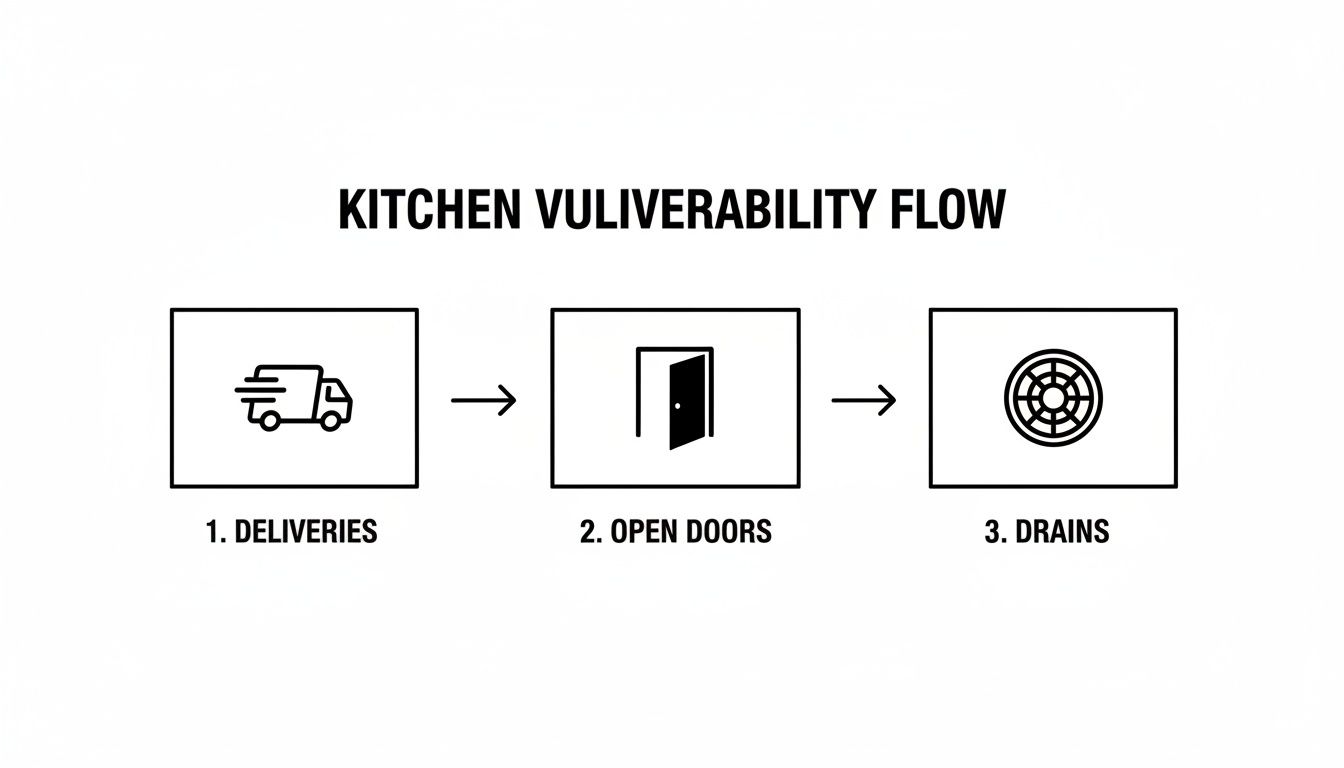
The takeaway here is that your kitchen is constantly being tested by threats from deliveries, open doors, and drains. These aren't just parts of your kitchen; they are critical control points that need a plan.
From Assessment to Actionable Plan
Everything we find during this initial inspection feeds directly into your Integrated Pest Management (IPM) strategy. Think of it as a defense-in-depth approach that combines physical, operational, and, only when truly necessary, chemical controls.
A detailed risk assessment is the most critical part of commercial kitchen pest control. It ensures that treatments aren't just reactive, but are part of a larger strategy to make your facility fundamentally less attractive to pests.
Based on that deep dive, a good pest control partner like The Green Advantage will build a plan that includes:
- Exclusion Recommendations: A specific punch list of structural repairs needed to physically seal off entry points for good.
- Sanitation Improvements: Actionable advice on cleaning protocols, waste management, and storage practices that eliminate the food and water pests need to survive.
- Targeted Treatments: Precise, low-impact treatments applied only where pest activity is confirmed, focusing on nests and harborage areas instead of broad, unnecessary spraying.
This proactive mindset is no longer a nice-to-have; it's becoming the industry standard. Stricter health regulations have fueled major growth in the commercial pest control sector. In fact, by 2026, the global pest control market reached $21.54 billion, with commercial services for restaurants leading that expansion.
The goal is always a partnership. We bring the expertise and the tools; you and your staff provide the daily diligence. This collaborative approach is at the core of our 7 pest prevention strategies for commercial spaces and is the only real way to maintain a pest-free environment that passes any health inspection with flying colors. By understanding your kitchen’s unique challenges, we can build a plan that truly protects your reputation and your bottom line.
Creating a Pest-Proof Environment with Sanitation and Exclusion
When you're dealing with an active infestation, you obviously need targeted treatments. But the real secret to long-term commercial kitchen pest control? It’s all about prevention. You have to make your kitchen a place where pests simply don't want to be. This comes down to two things: obsessive sanitation and smart structural exclusion.
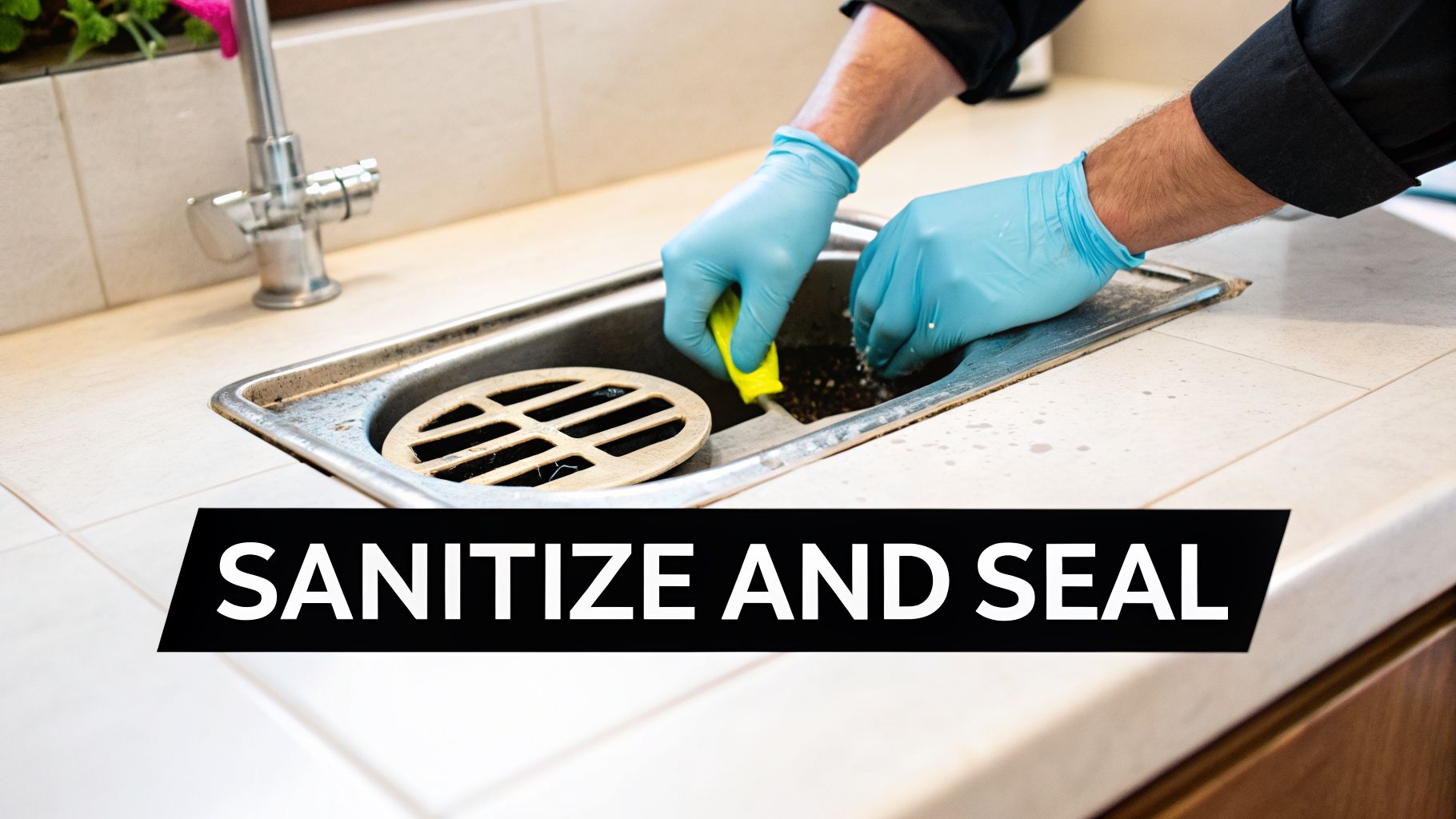
This goes way beyond just running through a nightly cleaning checklist. It means building strict, enforceable protocols that cut off the food, water, and shelter that every pest needs to survive. When you work with a pro like The Green Advantage, we help you weave these habits into your daily rhythm, essentially turning your kitchen into a fortress pests can’t breach.
The Power of Proactive Sanitation
Good sanitation is more than just wiping down counters; it’s about actively disrupting the pest life cycle. A few crumbs or a thin layer of grease might seem minor, but for pests, it's a full-on buffet that can sustain a surprisingly large population.
Pests are always looking for their next meal. If your kitchen offers a 24/7 smorgasbord, they will find it. Rigorous sanitation is how you shut that buffet down for good.
Your sanitation schedule is one of the most powerful pest control tools you have. A consistently clean kitchen provides fewer resources for pests, making it a much less attractive environment for them to live and breed.
This means getting serious about the spots everyone overlooks. For instance, the gunk that builds up in floor drains is a five-star resort for drain flies and a watering hole for cockroaches. A quick rinse won't cut it—those drains need a deep, thorough cleaning every single week. The same goes for grease traps; they need to be serviced on a non-negotiable schedule, not just when they start causing problems.
Key Sanitation Protocols for a Pest-Free Kitchen
A few simple shifts in your daily operations can make a world of difference for pest pressure in your Crown Point kitchen.
- Grease Management: Don't just clean the hood filters. Get your team in the habit of daily deep cleaning behind the cook line—the walls, the fryer cabinets, and the floor where grease vapor settles.
- Waste Disposal: Use heavy-duty trash bags and make sure every single indoor bin has a lid that fits snugly. Take the trash out multiple times a day, and keep the dumpster area spotless with the lid shut tight. Always.
- Stock Rotation: A strict "First-In, First-Out" (FIFO) system isn't just a good idea, it's essential. This simple practice prevents forgotten boxes of flour or grains from becoming a breeding ground for stored product pests like beetles and moths.
For many restaurants, it's also worth looking into the benefits of hiring a commercial cleaning company to handle the deep cleaning that your own staff might not have time for.

Sealing the Deal with Structural Exclusion
Sanitation removes the invitation, but structural exclusion slams the door shut. This is where you physically block pests from getting inside by finding and sealing every possible entry point, no matter how tiny. Remember, a mouse can flatten itself to get through a dime-sized hole, and a cockroach can slip through a crack you'd barely notice.
A professional pest audit from The Green Advantage is designed to find these weak spots around your Crown Point property. We’ll comb through your building's exterior and interior, giving you a clear, actionable punch list of exclusion tasks.
Common weak points we look for include:
- Cracks and Gaps: We check for any cracks in the foundation, walls, or floors, especially where utility lines and pipes enter the building. These need to be sealed with durable caulk or sealant.
- Poorly Sealed Doors: The receiving door is a major highway for pests. We make sure all exterior doors have tight-fitting sweeps and weatherstripping to close that gap at the bottom.
- Unscreened Vents: Roof vents, attic vents, and even dryer vents are open invitations for pests. Covering them with fine-gauge mesh is a simple fix that blocks rodents and insects.
- Moisture Sources: A dripping faucet or a small leak under a sink is a critical water source. We'll pinpoint these areas for immediate repair to eliminate the moisture pests depend on.
When you combine aggressive sanitation with thorough exclusion, you’re not just managing pests—you’re creating an environment where they can't establish themselves in the first place. This proactive mindset is the foundation of any truly successful commercial pest control program, protecting your reputation and giving you lasting peace of mind.
Your Guide to Ongoing Pest Monitoring and Management
One of the biggest mistakes we see restaurant managers make is treating pest control like a firefighter—only calling when there’s a major problem. The truth is, a solid pest control program for a commercial kitchen is a constant, quiet process. An Integrated Pest Management (IPM) plan isn't about scrambling during a crisis; it's about having a system that prevents one from ever starting.
This is what separates a truly secure kitchen from one that's always vulnerable. So, let’s talk about what a regular, professional service visit from The Green Advantage actually looks like for a kitchen in Crown Point, IN. It’s far less about spraying chemicals and much more about strategic detective work.
The Role of Strategic Monitoring
During every routine visit, our technicians are on the hunt for clues. We’re not just looking for pests; we’re looking for the conditions that allow them to thrive. We use a set of specialized, discreet tools to get a constant read on what’s happening in your high-risk areas.
Here’s what’s in our toolkit:
- Discreet Rodent Stations: These are locked, tamper-proof boxes placed along walls, behind bulky equipment, and near entryways. They let us see if rodents are exploring the area, giving us a crucial early warning without ever being seen by your staff or customers.
- Insect Light Traps (ILTs): Forget the noisy bug zappers you see on patios. Modern ILTs use specific UV light frequencies to attract flying insects to a silent glue board. This allows us to identify the exact species and count their numbers, helping us spot trends before they become infestations.
- Pheromone Traps: For pests that target your pantry, like Indian meal moths or flour beetles, we use traps that release a scent only they can detect. This alerts us to a problem in your dry storage long before you have to throw out contaminated inventory.
This approach is all about data. A sudden spike in drain flies tells us it's time to thoroughly inspect your floor drains and grease traps. Finding rodent activity near the back delivery door means we need to double-check the door sweep and look for new gaps.
Targeted Treatments and Meticulous Documentation
When our monitoring turns up activity, our response is surgical. We avoid broad, disruptive spraying. Instead, we use low-impact treatments applied directly into the cracks, crevices, and wall voids where pests hide and breed. It’s a safer, more effective way to work in a food-handling environment.
Equally important is the paperwork. For every single visit, we maintain a detailed logbook that stays right there on your premises.
Think of your pest management logbook as your proof of due diligence. When a health inspector arrives, that book is a clear, organized record showing you have a professional, compliant pest control program in place.
This logbook is designed to give an inspector everything they need at a glance:
- Dates and times of every service.
- Detailed notes on what we found (or didn't find).
- A map showing the location of every trap and monitoring station.
- A list of any products used and exactly where they were applied.
- Actionable recommendations for your team on sanitation or structural fixes.
This level of documentation turns a potentially stressful inspection into a non-event. It shows you’re on top of your game. Business-to-business pest control accounts for a significant portion of the industry's revenue, driven by businesses like yours that can't afford to fail an inspection. You can read the full research on the commercial pest control market to see just how critical this has become.
Partnering with The Green Advantage for ongoing monitoring in your Crown Point kitchen means you're never flying blind. You get the peace of mind that comes from knowing a professional is keeping watch, spotting risks, and solving problems before they can ever threaten your reputation.
Turn Your Staff Into Your First Line of Defense

A professional pest control partner can seal up entry points and apply treatments, but we aren't in your kitchen 24/7. Your team is. Think about it—your chefs, dishwashers, and line cooks are the most powerful weapon you have for keeping a pest-free kitchen.
They are your eyes and ears on the ground. When they’re trained properly, they become a proactive, incredibly effective first line of defense. The real goal is to build a culture of vigilance, where every single person on your team understands their part in protecting the kitchen.
Here at The Green Advantage, we see ourselves as your partners in this. We help you give your staff the right knowledge. This isn't about turning your cooks into exterminators. It's about making simple observation and prevention a completely natural part of their daily routine.
Teaching Your Team What to Look For
First things first: your staff needs to know what they’re looking for. A full-blown infestation rarely starts with a cockroach boldly marching across the floor during dinner service. It starts with small, subtle signs that are easy to miss—unless you know what to spot.
A quick, 15-minute huddle can teach them the most common red flags.
- Droppings: Show them the difference. Cockroach droppings look like tiny black pepper specks, while mouse droppings are larger and pellet-shaped. Tell them to keep an eye out inside cabinets, along baseboards, and behind equipment.
- Gnaw Marks: Rodents have to chew constantly. Point out what fresh gnaw marks look like on cardboard food boxes, wood trim, or even plastic containers.
- Smear Marks: Rats and mice are creatures of habit. They stick to the same paths, leaving greasy, dark smudges along walls and pipes from the dirt and oil in their fur.
- Weird Smells: If a storeroom or cabinet has a strong, oily, or musty odor, that’s a classic sign of a serious cockroach problem.
When your team is armed with this knowledge, the prep cook grabbing a bag of flour is the one who spots trouble early, letting you get ahead of the problem.
From Spotting to SOPs
Knowing what to look for is only half the job. Your team also needs a dead-simple process for what to do next. This is where your Standard Operating Procedures (SOPs) for commercial kitchen pest control become absolutely critical.
An SOP takes all the guesswork out of the equation. It makes sure that every employee, from the brand-new hire to the head chef, follows the exact same rules for cleaning, storage, and pest reporting—every single day.
For solid advice on creating consistent staff workflows, check out these examples of restaurant standard operating procedures that you can tailor for pest prevention. These procedures need to be written down, posted where everyone can see them, and talked about regularly.
Your pest prevention SOPs should lay out clear instructions on:
- Reporting: Who do they tell? Designate one person, like the kitchen manager, as the point of contact. Have a simple logbook where staff can write down the date, time, location, and what they saw. This log is gold for your pest technician.
- Receiving Deliveries: Make it a rule: all incoming shipments get inspected before they come into the kitchen. Staff should check boxes for holes, gnaw marks, or any live critters hitching a ride.
- Cleaning Protocols: Go deeper than the nightly checklist. Your SOPs should include specifics like scrubbing floor drains every week, deep cleaning under equipment, and sanitizing the dumpster pad.
When you train your staff to be proactive partners, you change the game. You create a vigilant team that not only keeps your Crown Point kitchen compliant and safe but also takes genuine pride in the workplace. It's a key part of a successful partnership with The Green Advantage.
Partnering with The Green Advantage in Crown Point, IN
Choosing a commercial pest control partner for your kitchen isn't just about calling an exterminator near me. It’s a serious business decision—one that has a direct line to your reputation, your health inspection scores, and ultimately, your bottom line.
For restaurants and food businesses across Crown Point and Northwest Indiana, The Green Advantage isn’t just another vendor. We’re your local partner, and we’re genuinely invested in seeing you succeed. We live here, so we have a deep, firsthand understanding of the regional pest pressures—from the way German cockroaches hide out in commercial kitchen equipment to the annual fall migration of rodents looking for a warm place to spend the winter. This knowledge helps us build smarter, more effective defense plans from day one.
We get what’s at stake. A single pest sighting can unravel years of hard work and good reviews. That’s why our whole approach is built around providing lasting peace of mind. We pair our expertise with clear, honest communication, so you’re never left wondering what’s going on in your own facility.
Your Local Experts in Northwest Indiana Pest Pressures
Being local isn't just a talking point; it's a real advantage. We know the specific challenges that come with the seasons in Crown Point. We've seen firsthand how humid summers can make fly populations explode and how brutal winters drive rodents straight for the warmth and food inside a restaurant.
This on-the-ground experience is baked into every service plan we create. It lets us be proactive instead of just reactive, anticipating these seasonal shifts and shoring up your kitchen’s defenses before a small issue becomes a full-blown infestation.
Partnering with a local expert means your pest control isn't based on a generic national checklist. It's based on real-world experience with the exact pest challenges your Crown Point business faces every day.
Our local presence also means we’re right here when you need us. If you have a question or an urgent concern, you won’t be routed to a national call center. You'll talk to our team right here in the community, people who know your business and can get you the help you need, fast.
What You Can Expect When Working with The Green Advantage
We believe in a straightforward, no-nonsense process that keeps your kitchen compliant and makes your life easier. When you team up with The Green Advantage, you’re choosing a partner who prioritizes clarity and tangible results.
Here’s our simple promise to you:
- A Comprehensive Initial Inspection: We start with a thorough, top-to-bottom look at your entire facility. We’re not just looking for pests; we’re identifying high-risk zones and uncovering the hidden structural or sanitation issues that invited them in.
- A Customized Service Plan: No two kitchens are alike. We’ll develop a strategic plan tailored to your specific layout, workflow, and the unique pest pressures you’re up against. This is a targeted strategy, not a one-size-fits-all spray.
- Clear and Consistent Communication: After every single visit, you get a detailed report. It will clearly outline what we found, the services we performed, and any practical recommendations for your team. You’ll always be in the loop.
- Health Code-Ready Documentation: We set you up with a professional logbook containing all your service records, product safety data, and corrective action reports. This keeps you organized and 100% prepared for any health inspection, turning a stressful event into a smooth process.
A Partnership Built on Trust and Results
At the end of the day, our goal is to operate as a seamless extension of your own team. We handle the complexities of commercial kitchen pest control so you can stay focused on what you do best—serving incredible food and running a thriving business. Our technicians are highly trained, licensed professionals committed to using effective, environmentally responsible solutions that are right for a sensitive food-handling environment. We honestly take pride in solving the tough pest problems that other companies can’t.
We also offer a full suite of services to protect your entire property. To learn more about how we shield businesses from a wider array of threats, take a look at our commercial pest control services and see how we can help.
Protecting your investment and your hard-earned reputation is everything to us. We are dedicated to being the most reliable and effective pest control partner for the food service community here in Crown Point, IN.
Your kitchen's compliance and reputation are too important to leave to chance. Let the local experts at The Green Advantage provide the peace of mind you deserve with a professional, no-obligation pest inspection. Protect your business and schedule your comprehensive assessment today.
Termite Control in Crown Point, IN: How to Prevent an Infestation

If you own a home in Crown Point, Indiana, you know that termites are more than a simple nuisance—they are a quiet but serious threat to your property's structure and value. The thought of these destructive pests silently chewing through your biggest investment is a major concern for any homeowner in Northwest Indiana.
But here’s the reassuring news: termite prevention is entirely possible. You don't have to wait for signs of damage to protect your home. As a trusted local pest control company serving the Crown Point community, The Green Advantage is here to guide you. We believe in empowering homeowners with the right information to safeguard their property and family.

This guide is your complete game plan for termite prevention. We’ll cover everything from simple yard maintenance tasks to professional termite control solutions, all tailored for our local climate. The advice here comes directly from our experience helping families in Crown Point keep their homes safe, and we're sharing our best insights with you.
Understanding the Termite Threat in Northwest Indiana
To effectively protect your home, you need to know what you’re up against. Here in Crown Point and across Northwest Indiana, our primary concern is the subterranean termite. This silent destroyer is responsible for the vast majority of termite damage we see in local homes.
Unlike more visible pests, subterranean termites operate from a hidden world. They live in large, organized colonies deep in the soil. Our region’s damp soil and seasonal weather create the perfect environment for them to thrive. From these underground nests, they build clever mud tubes—which look like pencil-thin tunnels of dirt—to travel undetected into your home in search of their only food source: wood.
Why Our Region Is a Termite Hotspot
The climate in Northwest Indiana, with its humid summers and wet springs, keeps the soil consistently moist. This is exactly what termite colonies need to flourish and expand. When these termites find a home with a moisture problem—like a leaky pipe, poor foundation drainage, or a damp crawl space—it’s like an open invitation.
The financial risk termites pose to your property is significant. The damage occurs slowly and out of sight, often progressing for years before any signs become obvious. By the time you notice a problem, the damage can be severe and expensive to repair.
Globally, termites cause over $40 billion in structural damage each year. This statistic underscores why proactive termite prevention is not just a good idea—it's an essential part of responsible homeownership, especially in areas like Crown Point where wood-frame construction is common.
Spotting the Subtle Signs of an Infestation
Your best defense against termites is knowing what to look for. Catching an infestation early can save you thousands of dollars in repairs. While a professional inspection from a qualified exterminator is the only way to be certain, every homeowner should be on the lookout for these common red flags.
Some signs, like a swarm of winged insects inside your home in the spring, are hard to miss. These "swarmers" are reproductive termites seeking to start new colonies. Finding piles of their shed wings, which look like tiny, identical fish scales, is another dead giveaway. Most other clues, however, are much more subtle.
If you've spotted something concerning, our guide can walk you through the specifics of how to identify termite damage and differentiate it from other common household issues.
Common Signs of a Termite Infestation
| Sign of Infestation | What to Look For | Common Location |
|---|---|---|
| Mud Tubes | Pencil-thin tunnels of dried mud running up foundation walls, support piers, or in crawl spaces. | Exterior foundation walls, basements, and crawl spaces. |
| Damaged or Hollow Wood | Wood that sounds hollow when tapped. It may also have a maze-like pattern carved into it, which you might find if you break a piece open. | Floor joists, structural beams, window sills, and wooden posts. |
| Discarded Wings | Small, translucent wings of the same size found in piles, often near windowsills, doorways, and lights after a spring rain. | Near windowsills, doorways, and light fixtures. |
| Bubbling or Peeling Paint | Paint that appears to be bubbling or uneven on a wall, often caused by moisture from termites or damage to the drywall paper beneath. | Interior and exterior walls, often mistaken for water damage. |
Understanding the risks and knowing the signs are the first steps in building a smart defense for your home. Now, let’s talk about how to make your property less attractive to these destructive pests.
Building Your First Line of Defense Outside
Your best defense starts right outside your door. Creating a termite-resistant zone around your home’s perimeter is the most important, hands-on step any Crown Point homeowner can take. It’s all about making your property a place where termites simply don’t want to be.
Think of your foundation as a fortress wall. Termites are constantly foraging in the soil, and anything that gives them moisture, food, or a hidden path can lead them straight into your house. Taking control of the area immediately surrounding your foundation creates a powerful first line of defense.
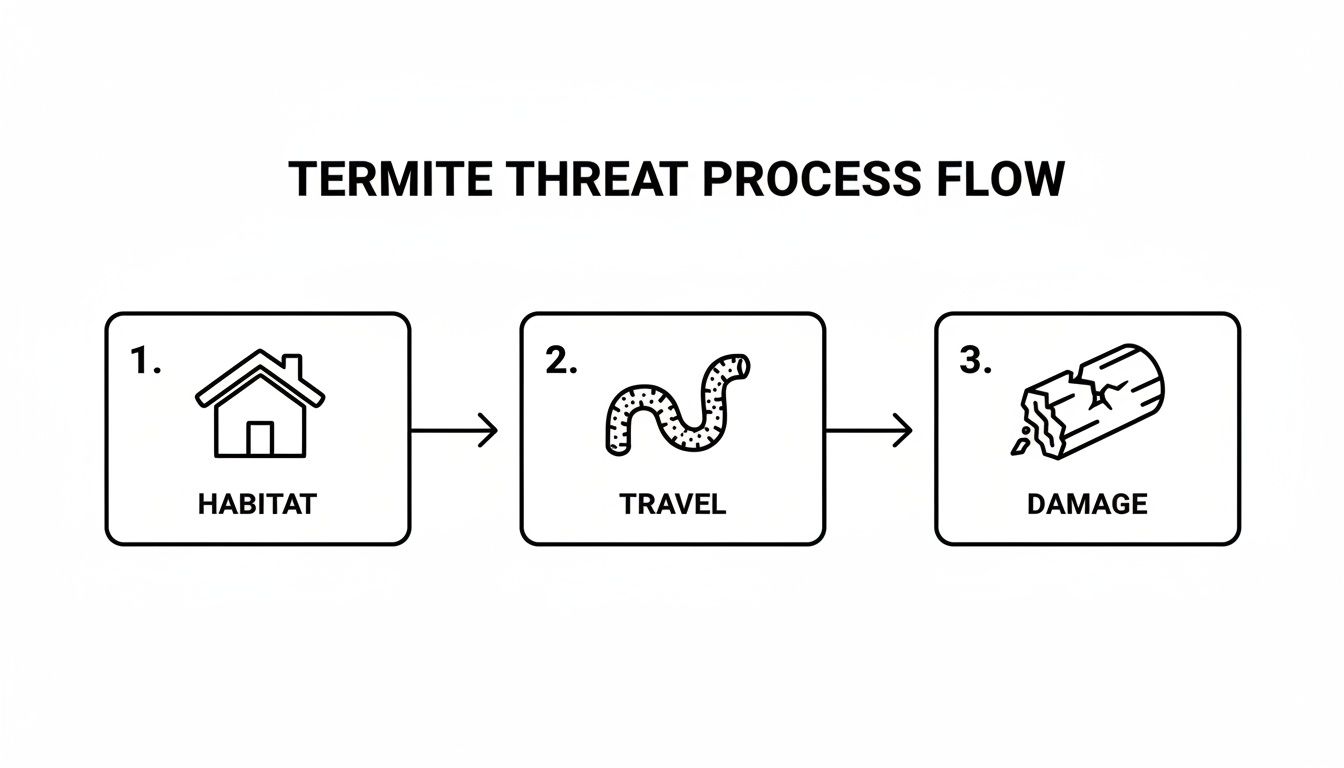
As you can see, termites need a hidden route—like a mud tube—to travel from the soil to your home’s structure. Your job is to eliminate those hidden highways before they ever get built.
Eliminate Termite Food Sources
Subterranean termites survive on cellulose, found in wood and plant-based materials. Any wood making direct contact with the ground is an open invitation. The first rule of termite prevention is to remove these easy meals.
- Firewood and Lumber: Store firewood piles at least 20 feet away from your house and elevate them on a metal rack or concrete blocks. Never stack wood directly against your foundation.
- Yard Debris: Regularly clean up fallen branches, old tree stumps, and scrap construction lumber. A forgotten pile of 2x4s behind the garage can quickly become a starter colony that targets your house next.
- Mulch Management: Mulch is great for gardens, but it holds moisture and provides a food source for termites. Maintain a mulch-free barrier of at least six inches between your foundation and any mulch beds. Consider using rubber mulch or decorative stone in the area immediately against your home.
Control Moisture Around Your Foundation
Termites need moisture to survive. Here in Northwest Indiana, our clay-heavy soil often holds water right against foundations, creating the damp environment where termites thrive. Your goal is to keep the area around your home as dry as possible.
- Gutters and Downspouts: Clean your gutters regularly to prevent overflows that dump water at your home's base. Ensure downspouts extend at least five feet away from the foundation to direct runoff away.
- Grading: Check that the ground around your home slopes away from the foundation. If water pools near the house after a storm, you may need to add soil to improve the grade and ensure proper drainage.
- Leaks: A leaky outdoor spigot can saturate the soil, creating a perfect entry point for termites. A simple washer replacement can eliminate a massive risk.
Maintain a Clear Inspection Zone
Termites are sneaky and do their work out of sight. By keeping the area around your foundation clear, you take away their cover and make it easier to spot them.
Trim shrubs, ivy, and other dense plants to create at least a one-foot gap between the greenery and your exterior walls. This simple step improves airflow, helps siding dry faster, and gives you a clear line of sight to spot tell-tale mud tubes. This gap is a critical part of any ongoing residential pest control plan because it allows you or your exterminator to conduct inspections easily.
Securing Your Home's Interior from Termite Entry
Even with a well-maintained exterior, termites can find hidden routes inside. The next step is to head indoors and focus on the places most homeowners forget: the basement, crawl space, and foundation. For homeowners in Crown Point, these interior checks are a vital defense against an infestation.
These dark, damp lower levels are ideal entry points for subterranean termites. They offer moisture, darkness, and direct access from the soil into your home's wooden framework. A regular inspection with a flashlight is one of the most effective ways to stop termites in their tracks.
Inspecting Your Foundation and Lower Levels
Grab a good flashlight and inspect your home’s lowest points for any gaps, cracks, or openings. Termites can squeeze through a crack as thin as a business card.
Scan your interior foundation walls for thin, muddy lines—these are the infamous mud tubes termites build to travel from the soil to the wood in your home. If you see one, break a small piece off. If it is repaired in a few days, you have an active infestation and should call a professional exterminator immediately.
Also, check these key areas:
- Plumbing Penetrations: Look closely around every pipe coming through the foundation or floor. Small gaps often form here as a house settles.
- Utility Lines: The tiny spaces around electrical conduits and gas lines can be superhighways for termites to enter your walls.
- Expansion Joints: If you have a concrete slab floor, check the joints between sections for openings.
Seal any gaps you find with a quality polyurethane caulk for concrete. For larger openings, use a combination of expanding foam sealant and steel wool to create a tough barrier that termites and rodents can’t chew through.
The Critical Role of Moisture Control
Termites are desperate for moisture. A damp, humid basement or crawl space is a huge attractant. Managing indoor humidity is a critical part of how to prevent termites.
In Northwest Indiana, crawl spaces with exposed dirt floors are a major vulnerability, as they constantly release moisture into the air. Installing a heavy-duty vapor barrier (a thick plastic sheet that covers the entire dirt floor) can drastically reduce ground moisture and make the space less inviting for pests.
Homeowners often overlook basement humidity. Even without standing water, high air moisture is enough to attract termites and can soften structural wood, making it easier for them to consume.
Learning how to reduce indoor humidity is essential. A good dehumidifier, especially during our humid summers, can make a world of difference. Also, fixing any interior water leaks is non-negotiable. A slow drip under a sink can provide a constant water source for a termite colony. By keeping your basement and crawl space dry and sealed, you make them hostile territory for termites.
Choosing the Right Professional Termite Solution
While home maintenance is your first line of defense, sometimes you need the power of a professional solution. This is especially true if you find an active infestation or simply want the peace of mind that comes with complete protection. Professional services generally fall into two categories: liquid barriers and baiting systems.
Traditional Liquid Barrier Treatments
For decades, the standard method for termite control was a liquid chemical barrier. A technician digs a shallow trench around the home’s foundation and applies a termiticide to the soil, creating a treated zone that termites cannot cross. Modern non-repellent products allow termites to pick up the active ingredient and carry it back to the colony, leading to its elimination.
- The Upside: It provides immediate protection and can last for several years.
- The Downside: The process is invasive, often requiring digging and drilling around your foundation, patios, and porches. Any future landscaping or utility work can disrupt the barrier, creating a gap in your protection.
Advanced Termite Baiting Systems
The modern, more strategic approach is a termite baiting system. A certified technician places discreet bait stations in the ground at key points around your property. These stations contain a cellulose material that is highly attractive to termites. The stations are monitored, and when termite activity is found, a slow-acting bait is introduced that eliminates the entire colony.
The genius of a baiting system is that it uses termite biology against them. Foraging workers find the bait, see it as a superior food source, and carry it back to share with the rest of the colony, including the queen. This method doesn't just block termites; it actively eliminates the colony at its source.
The Sentricon® System: A Smarter Solution for Crown Point Homes
At The Green Advantage, we exclusively use the Sentricon® System with Always Active™ technology. We believe it is the most effective and reliable baiting system available. The bait stations are loaded with the active ingredient from day one, so your home is protected 24/7 from the moment of installation—no waiting to find activity first.
For homeowners in Crown Point, IN, the Sentricon® System offers clear benefits:
- Total Colony Elimination: It is scientifically designed to wipe out the entire subterranean termite colony, not just foraging workers.
- No Mess, No Fuss: There's no trenching or drilling required. The stations are placed discreetly in your yard, leaving your landscaping untouched.
- Eco-Friendly: The active ingredient is contained within bait stations in small, targeted amounts. This makes it a responsible choice for families with children and pets, with no risk of chemical runoff.
Protecting your biggest investment is a serious decision. If you're looking for a proactive defense that works around the clock, we have more information on our professional termite treatments and how we can customize a plan for your property.
Your Local Partner for Termite Control in Crown Point, IN
Dealing with the threat of termites can be stressful. At The Green Advantage, our goal is simple: to provide Crown Point homeowners with a reliable, straightforward solution they can trust. We understand the local conditions in Northwest Indiana that make our homes vulnerable, and we are committed to protecting your property.
When you call us for your residential pest control or commercial pest control needs, you’re not just another customer. You are our neighbor, and we are a local partner genuinely invested in protecting your home or business. We believe peace of mind comes from understanding the problem and having a clear plan to fix it.
What to Expect When You Work With The Green Advantage
We have built our reputation in Crown Point on clear communication and trust. When you contact us, you’ll speak with a knowledgeable member of our local team who can schedule your service quickly.
When one of our licensed technicians arrives, their first job is to listen to your concerns. They will then perform a comprehensive inspection, using their local experience to identify active termite issues and any conditions on your property that could attract pests in the future.
Here’s what you can expect:
- A Thorough Inspection: We inspect your foundation, basement, crawl space, and the entire perimeter of your home for signs of termite activity or moisture problems.
- Clear Explanations: We walk you through our findings in plain English, ensuring you understand our recommendations.
- A Customized Plan: We will outline the best options for your specific situation, whether you need to eliminate an existing colony or want to establish a strong preventative defense. We’ll explain the benefits of modern, eco-friendly systems like Sentricon®, which we specialize in.
We’re Your Neighbors, Not a National Chain
As a local, family-owned business, our reputation in Crown Point means everything. We live here, our kids go to school here, and we care about our community. This personal connection drives us to provide a level of service that large, out-of-state companies simply can’t match.
We started The Green Advantage because we believe you shouldn't have to choose between getting rid of pests and keeping your family safe. Our focus is on smart solutions that are tough on pests but gentle on your home and the environment.
This commitment is at the heart of everything we do, whether it’s termite control, ant control, or mosquito control so you can enjoy your yard again. Let our team of professional exterminators handle the pests, so you can get back to enjoying your home, worry-free.
Common Questions About Termite Prevention
As your local exterminator in Crown Point, we get a lot of questions from homeowners. Here are our straightforward answers to some of the most common ones.
Is Termite Damage Covered By Homeowners Insurance?
The answer is almost always no. Most standard homeowners insurance policies view termite damage as a preventable maintenance issue, not a sudden, accidental event like a fire or storm. This is why being proactive about termite prevention is so critical. The cost of professional termite control is a fraction of the bill for structural repairs, which can easily run into tens of thousands of dollars.
How Often Do I Need a Professional Termite Inspection?
For homes in the Crown Point area, we recommend a professional termite inspection at least once per year. Termites are incredibly secretive, and a colony can feast on your home for years before you see obvious signs. An annual inspection from a trained exterminator is the single best way to catch problems early and avoid costly repairs. It’s like a yearly check-up for your house, providing priceless peace of mind.
Are Your Termite Treatments Safe For Kids and Pets?
Yes, absolutely. The health and safety of your family are our top priorities. That's why we specialize in eco-friendly pest control methods. We use advanced, targeted systems like the Sentricon® with Always Active™ technology. This system uses discreet bait stations placed around your property. It’s designed to eliminate the entire termite colony without spraying liquid chemicals in your home or yard, making it a powerful and responsible solution.
Ready to protect your home from termites? Contact The Green Advantage, your trusted exterminator in Crown Point, IN, to schedule a thorough termite inspection. Let's secure your home together!
8 Signs of Rodent Infestation: A Guide for Crown Point, IN Homeowners

For homeowners in Crown Point, IN, and across Northwest Indiana, discovering pests can be a significant source of stress. The thought of rodents scurrying through walls, damaging property, and posing health risks is unsettling. You work hard to maintain a safe and comfortable home for your family, and a potential infestation threatens that peace of mind.
Many homeowners first notice small, seemingly minor issues but are unsure if they indicate a larger problem. Is that scratching sound just the house settling? Are those droppings from something else? This guide is designed to provide clear, reassuring information to help you identify the definitive signs of a rodent infestation. By understanding what to look for, you can take prompt action to protect your property and health.
The Green Advantage, your local pest control partner in Crown Point, is here to help you understand these warning signs. We provide reliable, eco-friendly solutions to protect your home. We understand the unique pest pressures in our community and are committed to restoring your home's safety and your peace of mind with professional, effective pest control services. In this article, you will learn to spot the key indicators of rodent activity, from physical evidence like droppings and gnaw marks to more subtle clues such as strange odors and noises, empowering you to make informed decisions for your home.
1. Rodent Droppings (Feces)
Finding rodent droppings is often the first and most certain sign of an infestation in your Crown Point home. Because mice and rats are nocturnal and reclusive, you are far more likely to see the evidence they leave behind than the pests themselves. These droppings are a direct confirmation that rodents are actively moving through your space, feeding, and establishing territory. Their presence is one of the most reliable signs of a rodent infestation.

The appearance of droppings can tell you a lot. Fresh feces are dark and moist, while older droppings are dry, gray, and will crumble when touched. Their size and shape can also help identify the pest. Mouse droppings are small (3-6mm) with pointed ends, resembling dark grains of rice. Rat droppings are larger (12-18mm) and often have blunter, spindle-like ends. Finding a high concentration of droppings indicates a heavily trafficked area or nesting site.
Health Risks and DIY Checks
Rodent droppings are not just unsightly; they pose significant health risks. They can carry and spread dangerous pathogens and viruses, including Hantavirus, which can become airborne when droppings are disturbed.
Safety First: Never sweep or vacuum rodent droppings. This action can aerosolize virus particles, making them easy to inhale. Always use proper protective gear and wet-cleaning methods for safe removal.
Immediate DIY Inspection Tips:
- Safety Gear: Before inspecting, put on disposable gloves and an N95-rated mask.
- Safe Cleanup: Gently spray the droppings and surrounding area with a disinfectant or a 1:10 bleach-water solution. Let it sit for five minutes before wiping with a paper towel. Place the contaminated materials in a sealed plastic bag for disposal.
- Document and Map: Take photos of the droppings and note their locations. This information is invaluable for a professional pest control technician from The Green Advantage.
- Check Hotspots: Use a flashlight to inspect common rodent hiding places: under sinks, behind appliances, in the back of cabinets and pantries, and along the walls in your attic and basement.
The presence and quantity of droppings provide a critical baseline for assessing the infestation's scale. If you find droppings in your Northwest Indiana property, it’s a clear signal that you need a professional exterminator. Contact The Green Advantage for a professional inspection to confirm the species, locate entry points, and develop a safe and effective treatment plan.
2. Gnaw Marks, Rub Marks and Damaged Materials
Beyond what they leave behind, rodents cause direct physical damage that serves as another definitive sign of an infestation in your Crown Point home. Rodents have teeth that grow continuously, forcing them to gnaw on various materials to keep them filed down. At the same time, the oils and dirt from their fur leave dark, greasy smudges, known as rub marks, along the paths they travel repeatedly. These gnaw and rub marks are clear evidence of active rodent pathways and potential nesting areas.
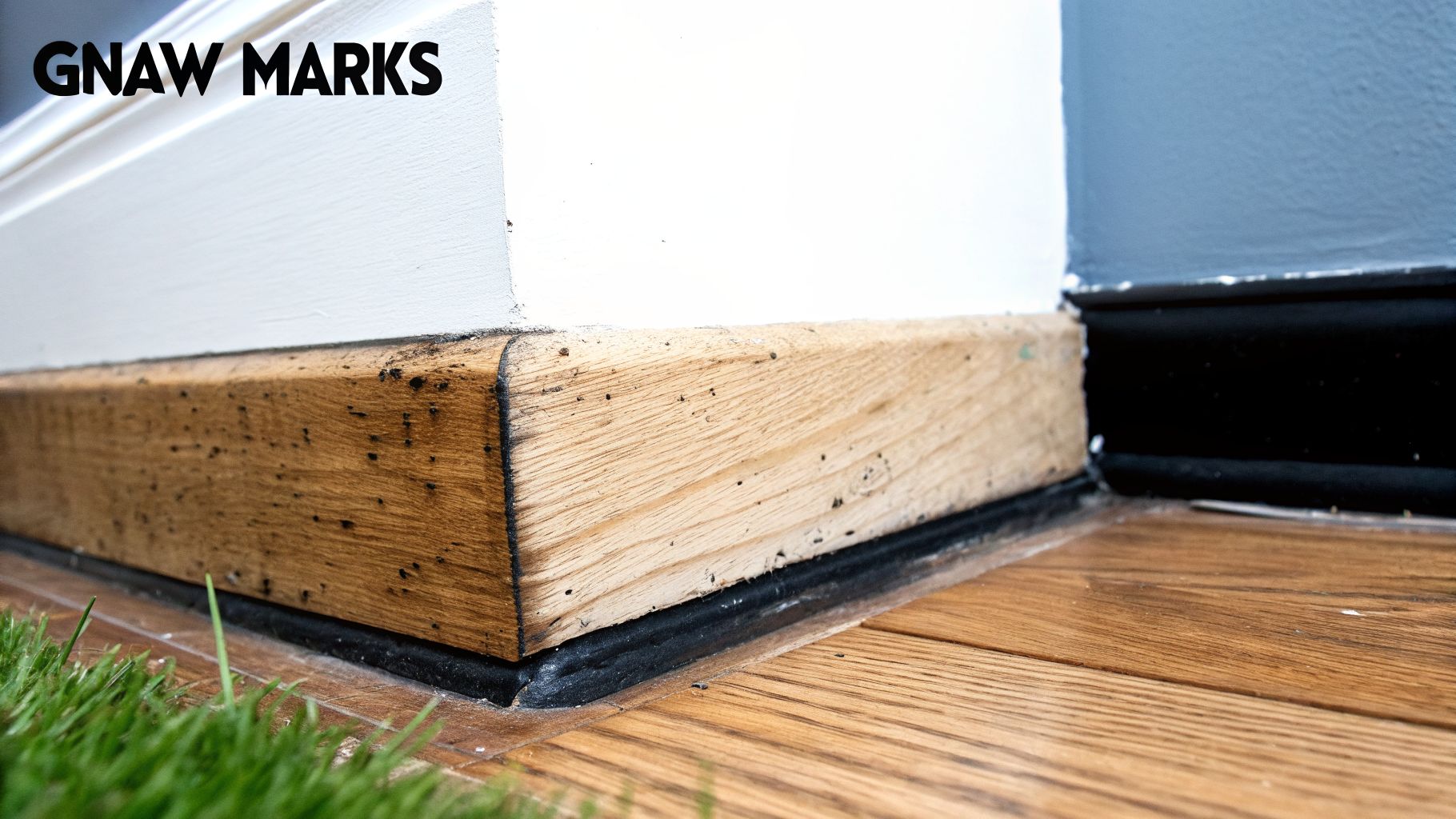
The type and location of the damage can reveal a great deal. Small, scratch-like gnaw marks on food packaging or drywall often point to mice. Larger, more significant gouges in wood, plastic, or even soft metals are characteristic of rats. Rub marks typically appear along baseboards, wall corners, and beams in attics or crawl spaces. Noticing these trails can help trace rodent movement from entry points to their food and water sources, guiding our residential pest control efforts.
Property Damage and Fire Hazards
This physical damage is more than just a cosmetic issue; it can lead to serious structural and safety problems. Gnawed electrical wiring is a major fire hazard, while damage to wooden joists, studs, and pipes can compromise your home’s integrity and lead to costly repairs.
Crucial Insight: The patterns of gnaw and rub marks act like a roadmap. They reveal the "rodent highways" inside your walls, attic, and behind appliances, providing essential clues for effective trap placement and exclusion efforts.
Immediate DIY Inspection Tips:
- Safety First: When inspecting areas with potential electrical damage, like attics or behind walls, turn off the circuit breaker for that area to prevent accidental shock.
- Trace the Trails: Use a bright flashlight held at a low angle against walls and baseboards. This technique makes faint rub marks and small scratches much easier to spot.
- Check Structural Elements: Carefully inspect wooden beams in the attic and basement, door frames, and the corners of walls for signs of gnawing. Pay special attention to the garage perimeter, a common entry area.
- Document Your Findings: Photograph any damage you find. Noting the location, date, and extent of the damage provides critical information for a pest control professional.
Finding gnaw marks or rub stains on your Northwest Indiana property is a strong indicator that rodents are not just passing through—they are making themselves at home. This is a clear sign that you need an expert exterminator in Crown Point, IN. Contact The Green Advantage for a thorough inspection to assess the damage, identify the rodent species, and create a targeted plan to eliminate the threat and prevent future entry.
3. Musky Odor and Urine Stains
Beyond visual cues, your sense of smell can be a powerful tool for detecting a hidden rodent issue in your Crown Point property. A persistent, musty odor similar to ammonia is a strong indicator of an active infestation. This distinct smell is caused by the accumulation of rodent urine and becomes more concentrated in enclosed, poorly ventilated spaces like attics, basements, wall voids, and behind large appliances. This foul odor is one of the more unpleasant signs of a rodent infestation.
The intensity of the odor often correlates with the size and duration of the infestation. A faint smell might point to a recent arrival, while a strong, overpowering scent suggests a large, established population. You may also see visible urine stains or pillars—mounds of grease, dirt, and urine that build up over time. To confirm the presence of these unsanitary clues, you might consider using a black light to reveal hidden urine stains, which fluoresce under UV light and can indicate active rodent pathways.
Health Risks and DIY Checks
Like feces, rodent urine can transmit diseases and contaminate surfaces. The ammonia smell itself can irritate the respiratory system, especially for individuals with asthma or allergies. Porous materials like insulation, drywall, and wood can become saturated, making odor removal difficult without professional intervention.
Trust Your Nose: A persistent, unexplained musky odor is not normal. It warrants immediate investigation to identify the source and prevent further contamination and health risks.
Immediate DIY Inspection Tips:
- Pinpoint the Source: Try to determine where the odor is strongest. Is it constant or does it come and go with your HVAC system? This helps narrow down the search area.
- Use UV Light: If you have a black light, perform a check in dark areas where you suspect activity. Focus on corners, along baseboards, and in pantries or closets.
- Check Enclosed Spaces: Carefully inspect your attic, basement, and crawl spaces. Look for stained insulation or wood and note any areas where the smell is particularly potent.
- Document Your Findings: Note the location and intensity of odors and any visible stains. This information is critical for guiding a professional technician to the heart of the problem.
If you detect a suspicious odor in your Northwest Indiana home, don’t ignore it. This sign indicates a potentially serious infestation that requires professional attention. Contact The Green Advantage to schedule an inspection. Our experts can use tools like UV lights to map contamination and develop a targeted plan to eliminate the pests and the odors they leave behind.
4. Nesting Materials and Debris
Discovering a rodent nest is a definitive sign of an active and established infestation in your Crown Point property. Rodents are resourceful builders, constructing nests in warm, secluded, and undisturbed areas close to food and water sources. Finding these nests confirms that rodents are not just passing through; they are breeding and creating a permanent home base, making it a critical sign of a rodent infestation that requires prompt attention.
Rodents will use any soft, shreddable material they can find. Common components include shredded paper, cardboard, fabric, cotton, and pieces of insulation. They often build their nests in hidden locations like wall voids, attics, basements, crawl spaces, and even inside stored boxes or unused furniture. The presence of multiple nests or a particularly large, well-established one often points to a significant, multi-generational population.
Property Risks and DIY Checks
Beyond being a clear indicator of pests, rodent nests present direct property risks. Rodents frequently shred building insulation to line their nests, which compromises your home's energy efficiency. Their habit of chewing on materials also extends to electrical wiring, creating a serious fire hazard.
Important Note: Never disturb a suspected nest with your bare hands. Nests are often contaminated with urine, feces, and parasites like fleas and mites, which can transmit diseases. An agitated rodent may also become aggressive to defend its young.
Immediate DIY Inspection Tips:
- Protective Gear: Always wear disposable gloves and an N95-rated mask before inspecting areas where nests are likely to be found.
- Locate Nests: Use a bright flashlight to carefully examine quiet, cluttered areas. Check behind appliances, inside cabinets, within attic insulation, and in storage boxes in your garage or basement.
- Photograph Evidence: Before attempting any cleanup, take clear pictures of the nest and its location. This documentation helps a professional pest technician understand the extent of the problem.
- Safe Removal (if necessary): For safe disposal, lightly spray the nest with a disinfectant. After letting it sit, carefully place the entire nest and surrounding debris into a sealable plastic bag. Dispose of it in a secure outdoor trash bin.
- Eliminate Materials: Reduce potential nesting supplies by storing fabrics, paper goods, and other soft materials in sealed, rodent-proof plastic containers rather than cardboard boxes.
Finding a nest means the infestation is progressing. If you discover rodent nesting materials on your Northwest Indiana property, it’s a clear sign you need professional help. Contact The Green Advantage for a thorough inspection to locate all nesting sites, assess the population size, and implement a targeted treatment plan to protect your home.
5. Scurrying Sounds and Nocturnal Activity
Because rodents are nocturnal, you are far more likely to hear them than see them, especially during the quiet hours of the night. Unexplained sounds like scratching, scurrying, squeaking, or gnawing coming from within your walls, attic, or ceiling are strong signs of rodent infestation. These noises indicate that rodents are actively moving through hidden voids in your home, building nests, or searching for food. For many Crown Point homeowners, these unsettling sounds are the first alert that a pest problem has developed.
The type of sound can offer clues about the activity. Light, quick scurrying might suggest mice are running along established pathways, while more pronounced scratching or gnawing could indicate a rat is trying to enlarge an opening or access a food source. Hearing these sounds consistently at night confirms the presence of these nocturnal pests. This is a clear indicator that it’s time to look for residential or commercial pest control services near you.
Property Damage Risks and DIY Checks
These noises are not just a nuisance; they often signal ongoing damage to your home’s structure. Rodents gnaw on wood, drywall, and insulation to create pathways and nests. More alarmingly, they are known to chew on electrical wiring, which creates a serious fire hazard.
Key Insight: Don't dismiss persistent nighttime noises as your house "settling." Consistent scratching or scurrying is a classic sign of a rodent infestation that requires immediate attention before significant damage occurs.
Immediate DIY Inspection Tips:
- Listen and Document: When you hear noises, carefully note the time, location (e.g., attic, specific wall, under the floor), and type of sound (scratching, squeaking, gnawing). This log is extremely useful for a pest control professional.
- Track Frequency: Is the sound a one-time occurrence or a nightly event? Regular activity almost certainly points to an active infestation.
- Focus Inspection: Use the location of the sounds to guide a visual inspection. If you hear noises in the kitchen, use a flashlight to check behind the stove and refrigerator and inside lower cabinets.
- Do Not Disturb: Avoid banging on walls to scare the rodents. This will only cause them to scatter temporarily and will not solve the underlying problem.
If you hear persistent sounds, it's a clear signal to act, even without other visible evidence. A professional can use these auditory clues to pinpoint activity and find entry points. To better understand how to handle these pests, you can learn more about getting rid of mice in your house. For a definitive assessment in your Northwest Indiana property, contact The Green Advantage. Our experts will conduct a thorough inspection to identify the source of the noise and create a targeted plan for removal.
6. Entry Points and Structural Gaps
A rodent infestation doesn't begin inside your home; it starts with a security breach from the outside. Rodents are opportunistic intruders, and even the smallest crack or opening can serve as a welcome mat. Identifying these entry points is not only a key sign of a potential infestation but is also the most critical step in long-term prevention. Sealing these gaps is the only way to stop the cycle of rodents getting into your Crown Point property.
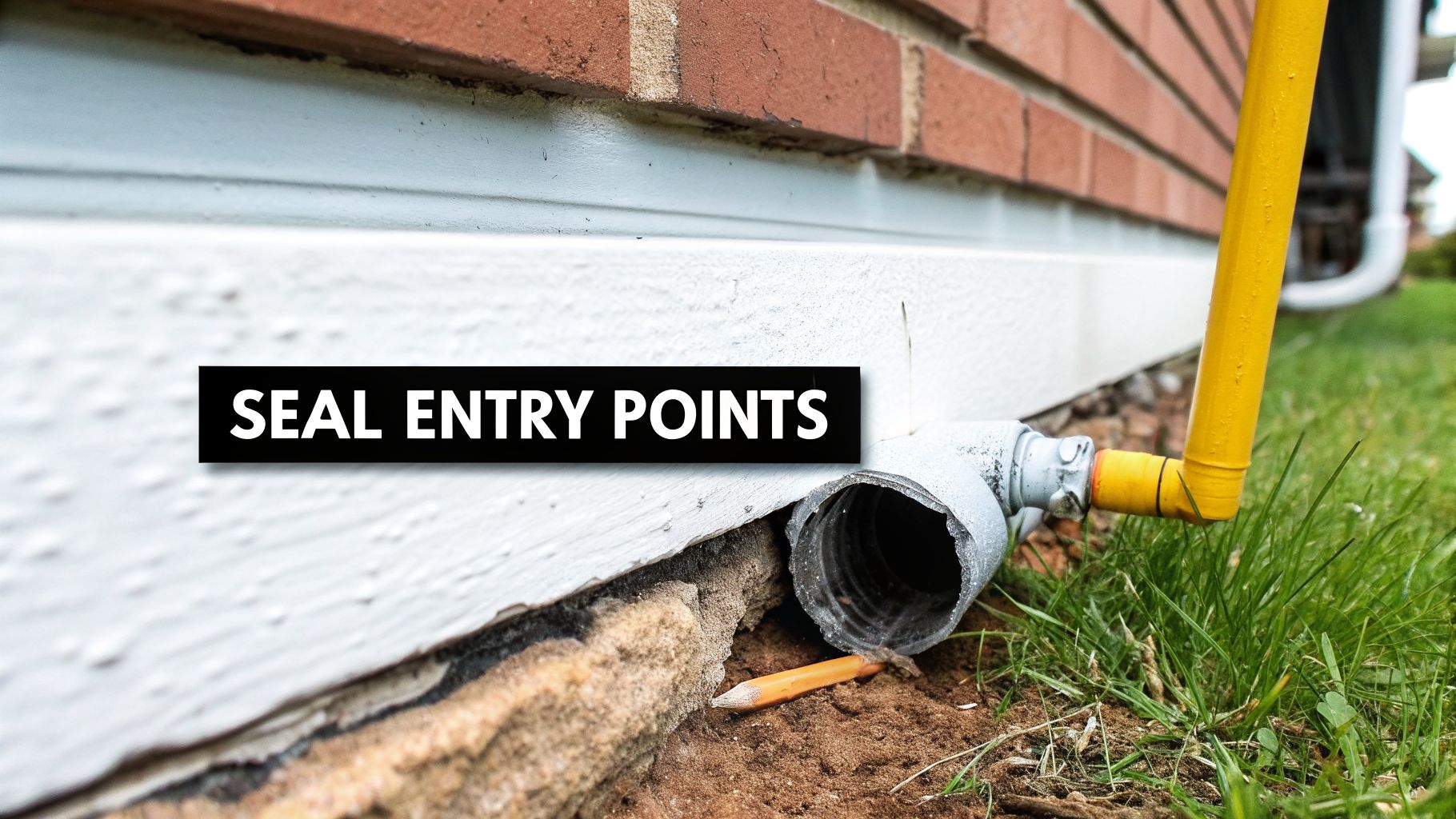
Mice can squeeze through openings as small as a dime (1/4 inch), while rats need only a gap the size of a quarter. Common weak points include gaps around utility pipes, cracks in the foundation, damaged seals on basement windows, and unscreened vents or chimneys. Finding these structural gaps, especially with other signs of rodent infestation present, strongly indicates how pests are getting in and out.
Property Risks and DIY Checks
Unsealed entry points create a constant vulnerability for your property. They don't just let rodents in; they can also lead to moisture problems, energy loss, and entryways for other pests like spiders and ants. Sealing these openings is a fundamental part of home maintenance and preventative pest treatments.
Proactive Sealing is Key: Simply removing the current rodents is a temporary fix. Without sealing entry points, new rodents will eventually find the same pathways into your home, leading to a recurring infestation.
Immediate DIY Inspection Tips:
- Conduct an Exterior Audit: Walk the perimeter of your home, paying close attention to the foundation. Look for cracks, gaps around plumbing and electrical lines, and spaces under siding.
- Check the Roofline: Inspect attic vents, chimney flashing, and the points where different roof sections meet. Ensure all vents are properly screened with hardware cloth.
- Measure Suspicious Gaps: Use a pencil as a guide. If it can fit into a crack or hole, a mouse can get through.
- Small Gap Sealing: Use steel wool packed tightly into small holes (rodents won't chew through it) and seal it with caulk. Expanding foam can be used but may be chewed through if not paired with a resistant material.
- Large Opening Solutions: For larger gaps or damaged vents, use hardware cloth or metal sheeting securely fastened over the opening.
Identifying and sealing entry points is a crucial component of any effective rodent control strategy. If you discover multiple potential entryways on your Northwest Indiana property, it’s a clear signal to seek professional help. Contact The Green Advantage for a thorough inspection to identify all vulnerabilities and implement a professional exclusion plan that keeps rodents out for good.
7. Food Contamination and Damaged Pantry Items
Discovering damaged food packaging and contaminated pantry items is a distressing yet definitive sign of rodent infestation. Rodents are driven by a constant need to eat, and your pantry offers a perfect, easily accessible food source. Finding torn-open cereal boxes, gnawed flour bags, or spilled dry goods on your shelves is clear evidence that mice or rats are actively feeding in your Crown Point home, making this one of the most urgent signs of a rodent infestation.
Rodent damage is usually easy to spot. They use their sharp incisors to chew through cardboard, paper, and thin plastic packaging to access the food inside. Besides the visible holes, you may also find their droppings, urine stains, or shed hairs directly on or around the food items. This contamination is not just limited to pantries; it can affect pet food bags in garages, stored birdseed in sheds, and ingredients in commercial kitchens across Northwest Indiana, indicating established feeding patterns.
Health Risks and DIY Checks
Food contaminated by rodents is a serious health hazard and must be discarded immediately. Rodents spread diseases like Salmonella and Leptospirosis through their feces, urine, and saliva. Consuming food that has come into contact with these pathogens can lead to severe illness.
Zero Tolerance for Contamination: If you suspect any food item has been touched by rodents, do not risk it. Even if the damage seems minor, the food inside is compromised. "When in doubt, throw it out."
Immediate DIY Inspection Tips:
- Pantry Audit: Put on gloves and carefully inspect all food items in your pantry, cupboards, and any other food storage areas. Look for small holes, chew marks, tears, or greasy rub marks on packaging.
- Safe Disposal: Place any compromised food items directly into a heavy-duty trash bag. Seal the bag tightly and dispose of it in an outdoor trash receptacle to prevent rodents from accessing it again.
- Thorough Cleaning: After removing contaminated items, empty the shelves completely. Use a disinfectant or a 1:10 bleach-water solution to thoroughly wipe down all surfaces, paying close attention to corners and crevices.
- Invest in Better Storage: Transfer remaining and new dry goods like grains, pasta, and cereals into sealed, rodent-proof containers made of thick plastic, glass, or metal.
Finding contaminated food is a clear signal that an infestation has breached your living space. This problem requires a swift response to protect your family's health. Contact The Green Advantage for professional pest control in Crown Point, IN to identify how rodents are getting in and implement a strategy to stop them for good.
8. Pest Control Inspection Findings and Professional Assessment
While DIY checks can reveal initial signs of a rodent infestation, a professional pest control inspection provides the definitive assessment needed to address the problem effectively. For homeowners in Crown Point, IN, a licensed technician's report is the most reliable way to confirm the scope and severity of an infestation. Professionals use systematic methods to document every piece of evidence, from droppings and gnaw marks to hidden entry points and nesting sites.
A formal inspection serves as a complete blueprint of the rodent activity in your home. This professional assessment is crucial not only for effective treatment but also for real estate transactions or landlord-tenant documentation. It replaces guesswork with a clear, evidence-based plan of action, showing you why professional rodent control is the best solution.
The Value of a Professional Report
A professional pest inspection is more than just a quick look around. It's a methodical investigation that yields critical information for eliminating rodents and preventing their return. Technicians are trained to spot subtle signs that are easily missed.
Expert Insight: An inspector can differentiate between evidence of an active infestation versus a historical one. This distinction is vital, preventing unnecessary treatments while ensuring current threats are properly addressed.
What a Professional Inspection Uncovers:
- Species Identification: The technician will identify whether you are dealing with mice, Norway rats, or roof rats based on evidence like droppings, gnaw marks, and nest locations.
- Severity Rating: The report will provide a severity rating (e.g., light, moderate, heavy) based on the volume and distribution of droppings, number of nests, and extent of damage.
- Entry Point Mapping: An inspector will identify all potential entry points, from cracks in the foundation to gaps around utility lines, which is essential for long-term exclusion.
- Photographic Documentation: You will receive detailed photos of all findings, providing indisputable proof of the infestation for your records.
- Treatment Recommendations: The report concludes with specific, actionable recommendations for treatment, sanitation, and structural repairs (exclusion) to solve the problem for good.
If you suspect you have a rodent problem, or need official documentation for a property, understanding when to call pest control is the first step. Contact The Green Advantage to schedule a professional inspection. Our detailed reports give you the clarity and confidence needed to protect your Northwest Indiana property.
8-Point Comparison of Rodent Infestation Signs
| Indicator | Implementation complexity | Resource requirements | Expected outcomes | Ideal use cases | Key advantages |
|---|---|---|---|---|---|
| Rodent Droppings (Feces) | Low — visual observation | Minimal: gloves, mask, camera | Confirms presence; helps identify species and activity areas | Initial inspections, kitchen/pantry checks, monitoring | Easy to spot; indicates recent/past activity; guides targeted treatment |
| Gnaw Marks, Rub Marks and Damaged Materials | Medium — requires close inspection | Flashlight, camera, measuring tools; possible pro assessment | Reveals entry points, travel routes, and active chewing damage | Locating access points, assessing structural/electrical risk | Indicates active pathways; maps movement; prioritizes trap placement |
| Musky Odor and Urine Stains | Medium — sensory plus diagnostic tools | UV/blacklight, ventilation, professional evaluation | Early detection of hidden contamination; estimates infestation age | Enclosed spaces (attics, wall voids, basements) and persistent odors | Early warning sign; UV locates hidden contamination for targeted cleanup |
| Nesting Materials and Debris | Low–Medium — visual search in protected areas | PPE, camera; professional removal for active nests | Indicates breeding sites and infestation severity | Attics, wall cavities, storage boxes — assessing reproduction | Direct indicator of reproduction; identifies safe-harbor areas for removal |
| Scurrying Sounds and Nocturnal Activity | Low — occupant observation/monitoring | Listening, recording devices or professional inspection | Confirms active movement; helps approximate location and timing | Nighttime monitoring, early detection before visual evidence | Often first noticed by occupants; signals active, ongoing infestation |
| Entry Points and Structural Gaps | High — thorough exterior and interior inspection | Skilled labor, sealing materials (caulk, mesh), possible contractors | Permanent exclusion when sealed; prevents reinfestation | Prevention, post-treatment exclusion, older or damaged properties | Addresses root cause; durable prevention across pest species |
| Food Contamination and Damaged Pantry Items | Low — routine pantry inspection | Inspection, disposal supplies, sealed containers, cleaning supplies | Confirms feeding behavior; requires disposal and targeted treatment | Kitchens, pantries, food service, warehouses | Clear proof of active feeding; documents health risk and liability |
| Pest Control Inspection Findings and Professional Assessment | High — formal, systematic evaluation | Licensed technicians, specialized tools (UV, endoscope), report costs | Comprehensive diagnosis, species ID, severity rating, treatment plan | Pre-purchase inspections, severe infestations, insurance/real estate needs | Expert identification and documentation; tailored treatment and follow-up |
Take the Next Step: Your Trusted Pest Control Partner in Crown Point, IN
Recognizing the subtle and often-hidden signs of rodent infestation is the crucial first step in defending your home or business. From discovering droppings in a dark corner to hearing scratching sounds in the walls at night, each sign you’ve learned to identify in this guide is a piece of a larger puzzle. These clues—gnaw marks, musky odors, and shredded nesting materials—are not just minor annoyances; they are direct warnings of a potential threat to your property’s structural integrity and your family's health. Ignoring them allows a small issue to grow into a significant, costly, and stressful problem.
Understanding these indicators empowers you as a property owner. You are now equipped to perform initial checks, connect the dots between a damaged pantry box and a potential entry point, and appreciate the urgency required. The real value, however, lies in using this knowledge to take prompt, effective action. Proactive identification is your first line of defense, but professional pest control is the only way to guarantee a complete and lasting solution. Simply setting a few traps often fails to address the full scope of an infestation, leaving hidden nests and undiscovered entry points that allow the cycle to continue.
From Detection to Resolution: A Clear Path Forward
The transition from identifying a problem to resolving it should be seamless and reassuring. This is where a trusted local partner like The Green Advantage becomes essential. For homeowners and business managers in Crown Point, IN, and the surrounding Northwest Indiana communities, a professional assessment is the fastest path to clarity and peace of mind. Attempting to manage a rodent problem on your own can lead to weeks of frustration, continued property damage, and ongoing health risks.
An expert exterminator doesn't just treat the symptoms you can see. They investigate the root cause, determining how rodents are getting in, where they are nesting, and the full extent of their activity. This expert diagnosis is fundamental to creating an effective, long-term extermination and exclusion strategy.
Why Choose Professional Pest Control in Crown Point, IN
Mastering the ability to spot the early signs of rodent infestation is an invaluable skill, but it's only half the battle. The other half is knowing when to call an exterminator near me for expert help. A professional from The Green Advantage brings years of field experience and specialized tools to your doorstep. We see what the untrained eye misses.
Our process is built on trust and transparency:
- Comprehensive Property Assessment: Our licensed technicians will conduct a thorough inspection of your home or commercial facility, from the attic to the crawlspace, identifying all active and potential problem areas.
- Clear, Honest Communication: We explain our findings in straightforward terms, showing you the evidence and detailing the specific risks to your property. We believe an informed customer is our best partner.
- Targeted Treatment Plan: Based on the inspection, we develop a specific plan for your property. This includes not only rodent control but also implementing exclusion work to seal entry points and prevent future invasions.
- Integrated Pest Management: We look at the bigger picture. If we notice conditions that could lead to other issues, such as ant control or termite control needs, we'll advise you on preventative measures and can integrate solutions like our mosquito control services for complete property protection.
Don't let the discovery of a rodent problem cause you distress. Instead, view it as an opportunity to secure your property with the help of a dedicated local expert. By partnering with The Green Advantage, you are choosing a solution that protects your investment, your family’s health, and restores your sense of security.
Ready to take control and ensure your property is rodent-free? Contact The Green Advantage today for a comprehensive inspection and a free quote. Our local Crown Point, IN team is ready to provide the expert solutions you need to solve your pest problems for good. Visit The Green Advantage to schedule your service.
Expert Pest Control in Crown Point, IN: A Guide to Mosquito Traps

The real difference between all the outdoor mosquito traps on the market comes down to one thing: how they attract mosquitoes. The most effective ones are designed to trick mosquitoes by mimicking what they’re actually looking for—us. They use CO2 and special lures to replicate human breath and scent. Simpler traps might just use UV light or stagnant water. Understanding this difference is the first step to choosing the right trap for your yard here in Crown Point and knowing when it's time to call a professional exterminator.
Reclaim Your Crown Point Yard from Mosquitoes

Nothing ruins a perfect summer evening in Northwest Indiana faster than the whine and bite of mosquitoes. For homeowners in Crown Point, Valparaiso, and our neighboring towns, these pests can make enjoying your own backyard feel like a constant battle. They don't just leave itchy welts; they can carry diseases, turning your personal oasis into a source of anxiety for your family and pets.
Finding a pest control solution that actually works is key to taking back your outdoor space. While many products make big promises, the best outdoor mosquito traps are those that work with mosquito biology. However, for a truly effective, long-term solution, many homeowners in Crown Point, IN find that professional pest control services are essential. At The Green Advantage, we're your local exterminator committed to protecting your home and family.
Understanding the Mosquito Problem and Why It Occurs
When you're trying to pick a trap, you can immediately look past the old-school bug zappers. Research has shown they're mostly useless against biting female mosquitoes. Instead, you'll want to focus on technology built specifically to target them. The most common and effective traps fall into a few distinct categories, which often supplement professional pest control treatments.
- Propane/CO2 Traps: These are widely considered the heavy hitters. They work by converting propane into a continuous stream of carbon dioxide (CO2), perfectly mimicking the breath we exhale to draw in mosquitoes from a surprisingly large area.
- UV/Light Traps: While UV light alone isn't a primary mosquito magnet, modern versions combine it with other attractants. Some use specific light frequencies, heat, or a titanium dioxide coating to lure in certain mosquito species that are drawn to those cues.
- Lure/Pheromone Traps: Think of these as a performance booster. They use specially formulated chemical attractants that replicate human skin odors and other scents mosquitoes find irresistible. They are almost always used to enhance CO2 or light traps.
- Water/Larvicide Traps: Often called "ovitraps," these clever devices exploit the mosquito breeding cycle. They attract egg-laying females with a small pool of stagnant water, then use a larvicide to eliminate the offspring before they can fly.
"The key to effective mosquito control is interrupting their life cycle. A good trap doesn't just kill adult mosquitoes; it actively reduces the future population in your yard by targeting breeding females or their larvae."
How Professional Pest Control Services Solve the Problem
To make the right call, it helps to see everything side-by-side. This table breaks down the essential differences between the main types of outdoor mosquito traps, so you can match the technology to the needs of your Crown Point property.
| Trap Type | Primary Attractant | Best For | Typical Coverage Area |
|---|---|---|---|
| CO2 / Propane | Carbon Dioxide (CO2) | Large yards, significant infestations | Up to 1+ acre |
| UV / Light | Ultraviolet Light | Small patios, enclosed spaces | Up to 1/4 acre |
| Lure / Pheromone | Chemical Scent Lures | Supplementing other traps | Varies by lure |
| Water / Larvicide | Stagnant Water | Targeting breeding sites | Localized (1,500 sq. ft.) |
While a good trap can make a huge difference, it's just one piece of a complete pest management strategy. For really tough infestations or for guaranteed peace of mind, bringing in a local expert is your best bet. At The Green Advantage, we provide professional mosquito reduction services for homeowners throughout the Crown Point, IN area. Our treatments are more comprehensive than any single trap, addressing breeding sites and adult populations to help you enjoy a peaceful, bite-free summer. We also offer robust ant control and rodent control for total home protection.
How Different Types of Mosquito Traps Work
Ever wonder what makes you a mosquito magnet? It’s not just bad luck. Mosquitoes are sophisticated hunters, and to beat them, you have to think like them. The best outdoor mosquito traps don’t just randomly kill bugs; they are specifically engineered to trick mosquitoes by mimicking the very signals they use to find their next meal—you.
Understanding this science is the key to picking a trap that will actually clear your Crown Point yard and let you enjoy the outdoors again. These devices essentially create a highly attractive decoy, luring mosquitoes away from people and into a capture chamber. Let's look at the different ways they pull this off.
CO2 and Propane Traps: The Heavy Hitters
If there's one thing mosquitoes can't resist, it's the carbon dioxide (CO2) we exhale with every breath. They are incredibly sensitive to it and can lock onto a CO2 trail from over 100 feet away. This is where propane-powered traps come in.
These powerhouse traps hook up to a standard propane tank and use a catalytic converter to produce a continuous, warm, moist stream of CO2. It’s the perfect imitation of a living, breathing person, acting as a long-range beacon that draws biting female mosquitoes from across your property. This makes CO2 traps a popular, though expensive, choice for larger yards or for anyone dealing with a serious infestation in Northwest Indiana.
UV Light and Heat Traps
Forget everything you know about those classic, sizzling bug zappers. They've been proven largely ineffective against mosquitoes. Modern traps, however, use light much more intelligently. Many mosquito species are drawn to specific wavelengths of ultraviolet (UV) light, seeing it as a sign of a potential host.
To make the illusion more convincing, these traps often generate a small amount of heat to replicate body temperature. Some of the more advanced models even have a titanium dioxide coating that releases a trace amount of CO2 when hit with UV light, adding another layer of attraction.
Lure and Pheromone Traps
To truly seal the deal, many CO2 and UV traps can be enhanced with special scent lures. These small cartridges slowly release a precise cocktail of attractants like octenol and lactic acid—compounds found in human sweat and skin odors that mosquitoes find irresistible.
A trap that combines CO2, heat, and a scent lure presents mosquitoes with a complete, multi-sensory illusion of a human target. This combination is far more effective than any single attractant on its own, significantly boosting capture rates.
Using the right lure is critical because different scents attract different species. Matching the lure to the aggressive mosquitoes common in our region can make a huge difference in your trap's performance.
Water and Larvicide Traps: The Breeding Disruptors
Another clever strategy is to stop mosquitoes before they can even fly. This approach targets the mosquito life cycle at its source: breeding. Female mosquitoes desperately need standing water to lay their eggs, and water-based traps (also called ovitraps) turn this instinct against them.
These traps use a small reservoir of stagnant water, sometimes made more attractive with organic bits like grass clippings, to create what seems like a perfect nursery. When the female lays her eggs, they hatch into larvae, which are then killed by a larvicide puck containing Bti. This is a naturally occurring bacterium that is lethal only to mosquito larvae, so it’s completely safe for birds, pets, pollinators, and other wildlife.
This growing interest in effective home solutions is reflected in the market. The global mosquito trap market was valued at approximately US$ 364.62 million in 2022 and is projected to grow substantially. This expansion gives homeowners in Crown Point more access to advanced technologies and competitive options for protecting their families. Read more about the mosquito trap market growth on theinsightpartners.com.
A Homeowner's Guide to Choosing the Right Outdoor Mosquito Trap in Northwest Indiana
If you're looking to buy an outdoor mosquito trap for your home in Crown Point, you've probably noticed there's a huge variety out there. The key to choosing the right one isn't about fancy marketing—it's about understanding how mosquitoes hunt and picking the trap that best fools them in our unique Northwest Indiana environment. The most effective traps all have one thing in common: they do a fantastic job of mimicking a living, breathing person.
Let’s break down the different technologies so you can figure out what makes sense for your yard, whether you have a small patio or a big, sprawling lawn.
This flowchart gives you a great visual starting point for the decision-making process, showing how different attractants and capture methods work.

As you can see, the most sophisticated traps layer multiple attractants to draw mosquitoes in before capturing them. It's a much smarter approach than just zapping every insect that flies by.
To help you decide, here's a direct comparison of the most common traps we see homeowners using in the area.
Outdoor Mosquito Trap Comparison for Northwest Indiana Homes
This table compares the most common types of outdoor mosquito traps based on their effectiveness, ideal use case, maintenance needs, and cost, helping homeowners in Crown Point choose the best solution.
| Trap Type | How It Works | Best For | Maintenance Level | Average Cost (Initial & Ongoing) |
|---|---|---|---|---|
| CO2 / Propane | Converts propane into CO2, heat, and moisture to mimic human breath, often with an added scent lure (octenol). | Large properties (up to 1 acre+), homes near woods or water, and severe infestations. | High: Requires propane tank refills every 21-30 days and lure replacements. | High: $300 - $1,500+ initial cost, plus ongoing propane and lure expenses. |
| UV / Light | Uses a specific UV light wavelength, sometimes with heat or a fan, to attract certain mosquito species. | Small, contained areas like covered patios, enclosed porches, or small urban backyards with moderate mosquito issues. | Low: Needs occasional cleaning and bulb replacement. | Low to Moderate: $30 - $200 initial cost, minimal ongoing expense. |
| Water / Larvicide | Creates an appealing spot for mosquitoes to lay eggs in water treated with a larvicide (Bti) that kills the larvae. | Any property as a supplemental, eco-friendly method for long-term population reduction. | Low: Requires adding water and replacing larvicide pucks every 30-60 days. | Very Low: $20 - $50 for a kit or DIY setup, plus inexpensive puck refills. |
Each of these traps has a place, but matching the technology to your specific problem is what brings real results.
Deep Dive: The Pros and Cons
1. CO2 and Propane Traps
When you need serious firepower for a large area, CO2 traps are the heavy hitters. By converting propane into a warm, moist stream of carbon dioxide, they perfectly imitate the main signal mosquitoes follow to find us: our breath.
- How They Work: A catalytic converter safely turns propane into CO2. The best models don’t stop there; they also add a bit of heat and a secondary scent lure, like octenol, creating a completely convincing, multi-sensory target for biting female mosquitoes.
- Best For: If you have a larger yard (up to an acre or more), live near woods or standing water, or just feel like you're losing the battle against a massive mosquito population, this is your tool.
- Real-World Scenario: For a home bordering a marshy field or pond, placing a CO2 trap between that breeding ground and your deck is a game-changer. It intercepts mosquitoes before they even have a chance to find your family.
2. UV Light and Heat Traps
Those old-school bug zappers are pretty useless against mosquitoes, but modern UV traps have gotten much smarter. Just think of them as a solution for a smaller, defined area, not your primary defense for an entire yard. Their popularity is undeniable; electric shock mosquito killers are a dominant force in the market, projected to capture 39.5% of the market share by 2026. This shows how many people trust them to keep smaller outdoor living spaces clear. You can read more about these findings on the outdoor mosquito trap market at futuremarketinsights.com.
- How They Work: These devices use a specific UV light wavelength that some mosquito species find attractive. The better ones add a titanium dioxide coating to produce tiny amounts of CO2, a little warmth to mimic body heat, and a fan to suck the insects into a trap.
- Best For: They are perfect for smaller, contained spaces—think a covered patio, a small city backyard, or an enclosed porch where the mosquito problem is annoying but not overwhelming.
- Real-World Scenario: A modern UV trap is a great fit for a townhome in downtown Crown Point with a little fenced-in patio. It can keep the immediate seating area comfortable without the expense and power of a large propane system.
The biggest mistake homeowners make is buying a trap that's completely wrong for their property size. A small UV trap won't make a dent in a one-acre yard, and a big CO2 unit is just overkill for a tiny balcony.
3. Water and Larvicide Traps
Now this is a clever and completely different approach. Instead of going after the adult mosquitoes buzzing around your head, these traps stop the next generation from ever taking flight. They attack the problem at its source: the breeding cycle.
- How They Work: The trap is designed to be the perfect place for a female mosquito to lay eggs, using stagnant water and organic bits. Once she lays her eggs, the larvae hatch into water treated with a larvicide puck. This puck contains Bti, a natural bacterium that is deadly only to mosquito larvae, so it’s completely safe for pets, birds, and pollinators.
- Best For: Honestly, any homeowner can benefit from these. They're a fantastic, low-cost, and eco-friendly way to reduce the local mosquito population over time. They work great alongside other traps or professional services.
- Real-World Scenario: Just by placing a few of these "mosquito buckets" in shady, out-of-the-way spots around your yard, you get a powerful population control system that’s working 24/7 in the background.
Sometimes, though, especially with the heavy mosquito seasons we get, traps alone just aren't enough to get the job done. If your yard is truly overrun, professional solutions can offer more immediate and widespread relief. For those who want a more powerful, set-it-and-forget-it option, you might want to learn more about our mosquito misting systems.
In the end, the "best" outdoor mosquito trap is the one that fits your yard size, your budget, and how much work you're willing to put in. By understanding how each of these traps works, you can finally make a smart choice and take a real step toward winning back your yard from these relentless pests.
Strategic Trap Placement for Maximum Effectiveness

You can buy the best outdoor mosquito trap on the market, but it'll be a complete waste of money if you don't set it up right. Where you put the device is every bit as important as the technology it uses. Many homeowners in Crown Point will stick their brand-new trap right in the middle of the patio, which is pretty much the worst spot you could choose.
Think of it this way: these traps are decoys. Their entire job is to lure mosquitoes away from people. Putting one next to your seating area is like sending a formal invitation for every mosquito in the neighborhood to come crash your barbecue. The real goal is to intercept them long before they even know you're there.
Finding the Sweet Spot in Your Yard
To get this right, you have to think like a mosquito. They aren't just zipping around at random. They're on a mission, following predictable paths as they search for a blood meal and a spot to lay eggs. Your job is to place the trap squarely in their flight path, somewhere between their home base and yours.
- Go Upwind: Mosquitoes hunt by smell, following scent trails (like the CO2 your trap emits) by flying upwind. Find out the typical wind direction in your Crown Point yard and position the trap so the breeze carries its attractant plume away from your deck and toward the mosquito hotspots.
- Target Breeding Grounds: Put your trap about 20 to 40 feet away from your primary outdoor living spaces. The ideal location is near the places where mosquitoes love to hide and breed: shady, damp areas, thick bushes, piles of leaves, or the wooded edge of your property.
- Stay Away from People: This is the golden rule. You want to make the trap a far more appealing target than you are. That distance is what creates an interception zone, catching mosquitoes before your family even registers on their radar.
Maintaining Your Trap for Peak Performance
Once you’ve found that perfect spot, you can't just walk away. Consistent maintenance is what keeps that trap working hard all season long. A neglected trap quickly becomes an ineffective one, so get yourself on a regular schedule for a few key tasks.
"A common mistake is 'set it and forget it.' Homeowners invest in a good trap but forget that attractants run out and nets fill up. Consistent maintenance is what delivers a noticeable reduction in mosquito populations throughout the summer."
Follow these simple tips, and your investment will keep paying dividends in bite-free evenings.
- Refill Propane and Lures: If you have a CO2 trap, the propane tank will generally last 21-30 days. The scent lures, like octenol, are designed to be replaced on that same schedule. Put a reminder on your calendar so you don't forget.
- Empty the Net: At least once a week, check the collection basket. If it gets too full, airflow gets blocked, and the trap's suction power plummets. Mosquitoes can even escape. A full net is a great sign that it's working, so don't let it get overstuffed.
- Keep It Clean: Once a month, give the exterior a quick wipe-down. Clear away any leaves, spiderwebs, or other gunk that could be blocking the vents or fan.
By combining a top-tier trap with smart placement and diligent upkeep, you can absolutely put a dent in your yard's mosquito problem. For stubborn infestations or guaranteed peace of mind, however, nothing beats calling in a professional exterminator. The Green Advantage offers comprehensive mosquito reduction programs for homeowners across Northwest Indiana, tackling the problem at its source for a truly peaceful summer.
When Your Mosquito Problem Needs a Professional Exterminator in Crown Point, IN
Even the best outdoor mosquito traps can make a huge difference, but let's be honest—they aren't a magic wand. For homeowners here in Crown Point, IN, and across the region, some situations just go beyond what a DIY approach can handle. Knowing when you've hit that limit is the first step to truly taking back your yard.
A single trap can only do so much. If you’re still feeling overwhelmed and chased indoors, it’s a clear sign that the problem is bigger than one device can solve. You're likely facing an issue that needs a more comprehensive game plan from a professional pest control company.
Signs That Traps Just Aren't Enough
Sometimes, the root of your mosquito nightmare isn't even on your property. Certain spots in Northwest Indiana are simply magnets for mosquitoes due to the surrounding environment. If any of these sound familiar, it's probably time to search for "pest control near me" and call in the pros.
- You Live Near a Breeding Hotspot: Is your home near a pond, creek, wetland, or a dense patch of woods? You’re fighting a constant, uphill battle. These areas churn out a never-ending supply of new mosquitoes that will quickly overwhelm any trap.
- The Infestation is Severe: Are you swarmed the second you step outside, even in the middle of the day? If you can't walk to the mailbox without getting attacked, you're dealing with a severe infestation that a single trap simply can't get ahead of.
- You Have a Deadline for an Outdoor Event: Planning a graduation party, wedding, or big family cookout in a few weeks? You don't have time to wait for a trap to slowly chip away at the population. You need fast, reliable results so your guests can actually enjoy themselves.
In these cases, you're not just dealing with a few annoying bugs—you're up against an environmental condition. This is exactly where a professional mosquito control service in Crown Point, like The Green Advantage, becomes a necessity.
Benefits of Professional Pest Control
A standalone trap is a passive tool. A professional mosquito reduction program, on the other hand, is an active strategy designed to knock down the entire mosquito lifecycle. We don't just trap the adult biters; we hit the problem from all sides for immediate relief and lasting control, protecting your property, health, and peace of mind.
A professional service goes way beyond just killing adult mosquitoes. We zero in on source reduction—finding and treating breeding grounds you probably don't even know you have. It's the single most important step to stop the next generation before they ever get their wings.
Our residential pest control service is built around a three-part strategy:
- Source Reduction: Our technicians start with a detailed inspection of your property, hunting for any hidden standing water. We’ll point out and help you eliminate these breeding sites, from clogged gutters and forgotten buckets to kids' toys collecting rainwater.
- Targeted Larvicide Treatments: For water you can't just dump out, like in ponds or drainage ditches, we use targeted, eco-friendly larvicides. These products stop larvae from ever becoming biting adults but are safe for fish, pets, and wildlife.
- Protective Barrier Applications: We apply a fine mist to the foliage, bushes, and trees where adult mosquitoes rest during the day. This treatment creates an invisible barrier that eliminates mosquitoes on contact and keeps working for weeks.
While traps are an excellent part of a larger plan, a professional service from The Green Advantage brings the targeted power needed to handle serious infestations and protect your family's health. You can learn more about the risks from local pests in our guide to mosquito-borne illnesses in Indiana. When you’re ready for a solution that truly gets the job done, our team is here to help homeowners in Crown Point and throughout Northwest Indiana.
What to Expect When You Work With The Green Advantage in Crown Point, IN
Even the best outdoor mosquito trap is just one piece of the puzzle. For homeowners here in Crown Point, IN, who want to take back their summers for good, the most effective approach is working with a local professional.
That’s where we come in. The Green Advantage provides a mosquito reduction service that goes far beyond what a single trap can accomplish. We’re focused on giving you peace of mind and a yard you can actually use without getting eaten alive.
Our Process for a Mosquito-Free Summer
Choosing our service isn't about aimlessly spraying chemicals. It's about a smart, targeted plan designed specifically for your property and the unique challenges we face in Northwest Indiana. Our licensed technicians are experts in local pest behavior, and they follow a clear, proven process.
Here’s what you can expect when you choose us for your residential or commercial pest control needs:
- A Comprehensive Property Inspection: Our work always starts with a thorough walk-through of your yard. We’re trained to spot the obvious mosquito hotspots and the sneaky breeding grounds that most people miss—things like clogged gutters, forgotten kids' toys holding water, or low spots with poor drainage.
- A Customized Treatment Plan: Based on that inspection, we build a strategy just for you. This isn't a one-size-fits-all spray-down; it's a precise plan to eliminate mosquitoes where they rest, eat, and breed.
- Targeted, Responsible Applications: We treat the foliage and shady spots where adult mosquitoes hang out, creating a protective barrier around your property. We also use eco-friendly larvicides in any standing water to stop the next generation before they can even fly. These are safe for pets, pollinators, and other wildlife.
The biggest difference between a trap and a professional service is this: a trap catches adults that are already flying around. Our program breaks the entire mosquito life cycle, giving you a level of control that no DIY solution can truly match.
The Real Value of Professional Mosquito Control
Investing in a professional service from The Green Advantage is about more than just getting fewer bites. It's a complete solution that brings real, tangible benefits to your family and your Crown Point home.
The long-term advantages are crystal clear:
- Unmatched Effectiveness: Our integrated approach—combining inspection, source reduction, and barrier treatments—is simply more powerful than any single device. We hit mosquitoes at every stage of life.
- More Time Enjoying Your Yard: Stop spending your evenings swatting and worrying. Our service helps make sure your yard is a genuinely comfortable and safe space for your family to play and relax.
- True Local Expertise: We're a local Crown Point company. We know the specific mosquito species, the weather patterns, and the environmental factors that make Northwest Indiana unique. This knowledge helps us apply the right treatments at exactly the right time for the best results.
Don’t let mosquitoes ruin another beautiful summer. It’s time to reclaim your yard and enjoy the outdoors with total confidence.
Contact The Green Advantage today to schedule your comprehensive pest inspection and take the first real step toward a peaceful, bite-free season.
Common Questions About Mosquito Control in Northwest Indiana
If you're a homeowner in Crown Point, you've probably wondered whether to buy one of the best outdoor mosquito traps or just call in the pros. It's a common dilemma. Here are some straightforward answers to the questions we hear most often, based on our experience in the field.
How Long Until a New Mosquito Trap Actually Starts Working?
A new trap starts catching mosquitoes almost immediately, usually within the first 24 hours. But don't expect your yard to be bug-free overnight. The real goal of a trap is to disrupt the local breeding cycle, and that takes time.
Think of it as a long-term investment. For most traps, especially the CO2 models that mimic human breath, you'll need to give them about 4 to 6 weeks to make a serious dent in the mosquito population. Be patient—its effectiveness builds week by week.
Are Mosquito Traps Safe Around My Kids and Pets?
This is a huge concern for any family, and the good news is that modern traps are designed with safety as a priority. They don't blanket your yard in chemicals.
- CO2 and UV traps rely on attractants like light and carbon dioxide to lure mosquitoes in, then use a simple fan to suck them into a catch basin. No harmful chemicals are broadcast into the air.
- Water-based larvicide traps often use Bti, a naturally occurring soil bacterium. It’s deadly to mosquito larvae but completely harmless to people, pets, birds, and even essential pollinators like bees.
Of course, it's always smart to follow the manufacturer's instructions and place the unit where curious toddlers or pets can't easily tamper with it.
Can I Use a Trap and a Professional Service at the Same Time?
Yes, you absolutely can. In fact, combining a high-quality trap with a professional service creates the most powerful defense you can get. It’s a one-two punch that tackles the problem from every angle.
Think of it this way: the professional barrier treatment acts as an immediate knockdown, clearing out the adult mosquitoes hiding in your shrubs and trees. The trap then works around the clock, acting as a sentinel to catch any new mosquitoes that fly in and helping to suppress the breeding population over the long haul.
This integrated approach gives you comprehensive, layered protection that neither method can achieve on its own.
What Makes a Professional Treatment More Effective Than Just Using a Trap?
While a good trap is a fantastic tool for reducing numbers, a professional service like the one we offer at The Green Advantage is designed to be a complete yard solution. A single trap simply can’t replicate what a trained technician does.
We start by inspecting your entire property to find and eliminate those sneaky, hidden breeding sites you'd probably never notice. From there, we apply targeted barrier sprays to the foliage and shady spots where adult mosquitoes rest during the day. We also use professional-grade larvicides to stop the next generation from ever taking flight. It's a proactive, comprehensive strategy that addresses the problem at its source.
Ready to stop swatting and start enjoying your summer evenings? The team at The Green Advantage is here to create a professional, effective solution for your Crown Point home. Schedule your pest inspection today!
Bed Bug Exterminator Valparaiso IN

Bed Bug Exterminator Valparaiso IN
In the vibrant and welcoming community of Valparaiso, IN, residents take immense pride in creating safe, comfortable sanctuaries for their families. From the historic homes near downtown to the sprawling properties on the outskirts, maintaining a peaceful living environment is a top priority for homeowners. However, a growing concern has been quietly disrupting this peace of mind: bed bugs. These elusive and resilient pests are not merely a nuisance found in international travel hubs or roadside motels; they have increasingly made their way into residential neighborhoods right here in Valparaiso, causing significant stress, anxiety, and physical discomfort for families. Hidden infestations pose a unique challenge because early detection requires a keen eye, patience, and specific knowledge of insect behavior. Unlike other pests that might scurry across the kitchen floor in broad daylight, bed bugs prefer to remain concealed in the deepest crevices of furniture and bedding, emerging only to feed on human blood. This stealthy nature often allows them to establish a strong foothold before residents even notice the first bite mark or a tiny blood spot on a sheet. While the discovery of bed bugs can be alarming, proactive prevention and professional intervention offer a clear path to resolution. Attempting to handle these resilient insects without expert assistance often leads to frustration and wasted resources, as over-the-counter solutions rarely address the root of the problem. Professional bed bug exterminator bring the necessary tools, strategy, and experience to fully eradicate infestations rather than just treating surface-level symptoms.Understanding Bed Bugs: What Makes Them So Hard to Detect
Behavior and Habits
Bed bugs are notoriously difficult to spot primarily because they are nocturnal creatures that have evolved to avoid detection at all costs. They are photophobic, meaning they naturally avoid light, and spend the vast majority of daylight hours tucked away in tight, dark cracks and crevices where they are protected from disturbances and predators. Their activity peaks between midnight and 5:00 a.m., coinciding with the deepest sleep cycles of their human hosts. This biological timing allows them to feed without interruption.Signs of an Infestation
- Unexplained Bites: Small, itchy, red welts on the skin are often the first sign. These bites often appear in a distinctive line or zig-zag pattern (sometimes referred to as "breakfast, lunch, and dinner") and are typically found on areas of skin exposed during sleep, such as arms, neck, and shoulders. Unlike mosquito bites, they may take a few days to appear.
- Blood Spots: Tiny, rust-colored blood spots on bed sheets or pillowcases can occur if a bug is inadvertently crushed while a person rolls over in their sleep, or simply as a result of the feeding process where anticoagulant saliva prevents clotting.
- Fecal Spots: Bed bugs leave behind dark, liquid waste that dries into black spots. These look like ink dots from a marker and are often found on mattress seams, tags, box springs, or surrounding wooden furniture.
- Shed Skins: As bed bugs grow, they molt and shed their exoskeletons to enter the next life stage. These look like translucent, empty shells of the bugs and can often be found in harboring areas.
- Musty Odor: In severe bed bug infestations, bed bugs emit pheromones that create a distinct, sweet, and musty odor, often described as smelling like rotting raspberries, coriander, or almonds.
Why They Multiply Quickly
One of the most alarming aspects of a bed bug problem is the speed at which a minor introduction can turn into a full-blown infestation. A single female bed bug is capable of laying hundreds of eggs over her lifetime. She typically deposits one to five eggs each day. These eggs are tiny (about the size of a dust speck), sticky, and pearly white, making them incredibly hard to see against light-colored mattresses or in wood grain. [caption id="attachment_717" align="aligncenter" width="550"] Bed Bug Exterminator Valparaiso IN[/caption]
Common Hiding Spots in Valparaiso Homes
Bedroom and Furniture
- Mattresses and Box Springs: This is the most common hiding spot. Check specifically along seams, piping, tufts, and under tags where the fabric folds over. The plastic corner guards of box springs are a favorite nesting site.
- Bed Frames and Headboards: Bed bugs can squeeze into gaps as thin as a credit card. Wooden headboards and frames offer countless cracks, joints, and screw holes where bugs can nestle deeply. Metal frames are less porous but can still harbor bugs in hollow tubes or joints.
- Nearby Furniture: Nightstands and dressers placed close to the bed are prime real estate. Bed bugs will often commute short distances to feed before retreating to the safety of a drawer slide, the back of a cabinet, or even inside a lamp base.
Living Areas
While the bedroom is the most likely location for an infestation, living rooms and dens are increasingly becoming hotspots. This is especially true in homes where family members spend time resting on sofas or recliners while watching TV or reading. Upholstered furniture provides an ideal environment for bed bugs, with deep crevices between cushions, underneath fabric folds, and inside the frame offering secure harborage.Luggage and Personal Items
Bed bugs are famously termed "hitchhikers" because they do not fly or jump; instead, they travel by latching onto personal belongings. Luggage, backpacks, purses, and gym bags are common vectors for bringing these pests into a Valparaiso home, especially after travel or visits to infested locations (such as hotels, dorms, or even movie theaters). Once inside, the bugs will migrate from the luggage to nearby furniture or clothing piles, effectively bypassing exterior barriers.DIY Detection and Prevention Tips
Regular Inspection Techniques
A high-quality, bright flashlight is an essential tool for bed bug inspections. Bright light causes bed bugs to scatter, making movement easier to spot in dark crevices. Using a magnifying glass or a smartphone camera with a zoom function can help identify tiny eggs or translucent nymphs that are otherwise invisible to the naked eye. When inspecting, act like a detective.Vacuuming and Steam Cleaning
Vacuuming is a highly effective, immediate way to reduce the number of visible bugs and eggs on surface areas. Using a vacuum with strong suction and a crevice tool allows homeowners to reach deep into mattress seams, carpet edges, and furniture interiors to physically remove the pests. However, vacuuming alone will not solve the problem. It is critical that the vacuum bag or canister be emptied into a sealed plastic bag and disposed of outside immediately to prevent escapees from returning to the home.Early Warning Systems
- Interceptors: These are small, dish-like traps placed under the legs of beds and furniture. Their rough outer surface allows bugs to climb in, while the slippery inner surface traps them, confirming their presence without the need for bait.
- Encasements: Mattress and box spring encasements are specialized, zipper-locked covers. They trap existing bugs inside (where they eventually starve) while preventing new ones from nesting in the mattress’s complex folds. This makes future inspections much easier, as bugs are forced to live on the smooth exterior of the cover where they are easily spotted.
Why DIY Treatments Often Fail
Limited Reach
One of the primary reasons self-treatment efforts fall short is the inability of consumer-grade products to reach the pests where they actually live. Bed bugs are masters of concealment, often residing deep within walls, under floorboards, or inside the internal mechanisms of electronics. Store-bought sprays and foggers typically only coat surface areas. This leaves the vast majority of the population untouched in their protected sanctuaries. Because these insects can survive for months without feeding, those hidden away simply wait until the chemical residue dissipates before re-emerging. This "surface-only" approach creates a false sense of security while the infestation continues to thrive out of sight.Resistance to Chemicals
Over the past few decades, bed bugs have developed a significant genetic resistance to many of the common pesticides available to the general public. Research has shown that the pyrethroids found in most over-the-counter bug sprays are increasingly ineffective, with some populations virtually immune to their effects. When homeowners apply these products, they may kill a few vulnerable insects, but the resistant survivors continue to breed, passing those strong genes to the next generation.Incomplete Solutions
Successful bed bug eradication requires a comprehensive strategy that addresses every life stage of the insect, from egg to adult. DIY attempts often focus on killing the visible adults while neglecting the tiny, resilient eggs that are glued to hidden surfaces. If even a few eggs survive the treatment, a new generation will hatch within weeks, restarting the cycle and leading to recurring infestations. This "yo-yo" effect of knocking down the population only to see it bounce back is a common source of frustration for homeowners who try to handle the problem alone. [caption id="attachment_707" align="aligncenter" width="550"] Bed Bug Extermination Valparaiso IN[/caption]
Professional Bed Bug Extermination in Valparaiso
Inspection and Assessment
When a professional team is called in, the process begins with a rigorous and systematic inspection of the property. Licensed technicians possess the training to identify subtle signs of activity that an untrained eye would likely miss, mapping out the full extent of the infestation. This assessment goes beyond just the bedroom; it includes analyzing traffic patterns in the home, adjacent rooms, and potential entry points to ensure no harborage area is overlooked.Treatment Options
- Heat Treatment: This is one of the most powerful options available. It involves using specialized equipment to raise the temperature of the affected area to levels that are lethal to bed bugs and their eggs instantly. Heat penetrates walls, furniture, and bedding, reaching pests where chemicals cannot.
- Chemical Treatments: Using commercial-grade insecticides with residual effects can be applied to key harborage zones. These create a long-lasting barrier against re-infestation, killing bugs that come into contact with treated surfaces days or weeks later.
- Integrated Pest Management (IPM): Often, the most effective strategy is an integrated one. This combines chemical and non-chemical methods to attack the problem from multiple angles while minimizing risks to health and property.
Follow-Up Services
The job of a professional for bed bug extermination does not end once the initial treatment is applied; follow-up is a critical component of success. Because of the bed bug's elusive nature and resilient life cycle, a secondary inspection or treatment is typically scheduled. This follow-up is designed to catch any stragglers or newly hatched nymphs that may have survived the first round. This ensures that the reproductive cycle is completely broken and that the home remains pest-free in the long term. The Green Advantage prioritizes this continuity of care, offering peace of mind that the investment made in professional services yields permanent results rather than temporary relief.Eco-Friendly Solutions by The Green Advantage
Safe Chemicals and Treatments
The Green Advantage addresses this concern by utilizing eco-friendly products and application methods designed to be tough on pests but gentle on the household environment. These treatments focus on targeted application rather than indiscriminate spraying, reducing the overall chemical load in the home. The goal is to solve the problem without compromising the safety of the living space.Preventive Programs
Beyond immediate extermination, The Green Advantage emphasizes the importance of ongoing prevention to keep homes safe year-round. Customized maintenance programs are available, providing regular inspections and proactive treatments that create a protective shield around the property. These services are particularly valuable for frequent travelers or those living in multi-unit buildings where the risk of re-introduction is higher.Sustainable Practices
Sustainability is at the core of The Green Advantage's philosophy, influencing every aspect of service delivery. The company is committed to using methods that minimize environmental impact. For example, heat remediation relies on thermal energy rather than chemicals, making it a green solution that is highly effective against pesticide-resistant bed bug strains. Working with nature, rather than against it, is a passion that transforms the way pest control is delivered.Protecting Your Home After Extermination
Cleaning and Decluttering
Rigorous cleaning and decluttering are essential steps in the recovery process. Removing piles of clothing, old magazines, cardboard boxes, and unused items eliminates potential hiding spots. This forces any remaining pests out into the open where they can be detected or exposed to residual treatments. Washing all bedding, curtains, and clothing in hot water and drying them on high heat ensures that any lingering bugs or eggs are destroyed. Vacuuming should continue regularly to remove any dead bugs or casings left behind after treatment.Preventive Measures
To safeguard the home against future invasions, specific physical barriers should remain in place long after the exterminators have left. High-quality mattress and box spring encasements should be kept on permanently to protect the bed, which is the most vulnerable area in the house. When returning from trips, luggage should be kept off the bed. It is best practice to inspect luggage outside or in a garage before bringing it inside. Clothes from a trip should go directly into the wash.Ongoing Monitoring
Vigilance is the final key to long-term protection; residents should not assume the problem is gone forever without verification. Periodic spot checks of the mattress seams, headboard, and interceptor traps should become a routine habit, perhaps done every time the sheets are changed. If any suspicious signs reappear, such as new bites or blood spots, contacting The Green Advantage immediately allows for a swift response before the population can rebuild. [caption id="attachment_672" align="aligncenter" width="550"] Bed Bug Extermination[/caption]