
Termite Control Lowell IN

Termite Control Lowell IN
Living in Lowell, Indiana, offers a unique blend of small-town charm and open landscapes that many of us are proud to call home. Whether you are enjoying a quiet evening on your porch or tending to your garden, there is a distinct sense of pride that comes with homeownership in our community. We invest time, money, and love into our properties, viewing them not just as buildings, but as the foundations of our future and financial stability. However, beneath the soil and behind the walls, a silent threat could be undermining your hard work. Termites are more than just a nuisance; they are a significant financial hazard that can quietly devastate the equity you have built in your home. Unlike storms or floods, which leave immediate and obvious damage, termites work in the dark, often eating away at the structural integrity of a house for years before they are detected. At The Green Advantage, we believe that informed homeowners are protected homeowners. We have decades of experience dedicated to quality services, and we understand that dealing with pests can be stressful. That is why we are here to guide you through the reality of termite threats in Lowell and explain how professional termite control is the smartest investment you can make for your property's long-term value.Understanding Termites: Essential Knowledge for Lowell Homeowners
To protect your home, you first need to understand what you are up against. In the Midwest, and specifically here in Northwest Indiana, the primary culprit is the Eastern Subterranean Termite. These are not the pests that simply crawl across your kitchen counter; they are subterranean, meaning they live in the soil and build complex tunnel systems to reach their food source: the wood in your home.Why Our Local Climate Matters
Lowell’s climate contributes significantly to termite activity. We experience a mix of humid summers and wet springs, which creates the ideal moisture levels in the soil that termites need to survive. While they slow down during our freezing winters, they don’t necessarily die off. Instead, they retreat deeper into the soil—or stay active inside the temperature-controlled environment of your heated home. This means your property could be under attack year-round without you realizing it.Identifying the Silent Destroyers
Termites are often confused with flying ants, but there are distinct differences. Termites have straight antennae and a broad waist, whereas ants have elbowed antennae and a pinched waist. However, you rarely see the insects themselves until an infestation is severe. Instead, you should be on the lookout for these warning signs:- Mud Tubes: Subterranean termites build pencil-sized tunnels made of soil and wood particles to travel from the ground to your foundation. You might see these running up concrete walls or foundation piers.
- Discarded Wings: When a termite colony matures, "swarmers" leave to start new colonies. Finding piles of discarded wings near windowsills or doors is a major red flag.
- Hollow-Sounding Wood: If you tap on your baseboards or wood trim and it sounds hollow or papery, termites may have eaten the interior, leaving only a thin outer layer of paint or varnish.
- Frass: While more common with drywood termites, seeing small piles of pellet-like droppings can indicate wood-destroying insect activity.
Pest Control Near Saint John IN[/caption]
Hidden Costs: How Termites Can Affect Your Finances
When we talk about termites, we aren't just talking about bugs; we are talking about your bank account. It is estimated that termites cause over $5 billion in property damage annually across the United States. What makes this statistic even more alarming for homeowners in Lowell is that most standard homeowners insurance policies do not cover termite damage. They view it as a preventable maintenance issue, meaning the cost of repairs comes directly out of your pocket.Structural Compromise
Termites consume cellulose, the organic material found in wood. Over time, a colony can eat through structural support beams, floor joists, and wall studs. In severe cases, this can cause floors to sag, walls to buckle, and even ceilings to collapse. Repairing structural damage is an incredibly expensive and invasive process, often requiring contractors to strip a home down to its frame.Impact on Resale Value
Even if the damage isn't catastrophic, a history of termite activity can ruin a real estate transaction. When you decide to sell your home, a wood-destroying insect inspection is typically required. Evidence of active termites or past untreated damage can cause potential buyers to walk away immediately or demand a significant reduction in the asking price. By maintaining a professional termite control plan with The Green Advantage, you are preserving your home's marketability and value.The Limitations of DIY Termite Solutions
We understand the urge to handle household problems yourself. There is a sense of accomplishment in DIY home maintenance. However, when it comes to termites, "do it yourself" methods are rarely effective and can lead to a false sense of security.The Problem with Surface Treatments
Most store-bought termite sprays kill only the insects you see on contact. The problem is that the visible termites are just the tip of the iceberg. The queen and the rest of the colony are hidden safely underground or deep within your walls. Killing a few foragers does nothing to stop the colony from reproducing and continuing to feed on your home.Incorrect Application
Termite control involves precise application of treatments. It requires knowledge of building construction, soil types, and termite biology. Creating a continuous chemical barrier around a home’s foundation requires specialized equipment to inject liquid termiticides into the soil at the correct depth and concentration. A gap of even a few inches in this barrier allows termites to find a way through.Safety Concerns
Handling chemicals requires expertise to ensure the safety of your family, pets, and the local ecosystem. At The Green Advantage, working with nature is a passion that goes beyond being a career. We are constantly researching ways to improve services offered to customers, ensuring that our methods are safe and effective. DIY applications often lead to overuse or misuse of products, which poses environmental risks without solving the pest problem.The Green Advantage: Your Partner in Termite Control in Lowell, IN
Choosing the right partner for your pest control needs is crucial. The Green Advantage began as a small lawn maintenance company, but we found ourselves dealing more and more with problems that others had difficulty solving. The knowledge of nature that was gained both in the field and by hobby began to transform the business into the premier pest control provider for Lowell and the surrounding areas. We are not just a service provider; we are your neighbors. We understand the specific soil conditions and construction styles in Lowell, IN, allowing us to tailor our approach to your specific needs. Every customer who signs up for our services will communicate directly with our helpful staff for scheduling and information about the pest problem. This allows for our licensed technicians to focus on what they do best: solving your pest issues. Our approach combines deep biological knowledge with advanced technology. We don't just spray and pray; we analyze the infestation and implement a strategy designed to eliminate the entire colony while respecting your property and the environment. [caption id="attachment_698" align="aligncenter" width="600"] Termite Control Service Lowell IN[/caption]
The Process: What to Expect from Professional Termite Control
If you suspect you have termites, or if you simply want to prevent them, you might be wondering what the process looks like. We believe in transparency, so here is what you can expect when you contact The Green Advantage.Comprehensive Inspection
It all starts with a thorough examination. Our licensed professionals will inspect the interior and exterior of your home, looking for the subtle signs of activity mentioned earlier. We check crawl spaces, basements, attics, and the perimeter of your foundation. We identify not just active infestations, but also conditions that might attract termites in the future.Customized Treatment Plan
No two homes in Lowell are exactly alike, and neither are our treatment plans. Based on our findings, we will recommend a solution that fits your home’s construction and the severity of the threat. This might involve liquid soil treatments to create a protective barrier, baiting systems that target the colony, or a combination of methods.Professional Application
Our technicians are trained in the safe and effective application of termiticides. We treat the soil around your foundation and, if necessary, treat specific wood components within your home. We take great care to protect your landscaping and ensure your family's safety during the process.Ongoing Monitoring and Prevention
Termite control is not a "one and done" event. The Green Advantage offers ongoing monitoring services to ensure the termites do not return. We place monitoring stations to detect early activity, allowing us to intervene before damage occurs. This long-term relationship ensures your home remains protected year after year.Preventative Measures: Keeping Termites at Bay
While professional termite treatment is the heavy lifting, there are several steps homeowners in Lowell can take to make their property less attractive to termites. Think of these as partnering with us to defend your home.Manage Moisture
Termites love damp environments. Ensure that your gutters and downspouts are clean and directing water away from your foundation. Fix leaky faucets and pipes immediately. If you have a crawl space, ensure it is properly ventilated or consider encapsulation to reduce humidity levels.Remove Food Sources
Don't feed the enemy. Avoid stacking firewood or lumber directly against your house or on the ground near your foundation. Keep mulch at least 15 inches away from the foundation, as mulch retains moisture and provides cover for termites. Remove dead tree stumps and roots from your yard, as these are prime nesting sites.Maintain Clear Visibility
Keep the soil line around your foundation visible. If siding or stucco extends into the soil, it provides a hidden entry point for termites. Ensure there is a gap between the ground and your siding so that any mud tubes they build are easily visible during inspections.The Value of Long-Term Termite Control Solutions
Investing in professional termite control is exactly that—an investment. The cost of prevention is a fraction of the cost of repair.Safeguarding Equity
Your home is likely your largest financial asset. By keeping it termite-free, you are protecting that equity. When it comes time to sell, being able to provide documentation of professional termite protection gives buyers confidence and supports your asking price.Peace of Mind
There is a tangible value to peace of mind. Knowing that a licensed professional is watching over your home allows you to sleep soundly, without worrying about what is happening inside your walls. You can enjoy your home without the nagging fear of hidden damage.Cost Effectiveness
The "wait and see" approach is the most expensive strategy. Waiting until you see damage usually means thousands of dollars in repairs are already necessary. Regular inspections and preventative treatments from The Green Advantage minimize this risk, saving you substantial money over the lifespan of your home ownership. [caption id="attachment_184" align="aligncenter" width="600"] Termite Control[/caption]
Don’t Wait: Secure Your Home Today
Your home in Lowell IN is more than just a structure; it is the backdrop of your life and a cornerstone of your financial future. Don't let termites compromise your safety or your property value. The threat is real, but the solution is local, reliable, and effective. Are you experiencing a pest issue? Would you like to have a local, knowledgeable licensed professional assist you in eradicating your pests? The Green Advantage is here to help! We can guide you through our process to ensure that the service you receive is the best fit for your household needs. Don't wait for the floor to creak or the walls to crumble. Take proactive steps today to secure your home. Contact The Green Advantage for a comprehensive inspection and a customized termite control plan. Let us put our passion and expertise to work for you, protecting your home so you can focus on enjoying it.Where Do Mosquitoes Go In The Winter? Get Ready For 2026

A Crown Point yard in winter looks quiet for a reason. The grass is down, the patio furniture is covered, and the buzzing that made July evenings miserable is gone.
That calm fools a lot of homeowners.
If you have ever asked where do mosquitoes go in the winter, the short answer is this. They do not vanish. Around Northwest Indiana homes, they hide, wait, and survive in places many individuals never think to check until spring brings them back all at once. That is why mosquito problems often feel sudden even when they have been developing for months.
For homeowners searching for pest control near me, pest control in Crown Point, IN, or a reliable exterminator near me, this is one of the most misunderstood seasonal pest issues. Mosquitoes are not only a summer nuisance. Their winter survival strategy starts around your home, under your deck, inside your crawl space, and anywhere moisture and shelter overlap.
The practical takeaway is reassuring. If you know where they spend the winter, you can reduce the pressure on your property before warm weather returns. That matters for families, pet owners, landlords, and anyone trying to enjoy a backyard without fighting off bites from the first warm week of spring.
The Unseen Threat Wintering in Your Crown Point Yard
A lot of winter mosquito problems begin with an ordinary yard.
A few leaves collect along the fence line. The gutter over the garage stays packed after fall cleanup got delayed. A planter holds just enough water to matter. The woodpile sits against the house because it is convenient. Nothing about that scene looks like a mosquito issue in January.
What homeowners usually notice too late
Many individuals notice mosquitoes only when adults are flying. By then, the setup work is already done.
On many Northwest Indiana properties, winter leaves behind hidden shelter and moisture in the same places. That combination matters. Mosquitoes use protected spots outdoors and around the structure to make it through the cold season, then take advantage of early warmups before homeowners are thinking about mosquito control.
A quiet yard is not always a pest-free yard. In winter, the problem shifts from visible activity to hidden survival.
This is one reason seasonal spraying alone often disappoints people. If the only plan starts after swarms are obvious, the property is already playing catch-up.
The local pattern around homes in Crown Point
In Crown Point and nearby communities, the properties that struggle most in spring often share a few traits:
- Heavy leaf buildup: Damp leaf piles hold moisture and create protected pockets near foundations and fences.
- Poor drainage: Low spots, clogged downspouts, and water-holding containers support the next wave of activity.
- Sheltered structure gaps: Older garages, crawl spaces, and basement access points can give pests a place to wait out winter.
- Mixed pest pressure: The same neglected edges that encourage mosquito survival can also contribute to broader residential pest control concerns, including spiders and rodent harborage.
Homeowners do not need to panic about every wet corner of the yard. They do need to stop thinking of winter as the off-season for mosquito prevention. Winter is often when the next season starts.
Mosquito Hibernation A Survival Strategy Explained
Mosquitoes survive winter by slowing down or by leaving behind a durable next generation. The exact method depends on the species.
The key term is diapause. Think of it as a built-in pause button, not a normal active life cycle.
What happens when temperatures drop
Temperatures consistently below 50°F cause mosquitoes to become inactive and enter diapause, a hibernation-like state that slows their metabolic processes. Adult females survive by moving into protected sites such as basements, garages, storm drains, logs, woodpiles, and underground drains, according to Mosquito Joe’s explanation of what temperature kills mosquitoes.
That is why the first cold stretch does not solve the problem by itself.
Some exposed mosquitoes die in severe cold. Others survive because they are not exposed. They are tucked into spaces that stay more stable than the open yard. Many individuals never consider those hidden areas.
The three ways winter survival works
Mosquito survival is easier to understand when you break it into categories.
| Survival pattern | What it means around a home |
|---|---|
| Adult dormancy | Fertilized females hide in sheltered spaces and wait for warmer conditions |
| Egg survival | Eggs remain in containers, damp soil, or water-holding spots until spring conditions trigger hatching |
| Limited larval survival | In certain protected water conditions, immature stages may persist, though this is less common around typical winter properties |
The first two matter most for homeowners in Crown Point.
Adult survival explains why hidden shelter around the structure matters. Egg survival explains why “it’s frozen, so the water is harmless” is a mistake.
Why this matters for prevention
A mosquito control plan has to match the biology.
- If adults are sheltering, exclusion and inspection matter.
- If eggs are waiting, cleanup and water management matter.
- If both are in play, a single quick treatment is not enough.
That is why homeowners who search for residential pest control or exterminator in Crown Point, IN are usually better served by a property-wide prevention mindset than by a narrow seasonal response.
Common Mosquito Overwintering Sites in Northwest Indiana
Walk around a typical Northwest Indiana home in winter and the likely hiding spots reveal themselves fast.
Start at the roofline. Then move to the foundation. Then check the damp, shaded areas people ignore until spring cleanup.
Around the outside of the property
Some of the most common overwintering sites are outdoors, but they are still close to the house.
Look closely at these areas:
- Clogged gutters: They trap wet organic matter and create protected moisture pockets.
- Leaf piles against the home: These hold humidity near foundation walls and basement windows.
- Woodpiles and stacked materials: They create dark, insulated gaps.
- Tree holes and low spots in the yard: Water and damp debris can linger long after the visible surface dries.
- Under decks and stairs: Shade and protection make these spaces easy to overlook.
A homeowner may think the issue is “coming from the neighborhood.” Sometimes it is. But a surprising amount of spring pressure starts within the property line.
Inside the home and attached structures
Indoor refuges matter more than many people realize.
Indoor winter refuges like basements, garages, and crawl spaces in Northwest Indiana’s older housing stock can allow certain species like Culex pipiens to remain active year-round rather than dormant, meaning spring infestations may originate from indoor overwintering populations, not just outdoor egg hatching, as discussed in this Army overview of where mosquitoes go during the winter.
That changes how you inspect a home.
A damp basement with condensation, a sump area, or poor airflow is not just a moisture problem. It can become a winter refuge. The same is true for attached garages with cluttered corners, crawl spaces with standing moisture, and utility penetrations that let pests move in and out.
If mosquitoes show up around basement windows or near a utility room before the yard fully wakes up, look indoors as well as outside.
A practical property walk
If you want a realistic winter check, do not just scan for flying insects. Look for conditions.
Ask these questions:
- Where does water sit after a thaw?
- Where does leaf litter stay packed and damp?
- Which areas stay dark, protected, and undisturbed?
- Does the basement, crawl space, or garage have persistent moisture?
This same inspection mindset helps with broader commercial pest control and home services too. Sealing crawl spaces and correcting damp access points can support mosquito prevention while also helping reduce pressure from other pests.
Not All Mosquitoes Are the Same How Different Species Survive
The biggest mistake homeowners make is treating all mosquitoes like they behave the same way.
They do not.
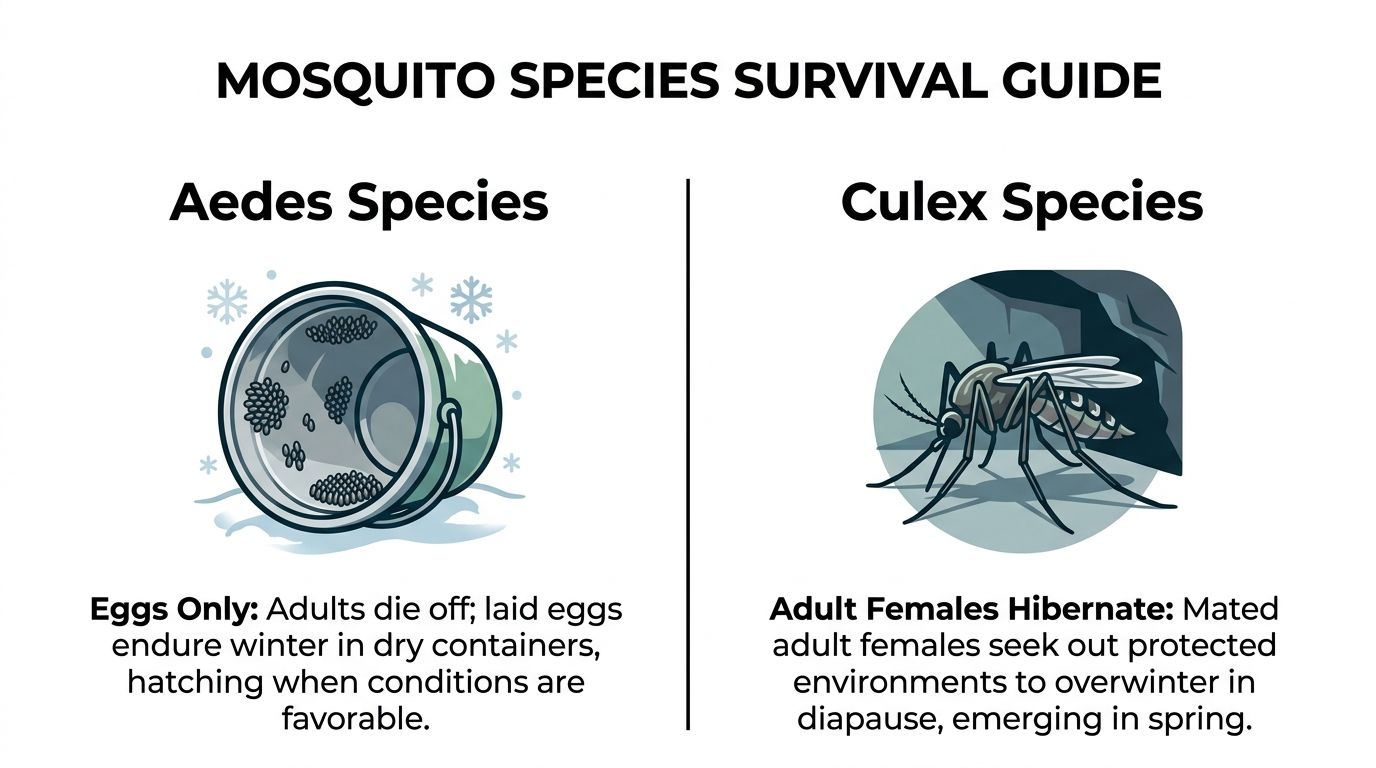
Aedes and Culex need different prevention
Survival methods vary dramatically by species. Aedes species survive as dormant eggs in containers, requiring fall cleanup of water-holding items, while Culex species enter diapause as adult females in sheltered spaces, requiring homeowners to seal foundation cracks and garage access points before winter, as outlined by Mosquito Authority’s winter mosquito guide.
That one distinction explains why so many do-it-yourself plans only work halfway.
If you dump containers but ignore structural shelter, you may still have overwintering adults. If you seal obvious gaps but leave water-holding items and damp breeding areas untouched, you may still get a heavy hatch when spring moisture arrives.
Side-by-side comparison
| Species group | Main winter strategy | What homeowners should focus on |
|---|---|---|
| Aedes | Eggs survive in containers and damp areas | Remove water-holding items, clear debris, manage low wet spots |
| Culex | Adult females shelter in protected spaces | Seal entry points, inspect basements, garages, crawl spaces, and sheltered voids |
For a closer look at local types, homeowners can review this resource on mosquito species.
Why one-size-fits-all advice falls short
Generic mosquito advice usually sounds simple. Empty water. Spray when you see activity. Maybe add a repellent.
The problem is that simple advice often ignores the species question.
A property with mostly container-breeding pressure needs disciplined cleanup. A property with indoor refuge issues needs structural attention and inspection. Many homes in Crown Point have both.
That is why homeowners who search for pest control in Crown Point, IN or exterminator near me often get better results when they stop asking only “What spray should I use?” and start asking “What kind of survival pattern is this property supporting?”
From Winter Slumber to Spring Swarm The Seasonal Threat
Spring mosquito pressure often feels abrupt because the insects emerging are already prepared.
For Culex mosquitoes, the winter pause is not a full reset. Female Culex mosquitoes mate in fall and store viable sperm throughout hibernation. Once temperatures exceed 50°F, they can immediately commence oviposition after their first blood meal, bypassing the mating phase and creating sharp population density spikes in early spring, according to Torpedo Mosquito’s discussion of winter survival in Culex.
Why the first warm stretch matters so much
That early-spring jump catches homeowners off guard.
You may have had weeks of cold weather and assumed the issue was behind you. Then a mild stretch arrives, snowmelt and rain add moisture, and the property suddenly has active mosquitoes before many individuals have even pulled patio furniture back out.
The same pattern holds with overwintering eggs. Once spring brings water and warmth, hatching can happen quickly. That is why a yard can seem quiet for months and then turn irritating in a very short window.
What works and what does not
Some responses help. Some only make homeowners feel busy.
What works
- Addressing likely overwintering areas before consistent warm weather
- Fixing drainage and moisture issues instead of just reacting to bites
- Treating the property as a system, not just the lawn
What does not
- Waiting until mosquitoes are obvious everywhere
- Assuming one frost solved the issue
- Treating open areas while ignoring basements, crawl spaces, and protected voids
Spring swarms are usually a delayed result of winter survival, not a random surprise.
Preventative pest treatments earn their value by interrupting the conditions that let mosquitoes launch early and aggressively. The goal is not only to reduce what is flying today. The goal is to interrupt the conditions that let mosquitoes launch early and aggressively.
Your Proactive Mosquito Prevention Plan for Your Crown Point Home
A good prevention plan starts in the cold months, not the hot ones.
The first goal is simple. Remove shelter, moisture, and hidden breeding support before spring turns those overlooked areas into a mosquito problem.
The homeowner checklist that helps
Aedes mosquito eggs can survive desiccation and freezing temperatures for months, hatching in spring when inundated with water. For Northwest Indiana homeowners, eliminating winter standing water in yards, tree holes, or drains is a critical prevention method because it removes the primary substrate for the spring’s first generation, as explained in Thermacell’s discussion of mosquitoes in winter.
Use that fact to guide your winter routine:
- Clean gutters thoroughly: Packed debris traps moisture and supports the wrong conditions right above the foundation.
- Empty and store containers: Planters, toys, buckets, and decorative items should not sit outside holding water through winter thaws.
- Correct drainage trouble spots: If downspouts dump near the house or low areas stay wet, address that before spring rains.
- Rake out dense leaf buildup: Focus on fence lines, under shrubs, around AC pads, and along the base of decks.
- Seal access points: Check garage door edges, crawl space vents, foundation cracks, and utility openings.
- Inspect the basement: Watch for condensation, standing water, sump problems, and corners that stay damp.
If you want a broader homeowner-friendly refresher on how to get rid of mosquitoes around a property, that guide is a useful complement to a local inspection mindset.
Here is a quick visual overview of why timing matters:
Where DIY reaches its limit
Homeowners can handle a lot of the cleanup work. That matters.
What is harder is identifying every overlooked refuge. Crawl spaces, inaccessible drainage lines, hidden water traps, and subtle structural gaps are where a lot of prevention plans weaken. If you are evaluating your next step, this page on how to reduce mosquitoes in yard gives a practical starting point for thinking beyond surface-level spraying.
The best winter mosquito plan is not complicated. It is thorough.
Schedule Your Crown Point Mosquito Inspection Today
If mosquitoes seem to return to your property faster than they should, there is usually a reason. The answer is often hidden in winter shelter, moisture, and overlooked breeding support around the structure.
A professional inspection helps narrow that down. Instead of guessing, you get a close look at the property conditions that support mosquito survival. That includes the obvious outdoor areas, but also the less obvious ones such as basements, garage edges, crawl spaces, drainage trouble spots, and shaded debris zones.
What to expect from a professional inspection
A solid inspection should include:
- A full property review: Not just the lawn, but the structure, moisture patterns, and likely refuge areas.
- Clear findings in plain language: Homeowners should understand what is happening and why it matters.
- Practical next steps: Cleanup, exclusion, treatment timing, and ongoing prevention should all fit the property.
- A broader pest perspective: Many mosquito-friendly conditions also overlap with other pest issues, which matters for both residential pest control and commercial pest control properties.
For homeowners improving exclusion, even basics like install window fly screens can support a stronger barrier strategy when paired with moisture and habitat correction.
Why timing matters in Crown Point
The best time to deal with winter mosquito survival is before spring pressure builds.
If you are in Crown Point or nearby Northwest Indiana communities and want fewer surprises when warm weather returns, start with a property assessment. It is one of the most practical ways to protect your yard, your comfort, and your peace of mind before mosquito season gets traction.
If you want local help identifying overwintering mosquito sites around your home or business, contact The Green Advantage to schedule an inspection or request a quote. Their team serves Crown Point and nearby Northwest Indiana communities with targeted pest evaluations, mosquito reduction programs, and practical solutions built around the way pests behave on local properties.
Uncover What Attracts Mice to Your Home

You hear a faint scratching in the wall after dark. The dog stares at the pantry. In the morning, there are a few tiny droppings under the sink, and suddenly your home does not feel quite as settled as it did the day before.
That worry is common in Crown Point and across Northwest Indiana. Mice do not need much to move in, and once they find what they want, they tend to stay close.
The good news is that mouse problems are usually very understandable when you know what to look for. If you know what attracts mice to your home, where they slip inside, and how local weather changes their behavior, the problem stops feeling mysterious. It becomes something you can act on with confidence.
Your Trusted Partner for Pest Control in Crown Point IN
When homeowners search for pest control in Crown Point, IN, they are usually not looking for theory. They want answers. They want to know why mice picked their house, whether the problem is getting worse, and what solution will work.
That is a fair concern. Mice are not drawn to dirty homes only. They are drawn to opportunity. A neat house with one plumbing gap, a little pet food, and a damp crawlspace can be just as appealing as a cluttered one.
Why mouse problems feel so sudden
Most infestations seem to appear out of nowhere because mice stay hidden well. They move through wall voids, behind appliances, inside garage corners, and above ceilings. By the time a homeowner sees one in the open, mice have often already found food, shelter, or moisture.
In Crown Point, that pattern gets worse because our seasons push pressure onto homes for much of the year. Cold snaps send mice toward warmth. Humid stretches create damp conditions around basements, garages, crawlspaces, and AC areas that many homeowners do not think of as rodent attractants.
Key takeaway: Mouse activity usually starts with a simple combination of access plus resources. If a home offers both, traps alone rarely solve the full problem.
What local homeowners need from an exterminator near me
A homeowner looking for an exterminator near me is usually balancing several priorities at once:
- Fast clarity: They want to know if the noises and droppings really point to mice.
- A complete fix: They do not want to catch one mouse only to find more a week later.
- Safe treatment: They want rodent control handled responsibly around children, pets, and daily life.
- Prevention: They want to stop the next entry, not just remove the current intruder.
That is why understanding attractants matters so much. Rodent control works best when it addresses the reason mice stayed in the first place. In practical terms, that means looking at food sources, water sources, shelter conditions, and the structural weak points that let mice move indoors.
Homeowners in Northwest Indiana often assume a mouse problem starts in winter. Sometimes it does. But local conditions make the pressure more year-round than many people realize. That local reality changes what effective prevention looks like.
The Top 3 Things That Attract Mice to Your Home
You hear a scratch in the wall on a cold Crown Point night, set a couple of traps in the kitchen, and hope that handles it. Sometimes it catches one. The activity comes back because the house is still giving mice what they came for in the first place.
Mice stay where they can reliably find food, water, and shelter. In Northwest Indiana, that combination shows up in every season. Winter pushes mice toward heated interiors. Summer humidity keeps crawlspaces, basements, garages, and utility areas more mouse-friendly than many homeowners realize.
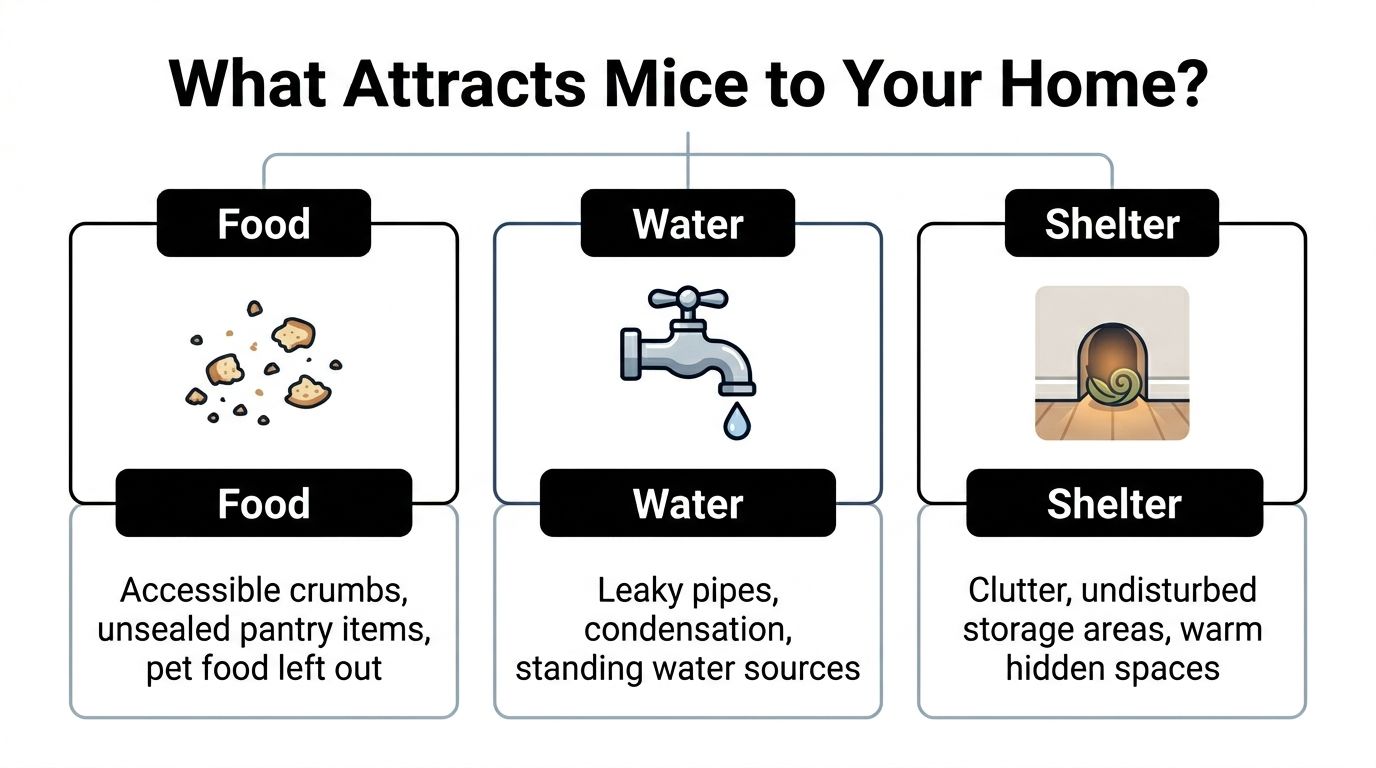
1. Food sources they can count on
A mouse does not need a major mess. It needs repeat access.
In real homes, I see the same patterns over and over. Crumbs under the stove, snack pieces under living room furniture, grease buildup beside a range, bird seed in the garage, and dry pet food left out overnight all give mice a reason to keep returning. Boxed goods and thin plastic packaging are not much protection either. If food odor gets out, mice will work at the package until they get in.
The trade-off is simple. Convenience for the household often creates consistency for mice. A bag of seed stored in the garage is easy for you to reach. It is also easy for mice to find. Pet food left out helps a busy evening routine. It also gives nighttime feeders a dependable meal.
2. Moisture that helps them stay
Food gets attention first. Water and damp conditions often explain why mice settle in instead of just passing through.
That matters in Crown Point because our climate creates moisture trouble in places homeowners often overlook. Condensation around HVAC lines, damp basement corners, crawlspace humidity, utility room drips, and moisture near sump areas all help support rodent activity. Harris Pest Control's overview of what attracts mice notes that even a small, steady water source such as a dripping faucet can support multiple mice.
Watch these areas closely:
- Under sinks: slow leaks hidden behind stored supplies
- Basements: damp walls, condensation, and musty corners
- Laundry rooms: appliance hoses, floor drains, and utility hookups
- Garages: humidity, minor leaks, and poor airflow
- Near HVAC equipment: condensation lines and pooled moisture
A house can look clean and still feel comfortable to mice if moisture is left in place.
3. Shelter that stays quiet and undisturbed
Once mice find food and moisture, they look for protected nesting spots. Most homes offer more of them than homeowners expect.
Cardboard boxes in the garage, holiday bins packed with fabric, paper storage in the basement, attic insulation, cluttered utility shelves, and dense shrubs near the foundation all give mice cover. They use soft materials for nesting and prefer areas that stay dark, warm, and undisturbed for long stretches.
Outdoor cover matters too. In Northwest Indiana, summer growth around the home can hide low entry areas and give mice safer movement along the foundation. Then fall and winter weather push that pressure closer to the house.
If you are already noticing scratching sounds, droppings, or gnaw marks, our guide to the common signs of rodent infestation can help you confirm whether mice are active.
Why these attractants matter together
One crumb usually is not the whole problem. One leak usually is not either.
What keeps an infestation going is the combination. Food gives mice a reason to return. Moisture helps them remain active inside. Shelter gives them a place to nest where they are hard to notice and harder to remove.
That is why quick trap-only fixes often fall short. Lasting rodent control means cutting off the resources that made the home worth using in the first place. At The Green Advantage, that is the part we pay close attention to because it is what turns a short-term catch into a long-term fix.
Unseen Entry Points and Telltale Signs of Mice
A Crown Point homeowner can keep a tidy house and still end up with mice in the walls by the first hard cold snap. In this area, the problem often starts outside long before anyone sees a droppings trail in the pantry.

Mice get in through openings homeowners pass every day without noticing. Small gaps around a pipe, a worn garage door corner, or a foundation crack can be enough. In Northwest Indiana, freeze-thaw movement, wet springs, and humid summers slowly open those weak spots, then fall and winter weather push mice to use them.
Where mice usually get in
A proper inspection is less about finding one big hole and more about spotting several small failures around the exterior shell.
Common trouble spots include:
- Foundation cracks: Especially where mortar has separated or settling has opened a seam.
- Utility penetrations: Gaps around water lines, gas lines, AC lines, and cable entry points.
- Door sweep failures: Side doors, service doors, and garage doors often leave just enough clearance at the bottom corners.
- Roof and vent gaps: Loose vent screens, soffit gaps, and openings near rooflines can give mice access to attics and wall voids.
- Garage corners: Garages collect clutter, stay quieter than main living areas, and often have more construction gaps than homeowners expect.
One reliable route is all it takes.
Why homeowners miss the first signs
Mice do most of their movement at night and usually travel along edges, not across open floors. That is why the first evidence often shows up in tucked-away spots instead of the middle of a room.
Watch for these signs early:
| Sign | What it often means |
|---|---|
| Small droppings | Regular travel routes near food storage, cabinets, or hidden nesting areas |
| Gnaw marks | Active feeding or attempts to widen access around wood, packaging, or drywall edges |
| Shredded material | Nest building with paper, insulation, fabric, or cardboard |
| Scratching sounds | Movement inside walls, above ceilings, or behind cabinets |
| Musty odor | Repeated activity in a concealed space, often with nesting nearby |
If you want to compare what you are seeing with common household warning signs, our page on common signs of rodent infestation gives a clear homeowner reference.
What a quick inspection should include
Start outside. Check the foundation line, door bottoms, garage perimeter, hose bibs, AC line entries, and any place one material meets another. Brick to siding transitions and pipe-to-wall gaps are frequent problem areas in homes around Crown Point.
Then move inside and inspect the places mice use first because they offer cover and steady access:
- Under sinks
- Behind the stove and refrigerator
- Inside pantry corners
- Basement rim areas
- Garage shelving edges
- Attic access points
This video gives a useful visual sense of the kinds of areas that deserve attention.
When signs point to a bigger issue
A single mouse caught in a trap does not rule out more activity elsewhere in the home. If droppings show up in multiple rooms, scratching continues after a catch, or fresh signs return after cleanup, there is usually an active entry route and a hidden nesting area that still need attention.
Homeowners often lose time focusing on the mouse they can see instead of the gap it used and the space where it settled. That trade-off matters. Catching one or two mice may bring short-term relief, but it rarely solves a Northwest Indiana mouse problem if seasonal pressure around the house is still in place.
Identifying entry points and hidden signs early makes it much easier to stop a mouse issue before it spreads.
Why Mouse Behavior Changes with Northwest Indiana Seasons
A lot of Crown Point homeowners call after the first hard cold snap. They hear scratching in a wall or find droppings that were not there a week earlier and assume the problem started overnight.
Usually, it started earlier.
Northwest Indiana gives mice two different kinds of opportunity through the year. Winter pushes them toward indoor warmth. Our humid summers and wet stretches help maintain the damp, protected conditions mice can use around basements, crawlspaces, garages, and utility areas. Generic national advice often focuses on cold weather alone. Around here, that misses half the pattern.
Fall and winter change how mice use a home
Once temperatures drop, homes in Crown Point become steady shelter. Attics stay warmer than the outdoors. Wall voids block wind. Utility areas hold residual heat. Mice respond fast to that shift, especially when fields are harvested and outdoor cover changes.
That is why activity often seems to surge in late fall. The route may have been there for weeks, but the weather finally gave mice a reason to use it heavily.

Summer brings pressure too, for different reasons
Summer mouse pressure looks different. It is quieter, and homeowners often misread it.
In Northwest Indiana, long humid stretches can keep certain parts of a property damp even without a plumbing leak. Basements can feel heavy. Crawlspaces can stay moist. Condensation around HVAC components and AC lines can keep small areas usable for longer than people expect. Purdue Extension's rodent control guidance emphasizes that mice need food, water, and shelter, and those conditions do not disappear just because it is warm outside. See Purdue Extension's house mouse management guidance.
Around Crown Point, I see the same summer conditions over and over:
- garages that stay damp after storms
- muggy basement corners with little airflow
- crawlspaces with persistent humidity
- utility and HVAC areas where condensation forms
- quiet storage areas that stay undisturbed for weeks
Those spaces may not draw attention the way a winter pantry issue does, but they still support mouse activity.
Why generic advice misses the Northwest Indiana pattern
A national article can tell you to seal gaps before winter, and that is good advice. It is incomplete for this area.
Our seasonal pressure is layered. Winter increases indoor movement toward heat and cover. Spring and fall often bring exploration and route-setting. Summer can support nesting and survival in damp, protected areas that stay stable during humid weather. The trade-off for homeowners is simple. If prevention starts only when frost shows up, mice may already be established in lower-traffic parts of the home.
That is one reason a local plan usually performs better than a one-size-fits-all checklist. A Crown Point home has to be evaluated for cold-weather entry pressure and warm-weather moisture pressure.
A seasonal plan works better than a one-season fix
The practical response changes with the calendar:
- In fall and winter, focus on heat-seeking activity and protected indoor nesting areas.
- In spring, watch for renewed movement as mice test routes and expand travel paths.
- In summer, correct humidity, condensation, and damp storage conditions.
- Year-round, keep the exterior less inviting so mice stay farther from the structure.
Homeowners who want to weigh short-term trap-and-seal work against a more durable treatment plan can compare both approaches in this guide on DIY mouse control vs hiring a professional.
Mouse behavior changes here because Northwest Indiana weather changes hard and often. The best results come from handling the problem the same way. Season by season, with a plan that fits Crown Point homes.
Your Rodent Control Options DIY Fixes vs Professional Treatment
A lot of Crown Point homeowners start the same way. They hear scratching at night, spot droppings near the pantry or garage wall, and pick up a few traps on the way home.
That first step can help. It just has limits, especially in Northwest Indiana, where mice keep shifting with the weather. In cold months, they push hard toward indoor warmth. In humid stretches, they often stay active around damp basements, crawl spaces, garages, and cluttered storage. A trap can remove a mouse. It does not tell you why the house keeps drawing them back.

What DIY does well
DIY control has a place.
If activity started recently, is limited to one area, and you can clearly identify where mice are getting in, traps and basic exclusion may be enough to get ahead of it. Good cleanup helps too, especially in kitchens, pet food areas, and storage spaces where crumbs or nesting material have built up.
DIY usually makes sense when:
- activity appears light and recent
- signs are limited to one room or one side of the home
- the gap or hole is easy to reach and seal correctly
- there is no strong odor, repeated droppings, or evidence of nesting
That is the honest trade-off. DIY can be a reasonable first response for a small, early problem.
Where DIY usually misses the core problem
The trouble starts when homeowners treat sightings instead of pressure points.
Mice rarely use just one opening. In Crown Point homes, I often find multiple access spots around utility lines, garage door corners, siding gaps, foundation joints, attic edges, and areas where cold-weather settling has opened small seams. Outside conditions matter too. Dense vegetation, stacked firewood, and stored items against the house give mice cover close to the structure. Once that pattern is established, catching one or two mice indoors does not break it.
Here is a practical comparison:
| DIY approach | What it can do | What it often misses |
|---|---|---|
| Traps | Reduce visible activity | Hidden travel routes, nests, and secondary entry points |
| Store-bought bait | Knock down some pressure | Safe placement, monitoring, and full-property strategy |
| Sealing one obvious hole | Blocks one access point | Small gaps in other parts of the structure |
| Extra cleaning | Lowers food availability | Shelter, moisture, and exterior harborage |
One of the most common mistakes is sealing only the spot where a mouse was seen. Another is putting traps indoors while ignoring the outside conditions that keep feeding the problem.
What professional treatment changes
Professional rodent control works best as a process, not a product.
A solid service starts with inspection. The goal is to find how mice are entering, where they are traveling, what conditions are supporting them, and whether the issue is isolated or established. From there, treatment is built around the house itself, not a generic setup.
A professional plan usually includes:
- Detailed inspection: interior signs, exterior gaps, nesting areas, and pressure zones
- Targeted trapping or control: placed where mice are moving
- Exclusion recommendations or repairs: to shut down repeat access
- Exterior evaluation: cover, moisture, storage habits, and structural conditions near the home
- Follow-up: to confirm activity has dropped and the plan worked
That matters here because our local weather creates repeat pressure. A home can seem quiet for a while, then mouse activity picks up again with the next hard temperature swing or damp spell. Lasting control usually comes from handling the whole pattern, not just the mouse you saw this week.
If you are comparing short-term fixes with a longer-lasting plan, this guide on DIY mouse control versus hiring a professional lays out the decision clearly.
What usually gives longer control: inspection, exclusion, and targeted treatment used together
What often falls short: traps alone, without fixing access and shelter conditions
Safety matters
Homeowners are right to ask about kids, pets, and treatment safety.
A good rodent service should explain what is being used, where it is being placed, and why that approach fits the home. It should also account for how the family uses the space. That includes kitchens, mudrooms, attached garages, basements, and utility areas where mouse activity often overlaps with daily routines.
Professional help offers clarity. You get a defined plan, you know what is being corrected, and you are not left guessing whether the scratching will start up again next week.
The Green Advantage Promise for Crown Point Homeowners
When mice get inside, the problem affects more than one corner of the house. It affects how comfortable people feel in their own kitchen, basement, garage, and bedrooms. That is why homeowners usually want more than a quick removal. They want confidence that the issue is being handled correctly.
For Crown Point homeowners, that means choosing a pest control company that understands both the pest and the local conditions that support it.
What professional rodent control protects
A proper mouse control plan helps protect several things at once:
- Your property: Mice chew, shred, and contaminate stored materials.
- Your living spaces: Kitchens, pantries, utility rooms, and attics are hard to enjoy when signs of rodents keep returning.
- Your routines: Ongoing trap checks and repeated cleanups wear people down quickly.
- Your peace of mind: The biggest relief often comes from knowing someone has found the root of the problem.
Professional service is especially valuable when mouse activity overlaps with other seasonal pest issues in Northwest Indiana. Homes dealing with rodents may also need broader support with preventative pest treatments, spider control, ant control, wasp removal, termite concerns, or mosquito control around the yard. A company that sees the full property picture can help homeowners protect the home more completely.
What homeowners should expect from a good service experience
A strong pest control experience should feel straightforward, not confusing.
It should usually include:
A clear first conversation
You should be able to describe what you are hearing or seeing and get practical guidance on next steps.An on-site inspection
The technician should inspect likely entry points, activity zones, and conditions that support mice.A site-specific plan
The home should be treated based on its layout, pressure points, and risk areas.Plain communication
You should know what was found, what was done, and what changes at home will help.Follow-through
Lasting control depends on confirming results, not just performing one visit and disappearing.
Why local experience matters in Crown Point IN
A company serving Crown Point, IN, and nearby Northwest Indiana communities should understand how local weather, construction styles, yard layouts, garages, crawlspaces, and seasonal moisture patterns shape pest activity. That local familiarity leads to better inspections and more practical recommendations.
Homeowner reassurance: The best pest control is not just about removing mice. It is about restoring normal life in the house without confusion, pressure, or guesswork.
If you are comparing providers after searching for exterminator in Crown Point, IN or pest control near me, look for direct communication, licensed and certified service, realistic prevention advice, and a process that addresses entry points as seriously as sightings.
Your Simple Home Maintenance Checklist for Mouse Prevention
Preventing mice is easier when small tasks become routine. The checklist below focuses on the parts of the home where mouse pressure builds fastest.
Kitchen and pantry
- Store dry goods securely: Move cereals, grains, snacks, and pet food into durable sealed containers.
- Clean low and hidden areas: Sweep under appliances and wipe crumbs from cabinet corners, not just countertops.
- Manage trash tightly: Keep garbage closed and avoid letting food waste sit overnight.
- Pick up pet bowls: Do not leave food and water out longer than necessary.
Basement attic and storage spaces
- Reduce soft nesting material: Limit loose paper, fabric, cardboard, and clutter in quiet areas.
- Use plastic totes: Long-term storage holds up better in lidded bins than in boxes.
- Watch for dampness: Check utility areas, under-sink zones, and corners that feel humid or musty.
- Inspect insulation and hidden edges: Look for shredding, droppings, or disturbed materials.
Home exterior and yard
- Trim back vegetation: Keep shrubs and growth from pressing against siding or foundation lines.
- Maintain perimeter clearance: Adequate clearance around the house helps reduce cover and climbing access, as noted earlier.
- Move wood and debris away from the house: Keep outdoor shelter spots from building pressure near the structure.
- Check doors and gaps: Pay attention to garage edges, side doors, vents, and utility penetrations.
A checklist like this does not replace treatment when mice are already active. It does make the property much less inviting.
Frequently Asked Questions About Mouse Control
Are mouse treatments safe for children and pets
They should be handled with safety in mind from the start. A responsible pest control company explains where products are placed, why they are used, and what precautions matter for your household. If you have children, pets, or specific concerns, ask for that conversation up front.
Can a clean home still get mice
Yes. Clean homes can still get mice if the structure has accessible gaps, moisture issues, or quiet nesting areas. Cleanliness helps, but it does not replace exclusion and inspection.
How long does it take to get rid of mice completely
That depends on how established the activity is, how many access points exist, and whether nesting areas are present. Some problems are resolved quickly. Others take a more involved plan with follow-up to make sure activity has fully stopped.
Do new homes in Crown Point get mice too
Yes. Newer homes can still have gaps around utility lines, garage doors, foundation transitions, roof vents, or landscaping that creates cover near the structure. Age alone does not prevent mouse pressure.
Should I call if I have only seen one mouse
If you have seen one mouse indoors, heard scratching, or found fresh droppings, it is worth taking seriously. Mice stay hidden well. One visible sign can mean there is already a route or nesting area somewhere out of sight.
If you are dealing with scratching in the walls, droppings in the pantry, or repeat mouse activity around your Crown Point home, The Green Advantage can help you get clear answers and a lasting solution. Our local team serves Crown Point and nearby Northwest Indiana communities with thoughtful, environmentally mindful pest control for homes and businesses. Reach out today to schedule an inspection, request a quote, and take the next step toward a home that feels settled again.
Termite Control Saint John IN
Termite Control Saint John IN
Owning a home in Saint John, Indiana, is a dream come true for many. With our beautiful neighborhoods, friendly community, and the distinct charm of the Midwest, it’s a wonderful place to put down roots and build a life. Your home is likely the most significant investment you will ever make, providing shelter, comfort, and a place for memories to grow. However, there is a silent threat lurking beneath the soil in Northwest Indiana that can undermine that investment faster than you might imagine. Termites are often called "silent destroyers" because they can chew through wood, flooring, and even wallpaper undetected for years. By the time you notice visible damage, the colony has often been established for quite some time, and the structural integrity of your property may already be compromised. For homeowners in Saint John, understanding this threat is the first step toward protection. At The Green Advantage, we believe that being informed is your best defense. We are here to help you navigate the complexities of termite control with a friendly, expert touch. Whether you have lived in your home for decades or just moved in, safeguarding your property value against termites is not just a maintenance task—it is a financial necessity.Understanding Termites: A Guide for Saint John Homeowners
To effectively protect your home, you first need to understand what you are up against. In the Saint John area, and throughout Indiana, the primary culprit is the Eastern Subterranean Termite. Unlike drywood termites that live entirely inside wood, subterranean termites live in colonies underground. They are moisture-loving insects that build complex tunnel systems to access food sources—specifically, the cellulose found in the wood of your home.The Midwest Climate Factor
Our local climate plays a significant role in termite activity. We experience a full range of seasons here. The moisture from spring thaws and summer rains creates the perfect humid environment for termites to thrive. While they slow down slightly in the freezing winter months, they do not die off. Instead, they retreat deeper into the soil to stay warm, waiting for the ground to thaw so they can resume their work. If they have managed to establish a nest inside the warmth of your heated basement or crawlspace, they can actually remain active year-round.Recognizing the Signs of Activity
Because termites work from the inside out, they are notoriously difficult to spot. However, there are subtle warning signs that every homeowner should look for:- Mud Tubes: These are pencil-sized tunnels made of soil and wood particles. You will often see them running up foundation walls, support piers, or even hanging from floor joists. These tubes serve as protected highways for termites to travel between their underground colony and your home.
- Discarded Wings: In the spring, reproductive termites (swarmers) fly out to start new colonies. After they mate, they shed their wings. Finding piles of wings on windowsills or near doorways is a major red flag.
- Hollow-Sounding Wood: If you tap on your baseboards or wood flooring and it sounds hollow, it may be because termites have eaten away the interior honeycombs of the wood.
- Stuck Windows or Doors: Termites produce moisture when they eat, which can cause wood frames to warp, making doors and windows difficult to open or close.
Termite Control Saint John IN[/caption]
The Financial Reality of Termite Damage
It is easy to underestimate a bug that is only a fraction of an inch long, but the collective power of a termite colony is financially devastating. Across the United States, termites cause billions of dollars in property damage every year. What is even more alarming for homeowners is that standard homeowners insurance policies typically do not cover termite damage. Insurance companies view termite infestations as a preventable maintenance issue, meaning the cost of repairs comes directly out of your pocket.Compromising Structural Integrity
Termites do not just eat cosmetic wood; they attack the structural supports of your home. They can compromise floor joists, wall studs, and support beams. In severe cases, this can cause floors to sag, walls to crack, and ceilings to bow. Repairing this kind of damage isn't as simple as patching a hole; it often requires extensive construction work to jack up the house and replace load-bearing wood.The Value of Early Detection
The gap between a minor treatment cost and a major structural repair bill is often defined by time. Early detection and professional intervention save money in the long run. By investing in regular inspections and preventative control, you are spending a fraction of what it would cost to repair significant damage later. Think of professional termite control as an insurance policy you buy for the health of your home’s structure.Why DIY Termite Solutions Are Risky
When faced with a pest issue, the temptation to head to the local hardware store for a quick fix is understandable. We all love a good weekend project, but termite control is one area where DIY methods fall short.The Problem with Surface Treatments
Most over-the-counter termite sprays and baits are designed as contact killers or repellents. While they might kill the termites you see foraging on the surface, they do nothing to address the colony underground. A single colony can house hundreds of thousands to millions of termites. Killing a few dozen workers does not stop the queen from reproducing. In fact, using repellents can sometimes make the problem worse by causing the colony to fracture and spread to other areas of your home to avoid the treated zone.The Risk of Hidden Access Points
Termites are masters of entry. They can squeeze through cracks in your foundation as thin as a business card. Without professional training, it is nearly impossible for a homeowner to identify every potential entry point or hidden mud tube. Professional technicians understand building construction and termite behavior, allowing them to locate and treat areas that an untrained eye would miss.Incomplete Eradication
The goal of termite control isn't just to kill bugs; it is to eliminate the colony threatening your structure. DIY methods rarely achieve colony elimination. This leads to a false sense of security where you believe the problem is solved, while the termites continue to eat away at your home’s framework in secret.The Green Advantage: Your Local Partner in Protection
When you are ready to protect your home, you want a partner who understands the local environment and cares about your community. The Green Advantage has decades of experience dedicated to quality services right here in the region. Beginning as a small lawn maintenance company, we found ourselves dealing more and more with problems that others had difficulty solving. The knowledge of nature that was gained both in the field and by hobby began to transform the business into the pest control experts we are today.A Focus on Customer Satisfaction
Are you experiencing a pest issue? Would you like to have a local, knowledgeable licensed professional assist you in eradicating your pests? The Green Advantage is here to help! We pride ourselves on communication. Every customer who signs up for our services will communicate directly with our helpful staff for scheduling and information about the pest problem. This allows our licensed technicians to focus on what they do best: solving your pest issues.Eco-Friendly and Effective
Working with nature is a passion that goes beyond being a career for us. We are constantly researching ways to improve services offered to customers, working hard to find solutions where many have surrendered. We specialize in solutions that are effective against pests but mindful of your family and the environment. We can guide you through our process to ensure that the service you receive is the best fit for your household needs. [caption id="attachment_698" align="aligncenter" width="800"] Termite Control Service Saint John IN[/caption]
The Professional Termite Control Process
Knowing what to expect can make the process of hiring a professional much less stressful. At The Green Advantage, we believe in transparency and education. Here is how we approach termite control for our Saint John neighbors:Comprehensive Inspection
It all starts with a thorough examination. Our licensed technicians will inspect your property inside and out. We look at the basement or crawlspace, the foundation perimeter, the attic, and any other high-risk areas. We aren't just looking for bugs; we are looking for moisture issues, wood-to-ground contact, and structural vulnerabilities that attract termites.Customized Treatment Plan
No two homes in Saint John are exactly alike. A home with a basement requires a different approach than a home on a slab or a crawlspace. Based on our inspection findings, we create a tailored plan. This might involve liquid barrier treatments applied to the soil around your foundation to create a protective zone, or it might involve baiting systems that utilize the termites' foraging behavior to carry active ingredients back to the colony.Professional Application
Our technicians are trained in the safe and precise application of termite control products. We use specialized equipment to treat the soil alongside your foundation, and if necessary, drill small holes in concrete areas (like patios or garages) to treat the soil underneath. We take great care to respect your property and landscaping during this process.Ongoing Monitoring and Prevention
Termite control is not a "one-and-done" event. It requires vigilance. We offer ongoing monitoring services to ensure the treatment remains effective and to catch any new activity immediately. This provides you with year-round peace of mind.Preventing Termites: Tips for a Safer Home
While professional treatment is essential for eradication and strong defense, there are steps you can take as a homeowner to make your property less attractive to termites. Think of these as a partnership with your termite control provider:- Address Moisture Issues: Termites love damp environments. Ensure your gutters and downspouts are diverting water away from your foundation. Fix leaky faucets and ensure your crawlspace has proper ventilation to reduce humidity.
- Remove Wood-to-Ground Contact: This is the number one way termites enter homes. Ensure that siding, door frames, and window frames are at least six inches above the soil line.
- Mind Your Mulch: Wood mulch retains moisture and provides food. Keep mulch pulled back at least a few inches from the foundation of your house, or consider using rubber mulch or decorative stone in the beds immediately touching the home.
- Store Firewood Properly: Never stack firewood against the side of your house. Store it off the ground and at a distance from your home to prevent termites from using it as a bridge.
- Seal Cracks: Use caulk or concrete patch to seal small cracks in your foundation or utility entry points where pipes enter the home.
The Long-Term Benefits of Investing in Your Home
Choosing professional termite control is about more than just getting rid of bugs; it is about securing your financial future.- Preserving Property Value: When you go to sell your home, a termite inspection is almost always required. A history of termite damage—even if it has been repaired—can spook potential buyers and lower your resale value. Conversely, having a warranty or a service record from a reputable company like The Green Advantage shows buyers that the home has been well-cared for.
- Cost-Effectiveness: The cost of a preventative termite plan is minuscule compared to the cost of structural repairs. Replacing a sill plate or rebuilding a wall can cost thousands upon thousands of dollars. Prevention is always cheaper than the cure.
- Peace of Mind: You cannot put a price on the comfort of knowing your home is safe. You shouldn't have to worry every time you see an ant if it’s actually a termite. With a professional partner, you can relax and enjoy your home, knowing that trained experts are keeping watch.
Termite Control Service[/caption]
Start Protecting Your Investment Today
Your home in Saint John is more than just wood and drywall; it’s the backdrop for your life. Don't let a hidden pest threaten the safety and value of your property. Taking a proactive stance against termites is one of the smartest decisions a homeowner can make. At The Green Advantage, we are ready to bring our expertise, our passion for nature, and our commitment to customer satisfaction to your doorstep. We don't just treat houses; we help neighbors protect their homes. If you suspect you have termites, or if you simply want the peace of mind that comes with a professional inspection, do not wait until damage becomes visible. Contact The Green Advantage today. Let us customize a protection plan that fits your needs and keeps your home standing strong for generations to come.Pest Control in Crown Point, IN: A Guide to Mosquitoes & Fireflies

Here in Crown Point, Indiana, there's nothing quite like watching fireflies light up a warm summer evening. It’s a magical sight for any homeowner. As you're enjoying the show, it's natural to wonder if those twinkling beetles are also doing you a favor by gobbling up pesky mosquitoes.
It’s a lovely thought, but unfortunately, it’s a myth. Fireflies do not eat mosquitoes, and they won't make a dent in your local mosquito population. If mosquitoes are taking over your yard, you need a professional solution. As a trusted local provider, The Green Advantage offers reliable pest control in Crown Point, IN, to help homeowners like you take back their outdoor spaces.
What Do Fireflies Actually Eat?
The confusion usually stems from a misunderstanding of the firefly life cycle. It's the firefly larvae—often called glow-worms—that are the voracious predators, but their prey isn't mosquitoes.
For up to two years, these larvae live in moist soil and leaf litter, acting as tiny but effective hunters. Their primary food sources are slow-moving creatures they can easily overpower.
- Primary Diet: Snails, slugs, worms, and other soft-bodied invertebrates.
- Hunting Ground: The damp, dark environment on the ground.
Once they transform into the flying adults we all know and love, their eating habits change dramatically. In fact, many adult fireflies don't eat at all. Their adult life is a short, two-month sprint focused on finding a mate. For the species that do eat, mosquitoes are still not on the menu. They might sip on nectar or pollen, or in some "femme fatale" species, predatory females lure in and eat males of other firefly species.
This diagram breaks down what's really on a firefly's plate.
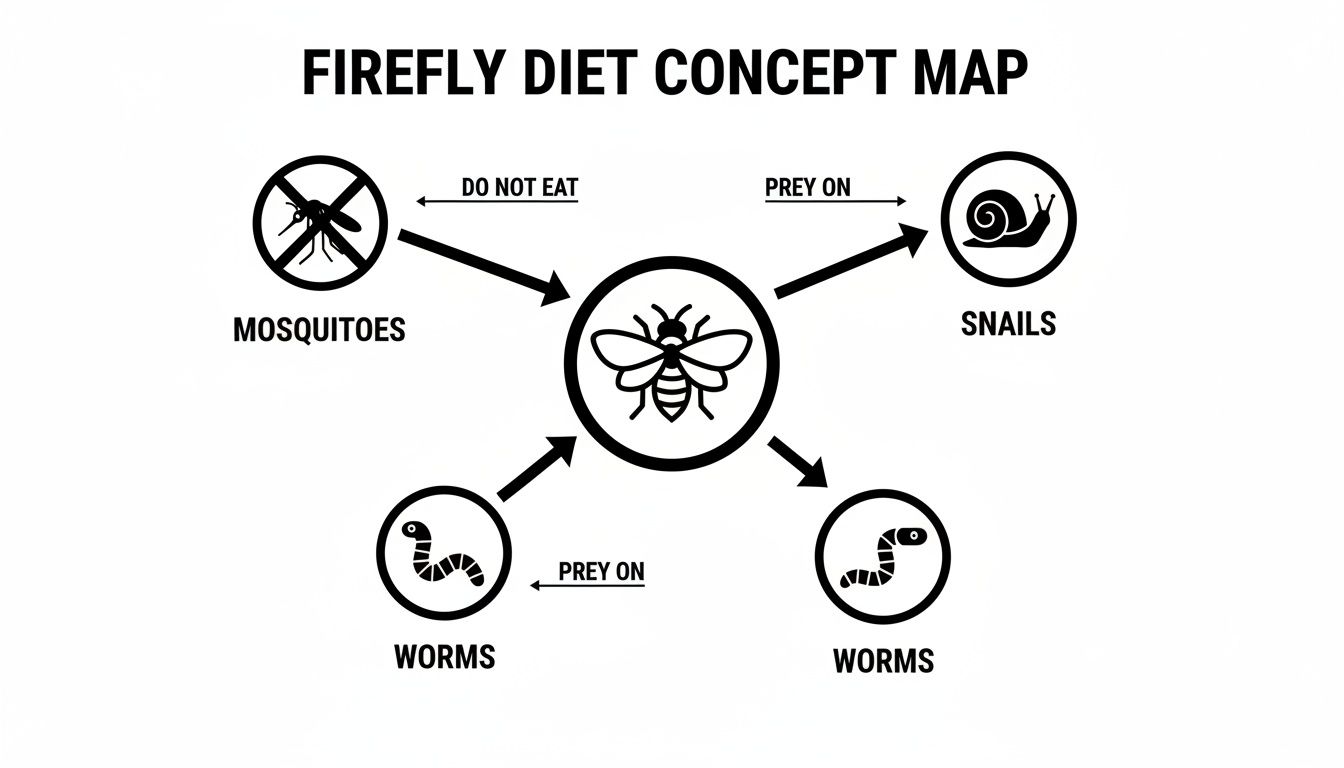
As you can see, they are fantastic at controlling garden pests like snails and slugs, but they offer no help when it comes to mosquitoes.
To give you a clearer picture, let's quickly compare what fireflies eat to some of the creatures that are recognized as natural mosquito predators in our region.
Firefly Diet vs. Mosquito Predators
| Organism | Primary Diet | Effectiveness for Mosquito Control |
|---|---|---|
| Firefly Larvae | Snails, slugs, earthworms | None. They operate in different environments and do not prey on mosquitoes. |
| Adult Fireflies | Nectar, pollen, or nothing at all | None. Their focus is on mating, not hunting mosquitoes. |
| Dragonflies | Mosquitoes, midges, other flying insects | High. Often called "mosquito hawks," they are skilled aerial predators of adult mosquitoes. |
| Bats | Moths, beetles, mosquitoes | Moderate. Mosquitoes are part of their diet, but often not the primary or preferred food source. |
| Mosquitofish | Mosquito larvae, aquatic insects | High (in water). Specifically introduced to control mosquito larvae in ponds and ditches. |
This comparison really highlights the difference. While fireflies are wonderful for your garden's ecosystem, true mosquito predators have entirely different appetites and hunting strategies.
So, what does this mean for your backyard in Crown Point? While you should absolutely cherish your firefly population—they are a sign of a healthy local environment—you can't count on them for bite relief. For more details on their fascinating lives, the National Wildlife Federation offers great insights into their life cycle and behaviors.
If mosquitoes are ruining your outdoor enjoyment, you need a solution aimed directly at the problem. That’s where professional mosquito control becomes essential. At The Green Advantage, we help families take back their yards. Our licensed exterminators use targeted treatments that effectively reduce mosquito populations while being mindful of beneficial insects like fireflies and bees.
The True Role of Fireflies in Your Indiana Yard

So, we've established that fireflies aren't nature's answer to mosquito control. What good are they in your Crown Point yard, then? Beyond their magical glow on a summer evening, fireflies are incredibly valuable members of our local ecosystem. Appreciating them means understanding what they truly bring to the table—not as mosquito hunters, but as beneficial beetles.
First off, a little-known fact: fireflies, or lightning bugs, aren't actually flies. They're a type of beetle from the family Lampyridae, and North America is home to over 150 different species.
Their famous blinking light is a masterclass in efficiency. The chemical process, called bioluminescence, is nearly 100% efficient. To put that in perspective, a standard incandescent light bulb wastes about 90% of its energy as heat. Fireflies waste almost none. If you're curious, you can learn more about these fascinating beetles from Mass Audubon and their incredible traits.
The real help fireflies offer homeowners in Northwest Indiana happens long before you see a single flash in the twilight sky.
Professional Pest Control Solves Problems Fireflies Can't
The most important work a firefly does happens during its larval stage. For one to two years, firefly larvae live in the damp soil and leaf litter of your garden. During this time, they are serious predators, but they aren't chasing the flying pests that bother your family.
Instead, they're hunting the slow-moving invertebrates that can destroy your plants. Their main diet is a gardener's dream come true:
- Slugs: A favorite meal for firefly larvae, they help protect your hostas and other leafy greens from these slimy pests.
- Snails: Just like slugs, snails are a primary target, which means less damage to your vegetables and flowers.
- Earthworms and other soft-bodied insects: The larvae will also happily devour other small critters they find slinking through the soil.
By preying on these common garden nuisances, firefly larvae provide a kind of built-in, natural pest control for your landscaping. Seeing them is a great sign of a healthy yard, even if it doesn't mean fewer mosquitoes.
Key Takeaway: Firefly larvae are fantastic at controlling garden pests like snails and slugs. Encouraging them is great for your plants, but it won't solve a mosquito problem. Managing mosquitoes requires a completely separate and dedicated strategy from a professional exterminator in Crown Point, IN.
Understanding this difference is everything. At The Green Advantage, we value the role beneficial insects play. Our approach to mosquito control is specifically designed to eliminate nuisance pests while respecting the helpful creatures that make our local environment so special.
Why Mosquitoes Overwhelm Natural Predators
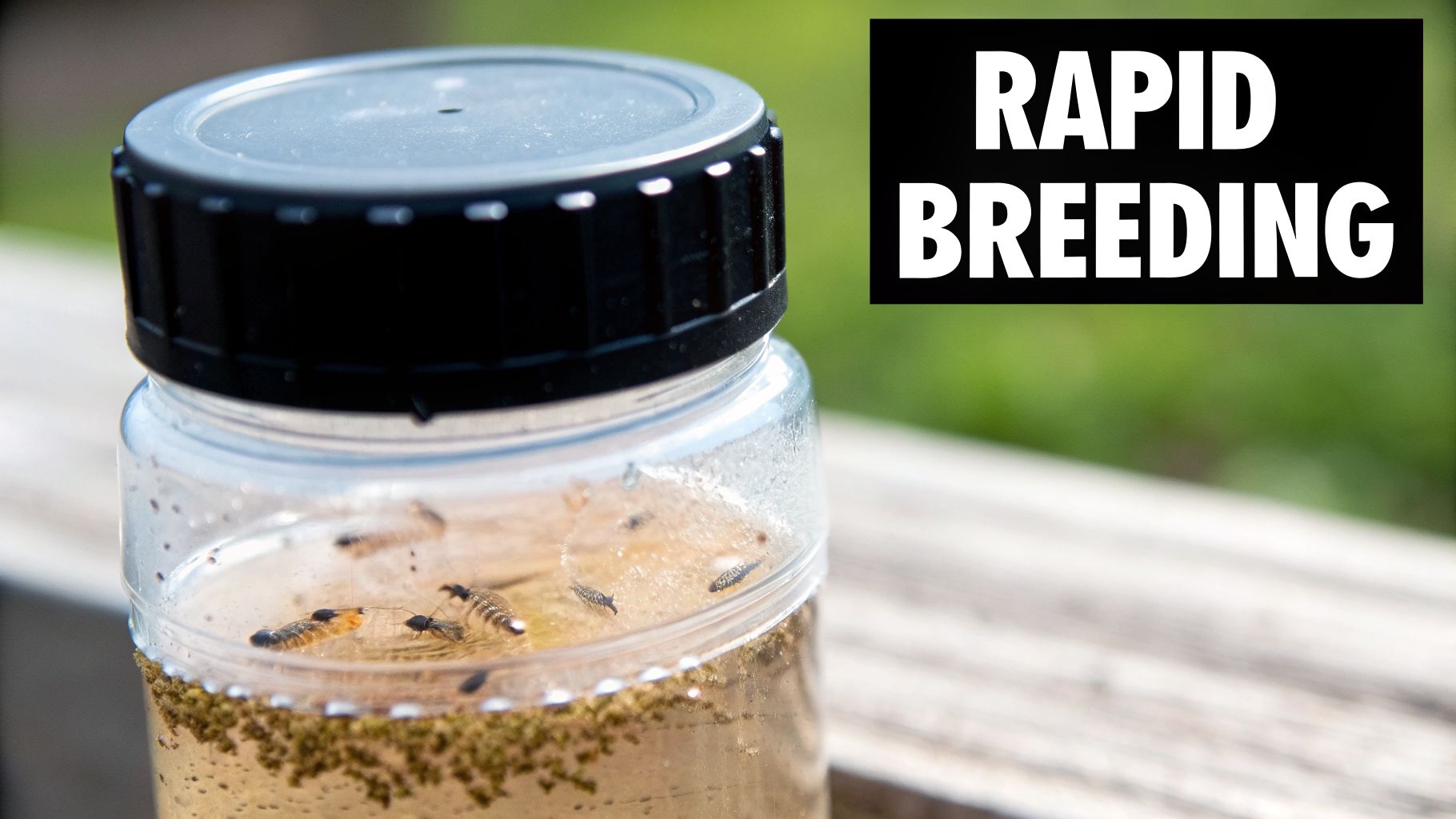
It’s a tempting thought for many homeowners. Since fireflies don't eat mosquitoes, maybe we can just let nature’s other helpers—like dragonflies or bats—handle the job. Many homeowners in Crown Point hope for this exact scenario, but it's like trying to bail out a sinking boat with a teacup. The real problem isn't a lack of predators; it's the mosquito's absolutely relentless biology.
The simple math is staggering. A single female mosquito can lay 100 to 300 eggs at once, and she'll repeat this several times in her short life. Even with a host of hungry predators, they just can't make a dent in those numbers. This explosive reproductive rate is why you need a professional exterminator near me when facing an infestation.
The Mosquito Breeding Machine
What really makes mosquitoes so successful is their sheer opportunism. They aren't picky. They don’t need a pristine pond or a vast swamp to get started; any little bit of standing water will do. This is precisely where a hands-off approach to pest control falls apart for most homeowners.
Think about all the hidden "nurseries" that might be scattered across your property right now:
- Clogged Gutters: A handful of wet leaves is all it takes to create a perfect, out-of-sight breeding ground.
- Forgotten Toys: That plastic bucket or toy truck your kid left on the lawn? After a rain, it's a mosquito magnet.
- Plant Saucers: The trays sitting under your flower pots are notorious for holding just enough water.
- Bird Baths: Unless you're refreshing the water every couple of days, a bird bath becomes a mosquito factory.
It’s shocking, but a female mosquito only needs about a bottle cap's worth of water to lay her eggs. From there, it can take as little as 7 to 10 days for those eggs to hatch and mature into fully grown, biting adults. The cycle just keeps going.
Benefits of Professional Pest Control
Here in Crown Point, IN, a yard full of mosquitoes is more than just an irritation—it's a real health concern that can disrupt your peace of mind.
- Protect Your Family's Health: Mosquitoes are infamous carriers of disease. In our region, the most significant threat is West Nile Virus, which can lead to serious illness. Professional treatments reduce this risk.
- Protect Your Property & Peace of Mind: Beyond mosquitoes, services like termite control and rodent control are crucial for protecting your home's structural integrity. A pest-free home is a secure home.
- Reclaim Your Outdoor Space: Constant biting and swatting can ruin outdoor fun. Our services, including wasp removal and ant control, allow you to enjoy your yard again.
This is why a proactive strategy from The Green Advantage is so critical. You can't rely on a few bats to win this battle for you. When you’re facing a true mosquito problem, you need a solution that hits them where they live and breed.
Can Mosquito Control Safely Coexist with Fireflies?
It’s a question we hear all the time from homeowners in Crown Point: "If we treat for mosquitoes, will it kill our fireflies?" It's a great question. You want your family to enjoy summer nights without getting eaten alive, but you don't want to lose the magic of lightning bugs.
The good news is, you can have both. Yes, professional mosquito control and a healthy firefly population can absolutely coexist, but it all comes down to how the treatment is done.
The key is a targeted, professional application. Our licensed technicians don’t just show up and spray everything in sight. We take a much more strategic approach, focusing only on the specific places where mosquitoes hide out during the day.
Think about it: mosquitoes hate the sun, so they rest in cool, damp, and shady spots like the undersides of leaves, under your deck, or in dense bushes. Fireflies spend their days in different spots, usually down in the leaf litter or in taller grasses. Our treatments zero in on mosquito resting areas, which drastically minimizes any contact with beneficial insects like fireflies, bees, and other pollinators.
What to Expect When You Work With The Green Advantage
Choosing a responsible exterminator in Crown Point is key to protecting beneficial insects. Our whole philosophy is built on the principles of Integrated Pest Management (IPM). The goal isn't to sterilize your yard—it's to precisely reduce the population of harmful pests that pose a risk to your family's health and comfort.
- Local Expertise: We live and work in Northwest Indiana. We know the specific pest pressures homeowners in Crown Point face each season.
- Clear Communication: We explain the problem and our treatment plan in clear, easy-to-understand language.
- Guaranteed Satisfaction: We stand by our work and are committed to solving your pest problems effectively.
So, what's actually causing firefly numbers to decline? The science points to two main culprits: habitat loss and light pollution. Bright porch and landscape lighting can seriously disrupt their flashing mating signals. In contrast, modern, targeted mosquito treatments have not been shown to harm them. You can read the study's findings on targeted pest control impacts to see the data for yourself.
You can read more about our IPM approach to pest control and see how we work to protect both your home and the local ecosystem. For a deeper dive into managing biting insects, check out this ultimate guide to Mosquito and Fly Control.
Our Firefly-Friendly Mosquito Program in Crown Point

While bringing more fireflies into your yard is a wonderful goal, the truth is they just can't solve a real mosquito problem. For that, you need a dedicated strategy that is both effective and environmentally responsible. Here at The Green Advantage, we've designed a firefly-friendly mosquito reduction program for homeowners in Crown Point who want their yards back without harming the good bugs.
Our approach is all about precision and expertise, not indiscriminate fogging. We know that real residential pest control means targeting the pests where they live and breed while respecting the rest of your backyard ecosystem.
Our Proven Treatment Process
Our service isn't just a quick spray—it's a systematic plan to break the mosquito life cycle for good. When you partner with us for mosquito control in Crown Point, IN, our certified technicians bring years of experience to your property.
Here’s a look at how we tackle the problem:
- Step 1: A Thorough Property Inspection. It all starts with a detailed walk-through of your property. We're trained to spot mosquito hotspots, flagging potential breeding grounds in standing water and identifying the shady, damp spots where adult mosquitoes hide from the sun.
- Step 2: A Targeted Application. With a clear map of the problem areas, we apply EPA-registered products with surgical precision. We focus on the undersides of leaves on bushes, areas beneath decks, and other known mosquito hiding spots. This method is incredibly effective against mosquitoes while minimizing any contact with fireflies and pollinators.
- Step 3: Season-Long Protection. A single treatment offers some relief, but lasting comfort requires consistency. Our program establishes a protective barrier around your property that we maintain all season long, from the first warm days of spring through the fall.
This strategic approach is how we solve the problem that fireflies can’t. By focusing our efforts directly on mosquito habitats, we drastically reduce their numbers and disrupt their breeding cycle, allowing your family to enjoy your outdoor spaces again.
Our goal is simple: give families in Crown Point and Northwest Indiana a yard that’s safe from biting pests and welcoming to the beneficial insects that make our local environment so special. You shouldn't have to choose between mosquito relief and a healthy ecosystem.
To see how we can help, you can learn more about our mosquito treatment for lawns and find out how we make your yard enjoyable all season long.
Putting It All Together: Your Questions Answered
When it comes to fireflies and mosquitoes in Crown Point, a lot of homeowners have the same great questions. You want to enjoy your yard and feel good about the local environment, but you also need to protect your family from pests. Let's walk through some of the most common things we discuss with our clients every day.
What About Other Mosquito Predators?
It’s a great question: if fireflies aren’t the answer, what is? People often hope that other backyard critters like dragonflies or bats will handle their mosquito problem for them. And while those species certainly eat their share of mosquitoes, they are what we call "opportunistic feeders." They won't turn down a mosquito, but they also won't specifically hunt them down to solve an infestation.
The real issue is simple math. A single female mosquito can lay hundreds of eggs in a puddle as small as a water-filled bottle cap. In about a week, those eggs can become biting adults. No natural predator can possibly keep up with that explosive breeding cycle in a typical backyard. That's why professional pest control in Crown Point, IN, is really the only reliable way to take back your yard.
The Hard Truth: Natural predators simply can't eat mosquitoes fast enough to overcome their rapid breeding cycle in a residential yard. Effective control means you have to proactively break that cycle.
How Can I Bring More Fireflies to My Yard?
The great news is that creating a firefly-friendly space is totally achievable and a wonderful way to support your local ecosystem. A few simple adjustments can make your yard a haven for these glowing beetles.
Here are a few things fireflies love:
- Taller Grass: Don't feel pressured to keep your entire lawn perfectly manicured. Letting some patches grow a bit longer gives fireflies a safe place to rest during the day.
- Leaf Litter: Instead of bagging up all your fall leaves, rake some into your garden beds or under shrubs. This layer creates a moist, sheltered home for firefly larvae, which are fantastic predators of slugs and snails.
- Dark Skies: This is a big one. Bright landscape lighting can seriously disrupt a firefly's flashing, which is how they find a mate. Dimming or turning off your outdoor lights at night can make a huge difference in their ability to reproduce.
Think of it as a balanced approach. You do your part to build a healthy habitat for beneficial insects, and we handle the targeted pest management.
Is Your Mosquito Treatment Safe for Kids and Pets?
Absolutely. As a local company, your family’s safety is our number one priority when we provide pest control in Crown Point, IN. We only use products that are registered with the EPA, and our certified technicians are trained to apply them with the utmost care, following strict safety protocols.
All we ask is that you keep kids and pets inside while the treatment is being applied and until it has had a chance to dry completely. This usually takes about an hour on a warm day. After that, your yard is ready for everyone—family, friends, and four-legged companions—to enjoy again.
When Is the Best Time to Start Mosquito Services?
To get the best results here in Northwest Indiana, we always recommend starting your mosquito plan in the spring. As soon as daytime temperatures are consistently hitting 50°F, mosquitoes wake up and start breeding. Getting ahead of that first wave is key to preventing a population explosion later.
That said, it's never too late to make a difference. Starting treatments mid-summer will still provide a dramatic reduction in mosquito activity and give you back your outdoor living space. Our exterminators in Crown Point, IN, can help you find relief no matter when you start.
Don't let mosquitoes ruin another summer evening for your family. The Green Advantage offers effective, eco-friendly pest control that gives you a yard you can actually use. Contact us today to schedule your free inspection and get a quote for a bite-free season!
Pest Control in Crown Point, IN: How to Get Rid of Mice in Walls

That faint, persistent scratching from behind the drywall? It’s the classic tell-tale sign of mice, and for homeowners in Crown Point, IN, it’s an all-too-common sound. Hearing those noises means it’s time to act. Getting rid of mice in your walls for good isn't just about setting a few traps; it’s a two-part process that requires a professional touch. You need strategic removal to handle the mice already inside and expert exclusion to seal up every tiny entry point they’re using to get in.
At The Green Advantage, we specialize in residential and commercial pest control for our neighbors in Crown Point and across Northwest Indiana. If you're hearing pests in your walls, we are the local exterminator you can trust to solve the problem completely.
Hearing Scratching Noises in Your Walls? It's a Local Problem
Those little scratching and scurrying sounds, almost always kicking up right as you’re trying to sleep, are more than just an annoyance. They're a sure sign rodents have made themselves at home inside your house's structure. As the seasons change here in Crown Point, IN, this is a problem many of us face, signaling the need for an exterminator near you.
Why Mice Settle in Your Walls
So, why the walls? It’s simple: mice are on a constant hunt for warmth, safety from predators, and a nearby food source. The empty space between your studs provides a perfect, hidden highway system and sanctuary, shielding them from the brutal Northwest Indiana winters.
From that safe home base, it’s a short, easy commute to your kitchen pantry or under the sofa for a dropped crumb. It’s a serious concern because a single mouse can quickly lead to a full-blown infestation. Your walls give them an ideal, undisturbed nursery to nest and breed. These aren’t just noisy roommates; they're a real threat to your property and your family's health, making professional rodent control essential.
You Deserve Peace and Quiet: That unsettling sound doesn't have to be the new normal in your house. A targeted, professional approach from a trusted local pest control company can bring back the quiet and make your home feel like your own again.
Your Local Solution for Pest Control in Crown Point, IN
Here at The Green Advantage, we’re not just another pest control company—we're your neighbors. We know the specific pressures that mice and other pests like ants and spiders put on homes throughout Crown Point and the rest of Northwest Indiana. We’ve seen firsthand that getting mice out of walls takes more than a couple of store-bought traps. It takes a deep understanding of how they think, how they get in, and a solid strategy to keep them out for good.
When you hear those first scratching sounds, it’s your cue to call a professional. Our residential pest control services are built to solve the problem from start to finish.
- First, we confirm the problem. We begin with a thorough inspection to figure out exactly what you're dealing with and how extensive the issue is.
- Then, we remove the threat. We use effective, family-safe methods to get the mice out of your walls and offer preventative treatments to protect your home.
- Finally, we prevent them from coming back. Our team excels at finding and sealing the dime-sized gaps and tiny cracks mice use to invade, giving you a real, long-term solution.
Don't let those scratching sounds steal another night of sleep. This guide will walk you through what's happening in your walls and show you why professional rodent control from a local exterminator is the most effective way to protect your home.
How to Find Evidence of a Mouse Problem in Your Home
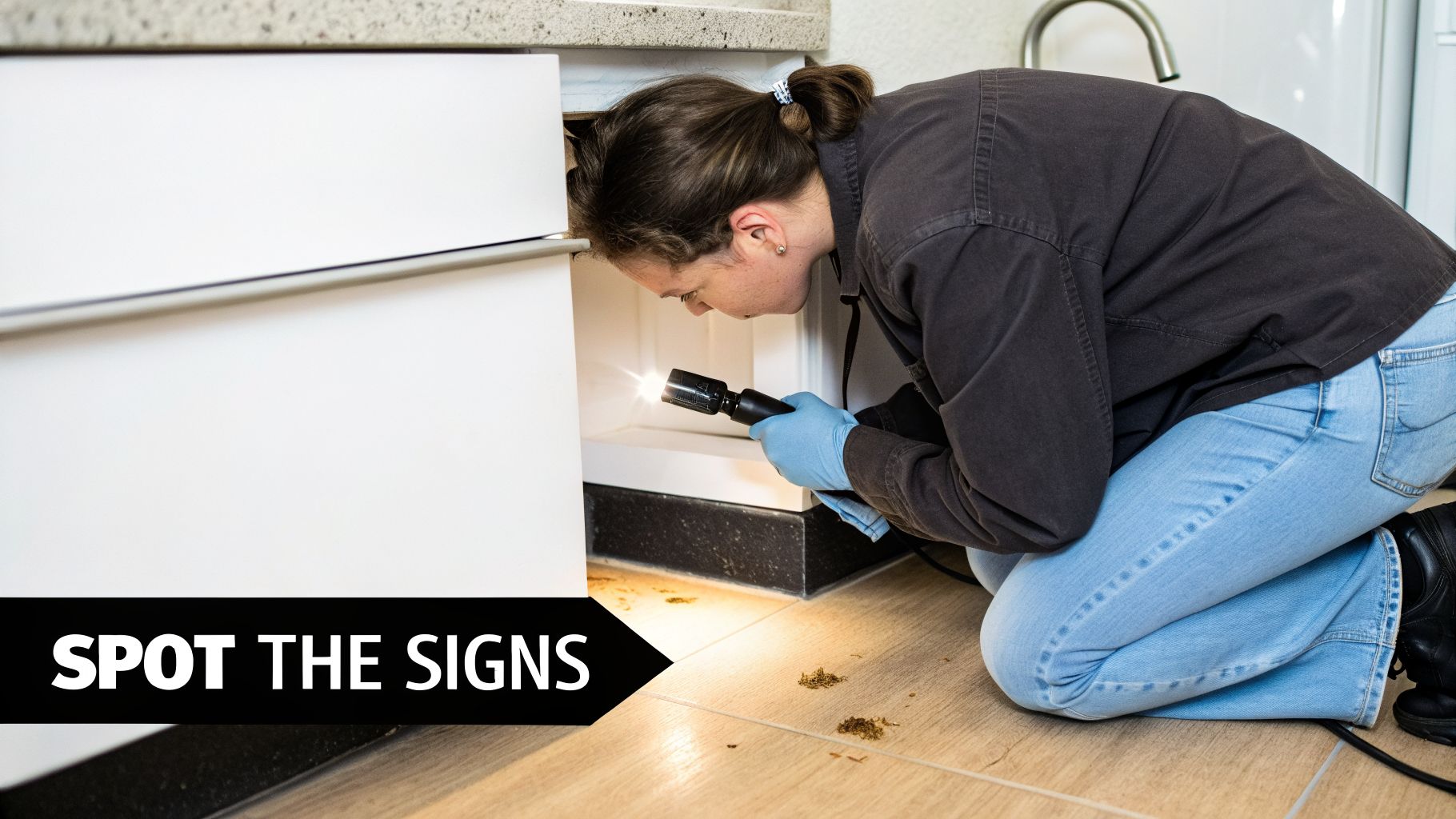
That scratching you hear in the walls? It’s more than just an unnerving sound—it’s a clear signal that it’s time to investigate. Before you can tackle the problem, you first need to understand its scope. Are we talking about one lost mouse or a full-blown family that’s moved in?
Gathering evidence is how you'll figure that out. The clues they leave behind will tell you everything you need to know, helping you decide if it's time to call The Green Advantage for a professional pest control plan for your Crown Point home.
Visual Clues Inside Your Home
Mice try to stay out of sight, but they’re messy houseguests. They leave a trail of evidence everywhere they travel, especially in the quiet, undisturbed corners of your house. Knowing where to look is half the battle.
Grab a good flashlight and start your search in areas that offer food, water, and shelter. These are the spots where you'll find the most telling proof of an infestation.
Common Indoor Hotspots:
- Under Sinks: Kitchen and bathroom cabinets are prime real estate. Check the very back, near the plumbing cutouts in the wall, for droppings or gnaw marks.
- Behind Appliances: Carefully pull out your refrigerator and stove. The warmth from the motors, combined with a steady supply of crumbs, makes these spots a five-star resort for mice.
- Pantries and Food Cabinets: Look along the back edges of shelves. Mice are excellent climbers and will absolutely explore where you keep your food, usually under the cover of darkness.
- Attics and Basements: These spaces are often quiet and cluttered, making them perfect for nesting. Scan along floor joists, in corners, and around any stored boxes. These areas are also common entry points for other pests, like spiders and wasps.
What to Look For
As you’re checking these hotspots, you’re looking for a few tell-tale signs. They can be subtle, so take your time and look closely.
- Droppings: This is the most obvious clue. Mouse droppings are small (about 1/8 to 1/4 inch long), dark, and pointed at the ends, like tiny grains of black rice. A few droppings might just be a scout, but piles of them mean you have an established problem. You can see more examples in our guide to the early signs of a rodent infestation.
- Gnaw Marks: A mouse’s teeth never stop growing, so they chew constantly to wear them down. Look for fresh, rough-looking chew marks on baseboards, drywall, wiring, and food packaging.
- Nesting Materials: Have you found a small, hidden pile of shredded paper, cotton, insulation, or fabric? You’ve just found a nest. These are often tucked away in wall voids, old drawers, or even inside upholstered furniture.
A Critical Warning Sign: If you discover gnawed electrical wires, treat it as an emergency. This isn't just evidence of mice; it's a very real fire hazard that needs to be addressed immediately by a professional. This is a key reason why residential pest control is so vital for your family's safety.
Inspecting Your Home’s Exterior
Once you’ve confirmed you have mice inside, the next step is to figure out how they’re getting in. This is non-negotiable for any long-term solution. Here in Northwest Indiana, a thorough walk around your home's exterior is crucial. Remember, a mouse can flatten its body and squeeze through a hole the size of a dime.
Think like a mouse looking for a way in. Walk the entire perimeter of your foundation, looking high and low for any potential vulnerability.
- Foundation and Siding: Check for cracks, even small ones. Pay special attention to the transition point where your siding meets the brick or concrete foundation—gaps are common there.
- Utility Entry Points: This is a big one. Inspect every spot where a pipe, wire, or cable enters your house. The small gaps around A/C lines, gas pipes, and cable wires are like open doors for rodents.
- Vents and Gaps: Look at dryer vents, attic vents, and any gaps under your garage or entry doors. Make sure all screens are intact and that weather stripping creates a tight seal.
Pinpointing these entry points is just as important as finding the nests inside. Any plan to get rid of mice in your walls is doomed to fail if you don't seal up their highways into your home. If you've done this inspection and the evidence feels overwhelming, a professional from The Green Advantage can quickly identify all the problem spots and provide a clear plan for your Crown Point, IN home.
Why Professional Removal Beats DIY Poison for Pests in Your Walls
When you know for sure there are mice scrabbling around inside your walls, the first thought for many is to reach for rodent poison. It seems so simple—a quick, hands-off solution. But as your local pest control experts serving Crown Point, IN, we can tell you that using poison indoors can turn a minor nuisance into a complete disaster.
The real problem with poison isn't how it affects the mouse, but what happens after. A mouse that eats rodenticide doesn't just drop dead on the spot. It retreats to the safest, most hidden place it knows, which is usually its nest deep inside your walls.
And that’s when the real trouble begins.
The Unseen Consequence: A Horrible Odor You Can't Escape
A few days after you’ve put out the poison, you'll start to notice it. A truly awful, persistent odor begins to creep out from your walls. It’s a uniquely foul smell that can take over entire rooms and linger for weeks, sometimes even months, as the carcass decomposes in a spot you can't possibly reach.
It's more than just unpleasant. That smell is a dinner bell for other pests. Suddenly, you've got blow flies, carpet beetles, and other insects that feed on decaying matter, kicking off a whole new infestation right where the first one ended. This is why professional pest control near you is a much better choice.
Our Professional Opinion: The entire point of rodent control is to get the problem out of your home. Using poison often just moves it out of sight, creating a more disgusting and unhealthy situation you can't easily fix.
The Safety Risks to Your Family and Pets
Beyond the nasty smell, rodenticides are a serious safety concern, especially in a home with kids or pets. These poisons are designed to be lethal, and they can't tell the difference between a mouse and a curious toddler or a family dog.
Even bait stations marketed as "pet-safe" can be chewed through or knocked around by a determined pet, leading to accidental poisoning and an emergency vet visit. For families here in Northwest Indiana, that risk just isn't worth it. The Green Advantage prioritizes eco-friendly pest control methods that are safe for your loved ones.
This is exactly why strategic trapping and removal is the gold standard for residential pest management.
The Professional Method: Strategic Trapping and Removal
At The Green Advantage, we rely on professional trapping methods because they are safer and far more effective. This approach gives you undeniable proof of removal. You know exactly when and where a mouse has been caught, which is the only real way to measure success.
Trapping lets you physically remove the rodent from your home, completely avoiding the risk of a dead mouse decomposing in your walls. You also sidestep the danger that poisons pose to your family. The key is doing it right. Research from experts, like those at the University of Missouri Extension, confirms that proper trap placement is crucial—they recommend setting traps about 6 to 10 feet apart along known rodent pathways.
Our targeted approach allows us to confirm the problem is solved without introducing unnecessary chemicals into your home, aligning with our commitment to eco-friendly pest control.
Choosing the Right Tools for the Job
Good trapping isn’t just about scattering a few traps and hoping for the best. It’s about having the right gear and a smart plan.
H3: Picking Your Traps
- Classic Snap Traps: Don't underestimate them. These have been around forever because they work. They’re affordable and, when set correctly, deliver a quick, humane end.
- Electronic Traps: These are battery-powered boxes that deliver a fatal shock. They’re a great choice if you’re squeamish about seeing or handling a snapped mouse, as most models have an indicator light and allow for no-touch disposal.
H3: Baiting for Success
Forget what you see in cartoons—cheese is not the best bait. Mice are drawn to high-protein, fatty foods. You want something sticky that forces them to work at it, which increases the odds of triggering the trap.
- Peanut butter is the classic for a reason. It's aromatic, sticky, and mice find it irresistible. A small dab is all you need.
- Chocolate hazelnut spread is another fantastic option.
- If you're in an area with plenty of other food sources (like a pantry), try baiting with nesting material. A small piece of cotton or string can be just as tempting to a mouse looking to build its home.
Where to Place Traps for Maximum Impact
This is where professional strategy really comes into play. Mice are cautious and prefer to travel along walls, using their whiskers to navigate in the dark. You have to use this behavior against them.
Always place traps perpendicular to the wall, with the trigger end almost touching the baseboard. As the mouse scurries along its natural path, it will run directly over the trigger.
Focus your efforts on the high-activity zones you found during your inspection:
- Along the walls in your attic, basement, or crawl space.
- Tucked behind the stove and refrigerator.
- Under sinks in the kitchen and bathrooms.
- Inside any closet or pantry where you've spotted droppings.
By combining the right traps, bait, and placement, an in-wall mouse problem can be solved. For our clients here in Crown Point, IN, professional removal is the cleanest, safest, and most definitive way to get your home back.
The Definitive Guide to Professional Mouse-Proofing (Exclusion)
Getting the mice out of your walls is a huge relief, but it’s only solving half the problem. If a professional doesn't find and seal every single crack and gap they used to get in, you're just leaving the door open for the next family of rodents to move in.
This sealing process is what we in the pest control business call exclusion. It's the single most important thing you can do for long-term protection. Trapping gets rid of the mice you have now; professional exclusion makes sure you don’t have them again next winter. This preventative pest treatment is a core part of our service in Crown Point.
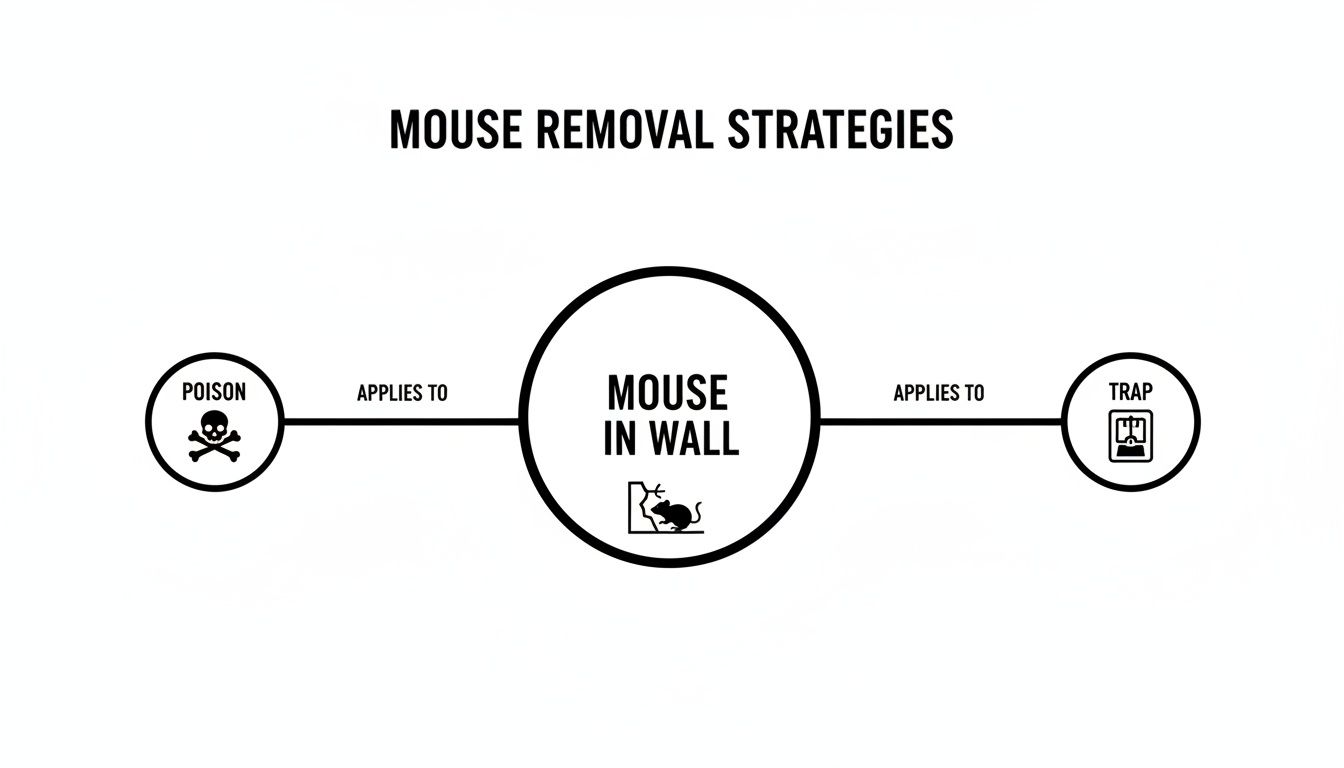
As you can see, trapping physically removes the mouse from your home, which is always the best option. It completely avoids the risk of a mouse dying and decaying inside your walls—a problem you definitely want to avoid.
Thinking Like a Mouse: Finding Their Secret Entrances
To truly mouse-proof your home, our technicians get on their level. Mice are masters of opportunity, and they can exploit the tiniest flaws in your home's exterior. We perform a slow, careful inspection of your entire property, from the foundation right up to the roofline.
Remember this: a mouse can squeeze through a hole the size of a dime. That's not an exaggeration. Any gap you find that's 1/4 inch or larger is a potential doorway.
We look for these common weak spots on your home's exterior:
- Foundation: We scan for cracks in the concrete or block, especially where the foundation meets the siding.
- Siding and Trim: We check for gaps at corner joints or where boards have warped or pulled away from the house.
- Utility Lines: This is a huge one. We carefully inspect where every pipe, wire, and cable enters your home. Gaps around plumbing, gas lines, and A/C refrigerant lines are practically an open invitation.
- Vents: We make sure your dryer, attic, and gable vents have tight, secure screens. A damaged vent cover is a welcome mat for rodents, wasps, and other pests.
- Roofline: We check where the roof meets the walls (your soffits and fascia). Wood can rot or separate over time, creating perfect entry points for mice that can climb.
Sealing the Deal: Using the Right Materials
Once we've mapped out all the potential entry points, we seal them with the right stuff. Mice have incredibly strong teeth and can chew right through plastic, rubber, wood, and cheap caulks. Using the wrong material is just a waste of time and money.
Sealing entry points is, by far, the most cost-effective, long-term solution. In our experience, preventing a 90% reduction in infestations is possible for Northwest Indiana homeowners who have their homes professionally sealed before the cold weather hits. It’s why modern pest control focuses so heavily on exclusion techniques, which you can read more on these modern pest control protocols.
We use materials that mice simply can’t chew through. A simple but highly effective combination is coarse steel wool packed into a gap and then sealed over with a quality caulking compound. They can't chew it, and they can't pull it out.
Pro Tip: Never use expanding spray foam by itself to seal a hole. It might look good, but a mouse can chew through it in minutes. Always pack the hole with steel wool or copper mesh first, then use the foam.
To make this easier, here’s a quick guide to some common problem areas and the best materials for the job.
Mouse-Proofing Your Home: Common Entry Points and Sealing Materials
| Vulnerable Area | Where to Look | Recommended Sealing Material |
|---|---|---|
| Utility Penetrations | Where pipes, wires, or conduits enter the house | Coarse steel wool or copper mesh, sealed with silicone caulk |
| Foundation Cracks | Along the base of your home, especially at corners | Masonry sealant or concrete patch; use copper mesh for larger gaps |
| Siding Gaps | Where siding meets foundation or at corner joints | High-quality exterior-grade caulk; metal flashing for larger areas |
| Vents | Dryer, soffit, and gable vents | 1/4-inch hardware cloth (galvanized steel mesh) securely fastened over the opening |
| Under Sinks | Around plumbing pipes that go into the wall | Pack the gap tightly with steel wool, then seal with caulk or expanding foam |
| Roofline/Soffits | Where the roof and walls meet; damaged fascia boards | Metal flashing and/or replacing rotted wood; often a job for a professional exterminator |
Finding and sealing these vulnerabilities is the only way to get true peace of mind. It’s a bit of work upfront, but it’s an investment in your home that pays off by ensuring you never have to hear that awful scratching sound in your walls again.
Cleaning and Sanitizing After an Infestation
So, the scratching has finally stopped. The traps are empty, and every last entry point has been sealed. It's a huge relief, but the job isn't quite over yet. Now comes the most important part for your family's health: the cleanup.
This isn't just about making things look clean. It's about removing dangerous contaminants and erasing the scent trails that act like a welcome mat for the next mouse looking for a home. Professional pest control services often include guidance on this crucial step.
Safety First: Don't Touch Anything Yet
Before you even think about cleaning, you have to protect yourself. Mouse droppings and urine aren't just gross; they can carry some nasty pathogens, like Hantavirus, which becomes a real threat when it gets stirred up into the air.
This is critical: Never, ever sweep or vacuum dry droppings. You'll just send those contaminated particles airborne.
Instead, gear up properly.
- Air it Out: Before you start, open up the windows and doors in the area. Let it air out for a good 30 minutes.
- Gear Up: This is non-negotiable. Get a pair of rubber or vinyl gloves and, ideally, an N95-rated respirator mask. You want a solid barrier between you and any harmful particles.
As you get ready, you might be asking yourself, "Is mouse urine a biohazard?". The short answer is yes, absolutely—which is exactly why homeowners in Crown Point and across Northwest Indiana need to take these precautions so seriously.
Your Step-by-Step Guide to a Safe Disinfection
Once you're geared up and the space is ventilated, you can get to work. The goal here is to disinfect everything first, then remove it.
Create your cleaning solution. Mix a disinfectant of 1 part household bleach to 10 parts water in a spray bottle.
Saturate, don't sweep. Liberally spray any droppings, urine stains, and nesting materials you see. You want them thoroughly soaked. Let the bleach solution sit and do its work for at least five minutes.
Wipe and remove. Using paper towels, carefully wipe up the soaked droppings and debris. Place all the soiled towels, nesting materials, and any carcasses directly into a heavy-duty, sealable plastic bag.
Disinfect all surfaces. After the visible mess is gone, it's time to clean everything else. Mop the floors and wipe down baseboards, shelves, and any other hard surfaces where mice might have scurried, using the same bleach solution.
Toss contaminated items. Cardboard, paper, or other porous items with gnaw marks or stains should be bagged and thrown out. If you have fabric items like clothing or bedding that can be salvaged, wash them immediately in the hottest water setting possible.
Proper Disposal is Key
Once all the waste is in a sealed plastic bag, double-bag it, seal the outer bag tightly, and throw it away in a secure outdoor trash can. Immediately after, take off your gloves (dispose of them if they're disposable) and wash your hands thoroughly with soap and warm water.
Make Your Home Unwelcoming for Good
Now that the cleanup is done, your final move is to make your home as unappealing as possible for any future rodents. A clean home is a pest-free home. I've seen it time and time again—simple, consistent sanitation habits are one of the most effective forms of preventative pest treatment.
For homeowners in our area, a few small changes can make a world of difference:
- Lock Down the Pantry: Store things like cereal, pasta, and grains in airtight glass or hard plastic containers. A mouse can chew through a cardboard box in minutes.
- Mind the Pet Food: Don't leave pet food out overnight. After your pet is done eating, put the rest away in a sealed, rodent-proof container.
- Eliminate Water Sources: Mice need water. Check under your sinks and in the basement for any leaky pipes or dripping faucets and get them fixed.
- Keep it Tidy: Wipe up kitchen crumbs and spills right away. Make sure all your indoor and outdoor trash cans have tight-fitting lids.
When you combine these habits with the professional exclusion work you've already had done, you're building a powerful defense. You're not just getting rid of the mice in your walls—you're making sure they never want to come back.
When to Call an Exterminator in Crown Point, IN for Mice in Walls
Trying to tackle a mouse problem on your own is one thing. But when those mice are living inside your walls, you're playing an entirely different ballgame. While the DIY spirit is admirable, there’s a tipping point where calling a professional isn't just easier—it’s safer, more effective, and protects your property from costly damage.
If you’re feeling overwhelmed, the problem won't quit despite your best efforts, or you simply want the peace of mind that comes with guaranteed results, it’s time to call the experts at The Green Advantage. A huge part of learning how to get rid of mice is knowing when the job is too big for a few store-bought traps and requires an exterminator near you.
Telltale Signs You Need Professional Help
A professional becomes essential when you spot the red flags that point to a much bigger issue than just a single, lost mouse.
For homeowners here in Crown Point and across Northwest Indiana, these are the signs that you need to call for professional pest control:
- You're Still Hearing Them: You’ve set traps and plugged every hole you can find, but that faint scratching and scurrying in the walls just won't stop. This is a classic sign that the infestation is larger than you thought, or the mice have simply found new highways you haven't discovered yet.
- The Evidence is Piling Up: Finding a few droppings is one thing. Finding droppings in multiple rooms, discovering several nests, or noticing that distinct, musty odor means you have a large, reproducing population.
- They're Causing Real Damage: Have you found gnawed electrical wires, chewed-up PEX or PVC pipes, or shredded insulation? This is a serious problem. Damaged wiring is a major fire hazard, and a punctured pipe can lead to a slow leak and costly water damage. This requires immediate expert attention.
- The Nests are Out of Reach: You can hear them, but you can't get to them. When mice are nesting deep inside wall voids, between floors, or in tight, inaccessible crawl spaces, you need specialized tools and know-how to solve the problem safely.
We've seen it a hundred times: a homeowner gets incredibly frustrated trying to find that last, tiny entry point. If you feel like you've done everything right but are still finding fresh droppings, that’s the perfect time to let an expert exterminator take over.
What to Expect From The Green Advantage in Crown Point, IN
When you call a company like The Green Advantage, you're not just hiring an exterminator; you're bringing in a local team that understands the unique pressures rodents place on homes in the Crown Point area. Our goal isn't a quick fix—it's a permanent solution that protects your property, health, and peace of mind.
Here’s a breakdown of what our comprehensive residential pest control service looks like:
- Meticulous Inspection: We conduct a thorough inspection of your entire property, from the attic to the foundation. We’re trained to spot the subtle entry points that homeowners almost always miss—like gaps around utility lines or tiny cracks in the foundation. This helps us identify the exact species and map out where they're living and how they're getting in.
- Safe Removal: We use powerful, professional-grade trapping systems to physically remove the existing mouse population from your walls. This is crucial because it completely avoids the health risks and awful smells that come from using poisons, where mice often die and decompose in unreachable areas.
- Expert Exclusion: The most critical step is the exclusion work. We seal off every single entry point using durable materials that mice can't chew through, like steel wool, copper mesh, and specialized sealants. This is what truly solves the problem for good. For a deeper dive, check out our guide on how to get rid of mice in your house to see why sealing is so important.
- Sanitation and Prevention: Finally, we’ll walk you through how to properly sanitize the contaminated areas and give you practical advice on making your home less appealing to future invaders, restoring your peace of mind.
For homes with recurring issues, investing in professional crawl space services can also be a game-changer, addressing a common source of pest problems from other seasonal pests like termites and mosquitoes. Ultimately, partnering with The Green Advantage in Crown Point, IN, is the surest way to get a complete, reliable, and safe resolution to a mouse infestation in your walls.
Common Questions We Hear About Mice in Walls
When you hear that telltale scratching in the walls, a lot of questions pop into your head. As a team that helps homeowners across Northwest Indiana, we’ve heard them all. Here are the answers to the ones that are probably on your mind right now.
Will Mice in My Walls Just Leave on Their Own?
It's a nice thought, but unfortunately, the answer is a firm no. Once mice discover the warmth, safety, and shelter of your wall voids, they've found the perfect place to set up camp. They have no predators, it's climate-controlled, and it’s right next to their food source—your kitchen.
They won't get bored and move on. In fact, the problem will only get worse as they begin to breed. A small issue can quickly spiral into a full-blown infestation if you don't take action and call for professional pest control.
How Long Does It Realistically Take to Get Rid of Them?
The timeline really hinges on the severity of the problem. If you’ve just noticed signs of a couple of mice that recently got in, you might solve it with a few days of strategic trapping. For a larger, more established colony that's been nesting for a while, you could be looking at a process that takes several weeks.
The real key to a permanent fix isn't just trapping the mice that are already inside. It's finding and sealing every single entry point they used to get in. That professional exclusion work is what truly solves the problem for good.
Is It Actually Dangerous to Have Mice in the Walls?
Yes, living with mice introduces some serious risks, both to your property and your family's health. They have a constant need to gnaw, and they aren't picky about what they chew on. Electrical wiring is a common target, which can create a very real fire hazard.
Beyond the structural damage, their droppings and urine are a major concern. This waste contaminates insulation and drywall, and the particles can even become airborne, carrying diseases like Salmonella and other pathogens. Addressing a mouse problem quickly with a qualified exterminator is always the safest bet.
What's the Absolute Fastest Way to Get Them Out?
For the quickest and most effective results, you need a two-pronged attack: trapping to remove the current population and comprehensive exclusion work to prevent re-entry. Trying to tackle this yourself can often turn into a frustrating, drawn-out battle with mixed success.
If you want the problem handled fast and correctly the first time, your best option is to bring in a professional. An expert from The Green Advantage can quickly identify the scale of the issue, implement a targeted plan, and make sure your Crown Point home is sealed tight against future intruders.
Don't let mice take over your home and your peace of mind. The team at The Green Advantage has the expertise to solve rodent problems for homeowners and businesses throughout Crown Point, IN, and the surrounding areas. Contact us today for professional, eco-friendly pest control you can trust.
Wasp Nest Removal in Crown Point, IN: A Homeowner’s Guide

Finding a wasp nest near your Crown Point home is an unsettling experience that requires a fast, safe solution. Homeowners and business owners across Northwest Indiana often wonder: what's the right way to handle it and protect my family and property?
While a very small, easily accessible nest might seem like a simple DIY task, the risks are significant. For any nest larger than a golf ball, hidden in tricky spots like wall voids, or if you're unsure of the wasp species, calling a professional exterminator in Crown Point, IN is the safest and most effective choice. At The Green Advantage, we specialize in residential and commercial pest control, providing peace of mind to our neighbors in Crown Point and the surrounding communities.
Your Guide to Wasp Nest Removal in Crown Point

It’s a familiar, unsettling moment for property owners across Northwest Indiana. You spot it under the eaves, tucked away in the shed, or hanging from a tree branch. That buzzing hive isn't just an eyesore; it's a real threat to your family, pets, and anyone visiting your home. Wasps are fiercely protective, and one misstep can provoke a swarm you don't want to be near.
This guide is for you, the Crown Point homeowner who's staring at a wasp nest and wondering what to do next. As your trusted local pest control company, we understand the urgency you're feeling. Our goal is to provide the practical knowledge you need to make a smart, safe decision for your property.
Why Wasp Nests Are a Problem in Northwest Indiana
As summer progresses into fall, a wasp colony only gets bigger and more aggressive. Your backyard can quickly go from a relaxing retreat to an anxiety-filled no-go zone. The risks of an active wasp infestation are very real.
- Painful Stings: Unlike honeybees, most wasps can sting you over and over again. Each sting delivers venom that causes sharp pain, swelling, and redness.
- Allergic Reactions: For someone with an allergy, a single sting isn't just painful—it can trigger anaphylaxis. This is a life-threatening emergency that needs immediate medical help.
- Property Damage: Some species, like yellow jackets, love building nests inside wall cavities. We've seen them chew right through drywall and insulation, leading to some surprisingly expensive repairs for Crown Point homeowners.
- Aggressive Behavior: If wasps feel their nest is threatened, they can launch a coordinated attack with hundreds of individuals. It happens fast and puts anyone in the vicinity in serious danger.
The Safest Path Forward: Professional Wasp Removal
The internet is filled with DIY "hacks" for wasp removal, but trying to handle a nest yourself is a huge gamble. A can of spray might look like an easy solution, but it rarely eliminates the entire colony and almost never reaches the queen. Often, all you've done is anger the survivors, creating an even more dangerous situation.
For the safety of your family and to ensure the entire colony is gone for good, professional pest control is the most reliable option. A trained expert has the right protective gear, specialized equipment, and experience to handle any nest, anywhere.
As your local Crown Point pest control experts, we at The Green Advantage are dedicated to keeping our community safe. We have the professional know-how to identify the threat, remove the nest properly, and give you back your peace of mind. Let’s walk through how to identify what you're up against and know when it’s time to call the best exterminator near you.
Spotting Wasp Nests and Understanding the True Risks
Before you can think about getting rid of a wasp nest, the first job is to figure out exactly what you're up against. Knowing the type of wasp and where it’s built its home is absolutely essential for gauging the real danger. For most of us here in Crown Point and across Northwest Indiana, a few usual suspects are behind most of those summer headaches.
Proper identification isn't just about curiosity—it's your most important safety check. Different wasps have wildly different temperaments, and their nests demand completely different tactics. Mistaking a notoriously aggressive bald-faced hornet for a more laid-back paper wasp can get you into a world of hurt, fast.
Common Wasps Around Northwest Indiana
The buzzing visitors in your yard probably fall into one of three main groups. Each one looks different, and more importantly, has its own unique way of building a nest. If you watch from a safe distance, you can usually gather all the clues you need.
Paper Wasps: These are those long, slender wasps you often see dangling around porch ceilings and under the eaves of your house. Their nests are a dead giveaway: a small, open-comb paper structure that looks like an upside-down umbrella. Since the honeycomb cells are exposed, you can sometimes even see the larvae inside. They aren't as aggressive as other types, but they'll absolutely defend their home if you get too close.
Yellow Jackets: Infamous for their short tempers and a knack for ruining a good barbecue, yellow jackets are a serious problem. They are masters of concealment, usually building their nests in hidden, protected spots. We find them everywhere—underground in old rodent burrows, inside hollow landscape timbers, or even deep within the wall voids of a house. The tell-tale sign is a small hole with a constant, frantic stream of wasp traffic. They are a primary reason homeowners search for "exterminator near me."
Bald-Faced Hornets: Don't let the name fool you; these are actually a large, black-and-white variety of yellow jacket. They are well-known for their extreme aggression and build those classic, big, gray, papery football-shaped nests you see hanging from tree limbs or stuck to the side of a building. These nests are completely enclosed except for a single entry hole at the bottom and can hold hundreds of very territorial hornets.
If you need a bit more help, our guide on how to tell if you have a wasp nest can walk you through the specifics on your property.
The Real Dangers of DIY Wasp Removal
Once you've located the nest, that urge to "just take care of it" can be powerful. But as professional exterminators, we have to be blunt: trying to remove a wasp nest yourself is one of the riskiest things you can do around your home. When threatened, wasps release an alarm pheromone that basically screams "ATTACK!" to the entire colony, and you're the target.
A scenario we see all too often in the Crown Point area goes like this: a homeowner gets on a ladder to spray a bald-faced hornet nest high up in a tree. The spray just makes them angry, and they pour out in a swarm. The person panics, falls off the ladder, and is left with injuries from the fall and dozens of painful stings. For someone with an allergy, that situation can become life-threatening in seconds.
Even a ground nest that looks simple is a huge gamble. Hitting the entrance with a spray from a can almost never penetrates the whole underground nest. The survivors will boil out of that single entry point in a furious swarm, stinging anything that moves. Worse yet, if the nest is inside a wall, using a spray can cause the wasps to chew their way inside your house to get away, turning your outdoor issue into an indoor nightmare.
Getting a professional assessment isn't about convenience; it’s about safety. A licensed technician from The Green Advantage has the right protective gear, specialized tools, and a deep understanding of wasp behavior to resolve the problem correctly. We can identify the species, evaluate the nest's location, and use a treatment plan that guarantees the entire colony is eliminated without putting your family in harm's way. Before you reach for a ladder or a can of spray, your safest first move is to get a professional evaluation from a trusted "pest control near me."
Should You Tackle That Wasp Nest Yourself? A Realistic Look at DIY Methods
When you spot a wasp nest on your Crown Point property, the first thought is usually to grab a can of spray and take care of it yourself. It seems straightforward enough, but as someone who's seen this go wrong countless times, I can tell you it's rarely that simple.
The most common go-to solutions are aerosol wasp sprays and home-brewed soap-and-water mixes. For either of these to have even a remote chance of working, your timing has to be absolutely perfect. You must act at dawn or dusk when the wasps are far less active and, more importantly, the entire colony is tucked inside the nest for the night.
When DIY Might Work (And When It Almost Certainly Won't)
Let's be realistic. A DIY approach is only a viable option in a very specific, and frankly, rare scenario. If you've found a brand-new, completely exposed paper wasp nest that’s no bigger than a golf ball and easy to reach, a quick, direct spray might work. You could potentially neutralize the founding queen and her first few workers before they establish a real foothold.
Unfortunately, that's not the situation most homeowners in Northwest Indiana face. The nests we typically find are much larger, well-established, and hidden away in tricky spots—think deep inside soffits, behind siding, or nestled in a dense shrub.
The biggest problem with DIY methods is their alarmingly high failure rate. If you spray a nest and don't eliminate the entire colony instantly, you've just kicked the hornet's nest—literally. You’ll trigger a furious defensive swarm and the survivors will often just rebuild, sometimes in a spot that’s even harder to get to.
This is why identifying the wasp and understanding its behavior is so critical before you act.

As you can see, the species you're dealing with and the location of their nest drastically change the level of risk involved.
DIY vs. Professional Wasp Removal: A Quick Comparison
Deciding whether to handle a nest yourself or call in a pro comes down to weighing the risks against the potential rewards. This table breaks down the key differences.
| Factor | DIY Removal | Professional Removal (The Green Advantage) |
|---|---|---|
| Risk of Stings | High. Improper application often provokes an aggressive swarm. No protective gear. | Minimal. Trained technicians use specialized protective equipment and proven techniques. |
| Effectiveness | Low to moderate. Often fails to eliminate the entire colony, especially for hidden nests. | Very High. Guarantees complete colony elimination, including the queen. |
| Cost | Low initial cost for a can of spray. Can become expensive with failed attempts or medical bills. | Higher upfront cost. Provides a guaranteed, safe, and final solution. |
| Safety | Risky. Potential for severe allergic reactions, multiple stings, and falls from ladders. | Safe. Professionals are insured and trained to handle all scenarios, including high or hidden nests. |
| Guarantee | None. If it doesn't work, you're back to square one with an angrier nest. | Guaranteed results. We ensure the colony is gone for good. |
Ultimately, while the cost of a can of spray is tempting, it doesn't account for the very real dangers and the high probability of failure.
The Professional Difference: A Look at the Numbers
The data tells a compelling story. A store-bought aerosol spray might reach 15-20 feet and can be effective 85% of the time on an exposed nest if, and only if, it's applied perfectly at dawn when 95% of the wasps are dormant inside.
But when things go wrong, they go very wrong. Improper spraying leads to 60% more stings, and we see hospital visits for severe stings jump by 25% every year between July and September.
Here at The Green Advantage, we handle over 1,200 wasp-related calls each season in Northwest Indiana alone. Our technicians use professional-grade insecticidal dusts, not sprays. Wasps unknowingly carry these dusts deep into the nest, which ensures we eliminate the entire colony—queen and all—within one to two days with a 98% success rate. That’s a massive improvement over the 1-in-5 failure rate of sprays.
Plus, the nature-based dusts we use are formulated to degrade 70% faster than harsh synthetic chemicals, which is better for your family, pets, and our local environment. You can dig deeper into these kinds of advanced pest control strategies by reading research from the Michigan State University Extension.
When to Call a Professional Exterminator in Crown Point, IN
We understand the impulse. You see a wasp nest, head to the hardware store, and figure you can save a few bucks by taking care of it yourself. While that can-do spirit is admirable, when it comes to stinging insects, knowing when to step back is the smartest—and safest—move you can make.
For homeowners here in Crown Point, there's a clear line between a small, manageable nest and a serious hazard that absolutely requires an expert. It’s not about admitting defeat; it’s about protecting yourself and your family.
Red Flags That Mean It's Time to Call a Pro
From our years providing residential pest control in Crown Point, IN, we can tell you there are a few scenarios that are automatic red flags. If you run into any of these, put down the spray can and pick up the phone. These aren't just suggestions—they are firm rules for staying safe.
The Nest is Bigger Than Your Fist: Once a nest gets past this size, the colony is well-established. A bigger colony means hundreds, sometimes thousands, of wasps ready to defend their home aggressively. It's a recipe for a swarm attack.
It's in a Hard-to-Reach Spot: Is the nest tucked two stories up under an eave? Hanging off a high branch over your patio? Any job that puts you on a ladder is a job for a professional. A sudden swarm can cause a fall, and a fall from a ladder is often more dangerous than the stings themselves.
You Can't See the Whole Nest: If you see wasps flying into a crack in your siding, a soffit vent, or a gap in the foundation, you have a concealed nest. Trying to spray into that opening is a huge mistake. Not only will it fail to kill the colony, but it can also drive angry wasps inside your house through drywall, vents, or light fixtures.
You've Found a Ground Nest: Yellow jackets love building nests in old rodent burrows. These underground colonies are incredibly difficult and dangerous to handle. The nest structure can be deep and complex, housing thousands of workers you can't see. Pouring gas or other liquids down the hole is illegal, environmentally harmful, and almost guarantees an explosive, angry response. Here in Northwest Indiana, about 20% of our summer wasp calls are for these tricky ground nests.
Someone in Your Home Has an Allergy: This is the most important rule of all. If you or a family member is allergic to stings, do not even consider DIY removal. The risk of anaphylactic shock is a life-or-death situation that is simply not worth taking.
Why The Green Advantage is the Solution
When you call The Green Advantage for wasp removal in Crown Point, you’re getting more than just a guy with a can of spray. You’re bringing in a licensed and insured technician with protective gear and access to commercial-grade products that are exponentially more effective than anything on a store shelf.
The National Pest Management Association finds that DIY pest control failures often lead to the problem roaring back in 55% of cases within just a few months. Our job is to solve it for good, the first time.
We've seen how often those store-bought sprays backfire. In controlled trials, they agitate the colony 80% of the time, leading to stings in 40% of those attempts. Our own client data in Crown Point shows 96% satisfaction with zero re-infestations in the first year, a stark contrast to the 35% recurrence rate we see with failed DIY efforts. You can learn more about the complexities of removal by reading these insights from Hanna's Bees.
Our technicians use specialized tools you just can't buy, like long-range foaming applicators that can safely treat a nest from 25 feet away with 99% efficacy. For ground nests, where DIY "solutions" are so dangerous, we apply specific insecticidal dusts that ensure a 100% kill rate without provoking a swarm. Choosing professional pest control is about choosing certainty and safety. It guarantees the complete removal of the colony, protecting your property and, most importantly, your family.
Our Process: What to Expect When You Work With The Green Advantage in Crown Point, IN

Finding a wasp nest on your property is stressful, and you just want it gone—safely and quickly. We get it. That’s why we’ve made our process completely straightforward, so you know exactly what’s happening from the moment you call us to the moment your yard is safe again.
It all starts with a simple phone call. You won't be routed to an automated system or a generic call center. You’ll talk directly with our friendly office staff right here in Northwest Indiana. We’ll listen to what’s going on, get the details on the nest’s size and location, and book a visit with one of our certified technicians that fits your schedule.
Step 1: Professional Pest Inspection
When our technician arrives at your Crown Point home, their first job is a complete, thorough inspection. This isn’t just a quick glance from the driveway. It’s a detailed assessment to identify the specific pest issue, locate all activity, and determine the safest, most effective treatment.
We start by correctly identifying the pest. Are we dealing with aggressive yellow jackets, territorial bald-faced hornets, or the more laid-back paper wasps? Knowing the species is everything, as it dictates how we’ll approach the nest and the safety precautions we need to take. While on site, we can also identify signs of other common Northwest Indiana pests, such as ants, spiders, or rodents.
Step 2: A Clear Explanation and Customized Treatment Plan
Once we have the full picture, we’ll walk you through our recommended plan. We believe in total transparency, so we’ll explain exactly what we’re going to do and why it’s the best approach for your specific situation. There are no cookie-cutter solutions in this business; our residential and commercial pest control services are tailored to your needs.
The staggering reality is that wasp-related incidents lead to over 500,000 emergency room visits in the U.S. each year, with aggressive yellow jackets being the culprit in half of those cases. This is why our professional methods are so critical for safety and success.
For most aerial and void nests, we use specialized equipment to apply a professional-grade insecticidal dust directly into the nest entrance. Unlike the sprays you buy at the store, this fine dust gets carried deep into the colony by the wasps themselves. It’s designed to reach the queen and every last worker, giving us a 95% effectiveness rate on even the most established nests. For ground nests, which account for about 15% of our calls, this same dust treatment is 100% successful, completely avoiding the risks of failed DIY methods.
If you’re curious about the science behind different removal techniques, you can learn more in this guide on howstuffworks.com about wasp control tactics.
Step 3: Guaranteed Results and Preventative Pest Control
After the treatment, we don’t just pack up and disappear. We let the product work its magic, which usually takes 24 to 48 hours to fully neutralize the colony.
Once we confirm the nest is inactive and it’s safe to do so, we’ll return to physically remove it if it's accessible. Wasps won't reuse an old nest, but getting rid of it gives you peace of mind and prevents other pests from moving in.
Finally, we’ll give you practical advice to keep wasps from coming back. Our technicians will point out potential entry points on your home and offer simple tips to seal them up. A few proactive steps can prevent 85% of future nests. Here in Crown Point, our 99% one-visit success rate is a testament to our targeted approach and our use of eco-friendly pest control methods. The products we use are formulated to biodegrade 80% faster than many conventional alternatives, keeping your family, pets, and our local ecosystem safe.
Frequently Asked Questions About Wasp Removal
When you find a wasp nest on your Crown Point property, your mind starts racing with questions. We get it. It’s totally normal to be concerned about safety, what it’s going to cost, and what the whole process looks like.
Here are the questions we hear most often from our Northwest Indiana neighbors, answered with the straightforward information you need.
How Much Does Professional Wasp Nest Removal Cost in Crown Point, IN?
There’s really no flat rate for wasp removal, and any company who gives you one over the phone without seeing the nest is just guessing. The final cost for professional service comes down to a few key factors: the nest's location, its size, and which type of stinging insect we're dealing with.
For example, a small, exposed paper wasp nest under your deck railing is a much simpler job than a massive bald-faced hornet nest hanging 30 feet up a tree. And that's still different from a yellow jacket nest that’s been built deep inside a wall void.
At The Green Advantage, our policy is simple: we give you a clear, upfront quote after a thorough inspection. No surprises. A can of DIY spray from the hardware store seems cheap, but a trip to the ER after a swarm attack—or a hefty bill for drywall repair—is anything but. A professional, guaranteed service from a local exterminator often saves you money and a major headache in the long run.
Is Your Wasp Treatment Safe for My Kids and Pets?
Yes, absolutely. This is the most important question for us, and the safety of your family is always our first priority. We use targeted, modern treatments designed to be tough on wasps but have a minimal impact on everything else. As a provider of eco-friendly pest control, we choose the safest effective products available.
Our technicians are highly trained to apply products precisely where they need to go. A common technique involves injecting an insecticidal dust directly into the nest entrance. This method is incredibly effective because it keeps the product contained right at the source, preventing it from becoming airborne and drifting.
We’ll always give you simple, clear instructions, like keeping kids and pets out of the immediate area for a short, specific amount of time. This ensures the treatment can work its magic while everyone stays completely safe.
We live and work here in the Crown Point area, too. Solving your pest problem without putting your loved ones at risk is the foundation of everything we do.
Will Wasps Build a Nest in the Same Spot Next Year?
That’s a great question, and the answer is a little more complex than a simple yes or no. The exact same colony will not come back. The original queen and all her workers die off after the first hard frost, leaving the nest empty and abandoned for good.
So, why do you sometimes see a new nest in the same place? Because a new queen, who survived the winter by hibernating, will look for a safe place to start her own colony next spring. A spot that worked well once—like under a protected eave, behind a shutter, or in an attic vent—is still prime real estate.
This is why we focus on more than just removal. Our preventative pest treatments and exclusion services are designed to make your home less attractive to all pests. We'll show you exactly why they chose that spot and give you practical tips to make it less appealing, dramatically reducing the odds of another nest popping up next year.
What Is the Difference Between Wasps and Hornets?
It's easy to get these mixed up, but knowing the difference is important because their aggression levels and nesting habits vary quite a bit.
Around here in Northwest Indiana, when people say "hornet," they’re almost always talking about bald-faced hornets. Fun fact: they aren't true hornets at all! They're actually a very large, aggressive type of yellow jacket. These are the insects that build those iconic, big, gray, papery teardrop nests you see hanging in trees.
"Wasp" is a much broader category. It typically includes:
- Paper wasps: They build the smaller, open-celled, umbrella-shaped nests you find under railings and porch ceilings. They're generally less aggressive unless you threaten their nest directly.
- Yellow jackets: These are the uninvited guests at your summer cookout. They are notoriously aggressive and often build their nests in hidden locations, like underground in old rodent burrows or inside the walls of your home.
Correctly identifying the pest is the first step to safely removing it. Our pros are trained to spot the difference instantly, ensuring we use the right strategy for the specific threat you're facing.
Ready to get rid of that wasp nest for good? For safe, effective, and guaranteed wasp removal, ant control, or any residential pest control in Crown Point, IN, trust the local experts at The Green Advantage. Contact us today for a free estimate and take back your yard!
Cockroach Control in Crown Point, IN: Why Roaches Are In Your Home (Updated for 2026)
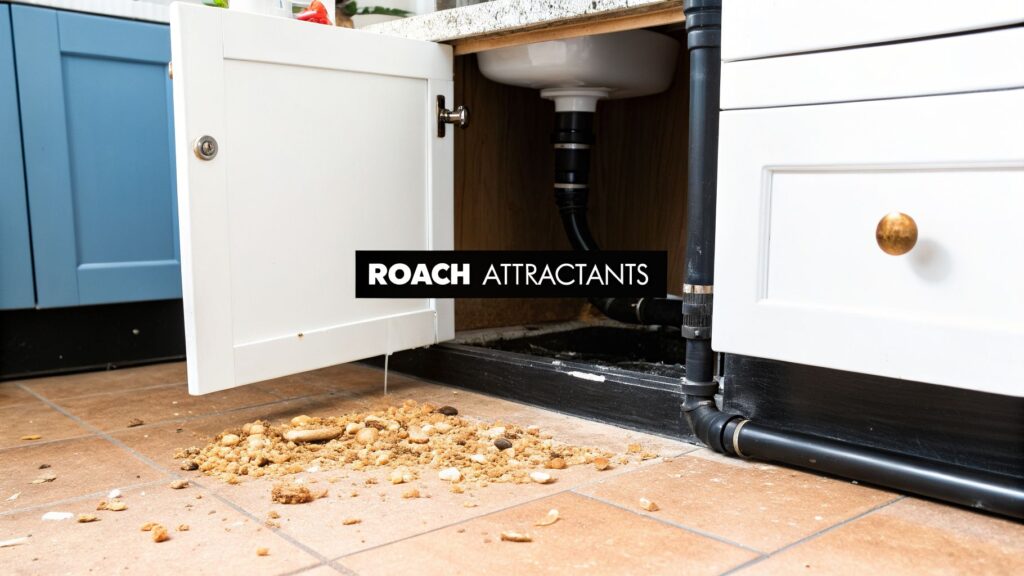
Flicking on a light and seeing a cockroach dart for cover is a feeling every homeowner in Crown Point, Indiana, dreads. That single moment can make you question your home’s cleanliness, but here’s a professional secret: a roach problem isn't always about being "dirty." It’s about what your home accidentally offers them.
Cockroaches are incredibly resourceful survivors looking for three simple things: food, water, and shelter. If your home provides these, you've rolled out the welcome mat. The good news for homeowners in Northwest Indiana is that understanding what attracts them is the first step to showing them the door—for good. Here at The Green Advantage, we help families in Crown Point and surrounding areas solve pest problems with professional, reassuring service. We know this is a solvable issue, and it all starts with knowing your enemy.
Why Cockroaches Invade Homes in Crown Point
Let's get down to brass tacks. Roaches aren't picky eaters. That tiny crumb that fell behind the stove, the grease spatter on the wall, or the pet food left out overnight is a full-course meal. They are especially drawn to food bits in hard-to-reach places, like under the refrigerator or behind the dishwasher, which is why a trusted exterminator in Crown Point, IN is your best defense.
It’s a shockingly common issue. The 2019 American Housing Survey from the U.S. Census Bureau found that nearly 14 million households in the U.S. reported seeing cockroaches. That tells you just how easily these pests can find what they need to move in.
The main attractants that draw cockroaches into your home are simple but critical to control. This table breaks down the top three culprits we see in Crown Point homes every day.
Top 3 Cockroach Attractants in Your Home
| Attractant | Common Examples in a Crown Point Home | Why It Is a Problem |
|---|---|---|
| Food | Crumbs under appliances, unsealed pantry goods, greasy stovetops, full trash cans, pet food bowls. | Provides a reliable food source, encouraging roaches to stay, breed, and multiply quickly. |
| Water | Leaky faucets, condensation on pipes, damp basements, pet water bowls, wet sponges in the sink. | Cockroaches can survive for a month without food, but only about a week without water. Moisture is essential. |
| Shelter | Cardboard boxes, stacks of newspaper, clutter in garages or attics, wall voids, dark cabinet corners. | Gives them a dark, safe, and undisturbed place to hide during the day and lay their eggs. |
By focusing your efforts on these three areas, you can make a huge dent in your home's appeal to these unwanted guests.
This simple diagram really sums it up. Take away just one of their basic needs, and your home suddenly becomes a much less inviting place for them to settle.
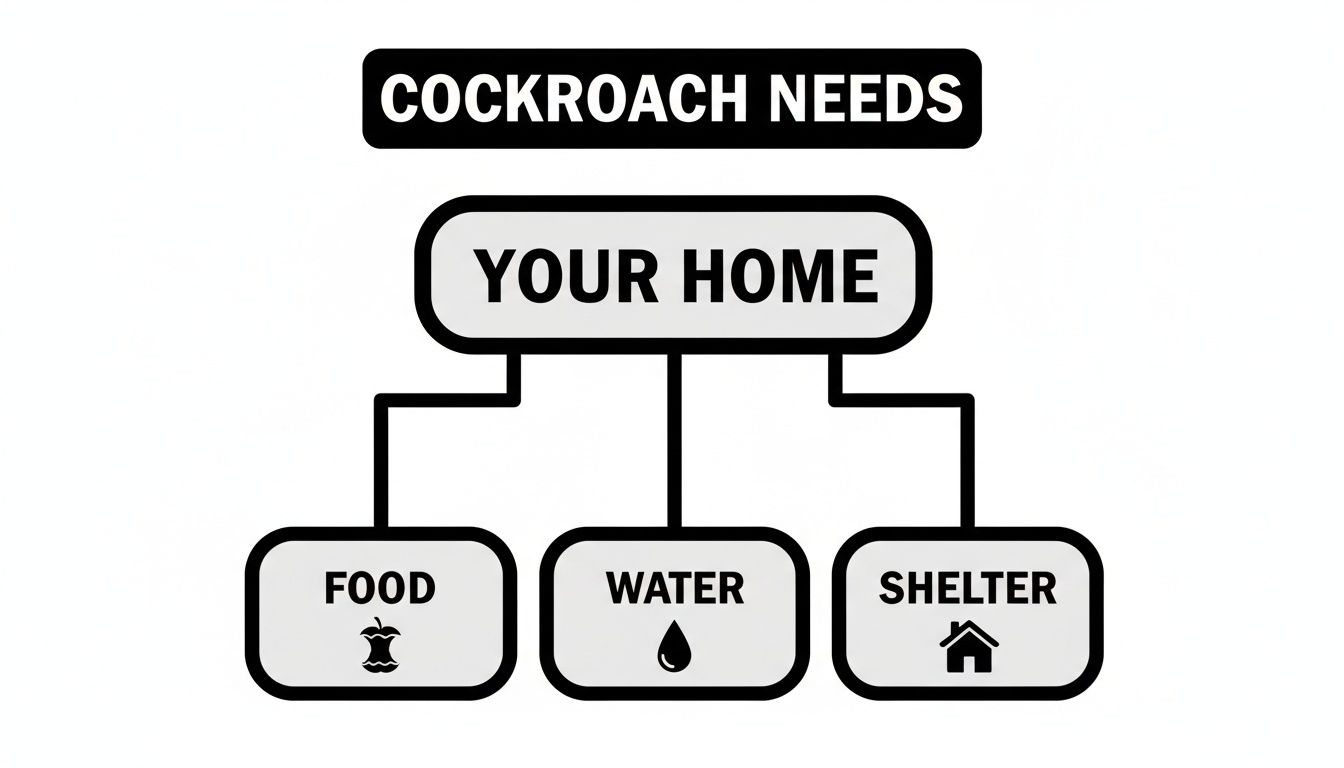
Moisture and Shelter: The Hidden Magnets
After food, a steady supply of water is the next biggest draw. A slow drip from a pipe under the sink or in the bathroom is more than enough to sustain a roach population. They don’t need a swimming pool; even the condensation on pipes in a humid Northwest Indiana basement is enough to keep them happy. A professional pest control service can help identify these hidden moisture issues.
Speaking of damp spaces, roaches absolutely love them. Learning how to avoid mold in your basement not only protects your home's structure and your family's health but also eliminates the moist environment roaches thrive in.
Finally, roaches need a safe harbor to hide out and raise their families. Clutter is their best friend. Those stacks of cardboard boxes in the garage, old magazines in the attic, or even a messy corner of a closet provide endless dark, tight spaces for them to live undisturbed. Our guide, Cockroaches Oh My!, dives deeper into how these common household items can turn into five-star hotels for pests like roaches and spiders.
Cutting off access to these three essentials is the foundation of effective cockroach control. It makes your home an undesirable, inhospitable place for them—which is exactly what you want.
Is Your Kitchen a 24/7 Buffet for Roaches?

Out of all the rooms in your Crown Point home, your kitchen is ground zero for a potential cockroach problem. It’s where your family gathers, but it's also a five-star restaurant for pests if you’re not careful. The first step to understanding what brings roaches into your house almost always starts right here, where they can easily find food, water, and shelter.
But let's get one thing straight: seeing a roach doesn't automatically mean your kitchen is dirty. Cockroaches are master survivors. A few crumbs that slipped between the stove and the counter, a sticky drop of juice under the fridge, or even a thin layer of grease on your range hood vent is a gourmet meal from their point of view.
It’s always surprising to homeowners in Northwest Indiana just how little food a single roach needs to get by. That’s why even the most meticulously clean kitchens can sometimes run into trouble with roaches, ants, or other common pests.
The Hidden Meals Roaches Crave
When we picture roach food, we usually think of obvious messes. But roaches are way more resourceful than that. They’re experts at finding the forgotten, overlooked food sources that exist in just about any busy family kitchen.
Figuring out what these hidden buffets are is your first move in making your kitchen a much less welcoming place.
- Grease Buildup: That greasy film on your backsplash, around the stovetop, or inside the range hood? It’s a high-calorie feast for a cockroach.
- Unsealed Pantry Goods: Cardboard boxes and flimsy plastic bags are zero challenge for a determined roach. They’ll chew right through packaging for cereal, crackers, and pasta.
- Pet Food Stations: Leaving your pet’s food bowl out all night is basically rolling out the welcome mat. Both the kibble and the water are huge draws for pests.
- Open Trash Cans: A garbage can without a lid that seals tightly is an open invitation. The scent of food scraps and old packaging is a powerful signal that dinner is served.
These are the kinds of small things that are easy to miss in the daily hustle, but together, they create the perfect storm for an infestation to take hold. This is where a professional eye from a local exterminator near me really pays off, as they can spot the subtle problem areas you might overlook.
Why Moisture is a Roach Magnet
Food is a big draw, but roaches absolutely cannot survive without water. This makes the damp, dark corners of your kitchen just as appealing as your pantry. Even a tiny, slow leak can sustain a surprisingly large infestation.
A cockroach can live for over a month without food, but only about a week without water. This makes controlling moisture one of the most powerful residential pest control tactics you can use.
Here in Northwest Indiana, humidity alone can create enough condensation to give pests a steady water supply. Roaches will naturally flock to these reliable sources:
- A slow drip from a faucet or garbage disposal.
- Condensation beading up on pipes under the sink.
- A damp sponge or dishcloth left out overnight.
- The water collection tray underneath your refrigerator.
These issues might seem minor, but they’re exactly what allows a roach population to explode. When The Green Advantage performs a pest control inspection in Crown Point, IN, we zero in on these hidden water sources. Our trained technicians know precisely where to look for the subtle leaks and damp spots that homeowners often miss, which is a critical step in any effective pest management plan, including rodent control.
From Clutter to Cockroach Condos: Where They Hide
Once roaches find food and water, their next mission is finding a safe place to live. And for them, your Crown Point home might as well be a five-star resort. They’re looking for dark, tight, undisturbed spots to hide out, digest, and breed. This is exactly how a small problem quietly explodes into a massive infestation, often before you even realize it’s happening.
What looks like a simple pile of storage boxes to you is a luxury high-rise to a cockroach. Learning to see your home through their eyes is the key to keeping them out for good.
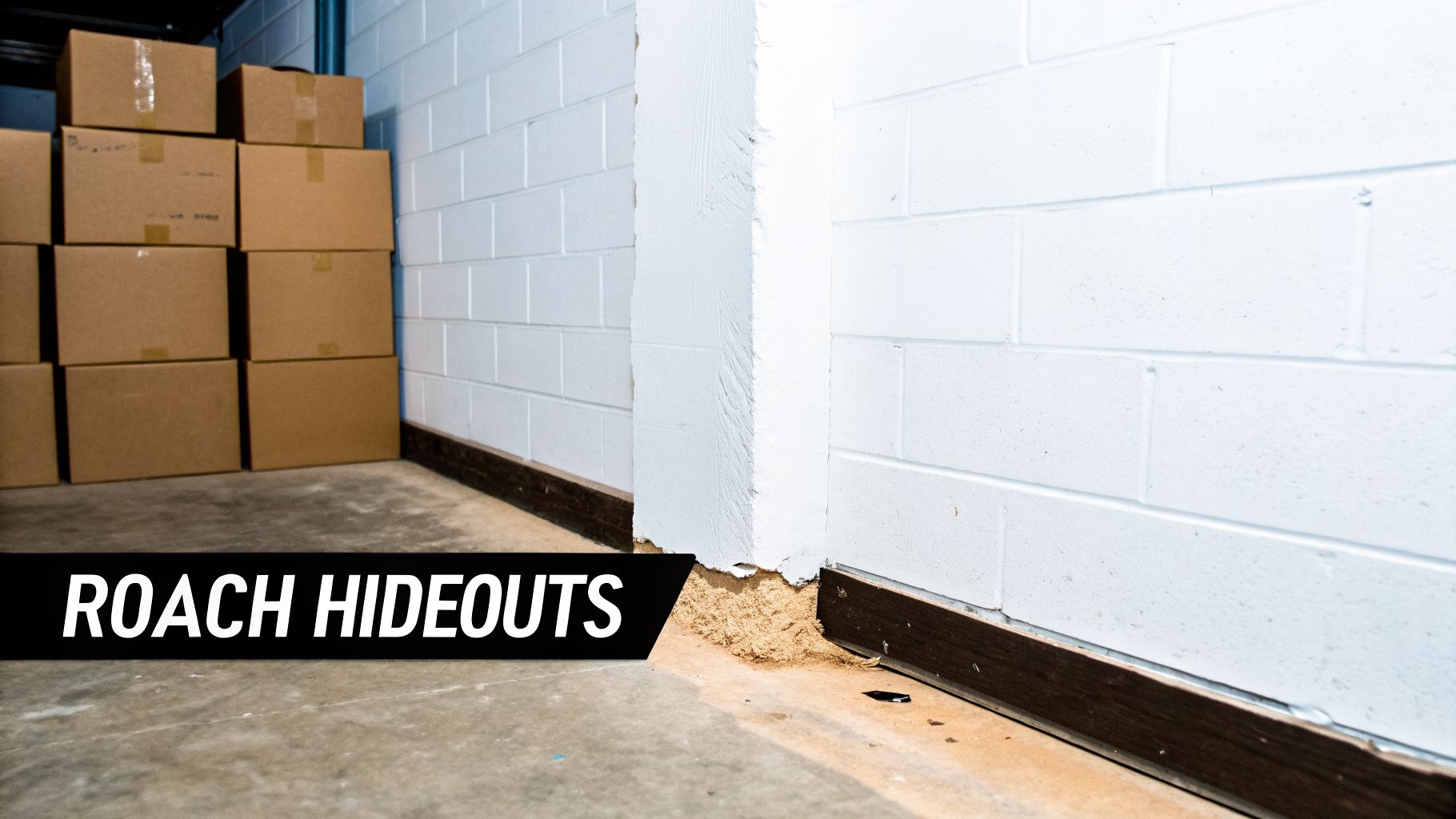
From Clutter to Cockroach Condos
Take a look at the cardboard boxes in the basement, that stack of old newspapers in the garage, or even a messy closet. To a roach, these aren't just piles of stuff; they're perfect, layered environments we call "cockroach condos."
Cardboard is a particularly huge draw. The corrugated flutes offer countless tiny, dark tunnels, and roaches will even munch on the starchy glue holding the box together. Throw in the classic Northwest Indiana humidity, which these materials soak right up, and you’ve created a roach’s dream home: dark, damp, and right next to a snack.
Shelter isn't just a preference for roaches; it's a necessity. Being nocturnal, they spend about 75% of their lives crammed into tight cracks and crevices. Getting rid of these hiding spots is every bit as critical as sweeping up crumbs.
It's a tough pill to swallow, but a roach problem often has less to do with a dirty floor and more to do with providing these perfect hiding spots. Any effective pest control plan for a home in Crown Point, IN, has to start with finding and eliminating these shelters.
The Pest Superhighway Hiding in Plain Sight
Beyond the obvious clutter, the very bones of your house can serve as a secret travel network for pests. Cockroaches are escape artists, capable of flattening their bodies to squeeze through unbelievably small openings. A crack no thicker than a quarter is basically an open door for an adult German cockroach.
These tiny structural gaps create a "pest superhighway," letting roaches move between rooms, floors, and even adjoining townhomes without ever being seen. They use this network to scout for food and water at night before vanishing back into the walls by sunrise.
Cockroaches are incredibly opportunistic, and they know how to find the path of least resistance. The table below outlines some of the most common places we find them hiding in and around Northwest Indiana homes.
Common Cockroach Hiding Spots in Northwest Indiana Homes
| Location | Specific Hiding Spot | Why Roaches Love It |
|---|---|---|
| Kitchens | Behind/under refrigerators, stoves, and dishwashers | Warmth from motors, crumbs, and moisture. |
| Inside and behind cabinets and pantries | Close to food sources, dark, and undisturbed. | |
| Under the sink | Plumbing provides moisture and entry points. | |
| Bathrooms | Behind toilets and under sinks | Constant source of moisture and humidity. |
| Inside medicine cabinets or linen closets | Dark, quiet, and often cluttered with toiletries. | |
| Basements & Garages | In stacks of cardboard boxes or newspapers | Corrugated cardboard offers perfect harborage. |
| Near water heaters or furnaces | Warmth and moisture create an ideal climate. | |
| Living Areas | Underneath or behind furniture | Dark, undisturbed, and catches crumbs. |
| In electronics like TVs or game consoles | The warmth and tight spaces are inviting. | |
| Exterior | Underneath siding or in weep holes | Provides a direct pathway into wall voids. |
| In woodpiles or leaf litter against the house | Damp, dark, and offers easy access to the foundation. |
Seeing these spots laid out makes it clear just how many opportunities our homes can unintentionally offer. Focusing on these specific areas is a huge step toward making your home less inviting.
These countless little entry points and hiding places are true cockroach magnets. If you think you might be seeing signs, you can learn more about how to spot the evidence of a roach problem from Orkin.
As your local exterminator in Crown Point, we at The Green Advantage have seen it all. We’ve learned to "think like a roach," spotting the subtle gaps around pipes or tiny foundation cracks most people would never notice. Sealing these entry points—a process called exclusion—is a fundamental part of our strategy. It shifts the focus from just treating the pests you see to physically blocking them from getting inside in the first place, which is key for termite control and rodent control as well.
The Health Risks Hiding in Your Walls

It’s one thing to be grossed out by a cockroach scuttling across your floor. It’s another thing entirely to understand what it’s bringing into your home. A roach sighting isn't just an unpleasant surprise; it’s a warning sign that your family's health could be at risk. These pests are much more than a simple nuisance—they are walking vectors for disease and powerful allergy triggers.
For families in Crown Point, IN, feeling safe and healthy at home is everything. At The Green Advantage, we see our job as protecting that peace of mind. That’s why we’re committed to eco-friendly pest control that is tough on pests but gentle on your home and family.
Contamination and Disease Transmission
Cockroaches have some truly disgusting habits. They spend their time crawling through sewers, feasting on garbage, and navigating decaying matter, picking up all sorts of nasty pathogens on their legs and bodies. When they march into your kitchen, they don’t wipe their feet.
Instead, they track those germs directly onto your countertops, into your cereal bowls, and across your silverware. This is exactly how a roach problem can lead to serious illnesses.
- Salmonella: Famous for causing food poisoning, it can lead to fever, cramps, and severe stomach issues.
- E. coli: This bacteria can cause symptoms from diarrhea to life-threatening conditions like kidney failure.
- Staphylococcus and Streptococcus: These can cause a whole range of problems, from painful skin infections to strep throat.
Just by walking across a surface, a single roach can leave behind a trail of contamination. You might not even know you've been exposed until someone gets sick, which is why professional pest control is so vital for a healthy home.
The Hidden Impact on Allergies and Asthma
Beyond spreading bacteria, cockroaches leave behind microscopic particles that can wreak havoc on respiratory health, especially for children and the elderly. Their shed skins, saliva, and droppings contain proteins that easily become airborne and get circulated by your HVAC system.
For many people, breathing in these allergens triggers uncomfortable and persistent reactions.
An estimated 63% of U.S. homes have cockroach allergens inside. In urban areas like those around Northwest Indiana, that number can jump to an astonishing 98%, making it one of the most common indoor allergens we face.
Exposure can cause everything from skin rashes and constant sneezing to chronic sinus problems. For anyone with asthma, the situation is even more serious. Cockroach allergens are a well-known trigger for asthma attacks, which can be incredibly dangerous for kids. A persistent infestation can make existing asthma worse and may even contribute to the condition developing in young children.
It's also important to remember that roaches are often a symptom of bigger problems. Issues like plumbing leaks or even a major backup can create the damp, unsanitary conditions that pests love, while also introducing other sewage backup health risks. That’s why a good pest control strategy doesn't just get rid of the bugs; it helps you find and fix the root causes. This proactive approach also benefits other services like mosquito control and wasp removal, as it addresses the underlying environmental issues.
Why DIY Methods Fall Short and When to Call a Pro
When you spot a cockroach darting across the floor, the first impulse is usually to grab a can of bug spray or set out some traps. It’s a natural reaction. These DIY products promise a quick, easy fix, but as many homeowners in Crown Point have learned the hard way, they almost never solve the problem for good.
The issue with DIY cockroach treatments is that they can create a false sense of security. Sure, they might kill the few roaches you catch out in the open, but they don’t touch the real heart of the problem: the hidden nest. For every one roach you see, there are likely dozens, if not hundreds, hiding in walls, behind appliances, or deep inside cluttered storage areas.
Those over-the-counter products just aren't strong enough to get into these hiding spots and take out the entire colony.
The Limits of Store-Bought Solutions
Supermarket sprays and bait stations come with some serious limitations. For starters, many cockroach populations, especially the notorious German cockroach, have built up a resistance to the low-dose pesticides found in consumer products. The roaches that survive simply keep on breeding, passing that resilience down to the next generation.
And those bug "bombs" or foggers? They're especially ineffective. These products send out a fine mist that coats all your exposed surfaces but fails to penetrate the tight cracks and voids where roaches spend most of their lives. You end up with chemicals all over your countertops without ever touching the source of the infestation.
- Surface-Level Action: Most DIY sprays only kill roaches on contact, which does nothing to the majority of the population hiding out of sight.
- Pest Resistance: Cockroaches are experts at adapting, and many have become immune to common store-bought chemicals, making them even tougher to control.
- Incorrect Application: Without knowing a roach’s habits, it’s easy to put traps in the wrong places or use sprays in a way that just drives the pests deeper into your home's walls.
This is exactly why a roach problem seems to vanish for a few days after a DIY attempt, only to come roaring back even worse. You've essentially just trimmed the weeds without ever pulling out the root.
The biggest risk of relying on DIY methods is that you’re giving the hidden infestation time to grow. While you’re busy dealing with a few visible roaches, the colony is expanding exponentially inside your walls, spreading contamination and increasing health risks.
The Green Advantage Professional Approach
This is where calling a professional exterminator in Crown Point, IN, completely changes the game. At The Green Advantage, we don’t just show up and spray. We deploy a strategic plan to find, eliminate, and prevent cockroach infestations for good.
It all starts with a thorough inspection. Our certified technicians know what to look for, examining your home from top to bottom to identify not only the roaches themselves but also the food sources, moisture problems, and entry points that are inviting them in. We understand the unique pressures homes in Northwest Indiana face, from our humid summers affecting basements to the common construction gaps in local houses.
Using what we find, we develop a targeted treatment plan with commercial-grade, eco-friendly products that are worlds more effective than anything you can buy at a hardware store. We apply these treatments directly into the cracks, crevices, and wall voids where roaches live and breed. This approach ensures we wipe out the entire population—including the eggs and nymphs—to completely break their life cycle. For a real solution that protects your family's health, professional residential pest control is the only way to go.
What to Expect with The Green Advantage
We get it. Hiring a pest control company near me for your home in Crown Point can feel like a gamble. You want someone you can trust, who knows what they're doing, and who will solve the problem for good.
At The Green Advantage, we believe in being upfront and transparent from the get-go. We want you to feel confident and completely in the loop, so you’re never left wondering what’s happening next. Here’s a straightforward look at our process.
It all starts with a phone call. When you reach out to our Crown Point office, you’ll talk to a real person from our team—not a call center miles away. We’ll take the time to actually listen, get a handle on your concerns, answer your questions, and find a time that works for you to have one of our certified technicians come out.
The Inspection and Consultation
Our work doesn't begin with a spray can; it begins with a thorough investigation. A friendly, uniformed technician will show up at your door, ready to play detective. They'll systematically examine your property, looking for the tell-tale signs of pests and, more importantly, the conditions that invited them in.
This is a top-to-bottom inspection, where we check:
- High-Risk Areas: Kitchens, bathrooms, basements, and utility rooms where food, water, and shelter are plentiful.
- Hidden Moisture Sources: Small leaks under sinks, condensation around appliances, and dampness in crawl spaces are a magnet for pests.
- Potential Entry Points: Tiny cracks in the foundation, gaps around plumbing, and unsealed vents that act as an open door for cockroaches and other intruders.
Once the inspection is complete, our technician will sit down with you and explain everything in plain English—no confusing jargon. We’ll show you exactly what we found and have an honest conversation about the "why" behind your pest problem. This isn't a high-pressure sales pitch; it's about empowering you with knowledge.
Treatment and Follow-Up
With a clear picture of the situation, we'll map out a targeted treatment plan. We rely on effective, eco-friendly pest control products that are tough on pests like cockroaches, spiders, and ants, but are carefully selected for use around your family and pets. Our mission is to eliminate the entire pest population, not just what you see on the surface, but also the hidden nests that most DIY approaches can't touch.
We treat your home with the same respect we would our own. Our technicians are careful, clean, and committed to leaving your property just as they found it—only without the pests.
But our job isn't done after the first visit. We'll give you a clear rundown of any follow-up steps and share practical tips to help you prevent pests from coming back. Whether you need a one-time fix for roaches or a preventative pest treatment plan for your home or business, our team is here to give you lasting peace of mind. To learn more about our approach, check out our article on why you should choose The Green Advantage for your pest control needs.
Your Cockroach Control Questions, Answered
When you're facing a cockroach problem in your Crown Point home, you've got questions. We get it. Feeling confident about the solution is the first step to getting your peace of mind back. We hear these concerns all the time from local homeowners, so let's get you some clear, straightforward answers.
Are Your Cockroach Treatments Safe for My Kids and Pets?
This is always the first question, and the most important one. The short answer is yes, absolutely. Your family's well-being is our top priority. We use eco-friendly pest control products that are specifically chosen for their low impact on your home while being incredibly effective against pests.
Our certified technicians don’t just spray and pray. We're trained in strategic placement, targeting the cracks, crevices, and hidden wall voids where roaches live and breed. These are spots your kids and pets can't get to. It's about being tough on pests, not on your family, and it’s why so many homeowners in Crown Point trust us for their residential pest control needs.
How Long Will a Professional Treatment Last?
A professional treatment is designed for lasting relief, not just a temporary fix like you'd get from a can of store-bought spray. Our goal is to break the entire cockroach life cycle, wiping out the source of the problem for good.
How long that relief lasts can depend on the initial size of the infestation and a few factors around your home. That's why we don't just treat the problem; we give you practical advice on sealing up entry points and removing the things that attract roaches in the first place. For most homes, one thorough treatment is enough when followed by these preventative steps. If you're dealing with a particularly stubborn case, we might suggest a seasonal service plan to keep that protective barrier up all year.
The real measure of success isn't just killing the roaches you see today. It's making sure they don't come back tomorrow. Our entire approach is built on long-term prevention, not just a quick fix.
What Are the Signs I Absolutely Need to Call an Exterminator?
It's always better to be proactive, but some signs are red flags telling you the problem has grown beyond a DIY solution. If you see these, it's time to call a professional exterminator near me right away.
- Daytime Sightings: Roaches are nocturnal. Seeing them scurrying around during the day is a classic sign of overcrowding in their hiding spots. It means you have a serious infestation.
- A Musty, Oily Odor: Large numbers of roaches produce a distinct, unpleasant smell. If you notice a lingering, oily, or musty odor that you just can't track down, it’s a strong indicator of a hidden nest.
- Finding Droppings or Egg Cases: If you spot small, dark specks that look like coffee grounds or black pepper in your cabinets, you're seeing roach droppings. Finding small, brown, capsule-shaped egg cases (oothecae) is even worse—it means they are actively breeding in your home.
Don't wait if you notice any of these signs. An established infestation only gets bigger and harder to manage.
Don't let cockroaches ruin your sense of comfort at home. The Green Advantage is ready to help you reclaim your space with safe, effective pest control services. Contact us today for a professional inspection in Crown Point or the greater Northwest Indiana area. We handle everything from ant control and termite control to commercial pest control for local businesses.
Wasp Control in Crown Point, IN: How to Tell if You Have a Wasp Nest

Worried you might have a wasp nest on your Crown Point property? It’s a common concern for homeowners in Northwest Indiana. While seeing a single wasp is normal, a constant stream of them flying to and from the same spot is the single most reliable sign you have a wasp nest. That "wasp highway" is a clear giveaway that a colony is growing nearby, often hidden just out of sight. At The Green Advantage, we understand the stress this causes. As your local pest control experts in Crown Point, IN, we're here to help you identify the problem and provide a safe, effective solution.
Spotting the First Clue: A Busy Flight Path
A lone wasp is an annoyance, but a predictable, deliberate flow of them to one specific point on your house is a sign of an infestation. This isn't just random activity; it’s a sign that a colony is hard at work. This busy flight path is your clearest indicator that a nest is nearby. Worker wasps are relentless foragers, flying out to gather food and building materials, then returning to the same entry point to expand the nest and feed the queen and her young.
If you’re seeing this in your Crown Point home, keep an eye out for focused activity around:
- The corners of your roofline or under the eaves.
- A tiny gap behind a window shutter or a loose siding panel.
- An opening in a porch ceiling or beneath a deck.
- A hole in the ground, which is a classic sign of yellow jackets.
Observing this from a safe distance is often all it takes to confirm your suspicions. If you're looking for an "exterminator near me" because you've spotted this traffic, you're on the right track.
Why This Wasp Traffic Matters for Crown Point Homes
Pest experts agree: the earliest and most reliable sign of a wasp nest is increased wasp traffic to and from a specific point. Here in Northwest Indiana, humid summers fuel rapid colony growth. You can learn more about how different pests react to seasonal changes in our article on the buzzing menace of seasonal pests.
By mid-summer, a single nest can house hundreds of wasps, turning casual sightings into a steady stream of wasps entering and exiting during peak foraging times. This isn't just annoying; it's a safety red flag. Discover more insights about how wasp activity signals a nest on GreenPestManagementCT.com.
Here at The Green Advantage, our licensed technicians providing pest control in Crown Point, IN have seen this exact scenario play out time and time again. We often trace this surge in activity to nests that started out as small as a golf ball but are expanding rapidly. If you're seeing consistent wasp traffic, it's time to act before the colony grows larger and more defensive. Ignoring this crucial first sign can lead to a much bigger, more dangerous problem down the road, and is a key reason residents search for residential pest control.
Pinpointing the Nest From a Safe Distance
So you've noticed a steady stream of wasps. Now, the trick is to figure out exactly where their nest is without putting yourself in harm's way. Your only job right now is to observe. Keep your distance and simply watch where the wasps are disappearing. Around Crown Point and Northwest Indiana, we've seen them build a home in just about any spot that gives them shelter.
Common Hiding Spots for Wasps
Start your visual sweep by checking the most likely places. Wasps look for protection from rain, wind, and predators.
Some classic hiding spots include:
- Under eaves and soffits: This is prime real estate for wasps.
- Behind loose siding or shutters: A tiny gap is all they need to get into a wall.
- Beneath the deck or porch: The dark, protected space underneath is ideal.
- Inside your shed or garage: Check the high corners and rafters.
- In dense shrubs and bushes: Certain species tuck their nests right into thick foliage.
But what if you can't see an actual nest? If you see wasps vanishing into a small crack or hole, you likely have a nest inside a wall void or attic. These hidden infestations are impossible to see and require a different approach. We often rely on specialized tools to confirm them, which is detailed in our guide on how advanced equipment improves pest inspection accuracy in Crown Point.
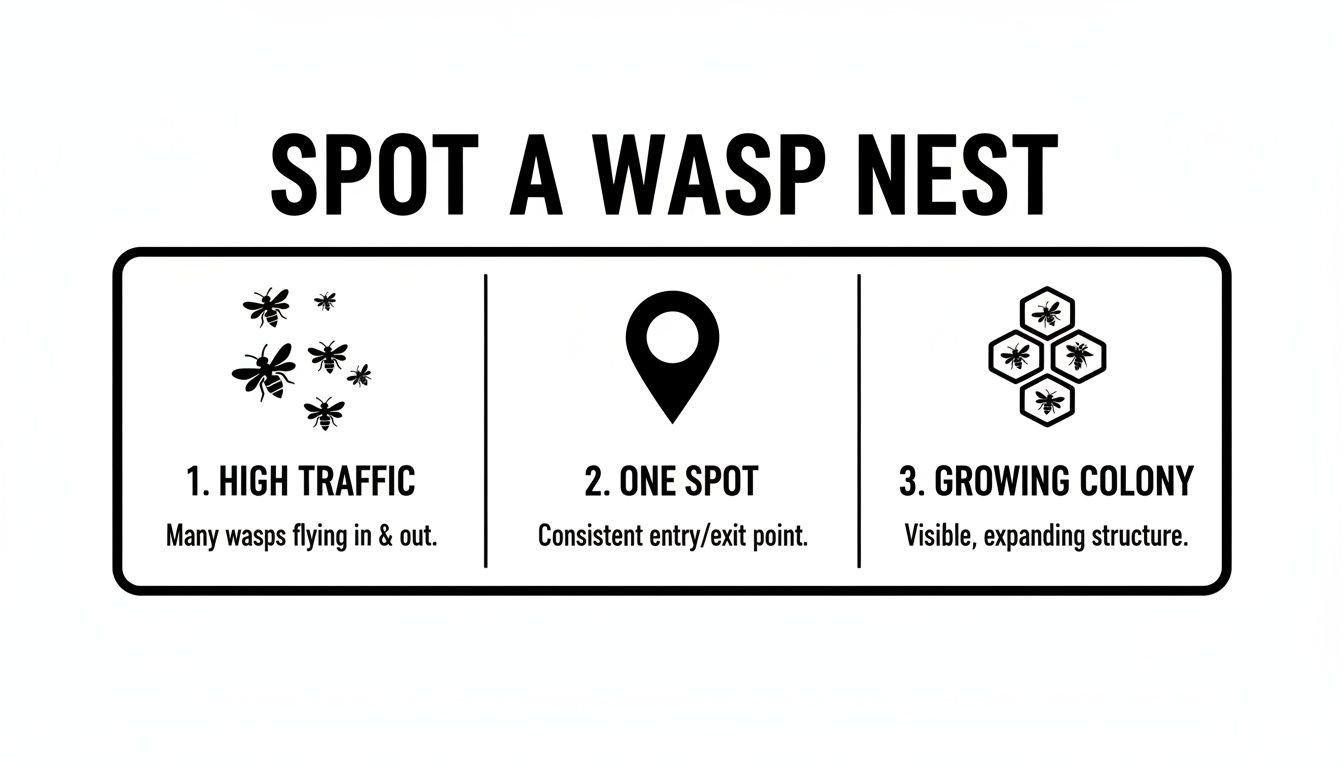
Recognizing Different Nest Types in Northwest Indiana
The nest itself can tell you a lot. Knowing what kind of wasp you're dealing with helps our Crown Point team prepare the right removal strategy.
Common Wasp Nests in Northwest Indiana
| Wasp Type | Nest Appearance | Common Locations |
|---|---|---|
| Paper Wasps | Open, umbrella-shaped comb with visible hexagonal cells. | Under eaves, porch ceilings, window and door frames. |
| Yellow Jackets | Usually hidden; nests are enclosed in a papery shell. | Underground in old rodent burrows, in wall voids, attics. |
| Bald-Faced Hornets | Large, enclosed, gray, and papery; often football-shaped. | Hanging from tree branches, shrubs, or the sides of buildings. |
Being able to identify the nest helps our technicians at The Green Advantage arrive at your Crown Point home with the most effective and safest plan of action for your wasp removal needs.
Crucial Safety Tip: Never get close to a suspected nest for a better look. Wasps are extremely defensive, and getting too close can trigger a swarm.
Once you’ve found the nest or confirmed that wasps are entering your home's structure, it's time to call a professional. An experienced exterminator has the proper protective gear and treatments to resolve the problem safely.
Listening for Clues Inside Your Home
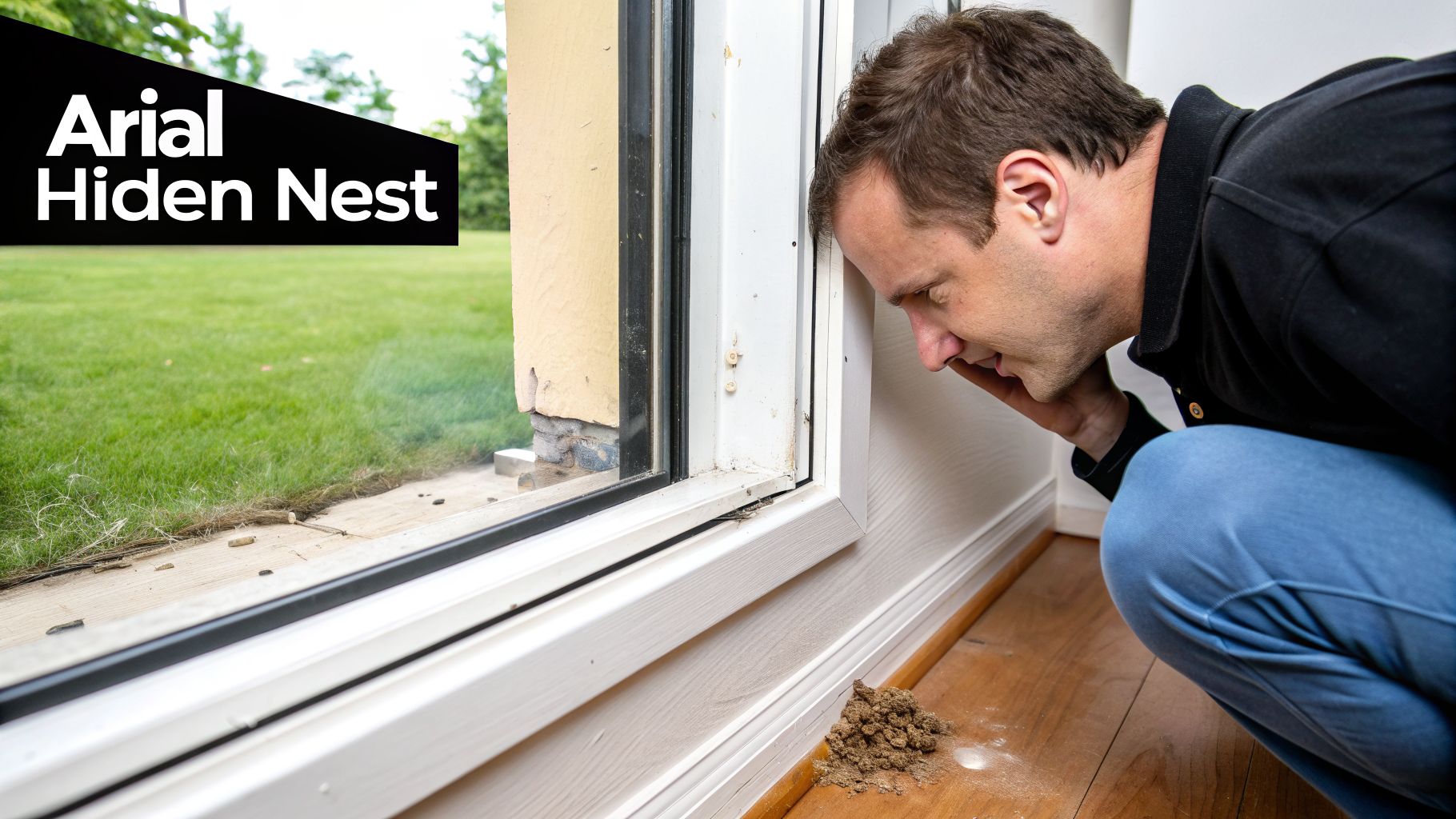
Sometimes, the first clue you have a wasp nest isn't something you see—it's something you hear. Many homeowners in Crown Point first discover a hidden nest this way. If you put your ear to a wall or ceiling and hear a faint, constant crackling or buzzing, pay attention. It's the sound of potentially thousands of wasps chewing wood pulp, building their comb, and moving around. People often describe it as a light rustling, almost like crinkling cellophane wrap.
Signs of Structural Impact
An active nest hidden in your walls can cause real, visible damage. The combination of moisture, waste, and constant activity will eventually take a toll.
Look for these secondary signs:
- Mysterious Stains: A yellowish or brown stain on a wall or ceiling that isn't from a leak can be caused by wasp nest waste seeping through drywall.
- Warped or Spongy Drywall: The area around a nest can feel soft, damp, or even warm to the touch, indicating the colony is affecting the wallboard's integrity.
- Small Piles of "Sawdust": Wasps construct nests from chewed wood fiber. You might find tiny, unexplained piles of wood shavings along baseboards.
A mature wasp colony inside a wall void isn't just a nuisance; it's a structural and safety risk. The nest can compromise drywall, attract other pests like our ant control or spider control services handle, and create a significant stinging hazard.
This is exactly the kind of situation that requires a professional. At The Green Advantage, our exterminators in Crown Point, IN, have specialized tools to find and remove nests hidden deep within walls, protecting your home from further damage.
Why Professional Pest Control is the Only Solution for Wasps
When you find a wasp nest, your first instinct might be a trip to the hardware store. But as local pest control experts, we can tell you that trying to remove a wasp nest is one of the riskiest DIY projects a homeowner can undertake. The moment wasps sense a threat, they swarm and can sting repeatedly.
Even if you avoid a swarm, most store-bought sprays aren't powerful enough to eliminate an established colony. You might kill the wasps on the surface, but you'll miss the queen and larvae deep inside. The survivors simply regroup and rebuild, often becoming more aggressive. This is why professional residential and commercial pest control is essential.
The Benefits of Professional Pest Control
Choosing a professional exterminator protects your property, health, and peace of mind.
- Protect Your Property: A hidden nest can cause structural damage over time. Our team addresses the infestation without causing further harm to your home. We also handle related issues like rodent control and termite control to provide comprehensive protection.
- Protect Your Health: Wasp stings are painful and can cause severe allergic reactions. Our technicians use professional-grade protective gear to perform the removal safely, eliminating the risk to you and your family.
- Gain Peace of Mind: Our eco-friendly pest control methods are guaranteed to solve the problem for good. We eliminate the entire colony, including the queen, so you can enjoy your home and yard without fear. Preventative pest treatments can also stop future infestations.
A failed DIY attempt doesn't just put you in danger; it often makes the colony more agitated and even tougher for a professional to deal with later. It's truly an investment in your safety to call for residential pest control from the very beginning.
The Green Advantage in Crown Point
Calling a professional exterminator in Crown Point, IN, like our team at The Green Advantage, is about safety and a definitive result. Our licensed technicians are trained to handle stinging insects common to Northwest Indiana and have access to professional-grade treatments you can't buy in a store. We know how to tackle nests in tricky spots, whether they're under high eaves, behind siding, or deep inside a wall void.
Professional wasp removal ensures the job is done right the first time, protecting your home, family, and peace of mind.
What to Expect From The Green Advantage

When you choose The Green Advantage for pest control in Crown Point, IN, you're choosing a partner dedicated to your safety and satisfaction. Here’s what you can expect when you work with us.
1. Thorough Site Inspection and Identification
Our process begins with a comprehensive inspection. A licensed technician will identify the pest, locate the nest, and assess the extent of the infestation. This allows us to tailor a specific, effective treatment plan for your property, whether it's for wasp removal, mosquito control, or another seasonal pest issue.
2. A Customized, Eco-Friendly Treatment Plan
Based on our findings, we develop a customized treatment plan. We'll walk you through our recommended approach, explaining the steps we’ll take and answering any questions you have. We prioritize eco-friendly pest control methods that are safe for your family and pets while being tough on pests.
3. Safe and Guaranteed Pest Removal
Our technicians arrive with the proper protective gear and specialized equipment to handle the job safely. We apply targeted treatments to eliminate the entire colony and can provide physical nest removal. We stand behind our work, ensuring a lasting solution and giving you the peace of mind that comes with professional service.
Your Questions About Wasp Nests Answered
As the go-to pest control team in Crown Point, we've heard every question about wasps. Here are answers to the most common concerns.
How Can I Tell If It Is Bees or Wasps?
It's easy to get them mixed up. Bees (like bumblebees) look fuzzy and stout. Wasps (like yellow jackets) are sleek, shiny, and have a very defined, thin waist. Bees are gentle pollinators found on flowers. Wasps are aggressive predators that hunt other insects and are often attracted to your food and drinks. We are committed to protecting beneficial pollinators, but when aggressive wasps threaten your family's safety, professional removal is necessary.
Will Wasps Go Away on Their Own If I Wait?
Hoping a wasp nest will just disappear almost always backfires. In Northwest Indiana, a hard frost will kill the workers and the old queen. However, before that, new queens will have found shelter for the winter in your attic, wall voids, or under siding. Come spring, each new queen starts a new colony. Ignoring a nest this year often leads to a bigger problem next year. Professional wasp removal is the only way to break that cycle.
Are Store-Bought Wasp Sprays a Good Idea?
We strongly caution homeowners against using DIY sprays. Most over-the-counter sprays have a weak stream, forcing you to get dangerously close to the nest. Worse, they rarely eliminate the whole colony, which can trigger a massive defensive swarm from the surviving wasps. Our professional-grade treatments are far more effective and safer. Don't gamble with your safety; searching for "pest control near me" and calling a professional is the smarter choice.
What Does Professional Wasp Removal Cost in Crown Point?
The cost for a professional exterminator depends on the situation. The final price is influenced by the size of the nest, its location (a nest in the ground is different from one under a third-story eave), and its accessibility. At The Green Advantage, we provide clear, upfront pricing after assessing the situation at your Crown Point home. No hidden charges, just an honest quote for a safe and effective solution.
Don't let a wasp problem ruin your summer or put your family at risk. The team at The Green Advantage has the expertise and equipment to safely resolve any wasp issue in Crown Point, IN, and the surrounding Northwest Indiana communities. Contact us today to schedule your pest inspection.
Schedule Your Wasp Removal Service with The Green Advantage Today
Termite Control Crown Point IN
Termite Control Crown Point IN
Owning a home in Crown Point, IN, brings a unique sense of pride. From the historic charm of the downtown square to the peaceful, tree-lined neighborhoods, it’s a wonderful place to put down roots. Whether you are enjoying a sunny afternoon at the Lake County Fairgrounds or simply relaxing in your own backyard, there is a deep satisfaction in maintaining a beautiful, safe home for your family. However, beneath the surface of this idyllic picture, a silent threat could be lurking. Termites are notoriously quiet invaders, often causing significant damage before you even realize they are there. For homeowners in our community, these pests are more than just a nuisance; they are a direct threat to your property value and your wallet. Protecting your biggest investment requires more than just hope; it requires action. At The Green Advantage, we understand the specific challenges Crown Point homeowners face. We are here to guide you through the importance of professional termite control and ensure that the service you receive is the best fit for your household needs.Understanding Termites: What Every Crown Point Homeowner Should Know
To effectively protect your home, it helps to understand what you are up against. In Northwest Indiana, the most common culprit is the Eastern Subterranean Termite. Unlike some other species that might live in dry wood above ground, these termites build their colonies deep in the soil. They are constantly foraging for cellulose—the main component of wood—and they need moisture to survive.How Our Local Climate Plays a Role
Our local climate in Crown Point contributes significantly to termite activity. We experience four distinct seasons, but the humidity during our springs and summers creates an ideal environment for these pests. The moisture in the soil allows them to thrive and build mud tubes, which act as safe highways from the ground up into the wooden structures of your home. Even as temperatures drop in the fall, termites don't simply disappear; they often move deeper into the soil or find warmth within the heated foundations of homes to continue their work.Signs of Activity
Because they work from the inside out, spotting termites can be tricky. Here are a few signs you should watch for around your property:- Mud Tubes: Pencil-sized tunnels made of soil and wood running up your foundation walls.
- Discarded Wings: After a swarm (usually in the spring), you might find piles of small, translucent wings near windowsills or doors.
- Hollow-Sounding Wood: If you tap on wood trim or flooring and it sounds hollow or papery, it may be eaten away from the inside.
- Frass: This looks like sawdust but is actually termite droppings.
- Sticking Doors or Windows: While often attributed to humidity, this can sometimes indicate that the wood frames have been compromised and warped by termite activity.
Termite Control Crown Point IN[/caption]
The Financial Impact of Termite Damage
It is easy to underestimate how much damage a tiny insect can do until you see the bill. Across the United States, termites cause an estimated $5 billion in property damage every year. What is even more alarming is that most standard homeowners insurance policies do not cover termite damage, categorizing it as a preventable maintenance issue. This means the cost of repairs comes directly out of your pocket. Termites are relentless eaters. A mature colony can consume a surprising amount of wood in a short period. Over time, they can compromise the structural integrity of your home. They don't just stop at the frame; they can damage flooring, support beams, ceiling joists, and even wall studs. In severe cases, this damage can make a home unsafe to live in. When it comes to selling your home, a history of termite damage—or an active infestation—can significantly lower your property value. Potential buyers are often wary of purchasing a home with structural issues, and lenders may refuse to approve a mortgage until the problem is resolved. Early detection and professional intervention are truly the best ways to save money in the long run. Investing in protection now costs a fraction of what structural repairs might cost later.Why DIY Termite Control Falls Short
In an era where we can learn to fix almost anything via online tutorials, the temptation to handle pest control yourself is understandable. You might see termite baits or sprays at the local hardware store and think, "I can handle this." However, when it comes to wood-destroying insects, DIY methods often fall short, leaving your home vulnerable.The Limitations of Store-Bought Solutions
Most over-the-counter termite treatments are contact killers. This means they only kill the termites you can see and spray directly. The problem is that the vast majority of the colony—including the queen—is hidden safely underground or deep within your walls. You might kill a few foragers, but the colony will quickly replenish its numbers and continue feeding. Furthermore, applying these chemicals effectively requires specialized knowledge. Without understanding building construction and termite behavior, it is difficult to place baits or barriers where they will actually stop the infestation.Risks of Incomplete Eradication
The biggest risk of DIY control is a false sense of security. You might think you have solved the problem because you don't see any more bugs, while the colony continues to eat away at your home's structure unseen. Professional control involves more than just applying a product; it involves a strategic approach to eliminate the entire colony and prevent future return. This is why working with licensed professionals like The Green Advantage is crucial. We have the training and tools to ensure the job is done right the first time.The Green Advantage: Your Partner in Termite Control
At The Green Advantage, we are more than just a service provider; we are your neighbors. We have decades of experience dedicated to quality services right here in Crown Point and the surrounding areas. Beginning as a small lawn maintenance company, we found ourselves dealing more and more with problems that others had difficulty solving. The knowledge of nature that was gained both in the field and by hobby began to transform the business into the pest control experts we are today. Working with nature is a passion that goes beyond being a career for us. We are constantly researching ways to improve services offered to customers, working hard to find solutions where many have surrendered. We believe in providing eco-friendly and effective pest control solutions that prioritize the safety of your family, your pets, and the local environment. Every customer who signs up for our services will communicate directly with our helpful staff for scheduling and information about the pest problem. This allows our licensed technicians to focus entirely on solving your pest issues when they arrive at your home. We take pride in being a local, knowledgeable resource you can trust. [caption id="attachment_184" align="aligncenter" width="800"] Termite Control[/caption]
The Process of Professional Termite Control
If you suspect you have termites, or if you simply want to be proactive, you might be wondering what the professional process looks like. We believe in transparency, so here is what you can expect when you partner with The Green Advantage.The Inspection
Everything starts with a thorough inspection. Our licensed professionals will come to your home and examine both the interior and exterior. We look for the subtle signs of infestation mentioned earlier, as well as conditions conducive to termite activity, such as wood-to-ground contact or excess moisture. We will check the basement, crawl spaces, and foundation perimeters. We don't just look for bugs; we look for the source of the problem.Customized Treatment Solutions
Once we understand the extent of the issue, we create a customized plan for your home. No two properties are exactly alike, and cookie-cutter solutions rarely work effectively. We utilize advanced methods that might include liquid soil treatments to create a barrier around your foundation or baiting systems that target the colony directly. We will explain our process clearly so you understand exactly what we are doing and why. We want to ensure that the service you receive is the best fit for your household needs!Follow-Up and Prevention
Termite control isn't a "one-and-done" event. Ongoing prevention is key. After the initial treatment, we recommend regular follow-up inspections to ensure the treatment is working and that no new activity has started. This vigilance is what keeps your home safe year after year.Preventative Measures to Protect Your Home
While professional termite treatment is the heavy lifter in termite defense, there are several steps you can take as a homeowner to make your property less attractive to these pests. Think of these as a partnership between you and your pest control team.Moisture Control
Termites love moisture. To discourage them:- Ensure downspouts divert water well away from your foundation.
- Fix leaky faucets and pipes immediately.
- Make sure your crawl spaces and attics are well-ventilated to reduce humidity.
- Eliminate standing water around your home’s perimeter.
Wood Storage and Maintenance
Since wood is their food source, be careful how you store it:- Keep firewood stacked off the ground and away from the side of your house.
- Remove old tree stumps and roots from your yard.
- Avoid wood mulch right up against the foundation; consider using gravel or rubber mulch instead.
- Ensure that any wooden parts of your home (like porch steps or door frames) do not directly touch the soil.
Termite Control Service Crown Point IN[/caption]