
If you own a home in Crown Point, Indiana, you know that termites are more than a simple nuisance—they are a quiet but serious threat to your property's structure and value. The thought of these destructive pests silently chewing through your biggest investment is a major concern for any homeowner in Northwest Indiana.
But here’s the reassuring news: termite prevention is entirely possible. You don't have to wait for signs of damage to protect your home. As a trusted local pest control company serving the Crown Point community, The Green Advantage is here to guide you. We believe in empowering homeowners with the right information to safeguard their property and family.

This guide is your complete game plan for termite prevention. We’ll cover everything from simple yard maintenance tasks to professional termite control solutions, all tailored for our local climate. The advice here comes directly from our experience helping families in Crown Point keep their homes safe, and we're sharing our best insights with you.
Understanding the Termite Threat in Northwest Indiana
To effectively protect your home, you need to know what you’re up against. Here in Crown Point and across Northwest Indiana, our primary concern is the subterranean termite. This silent destroyer is responsible for the vast majority of termite damage we see in local homes.
Unlike more visible pests, subterranean termites operate from a hidden world. They live in large, organized colonies deep in the soil. Our region’s damp soil and seasonal weather create the perfect environment for them to thrive. From these underground nests, they build clever mud tubes—which look like pencil-thin tunnels of dirt—to travel undetected into your home in search of their only food source: wood.
Why Our Region Is a Termite Hotspot
The climate in Northwest Indiana, with its humid summers and wet springs, keeps the soil consistently moist. This is exactly what termite colonies need to flourish and expand. When these termites find a home with a moisture problem—like a leaky pipe, poor foundation drainage, or a damp crawl space—it’s like an open invitation.
The financial risk termites pose to your property is significant. The damage occurs slowly and out of sight, often progressing for years before any signs become obvious. By the time you notice a problem, the damage can be severe and expensive to repair.
Globally, termites cause over $40 billion in structural damage each year. This statistic underscores why proactive termite prevention is not just a good idea—it's an essential part of responsible homeownership, especially in areas like Crown Point where wood-frame construction is common.
Spotting the Subtle Signs of an Infestation
Your best defense against termites is knowing what to look for. Catching an infestation early can save you thousands of dollars in repairs. While a professional inspection from a qualified exterminator is the only way to be certain, every homeowner should be on the lookout for these common red flags.
Some signs, like a swarm of winged insects inside your home in the spring, are hard to miss. These "swarmers" are reproductive termites seeking to start new colonies. Finding piles of their shed wings, which look like tiny, identical fish scales, is another dead giveaway. Most other clues, however, are much more subtle.
If you've spotted something concerning, our guide can walk you through the specifics of how to identify termite damage and differentiate it from other common household issues.
Common Signs of a Termite Infestation
| Sign of Infestation | What to Look For | Common Location |
|---|---|---|
| Mud Tubes | Pencil-thin tunnels of dried mud running up foundation walls, support piers, or in crawl spaces. | Exterior foundation walls, basements, and crawl spaces. |
| Damaged or Hollow Wood | Wood that sounds hollow when tapped. It may also have a maze-like pattern carved into it, which you might find if you break a piece open. | Floor joists, structural beams, window sills, and wooden posts. |
| Discarded Wings | Small, translucent wings of the same size found in piles, often near windowsills, doorways, and lights after a spring rain. | Near windowsills, doorways, and light fixtures. |
| Bubbling or Peeling Paint | Paint that appears to be bubbling or uneven on a wall, often caused by moisture from termites or damage to the drywall paper beneath. | Interior and exterior walls, often mistaken for water damage. |
Understanding the risks and knowing the signs are the first steps in building a smart defense for your home. Now, let’s talk about how to make your property less attractive to these destructive pests.
Building Your First Line of Defense Outside
Your best defense starts right outside your door. Creating a termite-resistant zone around your home’s perimeter is the most important, hands-on step any Crown Point homeowner can take. It’s all about making your property a place where termites simply don’t want to be.
Think of your foundation as a fortress wall. Termites are constantly foraging in the soil, and anything that gives them moisture, food, or a hidden path can lead them straight into your house. Taking control of the area immediately surrounding your foundation creates a powerful first line of defense.
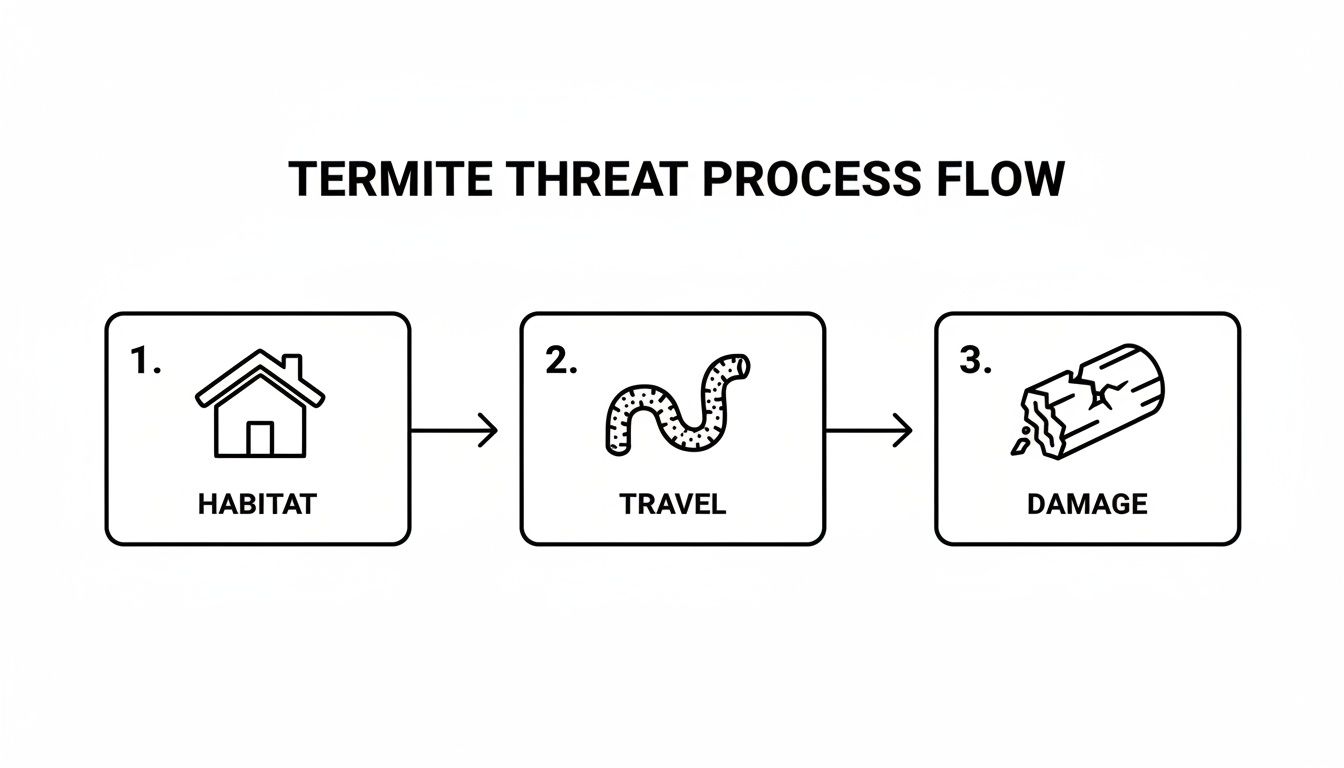
As you can see, termites need a hidden route—like a mud tube—to travel from the soil to your home’s structure. Your job is to eliminate those hidden highways before they ever get built.
Eliminate Termite Food Sources
Subterranean termites survive on cellulose, found in wood and plant-based materials. Any wood making direct contact with the ground is an open invitation. The first rule of termite prevention is to remove these easy meals.
- Firewood and Lumber: Store firewood piles at least 20 feet away from your house and elevate them on a metal rack or concrete blocks. Never stack wood directly against your foundation.
- Yard Debris: Regularly clean up fallen branches, old tree stumps, and scrap construction lumber. A forgotten pile of 2x4s behind the garage can quickly become a starter colony that targets your house next.
- Mulch Management: Mulch is great for gardens, but it holds moisture and provides a food source for termites. Maintain a mulch-free barrier of at least six inches between your foundation and any mulch beds. Consider using rubber mulch or decorative stone in the area immediately against your home.
Control Moisture Around Your Foundation
Termites need moisture to survive. Here in Northwest Indiana, our clay-heavy soil often holds water right against foundations, creating the damp environment where termites thrive. Your goal is to keep the area around your home as dry as possible.
- Gutters and Downspouts: Clean your gutters regularly to prevent overflows that dump water at your home's base. Ensure downspouts extend at least five feet away from the foundation to direct runoff away.
- Grading: Check that the ground around your home slopes away from the foundation. If water pools near the house after a storm, you may need to add soil to improve the grade and ensure proper drainage.
- Leaks: A leaky outdoor spigot can saturate the soil, creating a perfect entry point for termites. A simple washer replacement can eliminate a massive risk.
Maintain a Clear Inspection Zone
Termites are sneaky and do their work out of sight. By keeping the area around your foundation clear, you take away their cover and make it easier to spot them.
Trim shrubs, ivy, and other dense plants to create at least a one-foot gap between the greenery and your exterior walls. This simple step improves airflow, helps siding dry faster, and gives you a clear line of sight to spot tell-tale mud tubes. This gap is a critical part of any ongoing residential pest control plan because it allows you or your exterminator to conduct inspections easily.
Securing Your Home's Interior from Termite Entry
Even with a well-maintained exterior, termites can find hidden routes inside. The next step is to head indoors and focus on the places most homeowners forget: the basement, crawl space, and foundation. For homeowners in Crown Point, these interior checks are a vital defense against an infestation.
These dark, damp lower levels are ideal entry points for subterranean termites. They offer moisture, darkness, and direct access from the soil into your home's wooden framework. A regular inspection with a flashlight is one of the most effective ways to stop termites in their tracks.
Inspecting Your Foundation and Lower Levels
Grab a good flashlight and inspect your home’s lowest points for any gaps, cracks, or openings. Termites can squeeze through a crack as thin as a business card.
Scan your interior foundation walls for thin, muddy lines—these are the infamous mud tubes termites build to travel from the soil to the wood in your home. If you see one, break a small piece off. If it is repaired in a few days, you have an active infestation and should call a professional exterminator immediately.
Also, check these key areas:
- Plumbing Penetrations: Look closely around every pipe coming through the foundation or floor. Small gaps often form here as a house settles.
- Utility Lines: The tiny spaces around electrical conduits and gas lines can be superhighways for termites to enter your walls.
- Expansion Joints: If you have a concrete slab floor, check the joints between sections for openings.
Seal any gaps you find with a quality polyurethane caulk for concrete. For larger openings, use a combination of expanding foam sealant and steel wool to create a tough barrier that termites and rodents can’t chew through.
The Critical Role of Moisture Control
Termites are desperate for moisture. A damp, humid basement or crawl space is a huge attractant. Managing indoor humidity is a critical part of how to prevent termites.
In Northwest Indiana, crawl spaces with exposed dirt floors are a major vulnerability, as they constantly release moisture into the air. Installing a heavy-duty vapor barrier (a thick plastic sheet that covers the entire dirt floor) can drastically reduce ground moisture and make the space less inviting for pests.
Homeowners often overlook basement humidity. Even without standing water, high air moisture is enough to attract termites and can soften structural wood, making it easier for them to consume.
Learning how to reduce indoor humidity is essential. A good dehumidifier, especially during our humid summers, can make a world of difference. Also, fixing any interior water leaks is non-negotiable. A slow drip under a sink can provide a constant water source for a termite colony. By keeping your basement and crawl space dry and sealed, you make them hostile territory for termites.
Choosing the Right Professional Termite Solution
While home maintenance is your first line of defense, sometimes you need the power of a professional solution. This is especially true if you find an active infestation or simply want the peace of mind that comes with complete protection. Professional services generally fall into two categories: liquid barriers and baiting systems.
Traditional Liquid Barrier Treatments
For decades, the standard method for termite control was a liquid chemical barrier. A technician digs a shallow trench around the home’s foundation and applies a termiticide to the soil, creating a treated zone that termites cannot cross. Modern non-repellent products allow termites to pick up the active ingredient and carry it back to the colony, leading to its elimination.
- The Upside: It provides immediate protection and can last for several years.
- The Downside: The process is invasive, often requiring digging and drilling around your foundation, patios, and porches. Any future landscaping or utility work can disrupt the barrier, creating a gap in your protection.
Advanced Termite Baiting Systems
The modern, more strategic approach is a termite baiting system. A certified technician places discreet bait stations in the ground at key points around your property. These stations contain a cellulose material that is highly attractive to termites. The stations are monitored, and when termite activity is found, a slow-acting bait is introduced that eliminates the entire colony.
The genius of a baiting system is that it uses termite biology against them. Foraging workers find the bait, see it as a superior food source, and carry it back to share with the rest of the colony, including the queen. This method doesn't just block termites; it actively eliminates the colony at its source.
The Sentricon® System: A Smarter Solution for Crown Point Homes
At The Green Advantage, we exclusively use the Sentricon® System with Always Active™ technology. We believe it is the most effective and reliable baiting system available. The bait stations are loaded with the active ingredient from day one, so your home is protected 24/7 from the moment of installation—no waiting to find activity first.
For homeowners in Crown Point, IN, the Sentricon® System offers clear benefits:
- Total Colony Elimination: It is scientifically designed to wipe out the entire subterranean termite colony, not just foraging workers.
- No Mess, No Fuss: There's no trenching or drilling required. The stations are placed discreetly in your yard, leaving your landscaping untouched.
- Eco-Friendly: The active ingredient is contained within bait stations in small, targeted amounts. This makes it a responsible choice for families with children and pets, with no risk of chemical runoff.
Protecting your biggest investment is a serious decision. If you're looking for a proactive defense that works around the clock, we have more information on our professional termite treatments and how we can customize a plan for your property.
Your Local Partner for Termite Control in Crown Point, IN
Dealing with the threat of termites can be stressful. At The Green Advantage, our goal is simple: to provide Crown Point homeowners with a reliable, straightforward solution they can trust. We understand the local conditions in Northwest Indiana that make our homes vulnerable, and we are committed to protecting your property.
When you call us for your residential pest control or commercial pest control needs, you’re not just another customer. You are our neighbor, and we are a local partner genuinely invested in protecting your home or business. We believe peace of mind comes from understanding the problem and having a clear plan to fix it.
What to Expect When You Work With The Green Advantage
We have built our reputation in Crown Point on clear communication and trust. When you contact us, you’ll speak with a knowledgeable member of our local team who can schedule your service quickly.
When one of our licensed technicians arrives, their first job is to listen to your concerns. They will then perform a comprehensive inspection, using their local experience to identify active termite issues and any conditions on your property that could attract pests in the future.
Here’s what you can expect:
- A Thorough Inspection: We inspect your foundation, basement, crawl space, and the entire perimeter of your home for signs of termite activity or moisture problems.
- Clear Explanations: We walk you through our findings in plain English, ensuring you understand our recommendations.
- A Customized Plan: We will outline the best options for your specific situation, whether you need to eliminate an existing colony or want to establish a strong preventative defense. We’ll explain the benefits of modern, eco-friendly systems like Sentricon®, which we specialize in.
We’re Your Neighbors, Not a National Chain
As a local, family-owned business, our reputation in Crown Point means everything. We live here, our kids go to school here, and we care about our community. This personal connection drives us to provide a level of service that large, out-of-state companies simply can’t match.
We started The Green Advantage because we believe you shouldn't have to choose between getting rid of pests and keeping your family safe. Our focus is on smart solutions that are tough on pests but gentle on your home and the environment.
This commitment is at the heart of everything we do, whether it’s termite control, ant control, or mosquito control so you can enjoy your yard again. Let our team of professional exterminators handle the pests, so you can get back to enjoying your home, worry-free.
Common Questions About Termite Prevention
As your local exterminator in Crown Point, we get a lot of questions from homeowners. Here are our straightforward answers to some of the most common ones.
Is Termite Damage Covered By Homeowners Insurance?
The answer is almost always no. Most standard homeowners insurance policies view termite damage as a preventable maintenance issue, not a sudden, accidental event like a fire or storm. This is why being proactive about termite prevention is so critical. The cost of professional termite control is a fraction of the bill for structural repairs, which can easily run into tens of thousands of dollars.
How Often Do I Need a Professional Termite Inspection?
For homes in the Crown Point area, we recommend a professional termite inspection at least once per year. Termites are incredibly secretive, and a colony can feast on your home for years before you see obvious signs. An annual inspection from a trained exterminator is the single best way to catch problems early and avoid costly repairs. It’s like a yearly check-up for your house, providing priceless peace of mind.
Are Your Termite Treatments Safe For Kids and Pets?
Yes, absolutely. The health and safety of your family are our top priorities. That's why we specialize in eco-friendly pest control methods. We use advanced, targeted systems like the Sentricon® with Always Active™ technology. This system uses discreet bait stations placed around your property. It’s designed to eliminate the entire termite colony without spraying liquid chemicals in your home or yard, making it a powerful and responsible solution.
Ready to protect your home from termites? Contact The Green Advantage, your trusted exterminator in Crown Point, IN, to schedule a thorough termite inspection. Let's secure your home together!