
A Crown Point yard in winter looks quiet for a reason. The grass is down, the patio furniture is covered, and the buzzing that made July evenings miserable is gone.
That calm fools a lot of homeowners.
If you have ever asked where do mosquitoes go in the winter, the short answer is this. They do not vanish. Around Northwest Indiana homes, they hide, wait, and survive in places many individuals never think to check until spring brings them back all at once. That is why mosquito problems often feel sudden even when they have been developing for months.
For homeowners searching for pest control near me, pest control in Crown Point, IN, or a reliable exterminator near me, this is one of the most misunderstood seasonal pest issues. Mosquitoes are not only a summer nuisance. Their winter survival strategy starts around your home, under your deck, inside your crawl space, and anywhere moisture and shelter overlap.
The practical takeaway is reassuring. If you know where they spend the winter, you can reduce the pressure on your property before warm weather returns. That matters for families, pet owners, landlords, and anyone trying to enjoy a backyard without fighting off bites from the first warm week of spring.
The Unseen Threat Wintering in Your Crown Point Yard
A lot of winter mosquito problems begin with an ordinary yard.
A few leaves collect along the fence line. The gutter over the garage stays packed after fall cleanup got delayed. A planter holds just enough water to matter. The woodpile sits against the house because it is convenient. Nothing about that scene looks like a mosquito issue in January.
What homeowners usually notice too late
Many individuals notice mosquitoes only when adults are flying. By then, the setup work is already done.
On many Northwest Indiana properties, winter leaves behind hidden shelter and moisture in the same places. That combination matters. Mosquitoes use protected spots outdoors and around the structure to make it through the cold season, then take advantage of early warmups before homeowners are thinking about mosquito control.
A quiet yard is not always a pest-free yard. In winter, the problem shifts from visible activity to hidden survival.
This is one reason seasonal spraying alone often disappoints people. If the only plan starts after swarms are obvious, the property is already playing catch-up.
The local pattern around homes in Crown Point
In Crown Point and nearby communities, the properties that struggle most in spring often share a few traits:
- Heavy leaf buildup: Damp leaf piles hold moisture and create protected pockets near foundations and fences.
- Poor drainage: Low spots, clogged downspouts, and water-holding containers support the next wave of activity.
- Sheltered structure gaps: Older garages, crawl spaces, and basement access points can give pests a place to wait out winter.
- Mixed pest pressure: The same neglected edges that encourage mosquito survival can also contribute to broader residential pest control concerns, including spiders and rodent harborage.
Homeowners do not need to panic about every wet corner of the yard. They do need to stop thinking of winter as the off-season for mosquito prevention. Winter is often when the next season starts.
Mosquito Hibernation A Survival Strategy Explained
Mosquitoes survive winter by slowing down or by leaving behind a durable next generation. The exact method depends on the species.
The key term is diapause. Think of it as a built-in pause button, not a normal active life cycle.
What happens when temperatures drop
Temperatures consistently below 50°F cause mosquitoes to become inactive and enter diapause, a hibernation-like state that slows their metabolic processes. Adult females survive by moving into protected sites such as basements, garages, storm drains, logs, woodpiles, and underground drains, according to Mosquito Joe’s explanation of what temperature kills mosquitoes.
That is why the first cold stretch does not solve the problem by itself.
Some exposed mosquitoes die in severe cold. Others survive because they are not exposed. They are tucked into spaces that stay more stable than the open yard. Many individuals never consider those hidden areas.
The three ways winter survival works
Mosquito survival is easier to understand when you break it into categories.
| Survival pattern | What it means around a home |
|---|---|
| Adult dormancy | Fertilized females hide in sheltered spaces and wait for warmer conditions |
| Egg survival | Eggs remain in containers, damp soil, or water-holding spots until spring conditions trigger hatching |
| Limited larval survival | In certain protected water conditions, immature stages may persist, though this is less common around typical winter properties |
The first two matter most for homeowners in Crown Point.
Adult survival explains why hidden shelter around the structure matters. Egg survival explains why “it’s frozen, so the water is harmless” is a mistake.
Why this matters for prevention
A mosquito control plan has to match the biology.
- If adults are sheltering, exclusion and inspection matter.
- If eggs are waiting, cleanup and water management matter.
- If both are in play, a single quick treatment is not enough.
That is why homeowners who search for residential pest control or exterminator in Crown Point, IN are usually better served by a property-wide prevention mindset than by a narrow seasonal response.
Common Mosquito Overwintering Sites in Northwest Indiana
Walk around a typical Northwest Indiana home in winter and the likely hiding spots reveal themselves fast.
Start at the roofline. Then move to the foundation. Then check the damp, shaded areas people ignore until spring cleanup.
Around the outside of the property
Some of the most common overwintering sites are outdoors, but they are still close to the house.
Look closely at these areas:
- Clogged gutters: They trap wet organic matter and create protected moisture pockets.
- Leaf piles against the home: These hold humidity near foundation walls and basement windows.
- Woodpiles and stacked materials: They create dark, insulated gaps.
- Tree holes and low spots in the yard: Water and damp debris can linger long after the visible surface dries.
- Under decks and stairs: Shade and protection make these spaces easy to overlook.
A homeowner may think the issue is “coming from the neighborhood.” Sometimes it is. But a surprising amount of spring pressure starts within the property line.
Inside the home and attached structures
Indoor refuges matter more than many people realize.
Indoor winter refuges like basements, garages, and crawl spaces in Northwest Indiana’s older housing stock can allow certain species like Culex pipiens to remain active year-round rather than dormant, meaning spring infestations may originate from indoor overwintering populations, not just outdoor egg hatching, as discussed in this Army overview of where mosquitoes go during the winter.
That changes how you inspect a home.
A damp basement with condensation, a sump area, or poor airflow is not just a moisture problem. It can become a winter refuge. The same is true for attached garages with cluttered corners, crawl spaces with standing moisture, and utility penetrations that let pests move in and out.
If mosquitoes show up around basement windows or near a utility room before the yard fully wakes up, look indoors as well as outside.
A practical property walk
If you want a realistic winter check, do not just scan for flying insects. Look for conditions.
Ask these questions:
- Where does water sit after a thaw?
- Where does leaf litter stay packed and damp?
- Which areas stay dark, protected, and undisturbed?
- Does the basement, crawl space, or garage have persistent moisture?
This same inspection mindset helps with broader commercial pest control and home services too. Sealing crawl spaces and correcting damp access points can support mosquito prevention while also helping reduce pressure from other pests.
Not All Mosquitoes Are the Same How Different Species Survive
The biggest mistake homeowners make is treating all mosquitoes like they behave the same way.
They do not.
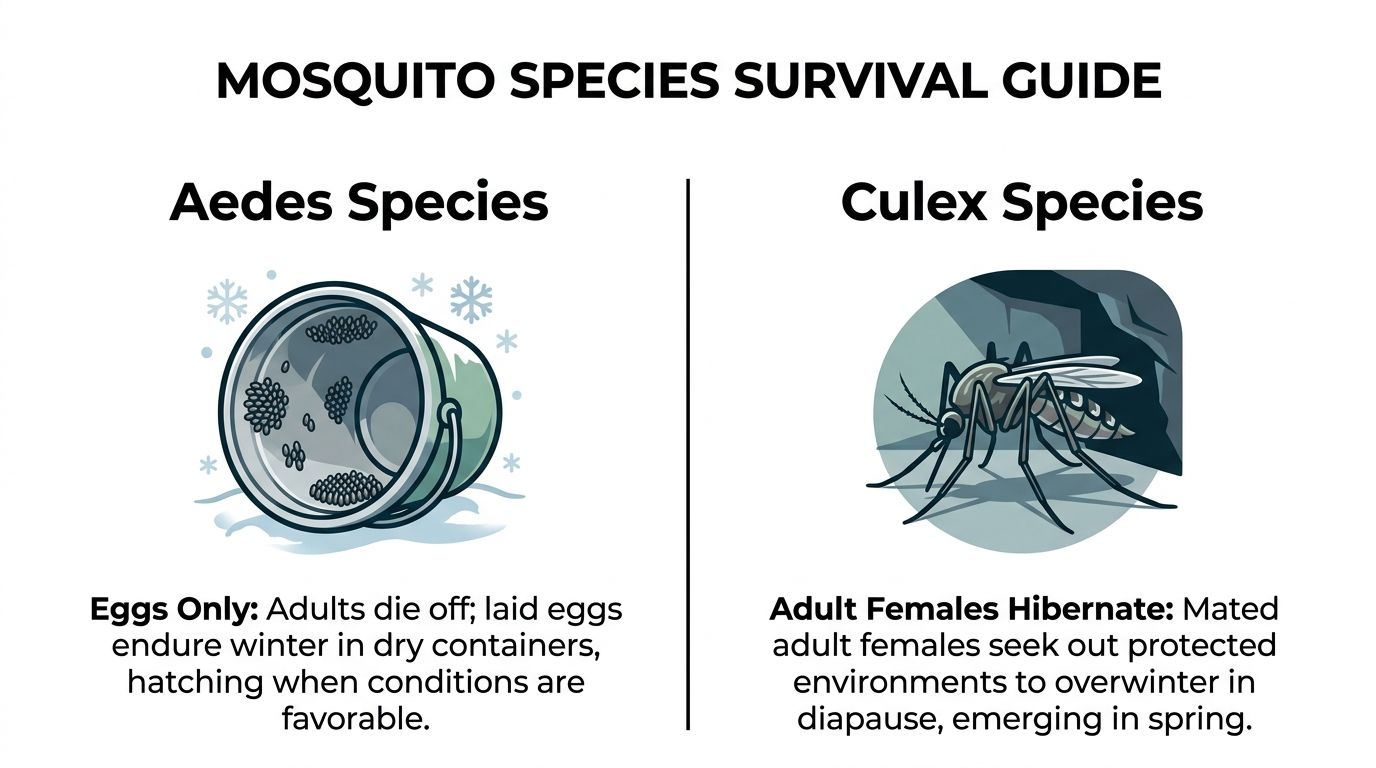
Aedes and Culex need different prevention
Survival methods vary dramatically by species. Aedes species survive as dormant eggs in containers, requiring fall cleanup of water-holding items, while Culex species enter diapause as adult females in sheltered spaces, requiring homeowners to seal foundation cracks and garage access points before winter, as outlined by Mosquito Authority’s winter mosquito guide.
That one distinction explains why so many do-it-yourself plans only work halfway.
If you dump containers but ignore structural shelter, you may still have overwintering adults. If you seal obvious gaps but leave water-holding items and damp breeding areas untouched, you may still get a heavy hatch when spring moisture arrives.
Side-by-side comparison
| Species group | Main winter strategy | What homeowners should focus on |
|---|---|---|
| Aedes | Eggs survive in containers and damp areas | Remove water-holding items, clear debris, manage low wet spots |
| Culex | Adult females shelter in protected spaces | Seal entry points, inspect basements, garages, crawl spaces, and sheltered voids |
For a closer look at local types, homeowners can review this resource on mosquito species.
Why one-size-fits-all advice falls short
Generic mosquito advice usually sounds simple. Empty water. Spray when you see activity. Maybe add a repellent.
The problem is that simple advice often ignores the species question.
A property with mostly container-breeding pressure needs disciplined cleanup. A property with indoor refuge issues needs structural attention and inspection. Many homes in Crown Point have both.
That is why homeowners who search for pest control in Crown Point, IN or exterminator near me often get better results when they stop asking only “What spray should I use?” and start asking “What kind of survival pattern is this property supporting?”
From Winter Slumber to Spring Swarm The Seasonal Threat
Spring mosquito pressure often feels abrupt because the insects emerging are already prepared.
For Culex mosquitoes, the winter pause is not a full reset. Female Culex mosquitoes mate in fall and store viable sperm throughout hibernation. Once temperatures exceed 50°F, they can immediately commence oviposition after their first blood meal, bypassing the mating phase and creating sharp population density spikes in early spring, according to Torpedo Mosquito’s discussion of winter survival in Culex.
Why the first warm stretch matters so much
That early-spring jump catches homeowners off guard.
You may have had weeks of cold weather and assumed the issue was behind you. Then a mild stretch arrives, snowmelt and rain add moisture, and the property suddenly has active mosquitoes before many individuals have even pulled patio furniture back out.
The same pattern holds with overwintering eggs. Once spring brings water and warmth, hatching can happen quickly. That is why a yard can seem quiet for months and then turn irritating in a very short window.
What works and what does not
Some responses help. Some only make homeowners feel busy.
What works
- Addressing likely overwintering areas before consistent warm weather
- Fixing drainage and moisture issues instead of just reacting to bites
- Treating the property as a system, not just the lawn
What does not
- Waiting until mosquitoes are obvious everywhere
- Assuming one frost solved the issue
- Treating open areas while ignoring basements, crawl spaces, and protected voids
Spring swarms are usually a delayed result of winter survival, not a random surprise.
Preventative pest treatments earn their value by interrupting the conditions that let mosquitoes launch early and aggressively. The goal is not only to reduce what is flying today. The goal is to interrupt the conditions that let mosquitoes launch early and aggressively.
Your Proactive Mosquito Prevention Plan for Your Crown Point Home
A good prevention plan starts in the cold months, not the hot ones.
The first goal is simple. Remove shelter, moisture, and hidden breeding support before spring turns those overlooked areas into a mosquito problem.
The homeowner checklist that helps
Aedes mosquito eggs can survive desiccation and freezing temperatures for months, hatching in spring when inundated with water. For Northwest Indiana homeowners, eliminating winter standing water in yards, tree holes, or drains is a critical prevention method because it removes the primary substrate for the spring’s first generation, as explained in Thermacell’s discussion of mosquitoes in winter.
Use that fact to guide your winter routine:
- Clean gutters thoroughly: Packed debris traps moisture and supports the wrong conditions right above the foundation.
- Empty and store containers: Planters, toys, buckets, and decorative items should not sit outside holding water through winter thaws.
- Correct drainage trouble spots: If downspouts dump near the house or low areas stay wet, address that before spring rains.
- Rake out dense leaf buildup: Focus on fence lines, under shrubs, around AC pads, and along the base of decks.
- Seal access points: Check garage door edges, crawl space vents, foundation cracks, and utility openings.
- Inspect the basement: Watch for condensation, standing water, sump problems, and corners that stay damp.
If you want a broader homeowner-friendly refresher on how to get rid of mosquitoes around a property, that guide is a useful complement to a local inspection mindset.
Here is a quick visual overview of why timing matters:
Where DIY reaches its limit
Homeowners can handle a lot of the cleanup work. That matters.
What is harder is identifying every overlooked refuge. Crawl spaces, inaccessible drainage lines, hidden water traps, and subtle structural gaps are where a lot of prevention plans weaken. If you are evaluating your next step, this page on how to reduce mosquitoes in yard gives a practical starting point for thinking beyond surface-level spraying.
The best winter mosquito plan is not complicated. It is thorough.
Schedule Your Crown Point Mosquito Inspection Today
If mosquitoes seem to return to your property faster than they should, there is usually a reason. The answer is often hidden in winter shelter, moisture, and overlooked breeding support around the structure.
A professional inspection helps narrow that down. Instead of guessing, you get a close look at the property conditions that support mosquito survival. That includes the obvious outdoor areas, but also the less obvious ones such as basements, garage edges, crawl spaces, drainage trouble spots, and shaded debris zones.
What to expect from a professional inspection
A solid inspection should include:
- A full property review: Not just the lawn, but the structure, moisture patterns, and likely refuge areas.
- Clear findings in plain language: Homeowners should understand what is happening and why it matters.
- Practical next steps: Cleanup, exclusion, treatment timing, and ongoing prevention should all fit the property.
- A broader pest perspective: Many mosquito-friendly conditions also overlap with other pest issues, which matters for both residential pest control and commercial pest control properties.
For homeowners improving exclusion, even basics like install window fly screens can support a stronger barrier strategy when paired with moisture and habitat correction.
Why timing matters in Crown Point
The best time to deal with winter mosquito survival is before spring pressure builds.
If you are in Crown Point or nearby Northwest Indiana communities and want fewer surprises when warm weather returns, start with a property assessment. It is one of the most practical ways to protect your yard, your comfort, and your peace of mind before mosquito season gets traction.
If you want local help identifying overwintering mosquito sites around your home or business, contact The Green Advantage to schedule an inspection or request a quote. Their team serves Crown Point and nearby Northwest Indiana communities with targeted pest evaluations, mosquito reduction programs, and practical solutions built around the way pests behave on local properties.