
In Crown Point, residential rodent control commonly costs about $150 to $600 per service, while heavier jobs involving exclusion, attic sanitation, or repeated visits can reach $1,000 or more. Commercial rodent control often falls between $500 and $3,000 or more, depending on the facility and monitoring needs.
You may be hearing scratching above the ceiling, finding droppings near the garage, or noticing gnaw marks around stored items. In a Crown Point home, those signs can turn a quiet evening into an urgent search for an exterminator near me. The first quote you receive may cover only trapping or baiting, not the sealing and cleanup needed to keep rodents from returning.
That distinction explains why rodent control prices vary so widely. The Green Advantage serves Crown Point, Indiana, and surrounding Northwest Indiana communities with residential and commercial pest services designed around the actual property, pest, and entry conditions. A clear plan should show what the first visit includes, what may cost extra, and whether follow-up protection is appropriate.
Introduction to Rodent Control Prices in Crown Point IN
Crown Point homeowners may first hear movement above the ceiling after sunset, then find droppings in the garage, shredded insulation, or a gap beside a utility line. Those signs do not determine the final price. They show that removing the rodents may be only the first layer of the job.
Rodent control pricing works like a tiered system. The lowest tier may address visible activity through trapping or baiting. A higher tier adds exclusion, which closes the openings mice or rats use to enter. Full protection can also involve sanitation, minor repairs, and follow-up monitoring. The first quote is therefore a starting point, not always the total cost of solving the problem.
Published 2026 U.S. pricing guides place ordinary residential service in a broad range of $150 to $600 per visit, while more involved work can reach $1,000 or more when technicians must seal several entry points, sanitize an attic, or return for additional service (2026 rodent control pricing guide). Those figures are useful for orientation, but they do not replace an evaluation of the home.
The price tiers homeowners usually encounter
Most jobs fit along this progression:
- Assessment and basic treatment: The technician identifies activity and begins trapping or baiting.
- Removal with exclusion: The service also seals gaps that allow mice or rats to enter.
- Remediation and prevention: Cleanup, repairs, and follow-up monitoring address conditions that could support a return.
- Commercial protection: Larger buildings may need scheduled inspections and documented service.
The appropriate tier depends on the property and the findings. One accessible opening with limited mouse activity is a different job from an older home with several penetrations, difficult attic access, or established rat activity. Rats often require more careful removal and repair planning because their size and strength can affect entry points and damage.
Why local context matters
Crown Point homes may include attached garages, crawlspaces, older construction, and outdoor areas that give rodents several routes toward shelter. Businesses have different cost drivers, such as receiving doors, kitchens, storage areas, and waste zones.
Whether you are comparing rodent control prices, pest control in Crown Point, IN, residential pest control, or commercial pest control, request a written scope of work. It should identify what the first visit covers, which repairs or cleanup are separate, and whether follow-up protection is recommended. Comparing those details gives a clearer answer than choosing the smallest first dollar amount.
Understanding What Rodent Control Services Include
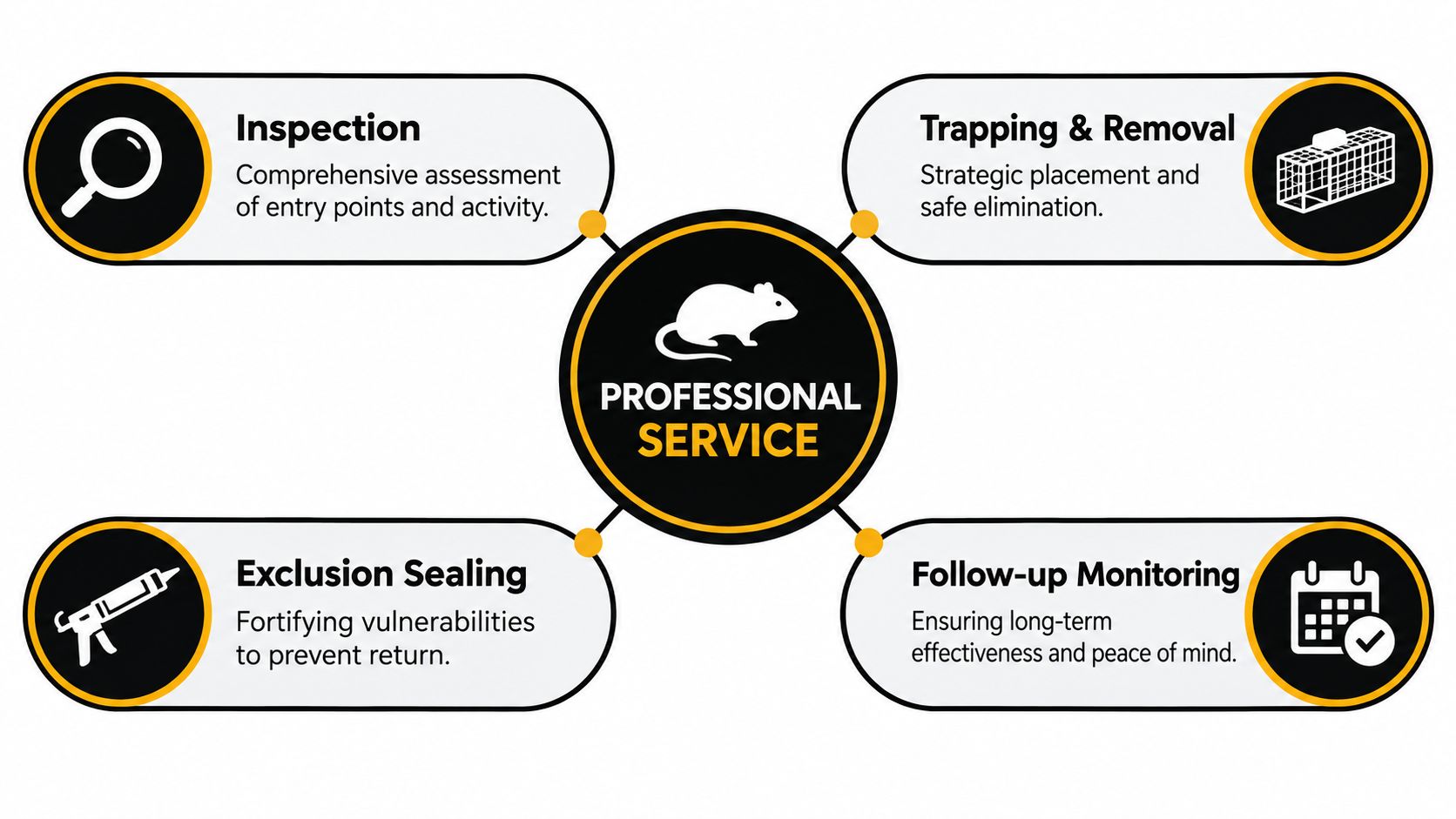
Professional rodent control is easier to understand when you treat the home like a system with a leak. First, someone has to find where water is getting in. Next, the immediate flow must stop. Then the opening needs to be repaired, and the area should be checked afterward to confirm the fix worked.
Rodent service follows the same logic. Inspection locates activity, droppings, nesting signs, and possible entry points. Trapping and removal address the rodents already inside. Exclusion sealing closes vulnerabilities around foundations, vents, doors, pipes, and roofline features. Follow-up monitoring and cleanup help confirm that the solution lasts and that contaminated areas receive appropriate attention.
Step one is finding the source
An inspection isn't just a quick look at the room where you saw a mouse. A technician may evaluate the attic, crawlspace, garage, exterior foundation, roofline, vents, and utility penetrations. Inspection charges are sometimes separate from treatment. One 2026 pricing guide lists standard pest inspections at $75 to $200, WDI reports at $75 to $150, and detailed inspections with thermal imaging at $200 to $400 (inspection pricing guide).
Removal and sealing solve different problems
Traps and bait can reduce current activity, but they don't repair the building. Exclusion uses materials and labor to close openings, which is why it often becomes the largest cost milestone. Homeowners considering a complete solution can review rodent exclusion services to understand how sealing fits into the broader treatment plan.
Follow-up turns a visit into a plan
Rodent control has increasingly shifted from one-time baiting toward prevention and maintenance. Published market guidance lists ongoing monitoring at about $50 to $120 per month for residential customers and $100 to $200 per month for commercial accounts (recurring rodent service pricing). A follow-up visit can identify new activity, check repaired areas, and determine whether conditions around the property are attracting rodents.
Cleanup matters, too. Droppings and nesting material may be present in insulation, attic spaces, or crawlspaces. A complete quote should explain whether sanitation is included, recommended, or handled as a separate remediation service.
Breaking Down Typical Rodent Control Prices by Service
A Crown Point homeowner may receive one price for trapping, then a larger recommendation after the technician checks the attic, crawlspace, roofline, and foundation. Rodent control works in tiers. Trapping reduces active animals, exclusion closes the routes they use, and cleanup addresses contamination left behind. The first quote is therefore not always the cost of completing the job.
The table uses published U.S. market ranges for planning, not guaranteed Crown Point prices. Local conditions, access, and the condition of the home determine the final scope.
| Service Component | Typical Price Range | What It Covers |
|---|---|---|
| Inspection | $75 to $200 | Standard assessment of activity and possible entry points |
| Inspection with thermal imaging | $200 to $400 | Detailed inspection methods and reporting |
| Basic trapping and baiting | About $150 to $350 | Initial control for active rodent signs |
| Typical residential rodent service | About $150 to $600 | Common treatment work, depending on scope |
| Exclusion work | About $200 to $1,000 or more | Sealing openings with labor, materials, and access requirements |
| Exclusion by linear foot | About $2 to $8 per foot, with an average near $4 per foot | Mesh and sealing work priced by the amount of vulnerable area |
| Attic or crawlspace cleanup | About $1,000 to $2,500 or more | Sanitation and related remediation for heavily affected spaces |
| Residential monitoring | About $40 to $120 per month | Recurring checks and prevention support |
| Commercial rodent control | About $500 to $3,000 or more | Larger facilities, labor, documentation, and ongoing monitoring |
Older Northwest Indiana homes can shift the price from removal toward exclusion and cleanup. Tight attic openings, low crawlspaces, layered additions, aging vents, and difficult roofline access increase labor. A technician may need more time to locate entry points, install mesh or sealant, and reach insulation or nesting material safely.
The inspection explains what was found. Trapping and baiting address current activity. Exclusion repairs the structure, so it should be evaluated separately from removal. Published guidance describes exclusion by linear foot, with material and sealing costs changing according to the opening's size and type (rodent exclusion cost per linear foot).
Why the first visit isn't always the full job
A basic visit can fit limited activity with accessible entry points. It may exclude insulation removal, contaminated-area cleanup, structural repairs, extensive exterior sealing, or later verification. Published cost guidance separates trapping, exclusion, and attic or crawlspace cleanup into different service components, rather than treating them as one flat charge (rodent control cost components).
That distinction helps explain why the cheapest first quote may not equal the total job cost. A trapping quote is reasonable when it clearly covers trapping only. It becomes confusing when a homeowner assumes it also includes permanent sealing and sanitation.
Practical rule: Compare written scopes of work, not just first-visit totals. Ask whether sealing, cleanup, follow-up visits, and warranty terms are included.
Commercial properties follow a separate pricing model. Warehouses, restaurants, offices, and multi-unit buildings usually have more service areas, storage zones, access points, documentation, and monitoring requirements than a single-family home.
Key Factors That Affect Your Rodent Control Cost
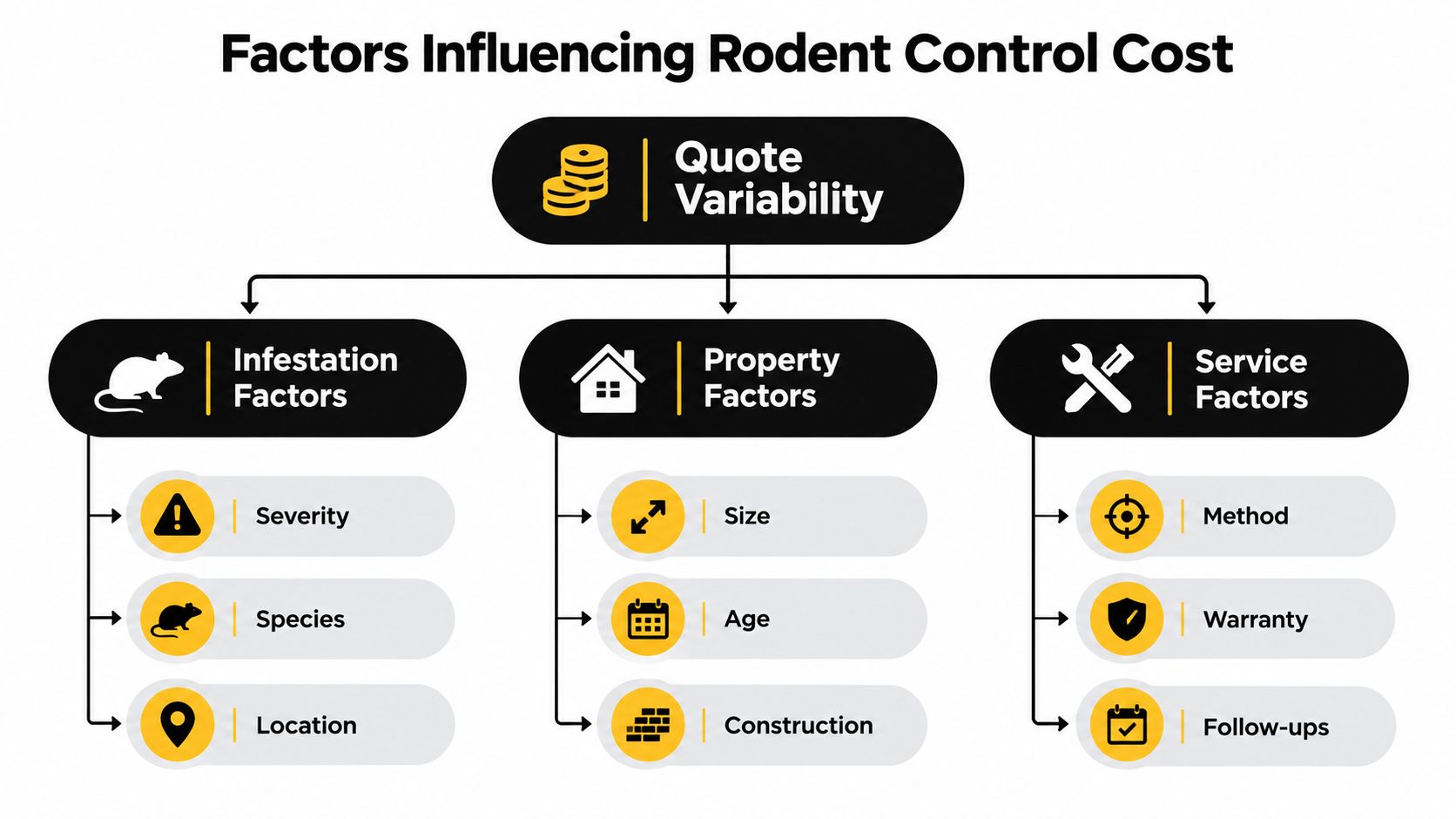
A Crown Point rodent quote increases when the technician must spend more time locating activity, reaching restricted areas, installing exclusion materials, or checking whether the work succeeded. The animal matters, but the home often determines how much labor the solution requires.
Infestation severity and rodent type
A few mouse signs in an accessible area may require less work than activity spread through an attic and wall voids. Published 2026 guidance places initial mouse jobs around $200 to $500 and rat jobs around $300 to $800 or higher (mouse and rat control cost comparison). The key pricing question is whether the visit handles visible activity only or also addresses the conditions allowing it to continue.
Location matters as much as the number of signs. A garage with an obvious access point may be easier to inspect than an attic reached through a tight opening. Insulation, nesting material, and droppings can move the recommendation from removal into cleanup or repair.
Home size, age, and construction
Larger homes may have more roofline transitions, vents, additions, garages, and utility penetrations. Older Crown Point homes can also have worn screens, gaps around pipes, deteriorated mortar, or later modifications that create several routes indoors. Each opening adds inspection time and may call for a different repair material.
A narrow gap might need one sealing material. A larger opening may require mesh, hardware cloth, or structural repair. Exclusion pricing therefore does not rise in a perfectly straight line with square footage. The shape, number, and condition of entry points matter more than size alone.
Access, entry points, and repairs
Technicians may need ladders, attic or crawlspace access, and additional exterior inspection time. Restricted access increases labor because the work takes longer and may require added safety precautions. Multiple openings around roof vents, foundation penetrations, doors, and attached structures also increase material and installation time.
Cleanup can place a project in a higher service tier. Rat activity may involve contaminated-area cleanup, insulation replacement, or repairs beyond initial control work. Published guidance describes these costs as separate factors in rodent projects (rat control cost factors).
Before the inspection, list every sign you have noticed, including sounds, odors, droppings, and locations. That information helps The Green Advantage distinguish a narrow treatment from a property-wide exclusion plan, so you can review each recommended line item and its purpose.
Comparing DIY vs Professional and Mice vs Rats Costs
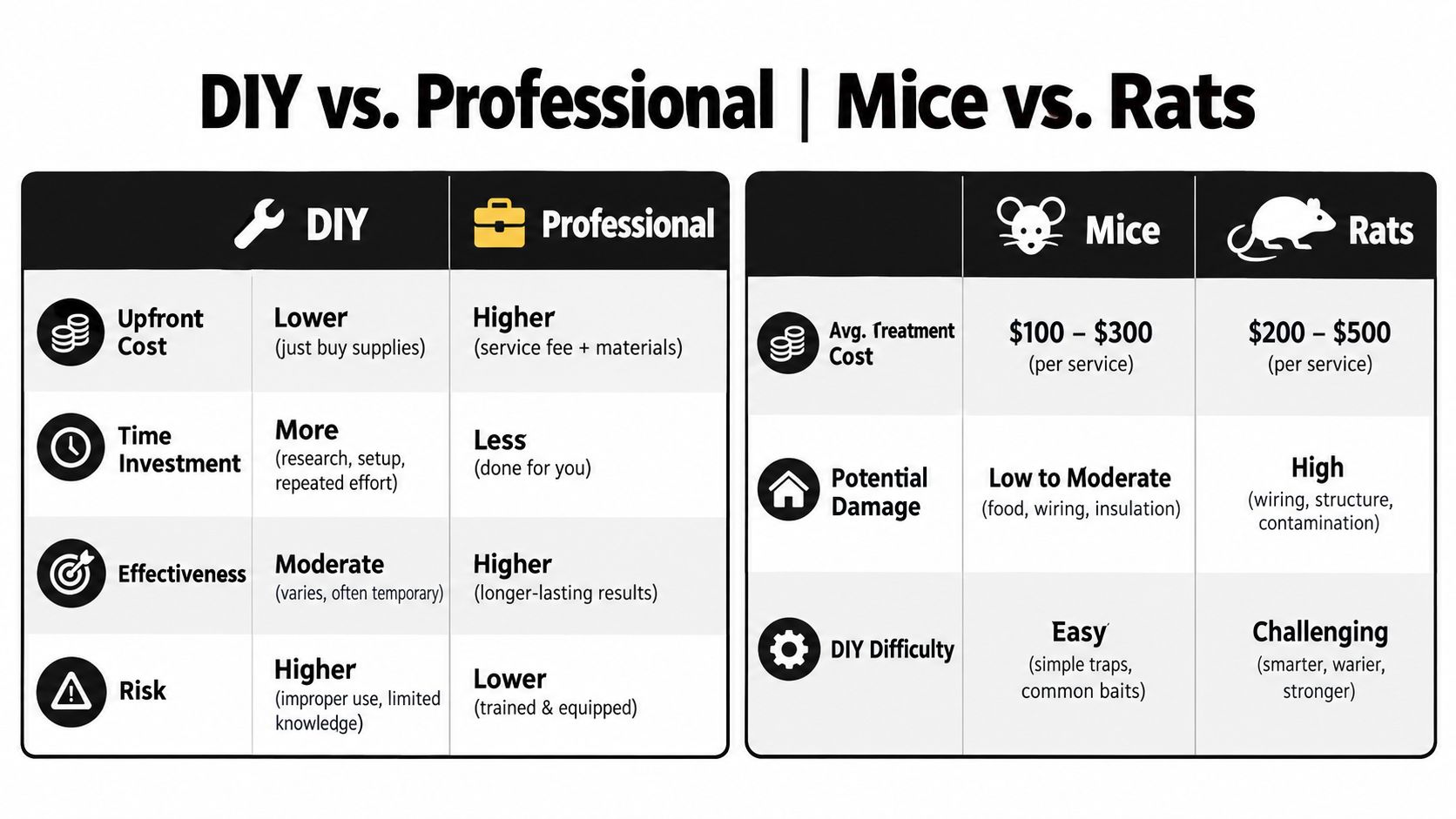
A homeowner may begin with a trap from a hardware store after hearing movement in the attic. That purchase addresses one visible part of the problem. It does not identify every entry point, confirm whether the activity is from mice or rats, monitor results, or repair openings that allow rodents back inside.
Professional service treats the work as a tiered plan. Inspection comes first, followed by trapping or other control, exclusion, and cleanup when conditions require it. This approach costs more at the beginning because labor, materials, documentation, and follow-up are included. DIY can fit a small, clearly limited issue with a safe, accessible entry point, but repeated trap purchases and incomplete sealing can make the lower first cost misleading.
A practical comparison
| Decision | Potential advantage | Common limitation |
|---|---|---|
| DIY traps and sealing | Lower immediate out-of-pocket commitment | Requires time, observation, safe handling, and accurate source identification |
| Professional treatment | One coordinated inspection and treatment plan | Higher initial price because labor, materials, and follow-up are included |
| Mouse-focused service | Often a narrower starting scope | May fail to solve the problem if exclusion is skipped |
| Rat-focused service | Addresses a more demanding pest problem | More likely to require substantial sealing, cleanup, and repairs |
Mice and rats should not share one generic budget category. As noted earlier, rat work commonly starts higher than mouse work because rats can require stronger exclusion, more difficult access, and additional cleanup or repairs. The first trapping quote is only one tier of the total project. A full exclusion plan can cost more, yet it may prevent the repeated service calls that follow when openings remain.
A recurring monitoring plan may suit a Crown Point property with repeated activity or several vulnerabilities. Published residential estimates place monitoring in a monthly service range, with the exact amount depending on visit frequency, property conditions, and what the plan includes (residential monitoring estimates). Its value comes from finding renewed activity early, before a small repair becomes a larger exclusion or cleanup project.
The choice is easier when each quote separates trapping, sealing, cleanup, repairs, and follow-up. Ask The Green Advantage which tier the recommendation covers and what would trigger additional work. This video offers a visual overview of the differences homeowners often weigh when considering rodent treatment options:
Why Professional Rodent Control Protects Your Home and Budget
The cheapest service is the one that solves the actual cause without leaving you to repeat the same purchase and repair cycle. Professional rodent control can protect wiring, insulation, stored belongings, and finished areas by addressing activity before damage spreads. It also gives homeowners a safer process for dealing with droppings and nesting material.
A complete plan supports more than comfort. Rodents can affect indoor hygiene, create odors, damage building materials, and make an attic or crawlspace unpleasant to use. Exclusion also improves the home's defenses against future entry, especially when technicians identify several small vulnerabilities rather than focusing only on the room where signs appeared.
Prevention supports broader property care
The same inspection mindset can reveal conditions connected to other pest concerns. The Green Advantage provides residential pest control, commercial pest control, pest inspections, mosquito reduction, and related services for properties in Crown Point and Northwest Indiana. Homeowners may also need ant control, termite control, spider control, wasp removal, or preventative pest treatments as seasonal conditions change.
Environmentally mindful methods should be adapted to the property and the surrounding local ecosystem. That means using the appropriate control approach, limiting unnecessary treatment, and explaining what residents should do before and after service. For readers comparing pest-management standards more broadly, this guide to trusted UK pest control companies 2026 provides additional context on evaluating providers and service quality.
Professional work also gives you a clearer record of what was inspected, what was sealed, and what still needs attention. That documentation can matter for homeowners preparing to sell, property managers coordinating maintenance, and businesses responsible for keeping their facilities in dependable condition.
What to Expect From The Green Advantage in Crown Point IN
The process should begin with a conversation, not a guess. When you contact The Green Advantage, knowledgeable office staff can gather details about the sounds, droppings, odors, locations, and timing you've observed. Sharing whether the activity is in an attic, garage, crawlspace, kitchen, or commercial area helps the team prepare for the inspection.
A technician then evaluates the property and looks for evidence of current activity and likely entry routes. The recommendation should connect those findings to a practical scope, whether that means trapping, exclusion, sanitation, monitoring, or a combination of services. You should receive a clear explanation of what the quote includes and which conditions could change the final cost.
A straightforward service experience
Expect the visit to follow a sequence like this:
- Listen and document: The team records your concerns and identifies priority areas.
- Inspect the property: The technician checks interior and exterior conditions, including accessible attic, crawlspace, garage, and foundation areas.
- Recommend the treatment: The plan may address active rodents, entry points, cleanup needs, and future monitoring.
- Explain the quote: You can ask which work is included now, what is optional, and what follow-up involves.
- Review results: Follow-up service checks activity and helps confirm that exclusion measures are working.
For homeowners who prefer environmentally mindful options, The Green Advantage also provides eco-friendly rodent control as part of its approach to property-specific pest management. The aim is to restore comfort while keeping you informed throughout the service.
If you're searching for pest control near me, an exterminator in Crown Point, IN, or help with a commercial facility, schedule an inspection before choosing a treatment based only on a low starting quote.
The Green Advantage can inspect your Crown Point home or Northwest Indiana business, explain the rodent control options, and provide a quote based on the actual property and pest activity. Visit The Green Advantage to request an inspection, ask about exclusion and follow-up service, or contact the team today.