
Most backyard mosquito barrier sprays last about 2 to 4 weeks, and the practical baseline for Crown Point homeowners is professional retreatment every 3 to 4 weeks through mosquito season. If you're hoping one spray in spring will carry you through summer, it won't. Mosquito control in Northwest Indiana is a calendar job, not a one-time fix.
You're probably reading this because the yard just turned on you. Late May hits, the kids want to be outside, the dog heads for the grass, you step onto the patio at dusk, and suddenly you're slapping your arms and ankles. That's usually when homeowners in Crown Point start asking the question. Not whether treatment works, but how long does mosquito treatment last when your yard backs up to trees, sits near retention water, or stays shady behind the fence line.
That's the part most generic mosquito articles miss. A small sunny lot behaves differently than a property with dense shrubs, damp corners, and standing water after every storm. Some treatments target adult mosquitoes resting on leaves and patio edges. Others target larvae in water. Some tools work on a service schedule. Others work continuously if they're maintained. In Crown Point, weather, vegetation, and water decide how long relief holds.
A Crown Point Homeowner's First Mosquito Treatment
Late spring in Crown Point usually starts the same way. The yard looks good, the patio furniture is out, and the first warm evenings feel like a green light to get outside again. Then the mosquitoes show up all at once.
A homeowner near a wooded lot or retention pond usually notices it first in the shaded corners. Under the deck. Around the downspout splash area. Along the back fence where the grass stays damp longer than the rest of the yard. The front lawn may feel fine, but the backyard turns into a place nobody wants to sit in after dinner.
The question homeowners actually mean
When people ask how long mosquito treatment lasts, they're usually asking something more specific.
- Will one treatment cover a party weekend?
- Will I need monthly service all summer?
- Why did the mosquitoes come back after rain?
- Is the problem my yard, or are they flying in from nearby water and brush?
Those are fair questions. They matter more in Northwest Indiana than broad national advice because local conditions swing hard. One stretch of dry weather can make a treatment feel solid. Then a wet, stormy run can make the same yard feel active again much sooner.
Practical rule: In Crown Point, don't judge a mosquito treatment by how many bugs drop the first night. Judge it by whether the yard stays comfortable through the next few weeks.
What usually drives the answer
A typical Crown Point yard has a few mosquito advantages working against it. Tree lines hold shade. Landscaping traps moisture. Birdbaths, clogged gutters, low spots, and toys left outside all create breeding pockets. Add kids, pets, and regular backyard use, and homeowners need a program that keeps pressure down consistently, not just briefly.
That's why most professional mosquito plans are built around repeat visits, not one dramatic treatment. Barrier sprays, larvicides, and traps each run on different timelines. The practical baseline stays the same. Most professional barrier sprays hold for roughly 2 to 4 weeks, so a 3 to 4 week retreatment cadence is the working schedule for most Crown Point properties through peak season.
How Mosquito Treatments Actually Work
A Crown Point mosquito treatment has one job. Break the cycle in the places mosquitoes hide and breed around your yard.
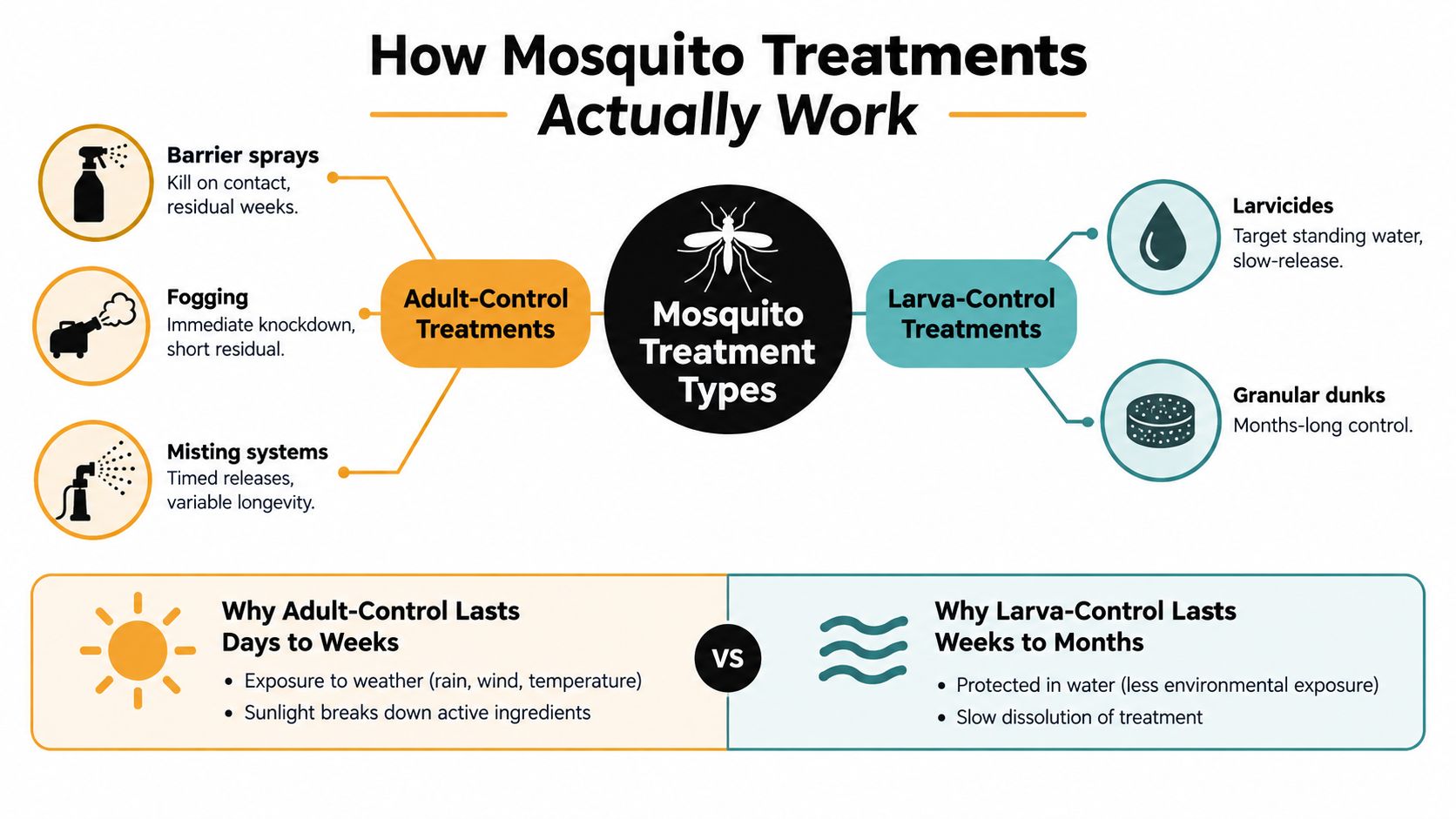
Adult-control treatments
Adult-control is what homeowners feel first. Barrier sprays and event fogging target the shaded rest zones mosquitoes use during the day, including shrubs, lower tree canopies, fence lines, dense mulch beds, and the damp edges around patios and play sets.
For most Crown Point properties, barrier spray is the main tool because it leaves a usable residue on those surfaces. That residue is what keeps working after the technician leaves. Product guidance collected in this mosquito insecticide residual overview puts common outdoor pyrethroid residuals in the general 2 to 4 week range, which matches how these treatments are usually scheduled through our local season.
Fogging is different. It drops adult numbers fast, but it is the short-window option. If you want a yard to stay comfortable through June, July, and August, a one-time knockdown is not a real plan.
Larva-control treatments
Larva-control goes after the next wave before it starts. That means treating standing water in places like catch basins, drains, low spots that stay wet, ornamental features, and any container that keeps producing larvae after rain.
This part matters more in Northwest Indiana than many homeowners expect. Crown Point yards often have exactly the kind of hidden water sources that keep pressure up between spray visits. A clean-looking yard can still have mosquito production in a gutter elbow, sump discharge area, or a stack of kids' toys holding water behind the garage.
Larvicides usually last longer than adult sprays because they are placed in the breeding site instead of exposed across foliage and hardscape. The University of Kentucky Entomology department explains that products such as methoprene and Bti are used to stop mosquitoes from developing in water and are most effective where breeding sites can be identified and treated directly, as outlined in this mosquito larval control overview.
The practical takeaway is simple. Adult treatments protect the spaces where your family spends time. Larval treatments cut down the next hatch. On many Crown Point properties, you need both if you want treatment intervals to hold the way they should.
If you want a broader public-health refresher, this guide to protecting your health is worth reading.
Comparing Mosquito Treatment Methods and How Long They Last
In Crown Point, the right question is not "Which mosquito treatment lasts the longest?" The right question is "Which treatment fits the part of the season and the kind of yard you have?"
A shaded lot near trees and fence lines needs a different plan than an open yard with standing water by the sump discharge. That is why I compare methods by job first, not by marketing claims.
What each method is actually good at
Barrier spray is the main tool for backyard use because it treats the shrubs, lower tree limbs, fence lines, and damp shade where adult mosquitoes spend the day. It is the treatment that carries a weekly or every-few-weeks service plan through the Northwest Indiana season.
Fogging is different. It is a quick adult knockdown. Use it when you want fast relief before a graduation party, cookout, or holiday weekend. Do not expect it to carry the yard for long.
Larvicides handle the source. If your property has catch basins, low wet spots, clogged gutters, or containers that keep refilling after rain, larva control usually gives you more staying power than another round of adult spray alone.
Traps and habitat changes can help, especially on larger lots or properties with steady mosquito pressure from nearby water or heavy vegetation. They are support tools. They are not the main schedule item for a typical Crown Point homeowner.
| Method | What It Best Handles | How It Fits a Crown Point Season |
|---|---|---|
| Barrier spray | Adult mosquitoes resting in shaded yard areas | Main recurring treatment from late spring through early fall |
| Fogging | Fast knockdown before events or during sudden spikes | Short-term add-on, not a full-season plan |
| Larvicides in standing water | Mosquitoes developing in water before they become biting adults | Strong support after rainy stretches and on properties with repeat water issues |
| CO2 or lure traps | Ongoing pressure reduction in specific parts of a yard | Supplemental tool for larger lots or stubborn pressure |
| Biological controls and habitat changes | Lowering mosquito pressure over time by reducing breeding and hiding areas | Works best as season-long maintenance, not a one-time fix |
The practical call is simple. If you want dependable use of the patio and backyard, start with barrier spray. If your yard keeps producing mosquitoes after rain, add larva control. If you have a one-day event, fogging can help, but it should not be mistaken for a regular program.
A published review of barrier spray research supports that general pecking order in the field, showing that outdoor residual treatments can suppress mosquito activity for a limited window while results vary by product and conditions, as outlined in this residual barrier spray review.
That matches how we schedule in Crown Point. The Green Advantage does not build mosquito service around the single longest number on a label. We build it around the local season, weather swings, and whether the property has water sources that keep refilling the yard with new mosquitoes.
What Makes Mosquito Treatments Wear Off Faster or Last Longer
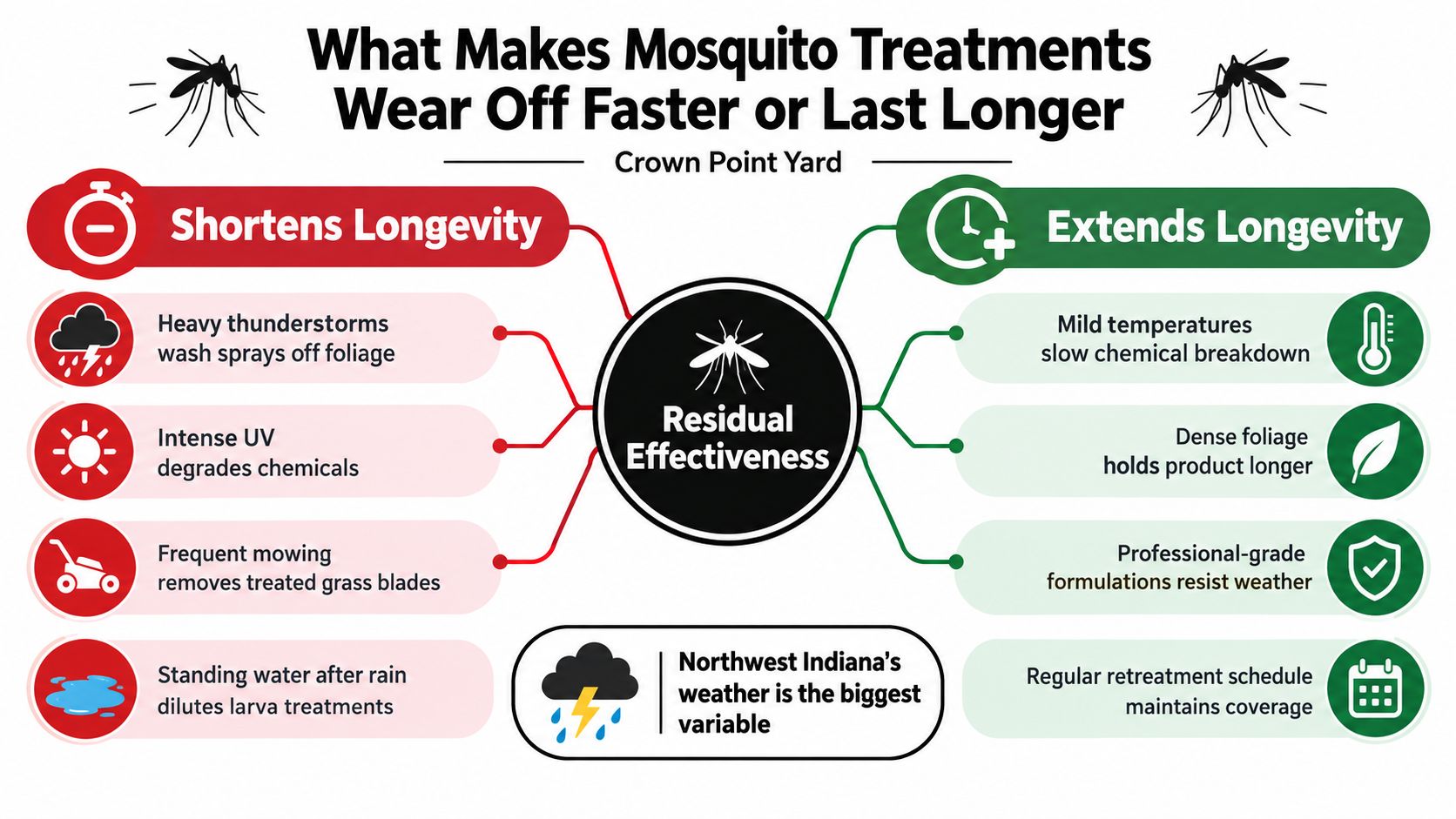
A mosquito treatment doesn't fade on a neat timer. In Crown Point, yard conditions decide a lot of the outcome.
Weather changes everything
Heavy summer rain is the first thing I look at when a homeowner says a treatment seemed short-lived. The Cass County Vector Control guidance says residual mosquito barrier sprays generally last a couple of weeks, but rain or heavy watering can shorten that effectiveness, and it recommends repeating the treatment as directed or every couple of weeks in this property mosquito spraying guidance.
Sun matters too. Hot, exposed leaf surfaces break down residue faster than shaded foliage. A south-facing shrub line usually won't hold the same way a dense, protected planting bed does.
Surface and plant type matter
Not every treated area holds product equally. A peer-reviewed summary of residual persistence points out that durability varies sharply by surface, active ingredient, and weather. It notes residual effects such as permethrin lasting up to 1 week, resmethrin about 48 hours to 1 week, and some products remaining detectable up to 2 weeks. Another paper cited there reported different persistence by target surface, with 8 to 14 days on vegetation versus 15 to 20 days on walls, according to this residual persistence summary.
That matters in real yards. Concrete patio edges, vinyl fence lines, and hard surfaces can hold differently than soft leaf tissue. Dense shrubs can protect treatment from direct exposure, but they also shelter mosquitoes. Open lawn doesn't hold mosquitoes the same way because it isn't their main daytime resting site.
Why a fresh spray can still feel weak
Sometimes the treatment didn't fail. The yard got repopulated fast.
The U.S. EPA says the mosquito life cycle typically takes about two weeks, though it can range from 4 days to as long as a month depending on conditions, in this mosquito life cycle overview. CDC material gives a similarly fast timeline of approximately 8 to 10 days from egg to adult in this CDC life cycle fact sheet.
If clogged gutters, toys, planters, ditch edges, or birdbaths keep producing new adults, a good barrier treatment can feel like it wore off before it did.
- Stormy stretches: Fresh water creates fresh breeding.
- Fast summer growth: Thickening vegetation creates more resting shelter.
- Nearby water features: New mosquitoes can keep emerging close to the yard.
A Crown Point Mosquito Treatment Calendar for the Season
The right mosquito schedule in Crown Point follows the season, not a generic national template.
What the local season usually looks like
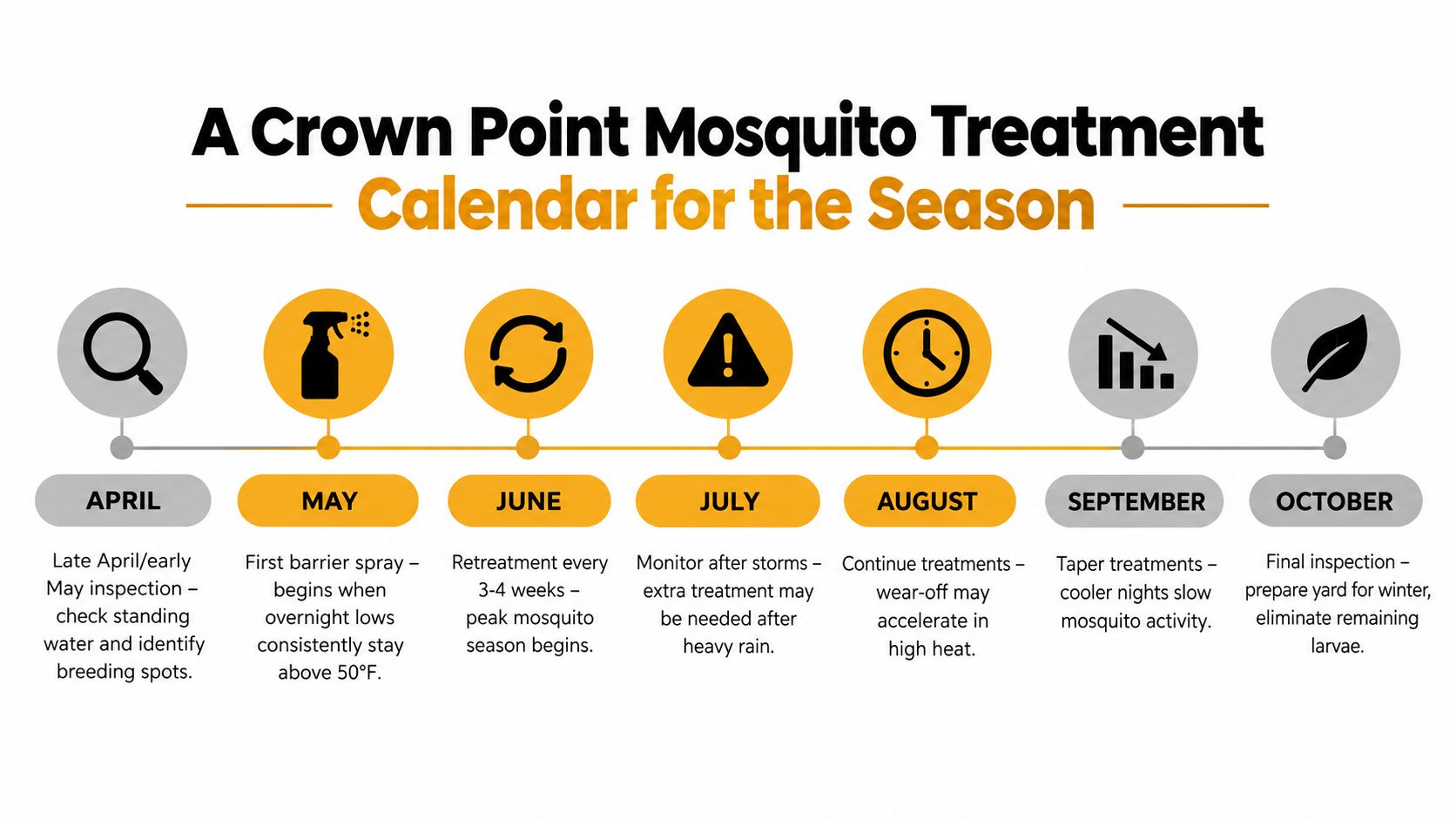
Start with an inspection in late April or early May, once overnight temperatures are staying mild and the yard starts holding moisture consistently. That's the time to check gutters, splash blocks, birdbaths, low spots, and shady edges before mosquito pressure ramps up.
The first barrier spray usually makes sense in mid-May for most Crown Point properties. From there, the practical rhythm is every 21 to 28 days through June, July, and August. That schedule tracks with the common residual window already covered above and lines up with the part of the season when backyard use peaks.
Texas A&M AgriLife Extension notes that residual sprays can suppress mosquito activity for up to a month, which is a fair upper-end benchmark when conditions cooperate, as noted in this backyard mosquito control publication.
How I'd time it in a Crown Point yard
- Late April to early May: Inspect the property and correct standing-water issues.
- Mid-May: First full-yard barrier treatment.
- June through August: Retreat every 3 to 4 weeks. Tighten the schedule after storm-heavy periods.
- September: Stay in rotation if evenings are still warm and activity remains noticeable.
- October: Consider a final visit after a wet year or on properties with lingering pressure near water and woods.
Homeowners who want a deeper local scheduling reference can review this best time to spray mosquitoes in Crown Point.
A quick visual helps if you're mapping the season around outdoor use and weather:
If you wait until the yard is miserable in July, you're already playing catch-up.
DIY Mosquito Products Versus Professional Service in Crown Point
DIY mosquito products can help around the edges. They usually don't hold up like a real service program on a Northwest Indiana property.
Where DIY usually falls short
Store-bought sprays, coils, torches, and plug-in repellents are mostly short-coverage tools. They may help for a brief stretch on a patio or during a single evening, but most homeowners don't get full-property reach. The underside of shrubs, the canopy edge, the back fence line, the area under decks, and foundation plantings are usually where coverage breaks down first.
That's the issue. Not just chemistry. Coverage.
What the side-by-side looks like
| Factor | DIY Store-Bought Products | Professional Barrier Spray Service |
|---|---|---|
| Coverage | Limited to what the homeowner can reach comfortably | Full-yard treatment of shrubs, shaded harborage, under decks, and perimeter vegetation |
| Longevity | Often feels short and inconsistent outdoors | More dependable residual window when applied thoroughly on target areas |
| Equipment | Basic sprayers, cans, foggers, or handheld products | Commercial application equipment designed for better reach and even coverage |
| Consistency | Depends on homeowner timing, weather judgment, and reapplication habits | Scheduled repeat service keeps the property on a steadier cycle |
| Water-site treatment | Usually overlooked | Can be paired with larva-control where standing water is part of the problem |
A lot of homeowners start with DIY because it seems simpler. Then they realize they're reapplying, missing hidden resting areas, and still getting bitten near the same damp corners of the lot.
For homeowners comparing options, The Green Advantage outlines its mosquito control service in Crown Point as a recurring seasonal approach rather than a one-and-done spray. That's the right framework for most local yards.
My blunt advice
Use DIY if you need a little short-term help before a cookout. Don't lean on it as your whole summer strategy if your yard has trees, shade, standing water issues, or bordering vegetation. That's when homeowners start typing pest control near me, exterminator near me, or pest control in Crown Point, IN because the store-bought approach stops being worth the time.
Practical Tips to Make Mosquito Treatment Last Longer
You can stretch the life of a mosquito treatment if you stop working against it.
What to do before and after service
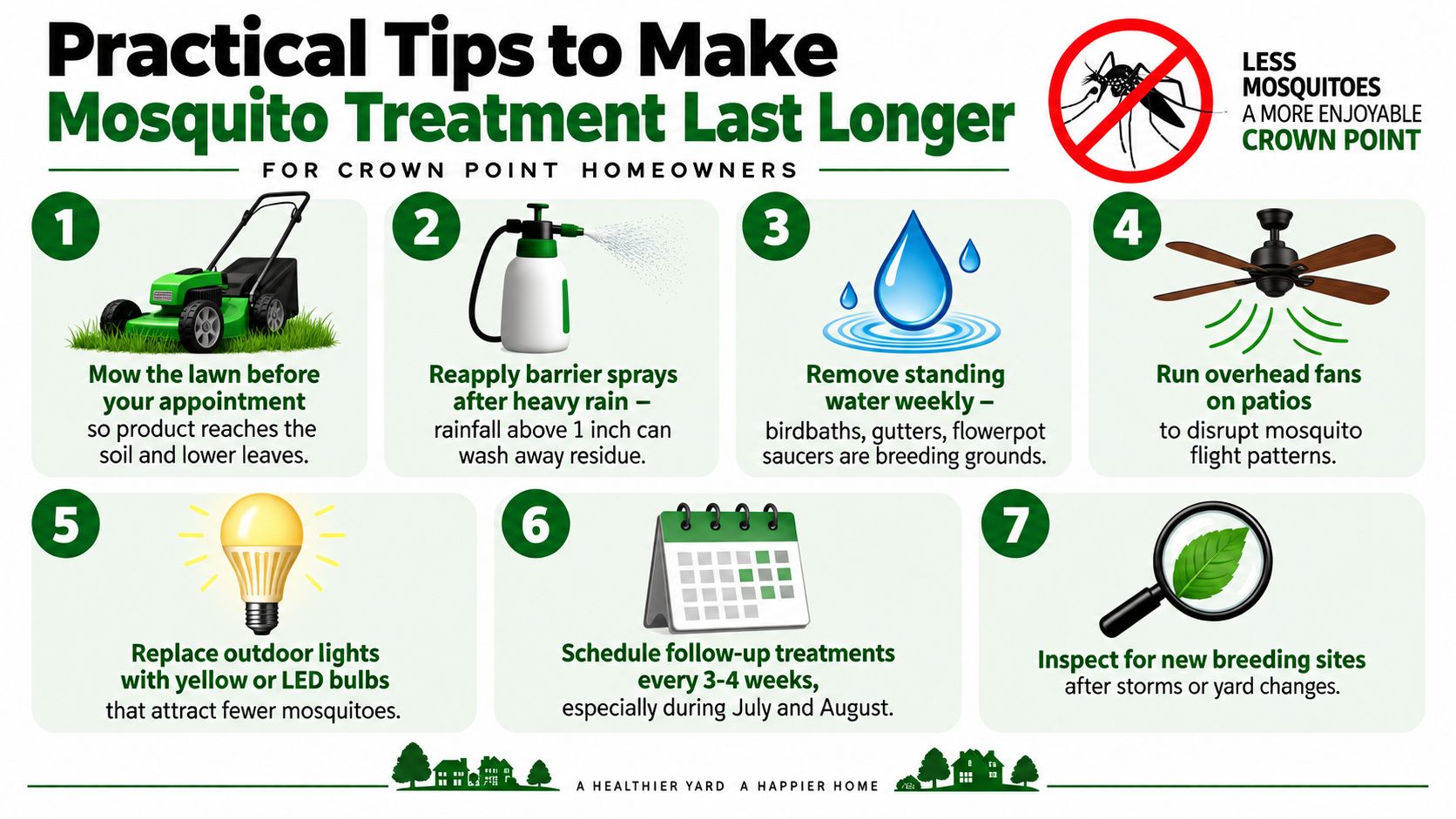
Mow before the appointment, not right after. If the grass and lower foliage are overgrown, product won't reach the zones where mosquitoes rest. Trim back thick edges around fences, decks, and landscaping beds so treatment can reach into those pockets.
Go easy on irrigation right after treatment. Heavy watering on fresh foliage shortens outdoor residual life. If you know a major rain is coming, timing matters. A treatment right before a washout won't perform the same way as one that gets a clean day to settle.
The weekly habits that matter
Here's the checklist I'd give any Crown Point homeowner trying to hold the line between visits:
- Dump standing water: Empty birdbaths, saucers, buckets, toys, and wheelbarrows every week.
- Clear the gutters: Debris-filled gutters become mosquito factories after summer storms.
- Refresh water features: Keep ornamental features moving and maintained so they don't turn stagnant.
- Use fans on porches: Air movement makes it harder for mosquitoes to work a sitting area.
- Watch the shady corners: If mosquitoes are coming back, they usually return to sheltered edges first.
Don't give mosquitoes a nursery and then blame the spray.
Skip the gimmicks
A lot of money gets wasted on gadgets that don't solve the actual problem. Ultrasonic devices, weak botanical-only fads, and random yard hacks usually don't fix a property with active breeding and heavy resting cover. Stick with methods that address vegetation, standing water, and repeat service timing.
This same practical thinking applies across other seasonal pest issues in Northwest Indiana too. Homeowners searching for residential pest control, eco-friendly pest control, rodent control, spider control, or wasp removal usually get better results when they combine treatment with cleanup and prevention instead of chasing quick fixes.
Setting Realistic Expectations and Scheduling Your Next Visit
Here's the honest version. Mosquito control works, but it doesn't create a magical mosquito-free bubble around your property.
What good service should feel like
After a solid yard treatment, most homeowners notice a drop in activity fairly quickly. The yard should feel more usable. The patio becomes tolerable again. The dog isn't getting swarmed near the fence line. The kids can play outside without constant slapping and scratching.
Then the pressure slowly rebuilds. That's normal outdoors. New adults emerge. Nearby activity shifts. Rain resets parts of the problem. By the time you're nearing the next service window, you may notice more activity in the shadiest zones first. That doesn't automatically mean the treatment failed. It usually means the schedule is doing exactly what it's supposed to do and the next visit is coming due.
Who usually needs tighter scheduling
Some properties need more attention than others.
- Larger lots with wooded edges: More resting sites and more incoming pressure.
- Homes near ponds, ditches, or retention areas: More breeding pressure nearby.
- Dense ornamental landscaping: More places for adult mosquitoes to hide.
- Commercial properties and multifamily sites: More square footage and more use patterns to protect.
That's why one homeowner searches for pest control in Crown Point, IN and needs a simple seasonal plan, while another needs a more layered program that may also touch related services like preventative pest treatments, commercial pest control, ant control, or termite control as part of broader property care.
My recommendation
If you're in Crown Point and you want the yard usable through mosquito season, plan on an early-season start and recurring visits through the peak months. Don't wait until July to think about it. Book before the season fills up, especially if your property backs to trees, holds water, or gets hammered after summer storms.
Professional mosquito service makes the most sense when you treat it like seasonal maintenance, not emergency cleanup.
If you want a practical mosquito plan built for Crown Point and nearby Northwest Indiana properties, The Green Advantage offers recurring mosquito treatments, property inspections, and broader pest support for homes and businesses dealing with seasonal pest pressure. To schedule service, request a quote, or line up a yard assessment before mosquito season peaks, visit The Green Advantage.