
If you're standing in your kitchen in Crown Point, IN, spotting a trail of ants near the sink, hearing scratching in the wall at night, or noticing wasps circling the eaves, your first search probably sounds familiar: pest control near me or exterminator in Crown Point, IN. Those searching aren't just looking for a fast appointment. They're also trying to answer a harder question. Who can I trust inside my home?
That question matters even more when the problem could affect your family, pets, walls, crawlspace, or yard. A termite issue, rodent activity, or recurring mosquito pressure isn't just annoying. It can push homeowners to hire the first company that answers the phone, without checking whether that provider is properly licensed for the work.
A pest control license isn't abstract paperwork. For homeowners in Northwest Indiana, it's one of the clearest signs that a company has met legal requirements to perform pest control for hire. It also gives you a practical way to sort through local options when you're comparing residential pest control, commercial pest control, termite treatments, rodent control, mosquito control, or wasp removal.
Finding Trusted Pest Control in Crown Point IN
A Crown Point homeowner notices droppings in the garage, then finds a chewed bag of pet food. Later that week, they see ants around the mudroom door and start wondering whether one issue turned into several. They open their phone and type in pest control in Crown Point, IN. What they really want isn't a lecture on regulations. They want to know who's qualified to help.
That same thing happens with termite concerns in older wood areas, spider activity in basements, and yellowjacket nests around decks and sheds. People want relief, but they also want to feel safe about the person applying products around children, pets, food areas, and entry points.
Why licensing comes up before treatment
When homeowners search for an exterminator near me, they're usually comparing three things at once:
- Safety: Will this treatment be applied correctly in and around the home?
- Legality: Is this company allowed to do pest control for hire in Indiana?
- Competence: Can this technician identify whether the issue is ants, rodents, termites, wasps, spiders, or something else entirely?
A license doesn't guarantee that every company communicates well or shows up on time. But it does tell you that the provider isn't just improvising. That's a big difference when you're dealing with something as sensitive as pesticide use, rodent exclusion, or preventative pest treatments.
Local rule of thumb: If you're inviting someone to treat your home, ask about licensing before you ask about price.
For local service businesses, online visibility shapes who gets that first call. If you're curious how homeowners find and compare nearby providers, this guide on how to optimize your local search with AI Tools offers a helpful look at service-area search behavior.
What homeowners in Northwest Indiana usually want to know
In plain language, property owners in Crown Point ask questions like these:
- Can they treat my specific problem? Ant control, termite control, mosquito control, rodent control, spider control, and wasp removal aren't all the same kind of work.
- Are they licensed for hire? That's different from someone spraying their own property.
- Will they explain the plan? Homeowners should understand what will be treated, where, and why.
That's where a company like The Green Advantage enters the conversation for Crown Point and nearby Northwest Indiana communities. People want a local provider that can explain licensing in regular language, inspect the problem carefully, and recommend a treatment plan that fits the actual pest issue instead of guessing.
What a Pest Control License Really Means
For a homeowner in Crown Point, a pest control license is less about paperwork and more about protection.
It tells you who is allowed to do the work, what kind of work they are qualified to handle, and which rules apply if pesticides are part of the job. That matters because pest control is not one single permission slip that covers every pest, every treatment, and every state.
In the United States, licensing works in layers. The federal government sets a baseline for certain pesticide work. The EPA says anyone who applies or supervises the use of restricted use pesticides must be certified through a state, territorial, or tribal program approved by the EPA. The agency also sets a federal minimum age of 18 for applicators seeking certification (EPA pesticide applicator certification overview).
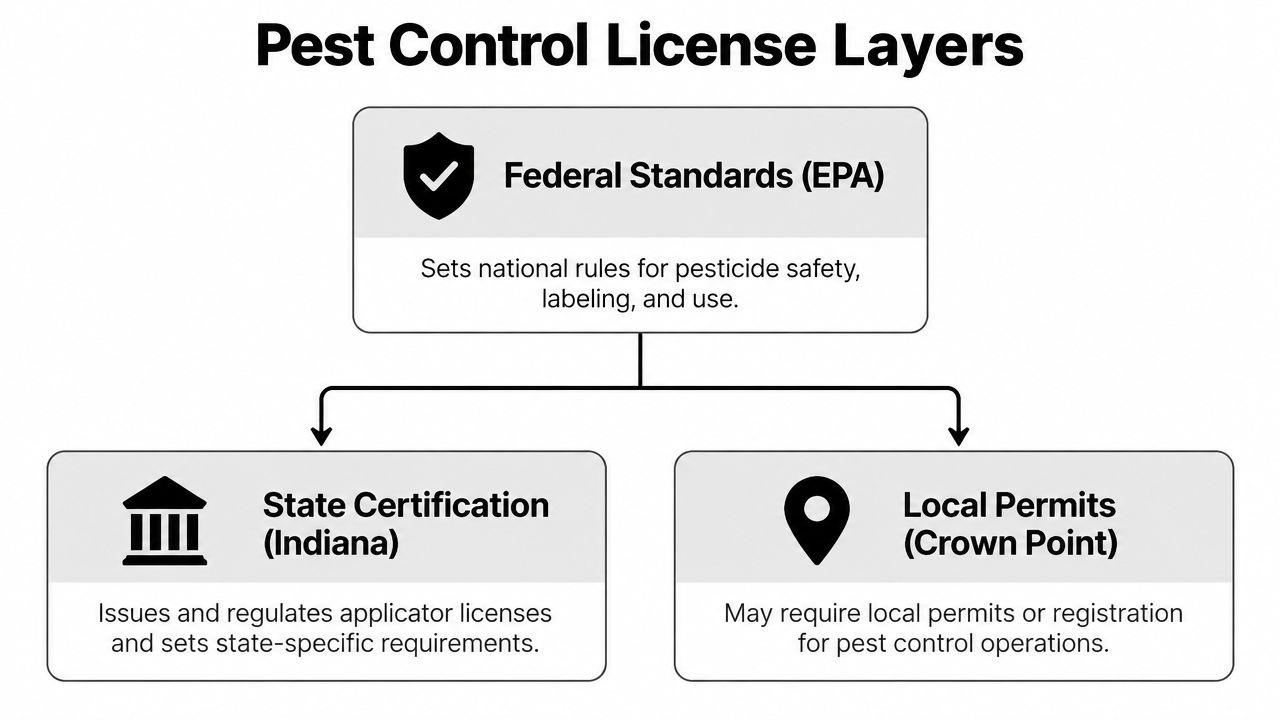
How the licensing layers work in plain language
A helpful comparison is a driver's license with added endorsements. Basic legal authority is one part. Permission for specific kinds of work is another part.
Pest control follows that same general structure. Federal rules set the floor for certain higher-risk pesticide uses. States fill in the details, including exams, service categories, renewals, and training expectations. For a family hiring help in Crown Point, that means "licensed" should connect to the actual service being done, not just to a company name on a truck.
That point clears up a common misunderstanding. A technician is not automatically qualified for every type of pest service just because they work for a pest company.
Why that matters at the kitchen table
Say you are hiring someone to address a recurring pest issue around your home. You are not just choosing a treatment. You are trusting that provider to make decisions around product use, placement, safety instructions, and follow-up.
Licensing is one of the checks built into that process.
A company working across state lines cannot rely on one universal credential. Certification has to match the state, territory, or tribal area where restricted use pesticide applications happen, and the provider has to keep up with that jurisdiction's rules and renewals (state-by-state licensing overview for pest control services).
For homeowners, the practical takeaway is simple. Licensing should fit the job. If it doesn't, that is a reason to ask more questions before work starts.
Why one license label can still mean different things
The phrase pest control license often gets used as if it means one document. In real life, it can refer to several related approvals depending on the service and the state. Some rules focus on restricted use pesticides. Others deal with operating a pest control business for hire, supervising work, or handling specific categories such as structural pests or termite-related treatments.
That structure protects homeowners in a very direct way. It helps tie the business, the applicator, and the type of service together so there is a clearer line of responsibility if something goes wrong.
For a broader look at how modern pest control companies organize service categories, records, and day-to-day operations, it helps to remember that licensing is part of the safety system, not just an office task.
Types of Pest Control Licenses Explained
Homeowners often hear several titles at once and assume they mean the same thing. They don't. One credential may apply to the business. Another may apply to the individual doing or supervising the work. In some states, there are added structural or branch-level requirements on top of pesticide certification.
The business license and the applicator aren't the same
Indiana gives a good example of why this distinction matters. State law says a person may not engage in pest control for hire on another person's property without a pesticide business license issued by the state chemist. The law also says a license is required for each unique business location or business name from which pesticides are used for hire, the annual license fee is $45, and at least one licensed applicator for hire must be associated with each licensed location (Indiana licensing summary).
That means a company can't just say, "We're in the pest business," and leave it there. The business itself has to be licensed, and the licensed location has to be connected to a qualified applicator.
Common titles homeowners may hear
Some of the most common labels include these:
- Pesticide business license means the company or location is authorized to operate for hire.
- Certified applicator usually refers to an individual who has passed required testing for specific work.
- Technician under supervision may perform certain duties depending on state rules, but not with the same independent authority as the licensed or certified person.
- Operator or structural license holder can refer to another layer used in some states for supervising services, branches, or structural pest work.
Here's the easiest way to compare them.
Common Pest Control License Types at a Glance
| License Type | Who Holds It | What It Authorizes | Homeowner Takeaway |
|---|---|---|---|
| Pesticide business license | The company or business location | Allows pest control work for hire to be offered from that location, subject to state rules | Check that the company itself is authorized to operate, not just the person who shows up |
| Certified applicator | An individual professional | Allows that person to apply or supervise pesticide work within approved categories | Ask whether the technician or supervisor is certified for the actual service you need |
| Technician under supervision | An employee working under a licensed or certified structure | May assist with service based on state requirements and supervision rules | Supervision matters. Not every employee has the same legal authority |
| Operator or structural license holder | An individual with added legal responsibility in some systems | May supervise structural pest services, office operations, categories, or branch activities depending on the state | If your issue involves structural pests, termites, or specialized treatments, extra credentials may be relevant |
| Category-specific credential | An individual tied to a pest or site category | Limits authority to particular types of application work | A mosquito technician, termite specialist, or rodent-focused provider may not all hold the same category permissions |
Practical check: When a company says "licensed," ask, "Is that the business, the applicator, or both?"
Why this helps when you're hiring
Homeowners in Crown Point can make better decisions. If you're hiring for residential pest control, you want to know whether the company is properly licensed to operate for hire and whether the person treating the property is covered for that kind of work. If you're a property manager or business owner seeking commercial pest control, that question becomes even more important because service scope can vary from office buildings to food-related environments to exterior mosquito programs.
The takeaway is simple. "Licensed" isn't one generic badge. It's a combination of business authority, individual qualification, and category fit.
How to Get a Pest Control License in Indiana
For homeowners, it helps to know what a technician had to do before ever arriving at the front door. For someone considering pest control as a career in Northwest Indiana, it also shows that this field has real entry standards.
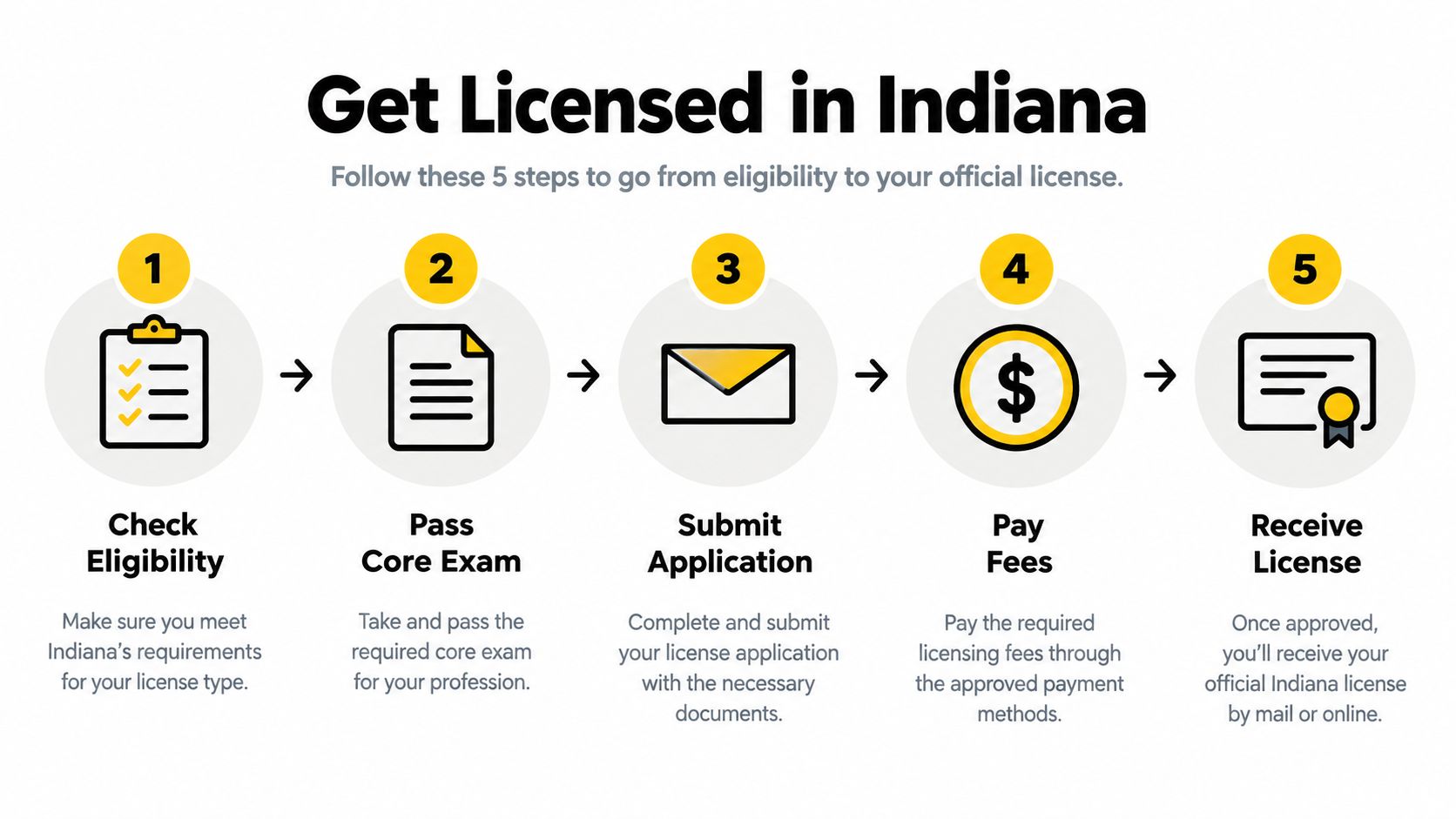
Start with legal eligibility
At the federal level, the baseline for pesticide applicator certification includes age. The EPA sets the minimum age for certification at 18 under the national framework already noted earlier in this guide. That doesn't mean every pest role starts the same way, but it does tell you the profession has a legal threshold for certified pesticide work.
The next piece is the kind of work being pursued. Pest control isn't one single lane. Some people are preparing for structural pest work. Others may be focused on categories tied to different sites or application types.
Expect two layers of testing
A common pattern in major state systems is a general or core exam plus at least one category-specific exam. California's Department of Pesticide Regulation is a clear example. Qualified Applicator Certificate and License applicants must be at least 18, submit an application and fees, and pass the Laws, Regulations, and Basic Principles exam plus at least one pest control category exam with a score of 70% or higher (California DPR qualified applicator exam overview).
North Carolina shows the same structure in another way. Its commercial certification model requires passing the Core Exam and a category exam, with the Core exam reported as 100 questions and the category exam as 50 questions in the same verified source set cited above through the California exam overview. The lesson for Indiana homeowners is straightforward. Licensing isn't just "know bugs." It tests both legal compliance and trade-specific work.
If a provider can't explain labels, laws, and category limits, that's a warning sign. Pest control isn't only about finding the insect. It's also about applying the right treatment under the right authority.
A typical path looks like this:
- Meet the baseline requirements. A person has to qualify to sit for the relevant certification track.
- Pass the core material. This covers the laws, regulations, and basic principles behind pesticide work.
- Pass the service category exam. That links the credential to the type of pest or treatment area involved.
- Apply through the state system. Paperwork and required fees have to be submitted.
- Tie the person to a licensed business operation. For-hire work doesn't stop with the individual exam result.
A short visual often helps make that process easier to follow.
Indiana adds the business side
Indiana's rules make clear that for-hire pest control isn't just about one person passing a test. The business side matters too. As noted earlier, each unique business location or business name from which pesticides are used for hire needs its own license, and each licensed location must have at least one licensed applicator for hire associated with it.
For homeowners, the process becomes reassuring. It means the state isn't only looking at the person holding the sprayer. It also expects an accountable business structure behind the service.
What this means in practical Crown Point terms
If you're comparing pest control in Crown Point, IN, ask yourself whether the company sounds like it's built around a real compliance process. A proper provider should be able to talk clearly about inspection, category fit, treatment limits, and follow-up. For example, a local service option such as The Green Advantage handles residential and commercial pest concerns with licensed and certified field work tied to specific service needs, rather than treating every infestation as the same job.
That matters whether the issue is ant control in the kitchen, termite control around structural wood, mosquito control for a yard, or rodent control involving entry-point exclusion. The path to licensure is designed to create that level of discipline before treatment starts.
Verifying a License Reciprocity and Continuing Education
A pest control license isn't "set it and forget it" paperwork. Protection for homeowners comes from the fact that credentials have to be verified, maintained, and used in the right place.
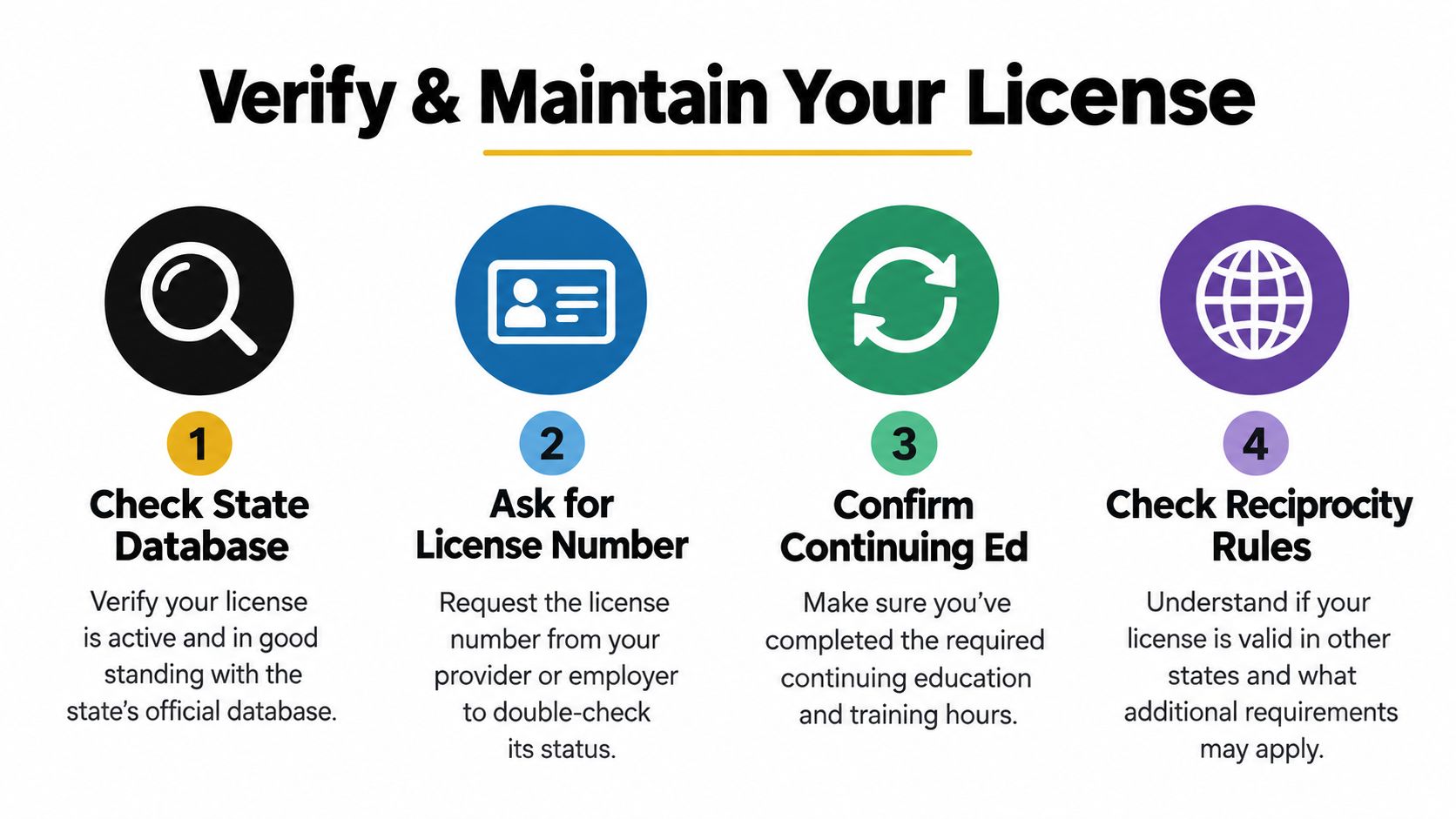
How to verify before someone treats your property
If you're hiring an exterminator in Crown Point, IN, don't feel awkward asking questions. A legitimate provider should expect them.
Use a simple checklist:
- Ask for the business license details. You want to know the company is authorized for hire in Indiana.
- Ask who the licensed applicator is. That helps separate the business authorization from the individual credential.
- Match the credential to the service. Termite work, mosquito programs, and structural pest treatments may involve different category considerations.
- Ask how records are handled. Good recordkeeping usually reflects good compliance habits.
Reciprocity isn't automatic
One of the most important protections in the system is that certification doesn't automatically follow a company everywhere. Federal rules require certification in each state, territory, or Indian country where restricted use pesticide applications are made. In plain terms, crossing a border can create a new legal requirement for the provider.
That matters in Northwest Indiana because homeowners may assume a company working in a nearby region is automatically cleared for Indiana work. It may be. It may not be. Verification removes the guesswork.
Ask a direct question: "Are you licensed for this work in Indiana, and is the person assigned to my property covered for this category?"
Why continuing education and records matter
Pest behavior changes with season, structure type, moisture issues, and product use patterns. Licensing systems address that by requiring renewals and continuing education under state frameworks. Homeowners don't need to memorize those rules. They just need to know that a current credential is better protection than relying on an old claim of experience.
Federal recordkeeping requirements also show why documentation matters. Under the EPA Indian Country certification plan, commercial applicators handling restricted use pesticide applications must keep records available for EPA inspection and copying for at least two years from the date of use, including the customer's name and address, the size of the treated area, the product brand or name, and the name and certification number of the certified applicator who made or supervised the application (EPA-related recordkeeping summary for commercial applicators).
That specific rule is tied to the Indian Country certification plan, but the broader point carries over for consumers everywhere. A provider who documents work carefully is usually taking the legal side of service seriously too.
What homeowners should look for after the first visit
Good compliance doesn't stop when the truck leaves the driveway. A responsible provider should leave you understanding what was observed, what was treated, and what follow-up steps matter. If a company can't explain what it did in plain language, that's not a technical issue. That's a trust issue.
Why Hiring a Licensed Provider Protects Your Home and Health
Licensing protects homeowners because pest control affects more than the pest. It affects where products go, how they are used, who supervises the work, and whether the person doing the treatment has legal authority to do it.
At the federal level, the EPA says any person who applies or supervises the use of restricted use pesticides must be certified in accordance with EPA regulations and state, territorial, and tribal laws. That means restricted use pesticide work isn't lawful for an unlicensed or uncertified technician (EPA certification requirement summary).
The practical homeowner benefits
When you hire a licensed provider, you're not just paying for someone to spray. You're paying for a process that should include correct identification, lawful product use, and a treatment plan that fits the site.
That matters for:
- Ant control: Different ant problems call for different placement and sanitation advice.
- Termite control: Structural wood issues need careful diagnosis because of the potential impact on the home.
- Mosquito control: Yard treatments should fit the property and outdoor use pattern.
- Rodent control: Exclusion, sanitation, and monitoring matter just as much as product choice.
- Spider control and wasp removal: Entry points, harborage areas, and nest location all affect the approach.
Why this matters in Crown Point homes and businesses
In Crown Point and nearby Northwest Indiana communities, many pest issues are seasonal or tied to moisture, construction gaps, landscaping, and changing temperatures. A licensed provider should know how to evaluate those conditions and explain the response in clear terms. That includes eco-friendly pest control options, preventative pest treatments, and service plans for both homes and commercial properties.
For readers who want a closer look at how qualified operators fit into safe, accountable service, this page on expert certified pest control operators is a useful next step.
A licensed provider protects more than the structure. They protect the decision-making behind the treatment.
What to Expect From The Green Advantage in Crown Point IN
When a homeowner or business owner reaches out for pest control in Crown Point, IN, the experience should feel steady from the first call forward. You should be able to describe what you're seeing, ask questions, and get clear direction on what happens next.
A straightforward local service experience
The first step is usually a conversation about the pest problem, where it's happening, and how urgent it feels. From there, the property can be inspected to determine whether you're dealing with ants, rodents, spiders, wasps, termites, mosquitoes, or a combination of issues. That inspection matters because visible activity doesn't always show the full source of the problem.
After that, the treatment plan should be explained in plain language. Homeowners deserve to understand where service will focus, what preventive steps may help, and whether follow-up is recommended. That's especially important for recurring seasonal pest issues and ongoing residential pest control or commercial pest control needs in Northwest Indiana.
Why local knowledge changes the outcome
A provider serving Crown Point needs to understand more than labels and products. Local weather swings, yard layouts, crawlspaces, garages, drainage patterns, and neighborhood building styles all affect how pest pressure shows up. That's one reason local service can feel more practical than generic national messaging.
If you'd like more background on the company's service approach and community focus, this page on why homeowners choose The Green Advantage for pest control needs gives a fuller picture.
When the process is handled well, licensing becomes more than a legal box being checked. It becomes part of a cleaner inspection, a more careful treatment, and better communication from start to finish.
If you need help with ants, rodents, termites, mosquitoes, spiders, or wasps in Crown Point or nearby Northwest Indiana, The Green Advantage offers licensed pest control backed by clear communication and site-specific treatment planning. If you'd like a professional inspection or a quote, visit The Green Advantage and take the next step with a local team that treats licensing as part of protecting your home, health, and peace of mind.