
Can Pest Control Get Rid of Rats? Expert Solutions 2026

Yes, pest control can get rid of rats, but lasting control usually takes more than traps or bait alone. Rats can enter through openings greater than 1/2 inch, and removed rats can be replaced by new ones within about 4 weeks if the home isn't sealed and cleaned up, so the permanent fix is a professional plan that combines removal, exclusion, sanitation, and follow-up.
If you're hearing scratching in the walls at night, finding droppings in the garage, or noticing something got into pet food, your concern is justified. Rat problems feel personal fast. They affect how safe your home feels, how comfortably you sleep, and whether you trust what's happening behind the walls.
In Crown Point and nearby Northwest Indiana communities, the answer to "can pest control get rid of rats" isn't just yes. It's yes, if the job is done completely. A few traps in the attic might catch some activity. They won't solve the reason the rats got in, why they stayed, or what will bring the next group back.
Answering Your Rat Concerns in Crown Point IN
Homeowners usually call about rats after the problem has already crossed a line. They hear movement overhead. They find droppings under the sink. They smell something stale in a crawl space or utility area. At that point, homeowners want one thing. They want the rats gone, and they want to know they aren't coming right back.
That's a reasonable expectation, but the method matters. Professional rat control works when it treats the infestation as both a population problem and a building problem. If you only remove rats, you get temporary relief. If you remove rats and block access, you give your home a real chance to stay clear.
What homeowners usually mean by get rid of rats
Homeowners aren't asking whether a trap can catch a rat. They're asking whether their house can be made safe again. They want the noise gone, the contamination cleaned up, the risk reduced, and the repeat problem prevented.
That's where professional service separates itself from trial-and-error DIY work.
Practical rule: If the plan doesn't include entry-point sealing and cleanup guidance, it isn't a permanent rat solution.
A complete rat control strategy usually includes:
- Inspection of active areas so the technician can identify travel routes, nesting zones, and structural gaps.
- Targeted population reduction using the right devices in the right locations, rather than random trap placement.
- Exclusion work to close off access points around the structure.
- Sanitation and habitat correction so rats have less reason to stay near the property.
- Monitoring and follow-up to confirm the problem is resolved.
Why local experience matters in Crown Point
Northwest Indiana properties present a mix of conditions that make rodent control more than a one-visit service. Older homes may have settled gaps, worn door sweeps, or utility penetrations that open over time. Newer construction can still leave hidden voids, unfinished transitions, or landscaping that gives rodents cover close to the house.
That's why homeowners looking for pest control near me, exterminator near me, or pest control in Crown Point, IN should ask a simple question before hiring anyone. Are they just removing rats, or are they solving the access and attractant issues too?
The right answer should reassure you. Rat control can work. It just has to be thorough.
The Reality of Rat Infestations in Northwest Indiana
Rats are persistent because our homes give them exactly what they need. Warm shelter, hidden voids, accessible food, and quiet travel routes around foundations, garages, crawl spaces, and rooflines. In Crown Point and nearby Northwest Indiana areas, seasonal weather shifts also push rodents toward structures when outdoor conditions get harder.
A rat problem is never just about seeing one animal. It's about what that activity means for the property. Rats contaminate spaces they travel through, chew materials they encounter, and settle where people rarely look until damage is already underway.
Why infestations keep returning
The biggest mistake homeowners make is assuming visible rat activity is the entire problem. It usually isn't. The larger issue is that many properties stay open to reinfestation.
Guidance summarized in the verified data notes a key reality for areas like Northwest Indiana. Even after a major reduction in activity, reinfestation can happen quickly from nearby outside populations if owners don't seal openings larger than 1/2 inch and remove exterior food sources. That same verified data also states that IPM-focused service reduces long-term regression by 40% compared with bait-only approaches.
In plain language, that means a bait-only fix can leave the door open for the next wave.
If you're seeing droppings, rub marks, gnawing, or nighttime sounds, it helps to compare those clues with common signs of rodent infestation before the issue spreads deeper into the structure.
What rats damage inside a home
The visible mess is only part of it. The more serious concern is what happens out of sight.
| Problem area | What homeowners often notice |
|---|---|
| Attics and wall voids | Scratching sounds, disturbed insulation, odor |
| Kitchens and pantries | Droppings, gnawed packaging, contamination |
| Garages and storage areas | Shredded materials, activity along edges and corners |
| Utility zones | Chewing on soft materials around lines and openings |
Rats don't need a dramatic opening or a large nest site. They need a repeatable route, a food source, and enough cover to move unnoticed.
Why DIY usually stalls out
Store-bought traps can remove individual rats. They rarely correct the conditions that made the infestation possible. Homeowners also tend to place traps where it feels logical to them, not where rodents travel.
Rats are cautious around new objects. That hesitation is one reason control isn't instant, and it's one reason scattered DIY efforts often produce inconsistent results. In rodent work, speed matters less than precision.
How Professional Pest Control Gets Rid of Rats for Good
Long-term rat control follows a system. The most reliable model is Integrated Pest Management, usually shortened to IPM. That approach combines inspection, proofing, sanitation, and targeted removal instead of relying on poison or traps alone.
Here's the process at a glance.
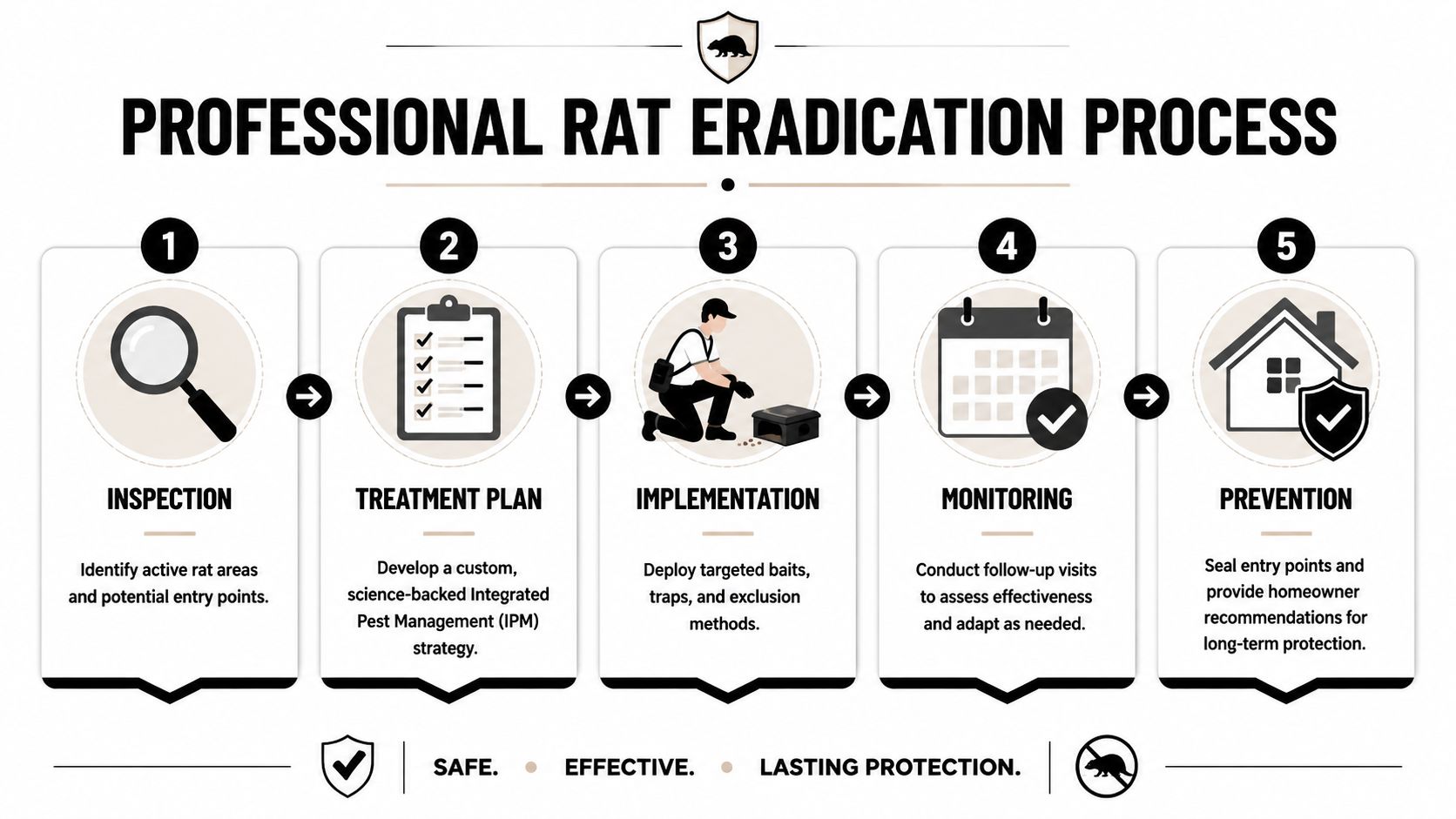
Inspection comes first
A technician starts by finding out where rats are active, how they're getting in, and what is sustaining them. That means checking foundations, garage edges, roof transitions, vents, utility entries, crawl spaces, attics, and exterior conditions that may support nesting or travel.
Many failed treatments fall apart due to the following reason. If nobody identifies the actual access points, the service only addresses symptoms.
Industry guidance supports that approach. professional rat control guidance notes that rats can enter through openings greater than 1/2 inch and emphasizes exclusion, sanitation, vegetation management, clutter removal, and traps as part of a customized plan.
Exclusion is what makes it last
Removing rats without sealing the building is temporary. Proofing is what turns a treatment into a long-term solution.
Texas A&M IPM guidance states that effective rodent control requires sanitation, structural exclusion, and population control together, and it recommends sealing openings larger than 1/4 inch in areas such as foundations, walls, fascia, and roofs, along with screening vents and installing door sweeps. That same guidance also notes that traps work best when placed along runways with the trigger side against the wall.
That's the difference between random placement and professional placement.
A rat program starts working faster when the house stops functioning like a shelter.
A complete proofing plan may include:
- Sealing gaps at utility penetrations where pipes or lines pass through walls
- Correcting door and garage thresholds that leave space at the bottom edge
- Screening vulnerable vent openings with durable materials
- Cutting back heavy vegetation and clutter that give rodents protected travel lanes
For homeowners searching for residential pest control or exterminator in Crown Point, IN, this is the part to ask about in detail.
The Green Advantage provides rodent control service in Crown Point and surrounding Northwest Indiana with that broader inspection-and-exclusion focus, rather than treating rodent activity like a simple trap placement problem.
After the inspection and proofing discussion, it helps to see the process in action.
Removal and monitoring finish the job
Once access and attractants are addressed, targeted traps or bait stations can do their job more effectively. Devices are placed where rats already travel, not out in the middle of open spaces where they're more likely to avoid them.
Monitoring matters because rat control is rarely instant. Activity usually declines in stages. A technician checks what's working, adjusts placements, confirms whether entry points remain secure, and decides whether more follow-up is needed.
That steady, methodical approach is how professional pest control gets rid of rats for good.
Your Rat Control Service What to Expect
Most homeowners feel better once they know what the process looks like. Rat work should feel organized, not mysterious. You should know what happens first, what happens next, and why the issue may take more than one visit to close out properly.
The first contact usually starts with symptoms. You describe noises in the attic, droppings in the pantry, activity in the garage, or concern around a crawl space. From there, the appointment focuses on confirming the level of activity, identifying likely access points, and mapping out a practical treatment plan.
The first visit
The first service is about diagnosis and action. The technician inspects the problem areas, looks for entry routes, checks for conditions that support rats, and determines where control devices should go.
Some homes need immediate population reduction. Others reveal a clear structural issue first, such as an unsealed utility line opening, a worn sweep, or a vent that needs attention. Good rodent work isn't one-size-fits-all.
Here's what a homeowner can usually expect during that stage:
- A detailed walkthrough of active and vulnerable areas.
- An explanation of findings in plain language, without guesswork.
- A treatment recommendation that balances removal with exclusion and cleanup priorities.
- Clear next steps so you know what changes should happen between visits.
The goal of the first appointment isn't to create the appearance of action. It's to start the right sequence of action.
Why follow-up isn't optional
One of the most important facts homeowners should understand comes from a large field study on rat control. That study found short-term reductions in rat activity with professional control methods, but it found no evidence of a longer-term effect on rodent abundance in houses versus untreated sites unless prevention and follow-up were part of the process. Researchers also concluded that removed rats tend to be replaced by incoming rats within about 4 weeks and reported that after 5 months of intermittent control there was no evidence of increased reproduction in treated in-house populations, reinforcing that the core issue is replacement from outside rather than a simple rebound inside the same home. You can review that study in the Madagascar field research on rat control outcomes.
That finding lines up with what technicians see in the field. If a home remains accessible, surrounding rat pressure can refill the vacancy.
What success looks like
Success doesn't always mean every sign disappears overnight. It means the pattern changes in the right direction. Noise drops off. Fresh droppings stop appearing. Devices show declining activity. Exterior vulnerabilities are corrected. Follow-up confirms the house is no longer easy to enter.
For commercial pest control accounts, rentals, and occupied homes, communication matters just as much as treatment. Property owners need realistic timelines, practical housekeeping guidance, and a clear understanding of what has been corrected and what still needs attention.
That's how you turn a stressful rodent problem into a controlled process.
Protecting Your Home Beyond Rodent Control
A rat entry point is usually more than a rat issue. The same gaps around doors, vents, siding lines, and utility penetrations can also invite ants, spiders, and other pests that show up throughout the year in Northwest Indiana. When a home gets tighter and cleaner from a rodent exclusion project, the benefit often extends well beyond rodents.
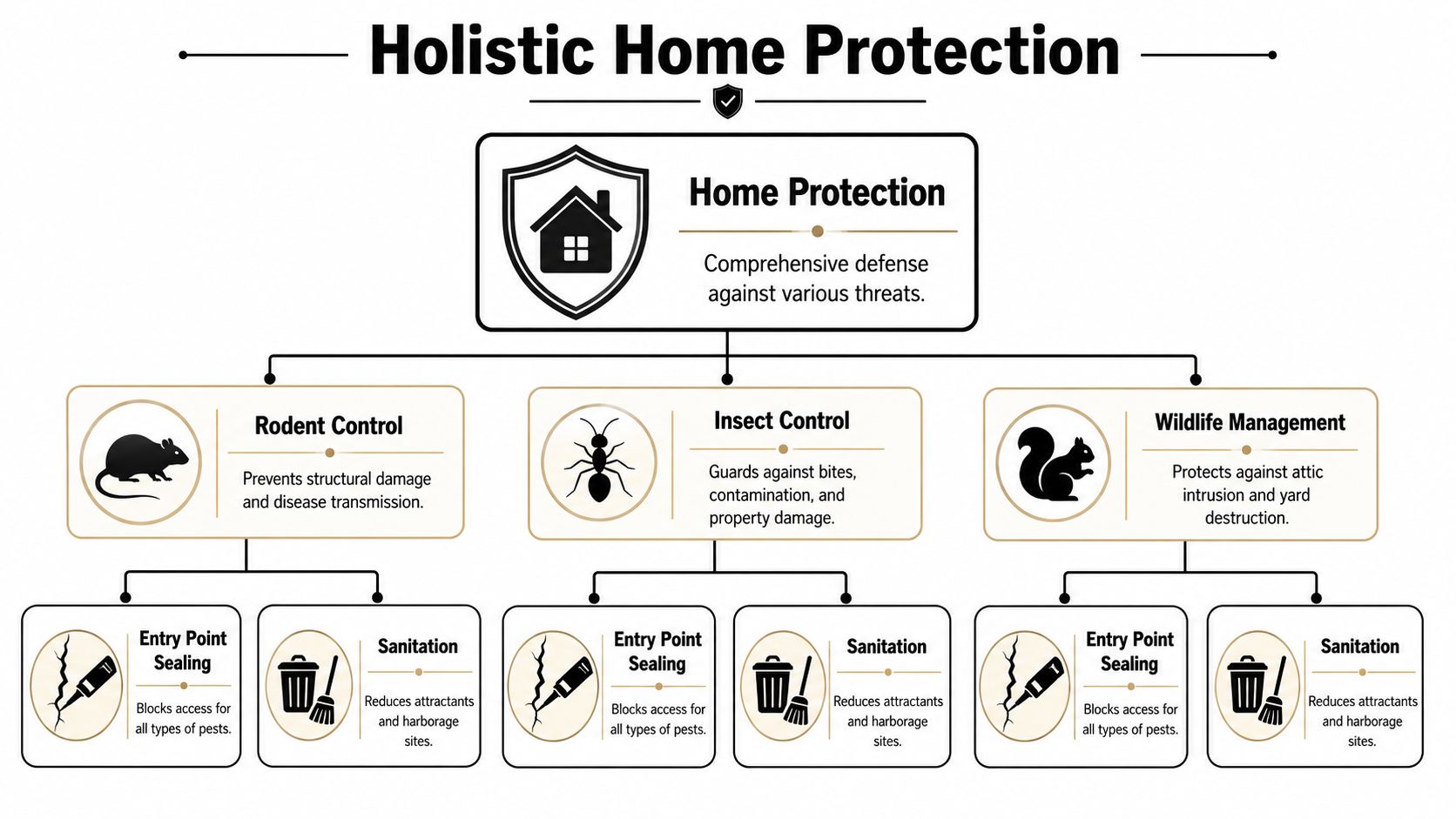
That's why smart pest management isn't just about solving the urgent problem in front of you. It's about reducing the property conditions that attract multiple pest types at once.
Exclusion helps more than one pest category
Verified data for this article includes an important point for homeowners with kids or pets. Emerging data from 2025 shows that exclusion-based methods such as sealing cracks and installing door sweeps prevent 65% of new infestations without poison. That's especially relevant for families who want a more environmentally mindful path and want to understand the role of proofing, not just products.
If you want to learn more about that style of service, this page on eco-friendly rodent control is useful background.
A broader protection plan may include:
- Rodent exclusion to block attic, crawl space, garage, and wall access
- General pest prevention for seasonal invaders such as ants, spiders, and wasps
- Moisture and structure awareness because damp or neglected spaces often support repeat pest pressure
- Yard and perimeter management to reduce sheltered movement close to the home
Crawl spaces and hidden conditions matter
Rodent issues often overlap with moisture, insulation, and air-quality concerns in lower parts of the house. That's one reason homeowners exploring long-term prevention often also look into why crawl space encapsulation matters. A cleaner, drier, better-sealed crawl space can remove shelter conditions that attract pests and make future inspections easier.
The strongest pest barrier usually isn't a product. It's a house that no longer offers easy food, water, and access.
One property plan is better than separate reactions
A homeowner who fixes a rat problem but ignores exterior clutter, unsecured trash, standing moisture, or foundation gaps may end up calling again for a different pest a few months later. A coordinated protection strategy is more efficient. It protects property value, reduces repeat disruptions, and gives you a clearer standard for what “under control” means.
That same thinking applies whether you need rodent control, mosquito control, spider control, or help evaluating a commercial facility. Prevention doesn't just reduce pests. It reduces uncertainty.
Partner with The Green Advantage for a Pest-Free Home
The answer to "can pest control get rid of rats" is yes, but the permanent answer is never just about killing or trapping what you see. It's about closing entry points, reducing attractants, monitoring results, and making the structure harder to invade again.
That matters in Crown Point because homes and businesses here face ongoing pest pressure from changing weather, surrounding habitat, and the simple fact that rodents look for the easiest shelter available. If one property gets cleaned out but stays open, the problem can restart. If the property gets sealed and managed correctly, the odds shift in the homeowner's favor.

Choose a complete solution, not a temporary fix
Whether you're dealing with rats now or trying to prevent the next infestation, look for a service approach that includes inspection, exclusion, sanitation guidance, and follow-up. That same mindset often helps homeowners spot related repair needs too. For example, if rodent activity has led to staining, moisture concerns, or damage around upper levels of the home, these Restore Heroes' ceiling repair tips can help you understand what to check next.
For homeowners searching pest control near me, pest control in Crown Point, IN, or exterminator near me, the right next step is simple. Get the property inspected before the problem spreads deeper into walls, insulation, stored items, or utility areas.
A thorough rat control plan protects more than the house. It protects how you live in it. It helps your family feel comfortable again, lowers the chance of repeat contamination, and gives you a path toward real peace of mind instead of temporary relief.
If you need help with rat control, residential pest control, or commercial pest control in Crown Point and nearby Northwest Indiana communities, contact The Green Advantage to schedule an inspection or request a quote. A clear plan, honest findings, and a long-term prevention strategy can turn a stressful rodent issue into a fixable one.
Effective Pest Control for Rats in Crown Point, IN

You hear scratching after dark. It's faint at first, then louder the next night. Maybe it's above the ceiling, maybe inside a wall, maybe near the basement rim joist. By morning, you're checking the pantry, looking behind storage bins, and wondering whether you've got one rat or a bigger problem.
That kind of uncertainty is what makes rat issues so stressful in Crown Point homes. People usually don't call because they saw a whole colony in broad daylight. They call because something feels off. A smell they can't place. Pet food disturbed overnight. A noise in the attic when the house is finally quiet.
Pest control for rats works best when the response is calm, methodical, and focused on the whole property instead of one trap in one room. In Northwest Indiana, rats take advantage of shelter, food, clutter, roof access, and tiny structural openings that most homeowners would never notice. Lasting control means finding all of that, correcting it, and then staying ahead of the next intrusion.
Your Guide to Effective Rat Control in Crown Point
A common Crown Point call starts with a small sign that is easy to explain away. Scratching after dark. A few droppings in the garage. Something pushed aside near pet food. Then the pattern builds, and the concern shifts from nuisance to damage, sanitation, and whether rats have already settled into the house.
That concern is justified. Rats contaminate storage areas, chew wiring and wood, and use hidden parts of a home that many people never inspect until the activity is established. In Northwest Indiana, the problem also changes with the season. As temperatures drop, rats press harder into attics, basements, crawl spaces, and attached garages. In warmer months, they often stay closer to exterior cover, sheds, wood piles, and foundation entry points before working their way inside.
People often focus on the room where they heard noise. That rarely solves the whole problem.
Why people miss the source
The rat near the pantry or kitchen is often just the visible part of a larger access issue. Entry usually starts outside, then extends into wall voids, insulation, storage zones, or utility penetrations that do not get much attention during day-to-day home maintenance.
In Crown Point homes, I see the same missed areas again and again:
- Exterior openings: gaps at rooflines, soffits, vents, siding transitions, utility lines, garage door corners, and foundation penetrations
- Food sources: bird seed, pet food, trash, grease residue, pantry spills, fallen fruit, and poorly sealed storage
- Harborage areas: crawl spaces, attic insulation, stacked materials, dense vegetation, sheds, and cluttered garage edges
Rats follow cover, routine, and easy access. If one part of that chain stays in place, trapping alone usually gives temporary relief.
Homeowners searching for common signs of a rodent infestation are usually trying to answer one practical question fast. Is this a one-time scare, or the start of a larger problem? The answer depends on the full property, not just the spot where activity was first noticed.
What reliable pest control for rats looks like
Effective rat control in Crown Point means handling the whole cycle. Inspection comes first. Then containment and removal. After that, the work that DIY guides often skip matters most. Sealing entry points, correcting sanitation issues, and checking whether the property still gives rats a safe route back in.
That is the difference between a short-term catch and a lasting result.
A sound service plan should include careful inspection, targeted trapping or baiting where appropriate, structural exclusion, cleanup guidance, and follow-up. It should also reflect how homes in Northwest Indiana are built and used. Attics over attached garages, older foundation gaps, crawl spaces, and roof-edge transitions all create hiding and travel routes that are easy to miss without experience.
The Green Advantage approaches rat control that way. Find how the rats are living on the property, remove the active population, close the openings they are using, and put a prevention plan in place so the same problem does not return with the next cold snap.
Identifying a Rat Problem in Your Indiana Home
Most homeowners don't confirm a rat issue by seeing a rat. They confirm it by seeing evidence. If you know what to look for, you can usually tell the difference between a one-time scare and an active problem that needs attention.

The signs that matter most
Start with the areas rats like to use without being disturbed. In Crown Point homes, that often means attics, basements, crawl spaces, garages, utility rooms, behind appliances, and along exterior-facing walls.
Look for:
- Droppings: small, dark pellets near stored food, along walls, under sinks, behind boxes, or around basement edges.
- Gnaw marks: chewed wood, cardboard, plastic, weather stripping, or wiring insulation.
- Rub marks: greasy streaks along baseboards, beams, or common travel paths where rats repeatedly brush past surfaces.
- Nesting material: shredded paper, insulation, fabric, dried plant matter, or soft debris gathered in hidden spaces.
- Noises: scratching, scurrying, or movement in walls, ceilings, attics, or under floors, especially at night.
One clue by itself can be misleading. Several clues together usually point to an active rodent issue.
Where Crown Point homeowners often overlook activity
A lot of inspections stop too early. People check the kitchen and pantry, then assume they've covered the risk. Rats often spend more time in transition areas than open living space.
Check these spots carefully:
- Garage corners and storage shelves where pet food, bird seed, and cardboard are kept.
- Basement rim joists and utility penetrations where pipes and lines enter the house.
- Attic edges and insulation runs near soffits, vents, and roof intersections.
- Behind appliances where heat, crumbs, and darkness come together.
- Outdoor edges near sheds, wood piles, heavy ivy, and overgrown landscaping.
UC IPM states that successful rat control usually requires sanitation, structural exclusion, and population control, and it specifically notes that environmental features like dense ivy and tree limbs near the roof can act like travel routes that keep a property attractive to reinfestation (UC IPM guidance on rats).
Practical rule: If you find signs indoors, inspect the exterior the same day. Rats almost always have a route, not just a hiding spot.
If you want a deeper checklist of what active rodent evidence looks like, this guide to signs of rodent infestation helps homeowners compare what they're seeing with common warning signs.
What not to assume
Don't assume silence means the problem is gone. Don't assume one trapped rat means there was only one. And don't assume a clean kitchen means the house isn't vulnerable.
Rats exploit shelter and access as much as food. That's why a neat home can still have a rodent problem if the exterior conditions and structural openings are right.
Immediate Safety and Containment Steps You Can Take
Once you suspect rats, take simple containment steps right away. These won't solve the infestation, but they can reduce risk and keep the problem from getting worse before treatment begins.
Start with food and access inside the home
Secure anything edible. Move pantry goods, pet food, bird seed, and bulk ingredients into hard containers with tight-fitting lids. Clean up crumbs, grease, and spills the same day, especially in kitchens, basements, and garages.
Then reduce easy interior movement:
- Pull storage away from walls: this makes signs easier to spot and removes hidden runways.
- Limit clutter on floors: rats prefer protected edges and covered spaces.
- Close off sensitive areas: if you suspect activity in a utility room, attic access point, or pantry, keep children and pets out until it's assessed.
Handle droppings and contaminated areas carefully
Avoid direct contact with rats, nests, or droppings. Don't sweep or vacuum contaminated material dry. That can stir particles into the air and spread contamination through the room.
Use gloves if you need to handle nearby items, and keep the area isolated until proper cleanup can be done. If there's heavy activity in one section of the home, it's better to leave that area alone than to disturb nesting or chase rodents deeper into the structure.
If you can hear rats but haven't identified the route yet, focus on safety first. Don't start tearing into walls, pulling insulation, or stuffing random materials into openings you haven't traced.
Temporary steps that help, and ones that don't
A few actions can buy you time:
- Helpful: store food securely, remove standing water, pick up pet dishes at night, and keep trash tightly closed.
- Not helpful: scattering poison without a plan, sealing active holes from the inside without inspection, or relying on scent-based repellents as a fix.
The key is not to turn a manageable problem into a hidden one. If a rat dies in a wall void or shifts to a harder-to-reach area, cleanup gets more complicated fast. Temporary containment should support a proper treatment plan, not replace it.
Effective Rat Removal Methods DIY vs Professional Control
A Crown Point rat problem often looks smaller than it is. You hear scratching near the attic on a cold night, set a couple of traps, and the noise drops off for a few days. Then winter pushes them deeper into the house, or spring brings activity back through the same gap that never got sealed.

That is the core DIY versus professional question. Can you catch a rat yourself? Sometimes, yes. Can you stop the full cycle of entry, nesting, feeding, and return on your own? That is where many homeowners get stuck.
What DIY can handle, and where it usually stalls
DIY methods can help with light, early activity. Snap traps placed correctly along known travel routes can remove individual rats. Basic cleanup, better food storage, and fixing one obvious opening, such as a gap under a side door or garage door, can reduce pressure.
The trade-off is visibility.
Homeowners usually work from the signs they can see or hear. Rats work from hidden routes. In Northwest Indiana homes, that often means wall voids, attic edges, crawl spaces, utility penetrations, and garage-to-house transitions. If the route is missed, trapping becomes maintenance instead of a solution.
DIY jobs also tend to slow down after the first improvement. A quieter attic or fewer droppings in the garage can feel like success, but rats often change paths before they leave the property.
Why one tactic rarely solves a rat problem
Rat control works best when removal and exclusion happen together. Catching the animals you have now matters. So does cutting off the shelter, food access, and entry points that allowed them in.
A trap-only plan can lower activity in one room while the colony keeps using another route. A bait-only plan can create other problems, especially if placement is careless or a rat dies in an inaccessible void. Repellents rarely hold up in real homes for long, especially once colder weather drives rats indoors.
Here is the plain version I give homeowners. A trap removes the rat in front of you. A full plan deals with the reason the rat was there at all.
Side-by-side comparison
| Factor | DIY Approach | Professional Service (The Green Advantage) |
|---|---|---|
| Initial response | Usually starts with store-bought traps or bait | Starts with a property-wide inspection and activity mapping |
| Entry point detection | Limited to obvious holes | Looks for subtle structural gaps, roofline access, utility penetrations, and travel routes |
| Safety management | Depends on homeowner placement and handling | Places control measures based on site conditions, access, and household safety concerns |
| Nest and harborage control | Commonly missed | Addressed as part of a complete plan |
| Prevention | Often partial or delayed | Built into the process through exclusion and monitoring |
| Long-term outcome | Can reduce activity temporarily | Aims to remove current pressure and lower reinfestation risk |
What professional control changes
Professional rat control changes the scope of the job. The work is not just setting more traps. It is identifying how rats are using the structure in this season, which openings are active, where nesting is likely, and what needs to be sealed with materials that hold up.
That seasonal piece matters in Crown Point. In fall and winter, I expect more pressure at warm entry points and attic spaces. In spring and summer, I pay closer attention to exterior harborage, garage clutter, overgrowth, and recurring foundation access. A good plan accounts for how rat behavior shifts through the year, not just what happened the day you called.
For homeowners searching for residential pest control, commercial pest control, or an exterminator in Crown Point, IN, the value is a plan that connects removal to repair. The Green Advantage approach is built around that full cycle. Find the activity. Remove the current rats. Close the routes that brought them in. Check the results and adjust if needed.
That last step is what many online guides miss. They explain how to catch one rat. They do not explain how to keep the next wave from using the same house.
The Green Advantage Rodent Control Process in Crown Point
A professional rat-control job should feel organized from the start. You shouldn't be guessing what happens next, whether the entry points were found, or if anyone is coming back to verify results.

Step one is a full inspection, not a quick glance
Real rodent work starts with inspection. That means mapping signs of activity, identifying likely entry points, checking harborage areas, and understanding how rats are moving through the property.
Effective Integrated Pest Management combines inspection, sanitation, sealing structural gaps, targeted control measures, and continuous monitoring instead of relying on one tactic alone (Frontiers review on rat IPM).
A proper inspection should look at more than the room where the homeowner heard a noise. It should include:
- Exterior structure lines: foundation edges, siding transitions, vents, roof intersections, and door thresholds
- Interior evidence zones: attic, basement, crawl space, garage, utility areas, storage rooms
- Contributing conditions: clutter, food storage, vegetation contact, moisture, and sheltered exterior zones
The treatment plan has to match the property
No two rat jobs are exactly alike. A ranch home with heavy shrub coverage has different pressure points than a newer two-story with garage access gaps and attic travel. A restaurant or commercial building has a different set of sanitation and exclusion concerns than a single-family home.
That's why treatment should be customized to the structure and the level of activity. The Green Advantage provides rodent control and exclusion service for homes and businesses in Northwest Indiana, including assessment of entry points and protection strategies inside and outside the structure.
Removal is only one part of the process
Targeted removal methods matter, but they're only one part of the cycle. If activity is confirmed, control tools are placed according to behavior, access, and safety needs. Then the structure itself has to be made less usable to rats.
That usually includes some combination of:
- Sealing active and potential entry points
- Correcting food and storage issues
- Reducing nesting and hiding areas
- Monitoring for remaining activity
The strongest rodent plans are boring in the best way. They're systematic, they're documented, and they don't stop after the first quiet night.
Follow-up is where lasting results are protected
Follow-up tells you whether the first plan was complete. It confirms whether activity is dropping, whether rats changed routes, and whether new evidence appeared in other parts of the structure.
It's also the point where wider pest issues sometimes come into focus. During a broader site inspection, homeowners may also ask about ant activity, spider pressure, wasp nesting, mosquito reduction, or signs of termite risk. For many Crown Point properties, the rodent issue is the reason for the call, but not the only condition worth correcting.
Long-Term Prevention The Key to a Rat-Free Property
Removing the current rats is important. Preventing the next wave is what protects your home.
That's where many properties fall backward. The immediate activity stops, everyone relaxes, and the same outdoor conditions remain in place. A few months later, the noises are back because the food, shelter, and access routes were never fully corrected.

Prevention is maintenance, not a one-time event
Industry data says professional rodent-proofing can achieve success rates over 90%, but long-term success depends heavily on maintenance and monitoring, and a set-it-and-forget-it approach often fails (rodent-proofing success and upkeep). That lines up with what experienced technicians see in the field. The homes that stay quiet are usually the ones where prevention becomes routine.
The most useful prevention work is practical, not dramatic.
What homeowners should keep doing
Focus on recurring property habits that remove attraction and access:
- Trim back contact points: keep branches and dense vegetation from giving rats easy cover near the structure.
- Store attractants properly: bird seed, pet food, grass seed, and bulk pantry items should stay in sealed containers.
- Manage trash tightly: lids should close fully, and overflow should never sit beside the can.
- Reduce hiding zones: stacked lumber, cluttered garage corners, and debris against the house create shelter.
- Watch the building envelope: damaged sweeps, loose vent covers, and small exterior gaps need attention before activity returns.
For many homeowners, it also helps to understand the broader pattern of attraction. This overview of what attracts mice to your home applies to many of the same food, shelter, and access conditions that support rat pressure around a structure.
Why ongoing service makes sense
Prevention plans are especially useful for rental properties, food-related businesses, multi-unit sites, and homes with a history of rodent pressure. In those settings, periodic checks catch new vulnerabilities before they turn into another infestation.
That's also where pest control near me searches often lead people after a repeat issue. They're not looking for another round of short-term relief. They want someone to keep the property from slipping back into the same cycle.
The best long-term result isn't dramatic. It's when nothing happens because the property stopped being easy to invade.
Your Local Rat Control Questions Answered
When are rats most likely to move into Crown Point homes
Rodent pressure tends to rise as temperatures drop and outdoor conditions become less comfortable. One report on urban rat complaints noted that annual complaints in New York reached 35,000 by November 2022, underscoring how seasonal shifts can intensify rodent activity and why fall is such an important prevention period in climates like Northwest Indiana (urban rat complaint trend example). In Crown Point, that usually means it's smart to inspect and seal before cold weather pushes more activity indoors.
Is professional rat treatment safe around kids and pets
It should be planned with the household in mind. Good rodent service accounts for who lives in the home, where pets go, which areas are accessible, and what control methods fit the situation. Ask direct questions about placement, monitoring, exclusion work, and any precautions you need to take before service starts.
How much does rat control cost in Northwest Indiana
The right answer depends on what the inspection finds. Pricing can vary based on the level of activity, the size and layout of the building, how much exclusion work is needed, and whether follow-up visits are part of the plan. If you're comparing quotes, make sure you know whether the service includes inspection, removal, sealing recommendations, and monitoring instead of just a basic trap setup.
Should I wait and see if the problem goes away
No. Rat issues usually get more complicated when they're allowed to settle in. The earlier you address access points, nesting conditions, and activity zones, the simpler the correction tends to be.
If you're hearing movement, finding droppings, or trying to stop repeat rodent problems, The Green Advantage can help you schedule an inspection, review the conditions around your property in Crown Point, and build a practical plan for pest control for rats that addresses removal, exclusion, and long-term prevention.
Rat Control
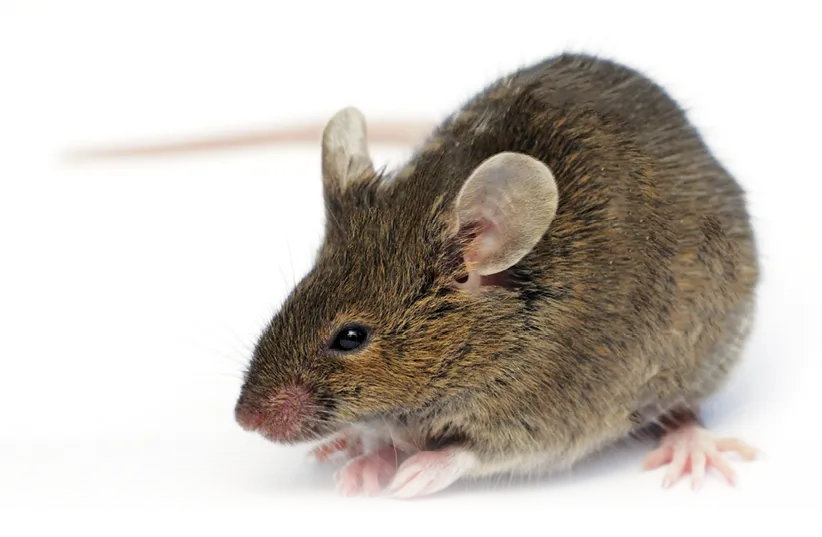
Rat Control: Stopping a Small Issue Before It Becomes an Infestation
It starts with a faint scratching sound in the ceiling or a fleeting shadow darting across the garage floor. For many homeowners, the immediate reaction is a mix of concern and hopeful denial. It is common to think that seeing a single rodent is just an isolated incident—a straggler that wandered in from the cold. However, biology and decades of field experience tell a different story. In the world of rodents, "just one" is almost never the reality. Understanding this reality is the very first step in effective rat control. There exists a critical, often brief, window of opportunity between the first sign of activity and a full-blown infestation. Acting during this period is the difference between a minor maintenance task and a costly, stressful home remediation project. Ignoring the signs allows the population to establish territory, damage infrastructure, and reproduce at an alarming rate. The Green Advantage combines decades of dedicated field experience with a genuine passion for helping neighbors maintain safe, healthy homes. This guide serves to educate the community on the mechanisms of infestation and how a dedicated team of licensed professionals can support households in keeping their property safe.Understanding the Rapid Reproductive Cycle of Rats
From Two to Twenty in Weeks
Rats are nature’s reproductive machines, designed for survival through sheer numbers. A single breeding pair can produce a litter of 6 to 12 pups, and unlike many other mammals, they do not wait a year to breed again. In favorable conditions with access to food and shelter, a female can produce up to seven litters in a single year.Sexual Maturity Speed
The speed of infestation is driven not just by the number of offspring, but by how quickly those offspring can contribute to the population growth. Young rats reach sexual maturity with incredible speed, often being ready to reproduce as early as three to four months of age. This accelerates the infestation exponentially, as the first litter begins having their own litters before the original parents have even finished their year of breeding.The "Carrying Capacity" Concept
Every environment has a limit on how much life it can support, known as carrying capacity, but rats are experts at expanding it. They possess a unique biological ability to adapt their breeding rates based on the available resources in their immediate environment. If a home provides unlimited access to pet food, unsealed garbage, and warm shelter, the rat population will sense this abundance and reproduce at maximum capacity to fill the void. [caption id="attachment_692" align="aligncenter" width="800"] Rat Control[/caption]
Early Detection: Subtle Signs You Might Miss
Grease Marks and Runways
Rats are creatures of habit with poor eyesight, relying on their whiskers and sense of touch to navigate. They tend to use the same paths repeatedly, hugging walls and baseboards for safety rather than crossing open spaces. Over time, the oils and dirt on their fur leave behind dark, greasy smudges known as "sebum" marks along these travel routes. Spotting these faint, oily discolorations along the bottom of walls, on pipes, or around entry holes is a sure sign of a heavy traffic area that requires immediate attention from a professional.Gnawing Damage vs. Wear and Tear
Homeowners often mistake structural damage for general wear and tear, but rodent teeth leave a distinctive signature. A rat's incisors never stop growing, forcing them to chew constantly to file them down. This results in gnaw marks that have rough, uneven edges, distinguishing them from the smooth deterioration of rot or age. Identifying fresh, light-colored wood chippings or jagged holes in plastic storage bins, drywall, and even electrical wiring can confirm the presence of an active rodent issue that is causing ongoing physical damage to the property.The "Musky" Odor
As rat infestation grows, it begins to generate a distinct and unpleasant olfactory footprint. Rodent urine has a sharp, ammonia-like scent that becomes increasingly potent as the population density rises. This musky odor often permeates enclosed spaces with poor ventilation, such as attics, basements, or pantries, long before a rodent is ever visually spotted.The Green Advantage Approach to Strategic Control
Beyond the Trap
Simply placing a snap trap in the middle of a room is rarely effective against cautious, intelligent rodents. The licensed professionals at The Green Advantage analyze rat psychology and travel patterns to place controls where they will be most effective. By identifying the runways and high-activity zones mentioned earlier, technicians can strategically position devices to intercept the pests during their daily routine.Environmentally Responsible Solutions
Working with nature is a passion for The Green Advantage, which means prioritizing methods that target the pest specifically without endangering the surrounding ecosystem. The goal is to solve the problem with surgical precision rather than using a broad-spectrum approach that could harm local wildlife or family pets.Continuous Monitoring Protocols
A single visit is rarely enough to fully resolve a rodent issue, as nature is unpredictable and populations can be stubborn. The Green Advantage employs a rigorous follow-up process where helpful staff and technicians monitor activity levels to ensure the plan is working. This continuous monitoring allows for adjustments in strategy and provides confirmation that the population is actually declining, rather than just relocating to a different part of the home.Sanitation: The First Line of Defense
Starving the Population
Rats require three fundamental elements to survive and thrive: food, water, and shelter. Creating a sanitation barrier involves systematically eliminating food sources that might be sustaining the colony. This includes securing pet food in airtight containers at night, cleaning up fallen fruit in the yard, and managing bird feeders that often inadvertently feed the wrong animals.Water Management Strategies
While rats can get some moisture from their food, they generally need a reliable water source, making a leaky spigot or a pet bowl left out overnight an oasis for them. Correcting moisture issues around the home, such as repairing dripping pipes, ensuring gutters drain properly, and eliminating standing water, makes the environment hostile to their survival.Decluttering to Remove Hiding Spots
Clutter provides the perfect camouflage for rodents, offering them safe harbor to nest and move without being detected. Piles of wood against the house, debris in the yard, or disorganized boxes in garages create a labyrinth of safety for nesting females. organizing these spaces and elevating storage off the ground removes these safe zones, forcing rats out into the open where they feel vulnerable and unsafe. [caption id="attachment_609" align="aligncenter" width="800"] Rat Control Service[/caption]
Exclusion: Locking Them Out Permanently
The Pencil Test
It is shocking how small of a gap a rodent can squeeze through; if a pencil can fit into a crack, a young rat or mouse can likely force its way in. Inspecting the foundation, siding, and utility entry points for these tiny gaps is a crucial step in the exclusion process. The Green Advantage technicians are trained to spot these minute vulnerabilities that most homeowners miss, ensuring that the "open door" sign is taken down permanently.Material Matters
Rats are formidable chewers capable of gnawing through wood, plastic, and even un-reinforced concrete given enough time. Therefore, blocking holes with expanding foam or standard caulk is often just a temporary delay rather than a permanent solution. The Green Advantage utilizes specific, durable exclusion materials like heavy-gauge hardware cloth and copper mesh—materials that are painful or impossible for rodents to chew through.Roof and Vent Vulnerabilities
Rats are excellent climbers, often scaling drainpipes or tree branches to access the roof, where they find easy entry through vents and eaves. These high-up hazards are frequently overlooked by homeowners who focus solely on ground-level entry points. Technicians from The Green Advantage secure these elevated areas, installing heavy-duty screens over chimney gaps and reinforcing roof vents.The Dangers of "Wait and See"
Health Hazards Escalate
As a rat population grows, so does the accumulation of biological waste within the walls and crawlspaces of the home. Droppings and urine can build up rapidly, becoming a breeding ground for harmful pathogens. Risks associated with hantavirus, salmonella, and leptospirosis increase significantly as the infestation ages and waste becomes more concentrated.Structural Damage Compounding
The physical damage caused by rodents is not static; it compounds and worsens with every passing day. What starts as a few gnaw marks can quickly turn into severed electrical wires, creating a serious fire hazard, or destroyed insulation that leads to significant energy loss. Ignoring the problem in hopes that it will resolve itself allows these damages to multiply, turning a small pest control bill into thousands of dollars in electrical, plumbing, and carpentry repairs. Early rat control is an investment in protecting the asset of the home.Displacement into Living Areas
Rats generally prefer dark, secluded areas like attics or crawlspaces, but as the population expands, space becomes limited. When an attic gets too crowded, the more dominant rats force subordinates to find new territory, often pushing them down into the living areas of the house.Why Professional Intervention Saves You More
The Cost of Failed DIY Attempts
Many homeowners attempt to handle rodent issues themselves to save money, only to end up spending more in the long run. Buying trap after trap, purchasing ineffective baits, and repeatedly repairing the same damage adds up quickly without actually solving the root cause. Investing in a professional service gets the job done right the first time, eliminating the recurring costs of a lingering infestation.Expert Knowledge of Local Species
Not all rats behave the same way, and successful control requires understanding the specific behaviors of the local rodent population. The Green Advantage leverages deep knowledge of regional species, understanding their specific nesting preferences, dietary habits, and seasonal movement patterns. This insight allows the team to predict the rodents' next moves and intercept them faster than a generic approach would allow.Peace of Mind Guarantee
When a homeowner chooses to work with The Green Advantage, they are not just buying a service; they are gaining a dedicated partner in home maintenance. There is a profound relief that comes from knowing a licensed professional is handling the dirty work, navigating the crawlspaces, and handling the removal. The commitment to customer satisfaction ensures that the helpful staff is always available to answer questions and provide reassurance. [caption id="attachment_482" align="aligncenter" width="800"] Professional Rat Removal[/caption]