
Uncover What Attracts Mice to Your Home

You hear a faint scratching in the wall after dark. The dog stares at the pantry. In the morning, there are a few tiny droppings under the sink, and suddenly your home does not feel quite as settled as it did the day before.
That worry is common in Crown Point and across Northwest Indiana. Mice do not need much to move in, and once they find what they want, they tend to stay close.
The good news is that mouse problems are usually very understandable when you know what to look for. If you know what attracts mice to your home, where they slip inside, and how local weather changes their behavior, the problem stops feeling mysterious. It becomes something you can act on with confidence.
Your Trusted Partner for Pest Control in Crown Point IN
When homeowners search for pest control in Crown Point, IN, they are usually not looking for theory. They want answers. They want to know why mice picked their house, whether the problem is getting worse, and what solution will work.
That is a fair concern. Mice are not drawn to dirty homes only. They are drawn to opportunity. A neat house with one plumbing gap, a little pet food, and a damp crawlspace can be just as appealing as a cluttered one.
Why mouse problems feel so sudden
Most infestations seem to appear out of nowhere because mice stay hidden well. They move through wall voids, behind appliances, inside garage corners, and above ceilings. By the time a homeowner sees one in the open, mice have often already found food, shelter, or moisture.
In Crown Point, that pattern gets worse because our seasons push pressure onto homes for much of the year. Cold snaps send mice toward warmth. Humid stretches create damp conditions around basements, garages, crawlspaces, and AC areas that many homeowners do not think of as rodent attractants.
Key takeaway: Mouse activity usually starts with a simple combination of access plus resources. If a home offers both, traps alone rarely solve the full problem.
What local homeowners need from an exterminator near me
A homeowner looking for an exterminator near me is usually balancing several priorities at once:
- Fast clarity: They want to know if the noises and droppings really point to mice.
- A complete fix: They do not want to catch one mouse only to find more a week later.
- Safe treatment: They want rodent control handled responsibly around children, pets, and daily life.
- Prevention: They want to stop the next entry, not just remove the current intruder.
That is why understanding attractants matters so much. Rodent control works best when it addresses the reason mice stayed in the first place. In practical terms, that means looking at food sources, water sources, shelter conditions, and the structural weak points that let mice move indoors.
Homeowners in Northwest Indiana often assume a mouse problem starts in winter. Sometimes it does. But local conditions make the pressure more year-round than many people realize. That local reality changes what effective prevention looks like.
The Top 3 Things That Attract Mice to Your Home
You hear a scratch in the wall on a cold Crown Point night, set a couple of traps in the kitchen, and hope that handles it. Sometimes it catches one. The activity comes back because the house is still giving mice what they came for in the first place.
Mice stay where they can reliably find food, water, and shelter. In Northwest Indiana, that combination shows up in every season. Winter pushes mice toward heated interiors. Summer humidity keeps crawlspaces, basements, garages, and utility areas more mouse-friendly than many homeowners realize.
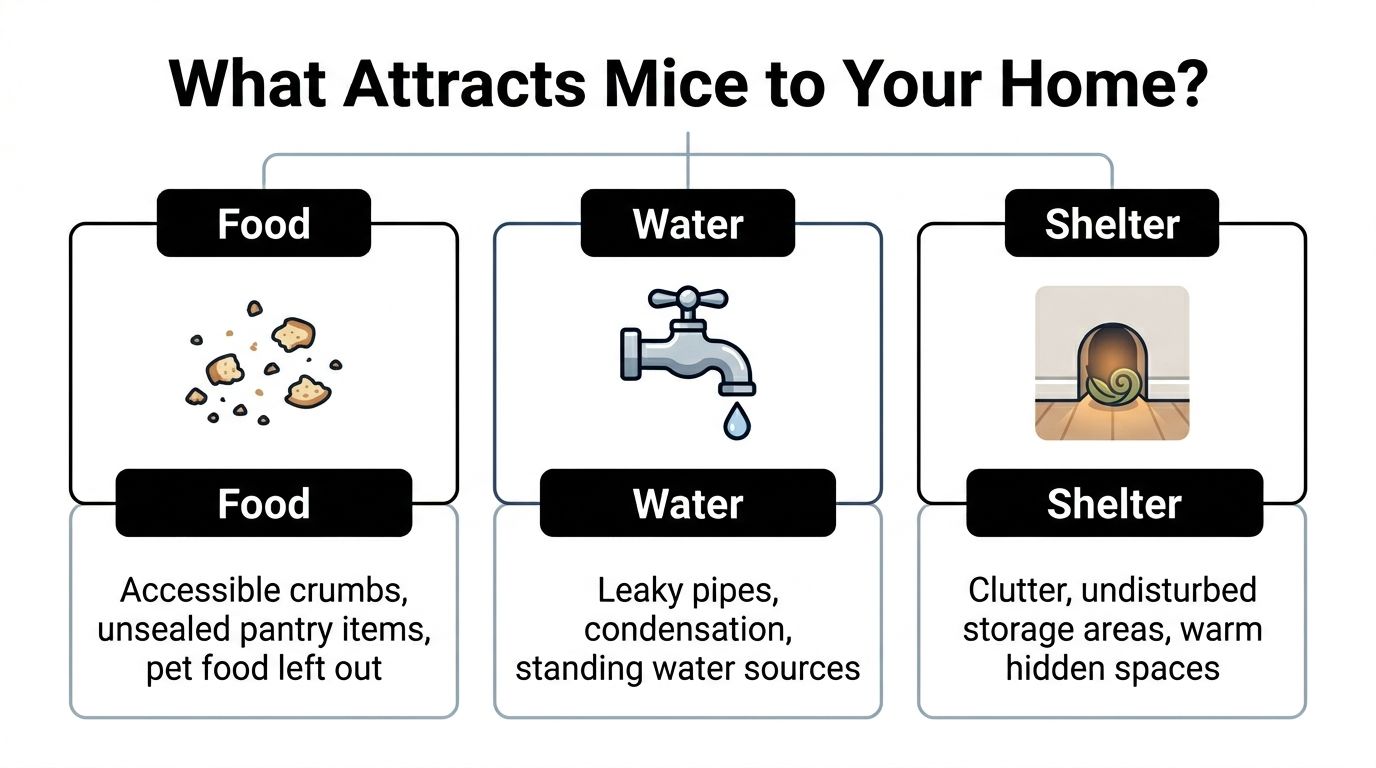
1. Food sources they can count on
A mouse does not need a major mess. It needs repeat access.
In real homes, I see the same patterns over and over. Crumbs under the stove, snack pieces under living room furniture, grease buildup beside a range, bird seed in the garage, and dry pet food left out overnight all give mice a reason to keep returning. Boxed goods and thin plastic packaging are not much protection either. If food odor gets out, mice will work at the package until they get in.
The trade-off is simple. Convenience for the household often creates consistency for mice. A bag of seed stored in the garage is easy for you to reach. It is also easy for mice to find. Pet food left out helps a busy evening routine. It also gives nighttime feeders a dependable meal.
2. Moisture that helps them stay
Food gets attention first. Water and damp conditions often explain why mice settle in instead of just passing through.
That matters in Crown Point because our climate creates moisture trouble in places homeowners often overlook. Condensation around HVAC lines, damp basement corners, crawlspace humidity, utility room drips, and moisture near sump areas all help support rodent activity. Harris Pest Control's overview of what attracts mice notes that even a small, steady water source such as a dripping faucet can support multiple mice.
Watch these areas closely:
- Under sinks: slow leaks hidden behind stored supplies
- Basements: damp walls, condensation, and musty corners
- Laundry rooms: appliance hoses, floor drains, and utility hookups
- Garages: humidity, minor leaks, and poor airflow
- Near HVAC equipment: condensation lines and pooled moisture
A house can look clean and still feel comfortable to mice if moisture is left in place.
3. Shelter that stays quiet and undisturbed
Once mice find food and moisture, they look for protected nesting spots. Most homes offer more of them than homeowners expect.
Cardboard boxes in the garage, holiday bins packed with fabric, paper storage in the basement, attic insulation, cluttered utility shelves, and dense shrubs near the foundation all give mice cover. They use soft materials for nesting and prefer areas that stay dark, warm, and undisturbed for long stretches.
Outdoor cover matters too. In Northwest Indiana, summer growth around the home can hide low entry areas and give mice safer movement along the foundation. Then fall and winter weather push that pressure closer to the house.
If you are already noticing scratching sounds, droppings, or gnaw marks, our guide to the common signs of rodent infestation can help you confirm whether mice are active.
Why these attractants matter together
One crumb usually is not the whole problem. One leak usually is not either.
What keeps an infestation going is the combination. Food gives mice a reason to return. Moisture helps them remain active inside. Shelter gives them a place to nest where they are hard to notice and harder to remove.
That is why quick trap-only fixes often fall short. Lasting rodent control means cutting off the resources that made the home worth using in the first place. At The Green Advantage, that is the part we pay close attention to because it is what turns a short-term catch into a long-term fix.
Unseen Entry Points and Telltale Signs of Mice
A Crown Point homeowner can keep a tidy house and still end up with mice in the walls by the first hard cold snap. In this area, the problem often starts outside long before anyone sees a droppings trail in the pantry.

Mice get in through openings homeowners pass every day without noticing. Small gaps around a pipe, a worn garage door corner, or a foundation crack can be enough. In Northwest Indiana, freeze-thaw movement, wet springs, and humid summers slowly open those weak spots, then fall and winter weather push mice to use them.
Where mice usually get in
A proper inspection is less about finding one big hole and more about spotting several small failures around the exterior shell.
Common trouble spots include:
- Foundation cracks: Especially where mortar has separated or settling has opened a seam.
- Utility penetrations: Gaps around water lines, gas lines, AC lines, and cable entry points.
- Door sweep failures: Side doors, service doors, and garage doors often leave just enough clearance at the bottom corners.
- Roof and vent gaps: Loose vent screens, soffit gaps, and openings near rooflines can give mice access to attics and wall voids.
- Garage corners: Garages collect clutter, stay quieter than main living areas, and often have more construction gaps than homeowners expect.
One reliable route is all it takes.
Why homeowners miss the first signs
Mice do most of their movement at night and usually travel along edges, not across open floors. That is why the first evidence often shows up in tucked-away spots instead of the middle of a room.
Watch for these signs early:
| Sign | What it often means |
|---|---|
| Small droppings | Regular travel routes near food storage, cabinets, or hidden nesting areas |
| Gnaw marks | Active feeding or attempts to widen access around wood, packaging, or drywall edges |
| Shredded material | Nest building with paper, insulation, fabric, or cardboard |
| Scratching sounds | Movement inside walls, above ceilings, or behind cabinets |
| Musty odor | Repeated activity in a concealed space, often with nesting nearby |
If you want to compare what you are seeing with common household warning signs, our page on common signs of rodent infestation gives a clear homeowner reference.
What a quick inspection should include
Start outside. Check the foundation line, door bottoms, garage perimeter, hose bibs, AC line entries, and any place one material meets another. Brick to siding transitions and pipe-to-wall gaps are frequent problem areas in homes around Crown Point.
Then move inside and inspect the places mice use first because they offer cover and steady access:
- Under sinks
- Behind the stove and refrigerator
- Inside pantry corners
- Basement rim areas
- Garage shelving edges
- Attic access points
This video gives a useful visual sense of the kinds of areas that deserve attention.
When signs point to a bigger issue
A single mouse caught in a trap does not rule out more activity elsewhere in the home. If droppings show up in multiple rooms, scratching continues after a catch, or fresh signs return after cleanup, there is usually an active entry route and a hidden nesting area that still need attention.
Homeowners often lose time focusing on the mouse they can see instead of the gap it used and the space where it settled. That trade-off matters. Catching one or two mice may bring short-term relief, but it rarely solves a Northwest Indiana mouse problem if seasonal pressure around the house is still in place.
Identifying entry points and hidden signs early makes it much easier to stop a mouse issue before it spreads.
Why Mouse Behavior Changes with Northwest Indiana Seasons
A lot of Crown Point homeowners call after the first hard cold snap. They hear scratching in a wall or find droppings that were not there a week earlier and assume the problem started overnight.
Usually, it started earlier.
Northwest Indiana gives mice two different kinds of opportunity through the year. Winter pushes them toward indoor warmth. Our humid summers and wet stretches help maintain the damp, protected conditions mice can use around basements, crawlspaces, garages, and utility areas. Generic national advice often focuses on cold weather alone. Around here, that misses half the pattern.
Fall and winter change how mice use a home
Once temperatures drop, homes in Crown Point become steady shelter. Attics stay warmer than the outdoors. Wall voids block wind. Utility areas hold residual heat. Mice respond fast to that shift, especially when fields are harvested and outdoor cover changes.
That is why activity often seems to surge in late fall. The route may have been there for weeks, but the weather finally gave mice a reason to use it heavily.

Summer brings pressure too, for different reasons
Summer mouse pressure looks different. It is quieter, and homeowners often misread it.
In Northwest Indiana, long humid stretches can keep certain parts of a property damp even without a plumbing leak. Basements can feel heavy. Crawlspaces can stay moist. Condensation around HVAC components and AC lines can keep small areas usable for longer than people expect. Purdue Extension's rodent control guidance emphasizes that mice need food, water, and shelter, and those conditions do not disappear just because it is warm outside. See Purdue Extension's house mouse management guidance.
Around Crown Point, I see the same summer conditions over and over:
- garages that stay damp after storms
- muggy basement corners with little airflow
- crawlspaces with persistent humidity
- utility and HVAC areas where condensation forms
- quiet storage areas that stay undisturbed for weeks
Those spaces may not draw attention the way a winter pantry issue does, but they still support mouse activity.
Why generic advice misses the Northwest Indiana pattern
A national article can tell you to seal gaps before winter, and that is good advice. It is incomplete for this area.
Our seasonal pressure is layered. Winter increases indoor movement toward heat and cover. Spring and fall often bring exploration and route-setting. Summer can support nesting and survival in damp, protected areas that stay stable during humid weather. The trade-off for homeowners is simple. If prevention starts only when frost shows up, mice may already be established in lower-traffic parts of the home.
That is one reason a local plan usually performs better than a one-size-fits-all checklist. A Crown Point home has to be evaluated for cold-weather entry pressure and warm-weather moisture pressure.
A seasonal plan works better than a one-season fix
The practical response changes with the calendar:
- In fall and winter, focus on heat-seeking activity and protected indoor nesting areas.
- In spring, watch for renewed movement as mice test routes and expand travel paths.
- In summer, correct humidity, condensation, and damp storage conditions.
- Year-round, keep the exterior less inviting so mice stay farther from the structure.
Homeowners who want to weigh short-term trap-and-seal work against a more durable treatment plan can compare both approaches in this guide on DIY mouse control vs hiring a professional.
Mouse behavior changes here because Northwest Indiana weather changes hard and often. The best results come from handling the problem the same way. Season by season, with a plan that fits Crown Point homes.
Your Rodent Control Options DIY Fixes vs Professional Treatment
A lot of Crown Point homeowners start the same way. They hear scratching at night, spot droppings near the pantry or garage wall, and pick up a few traps on the way home.
That first step can help. It just has limits, especially in Northwest Indiana, where mice keep shifting with the weather. In cold months, they push hard toward indoor warmth. In humid stretches, they often stay active around damp basements, crawl spaces, garages, and cluttered storage. A trap can remove a mouse. It does not tell you why the house keeps drawing them back.

What DIY does well
DIY control has a place.
If activity started recently, is limited to one area, and you can clearly identify where mice are getting in, traps and basic exclusion may be enough to get ahead of it. Good cleanup helps too, especially in kitchens, pet food areas, and storage spaces where crumbs or nesting material have built up.
DIY usually makes sense when:
- activity appears light and recent
- signs are limited to one room or one side of the home
- the gap or hole is easy to reach and seal correctly
- there is no strong odor, repeated droppings, or evidence of nesting
That is the honest trade-off. DIY can be a reasonable first response for a small, early problem.
Where DIY usually misses the core problem
The trouble starts when homeowners treat sightings instead of pressure points.
Mice rarely use just one opening. In Crown Point homes, I often find multiple access spots around utility lines, garage door corners, siding gaps, foundation joints, attic edges, and areas where cold-weather settling has opened small seams. Outside conditions matter too. Dense vegetation, stacked firewood, and stored items against the house give mice cover close to the structure. Once that pattern is established, catching one or two mice indoors does not break it.
Here is a practical comparison:
| DIY approach | What it can do | What it often misses |
|---|---|---|
| Traps | Reduce visible activity | Hidden travel routes, nests, and secondary entry points |
| Store-bought bait | Knock down some pressure | Safe placement, monitoring, and full-property strategy |
| Sealing one obvious hole | Blocks one access point | Small gaps in other parts of the structure |
| Extra cleaning | Lowers food availability | Shelter, moisture, and exterior harborage |
One of the most common mistakes is sealing only the spot where a mouse was seen. Another is putting traps indoors while ignoring the outside conditions that keep feeding the problem.
What professional treatment changes
Professional rodent control works best as a process, not a product.
A solid service starts with inspection. The goal is to find how mice are entering, where they are traveling, what conditions are supporting them, and whether the issue is isolated or established. From there, treatment is built around the house itself, not a generic setup.
A professional plan usually includes:
- Detailed inspection: interior signs, exterior gaps, nesting areas, and pressure zones
- Targeted trapping or control: placed where mice are moving
- Exclusion recommendations or repairs: to shut down repeat access
- Exterior evaluation: cover, moisture, storage habits, and structural conditions near the home
- Follow-up: to confirm activity has dropped and the plan worked
That matters here because our local weather creates repeat pressure. A home can seem quiet for a while, then mouse activity picks up again with the next hard temperature swing or damp spell. Lasting control usually comes from handling the whole pattern, not just the mouse you saw this week.
If you are comparing short-term fixes with a longer-lasting plan, this guide on DIY mouse control versus hiring a professional lays out the decision clearly.
What usually gives longer control: inspection, exclusion, and targeted treatment used together
What often falls short: traps alone, without fixing access and shelter conditions
Safety matters
Homeowners are right to ask about kids, pets, and treatment safety.
A good rodent service should explain what is being used, where it is being placed, and why that approach fits the home. It should also account for how the family uses the space. That includes kitchens, mudrooms, attached garages, basements, and utility areas where mouse activity often overlaps with daily routines.
Professional help offers clarity. You get a defined plan, you know what is being corrected, and you are not left guessing whether the scratching will start up again next week.
The Green Advantage Promise for Crown Point Homeowners
When mice get inside, the problem affects more than one corner of the house. It affects how comfortable people feel in their own kitchen, basement, garage, and bedrooms. That is why homeowners usually want more than a quick removal. They want confidence that the issue is being handled correctly.
For Crown Point homeowners, that means choosing a pest control company that understands both the pest and the local conditions that support it.
What professional rodent control protects
A proper mouse control plan helps protect several things at once:
- Your property: Mice chew, shred, and contaminate stored materials.
- Your living spaces: Kitchens, pantries, utility rooms, and attics are hard to enjoy when signs of rodents keep returning.
- Your routines: Ongoing trap checks and repeated cleanups wear people down quickly.
- Your peace of mind: The biggest relief often comes from knowing someone has found the root of the problem.
Professional service is especially valuable when mouse activity overlaps with other seasonal pest issues in Northwest Indiana. Homes dealing with rodents may also need broader support with preventative pest treatments, spider control, ant control, wasp removal, termite concerns, or mosquito control around the yard. A company that sees the full property picture can help homeowners protect the home more completely.
What homeowners should expect from a good service experience
A strong pest control experience should feel straightforward, not confusing.
It should usually include:
A clear first conversation
You should be able to describe what you are hearing or seeing and get practical guidance on next steps.An on-site inspection
The technician should inspect likely entry points, activity zones, and conditions that support mice.A site-specific plan
The home should be treated based on its layout, pressure points, and risk areas.Plain communication
You should know what was found, what was done, and what changes at home will help.Follow-through
Lasting control depends on confirming results, not just performing one visit and disappearing.
Why local experience matters in Crown Point IN
A company serving Crown Point, IN, and nearby Northwest Indiana communities should understand how local weather, construction styles, yard layouts, garages, crawlspaces, and seasonal moisture patterns shape pest activity. That local familiarity leads to better inspections and more practical recommendations.
Homeowner reassurance: The best pest control is not just about removing mice. It is about restoring normal life in the house without confusion, pressure, or guesswork.
If you are comparing providers after searching for exterminator in Crown Point, IN or pest control near me, look for direct communication, licensed and certified service, realistic prevention advice, and a process that addresses entry points as seriously as sightings.
Your Simple Home Maintenance Checklist for Mouse Prevention
Preventing mice is easier when small tasks become routine. The checklist below focuses on the parts of the home where mouse pressure builds fastest.
Kitchen and pantry
- Store dry goods securely: Move cereals, grains, snacks, and pet food into durable sealed containers.
- Clean low and hidden areas: Sweep under appliances and wipe crumbs from cabinet corners, not just countertops.
- Manage trash tightly: Keep garbage closed and avoid letting food waste sit overnight.
- Pick up pet bowls: Do not leave food and water out longer than necessary.
Basement attic and storage spaces
- Reduce soft nesting material: Limit loose paper, fabric, cardboard, and clutter in quiet areas.
- Use plastic totes: Long-term storage holds up better in lidded bins than in boxes.
- Watch for dampness: Check utility areas, under-sink zones, and corners that feel humid or musty.
- Inspect insulation and hidden edges: Look for shredding, droppings, or disturbed materials.
Home exterior and yard
- Trim back vegetation: Keep shrubs and growth from pressing against siding or foundation lines.
- Maintain perimeter clearance: Adequate clearance around the house helps reduce cover and climbing access, as noted earlier.
- Move wood and debris away from the house: Keep outdoor shelter spots from building pressure near the structure.
- Check doors and gaps: Pay attention to garage edges, side doors, vents, and utility penetrations.
A checklist like this does not replace treatment when mice are already active. It does make the property much less inviting.
Frequently Asked Questions About Mouse Control
Are mouse treatments safe for children and pets
They should be handled with safety in mind from the start. A responsible pest control company explains where products are placed, why they are used, and what precautions matter for your household. If you have children, pets, or specific concerns, ask for that conversation up front.
Can a clean home still get mice
Yes. Clean homes can still get mice if the structure has accessible gaps, moisture issues, or quiet nesting areas. Cleanliness helps, but it does not replace exclusion and inspection.
How long does it take to get rid of mice completely
That depends on how established the activity is, how many access points exist, and whether nesting areas are present. Some problems are resolved quickly. Others take a more involved plan with follow-up to make sure activity has fully stopped.
Do new homes in Crown Point get mice too
Yes. Newer homes can still have gaps around utility lines, garage doors, foundation transitions, roof vents, or landscaping that creates cover near the structure. Age alone does not prevent mouse pressure.
Should I call if I have only seen one mouse
If you have seen one mouse indoors, heard scratching, or found fresh droppings, it is worth taking seriously. Mice stay hidden well. One visible sign can mean there is already a route or nesting area somewhere out of sight.
If you are dealing with scratching in the walls, droppings in the pantry, or repeat mouse activity around your Crown Point home, The Green Advantage can help you get clear answers and a lasting solution. Our local team serves Crown Point and nearby Northwest Indiana communities with thoughtful, environmentally mindful pest control for homes and businesses. Reach out today to schedule an inspection, request a quote, and take the next step toward a home that feels settled again.
Pest Control in Crown Point, IN: How to Get Rid of Mice in Walls

That faint, persistent scratching from behind the drywall? It’s the classic tell-tale sign of mice, and for homeowners in Crown Point, IN, it’s an all-too-common sound. Hearing those noises means it’s time to act. Getting rid of mice in your walls for good isn't just about setting a few traps; it’s a two-part process that requires a professional touch. You need strategic removal to handle the mice already inside and expert exclusion to seal up every tiny entry point they’re using to get in.
At The Green Advantage, we specialize in residential and commercial pest control for our neighbors in Crown Point and across Northwest Indiana. If you're hearing pests in your walls, we are the local exterminator you can trust to solve the problem completely.
Hearing Scratching Noises in Your Walls? It's a Local Problem
Those little scratching and scurrying sounds, almost always kicking up right as you’re trying to sleep, are more than just an annoyance. They're a sure sign rodents have made themselves at home inside your house's structure. As the seasons change here in Crown Point, IN, this is a problem many of us face, signaling the need for an exterminator near you.
Why Mice Settle in Your Walls
So, why the walls? It’s simple: mice are on a constant hunt for warmth, safety from predators, and a nearby food source. The empty space between your studs provides a perfect, hidden highway system and sanctuary, shielding them from the brutal Northwest Indiana winters.
From that safe home base, it’s a short, easy commute to your kitchen pantry or under the sofa for a dropped crumb. It’s a serious concern because a single mouse can quickly lead to a full-blown infestation. Your walls give them an ideal, undisturbed nursery to nest and breed. These aren’t just noisy roommates; they're a real threat to your property and your family's health, making professional rodent control essential.
You Deserve Peace and Quiet: That unsettling sound doesn't have to be the new normal in your house. A targeted, professional approach from a trusted local pest control company can bring back the quiet and make your home feel like your own again.
Your Local Solution for Pest Control in Crown Point, IN
Here at The Green Advantage, we’re not just another pest control company—we're your neighbors. We know the specific pressures that mice and other pests like ants and spiders put on homes throughout Crown Point and the rest of Northwest Indiana. We’ve seen firsthand that getting mice out of walls takes more than a couple of store-bought traps. It takes a deep understanding of how they think, how they get in, and a solid strategy to keep them out for good.
When you hear those first scratching sounds, it’s your cue to call a professional. Our residential pest control services are built to solve the problem from start to finish.
- First, we confirm the problem. We begin with a thorough inspection to figure out exactly what you're dealing with and how extensive the issue is.
- Then, we remove the threat. We use effective, family-safe methods to get the mice out of your walls and offer preventative treatments to protect your home.
- Finally, we prevent them from coming back. Our team excels at finding and sealing the dime-sized gaps and tiny cracks mice use to invade, giving you a real, long-term solution.
Don't let those scratching sounds steal another night of sleep. This guide will walk you through what's happening in your walls and show you why professional rodent control from a local exterminator is the most effective way to protect your home.
How to Find Evidence of a Mouse Problem in Your Home
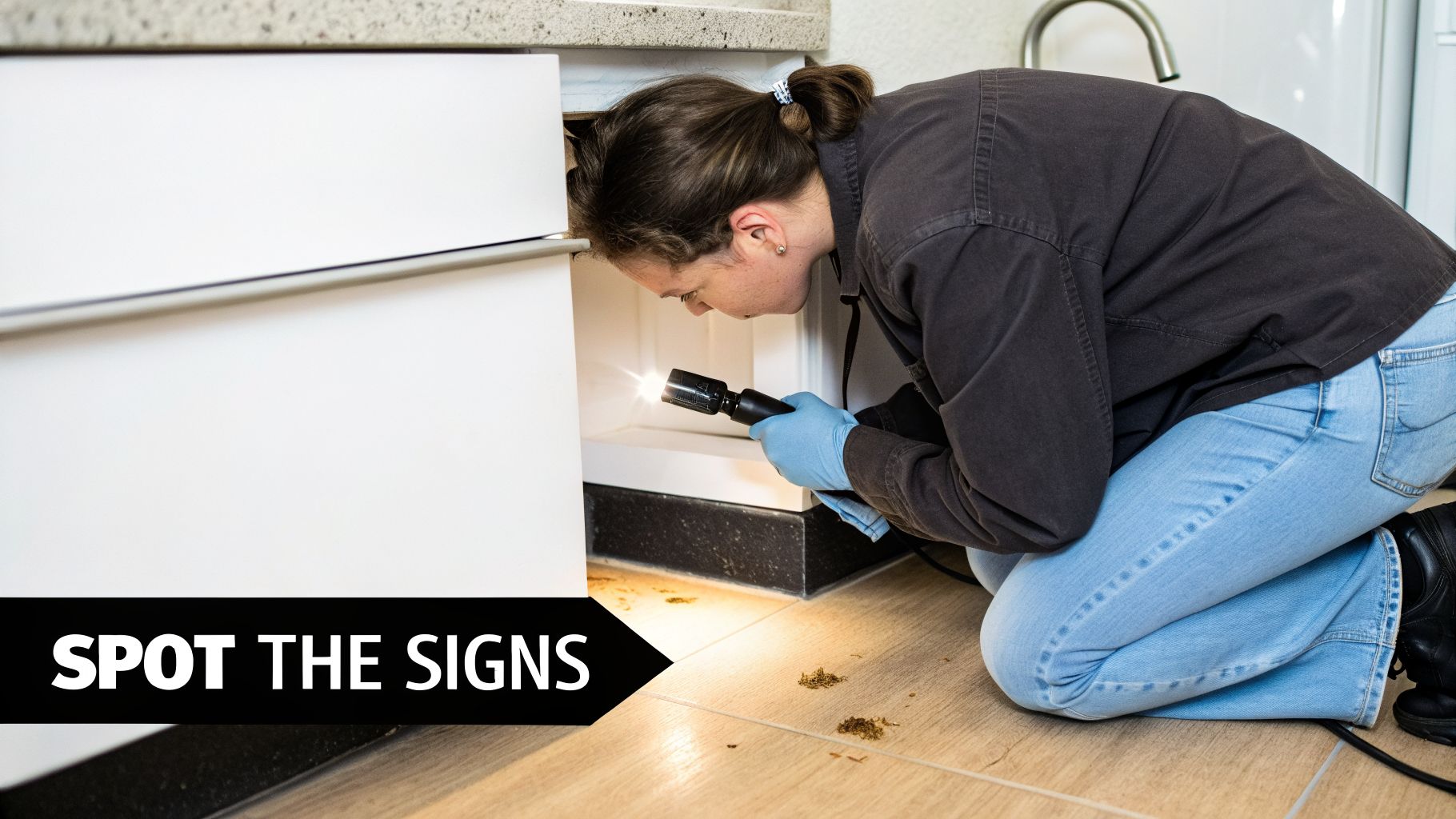
That scratching you hear in the walls? It’s more than just an unnerving sound—it’s a clear signal that it’s time to investigate. Before you can tackle the problem, you first need to understand its scope. Are we talking about one lost mouse or a full-blown family that’s moved in?
Gathering evidence is how you'll figure that out. The clues they leave behind will tell you everything you need to know, helping you decide if it's time to call The Green Advantage for a professional pest control plan for your Crown Point home.
Visual Clues Inside Your Home
Mice try to stay out of sight, but they’re messy houseguests. They leave a trail of evidence everywhere they travel, especially in the quiet, undisturbed corners of your house. Knowing where to look is half the battle.
Grab a good flashlight and start your search in areas that offer food, water, and shelter. These are the spots where you'll find the most telling proof of an infestation.
Common Indoor Hotspots:
- Under Sinks: Kitchen and bathroom cabinets are prime real estate. Check the very back, near the plumbing cutouts in the wall, for droppings or gnaw marks.
- Behind Appliances: Carefully pull out your refrigerator and stove. The warmth from the motors, combined with a steady supply of crumbs, makes these spots a five-star resort for mice.
- Pantries and Food Cabinets: Look along the back edges of shelves. Mice are excellent climbers and will absolutely explore where you keep your food, usually under the cover of darkness.
- Attics and Basements: These spaces are often quiet and cluttered, making them perfect for nesting. Scan along floor joists, in corners, and around any stored boxes. These areas are also common entry points for other pests, like spiders and wasps.
What to Look For
As you’re checking these hotspots, you’re looking for a few tell-tale signs. They can be subtle, so take your time and look closely.
- Droppings: This is the most obvious clue. Mouse droppings are small (about 1/8 to 1/4 inch long), dark, and pointed at the ends, like tiny grains of black rice. A few droppings might just be a scout, but piles of them mean you have an established problem. You can see more examples in our guide to the early signs of a rodent infestation.
- Gnaw Marks: A mouse’s teeth never stop growing, so they chew constantly to wear them down. Look for fresh, rough-looking chew marks on baseboards, drywall, wiring, and food packaging.
- Nesting Materials: Have you found a small, hidden pile of shredded paper, cotton, insulation, or fabric? You’ve just found a nest. These are often tucked away in wall voids, old drawers, or even inside upholstered furniture.
A Critical Warning Sign: If you discover gnawed electrical wires, treat it as an emergency. This isn't just evidence of mice; it's a very real fire hazard that needs to be addressed immediately by a professional. This is a key reason why residential pest control is so vital for your family's safety.
Inspecting Your Home’s Exterior
Once you’ve confirmed you have mice inside, the next step is to figure out how they’re getting in. This is non-negotiable for any long-term solution. Here in Northwest Indiana, a thorough walk around your home's exterior is crucial. Remember, a mouse can flatten its body and squeeze through a hole the size of a dime.
Think like a mouse looking for a way in. Walk the entire perimeter of your foundation, looking high and low for any potential vulnerability.
- Foundation and Siding: Check for cracks, even small ones. Pay special attention to the transition point where your siding meets the brick or concrete foundation—gaps are common there.
- Utility Entry Points: This is a big one. Inspect every spot where a pipe, wire, or cable enters your house. The small gaps around A/C lines, gas pipes, and cable wires are like open doors for rodents.
- Vents and Gaps: Look at dryer vents, attic vents, and any gaps under your garage or entry doors. Make sure all screens are intact and that weather stripping creates a tight seal.
Pinpointing these entry points is just as important as finding the nests inside. Any plan to get rid of mice in your walls is doomed to fail if you don't seal up their highways into your home. If you've done this inspection and the evidence feels overwhelming, a professional from The Green Advantage can quickly identify all the problem spots and provide a clear plan for your Crown Point, IN home.
Why Professional Removal Beats DIY Poison for Pests in Your Walls
When you know for sure there are mice scrabbling around inside your walls, the first thought for many is to reach for rodent poison. It seems so simple—a quick, hands-off solution. But as your local pest control experts serving Crown Point, IN, we can tell you that using poison indoors can turn a minor nuisance into a complete disaster.
The real problem with poison isn't how it affects the mouse, but what happens after. A mouse that eats rodenticide doesn't just drop dead on the spot. It retreats to the safest, most hidden place it knows, which is usually its nest deep inside your walls.
And that’s when the real trouble begins.
The Unseen Consequence: A Horrible Odor You Can't Escape
A few days after you’ve put out the poison, you'll start to notice it. A truly awful, persistent odor begins to creep out from your walls. It’s a uniquely foul smell that can take over entire rooms and linger for weeks, sometimes even months, as the carcass decomposes in a spot you can't possibly reach.
It's more than just unpleasant. That smell is a dinner bell for other pests. Suddenly, you've got blow flies, carpet beetles, and other insects that feed on decaying matter, kicking off a whole new infestation right where the first one ended. This is why professional pest control near you is a much better choice.
Our Professional Opinion: The entire point of rodent control is to get the problem out of your home. Using poison often just moves it out of sight, creating a more disgusting and unhealthy situation you can't easily fix.
The Safety Risks to Your Family and Pets
Beyond the nasty smell, rodenticides are a serious safety concern, especially in a home with kids or pets. These poisons are designed to be lethal, and they can't tell the difference between a mouse and a curious toddler or a family dog.
Even bait stations marketed as "pet-safe" can be chewed through or knocked around by a determined pet, leading to accidental poisoning and an emergency vet visit. For families here in Northwest Indiana, that risk just isn't worth it. The Green Advantage prioritizes eco-friendly pest control methods that are safe for your loved ones.
This is exactly why strategic trapping and removal is the gold standard for residential pest management.
The Professional Method: Strategic Trapping and Removal
At The Green Advantage, we rely on professional trapping methods because they are safer and far more effective. This approach gives you undeniable proof of removal. You know exactly when and where a mouse has been caught, which is the only real way to measure success.
Trapping lets you physically remove the rodent from your home, completely avoiding the risk of a dead mouse decomposing in your walls. You also sidestep the danger that poisons pose to your family. The key is doing it right. Research from experts, like those at the University of Missouri Extension, confirms that proper trap placement is crucial—they recommend setting traps about 6 to 10 feet apart along known rodent pathways.
Our targeted approach allows us to confirm the problem is solved without introducing unnecessary chemicals into your home, aligning with our commitment to eco-friendly pest control.
Choosing the Right Tools for the Job
Good trapping isn’t just about scattering a few traps and hoping for the best. It’s about having the right gear and a smart plan.
H3: Picking Your Traps
- Classic Snap Traps: Don't underestimate them. These have been around forever because they work. They’re affordable and, when set correctly, deliver a quick, humane end.
- Electronic Traps: These are battery-powered boxes that deliver a fatal shock. They’re a great choice if you’re squeamish about seeing or handling a snapped mouse, as most models have an indicator light and allow for no-touch disposal.
H3: Baiting for Success
Forget what you see in cartoons—cheese is not the best bait. Mice are drawn to high-protein, fatty foods. You want something sticky that forces them to work at it, which increases the odds of triggering the trap.
- Peanut butter is the classic for a reason. It's aromatic, sticky, and mice find it irresistible. A small dab is all you need.
- Chocolate hazelnut spread is another fantastic option.
- If you're in an area with plenty of other food sources (like a pantry), try baiting with nesting material. A small piece of cotton or string can be just as tempting to a mouse looking to build its home.
Where to Place Traps for Maximum Impact
This is where professional strategy really comes into play. Mice are cautious and prefer to travel along walls, using their whiskers to navigate in the dark. You have to use this behavior against them.
Always place traps perpendicular to the wall, with the trigger end almost touching the baseboard. As the mouse scurries along its natural path, it will run directly over the trigger.
Focus your efforts on the high-activity zones you found during your inspection:
- Along the walls in your attic, basement, or crawl space.
- Tucked behind the stove and refrigerator.
- Under sinks in the kitchen and bathrooms.
- Inside any closet or pantry where you've spotted droppings.
By combining the right traps, bait, and placement, an in-wall mouse problem can be solved. For our clients here in Crown Point, IN, professional removal is the cleanest, safest, and most definitive way to get your home back.
The Definitive Guide to Professional Mouse-Proofing (Exclusion)
Getting the mice out of your walls is a huge relief, but it’s only solving half the problem. If a professional doesn't find and seal every single crack and gap they used to get in, you're just leaving the door open for the next family of rodents to move in.
This sealing process is what we in the pest control business call exclusion. It's the single most important thing you can do for long-term protection. Trapping gets rid of the mice you have now; professional exclusion makes sure you don’t have them again next winter. This preventative pest treatment is a core part of our service in Crown Point.
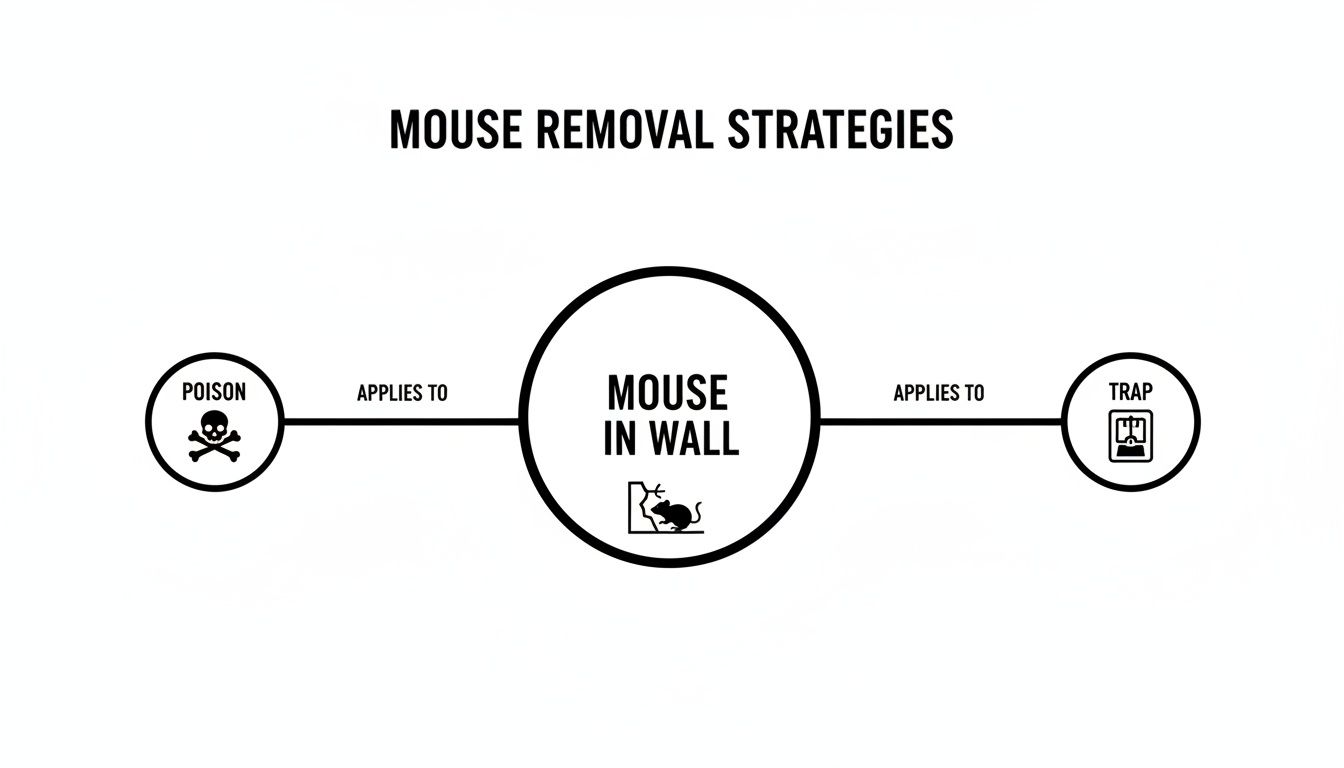
As you can see, trapping physically removes the mouse from your home, which is always the best option. It completely avoids the risk of a mouse dying and decaying inside your walls—a problem you definitely want to avoid.
Thinking Like a Mouse: Finding Their Secret Entrances
To truly mouse-proof your home, our technicians get on their level. Mice are masters of opportunity, and they can exploit the tiniest flaws in your home's exterior. We perform a slow, careful inspection of your entire property, from the foundation right up to the roofline.
Remember this: a mouse can squeeze through a hole the size of a dime. That's not an exaggeration. Any gap you find that's 1/4 inch or larger is a potential doorway.
We look for these common weak spots on your home's exterior:
- Foundation: We scan for cracks in the concrete or block, especially where the foundation meets the siding.
- Siding and Trim: We check for gaps at corner joints or where boards have warped or pulled away from the house.
- Utility Lines: This is a huge one. We carefully inspect where every pipe, wire, and cable enters your home. Gaps around plumbing, gas lines, and A/C refrigerant lines are practically an open invitation.
- Vents: We make sure your dryer, attic, and gable vents have tight, secure screens. A damaged vent cover is a welcome mat for rodents, wasps, and other pests.
- Roofline: We check where the roof meets the walls (your soffits and fascia). Wood can rot or separate over time, creating perfect entry points for mice that can climb.
Sealing the Deal: Using the Right Materials
Once we've mapped out all the potential entry points, we seal them with the right stuff. Mice have incredibly strong teeth and can chew right through plastic, rubber, wood, and cheap caulks. Using the wrong material is just a waste of time and money.
Sealing entry points is, by far, the most cost-effective, long-term solution. In our experience, preventing a 90% reduction in infestations is possible for Northwest Indiana homeowners who have their homes professionally sealed before the cold weather hits. It’s why modern pest control focuses so heavily on exclusion techniques, which you can read more on these modern pest control protocols.
We use materials that mice simply can’t chew through. A simple but highly effective combination is coarse steel wool packed into a gap and then sealed over with a quality caulking compound. They can't chew it, and they can't pull it out.
Pro Tip: Never use expanding spray foam by itself to seal a hole. It might look good, but a mouse can chew through it in minutes. Always pack the hole with steel wool or copper mesh first, then use the foam.
To make this easier, here’s a quick guide to some common problem areas and the best materials for the job.
Mouse-Proofing Your Home: Common Entry Points and Sealing Materials
| Vulnerable Area | Where to Look | Recommended Sealing Material |
|---|---|---|
| Utility Penetrations | Where pipes, wires, or conduits enter the house | Coarse steel wool or copper mesh, sealed with silicone caulk |
| Foundation Cracks | Along the base of your home, especially at corners | Masonry sealant or concrete patch; use copper mesh for larger gaps |
| Siding Gaps | Where siding meets foundation or at corner joints | High-quality exterior-grade caulk; metal flashing for larger areas |
| Vents | Dryer, soffit, and gable vents | 1/4-inch hardware cloth (galvanized steel mesh) securely fastened over the opening |
| Under Sinks | Around plumbing pipes that go into the wall | Pack the gap tightly with steel wool, then seal with caulk or expanding foam |
| Roofline/Soffits | Where the roof and walls meet; damaged fascia boards | Metal flashing and/or replacing rotted wood; often a job for a professional exterminator |
Finding and sealing these vulnerabilities is the only way to get true peace of mind. It’s a bit of work upfront, but it’s an investment in your home that pays off by ensuring you never have to hear that awful scratching sound in your walls again.
Cleaning and Sanitizing After an Infestation
So, the scratching has finally stopped. The traps are empty, and every last entry point has been sealed. It's a huge relief, but the job isn't quite over yet. Now comes the most important part for your family's health: the cleanup.
This isn't just about making things look clean. It's about removing dangerous contaminants and erasing the scent trails that act like a welcome mat for the next mouse looking for a home. Professional pest control services often include guidance on this crucial step.
Safety First: Don't Touch Anything Yet
Before you even think about cleaning, you have to protect yourself. Mouse droppings and urine aren't just gross; they can carry some nasty pathogens, like Hantavirus, which becomes a real threat when it gets stirred up into the air.
This is critical: Never, ever sweep or vacuum dry droppings. You'll just send those contaminated particles airborne.
Instead, gear up properly.
- Air it Out: Before you start, open up the windows and doors in the area. Let it air out for a good 30 minutes.
- Gear Up: This is non-negotiable. Get a pair of rubber or vinyl gloves and, ideally, an N95-rated respirator mask. You want a solid barrier between you and any harmful particles.
As you get ready, you might be asking yourself, "Is mouse urine a biohazard?". The short answer is yes, absolutely—which is exactly why homeowners in Crown Point and across Northwest Indiana need to take these precautions so seriously.
Your Step-by-Step Guide to a Safe Disinfection
Once you're geared up and the space is ventilated, you can get to work. The goal here is to disinfect everything first, then remove it.
Create your cleaning solution. Mix a disinfectant of 1 part household bleach to 10 parts water in a spray bottle.
Saturate, don't sweep. Liberally spray any droppings, urine stains, and nesting materials you see. You want them thoroughly soaked. Let the bleach solution sit and do its work for at least five minutes.
Wipe and remove. Using paper towels, carefully wipe up the soaked droppings and debris. Place all the soiled towels, nesting materials, and any carcasses directly into a heavy-duty, sealable plastic bag.
Disinfect all surfaces. After the visible mess is gone, it's time to clean everything else. Mop the floors and wipe down baseboards, shelves, and any other hard surfaces where mice might have scurried, using the same bleach solution.
Toss contaminated items. Cardboard, paper, or other porous items with gnaw marks or stains should be bagged and thrown out. If you have fabric items like clothing or bedding that can be salvaged, wash them immediately in the hottest water setting possible.
Proper Disposal is Key
Once all the waste is in a sealed plastic bag, double-bag it, seal the outer bag tightly, and throw it away in a secure outdoor trash can. Immediately after, take off your gloves (dispose of them if they're disposable) and wash your hands thoroughly with soap and warm water.
Make Your Home Unwelcoming for Good
Now that the cleanup is done, your final move is to make your home as unappealing as possible for any future rodents. A clean home is a pest-free home. I've seen it time and time again—simple, consistent sanitation habits are one of the most effective forms of preventative pest treatment.
For homeowners in our area, a few small changes can make a world of difference:
- Lock Down the Pantry: Store things like cereal, pasta, and grains in airtight glass or hard plastic containers. A mouse can chew through a cardboard box in minutes.
- Mind the Pet Food: Don't leave pet food out overnight. After your pet is done eating, put the rest away in a sealed, rodent-proof container.
- Eliminate Water Sources: Mice need water. Check under your sinks and in the basement for any leaky pipes or dripping faucets and get them fixed.
- Keep it Tidy: Wipe up kitchen crumbs and spills right away. Make sure all your indoor and outdoor trash cans have tight-fitting lids.
When you combine these habits with the professional exclusion work you've already had done, you're building a powerful defense. You're not just getting rid of the mice in your walls—you're making sure they never want to come back.
When to Call an Exterminator in Crown Point, IN for Mice in Walls
Trying to tackle a mouse problem on your own is one thing. But when those mice are living inside your walls, you're playing an entirely different ballgame. While the DIY spirit is admirable, there’s a tipping point where calling a professional isn't just easier—it’s safer, more effective, and protects your property from costly damage.
If you’re feeling overwhelmed, the problem won't quit despite your best efforts, or you simply want the peace of mind that comes with guaranteed results, it’s time to call the experts at The Green Advantage. A huge part of learning how to get rid of mice is knowing when the job is too big for a few store-bought traps and requires an exterminator near you.
Telltale Signs You Need Professional Help
A professional becomes essential when you spot the red flags that point to a much bigger issue than just a single, lost mouse.
For homeowners here in Crown Point and across Northwest Indiana, these are the signs that you need to call for professional pest control:
- You're Still Hearing Them: You’ve set traps and plugged every hole you can find, but that faint scratching and scurrying in the walls just won't stop. This is a classic sign that the infestation is larger than you thought, or the mice have simply found new highways you haven't discovered yet.
- The Evidence is Piling Up: Finding a few droppings is one thing. Finding droppings in multiple rooms, discovering several nests, or noticing that distinct, musty odor means you have a large, reproducing population.
- They're Causing Real Damage: Have you found gnawed electrical wires, chewed-up PEX or PVC pipes, or shredded insulation? This is a serious problem. Damaged wiring is a major fire hazard, and a punctured pipe can lead to a slow leak and costly water damage. This requires immediate expert attention.
- The Nests are Out of Reach: You can hear them, but you can't get to them. When mice are nesting deep inside wall voids, between floors, or in tight, inaccessible crawl spaces, you need specialized tools and know-how to solve the problem safely.
We've seen it a hundred times: a homeowner gets incredibly frustrated trying to find that last, tiny entry point. If you feel like you've done everything right but are still finding fresh droppings, that’s the perfect time to let an expert exterminator take over.
What to Expect From The Green Advantage in Crown Point, IN
When you call a company like The Green Advantage, you're not just hiring an exterminator; you're bringing in a local team that understands the unique pressures rodents place on homes in the Crown Point area. Our goal isn't a quick fix—it's a permanent solution that protects your property, health, and peace of mind.
Here’s a breakdown of what our comprehensive residential pest control service looks like:
- Meticulous Inspection: We conduct a thorough inspection of your entire property, from the attic to the foundation. We’re trained to spot the subtle entry points that homeowners almost always miss—like gaps around utility lines or tiny cracks in the foundation. This helps us identify the exact species and map out where they're living and how they're getting in.
- Safe Removal: We use powerful, professional-grade trapping systems to physically remove the existing mouse population from your walls. This is crucial because it completely avoids the health risks and awful smells that come from using poisons, where mice often die and decompose in unreachable areas.
- Expert Exclusion: The most critical step is the exclusion work. We seal off every single entry point using durable materials that mice can't chew through, like steel wool, copper mesh, and specialized sealants. This is what truly solves the problem for good. For a deeper dive, check out our guide on how to get rid of mice in your house to see why sealing is so important.
- Sanitation and Prevention: Finally, we’ll walk you through how to properly sanitize the contaminated areas and give you practical advice on making your home less appealing to future invaders, restoring your peace of mind.
For homes with recurring issues, investing in professional crawl space services can also be a game-changer, addressing a common source of pest problems from other seasonal pests like termites and mosquitoes. Ultimately, partnering with The Green Advantage in Crown Point, IN, is the surest way to get a complete, reliable, and safe resolution to a mouse infestation in your walls.
Common Questions We Hear About Mice in Walls
When you hear that telltale scratching in the walls, a lot of questions pop into your head. As a team that helps homeowners across Northwest Indiana, we’ve heard them all. Here are the answers to the ones that are probably on your mind right now.
Will Mice in My Walls Just Leave on Their Own?
It's a nice thought, but unfortunately, the answer is a firm no. Once mice discover the warmth, safety, and shelter of your wall voids, they've found the perfect place to set up camp. They have no predators, it's climate-controlled, and it’s right next to their food source—your kitchen.
They won't get bored and move on. In fact, the problem will only get worse as they begin to breed. A small issue can quickly spiral into a full-blown infestation if you don't take action and call for professional pest control.
How Long Does It Realistically Take to Get Rid of Them?
The timeline really hinges on the severity of the problem. If you’ve just noticed signs of a couple of mice that recently got in, you might solve it with a few days of strategic trapping. For a larger, more established colony that's been nesting for a while, you could be looking at a process that takes several weeks.
The real key to a permanent fix isn't just trapping the mice that are already inside. It's finding and sealing every single entry point they used to get in. That professional exclusion work is what truly solves the problem for good.
Is It Actually Dangerous to Have Mice in the Walls?
Yes, living with mice introduces some serious risks, both to your property and your family's health. They have a constant need to gnaw, and they aren't picky about what they chew on. Electrical wiring is a common target, which can create a very real fire hazard.
Beyond the structural damage, their droppings and urine are a major concern. This waste contaminates insulation and drywall, and the particles can even become airborne, carrying diseases like Salmonella and other pathogens. Addressing a mouse problem quickly with a qualified exterminator is always the safest bet.
What's the Absolute Fastest Way to Get Them Out?
For the quickest and most effective results, you need a two-pronged attack: trapping to remove the current population and comprehensive exclusion work to prevent re-entry. Trying to tackle this yourself can often turn into a frustrating, drawn-out battle with mixed success.
If you want the problem handled fast and correctly the first time, your best option is to bring in a professional. An expert from The Green Advantage can quickly identify the scale of the issue, implement a targeted plan, and make sure your Crown Point home is sealed tight against future intruders.
Don't let mice take over your home and your peace of mind. The team at The Green Advantage has the expertise to solve rodent problems for homeowners and businesses throughout Crown Point, IN, and the surrounding areas. Contact us today for professional, eco-friendly pest control you can trust.
Rodent Exterminator

Rodent Exterminator Secrets: How Pros Keep Homes Pest-Free
The sound of scratching in the walls or the sight of a shadow darting across the kitchen floor is enough to make anyone’s skin crawl. Rodents are more than just a nuisance; they are carriers of disease, destroyers of property, and unwanted houseguests that never seem to get the hint to leave. While a quick trip to the hardware store for a few traps might seem like the logical first step, true pest control requires a strategy far more comprehensive than a piece of cheese on a spring-loaded board. Professional exterminators approach rodent exterminator with a mindset similar to a siege mentality. It is about understanding the enemy, fortifying the castle, and cutting off resources. At The Green Advantage, we believe that effective pest control isn't just about reacting to an infestation; it is about creating an environment where rodents simply cannot thrive. This guide pulls back the curtain on the methods industry professionals use to keep homes secure. From understanding the biological drives of mice and rats to the specific construction flaws they exploit, we are sharing the secrets that turn a vulnerable house into a fortress.Understanding Rodent Behavior
To defeat an opponent, you must first understand how they think. Rodents are not invading your home out of malice; they are driven by simple biological imperatives: food, water, and shelter. Unfortunately, human dwellings are perfect ecosystems for meeting these needs.The Survival Instinct
As temperatures drop, the warmth leaking from your home becomes a beacon. Mice and rats are warm-blooded mammals that struggle to regulate their body temperature in freezing conditions. Your insulation, heating vents, and wall voids offer a stable climate that is irresistible to them. This is why infestations often spike in autumn and winter. They aren't just looking for a meal; they are looking to survive the season.Breeding Capabilities
One of the reasons rodent problems spiral out of control so quickly is their reproductive speed. A single pair of mice can produce dozens of offspring in a year. Those offspring can begin reproducing in as little as six weeks. This exponential growth means that seeing one mouse often indicates a much larger, unseen population. Professionals know that for every rodent you see, there are likely many more hiding in the shadows. Ignoring the problem or catching just one or two individuals rarely solves the issue because the breeding cycle continues uninterrupted in the safety of your walls.Neophobia vs. Curiosity
Mice and rats behave differently, and understanding this distinction is crucial for removal. Mice are naturally curious. If you place a new object in their environment, like a trap, they will likely investigate it. Rats, however, are neophobic—they fear new things. If you introduce a trap into a rat's territory, they may avoid it entirely for days or weeks until it becomes a familiar part of the scenery. This is why homeowners often find their rat traps empty while the infestation continues. Professionals adjust their strategies based on the specific species they are dealing with, using pre-baiting techniques to gain trust before setting traps. [caption id="attachment_692" align="aligncenter" width="800"] Rodent Exterminator[/caption]
Sealing Entry Points: The Exclusion Method
The cornerstone of professional pest control is "exclusion." This is the industry term for physically blocking rodents from entering a structure. You cannot trap your way out of a problem if the front door is wide open.The Quarter-Inch Rule
A common misconception is that a hole needs to be large for a rodent to enter. In reality, a mouse can squeeze through an opening the size of a dime, and a rat can fit through a hole the size of a quarter. Their skulls are collapsible to a degree, and if the head fits, the body follows. Professionals conduct rigorous inspections of rodents, looking for gaps that most homeowners would ignore.Identifying Common Access Points
Exclusion work requires a detective's eye. We look for:- Utility Lines: Pipes and wires entering the home often have gaps around them.
- Weep Holes: Small ventilation gaps in brick veneer are essential for airflow but are highways for mice.
- Rooflines and Eaves: Rats are excellent climbers. Overhanging branches can act as bridges to your roof, where they find gaps in the fascia or eaves.
- Garage Doors: The rubber seal at the bottom of a garage door is often the first thing to deteriorate, offering an easy ground-level entrance.
- Vents: Dryer vents and attic louvers without heavy-duty screening are open invitations.
Materials Matter
A major secret of the trade is knowing what materials to use for repairs. Rodents are incessant chewers. Their teeth never stop growing, so they must gnaw on things to file them down. This means expanding spray foam—a favorite DIY fix—is useless. A determined mouse will chew through foam in minutes. The Green Advantage professionals use specific, durable materials:- Copper Mesh: Unlike steel wool, which can rust and degrade, copper mesh stuffs into holes tightly and hurts rodents' teeth when they try to chew it.
- Hardware Cloth: This is a heavy-gauge wire mesh used to cover vents and large openings. It allows airflow but is too strong for rodents to breach.
- Concrete and Caulk: For foundation cracks, hydraulic cement or high-quality exterior caulk provides a permanent seal that rodents cannot navigate.
- Metal Flashing: Sheet metal is often installed around roof edges or corners of siding where gnawing is evident.
Maintaining a Clean Environment
Sanitation is pest control. If you remove the food and nesting materials, your home becomes a less attractive target. However, "clean" to a human is different from "clean" to a rodent.Starve Them Out
You might have a sparkling clean kitchen counter, but if there is a bag of dog food open in the garage or a few crumbs under the toaster, you are feeding the enemy. Rodents require very little food to survive—a mouse only needs about 3 grams of food per day.- Airtight Containers: Cardboard boxes and thin plastic bags offer zero protection. Transfer pantry staples like flour, sugar, and cereals into glass or thick plastic containers with screw-top lids.
- Pet Food Discipline: Do not leave pet food out overnight. This is a primary attractant for both mice and rats. Store bulk pet food in metal bins if possible.
- Water Sources: Rats, in particular, need water daily. Leaky pipes, pet water bowls, and condensation on pipes can sustain a colony. Fixing plumbing leaks is a pest control measure.
Eliminate Nesting Sites
Clutter provides security. A stack of newspapers, a pile of laundry on the floor, or chaotic storage areas in basements and attics are perfect nesting grounds. Rodents prefer to move under cover. By decluttering, you open up sightlines and reduce the number of safe harbors available to them.Yard Maintenance
The battle often begins outside. If the perimeter of your house is rodent-friendly, they will eventually find a way inside.- Vegetation: Keep shrubbery trimmed back at least two feet from the house. Overgrown bushes against the siding provide a protected runway for rodents to search for entry points.
- Debris: Woodpiles, old tires, and construction debris should be kept far from the home's foundation.
- Compost: Ensure compost bins are sealed and elevated if possible, as decomposing food scraps are a powerful attractant.
When DIY Fails: Professional Solutions
Homeowners often turn to professional help only after they have spent weeks or months trying to solve the problem themselves. During that time, the infestation usually grows. Knowing when to call in experts like The Green Advantage can save money and stress in the long run.The Limitations of Retail Products
The traps and poisons available at hardware stores are often lower concentrations or less effective designs than what professionals use. Furthermore, improper placement renders even good traps useless. Placing a trap in the middle of a room is rarely effective because rodents hug the walls.Safety Concerns
One of the biggest risks of DIY rodent control is the improper use of rodenticides. Loose poison pellets can be moved by rodents into areas accessible to children or pets. At The Green Advantage, safety is paramount. We use tamper-resistant bait stations that secure the bait, ensuring that only the target pests can access it. We also prioritize non-toxic methods whenever possible, focusing on exclusion and trapping to minimize chemical presence in your home.The Green Advantage Difference
Our approach goes beyond simply setting traps. We employ Integrated Pest Management (IPM). This is an ecosystem-based strategy that focuses on long-term prevention. Inspection: We identify the species, the size of the population, and the root causes (entry points and food sources). Customized Plan: No two homes are the same. We design a strategy that fits your property’s layout and your family’s needs. Execution: We perform the exclusion work, place the traps strategically based on rodent runways, and monitor the situation. Follow-up: Rodent control is rarely a "one-and-done" event. We return to check traps, assess the population reduction, and ensure new entry points haven't been created. [caption id="attachment_482" align="aligncenter" width="800"] Rodent Extermination Service[/caption]
Long-Term Prevention Strategies
Once the immediate threat is neutralized, the goal shifts to maintenance. A rodent-free home requires ongoing vigilance.Regular Exterior Inspections
Every spring and autumn, walk the perimeter of your home. Look for new cracks in the foundation, gaps around windows, or damage to roof vents. Weather and settling can create new entry points in a house that was previously sealed.Monitoring Devices
Even if you don't think you have an active infestation, keeping a few monitoring traps (glue boards or snap traps) in high-risk areas like attics or basements can act as an early warning system. If you catch a mouse, you know there is a breach that needs immediate attention before a colony establishes itself.Community Awareness
Rodent populations are often a neighborhood issue. If your neighbor has an uncontrolled infestation or leaves trash accessible, it puts pressure on your home. While you can't control your neighbors, maintaining open communication and keeping your own property fortified helps create a buffer zone.Secure Your Sanctuary
A home should be a sanctuary, not a shared space with wildlife. While the biological drive of rodents to invade is strong, the tools and knowledge available to keep them out are stronger. By adopting a professional mindset—focusing on exclusion, sanitation, and strategic trapping—you can reclaim your territory. However, when the scratching in the walls becomes too much, or if you simply want the peace of mind that comes with a guaranteed solution, professional help is the most reliable path. The Green Advantage brings years of expertise and a commitment to safe, effective, and environmentally responsible pest control. We don't just catch mice; we solve the problem at its source. The Green Advantage https://maps.app.goo.gl/wzz1BewPEdKx96pQ6 14451 Reeder Rd, Crown Point, IN 46307, United States (219) 779-9815 https://thegreenadvantage.biz/Exterminator in Crown Point, IN: How to Get Rid of Mice in Your House

Discovering a mouse in your house is an unsettling experience for any homeowner in Crown Point. That sudden scratching in the walls at night, or the sight of tell-tale droppings in the pantry, can disrupt your peace of mind and leave you worried about the health and safety of your family. As the seasons change in Northwest Indiana, mice seek shelter from the cold, making our homes a prime target.

If you're facing a rodent problem, you are not alone, and there is a reliable solution. At The Green Advantage, we're more than just an exterminator; we are your local, community-focused pest control experts dedicated to protecting homes and businesses in Crown Point, IN. We understand that getting rid of mice for good requires a professional, comprehensive strategy—not just a few traps. This guide will walk you through the effective methods we use to solve rodent infestations, restoring comfort and security to your home.
Why Do I Have Mice? Understanding the Problem
When you see one mouse, it's a safe bet there are more hiding just out of sight. It's a massive issue nationwide—research shows that nearly 15 million American homes deal with rodents annually. That's a staggering 14.8 million households reporting sightings in a single 12-month period.
Here in the Midwest, our cold winters drive mice and other pests indoors, making homes in Crown Point especially vulnerable. You can see more on this in pest prevalence data from the U.S. Census Bureau. These numbers aren't meant to scare you; they're meant to show why a professional, proactive approach is so important for local homeowners.
A real, lasting solution means tackling the problem from every angle. It's a three-part process that professionals follow:
- Inspection: A trained technician knows how to "think like a mouse" to find every sign they leave behind and identify how they are getting into your home.
- Exclusion: This is the most important step for long-term success. We find and seal every tiny gap and crack they use to sneak inside, a critical service for any homeowner looking for a permanent fix.
- Sanitation & Removal: Once the house is sealed, the focus shifts to cleaning up messes that attract them and effectively removing the mice already living inside using professional-grade tools and techniques.
The real goal isn't just to catch the mouse you saw. It’s to create an environment where new mice can't get in and existing ones are removed safely and effectively. That’s how you achieve lasting peace of mind.
This comprehensive mindset is what separates a quick fix from a permanent solution. It’s the foundation of our residential pest control services at The Green Advantage. We don't just eliminate the pests you have now; we partner with you to protect your home from future invasions. Whether you need rodent control, ant control, or another service, our team is the exterminator in Crown Point, IN that local families trust.
How Professional Pest Control Solves Your Mouse Problem
If you’ve seen a mouse scurrying across your floor, your first instinct might be to just set a trap. But if you want to solve the problem for good, you need a professional to play detective first. Before you can get rid of mice, you have to understand how they’re living in your house. A thorough inspection from a trained expert is the only way to get the full picture.
A professional knows to look beyond the obvious. Mice are creatures of habit, sticking to hidden paths along the edges of walls and baseboards. Our technicians are trained to identify these "rodent highways" and use them to our advantage.
Where We Look for Mouse Activity
The key is to be methodical. At The Green Advantage, we tell homeowners in Crown Point that our process starts in the lowest part of the house, like the basement, and works its way up to the attic. Mice are surprisingly good climbers, so no area is overlooked. They’re looking for quiet, undisturbed spots to travel and nest.
Our technicians focus on these common hotspots:
- Kitchens and Pantries: We pull out the fridge and stove and look in the back of lower cabinets, paying close attention to where plumbing pipes for the sink or dishwasher enter the wall.
- Basements and Crawl Spaces: With a good flashlight, we examine the sill plate—that’s the wooden beam where your house frame sits on the foundation. Gaps around pipes, wires, and vents are common entry points we seal.
- Attics: We check where the roofline meets the exterior walls and around any vents. Attics are a primary nesting area, and there are specific attic rodent control strategies that our experts employ.
- Utility and Laundry Rooms: The clutter and warmth around your furnace, water heater, and washer/dryer hookups create a perfect five-star resort for a mouse family, and we know exactly where to look.
Learning to Read the Signs
Droppings are the classic sign, but they only tell part of the story. To understand the severity of the problem and where mice are most active, a professional looks for other clues.
One of the biggest giveaways we find that people miss are rub marks. As mice run along the same baseboards and wall corners over and over, the grease and dirt from their fur creates dark, oily smudges. Finding these tells a technician their exact travel routes.
We also look for:
- Gnaw Marks: A mouse’s teeth never stop growing, so they chew constantly. We look for small, paired grooves on wooden studs, plastic pipes, electrical wires, and even the corners of your cereal boxes.
- Nesting Materials: Mice will shred paper, insulation, cotton, and fabric to build a nest. We find these little piles tucked away in boxes, behind appliances, inside drawers, or within wall voids.
- A Unique Smell: A large or well-established infestation has a distinct musky, stale urine smell that is strongest near their main nesting sites.
It's also crucial to know exactly what pest you're dealing with. The evidence a tiny house mouse leaves is very different from that of a much larger Norway rat or even a squirrel.
For a comprehensive guide to looking for these signs and more, our pest control inspection checklist walks you through every part of your home.
Identifying Pest Signs in Your Home
Before choosing a treatment, a professional must be sure of the target. A mouse trap is useless against a rat, and neither will do much for a squirrel in the attic. This table breaks down the key differences in the evidence they leave behind.
| Sign of Infestation | House Mouse Indicators | Norway Rat Indicators | Other Pest Indicators (e.g., Squirrels) |
|---|---|---|---|
| Droppings | Small (1/8 to 1/4 inch), pointed ends, scattered. | Large (1/2 to 3/4 inch), blunt ends, found in clusters. | Larger, oblong pellets or irregularly shaped droppings, often near entry points. |
| Gnaw Marks | Small, scratch-like marks. Can damage wires and plastic. | Large, distinct gouges. Can damage wood, pipes, and even concrete. | Significant damage to wood trim, siding, and attic structures. May strip insulation from wires. |
| Sounds | Light scratching, squeaking, and scurrying, often in walls or ceilings at night. | Louder gnawing and clawing sounds, often from basements or lower floors. | Daytime noises are common. Loud scratching, rolling, or "chattering" sounds from the attic or walls. |
By using this table, our experts move from "you think you have a pest" to "we know you have mice." After finishing a complete inspection, we are ready to implement the most important step in taking back your home: professional exclusion and removal.
The Benefits of Professional Pest Control
So you’ve seen the signs of mice. The droppings, the gnaw marks, the unsettling scratch in the walls. While setting traps is a tempting first step, it’s only half the battle. If you truly want to solve your mouse problem for good, you need to call a professional who knows how they got in.
This is what we in the pest control world call exclusion. It's the single most important part of a long-term solution for your Crown Point home. Exclusion is all about fortifying your house to make sure that once the mice are out, they stay out. A mouse can flatten its body and squeeze through a hole the size of a dime. That tiny space where your air conditioner line comes into the house? That’s a front door. A professional service finds and seals every single one of these entry points.
Finding and Sealing The Gaps
Think of your home's exterior as a fortress. Every little crack or gap is a potential weak spot. Here in Northwest Indiana, the constant freeze-thaw cycles are brutal on a house, creating new mouse-sized openings every season. A thorough professional inspection is critical.
Based on years of experience, here are the most common entry points our technicians at The Green Advantage find on local homes:
- Foundation and Siding: We get down low and look for cracks in the foundation, especially near the corners. We pay close attention to where the siding meets the foundation—a classic entry point.
- Utility Lines: This is a big one. Our team walks the perimeter of your home and inspects every spot where a pipe, wire, or vent goes through the wall. We’re talking about water spigots, gas lines, dryer vents, and electrical conduits.
- Doors and Windows: We check the weatherstripping on all your exterior doors. A worn-out seal at the bottom of a garage door is one of the easiest ways for mice to get in.
- Roofline and Vents: Mice are excellent climbers. We inspect gaps along your soffits, fascia, and roof vents that give them direct access to your attic.
The image below breaks down the simple, three-part process we use to track mouse activity right back to its source. It's the foundation of any successful exclusion plan.

This simple flow—Look, Find, Trace—guides our process from identifying the first signs of a problem to pinpointing the exact spot where they're getting in.
Using the Right Materials to Protect Your Property
Once we've found the entry points, we plug them with materials a mouse can't simply chew through. Just squirting some spray foam in a hole is a waste of time; a mouse will make short work of it overnight.
For smaller cracks and gaps, the best method is a one-two punch of steel wool and caulk. First, we pack the opening tightly with coarse steel wool. Then, to secure it and create an airtight seal, we cover the steel wool with a high-quality silicone caulk. Learning some effective caulking techniques is a valuable skill, but our technicians are masters.
For larger holes, we step it up with hardware cloth (a heavy-duty metal mesh) or even metal flashing, secured firmly over the opening. The idea is to create a permanent, non-negotiable barrier that protects your property value.
I see it all the time: homeowners underestimate just how determined a mouse can be. If they can smell warmth and food inside your house, they will work 24/7 to find a way in. A proper seal isn't just a patch; it's a permanent lock on the door.
This proactive protection is a critical part of the residential pest control plans we build for homeowners across Crown Point, IN. By combining physical barriers with professional removal and sanitation, you get lasting results and your peace of mind back.
Choosing Effective Mouse Removal Methods

Okay, you’ve done the hard work of sealing every possible entry point around your home. So what about the mice that are already inside? Now they’re trapped, and your next step is to remove them before their desperation for food and escape leads to even more damage. This is where we shift from defense to offense, focusing on two main strategies: trapping and baiting. Knowing how to use these tools safely and effectively is what makes all the difference.
This isn't just about getting rid of a nuisance; it's a health issue. A house mouse might seem small, but it's a known vector for disease—the lymphocytic choriomeningitis (LCM) virus, for example, is found in about 5% of U.S. cases linked to mice. The good news is that a smart approach gets results. Studies using Integrated Pest Management (IPM) have shown that strategic baiting can slash mouse activity in infested apartments from an average of 16.4% all the way down to 1.7%. The data from programs like UC ANR's pest management program confirms that the right strategy works.
Understanding Your Trapping Options
When most people think about getting rid of mice, traps are the first thing that comes to mind. But walking down the pest control aisle can be overwhelming. The right choice really comes down to the size of your problem, your personal comfort level, and whether you have kids or pets to consider.
- Classic Snap Traps: These are the old-school standard for a reason. They’re cheap, reusable, and when set correctly, they offer a quick, decisive result. The secret is to get one with a sensitive trigger and place it perfectly.
- Electronic Traps: A more modern, hands-off option. These use bait to lure a mouse into a chamber, where it’s dispatched with a quick, high-voltage shock. They keep the mouse contained and out of sight, and a simple indicator light tells you when it's time to empty it.
- Live-Catch Traps: If you prefer a no-kill method, these traps will capture mice alive. The big catch? You have to check them constantly and be prepared to drive the captured mouse far, far away—at least two miles is the recommendation—or it will find its way back.
- Glue Boards: Honestly, we tell our clients to steer clear of these. While they are sold everywhere, glue boards are an inhumane option that causes a slow, stressful death. They also pose a risk of accidentally trapping pets, beneficial insects, or other small wildlife.
And a quick word on bait: forget the cartoon image of a wedge of cheese. Mice are after calories and security. A dab of peanut butter, some hazelnut spread, or even a sticky piece of chocolate is far more effective. It forces them to stop and work at the food, giving the trap time to trigger.
Professional Tips for Trap Placement
I can't stress this enough: where you put your traps is more important than how many you set out. A trap in the middle of the floor is a waste of time and money. Mice are creatures of habit that hug walls and baseboards for security, using them as their highways.
A trap’s effectiveness increases tenfold when it’s placed correctly. Always set traps perpendicular to the wall, with the trigger end facing the baseboard. This forces the mouse to run directly over the trigger as it naturally scurries along its path.
Go back to the areas you identified during your inspection—the greasy rub marks, the trails of droppings. Those are your hotspots. Place traps along these mouse highways, focusing on hidden areas like behind the stove, under sinks, and along the perimeter of your attic or basement.
The Role of Professional Rodenticide Bait Stations
For a stubborn or widespread infestation, trapping alone sometimes isn't enough to get ahead of their breeding cycle. That’s when professional-grade rodenticides, or baits, become a necessary tool. This, however, is one area where DIY can be genuinely dangerous. The anticoagulants in these products are powerful and can pose a serious risk to children, pets, and local wildlife if they aren’t used with extreme caution.
This is exactly why licensed professionals like us at The Green Advantage exclusively use tamper-resistant bait stations. These are heavy-duty, locked boxes designed so that mice can get in to access the bait, but curious kids or pets can't. Our training is all about placing these stations for maximum impact on the rodent population with zero risk to your family.
This safety-first approach is a cornerstone of our residential pest control services. As the go-to exterminator in Crown Point, IN, our mission is to solve your pest problem for good while keeping your home and loved ones completely safe. By combining targeted trapping with professional baiting, we can deliver immediate relief and lasting control.
Why a Professional Exterminator Is Your Best Bet
Look, DIY methods can sometimes catch a single, curious mouse that wandered in by mistake. But let's be honest—when you're dealing with a real infestation, those hardware store traps just aren't going to cut it. Getting rid of mice for good isn't about setting a few traps and hoping for the best; it requires a real strategy. For homeowners here in Crown Point, IN, working with a licensed exterminator is simply the most reliable way to take back your home.
When you call The Green Advantage, you're not just getting someone to drop off a few bait boxes. You're bringing in a trained technician who knows the specific challenges of dealing with rodents in Northwest Indiana. We look past the obvious to find the root cause of the problem.
Access to Real Expertise and Professional-Grade Tools
The biggest gap between a DIY attempt and a professional service is the depth of knowledge. Our technicians are trained to spot the subtle clues mice leave behind—the faint, greasy rub marks along baseboards, the tiny entry points hidden in a foundation, or the specific nesting behaviors mice exhibit when they're trying to settle in for the winter.
We also come equipped with professional-grade products that you can't buy off the shelf. This includes powerful baits secured inside tamper-resistant stations, which are designed to be safe around children and pets. We also use advanced inspection tools that help us locate nests hidden deep inside wall voids or other spots you'd never be able to access. A professional approach just means faster, more decisive results.
The heart of professional pest control isn't just about killing pests; it’s about understanding their behavior. We know how mice think, where they hide, and how they multiply. This lets us dismantle their entire operation, not just catch the few you happen to see scurrying around.
A Strategic Plan, Not Just a Quick Fix
A lasting solution is built on a comprehensive strategy called Integrated Pest Management (IPM). It’s the philosophy that guides everything we do, tackling the problem from every possible angle.
Our process always involves:
- A Detailed Inspection: We start with a thorough assessment of your entire property. We're not just looking for where mice are active, but more importantly, how they're getting inside in the first place.
- Targeted Treatment: Based on our findings, we develop a custom plan. It might combine strategic trapping, professional baiting, and clear sanitation advice to get rid of the current population quickly and safely.
- Exclusion and Prevention: This is the key to a long-term fix. We identify all potential entry points and give you clear guidance on how to seal them, effectively closing the door on future invasions.
Knowing when to call for professional pest control can save you weeks of frustration and stop a small issue from spiraling into a major headache. If the problem keeps coming back, it’s a sure sign of a hidden nest or an unsealed entry point that DIY methods are unlikely to solve.
The Challenge of Large-Scale and Neighborhood Infestations
In townhouses, apartment buildings, or even tightly packed neighborhoods, a mouse problem in one home is rarely isolated. What happens in your neighbor's house can directly impact yours. Research from nearby urban centers like Gary, Indiana, shows just how connected these infestations can be—mice were found in 36% of apartments studied.
Even more telling, when one apartment has mice, there's a staggering 79% chance an adjoining unit with shared walls or floors is also at risk. These insights on managing widespread infestations show that professional, building-wide strategies are essential. In one study, this approach slashed infestation rates from 26.9% down to just 3.2% in only six months.
That same logic applies right here in Crown Point's residential neighborhoods. A professional exterminator knows how to look beyond your property line to assess and manage the bigger picture.
As the trusted exterminator near you in Crown Point, The Green Advantage has solutions for every type of situation. Whether it's a single-family home or a larger property, our team has the experience to handle it. We also design commercial pest control plans to protect local businesses, ensuring a safe, healthy environment for everyone. When you need a reliable partner to get rid of mice for good, we’ve got your back.
What to Expect When Working with The Green Advantage in Crown Point, IN
There comes a point in every homeowner's battle with mice where you’re just done. You’re tired of finding droppings, tired of setting traps, and tired of that feeling that you’re not quite alone in your own house. When you’re ready to end the cycle for good, calling in a professional is the right move. For homeowners here in Crown Point, IN, we've made the process of working with The Green Advantage simple, reassuring, and effective.
From the very first call, you’ll notice a difference. You’ll be talking to our local office staff right here in Northwest Indiana—no call centers, no frustrating phone trees. Just a real person who understands your problem and can get an inspection scheduled around your life.
Our Approach: Your Custom Rodent Control Plan
Once you’ve scheduled a visit, one of our licensed and certified technicians will come to your home. This is where the real work begins, and it's far more than just a quick look around for droppings. We're trained to think like a mouse, investigating your home from top to bottom to figure out the why behind your problem.
Here’s what our on-site assessment looks like:
- A Full Property Investigation: We don't just confirm you have mice; we find out how they're getting inside. We'll be on our hands and knees checking the foundation for tiny cracks, inspecting where utility lines enter the house, and even looking up at the roofline. A mouse only needs a dime-sized hole to squeeze through.
- A Practical, Tailored Strategy: Based on what we find, we'll walk you through a clear plan of action. This isn't a one-size-fits-all spray job. We’ll explain the best approach for your home, whether it’s strategic trapping, placing professional bait in key areas, or performing exclusion work to seal up entry points for good.
- A Focus on Family Safety: Nothing is more important than the safety of your family and pets. All our interior treatments rely on professional-grade products secured inside tamper-resistant stations. This ensures the mice can get to the bait, but curious pets and children can't.
The only way to truly get rid of mice for good is to combine removal with prevention. Our technicians don’t just get rid of the mice you have now; we focus on making sure they can't come back next winter.
Your Local Partner in Pest Control
Choosing The Green Advantage means you're hiring neighbors who understand the unique pest pressures in Crown Point and across Northwest Indiana. We know firsthand how a sudden cold snap can send every mouse in the neighborhood looking for a warm wall to hide in.
We're not just a one-and-done exterminator service. We're your year-round partners for keeping your home safe and comfortable, whether it’s dealing with wasp removal in the summer or spider control in the fall. We believe in clear communication, dedicated follow-up, and standing by our work until the problem is solved. Don’t let a few mice turn into a major infestation—let us handle it for you.
Ready to get rid of mice for good and protect your home? Contact The Green Advantage today to schedule your comprehensive pest inspection and discover the peace of mind that comes with a professional, local solution.