
Best Mosquito Control Company in Crown Point, IN
A lot of Crown Point homeowners reach the same point every summer. You clean the patio, fire up the grill, set drinks out for friends, and within minutes everyone is swatting, itching, and heading back inside. Mosquitoes don’t just ruin the evening. They make your own yard feel off-limits.
That frustration is why more people now look for a real mosquito control company instead of cycling through candles, foggers, and hardware store sprays that only seem to help for a short window. If you're searching for pest control near me, exterminator near me, or dependable pest control in Crown Point, IN, mosquito service is often the issue that pushes people to finally call a professional.
Reclaim Your Summer Evenings in Crown Point
In Northwest Indiana, mosquito problems rarely feel minor. A yard can look perfectly maintained and still be uncomfortable by dusk. That’s especially true in neighborhoods with tree lines, low spots that hold water, ornamental landscaping, or nearby ponds and drainage areas.

Many homeowners start with the same plan. They put out citronella products, spray around the deck, and hope for the best before a cookout or family get-together. Sometimes that knocks activity down briefly. Often it doesn’t. The bigger issue is that adult mosquitoes are only the visible part of the problem. If breeding sites stay active, the pressure returns fast.
That’s one reason professional service has become a bigger priority for homeowners. The global mosquito control market is projected to reach USD 7.24 billion in 2026, and residential applications are projected to account for 43.7% of that market, reflecting how strongly homeowners value yard and family protection, according to mosquito control market projections from Coherent Market Insights.
Why outdoor living matters here
In Crown Point, summer isn’t just a season. It’s porch time, patio dinners, graduation parties, and weekends spent outside as long as the weather allows. Homeowners invest in landscaping, seating areas, pergolas, and screened spaces because they want to use them.
If you're thinking about improving comfort beyond pest service alone, some homeowners also explore Lafayette enclosed deck options to make outdoor spaces more usable during bug season and changing weather.
Practical rule: If mosquitoes are driving you indoors at the same time every evening, that usually points to an active property-wide pattern, not a one-spot nuisance.
A local, family-owned provider in Crown Point should understand that difference. Good mosquito control isn't just about spraying shrubs. It’s about reading the yard, knowing how our local conditions affect breeding, and choosing treatment methods that match how mosquitoes behave on your property.
Understanding Northwest Indiana’s Unique Mosquito Problem
Mosquitoes thrive where moisture, shade, and still air overlap. Northwest Indiana gives them plenty of those opportunities. Crown Point and nearby communities deal with humid summer conditions, wooded edges, drainage areas, retention ponds, bird baths, clogged gutters, outdoor containers, and low ground that holds water after rain.

A yard doesn’t need a marsh to produce mosquitoes. A forgotten bucket, a saucer under a planter, pooled water on a tarp, or a neglected corrugated drain can be enough. On larger properties, pressure often builds around fence lines, heavy foundation plantings, shaded back corners, and areas near neighboring standing water.
Why the lifecycle matters
A mosquito problem starts long before you notice adults flying around your patio. Eggs, larvae, pupae, then adults. If treatment only goes after the mosquitoes already biting, you’re treating the symptom and leaving the source behind.
That’s where many homeowners get frustrated. Most mosquito control services focus on reactive barrier sprays, but the more effective strategy targets mosquitoes throughout their lifecycle. Homeowners often aren’t told that breeding site work and larval-stage treatment are what help prevent the next wave, a gap highlighted in this discussion of lifecycle-based mosquito control.
For a closer look at common problem spots around homes, The Green Advantage has a useful page on mosquito breeding and mosquito control.
What Crown Point properties often have in common
Some properties get heavier activity because the environment keeps supporting reinfestation. Common local contributors include:
- Retention features: Newer developments often include water-management areas that can increase mosquito pressure nearby.
- Dense landscaping: Thick shrubs and shaded ornamentals give adults cool resting areas during the day.
- Backyard moisture pockets: Downspout discharge areas, poor drainage, and low ground create repeated breeding conditions.
- Neighboring influences: Mosquitoes don’t respect property lines. One neglected area nearby can keep your yard active.
When a homeowner says, "We sprayed and they came right back," the missing piece is usually habitat, not effort.
Nuisance bites versus bigger concerns
Most homeowners call because they’re tired of bites. That alone is reason enough. But mosquitoes also matter from a public health standpoint, which is part of why professional control keeps growing as a service category.
In practical terms, that means a mosquito control company should treat your yard as an ecosystem problem. The right service doesn’t just ask where you got bitten. It asks where mosquitoes are resting, where they’re breeding, how water moves across the property, and why the problem keeps repeating.
Comparing Professional Mosquito Control Methods
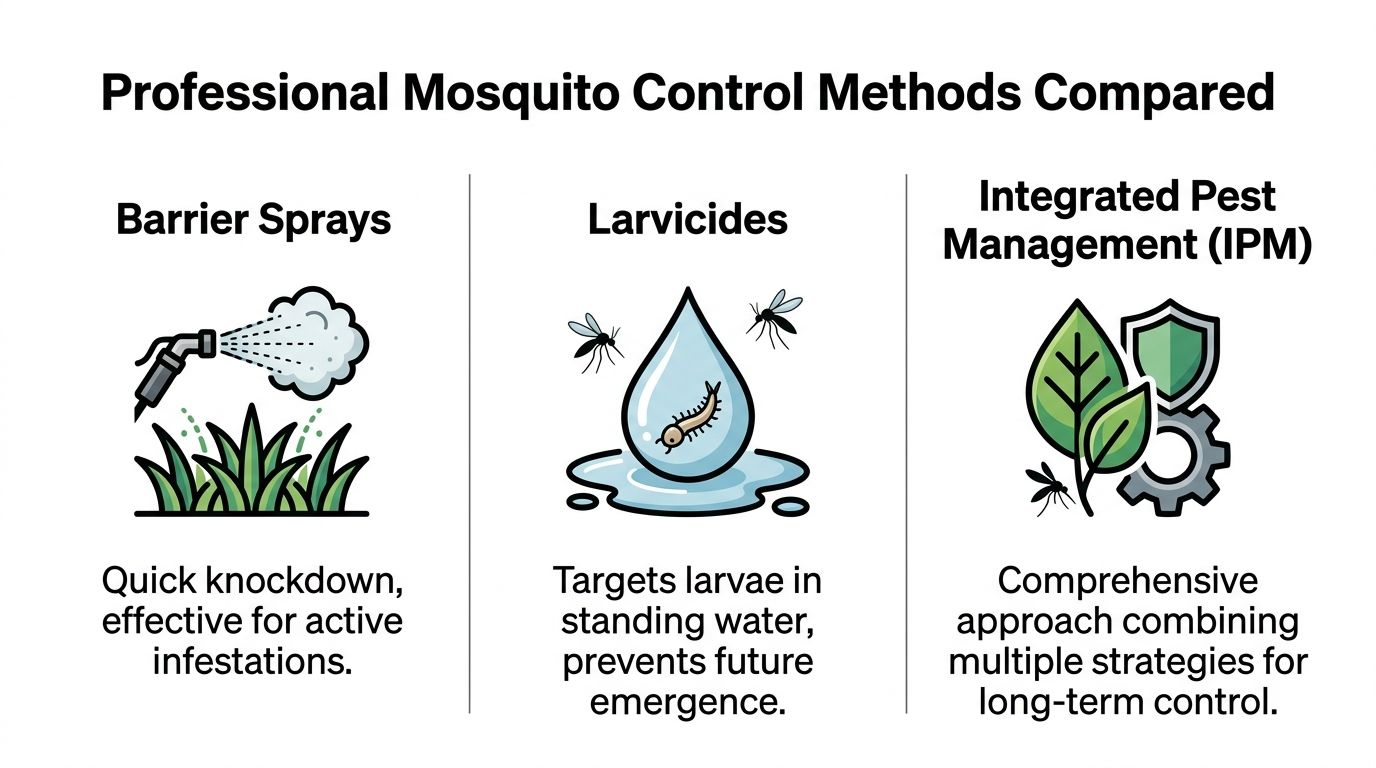
A Crown Point yard can look fine at a glance and still produce miserable evenings. The part homeowners do not always see is that different mosquito services solve different parts of the problem. Barrier spray, larvicide, fogging, and Integrated Pest Management all have a place, but they are not interchangeable.
Barrier sprays
Barrier treatments are usually the first service people ask about, and for good reason. Applied to shaded foliage, fence lines, lower tree canopy, and other resting sites, they reduce the adult mosquitoes already using your yard. Homeowners often notice relief quickly, especially around patios, play areas, and dog runs.
The limitation is straightforward. A barrier spray works on the mosquitoes that land in treated areas. It does not correct the catch basin holding water behind the fence, the low spot staying wet after every storm, or the container nobody noticed near the shed.
In Northwest Indiana, that trade-off matters. Warm, wet stretches can keep new adults emerging even after a good spray, so the treatment needs to be tied to what is happening on the property.
Larvicides
Larvicides target mosquitoes in the water before they turn into biting adults. On many properties, this is the quiet part of the job that makes the biggest difference over time.
A technician may use larvicides in places that cannot be dumped or drained right away, such as drainage structures, ornamental features, or recurring water collection points. Good use of larvicides takes judgment. Not every wet area needs treatment, and not every water source is practical or legal to treat the same way.
That is one reason a local company tends to outperform a one-size-fits-all program. The crew has to know where Northwest Indiana properties usually hold water and which sites keep producing after rain.
Adulticiding and targeted knockdown
Sometimes homeowners need fast relief. A graduation party is coming up. Kids want to use the yard. Mosquito pressure is already high. In those cases, targeted adult control can knock numbers down quickly.
Used well, it is helpful. Used by itself, it often turns into a loop of repeated treatments with the same underlying problem still in place.
A short visual overview helps make those differences easier to see.
Why IPM usually works better
Integrated Pest Management combines inspection, source reduction, larval control, and adult treatments based on what the yard requires. IPM is more than a buzzword. It is the field process experienced technicians use when they want results to last longer than a few evenings.
According to this breakdown of mosquito IPM methods and effectiveness, professional IPM can achieve a 70% to 90% reduction in mosquitoes per treatment, and focusing on eggs and larvae can reduce populations by up to 90% before they become biting adults. That same source explains why larval control is often the most cost-effective part of the program.
Here is how the methods compare in practical terms:
| Method | What it does well | Where it falls short |
|---|---|---|
| Barrier spray | Reduces active adult mosquitoes in treated resting areas | Doesn’t fix breeding sites by itself |
| Larvicide | Interrupts future emergence in standing water | Requires careful identification of water sources |
| Event-style knockdown | Helpful before parties or short-term outdoor use | Usually not enough for season-long management |
| IPM | Combines correction, prevention, and targeted treatment | Takes more skill, inspection, and follow-through |
What works and what usually disappoints
Store-bought sprays, candles, and traps can help in a small area for a short period. They usually fall short when a yard has several shaded resting sites, multiple moisture pockets, or pressure coming from nearby properties. Professional mosquito management works outdoors by stacking methods, matching them to the site, and adjusting as conditions change.
That is why a seasonal program usually performs better than a spray-only approach. A company may combine recurring adult control with larval work, inspection findings, and recommendations for trimming, drainage, or container cleanup. The Green Advantage mosquito control service offers both seasonal and one-time treatments in Northwest Indiana, which makes sense for homeowners who either want steady backyard use or need relief before a single event.
Field insight: Fast relief matters, but long-term control usually comes from the less visible work. Drainage corrections, habitat reduction, and larval control are what keep a property from slipping back.
A better question than “Do you spray?” is “How do you decide which method fits my yard?” That answer tells you a lot about the company standing in front of you.
Your Checklist for Hiring a Company in Northwest Indiana
Mosquito control is now a standard offering, which means homeowners have more choices and more reason to ask sharper questions. In 2023, 86% of U.S. pest control company locations offered mosquito control services, up from 74% the previous year, according to the 2024 PCT State of the Mosquito Control Market survey PDF. More options can be helpful, but it also means not every provider brings the same depth, training, or process.
Ask how they inspect, not just how they spray
A reliable mosquito control company should describe how they assess the property before treatment. That includes resting areas, standing water, drainage problems, shaded zones, and features that support recurring activity.
If the answer sounds like “we spray the yard every few weeks,” keep asking questions. That may be part of the service, but it shouldn’t be the whole plan.
Confirm licensing and insurance
This should be a straightforward question. A company working on your property should be properly licensed and insured for pest control work in Indiana.
You don’t need a sales pitch here. You need a clear answer. If a provider gets vague or defensive, move on.
Ask what products are used and where
Homeowners should know:
- Treatment areas: Which parts of the yard get treated, and which areas are intentionally avoided.
- Product purpose: Whether the service addresses adult mosquitoes, larvae, or both.
- Use guidance: What the technician wants you to do before and after treatment.
- Sensitive areas: How they handle gardens, play spaces, pollinator activity, pet areas, and water features.
A good provider won’t dodge these questions. They’ll explain the plan in plain English.
A trustworthy answer usually sounds calm and specific. It doesn’t sound rushed, vague, or overly absolute.
Get clear on scheduling
Mosquitoes aren’t a one-and-done pest. Re-treatment is often part of the program because weather, neighboring conditions, and ongoing breeding pressure all affect results.
Ask these questions before you sign up:
- How often do you typically return during mosquito season?
- Do you offer one-time service for events as well as ongoing seasonal plans?
- What happens if pressure stays high between visits?
- Will you recommend property changes that improve results between treatments?
If a company promises complete elimination, be careful. That’s not how real mosquito management works outdoors.
Read local reviews with the right filter
Don’t just count stars. Read for specifics. Look for comments that mention communication, punctuality, technician professionalism, clarity about the plan, and whether the company explained what the homeowner could do to help.
For residential pest control, those details matter because service quality isn’t only about the treatment itself. It’s also about whether the company helps you understand the problem. The same applies for commercial pest control if you manage apartments, hospitality properties, outdoor dining areas, or event spaces around Crown Point.
Compare the proposal, not just the price
A lower quote may cover less than you think. Compare what’s included.
| What to compare | Why it matters |
|---|---|
| Inspection detail | Shows whether the company is solving a property issue or selling a generic route stop |
| Treatment scope | Reveals if they address adults only or include larval prevention |
| Follow-up plan | Tells you what happens when weather or reinfestation changes conditions |
| Communication | Helps you know what to expect before, during, and after service |
If you're also evaluating broader pest control in Crown Point, IN, this same checklist applies to ant control, rodent control, wasp removal, spider control, and preventative exterior service. The company’s process usually tells you more than the ad does.
The Green Advantage Process What to Expect
The first thing most homeowners want is a simple answer to a simple question. “What happens if I call?” That’s fair. Pest control should feel organized, not confusing.
The first conversation
When you reach out, the goal is to understand what you’re seeing. Some callers describe constant evening bites around the patio. Others mention mosquitoes around a playset, a pond edge, or a dog run. Commercial clients may be dealing with complaints around outdoor seating, entry areas, or event spaces.
That early conversation matters because not every mosquito problem looks the same on site.
The inspection and yard read
Once a technician visits the property, the work becomes more specific. They look for likely resting zones, moisture patterns, standing water, and property features that support ongoing mosquito pressure. They also look for things the homeowner may not notice, such as clogged drainage paths, hidden containers, heavy shaded foliage, or water-holding structures around the property.
Some businesses in Northwest Indiana need this same level of site analysis. That matters because there’s still a lack of practical information for commercial mosquito service, even though restaurants, event venues, and golf-related properties can see a direct effect on customer experience and revenue, as noted in this discussion of mosquito control for businesses.
The treatment plan
A solid plan should match the site. One property may need regular seasonal attention because of neighboring water and dense landscaping. Another may be a better fit for one-time event treatment plus habitat corrections. The point is to avoid treating every yard like it has the same mosquito pattern.
For homeowners who want a broader look at company standards and service philosophy, The Green Advantage shares more about that on why homeowners choose The Green Advantage for pest control.
Good mosquito service should leave you knowing what was found, what was treated, and what changes on the property will help the most between visits.
During and after service
A professional visit should feel careful and predictable. You should know when the technician is coming, what areas are being treated, and whether there are any simple prep or post-treatment instructions.
Follow-up also matters. Homeowners often have questions after the first visit, especially if they’re comparing the result to past DIY attempts. A dependable company explains what improvement to watch for, why some mosquito activity may still appear, and what conditions can affect how long relief lasts.
That same communication is useful if you're hiring for commercial pest control or even looking for an exterminator in Crown Point, IN for a wider pest issue. The best providers don’t just treat. They diagnose, document, and communicate.
Common Questions About Mosquito Control Services
Is professional mosquito control safe for children and pets
That depends on the provider’s process, products, and application practices. A responsible company should explain where treatment is applied, what precautions matter, and any reentry guidance you should follow. If you don’t get a clear answer, keep asking.
How long do treatments last
That varies with weather, vegetation, standing water, and overall mosquito pressure. Heavy rain, nearby breeding sources, and dense shade can all affect how a yard performs between visits. That’s why recurring seasonal service often works better than a one-time reactive approach for ongoing outdoor use.
Will I still see some mosquitoes
It is likely so. Outdoor mosquito control focuses on reduction rather than perfection. The practical goal is to make your yard significantly more comfortable and usable, rather than pretending nature stops at the property line.
Why is professional service better than DIY
Because professionals look beyond the obvious. They inspect breeding conditions, identify resting areas, choose the right method for the site, and adjust the program when the yard or season changes. DIY products usually focus on what you can see right now. A trained mosquito control company looks at what’s about to hatch next.
Can a mosquito company help businesses too
Yes. Outdoor dining, event areas, common spaces, entrances, and property grounds can all benefit from site-specific mosquito service. If you manage property in Northwest Indiana, mosquito pressure can affect both tenant comfort and guest experience.
If mosquitoes are keeping you from using your yard or outdoor business space in Crown Point, it’s time to get a clear plan. The Green Advantage helps homeowners and businesses across Northwest Indiana identify breeding conditions, reduce biting pressure, and make outdoor areas more usable again. Reach out to request a quote, schedule an inspection, or talk through the mosquito issues you’re seeing on your property.
Expert Mosquito Control for Yard in Crown Point
You step outside on a warm Crown Point evening, ready to enjoy the patio, and within minutes the swatting starts. The kids want to play in the yard. The dog keeps pacing by the back door. You’ve emptied a few flowerpot trays, burned a candle, maybe even bought a bug zapper, and the mosquitoes still seem to own the place.
That’s a familiar pattern in Northwest Indiana. Our yards deal with humidity, shaded fence lines, clogged gutters, low spots that hold water after rain, and nearby drainage areas that keep mosquito pressure high through the season. Good mosquito control for yard spaces isn’t about one product or one spray. It’s about understanding where mosquitoes breed, where they rest, and when simple prevention stops being enough.
Homeowners looking for pest control near me, exterminator near me, or mosquito control in Crown Point, IN usually want the same thing. They want to reclaim their yard without guessing. They want practical answers, honest trade-offs, and a plan that works for real Northwest Indiana conditions. That’s what this guide is built to provide.
Understanding the Mosquito Problem in Northwest Indiana
Mosquito pressure in Northwest Indiana builds fast because our weather keeps giving them what they need. Warm evenings, regular summer rain, shaded fence lines, drainage swales, and damp pockets around the yard create steady breeding and resting areas from late spring into early fall. A property does not need a pond or woods behind it to have a serious mosquito problem. Small water sources around the home are often enough.

Why Crown Point yards stay active
In Crown Point and nearby communities, mosquito activity often stays high because rain keeps resetting the problem. Gutters clog. Low spots stay wet. Downspout extensions hold water. Kids' toys, tarps, and plant saucers collect enough moisture to support larvae. I see this on tidy properties all the time, including neatly trimmed yards where the issue is hidden behind a shed or along a damp side yard.
Shade matters too. Adult mosquitoes avoid bright, exposed areas during much of the day and settle into cooler protected spots. Dense shrubs, overgrown edges, and thick groundcover give them a place to rest until people come outside in the evening.
If your yard stays damp after rain, fixing drainage usually cuts pressure more than another store-bought spray. These practical drainage tips for lawns line up with the same problem areas we check during mosquito inspections.
The species homeowners notice most
Northwest Indiana yards usually deal with two mosquito groups that behave differently enough to matter. You do not need to identify them on sight, but you should know why one yard can have several mosquito patterns at once.
- Aedes mosquitoes: These often breed in small containers and scattered water sources close to the house. They are common around patios, toys, buckets, and clogged items that hold rainwater.
- Culex mosquitoes: These are more closely tied to stagnant water in catch basins, ditches, neglected drains, and similar sites nearby.
- Both groups: They use shaded plantings, damp corners, and protected areas around the property as daytime resting sites.
That is why open lawn treatment by itself rarely gives lasting relief. Most activity is usually happening in the shaded margins and hidden water sources.
Why the problem can feel bigger than your yard
Many homeowners get frustrated because they empty containers and still get swarmed. In Northwest Indiana, that frustration is justified. Mosquitoes move in from nearby pressure points, including roadside ditches, drainage areas, unmanaged neighboring containers, and low ground beyond the fence line. You can do a lot on your own property and still feel the impact of what is happening around it.
That does not mean DIY work is pointless. It means expectations need to match the situation. Good prevention lowers breeding on your property. Professional treatment becomes more useful when outside pressure stays high, when the yard has heavy shade and moisture, or when disease concerns add urgency. If you want to understand that risk better, review mosquito-borne illnesses in Indiana and why steady control matters for more than comfort.
Your Seasonal Action Plan for At-Home Prevention
In Northwest Indiana, mosquito season usually starts frustrating homeowners before summer cookouts even begin. A warm stretch in spring, steady rain, and shaded corners around the yard can give local mosquito populations a fast start. A good at-home plan cuts down pressure on your property, but it works only when it follows the season and gets repeated often.
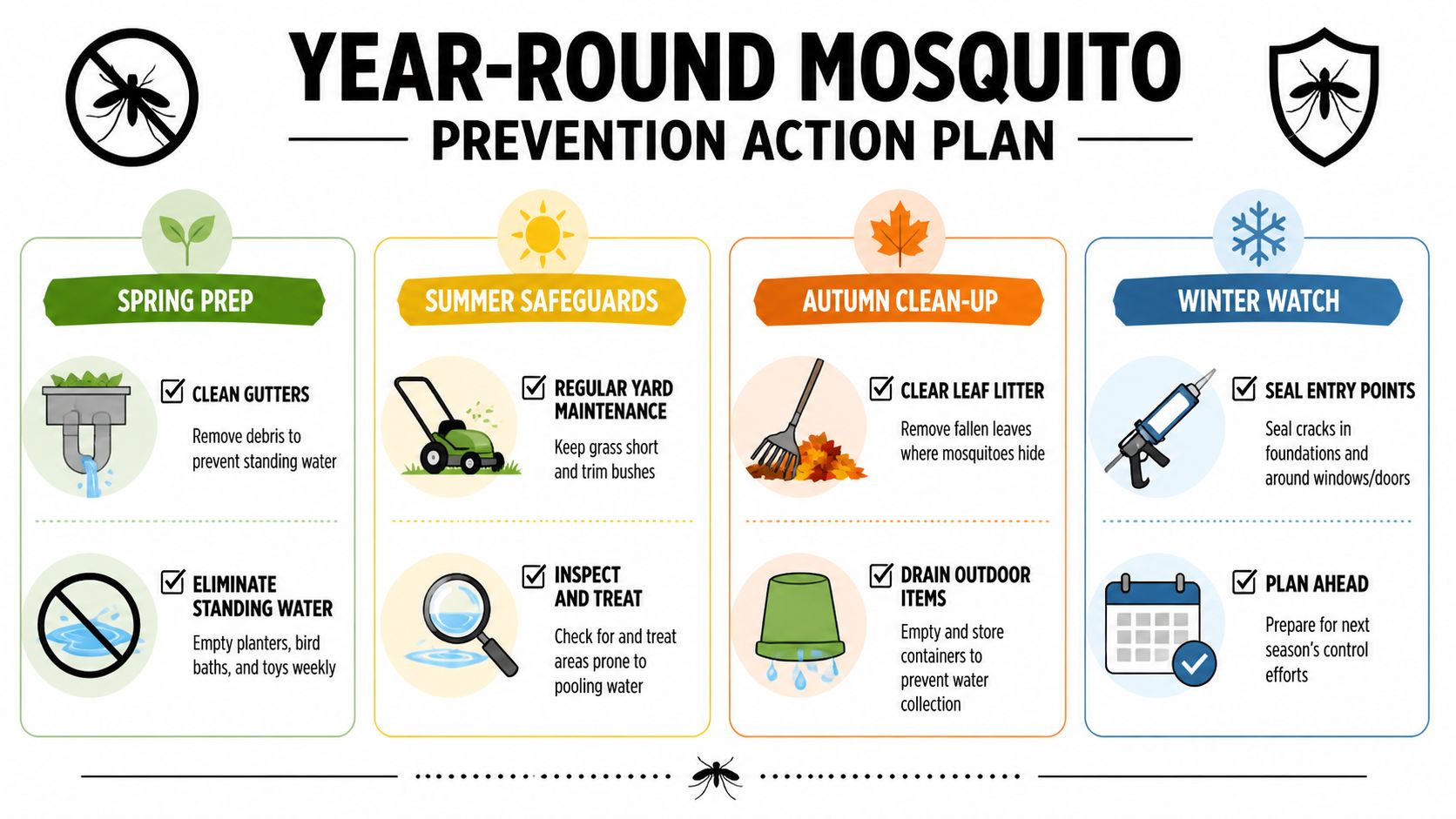
The first priority is simple. Remove places where water sits long enough for mosquitoes to develop. The second is reducing cool, protected hiding spots near the areas where your family spends time. Broad spraying without fixing those two issues usually leads to the same complaint I hear all the time in Crown Point and nearby towns. "We treated, but they came right back."
Spring prep
Spring is when yards either get ahead of mosquitoes or spend the rest of the season catching up. Once the thaw passes and rains settle in, walk the property slowly and check the overlooked items, not just the obvious ones. I tell homeowners to look at the yard the way a technician would. Follow water, shade, and clutter.
Check flowerpots and birdbaths, of course. Then keep going. Look at wheelbarrows, grill covers, kids' toys, piles of edging material, clogged gutters, corrugated window wells, and the low area near the air conditioner discharge.
A useful spring checklist includes:
- Clean gutters: Debris blocks flow and leaves small pockets of standing water.
- Flip or store containers: Buckets, lids, planters, and toys should not hold rainwater.
- Refresh birdbaths and pet bowls often: Clean water is less likely to become a breeding site.
- Correct drainage problems: Water that settles near patios, fence lines, or downspouts needs attention.
- Inspect ponds and rain barrels: These need active management all season, not occasional checks.
If your yard stays soggy after storms, review practical drainage tips for lawns and fix the water issue itself. That pays off longer than chasing mosquitoes week after week.
Summer maintenance
Summer is where prevention either holds or slips. Rainfall, irrigation, humidity, and backyard activity create new water sources fast, especially in Northwest Indiana neighborhoods with shade, fencing, and heavier vegetation around decks and property lines.
Do a quick inspection every week. After a storm, do another one.
Focus on these summer habits:
- Keep grass cut and vegetation thinned around use areas: Mosquitoes rest in cool, damp cover near foundations, fences, shrubs, and under decks.
- Dump standing water weekly: Check saucers, tarps, tire swings, kiddie pools, toys, and anything else that catches runoff.
- Manage water that cannot be drained: Ponds, rain barrels, and other permanent water sources need proper larval control products used according to the label.
- Watch irrigation closely: Overwatering creates muddy or damp spots that stay attractive longer than homeowners expect.
- Inspect shaded pockets: Behind sheds, under stairs, around timbers, and along the back side of dense shrubs are common resting sites.
There is a real trade-off with DIY treatment here. Larval control can be useful when you have water that must remain in place. Adult mosquito sprays can also help for a short period. But if the timing is off, rain interrupts the treatment, or nearby pressure is high, results drop fast. Homeowners who want better timing guidance should read about the best time to spray mosquitoes before treating on their own.
If you cannot drain a water source, you have to manage it consistently. Otherwise it becomes the spot that keeps repopulating the yard.
Fall wind-down
Mosquito pressure often lingers deeper into fall than homeowners expect, especially after a mild September or wet stretch. Cooler evenings do not mean the yard is clear.
Fall work is mostly cleanup and moisture control:
- Remove leaf buildup from gutters, beds, window wells, and low corners.
- Drain and store unused outdoor items before they collect repeated fall rains.
- Cut back overgrown vegetation near patios, fences, and the house.
- Keep checking after rain until cold weather is consistently established.
This step matters in wooded or shaded Northwest Indiana lots where damp cover hangs on well into autumn.
Winter watch
Winter is the right time to fix the conditions that made summer miserable. Regrade the low spot by the downspout. Repair gutters that overflow. Replace torn screens. Clear out the side yard where containers and debris collected all year.
That off-season work makes spring prevention easier. It also helps you figure out where DIY care is enough and where recurring mosquito pressure calls for professional treatment, especially on properties with heavy shade, drainage issues, or pressure coming in from beyond the fence line.
Common DIY Mosquito Control Mistakes Homeowners Make
Most DIY mosquito products aren’t failing because homeowners are careless. They’re failing because they don’t match how mosquitoes behave in a Northwest Indiana yard.
Mistaking insect activity for mosquito control
A lot of products create the impression that they’re working because they kill some flying insects. That’s not the same as reducing the biting pressure around your patio or back door.
The clearest example is the bug zapper. It’s popular, it’s visible, and it gives homeowners instant feedback. But the actual target is biting mosquitoes, especially females. A study highlighted by Vector Disease Control International found that bug zappers captured only 6.4% mosquitoes in their insect catch, and only half of those were the biting females, according to VDCI’s review of mosquito control myths.
That’s why many homeowners hear the zap all evening and still get bitten the same night.
Treating the air instead of the habitat
Another common mistake is focusing only on what’s flying around at dusk. Mosquitoes spend a lot of time hiding in cool, shaded vegetation and breeding in water sources that aren’t obvious from the patio. Spraying open air with a hand can or fogger often gives a short burst of satisfaction without touching the places that keep the population going.
What usually gets missed?
- Hidden water: Corrugated drain pipes, folds in tarps, clogged gutters, and objects stored against the fence.
- Resting sites: Lower branches, dense shrubs, tall weeds, and shaded corners that stay humid.
- Neighbor influence: A tidy yard can still get pressure from nearby breeding and resting areas.
Expecting one retail product to solve a layered problem
Citronella candles, occasional yard sprays, and one-time treatment of visible puddles can all play a small role. They just don’t replace an integrated plan. In practice, homeowners run into trouble when they rely on a single product while leaving the structural causes in place.
The biggest DIY mistake isn’t trying. It’s using a comfort product as if it were a control program.
If you’ve already trimmed the yard, dumped the containers, and stayed on top of the basics but still can’t use your outdoor space comfortably, that’s usually the point where a professional approach starts making sense.
How Professional Mosquito Services Provide Lasting Relief
Professional mosquito control for yard spaces works because it targets the full pattern of mosquito activity, not just the insects you happen to see at one moment. A technician does more than spray a lawn. The technician is reading the property, identifying where mosquitoes breed, where they rest, and how local weather changes the treatment window.

What professionals target that homeowners often miss
Most mosquito pressure in a residential yard comes from a combination of breeding sites and protected resting areas. Professional service addresses both.
Barrier treatments focus on vegetation and other surfaces where adult mosquitoes shelter during the day. That includes shaded shrubs, lower tree limbs, perimeter plantings, damp fence lines, and other cool protected zones near activity areas. In larger or more complex sites, technicians may also use application methods designed to distribute very fine droplets effectively where adult mosquitoes are active.
The process is far more deliberate than “spray everything.” Good service starts with site inspection and selective treatment.
Why timing matters so much
Mosquito control isn’t something you should put on a rigid every-month calendar and forget. Professional barrier applications are adjusted every 10 to 17 days based on rainfall, moisture, and temperature, and those conditions can compress the treatment window, according to Clarke’s guidance on mosquito spray application methods.
That matters a lot in Crown Point. A stretch of wet, humid weather can change mosquito pressure quickly. If the treatment schedule doesn’t adapt, the yard can slip backward even when a homeowner thinks they’re “on plan.”
Field note: The weather doesn’t care what date is on the service reminder. Rainfall and humidity change mosquito activity, so treatment timing has to respond to conditions on the ground.
Professional application timing also takes mosquito behavior into account. Adult mosquitoes are often most active at dawn and dusk, while daytime work can focus on resting vegetation where they shelter between blood meals.
Here’s a short look at the difference:
| Approach | Typical limitation | Professional adjustment |
|---|---|---|
| Calendar-based DIY spraying | Misses changes caused by rain and humidity | Schedule shifts with weather and site moisture |
| Open-yard spraying | Little impact on hidden resting zones | Targets shaded vegetation and harborage areas |
| Single-method treatment | Leaves breeding sources active | Combines habitat review, larval attention, and adult control |
A visual overview helps show how proper application is handled in the field:
What a reliable service plan includes
A professional yard treatment plan usually includes several pieces working together:
- Property inspection: Looking at drainage patterns, standing water risks, vegetation density, and mosquito pressure points.
- Targeted barrier treatment: Applying product where adult mosquitoes rest.
- Larval site attention: Identifying water features or recurring wet areas that need management.
- Adaptive scheduling: Returning based on weather, mosquito pressure, and property conditions instead of generic timing.
- Communication with the homeowner: Explaining what was treated, what still needs cleanup, and what to watch between visits.
One available option for local homeowners is The Green Advantage’s mosquito program, which treats both adult activity areas and larval concerns in serviced yards and can be set up as seasonal service or as a one-time yard treatment for an outdoor event.
That’s also where professional mosquito service connects with broader residential pest control. Homeowners searching for pest control in Crown Point, IN or an exterminator in Crown Point, IN are often dealing with more than one outdoor issue at once. Dense vegetation, moisture, and clutter can also support spiders, stinging insects, and other nuisance pests around the home’s exterior.
The Green Advantage Process for Crown Point Families
Homeowners rarely call for mosquito service because they want to learn the pest control industry. They call because they want to use their yard again. The process should feel straightforward, not confusing.
It usually starts with a conversation about what’s happening on the property. Some homeowners say the bites are worst near the deck. Others notice the side yard is miserable after rain. Some are planning a graduation party, cookout, or weekend gathering and need relief in a short window. Those details matter because mosquito pressure isn’t the same across every property in Crown Point.
What happens first
The first step is getting a clear picture of the problem. A knowledgeable office team can help narrow down the type of service needed, whether that’s recurring seasonal treatment or a one-time application for a special event. From there, the property gets evaluated with attention to the areas that often drive mosquito pressure in Northwest Indiana: shaded vegetation, drainage trouble spots, standing water risks, and activity zones like patios, play areas, and pool surrounds.
A proper inspection also helps separate mosquito issues from other outdoor pest problems. Homeowners searching for residential pest control sometimes discover they also need help with wasp activity under eaves, spiders around entry points, or general perimeter pest pressure around the structure.
How the treatment plan is explained
Good service should be clear about what’s being done and why. Homeowners need to know where treatment will be focused, what preparation helps the result, and what limitations still exist if neighboring conditions continue to produce mosquitoes.
That discussion should also cover practical safety steps. Families commonly ask about pets, kids, and yard use after treatment. Clear directions matter because confidence comes from knowing what to expect, not from vague reassurance.
A trustworthy technician doesn’t just apply a product and leave. The technician explains the conditions that are helping mosquitoes, what the treatment is targeting, and what the homeowner can do between visits.
What follow-up should feel like
A dependable mosquito service doesn’t end when the application is finished. Weather changes, new standing water forms, and vegetation grows back. Homeowners should know what signs to watch for and when to call with concerns.
In real service work, follow-up often includes:
- Reviewing treated zones: So the homeowner understands where mosquito pressure was highest.
- Pointing out correction items: Such as clogged gutters, water-holding containers, or overgrown edges.
- Adjusting future timing: Based on rainfall, moisture, and how the yard is responding.
- Coordinating with other pest needs: If the property would benefit from broader exterior pest service.
That local familiarity matters. Crown Point yards vary a lot. Newer subdivisions, older neighborhoods with mature landscaping, and properties near open drainage or wooded edges all create different mosquito patterns. A technician who works in Northwest Indiana regularly can recognize those differences quickly.
Why the experience matters as much as the treatment
Homeowners usually aren’t just buying an application. They’re buying relief from frustration. They want to stop guessing which product to try next. They want direct answers, scheduling that makes sense, and service that respects their home.
That’s true whether the property owner is dealing with a family backyard, a rental property, or a commercial site that needs outdoor comfort for tenants, staff, or customers. The same principles apply: inspect carefully, treat the right places, communicate clearly, and adapt to changing conditions.
Why Expert Mosquito Control Is a Smart Investment
By mid-July, a lot of Northwest Indiana homeowners have already spent money on yard spray, citronella products, mosquito dunks, and one more gadget that promised better evenings outside. Then the mosquitoes come out after a warm rain, and the backyard still feels off-limits.
That is usually the point where cost needs to be judged by results, not by the price tag on one bottle.
Professional mosquito service often makes better financial sense because it reduces wasted trial and error. Homeowners who handle the problem on their own tend to buy in pieces across the season. A hose-end spray one week, dunks for standing water the next, then patio repellents for a cookout. Those purchases add up, and they still may not address where mosquitoes in Crown Point and the rest of Northwest Indiana rest and rebuild, especially in shaded foliage, damp edges, and properties near drainage areas or wooded borders.
There is also the time factor. Consistent mosquito reduction takes inspection, timing, and repeat applications based on weather and pressure. Missing a treatment window during a wet stretch can leave homeowners chasing the problem for weeks.
What the investment really buys
A professional program buys more than fewer bites.
- More usable evenings outside: Patios, playsets, and backyards stay practical during peak mosquito months.
- Less product guesswork: Homeowners stop rotating through retail options that may not fit the property or the level of pressure.
- A safer treatment plan: Sensitive areas like pet spaces, pollinator plantings, and vegetable gardens can be accounted for before service starts.
- Season-long consistency: Service is scheduled around mosquito activity and local conditions, not just around when someone has free time on a Saturday.
In my experience, that last point matters most. Mosquito control in Northwest Indiana is rarely a one-and-done job. Spring moisture, summer storms, heavy shade, and neighborhood drainage patterns can keep pressure high even when a homeowner is doing several things right.
Why professional help becomes the practical choice
DIY prevention still has value. Dumping standing water, cleaning gutters, thinning overgrown edges, and treating obvious breeding spots can lower pressure. But once a yard has repeated evening activity, bites around shaded seating areas, or mosquitoes pushing in from nearby harborage, the job usually needs a broader plan.
That is where professional service earns its keep. A technician can treat the places homeowners often miss, adjust the schedule after weather changes, and choose materials and application methods that fit the property. At The Green Advantage, that means looking at the whole yard as it behaves through the season, not just spraying the obvious spots and hoping for the best.
For many families in Crown Point, mosquito service becomes a practical property expense for the same reason they call for termite control, rodent control, or wasp removal. The problem has reached a point where steady, informed service is more reliable than another round of trial and error.
Frequently Asked Questions About Yard Treatments
A few questions come up on almost every mosquito call. Most are really about safety, expectations, and timing. Those are fair questions, and homeowners should get clear answers before any service is scheduled.
Common Questions About Our Mosquito Services
| Question | The Green Advantage Answer |
|---|---|
| Are yard mosquito treatments safe around pets and children? | Treatments should always be applied according to label directions, with clear instructions about when the yard can be used again. Homeowners should follow the technician’s post-treatment guidance closely, especially for pets and children who spend a lot of time on turf and patios. |
| Can you treat a yard that has a vegetable garden or pollinator plants? | Yes, but those areas need to be identified during the inspection so treatment can be planned carefully. Mosquito work should be targeted to resting areas and problem zones, not applied carelessly across the whole landscape. |
| What if it rains after service? | Rain timing matters. Light conditions after the application has had time to settle may not affect results the same way heavy rainfall would. If weather becomes a concern, the property should be evaluated based on treatment timing, yard conditions, and mosquito activity afterward. |
| How long should I wait before using the yard again? | The exact wait time depends on the product used and the application instructions. Your technician should give direct, property-specific guidance after service so you know when normal yard use can resume. |
A few practical points homeowners appreciate
If you’re preparing for service, it helps to mow if needed, reduce obvious standing water, and ensure gates are accessible so the technician can access the full treatment area. If you have specific concern zones, point them out. The worst mosquito pressure usually isn’t random.
It’s also worth mentioning if you’re dealing with other exterior pest issues. Homeowners looking for commercial pest control or home perimeter service often want one provider to evaluate the full outdoor pest picture, especially around entry points, foundation plantings, trash areas, and outdoor seating spaces.
Ask direct questions before service day. A good answer should be clear, specific, and easy to follow.
If your yard in Crown Point or nearby Northwest Indiana has reached the point where DIY steps aren’t enough, contact The Green Advantage to schedule an inspection or request a quote. A clear mosquito control plan can help you reclaim your outdoor space, reduce frustration, and make the yard usable again for your family, guests, or tenants.