
A lot of Crown Point homeowners reach the same point every summer. You clean the patio, fire up the grill, set drinks out for friends, and within minutes everyone is swatting, itching, and heading back inside. Mosquitoes don’t just ruin the evening. They make your own yard feel off-limits.
That frustration is why more people now look for a real mosquito control company instead of cycling through candles, foggers, and hardware store sprays that only seem to help for a short window. If you're searching for pest control near me, exterminator near me, or dependable pest control in Crown Point, IN, mosquito service is often the issue that pushes people to finally call a professional.
Reclaim Your Summer Evenings in Crown Point
In Northwest Indiana, mosquito problems rarely feel minor. A yard can look perfectly maintained and still be uncomfortable by dusk. That’s especially true in neighborhoods with tree lines, low spots that hold water, ornamental landscaping, or nearby ponds and drainage areas.

Many homeowners start with the same plan. They put out citronella products, spray around the deck, and hope for the best before a cookout or family get-together. Sometimes that knocks activity down briefly. Often it doesn’t. The bigger issue is that adult mosquitoes are only the visible part of the problem. If breeding sites stay active, the pressure returns fast.
That’s one reason professional service has become a bigger priority for homeowners. The global mosquito control market is projected to reach USD 7.24 billion in 2026, and residential applications are projected to account for 43.7% of that market, reflecting how strongly homeowners value yard and family protection, according to mosquito control market projections from Coherent Market Insights.
Why outdoor living matters here
In Crown Point, summer isn’t just a season. It’s porch time, patio dinners, graduation parties, and weekends spent outside as long as the weather allows. Homeowners invest in landscaping, seating areas, pergolas, and screened spaces because they want to use them.
If you're thinking about improving comfort beyond pest service alone, some homeowners also explore Lafayette enclosed deck options to make outdoor spaces more usable during bug season and changing weather.
Practical rule: If mosquitoes are driving you indoors at the same time every evening, that usually points to an active property-wide pattern, not a one-spot nuisance.
A local, family-owned provider in Crown Point should understand that difference. Good mosquito control isn't just about spraying shrubs. It’s about reading the yard, knowing how our local conditions affect breeding, and choosing treatment methods that match how mosquitoes behave on your property.
Understanding Northwest Indiana’s Unique Mosquito Problem
Mosquitoes thrive where moisture, shade, and still air overlap. Northwest Indiana gives them plenty of those opportunities. Crown Point and nearby communities deal with humid summer conditions, wooded edges, drainage areas, retention ponds, bird baths, clogged gutters, outdoor containers, and low ground that holds water after rain.

A yard doesn’t need a marsh to produce mosquitoes. A forgotten bucket, a saucer under a planter, pooled water on a tarp, or a neglected corrugated drain can be enough. On larger properties, pressure often builds around fence lines, heavy foundation plantings, shaded back corners, and areas near neighboring standing water.
Why the lifecycle matters
A mosquito problem starts long before you notice adults flying around your patio. Eggs, larvae, pupae, then adults. If treatment only goes after the mosquitoes already biting, you’re treating the symptom and leaving the source behind.
That’s where many homeowners get frustrated. Most mosquito control services focus on reactive barrier sprays, but the more effective strategy targets mosquitoes throughout their lifecycle. Homeowners often aren’t told that breeding site work and larval-stage treatment are what help prevent the next wave, a gap highlighted in this discussion of lifecycle-based mosquito control.
For a closer look at common problem spots around homes, The Green Advantage has a useful page on mosquito breeding and mosquito control.
What Crown Point properties often have in common
Some properties get heavier activity because the environment keeps supporting reinfestation. Common local contributors include:
- Retention features: Newer developments often include water-management areas that can increase mosquito pressure nearby.
- Dense landscaping: Thick shrubs and shaded ornamentals give adults cool resting areas during the day.
- Backyard moisture pockets: Downspout discharge areas, poor drainage, and low ground create repeated breeding conditions.
- Neighboring influences: Mosquitoes don’t respect property lines. One neglected area nearby can keep your yard active.
When a homeowner says, "We sprayed and they came right back," the missing piece is usually habitat, not effort.
Nuisance bites versus bigger concerns
Most homeowners call because they’re tired of bites. That alone is reason enough. But mosquitoes also matter from a public health standpoint, which is part of why professional control keeps growing as a service category.
In practical terms, that means a mosquito control company should treat your yard as an ecosystem problem. The right service doesn’t just ask where you got bitten. It asks where mosquitoes are resting, where they’re breeding, how water moves across the property, and why the problem keeps repeating.
Comparing Professional Mosquito Control Methods
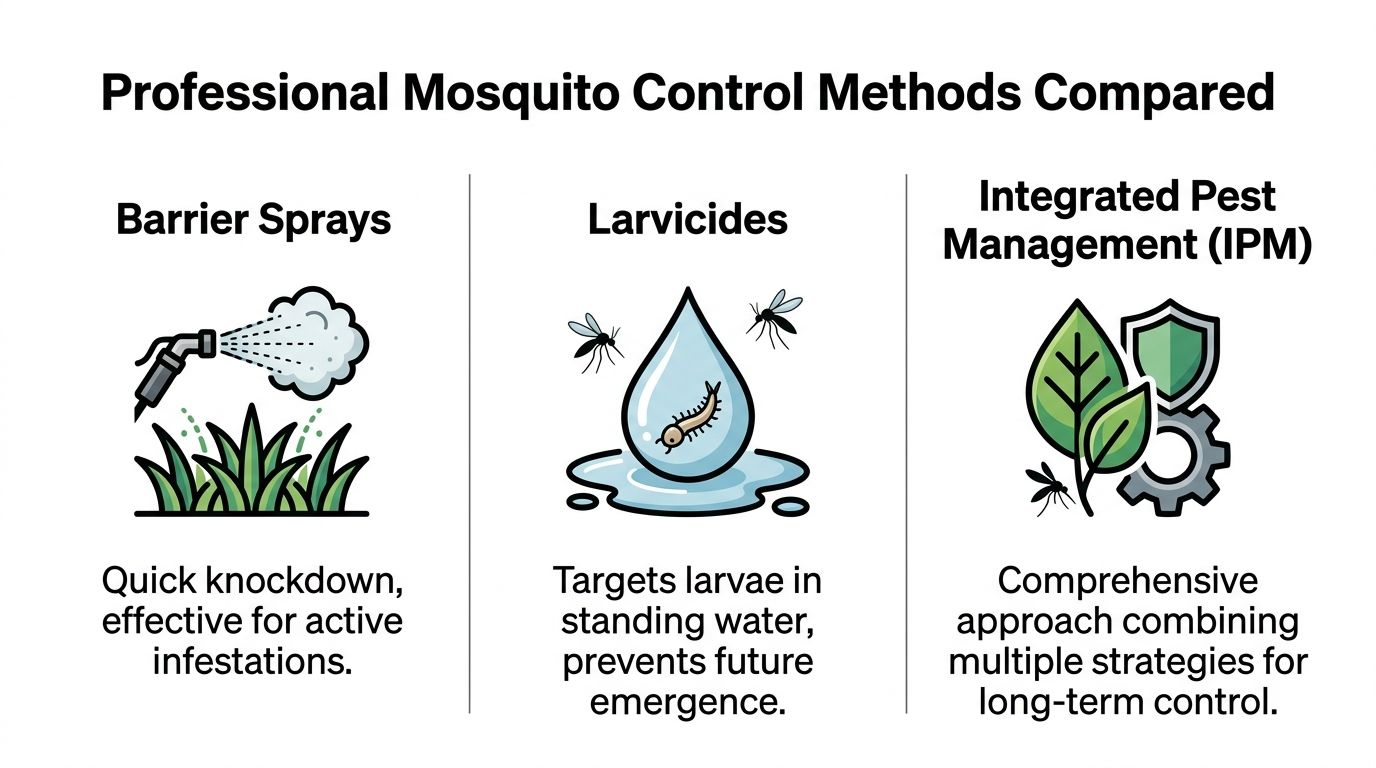
A Crown Point yard can look fine at a glance and still produce miserable evenings. The part homeowners do not always see is that different mosquito services solve different parts of the problem. Barrier spray, larvicide, fogging, and Integrated Pest Management all have a place, but they are not interchangeable.
Barrier sprays
Barrier treatments are usually the first service people ask about, and for good reason. Applied to shaded foliage, fence lines, lower tree canopy, and other resting sites, they reduce the adult mosquitoes already using your yard. Homeowners often notice relief quickly, especially around patios, play areas, and dog runs.
The limitation is straightforward. A barrier spray works on the mosquitoes that land in treated areas. It does not correct the catch basin holding water behind the fence, the low spot staying wet after every storm, or the container nobody noticed near the shed.
In Northwest Indiana, that trade-off matters. Warm, wet stretches can keep new adults emerging even after a good spray, so the treatment needs to be tied to what is happening on the property.
Larvicides
Larvicides target mosquitoes in the water before they turn into biting adults. On many properties, this is the quiet part of the job that makes the biggest difference over time.
A technician may use larvicides in places that cannot be dumped or drained right away, such as drainage structures, ornamental features, or recurring water collection points. Good use of larvicides takes judgment. Not every wet area needs treatment, and not every water source is practical or legal to treat the same way.
That is one reason a local company tends to outperform a one-size-fits-all program. The crew has to know where Northwest Indiana properties usually hold water and which sites keep producing after rain.
Adulticiding and targeted knockdown
Sometimes homeowners need fast relief. A graduation party is coming up. Kids want to use the yard. Mosquito pressure is already high. In those cases, targeted adult control can knock numbers down quickly.
Used well, it is helpful. Used by itself, it often turns into a loop of repeated treatments with the same underlying problem still in place.
A short visual overview helps make those differences easier to see.
Why IPM usually works better
Integrated Pest Management combines inspection, source reduction, larval control, and adult treatments based on what the yard requires. IPM is more than a buzzword. It is the field process experienced technicians use when they want results to last longer than a few evenings.
According to this breakdown of mosquito IPM methods and effectiveness, professional IPM can achieve a 70% to 90% reduction in mosquitoes per treatment, and focusing on eggs and larvae can reduce populations by up to 90% before they become biting adults. That same source explains why larval control is often the most cost-effective part of the program.
Here is how the methods compare in practical terms:
| Method | What it does well | Where it falls short |
|---|---|---|
| Barrier spray | Reduces active adult mosquitoes in treated resting areas | Doesn’t fix breeding sites by itself |
| Larvicide | Interrupts future emergence in standing water | Requires careful identification of water sources |
| Event-style knockdown | Helpful before parties or short-term outdoor use | Usually not enough for season-long management |
| IPM | Combines correction, prevention, and targeted treatment | Takes more skill, inspection, and follow-through |
What works and what usually disappoints
Store-bought sprays, candles, and traps can help in a small area for a short period. They usually fall short when a yard has several shaded resting sites, multiple moisture pockets, or pressure coming from nearby properties. Professional mosquito management works outdoors by stacking methods, matching them to the site, and adjusting as conditions change.
That is why a seasonal program usually performs better than a spray-only approach. A company may combine recurring adult control with larval work, inspection findings, and recommendations for trimming, drainage, or container cleanup. The Green Advantage mosquito control service offers both seasonal and one-time treatments in Northwest Indiana, which makes sense for homeowners who either want steady backyard use or need relief before a single event.
Field insight: Fast relief matters, but long-term control usually comes from the less visible work. Drainage corrections, habitat reduction, and larval control are what keep a property from slipping back.
A better question than “Do you spray?” is “How do you decide which method fits my yard?” That answer tells you a lot about the company standing in front of you.
Your Checklist for Hiring a Company in Northwest Indiana
Mosquito control is now a standard offering, which means homeowners have more choices and more reason to ask sharper questions. In 2023, 86% of U.S. pest control company locations offered mosquito control services, up from 74% the previous year, according to the 2024 PCT State of the Mosquito Control Market survey PDF. More options can be helpful, but it also means not every provider brings the same depth, training, or process.
Ask how they inspect, not just how they spray
A reliable mosquito control company should describe how they assess the property before treatment. That includes resting areas, standing water, drainage problems, shaded zones, and features that support recurring activity.
If the answer sounds like “we spray the yard every few weeks,” keep asking questions. That may be part of the service, but it shouldn’t be the whole plan.
Confirm licensing and insurance
This should be a straightforward question. A company working on your property should be properly licensed and insured for pest control work in Indiana.
You don’t need a sales pitch here. You need a clear answer. If a provider gets vague or defensive, move on.
Ask what products are used and where
Homeowners should know:
- Treatment areas: Which parts of the yard get treated, and which areas are intentionally avoided.
- Product purpose: Whether the service addresses adult mosquitoes, larvae, or both.
- Use guidance: What the technician wants you to do before and after treatment.
- Sensitive areas: How they handle gardens, play spaces, pollinator activity, pet areas, and water features.
A good provider won’t dodge these questions. They’ll explain the plan in plain English.
A trustworthy answer usually sounds calm and specific. It doesn’t sound rushed, vague, or overly absolute.
Get clear on scheduling
Mosquitoes aren’t a one-and-done pest. Re-treatment is often part of the program because weather, neighboring conditions, and ongoing breeding pressure all affect results.
Ask these questions before you sign up:
- How often do you typically return during mosquito season?
- Do you offer one-time service for events as well as ongoing seasonal plans?
- What happens if pressure stays high between visits?
- Will you recommend property changes that improve results between treatments?
If a company promises complete elimination, be careful. That’s not how real mosquito management works outdoors.
Read local reviews with the right filter
Don’t just count stars. Read for specifics. Look for comments that mention communication, punctuality, technician professionalism, clarity about the plan, and whether the company explained what the homeowner could do to help.
For residential pest control, those details matter because service quality isn’t only about the treatment itself. It’s also about whether the company helps you understand the problem. The same applies for commercial pest control if you manage apartments, hospitality properties, outdoor dining areas, or event spaces around Crown Point.
Compare the proposal, not just the price
A lower quote may cover less than you think. Compare what’s included.
| What to compare | Why it matters |
|---|---|
| Inspection detail | Shows whether the company is solving a property issue or selling a generic route stop |
| Treatment scope | Reveals if they address adults only or include larval prevention |
| Follow-up plan | Tells you what happens when weather or reinfestation changes conditions |
| Communication | Helps you know what to expect before, during, and after service |
If you're also evaluating broader pest control in Crown Point, IN, this same checklist applies to ant control, rodent control, wasp removal, spider control, and preventative exterior service. The company’s process usually tells you more than the ad does.
The Green Advantage Process What to Expect
The first thing most homeowners want is a simple answer to a simple question. “What happens if I call?” That’s fair. Pest control should feel organized, not confusing.
The first conversation
When you reach out, the goal is to understand what you’re seeing. Some callers describe constant evening bites around the patio. Others mention mosquitoes around a playset, a pond edge, or a dog run. Commercial clients may be dealing with complaints around outdoor seating, entry areas, or event spaces.
That early conversation matters because not every mosquito problem looks the same on site.
The inspection and yard read
Once a technician visits the property, the work becomes more specific. They look for likely resting zones, moisture patterns, standing water, and property features that support ongoing mosquito pressure. They also look for things the homeowner may not notice, such as clogged drainage paths, hidden containers, heavy shaded foliage, or water-holding structures around the property.
Some businesses in Northwest Indiana need this same level of site analysis. That matters because there’s still a lack of practical information for commercial mosquito service, even though restaurants, event venues, and golf-related properties can see a direct effect on customer experience and revenue, as noted in this discussion of mosquito control for businesses.
The treatment plan
A solid plan should match the site. One property may need regular seasonal attention because of neighboring water and dense landscaping. Another may be a better fit for one-time event treatment plus habitat corrections. The point is to avoid treating every yard like it has the same mosquito pattern.
For homeowners who want a broader look at company standards and service philosophy, The Green Advantage shares more about that on why homeowners choose The Green Advantage for pest control.
Good mosquito service should leave you knowing what was found, what was treated, and what changes on the property will help the most between visits.
During and after service
A professional visit should feel careful and predictable. You should know when the technician is coming, what areas are being treated, and whether there are any simple prep or post-treatment instructions.
Follow-up also matters. Homeowners often have questions after the first visit, especially if they’re comparing the result to past DIY attempts. A dependable company explains what improvement to watch for, why some mosquito activity may still appear, and what conditions can affect how long relief lasts.
That same communication is useful if you're hiring for commercial pest control or even looking for an exterminator in Crown Point, IN for a wider pest issue. The best providers don’t just treat. They diagnose, document, and communicate.
Common Questions About Mosquito Control Services
Is professional mosquito control safe for children and pets
That depends on the provider’s process, products, and application practices. A responsible company should explain where treatment is applied, what precautions matter, and any reentry guidance you should follow. If you don’t get a clear answer, keep asking.
How long do treatments last
That varies with weather, vegetation, standing water, and overall mosquito pressure. Heavy rain, nearby breeding sources, and dense shade can all affect how a yard performs between visits. That’s why recurring seasonal service often works better than a one-time reactive approach for ongoing outdoor use.
Will I still see some mosquitoes
It is likely so. Outdoor mosquito control focuses on reduction rather than perfection. The practical goal is to make your yard significantly more comfortable and usable, rather than pretending nature stops at the property line.
Why is professional service better than DIY
Because professionals look beyond the obvious. They inspect breeding conditions, identify resting areas, choose the right method for the site, and adjust the program when the yard or season changes. DIY products usually focus on what you can see right now. A trained mosquito control company looks at what’s about to hatch next.
Can a mosquito company help businesses too
Yes. Outdoor dining, event areas, common spaces, entrances, and property grounds can all benefit from site-specific mosquito service. If you manage property in Northwest Indiana, mosquito pressure can affect both tenant comfort and guest experience.
If mosquitoes are keeping you from using your yard or outdoor business space in Crown Point, it’s time to get a clear plan. The Green Advantage helps homeowners and businesses across Northwest Indiana identify breeding conditions, reduce biting pressure, and make outdoor areas more usable again. Reach out to request a quote, schedule an inspection, or talk through the mosquito issues you’re seeing on your property.