
Protect Your Family with Tick Control Services

A lot of Crown Point homeowners reach the same point every year. The weather turns nice, the grill comes out, the kids want to run through the yard, and someone says the sentence nobody wants to hear: “Check for ticks when you come inside.”
That worry isn’t overblown. In Northwest Indiana, ticks aren’t just a deep-woods problem. They show up along fence lines, near wood piles, around ornamental beds, beside retaining walls, and in the transition areas where lawn meets shade. A yard can look clean and still support tick activity if it gives them moisture, cover, and access to animal hosts.
People searching for pest control in Crown Point, IN, residential pest control, or even an exterminator near me usually want a simple answer. Can this problem be handled safely, and can they trust the result? Yes, but only if the treatment plan matches how ticks live on the property. A generic spray-and-go visit usually misses the bigger issue.
Your Guide to Tick Control in Crown Point Indiana
A backyard in Crown Point doesn’t have to be overgrown to feel risky. Many of the properties that create concern are well maintained. The grass is cut. The landscaping is tidy. The problem sits in the margins. Dense edges, damp shade, leaf litter behind shrubs, and wildlife traffic through the lot.
That’s one reason tick control services have become far more common. The market has grown enough that 83% of pest control company locations offer tick control services as of 2025, according to the 2025 State of the Tick Control Market. That kind of adoption tells you something practical. Pest professionals are seeing enough pressure, and enough demand, that tick work is now a mainstream part of modern pest management.
Why local yards create local risk
Crown Point and nearby Northwest Indiana neighborhoods give ticks what they need. They don’t need a huge forest. They need hiding places, humidity, and hosts that move through the property. Mice, chipmunks, deer, dogs, and people all play a role in how ticks spread across a yard.
Homeowners often notice the problem in ordinary moments:
- After mowing near a fence line when ticks seem to show up on socks or pant legs
- After pets come in from the yard and need to be checked more closely
- After working in garden beds where shade and mulch hold moisture
- After hosting outside when guests start asking whether the yard has been treated
Local reality: Tick problems often begin where maintained lawn meets protected cover. That edge matters more than most homeowners realize.
Anyone looking for pest control near me or commercial pest control for a property with outdoor foot traffic should treat ticks as a legitimate health concern, not just an annoyance. Good service starts with understanding where the pressure is coming from and how to reduce it without overapplying product where it isn’t needed.
Understanding the Tick Threat in Northwest Indiana
Ticks are part of the pest picture in Northwest Indiana because the local environment gives them cover, moisture, and steady access to hosts. Crown Point properties with mixed sun and shade, wooded borders, brushy edges, or active wildlife traffic tend to face the most pressure, but even open suburban lots can support ticks if the conditions stay favorable.
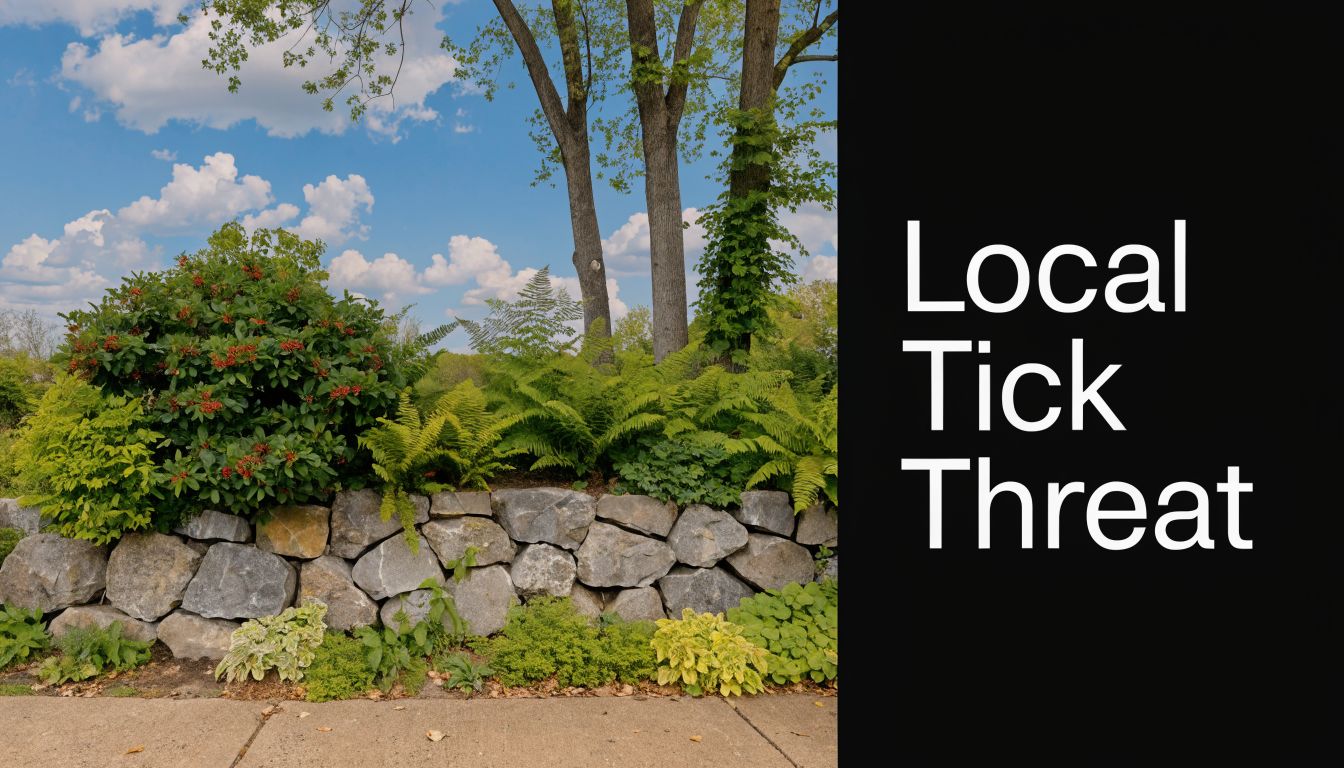
The ticks homeowners worry about most
In this region, homeowners usually hear about blacklegged ticks and American dog ticks. They matter for different reasons, but the practical takeaway is the same. A person doesn’t need to walk deep into the woods to encounter them. Ticks wait in low vegetation, along trail edges, around brushy transitions, and in places where animals travel.
The blacklegged tick gets much of the attention because of its connection to Lyme disease. The American dog tick is also a concern around homes, yards, and outdoor recreation areas. What matters on the ground is not memorizing every species detail. It’s recognizing that different ticks can use the same property in different ways, which is why inspection and timing matter.
Why the nymph stage causes so much trouble
Ticks don’t stay in one simple stage. They move through a life cycle, and that affects treatment strategy. Homeowners often focus on larger, visible ticks, but the smaller stages can create more risk because they’re easier to miss.
Nymphs are a major concern because they can be hard to spot on skin, pets, and clothing. That makes early detection harder and increases the chance that a tick stays attached longer than anyone realizes.
For a deeper look at survival and behavior, this guide on how long ticks can live helps explain why a one-time casual response usually isn’t enough.
Why this matters in the Upper Midwest
This isn’t just a general national issue. It’s a regional one. Tick-borne diseases are a major public health issue in the Upper Midwest, and neighboring states like Wisconsin and Minnesota report tens of thousands of cases annually, as outlined in this tick-borne disease summary from ConsumerAffairs.
That matters to Indiana homeowners because ticks don’t respect state lines. The same broad regional patterns that affect the Upper Midwest affect outdoor living in Crown Point and the surrounding area.
| Property feature | Why ticks like it |
|---|---|
| Shady bed edges | They stay cooler and hold moisture |
| Leaf litter | It gives ticks protection and helps them avoid drying out |
| Tall grass near fences | It creates a waiting zone for host contact |
| Wooded borders | Wildlife moves through these areas regularly |
| Stone walls and landscape transitions | Small animals travel and shelter there |
Ticks thrive in the parts of a yard people don’t think about until someone gets bitten.
That’s why effective control starts with the whole property, not just a quick pass over the lawn.
The Green Advantage Integrated Tick Management System
Most failed tick treatments have the same weakness. They assume the answer is “spray more.” That sounds decisive, but it isn’t very precise. Good tick control services rely on Integrated Tick Management, or ITM, because ticks live in patterns. They don’t spread evenly across the property.
A proper ITM program is surveillance-driven and combines multiple tools. Research on professional tick management describes an approach that uses host-targeted devices like permethrin-treated tick tubes, habitat modification, and targeted residual applications, with tick tubes remaining effective for 75 to 90 days as part of a broader strategy, as explained by Vector Disease Control International.
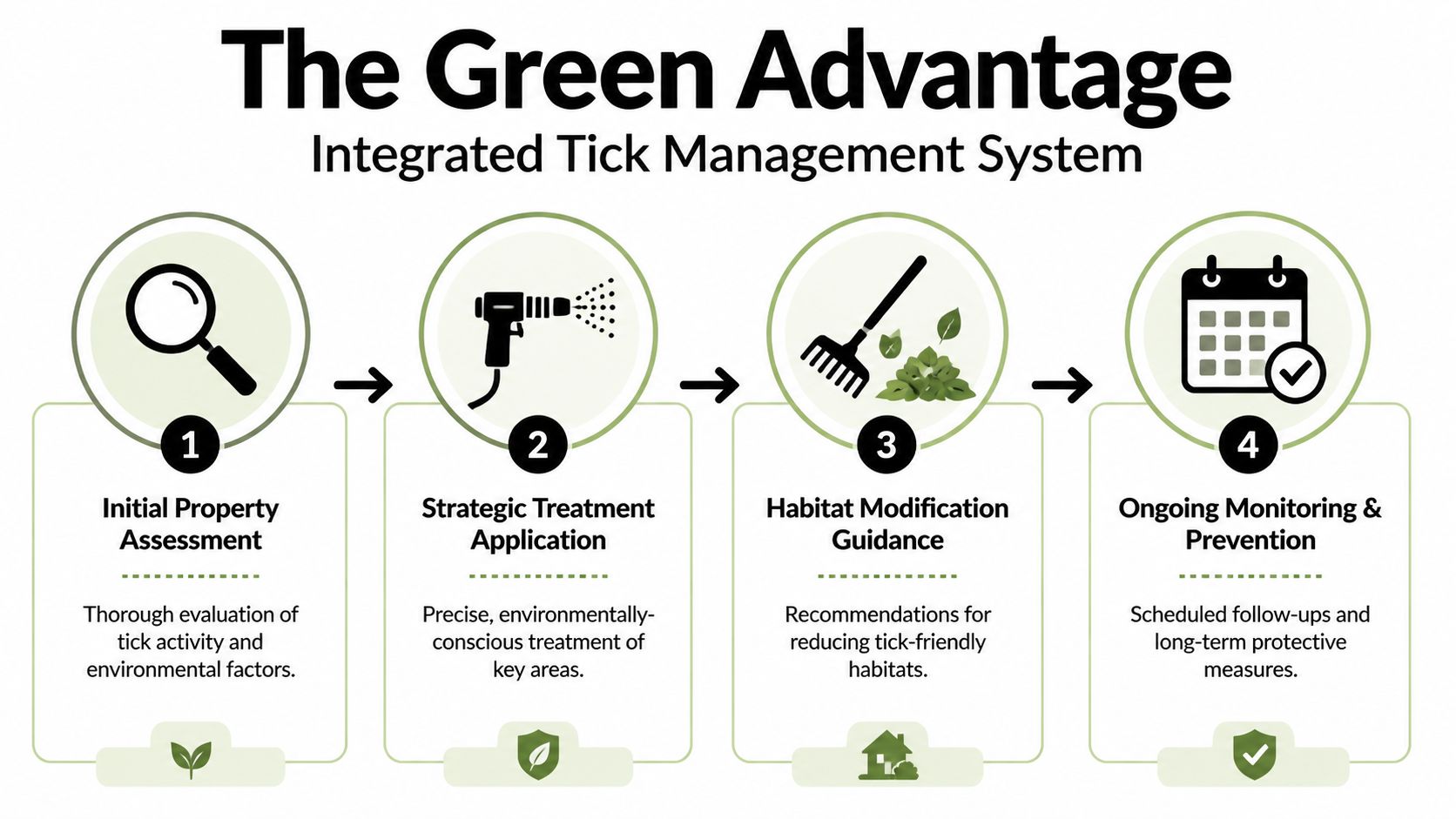
It starts with surveillance, not guesswork
Before treatment, the property needs to be read correctly. That means identifying where ticks are likely to harbor, where animal movement is concentrated, and where human exposure is most likely. The shaded back corner may matter more than the whole front lawn. The mulch edge behind the playset may matter more than the center turf.
That’s the biggest difference between a thoughtful plan and a generic yard spray. One looks at pressure points. The other treats the entire property as if every square foot carries the same risk.
The barrier treatment has a job, and limits
Targeted residual applications are important, especially around transition zones. These are the places where people and pets are most likely to pick up ticks. Think lawn-to-woods edges, perimeter vegetation, shaded pathways, dog runs, and the outer margins of ornamental beds.
Barrier treatments work best when they’re applied to the places ticks use. They work less well when homeowners expect them to instantly sterilize an entire outdoor space with no support from habitat reduction.
Practical rule: If a yard keeps its moisture, shade, and host traffic, treatment has to work harder. The landscape either supports the service or fights it.
Tick tubes solve a different part of the problem
Tick tubes are one of the most misunderstood tools in professional tick control. They aren’t a substitute for inspection or perimeter treatment. They address a separate route of tick development by targeting rodent activity.
These devices use permethrin-treated cotton that mice carry back to nesting areas. When ticks feed on those rodents, the treatment helps reduce them at a point many homeowners never see. This matters because a lot of tick pressure begins long before a tick reaches a person, a pet, or a patio edge.
This is also where tick control overlaps with broader rodent control thinking. If a property supports heavy mouse activity around sheds, wood stacks, brush piles, or neglected corners, it creates conditions that can feed the tick problem too.
Vegetation management is where local knowledge matters
A company with real outdoor care experience has an advantage. Tick work isn’t just about product choice. It’s about understanding what the outdoor environment is doing. Grass height, leaf accumulation, dense groundcover, neglected border growth, and moisture-retaining areas all affect the outcome.
In Crown Point and nearby Northwest Indiana communities, practical vegetation adjustments often include:
- Reducing leaf litter in shaded borders and behind dense shrubs
- Trimming grass and edge growth near fence lines and property margins
- Opening airflow around heavily planted zones that stay damp
- Keeping trails and walk paths defined so people avoid brushing against tick habitat
- Managing clutter near outbuildings where mice and chipmunks may shelter
That’s why the best programs also complement other outdoor services. Tick reduction can support a broader property plan that includes mosquito control, habitat correction, and exclusion steps that make the whole site less inviting to pests.
What doesn’t work well
Homeowners often ask whether store-bought sprays are enough. They can have a place for very limited, short-term spot response, but they usually fall short for recurring pressure.
The common problems are predictable:
- Coverage is inconsistent. Key harborage areas are frequently missed.
- Timing is poor. Applications happen after a problem is obvious, not when intervention is most useful.
- The habitat remains unaltered. Ticks return to the same favorable zones.
- The treatment isn’t tied to host activity. Wildlife and rodents keep moving ticks back in.
An ITM system works because it attacks the problem from more than one direction. It doesn’t treat ticks as random. It treats them as a property-level pest with identifiable sources and repeatable patterns.
Benefits of Professional Tick Services for Your Property
The immediate benefit of tick control services is obvious. You want fewer ticks where your family, pets, guests, or customers spend time outdoors. But that’s only part of the value. The larger benefit is getting your property back without the constant mental checklist of socks, pant legs, pet fur, and bite anxiety.

Better use of the yard
Most homeowners don’t invest in outdoor spaces so they can avoid them. Patios, fire pits, swing sets, gardens, and walking paths should feel usable. Professional treatment helps reduce hesitation around those daily routines.
That matters for homes, rental properties, and businesses alike. If people are constantly watching for ticks, the property stops functioning the way it should.
Protection goes beyond comfort
Comfort matters, but health concerns are what push many people to act. Preventative service makes financial sense too. As noted by Waltham’s discussion of tick prevention value, the true value of prevention isn’t just immediate comfort. It’s that the annual cost is a fraction of the potential medical bills, lost productivity, and long-term health complications associated with a single case of Lyme disease.
That’s a useful way to think about the decision. Tick control isn’t just a convenience purchase. It’s part of risk management for the property and the people using it.
- Family protection: Children play low to the ground, move in and out of edges, and don’t always notice exposure quickly.
- Pet safety: Dogs often brush through the exact areas ticks prefer.
- Property confidence: Outdoor gatherings feel different when hosts aren’t worried about what guests may bring home.
- Longer-term suppression: Repeated, thoughtful treatment works toward interrupting the life cycle rather than just reacting to the latest sighting.
Habitat changes multiply the results
Professional service gets stronger when it’s paired with cleanup and host reduction. That doesn’t mean a homeowner has to redesign their entire outdoor area. It means removing the features that subtly support the problem.
One useful example is rodent harborage near sheds and storage areas. Since mice can play a role in tick activity, practical exclusion around outbuildings supports the larger control effort. Van Dyke Outdoors' mice prevention guide offers a solid checklist for reducing the kind of shelter that can help pests persist around a property.
For homeowners comparing options, this guide to the best flea and tick control for yard is also helpful for understanding why broad consumer products and professional site-specific plans produce very different results.
A quick visual explanation can help show why prevention pays off over time.
Professional tick service is worth the cost when it changes behavior on the property. People stop avoiding the yard and start using it again.
What to Expect with Our Crown Point Tick Control Service
Homeowners are more comfortable with pest control when they know exactly what will happen. Tick service should feel clear from the first call through the follow-up period. That includes preparation, treatment, and realistic expectations after the work is done.

The first conversation should be local and useful
A good service process starts with key questions. What kind of property is it? Where have ticks been found? Are pets bringing them inside? Is the lot wooded, open, or mixed? Are there sheds, retaining walls, fence lines, play areas, or brushy edges?
Those details shape the visit. Tick pressure on a compact subdivision lot doesn’t look exactly like tick pressure on a larger edge property in Northwest Indiana.
Inspection comes before recommendation
The on-site visit should identify likely harborage zones and exposure areas. That usually includes the perimeter, ornamental beds, shaded transitions, high-moisture sections, outbuildings, and any routes where wildlife tends to move.
A proper inspection also looks at what’s feeding the issue. Examples include:
- Leaf buildup behind shrubs or along back lot lines
- Tall or dense border growth where people rarely walk but ticks thrive
- Rodent-friendly clutter near sheds, wood piles, and storage areas
- Pet routes and play zones where contact risk is higher
- Neighboring habitat pressure that may keep introducing ticks
The treatment plan should match the property
Not every yard needs the same mix of tactics. Some need strong perimeter and vegetation-edge treatment. Others benefit from adding host-targeted devices and more detailed habitat correction. A straightforward property may need simple seasonal service. A more complex site with shade, wildlife movement, and recurring exposure may need a more layered plan.
That customization is the difference between service that looks active and service that solves something.
A homeowner may also get preparation guidance before treatment, such as bringing in toys, limiting unnecessary yard traffic during service, and making sure technicians can access key treatment zones. Clear communication here matters because it reduces surprises and helps the treatment go where it needs to go.
After treatment, results follow the tick life cycle
Expectations need to be realistic. It’s normal to see some ticks for two to three weeks after the initial service due to their life cycle, and professional residual products are designed for proven 90-day outdoor control when used appropriately, as discussed in Syngenta’s guidance on residual tick protocols.
That doesn’t mean the service failed. It means the treatment is working through a real biological process rather than creating instant, total disappearance overnight.
| Stage of service | What the homeowner should expect |
|---|---|
| Initial contact | Questions about the property, tick sightings, and use patterns |
| Inspection | Review of habitat, shade, edges, host traffic, and risk zones |
| Treatment | Targeted application based on pressure points, not random blanket coverage |
| Short-term follow-up | Some tick activity may still appear for a limited period |
| Ongoing prevention | Monitoring, repeat service if needed, and habitat adjustments |
The best tick program is the one that explains what success looks like before the technician ever starts.
Safety and communication matter
For families with children and pets, confidence comes from knowing what was treated, why it was treated, and when normal yard use can resume. A professional should explain reentry guidance clearly and answer site-specific questions without rushing through them.
That same transparency matters for commercial pest control accounts, landlords, and property managers. Outdoor common areas, entry corridors, and employee break spaces all require predictable service and clear documentation. Tick control works best when nobody has to guess what was done or what happens next.
Frequently Asked Questions About Tick Treatments
Are professional tick treatments safe for kids and pets
Safety starts with product selection, proper application, and clear instructions after service. The most important point is that treatment should be targeted and deliberate, not overapplied. Professional technicians focus on the places ticks harbor and travel, which helps reduce unnecessary exposure across the rest of the property.
Homeowners should always follow the post-treatment guidance they’re given. If something about the yard is unusual, such as a dog run, a play area, or a heavily used garden path, that should be discussed before service so the plan reflects how the space is used.
How often do most properties need tick control services
That depends on pressure, habitat, and how the property is used. Some lots have light seasonal pressure and need a simpler prevention approach. Others have recurring tick activity because of shade, wildlife traffic, rodent harborage, or neighboring habitat.
A one-time response can help in some situations, but repeated exposure usually calls for a seasonal plan. Tick control works best when timing is tied to actual property conditions, not just a homeowner’s last-minute concern after a bite or a sighting.
Can I get ticks even if my yard isn’t wooded
Yes. This surprises a lot of people. Ticks don’t need a forest to show up. They need protected zones and a host pathway. A clean-looking suburban lot can still support them if there’s a fence line with tall growth, a moist mulch bed, heavy shrub cover, a nearby drainage area, or animal traffic moving through.
That’s why homeowners who search for an exterminator in Crown Point, IN after finding ticks in a tidy lawn aren’t overreacting. The property may look low-risk from the driveway and still have several active edge habitats.
What can I do between treatments to help
The biggest help is habitat reduction. Keep vegetation from becoming a protected corridor. Reduce leaf buildup. Clean up clutter near the perimeter. Watch for small animal activity around sheds, wood piles, and dense landscaping.
A few practical habits make a real difference:
- Trim the margins: Keep fence lines and border growth from turning into cool, protected zones.
- Clear leaf litter: Don’t let shaded beds stay packed with organic debris.
- Manage storage areas: Sheds and stacked materials can support rodent activity.
- Check pets routinely: Dogs often reveal where the property pressure is highest.
- Keep paths defined: The less brushing against edge growth, the lower the exposure risk.
Do tick services work better with other pest control programs
Often, yes. Tick problems don’t exist in isolation. A property that supports ticks may also support mosquitoes, rodents, or other outdoor pests. Combining services can produce a more coherent prevention plan because the technician sees the whole site, not just one symptom.
For example, if a yard has damp shade and dense edge vegetation, those same features may matter for mosquito control. If there’s heavy mouse activity around a shed or wood stack, that can affect the broader pest picture too. Integrated service doesn’t mean every property needs every treatment. It means the recommendations should fit the ecology of the site.
Is DIY tick control enough
Usually not when the problem is recurring. DIY products tend to underperform for one of three reasons. The wrong places get treated, the timing is off, or the habitat stays exactly the same. Homeowners can help a lot with maintenance, but recurring tick activity usually needs professional inspection and a plan built around how ticks are using the property.
What about businesses and managed properties
Tick control matters anywhere people spend time outdoors. Apartment communities, office campuses, daycare grounds, pet-friendly facilities, and hospitality properties all face the same basic issue. If people or animals move through outdoor edges, the property has exposure potential.
For managed properties, the standard is higher. The service needs to be reliable, documented, and easy to coordinate. That’s especially true when tenants, employees, or visitors may be using the grounds daily.
A good answer to a tick problem isn’t “spray everything.” It’s “treat the right places, fix the habitat, and set honest expectations.”
Take Back Your Yard Contact The Green Advantage Today
Ticks change how people use their property. They make families hesitate before letting kids play outside. They make pet owners second-guess the yard. They make outdoor spaces feel smaller than they are.
That problem is manageable with the right plan. Professional tick control services work best when they combine inspection, targeted treatment, habitat correction, and clear communication about what to expect. That kind of approach is especially important in Crown Point and nearby Northwest Indiana communities, where shade, wildlife movement, and suburban landscaping often create ideal tick conditions.
If you’ve been searching for pest control near me, pest control in Crown Point, IN, or an exterminator near me because ticks are showing up around your home or business, now is the right time to act. The sooner the property is evaluated, the sooner the pressure points can be identified and treated properly.
Protect your yard before another weekend gets planned around tick checks instead of enjoying the space.
If you're ready for a property-specific plan, contact The Green Advantage to schedule an inspection or request a quote for tick control services in Crown Point and Northwest Indiana.
Pest Control in Crown Point, IN: How Long Can Ticks Live in Your Yard?

It’s a question we hear all the time from concerned homeowners in Crown Point: how long can a tick actually live? The answer is often surprising and unsettling. Depending on the species and the conditions in your yard, a single tick can survive for several months up to over two years.
This incredible staying power is exactly why a small tick problem can quickly become a multi-year battle for your family's safety. When you're looking for an exterminator in Crown Point, IN, you need a team that understands this persistent threat. At The Green Advantage, we provide trusted residential pest control to protect your home and give you back your peace of mind.
Understanding Tick Longevity and Why It Matters for Your Home
When homeowners ask about a tick's lifespan, what they're really trying to grasp is the true risk they pose to their family and pets. Unlike a mosquito with a fleeting existence, ticks are built for the long haul. They are patient predators, capable of waiting months for their next meal—your dog, your child, or you—to wander by.
This longevity makes them a serious threat. A longer life means more opportunities to transmit dangerous diseases like Lyme disease. And because they can survive our tough Northwest Indiana winters, the danger doesn't just vanish with the first frost. This is why professional pest control in Crown Point, IN is not a luxury, but a necessity for protecting your property.
The Resilient Nature of Ticks
A tick’s ability to survive is a lesson in patience and endurance. They can enter a state of near-dormancy, allowing them to ride out harsh weather and long periods without a host. It’s this toughness that makes them such a formidable pest in our local environment.
While the common ticks we see in the Crown Point area typically live for about two years, some species take resilience to a whole new level. In one lab study, researchers documented certain soft ticks surviving for an unbelievable 27 years, with one going a full eight years without a single blood meal. While that's an extreme case, it perfectly illustrates why a casual, wait-and-see approach to tick control is never a good idea.
Ticks aren't just a fleeting summer nuisance; they are a persistent, year-round threat. Once they establish a population in your yard, they are there to stay unless you take decisive action.
Here at The Green Advantage, we've seen firsthand the challenges ticks create for homeowners in Crown Point. Our local expertise means we know exactly how to disrupt their long and complex lifecycle. Our mosquito control and tick services are designed to give you back your yard and your peace of mind.
Of course, their survival isn't just about time—it's also about withstanding different environments. If you've ever wondered about their limits, you might be interested in our guide that explores whether ticks can live in water.
The Tick Life Cycle: A Multi-Year Threat
To really get a handle on how long ticks can live, you have to stop thinking of their life as a short sprint. It's more of a patient, multi-year marathon. The entire journey from a single egg to a reproducing adult can take up to three years to complete, which is exactly why a few ticks in your Crown Point yard can quickly become a stubborn, long-term infestation.
A tick has to pass through four distinct life stages: egg, larva, nymph, and adult. Here’s the catch—to graduate from one stage to the next, it absolutely must find and take a blood meal from a host. This constant need to feed is what makes them a persistent danger at every phase of their life, requiring a professional exterminator near me to break the cycle.
The Four Stages of a Tick's Life
It all starts when a female tick lays thousands of eggs, usually tucked away in a patch of moist, leafy debris in your yard. Once hatched, you have six-legged larvae that are incredibly tiny, about the size of a grain of sand. They’ll wait for their first host, often a small mammal like a mouse, and after feeding, they molt into the next stage.
This next phase, the nymph stage, is arguably the most dangerous one for people and our pets. Nymphs are only about the size of a poppy seed, making them incredibly difficult to see. After they secure their second blood meal, they finally transform into full-sized adults, ready to find a mate and start the whole cycle over again.
The blacklegged tick's full life cycle spans up to three years in the wild, a critical fact for Northwest Indiana residents battling Lyme disease. Progressing through four stages, each requires a multi-day blood meal from hosts like deer, mice, or humans. You can discover more insights about their journey at the Johns Hopkins Lyme Disease Research Center.
This timeline shows just how resilient these pests are, from their average lifespan to the surprising records set in laboratory conditions.
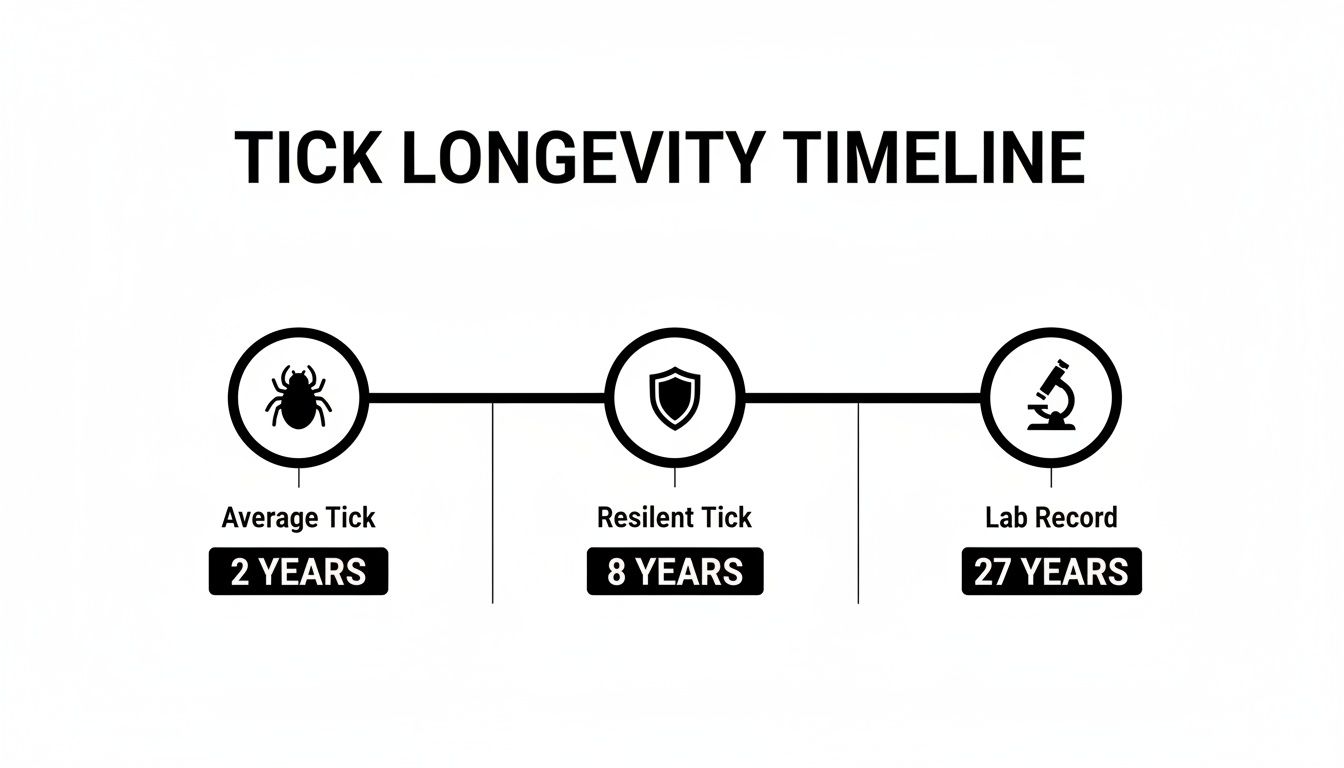
Their incredible longevity proves that just "waiting out" a tick problem in your yard isn't a realistic strategy for keeping your family safe.
A Year-Round Concern in Northwest Indiana
That multi-year life cycle means that different tick stages are active at different times of the year right here in Crown Point. While you might see more adult ticks during the cooler months of spring and fall, the tiny, dangerous nymphs are most active in the summer—just when your family wants to be outside the most. This staggered timing ensures that ticks are a constant threat.
Because a single tick can take years to mature, an infestation can easily sustain itself for a very long time. The larvae that hatch one spring can still be hanging around as a threat two summers later. This is why professional tick control is so vital; it’s designed to target ticks at every stage, effectively breaking the cycle and giving your property lasting protection. This is also why our preventative pest treatments are a popular choice for local homeowners.
The Top 3 Ticks We See in Northwest Indiana Yards
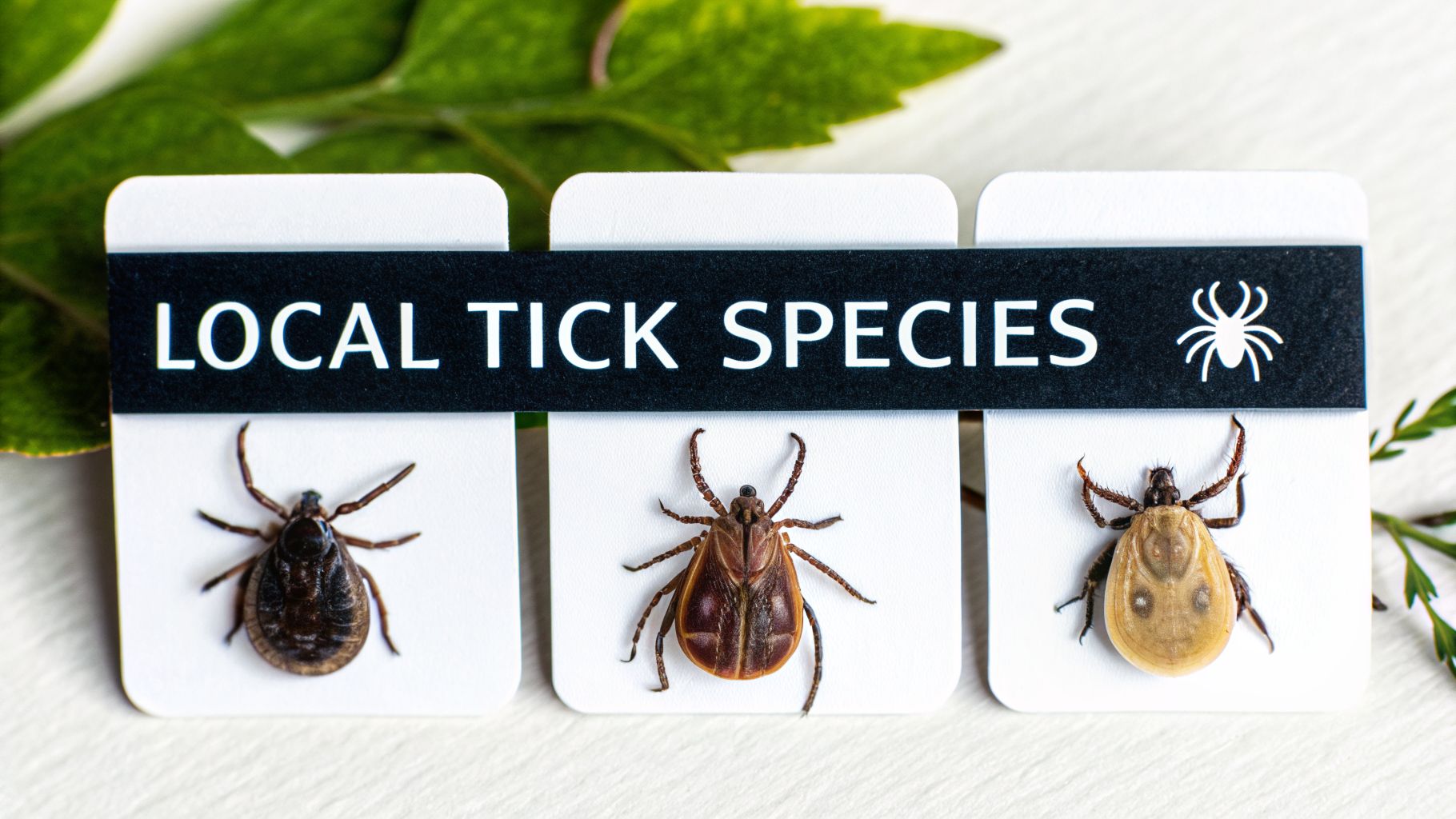
When it comes to ticks, what you don't know can absolutely hurt you. In our experience providing pest control in Crown Point, IN, we've found that most local tick problems boil down to three main culprits.
It’s easy to think of a tick as just a tick, but that's a mistake. Each species has its own rulebook for survival, from where it likes to hide to how long it can wait for its next meal. Knowing who you're up against is the first step toward taking back your yard.
The American Dog Tick
As the name suggests, the American dog tick is the one we're constantly pulling off our dogs after a walk. But don't be fooled—they’re just as happy to feed on people. We see them most often in spring and summer, hanging out in the tall grass of open fields and along trails, which describes plenty of outdoor spaces in our community.
What's truly incredible about this species is its patience. An unfed adult American dog tick can survive for a staggering 2-3 years—that's up to 1,053 days—without a single blood meal. Think about that. A tick can be waiting in your lawn for years. This is why you can't just assume ticks are gone during the off-season. You can dig deeper into how long ticks can survive without food and see just how resilient they are.
The Blacklegged Tick (Deer Tick)
This is the one that gets the most attention, and for good reason. The blacklegged tick, better known as the deer tick, is the main carrier of Lyme disease. It loves the woods and the shady, overgrown edges where your lawn meets a tree line—a perfect hiding spot on many local properties.
Their two-year life cycle means they’re a persistent threat, and they’ll be active any time temperatures climb above freezing, even on a surprisingly warm day in January. This is a common cause for spider control calls as well, as many insects seek shelter indoors.
Because blacklegged nymphs are so tiny—about the size of a poppy seed—they often go unnoticed, allowing them to transmit diseases before they are ever discovered.
The Lone Star Tick
You can spot a female lone star tick by the distinct white dot on her back. These ticks are becoming more and more of a problem in Northwest Indiana. Unlike other ticks that sit and wait for a host to brush by, lone star ticks are aggressive hunters that will actively move toward you.
They prefer shady, wooded spots and are infamous for their link to alpha-gal syndrome, a frightening allergy to red meat caused by their bite.
At The Green Advantage, our exterminators in Crown Point, IN, have seen it all. We bring that specific, local knowledge to your property. We don't just show up and spray; we identify the exact species you're dealing with and build a plan that targets their unique habits and life cycles to keep your family safe.
How Your Yard Helps Ticks Survive Longer
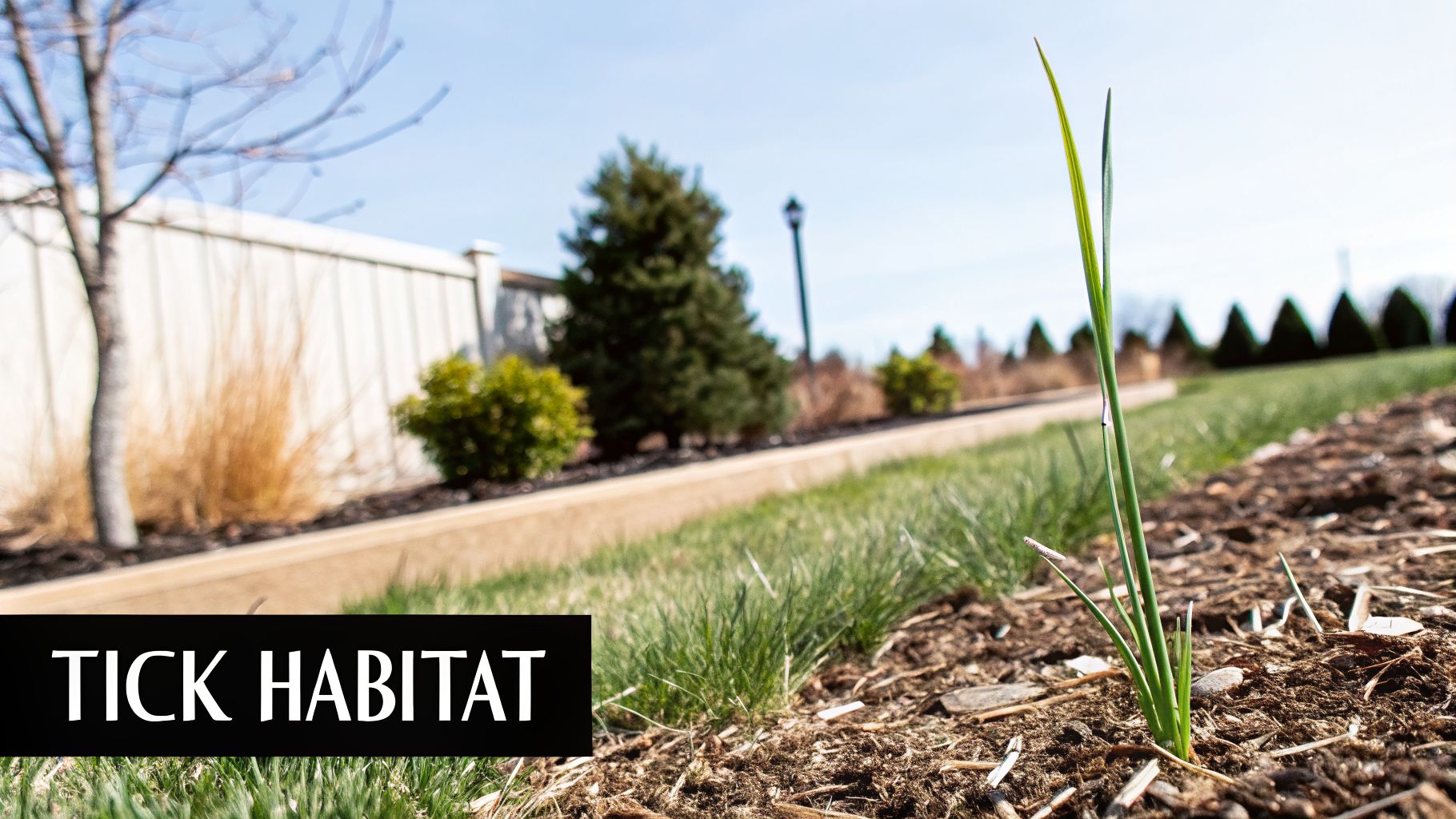
Without even realizing it, you could be rolling out the welcome mat for ticks. Your yard might have the exact conditions they need not just to survive, but to live far longer than they would otherwise. It all boils down to a single, critical need: moisture. Ticks are incredibly prone to drying out, a fatal weakness for them. To combat this, they spend most of their lives hiding in damp, shady spots to conserve water while waiting for their next blood meal.
This is why you'll rarely find a tick hanging out in the middle of a sun-drenched, well-kept lawn. They instinctively know it’s a death trap. Instead, they’re drawn to the unkempt edges and shady corners of your property where they can stay hydrated and patiently wait for a host.
This patient waiting game has a name: questing. When a tick is ready for a meal, it crawls up to the top of a blade of grass or the edge of a leaf, holds out its front legs, and simply waits. It isn't actively hunting you down; it’s just ambushing, hoping you, your child, or your dog will brush past and give it a ride.
Creating a Tick-Friendly Paradise
Many common yard features, especially here in Northwest Indiana, can accidentally create the perfect tick habitat. These hotspots are where moisture lingers, the ground stays cool, and ticks get everything they need to extend their lifespan.
Ticks absolutely love these spots:
- Leaf Litter: That thick blanket of leaves left over from the fall? It’s a dark, damp paradise for ticks, shielding them from the sun and locking in humidity.
- Tall Grass and Overgrowth: Unmowed sections of your yard and dense, brushy areas offer both shade and moisture. They also double as the perfect launchpad for questing ticks.
- Shady Areas: The ground under large trees, behind thick bushes, or along the north-facing side of your house stays cool and damp, making it prime real estate for ticks trying to avoid dehydration.
- Wood Piles: A stack of firewood is full of dark, moist gaps that offer shelter. It’s an ideal place for ticks to hide and even survive a harsh winter, and can also attract termites, requiring termite control.
Think of it this way: every pile of leaves, overgrown patch of grass, or unkempt garden bed is a safe house for ticks. By providing these shelters, you’re helping them live long enough to find their next meal right on your property.
Once you start seeing your yard through the eyes of an exterminator in Crown Point, IN, these problem areas become glaringly obvious. This is exactly why our professional tick and mosquito control service is so effective. We don’t just spray your lawn and call it a day; we focus on these high-risk hiding spots. By disrupting the tick life cycle where it begins, we can provide meaningful, long-term protection for your family and pets.
Why DIY Tick Control Often Fails
When you understand just how resilient ticks are and how long they can survive in your Crown Point yard, it becomes clear why store-bought sprays and granules so often miss the mark. Tackling a tick problem yourself is a bit like putting a small bandage on a serious wound—it might cover the issue for a moment, but it does little to solve the underlying problem.
Most over-the-counter products are contact killers, meaning they only eliminate the adult ticks you happen to spray directly. While there's a certain satisfaction in that, it’s a false sense of security. This approach completely ignores the thousands of eggs, nearly invisible larvae, and pinhead-sized nymphs lurking in the leaf litter, just waiting for their turn.
The Problem with a One-Size-Fits-All Approach
The tick life cycle is a slow-burn, multi-year process. A generic bottle from the hardware store simply isn’t built to interrupt something that complex. These products usually have little to no residual effect; once they dry, they stop working. A fresh batch of nymphs can hatch the very next day, putting your yard right back in the high-risk zone.
DIY methods are stuck treating the symptoms—the adult ticks you see. A real solution has to target the source of the problem: the next generation of larvae and nymphs that guarantee the infestation continues for years.
On top of that, a DIY spray doesn't know your yard. A trained professional from The Green Advantage does. We’re taught to spot and treat the specific micro-environments where ticks thrive, from that damp, shady spot behind the shed to the overgrown border with the woods. Some homeowners wonder about using harsh household chemicals, but that can be ineffective and unsafe. You can read our guide that explains if bleach is an effective way to kill ticks to see why that's not the answer.
Our residential pest control programs are designed for the long game. We don’t just knock down the current adults; we systematically break the entire tick life cycle. This is the only way to move beyond temporary fixes and give your family lasting protection and genuine peace of mind.
What to Expect From Your Crown Point, IN Exterminator
Dealing with a tick problem can feel overwhelming, but getting professional help shouldn't be. Here in Crown Point, we've built our entire approach at The Green Advantage around making the process straightforward and effective, so you can feel confident in your yard again.
When you first reach out to us, you'll talk to a friendly expert who genuinely understands the local pest pressures we face in Northwest Indiana. We’re here to listen to your concerns, answer your immediate questions, and schedule a convenient time for one of our technicians to conduct a thorough inspection of your property.
Our Process for Effective Pest Control
When our certified and licensed technician arrives at your home, they do more than just a quick walk-through. They conduct a detailed inspection to identify the specific tick species on your property and pinpoint those high-risk zones where they hide and breed—think shady fence lines, dense ground cover, and piles of leaf litter.
From that assessment, we build a customized treatment plan for your yard. The key is to break their lifecycle, so we target ticks at every stage, from eggs and nymphs to adults. We apply treatments precisely where ticks thrive, which makes the application both more effective and more responsible. We also offer eco-friendly pest control options for families who prefer them.
Our goal is simple: we want you to feel completely cared for and in the loop. We'll show you exactly what we found, explain the 'why' behind our plan, and walk you through how it will protect your family and pets. That transparency and commitment are why so many people trust us as their exterminator in Crown Point, IN.
Your technician will explain the entire treatment process and even give you practical tips on how to make your yard less inviting to ticks in the future. From your first call to our final follow-up, you can count on the reliable residential pest control that your neighbors depend on.
Answering Your Top Tick Control Questions
When you start learning just how long ticks can stick around, a lot of questions naturally come up. As the trusted local pest control near me for many in Crown Point, IN, we hear these concerns from homeowners every single day. We've put together some straight answers to the most common questions we get, so you can feel confident about protecting your family.
How Quickly Do I Need to Remove an Attached Tick?
The short answer? Immediately. As soon as you spot an attached tick, it's time to act. A tick's ability to transmit diseases goes up the longer it's attached and feeding.
Grab a clean pair of fine-tipped tweezers, get as close to the skin as you possibly can, and pull straight up with steady, even pressure. Don't twist or jerk it. Once it's out, wash the bite area and your hands thoroughly with soap and water or some rubbing alcohol.
Do Ticks Actually Survive a Crown Point Winter?
Yes, they absolutely do. It's a dangerous myth that ticks die off after the first hard frost. Here in Northwest Indiana, tough species like the blacklegged tick are pros at surviving the cold.
They find shelter by burrowing under leaf litter, hiding in woodpiles, or nestling into other protected spots. The moment the temperature inches above freezing, they can become active again. This makes them a potential threat almost year-round, similar to overwintering pests like rodents that require rodent control.
Is It Worth Getting a Tick Tested for Diseases?
This is a question we get a lot. While it seems like a logical step, public health officials generally don't recommend sending individual ticks for testing. The results can be unreliable, and a positive test on the tick doesn't automatically mean the disease was transmitted to you.
The better approach is to remove the tick properly and then simply keep an eye on yourself for any unusual symptoms like a fever or rash. If anything pops up, call your doctor, and be sure to tell them you had a recent tick bite.
The best strategy for real peace of mind isn't about testing one tick—it's about drastically reducing the number of ticks in your yard to begin with. The most reliable way to lower your family's risk is to control the entire population.
I Treated My Yard Myself, So Why Do I Still Have Ticks?
DIY yard treatments often feel like a losing battle because they usually only target the adult ticks you can see. The real problem is that they miss the thousands of tiny eggs, larvae, and nymphs hiding in the environment, just waiting for their turn to mature.
Professional pest control works because it’s designed to break this cycle. We use targeted applications and products that disrupt every stage of a tick's life, delivering a level of protection that’s far more complete and lasts much longer.
If you're looking for more information on ticks and other common pests, our comprehensive parasites guide is a great resource.
Ready to take back your yard and stop worrying about ticks? The team at The Green Advantage has the expertise to give you the reliable protection you need. Contact us today to schedule your professional pest inspection in Crown Point, IN.