
Indiana Pest Control: A Homeowner’s Guide for Crown Point
You hear scratching in a wall after dark. The next morning, you find a line of ants cutting across the kitchen counter. By the weekend, you're checking the basement, the pantry, and the window frames, wondering if you've got one small nuisance or a real infestation starting.
That's a common moment for homeowners in Crown Point and across Northwest Indiana. Our seasons shift hard, moisture levels change fast, and pests respond to every bit of it. Some stay outside until weather or food pressure pushes them in. Others settle in undetected long before you notice them.
A lot of people start by searching for pest control near me, hoping for a quick answer. The better answer is a clear one. You need to know what's active in this area, what you can handle on your own, and when it's time to bring in a licensed exterminator in Crown Point, IN.
Your Guide to Pest Control in Crown Point Indiana
One of the most common calls starts with something simple. A homeowner spots a few ants near the sink and assumes it's a cleaning issue. Then they wipe the counter, put food away, and the ants still come back. By then, the problem isn't the crumb on the counter. It's the route into the house, the moisture source, and the colony pressure behind it.
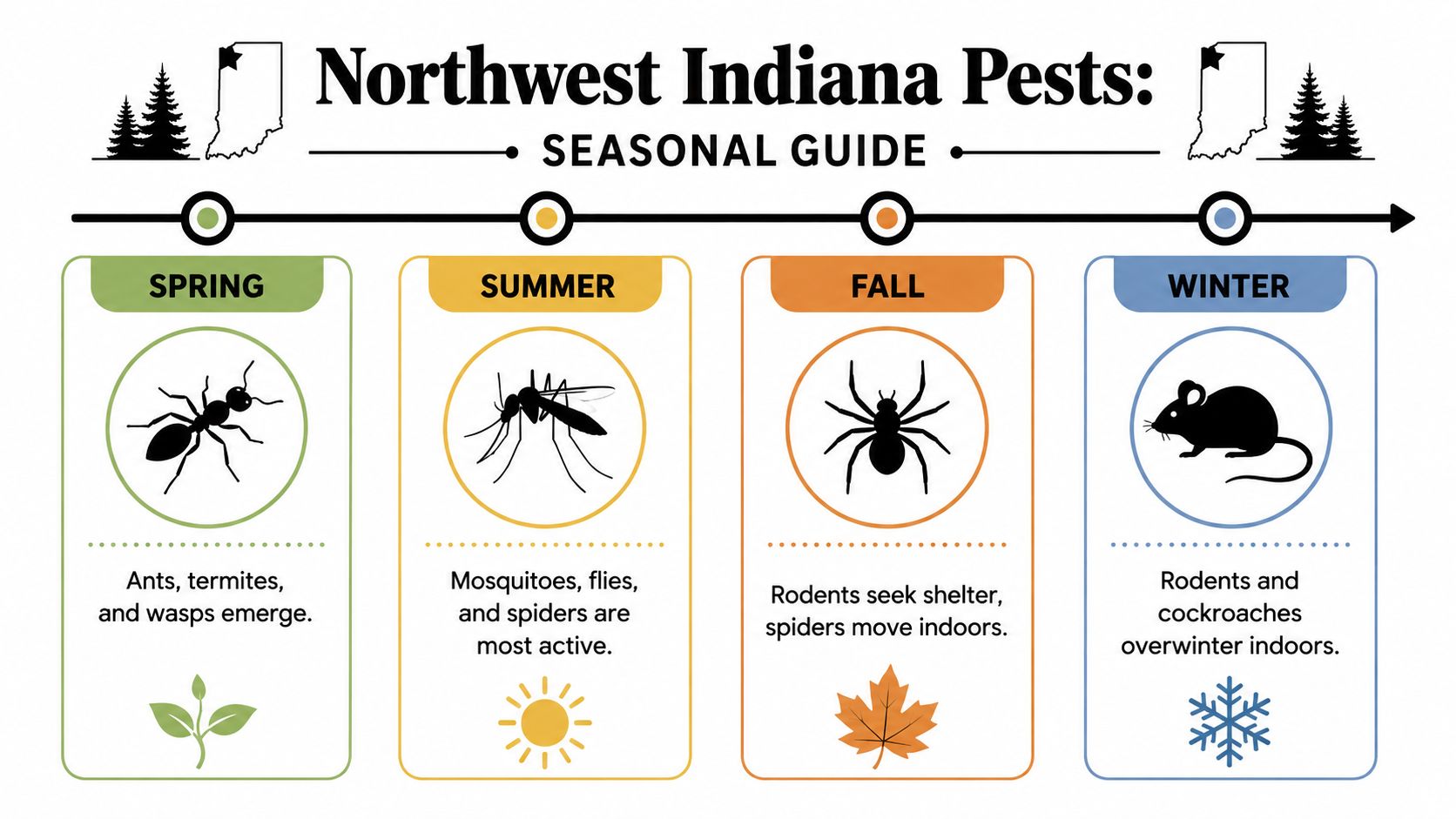
That's how a lot of pest issues work in Northwest Indiana. You don't just have “bugs.” You have a local pattern. Ants in spring, mosquitoes around standing water in summer, spiders and rodents pressing inward as temperatures drop, and overwintering pests that take advantage of quiet corners indoors. A house in Crown Point can look sealed and well-kept and still have enough gaps, moisture, or food access to attract pests.
Why local context matters
Indiana pest control isn't a niche service. IBISWorld projects Indiana's pest control industry will reach 597 businesses and $417.1 million in market size in 2026, with average annual growth of 6.0% from 2021 to 2026. That scale tells you something practical. Homeowners here deal with pest pressure often enough that the work has become more structured and specialized.
If you want a broader look at how service demand varies by area, this Transactional LLC pest control mapping resource gives useful geographic context.
Practical rule: If the same pest keeps showing up after you clean, remove clutter, or spray a store product, the pest usually isn't the main issue. The access point is.
What homeowners usually need
What's needed isn't more noise, stronger odors, or random treatments. Rather, it's a process that answers a few direct questions:
- What's active on the property right now
- Why it's there, including entry points and attractants
- What treatment fits, instead of using the same method everywhere
- Whether follow-up is needed to confirm the problem is under control
That's the difference between a one-time reaction and a real residential pest control plan. For homes in Crown Point, IN, that difference matters.
Common Pests in Northwest Indiana and Their Seasons
Pest activity in Northwest Indiana follows a pretty familiar rhythm. Not every home sees the same pressure, but the timing matters. If you know what usually shows up each season, you can catch problems earlier and avoid treating every issue like an emergency.
Spring activity around Crown Point
Spring usually starts the visible push. Soil warms, moisture shifts, and insects that stayed hidden become active around foundations, mulch beds, window lines, and kitchens.
You'll often want to watch for:
- Ants indoors as colonies expand and foragers start moving
- Termite concerns when conditions support swarming activity
- Early wasp activity around eaves, sheds, and porch areas
A few insects in spring can turn into a regular pattern fast. This is when people often realize the problem didn't begin today. It started outside and worked inward.
Summer pressure on yards and living spaces
Summer is when outdoor activity and indoor annoyance collide. Windows open more, people spend time in the yard, pets move in and out, and pests have more places to feed and breed.
The most common summer complaints include mosquitoes, flies, spiders, and stinging insects. Mosquito control matters most where there's standing water, dense shade, clogged areas that stay damp, or containers collecting rain. Wasps also become more noticeable as nests develop around rooflines, play areas, and entry points.
Warm weather doesn't create pest problems by itself. It speeds up feeding, nesting, and movement that was already building.
For many homes, this is also the season when outdoor treatment and yard-focused prevention make the biggest difference in daily comfort.
Fall movement indoors
Fall changes the job. Pests that stayed mostly outside start looking for stable shelter. Homes in Crown Point with attached garages, basements, crawl spaces, or utility penetrations often show activity first.
Common fall invaders include:
| Season shift | What homeowners notice |
|---|---|
| Cooler nights | Rodents testing gaps near doors, siding, and utility lines |
| Less outdoor prey | Spiders showing up in corners, basements, and garages |
| Dry indoor shelter | Other nuisance pests settling into wall voids and storage areas |
This is usually when a homeowner searches for an exterminator near me after hearing movement, spotting droppings, or finding webs in rooms that were quiet all summer.
Winter doesn't mean pest-free
Winter feels calmer, but it doesn't mean the property is clear. It usually means the activity is less visible and more concentrated indoors. Rodents and cockroaches are the main concerns people tend to ignore too long because they assume cold weather solved the problem.
That assumption rarely helps. If pests found warmth, food, and shelter before winter settled in, they're already where they want to be.
Proactive Prevention and When to Call an Exterminator
Most pest control starts before any product comes out. Good prevention lowers pressure, helps treatments work better, and sometimes stops a small issue from becoming a recurring one. Indiana's public guidance reflects that approach. The Indiana Department of Environmental Management recommends integrated pest management, including sealing openings with 16-gauge mesh, using sealant around pipes and cracks, keeping food and water sources dry, and requesting targeted strategies from providers. It also points residents toward practical tools like bait stations for cockroaches, snap traps for mice, and outdoor water management to reduce mosquito breeding sites, as outlined in Indiana's pests and pesticides guidance.
Prevention that actually helps
A few basic habits do more than is commonly thought:
- Seal entry points around utility lines, pipe gaps, sill plates, and foundation cracks
- Dry problem areas under sinks, near sump spaces, around hoses, and beside HVAC lines
- Store food properly in containers, not loosely in pantries or garages
- Reduce exterior harborage by trimming back contact points and keeping clutter off the house
- Manage standing water in buckets, toys, planters, and low spots in the yard
The point isn't to make your home sterile. It's to make it harder for pests to feed, breed, and settle in.
What usually doesn't work
Homeowners often lose time with the same three moves. They buy a spray for the insects they can see, put traps in one room only, or treat inside while ignoring the exterior source. That can knock down activity for a few days, but it usually doesn't solve the cause.
Recurring ants, persistent rodent noise, repeated wasp nesting, and ongoing roach sightings all point to a problem that needs more than surface treatment.
If pest activity keeps returning to the same room, the pest is using that room for access or resources. It's not there by accident.
When it's time to call an exterminator in Crown Point, IN
Call for professional help when any of the following shows up:
- Repeat sightings after cleaning and store-bought treatment
- Evidence of nesting such as droppings, gnawing, void activity, or concentrated webs
- Higher-risk pests like termites or stinging insects near family activity areas
- Property-related concerns tied to rental units, real estate transactions, or commercial use
That's the point where professional residential pest control or commercial pest control becomes less about convenience and more about protecting the property.
What to Expect from Professional Pest Control Services
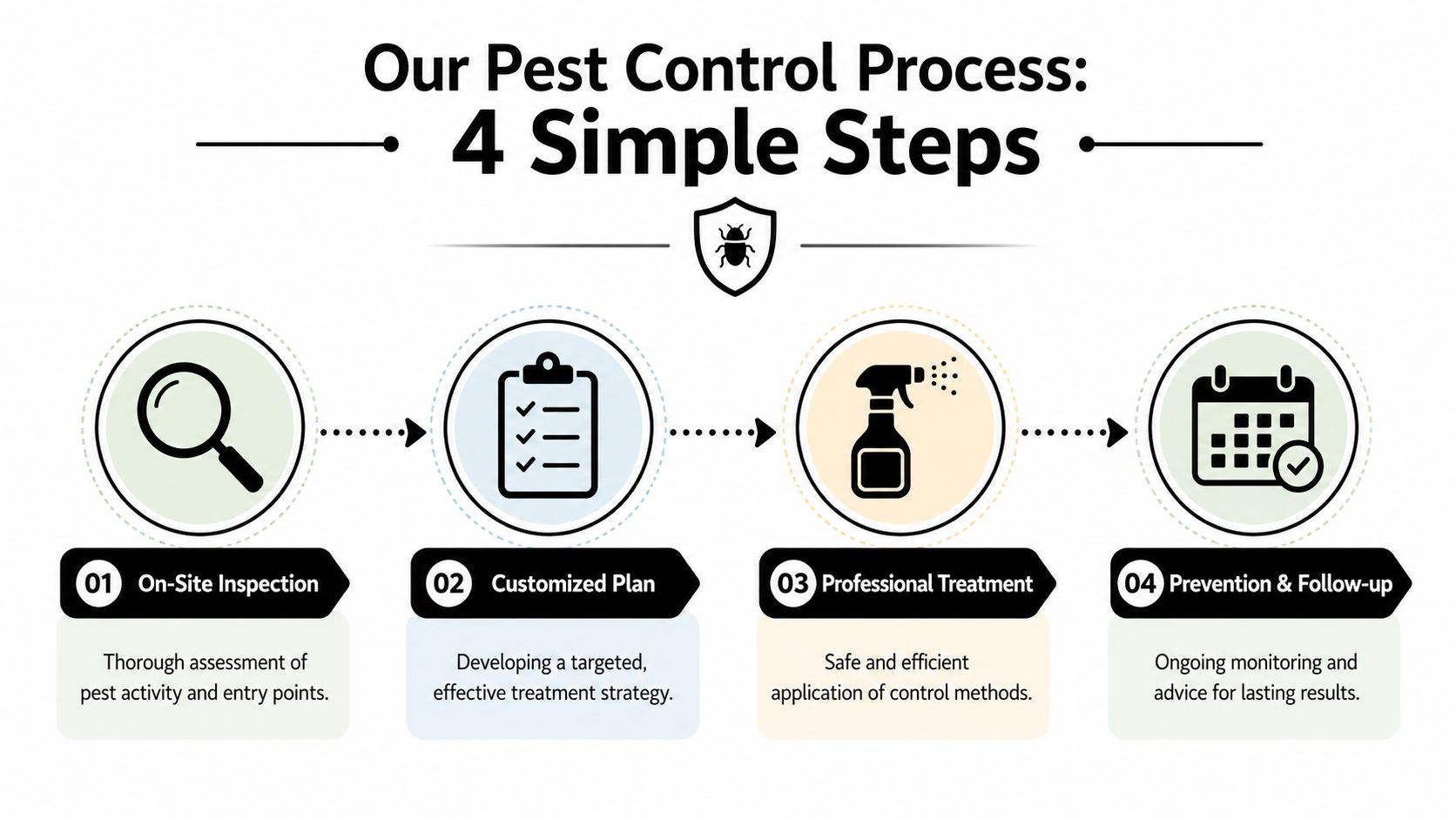
Most homeowners feel better once they know what a service visit looks like. Good pest control isn't guessing, and it shouldn't feel rushed. It follows a sequence that makes sense for the pest, the property, and the level of activity.
Here's the service flow typically expected from a structured Indiana pest control program.
Inspection comes first
A real inspection looks beyond the obvious complaint. If someone says they're seeing ants in a bathroom, the technician should also be checking moisture, exterior access, sill conditions, plumbing penetrations, and nearby rooms.
That first visit usually answers three practical questions:
- What pest are we dealing with
- Where is it entering or nesting
- What conditions are helping it stay active
That's why inspection matters more than quick spraying. If identification is wrong, treatment is usually weak or temporary.
Treatment should match the problem
A good treatment plan isn't one-size-fits-all. Ant control, rodent control, mosquito reduction, termite work, and wasp removal all require different methods and follow-up expectations. A family home with pets also needs a different treatment discussion than a warehouse, office, or multi-unit property.
Indiana residential service commonly follows a process of inspection, identification, treatment selection, and follow-up verification, often 14 to 30 days after the first application, in line with the practical framework described in Indiana pesticide regulation guidance and service standards.
Indiana law also matters here. Commercial applicators must hold the right IDOA license or certification for the category they're working in, and restricted-use products can only be applied by certified applicators or people under their direct supervision. The same guidance notes record retention requirements for at least 2 years for those regulated uses, which is part of what makes licensing more than paperwork.
For homeowners comparing providers, it also helps to understand bonded and insured pros so you know what protections and accountability to look for.
If you want a plain-language look at service scope, this page on what pest control companies do is useful.
Follow-up is where the job gets confirmed
One visit can solve some problems. Other issues need verification after the initial work. Rodents may require monitoring and exclusion updates. Roach jobs often need rechecks. Exterior invaders may change with weather or sanitation conditions.
This short video gives a quick visual overview of how homeowners often think about the process:
A professional service should leave you with fewer surprises. You should know what was found, what was done, and what happens next.
The Green Advantage Our Eco-Friendly Approach
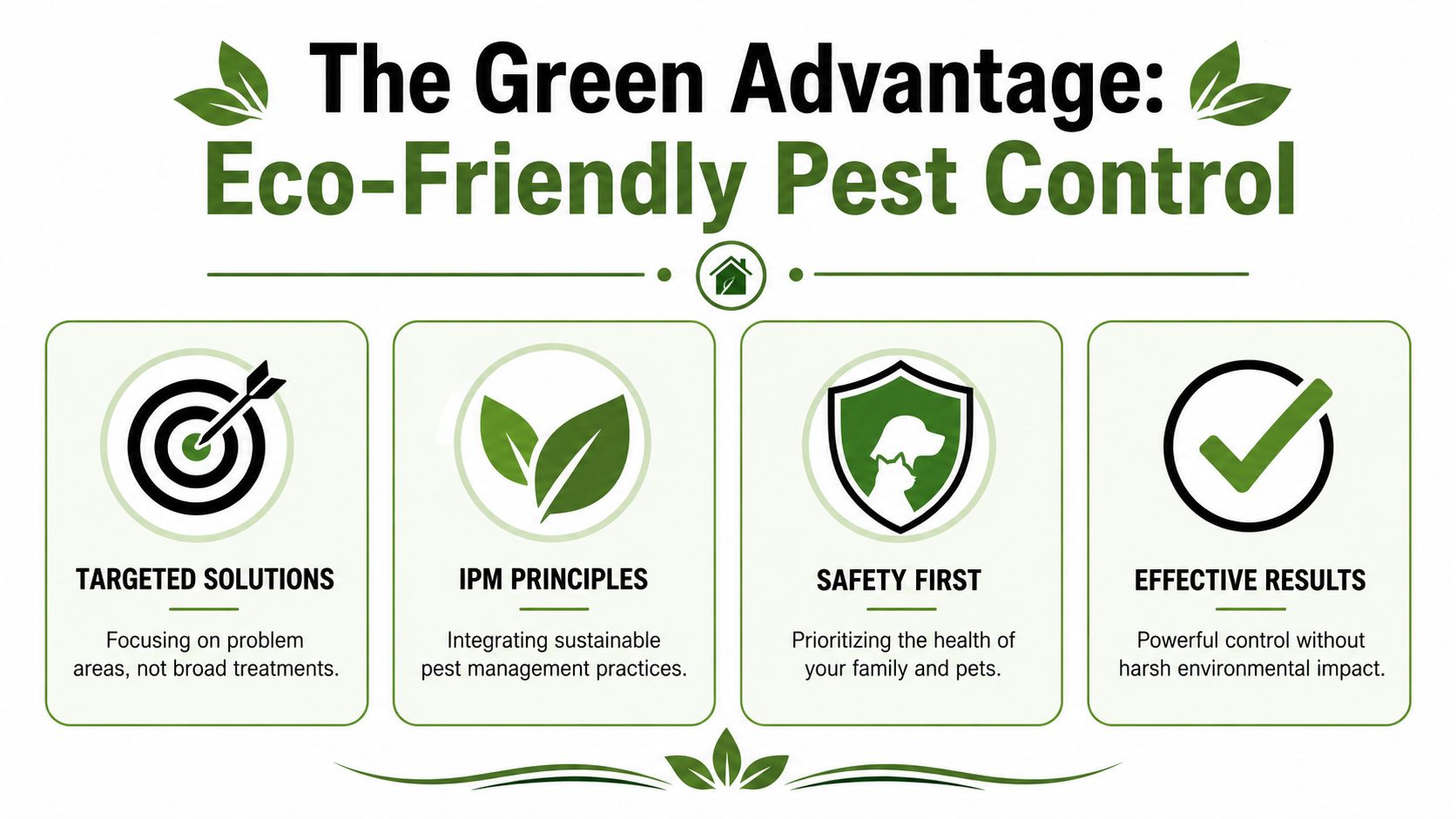
A lot of homeowners hear “eco-friendly pest control” and assume it means lighter treatment that won't hold up. That's not how effective work is done. The better definition is targeted treatment with less unnecessary exposure.
What eco-friendly means in practice
For a homeowner, the practical version looks like this:
- Focused placement instead of broad, indiscriminate treatment
- Exclusion and sanitation to reduce the need for repeat chemical use
- Product selection based on pest behavior rather than using the same material everywhere
- Attention to family and pet routines before treatment decisions are made
That approach usually works better because it lines up with how pests use a property. Roaches need harborage and food access addressed. Rodents require entry-point correction. Mosquito relief depends heavily on habitat pressure outdoors. Spiders often improve when the insects they feed on are reduced and access routes are cut off.
Why effective and careful can go together
The strongest-looking treatment isn't always the most useful one. Overapplying products to the wrong places can waste time and leave the actual issue in place. Smart pest control uses the least disruptive method that still solves the problem.
That's where integrated methods matter. They connect inspection, habitat correction, targeted applications, and follow-up. For homeowners who want to read more about that philosophy, this overview of environmentally friendly pest control methods gives a clear explanation.
The Green Advantage applies that kind of approach in Northwest Indiana with licensed service for homes and businesses, including common household pests, rodents, mosquitoes, termites, and stinging insects.
Good eco-friendly pest control isn't passive. It's precise.
Understanding Pest Control Costs in Northwest Indiana
Clients inquiring about price typically want to know two things. What affects the quote, and what are they paying for beyond a single visit. That's a fair question, because pest control in Crown Point, IN isn't priced as a flat commodity. The cost depends on the problem you have.
What changes the price
Several factors shape service recommendations and pricing:
- Property size and layout because larger homes, multi-unit sites, and complex structures take more inspection and treatment time
- Type of pest since ants, mosquitoes, rodents, termites, and cockroaches each require different materials, labor, and follow-up
- Severity of activity because a light seasonal issue is different from an established infestation
- Service frequency including one-time work versus a recurring preventive plan
- Access and exclusion needs if sealing, trapping, monitoring, or specialized placement is part of the solution
A termite concern, for example, is a different level of job than a minor ant trail at one sink. A rodent issue in a finished basement with utility gaps is different from occasional spider activity in a garage.
Cost versus value
The cheapest option often looks better only at the start. If the treatment doesn't identify the pest correctly, misses the entry route, or skips follow-up, you may end up paying again while the infestation keeps going.
Here's the better way to consider it:
| What you're paying for | Why it matters |
|---|---|
| Accurate inspection | Wrong identification leads to weak treatment |
| Targeted control | Better fit for the pest and the site |
| Licensed application | Important for compliance, safety, and accountability |
| Prevention guidance | Helps reduce repeat activity |
For homeowners and property managers, pest control is usually an investment in structure protection, livability, and peace of mind, not just a one-day fix.
Indiana Pest Control Frequently Asked Questions
Are pest control treatments safe around kids and pets
That depends on the pest, the product, where it's applied, and whether the treatment plan is built carefully. A responsible provider should explain where materials will be placed, what to avoid touching, and whether any temporary restrictions apply. Safety improves when treatment is targeted instead of broadly applied and when exclusion and sanitation do part of the work.
If you have children, pets, or specific sensitivities in the home, say that up front. That information should shape the plan.
Is one visit enough or do I need ongoing service
Some problems respond well to a one-time visit. Others don't. Wasp removal at a single nest may be straightforward. Recurring ant activity, rodent pressure, mosquitoes, and general household pest issues often benefit from ongoing monitoring and seasonal prevention.
The question isn't whether repeat service sounds appealing. It's whether the property has conditions that keep attracting pests. If it does, a maintenance plan is usually more practical than treating the same issue from scratch over and over.
What's the difference between residential and commercial pest control
Residential pest control focuses on living spaces, family routines, pets, garages, yards, and the comfort of the home. Commercial pest control has a different pressure. It often includes sanitation oversight, traffic patterns, storage areas, staff coordination, documentation needs, and protection of business operations.
A restaurant, office, warehouse, or multi-tenant property can't be treated exactly like a single-family house. The inspection and service plan need to match how the building is used.
When should I schedule an inspection
Schedule one as soon as activity becomes repeatable. If you see the same pest more than once, hear movement in walls or ceilings, notice droppings, find fresh nesting signs, or keep getting bitten outdoors, waiting rarely makes the job easier.
People often call later than they should because they hope a change in weather will solve it. Usually, pests are already responding to the weather faster than the homeowner is.
If you're looking for pest control in Crown Point, IN, want a local exterminator near me, or need help with residential pest control, commercial pest control, mosquito control, rodent control, termite concerns, spider issues, ant control, or wasp removal in Northwest Indiana, the next step is simple. Get the property inspected and get a plan based on what's happening.
If you're dealing with pest activity in Crown Point or nearby Northwest Indiana communities, contact The Green Advantage to schedule a pest inspection, request a quote, or talk through what you're seeing. A clear inspection and a targeted plan can save a lot of frustration, especially when the problem keeps coming back.
Expert Pest Control Evansville: Top 2026 Solutions
You hear it at the worst time. Scratching in the wall after dark. Ants threading across the kitchen counter before coffee. A wasp drifting past the back door when the kids are headed outside. For most homeowners, the stress isn't just the pest itself. It's the uncertainty. How bad is it, where is it coming from, and can you handle it before it turns into a bigger mess?
That's where practical pest control matters. Homeowners looking for Pest Control Evansville usually don't need a lecture. They need clear answers, a sensible plan, and someone who understands how Indiana properties really work through wet springs, humid summers, and cold-weather pest pressure. A good response starts with identifying the pest correctly, matching the treatment to the problem, and stopping repeat activity instead of spraying and hoping.
Your Trusted Partner for Pest Control in Evansville
A lot of pest problems start small enough to ignore. One spider in the basement. A few ants near the sink. A mouse sighting that you try to explain away as a one-time thing. Then the pattern changes. You keep seeing activity in the same area, and now the problem feels less like an annoyance and more like a threat to your home.
That reaction is normal. Pests put homeowners on edge because they affect the spaces that are supposed to feel safe. Kitchens, bedrooms, attics, crawl spaces, garages, patios. Once bugs or rodents start showing up there, homeowners want the issue resolved quickly, but they also want to know the treatment will be handled the right way.
In Evansville, that means looking at the whole property, not just the pest you noticed first. Moisture around the foundation, gaps at utility lines, mulch beds against siding, clutter in the garage, standing water in the yard, food storage habits inside. Those details tell you whether you're dealing with a brief flare-up or a pattern that will keep returning.
Practical rule: The pest you see is often only the symptom. The real job is finding what's feeding it, sheltering it, or letting it inside.
Homeowners also need honest guidance about service type. Some homes need a one-time treatment and correction of a specific issue. Others need ongoing residential pest control because the conditions around the property keep inviting pests back. That's especially true when the home backs up to wooded edges, holds moisture, or has outdoor living areas that increase mosquito and wasp pressure.
The point isn't to push every property into the same plan. It's to choose the response that fits the pressure on that specific home, then explain it clearly so the homeowner can make a calm, informed decision.
Common Pests Threatening Evansville Homes
Evansville homes deal with a mix of structural pests, nuisance pests, and seasonal invaders. Some show up because they're looking for food. Others move in because the property gives them moisture, shelter, or easy access.
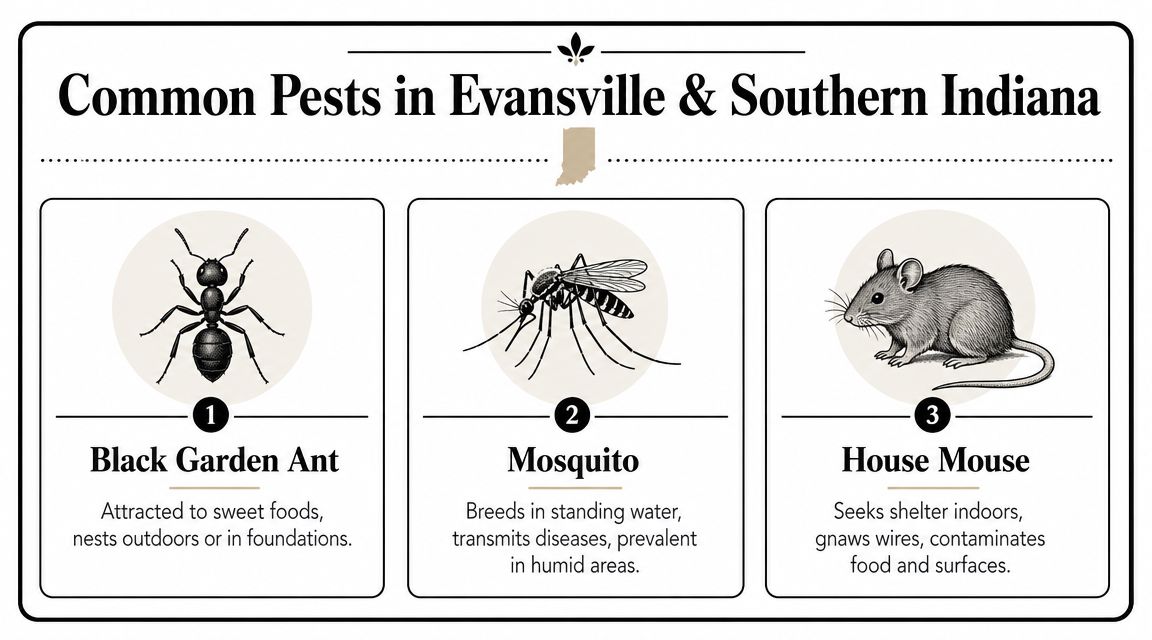
This quick visual covers three of the most common:
Ants and carpenter ants
Most homeowners notice ants first in kitchens, bathrooms, or along exterior walls. They follow scent trails, so what looks like a few scouts can turn into a steady line fast. Black garden ants usually show up where sweets, crumbs, or moisture are easy to reach.
Carpenter ants create a different level of concern. They tend to favor damp or softened wood and can turn up around window frames, porches, wall voids, and older wood trim. If ant activity keeps returning after store-bought sprays, the colony may be nesting in or near the structure.
Termites and hidden wood damage
Termites are one of the pests homeowners miss the longest because they usually stay out of sight. By the time visible signs appear, they may have been active for a while. Mud tubes on the foundation, blistered paint, tight-fitting doors, or wood that sounds hollow are all worth taking seriously.
Warm, wet conditions and wood-to-soil contact can make a property more inviting. Homes with crawl spaces, older wood features, or moisture issues deserve closer attention because termite activity often starts where homeowners don't spend much time looking.
A short explainer can help you spot the difference between nuisance insects and a deeper issue:
Spiders and what repeated sightings mean
Spiders usually follow food. If you're seeing a lot of them, there's often another insect population supporting them. Basements, garages, storage areas, and less-disturbed corners tend to be the main trouble spots.
Brown recluse concerns come up often in Indiana homes, especially in quiet indoor spaces. Whether the spider is harmless or not, repeated sightings mean it's time to reduce harborage, check clutter, and address the insect activity that's drawing them in.
Rodents, mosquitoes, and stinging insects
Rodents are problem solvers. They use garages, attics, crawl spaces, and wall voids for shelter, especially when temperatures swing. Common signs include droppings, gnaw marks, scratching sounds, pet food disturbance, or chewed packaging in the pantry.
Mosquitoes build up where water lingers and shade holds humidity. Birdbaths, clogged gutters, toys, planters, low spots in the yard, and dense landscaping all contribute. Wasps and hornets tend to settle around eaves, soffits, sheds, fences, and covered outdoor spaces where they can build undisturbed.
A simple way to think about common pests in Evansville is by what attracts them:
| Pest | What draws them in | Early sign homeowners notice |
|---|---|---|
| Ants | Food residue, moisture, cracks at entry points | Trails near counters or windows |
| Termites | Moisture, wood contact, hidden structural voids | Mud tubes or damaged wood |
| Spiders | Insect activity, clutter, quiet corners | Webs and repeat sightings |
| Rodents | Shelter, food sources, gaps into the home | Scratching, droppings, gnawing |
| Mosquitoes | Standing water, shade, humidity | Biting activity outdoors |
| Wasps | Protected overhangs and nesting sites | Visible nest traffic |
DIY Solutions vs Professional Pest Control
DIY treatment is tempting for a simple reason. It feels faster and cheaper at the start. You can buy traps, aerosol sprays, granules, or bait stations the same day and do something immediately. For a very small issue, that can help reduce activity.
The problem is that DIY work often treats what's visible and misses what's driving the infestation. Homeowners commonly misidentify ants, overlook hidden nests, spray the wrong areas, or stop treatment too early because activity drops for a few days. Then the pests come back, usually in the same spot.
Where DIY can fall short
The biggest risk isn't always wasted time. Sometimes it's pushing the problem deeper into the structure. Improper spraying can scatter insects instead of controlling them. Rodent bait placed without a broader plan can leave entry points wide open. And broad indoor chemical use around food areas, pets, or children needs more care than many people realize.
If you don't know where the pests are nesting, breeding, or entering, you're not really solving the problem. You're interrupting it.
There's also the cost issue. A homeowner may buy multiple rounds of products trying to beat the same recurring problem. By the end, they've spent money, lost time, and still need an inspection because the underlying conditions were never addressed.
When professional service makes more sense
Professional pest control makes the most sense when the activity is recurring, widespread, hard to identify, or tied to structural conditions. That includes termite concerns, rodents in walls or attics, repeated ant invasions, brown recluse worries, mosquito pressure around the yard, and stinging insect nests in difficult locations.
A trained exterminator approaches the problem differently:
- Correct identification first so the treatment matches the pest.
- Entry-point review to see how pests are getting inside.
- Targeted product placement instead of overapplying material everywhere.
- Prevention steps that make repeat infestations less likely.
For homeowners weighing the decision, this guide on DIY or hiring a pro for pest control gives a practical framework for when store-bought solutions may be enough and when they usually aren't.
The Green Advantage Inspection and Treatment Process
Most homeowners feel better once they know what the service visit will look like. Uncertainty keeps people from booking. A clear process removes that friction.
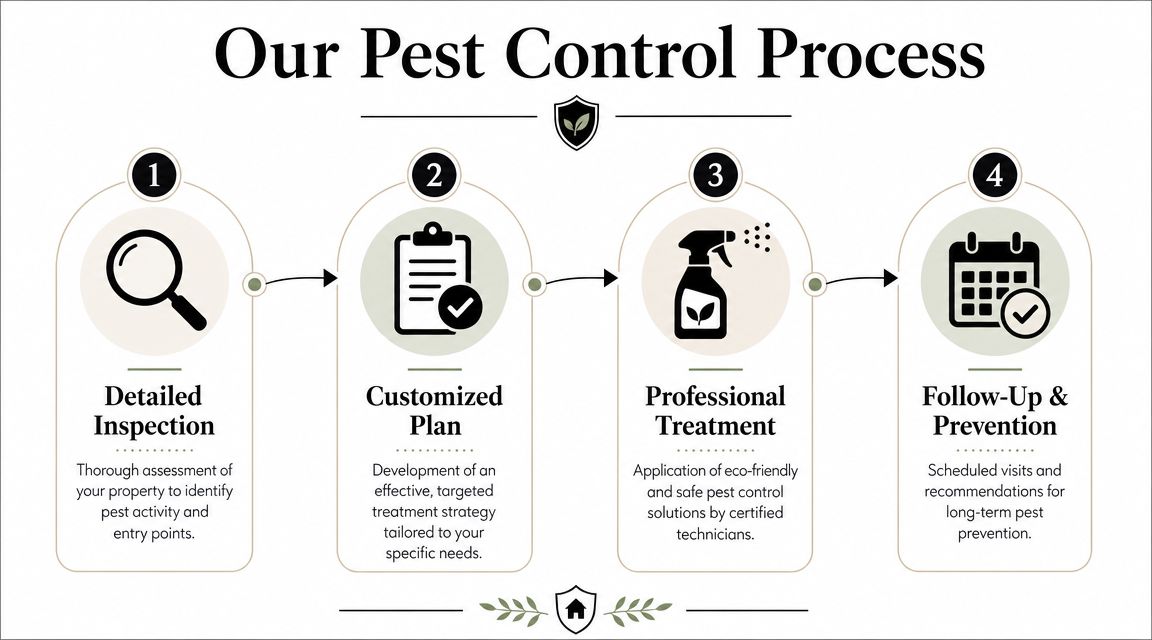
The Green Advantage handles pest problems by starting with inspection, then building the treatment around the conditions on the property. That matters because a ranch home with mosquito pressure in the yard needs a different approach than a two-story home with attic rodents or a crawl-space moisture issue.
Inspection that looks past the obvious
The first step is a careful review of the areas where pest pressure usually starts or spreads. That includes the exterior foundation, door thresholds, garage edges, utility penetrations, windows, attic access points, moisture-prone areas, and any interior rooms where activity has been reported.
Homeowners often focus on the one room where they saw the pest. The technician's job is to connect that sighting to the larger pattern. If ants are in the kitchen, the nest may be outside by the foundation. If mice are in the pantry, the entry point may be at the garage corner or utility line. If mosquitoes are bad on the patio, drainage and vegetation are often part of the story.
A treatment plan built for the actual issue
After inspection, the next step is choosing the response that fits the problem. That may involve crack-and-crevice treatment, exterior perimeter applications, baiting, trapping, nest treatment, exclusion recommendations, or a broader recurring service schedule when pressure is ongoing.
This is also where trade-offs get discussed. Some homeowners want the fastest knockdown possible. Others care most about long-term prevention, lower disruption, or eco-minded application choices. A good provider explains those options in plain language so the homeowner understands what each method is meant to accomplish.
A practical service plan usually covers:
- What pest is being targeted
- Where the pressure is coming from
- Which treatment methods are being used
- What the homeowner should do next
On-site judgment matters most when the same pest keeps reappearing after previous treatment. That usually means the source was missed, not that the pest is impossible to control.
Follow-up and prevention
Treatment shouldn't end with application. Some pests require monitoring. Others call for changes around the home, such as trimming back vegetation, reducing standing water, improving sanitation, sealing gaps, or storing items differently in garages and basements.
That follow-up piece is where many recurring problems are either prevented or allowed to restart. Clear communication after service helps the homeowner know what to expect in the next few days and what signs would justify another check.
Understanding Pest Control Costs in Evansville
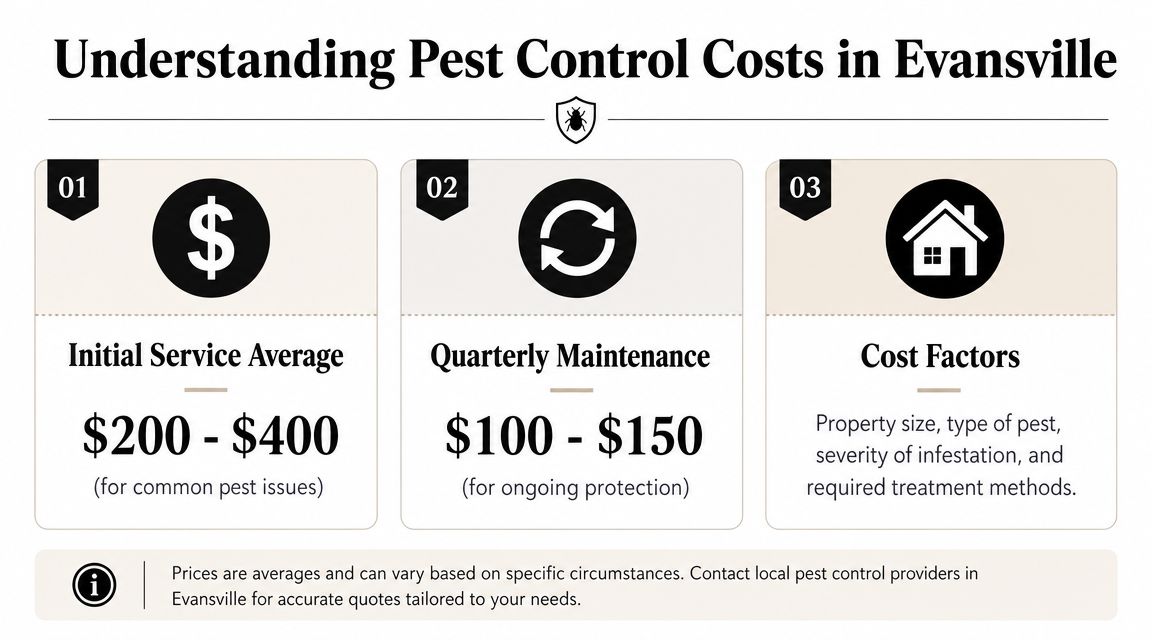
Cost matters, and most homeowners want a realistic benchmark before they make the call. In Evansville, one local pricing report shows an average initial treatment cost of $140.69 for a standard 4-bedroom home, with a reported range of $127.47 to $153.91 according to Evansville pest control cost data. That gives you a starting point for budgeting an initial visit.
What changes the final price
That local benchmark is useful, but no honest company should price every job the same. The actual cost depends on what the technician finds and what kind of control is required.
Here are the factors that usually matter most:
- Type of pest because termites, rodents, ants, mosquitoes, and wasps don't require the same tools or visit structure.
- Property size and layout since larger homes, detached garages, crawl spaces, and complicated exterior lines take more time to inspect and treat.
- Severity of activity because a light issue near one entry point is different from a widespread infestation.
- Service type such as one-time treatment, recurring residential pest control, mosquito reduction, or a commercial service plan.
One-time visit or ongoing service
Some homeowners only need a targeted initial treatment. Others benefit more from recurring service because the property has steady pressure through the year. That's often the better value when pests are tied to the outdoor environment, moisture, or repeated seasonal activity.
The key is matching the budget to the existing risk. A one-time treatment can feel cheaper, but if the same conditions keep inviting pests back, repeated spot treatments may cost more over time and produce less peace of mind.
For a fuller breakdown of what affects pricing, this article on how much pest control services cost is a useful next step.
Proactive Prevention Lasting Peace of Mind
Reactive treatment has a place. If pests are already active in the home, you handle that first. But the strongest long-term strategy is prevention based on how the property is built, where it sits, and what conditions around it keep attracting pests.

A lot of homeowners get offered a generic quarterly plan and assume that's always the right answer. It isn't. Guidance specific to Evansville points out that treatment frequency should be based on real pest pressure, property type, and infestation risk rather than a one-size-fits-all quarterly plan, and that apartments, restaurants, and single-family homes may need different schedules, as explained in this discussion of Evansville treatment frequency and service type.
What should shape the schedule
The best prevention plans are built around what the property is dealing with, not what sounds standard.
A few examples:
- Single-family homes with yard and foundation pressure may need seasonal exterior protection and mosquito reduction when outdoor living is a priority.
- Properties with repeated rodent entry need exclusion work and monitoring, not just trap placement.
- Homes with moisture and wood-risk conditions deserve closer termite attention than homes without those triggers.
- Rental properties or multi-unit settings often need more frequent observation because turnover, storage patterns, and shared walls change the risk.
What works and what usually doesn't
What works is consistency. Trimming vegetation away from siding, correcting drainage, keeping mulch from piling too high against the structure, reducing clutter in garages, sealing entry gaps, and checking vulnerable areas before peak pest activity starts. When these steps are paired with professional treatment at the right intervals, homeowners usually deal with fewer surprises.
What doesn't work is relying on a schedule that ignores the site. Monthly service for a low-pressure property can be more than the home needs. A broad quarterly plan for a property with heavy mosquito breeding, rodent entry, or repeated ant pressure may not be enough by itself.
Prevention works best when service frequency follows the pressure on the property, not the calendar alone.
Long-term peace of mind comes from that fit. The home gets the level of protection it needs, and the homeowner isn't paying for the wrong kind of service.
Choose The Green Advantage for Your Home
When homeowners search for an exterminator near me or residential pest control in Indiana, they usually want three things. Clear communication, reliable work, and a plan that matches the problem instead of overselling it.
That's the standard to hold any provider to. If you're comparing options for Pest Control Evansville, keep the checklist simple:
- Family-owned perspective that treats your home like a place that needs protection, not just a service ticket.
- Licensed and certified service so inspection, product selection, and treatment decisions are handled by trained professionals.
- Eco-minded approach for homeowners who want effective control with thoughtful application methods.
- Residential and commercial capability if you need help at home, for a rental, or for a business property.
- Straight answers about next steps including what's causing the pest pressure, what treatment makes sense, and what follow-up may be needed.
A strong pest control company should never rush you into a generic package. It should help you understand whether you need a one-time response, ongoing prevention, termite attention, mosquito control, rodent exclusion, or a more targeted solution for spiders, ants, or wasps.
That kind of clarity saves time and usually saves frustration too. It also makes it much easier to protect the home before a small problem turns into a costly one.
Frequently Asked Questions
Are treatments safe for kids and pets
That depends on the pest, the product, and how the treatment is applied. A professional should explain where materials are being used, what precautions matter, and when it's okay to re-enter treated areas. If you have pets, small children, or specific health concerns, mention that before service so the plan can be adjusted appropriately.
Do I need to be home during the service
Not always. Some exterior treatments and certain follow-up visits can be completed without the homeowner present, depending on the service. Interior inspections, first-time diagnostics, and treatments in occupied problem areas usually go smoother if someone is available to answer questions and point out where activity has been happening.
How long does it take to see results
That varies by pest. Some treatments reduce visible activity quickly, while others work over time as pests contact treated areas or carry bait back to the nesting site. Rodent control, ant control, termite work, and mosquito reduction all behave differently, so the expected timeline should be explained up front.
Should I choose one-time service or recurring pest control
Choose based on the pattern, not just the price. A one-time treatment can make sense for an isolated issue. Recurring service usually makes more sense when pests are seasonal, tied to the property's surroundings, or likely to return because of ongoing pressure around the structure.
What should I do before the technician arrives
Keep access open to the areas where you've noticed activity. Make note of where and when you saw pests, whether the problem is worse after rain or at night, and whether you've already used any store-bought products. Those details help the inspection go much faster and usually lead to a better treatment plan.
If pests are making your home feel unsettled, the next step is simple. Contact The Green Advantage to schedule an inspection, request a quote, and get a practical plan built around your property, your concerns, and the kind of protection that fits your home.
Stink Bug Control in Crown Point, IN: How to Get Rid of Stink Bugs
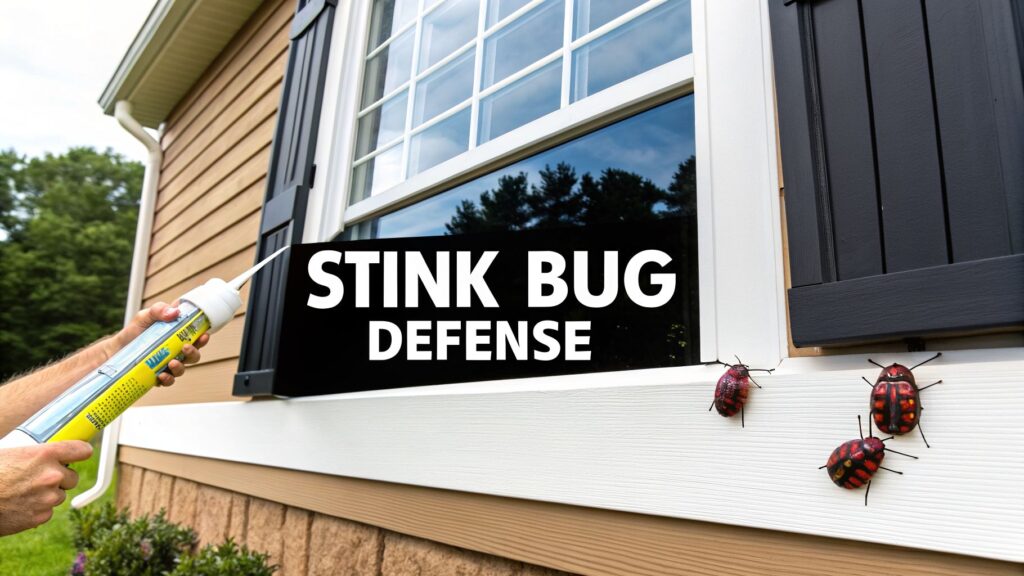
When you find a stink bug inside your Crown Point home, the goal is simple: get it out without releasing that awful smell. Dealing with these pests effectively involves a two-part plan: first, remove the ones you see, and second, stop more from getting in. The best way to handle the immediate problem is by vacuuming them up or dropping them into a container of soapy water. Both methods are quick, clean, and—most importantly—odor-free. But for a lasting solution, you need a professional strategy.
The Unwanted Houseguests Arriving in Crown Point
If you're a homeowner in Northwest Indiana, you know the scene. As soon as the weather turns crisp in the fall, suddenly your home’s siding, windows, and doors are covered with brown, shield-shaped insects. Seeing this unfold at your home in Crown Point doesn't mean it's dirty; it's just your turn to deal with the annual stink bug migration. This is a common issue our community faces, and a professional exterminator near you can help.
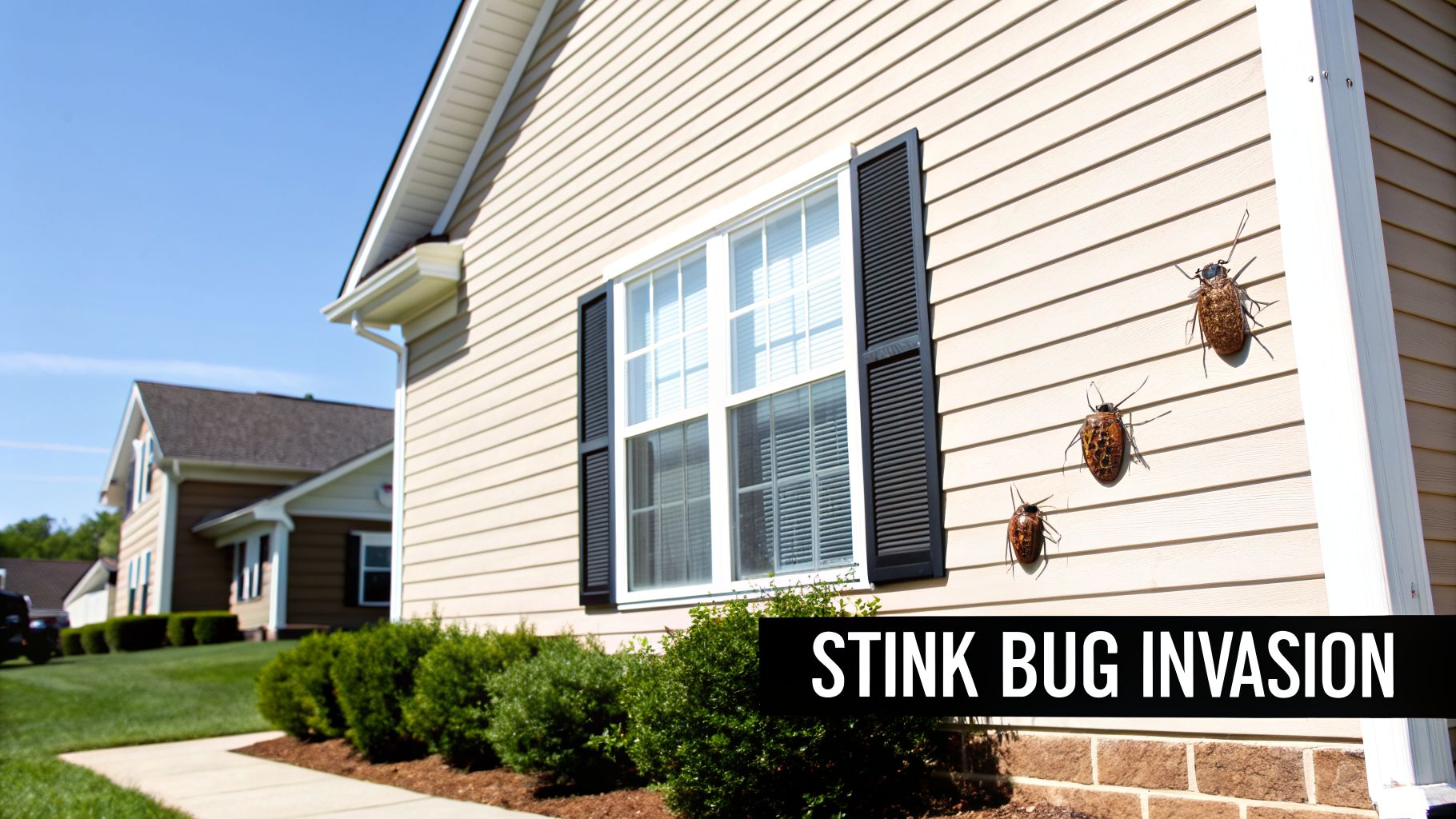
These are brown marmorated stink bugs, an invasive species that has become a huge nuisance across the region. As a trusted local provider of residential and commercial pest control, The Green Advantage has seen this problem grow firsthand. We want to share our field-tested strategies to help you tackle the bugs you have now and prevent them from coming back.
A Growing Problem Across Indiana
It can feel like an overnight invasion. One day everything is fine, and the next you have hundreds of these pests looking for a warm place to spend the winter—inside your walls. Since they first showed up in the U.S. in the late 1990s, their population has absolutely exploded.
They are now a confirmed pest in 47 states and 4 Canadian provinces, a real testament to how resilient they are. Here in Indiana, the National Pest Management Association is forecasting a major surge. Warmer, drier autumns give them more time to thrive outdoors before they make a run for our homes.
Milder winters are a big factor. Without a sustained hard freeze, local stink bug populations in northern states like ours could balloon by as much as 70%. This is why proactive pest control is no longer optional for homeowners.
This population boom explains why a minor seasonal annoyance has turned into a major headache for homeowners from Crown Point to Valparaiso. You can even see just how far they've spread by looking at this state-by-state stink bug tracking map.
Quick Guide to Handling Stink Bugs Indoors
When you find stink bugs inside, your first instinct might be to swat or crush them. That's the one thing you don't want to do. The table below outlines the right way to handle them and the common mistakes to avoid.
| Action | Best Practice (What to Do) | Common Mistake (What to Avoid) |
|---|---|---|
| Immediate Removal | Use a vacuum with a hose attachment to suck them up. Dispose of the bag or empty the canister outside immediately. | Crushing or swatting them, which releases their defensive, foul-smelling odor. |
| Trapping | Place a shallow dish of soapy water under a light source at night. They are attracted to the light and will fall into the trap. | Using ineffective sticky traps that can also catch beneficial insects or leave a residue. |
| Disposal | Flush them down the toilet or seal them in a plastic bag and place them in an outdoor trash can. | Throwing them in an indoor, unsealed trash can, where the smell can linger and escape. |
| Observation | Take note of where you are finding them most often (e.g., a specific window, a light fixture). This can help you pinpoint entry points. | Ignoring the problem and assuming they will just go away on their own. They won't. |
Following these simple do's and don'ts will make managing the occasional indoor stink bug much less stressful and a lot less smelly.
Why Professional Pest Control Is Your Best Defense
While you can certainly manage a few stragglers with a vacuum, a full-blown invasion requires a more strategic approach. This is where professional help really shines and why so many homeowners opt for professional pest control in Crown Point, IN. A professional treatment protects your property, health, and peace of mind.
At The Green Advantage, our experience has shown us what works:
- Exterior Barrier Treatment: The most effective defense is stopping them before they breach your home. We apply a targeted treatment to your home’s exterior in the early fall, right when they start looking for winter shelter. This perimeter defense is key to preventing infestations of stink bugs, spiders, and ants.
- Local Expertise and Timing: We live and work here, so we know the pest pressures of Northwest Indiana. Our stink bug applications are timed perfectly with their migratory patterns to ensure maximum impact.
- Long-Term Prevention: A professional service isn't a one-time fix; it's an investment in keeping your home pest-free. We break the cycle, preventing them from coming back season after season.
Instead of fighting a losing battle against a constant stream of bugs all winter, let our team put a stop to it. Our residential pest control services are designed to handle persistent invaders like stink bugs, giving you and your family true peace of mind.
Getting to Know Northwest Indiana's Unwanted Guest: The Stink Bug
If you've noticed swarms of shield-shaped insects crawling on the sunny side of your Crown Point home in the fall, you've met the brown marmorated stink bug (Halyomorpha halys). These pests aren't native to the U.S., but they've certainly made themselves at home here in Northwest Indiana.
Before you can get rid of them, you need to be sure that's what you're dealing with.
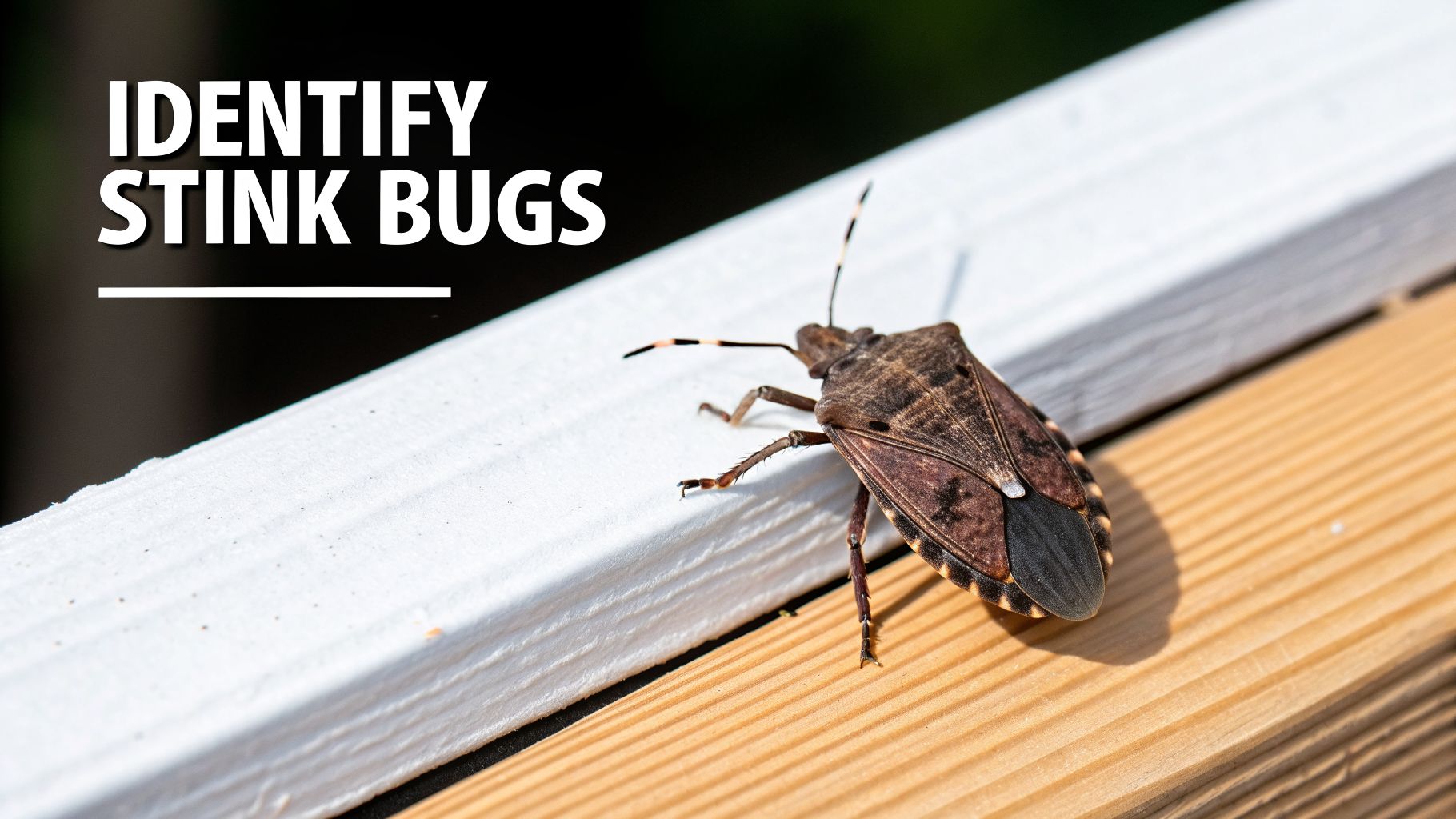
Look for a distinctive shield shape that's about a half-inch long. They have a mottled, almost marbled brown-and-gray pattern. The key giveaways are the light-colored bands on their antennae and along the edges of their abdomen—details that help separate them from other local look-alikes.
Why Your Home Becomes Their Winter Getaway
That autumn invasion isn't random. As the days get shorter and a chill hits the air, a stink bug’s instinct screams one thing: find shelter. They're not looking to raid your pantry or start a family in your living room. Their goal is to find a safe, quiet place to ride out the winter.
This dormant state is called diapause, and your home's walls, attic, and crawl spaces are the perfect five-star resort. They’ll congregate on warm, sun-drenched siding, methodically searching for any tiny crack or gap that lets them inside.
Here's the key thing to remember: They aren't in your house to feed or breed. They're just waiting for spring. This is why a sudden warm, sunny day in February can trigger a flurry of activity—they get confused and think it's time to head back outside.
The "Stink" Is a Warning, Not a Weapon
Of course, their most famous feature is that unforgettable smell. When a stink bug feels threatened or gets crushed, it releases a pungent chemical from glands on its abdomen. It’s a purely defensive move meant to ward off predators.
People describe the odor in a lot of ways, from old cilantro to burnt rubber. Whatever you call it, it’s effective, and it lingers.
This is exactly why grabbing a shoe or magazine is the worst way to handle one. Squashing a stink bug not only unleashes that awful smell, but there's also some thought that the scent may signal danger, attracting other stink bugs in the area. Your one-bug problem could quickly get worse. For a closer look at their biology, check out our deep dive on The Brown Marmorated Stink Bug.
A Major Nuisance, But Not a Direct Threat
Let’s be clear: stink bugs won’t hurt you. They don't bite people or pets, and they won't chew through your home's foundation like termites. Their mouthparts are designed strictly for sipping juice from plants.
But that doesn't mean they're harmless. Their droppings can leave behind ugly stains on curtains, walls, and furniture. A full-blown infestation creates a constant, unpleasant odor and the unnerving feeling of sharing your space. For most homeowners in Crown Point, the sheer annoyance is more than enough reason to call in a professional exterminator and stop the invasion before it starts.
Safely Removing Stink Bugs From Your Home
You see it out of the corner of your eye—a small, shield-shaped bug crawling up the curtains. Then you see another one buzzing around a lamp. When stink bugs make their way inside, your first instinct is to get them out, and fast, without triggering that notoriously awful smell.
Good news: you can do this without resorting to harsh chemical sprays. The secret is to avoid crushing or startling them. A calm, deliberate approach is all you need to keep your home pest-free and, more importantly, odor-free.
The Vacuum Method and The Sock Trick
One of the best tools for the job is probably already in your hall closet. A vacuum cleaner with a hose attachment lets you suck up stink bugs from a safe distance, whether they’re high up on the ceiling or hiding behind furniture.
But just vacuuming them up can create a new problem. The bugs can release their odor inside the canister, and that smell will blast out every time you turn the vacuum on. To get around this, we always recommend the "sock trick."
- Grab an old tube sock and slide it into the vacuum hose.
- Fold the cuff of the sock over the end of the nozzle.
- Secure the cuff tightly with a rubber band.
Now, when you turn the vacuum on and suck up the bugs, they'll be trapped inside the sock, not in your vacuum’s main compartment. When you're finished, just carefully pull the sock out, tie it in a tight knot, and toss it in your outdoor trash bin. It's a clean, simple, and smell-free solution our technicians use all the time for interior cleanups in homes around Crown Point.
The DIY Soapy Water Light Trap
Stink bugs are naturally drawn to light, a behavior you can easily use to your advantage. A homemade light trap is an incredibly effective and hands-off way to capture dozens of them overnight, especially in a dark room where it's the only light source.
Here’s the simple, field-tested trap we swear by:
- Get a wide, shallow dish. An aluminum foil roasting pan is perfect for this.
- Fill it with an inch of water and add a good squirt of dish soap. A quick stir is all you need. The soap breaks the water's surface tension, meaning any bug that lands in it will sink and drown instead of just floating on top.
- Set up a light source. A small, battery-operated desk lamp or even a book light aimed directly at the water's surface is ideal.
Place the trap in the room where you’ve seen the most bugs. Turn off all the other lights in the room, shut the door, and leave it overnight. In the morning, you’ll be surprised at how many you’ve caught. You can just flush the contents down the toilet.
A Note on Store-Bought Sprays: Many homeowners in Northwest Indiana grab aerosol pest sprays from the hardware store, but we’ve found these are a poor choice for stink bugs. They’re contact-killers, which means you have to spray each bug directly—a losing battle when you have a real infestation. Worse, they introduce unnecessary chemicals into your home and do absolutely nothing about the hundreds of bugs still hiding in your walls, waiting to emerge all winter long.
The Best Approach Is a Two-Part Strategy
While these removal methods work great for the bugs you can see, they are only half the battle. A true, lasting solution combines immediate removal with professional prevention.
Getting rid of bugs one by one is a temporary fix. To actually stop the endless cycle, you need an exterminator in Crown Point, IN, to apply a preventative treatment to your home's exterior. This creates an invisible barrier that stops new bugs from ever getting inside in the first place, saving you from the daily chore of vacuuming and setting traps. It’s the only way to address the root of the problem and get real peace of mind.
Your Guide to a Pest-Proof Home This Fall
The absolute best way to handle a stink bug problem is to stop it before it even starts. Sure, you can deal with the bugs you see inside, but that’s just a temporary fix. If you want real, lasting peace of mind, you have to prevent them from getting in in the first place. Think of it as a critical fall project for your Crown Point home—investing a weekend now will save you from a winter-long headache.
Sealing up your home against these persistent pests is the single most effective strategy you can use. This means taking a good, hard look at your home’s exterior and closing off all the tiny cracks and gaps they use as their personal doorways.
Your Weekend Pest-Proofing Checklist
First things first, grab a notepad and take a slow walk around the outside of your house. Your mission is to find and jot down every potential entry point, no matter how small it seems. I'm not kidding when I say they can squeeze through cracks just 3.5 millimeters wide, so you need to be thorough.
Here are the hotspots you'll want to inspect carefully:
- Windows and Doors: Check the seals around every single window and door frame. Look for any caulk that's cracked or peeling away. Worn-out weather stripping is another major culprit, creating just enough of a gap for a bug to slip through.
- Siding and Foundation: Pay close attention to where your siding meets the foundation. As a house settles over time, gaps frequently open up here. While you're down there, look for any cracks in the foundation itself.
- Utility Entry Points: Take a close look at every spot where pipes, wires, and vents enter your home. This includes your gas lines, electrical conduits, outdoor faucets, and dryer vents. These areas are notorious for having unsealed gaps around them.
Once you’ve got your list, it's time to get to work. Use a high-quality silicone or silicone-latex caulk to fill the cracks around windows, siding, and those utility penetrations. For any larger gaps, you might need to stuff some steel wool or use expandable foam first, then caulk over it for a perfect seal.
This whole process is what we in the business call "exclusion." It's absolutely critical. While vacuuming up a few stragglers inside helps, the real victory is preventing the hidden masses from setting up camp in your wall voids for the winter.
For any bugs that do manage to sneak past your defenses, the infographic below shows a couple of simple, odor-free ways to get rid of them.
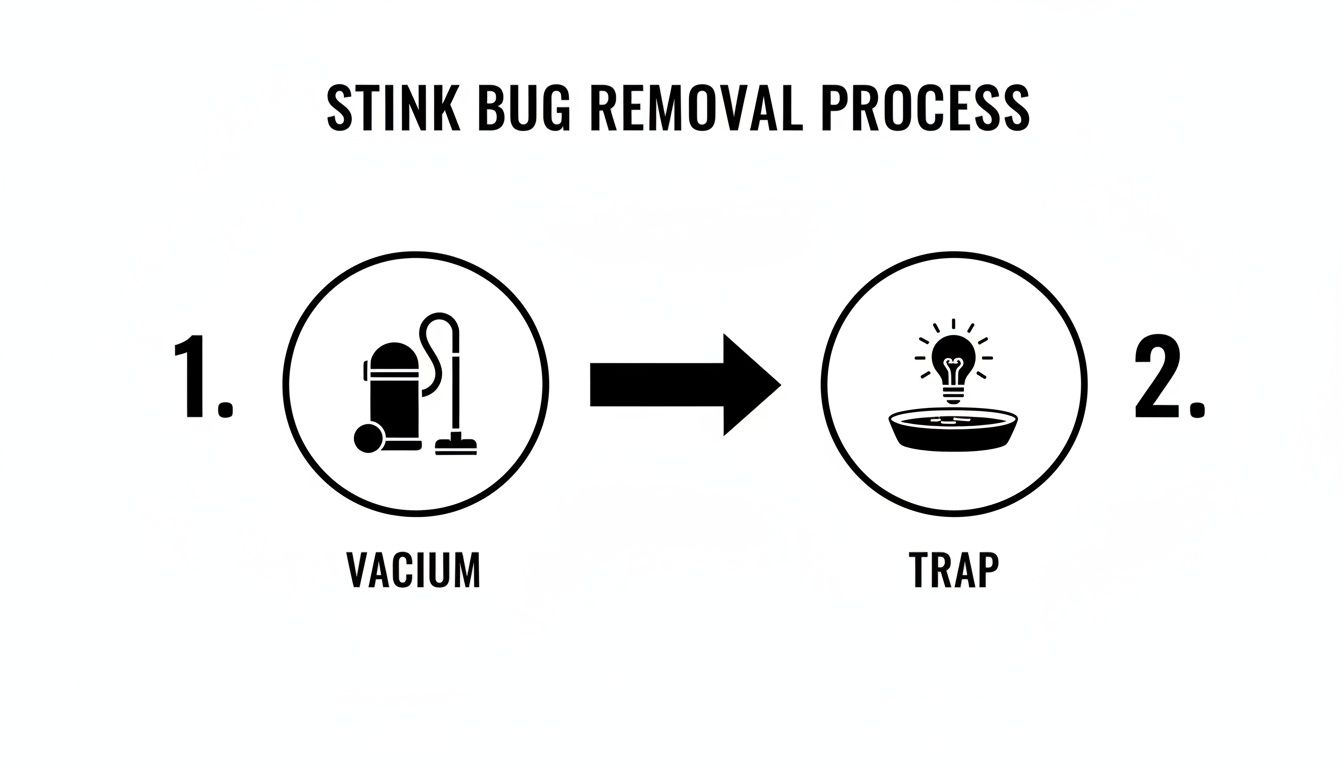
Just remember, while these indoor methods are handy for the ones you see, proactive sealing is your primary line of defense against a full-scale invasion.
Overlooked Entry Points for Stink Bugs
Beyond the usual cracks, there are a few other weak spots on a home that give pests an easy way in. From my experience, many homeowners in Northwest Indiana miss these vulnerabilities during their fall prep.
Damaged Window and Door Screens: A tiny tear or a small hole in a screen is basically an open invitation. Make sure to repair or replace any damaged screens before the stink bugs start their fall migration.
Attic and Soffit Vents: These are essential for airflow, but if they aren't properly screened, they become superhighways for stink bugs. Check that all your vents have intact, fine-mesh screening.
Fireplace Chimneys: An open chimney flue is like leaving the front door wide open for pests. Always ensure your chimney is capped and that the damper is closed tight when it's not in use.
A huge part of keeping unwanted guests out is just maintaining your home's exterior. Taking a moment to understand what a window seal is and how to spot a failing one can head off a lot of pest problems before they even begin.
Why Sealing Your Home Is a Non-Negotiable Step
Stink bugs are more than just a smelly annoyance; they're considered economic pests known to damage over 100 different types of crops. The EPA is clear: getting rid of them starts with exclusion. In fact, field tests have shown that securing weather stripping, caulking crevices, and screening vents can block 85-95% of potential entry points. Spraying aerosols might kill on contact, but it's a poor long-term strategy—the survivors simply retreat into your walls to wait you out.
Sealing your home is the most powerful DIY action you can take. It doesn't just stop stink bugs; it also helps prevent other pests like spiders, ants, and rodents from moving in. As a bonus, it makes your home more energy-efficient, too.
Of course, sealing a home perfectly is a tough job. If you've sealed every crack you can find but are still seeing bugs, or if the whole task just feels overwhelming, that's a clear sign you need a professional strategy. A company offering pest control in Crown Point, IN, can supplement your hard work with a protective barrier treatment, giving you the comprehensive defense your home truly needs.
When Your Stink Bug Problem Needs a Professional Solution
Vacuuming up the occasional stink bug is one thing. But when you start to feel like you're fighting a losing battle, it's a clear sign that the DIY approach isn't cutting it anymore. If you're overwhelmed, that's your cue to call in a professional exterminator in Crown Point, IN.
Recognizing When DIY Isn't Enough
So, how do you know when you’ve gone from a nuisance to a full-blown infestation? For most homeowners we talk to in Crown Point, it comes down to a few familiar stories. If you're spotting dozens of bugs every single day, the problem is almost certainly bigger than what you can see.
The real giveaway is where you find them. Are they showing up in strange places like inside light fixtures, emerging from behind baseboards, or dropping from attic vents? That means they've already set up shop inside your wall voids. At that point, you're only seeing the tip of the iceberg, and no amount of vacuuming will reach the source.
The most common reason we get a call is simple frustration. A homeowner has spent weeks sealing cracks and setting traps, but the bugs just keep coming. That kind of persistence tells us a significant population has already breached the home's defenses, and only a professional treatment will break the cycle for good.
How Professional Stink Bug Control Is Different
At The Green Advantage, our approach isn't just about reacting to the bugs inside your home. It’s about proactive prevention. We focus on a targeted exterior treatment that creates a protective barrier, which is the key to effective, long-term relief from stink bugs.
When working with The Green Advantage in Crown Point, IN, you can expect our licensed technicians to apply a specially formulated, family-safe product to the key weak points on your home's exterior. This includes:
- Around all window and door frames: We treat the most common entry points from the outside.
- Beneath eaves and soffits: These are classic gathering spots for stink bugs right before they sneak their way indoors.
- Along the foundation: This creates a ground-level barrier to stop them from climbing up your siding.
We time this application to coincide perfectly with their fall migration here in Northwest Indiana. By treating your home before they start their desperate search for winter shelter, we stop the invasion before it can even begin. Our goal isn't just to get rid of the stink bugs you have, but to prevent them from becoming a problem in the first place.
The Green Advantage Commitment for Crown Point
We get it. The idea of spraying products around your property can be a bit unsettling. As a local, family-owned business, we value the safety of our community. That’s why we’re committed to using the most effective eco-friendly pest control solutions on the market—products that are tough on pests but gentle on your family, pets, and the environment.
Our entire process is built on clear communication. When you call us, we don't just show up and start spraying. We take the time to inspect your property, pinpoint the specific pressures your home is facing, and walk you through our treatment plan. We want you to feel confident from start to finish.
If you're still on the fence, our guide on choosing between DIY or professional pest control offers some great insights to help you decide.
Ultimately, calling in an expert provides a reliable solution that DIY efforts just can't match. Instead of spending another fall and winter chasing bugs, you can rest easy knowing your home is truly protected.
Common Questions from Indiana Homeowners About Stink Bugs
Working in pest control here in Crown Point, we get a lot of the same questions every fall. Stink bugs drive everyone nuts, so if you're feeling overwhelmed, you're not alone. Let's get right to it—here are the honest answers to the questions we hear most often from your neighbors.
Do Stink Bugs Bite or Damage My House?
This is always the first question, and I get it. The good news is, no. Stink bugs are what we call a nuisance pest. They aren’t built to bite or sting people or pets; their mouthparts are more like a tiny straw for sipping plant juices.
They also won't chew up your house like termites or gnaw on wires like mice. Stink bugs are just looking for a warm, quiet spot to ride out the Indiana winter. The real problem is what they leave behind. Their droppings can create small, yellowish-brown stains on walls and curtains, and that unmistakable odor from a large group is just awful. Mostly, it's about the constant, unsettling presence of bugs where they don't belong.
Why Is My House a Magnet for Stink Bugs?
Ever feel like your house gets slammed with stink bugs while your neighbor’s is fine? It's not just in your head. Certain homes, especially around Northwest Indiana, are definitely more appealing to them.
- Sun Exposure: Stink bugs crave warmth. If you have a side of your house that gets blasted with the afternoon sun (usually south- or west-facing), that's where they'll congregate in the fall.
- House Color: This might sound odd, but they seem to prefer lighter colors. We see it all the time. A white, tan, or light gray home often attracts more stink bugs than a dark brown or forest green one.
- Proximity to Nature: If your property bumps up against a cornfield, a wooded lot, or even just a large open field, you're in the front row. They spend their summer in those areas, and your house is the closest and most convenient hotel when the weather turns cold.
If you have a light-colored home that gets a lot of sun and backs up to a field, you've basically hit the stink bug jackpot—and not in a good way.
Are Professional Stink Bug Treatments Safe for My Family?
This is a big deal, and we take it seriously. The safety of your family and pets is priority number one. Our entire eco-friendly pest control approach is built around that principle.
At The Green Advantage, we specifically use products that are tough on pests but have low toxicity for people. The exterior barrier treatment is applied strategically right where bugs try to get in—around windows, doors, and utility lines—which keeps the product outside and away from your living spaces. Our licensed technicians know exactly where and how to apply these solutions for maximum effect and minimal exposure.
We're an open book. Before we do anything, we’ll walk you through what we’re using, where it’s going, and any simple precautions, like keeping your dog inside for a bit while the treatment dries. Protecting your home has to include protecting everyone inside it.
Is It Possible to Get Rid of Stink Bugs for Good?
Let me give it to you straight: we are not going to eliminate the brown marmorated stink bug from Northwest Indiana. They're an invasive species, and they are here to stay.
The real goal isn't eradication; it's exclusion. The win is keeping them out of your house, so you don't have to live with them all winter.
And that is 100% achievable. A smart strategy that combines diligent home sealing with a professional preventative treatment works wonders. By caulking cracks, fixing screens, and having a residential pest control expert apply a barrier treatment in the fall, you can stop the invasion before it starts. You'll still see them outside, but they won't be able to make your home their winter hideout.
Don't let another season go by fighting a losing battle against stink bugs. If you're looking for an exterminator near you, the team at The Green Advantage has the local expertise and effective, family-safe solutions to protect your Crown Point home. Contact us today to schedule your pest inspection and enjoy a pest-free winter with complete peace of mind. https://thegreenadvantage.biz
Pest Control in Crown Point, IN: Will Bleach Kill Ticks?

When you find a tick crawling on your child, your pet, or even yourself, your first instinct is to get rid of it immediately. In that moment of panic, many homeowners in Crown Point reach for what seems like the strongest solution under the sink: bleach.
So, does bleach kill ticks? The straightforward answer is yes. However, using it for tick control is a prime example of a solution that creates more problems than it solves. For homeowners concerned about the safety of their family and property, relying on harsh chemicals like bleach is a risky and ineffective strategy. The Green Advantage offers a safer, more comprehensive approach to pest control in Crown Point, IN, ensuring your peace of mind.
Why Bleach Is the Wrong Tool for Tick Problems

Spotting a single tick is enough to make any Crown Point, IN homeowner's skin crawl, especially from late spring through fall when they’re most active. While dousing the pest in a harsh chemical might feel like a quick victory, this approach is incredibly short-sighted. It’s not a practical or safe way to protect your family from the real threat: the ticks you don't see lurking in your yard.
Bleach Only Works on Contact
Household bleach is undeniably powerful. If you've already removed a tick and drop it into a capful of bleach, it will be killed instantly. The effectiveness for a single, contained tick is 100%.
However, this only addresses one tick. It does absolutely nothing to manage the larger population hiding in the tall grass, leaf litter, or shrubs around your property. A single tick is often a warning sign of a much larger infestation that requires a professional solution.
For homeowners in Northwest Indiana, finding one tick is often a warning sign of a much larger population. Relying on bleach is like swatting one mosquito while a whole swarm is buzzing around your head—it solves nothing.
A Hazard to Your Family, Pets, and Property
Using a potent chemical like bleach for DIY pest control introduces a range of risks that our trained professionals are equipped to avoid.
Here’s what you’re up against:
- Health Risks: Bleach fumes are harsh and can easily irritate the lungs and airways. Contact with skin or eyes can cause chemical burns. For a curious dog or cat, ingesting even a small amount is extremely toxic.
- Property Damage: Spraying bleach on your lawn will kill grass and other plants, creating ugly brown patches. It can also discolor your home's siding, stain your deck, and corrode metal patio furniture.
Bleach vs Professional Tick Control at a Glance
| Feature | Household Bleach | Professional Tick Control (The Green Advantage) |
|---|---|---|
| Scope of Treatment | Kills one captured tick | Targets entire tick lifecycle across your property |
| Safety | High risk to people, pets, plants, and surfaces | Regulated, pet- and family-friendly treatments |
| Long-Term Effect | Zero. Offers no future prevention. | Provides a protective barrier to reduce populations |
| Expertise | DIY guesswork | Identifies and treats tick habitats and hot spots |
| Peace of Mind | Low. The bigger problem remains. | High. Comprehensive protection for your family. |
Ultimately, while the answer to "will bleach kill ticks" is technically yes, it’s a firm "no" for anyone seeking a safe and effective solution. For real peace of mind and effective tick management in Crown Point, IN, nothing beats a professional pest control service.
How Professional Pest Control Services Solve the Problem
So, you've heard that bleach can kill a tick. It's true. But to really understand why this is such a terrible idea for your home and yard, it helps to know what's actually happening on a microscopic level. It's a brutal, messy bit of chemistry.
The powerhouse in household bleach is a chemical called sodium hypochlorite. This stuff is a potent oxidizer, which is a scientific way of saying it aggressively steals electrons from whatever it touches. This process causes other substances to break down—fast.
For a tick, contact with bleach is catastrophic. Its main line of defense is a tough, waxy outer shell, known as an exoskeleton. Sodium hypochlorite obliterates this protective coating almost on contact, leaving the tick’s soft insides completely exposed.
The Breakdown Process
Once that exoskeleton is gone, the real damage begins. The bleach goes to work on the tick’s cells, and the oxidizing reaction literally rips apart cell membranes and proteins. This triggers a complete and fatal system meltdown.
Think of it like pouring a powerful acid on a finely tuned watch—the gears don't just stop; they are physically dissolved and destroyed.
This chemical assault is incredibly fast. If you were to drop a tick into a small cup of bleach, it wouldn't stand a chance.
The reaction is so violent that the tick is essentially unmade at a molecular level. That's why, on direct contact in a controlled setting, bleach is considered 100% lethal to ticks.
Why Professional Service is the Safer Choice
This isn't just a theory; the science backs it up. The active ingredient in bleach, sodium hypochlorite, is a well-documented destroyer. One study analyzing different decontamination methods found that a 5% sodium hypochlorite solution—which is right in line with household bleach—was incredibly effective at neutralizing ticks. For those interested in the raw data, you can review the complete study on its effects to see just how potent it is.
But here’s the critical takeaway for homeowners in Crown Point: what works in a lab is rarely a safe or practical solution for your home. The very chemical power that makes bleach so deadly to a single tick is precisely what makes it a huge risk to your lawn, your pets, and your family. It’s a sledgehammer, not a scalpel, and has no place in a responsible residential pest control plan.
A much smarter approach involves methods that target ticks where they live and breed without endangering everything else. This is where professional services, like the mosquito control and tick programs from The Green Advantage, offer a solution that’s both effective and responsible. Our licensed technicians understand how to apply treatments that are tough on pests but mindful of your family’s well-being.
Benefits of Professional Pest Control
Sure, a drop of bleach will kill a tick. But just because you can do something, doesn’t mean you should. The real question isn't whether it works, but whether it's safe—and the answer is a hard no.
Thinking of using bleach for pest control is a dangerous gamble. The very properties that make it a powerful disinfectant are what make it a significant hazard to your family, your pets, and your home itself. For any Crown Point homeowner, understanding these risks is the first step toward choosing a professional service that protects your property, health, and peace of mind.
Protecting Your Health and Property
Let's be blunt: bleach is a harsh, caustic chemical. When you use it around your home, you're releasing strong fumes that can quickly irritate your throat and lungs. Get it on your skin, and you’re looking at redness, irritation, or even a chemical burn.
For our pets, the risks are magnified. A curious dog or cat can easily be poisoned by licking a surface you've sprayed or by grooming bleach off their fur. Ingesting it can cause severe internal damage—and can even be fatal. It should go without saying, but we'll say it anyway: never, ever apply bleach directly to your pet to kill an attached tick.
Bleach is also incredibly destructive to your property. Here’s a quick look at the kind of collateral damage you can expect:
- Lawn and Garden: Spraying bleach on grass will kill it, leaving ugly brown patches across your yard.
- Siding and Decks: Bleach is notorious for stripping the color from vinyl siding, wood stains, and composite decking.
- Corrosion: It's also highly corrosive to metals. Patio furniture and railings can begin to rust and weaken after exposure.
Worst of all, after all that risk and damage, bleach offers zero residual protection. It might kill the ticks it touches, but it does absolutely nothing to stop the next wave from moving in an hour later. For a solution that actually works without compromising the safety of your home, you need a targeted approach from an exterminator in Crown Point, IN. At The Green Advantage, we focus on solutions that protect your family first, effectively managing pests like spiders, wasps, and ticks.
What to Expect From The Green Advantage in Crown Point, IN
So, we've established that grabbing the bleach bottle to deal with ticks is a bad idea. The real question is, what should you do when you find one latched onto you, a family member, or a pet? It's completely normal for any Crown Point homeowner to feel a bit of panic, but having a calm, steady plan is your best tool.
Knowing the right way to remove and get rid of a tick isn't just about protecting yourself from disease; it’s about giving yourself some much-needed peace of mind.
This infographic lays out exactly why bleach is the wrong tool for the job, highlighting the risks it poses to your family and home.

As you can see, the downsides—from causing respiratory irritation in people to poisoning pets and corroding your property—are serious. That's why our professional methods always prioritize safety and effectiveness above all else.
How to Properly Remove an Attached Tick
When you find a tick that has already bitten down, please don't reach for old-school remedies like a hot match or petroleum jelly. These methods often do more harm than good by stressing the tick, which can cause it to regurgitate saliva into the bite wound and increase the risk of disease.
Instead, stick to this proven, expert-approved technique:
- Use Fine-Tipped Tweezers: Grab the tick as close to your skin as you possibly can, gripping its head, not its body.
- Pull Upward Steadily: With even, consistent pressure, pull the tick straight out. Avoid twisting or jerking.
- Clean the Bite Area: Once the tick is out, clean the bite area and your hands with rubbing alcohol or soap and water.
Safe Disposal Methods
After you've removed the tick, dispose of it properly. A capful of bleach would kill it, but it's an unnecessary chemical risk. A common question we get is about ticks and water; while they are surprisingly tough, there are better ways to get rid of them. You can learn more in our guide on whether ticks can live in water.
Here are a few safe and easy disposal options:
- Pop it into a sealed bag or a small container.
- Wrap it up tightly in a piece of tape.
- Flush it right down the toilet.
Following these steps handles the immediate problem safely. But remember, removing a single tick doesn't solve a bigger issue. If you're finding them regularly, it’s time for a comprehensive residential pest control strategy for your property in Crown Point.
Creating a Tick-Resistant Yard in Crown Point

The best way to protect your family and pets here in Crown Point is to be proactive. By making your yard less hospitable to ticks, you can significantly reduce their numbers. A well-kept yard is your first line of defense.
Essential Landscaping Tips for Tick Prevention
Ticks love damp, shady spots and overgrown brush. By creating a clean, dry, and sunny environment, you make your property a terrible place for them to live.
Here are a few practical things you can do right now to make a huge difference:
- Keep Your Grass Mowed: Ticks climb tall blades of grass to wait for a host to brush past. Keeping your lawn short eliminates these ambush points and allows more sunlight to dry out the soil.
- Clear Away Leaf Litter: Piles of damp leaves are a five-star resort for ticks. Regularly rake up and remove leaves, grass clippings, and other yard waste.
- Create a Barrier: If your yard backs up to a wooded area, lay down a 3-foot-wide strip of wood chips or gravel between your lawn and the woods. This dry border is surprisingly effective at stopping ticks from migrating into your yard.
A sunny, open lawn is a tick’s worst enemy. By simply letting the light in and keeping things tidy, you are actively making your Crown Point yard a safer place for your family and pets.
Manage Wildlife and Reduce Tick Hosts
In Northwest Indiana, animals like deer, raccoons, and mice are common carriers of ticks. Making your yard less appealing to these critters will naturally reduce the number of ticks they leave behind.
- Secure Your Garbage Cans: Use lids that lock down to keep scavengers away.
- Rethink Bird Feeders: Spilled birdseed is a magnet for rodents like mice, which are significant hosts for young ticks.
- Use Fencing or Deer-Resistant Plants: If deer are regular visitors, a fence is your most effective tool for keeping them out.
These DIY steps are an excellent foundation for tick management. For a truly robust defense, the best results come from combining these habits with a professional treatment plan. Our approach uses integrated pest management, which combines smart environmental fixes with targeted, responsible treatments to give you the ultimate peace of mind.
The Professional Solution for Tick Control in Northwest Indiana
Landscaping and knowing how to remove a single tick are good defensive moves. But to truly reclaim your yard and stop worrying every time the kids or pets play outside, it’s time to go on the offensive with a professional.
For homeowners in Crown Point, IN, this is about getting lasting peace of mind. A professional service like The Green Advantage provides a reliable, property-wide solution that DIY attempts with bleach can't deliver. We shift the focus from reacting to individual ticks to implementing a comprehensive prevention strategy for your entire yard.
Our Targeted and Responsible Treatment Process
Your family's safety is our top priority. That’s why our residential pest control approach is the exact opposite of using hazardous chemicals like bleach. We use specially formulated, eco-friendly products that are potent against pests but designed for residential landscapes. Our licensed technicians are experts in the Northwest Indiana ecosystem and know precisely where ticks hide and breed.
This expertise allows us to apply treatments with surgical precision right where they’ll have the biggest impact.
It’s the difference between using a sledgehammer and a scalpel. This targeted approach is not only far more effective for long-term control, but it also minimizes the impact on your family, pets, and the beneficial insects you actually want in your garden.
What to Expect When You Work With Us
When you call The Green Advantage for tick control, you’re getting a partner committed to making your home safer. If you've ever wondered how local companies connect with homeowners, many use online strategies detailed in articles like this one on Local SEO for Pest Control to ensure they can be found when you need them most.
Our process is straightforward and built on delivering real results:
- Thorough Property Inspection: We walk your entire property to pinpoint tick habitats and high-risk zones, looking for overgrown brush, poor drainage, and signs of wildlife.
- Customized Treatment Plan: We map out a tailored treatment plan that fits the specific layout and challenges of your yard.
- Expert Application: Our technicians apply proven control products to key areas, creating a protective barrier that knocks down the tick population all season long.
- Ongoing Support and Advice: We provide clear instructions and practical advice for keeping your yard less attractive to ticks in the future.
Choosing a professional exterminator near me is an investment in your family’s health and your ability to enjoy your own backyard. Contact The Green Advantage today to schedule an inspection and take the first real step toward a tick-free summer.
Schedule Your Pest Inspection in Crown Point Today
When it comes to ticks, homeowners around the Crown Point area have plenty of questions, and rightfully so. We get it. To give you some clarity, we've put together answers to a few of the most common concerns we hear at The Green Advantage.
Are DIY Tick Sprays With Essential Oils Actually Effective?
While certain essential oils like lemon eucalyptus have some repellent properties, they are only a temporary fix. They might keep a few ticks at bay for a short time, but they evaporate quickly and do nothing to reduce the actual tick population thriving in your yard. For real, lasting protection in Northwest Indiana, you need a professional-grade product that interrupts the tick life cycle, which is what a licensed exterminator in Crown Point, IN provides.
How Often Will My Yard Need Professional Tick Treatment?
The right treatment schedule depends on your specific property and the severity of the tick problem. Ticks are most active from spring through fall in Indiana. Because of this, our residential pest control programs typically involve several strategically timed applications throughout this peak season. An expert from The Green Advantage can assess your yard and create a plan that keeps your family and pets protected when they need it most.
Is Professional Tick Control Safe for My Kids and Pets?
Absolutely. This is the most important question we get. Our process is built around safety. We use environmentally mindful products and apply them strategically in areas where ticks live, minimizing contact with people and pets. We simply ask that you keep children and pets off treated areas until the application is dry, and our certified technicians will always provide clear instructions after each service.
Ready to take back your yard from ticks and other pests? For a professional solution that puts your family’s safety first, trust the local experts. Contact The Green Advantage today to schedule your pest inspection and enjoy peace of mind all season long.