
You hear it at the worst time. Scratching in the wall after dark. Ants threading across the kitchen counter before coffee. A wasp drifting past the back door when the kids are headed outside. For most homeowners, the stress isn't just the pest itself. It's the uncertainty. How bad is it, where is it coming from, and can you handle it before it turns into a bigger mess?
That's where practical pest control matters. Homeowners looking for Pest Control Evansville usually don't need a lecture. They need clear answers, a sensible plan, and someone who understands how Indiana properties really work through wet springs, humid summers, and cold-weather pest pressure. A good response starts with identifying the pest correctly, matching the treatment to the problem, and stopping repeat activity instead of spraying and hoping.
Your Trusted Partner for Pest Control in Evansville
A lot of pest problems start small enough to ignore. One spider in the basement. A few ants near the sink. A mouse sighting that you try to explain away as a one-time thing. Then the pattern changes. You keep seeing activity in the same area, and now the problem feels less like an annoyance and more like a threat to your home.
That reaction is normal. Pests put homeowners on edge because they affect the spaces that are supposed to feel safe. Kitchens, bedrooms, attics, crawl spaces, garages, patios. Once bugs or rodents start showing up there, homeowners want the issue resolved quickly, but they also want to know the treatment will be handled the right way.
In Evansville, that means looking at the whole property, not just the pest you noticed first. Moisture around the foundation, gaps at utility lines, mulch beds against siding, clutter in the garage, standing water in the yard, food storage habits inside. Those details tell you whether you're dealing with a brief flare-up or a pattern that will keep returning.
Practical rule: The pest you see is often only the symptom. The real job is finding what's feeding it, sheltering it, or letting it inside.
Homeowners also need honest guidance about service type. Some homes need a one-time treatment and correction of a specific issue. Others need ongoing residential pest control because the conditions around the property keep inviting pests back. That's especially true when the home backs up to wooded edges, holds moisture, or has outdoor living areas that increase mosquito and wasp pressure.
The point isn't to push every property into the same plan. It's to choose the response that fits the pressure on that specific home, then explain it clearly so the homeowner can make a calm, informed decision.
Common Pests Threatening Evansville Homes
Evansville homes deal with a mix of structural pests, nuisance pests, and seasonal invaders. Some show up because they're looking for food. Others move in because the property gives them moisture, shelter, or easy access.
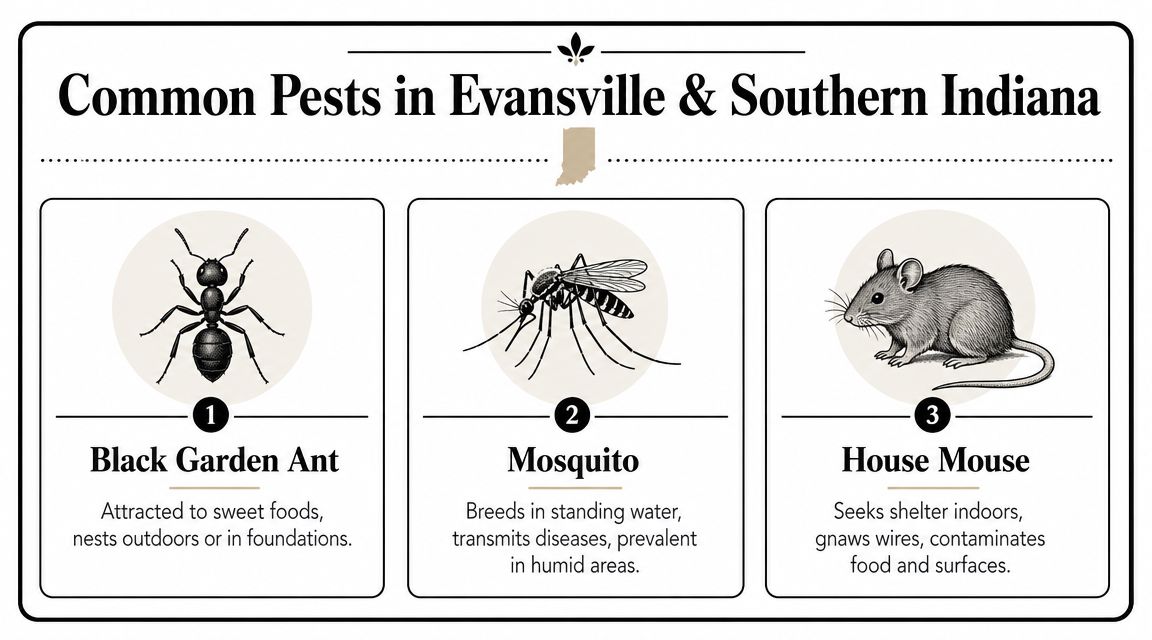
This quick visual covers three of the most common:
Ants and carpenter ants
Most homeowners notice ants first in kitchens, bathrooms, or along exterior walls. They follow scent trails, so what looks like a few scouts can turn into a steady line fast. Black garden ants usually show up where sweets, crumbs, or moisture are easy to reach.
Carpenter ants create a different level of concern. They tend to favor damp or softened wood and can turn up around window frames, porches, wall voids, and older wood trim. If ant activity keeps returning after store-bought sprays, the colony may be nesting in or near the structure.
Termites and hidden wood damage
Termites are one of the pests homeowners miss the longest because they usually stay out of sight. By the time visible signs appear, they may have been active for a while. Mud tubes on the foundation, blistered paint, tight-fitting doors, or wood that sounds hollow are all worth taking seriously.
Warm, wet conditions and wood-to-soil contact can make a property more inviting. Homes with crawl spaces, older wood features, or moisture issues deserve closer attention because termite activity often starts where homeowners don't spend much time looking.
A short explainer can help you spot the difference between nuisance insects and a deeper issue:
Spiders and what repeated sightings mean
Spiders usually follow food. If you're seeing a lot of them, there's often another insect population supporting them. Basements, garages, storage areas, and less-disturbed corners tend to be the main trouble spots.
Brown recluse concerns come up often in Indiana homes, especially in quiet indoor spaces. Whether the spider is harmless or not, repeated sightings mean it's time to reduce harborage, check clutter, and address the insect activity that's drawing them in.
Rodents, mosquitoes, and stinging insects
Rodents are problem solvers. They use garages, attics, crawl spaces, and wall voids for shelter, especially when temperatures swing. Common signs include droppings, gnaw marks, scratching sounds, pet food disturbance, or chewed packaging in the pantry.
Mosquitoes build up where water lingers and shade holds humidity. Birdbaths, clogged gutters, toys, planters, low spots in the yard, and dense landscaping all contribute. Wasps and hornets tend to settle around eaves, soffits, sheds, fences, and covered outdoor spaces where they can build undisturbed.
A simple way to think about common pests in Evansville is by what attracts them:
| Pest | What draws them in | Early sign homeowners notice |
|---|---|---|
| Ants | Food residue, moisture, cracks at entry points | Trails near counters or windows |
| Termites | Moisture, wood contact, hidden structural voids | Mud tubes or damaged wood |
| Spiders | Insect activity, clutter, quiet corners | Webs and repeat sightings |
| Rodents | Shelter, food sources, gaps into the home | Scratching, droppings, gnawing |
| Mosquitoes | Standing water, shade, humidity | Biting activity outdoors |
| Wasps | Protected overhangs and nesting sites | Visible nest traffic |
DIY Solutions vs Professional Pest Control
DIY treatment is tempting for a simple reason. It feels faster and cheaper at the start. You can buy traps, aerosol sprays, granules, or bait stations the same day and do something immediately. For a very small issue, that can help reduce activity.
The problem is that DIY work often treats what's visible and misses what's driving the infestation. Homeowners commonly misidentify ants, overlook hidden nests, spray the wrong areas, or stop treatment too early because activity drops for a few days. Then the pests come back, usually in the same spot.
Where DIY can fall short
The biggest risk isn't always wasted time. Sometimes it's pushing the problem deeper into the structure. Improper spraying can scatter insects instead of controlling them. Rodent bait placed without a broader plan can leave entry points wide open. And broad indoor chemical use around food areas, pets, or children needs more care than many people realize.
If you don't know where the pests are nesting, breeding, or entering, you're not really solving the problem. You're interrupting it.
There's also the cost issue. A homeowner may buy multiple rounds of products trying to beat the same recurring problem. By the end, they've spent money, lost time, and still need an inspection because the underlying conditions were never addressed.
When professional service makes more sense
Professional pest control makes the most sense when the activity is recurring, widespread, hard to identify, or tied to structural conditions. That includes termite concerns, rodents in walls or attics, repeated ant invasions, brown recluse worries, mosquito pressure around the yard, and stinging insect nests in difficult locations.
A trained exterminator approaches the problem differently:
- Correct identification first so the treatment matches the pest.
- Entry-point review to see how pests are getting inside.
- Targeted product placement instead of overapplying material everywhere.
- Prevention steps that make repeat infestations less likely.
For homeowners weighing the decision, this guide on DIY or hiring a pro for pest control gives a practical framework for when store-bought solutions may be enough and when they usually aren't.
The Green Advantage Inspection and Treatment Process
Most homeowners feel better once they know what the service visit will look like. Uncertainty keeps people from booking. A clear process removes that friction.
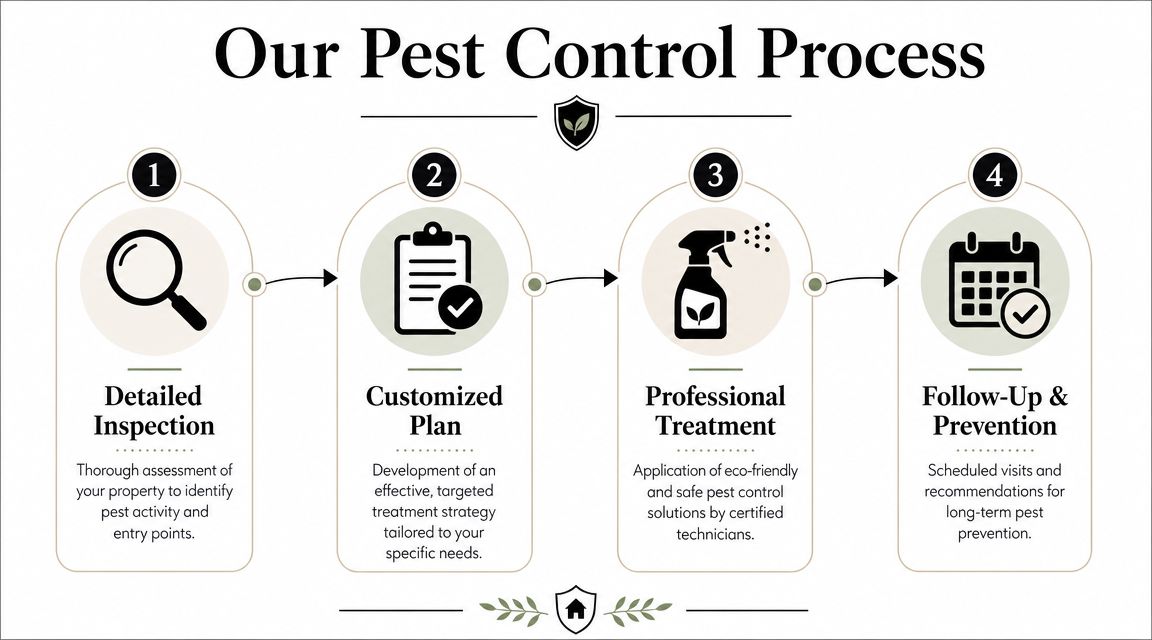
The Green Advantage handles pest problems by starting with inspection, then building the treatment around the conditions on the property. That matters because a ranch home with mosquito pressure in the yard needs a different approach than a two-story home with attic rodents or a crawl-space moisture issue.
Inspection that looks past the obvious
The first step is a careful review of the areas where pest pressure usually starts or spreads. That includes the exterior foundation, door thresholds, garage edges, utility penetrations, windows, attic access points, moisture-prone areas, and any interior rooms where activity has been reported.
Homeowners often focus on the one room where they saw the pest. The technician's job is to connect that sighting to the larger pattern. If ants are in the kitchen, the nest may be outside by the foundation. If mice are in the pantry, the entry point may be at the garage corner or utility line. If mosquitoes are bad on the patio, drainage and vegetation are often part of the story.
A treatment plan built for the actual issue
After inspection, the next step is choosing the response that fits the problem. That may involve crack-and-crevice treatment, exterior perimeter applications, baiting, trapping, nest treatment, exclusion recommendations, or a broader recurring service schedule when pressure is ongoing.
This is also where trade-offs get discussed. Some homeowners want the fastest knockdown possible. Others care most about long-term prevention, lower disruption, or eco-minded application choices. A good provider explains those options in plain language so the homeowner understands what each method is meant to accomplish.
A practical service plan usually covers:
- What pest is being targeted
- Where the pressure is coming from
- Which treatment methods are being used
- What the homeowner should do next
On-site judgment matters most when the same pest keeps reappearing after previous treatment. That usually means the source was missed, not that the pest is impossible to control.
Follow-up and prevention
Treatment shouldn't end with application. Some pests require monitoring. Others call for changes around the home, such as trimming back vegetation, reducing standing water, improving sanitation, sealing gaps, or storing items differently in garages and basements.
That follow-up piece is where many recurring problems are either prevented or allowed to restart. Clear communication after service helps the homeowner know what to expect in the next few days and what signs would justify another check.
Understanding Pest Control Costs in Evansville
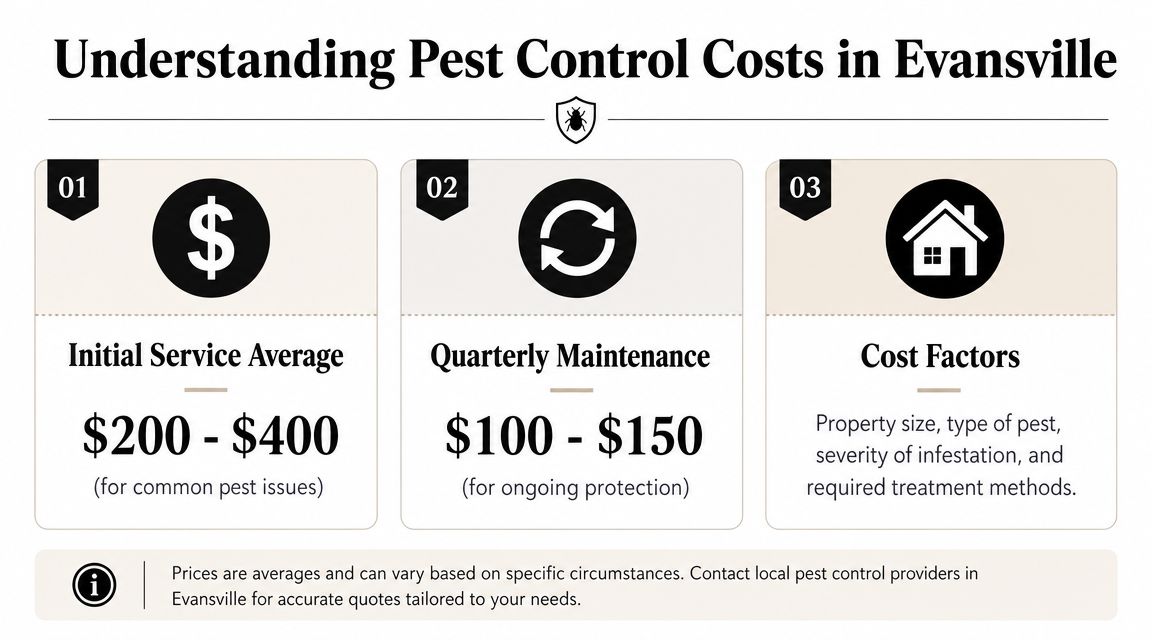
Cost matters, and most homeowners want a realistic benchmark before they make the call. In Evansville, one local pricing report shows an average initial treatment cost of $140.69 for a standard 4-bedroom home, with a reported range of $127.47 to $153.91 according to Evansville pest control cost data. That gives you a starting point for budgeting an initial visit.
What changes the final price
That local benchmark is useful, but no honest company should price every job the same. The actual cost depends on what the technician finds and what kind of control is required.
Here are the factors that usually matter most:
- Type of pest because termites, rodents, ants, mosquitoes, and wasps don't require the same tools or visit structure.
- Property size and layout since larger homes, detached garages, crawl spaces, and complicated exterior lines take more time to inspect and treat.
- Severity of activity because a light issue near one entry point is different from a widespread infestation.
- Service type such as one-time treatment, recurring residential pest control, mosquito reduction, or a commercial service plan.
One-time visit or ongoing service
Some homeowners only need a targeted initial treatment. Others benefit more from recurring service because the property has steady pressure through the year. That's often the better value when pests are tied to the outdoor environment, moisture, or repeated seasonal activity.
The key is matching the budget to the existing risk. A one-time treatment can feel cheaper, but if the same conditions keep inviting pests back, repeated spot treatments may cost more over time and produce less peace of mind.
For a fuller breakdown of what affects pricing, this article on how much pest control services cost is a useful next step.
Proactive Prevention Lasting Peace of Mind
Reactive treatment has a place. If pests are already active in the home, you handle that first. But the strongest long-term strategy is prevention based on how the property is built, where it sits, and what conditions around it keep attracting pests.
A lot of homeowners get offered a generic quarterly plan and assume that's always the right answer. It isn't. Guidance specific to Evansville points out that treatment frequency should be based on real pest pressure, property type, and infestation risk rather than a one-size-fits-all quarterly plan, and that apartments, restaurants, and single-family homes may need different schedules, as explained in this discussion of Evansville treatment frequency and service type.
What should shape the schedule
The best prevention plans are built around what the property is dealing with, not what sounds standard.
A few examples:
- Single-family homes with yard and foundation pressure may need seasonal exterior protection and mosquito reduction when outdoor living is a priority.
- Properties with repeated rodent entry need exclusion work and monitoring, not just trap placement.
- Homes with moisture and wood-risk conditions deserve closer termite attention than homes without those triggers.
- Rental properties or multi-unit settings often need more frequent observation because turnover, storage patterns, and shared walls change the risk.
What works and what usually doesn't
What works is consistency. Trimming vegetation away from siding, correcting drainage, keeping mulch from piling too high against the structure, reducing clutter in garages, sealing entry gaps, and checking vulnerable areas before peak pest activity starts. When these steps are paired with professional treatment at the right intervals, homeowners usually deal with fewer surprises.
What doesn't work is relying on a schedule that ignores the site. Monthly service for a low-pressure property can be more than the home needs. A broad quarterly plan for a property with heavy mosquito breeding, rodent entry, or repeated ant pressure may not be enough by itself.
Prevention works best when service frequency follows the pressure on the property, not the calendar alone.
Long-term peace of mind comes from that fit. The home gets the level of protection it needs, and the homeowner isn't paying for the wrong kind of service.
Choose The Green Advantage for Your Home
When homeowners search for an exterminator near me or residential pest control in Indiana, they usually want three things. Clear communication, reliable work, and a plan that matches the problem instead of overselling it.
That's the standard to hold any provider to. If you're comparing options for Pest Control Evansville, keep the checklist simple:
- Family-owned perspective that treats your home like a place that needs protection, not just a service ticket.
- Licensed and certified service so inspection, product selection, and treatment decisions are handled by trained professionals.
- Eco-minded approach for homeowners who want effective control with thoughtful application methods.
- Residential and commercial capability if you need help at home, for a rental, or for a business property.
- Straight answers about next steps including what's causing the pest pressure, what treatment makes sense, and what follow-up may be needed.
A strong pest control company should never rush you into a generic package. It should help you understand whether you need a one-time response, ongoing prevention, termite attention, mosquito control, rodent exclusion, or a more targeted solution for spiders, ants, or wasps.
That kind of clarity saves time and usually saves frustration too. It also makes it much easier to protect the home before a small problem turns into a costly one.
Frequently Asked Questions
Are treatments safe for kids and pets
That depends on the pest, the product, and how the treatment is applied. A professional should explain where materials are being used, what precautions matter, and when it's okay to re-enter treated areas. If you have pets, small children, or specific health concerns, mention that before service so the plan can be adjusted appropriately.
Do I need to be home during the service
Not always. Some exterior treatments and certain follow-up visits can be completed without the homeowner present, depending on the service. Interior inspections, first-time diagnostics, and treatments in occupied problem areas usually go smoother if someone is available to answer questions and point out where activity has been happening.
How long does it take to see results
That varies by pest. Some treatments reduce visible activity quickly, while others work over time as pests contact treated areas or carry bait back to the nesting site. Rodent control, ant control, termite work, and mosquito reduction all behave differently, so the expected timeline should be explained up front.
Should I choose one-time service or recurring pest control
Choose based on the pattern, not just the price. A one-time treatment can make sense for an isolated issue. Recurring service usually makes more sense when pests are seasonal, tied to the property's surroundings, or likely to return because of ongoing pressure around the structure.
What should I do before the technician arrives
Keep access open to the areas where you've noticed activity. Make note of where and when you saw pests, whether the problem is worse after rain or at night, and whether you've already used any store-bought products. Those details help the inspection go much faster and usually lead to a better treatment plan.
If pests are making your home feel unsettled, the next step is simple. Contact The Green Advantage to schedule an inspection, request a quote, and get a practical plan built around your property, your concerns, and the kind of protection that fits your home.