
You notice the ants first. A line along the kitchen trim. Then a few more near the sink the next morning. By the weekend, you're hearing scratching in the garage at night, and the backyard you wanted to enjoy is full of mosquitoes by dusk. Residents in Crown Point don't panic at the first pest they see. They get frustrated when the problem keeps coming back.
That's where sustainable pest management makes sense. Instead of spraying on a fixed schedule and hoping for the best, it starts with a simpler question. Why are pests getting in, what is attracting them, and what level of activity needs action?
Homeowners and business owners searching for pest control near me, exterminator near me, or pest control in Crown Point, IN usually want two things at once. They want relief now, and they want a solution that doesn't turn into a cycle of repeat problems. That balance is exactly why this approach matters in Northwest Indiana.
Sustainable Pest Management for Crown Point Homes and Businesses
In real life, pest issues rarely show up as one big dramatic event. They build slowly. A few ants near the dishwasher. Mice in the garage after the weather changes. Wasps around the entryway. Spiders in the basement corners. At a restaurant, warehouse, office, or apartment building, the signs may be different, but the pattern is the same. Pests find food, water, shelter, and access.
For many property owners, the default idea of pest control is simple. Spray first. Ask questions later. That can feel fast, but it often misses the reason the problem started. If the gap under the back door is still open, the trash area stays messy, or moisture keeps collecting around the foundation, the pests usually return.
A more practical way to handle recurring pests
Sustainable pest management takes a more grounded approach for residential pest control and commercial pest control. It focuses on inspection, prevention, monitoring, and targeted treatment only when the situation calls for it. That matters whether you're dealing with ant control in a kitchen, rodent control around a storage area, mosquito control in a backyard, or wasp removal around doors and soffits.
For Crown Point homes, that often means solving the entry issue before treating the symptom. For Northwest Indiana businesses, it can mean improving sanitation, sealing utility penetrations, adjusting monitoring, and using products more precisely instead of treating every room the same way.
Practical rule: A good pest plan doesn't start with the product. It starts with where pests are entering, what they're using, and how much risk they create.
This approach also fits how people live. Parents worry about kids and pets. Property managers worry about tenant complaints and building conditions. Business owners worry about health, inventory, and reputation. Sustainable pest management answers those concerns without pretending every pest problem can be solved by doing nothing or by using "all-natural" products alone.
Local help for Crown Point and nearby Northwest Indiana properties
In Crown Point, IN and nearby Northwest Indiana communities, seasonal shifts matter. Wet periods can boost mosquito pressure. Cooler weather can push rodents indoors. Spring and summer often bring more visible insect activity around foundations, landscaping, and outdoor gathering areas.
That local pattern is why people looking for an exterminator in Crown Point, IN usually need more than a generic checklist. They need a plan built around the property, the pest, and the level of risk. The rest of this guide puts that into plain language so you can understand what works, what doesn't, and when it's time to bring in professional help.
What Sustainable Pest Management Means and How IPM Works
Integrated pest management, usually shortened to IPM, is the foundation of sustainable pest management. It grew out of a major shift away from routine calendar spraying after World War II, when heavy dependence on chemical insect controls created serious problems. The Food and Agriculture Organization describes IPM as a move toward a more holistic agro-ecosystem approach that combines biological, cultural, and chemical methods rather than relying on automatic spraying. FAO also notes that the expert panel work that helped formalize IPM began in 1968 and continued through 1974, giving the framework more than five decades of development behind it in global practice (FAO overview of what IPM is).
For a homeowner, that history matters for one reason. IPM isn't a trend term. It's a proven way to make pest decisions more carefully.
Think of IPM like home maintenance, not emergency medicine
If you only paid attention to your house when water was pouring through the ceiling, you'd spend more and fix less. Pest control works the same way. IPM looks at regular checks, early warning signs, prevention steps, and treatment only when needed.
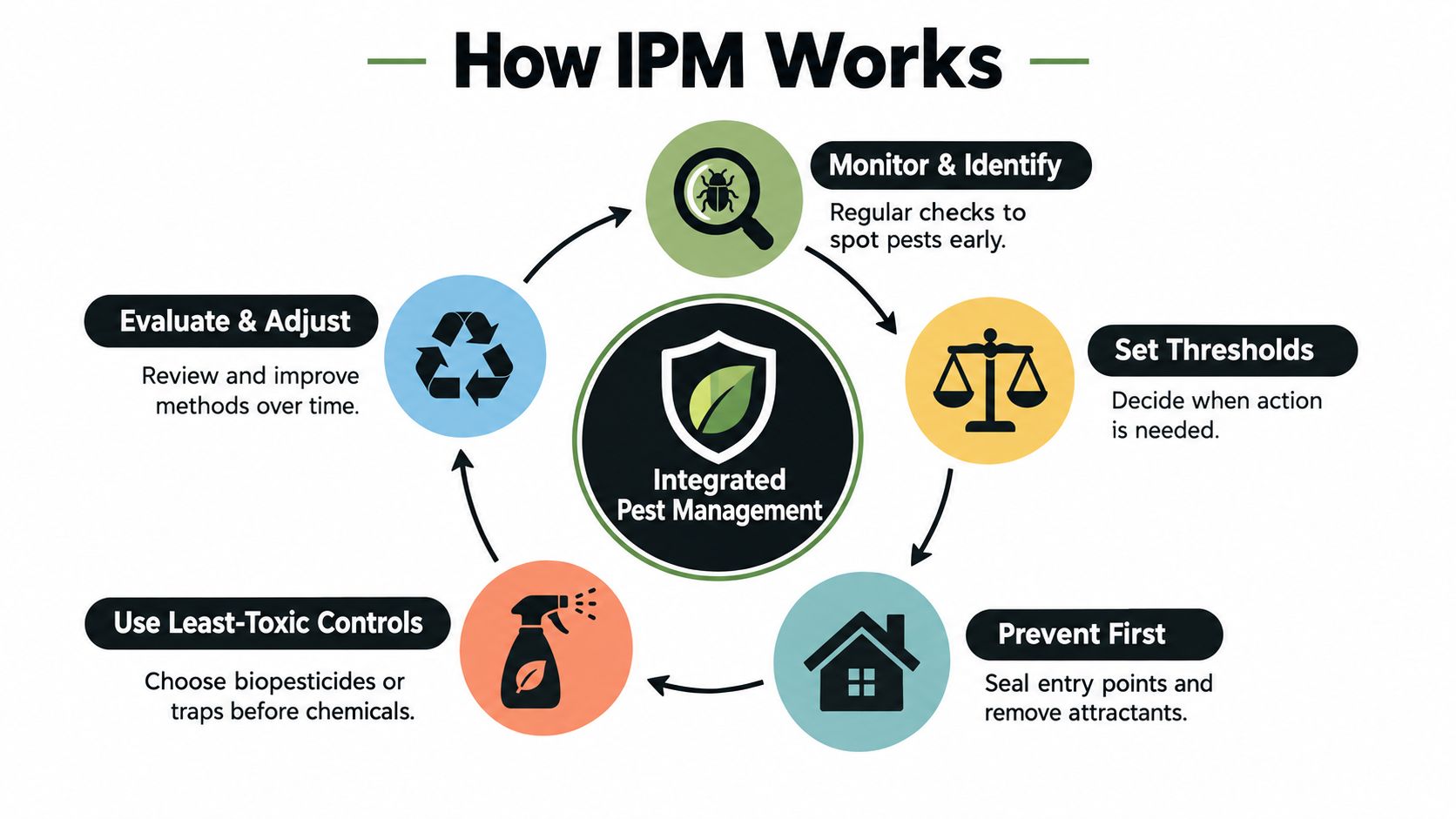
At the property level, the process usually works like this:
- Inspect and identify what's present. Ants, drain flies, mice, pantry pests, and wasps all call for different responses.
- Monitor activity so you know whether the issue is isolated or growing.
- Set a threshold for action. One spider in a basement corner isn't the same as rodent activity in a food area.
- Prevent first by sealing access points, correcting moisture issues, and reducing food sources.
- Treat precisely if prevention alone won't control the risk.
A more detailed example of that kind of program appears in this integrated pest management plan.
What thresholds mean in plain language
Thresholds confuse people because they sound technical. They aren't. The U.S. EPA says pest control action should begin only after a defined threshold is reached, and that seeing a single pest doesn't always mean treatment is needed (EPA IPM principles).
That doesn't mean "ignore pests." It means match the response to the risk.
One ant on the counter may mean watch and clean. Repeated ant trails, mouse droppings, or stinging insects near an entry door usually mean act.
In homes and commercial spaces, the threshold depends on the pest, the location, and the consequences. A low level of occasional nuisance pests may be manageable with monitoring and prevention. A pest tied to health or contamination may call for immediate action. That's what makes IPM practical. It replaces guesswork with decisions based on conditions you can see.
Why Sustainable Pest Control Protects Health Property and Peace of Mind
People usually choose sustainable pest control for a simple reason. They want fewer pests without turning their home or workplace into a place of constant chemical use. The logic behind that choice is strong.
A major reason IPM matters is the scale of chemical dependence. Global pesticide consumption reached 3.7 million tons in 2023, while an older worldwide assessment found crop losses from arthropods, diseases, and weeds still rose from 34.9% in 1965 to 42.1% in 1988 to 1990 despite intensified pest control efforts (FAO background on integrated pest management). The lesson is useful even outside agriculture. More spraying by itself doesn't guarantee better control.
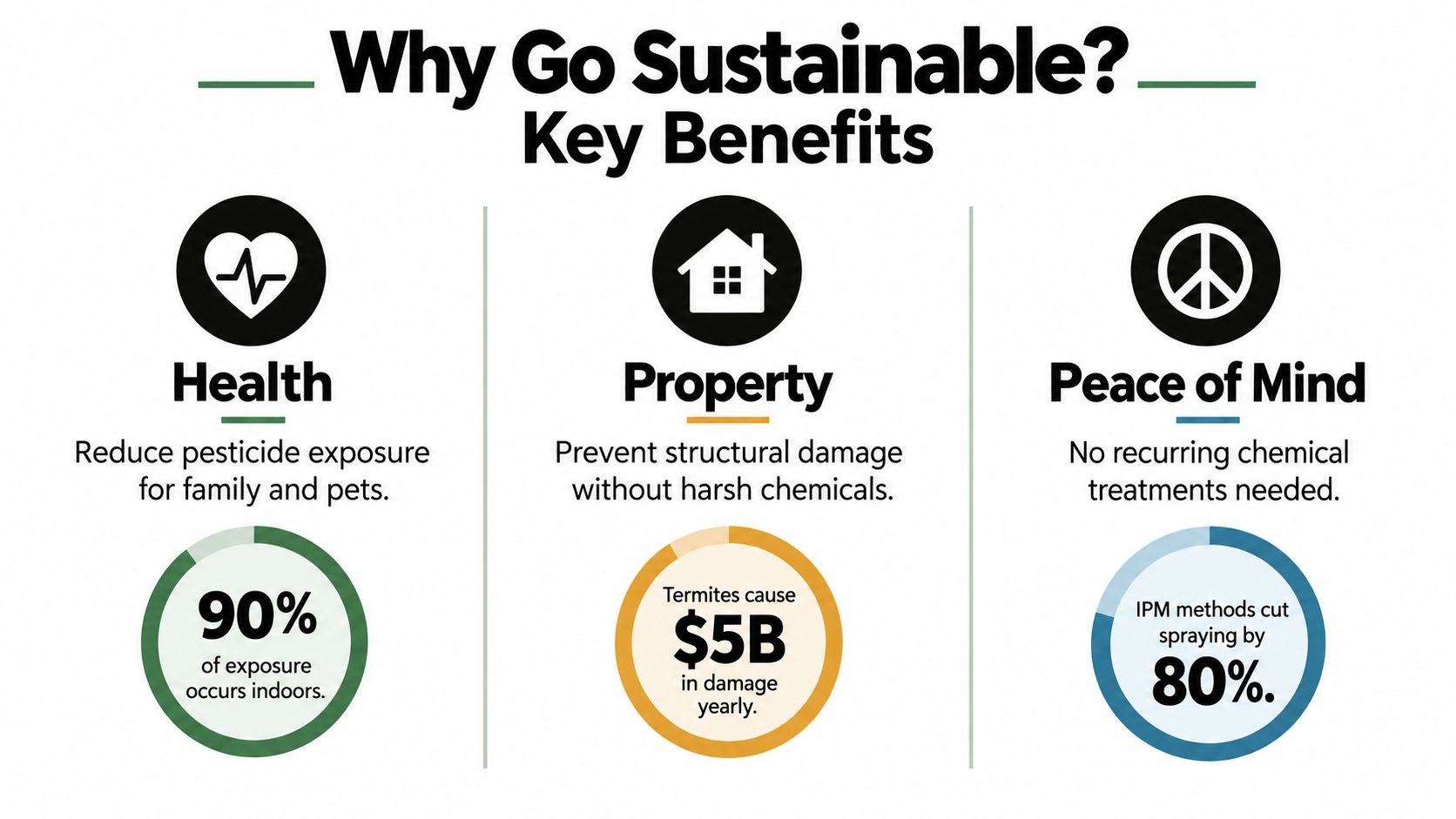
Why less routine spraying can still mean better protection
When a pest plan uses thresholds, monitoring, and multiple tactics, it cuts out a lot of unnecessary treatment. That matters in family homes, apartment buildings, offices, and food-handling areas where people spend long periods indoors.
A large meta-analysis covering 85 IPM projects across 24 countries found an average 40.9% yield increase alongside a 30.7% decline in pesticide use versus baseline, and 30% of crop combinations reached zero pesticide use without becoming organic conversions (peer-reviewed IPM meta-analysis). The setting was agricultural, but the takeaway is broader. Well-run IPM programs can improve outcomes while reducing dependence on routine spraying.
What that means for homes and businesses
For a house in Crown Point, sustainable pest management protects more than comfort. It helps reduce repeated exposure from unnecessary treatments, especially when the fix is exclusion or moisture correction. For commercial properties, it supports cleaner, more precise decision-making about where treatment is needed and where prevention will do more.
A few examples make the point clear:
| Concern | Routine approach | Sustainable approach |
|---|---|---|
| Ant control | Spray every sighting | Find the food source, entry point, and trail pattern |
| Rodent control | Set traps only | Combine trapping with sealing access and reducing shelter |
| Mosquito control | Fog repeatedly | Reduce breeding sites and target active pressure areas |
| Wasp removal | Treat visible nests only | Remove nests and correct the conditions attracting them |
Key takeaway: Sustainable pest control isn't about doing less. It's about doing the right thing first, and treating only where the risk justifies it.
That tends to protect health, property, and peace of mind all at once. You aren't just reacting to pests. You're making the building harder for pests to use.
Prevention First Tactics That Keep Pests Outside in Northwest Indiana
The most effective pest control work often looks boring from the outside. It isn't dramatic. It's careful. Someone checks door sweeps, finds a pipe gap under a sink, notices mulch piled too high near the siding, or spots standing water behind a commercial dumpster. Those small details are what keep a minor issue from becoming an infestation.
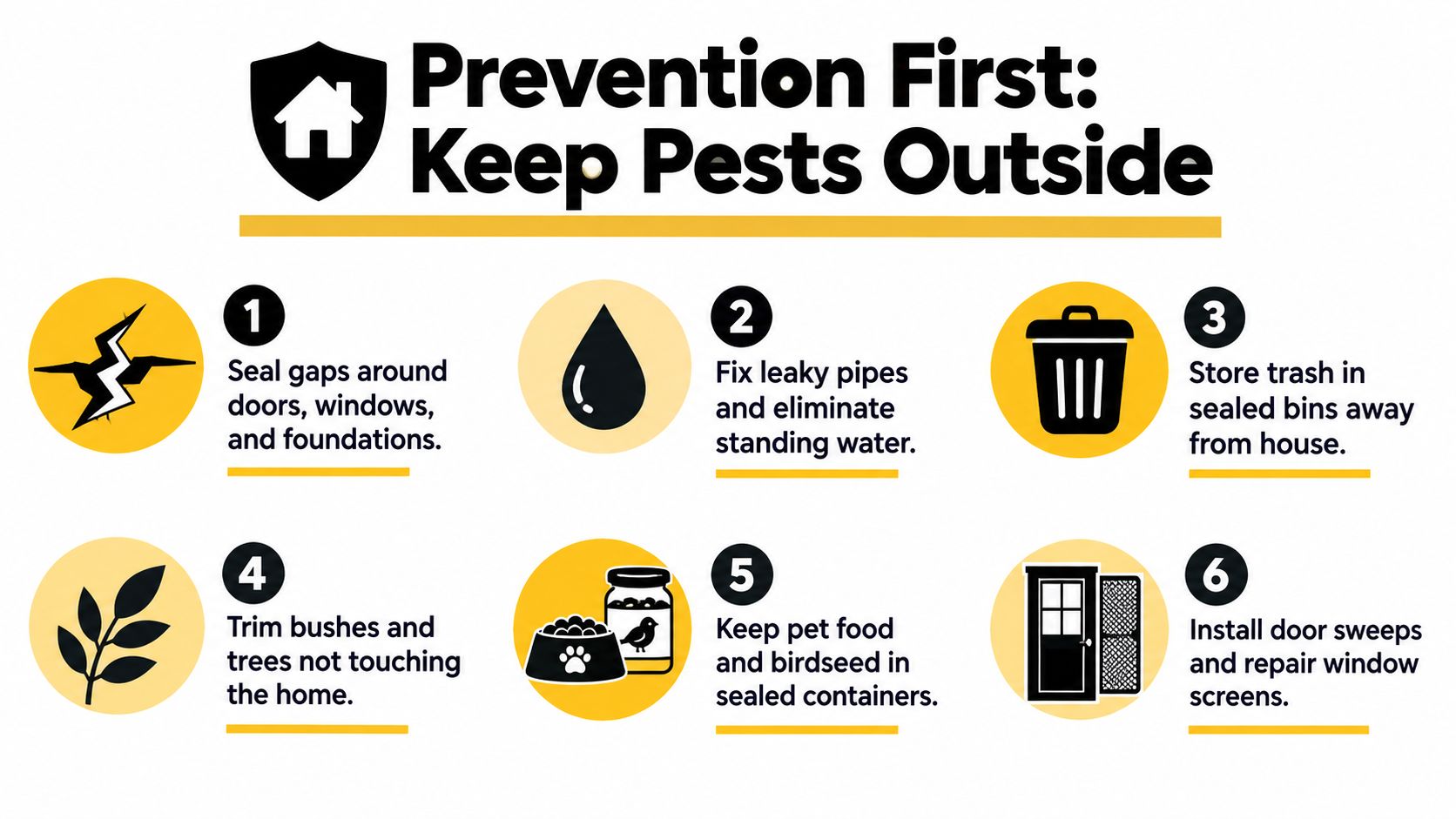
Start with the structure
Rodents and insects don't need a wide-open door. The National Park Service rodent exclusion manual says effective exclusion means finding and eliminating holes, cracks, and gaps of 1/4 inch or larger that rodents can use to enter. The same manual notes 1/4 inch hardware mesh for mice exclusion, which shows how small an opening can matter (rodent exclusion manual from the National Park Service).
For homes and commercial sites in Northwest Indiana, common problem areas include:
- Foundation gaps near utility lines, hose bibs, and vents
- Door failures where sweeps no longer touch the threshold
- Garage edges with worn weather seals
- Roofline and soffit openings that invite wasps and other insects
A close inspection around these areas usually tells you more than a can of spray ever will.
Remove what pests need every day
Pests stay where they can reliably find food, water, and shelter. That's why prevention-first service focuses on site conditions, not just pest sightings.
Use this simple property check:
- Food access. Keep pet food, birdseed, and pantry items in sealed containers.
- Moisture. Fix leaks under sinks, around hose spigots, and near HVAC areas.
- Trash control. Use sealed bins and keep the area around them clean.
- Yard contact. Trim shrubs and branches so they aren't resting against the structure.
- Indoor clutter. Reduce cardboard, stored fabric, and hidden harborage in garages and utility rooms.
This short video shows the kind of prevention habits that make pest control more effective over time.
Watch first, then decide
Not every pest should trigger the same response. Halifax's IPM strategy explains that thresholds are species-specific and that severe human-health pests may require zero tolerance, while nuisance pests may be tolerated at a higher level. The same policy describes IPM as combining prevention with carefully selected treatments while reducing pesticide use (Halifax IPM strategy).
That means a practical inspection in Crown Point should answer three questions:
- What pest is it?
- Where is it showing up?
- Is it a nuisance, a property threat, or a health risk?
If the answer changes from "annoying" to "unsafe," the response should change too.
That's the strength of prevention-first pest control. It gives you a steady system instead of a constant cycle of surprise treatments.
Low Toxicity Control Options and When Limited Treatment Makes Sense
Once prevention is in place, the next question is usually straightforward. What should you use if pests are still active? The answer depends on the pest, the location, and whether the problem can be handled with traps, physical removal, a lower-toxicity product, or a carefully limited chemical treatment.
Biopesticides are part of that toolbox now, not a fringe category. A recent review estimated about 1,400 commercial biopesticide products worldwide and found that their efficacy is often similar to synthetic pesticides for insect control when formulations and application methods are optimized (review of biopesticides in sustainable pest management). Their value isn't only lower toxicity. Many are more species-specific, less persistent, and less likely to drive cross-resistance.
A plain-language comparison of control options
| Option | Best fit | Limitation |
|---|---|---|
| Traps and monitors | Rodents, crawling insects, early detection | They don't fix access or attractants |
| Physical removal | Wasp nests, webs, isolated harborage | Works only when the source is reachable |
| Biopesticides and botanical tools | Targeted insect issues where lower persistence helps | Timing and application matter more |
| Selective chemistry | Higher-risk or established infestations | Should be tied to identification and thresholds |
For homeowners, this might mean using baiting and exclusion for ant control rather than broad indoor spraying. For rodent control, it often means trapping plus sealing entry points. For spider control, reducing harborage and insect prey usually matters more than chasing every web. For wasp removal, direct nest treatment may be appropriate because the location creates an immediate sting risk.
When limited treatment is the right call
Low-toxicity doesn't mean no action. Some situations need fast intervention. Mosquito pressure around outdoor seating, rodent activity in a food area, or repeated ant activity inside a kitchen may justify targeted product use after inspection.
For properties that want a lower-impact approach, one option is reviewing environmentally friendly pest control methods that combine inspection, exclusion, monitoring, and focused applications where needed.
A similar decision process shows up outside household pest control too. For example, tree owners comparing treatment choices for invasive pests can compare EAB insecticides and removal to understand how targeted intervention and removal decisions depend on risk, timing, and long-term site goals.
The safest choice isn't always "never treat." Sometimes it's "treat only where the pest, the place, and the risk justify it."
That's how sustainable pest management stays practical. It keeps the toolbox broad and the decision-making narrow.
Seasonal Pest Calendar and Local Tips for Crown Point and Northwest Indiana
Pest pressure in Northwest Indiana changes with the season, and timing matters almost as much as treatment choice. In Crown Point, homes and businesses often deal with one pattern in spring, another in summer, and a different one again when cooler weather pushes pests toward shelter.
Spring and summer pressure
Spring usually brings more visible ant activity, more wasp building around eaves and entry points, and the start of mosquito breeding anywhere water collects. Summer keeps that pressure going and often adds more outdoor nuisance issues around patios, trash areas, landscaping, and standing water.
For mosquitoes, the CDC recommends a strict weekly routine. Once a week, empty, scrub, turn over, cover, or throw out items that hold water, including tires, buckets, planters, toys, pools, birdbaths, flowerpot saucers, and trash containers. The CDC also advises tightly covering water-storage containers and using wire mesh with holes smaller than an adult mosquito where lids aren't possible (CDC guidance for mosquito control at home).
That weekly habit is one of the most practical forms of mosquito control available to homeowners because it stops breeding before adult mosquitoes emerge.
Fall and winter pressure
As temperatures cool, rodent activity often becomes more noticeable. Mice and rats look for warmth, shelter, and stable food sources, which is why garages, utility rooms, storage areas, and commercial back-of-house spaces become more vulnerable in fall and winter.
A simple seasonal rhythm helps:
- Spring. Inspect the exterior, repair screens, and watch for ants and early wasp activity.
- Summer. Stay on top of standing water, outdoor sanitation, and mosquito reduction.
- Fall. Check door sweeps, garage seals, vents, and foundation gaps before rodents move in.
- Winter. Monitor basements, storage areas, and commercial interiors for hidden activity.
Local timing helps you stay ahead
Urban pest management also depends on building design, prevention habits, and good data, not just product choice. A 2022 roadmap on urban sustainable pest management argued that cities need better data on pesticide use and impacts, stronger outreach, and design changes that make prevention the default. The same discussion noted an important policy signal in Europe, where the hazard-weighted use-and-risk proxy called HRI-1 fell about 61% from the 2011 to 2013 baseline and about 5% versus 2022, while emergency authorizations also declined (urban sustainable pest management roadmap).
For Crown Point properties, the practical takeaway is simple. Seasonal pest issues are easier to manage when you act before pressure peaks, not after the infestation is obvious.
When to Call The Green Advantage and What to Expect From Service
Some pest problems are manageable with cleanup, sealing, and monitoring. Others cross a line where professional help makes more sense. If activity keeps returning, if the pest can affect health, or if the location raises the stakes, it's time to stop guessing.
A single occasional nuisance pest may not require the same response as repeated ant trails, rodent signs, stinging insects at entry points, or mosquitoes that make outdoor use difficult. Public-facing education has often lagged behind real demand for lower-risk services, and one peer-reviewed survey found that many people had little to no knowledge of IPM even as interest in lower-risk pest control has grown (plain-language IPM and consumer understanding research). That's why many property owners wait too long or choose the wrong response first.
Signs it's time to bring in professional help
Call for a professional inspection when you notice patterns like these:
- Repeat activity that returns after store-bought sprays or traps
- Sensitive locations such as kitchens, food storage, childcare spaces, or shared housing
- Entry concerns involving mice, rats, or repeated insect access around doors, utility lines, or foundations
- Outdoor pressure from mosquitoes or wasps that changes how you use the property
What service should feel like
When you work with The Green Advantage, the process should be clear and direct. You should be able to explain what you're seeing, ask questions, and get a site-specific plan based on the pest, the property, and the level of risk. That may involve a residential inspection, a commercial service plan, rodent exclusion recommendations, mosquito reduction work, or targeted treatment supported by monitoring.
You should also expect honest guidance about tolerance levels. Some pests may call for zero tolerance because of health or safety concerns. Others may be handled with monitoring and prevention if the activity is minor.
Good pest control doesn't just remove what's visible. It explains why the problem started and what will keep it from coming back.
For homeowners searching pest control in Crown Point, IN or exterminator in Crown Point, IN, that kind of clarity matters. For businesses, landlords, and property managers across Northwest Indiana, it matters even more because recurring pest issues can affect tenants, staff, customers, and daily operations.
If you're seeing signs that don't feel normal, or you've already tried the quick fix and the pests came back, a professional inspection is the next sensible step.
The Green Advantage provides residential pest control, commercial pest control, inspections, mosquito reduction, and prevention-focused service built around the conditions at your property in Crown Point and Northwest Indiana. If you want a practical plan that uses sustainable pest management principles instead of guesswork, visit The Green Advantage to request a quote or schedule an inspection.