
A warm evening in Crown Point can change quickly. You set out dinner on the patio, the kids run through the grass, and then mosquitoes begin circling ankles and arms. Before long, everyone moves indoors, even though the weather is perfect for being outside.
That frustration leads many Northwest Indiana homeowners to search for mosquito trap effectiveness, mosquito control, or a pest control near me option. Traps can help, but their results depend on more than the device sitting in a corner of the yard. Species, attractants, placement, maintenance, trap density, and standing water all influence whether you notice meaningful relief.
Why Mosquito Traps Matter for Crown Point Homeowners
A Crown Point homeowner may buy a trap hoping it will create a comfortable outdoor area. The trap runs, the collection chamber gathers insects, yet mosquitoes still appear around the patio. That doesn't automatically mean the device is useless. It may be attracting the wrong species, sitting too close to people, lacking the right lure, or working against breeding sites elsewhere on the property.
Mosquitoes don't treat every yard the same way. Shaded landscaping, dense vegetation, damp areas, containers, clogged drainage points, and neighboring properties can all influence where adults rest and where larvae develop. A trap can capture adult mosquitoes, but it won't automatically remove every source of new mosquitoes.
Homeowners also have reasonable concerns beyond comfort. Bites can make children and guests miserable, disrupt outdoor meals, and cause families to avoid their own yards. Anyone researching mosquito-borne illnesses in Indiana should also understand that reducing mosquito contact involves more than relying on one appliance.

What homeowners should expect
The practical question isn't, “Does this brand work?” It's, “Can this trap capture enough of the mosquitoes affecting my yard, and can I operate it correctly for long enough to notice a change?”
A 2017 field study in a sensitive natural area found that traps reduced overall mosquito nuisance by 70%, with biting attempts falling from a mean of 14.1 per 10 minutes at control sites to 4.1 per 10 minutes at locations 10 to 40 meters from traps. Yet the same study found that reductions for two targeted species were 74% and 98%, showing how sharply results can differ by species (field study on area-wide mosquito trap performance).
That evidence supports a balanced view. Traps can provide measurable relief, but homeowners shouldn't expect automatic elimination. For residential pest control in Crown Point, IN, a trap is often most useful as one part of a plan that also addresses habitat and breeding conditions.
How Different Mosquito Traps Work to Lure and Capture
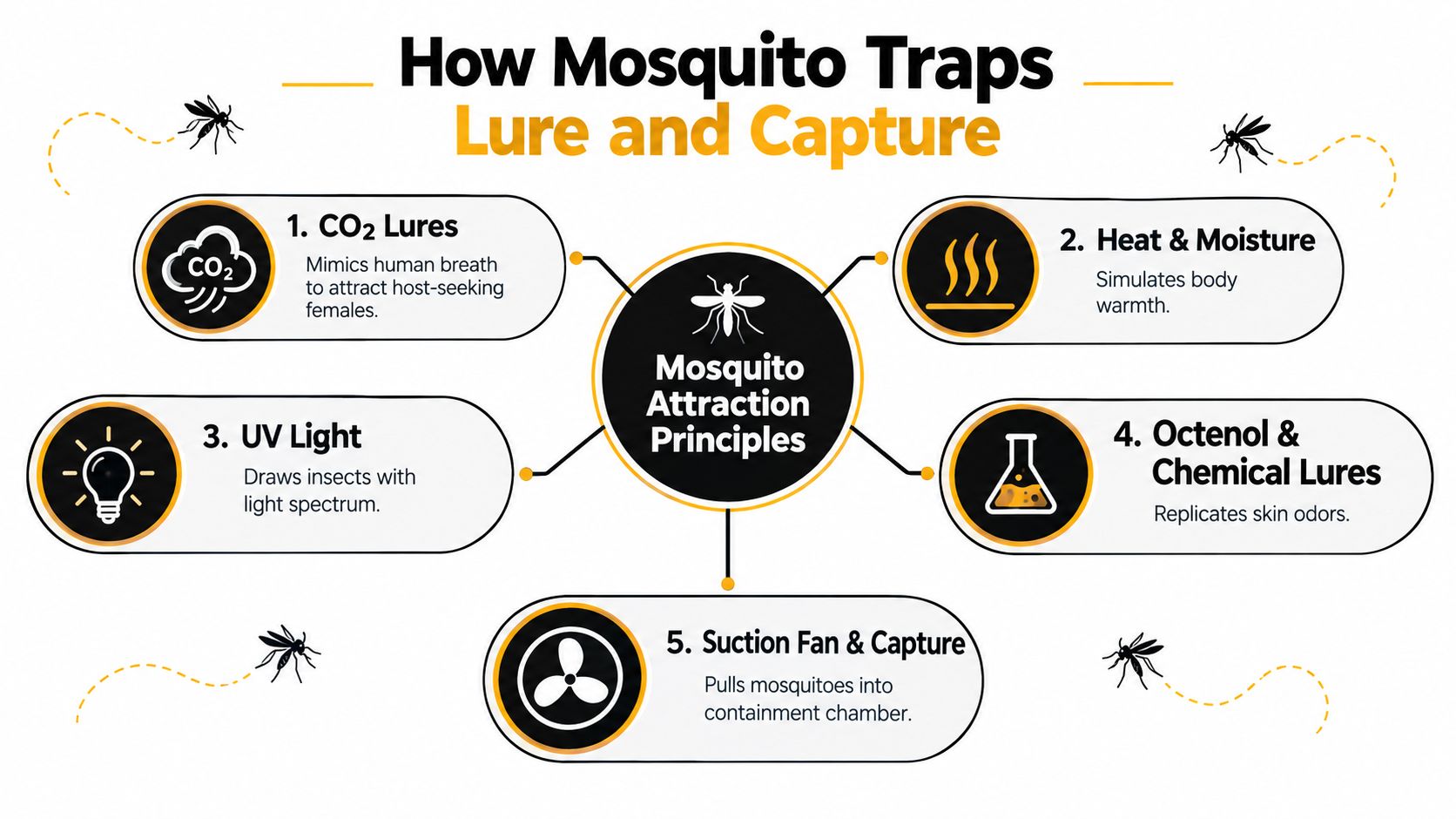
Mosquito traps work by imitating signals mosquitoes associate with a host or a place to lay eggs. Think of the trap as a substitute target. It may produce a breath-like carbon dioxide plume, offer a chemical scent, create airflow, or provide a container that resembles a breeding site.
The attraction signals
Carbon dioxide is one of the strongest signals used by host-seeking mosquitoes. People and animals release it while breathing, so a trap that emits CO2 can act like a moving trail leading mosquitoes toward the collection system. In one field evaluation, BG-Sentinel traps baited with CO2 attracted significantly more mosquitoes than traps using BG-Lure alone. CO2 produced a 2.67 adjusted odds ratio after controlling for time and species, and the CO2 configuration collected more specimens and more species consistently (Miami-Dade County trap surveillance evaluation).
Heat, moisture, and body odor add other clues. Chemical lures such as octenol can imitate parts of the scent profile mosquitoes associate with people or animals. Research also found that combining CO2 with 1-octen-3-ol was more effective than either attractant alone for several species, while increasing CO2 from 200 to 1,000 cc per minute didn't significantly increase catches in that study (CO2 and octenol attractant study).
Common trap designs
UV light traps: These use light to attract some flying insects, then pull them into a chamber or onto a killing surface. They may collect many insects without specifically targeting the mosquitoes biting people in your yard.
CO2 traps: These release carbon dioxide, often alongside heat, moisture, airflow, or a chemical lure. They're designed to imitate a living host and can be useful when host-seeking mosquitoes are the main concern.
Propane traps: These typically convert propane into carbon dioxide and may also generate heat and moisture. Their performance depends on correct setup, fuel supply, attractant selection, and the species present.
Gravid traps: These target females looking for a place to lay eggs. Instead of imitating a person, they imitate an appealing egg-laying environment, so they can address a different point in the mosquito life cycle.
Sticky traps: These use an attractant or visual cue to bring mosquitoes onto an adhesive surface. They're simple, but the capture area and lure need to match the mosquito problem.
The capture mechanism matters just as much as the lure. A fan may draw the mosquito into a bag or chamber, while another design may use a sticky panel or a water-based container. This video offers a visual explanation of how trap components work together.
A trap can be technically functional and still be a poor match for a particular Crown Point yard. Understanding what it attracts helps you judge results more accurately. The best outdoor mosquito traps aren't interchangeable, because their lures and capture systems may target different behaviors.
What Scientific Studies Show About Mosquito Trap Effectiveness
A trap beside a Crown Point patio may collect mosquitoes, yet nearby family members can still be bitten. Field research explains why. Results depend on the species present, how widely traps are deployed, where they are placed, and whether they remain operating. The device itself is only one part of the control plan.
Relief near the deployment area
A 2017 field study found a 70% reduction in overall mosquito nuisance near trap locations. Biting attempts fell from 14.1 to 4.1 per 10 minutes, showing that trapping can reduce human exposure in the surrounding area, not merely fill a collection chamber (2017 field study on nuisance reduction).
The same study recorded species-specific reductions of 74% and 98% for two targeted species. That difference is important for homeowners. Mosquitoes do not all feed, breed, or respond to lures in the same way. A setup that performs well against one species may provide less relief from another.
Effects across life stages
Some programs influence more than adult mosquitoes in flight. A 2021 field evaluation of In2Care traps reported 60% fewer eggs, 57% fewer larvae, and 57% fewer adults at the trapped site than at an integrated mosquito management site (In2Care field evaluation). The result points to a broader lesson: a properly designed program can affect several stages of the mosquito life cycle.
An adult trap alone may not resolve a recurring breeding source. Water-holding containers can continue producing larvae, replacing adults removed by the trap. For that reason, trap results should be judged alongside the conditions that allow mosquitoes to reproduce.
Neighborhood-scale results are conditional
A 2025 community study of mass trapping against Aedes albopictus found abundance reductions ranging from 36% to 64%. Greater trap density and broader house coverage were associated with the stronger reductions (recent community-scale mosquito trapping evidence). Participation also declined by the third year, creating a sustainability problem. A neighborhood network works only while enough homes keep traps installed, positioned, and maintained.
Practical rule: One trap on one property is not the same intervention as a coordinated trapping network across a neighborhood.
WHO guidance separates device performance from community impact. Laboratory and small field tests can measure attraction and killing. Larger community trials are needed to determine whether a trapping program reduces mosquito populations and disease transmission under real conditions (WHO trap-efficacy guidance).
For a Crown Point homeowner, the takeaway is practical. A trap can help, but coverage, placement, target species, and maintenance usually matter more than a brand claim. A single unit may offer localized relief, while wider placement and consistent upkeep give the approach a better chance of reducing nuisance across the yard.
Why Trap Performance Varies by Species Attractants and Design
A mosquito trap doesn't have one universal performance rating. It has a particular attraction profile. That profile may favor host-seeking females, gravid females, Aedes mosquitoes, Culex mosquitoes, or another group depending on the lure and trap structure.
Comparing attractant configurations
| Attractant Configuration | Relative Performance | Best Use Case |
|---|---|---|
| CO2 alone | Strong response from many mosquito species, though results depend on release rate and airflow | Host-seeking mosquito monitoring and capture |
| Chemical lure alone | Can attract mosquitoes, with results varying by species and formulation | Situations where CO2 isn't practical |
| CO2 plus chemical lure | Outperformed lure-only, CO2-only, and unbaited versions for both Aedes and Culex in a 2025 controlled study | Broader targeting when multiple species are present |
| BG-Lure alone | Attracted fewer mosquitoes than the CO2-baited BG-Sentinel configuration in a Miami-Dade evaluation | Lure-based monitoring without CO2 |
| Gravid-trap design | Comparative assays found it caught 2.46 to 4.34 times more Aedes albopictus than BG-GAT | Targeting females seeking egg-laying sites |
The first comparison is about chemistry. CO2 can tell a mosquito that a host may be nearby, while a chemical lure adds scent information. Research found that many species responded strongly to CO2 alone, and that combining CO2 with octenol often doubled the response (USDA mosquito attractant field findings). Another controlled study found the lure-plus-CO2 combination outperformed lure-only, CO2-only, and unbaited configurations for both Aedes and Culex collections (2025 controlled lure comparison).
Design changes the target
Airflow determines whether a mosquito reaches the entrance and whether the fan successfully pulls it into containment. The Miami-Dade evaluation found that CO2-baited BG-Sentinel traps collected more specimens and more species consistently than lure-only configurations, making them better for relative-abundance monitoring (BG-Sentinel attractant evaluation).
Trap comparisons also show why a device's capture total shouldn't be interpreted without context. In one published comparison, the Mosquito Magnet-Pro collected 1,117 mosquitoes total, with a mean of 124 ± 28.3 per night, while the CDC Miniature Light Trap collected 167 total, with a mean of 19 ± 5.5 per night (published comparison of mosquito trap types).
Those figures compare collection performance, not guaranteed reduction in backyard bites. For Northwest Indiana properties, the right match depends on the species present, the trap's attractant, and whether the design fits the yard's airflow and habitat.
How to Maximize Mosquito Trap Results in Your Yard
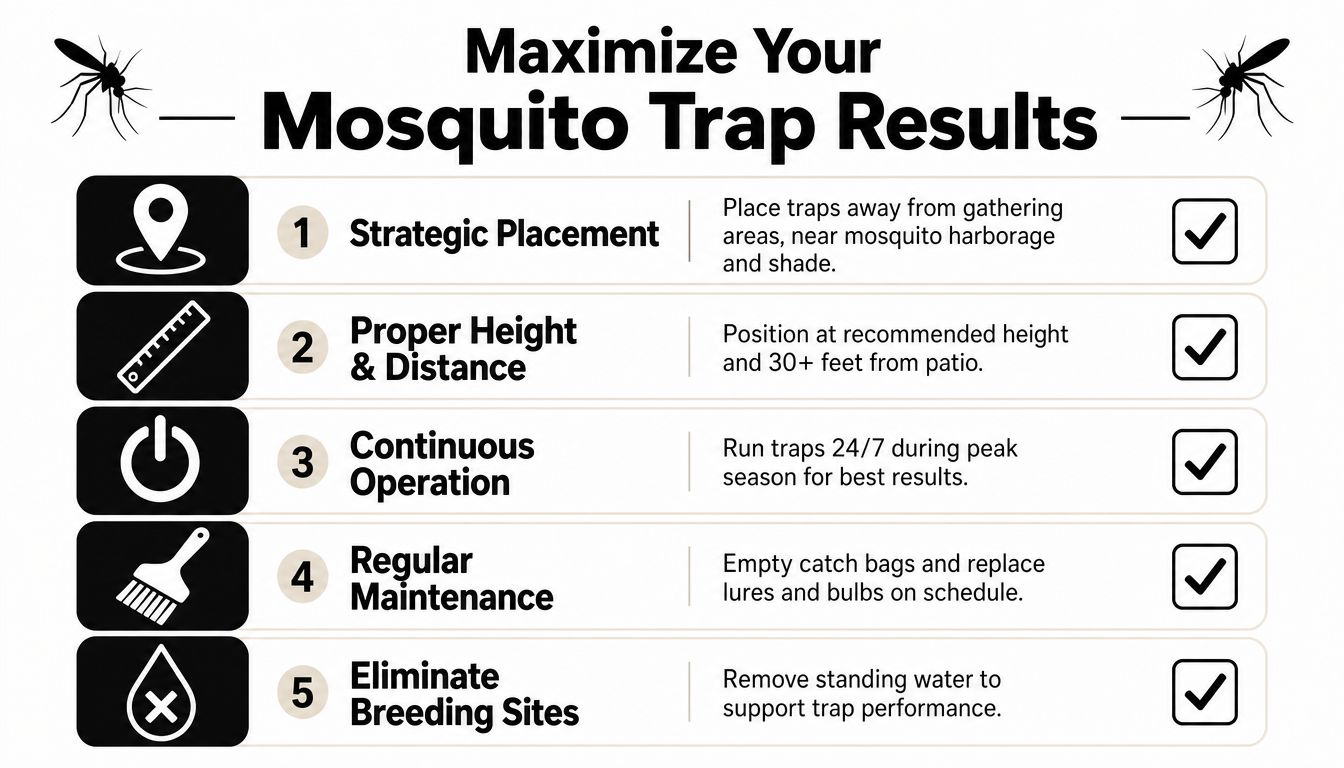
A trap performs better when homeowners treat it as equipment that needs a site plan and regular care. The placement that feels most intuitive, beside the patio, is often not the most effective. You want the device to intercept mosquitoes before they reach people, not compete with people as an attractant.
Start with placement
Place the trap near mosquito resting areas, such as shaded vegetation or damp edges, while keeping it away from the place where your family gathers. Follow the manufacturer's height guidance, and keep the unit at least 30 feet from the patio when that distance is compatible with the equipment and property layout.
A trap hidden behind dense plants may have restricted airflow. A trap sitting in direct sun may operate under harsher conditions than intended. Look for a location with clear intake airflow, nearby shade, and access to power or fuel without creating a trip hazard.
Keep the system active
Mosquito populations respond to repeated capture more reliably than to occasional operation. Run the device continuously during the active season if the manufacturer allows it, rather than turning it on only when guests arrive. A trap that starts after mosquitoes are already active around the patio has less opportunity to intercept them earlier.
Maintain the capture system
Check the collection bag, chamber, fan, power supply, and lure according to the product directions. Emptying the catch container prevents buildup from interfering with airflow, while replacing depleted attractants keeps the device from becoming an empty shell that merely hums in the yard.
Use this practical checklist:
- Inspect the catch area: Remove captured insects and debris before they restrict airflow or capacity.
- Refresh consumables: Replace lures, fuel, bulbs, or other components on the schedule specified for the model.
- Watch the airflow: Keep leaves, grass, and stored items away from intake and exhaust openings.
- Record observations: Note where biting is worst and which locations produce the largest catch, then adjust placement carefully.
- Remove standing water: Empty containers, refresh water features as appropriate, and correct areas that hold water after rain.
A trap can't compensate for a yard that keeps producing mosquitoes.
Standing water reduction supports every other control measure. Buckets, toys, planters, blocked drains, and low areas can provide breeding opportunities, even when they look insignificant. If neighboring properties or shared drainage areas contribute to the problem, a single homeowner may need a broader inspection and treatment plan.
When Traps Alone Are Not Enough and Professional Control Helps
DIY traps often fall short for one of three reasons. The device targets a different species, the yard contains active breeding sites, or the property needs more coverage than one unit can provide. Homeowners may also overlook shaded resting zones, drainage issues, dense vegetation, or water-holding structures that a trained technician can identify during an inspection.
Professional mosquito control uses several tools rather than asking one trap to carry the entire burden. A site evaluation can identify likely adult resting areas and breeding sources. Source reduction addresses water and habitat conditions, larval control targets developing mosquitoes where appropriate, and barrier treatments can reduce adult activity around outdoor living spaces.
The Green Advantage provides mosquito reduction programs, pest inspections, residential pest control, and commercial pest control for properties in Crown Point, IN and surrounding Northwest Indiana communities. Its technicians assess the site and tailor treatment to the property instead of assuming that every yard has the same exposure.
An integrated plan also helps homeowners connect mosquito issues with other seasonal pest concerns. Ant control, spider control, wasp removal, rodent control, termite control, and preventative pest treatments may require different methods, but the same basic principle applies. Accurate identification and property-specific treatment are more dependable than applying a generic product everywhere.
Professional service can be especially useful for families who want outdoor comfort without guessing about placement or treatment timing. It can also help property managers, landlords, restaurants, and commercial facilities address mosquito pressure across larger or more complicated sites.
Protect Your Crown Point Home With The Green Advantage
Mosquito trap effectiveness depends on a practical match between the device and the property. The most important questions are whether the trap targets the mosquitoes present, whether it's positioned correctly, whether it stays maintained, and whether breeding areas are addressed at the same time.
Traps can support a broader mosquito control plan, but they shouldn't be judged by collection totals alone. A full assessment considers biting pressure, yard layout, standing water, vegetation, neighboring conditions, and the outdoor areas your family or customers use.
When you contact The Green Advantage in Crown Point, IN, you can expect direct communication with knowledgeable office staff, a site-focused evaluation, treatment recommendations suited to the property, and transparent follow-up. That process supports homeowners searching for pest control near me, pest control in Crown Point, IN, or an exterminator near me who can address more than a single visible symptom.
If you're trying to decide whether a trap is enough, a professional inspection can give you a clearer answer. The right plan may include trapping, source reduction, preventative treatments, or a combination selected for your home or business.
The Green Advantage offers property inspections and mosquito reduction programs for Crown Point homeowners, property managers, and local businesses. Visit The Green Advantage to discuss your mosquito concerns, request a quote, or schedule an inspection for your Northwest Indiana property.