
Orange beetles are gathering on the sunny side of your Crown Point home, and now you're finding them along an upstairs window. Before you buy another spray or search for pest control near me, find out whether you're dealing with a seasonal shelter problem rather than insects breeding inside your walls.
The Green Advantage helps homeowners and businesses seeking pest control in Crown Point, IN, identify the pest and choose a practical response. With an Asian beetle infestation, the most consequential work often happens before the insects arrive: closing exterior gaps during the late-September prevention window.
How to Tell Asian Beetles From Lookalikes
Say you find dozens of orange beetles on a sunny, south-facing wall in October. That doesn't automatically mean your house is infested. It means you should identify the insects and inspect the nearby openings before treating anything.
Asian lady beetles are round, domed insects about 1/4 inch long. Boxelder bugs, another common source of confusion around Northwest Indiana homes, have a longer, flatter outline. Use body shape first, then look at color and the area behind the head.
Asian lady beetle vs. boxelder bug at a glance
| Trait | Asian lady beetle | Boxelder bug |
|---|---|---|
| Body shape | Round and domed | Long, narrow, flat-backed |
| Size | About 1/4 inch | About 1/2 inch |
| Color | Orange to red; spot count varies widely | Black with red-orange markings |
| Head marking | White area behind the head with a dark M- or W-shaped mark | No M-shaped mark |
| Indoor clustering | Wall voids, window frames, ceilings in fall and winter | Sunny walls and window sills, mostly in spring and fall |
| Defense or bite | Yellow, foul-smelling fluid; may bite | Doesn't normally bite; can stain surfaces |
Check shape, markings, and behavior
Don't count spots to make the decision. Asian lady beetles can have noticeably different spot patterns, so two insects from the same cluster may not look identical. Orange color alone isn't enough either.
Look at the pale area immediately behind the head. The dark M- or W-shaped marking against that white background is a more useful identification clue than the number of spots. A close, well-lit phone photo can make that detail easier to inspect.
Clusters around wall joints and window frames strengthen the case for Asian lady beetles. If the insects are narrow and black with red-orange lines, use our guidance on how to get rid of boxelder bugs instead.
The Green Advantage serves Crown Point and nearby Northwest Indiana communities with an identification-first approach. If the markings match, begin careful containment; if they don't, send a clear photo before planning treatment. The right identification prevents paying for the wrong solution.
When Asian Beetles Arrive and Why They Return Indoors
A Crown Point house can seem beetle-free through summer, attract clusters during autumn, and then have insects appear at bedroom windows during winter. Those aren't necessarily separate infestations. They can be different stages of the same seasonal shelter-seeking behavior.
The outdoor-to-indoor pattern is easier to recognize when you compare sightings with the season.
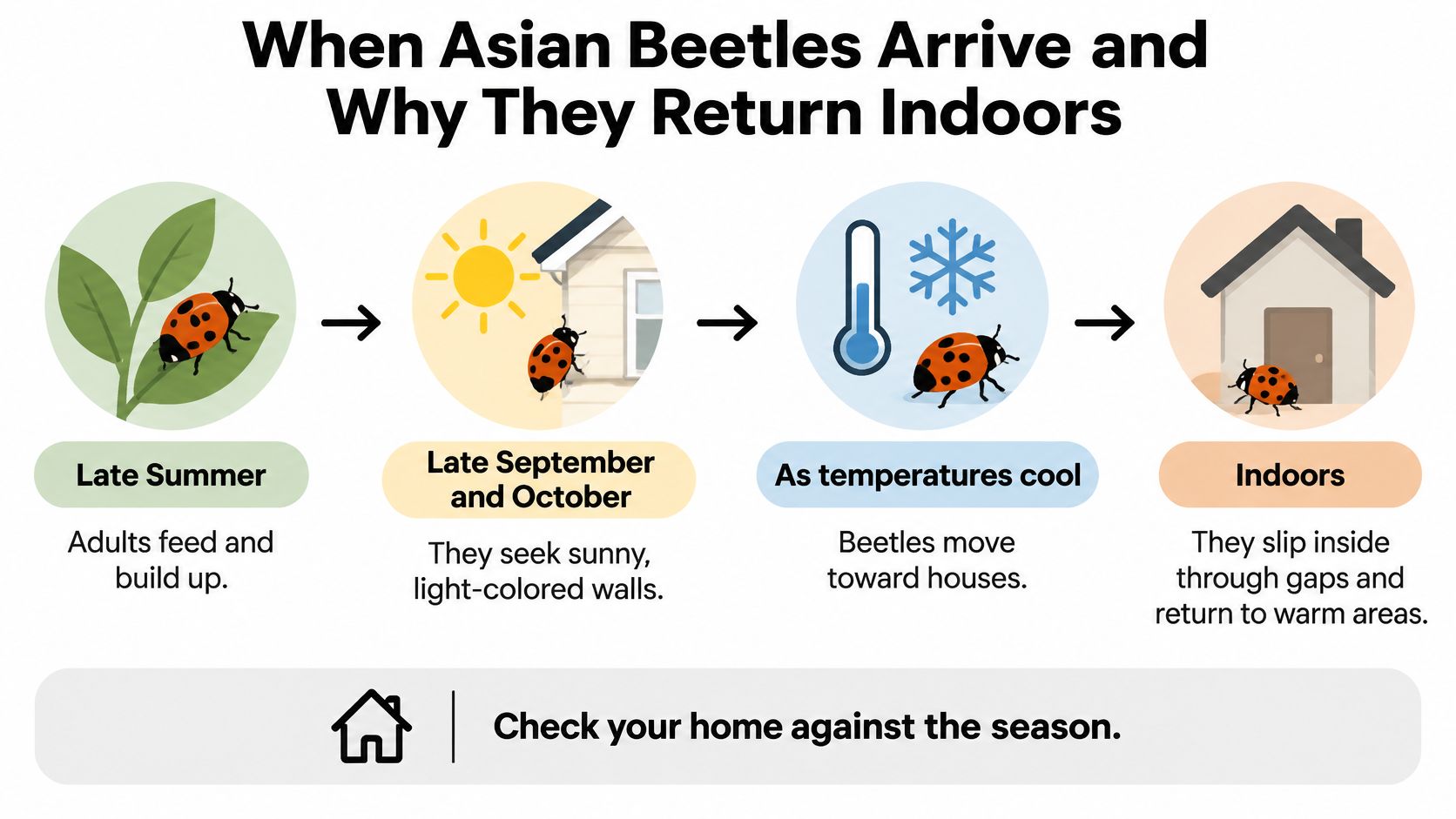
- Late summer: Adults feed outdoors and populations build. You may barely notice them around the house because they haven't started gathering at sheltered entry points.
- Early to mid October: Watch sunny siding as cold weather gives way to warmer conditions. In Indiana, congregation typically begins in mid-October and peaks by the end of the month, often after the first cold snap followed by warmer weather, according to Purdue Extension's Asian lady beetle guidance.
- Winter: Beetles that entered settle into protected spaces such as wall voids, attics, and window frames. A quiet room doesn't necessarily mean those sheltered adults are gone.
- Late winter and spring: A sunny afternoon can bring concealed beetles back into view. Temperatures near 50°F can reactivate some adults, which move toward warmer windows and light, explains University of Minnesota Extension.
What winter sightings actually mean
Asian lady beetles don't normally establish a breeding population inside a house. A beetle appearing at a window in January usually entered during the previous fall, rather than developing from an indoor colony.
Consider a warm March afternoon when beetles suddenly appear around an upstairs window. Repeatedly spraying that window treats the place where they're visible, not necessarily the opening they originally used.
Seasonal clue: Winter indoor sightings are usually a record of an unsealed fall entry, not evidence of a new indoor breeding problem.
Pay particular attention to light-colored walls, southwest-facing exposures, and buildings near trees. Large outdoor clusters are the warning to act while the insects are still outside, not a reason to wait for them to reach the living room.
Emergency Steps for Beetles Already Inside Your Home
Start with controlled removal, not a whole-house pesticide application. Asian lady beetles are nuisance invaders rather than wood-destroying pests, so finding them indoors doesn't mean they're eating framing or furniture.
Purdue's homeowner guidance supports vacuum removal and cautions that fogging won't affect beetles secluded in building cavities. A measured cleanup is more useful than filling occupied rooms with spray.
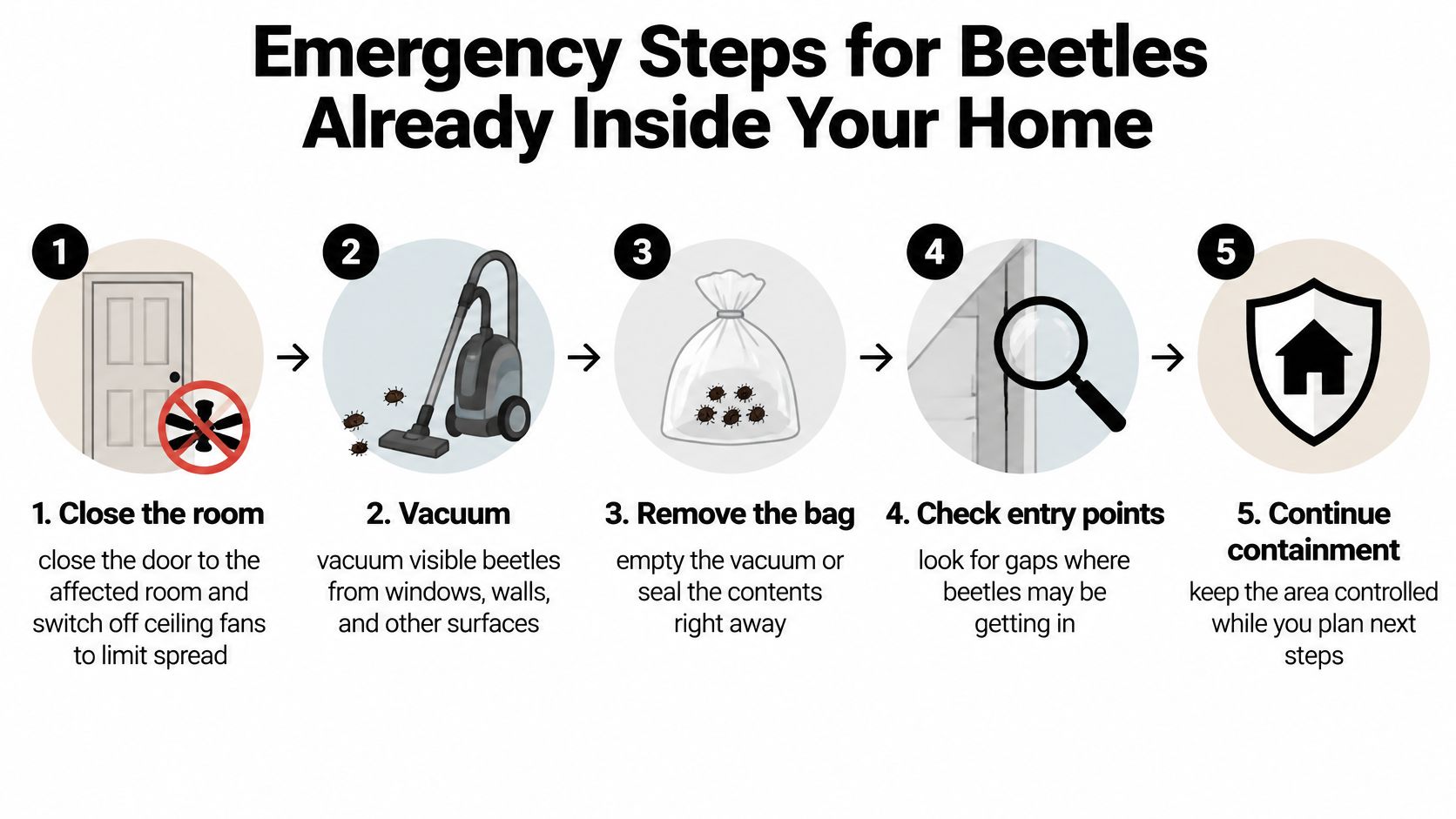
A practical containment routine
Close the affected room. Shut the door and switch off ceiling fans to make removal easier and limit movement. Keep children and pets outside the cleanup area.
Vacuum accessible beetles. Use a hose attachment around windows, walls, and accessible light-fixture surfaces, without opening electrical fittings. Use a disposable bag or empty the canister outdoors promptly into a sealed disposal bag so live insects can't crawl back out.
Avoid crushing them. Pressing beetles against walls, curtains, or upholstery can release yellow, foul-smelling defensive fluid. Lift them with the vacuum rather than swatting or rubbing them into the surface.
Clean marks gently. Try a damp cloth and mild soap, testing an inconspicuous spot first. Don't soak painted trim, unfinished wood, or electrical fixtures.
Skip indoor aerosols and foggers. They may kill exposed insects without reaching the concealed aggregation. Extra chemical residue and odor won't repair the entry route.
Check emergence points. Inspect accessible baseboards, trim, window tracks, lights, and fan surrounds on warm afternoons. Vacuum newly visible insects without dismantling walls or fixtures.
Keep the basic removal sequence handy while you manage the affected room.
Protect sensitive occupants during cleanup
Asian lady beetles aren't known to transmit disease and rarely bite, but bites and contact with beetle material can cause irritation. Sensitive occupants may experience itchy eyes, skin symptoms, or asthma and other allergic responses, as described by West Virginia University Extension.
Wear gloves when clearing accumulated dead insects. Use a damp paper towel or cloth for crushed remains instead of dry sweeping, which can stir up irritating dust; ventilate afterward when conditions allow.
Families with asthma, allergies, or young children should limit exposure during cleanup. Seek medical advice for persistent skin or breathing symptoms, and urgent care for breathing difficulty. Containment controls the immediate mess, but it doesn't stop another outdoor entry.
Sealing Entry Points Before Fall Migration
Inspect during late spring and summer, then finish repairs before fall clustering begins. Late September should be your completion target, not the moment you first discover that a garage-door seal has pulled away.
Penn State Extension recommends mechanical exclusion and notes that gaps approximately 1/8 inch wide can admit beetles. Its guidance supports exterior-grade silicone or silicone-latex caulk, door seals, repaired screens, and number 20 mesh or smaller for appropriate protected openings, with preventive work commonly completed by late September or early October.
Start on sunny, light-colored elevations. Carry a flashlight, inspection mirror, notebook, and phone so you can record defects rather than repeatedly walking past the same window.
Entry points, fixes and materials
| Entry point | Fix | Material or size |
|---|---|---|
| Gaps around windows and doors | Caulk the joint | Exterior-grade silicone or silicone-latex |
| Cracks in siding, soffit, and fascia | Caulk and repair | Exterior-grade silicone or silicone-latex |
| Torn or damaged window screens | Repair or replace | Intact screen mesh |
| Gaps under doors and garage doors | Install seals | Door sweeps and garage-door bottom seals |
| Attic, chimney, and exhaust vents | Cover appropriate openings | Number 20 mesh or smaller, where compatible with safe operation |
| Utility penetrations and foundation joints | Seal gaps | Compatible exterior sealant or repair material |
Make repairs without creating building problems
At windows and doors, remove loose sealant and clean the joint before applying new caulk. Don't cover intended drainage openings, including window weep holes. A joint that looks tidy but traps water isn't a successful repair.
Check siding, soffit, and fascia for displaced or damaged pieces before reaching for the caulking gun. Repair the underlying defect rather than filling a moving or oversized opening with a thick bead of sealant.
Door sweeps should contact the threshold without preventing the door from closing properly. For a useful explanation of how perimeter seals fit together, the Neasden Hardware resource on sealing door gaps against noise illustrates the same gap-checking principle, although acoustic sealing isn't a substitute for pest inspection.
Use particular care around vents and chimneys. Never screen a dryer outlet, combustion opening, or flue in a way that restricts airflow or violates equipment requirements. Have the appropriate trade professional choose a compatible pest guard where necessary.
Avoid the repairs that leave the problem open
- Spot caulking: Fixing the obvious window crack while missing utility penetrations, roofline defects, or the garage leaves alternate routes available.
- Late action: Waiting until adults are already clustered on siding reduces the opportunity to exclude them before they find shelter.
A complete building-envelope check is more valuable than repeatedly treating the insects you can see indoors.
Our technicians note customer prevention steps on the inspection report, giving you a repair list rather than a vague instruction to seal everything. Request a full exterior check through The Green Advantage's pest exclusion guidance if access, hidden gaps, or uncertain vent details make the walk-around difficult.
When to Call a Professional and When a Barrier Helps
DIY is appropriate when the insects are accessible and the repairs are safe to reach. Professional help becomes more valuable when you can't locate the route, can't safely access it, or need a pesticide decision suited to the building.
Handle it yourself or call a professional
| Situation | Handle it yourself | Call a professional |
|---|---|---|
| Few beetles on a sunny wall in early fall | Seal visible gaps and vacuum accessible beetles | If they keep coming back |
| Clusters in attic, wall voids, or ceilings | Vacuum accessible beetles only | Yes, for an inspection and exclusion plan |
| Indoor sightings after sealing | Recheck openings on sunny sides | Yes, to find hidden gaps |
| Exterior barrier needed | Not recommended without label knowledge | Yes, arrange assessment before late September |
| Sensitive residents with symptoms | Vacuum, seal, and ventilate | Yes, plus a doctor for persistent symptoms |
An inspection should connect the insects, the entry points, and the proposed response.

Treat a barrier as a supplement
When exclusion remains incomplete, a preventive exterior barrier may be justified before beetles enter overwintering sites. The Ohio State integrated pest management guide places that timing generally in late September to early October and describes field observations in which an exterior application of lambda-cyhalothrin, deltamethrin, or bifenthrin on vinyl siding provided at least three weeks of protection.
That isn't a guarantee for every house. Sunlight, rainfall, surface material, application quality, and continuing beetle arrivals affect performance. A trained professional should decide whether an exterior product is appropriate, following its label and applicable regulations.
The same guide's homeowner survey found vacuuming much more common than sealing and caulking. Those responses describe homeowner behavior, not proof that a particular method solved the problem.
Exclusion comes before chemistry. That's the practical starting point for environmentally mindful pest control because it reduces the need to expose outdoor insects, including beneficial aphid-eating lady beetles, to pesticides.
What professional service should clarify
At The Green Advantage, all technicians are licensed for structural pest control by the Department of Public Health. Identification comes before treatment, and the inspection should distinguish accessible cleanup from repairs or treatment that require professional attention.
For most general pest control services, customers don't need to leave their home during treatment. Preparation still depends on the work involved, so share concerns about sensitive occupants when scheduling.
If you're comparing an exterminator near me or an exterminator in Crown Point, IN, prioritize a clear diagnosis and prevention plan over an offer to spray every room. When your situation falls in the professional column, arrange an inspection rather than buying another indoor aerosol.
Book Your Pest Control Inspection in Crown Point, IN
Book a pre-fall exterior inspection while there's still time to complete repairs before autumn aggregations. If the markings match and you're seeing inaccessible clusters or persistent indoor activity, contact The Green Advantage rather than waiting for the problem to become harder to manage.
Send clear photos and describe where you're finding insects when you reach out. Include whether they're outside on siding, inside a window track, or emerging around ceiling trim. Those details help the team prepare for a focused inspection.
What to expect when you contact us
You'll communicate directly with our office staff about scheduling and the pest problem, allowing licensed technicians to concentrate on diagnosis and treatment. For general pest issues, we typically schedule service the same day or the next business day, depending on your convenience.
For an overview of inspection preparation, the Pestless guide to home pest inspections provides useful background. For your Crown Point property, keep photos, affected-room notes, and questions ready.
Our residential pest control and commercial pest control work includes Asian beetles and boxelder bugs, along with ant control, spider control, rodent control, termite control, mosquito control, and other common pest concerns. Mention any additional activity when scheduling so the inspection addresses the right problems without assuming every insect needs the same treatment.
The Green Advantage offers pest inspections and practical Asian beetle prevention for Crown Point and surrounding Northwest Indiana communities. Visit The Green Advantage to schedule your pest control inspection and plan exterior repairs before beetles start gathering on your home.