
Mice can enter through an opening as small as 1/4 inch (6 millimeters), about the width of a pencil, according to University of California Integrated Pest Management's house mouse guidance. On a Crown Point night when the first hard freeze arrives, that small opening can explain scratching inside a kitchen wall, even when the house looks well maintained.
Mice Slip Through a Pencil-Width Gap
Say you've cleaned the pantry, put away the cereal, and checked behind the refrigerator. Yet you still hear movement after dark. The opening may not be in the kitchen at all. A worn garage seal or a gap beside an outdoor utility line can lead into hidden spaces connected to the house.
Mice follow accessible food and sheltered routes into wall cavities, crawlspaces, and attic corners. In Northwest Indiana, autumn is a practical time to inspect foundation joints, garage-door bottoms, crawlspace vents, and utility penetrations. Waiting until you hear scratching makes prevention harder because you may need to remove occupants as well as repair entrances.
A clean kitchen isn't a complete barrier
A spotless kitchen won't compensate for accessible pet food in an attached garage, deep mulch against the foundation, or a loose door sweep. The useful question isn't whether the house is clean. It's whether mice can reach food and shelter through an opening you haven't measured.
Small interior gaps can reveal where mice move between concealed spaces.
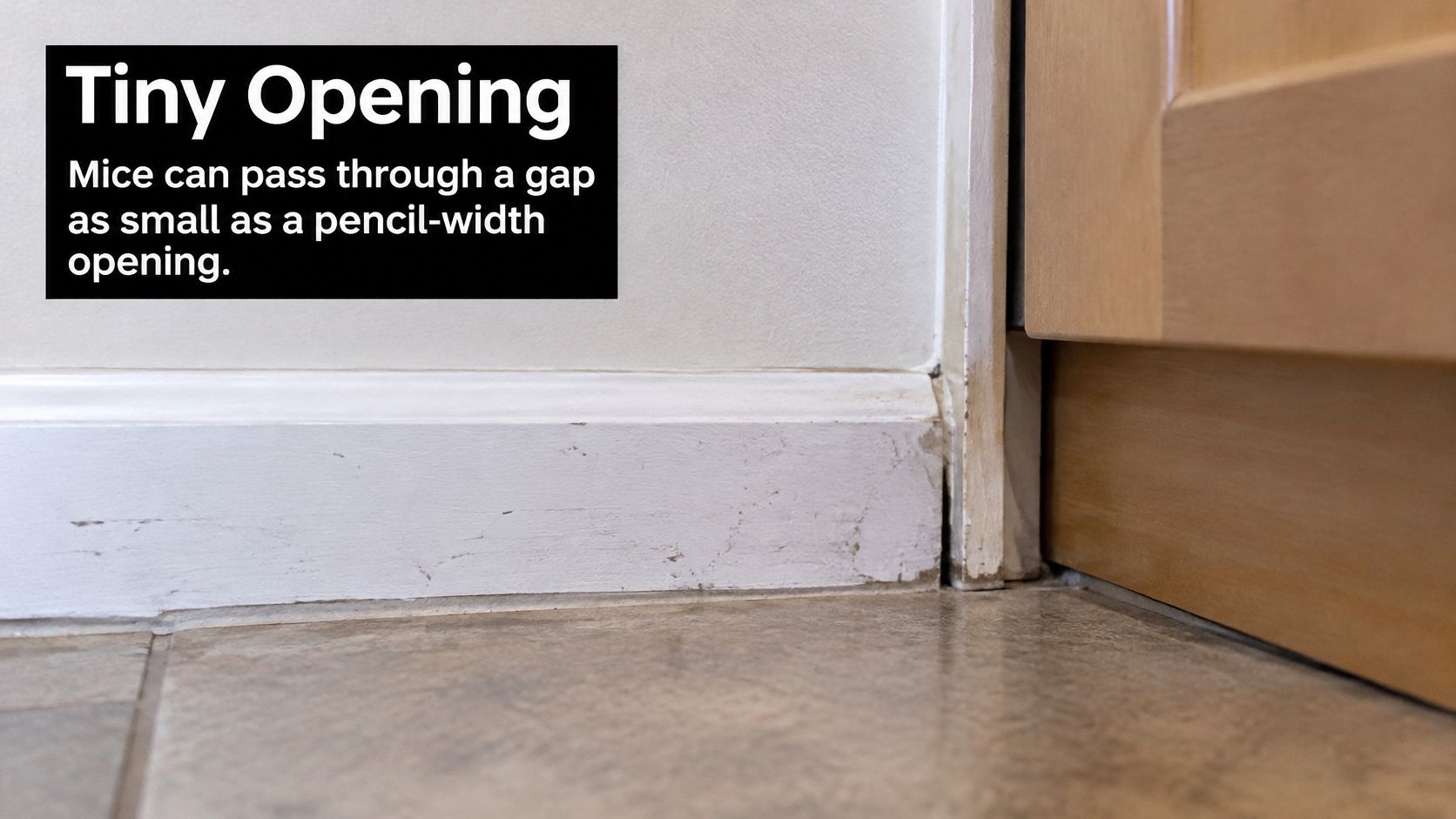
For single-family homes, attached garages, and smaller rentals, learning how to stop mice from entering your home starts with an entry-and-attraction audit. Measure openings, select gnaw-resistant repairs, remove accessible resources, and trap mice already indoors before closing their routes. Then verify that the work holds after changing weather.
A mouse problem isn't proof of poor housekeeping. It's a reason to inspect the entire building boundary, not just the room where you found evidence.
The Green Advantage is a local team for pest control in Crown Point, IN, serving homeowners and property managers across nearby Northwest Indiana communities. When the route map extends beyond accessible repairs, or fresh signs continue despite your work, our licensed technicians can assess what's happening.
Entry Points and the Materials That Hold
Mouse entry points and seals that last
| Location | Gap that matters | Durable seal | Fix that fails |
|---|---|---|---|
| Foundation cracks and mortar joints | Hairline up to 1/4 inch or wider | Cement, mortar, or sheet metal | Caulk or foam alone |
| Pipes, cables, and ducts through walls or floors | Any opening near 1/4 inch around the line | Steel wool or copper mesh secured with caulk | Loose steel wool or foam only |
| Under-sink and cabinet pipe holes | Gaps around supply and drain lines | Copper mesh or steel wool plus caulk or a metal escutcheon | Decorator caulk alone |
| Exterior door bottom | Remaining gap must be under 1/4 inch | Door sweep or threshold repair | Worn rubber left in place |
| Garage door bottom and sides | Daylight at the slab or jambs | Threshold seal plus side seals | A single foam strip on an uneven slab |
| Vents, weep holes, and soffit openings | Openings larger than 1/4 inch | Hardware cloth or metal screening, 1/4 inch or tighter, fastened at the edges | Plastic window screen |
| Window and door frames | Cracks at trim and sills | Exterior-grade caulk; metal if the void is wide | Paint or interior painter's caulk outdoors |
| Holes larger than about 1/2 inch | Structural or gnawed openings | Sheet metal, cement, or hardware cloth over a solid patch | Spray foam as the only fill |
The CDC's sealing guidance identifies approximately 1/4 inch as a mouse-sized opening and recommends steel wool secured with caulk or spray foam for small holes, with metal screening, hardware cloth, sheet metal, or cement for larger gaps. The table turns those material choices into a practical repair list; its larger-hole category is a work-planning distinction, not a different entry threshold.
Read the opening before buying filler
Bring a flashlight, tape measure, inspection mirror, and phone on a daylight walkthrough. Match the outside defect to its inside counterpart whenever possible. A pipe opening behind a cabinet may connect to a larger unfinished penetration in the basement.
Older Crown Point houses and attached garages deserve attention where different materials meet. Check sill cocks, conduits, siding transitions, and door jambs. Photograph both the close-up opening and enough surrounding wall to locate it later.
Soft filler isn't a stand-alone rodent barrier. Mice can gnaw foam, plastic screening, wood, and rubber. Mesh or metal provides resistance; compatible caulk helps hold the repair and close irregular edges.
Keep drainage, ventilation, and safety intact
Don't stuff mesh into a dryer exhaust or block a weep hole with cement. Dryer vents need an appropriate functioning termination that won't collect lint, while drainage and ventilation openings need purpose-designed protection. Keep metal packing away from exposed electrical connections, and leave damaged wiring to a qualified professional.
For a separate flashing or weatherproofing repair, Contractor's Den roofing tape is a resource to review for product suitability. Roofing tape isn't a substitute for a mechanically secured rodent barrier.
Door repairs need more than fresh-looking rubber. Check the closed door across its full width, including corners and uneven slab edges. Our pest exclusion information explains the building-access side of prevention.
Finish the walkthrough with a photographed, measured job list. Don't start caulking until you've checked whether mice are already using those openings.
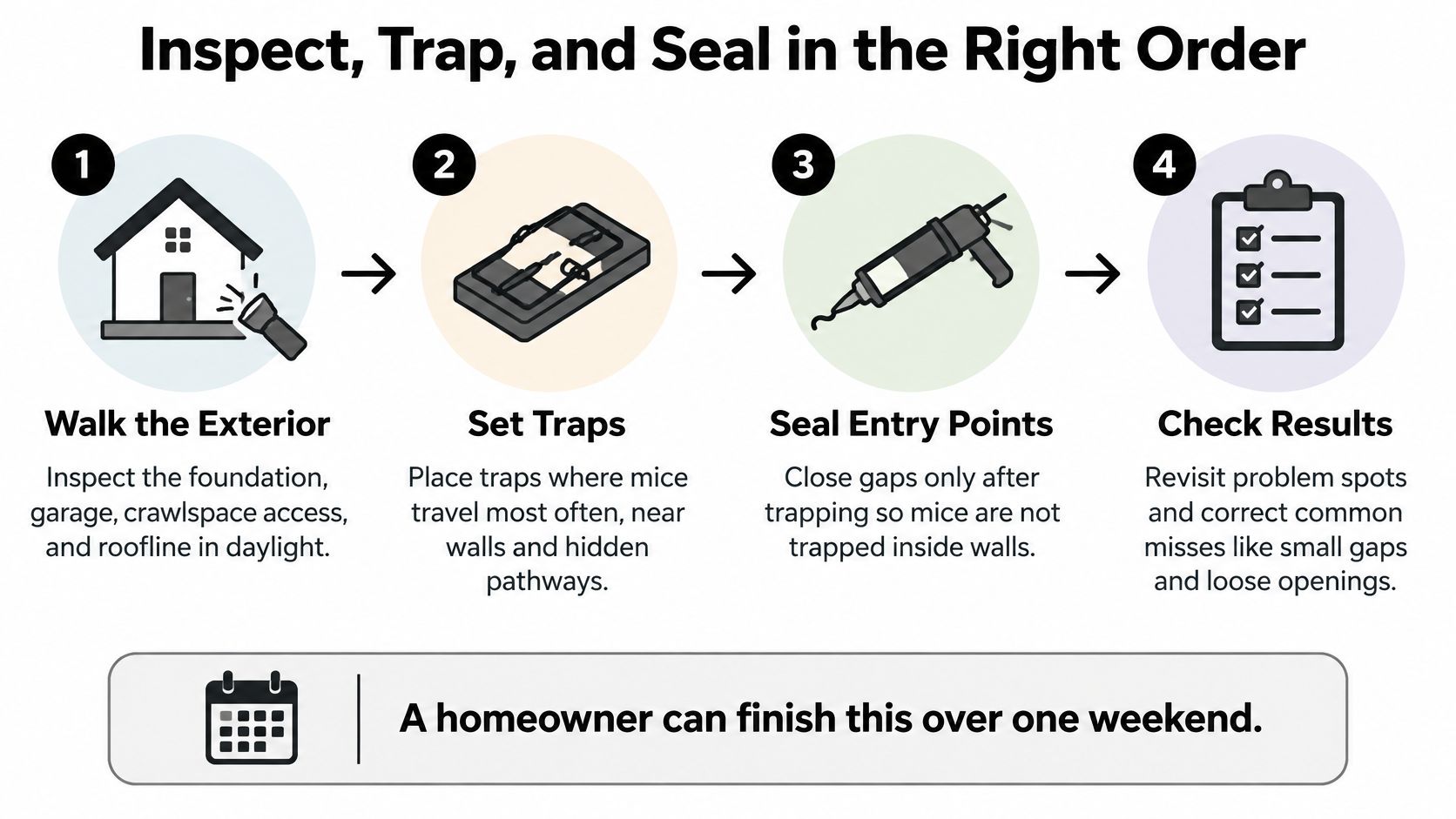
Inspect, Trap, and Seal in the Right Order
A homeowner can complete an initial inspection and accessible repairs over a weekend. Removing an established indoor population and confirming success may take longer, so don't treat Sunday evening as a deadline for declaring the house clear.
The process below keeps trapping ahead of closure and makes verification part of the work.
Map the routes before disturbing them
Walk the exterior in daylight. Follow the foundation, garage perimeter, crawlspace access, utility lines, and accessible roofline views. Use a flashlight under siding edges and around penetrations rather than judging from standing height. Mark suspect gaps on a simple sketch, but inspect higher openings from the ground instead of climbing an icy or awkward ladder.
Check the corresponding indoor spaces. Look beneath sinks, behind safely accessible appliances, around basement plumbing, and along accessible attic edges for droppings, urine odor, gnawing, damaged food packaging, and nesting material. Don't pull heavy appliances across utility connections or enter a cramped crawlspace without safe access. A hole without visible activity still belongs on the repair list, but evidence helps establish priorities.
Photograph and date each finding. Include an object or ruler for scale and take a wider photograph showing the location. Give each defect a plain description, such as “garage service door, hinge-side corner.” Without a record, it's easy to confuse an old stain with a new problem or overlook an opening hidden behind stored belongings.
Avoid dry sweeping or vacuuming droppings while inspecting. Keep children and pets away from contaminated areas, and arrange appropriate cleanup guidance if evidence is widespread.
Remove occupants before closing their routes
Set spring-loaded snap traps where fresh activity appears. The CDC's trapping guidance recommends traps along observed routes, positioned perpendicular to walls with the trigger toward the wall, using a pea-sized amount of chunky peanut butter. Suitable locations include behind appliances, inside affected cabinets, and along accessible attic, basement, or crawlspace routes.
Place traps where children and pets can't reach them; use suitable protective enclosures where needed. Check them daily and continue until repeated checks show no captures or fresh signs. A quiet night alone isn't proof that every mouse is gone.
Starting traps before closure prevents the common mistake of leaving mice active inside while blocking the route they were using. If scratching comes from an inaccessible wall cavity, have the route assessed rather than blindly filling the nearest hole.
Sequence matters: Traps remove mice already indoors. Repairs prevent new entry. Neither task reliably replaces the other.
This video provides an additional visual reference for the work.
Repair from a documented list
Pack small, suitable openings with steel wool or rodent-resistant copper mesh, then secure the material with compatible caulk or a thin foam cap. The packing should stay seated when lightly probed, not fall into the wall cavity. Don't use foam to disguise a loose wad, and don't pack materials against hot flues or exposed wiring.
Close wider defects with a secured barrier. Cut hardware cloth or sheet metal to overlap sound surrounding material, then fasten the edges so they can't be lifted. Use an appropriate masonry repair for sound, nonmoving masonry defects. A deep crack, loose mortar, rot, or crumbling substrate needs building repair rather than a cosmetic covering.
Fit exterior door sweeps and garage seals to the actual opening. Close the door and inspect both corners, the center, and the side junctions. If a garage slab is uneven, adjust the repair to the slab rather than stretching a straight foam strip across the low spot. The door must still operate properly without creating a trip hazard.
Recheck after changing weather. Compare the finished repair with your photographs after a storm or freeze. Look for pulled fasteners, lifted patch edges, distorted sweeps, and fresh signs nearby. A later walkthrough should show no daylight beneath closed doors and no renewed evidence along monitored indoor routes.
The final test is observed performance, not how much sealant you used. If trapping continues despite completed accessible repairs, don't keep adding patches at random. An unseen connection, concealed nest, or shared building route needs further diagnosis.
Remove Food, Water, and Shelter, Then Diagnose Repeat Visits
Test the property from a mouse's perspective: can it find an easy meal, moisture, or a sheltered place beside the building? A sealed opening doesn't remove those attractions. Mice may keep investigating the structure when resources remain nearby.
The EPA's rodent-prevention guidance pairs sealing with removing food and water, securing garbage, managing compost, reducing leaf piles and deep mulch, and reconsidering bird feeding during an infestation. That combination matters more than repeatedly scrubbing an already clean countertop.
Audit the kitchen and the yard together
Store human and pet food in thick plastic, glass, or metal containers with tight lids. Wipe spills promptly, wash dishes before bed, and use a covered trash container. Don't leave pet bowls out overnight, and check the shelf beneath the food bag for spilled kibble.
Outside, pull leaf piles and deep mulch back from the foundation. Trim vegetation touching siding, pick up fallen fruit and spilled birdseed, secure garbage before windy weather, and empty water from trays and buckets. Fix leaks rather than relying on occasional drying.
Say the kitchen is spotless, but an open dog-food bag sits beside garage boxes and a leaf pile presses against the service door. That garage still offers food, cover, and a route toward the house. Moving the bag into a secure container and clearing the door perimeter addresses conditions the kitchen cleanup missed.
Use this checklist to separate resource removal from structural repair.
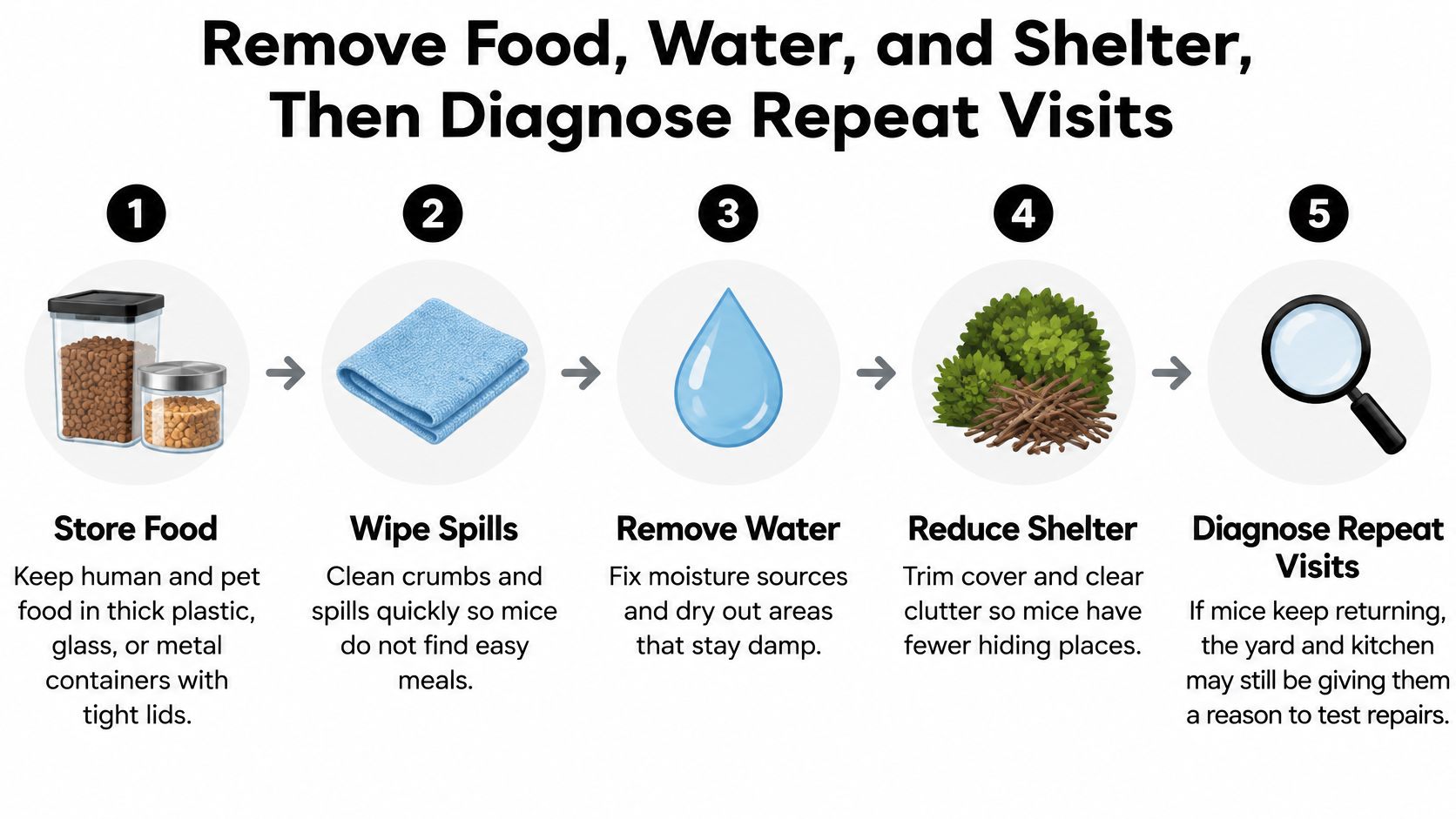
The CDC's rodent-control overview brings prevention and response together through sealing, trapping, and removing accessible resources. For a room-by-room resource check, use our explanation of what attracts mice to your home.
Let fresh evidence choose the next action
Returning activity doesn't automatically mean a product failed. You may have closed the visible opening but missed the route behind it, or mice may still occupy an interior space.
Fresh mouse signs after a repair
| Fresh sign | Usual meaning | Next action |
|---|---|---|
| New droppings along a wall you already trapped | A travel route is still open | Trace that wall to a foundation, pipe, or door gap before adding more traps |
| Gnaw marks on a new patch | The fill is soft enough to chew | Replace foam or plastic with steel wool plus caulk, metal, or cement |
| Nesting in garage boxes or stored clutter | Harborage sits against the house | Reduce storage and recheck the garage-door bottom and side seals |
| Activity only after a storm or freeze | A sweep, vent, or flashing shifted | Recheck door bottoms, crawlspace vents, and roofline openings |
| Droppings in a shared hallway or neighboring unit | The route may be outside one household's walls | Document with photos and coordinate the exterior repair with the owner |
These are diagnostic starting points, not proof of a single cause. Droppings can come from mice already inside, and weather-related activity doesn't necessarily mean a component moved.
For attic work, attic ventilation advice from Premier Builders offers useful background on maintaining airflow. Don't turn pest exclusion into a moisture problem by covering intended ventilation.
Assign each finding to a person and an action. A dated photograph helps a tenant and property owner resolve a shared route more effectively than repeated complaints about mice.
Before autumn and after the first hard freeze, revisit garage sweeps, foundation corners, crawlspace vents, and roofline openings. If sound repairs and a clean resource audit still leave fresh activity, stop cycling through consumer products and arrange an inspection.
When to Call a Crown Point Rodent Pro
Call a professional when you can't safely reach the suspected route, can't identify the source, or can't stop fresh activity with accessible repairs and snap trapping. Continuing the same unsuccessful approach can leave concealed damage or contamination unaddressed.
For homeowners searching for an exterminator in Crown Point, IN, these are practical handoff points:
- Persistent captures: Traps keep catching mice after food is secured and visible openings are repaired.
- Unsafe access: Suspected entrances sit high on a roofline, beside damaged wiring, or inside an inaccessible crawlspace.
- Shared construction: Rental units, common hallways, and attached spaces connect beyond the area you control.
- Multiple pest concerns: Mouse evidence appears alongside ants, spiders, or wasp activity that needs separate identification.
Escalate the diagnosis, not just the product
Poison isn't the automatic next step. An inaccessible carcass creates another problem, and careless bait placement can expose children, pets, and wildlife. The EPA's rodenticide safety guidance explains those risks and the importance of keeping products away from people and non-target animals.
If a pesticide is needed, it belongs in a site-specific plan with label-compliant placement and appropriate secured stations. It doesn't replace sanitation or exclusion.
Northwest Indiana cold weather makes garages, attics, and utility chases important inspection areas before winter settles in. Scheduling an assessment before an urgent indoor problem gives you time to address difficult access and necessary building repairs.
When you're comparing results for pest control near me, prioritize a licensed assessment that explains the route, the removal strategy, and the precautions. Our technicians explain the process before rodent work begins.
What to Expect From The Green Advantage in Crown Point
Professional help should leave you with a clearer understanding of the building, not just a treatment receipt. Effective rodent work protects stored belongings, insulation, and other materials from gnawing and nesting. It also helps reduce exposure to droppings and urine in occupied areas.
For families and property managers, the practical benefit is knowing what needs repair, what needs monitoring, and who is responsible. That replaces guesswork with a manageable set of actions.
From the inspection to a clear plan
At The Green Advantage, our licensed technicians assess Crown Point and Northwest Indiana properties and develop a customized rodent control plan. We explain the process and customer precautions before work starts. Customer prevention tasks are recorded on the inspection report so sanitation and building maintenance remain part of the response.
Our residential pest control and commercial pest control work also addresses other concerns identified during an inspection, including ant control, spider control, wasp removal, mosquito control, and termite control. Different pests need different responses; a mouse opening won't be solved by a general spray-only visit.
- Prepare useful information: Share where you've heard activity, where traps were placed, and which repairs you've completed.
- Identify access concerns: Tell the office about locked spaces, tenant coordination, children, and pets.
- Keep the inspection report: Use its prevention notes to organize household tasks or property maintenance.
Know what the quote reflects
Pricing depends on the building's size, the pest, the service needed, and the materials involved. A site-specific quote is more useful than a guessed cost based only on a scratching sound.
When looking for an exterminator near me, bring your photographs and questions to the conversation. Clear communication helps us distinguish an active indoor problem from an exterior maintenance issue and explain the appropriate next steps.
The Green Advantage offers rodent inspections, control, and exclusion support for homes and businesses in Crown Point and nearby Northwest Indiana communities. Visit The Green Advantage to schedule a pest inspection and get a practical plan for keeping mice outside before the next cold snap.