
A homeowner in Crown Point, IN, sweeps the basement stairwell clean on Saturday and finds fresh webs in the same corner a few days later. Another homeowner notices spiders near the garage light, while a property manager sees webs returning around several utility rooms. These findings can feel like an infestation, but one spider or one web usually isn't enough to justify treatment.
A practical spider inspection looks for the pattern behind the sighting. Where are spiders appearing? Are webs, egg sacs, and prey insects returning? Could gaps, moisture, clutter, or outdoor lighting be supporting activity? The Green Advantage serves Crown Point and surrounding Northwest Indiana communities with inspection-focused pest control for homeowners, landlords, businesses, and commercial facilities. The process is designed to identify the reason spiders are present before recommending the lightest effective next step.
What a Spider Inspection Solves
A Crown Point homeowner may sweep the basement stairs repeatedly and still find fresh webs in the same quiet corner. The cleanup removes visible evidence for a short time, but it does not explain why spiders keep using that location. A useful inspection follows the pattern across repeated checks instead of treating each sighting as a separate event.
The inspection looks beyond the spider
Spiders are predators. Their presence often reflects access to prey insects, shelter, moisture, and entry points, rather than a problem caused by spiders alone. Inspection therefore considers insects near windows or lights, clutter beneath stairs, damp areas around a sump pump, and openings along the foundation.
The process also checks whether activity is tied to a particular room, wall, window, foundation section, or exterior light. Regular observations, flashlights, sticky traps, and systematic checks around edges and corners help separate occasional outdoor movement from recurring indoor pressure. Recording the location and type of evidence gives the technician something more useful than a single spider count.
The technician is trying to answer four practical questions:
- Where is activity concentrated? A basement stairwell suggests a different pathway than a bedroom windowsill or exterior eave.
- Is the activity recurring? Reappearing webs carry more weight than one web left after a door or window was opened.
- Are spiders reproducing indoors? Egg sacs and repeated findings may indicate an ongoing indoor cycle.
- What conditions support them? Prey insects, cracks, clutter, outdoor lighting, and moisture can shape the recommendation.
A single sighting may call for observation and cleanup. Repeated signs can justify monitoring, exclusion, or targeted treatment, depending on where the evidence appears and what supports it.
The result is a property-specific diagnosis, not an automatic pesticide application. It helps distinguish harmless outdoor activity from recurring indoor activity and identifies the prey, entry points, or harborage conditions that warrant action. That distinction matters for residential pest control, commercial pest control, and homeowners seeking a lasting solution instead of repeated surface cleanup. The inspection approach is consistent with EPA school integrated pest management guidance, which emphasizes regular monitoring and documentation in preventive pest management.
How Spider Monitoring and Exclusion Work
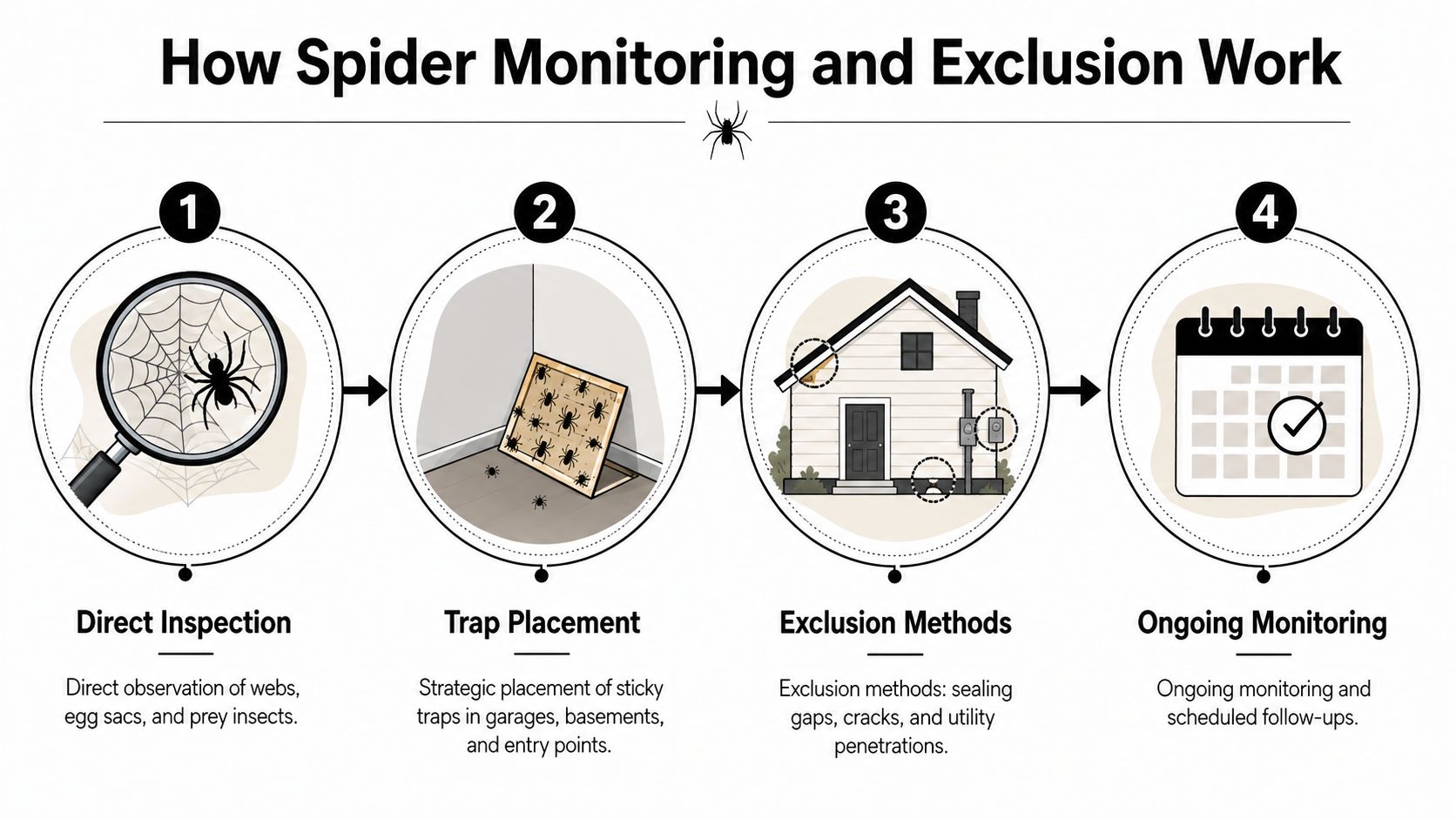
Monitoring and exclusion address different parts of the same problem. Monitoring identifies where and when activity occurs. Exclusion closes the routes and removes the conditions that keep spiders and their prey near the structure.
Start with direct observation
Begin with evidence you can locate and compare. Check for live spiders, fresh and old webs, egg sacs, shed skins, and prey insects. Web shape and placement help show whether a corner is rarely disturbed or has become a regular hunting site.
Place glue boards in quiet areas such as garages, basements, utility rooms, corners, and along baseboards. A trap confirms movement where sightings are uncommon. Household inspection guidance recommends glue board monitors in corners and along baseboards, especially in closets, garages, basements, attics, and crawlspaces, as described in this practical home spider inspection guide.
Repeat the check and record the location
One observation may reflect a door opened that day or a web that had been left undisturbed. Repeat checks over one to two weeks show whether the same room, wall, trap, or window continues to produce evidence. Record the date, location, sign type, and nearby insects. Facilities may use numbered, dated traps and record captures after 24 to 48 hours, following a monitoring method described in EPA monitoring instructions for pest management.
For a homeowner, a phone note is enough:
- Record the room and exact location.
- Identify the sign as a web, spider, egg sac, or prey insect.
- Photograph recurring areas before cleaning.
- Compare the findings at each later check.
Use exclusion as the long-term layer
Seal gaps around windows, doors, screens, weather stripping, and utility penetrations. Move stored materials away from walls, manage vegetation near the foundation, and correct conditions that attract prey. Outdoor lighting also matters. Insects gather around bright fixtures, supplying spiders with food near entry points. Reduce unnecessary lighting, reposition fixtures, and keep doors closed. These changes reduce insect traffic and spider presence near entry points. Spider inspection guidance for structures recommends reviewing interior and exterior entry points, including low areas such as decking and patio furniture and high areas such as eaves and light fixtures.
After the first trap check, keep the records and mark the locations that produced repeated evidence. Clean isolated webs, correct the nearby condition, and check the same traps again. If activity continues in the same areas, show the record to a pest professional so the inspection can focus on those entry points and harborage conditions.
Interior and Exterior Inspection Walkthrough
A thorough inspection starts indoors, then follows the structure outward. That order helps connect the place where a spider was seen with the entry point or outdoor condition that may be supporting it.
Begin with quiet interior spaces
Spiders prefer areas with little disturbance, available shelter, and access to prey. In a Crown Point home, check:
- Basements and stairwells: Look along baseboards, ceiling corners, window wells, and behind stored items.
- Crawlspaces and sump pump rooms: Check moisture, foundation gaps, pipes, and areas that rarely receive foot traffic.
- Garages and utility rooms: Inspect corners, door edges, electrical boxes, shelves, and the space around equipment.
- Attics and storage areas: Examine rafters, boxes, clothing, boots, and the edges where walls meet ceilings.
- Windows and doors: Review damaged screens, worn weather stripping, and webs near exterior-facing openings.
Homeowners can safely sweep visible webs, reduce clutter, and note exactly where signs return. Those actions provide useful information, but they don't replace a closer review of crawlspace access, attic voids, or structural gaps that aren't easy to see from floor level.
Follow the exterior perimeter
Outside, walk the foundation line and inspect the places that combine shelter, web-building surfaces, and insect activity. Check under decks, patio furniture, window ledges, eaves, soffits, gutters, exterior lights, and shed perimeters. Look for shrubs touching the siding, uncut grass, mulch or leaf buildup, stacked wood, and old webs around doors and windows.
Repeated activity at an exterior light often says more about nearby insect pressure than about a spider entering directly through that fixture.
The property's water management also matters. Downspouts that discharge beside the foundation, damp mulch, and moisture near a sump pump can make surrounding areas more favorable to insects and spiders. Inspectors should document these conditions rather than assume that spraying the visible web will solve them.
Account for Northwest Indiana construction conditions
Crown Point homes experience seasonal temperature changes that can stress caulk, screens, door sweeps, and weather stripping. Freeze-thaw cycles may widen small gaps around windows, foundations, and utility lines, so a gap that looked insignificant during one inspection can become a more useful entry route later.
Exterior guidance recommends checking cracks, gaps, damaged window screens, and degraded weather stripping, along with low harborages and high attractors. A professional inspection also considers accessibility and safety, particularly around attic voids, crawlspaces, rooflines, and high eaves. A trained technician can identify relationships that a quick visual sweep may miss.
Signs That Activity Needs Attention
One spider doesn't prove an infestation. Neither does one web in a basement corner, one specimen near a window, or a brief outdoor sighting after a storm. Treating every sighting as equally urgent can waste time and obscure the condition that needs attention.
Sort evidence by signal strength
The useful threshold is repetition, location, and supporting evidence. A spider seen once may have entered through an open door. Webs that return in the same place after cleaning suggest that the location continues to offer shelter or prey.
Low-signal findings usually support observation and basic cleanup:
- An isolated web in a basement or garage corner.
- A single spider near a window or door.
- A short-lived outdoor sighting after weather changes.
Medium-signal findings deserve closer monitoring:
- Webs reappearing in the same location.
- Activity in several rooms on the same level.
- Daytime sightings in dark, undisturbed interior spaces.
- Repeated webs around a garage light, window well, or foundation section.
High-signal findings support prompt professional follow-up:
- Visible egg sacs indoors.
- Multiple spiders in a garage, basement, or utility room.
- Prey insects, including small flies or stored-product pests, in the same area.
- Shed skins or evidence of continued development.
- Recurring activity across consecutive weeks.
This pattern-based approach is especially useful in Northwest Indiana homes with finished basements, sump pump rooms, attached garages, and storage areas that may sit undisturbed for long periods.

Let the evidence guide the response
A web that appears once and stays gone after cleaning may not require a service visit. A web that returns repeatedly, especially alongside egg sacs or prey insects, tells a different story. The inspection's job is to determine whether you're seeing a snapshot or a pattern.
For a homeowner searching for pest control near me, that distinction creates a more measured decision. Monitoring may be enough for isolated outdoor activity. Exclusion and targeted spider control become more reasonable when repeated indoor evidence shows that the property is supporting ongoing activity.
Identification and Conducive Conditions
A phone photo can help start a conversation, but it rarely provides dependable species identification by itself. Lighting, distance, camera angle, molt stage, and image quality can alter the features a technician needs to examine. Color and markings alone are especially unreliable.
Compare the evidence before choosing a response
A professional identification may consider body shape, leg arrangement, web structure, web location, and time of day. Webs may appear as loose cobwebs, flat sheets, or funnel-like structures, and their placement can help explain how the spider is using the property.
Some spiders found around homes, sheds, and outdoor areas are typically low concern, including orb weavers, cellar spiders, and common house spiders. Recurring sightings of larger or more secretive spiders indoors deserve closer attention, especially when paired with egg sacs, prey insects, or repeated activity in protected spaces. Species confirmation can require magnification, from a 10× hand lens for basic morphology to a 20×–50× stereoscopic microscope for advanced identification, and sometimes a 40×–200× compound microscope for fine structures, as explained in this arachnid identification reference.
| Evidence Factor | Reliable Pattern Observation | Appearance-Only Judgment |
|---|---|---|
| Location | Repeated signs near a foundation gap, window well, or utility room | “It looks like the same spider” |
| Web structure | Cobweb, sheet, or funnel pattern connected to a specific harborage | General web shape seen briefly |
| Supporting signs | Egg sacs, shed skins, and prey insects in the same area | A single color or marking |
| Timing | Activity that returns across consecutive checks | One sighting at an unknown time |
| Property conditions | Moisture, clutter, lighting, or entry gaps nearby | No review of the surrounding structure |
Identify what keeps the area attractive
The inspection should connect identification with conducive conditions, such as exterior lights that draw insects, woodpiles or mulch against the foundation, gaps around utility lines, cluttered storage, and moisture near sump pumps or downspouts. Spider management protocols also recommend checking vegetation, debris, stacked wood, uncut grass, and old webs around doors and windows, as outlined in this spider management protocol.
Those two inputs, reliable identification and property evidence, shape the recommendation. Depending on what the inspection finds, the right next step may be cleanup and monitoring, exclusion work, prey-insect control, or targeted treatment. The spider identification guide from The Green Advantage can help homeowners organize observations before a service visit, but a technician should evaluate recurring or uncertain activity in context.
Cost and Inspection Frequency
The cost of a spider inspection depends on the work required at the property, not just on the number of spiders seen. A small home with accessible areas may require a different inspection scope than a larger property with a finished basement, attached garage, shed, crawlspace, and extensive exterior perimeter.
What shapes the service scope
Common pricing variables include:
- Property size: More rooms and more perimeter require more inspection time.
- Basement configuration: Finished areas can hide activity behind stored items, while unfinished spaces may expose foundation gaps and pipes.
- Attached garages and outbuildings: These add separate entry points, lighting, and harborage zones.
- Finding severity: Egg sacs, recurring webs, prey insects, and multiple active areas may require more detailed follow-up.
- Service format: A standalone inspection differs from an assessment bundled with broader residential or commercial pest control.
A one-time visit is often diagnostic rather than curative. It can identify active areas and conditions, but it may not show whether activity is persistent unless the property also uses monitoring and later comparison.
Match frequency to risk
Many Northwest Indiana homes benefit from an annual exterior check. Properties with prior spider activity, moisture concerns, extensive landscaping, wooded lots, or recurring prey insects may justify seasonal monitoring, particularly during periods when homeowners notice more activity in late summer and fall.
Commercial facilities and multi-unit buildings often gain more from consistent walkthroughs and dated records than from occasional reactionary service. Recent spider inspection guidance recommends glue boards in storage areas, consistent monthly walkthroughs, and logs tracking date, location, sign type, and counts so patterns can emerge after three to four months, as described in this spider inspection monitoring guide.
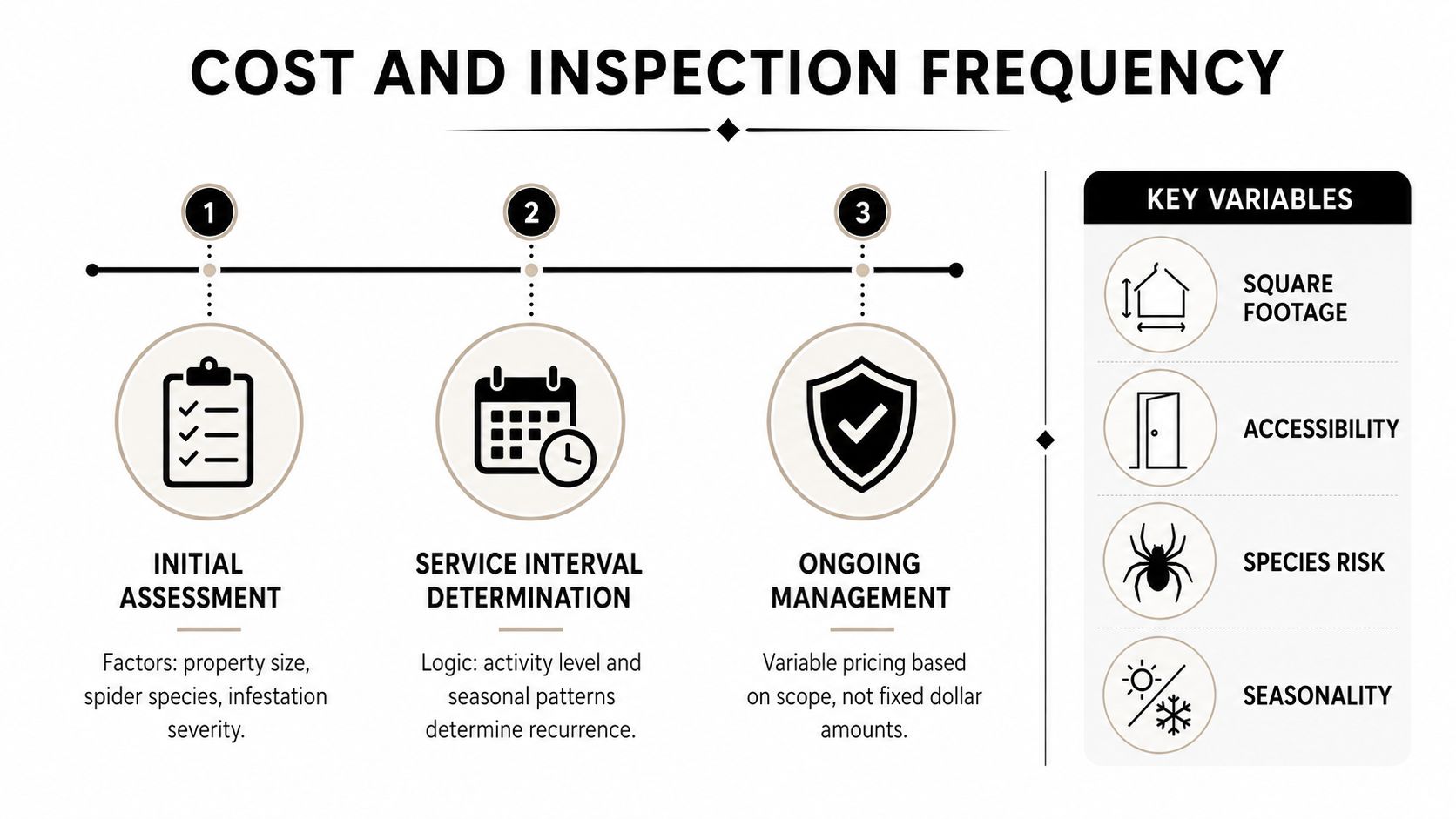
Bundling inspections into a quarterly pest program typically reduces the per-visit cost compared with standalone service, though the right model depends on the property and documented risk. The Green Advantage should explain which cadence fits the evidence and recommend the lightest effective approach rather than an unnecessarily aggressive schedule.
The Green Advantage Service Experience
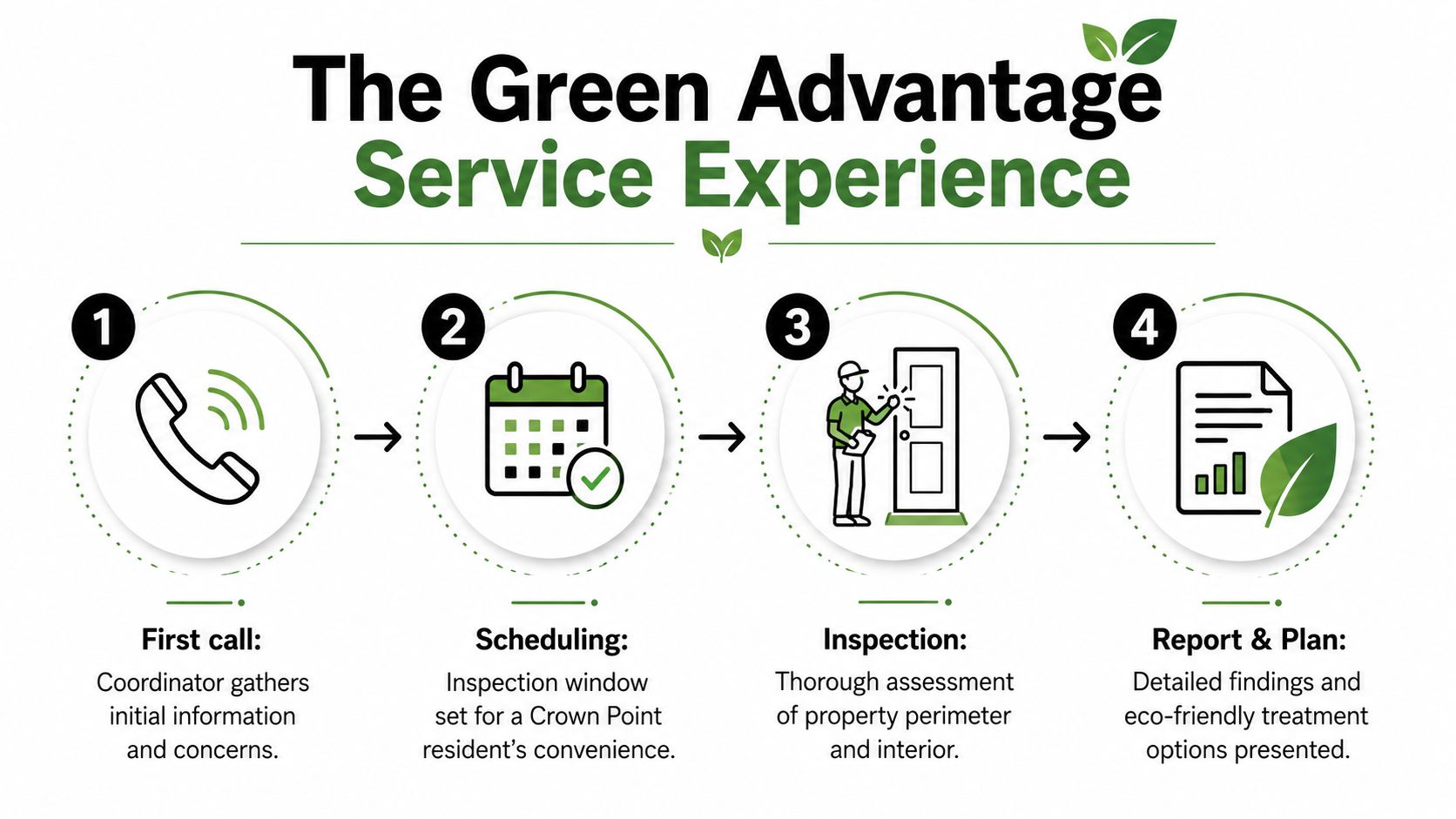
A concerned homeowner usually starts with a simple description, “The webs keep coming back in the basement,” or “There are spiders around the garage every morning.” The first call should turn that concern into useful inspection information. A coordinator can gather the locations, timing, visible signs, property features, and any related pest concerns before scheduling an inspection window that suits the Crown Point resident.
The visit starts with diagnosis
On arrival, the technician explains what will be examined and walks through the property systematically. Interior areas may include basements, stairwells, utility rooms, garages, storage zones, window wells, and accessible crawlspaces. The exterior review follows foundation lines, doors, windows, eaves, lighting, sheds, landscaping contact points, and possible entry gaps.
The technician isn't looking only for live spiders. They're also checking for webs, egg sacs, prey insects, moisture, clutter, damaged screens, worn weather stripping, and other conditions that could support recurring activity. That broader assessment helps separate a harmless outdoor visitor from a property condition that needs attention.
Findings become a plain-language plan
After the walkthrough, the homeowner should receive a clear explanation of what was found and what wasn't. Recommendations may include sealing entry points, moving wood or debris away from the foundation, reducing clutter, adjusting outdoor lighting, improving moisture management, adding glue board monitoring, or scheduling a follow-up check.
Treatment options should be discussed when evidence supports them. If the inspection finds only isolated outdoor activity, monitoring and maintenance may be more appropriate than immediate indoor treatment. If it finds recurring indoor signs, egg sacs, prey insects, or multiple active areas, targeted spider control and related pest management may make sense.
Keep the record useful after the visit
Written findings and photo records can make follow-up more consistent, especially for repeat customers, landlords, and commercial facilities. A documented location, condition, and recommendation gives the next technician a meaningful comparison instead of forcing the property owner to start from memory.
The Green Advantage provides pest inspections and spider-specific pest control for residential and commercial properties in Crown Point and nearby Northwest Indiana communities. Its service approach focuses on diagnosing the site, discussing environmentally mindful options, and keeping customers informed from scheduling through follow-up.
Prevention and Next Steps
A spider inspection becomes more valuable when homeowners use the findings to change the property. Sweeping webs can improve appearance, but it won't address a foundation gap, a damp storage area, or the insects gathering around an exterior light. Prevention works best when it reduces the shelter, access, and food conditions identified during the inspection.
Improve the exterior perimeter
Start outside, where many indoor problems begin. Keep firewood away from the foundation, trim vegetation off siding, clear leaf litter from corners and gutters, and remove debris that creates low, protected harborages. Review porch, garage, and outdoor lighting, especially fixtures that attract insects close to doors and windows.
Use the inspection record to prioritize repairs:
- Entry points: Replace damaged screens, install effective door sweeps, and caulk gaps around windows, doors, and utility lines.
- Moisture zones: Check downspout discharge, sump pump areas, crawlspaces, and damp foundation edges.
- Storage areas: Move boxes and seasonal items away from walls where practical, and avoid creating dense piles under decks or in sheds.
- Vegetation contact: Keep shrubs, grass, mulch, and branches from forming a continuous bridge against the structure.
These changes can also support broader residential pest control goals, including ant control, mosquito control, rodent exclusion, and seasonal pest prevention.
Make indoor spaces easier to monitor
Basements, garages, attics, and closets become easier to inspect when clutter is reduced. Store clothing, boots, decorations, and seasonal equipment in sealed bins instead of open piles. Manage humidity in crawlspaces and basements, and keep the areas around sump pumps and utility penetrations accessible for future checks.
A recurring web should be photographed and logged before it's removed. That small habit helps reveal whether the same location is active, whether several rooms are involved, and whether an exterior repair changed the pattern. Homeowners looking for additional property-specific ideas can review these Crown Point spider prevention techniques.
The most practical response isn't always an exterminator near me for an immediate spray. Sometimes it's observation, cleanup, and entry-point maintenance. When signs repeat across locations or consecutive checks, a professional spider inspection can identify the prey, harborage, moisture, and access conditions that DIY cleanup misses.
The Green Advantage offers spider inspections, residential pest control, commercial pest control, and environmentally mindful treatment options for properties in Crown Point, IN, and surrounding Northwest Indiana communities. Visit The Green Advantage to schedule an inspection or request a quote based on the activity pattern at your home or business.