
Professional termite treatment in the U.S. typically runs from a few hundred dollars for a small spot job to well over $5,000 for full-structure fumigation, with most homeowners paying somewhere in the $600 to $1,500 range. A Crown Point quote can land inside or outside that band depending on your home's construction, how far the infestation has spread, and the method the technician has to use.
If you're staring at a suspicious line on a basement beam, a soft spot near trim, or mud tubes along the foundation, the number on the estimate matters, but the structure behind it matters more. Termite treatment cost isn't a single price in Crown Point, IN, it's a property-specific number shaped by access, perimeter, species, and whether you need prevention or active remediation. The Green Advantage handles that kind of quote the right way, by inspecting the home first and pricing the property instead of tossing out a flat rate.
What Homeowners in Crown Point Should Expect to Pay
A Crown Point homeowner usually starts this search after noticing something small, maybe a damaged line on a basement beam or wood that sounds wrong when tapped. That's exactly when the price question becomes urgent, because early treatment and full remediation are two very different jobs.
At the national level, HomeAdvisor puts professional termite treatment between $263 and $1,033, with most homeowners paying about $621. Small jobs can run as low as $75, while large infestations can reach $1,750 or more, and other consumer guides push higher when the work moves from a perimeter job to whole-structure intervention (HomeAdvisor termite treatment cost guide).
A realistic way to read those numbers is simple, low-end pricing usually means a contained issue, while the high end usually means you're dealing with broader access problems, more labor, or a more disruptive method. For severe or whole-structure work, homeowners may end up in the $2,000 to $8,000 range or beyond, especially when fumigation or large-scale structural access is involved (HomeAdvisor termite treatment cost guide).
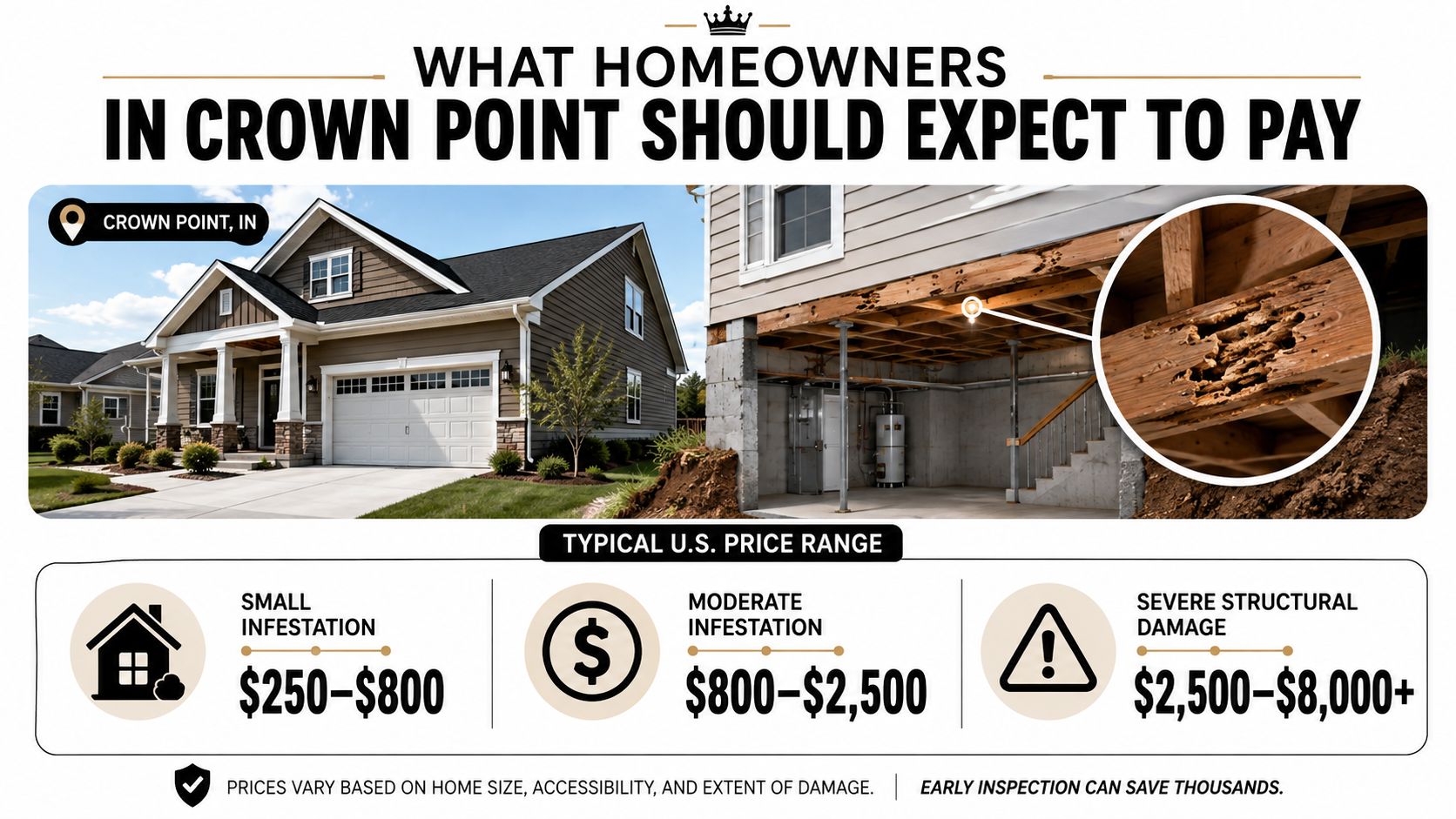
Practical rule: treat national averages as a starting line, not a quote. A Crown Point home with easy perimeter access and a limited issue won't price the same way as a house with a crawlspace, finished basement, or widespread damage.
For local homeowners, the right expectation is not “What does termite treatment cost?” It's “What kind of termite problem do I have, and what kind of access does my house force the technician to work around?” That's how a local provider builds a useful estimate instead of a number that looks good on paper and fails in the field.
Treatment Methods and Their Real Cost Ranges
Not every termite job is built the same, and the quote should tell you that immediately. If it doesn't, you're not buying clarity, you're buying confusion.
Liquid barriers and bait systems
For subterranean termite control, liquid soil treatments are commonly priced around $4 to $16 per linear foot, with installed totals often landing around $680 to $2,720 for a typical home (Angi termite treatment cost guide). Bait systems usually run a bit higher per foot, about $8 to $12 per linear foot, because you're paying for station hardware, installation, and ongoing monitoring instead of a one-time barrier alone (Angi termite treatment cost guide).
These are the workhorse options for homes where termites are coming from the soil, which is why the quote often tracks the foundation rather than the square footage. The disruption is moderate, trenching, drilling, or station placement can be visible for a short time, but it usually doesn't require the kind of shutdown that fumigation does.
| Method | Typical Cost | Best Fit | Disruption |
|---|---|---|---|
| Liquid soil barrier | $4 to $16 per linear foot | Active subterranean termite control | Trenching, drilling, and exterior access |
| Bait system | $8 to $12 per linear foot | Ongoing subterranean termite monitoring and control | Station placement around the perimeter |
| Spot or borate treatment | A few hundred dollars for contained cases | Small, localized activity | Limited access to the affected area |
| Whole-structure fumigation | $1,200 to $8,500+ | Severe or widespread drywood termite cases | High, the structure must be sealed |
| Heat or localized drywood treatment | Varies by area treated | Limited drywood infestations | Moderate to high, depending on access |
Spot treatment, heat, and fumigation
When the infestation is contained, a targeted approach can keep the bill down. Spot treatment and borate work are usually far cheaper than a full perimeter or whole-house solution because the technician is treating a specific void, wall area, or isolated section instead of the whole structure.
Drywood termite cases are a different animal. Whole-structure fumigation is commonly billed in the $1,200 to $8,500+ range and is often priced by cubic volume because the gas has to reach every enclosed airspace (Termite Specialist Authority cost guide). That's why the work feels expensive, it's not just a treatment, it's a building-wide process with sealing, tarping, labor, and compliance baked in.
For homeowners looking at service pages and trying to decode the sales language, The Green Advantage's termite treatment options page helps make the treatment choice easier to compare with the quote in front of you. The main thing to watch is whether the proposal is a one-time fix, a monitored system, or a full-structure response.
The Property Factors That Move Your Quote
Two homes with the same square footage can produce very different termite bids, and that's not a scam, it's geometry and access. The quote changes because the work changes.
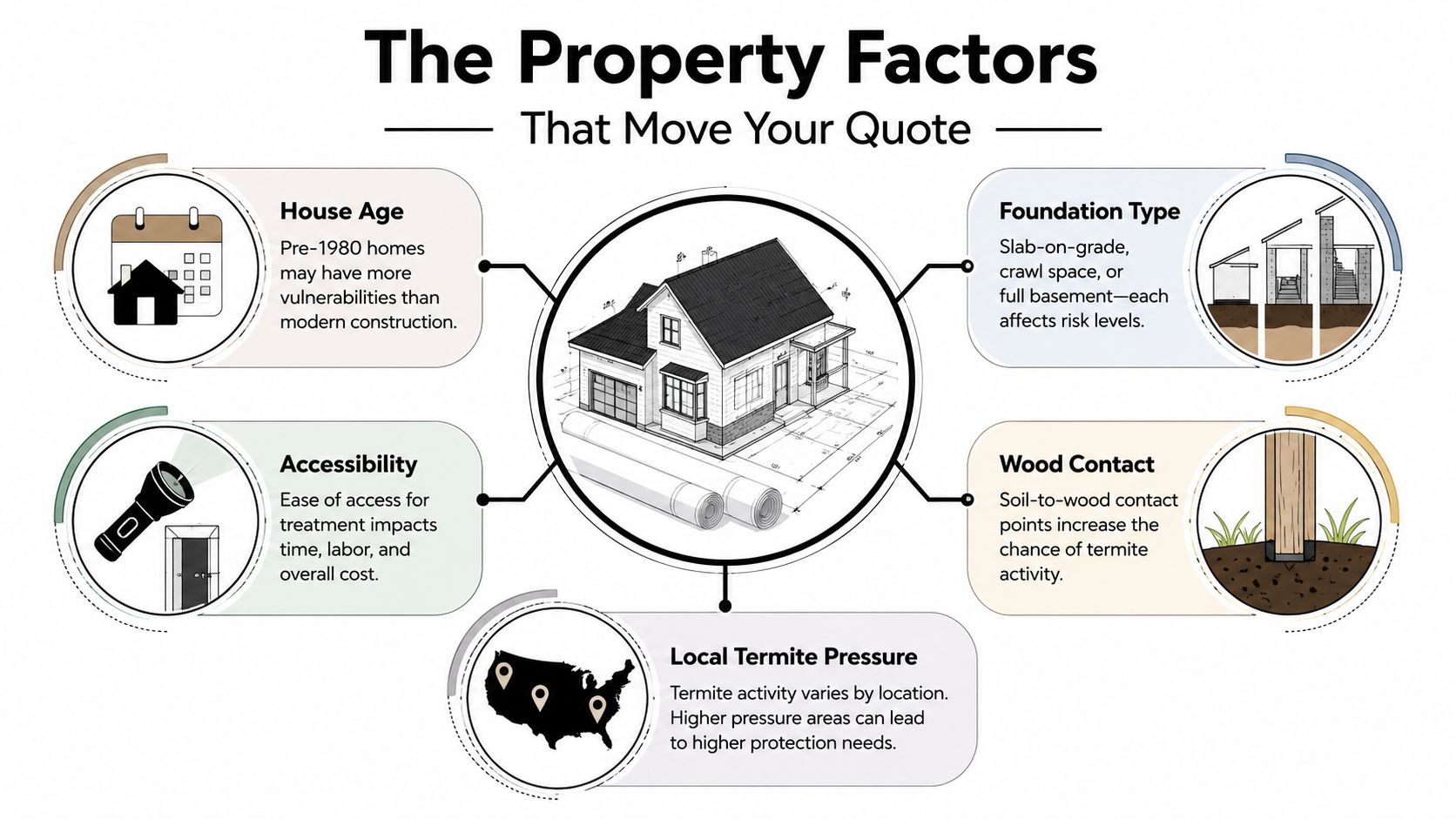
What actually changes the price
Perimeter linear footage matters first. Liquid barriers and bait systems scale with the foundation that has to be trenched, drilled, or monitored, so a house with a longer perimeter costs more even if it has the same living area as a simpler layout (Angi termite treatment cost guide).
Slab versus crawlspace construction changes labor. A crawlspace can make access easier in some situations, while a slab often means more drilling and more careful placement around the foundation. Infestation severity changes the job again, because a preventative barrier isn't priced the same way as active remediation. Species matters, too, subterranean termites are usually handled with soil or bait methods, while drywood termites may require fumigation, heat, or spot treatment.
Accessibility adds labor where homeowners don't always see it coming. Finished basements, hardscape, decks, and detached structures can make the technician work around more obstacles, and that extra time shows up in the quote.
One line to remember: if the company has to switch from a perimeter model to a structure-volume model, the price jump is usually real, not padded. That's why a “small” drywood problem can cost more than a bigger-looking preventative job.
For homeowners who are dealing with visible damage and wondering whether a structural report is needed alongside pest treatment, NW Claims Management's 2026 guide is a useful reference point for understanding when property documentation becomes part of the conversation. That's not a pest treatment substitute, but it does help frame the paperwork side when damage is already on the table.
DIY Products Versus Professional Service
DIY termite products look cheap for a reason, they don't do the same job as a real treatment plan. If you only need very limited preventative work on a small structure, or you're buying time because a professional service just isn't possible right now, the retail aisle can make sense. But it's not the same thing as having a trained technician treat the property.
Retail liquid termiticides, bait stations, and foams can cost from roughly $50 to several hundred dollars in product cost. That sounds appealing until you remember what you're giving up: inspection depth, correct species identification, and a full-coverage treatment plan.
The risk is simple. Misapplied DIY products can push termites into other areas of the structure instead of eliminating the problem, and most consumer-grade work comes with no meaningful service warranty or damage coverage. Professional service costs more upfront, but it usually includes the inspection, the right treatment choice, and a service structure that keeps you from guessing later.
If the problem is active, DIY is a gamble. If the goal is prevention on a small, manageable area, it can be a stopgap, not a finish line.
The decision comes down to risk tolerance and severity. If you're buying prevention, the DIY route can be a temporary option. If you're trying to solve an active termite problem in a Crown Point home, professional inspection and treatment are the smarter move.
The Real Long-Term Cost Most Quotes Don't Show
The cheapest first quote isn't always the cheapest treatment over time. That's the part most homeowners miss, and it's where bad comparisons happen.
Mississippi State notes that pricing depends on home size, slab versus crawlspace construction, bait versus liquid termiticide, and whether the contract includes damage repair or only retreatment, with rough estimates of $1,000 to $2,000 upfront and $200 to $300 annually for renewal (Mississippi State termite control questions). That's the math behind many termite contracts; the price you pay today is only part of the ownership cost.
Bait systems often shift more of the expense into recurring monitoring and renewal. Liquid barriers can look heavier upfront, but they may come with retreatment coverage that changes the value picture. Some contracts only cover retreatment, not damage repair, which means the treatment can work and the homeowner can still eat the repair bill if the damage is already there or if the contract excludes it.
A lot of homeowners compare bids the wrong way. They ask which number is lower instead of asking what the number includes, how long it lasts, and what happens if termites show up again.
Ask this directly: does the warranty cover new damage, retreatment only, or neither? If the answer is vague, the quote is too.
If you manage a rental or multiple properties, the same logic applies to property systems and service contracts. California rental pest management is a useful lens for understanding how recurring service terms affect the overall cost of keeping a building protected. Different market, same lesson, the contract matters as much as the first invoice.
How to Get an Accurate Local Estimate
A real estimate starts with a real inspection. Anything else is just a guess dressed up as a quote.
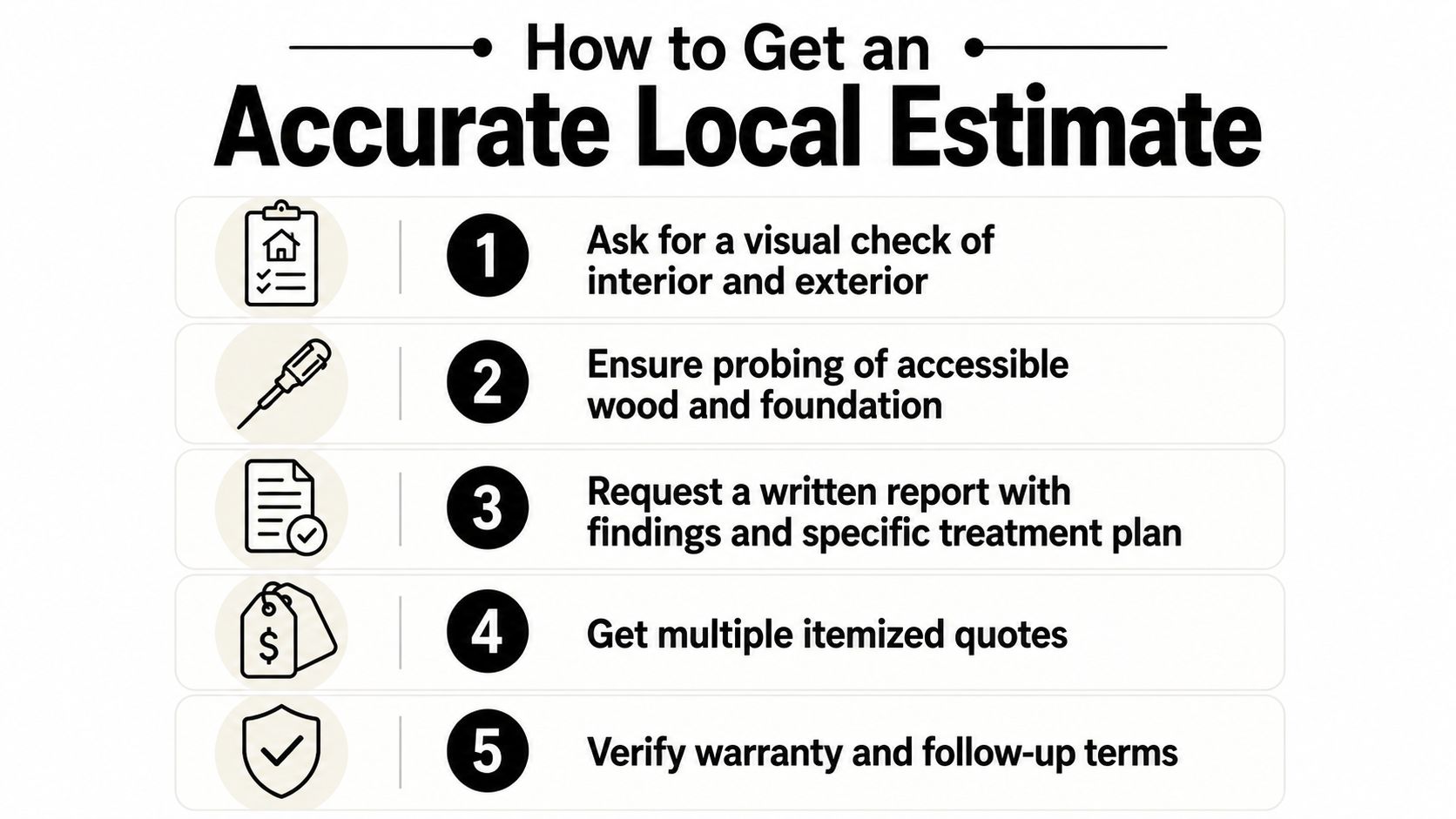
What the technician should check
A thorough inspection should include the interior and exterior, probing of suspicious wood, termite species identification, and a moisture check around likely entry points. If a provider skips those basics and jumps straight to a price, the quote is weak.
Before the appointment, have a few facts ready:
- Year built. Older homes often raise different access and repair questions than newer construction.
- Foundation type. Slab, crawlspace, and basement homes don't price the same way.
- Prior treatment history. A home that's been treated before may need a different approach.
- Recent renovations. New finished spaces, new decks, or concrete work can change access.
- Visible damage. Show the technician the spots that worry you most.
Ask the questions that separate a serious quote from a sales pitch:
- What's included in the price?
- What's excluded?
- What does the warranty cover?
- Are renewal terms required, and what do they change?
- Is this quote based on actual inspection findings or just square footage?
Good estimate, bad estimate: a quote based only on square footage is a starting point, not a final price. The perimeter, construction type, and severity can only be confirmed on site.
For homeowners comparing inspection costs and wanting a more exact local picture, The Green Advantage's termite inspection cost page gives a clearer view of how inspection-driven pricing works in practical application. In Crown Point and nearby Northwest Indiana towns, that's the only way to turn a rough range into a usable number.
Choosing a Provider and Your Next Step
The right provider doesn't just sell treatment, they match the method to the infestation and the contract to the timeline. That's the whole decision framework.
When you compare Crown Point exterminators, look for licensed and certified technicians, transparent written quotes, clear warranty terms, familiarity with Northwest Indiana construction, and direct communication from the office instead of a call center. Those details matter because termite work is part diagnosis and part execution, and sloppy communication turns both into a mess.
The cost outcomes are easy to summarize once you strip away the fluff. A few hundred dollars can cover an early spot job. Roughly $600 to $1,500 is where many professional residential treatments land. Severe or widespread drywood cases that require full fumigation can reach $2,000 to $8,000+ (HomeAdvisor termite treatment cost guide and Termite Specialist Authority cost guide).
That spread is why you should never sign a termite proposal before you know three things: what species you have, what method is being proposed, and what the warranty covers. If the provider can't explain those plainly, keep looking.
The Green Advantage schedules inspections with local homeowners in Crown Point, IN, and builds proposals around the property, not around a one-size-fits-all script. If you've seen signs of termite activity or you're comparing quotes right now, schedule an inspection, ask for a property-specific estimate, and get the warranty terms spelled out before you commit.
If you need a straight answer on termite treatment cost in Crown Point, The Green Advantage can inspect the property, identify the termite scenario, and give you a quote that fits the home instead of a guess based on square footage. Visit The Green Advantage to schedule an inspection and get clear next steps before the damage gets worse.