
You hear it first as a faint buzz near the lamp. Then one lands on your arm while you're watching TV, and another shows up in the bedroom right after you turn out the light. If you're dealing with mosquitoes inside your house in Crown Point, grabbing an indoor mosquito repellent spray feels like the obvious move.
Sometimes it is the right first move.
It just isn't the whole answer. Indoor sprays can knock down the mosquitoes you see. They usually don't fix why mosquitoes are getting inside in the first place, why they keep showing up, or why the problem returns after a few days. That's where homeowners lose time, money, and patience.
If you've been searching for pest control near me, exterminator near me, or pest control in Crown Point, IN, you're probably past the point of wanting another generic product roundup. You want a straight answer. Here it is. Use indoor mosquito spray for short-term relief, but don't mistake it for a complete mosquito control plan.
Battling Indoor Mosquitoes in Your Crown Point Home
A lot of indoor mosquito problems start the same way. A door opens after sunset. A torn screen goes unnoticed. Moisture builds up around the home, and mosquitoes stay active around entry points. Then they end up in the kitchen, the bathroom, or circling the living room window when you're trying to relax.
For Northwest Indiana homeowners, this gets frustrating fast because indoor mosquitoes feel personal. They're in your safe space. They're near your kids' rooms, your pets' bedding, your food prep area, and the places where you should be comfortable. So you spray the room, swat what you can, and hope that handles it.
Why the quick fix keeps disappointing
Indoor mosquito sprays can help, but they don't erase the conditions that let mosquitoes enter and linger. If entry points stay open, if resting spots remain untouched, or if mosquitoes are breeding outside and moving in, the problem keeps resetting.
Local reality: If you're spraying the same room over and over, the spray isn't your main problem. Your house is telling you mosquitoes still have access.
That matters in Crown Point because mosquito activity around homes often overlaps with broader pest issues. The same house that needs mosquito control may also benefit from residential pest control, screen inspection, moisture correction, and seasonal prevention around the exterior.
What homeowners should do next
Start by treating the indoor sightings seriously, especially if they keep happening. If mosquitoes are surviving long enough to bother you indoors, there is usually a reason.
A useful place to begin is learning how long mosquitoes can live inside a home. That helps you understand why one mosquito tonight can turn into several nights of frustration if the conditions are right.
If you're looking for an exterminator in Crown Point, IN, the smarter goal isn't just killing the mosquitoes you can see. It's stopping the cycle so your home feels normal again.
Understanding Indoor Mosquito Sprays and How They Work
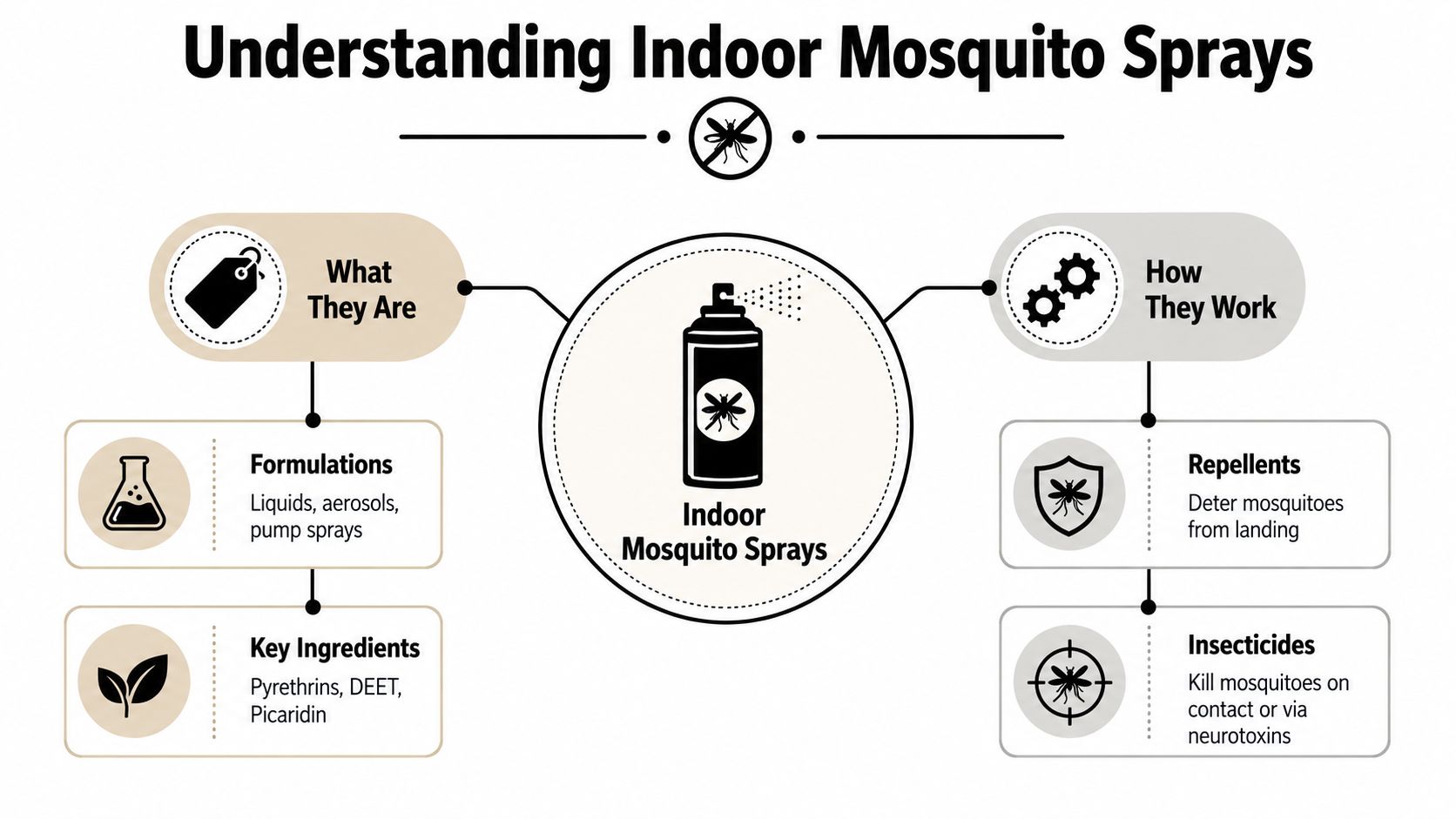
Most homeowners use the phrase indoor mosquito repellent spray to describe any product they spray inside the house. That's too broad. Some products repel. Some kill. Some do both poorly if they're used for the wrong job.
The two indoor spray categories that matter
The CDC separates indoor mosquito products into foggers or aerosols and surface sprays. Foggers and aerosols kill mosquitoes in the air. Surface sprays kill when mosquitoes land on treated indoor resting sites like under sinks, in closets, and behind furniture, according to CDC guidance on indoor spraying.
That distinction matters because mosquitoes indoors don't just fly around randomly. They rest. They hide in protected areas. If you only spray open air, you may knock down a few adults and miss the places where others settle.
Repellent versus insecticide
Homeowners also mix up repellents and insecticides, and that leads to bad expectations. Public health guidance treats those as different tools. A repellent is meant to keep mosquitoes away from you. An insecticide is meant to kill mosquitoes.
If you spray a personal repellent around a room and expect the product to eliminate the infestation, you're using the wrong tool for the job. If you use an indoor insect spray but ignore re-entry points, you're still leaving the door open to the next round.
Sprays work better when you match the product to the problem. Air knockdown for active flyers. Targeted treatment for indoor resting areas. Prevention at the entry points and around the home.
What this means in real homes
If you're standing in a store aisle comparing cans, keep this simple:
| Product type | Primary job | Typical use case |
|---|---|---|
| Fogger or aerosol | Kill mosquitoes in the air | Fast knockdown when mosquitoes are actively flying indoors |
| Surface spray | Kill on contact after landing | Treat indoor resting spots where mosquitoes settle |
| Personal repellent spray | Keep mosquitoes off skin | Bite prevention for people, not room-wide elimination |
The mistake I see most often is using one category and expecting results from another. That's why brand comparisons alone don't solve much. The issue isn't just what product you bought. It's whether the product matches the behavior of the mosquitoes in your house.
Safe and Effective Use of Mosquito Sprays Indoors
If you're going to use an indoor mosquito repellent spray, use it with discipline. A lot of DIY frustration comes from two bad assumptions. First, that more product means better protection. Second, that if a product is sold on a shelf, it must be safe to use however you want.
Neither is true.
Higher concentration doesn't automatically mean better results
For personal mosquito repellent sprays, the active ingredient concentration matters, but higher isn't always better. The Mississippi State Department of Health reports that DEET products are sold from about 5% to 100%, but 10% to 35% DEET provides adequate protection under most circumstances, and concentrations above about 50% don't provide significantly greater protection. It gives a practical example. 50% DEET provides about 4 hours of protection, while 100% DEET gives only about 1 extra hour according to the department's mosquito repellent guidance.
That should change how you shop. Stop chasing the strongest label just because it sounds tougher. For many homeowners, that's wasted exposure without a meaningful gain.
Indoor use needs a safety-first routine
The CDC's indoor spraying guidance says foggers or aerosols require occupants and pets to leave the home until the spray has dried. That's not a minor detail. It's the difference between proper use and careless use.
Use this checklist before you spray indoors:
- Read the label all the way through: Don't assume two products work the same way.
- Remove people and pets when required: If the label or product category requires vacancy, follow it.
- Keep sprays away from food areas: Kitchens, counters, utensils, and food storage need extra caution.
- Treat the right spots: Random spraying wastes product and increases exposure.
- Reapply only as directed: Overapplication doesn't create bonus protection.
If you're also trying to reduce residue concerns in a house with animals, this guide on what to use for pet-safe cleaning is a useful companion resource for handling the surfaces around your living space more carefully.
The label is not optional
Homeowners get into trouble when they improvise. They spray bedding, overuse products in closed rooms, treat the wrong surfaces, or mix products that were never meant to be combined.
Practical rule: Use mosquito products exactly where the label allows, exactly how the label allows, and no more often than the label allows.
If you need a broader primer on indoor application habits, this article on how to spray pest control in your home is worth reviewing before you start. Indoor spraying can be useful, but once you need to think this hard about location, drying time, people, pets, and surfaces, you can see the limit of DIY pretty quickly.
DIY Sprays vs Professional Mosquito Control Strategies
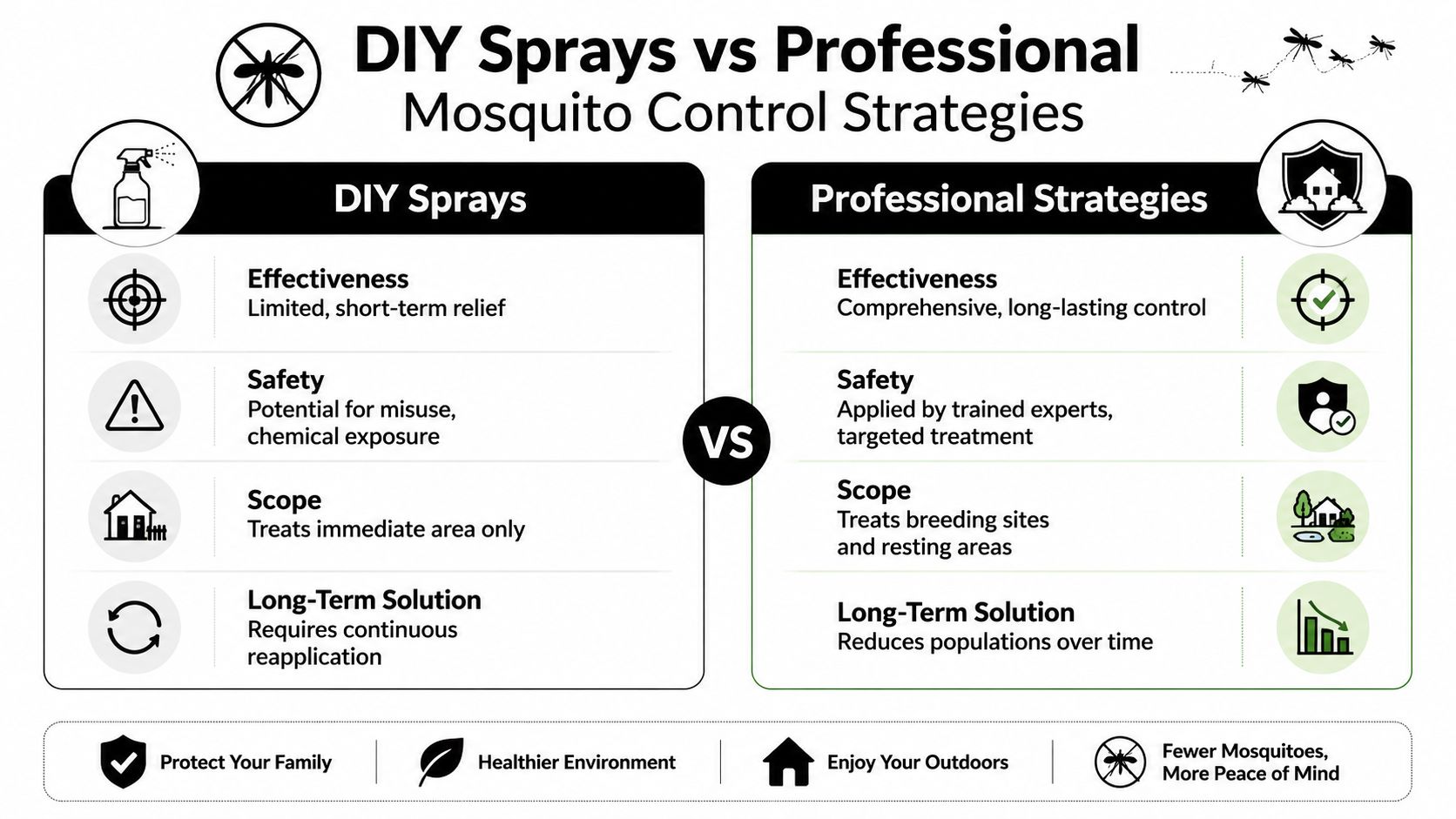
DIY indoor sprays have a role. They just have a narrow one. They help when you need immediate relief from mosquitoes already inside. They don't give most Crown Point homeowners what they want, which is fewer mosquitoes around the property and fewer mosquitoes getting indoors in the first place.
What DIY does well and where it stops
A can of spray is reactive. You see mosquitoes, so you spray mosquitoes. That can make the room better tonight.
Public-health guidance is clear that indoor spraying belongs inside a broader system. The American Mosquito Control Association says indoor use works best when combined with screened windows, air conditioning, and removal of standing water in its mosquito control guidance. That's the part too many homeowners skip.
Side-by-side comparison
| Issue | DIY indoor spray | Professional mosquito strategy |
|---|---|---|
| Immediate knockdown | Good for visible mosquitoes indoors | Good, plus evaluation of where mosquitoes are coming from |
| Root cause control | Weak | Stronger because the plan includes entry points, resting areas, and breeding pressure around the property |
| Consistency | Depends on homeowner timing and technique | Depends on inspection, targeted treatment, and follow-up |
| Safety burden | Falls on the homeowner | Managed through trained application and site-specific decisions |
| Long-term peace of mind | Limited | Better when the whole property is part of the plan |
A more complete strategy can include indoor assessment, exterior reduction, standing-water inspection, and recommendations on screens, doors, and moisture-prone areas. One available option in Crown Point is The Green Advantage, which provides mosquito reduction as part of broader pest management for local properties.
Here's a useful video if you want a quick visual overview before deciding how far to take DIY.
My recommendation
If you get the occasional mosquito indoors, use the right spray correctly and move on. If you're repeatedly buying products, reapplying, and still getting bit inside, stop treating this as a spray-shopping problem.
It's a control-plan problem.
When to Call a Pest Control Exterminator in Crown Point IN
A lot of homeowners wait too long to call. They keep testing one more aerosol, one more room spray, one more weekend cleanup. Meanwhile, the mosquitoes keep showing up.
The trigger point is straightforward. The CDC recommends hiring a pest control professional if mosquitoes persist after you've taken steps like using indoor sprays, fixing screens, and removing standing water, according to its guidance on mosquito control at home. That's the line between a manageable nuisance and a problem that needs diagnosis.
Clear signs it's time to stop experimenting
Call a professional if any of these sound familiar:
- Mosquitoes keep returning indoors: You knock them down, but new ones show up anyway.
- You already fixed the obvious issues: Screens, doors, and standing water have been addressed, but the activity continues.
- You're seeing them in multiple rooms: That usually points to a broader access or resting pattern.
- You want a whole-property solution: Indoor relief isn't enough if the source pressure outside remains high.
- You need confidence around family spaces: Bedrooms, bathrooms, kitchens, and pet areas require smarter treatment choices.
Why persistence matters
Persistent mosquitoes usually mean one of two things. Either they're continuing to enter the house, or they're surviving in overlooked areas connected to a larger property issue. Both problems call for inspection, not guesswork.
If you've already done the obvious work and mosquitoes are still winning, the next step isn't another can. It's a professional diagnosis.
For homeowners comparing service approaches, this overview of Effective mosquito management is a helpful example of what a broader mosquito-control mindset looks like. The key takeaway is simple. Serious mosquito problems don't respond well to isolated indoor spraying.
This is the moment that warrants a search for an exterminator in Crown Point, IN or pest control near me. Not at the first mosquito. At the point where repeated DIY effort isn't solving the problem.
Your Solution for a Mosquito-Free Home in Northwest Indiana
Indoor mosquito repellent spray has a place. It's useful for fast relief. It is not a complete defense for your home, and it shouldn't carry that burden by itself.
What protects your family better is a layered approach. Control the mosquitoes you find indoors. Reduce the reasons they get inside. Address conditions around the home that support them. Then keep pressure on the problem before it rebuilds. That's how homeowners move from constant swatting to real peace of mind.

If you're in Crown Point or nearby Northwest Indiana communities, don't treat mosquitoes as a one-room issue when they're clearly a property issue. The same home may also benefit from broader residential pest control, seasonal exterior treatments, spider control, rodent control, wasp removal, or prevention for other recurring pest pressures.
For homeowners budgeting and comparing service categories, Home Project Services' pest control guide can help you think through the bigger picture. Then take the next practical step and talk to a local team that can inspect the situation directly.
You don't need another summer of spraying the same corners and hoping for a different outcome. If mosquitoes are getting inside your home, fix the cause and take control of the whole problem.
If you're ready for a practical plan instead of another temporary fix, contact The Green Advantage to schedule a pest inspection or request a quote in Crown Point, IN and Northwest Indiana. Whether you need mosquito control, residential pest control, or help tracking down a recurring indoor pest issue, the goal is simple. Protect your home, reduce the stress, and make your space comfortable again.