
You notice ants along the baseboard, mosquitoes building up near the backyard, or spiders showing up in the corners of the garage. Your first thought is simple. You want them gone. Your second thought is just as common. You don't want to spray harsh products around your kids, pets, or the places your family uses every day.
That's where a lot of Crown Point homeowners start asking the same question: what is biological pest control, and can it work at home?
In plain English, biological pest control means using a pest's natural enemies to help reduce the pest population. Instead of relying only on broad chemical treatments, this approach uses living organisms or habitat-based strategies to put pressure on the pest in a more targeted way. It's not a gimmick, and it's not new. Professionals have used these principles for a long time in agriculture, grounds management, and integrated pest programs.
For homeowners in Northwest Indiana, that matters because pest control doesn't have to be a choice between doing nothing and using the strongest product on the shelf. There's a middle ground. It starts with understanding how nature already controls pests, then applying that science carefully around real homes, real yards, and real families.
A Smarter, Safer Approach to Pest Control in Crown Point IN
A homeowner in Crown Point might spot aphids on garden plants, deal with mosquitoes near standing water, or wonder why ant activity keeps returning after a quick store-bought treatment. The frustrating part isn't just the pest itself. It's the feeling that every option seems too weak, too harsh, or too temporary.
Biological pest control offers a different way to think about the problem. Instead of asking, “What can I spray to kill this right now?” the better question is often, “What naturally keeps this pest in check, and how do we support that safely?” That shift matters for families who want residential pest control that's effective without treating the home like a chemistry experiment.
One reason this approach gets serious attention is scale. Augmentative biological control is already used across approximately 16 million hectares worldwide, which shows it's a real, large-scale strategy rather than a niche idea, as reported in this peer-reviewed review of biological control use.
Practical rule: Biological control isn't about releasing random bugs and hoping for the best. It's about matching the right natural enemy, habitat, or treatment strategy to the pest you actually have.
Around Northwest Indiana, that often connects with broader outdoor care choices too. If you're trying to reduce pest pressure in a more natural way, resources like Barefoot Organics for healthy, pest-free lawns can help homeowners think about how lawn health, moisture, and plant stress all affect pest activity.
For people searching pest control near me, exterminator near me, or pest control in Crown Point, IN, this matters because the safest plan isn't always the simplest one. Good pest control starts with diagnosis, not guesswork. That's especially true when you want a solution that protects your home and still respects the people and pets living in it.
Understanding Nature's Pest Control Agents
Biological pest control works because pests already have enemies in nature. The trick is knowing which natural enemy matters, what pest it affects, and whether that relationship helps in a home or outdoor area.
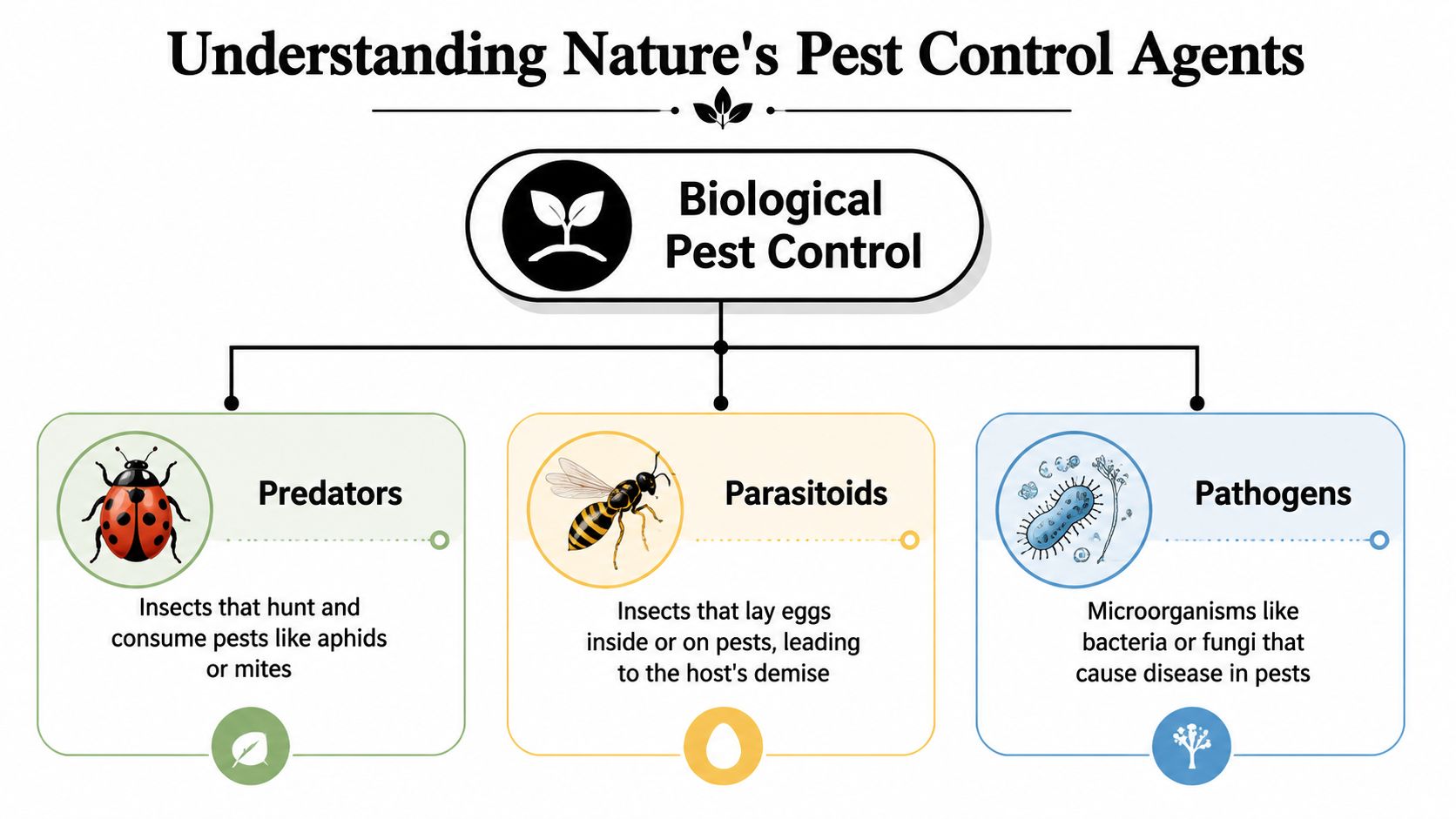
Predators that hunt pests
Some beneficial organisms are straightforward. They hunt and eat pests. Lady beetles feeding on aphids are the classic example people know, but the larger lesson is simple. A predator lowers pest numbers by consuming them directly.
For a homeowner, that's an easy mental model. Think of predators as the yard's built-in patrol team. When conditions support them, they help keep certain pest populations from taking off.
Parasitoids that target a host
Readers often get confused because the word sounds technical. A parasitoid is usually a small insect, often a wasp, that uses another insect as a host. Over time, that host dies.
It sounds intense, but it's a natural pest-control relationship, not a horror movie. In practical terms, these organisms can be highly targeted, which is one reason professionals pay attention to them.
Some of the most effective biological control agents are tiny enough that homeowners never notice them, even though they may be helping reduce pest pressure in the background.
Pathogens that make pests sick
The third group includes pathogens, which are microorganisms such as bacteria or fungi that cause disease in pests. These aren't the same as tossing chemicals at every insect in sight. They're part of a more selective biological approach.
That's one reason “natural” doesn't mean casual. A pathogen-based product still has to be chosen correctly, applied correctly, and used where it makes sense.
Three different game plans
Biological pest control also has three core operating models: classical, augmentative, and conservation, as outlined in this overview of biological pest control methods. Those terms describe how professionals use natural enemies, not just what kind of organism they are.
- Classical control involves importing a natural enemy for a pest problem.
- Augmentative control means releasing more beneficial organisms to boost what's already available.
- Conservation control focuses on protecting and supporting the beneficial organisms already present.
If you want a homeowner-friendly example of how food webs shape pest pressure, Magic Eagle's tick control insights offer a useful look at animals that naturally interact with tick populations.
For homes and outdoor areas, the most useful question isn't “Are beneficial insects good?” It's “Which biological tool fits this exact pest problem?” If you want a practical local overview of that kind of approach, natural pest control for home is a helpful place to start.
How Professionals Implement Biological Pest Control
Knowing what biological control is helps. Knowing how professionals use it is what turns the idea into a real pest management plan.
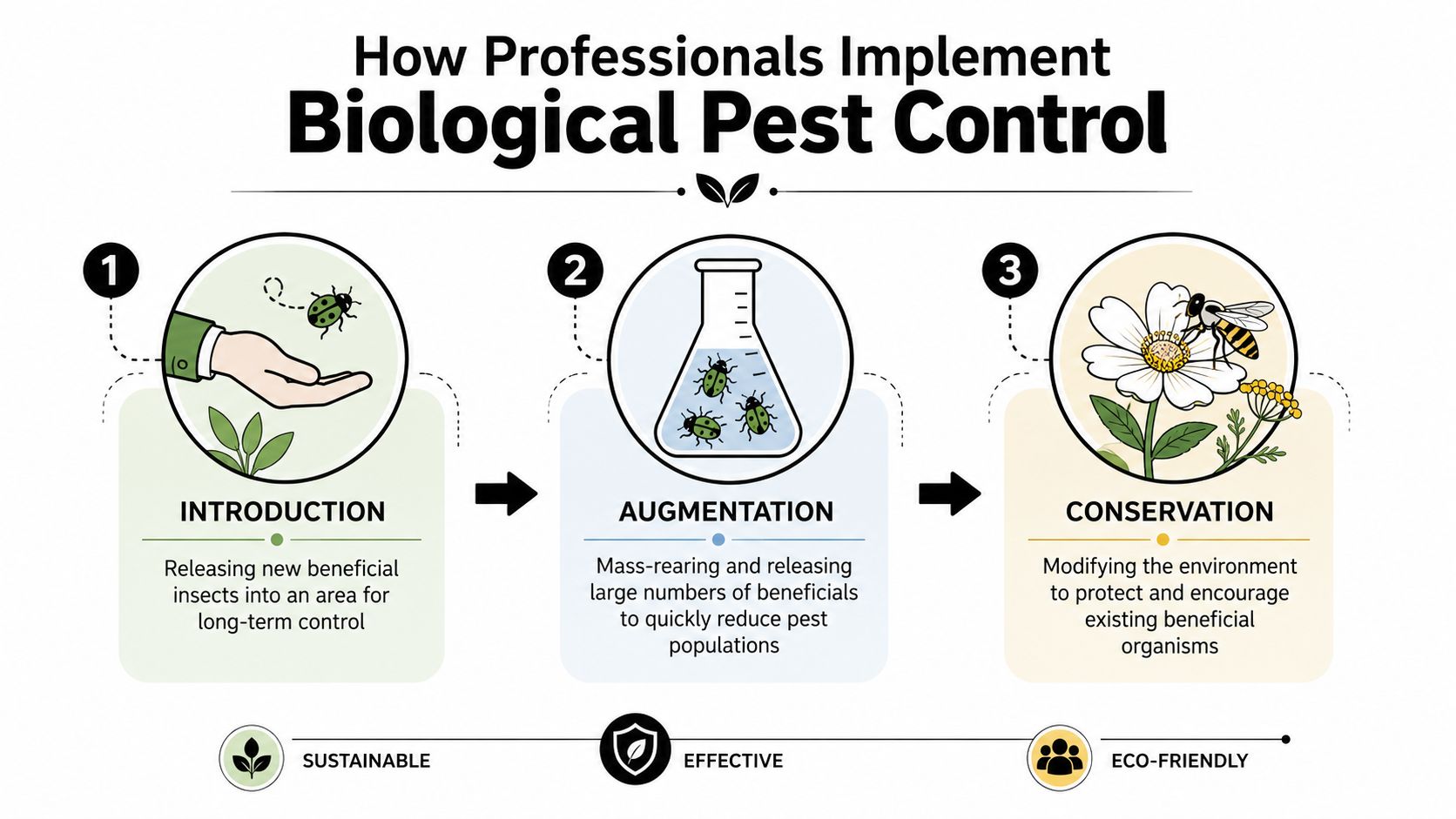
Introduction for long-term pest problems
Sometimes a pest isn't well controlled by the local environment. In those situations, professionals may look at introduction, also called classical biological control. This is not a homeowner DIY project. It's a specialized, regulated strategy used in narrow circumstances and handled at a professional or institutional level.
For most readers in Crown Point, the important takeaway is this. Not every biological solution means buying a box of beneficial insects online. Some forms are highly technical and far outside normal home treatment.
Augmentation when extra help is needed
Augmentation means increasing the number of beneficial organisms to improve pest suppression. This is often the method people picture first when they hear about biological control.
According to technical guidance from extension sources, augmentative releases work best when matched to the pest. They're most effective against slow-moving pests like aphids and mites, and success drops when broad-spectrum pesticides kill the beneficials you're trying to establish, as explained in this extension guidance on biological control.
That's why professionals don't just ask what pest is present. They ask:
- How fast does it reproduce
- Where is it active
- Is it exposed or hidden
- Has the site recently been treated with broad-spectrum products
Conservation by changing the environment
Conservation biological control is often the most practical concept for homeowners. Instead of importing or releasing large numbers of organisms, the goal is to make the property less disruptive to beneficial species that already help control pests.
That can include reducing unnecessary broad-spectrum applications, improving ecological balance, and paying attention to how moisture, excess plant growth, and hiding spots affect pest populations. In many cases, the smartest pest plan isn't “more product.” It's a better environment.
If a treatment wipes out the beneficial organisms along with the pest, the pest often comes back faster than the natural enemies do.
This is one reason integrated planning matters. A service approach that combines inspection, pest identification, exclusion, and targeted treatment is usually more dependable than a one-step fix. Homeowners who want that broader framework can learn more about integrated pest management, which brings biological, physical, and chemical tools together based on the site.
Benefits and Limitations Compared to Chemical Treatments
Biological control has real advantages, but a trustworthy explanation also needs to cover where it can fall short. Homeowners deserve a clear comparison, especially when choosing between immediate knockdown and longer-term prevention.
Side-by-side comparison
| Feature | Biological Control | Chemical Control |
|---|---|---|
| Primary approach | Uses living organisms or habitat support to suppress pests | Uses pesticide products to kill or repel pests |
| Targeting | Often more selective when properly matched to the pest | Can be broad, depending on the product |
| Impact on beneficials | Can support beneficial organisms if managed carefully | Broad-spectrum products may harm helpful organisms too |
| Speed | May take longer to show full effect | Often faster for immediate knockdown |
| Long-term role | Can support ongoing suppression in a broader IPM plan | May need repeated applications if root causes remain |
| Complexity | Requires close matching of pest, timing, and environment | Often simpler to apply, but not always simpler to manage long term |
| Homeowner fit | Best when guided by inspection and strategy | Useful when fast action is necessary |
Where biological control stands out
One of the strongest arguments for biological control is long-term value. New Jersey's Department of Agriculture notes that a 1965 U.S. presidential science review concluded that every $1 spent on biocontrol research and development returned about $30 in benefits, which is one reason biological control remains important in pest management strategy, according to New Jersey's overview of biological control.
For homeowners, that doesn't mean every pest issue should be handled biologically. It means biological control has a long track record as a practical tool, not just an eco-friendly talking point.
Where chemical treatments still matter
Some infestations need quick suppression. Wasp issues near entry points, active rodent problems, or a serious indoor pest situation may require a more direct treatment response. A good pest professional won't force every problem into the same method.
That's especially important with termite control, rodent control, or urgent stinging insect concerns. In those cases, speed, access, and safety can outweigh the slower pace of a biology-first plan.
The right question isn't “biological or chemical?” It's “What solves this pest problem with the least disruption and the most control?”
That balanced view is what builds trust. A strong residential pest control or commercial pest control plan in Crown Point should use the tool that fits the pest, the property, and the people living or working there.
Biological Pest Control for Northwest Indiana Homes
A home in Crown Point doesn't have the same pest pressures all year. Spring moisture, summer mosquitoes, fall invaders, and sheltered winter activity all change what works. That's why local knowledge matters so much.
Where these ideas show up around the home
In Northwest Indiana, biological principles often connect to pest issues such as:
- Mosquito pressure outdoors by targeting breeding areas and using selective strategies where they fit
- Ant activity around landscaping by reducing favorable conditions and avoiding disruption that can make rebounds worse
- Spider populations in garages and exterior corners by changing the environment that supports the insects spiders feed on
- Aphids and mites on ornamentals where beneficial organisms may play a role if the site and timing are right
This is also where homeowners need a caution flag. Some people hear “biological control” and assume they should order non-native beneficial organisms online and release them around the property. That's not a safe shortcut.
Why professional oversight matters
The risk and regulation side is important. Introducing non-native biological control agents is a highly regulated process that requires extensive quarantine and testing by agencies like the USDA, as described by USDA APHIS biocontrol guidance. That's one reason classical biological control is strictly for professionals and institutions working within regulation.
For a homeowner in Crown Point, the practical message is simpler. Good biological pest control is local, targeted, and informed by the property itself. It depends on what pest is present, what's attracting it, what season you're in, and whether the environment supports a stable solution.
That local lens is why one-size-fits-all pest control rarely works well in Northwest Indiana. A wet backyard, dense shrubs near the foundation, cluttered garage edges, and untreated entry gaps all create different pest opportunities. The best results come from reading those conditions correctly and building the response around them.
Trust The Green Advantage for Your Pest Control Needs
Biological pest control sounds simple on the surface. Let nature handle the pests. In reality, it takes knowledge to use it well. Someone has to identify the pest, understand its life cycle, decide whether biological methods fit the situation, and know when another treatment is the safer choice.
That's why homeowners searching exterminator in Crown Point, IN, pest control near me, or commercial pest control usually benefit from a full inspection rather than a quick guess. Ants, mosquitoes, rodents, spiders, and stinging insects all create different risks for families, buildings, and outdoor spaces.
The Green Advantage provides pest inspection and treatment planning for homes and businesses in Crown Point and nearby Northwest Indiana service areas. In practice, that means looking at the full picture. Entry points, moisture, sanitation, pest biology, seasonal pressure, and the right balance between biological, mechanical, and conventional tools.
A safer pest plan starts with an accurate diagnosis. You can't choose the right control method until you know exactly what you're dealing with.
If you've been trying to figure out what biological pest control is, the short answer is this. It's a science-based way to manage pests by working with natural enemies and ecological balance instead of relying only on broad chemical force. Used correctly, it can be part of a smart, family-conscious pest strategy. Used casually, it can disappoint or create new problems.
That's why professional guidance matters for pest control in Crown Point, IN. The goal isn't just to remove pests today. It's to protect your home, reduce repeat issues, and give you confidence that the treatment plan makes sense for your property.
If pests are taking over your home, yard, or business, contact The Green Advantage to schedule an inspection or request a quote. You'll get a practical plan built for your property in Crown Point and Northwest Indiana, with clear recommendations for safe, effective pest control that fits your family's needs.