
You find the issue when your house is supposed to feel calm. Ants show up on the kitchen counter before school. A wasp nest appears over the patio the day you plan to have people over. At night, you hear scratching in the wall and start wondering what is in there.
The search usually starts fast with pest control near me or exterminator near me. The hard part comes a few minutes later. Now you have to decide who should inspect your home, apply products safely around food areas, kids, and pets, and fix the problem instead of stirring it up for a week and letting it return.
Certification is part of that decision.
A certified pest control operator has training, state oversight, and a legal responsibility to handle pest problems the right way. For a homeowner in Crown Point, that shows up in practical ways. The inspection is more thorough. The pest is identified before treatment starts. The products, placement, and timing are chosen for the site instead of pulled from a one-size-fits-all routine.
That difference protects more than the house. It reduces the risk of misapplied pesticides around baseboards, kitchens, pet areas, and entry points. It also improves the odds of getting control the first time, because the work is based on pest biology, entry conditions, moisture issues, nesting habits, and seasonal pressure in Northwest Indiana.
Local experience matters too.
Ants, mosquitoes, rodents, wasps, spiders, and termites do not behave the same way in Crown Point from spring through fall, and they definitely do not respond to the same treatment plan. A certified operator knows when a line of ants points to a moisture issue, when mosquito activity calls for source reduction as well as treatment, and when scratching in a wall needs a proper inspection before anyone reaches for a product.
Homeowners are not just paying for someone to spray. They are paying for judgment, safe handling, and a treatment plan that fits the pest and the property. That is the true value behind certification.
Pests in Crown Point and Finding a Pro You Can Trust
A lot of service calls start with a homeowner who's already tried something from the store.
They've sprayed the baseboards for ants, hung a wasp trap near the deck, or put a few bait stations in the garage for mice. Sometimes that slows activity down for a few days. Sometimes it makes the problem look gone when it really isn't. Then the pests come back, often in a different part of the house.
That's the moment when people start searching for exterminator in Crown Point, IN and trying to figure out who's legitimate.
What homeowners are really asking
Clients aren't just asking, “Who can kill this pest?”
They're asking different questions underneath that one:
- Is this safe around my family and pets
- Will the treatment work
- Am I paying for a real solution or a temporary patch
- Does this company understand the kinds of pest issues we get in Crown Point and the rest of Northwest Indiana
Those are fair questions. Pest problems are stressful because they affect comfort quickly. A line of ants in the pantry feels invasive. A yellowjacket nest near the front walk changes how you use your own yard. Rodent activity in an attic or crawlspace can keep people awake at night.
Homeowners don't need someone who sounds convincing. They need someone who can identify the pest, explain the cause, and choose a treatment that fits the site.
The difference between help and qualified help
A handyman might seal a gap. A general maintenance person might knock down a visible nest. Those actions can help in a narrow sense.
But certified pest control operators are trained to look at the full problem. They inspect entry points, moisture conditions, harborage areas, product selection, label compliance, and follow-up needs. They also understand when a pest issue is part of a larger pattern, such as recurring ant pressure from grading and mulch contact, or mosquito activity tied to standing water and dense vegetation.
That's why choosing a professional matters so much more than choosing the lowest price. The wrong treatment wastes time, delays control, and can create unnecessary exposure without solving the infestation.
For residential pest control and commercial pest control in Crown Point, trust should be built on credentials, inspection quality, and clear communication. If a company can't explain what they found, why it's happening, and what the plan is, keep looking.
What a Certified Pest Control Operator Actually Does
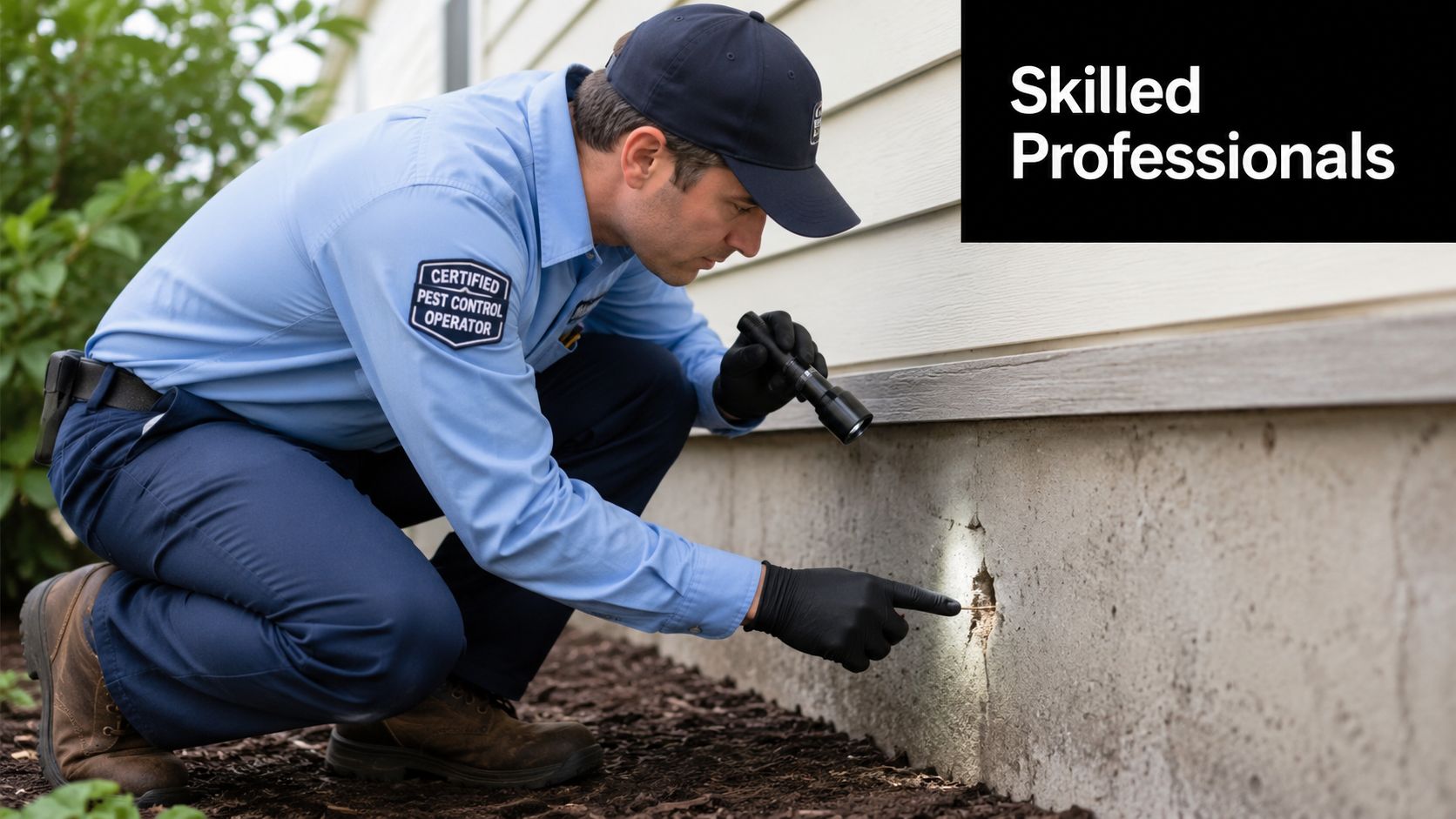
A certified operator starts by slowing the problem down.
Homeowners in Crown Point often call after trying the obvious fix. They sprayed the ant trail under the sink. They knocked down the wasp nest by the garage. They put out a few mosquito treatments from the hardware store. The pressure comes back because the visible pest was only part of the problem.
A certified operator is trained to identify the pest, inspect the site, choose a legal and appropriate treatment, and explain how to keep the issue from returning. That work protects more than comfort. It affects where products can be used, how exposure is limited around children and pets, and whether the service solves the source instead of chasing symptoms.
Inspection first, treatment second
A strong visit usually includes checking:
- Foundation lines and entry points where insects and rodents can get inside
- Moisture-prone areas such as basements, crawlspaces, sump areas, and plumbing penetrations
- Exterior conditions like stacked firewood, mulch against siding, clogged gutters, and vegetation touching the home
- Signs of activity such as droppings, trails, nesting, rub marks, frass, or insect debris
That inspection stage is where certification shows up in real life. The operator has to know whether the small ants in the kitchen are odorous house ants, pavement ants, or carpenter ants, because the treatment plan changes with the species. The same is true for mosquitoes. Some yards need targeted reduction around harborage and standing water. Others need a broader plan that starts with drainage, gutter correction, or trimming heavy vegetation.
For homeowners who want a closer look at the service process, this guide on what pest control companies do gives a useful overview.
The job involves judgment, safety, and accountability
Certified operators do more than apply products. They read labels, measure application rates, watch for sensitive areas, and document what was used and where it was applied. In a family home, those details matter.
A treatment around a play area, a dog run, a vegetable garden, or a kitchen cannot be approached carelessly. Product choice, placement, timing, and follow-up all have to fit the site. In Northwest Indiana, that often means balancing quick relief with long-term correction for recurring ants in spring, stinging insects in summer, rodents in colder months, and mosquito pressure during humid stretches.
A good operator also knows when chemical treatment should be limited or supported by other steps. Sealing a mouse entry point, correcting a moisture issue behind a bathroom wall, or removing leaf clutter from a shaded foundation can do more than another round of spray.
Here's a short look at the field in action:
What works and what usually doesn't
The strongest pest control programs use inspection, exclusion, habitat correction, monitoring, and targeted treatment together.
A few examples:
| Situation | What usually works | What usually fails |
|---|---|---|
| Ants in kitchen | Identify the species, trace entry routes, use targeted materials, reduce food and moisture sources | Repeated over-the-counter surface spraying |
| Rodents in garage or attic | Seal gaps, place traps and devices correctly, monitor activity, address food sources | Setting random traps without exclusion |
| Mosquito pressure in yard | Reduce breeding sites, trim dense harborage, use targeted service where needed | Treating blindly without addressing standing water |
| Wasp activity near entry doors | Treat the active nest safely, inspect nearby voids and repeat sites | Knocking nests down without dealing with live insects |
Practical rule: If the plan is just to spray every surface and leave, keep looking.
Understanding Pest Control Certifications and Licensing
Certification sounds abstract until you break it down into the parts that protect a homeowner.
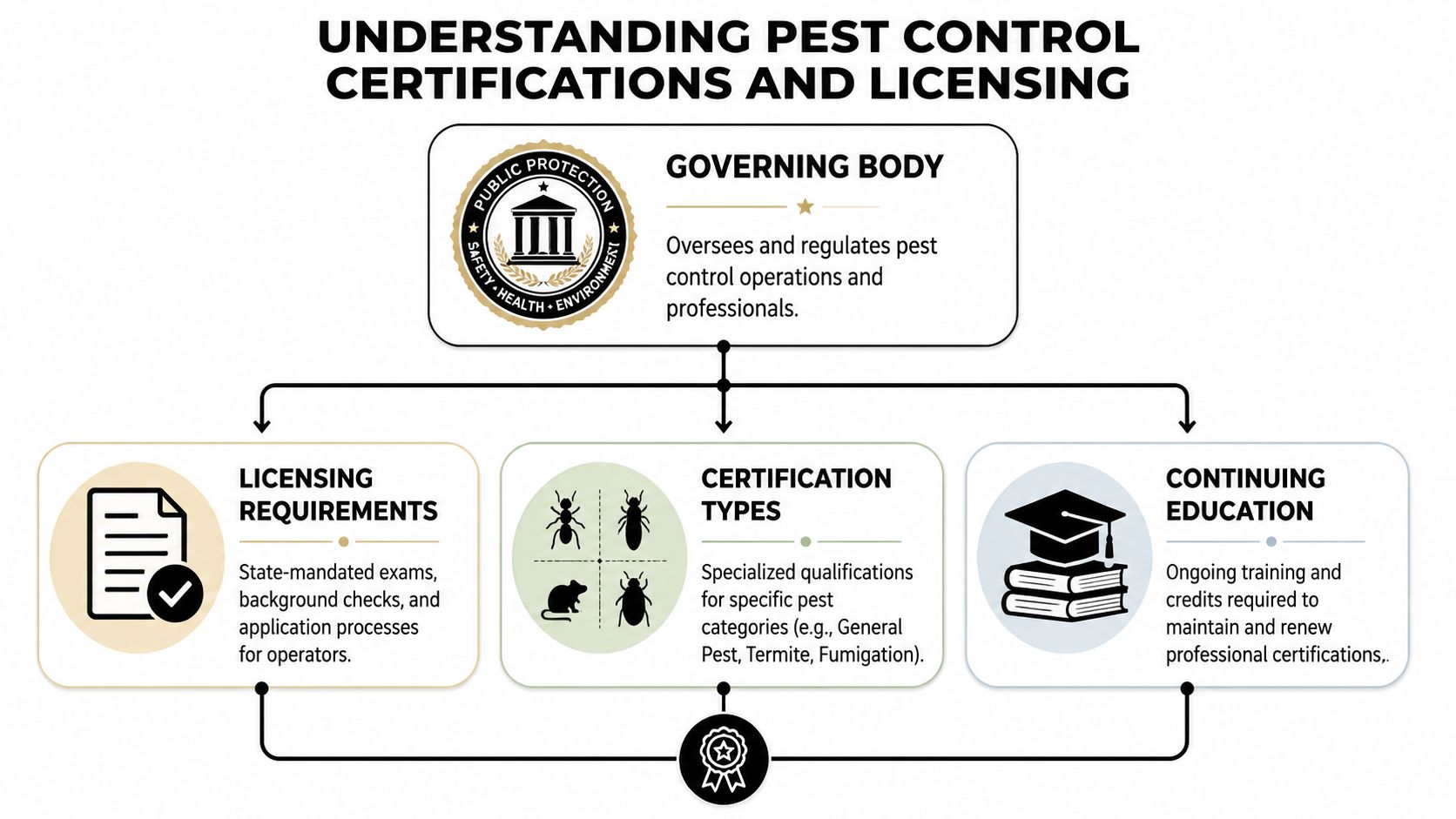
Certification means the person responsible for pest control work has met formal standards for experience, testing, and ongoing renewal. That's important because pest control involves product handling, legal restrictions, recordkeeping, and treatment decisions that affect health and property.
What certification typically requires
A good benchmark comes from Georgia's certified operator model. Applicants need at least two years of verifiable structural pest control experience within the last five years, or a related degree plus one year of actual service experience in that same period. They must pass the core exam plus a category exam. Each exam category costs $45, the credential fee is $100, and certification lasts for a five-year period. Renewal requires continuing education or reexamination, including 25 credits for Household Pest Control and 12 credits for Fumigation, according to Georgia's certified operator license requirements.
That's a useful example because it shows how the trade is built. It isn't one quick test and done. It's field work, exams, category knowledge, and renewal over time.
Exams are about judgment, not memorization alone
In many places, applicants must pass both a core pesticide safety exam and a category-specific exam. Some jurisdictions require a 75%+ passing mark on each module. In Ontario, the certification course also has to be completed within the last 12 months before applying, as described in the Ontario exterminator certification guide.
That matters because current knowledge counts. Labels change. best practices change. Pest pressure changes. A person who hasn't stayed current may still sound experienced while missing newer safety or treatment standards.
Certification should be viewed the way homeowners view electrical or plumbing credentials. It's proof that someone is allowed to do regulated work and expected to stay competent.
Why there are layers of responsibility
Homeowners sometimes assume the person at the door and the person legally responsible for the work are always the same person. Sometimes they are. Sometimes the technician performs service under the supervision of a certified operator who oversees the program, approves methods, and ensures compliance.
That layered accountability is a strength, not a flaw. It means there's a structure behind the visit.
Here's the simple version:
- Technician or applicator handles field service, inspection details, and treatment execution.
- Certified operator holds responsibility for category knowledge, supervision, and compliant service decisions.
- The company maintains licensing, records, and operational standards.
When you hire a firm for pest control in Crown Point, IN, you want all three parts to be in place. That's what separates a real professional operation from someone doing side work with store-bought materials and no oversight.
Key Benefits of Hiring a Certified Pro for Your NWI Home
Certification matters most when it changes the outcome for your household. For a homeowner in Northwest Indiana, that usually comes down to three things. Safety, effectiveness, and peace of mind.
Safer handling around people, pets, and property
Some products and use categories carry tighter rules for a reason. Government guidance in several markets requires certified applicators for restricted-class pesticides and limits assistant applicators to supporting certified applicators in application, transport, storage, and security, according to British Columbia pesticide certification and training guidance.
That tells homeowners something practical. Certification is not just personal knowledge. It's a workflow control. It affects who can handle what, who supervises whom, and how materials are stored and applied.
In everyday terms, a certified professional is more likely to make disciplined choices such as:
- Using targeted placement instead of broad, unnecessary application
- Reading site conditions carefully before treating near pet areas, food zones, or play spaces
- Choosing the right formulation for the location rather than using the same approach everywhere
Better diagnosis means better control
A lot of failed pest work comes from treating the visible symptom and missing the reason the pests are there.
That's common with ant control, rodent control, and spider control. A homeowner sees activity in one room, treats that room, and wonders why the problem returns. The certified pro is trained to work backwards from the evidence. Where are they getting in. What are they feeding on. What conditions are helping them stay. What treatment reaches the source instead of only the traffic path.
That's also why termite control, wasp removal, and mosquito control should never be approached casually. Each one has its own safety concerns and service logic.
Less guesswork, less stress
Good pest control should make your life simpler.
You should get a clear explanation of what was found, what the plan is, what preparation is needed, and what kind of follow-up makes sense. You shouldn't feel pushed into a one-size-fits-all package or a vague promise that “everything will be sprayed.”
The best service call often feels calm, not dramatic. The operator identifies the issue, explains the plan in plain language, and leaves you knowing what happens next.
For homes in Crown Point, that kind of clarity matters because many pest issues are seasonal, recurring, or tied to exterior conditions. A trained professional helps you solve the current problem and reduce the chance of the next one.
Your Checklist for Hiring a Pest Control Operator in Crown Point
When you're comparing residential pest control or commercial pest control options, don't judge by price alone. Ask better questions.
A strong company should be comfortable answering them.
What to verify before you hire
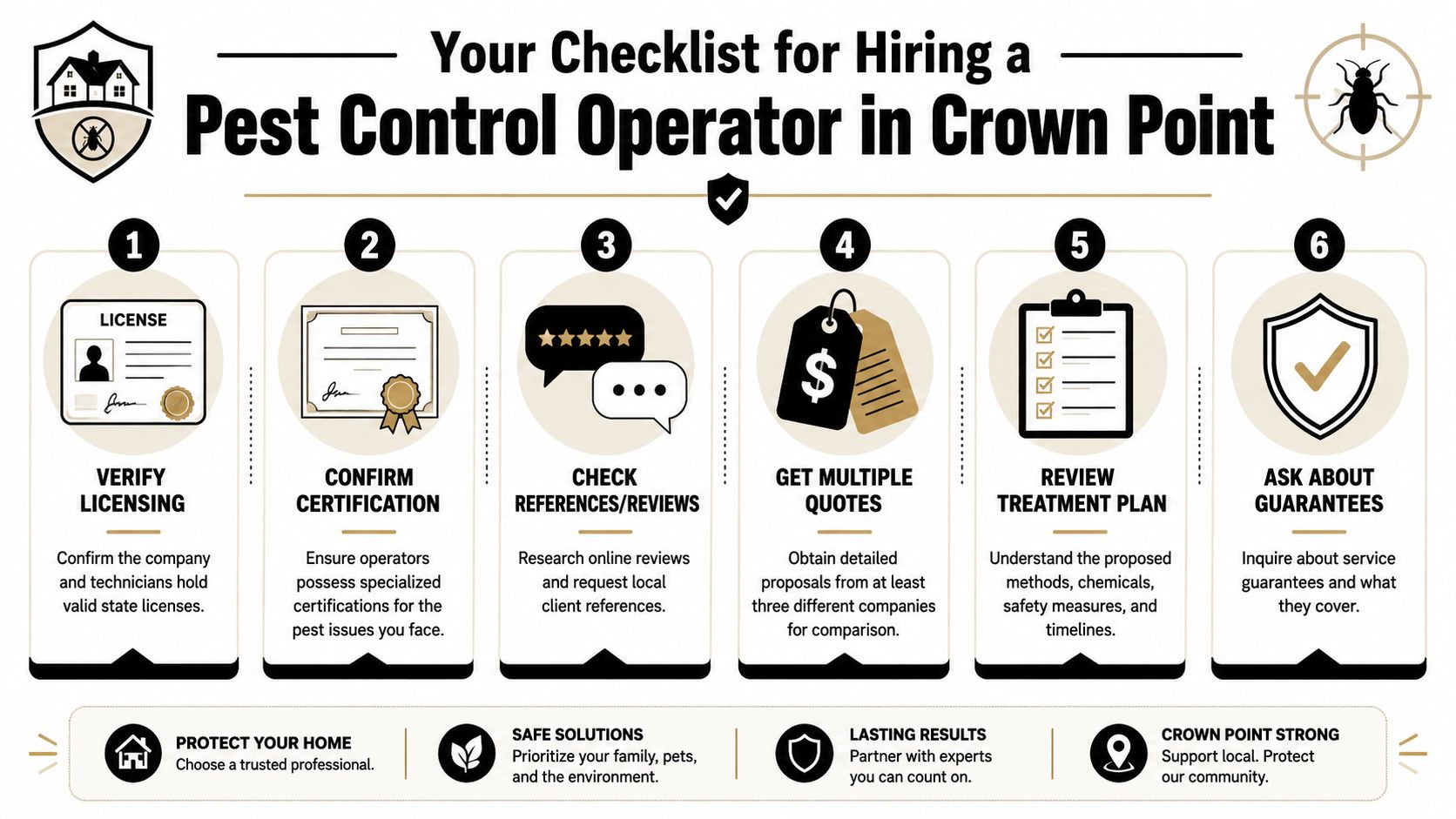
Use this checklist when speaking with any exterminator in Crown Point, IN.
- Ask for licensing information. A legitimate company should be able to provide its state licensing details without hesitation. If someone gets evasive, that's a warning sign.
- Confirm certification for the type of work you need. General pest service, termite work, mosquito programs, and specialty treatments may involve different responsibilities and qualifications.
- Ask who supervises the service work. If a technician is coming out, find out who the certified operator or responsible manager is.
- Request proof of insurance. Pest control is regulated work performed on your property. Insurance is part of basic professionalism.
- Read local reviews carefully. Look for comments about communication, follow-through, punctuality, and whether the company solved the issue instead of repeating the same treatment.
What a professional consultation should look like
A quality inspection usually leads to a better result than a fast quote over the phone.
Watch for these signs:
| Good sign | Why it matters |
|---|---|
| The inspector asks where activity started | Helps establish pattern, severity, and likely source |
| They check inside and outside | Most pest issues connect to exterior conditions |
| They explain the pest clearly | Good service starts with correct identification |
| They describe prep and follow-up | Professional work includes expectations and next steps |
| They put the plan in writing | Clear scope protects both homeowner and company |
A weak consultation often skips inspection details and jumps straight to pricing. That may feel convenient, but it usually means the plan is generic.
Smart questions that protect you
Ask direct questions and listen to how specific the answers are.
- What exactly are you treating for
- Where will treatment be applied
- What do I need to do before or after service
- How do you handle children, pets, and sensitive areas
- What happens if activity continues after the first visit
For owners of rental property or commercial sites, it's also worth understanding the insurance side of operations. This resource on protecting your Tennessee pest control operations is focused on another state, but it gives a useful picture of why insurance and operational safeguards matter in the pest control industry.
Cheap service can be expensive if it leads to repeat infestations, unclear liability, or treatments that don't match the pest.
The best company to hire is usually the one that inspects carefully, documents clearly, and doesn't rush you past the questions.
The Green Advantage Experience Your Local Certified Solution
Homeowners in Crown Point don't need more jargon. They need a company that shows up, knows the difference between a surface issue and a structural one, and treats the property with care.
That's where a local, licensed team stands out. A company rooted in Northwest Indiana understands the seasonal rhythm here. Spring ant activity, summer mosquito complaints, fall rodent pressure, overwintering insects, and the outdoor conditions that drive pests toward homes and businesses. Local knowledge changes how inspections are done and how prevention plans are built.
Prevention-first service matters more now
Public health organizations have warned that mosquito-borne disease risk is expanding as warmer conditions and invasive mosquitoes affect more places. That's why modern pest management has shifted toward inspection, habitat modification, and targeted prevention-first programs instead of simple blanket chemical use.
For homeowners, that means better service should include looking for standing water, dense resting sites, drainage trouble, clogged areas, and yard conditions that support mosquito activity. The same prevention-first mindset helps with ants, rodents, and many recurring perimeter pests.
What good local service should feel like
The experience should be straightforward from the first phone call.
You should be able to talk with knowledgeable staff, get answers without runaround, and schedule an inspection that looks at the actual site conditions. The technician should explain what's happening in plain English, whether that's ant control, spider control, rodent control, mosquito control, termite control, or wasp removal. From there, the treatment plan should match the property instead of forcing the property into a canned plan.
For homeowners comparing providers, this page on why you should choose The Green Advantage for your pest control needs gives a clear picture of what that local service model looks like in practice.
When you hire certified professionals, you're not just paying for a treatment. You're paying for judgment, compliance, safer handling, and a better chance of fixing the problem correctly the first time.
If you're looking for pest control in Crown Point, IN, or searching for a dependable exterminator near me, contact The Green Advantage. Their licensed, certified team serves Crown Point and nearby Northwest Indiana communities with thoughtful inspections, effective treatment plans, and homeowner-focused service that puts safety and long-term prevention first.