
A 2022 survey of 140 vector-borne disease professionals found that 97.6% of respondents who could comment said their jurisdiction did at least one form of tick surveillance, while fewer than half reported routine active surveillance and nearly two-thirds reported passive surveillance, which tells you tick control starts with knowing where ticks are instead of spraying blindly (survey findings on U.S. tick surveillance). If you're finding multiple ticks on pets, seeing them after yard work, or living beside woods, brush, or unmanaged edges in Crown Point, it's time to call for professional tick control.
You want to enjoy your yard without second-guessing every step through the grass. That could mean kids playing near the fence line, the dog cutting through shrubs, or friends staying outside after dinner instead of heading in early because everyone is checking ankles and socks.
In Northwest Indiana, that concern usually starts the same way. Someone finds a tick after mowing, a pet comes inside with one attached, or a family realizes the problem seems worst near the back edge of the property where lawn meets trees and leaf litter. That's the point where basic prevention may not be enough.
Enjoy Your Crown Point Yard Without the Worry of Ticks
A lot of homeowners in Crown Point call about ticks after a simple moment changes how they feel about their own yard. The family barbecue is still on. The patio looks great. Then somebody spots a tick crawling on a pant leg, or the dog needs another check before coming inside. The space is still beautiful, but it doesn't feel relaxing anymore.
That shift matters because people don't hire tick control just to remove a nuisance. They want to use their property again without worrying every time kids play near shrubs, a pet cuts along the fence, or someone walks out to the woodpile.

What homeowners notice first
Most yards with tick pressure don't look neglected. In Crown Point and the surrounding Northwest Indiana area, the problem often shows up on otherwise well-kept properties with a few risk features:
- Wooded borders: Lawn that backs up to trees, drainage areas, or brush holds more shade and moisture.
- Yard clutter: Leaf litter, ornamental beds, stacked firewood, and overgrown edges give ticks cover.
- Pet traffic: Dogs often pick up ticks first because they move through perimeter areas people don't pay attention to.
- Wildlife movement: Deer and other animals travel the same edges and carry ticks back into the property.
Ticks don't use a yard evenly. They collect where cover, moisture, and hosts come together.
A good tick service starts by identifying those pressure points. It doesn't start with treating every square foot the same way.
When the problem needs more than maintenance
Homeowners can do a lot with mowing, cleanup, and pet checks. But if you're seeing recurring activity, especially near the same edge zones, that's usually a sign the population is tied to habitat around the property. In those cases, the right answer isn't more guesswork. It's a focused inspection and a treatment plan built around where ticks survive.
Why Ticks Are a Growing Concern in Northwest Indiana
Ticks aren't just a problem in a few isolated pockets anymore. The CDC says that by 2025 the lone star tick is estimated to be widely distributed in the Northeast, South, and Midwest United States, with established populations across a broad multi-state range. The CDC also identifies the lone star tick as a particularly aggressive human biter and notes that nymphs and adult females most frequently bite humans and spread disease (CDC lone star tick surveillance overview).
That matters in Crown Point because our area has many of the environmental characteristics that support tick activity. Neighborhoods near wooded lots, park edges, creek corridors, and unmanaged vegetation create the kind of transition zones where ticks persist. Even a tidy property can have a problem if the back line stays shaded, humid, and connected to nearby habitat.
Why local yards create risk
Ticks do well where lawn meets cover. In Northwest Indiana, that often means the strip behind the shed, the mulch bed along the fence, the brushy side yard, or the rear lot line that blends into trees. Homeowners often assume the open lawn is the issue because that's where people walk. In practice, the pressure usually starts at the margins and moves inward through pets, wildlife, and foot traffic.
A second issue is visibility. Ticks don't announce themselves the way wasps, ants, or rodents do. Families may have activity on the property for a while before they connect it to a recurring pet issue or a bite after yard work.
Why this isn't just a rural problem
Suburban properties get hit too, especially where development sits close to natural areas. Larger lots, privacy plantings, and decorative beds can all create pockets of shade and moisture. That's one reason homeowners searching for tick control near me often aren't dealing with a wild property. They're dealing with a normal residential yard with a few high-risk features.
If you've already had concerns about species identification or disease questions, it helps to understand brown dog tick disease and related risks so you can separate general worry from the conditions that require service.
DIY Prevention vs Professional Tick Control Services
A lot of Crown Point homeowners do the right basic maintenance and still end up finding ticks on a dog, on pant legs, or near the back edge of the yard. That usually happens because routine upkeep lowers risk, but it does not always stop tick activity coming from shaded borders, pet routes, and wildlife travel corridors common across Northwest Indiana.
What DIY does well
DIY prevention has real value. It reduces the conditions ticks prefer and makes service more effective when professional treatment is needed later.
Good homeowner prevention usually includes:
- Keep turf trimmed: Short grass is less favorable than damp, overgrown cover.
- Clear leaf litter: Debris along edges, beds, and under shrubs holds moisture where ticks last longer.
- Check pets often: Dogs often pick up ticks first, especially after time near fence lines, beds, or wooded edges.
- Use repellents when needed: Personal protection helps during yard work, gardening, and time spent near brush or heavy vegetation.
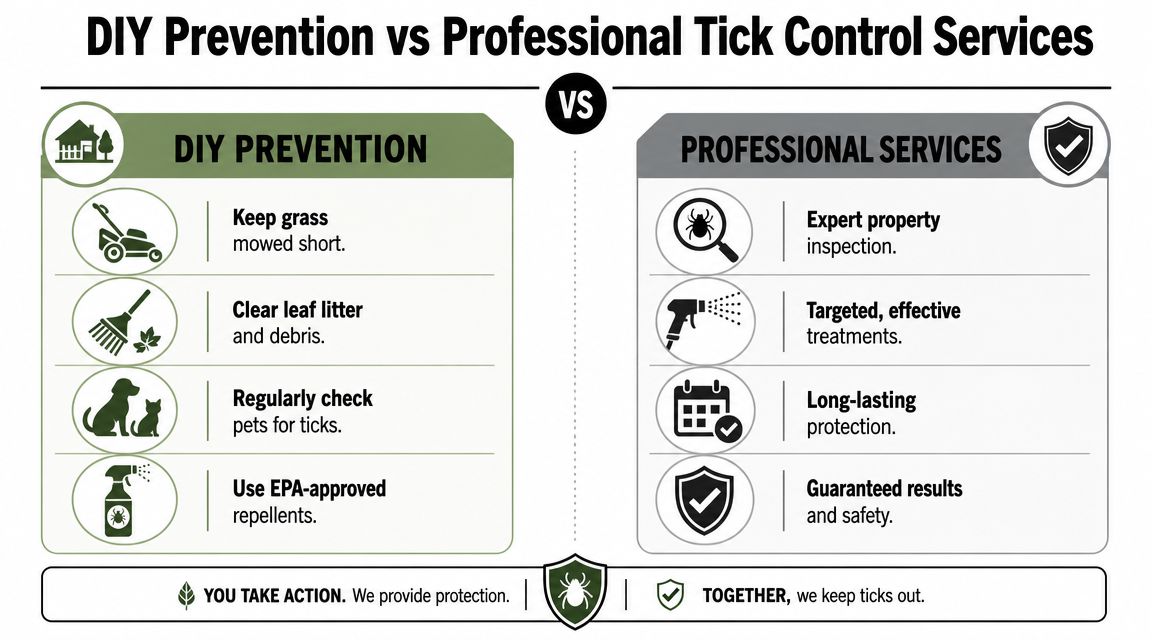
On lower-pressure properties, those steps may be enough to keep activity manageable for a while. On lots with tree lines, shaded bed edges, drainage swales, or neighboring natural cover, DIY work often slows the problem without fully suppressing it.
Where DIY starts to fall short
The biggest issue with store-bought tick control is coverage without strategy. Homeowners tend to focus on the open areas they see every day, while ticks hold in protected zones that stay cooler and more humid.
In Crown Point and nearby communities, those trouble spots are often the rear property line, the strip behind a shed, mulch along the fence, groundcover near ornamentals, or the side yard that stays shaded after rain. Treating every part of the yard the same way usually wastes material and misses the places where ticks persist.
That leads to a practical trade-off:
| Approach | Usually works for | Usually misses |
|---|---|---|
| Basic DIY cleanup | Lowering moisture and reducing hiding spots | Tick pressure coming from adjoining cover and repeated wildlife activity |
| Store-bought broad spray | Short-term treatment in obvious areas | Accurate placement, timing, and follow-up where ticks are most active |
| Professional service | Inspection, targeted applications, and season-long control planning | The routine trimming and cleanup the homeowner still needs to keep up |
A good professional service is not just a stronger version of DIY. It is a more precise one. The job is to inspect the property, identify where tick pressure is starting, and treat the zones that matter most instead of applying product everywhere.
Practical rule: If ticks keep showing up in the same part of the yard, the source is usually consistent habitat and host traffic, not random chance.
For homeowners weighing the difference between cleanup and targeted treatment, this guide to yard flea and tick control for residential properties can help clarify what a service plan should include beyond a one-time spray.
The Green Advantage Process What to Expect During Your Service
A good tick service visit should answer a simple question for a Crown Point homeowner: where are ticks likely coming from on this property, and what are we going to do about it?
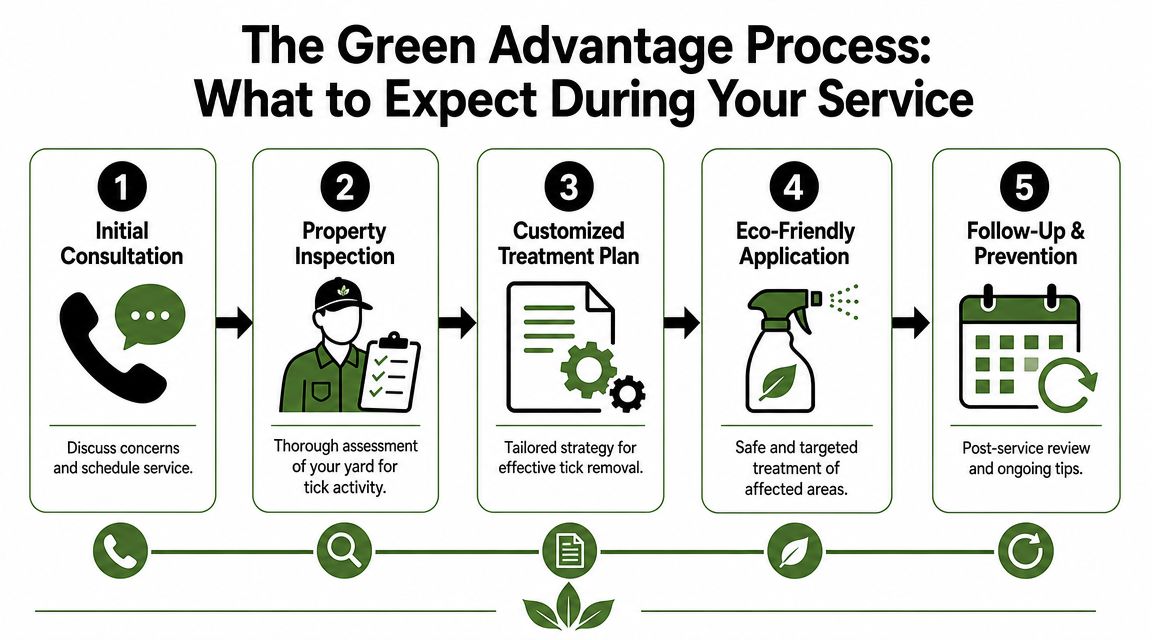
The visit starts with inspection, not guessing
The first step is a conversation on site. We want to know where ticks have been found, whether dogs cut the same route along the fence each day, which parts of the yard stay damp after a Northwest Indiana rain, and whether the property backs up to woods, drainage ground, or a brushy easement.
Then the inspection focuses on the places that hold moisture and host traffic. In Crown Point, that often means rear fence lines, shaded mulch beds, groundcover near ornamentals, wood lines, brush piles, and transitions where maintained lawn gives way to taller cover. Those edge zones matter because they are where people and pets usually brush against vegetation and pick ticks up.
A careful inspection also helps avoid treating low-risk areas that do not need it.
The treatment plan is built around the site and the season
Tick work in Northwest Indiana is not a one-size-fits-all service. A compact subdivision yard near open drainage ground has different pressure than a larger lot with mature trees and deer movement along the back edge. The treatment plan should reflect that difference.
Timing matters too. Guidance from the Indiana Department of Health on tick prevention and habitat reduction supports the same practical approach we use in the field: reduce contact in shaded edge habitat, manage the yard conditions ticks favor, and stay alert during the parts of the season when local activity rises. In Crown Point and nearby communities, that usually means paying close attention through spring, early summer, and again during the fall shoulder season when yards are still in use.
Good tick work focuses on the edges, the shade, and the travel paths. That is where pressure builds on real properties in our area.
For homeowners who want one local option, The Green Advantage provides residential pest control and outdoor pest services in Crown Point and Northwest Indiana with site-specific inspections and treatment recommendations.
A helpful part of any service is setting expectations. This short video gives a broader look at how pest professionals approach property treatment and prevention.
Follow-up matters more than most people expect
One visit can reduce active pressure, but lasting control usually depends on what happens after that first treatment. Nearby habitat, wildlife movement, heavy irrigation, and fast summer growth can all rebuild favorable conditions if nobody is watching the property over time.
That is why a serious service includes follow-up and clear homeowner guidance. You should know when treated areas are safe to reenter, what cleanup steps will support the work, and which spots need extra attention between visits. On some properties, the trade-off is straightforward. More frequent monitoring gives better control along difficult edges, while lighter service may be enough for a yard with limited shade and fewer habitat pockets.
The goal is a yard that is being managed on purpose, not sprayed on a generic schedule.
Protecting Your Health Property and Peace of Mind
A Crown Point yard should feel like part of the home, not a place where you second-guess every trip to the swing set, fire pit, or fence line. Tick control helps reduce that stress by lowering contact in the areas where ticks are most likely to wait for people and pets.
That matters because the risk is not only about comfort. Ticks in Northwest Indiana can carry diseases that affect people and animals, and the Indiana Department of Health advises prevention steps such as avoiding tick habitat, checking for ticks after time outdoors, and reducing exposure around the home (Indiana Department of Health Lyme disease guidance).
What tick service really gives you
Good tick service changes how a property functions day to day.
- More confidence outdoors: Family members, visitors, and pets can spend time outside with less concern about brushy edges and shaded transition zones.
- Usable space again: Backyards feel more practical when play areas, patios, and dog paths are not bordered by untreated harborage.
- A clearer risk-reduction plan: Instead of guessing whether activity started in your yard or came in from a neighboring lot, you know the pressure points are being addressed on purpose.
The trade-off is important to understand. Professional service lowers tick pressure, but no responsible company should promise zero ticks or zero disease risk. In Crown Point and across Northwest Indiana, deer movement, mice, wooded borders, and adjoining untreated properties can keep introducing new ticks. Strong control means reducing exposure as much as possible and staying ahead of the conditions that support them.
The practical goal is a yard with lower tick activity, fewer pickup points, and a plan that fits the way your property is actually used.
Why whole-property pest care often makes sense
Ticks often show up in the same parts of the yard that support other outdoor pest problems. Moist shade behind shrubs, leaf buildup along fences, clutter near sheds, and overgrown edges can also contribute to mosquito resting sites and general pest activity.
For many homeowners in our area, treating the property as a whole gets a better result than looking at ticks by themselves. That does not mean every yard needs every service. It means the inspection should account for how the lot drains, how much tree cover it has, where pets travel, and what borders the property. In Crown Point neighborhoods with mature trees, drainage swales, and wooded edges, that local context makes a real difference.
Your Checklist for Tick Control Service in Crown Point
A good tick program starts with good questions. In Crown Point, that matters because one yard may back up to a drainage swale or wooded edge, while the next sits in full sun with far less tick pressure. The right provider should be able to explain that difference and show how it changes the service plan.
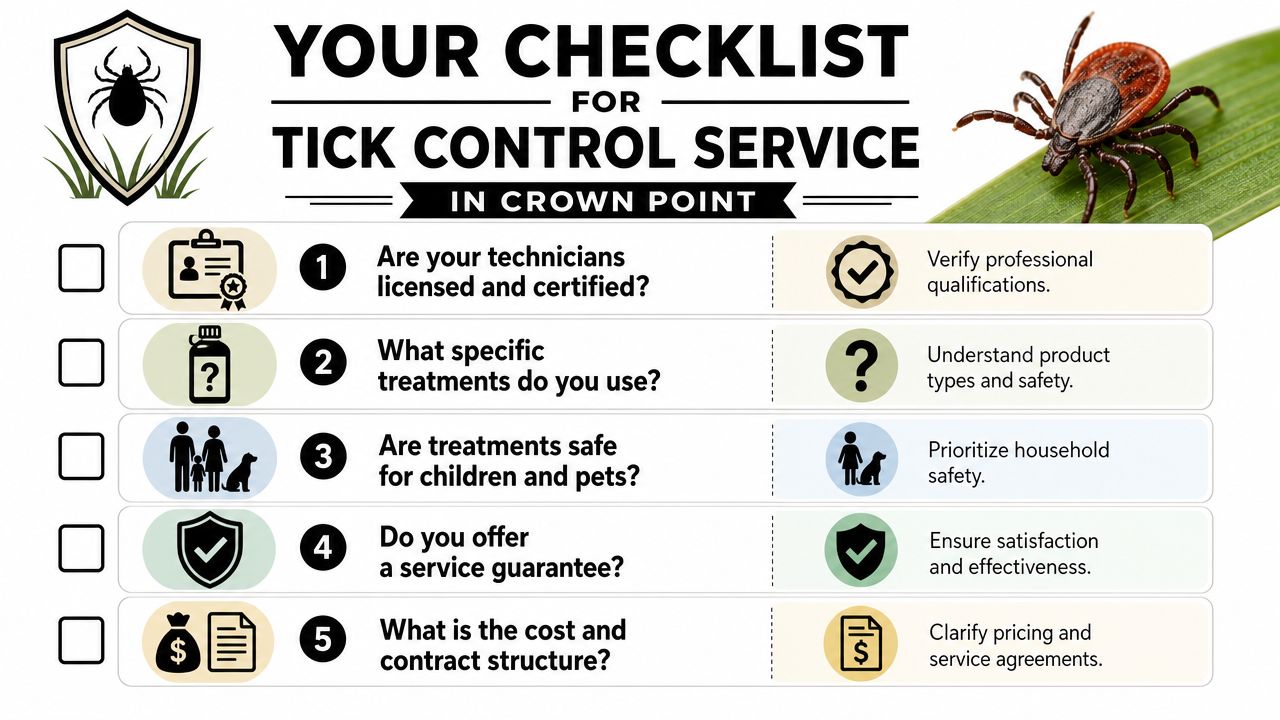
Questions worth asking before you book
Use this checklist when you're getting quotes for tick control in Crown Point:
- Ask about licensing: Make sure the technicians are properly licensed for pesticide application in Indiana.
- Ask what gets treated: A good company should explain whether it targets fence lines, bed edges, wooded borders, shrubs, and other high-risk areas where ticks tend to hold.
- Ask about family and pet guidance: You should get clear instructions for before and after treatment, including when the yard can be used again.
- Ask whether follow-up is included: Tick control usually works better as an ongoing plan than a single visit, especially during active season in Northwest Indiana.
- Ask how pricing is structured: Cost usually depends on property size, habitat complexity, level of activity, and service frequency.
What a strong answer sounds like
Specifics matter. A useful answer sounds like this: we inspect the property first, identify shaded edge habitat, point out cleanup or trimming that will reduce tick harborage, treat the areas where ticks are most likely to quest, and set a follow-up schedule based on the conditions on your lot.
That level of detail is important in our area. Crown Point properties often have the exact features that keep ticks active longer, including mature trees, leaf litter, heavy foundation plantings, fence lines, and neighboring untreated ground. A company that treats every yard the same will miss those pressure points.
Look past the first visit price. Ask whether the company understands why ticks are showing up on your property and whether the plan fits how your family uses the yard. That usually tells you more than a low quote ever will.
If you're in Crown Point or nearby Northwest Indiana and want a clear plan for tick control, contact The Green Advantage. We'll answer your questions, review the conditions on your property, and help you decide whether a targeted treatment program makes sense for your yard, pets, and outdoor routine.